Context-Aware Intelligent User Interfaces
for Supporting System Use
Vom Fachbereich Informatik der Technischen Universität Darmstadt
genehmigte Dissertation
zur Erlangung des akademischen Grades Dr.-Ing. von
Dipl.-Inform. Melanie Hartmann geboren in Seeheim-Jugenheim
Referenten: Prof. Dr. Max Mühlhäuser (TU Darmstadt) Prof. Dr. Rainer Malaka (Universität Bremen) Tag der Einreichung: 4. Dezember 2009
Tag der mündlichen Prüfung: 18. Januar 2010
Darmstadt 2010 Hochschulkennziffer D17
i
Ehrenwörtliche Erklärung
1Hiermit erkläre ich, die vorgelegte Arbeit zur Erlangung des akademischen Grades “Dr.-Ing.” mit dem Titel “Context-Aware Intelligent User Interfaces for Support-ing System Use” selbständig und ausschließlich unter Verwendung der angegebenen Hilfsmittel erstellt zu haben. Ich habe bisher noch keinen Promotionsversuch unter-nommen.
Darmstadt, den 4. Dezember 2009
Melanie Hartmann
Abstract
Two trends can be observed in current applications: the amount of functionality of-fered is constantly increasing and applications are more often used in mobile settings. Both trends often lead to a decrease in the usability of applications. This effect can be countered by Intelligent User Interfaces that facilitate the interaction between user and application. In order to support the user in an optimal way, the Intelligent User Interface has to be aware of the user’s needs and adapt the provided support to her current situation, i.e. her current context. The relevant context information can thereby be gathered from the environment (e.g. her current location) or from sophisticated user models that reflect the user’s behavior.
In this thesis, we present a novel approach of combining user and environmental context information for supporting the system use. As context information is often very error-prone and the user‘s workflow should not be disrupted by erroneous in-teraction support, we adapt the presentation of the support to the reliability of the context information. Therefore, we use different levels of proactivity from unobtru-sive highlighting to automatically performing tasks. The presented approach –called AUGUR– is application independent and is able to support the interaction for arbi-trary existing applications, even across application boundaries. For that purpose, we developed a novel application modeling language that is able to model applications and their relationships to context. The application models can thereby be defined by the application developer, learned by AUGUR, and augmented by the end-user.
The interaction can be facilitated by an Intelligent User Interface in two different ways: on the one hand by supporting the entering of data and on the other hand by simplifying the navigation within and between applications. For supporting the user inentering data, we contribute three approaches based on (i) the user’s previous interactions, (ii) the information represented in the application models, and (iii) the semantics of the data required by the user interface and the context information currently relevant for the user. For the latter, we developed a novel algorithm that combines string-based and semantic similarity measures.
AUGUR supports the user’snavigationin three different ways: It can (i) guide the user through an application, (ii) provide navigation shortcuts to other applications, and (iii) reduce the user interface to the most relevant functionality for mobile use.
For guiding the user, we developed a novel algorithm called FxL that is able to predict the next relevant interaction element. For the interface adaptation, we introduce a novel approach based on FxL to determine the elements that should be presented to the user for mobile use according to her current situation.
We realized the developed concepts of AUGUR in a working prototype. Further, we evaluated the usability of the context-aware support provided by AUGUR in a user study, and showed that it can significantly increase the usability of an application.
Zusammenfassung
Heutige Anwendungen werden zum einen immer komplexer und zum anderen zu-nehmend auf mobilen Endgeräten verwendet. Beide Faktoren beeinträchtigen häufig die Gebrauchstauglichkeit der Anwendungen. Intelligente Benutzungsschnittstellen wirken dem entgegen indem sie den Benutzer bei der Interaktion mit einer Anwen-dung unterstützen. Um die optimale Unterstützung bieten zu können, muss sich die intelligente Benutzungsschnittstelle an die Bedürfnisse des Benutzers und an seine aktuelle Situation, d.h. seinen Kontext, anpassen. Kontextinformationen können dabei aus der Umgebung des Benutzers gewonnen werden (z.B. sein aktueller Aufen-thaltsort) oder aus Benutzermodellen, die das Verhalten des Benutzers widerspiegeln. In dieser Arbeit präsentieren wir einen neuen Ansatz zur kontextsensitiven In-teraktionsunterstützung, der sowohl den Umgebungs- als auch den Benutzerkontext berücksichtigt. Da Kontextinformationen häufig fehlerbehaftet sind und der Ar-beitsfluss des Benutzers nicht mit fehlerhafter Unterstützung gestört werden soll, müssen wir die Zuverlässigkeit der genutzten Kontextdaten bei der Interaktionsun-terstützung berücksichtigen. Daher passen wir die Darstellung der Interaktionsunter-stützung an die Zuverlässigkeit der zugrunde liegenden Daten an. Die Darstellung reicht von unaufdringlichem Hervorheben relevanter Elemente bis zur automatis-chen Ausführung von Anwendungsschritten. Der vorgestellte Ansatz zur kontextab-hängigem Interaktionsunterstützung, genannt AUGUR, ist anwendungsunabhängig und kann den Benutzer auch über Anwendungsgrenzen hinweg unterstützen. Dies wird durch eine neue Anwendungsmodelierungssprache ermöglicht, die uns erlaubt, Anwendungen und ihren Zusammenhang zu Kontextinformationen zu modellieren. Die Anwendungsmodelle können dabei vom Anwendungsentwickler erstellt werden oder von AUGUR erlernt werden. Zusätzlich können sie jederzeit vom Endbenutzer überprüft und erweitert werden.
Wir konzentrieren uns in der vorliegenden Arbeit auf die Unterstützung des Be-nutzers bei der Dateneingabe und bei der Navigation in und zwischen Anwendun-gen. Zur Unterstützung bei der Dateneingabe verwenden wir folgende Informa-tionsquellen: (i) die bisherigen Interaktionen des Benutzers, (ii) das zugehörige An-wendungsmodell und (iii) die Semantik der von der Anwendung benötigten Daten und des aktuellen Kontexts des Benutzers. Für Letzteres haben wir einen neuen
Al-gorithmus entwickelt, der zeichenfolgenbasierte und semantische Ähnlichkeitsmasse kombiniert und neue Zusammenhänge erlernt.
Die Navigation des Benutzers wird von AUGUR auf drei verschiedene Arten unterstützt: AUGUR kann (i) den Benutzer durch eine Anwendung führen, (ii) Nav-igationsshortcuts zu anderen Anwendungen vorschlagen und (iii) automatisch eine reduzierte Version der Anwendungsoberfläche für mobile Benutzung generieren. Um den Benutzer durch eine Anwendung zu führen, haben wir einen neuen Algorithmus namens FxL entwickelt, der in der Lage ist, das nächste relevante Interaktionsele-ment auf Basis der bisherigen Interaktionen vorherzusagen. Für die Generierung der reduzierten Benutzungsoberfläche stellen wir einen neuen Algorithmus basierend auf FxL vor, der die Interaktionselemente bestimmen kann, die idealerweise dem Benutzer angezeigt werden sollten.
Die entwickelten Konzepte wurden in einem Prototyp umgesetzt und getestet. Darüberhinaus haben wir die Gebrauchstauglichkeit der kontextabhängigen Inter-aktionsunterstützung in AUGUR in einer Benutzerstudie überprüft. Wir konnten zeigen, dass eine solche Unterstützung die Gebrauchstauglichkeit einer Anwendung signifikant erhöhen kann.
Acknowledgments
This work would not have been possible without the continuous support and encour-agement of my colleagues, family and friends over the last years, which I would like to acknowledge here.
First and foremost, I would like to thank my advisor, Max Mühlhäuser, for his unlimited support, excellent advice and faith in my work. I am also grateful to Rainer Malaka (Universität Bremen) for acting as second referee.
I am grateful to all at Telecooperation and RBG for providing me with a friendly and supportive place to work. Especially, I would like to thank Daniel Schreiber for all the fruitful discussions and support (It is really a pleasure working with you). I am also grateful to all the other members in the Telecooperation Group who proof-read papers and provided feedback (Andreas Behring, Dirk Schnelle-Walka, Felix Flentge, Tobias Klug, Sebastian Ries, Jürgen Steimle to name only few of them).
I would also like to thank Manuel Görtz and Andreas Faatz from SAP research for their support in the AUGUR project and all the others from SAP we cooperated with. Furthermore, I would also like to acknowledge Holger Ziekow (HU Berlin), Dominikus Heckmann (DFKI), Frederik Janssen (TUD), Anthony Jameson (DFKI), and Christine Müller (Jacobs University Bremen) for their advice. Many thanks are also due to Marcus Ständer, Matthias Beckerle and Markus Miche for their support and for continuously supplying me with chocolate.
I am highly grateful to my brother and parents for their support and patience during the course of this work. Finally, many thanks are due to Torsten Zesch for his unlimited support and for standing all the stressful time with me when finishing the thesis.
Contents
1. Introduction 1 1.1. AUGUR . . . 4 1.2. Main Contributions . . . 6 1.3. Publication Record . . . 7 1.4. Thesis Outline . . . 72. Basics and Requirements 11 2.1. Context . . . 11
2.1.1. Definition . . . 12
2.1.2. Categories of Context . . . 14
2.1.3. Difficulties in Using Context . . . 15
2.2. Intelligent User Interfaces . . . 16
2.2.1. Definition and Models . . . 16
2.2.2. Classification of IUIs . . . 17
2.2.3. Classification of Personal Assistants . . . 19
2.2.4. Classification of Interface Adaptations . . . 20
2.2.5. Summary . . . 20
2.3. Requirements for Context-Aware IUIs . . . 21
2.3.1. Challenges in Developing IUIs . . . 21
2.3.2. Requirements for Using Context in IUIs . . . 25
2.4. Chapter Summary . . . 26
3. State of the art 27 3.1. Classification of Personal Assistants . . . 27
3.2. Knowledge-based Personal Assistants . . . 28
3.3. End-user Programmed Personal Assistants . . . 31
3.4. Learning Personal Assistants . . . 31
3.5. Chapter Summary . . . 34
4. High-Level Design 35 4.1. Conceptual Building Blocks . . . 35
4.2. Models in the Knowledge Base . . . 38 4.2.1. Context Model . . . 38 4.2.2. User Model . . . 39 4.2.3. Application Model . . . 40 4.3. Interaction Support . . . 40 4.3.1. Content Support . . . 41 4.3.2. Guidance . . . 42 4.3.3. Navigation Shortcuts . . . 43 4.3.4. Interface Adaptation . . . 43 4.4. Representing Support . . . 43 4.5. Scenarios . . . 45 4.6. Chapter Summary . . . 46 5. Implementation 47 5.1. Interaction Support . . . 48 5.1.1. Content Support . . . 48
5.1.2. Navigation Support - Guidance . . . 50
5.1.3. Navigation Support - Navigation Shortcuts . . . 50
5.1.4. Interface Adaptation . . . 51 5.2. Controlling AUGUR . . . 52 5.3. Architecture . . . 54 5.3.1. Support Tier . . . 56 5.3.2. Knowledge Base . . . 57 5.3.3. Editors . . . 58 5.4. Chapter Summary . . . 58 6. Knowledge Models 59 6.1. Context Model . . . 59 6.1.1. Current Context . . . 61 6.2. User Model . . . 66 6.2.1. Usage Model . . . 66 6.3. Application Model . . . 67
6.3.1. Requirements for Application Modeling Language . . . 68
6.3.2. Existing Application Modeling Languages . . . 68
6.3.3. ATML: ApplicaTion Modeling Language . . . 69
6.3.4. LabelFinder: Recognizing Labels . . . 76
6.3.5. Visualization in the AUGUR Prototype . . . 79
6.3.6. Summary . . . 81
6.4. Chapter Summary . . . 81
7. Content Support 83 7.1. Confidence in Content Support . . . 83
Contents xi
7.3. Content Support based on Semantics . . . 86
7.3.1. Requirements . . . 86
7.3.2. Related work . . . 87
7.3.3. Representing UI and Context Objects . . . 88
7.3.4. Mapping textual representations . . . 89
7.3.5. Measuring the Relevance of a Context Object . . . 93
7.3.6. Confidence in Content Support based on Semantics . . . 93
7.3.7. Evaluation. . . 94
7.3.8. Summary . . . 100
7.4. Content Support based on Modeled Relations . . . 102
7.4.1. Relations in AUGUR . . . 102
7.4.2. Learning Direct Relations . . . 103
7.4.3. Learning Rules . . . 104
7.4.4. Computing Content Support based on Relations . . . 110
7.4.5. Confidence in Content Support based on Relations . . . 112
7.4.6. Summary . . . 113 7.5. Chapter Summary . . . 113 8. Navigation Support 115 8.1. Guidance . . . 115 8.1.1. Sequence Prediction . . . 116 8.1.2. Existing Algorithms . . . 117 8.1.3. FxL . . . 119 8.1.4. Confidence in Guidance . . . 120
8.1.5. Evaluating Sequence Prediction Algorithms . . . 120
8.1.6. Evaluation. . . 122
8.1.7. Summary . . . 127
8.2. Navigation Shortcuts . . . 128
8.2.1. Learning Navigation Shortcuts . . . 128
8.2.2. Confidence in Navigation Shortcuts . . . 129
8.2.3. Summary . . . 129 8.3. Interface Adaptation . . . 130 8.3.1. Requirements . . . 130 8.3.2. Related Work . . . 131 8.3.3. Adaptation Process . . . 134 8.3.4. FxL*: Prediction Algorithm . . . 135 8.3.5. Evaluation. . . 137 8.3.6. Summary . . . 140 8.4. Chapter Summary . . . 140 9. User Study 143 9.1. Experiment . . . 143 9.1.1. Technical Setup . . . 147
9.2. Results . . . 147 9.2.1. Efficiency . . . 148 9.2.2. Effectiveness . . . 150 9.2.3. Satisfaction . . . 150 9.3. Chapter Summary . . . 152 10.Conclusion 153 10.1. Contributions . . . 153 10.2. Revisiting Challenges . . . 156 10.3. Outlook . . . 159 A. Appendix A 163 A.1. DTD for ATML. . . 163
A.2. Questionnaires of the User Study . . . 165
A.2.1. General Questionnaire . . . 165
A.2.2. Questionnaire regarding Support . . . 165
List of Figures 167 List of Figures 167 List of Tables 167 List of Tables 169 List of Algorithms 169 List of Algorithms 171 Bibliography 171 Bibliography 173
1
Introduction
Users of current applications face the problem of increasing interaction effort caused by two main reasons. Firstly, applications are becoming more and more feature-laden (as evidenced by Figure 1.1). Contrary to the intention, this increase in provided functionality often leads to a decrease in the usability of the application (Sikora and Swan, 1998). Secondly, applications are increasingly used in mobile or ubiquitous computing settings. However, the devices used in these settings usually have limited input and output capabilities. For example, a mobile phone only provides a small screen and few or only very small buttons. This leads to increased effort which hampers the entering of data and reduces the amount of information that can be
Figure 1.1. Number of top-level menu items in Microsoft Word, by release (adapted from http://blogs.msdn.com/jensenh/archive/2005/10/24/
conveyed to the user. Furthermore, mobility often leads to limited attention of the user (Satyanarayanan,2001). Users cannot always direct their full attention towards the application, as this might be socially unacceptable (e.g. in a restaurant), or even dangerous (e.g. while crossing a busy street). These problems can be countered with
Intelligent User Interfaces which support the user in performing her tasks.
Intelligent User Interfaces Intelligent user interfaces try to improve the efficiency, effectiveness, and naturalness of human computer interaction by applying artificial intelligence techniques. In this thesis, we focus on Intelligent User Interfaces that support the user (i) in entering data (Content Support) and (ii) in navigating within and between applications (Navigation Support).
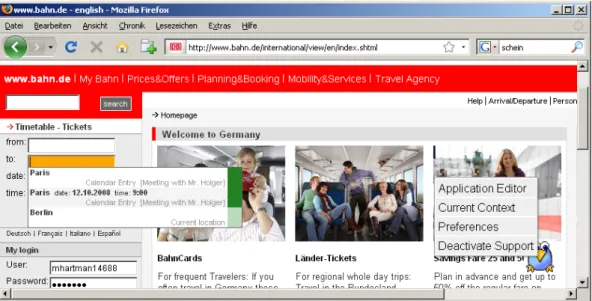
Content support assists the user by suggesting data to be entered in input elements. For example, if an address needs to be filled in an input element, the input element could be linked to the user’s address database. Whenever the user clicks in the input element, a list of addresses is presented to her from which she can choose the correct one instead of having to type the address herself.
Navigation support guides the user through an application or provides explanations about its functionality. For example, an Intelligent User Interface could highlight the interaction element (e.g. a button or a link) that needs to be activated to finish the current task. Another type of navigation support is to adapt the user interface to facilitate access to the most relevant functionality and information. This helps the user to cope with the increasing amount of features, to focus on the relevant information, and to reduce the required effort, i.e. the required interaction costs. For example, on a mobile device, the number of interaction elements presented to the user should be reduced to the most relevant ones.
The amount of content or navigation support that should be provided by an Intel-ligent User Interface strongly depends on the specific needs of a user. For example, a novice user needs more assistance and a simpler interface than an expert user who needs access to more advanced functionality.
Some tasks involve interaction with several applications, e.g. booking a trip often involves looking up train connections, booking a hotel, etc. In order to provide content and navigation support for those tasks, an Intelligent User Interface should be able to operate with a variety of different applications, i.e. it should be application-independent, and also offer support across application boundaries.
Context-Aware Support The user’s current needs are influenced by the context in which the user performs a task. For example, a user usually performs different tasks at home than in the office. Thus, Intelligent User Interfaces should be able to take the current context of the user (e.g. her location) into account, i.e. they should be
context-aware. This ensures that the interaction support can be better adapted to the user’s needs.
We refer to all information as context that can be used as auxiliary information for facilitating the interaction, i.e. information which is not required for the normal
3 functionality. A formal definition of the term “context” is given in Chapter 2. We distinguish between two types of context: user context and environmental context. The user context contains all information describing the user, e.g. the individual working habits of a user, which are represented in the form of user models.
The environmental context comprises all information that cannot be described in a user model, but is related to the user’s current situation, e.g. the temperature of a room or the user’s current location.
However, context information is often error-prone and hence also the support that an Intelligent User Interface generates from this context information. For that reason, an Intelligent User Interface which uses context information needs to cope with the unreliable nature of context information. For example, it should not perform tasks automatically that rely on uncertain context information.
Application Knowledge In order to support the interaction with an application, an Intelligent User Interface needs knowledge about the application, i.e. which infor-mation is required and which inforinfor-mation is provided by an application. Depending on how this knowledge is acquired, we distinguish between three types of Intelligent User Interfaces (Maes, 1994): (i) knowledge-based, (ii) end-user programmed, and (iii) learning Intelligent User Interfaces.
Knowledge-based Intelligent User Interfaces rely on elaborate models for each ap-plication that provide reliable knowledge, but induce a huge modeling effort. This prevents the provision of support for yet unknown applications. Moreover, inter-action support provided by knowledge-based Intelligent User Interfaces cannot be adapted to the individual user’s needs, as it relies on predefined knowledge.
End-user programmed Intelligent User Interfaces rely on the end-user to model the required knowledge about the application. This allows the provision of user-adapted support, but involves a large effort for the end-user. Additionally, it requires the end-user to possess a good understanding of the Intelligent User Interface.
Learning Intelligent User Interfaces gather an application model from observing the user’s interaction with the application. Thus, they are able to provide user-adapted support and do not require any modeling effort. However, the user cannot be supported right from the first interaction, as it takes some time to learn a reli-able application model. Furthermore, learning Intelligent User Interfaces are usually limited to providing support for one specific application.
As each approach has specific advantages and disadvantages, the best support can be provided by combining the three approaches: An Intelligent User Interface should (i) use application models if they are provided along with the application, (ii) enable the end-user to easily modify the application models, and (iii) learn additional infor-mation from observing the user and thus enhance and adapt the application models over time.
We have seen that current applications face the problem of increasing interaction costs due to (i) an increasing number of features, and (ii) being used on mobile and
Figure 1.2. Conceptual building blocks of AUGUR
ubiquitous devices with limited interaction capabilities. The problem can be tackled with Intelligent User Interfaces providing content and navigation support. In order to support the user in an optimal way, Intelligent User Interfaces should take user context and environmental context into account, and should combine the three main approaches to acquire knowledge about the applications as described above. In the next section, we introduce a novel approach to Intelligent User Interfaces that considers all these conclusions.
1.1. AUGUR
In this thesis, we present a novel approach (called AUGUR) for using context infor-mation in Intelligent User Interfaces. In contrast to existing approaches, we consider the user context as well as the environmental context to provide content and navi-gation support. Our approach is able to adapt its support to the reliability of the context information. Furthermore, the provided support is not limited to a specific application, but is able to facilitate the interaction with different applications by using a proxy-based architecture. This means that all events evoked by the applica-tion and by the user are routed through AUGUR. This enables AUGUR to provide interaction support for existing applications without the need to modify them and to provide support even across application boundaries.
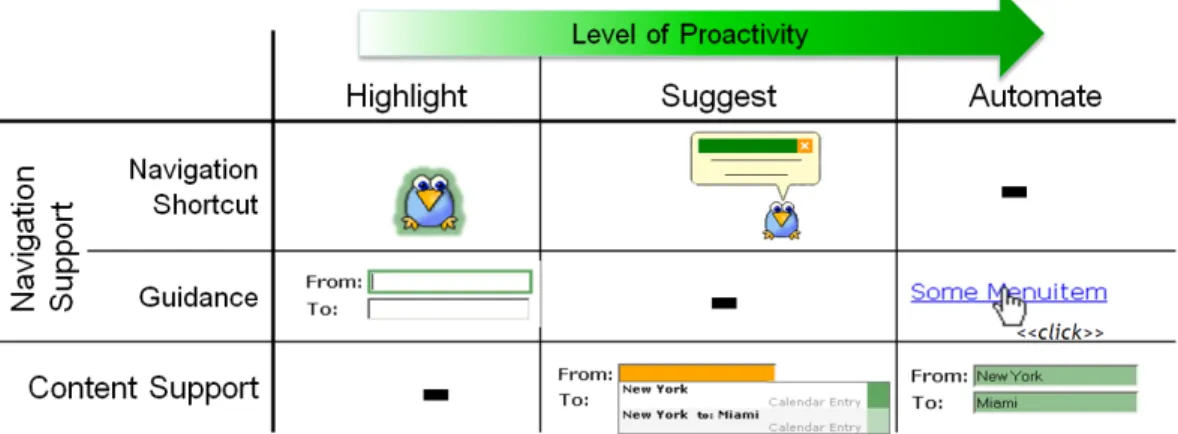
Figure1.2gives an overview of the main conceptual building blocks of AUGUR. It contains two main components: TheSupport Generator,which contains all algorithms for generating context-aware content and navigation support, and the Knowledge Base, which maintains all knowledge models required for that purpose. In this section, we briefly introduce the knowledge models used by AUGUR and describe how it provides content and navigation support.
1.1. AUGUR 5 Knowledge Models
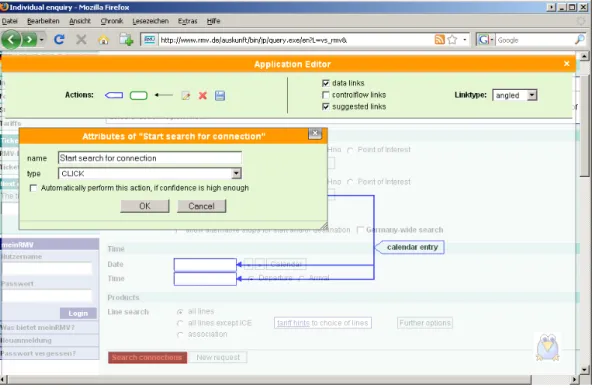
In order to provide context-aware content and navigation support which is adapted to the user’s needs, we at first require a model for the context and the user. The context model is able to keep track of all context information which is currently relevant for the user’s interactions. The user model contains information on how the user interacts with applications. Moreover, we need an application model which represents the relations between context elements and application elements. For that purpose, we developed a novel application modeling language called ATML. The ATML application models can be provided by the application developer ( knowledge-based approach), modified by the end-user (end-user programmed approach), and learned by AUGUR from observing the user’s interactions (learningapproach). Thus, AUGUR combines the three approaches for acquiring knowledge about applications discussed before.
Content Support
In order to facilitate the entering of information for the user, we can rely on a-priori modeled information about the applications and their relations to context information. However, these models are not able to reflect the usage patterns of an individual user. Thus, AUGUR observes the user’s interactions to learn how the user interacts with an application and adapts the application models accordingly. Besides providing content support based on these learned and modeled relations be-tween application elements and context information, AUGUR is able to generate content support based on the user’s previous interactions and based on the seman-tics of context and UI information. For the latter, AUGUR computes the semantic relatedness of the elements in the UI with the context information currently relevant for the user. AUGUR determines the best mapping between context elements and application elements using a combination of string-based and semantic similarity measures.
Navigation Support
AUGUR supports the user’s navigation in three different ways: (i) By guiding her through an application, (ii) by providing navigation shortcuts, and (iii) by reducing the user interface to the most relevant interaction elements. For guiding the user through an application, AUGUR highlights the next relevant interaction element in order to draw the user’s attention to it. This is especially useful for novice users or when navigating in large menu structures. For predicting the next relevant in-teraction element, we developed a sequence prediction algorithm called FxL. The predictions are based on models of the user’s interactions with an application. For novice users this model can be initiated with the data of an expert user to guide her right from the beginning.
Additionally, AUGUR is able to generate anadapted version of a user interface for mobile and ubiquitous use. For that purpose, it reduces the user interface to those
elements that are currently relevant for the user’s interactions. For predicting the most relevant interaction elements, we developed an algorithm called FxL*, which is based on the FxL algorithm. It is able to take the user’s current interactions as well as the device used into account.
Finally, AUGUR suggests shortcuts based on events triggered by an external con-text event (e.g. an incoming phone call) or by the user interface (e.g. when address information is presented). For example, if address information is contained in a user interface, the Intelligent User Interface can suggest a shortcut to a map application to look up the respective address.
1.2. Main Contributions
In this section, we give a brief summary of the main contributions of this thesis: • Overall Concept: We developed an overall concept for integrating context
information into Intelligent User Interfaces. In this concept, we take user con-text and environmental concon-text into account, and combine the three main approaches for building Intelligent User Interfaces (knowledge-based systems,
end-user programming,andlearning systems). Our approach is able to provide application-independent support across application boundaries, and to deter-mine which context information is currently relevant for the user’s interactions. In addition, we performed a user study to evaluate the effects of using context information in Intelligent User Interfaces on the usability of an application. • ApplicaTion Modeling Language (ATML): We developed a new language to
store relevant information about an application, e.g. about its interaction elements and about its relations to context. We also developed an editor for ATML to enable end-users with minimal technical experience to augment the application models.
• FxL Algorithm: We developed this sequence prediction algorithm in order to predict the next relevant interaction element in performing a task. FxL learns from observing the user’s interactions, and is thus able to provide user-adapted support. The algorithm is applied to guide the user through a user interface. Thus, it facilitates the use of an application and reduces the user’s cognitive load by drawing the user’s attention to the relevant interaction elements. • Interface Adaptation using FxL* Algorithm: We developed an augmented
ver-sion of the FxL algorithm that is able to predict which parts of the user interface are most relevant for the user in her current situation. Thus, it enables us to generate a reduced version of a user interface. Depending on the available screen size, we are able to generate a user-adapted version of the user interface of the application which is better suited for mobile usage and thus facilitates navigation.
1.3. Publication Record 7 • Semantic Mapping Algorithm: We tackled the problem of deciding which con-text elements should be suggested as input to the user by applying semantic similarity measures. For that purpose, we compare the textual descriptions available for the UI and context elements. This requires a reliable detection of the label of input elements. This is problematic for Web applications as the tag for marking labels in HTML is scarcely used in practice. For that reason, we developed an algorithm called LabelFinder which is able to identify the label from the actual visual representation of the user interface of a Web application. • AUGUR Prototype:We implemented all the developed concepts and algorithms for a context-aware Intelligent User Interface in a working prototype applicable to different (form-based) Web applications.
1.3. Publication Record
This thesis builds on a number of publications in peer-reviewed books, conferences, journals, and workshop proceedings. In the book chapter Hartmann and Austaller (2008), we give a general overview of context and its usage in context-aware appli-cations. In Hartmann(2009), we summarize the challenges which have to be faced when developing user-adaptive Intelligent User Interfaces.
The basic concepts of the context-aware Intelligent User Interface described in this thesis were first presented inHartmann et al. (2009). In this paper, we describe how context information can be used for content and navigation support. We also introduce the concept of a component for keeping track of all the context information currently relevant for the user’s interactions. In Mühlhäuser and Hartmann (2009), we contributed to the identification of problems arising when context information is used for interaction support. In this paper, we stress that the user context as well as the environmental context should be considered for that purpose. In Schreiber et al.(2007,2008), we report the results of a user study for evaluating the usability of applications which are enhanced with context-aware interaction support.
In Hartmann et al. (2007), we present the application model that we developed for specifying the relations between context and application. Improvements to the model are presented inHartmann and Schreiber (2009) and Hartmann et al.(2009). The FxL algorithm for guiding the user is presented in Hartmann and Schreiber (2007). Its extension for generating adapted user interfaces (called FxL*) is published in Hartmann et al. (2008a); Hartmann and Schreiber (2008) and Hartmann and Schreiber(2009). The semantic mapping algorithm for providing content support is described in Hartmann et al.(2008b) and Hartmann and Mühlhäuser (2009).
1.4. Thesis Outline
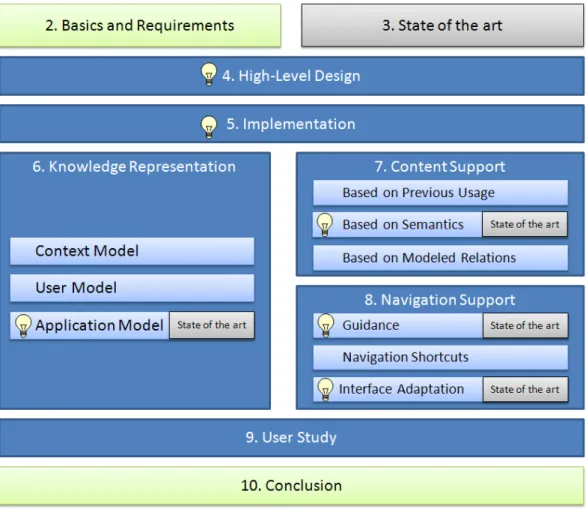
Figure1.3illustrates the overall structure of this thesis. The light bulbs thereby refer to the main contributions as listed in Section 1.2. In Chapter2, we define the most
Figure 1.3. Structure of this thesis
important concepts in this thesis –i.e. “context” and “Intelligent User Interfaces”–, and relate our approach to the different research areas subsumed under the term Intelligent User Interface. We also review challenges identified in literature for de-veloping Intelligent User Interfaces, and identify requirements that arise when using context information for supporting the user’s interaction. In Chapter 3, we give an overview of state-of-the-art Intelligent User Interfaces which are related to the ap-proach presented in this thesis, and analyze them with respect to the requirements identified in Chapter 2. However, we focus here only on related work considering complete Intelligent User Interface systems. The state of the art for the novel models and algorithms introduced in this thesis is explained in the respective sections. We decided in favor of this structure as we assume that the requirements we pose on the different models and algorithms and thus the analysis of the respective state of the art, can be better understood in this context.
Chapter 4 presents the overall design of the context-aware Intelligent User Inter-face called AUGUR presented in this thesis. We introduce its different conceptual
1.4. Thesis Outline 9 building blocks, and show how they meet the identified requirements. In Chapter 5, we then describe our reference implementation of AUGUR for Web applications.
Chapter 6 introduces the different models required for using context information for providing interaction support. We put a special focus on the application model, as it describes the relations between context and application elements. For the appli-cation model, we give an overview of the state of the art. We show how our proposed modeling language overcomes the shortcomings of existing languages regarding the usage in context-aware Intelligent User Interfaces.
In Chapter 7, we give an overview of the algorithms for providing content sup-port. We describe how we generate content support based on previous usage, on the semantics of the context and UI elements, and on modeled relations. We also show how these relations can be learned from observing the user’s interactions to reduce the modeling effort and adapt the support to the user’s needs.
Chapter8presents the algorithms for providing navigation support, i.e. for guiding the user through an application, for providing navigation shortcuts, and for adapting the interface.
In Chapter 9, we describe the user study that we performed for evaluating the impact of our context-aware Intelligent User Interface on the usability of an appli-cation.
2
Basics and Requirements
In this chapter, we describe the basics for using context information in Intelligent User Interfaces (IUIs). To get a common understanding, we first define the meaning of the term “context” in the scope of this thesis (Section 2.1). We also introduce the research area of IUIs and point out the aspects on which we focus in this thesis (Section2.2). In Section 2.3, we identify the challenges and requirements which we have to consider when using context in IUIs.
2.1. Context
Humans use all kinds of information for characterizing their current situation, like the current time, location, or the identity of persons nearby. They use the information to adapt their behavior to the situation. For example, when we speak to a person, we adapt what we say and how we say it to the social rank of the person (e.g. most people would not say “that’s nonsense” to their boss, but they would say it to a friend). None of this information is easily captured, represented, or processed by a computer. However, this information is an extremely important knowledge source for building IUIs, as it enables IUIs to provide support that is better adapted to the current user needs. For example, knowing the current context enables an IUI to filter information which is irrelevant to the current situation and thus to reduce the user’s cognitive load. This is especially necessary in the area of Ubiquitous Computing, where the user has to deal with a multitude of different computers and thus with a multitude of possible distractions. Furthermore, the interaction costs in Ubiquitous Computing settings are very high – much higher than in a desktop setting. Using context information to better understand the user’s needs enables IUIs to better support her interactions and thus to increase the usability of an application.
To support common understanding of the term context, we provide a definition in Section 2.1.1. We review different categories of context from a computational perspective and from a human computer interaction (HCI) perspective, and advocate the combination of both to gather a better understanding of the user’s needs (Section 2.1.2). Finally, we point out which properties differentiate context from traditional information sources (Section2.1.3).
2.1.1. Definition
The word “context” has its origins in the Latin word “contextus” meaning “to weave together”, originally denoting the construction of a text. Nowadays, the term is loaded with a variety of different meanings. According to Merriam-Webster’s Colle-giate Dictionary2, context is defined as “the interrelated conditions in which
some-thing exists or occurs”. Even in computer science itself, context is used with a number of different meanings. For example, context in context-free or context-sensitive gram-mars refers to the symbols that surround a placeholder and determine which strings can replace it. In contrast, “context” in the area of context-aware computing refers to any auxiliary information that can be used to enhance an application, especially focusing on the interaction with the user. The term “context-aware computing” be-came popular in the mid-1990s, when researchers started to develop applications that incorporated the current location of users. By then, location-awareness was regarded as the most important subset of context-awareness and often used synonymously.
However, there were also a growing number of applications, such as navigation systems, that did not regard location as auxiliary but rather as mandatory infor-mation. These applications required location information in order to provide their normal functionality and could not operate without it. As location-awareness was still regarded as a subset of context-awareness, the latter lost its connotation of using auxiliary information for enhancing the interaction. Thus, the term context became even more difficult to define.
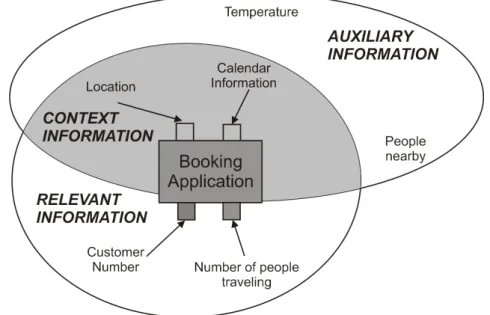
We illustrate the problem of defining context with an example application of a booking process for train tickets. In Figure 2.1, we show some information sources that are available when using the booking application. Some of the information is mandatory for the normal functionality of the system (i.e. the customer number and how many persons want to travel), some information cannot be processed by the application (i.e. the temperature and which people are near the user), and some is optional as it is just used as additional information (e.g. the user’s current location and her calendar information). The latter information can be used to infer the station of departure as well as the arrival and travel times, and saves the user from having to enter this information manually.
We define context as follows:
Context characterizes the actual situation in which the application is used. This situation is determined by information which distinguishes the actual usage from others, in particular characteristics of the user (her location, task at hand, etc) and interfering physical or virtual objects (noise level, nearby resources, etc). We thereby only refer to information as context that can actually be processed by an application (relevant infor-mation), but that is not mandatory for its normal functionality (auxiliary information).
2.1. Context 13
Figure 2.1. Available information sources when using a booking application Thus, we refer to context as the intersection of “Relevant Information” and “Auxiliary Information” as visualized in Figure 2.2. In this way, our definition overcomes the limitations of existing definitions which we discuss below.
The simplest definitions of context are given by enumerating all constituents of context. For example,Schilit et al. (1994) attempted to define context by specifying three categories of context: computing, user, and physical context. Chen and Kotz (2000) later extended this definition by the time context (e.g. time of day, season of the year).
A common problem of these definitions is that they do not specify a bound, for which information can be referred to as context. According to these definitions everything that fits into one of the categories can be named context, no matter whether or not it has any relevance for the application. In our example application, the temperature and the people nearby would also be referred to as context for the application, even though the application cannot make use of it.
The most prominent context definition by Dey (2001) solves this problem by lim-iting the context to all information that is relevant to the interaction between user and application: “Context is any information that can be used to characterize the situation of an entity. An entity is a person, place, or object that is considered rel-evant to the interaction between a user and an application, including the user and applications themselves”. In our example, all information that can be processed by the application would be referred to as context (see “Relevant Information” in Figure 2.2). However, the definition has the shortcoming of defining context by means of other ill-defined terms such as “situation” or “relevance”. Another problem that arises from Dey’s definition is that even information that the application needs to fulfill its
Figure 2.2. Classification of the different information sources from Figure 2.1
tasks, in our example the customer number and the number of people traveling, can be referred to as context. Thus, every application could be called context-aware.
To sum up, we need a context definition that defines an upper and a lower bound of what we consider as context for an application. The upper bound is needed to exclude information that is irrelevant for the application, and the lower bound is needed to exclude information that is mandatory for its normal functionality. These bounds are defined in our definition, so it overcomes the limitations of the existing definitions.
2.1.2. Categories of Context
The research in the context-aware computing community usually takes a computa-tional view on context, because it often focuses on the derivation of context informa-tion. For that reason, the widely used categorization (e.g. by Baldauf et al. (2007)) distinguishes between physically sensed, virtually sensed, and derived context:
• Physically sensed: Context information that is sensed from the real world, e.g. temperature, acceleration, or location.
• Virtually sensed: Context information derived from software sources, e.g. the location included in a calendar entry.
• Derived: Higher-level context information which is gathered by filtering, ag-gregating, interpreting (e.g. mapping GPS coordinates to city names), or com-bining context information (e.g. infer the user’s activity from her location and her movements).
2.1. Context 15 The view of the HCI community is orthogonal to this computational perspective; the considered context information can be roughly classified as user context and environmental context:
• The User Context contains all information describing the user. User models which are often used for that purpose can range from simple user profiles to complex models that describe the emotional or cognitive state of the user (e.g. Pantic et al. (2005); Susan and McEvoy (2003)). This also includes models of how the user interacts with applications and which goals she is currently pursuing. These more sophisticated models are usually learned from observing the user and interpreting the interaction with the help of some predefined background knowledge, e.g. about available goals.
• The Environmental Context comprises all information that cannot be de-scribed in a user model, but is related to the user’s current situation, e.g. the temperature of a room or her current location.
Until now, the HCI community focuses on the user context and does not take much environmental context into account. In contrast, context-aware computing puts more emphasis on the environmental context. The user context they consider is usually limited to simple user profiles (e.g. the user’s mother tongue). LikeJameson(2001), we argue that we have to consider both context sources – sophisticated user models and environmental context – to bring us closer to understanding the user’s needs, and thus to enable us to provide a level of support which is of maximum benefit for the user.
2.1.3. Difficulties in Using Context
Context is difficult to use because it differs from most other data sources used in traditional applications in the following properties:
• Context is gathered from heterogeneous sources which use different represen-tations.
• Context is error-prone: Context is often acquired by external sensors that can get out of reach, report unreliable data, or completely fail. Furthermore, context is often inferred using machine learning approaches (e.g. activity recog-nition or sophisticated user models as discussed in the previous section), which induce additional uncertainty.
For those reasons, most applications available today do not take any context infor-mation into account and if they do, they only consider a very limited number of context sources, like location.
The problem of heterogeneous sources can be tackled by using a middleware which provides a uniform context representation to the applications. In this thesis, we present a uniform representation which is suitable for using context information in
IUIs. However, we will not go into detail about how this uniform representation is gathered from sensor information. We leave it up to the middleware used (e.g. the Context Server described in Aitenbichler et al. (2007b)) to provide such a uniform representation.
The problem of error-prone context information has to be addressed by every ap-plication that uses context information. In Section 2.3, we describe the implications of this property of context for the development of context-aware IUIs.
2.2. Intelligent User Interfaces
The area of Intelligent User Interfaces (IUIs) is a very heterogeneous research subject, covering all kinds of different disciplines, which makes it difficult to give a general definition. IUIs try to facilitate the interaction between user and computer by means of artificial intelligence (AI). In contrast to traditional human computer interaction (HCI), IUIs do not only focus on enabling the user to perform intelligent actions but also on ways to incorporate knowledge to be able to assist the user in performing actions. In contrast to traditional research in the area of AI, IUIs do not focus on making the computer smart by itself (e.g. by developing sophisticated problem solvers) but on making the interaction between computer and human smarter.
In this section, we give an overview of the research field of IUIs and relate the approach in this thesis to the different research topics subsumed under the term IUI. In Section 2.2.1, we give a definition of IUIs. As one of the most important building blocks of IUIs are models, we further describe the models they rely on. In Section 2.2.2, we present a classification of IUIs based on a literature survey. We describe the two research areas relevant to the approach presented in this thesis, i.e. Personal Assistants andInterface Adaptation, in more detail (Section 2.2.3 and 2.2.4). 2.2.1. Definition and Models
Giving a clear definition of the term “Intelligent User Interfaces” is almost as difficult as defining context, because already the term “intelligence” is hard to grasp. Malaka (2008) refers to a technical solution as “intelligent” if it (i) has some built-in intelligent computation that solves a problem for the user or (ii) enables the user to solve a problem3. The goal of IUIs is to better support the user’s current needs by making
the interaction itself as well as the presentation of information more effective and efficient. Based on the definition by Maybury and Wahlster (1998), we define IUIs as follows:
Intelligent User Interfacesare human-machine interfaces that aim to improve the efficiency, effectiveness, and naturalness of human machine
3Malaka (2008) only refers to “otherwise unsolvable problems”. However, this definition is too strict, because Intelligent User Interfaces aim at facilitating the interaction and not enabling the interaction in the first place.
2.2. Intelligent User Interfaces 17
interaction by representing, reasoning, and acting on models of the user, domain, application, discourse, context, and media and device.
As stated by the definition, IUIs need models to be able to provide meaningful support or adapt the interaction in a meaningful way. We provide below an overview of the different types of models that can be used. Which models are available in an IUI differs from system to system:
• User Model contains all information that was gathered about a user, e.g. her skills, preferences, or how she usually interacts with an application. This information can be either modeled or learned from observing the user. Besides modeling individual users, IUIs sometimes also use models of a group of users or of the average user.
• Context Modelholds information about the current context of use, e.g. light-ing conditions. As stated in the previous section, we also consider the user model as context information. However, as the user model is of particular im-portance for IUIs, we address these two models separately. We subsume all information concerning the user context in the user model and all information concerning the environmental context in the context model.
• Application Modelcontains available information about an application, e.g. its structure, the goals that can be achieved, or help instructions.
• Domain Model contains knowledge of a given domain, e.g. the domain ‘travel’ for travel booking applications. This model contains semantic infor-mation about the different terms that are used in this domain to enable the IUI to interpret the user’s input.
• Discourse Modelcontains the description of the syntax, semantics, and prag-matics of a dialog as it proceeds (Wahlster,1988). This is especially important for natural language systems.
• Media and device model states the capabilities of available in- and output devices and properties of media. This comprises for example which modalities can be provided by an interaction device, which modalities are needed by a media, or the characteristics of the media e.g. its resolution. These models are needed for example in multimodal environments to determine which modalities should be used in a given setting.
2.2.2. Classification of IUIs
According to Jameson (2007), we distinguish between two main categories of IUIs (see also Figure2.3):
• IUIs that support the system use can perform parts of routine tasks on behalf of the user, adapt the UI, and provide help.
• IUIs forsupporting information acquisition assist the user to find relevant information, filter data for the user, or provide her with additional information. Recommender systems or eLearning systems are examples of this category. In this thesis, we focus on IUIs for supporting the system use. For that reason, we take a closer look at the major research areas for this category of IUIs. We identified the following five main research areas and briefly introduce each one of them:
• Personal Assistants support the user’s interaction by augmenting an ap-plication with support information. They are also able to interact with an application by themselves and thus perform tasks on behalf of the user. Their support relies on models of the application that are either provided by the ap-plication developer, the end-user, or that are learned from observing the user. Personal assistants are often also called user interface agents, adaptive agents, or learning apprentice systems.
• Help Systemscan assist the user by explaining how to use an application. In contrast to Personal Assistants, they do not require access to the functionality of the application, as they do not perform any tasks by themselves.
• Programming by Demonstration Systems learn to perform a task accord-ing to a few examples (usually only one) demonstrated by the user.
• Interface Adaptation Systems are able to generate UIs for an application which are adapted to the needs of an individual user, the current context, or the available in- and output devices.
• Post Desktop Interaction Systems try to provide a very natural interac-tion for the user by supporting modalities other than the standard keyboard,
Figure 2.3. Classification of research areas of IUIs (gray research areas: Focus of this thesis)
2.2. Intelligent User Interfaces 19
Figure 2.4. Support classes provided by personal assistants
mouse, and screen interaction. For example, they use natural language for the communication or allow the user to interact via various input modalities. Examples of post desktop interaction systems are multimodal user interfaces, gesture- and sketch-based interfaces, or natural language interfaces.
Existing systems often fall into more than one of these research areas, e.g. many personal assistants contain help systems or programming by demonstration systems. In this thesis, we focus onPersonal Assistants and how they can benefit from context information as they provide the most profound support for facilitating system use. In ubiquitous computing settings, the standard UIs are usually difficult to use due to the limited screen space. To support also the interaction in those settings, we reduce UIs to the given context. For that reason, we also contribute to the area of Interface Adaptation. In the following sections, we point out how the user’s interaction is supported in these two areas.
2.2.3. Classification of Personal Assistants
We analyzed the state of the art of personal assistants to identify in which ways they support the user’s interactions. We found that we can distinguish between two categories (see Figure 2.4):
• Navigation support helps the user in navigating within and between ap-plications. This comprises guiding her through an application and providing navigation shortcuts.
Guidance highlights interaction elements to draw the user’s attention to it. It thus reduces the user’s cognitive load and is especially useful for navigation in large menu structures or for novice users. Guidance is applied for example in COLLAGEN (Rich et al., 2001) and AGUSINA (Amandi and Armentano, 2004).
Navigation shortcuts provide the user with shortcuts to applications she might want to switch to depending on the information which is presented to her. For example, a shortcut to a map application can be suggested if address
information is presented. Navigation shortcuts are for example provided by CyberDesk (Dey et al., 1997), onCue (Dix et al., 2006), and FolderPredictor (Bao et al.,2006).
• Content support predicts which data should be entered, and suggests it to the user or even fills it into the corresponding elements. This reduces the required interaction costs for entering the data, which is especially important for mobile applications (see Rukzio et al. (2008)). Content Support is applied for managing meetings for example by LookOut (Horvitz,1999) or CMRadar (Modi et al.,2005) and used more generally for example by VIO (Zimmerman et al.,2007) or Citrine (Stylos et al.,2004).
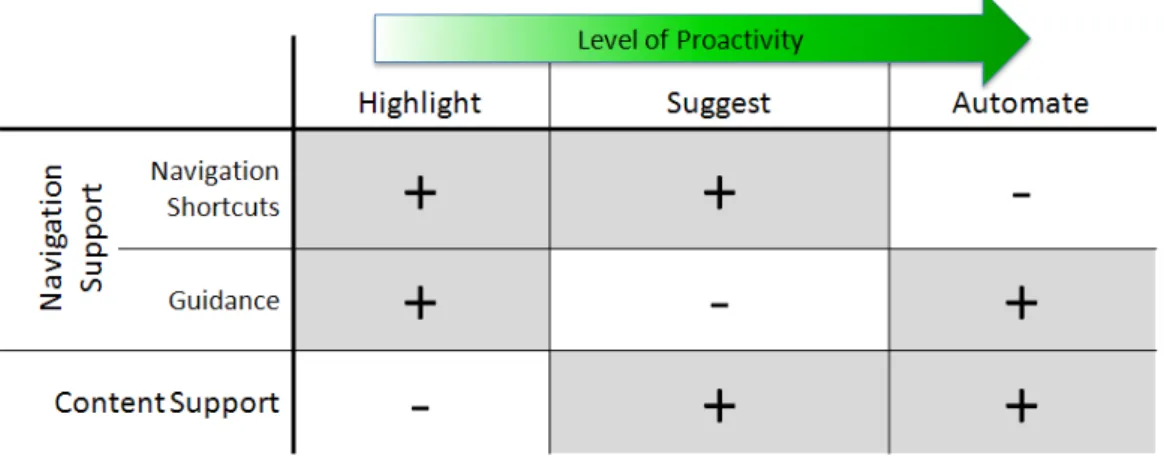
In some applications Task Automation is also named as an additional method of supporting the interaction. The techniques needed to automate a task are the same as for providing navigation or content support: The system has to know which data to enter or where to navigate to. For that reason, we consider task automation as content and navigation support that is executed in a very proactive way.
2.2.4. Classification of Interface Adaptations
Interface adaptation systems aim to generate interfaces that best fit the current usage situation. Thereby, they can adapt what is shown to the user and how. Thus, we can distinguish between the following two classes:
• Adapting the content(i.e. what to present) refers to adapting the displayed information as well as the structure of the UI. For example, systems focusing on this aspect can provide a reduced version of a UI for mobile usage or for reducing the user’s cognitive load.
• Adapting the presentation (i.e. how to present) refers to adapting the modality used and how the different interaction elements, e.g. buttons, are presented. For example, systems focusing on this aspect increase the button size for touch screen displays or for persons with disabilities. Another way of supporting the interaction is to automatically generate UIs for another modal-ity, e.g. using voice.
In this thesis, we focus on the content adaptation and on reducing the UI to relevant interaction elements, as this is very important for the ubiquitous usage of applica-tions. We also support to render the reduced UI using another modality, but we do not support further adaptation features for this aspect.
2.2.5. Summary
In this section, we introduced the research area of IUIs. The approach presented in this thesis falls into the research area of Personal Assistants. Personal assistants focus on collaborating with the user to facilitate the entering of data (Content Support)
2.3. Requirements for Context-Aware IUIs 21 and navigation (Navigation Support). However, they do not provide any assistance for the use of applications in mobile and ubiquitous settings. As the navigation in these settings can be dramatically enhanced when using a reduced version of a UI with the most relevant functionality, we also contribute to the research area of Interface Adaptation. As stated before, our approach also supports the rendering of the reduced UI using another modality, but we will not go into detail of this aspect. To sum up, we focus on the following methods of supporting the user’s interaction:
• Content Support: Facilitate entering data
• Navigation Support: Facilitate the navigation by – guiding the user (Guidance),
– providing Navigation Shortcuts, and by
– reducing the UI to the most important elements (Interface Adaptation).
2.3. Requirements for Context-Aware IUIs
In this section, we give an overview of the challenges and requirements that arise when using context in IUIs, i.e. when building context-aware IUIs. This analysis builds the basis for the development of the concepts and algorithms presented in the remainder of this thesis.
In Section 2.3.1, we first present an overview of general challenges identified in literature for developing IUIs. In Section 2.3.2, we list the additional requirements which have to be faced when using context information for supporting the user’s interaction.
2.3.1. Challenges in Developing IUIs
The main goal in developing IUIs is that they should be usable, useful, and trustable (Myers,2007). This aligns with the main problems identified by Maes(1994): Pre-sentation, Competence, and Trust. Presentation is concerned with the human computer interaction part of IUIs, whereas Competence focuses on the artificial intelligence techniques that can be applied. The development of IUIs has to take special care of Trust, as the user is not willing to delegate tasks to an IUI she does not trust, thus rendering the IUI useless. In this section, we point out which chal-lenges have to be faced when developing IUIs, and describe possible ways to cope with them. We thereby focus on IUIs that are able to adapt their behavior to the user’s needs. An overview of the identified challenges is given in Table 2.1. The challenges are not disjunctive and heavily interrelated; they should just give some of the focus points for developing IUIs. This list is not meant to be complete and not all challenges have to be faced in each IUI, e.g. collaborative filtering systems usually do not have to cope with the problem of little usage data.
Presentation Interaction design Unobtrusiveness Adaptivity Competence Little usage data
Changing user behavior Trust Controllable behavior
Intelligibility Privacy
Table 2.1. Challenges in developing IUIs Presentation
For the presentation of IUIs, we at first need to consider how to design the inter-action between the user and the IUI. Especially personal assistants are often only augmentations of existing UIs. Thus, they have to be integrated into the existing layout, offering the user a way to communicate with the assistant. In doing so, it should not hamper the normal usage of the application. The interaction should also support some kind offorgiveness that allows the user to easily correct previously per-formed actions using an undo capability (Apple,2008). Many researchers argue that IUIs should fail softly – this means if the provided support is not (entirely) correct, it should still move the user closer to the goal (Lieberman et al.,2004) and should not cause problems when it is wrong (Dix et al., 2000). Furthermore, the design of the interaction tackles whether and how the user can instruct the IUI (Norman, 1994) or whether an anthropomorphic agent is used to allow the user to communicate with the IUI (Wexelblat and Maes,1997). These issues are closely related to trust issues that will be discussed later, i.e. how the user can control an IUI and which expectations are raised by the IUI.
Another important factor regarding the presentation is unobtrusiveness( Jame-son,2007; Langley and Fehling,1996). The intelligent support should not distract the user from normal usage of the application. A counterexample is the Microsoft Office Assistant, which is constantly moving and thus drawing the user’s attention to it without providing any relevant help for the user’s current task. Wexelblat and Maes(1997) propose reducing the distraction of the user by minimizing the amount of interruptions and deferring interruptions until they are less disruptive. Another way to cope with this issue is to support different levels of obtrusiveness (or proac-tivity) depending on the information importance or the certainty in the action, e.g. as applied by Horvitz(1999) and Maes(1994).
Furthermore, an IUI should be able to adapt its presentation to different users,
devices,andsituations. For example, a novice user needs more explanations than an expert user, or voice output is suitable for mobile usage, but not if the user is sitting in a library. As the costs of interacting with applications via a mobile phone are
2.3. Requirements for Context-Aware IUIs 23 much higher than in a traditional desktop setting, more support may be desirable in mobile settings. However, adaptivity not only influences the presentation of an IUI, but also how much the user trusts the IUI or which demands an IUI puts on the underlying algorithms (i.e. affecting the competence of the IUI).
Competence
The competence of an IUI is determined by the underlying algorithms. If an IUI adapts its behavior to the individual user’s needs, its level of competence depends on the amount of training data available. However, this is usually limited at the begin-ning. Thus, the algorithms used for IUIs mostly have to be able to deal with little usage data. For that reason, IUIs that just learn from observation are usually not of great aid at the beginning (“slow-start problem”). This problem can be overcome for example by relying on predefined models or by using a default model that is inferred from the models of other users. However, the former requires a large modeling effort by a developer and the latter can cause privacy problems (as discussed in the Trust
section).
A second problem is that theuser’s behavior changes over time (Höök,2000). Especially the usage patterns of a novice user often dramatically differ from the usage patterns of an expert. For that purpose, ageing can be used that decreases the weight of older interactions.
Trust
It is much more challenging for IUIs to induce user’s trust in it than for traditional user interfaces, because IUIs apply AI techniques whose results can often not be directly foreseen by the user and thus reduce the user’s feeling of being in control of the system.
The trust the user puts in an IUI is influenced by many factors, especially by presentation issues as discussed before. We state below the main challenges identified in literature that have to be considered when building trustable IUIs. At first, it is essential that the user feels incontrolof the IUI. The user should be able to correct and adjust the actions of an IUI, and to control its autonomy (Höök,2000;Bellotti and Edwards, 2001; Glass et al., 2008; Dey and Newberger,2009). One possibility to control the actions of an IUI is to require the user to approve or disapprove every action (Cypher,1991), or by letting the user specify confidence thresholds for actions (Maes,1994). However, requiring the user to always control the application is usually not desirable as the users differ in their desire for control (Jameson and Schwarzkopf,2002) and too much control may lead to distraction and time-wasting (Kay, 2001). The amount of control should also depend on the criticalness of the task, e.g. for non-critical tasks, like filling data in input fields, a lower level of control is needed than for automatically buying goods. Another factor that influences how much control the user wants to exert is her trust in the IUI that (hopefully) evolves over time. For all those reasons, an IUI should support variable levels of control that
can also be adjusted by the user.
Another important issue for establishing the user’s trust in the IUI is intelligi-bility, i.e. that the user is able to understand the actions of the IUI (Bellotti and Edwards,2001;Malaka,2008;Dey and Newberger,2009). As stated byMaes(1994), a user is more likely to trust an IUI if she sees in advance what the agent would do. A study of context-aware systems by Barkhuus and Dey (2003) also showed that users become very frustrated when they do not understand why a system has per-formed an action, or when they do not have the ability to fix it. One way to achieve intelligibility istransparency, i.e. that the IUI helps the user understand its actions. Transparency can be realized by an IUI by giving feedback of its actions (Maes, 1994), by being able to justify its actions, or by making the user aware of automatic adaptations. Another way of increasing the intelligibility of an IUI is to give the useraccess to the knowledge source that was used for providing support (Glass et al., 2008). For example, Cook and Kay (1994) argue that the IUI should let the user inspect and modify the user models used by the IUI. The intelligibility of its actions should thus support the user in developing an appropriate model of the behavior of the IUI (Malaka,2008). In this way, it is not necessary to mediate a complete model of the IUI, as “understanding comes from a careful blend of hiding and revealing agent state and functioning” (Wexelblat and Maes,1997). They argue for example that for driving a car, it is also not necessary to have a complete model of how the engine or the brakes work. This blend can be achieved by applying a black box in a glass box system (Höök et al.,1996), i.e. complex inferences are hidden from view in a black box system, whereas a simpler model is conveyed to the user, like cartoons as used by Kozierok and Maes(1993). A good mental model of the behavior of an IUI also influences howpredictable its actions are perceived by the user, and finally which
expectations she has of the IUI (Glass et al.,2008). Erroneous higher expectations can easily lead to disappointment among users and discourage them from using the IUI. This is also one of the main reasons why many researchers argue against using anthropomorphic agents, as they are perceived by the user to be similar to a human being, and thus could also take responsibility for their actions.
Finally, for IUIs that share information between users, privacyhas to be regarded. The requirements that are posed on privacy differ between applications. For example, the users of FireFly4, an application for sharing preferences for music or movies,
did not perceive this sharing as critical, whereas users of the Doppelgänger system (Orwant,1994), which provides personalized news by considering the type of news that a colleague usually reads, had strong privacy concerns against the system. This might be the case as the data differed in their level of importance to the user and as the data in the Doppelgänger system, in contrast to the Firefly system, was not anonymized. Besides anonymizing the data, another solution proposed for this problem is to split the user model into a private and a public part (Cook and Kay, 1994).
4A company founded by a group of engineers from MIT media lab, including Pattie Maes, which was sold to Microsoft in April 1998.
2.3. Requirements for Context-Aware IUIs 25 2.3.2. Requirements for Using Context in IUIs
Besides the general challenges for IUIs, we have to face additional requirements when using context information in IUIs, that is for building context-aware IUIs. In our opinion, considering the user’s context is the key to providing useful support, as the required assistance often heavily depends on it. The relevant context can thereby be gathered from the user’s environment as well as from models describing the user’s behavior. For that reason, it is important to consider the environmental context as well as the user context (see Section2.1.2):
R1 (Awareness of user context and environmental context) An ideal context-aware IUI should be able to consider user context as well as all kinds of environmental context to support the user’s interaction in a user-adapted way.
This also requires that the specific nature of context has to be taken into account, i.e. that context information is often unreliable. For example, if physical context sensors provide inaccurate values, or if the user’s behavior has changed. The pro-vided support thus has to adapt to this uncertainty. This is especially important as erroneous support can easily lead to losing the user’s trust (Tiernan et al.,2001).
R2 (Cope with error-prone context) An ideal context-aware IUI should be able to cope with the error-prone nature of context information and adapt the support according to the reliability of the data.
To get a better understanding of the user’s context, we also have to consider her interactions. Many tasks a user performs involve the interaction with several ap-plications. For example, booking travel often involves looking up train connections, booking a flight, etc. using different applications. Information entered into one ap-plication can be relevant context for another one. For that reason, we state that it is important to support the interaction with all kinds of existing applications and not just to focus on a single one.
R3 (Application-independence) An ideal context-aware IUI should be able to facilitate the interaction for all kinds of applications.
R4 (Support across application boundaries)An ideal context-aware IUI should be able to provide support across application boundaries.
We cannot expect that all applications the user interacts with are developed using our approach. However, the interaction with applications is an important information source for understanding the user’s context. For that reason, an ideal context-aware IUI should be able to gather context information from existing applications. It should also be able to provide interaction support for these existing applications to gain wide applicability.