sustainability
ArticleResource-Based View and SMEs Performance
Exporting through Foreign Intermediaries: The
Mediating E
ff
ect of Management Controls
Juan Manuel Ramon-Jeronimo1 , Raquel Florez-Lopez1 and Pedro Araujo-Pinzon2,*
1 Department of Financial Economics and Accounting, University Pablo of Olavide of Seville, 41013 Sevilla, Spain; [email protected] (J.M.R.-J.); [email protected] (R.F.-L.)
2 Department of Financial Economics and Accounting, University of Cadiz, Faculty of Economics and Business Sciences, 11002 Cadiz, Spain
* Correspondence: [email protected]; Tel.:+34-956-015-367
Received: 4 April 2019; Accepted: 3 June 2019; Published: 12 June 2019 Abstract:Following the resource-based view, this research empirically explores the role of formal and informal management control in mobilizing export resources to develop export capabilities, influencing the export performance of small and medium-sized enterprises (SMEs) in an interorganizational relationship context. Empirical data were collected using a survey administrated online to finance managers in Spanish SMEs which use foreign intermediaries to access export markets. In this setting, evidence mainly suggests, first, that management control systems (MCSs) play a relevant mediating role between the effect of, on the one hand, resources on capabilities, and, on the other hand, resources and capabilities on performance. Second, that MCSs and capabilities play a interrelated double mediating effect between the impact of resources on performance; more specifically, a significant double indirect effect is found (1) between financial resources, behavior control, customer relationship building capability and performance, and (2) between physical resources, behavior control, customer relationship building capability and performance.
Keywords: management control systems; resource-based theory; export performance; SMEs
1. Introduction
Resource-based view (RBV) literature has largely considered firms’ export performance to be influenced by a proper combination of their own resources and capabilities [1,2]. Increasing globalization and economic crisis have made it necessary for many small and medium-sized enterprises (SMEs) to internationalize their products or services, exporting being the more extended entry mode [3–5]. However, usually SMEs have greater difficulties than larger firms to access export resources and capabilities, SMEs face barriers to enter and to achieve successful performance in foreign markets [6,7]. Cooperation between firms can provide them with the resources to engage in internationalization activities [7–9], RBV suggests that inter-organizational relationships can allow SMEs to gain access and availability to tangible and intangible resources that strengthen their current resource base, which will positively impact on performance [10–12]. Export activities are usually based on relationships between firms and foreign intermediaries [13] and independent export channels are the most common exporting mode [14,15]. The main advantages of this exporting mode are lower costs and investments than other modes [16], and access to knowledge about foreign markets and customers, economies of scale, negotiation skills and specialization in products/markets beyond the reach of individual exporters [17]. Regarding control issues, independent export channels also imply the delegation of decision making and responsibility for tasks related to logistics, sales, marketing and service activities [18].
Sustainability2019,11, 3241 2 of 26
Organizations operating through inter-organizational relationships without common property or a superior authority that controls the relationship specify agreements or mechanisms for the coordination and supervision of participants’ activities [19,20]. Downstream relations, as an independent export channel, imply an abstract nature of the services performed by intermediaries [21], leading to greater dependence, risk and vulnerability, and less power [22] for the focal company than other relationships: in addition to the low hierarchical command derived from ownership separation [23], whose inadequate management control can harm the export performance, which can be aggravated by geographical and cultural distances [24–26], partners deal directly with, and often on behalf of, customers [27].
Monitoring and coordination routines between parties in inter-firm relationships are key elements in integrating resources and capabilities. To create value, partners must pool resources, determine tasks to be performed and decide on a division of labor, which demands coordination efforts [28]. Management control systems (MCSs) can collaborate in ensuring that the resources committed to internationalization are managed in the best way [29], positively impacting on export processes, as [30] argue, analyzing its effect on the degree of internationalization and export intensity. These systems are not necessarily desirable per se but are subject to efficiency considerations and deliberate choice [25]; they are implemented to exercise control over foreign intermediaries because intermediaries are instrumental in achieving the business objectives. The efficient management of interdependent foreign activities necessitates sophisticated MCSs that can respond to local differences while taking advantage of global opportunities [31].
Although SMEs adopting appropriate systems usually have better business performance, allowing them to optimize the use of their resources [32], their reduced scale in comparison to larger firms suggests the coordination and monitoring roles of management accounting are not as important in the small businesses as in larger organizations [33]. However, regarding export SMEs that regularly use intermediaries, developing systems or procedures to influence intermediaries’ behavior and so to improve export performance is vital [18]. As Araujo et al. [34] argue, these export SMEs implement multiple (both formal and informal) control mechanisms to monitor and coordinate independent export channels. Regarding international alliances, Voss et al. [35] suggest the importance of high-quality information flows between parties for increasing alliance performance. However, the existing empirical findings are not conclusive on the influence of different control types on export performance [36].
In the last two decades, the need to extend the context of management accounting and control to sales and marketing functions has been pointed out [37], along with greater integration with the marketing area [38–40]. Some studies in the accounting literature have shown empirical evidence about the differences in the management control systems used and the information requested by managers working in the distribution and marketing fields [41–43], activities or functions that are the subject of outsourcing in a downstream relationship. Regarding the most updated view of the RBV, Kozlenkova et al. [44] argue that sustainable competitive advantage is only achievable when resources are simultaneously valuable, rare, imperfectly imitable, and exploitable by the company’s organization. These researchers also argue for the necessity in marketing literature to wide RBV, on the one hand, including inter-firm relationships to explain the effect of exchange-level resources on the performance of marketing exchange, and, on the other hand, carrying out research to understand and refine the knowledge about the skills, processes, and policies that lead to resource exploitation at the exchange level of analysis. Recent studies in RBV claim that the adequate management of inter-organizational activities should also be analyzed as a key determinant of export performance [12,45,46] and that the role of MCSs can be argued “as a capability which is valuable, distinctive and imperfectly imitable” ([47] p. 549), even as an important capability for SME internationalization that can collaborate in the exploitation phase [29]. In addition, research beyond direct links of antecedents on export performance, but about factors mediating this relationship in order to “improve research accuracy and reliability” (p. 636), is required in marketing literature [48].
To address this research gap, we combine the RBV with management control and marketing literatures about the design of MCS, and empirically explore the mediating effects of different types
Sustainability2019,11, 3241 3 of 26
of MCSs (outcome, behavior and social) on the relationship between export resources, capabilities and performance. Data were collected using a survey administrated in 2008 to finance directors or controllers in Spanish SMEs that use intermediary to access export markets and where controllers are responsible for implementing MCSs. The Spanish context is relevant to this research because, on the one hand, these firms are an essential element of its economy: first, in terms of business employment (65.9% in 2018) it is similar to the EU countries’ mean, although, in Spain, microenterprises (1–9 employees) predominate (95.4% of firms, with 31.9% of business employment); second, regarding the number of exports firms in 2015, 40.7% of Spanish medium-sized companies (50–249 employees), 23.3% of small firms (10–49 employees) and 9.9% of microenterprises carried out export activities, showing a positive upward trend compared to previous years [49], with an increase of 15% in their stable export base in 2014 compared to 2010 [50]; and lastly, in 2015, SMEs were responsible for 51.1% of Spanish intra-EU exports [51]. On the other hand, since Spanish exporting firms with a better competitive position stand out for valuing mainly (after the quality of their product) their management control systems [52], it seems necessary to advance in detailing which types of control mechanisms collaborate in the exploitation of resources and capacities, which tend to be more limited than in the case of large companies. From a final sample of 85 valid responses, our findings suggest a complex interrelation between export resources and capabilities, MCSs and performance. In addition, to show which are the key resources and capabilities that impact on both MCSs and export performance, and which capabilities mediate the effect of resources on performance, we suggest as our main contributions to RBV, management control and marketing literatures, first, that MCSs play a relevant mediating role between the effect of, on the one hand, resources on capabilities, and, on the other hand, resources and capabilities on performance; and second, we also suggest that MCSs and capabilities play a interrelated double mediating effect between the impact of resources on performance.
The remainder of the paper is structured as follows. Section2provides the theoretical discussion that leads to the conceptual model and research hypotheses. In Section3, the empirical research setting is presented, and the results are analyzed and discussed in Section4. In Section5, the main conclusions are included and, finally, limitations and further research avenues are suggested in Section6.
2. Theoretical Framework
2.1. RBV in the Inter-Organizational Export Context
The RBV focuses on internal resources and capabilities to identify the determinants of a firm’s competitive advantage and performance. It has been suggested that inclusion of the RBV is a fruitful direction that would enrich the export management literature [12,53], focusing more on dynamic capabilities, considering the interactions between resources and capabilities and incorporating views from other academic areas [53,54]. Furthermore, this perspective has been advocated as a fruitful direction for understanding the complex process of managing internationalization [13,55] and export channels [1,2,54].
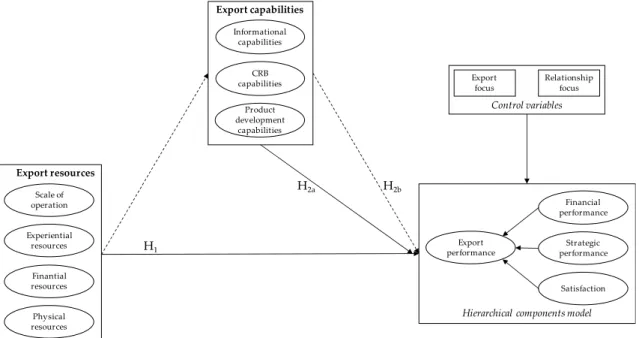
Resources are defined as stocks of knowledge, physical assets, human capital, and other tangible and intangible factors owned or controlled [56]. From this theoretical framework, exporting firms consist of assortments of assets and individuals that possess skills. It is the synergistic effects generated by their combinations that matter most in the process of establishing competitive advantage rather than simple accumulation of all these factors [57,58]. Thus, firms are idiosyncratic in terms of the bundle of resources that they accumulate over time, and organizational resources are considered the ultimate sources of competitive advantage. Kaleka [1] identifies four areas of competitive resources for exporters: physical assets, the scale of operation, financial assets and the firm’s experience in export market operations. In an inter-organizational context, Kaleka [54] finds that most of these key resources influence positively on different performance dimensions for regularly operating export ventures. Therefore, our first hypothesis is set as (see Figure1):
Sustainability2019,11, 3241 4 of 26
Hypothesis 1 (H1).Export resources are positively related to export performance.
Sustainability 2019, 11, x FOR PEER REVIEW 4 of 26
that most of these key resources influence positively on different performance dimensions for regularly operating export ventures. Therefore, our first hypothesis is set as (see Figure 1):
Hypothesis 1 (H1). Export resources are positively related to export performance.
Figure 1. Hypotheses H1, H2a and H2b. Source: Authors.
Capabilities are a firm’s complex bundles of skills and accumulated knowledge, exercised through organizational processes, which enable the firm to coordinate activities and make the best use of its resources. They concern the firm’s ability to combine, develop, and use its internal and external resources in ways that create competitive advantage and drive superior performance [13,56]. When capabilities support a market position that adds value and it is difficult to reach by competitors, they become distinctive capabilities or skills. Kaleka [1] argues that there are four main capabilities in export markets: informational, customer relationship building, product development and supply chain capabilities. Weerawardena et al. [59] suggest, through a meta-analysis, that marketing capabilities can lead to export performance, and Kaleka [54] claims that informational capabilities have a direct positive effect on export performance. Thus (Figure 1):
Hypothesis 2a (H2a). Export capabilities are positively related to export performance.
Studies on marketing literature discuss how to establish a competitive advantage through the effective use of the capabilities and the updating of the resources [2]. Focused on international performance, Lu et al. [13] find that the firm’s ability to coordinate, recombine and allocate resources to meet the different requirements mediates the relationship between resources and performance. A distinction between operational and dynamics capabilities is important in an internationalization setting [60]: operational capabilities “generally involves performing an activity […] using a collection of routines executing to execute and coordinate the variety of tasks required to perform the activity”; meanwhile, dynamic capabilities “build, integrate, or reconfigure operational capabilities” ([61], p. 999). Dynamic capabilities emphasize the integration, construction, reconfiguration and renewal of capabilities to cope with changing environments, focusing on the company’s ability in exploiting and reconfiguring resources to achieve new forms of sustainable competitive advantage over time [55,59]. Kaleka [54] suggests that export resources and dynamic capabilities interact, influencing each other and re-configuring themselves, impacting on firms’ competitive advantage and performance.
Pinho and Prange [55] argue that marketing dynamic capabilities are deeply embedded in
organizations and find, through a meta-analysis, that these capabilities can directly and indirectly Scale of operation Experiential resources Finantial resources Physical resources Export resources Financial performance Strategic performance Satisfaction Export performance
Hierarchical components model Export focus Relationship focus Control variables H1 H2b H2a Informational capabilities CRB capabilities Product development capabilities Export capabilities
Figure 1.Hypotheses H1, H2aand H2b. Source: Authors.
Capabilities are a firm’s complex bundles of skills and accumulated knowledge, exercised through organizational processes, which enable the firm to coordinate activities and make the best use of its resources. They concern the firm’s ability to combine, develop, and use its internal and external resources in ways that create competitive advantage and drive superior performance [13,56]. When capabilities support a market position that adds value and it is difficult to reach by competitors, they become distinctive capabilities or skills. Kaleka [1] argues that there are four main capabilities in export markets: informational, customer relationship building, product development and supply chain capabilities. Weerawardena et al. [59] suggest, through a meta-analysis, that marketing capabilities can lead to export performance, and Kaleka [54] claims that informational capabilities have a direct positive effect on export performance. Thus (Figure1):
Hypothesis 2a (H2a).Export capabilities are positively related to export performance.
Studies on marketing literature discuss how to establish a competitive advantage through the effective use of the capabilities and the updating of the resources [2]. Focused on international performance, Lu et al. [13] find that the firm’s ability to coordinate, recombine and allocate resources to meet the different requirements mediates the relationship between resources and performance. A distinction between operational and dynamics capabilities is important in an internationalization setting [60]: operational capabilities “generally involves performing an activity [. . . ] using a collection of routines executing to execute and coordinate the variety of tasks required to perform the activity”; meanwhile, dynamic capabilities “build, integrate, or reconfigure operational capabilities” ([61], p. 999). Dynamic capabilities emphasize the integration, construction, reconfiguration and renewal of capabilities to cope with changing environments, focusing on the company’s ability in exploiting and reconfiguring resources to achieve new forms of sustainable competitive advantage over time [55,59].
Kaleka [54] suggests that export resources and dynamic capabilities interact, influencing each other and re-configuring themselves, impacting on firms’ competitive advantage and performance. Pinho and Prange [55] argue that marketing dynamic capabilities are deeply embedded in organizations and find, through a meta-analysis, that these capabilities can directly and indirectly influence export performance. Dynamic capabilities mediate the relation between resources and performance, resources
Sustainability2019,11, 3241 5 of 26
as, for example, those related to learning and knowledge [62], institutional capital and managerial ties [13] or social networks [55]. Therefore (Figure1):
Hypothesis 2b (H2b).Export capabilities mediate the positive effect of export resources on performance. 2.2. MCSs and RBV in the Inter-Organizational Export Context
According to the RBV, we consider MCSs as a collection of several mechanisms to orient the combinations of physical and organizational resources [63], formal and informal mechanisms that are used by management to achieve organizational goals [64]. In an inter-organizational export context [65], control refers to manufacturers’ efforts to coordinate and influence foreign distributor actions in ways that support manufacturer objectives [41]. Recognized as an important aspect to manage inter-firm relationships, MCSs are implemented to influence the behavior of participants in these relationships, more specifically focused to coordinate their activities and resources, to exchange information and know-how, to resolve problems in collaborative ways, and to support parties [27,28,46,66]. Adopting a meta-analytic focus, Kang et al. [67] find control mechanisms to be one of the most effective inter-organizational drivers of marketing channel performance across different theoretical perspectives. However, RBV has argued that Information and Communication Technologies do not represent a source of competitive advantage since they are not inimitable [68]. Nevertheless, although currently MCSs are technically implemented taking advantage from these technologies—and, as empirically argued by [69], the implementation of IT such as ERP and e-CRM allows firms to take advantage of innovative capabilities to respond to international market opportunities, leading to higher export intensity—to be effective, these systems must be tailored for each firm in order to fit to specific (inter)organizational internal and external environments [70]. Examining the context of supply chain management, Tan and Cross [71] argues that inter-organizational coordination plays a very relevant role to link activities and to integrate a firm with its upstream and downstream members; “inter-organizational coordination competence [serves] as unique assets to link manufacturing firms and retail organizations in a supply chain” (p. 941). Besides, MCSs go beyond the technical dimension, since MCS practices are deeply embedded in organizational routines, especially in the case of SMEs [72], and inextricably intertwined to the cultural dimension [73,74]. Hence, MCSs are imperfectly imitable and have the potential to support competitive advantage [47,72].
Nevertheless, in the literature, there is no consensus on the association of control and export performance, perhaps influenced by the diversity of control types and research contexts employed [36,75]. Although the literature proposes different typologies regarding MCS design, a widely accepted typology that has shown its relevance to analyze control elements in downstream inter-organizational relationships [12,16] classifies its elements into two main categories [41,76]: formal and informal control. Formal control is made up by written, deliberately articulated, management-initiated mechanisms and practices that provide information in a structured and routinized way for control and decision-making processes. Two key formal control mechanisms predominate the marketing literature [77]: outcome-based (output) and behavior-based (process) mechanisms.
Outcome-based control refers to formal devices implemented to monitor and evaluate the achievement degree of results or outcomes produced by intermediaries. Exporter’s managers signal their key objectives to intermediaries and, making clear the monitoring of intermediaries’ outcomes, managers transfer the risk of goal achievement to intermediaries [25], making them accountable regardless of the means they use to achieve the outcomes [78,79], and diminishing the interest conflicts between parties [65]. Behavior-based control includes formal mechanisms designed to influence how a given job is performed. It refers to the extent to which the exporter monitors the intermediaries’ behavior or the means used to achieve desired outputs, and ensures that desirable actions are performed, also preventing undesirable actions. Process devices are intended to influence intermediaries, inducing them to focus their resources and managerial attention on selling and servicing exporter’s products [65].
Sustainability2019,11, 3241 6 of 26
Informal (social or norm-based) controls are unwritten mechanisms that influence behavior through utilizing “values, norms, and cultures to encourage desirable behavior” [80]. Informal controls include professional and cultural controls [41,81,82]. Professional control refers to behavioral norms internalized by (inter)organizational members; these norms are based on prevailing social perspectives and patterns of interpersonal interactions [41] outside the hierarchical command system, such as training, seminars, working collaboration and spontaneous interactions over time [83–85]. Cultural control refers to norms, rituals and values that guide people’s behavior [41,86]. Social interactions can be used by managers to develop and encourage shared values, beliefs and interests that guide parties’ behaviors through socialization processes; so, informal mechanisms can collaborate in making parties feel as an integral part of a larger system [25,65], and even to favor the adoption of common procedures [87].
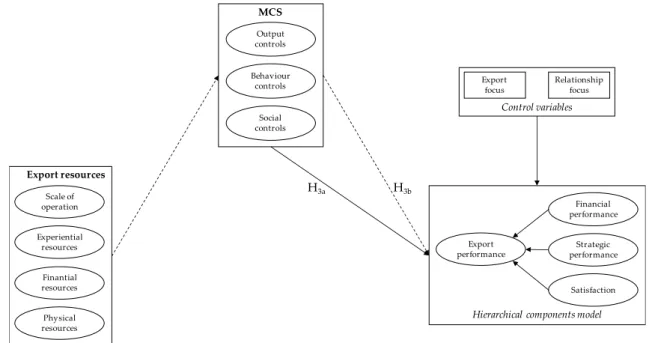
Following [54,88] and based on previous arguments, we propose examining the effect of control mechanisms on export performance (see Figure2):
Hypothesis 3a (H3a).MCSs are positively related to export performance.
Sustainability 2019, 11, x FOR PEER REVIEW 6 of 26
Informal (social or norm-based) controls are unwritten mechanisms that influence behavior through utilizing “values, norms, and cultures to encourage desirable behavior” [80]. Informal controls include professional and cultural controls [41,81,82]. Professional control refers to behavioral norms internalized by (inter)organizational members; these norms are based on prevailing social perspectives and patterns of interpersonal interactions [41] outside the hierarchical command system, such as training, seminars, working collaboration and spontaneous interactions over time [83–85]. Cultural control refers to norms, rituals and values that guide people’s behavior [41,86]. Social interactions can be used by managers to develop and encourage shared values, beliefs and interests that guide parties’ behaviors through socialization processes; so, informal mechanisms can collaborate in making parties feel as an integral part of a larger system [65,25], and even to favor the adoption of common procedures [87].
Following [54,88] and based on previous arguments, we propose examining the effect of control mechanisms on export performance (see Figure 2):
Hypothesis 3a (H3a). MCSs are positively related to export performance.
Figure 2. Hypotheses H3a, H3b and H3c. Source: Authors.
In recent years, there is a growing number of studies in RBV that considers MCSs as drivers to achieve competitive advantages in inter-organizational relationships [12,46,47,89–91]. Focusing on planning and implementation capabilities, Spyropoulou et al. [92] find that these architectural capabilities collaborate in achieving strategic goals in export markets; since, in an exporter–foreign intermediary relationship, MCSs are implemented and used both to create conditions that motivate the intermediary to achieve predetermined outcomes and to contribute to the definition and implementation of the strategy [16,93], these systems can play a key role in supporting the creation of value for organizations. Specifically, Mitter andHiebl[29] claim that this is relevant role of MCSs in the exploitation phase (once the firm has gone international) and in the continuous control of foreign operations. An essential condition to achieve a sustainable competitive advantage is that the company should be organized to exploit the resources and capabilities available [44], management capability playing a main role as the determinant of the exploitation learning [94], affecting the impact of resources on firm performance [95]. Baraldi et al. [96] argue that, to assist in the process of interaction of resources in inter-firm relationships, MCSs should indicate what resources (technical and organizational) and interfaces (interconnections or contact points for which two or more resources interact between two entities) are relevant to track them and measure them. The key issue
Scale of operation Experiential resources Finantial resources Physical resources Export resources Financial performance Strategic performance Satisfaction Export performance
Hierarchical components model Export focus Relationship focus Control variables H3b Output controls Behaviour controls Social controls MCS H3a
Figure 2.Hypotheses H3a, H3band H3c. Source: Authors.
In recent years, there is a growing number of studies in RBV that considers MCSs as drivers to achieve competitive advantages in inter-organizational relationships [12,46,47,89–91]. Focusing on planning and implementation capabilities, Spyropoulou et al. [92] find that these architectural capabilities collaborate in achieving strategic goals in export markets; since, in an exporter–foreign intermediary relationship, MCSs are implemented and used both to create conditions that motivate the intermediary to achieve predetermined outcomes and to contribute to the definition and implementation of the strategy [16,93], these systems can play a key role in supporting the creation of value for organizations. Specifically, Mitter and Hiebl [29] claim that this is relevant role of MCSs in the exploitation phase (once the firm has gone international) and in the continuous control of foreign operations. An essential condition to achieve a sustainable competitive advantage is that the company should be organized to exploit the resources and capabilities available [44], management capability playing a main role as the determinant of the exploitation learning [94], affecting the impact of resources on firm performance [95]. Baraldi et al. [96] argue that, to assist in the process of interaction of resources in inter-firm relationships, MCSs should indicate what resources (technical and organizational) and interfaces (interconnections or contact points for which two or more resources interact between two entities) are relevant to track them and measure them. The key issue for the inter-organizational
Sustainability2019,11, 3241 7 of 26
control is to be aware of the interdependencies between resources and make them explicit and traceable through control systems.
Therefore, we also propose examining the effect of controls on export performance as complementary capabilities that complement export capabilities mediating the resource–export performance association (see Figure2):
Hypothesis 3b (H3b).MCSs mediate the positive effect of export resources on export performance.
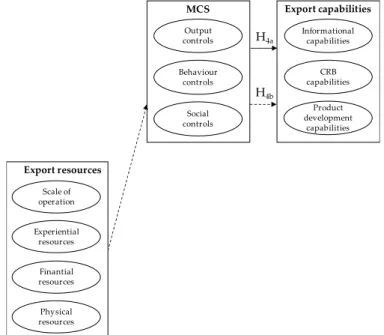
Albertini [97] argues the role of MCSs in fostering organizational capabilities and studies such as [89,90] and [98] show empirical evidence about the indirect influence of MCSs on companies’ performance by means of their impact on strategic capabilities, influencing on management and development of capabilities related to innovation, learning, market orientation and entrepreneurship. MCSs allow a company to improve operational effectiveness, employee creativity, and company competitiveness [12,99]. MCSs, when aligned with the capabilities and strategic resources of the organization, are not only an effective tool for strategy implementation and goals achievement, but they also contribute to identify and generate dynamic capabilities [47]. This reasoning leads to the following hypothesis (Figure3):
Hypothesis 4a (H4a).MCSs are positively related to export capabilities.
Sustainability 2019, 11, x FOR PEER REVIEW 7 of 26
for the inter-organizational control is to be aware of the interdependencies between resources and make them explicit and traceable through control systems.
Therefore, we also propose examining the effect of controls on export performance as complementary capabilities that complement export capabilities mediating the resource–export performance association (see Figure 2):
Hypothesis 3b (H3b). MCSs mediate the positive effect of export resources on export performance.
Albertini [97] argues the role of MCSs in fostering organizational capabilities and studies such as [89,90] and [98] show empirical evidence about the indirect influence of MCSs on companies’ performance by means of their impact on strategic capabilities, influencing on management and development of capabilities related to innovation, learning, market orientation and entrepreneurship. MCSs allow a company to improve operational effectiveness, employee creativity, and company competitiveness [12,99]. MCSs, when aligned with the capabilities and strategic resources of the organization, are not only an effective tool for strategy implementation and goals achievement, but they also contribute to identify and generate dynamic capabilities [47]. This reasoning leads to the following hypothesis (Figure 3):
Hypothesis 4a (H4a). MCSs are positively related to export capabilities.
Figure 3. Hypotheses H4a and H4b. Source: Authors.
Regarding innovation and operations processes, Brühl et al. [100] empirically argue that management control is an essential part of integration capability that is a necessary condition to align the different processes and, therefore, to drive sustainable competitive advantage. Besides, inter-firm relationships consist of routines, information and diverse forms of knowledge that managers need to be able to handle to achieve the interaction between resources; that is to say that the combination, recombination and co-development processes of resources occur when organizations interact [96]. Therefore, control mechanisms mediate how export resources impact on capabilities in such a way that we propose:
Hypothesis 4b (H4b). MCSs mediate the relationship between export resources and capabilities.
Ballesteros and Rehman et al. [98,101] empirically argue that capabilities can mediate the impact of MCSs on performance. Since MCSs are implemented to support users in their managerial process,
Scale of operation Experiential resources Finantial resources Physical resources Export resources Export capabilities Output controls Behaviour controls Social controls MCS H4b Informational capabilities CRB capabilities Product development capabilities H4a
Figure 3.Hypotheses H4aand H4b. Source: Authors.
Regarding innovation and operations processes, Brühl et al. [100] empirically argue that management control is an essential part of integration capability that is a necessary condition to align the different processes and, therefore, to drive sustainable competitive advantage. Besides, inter-firm relationships consist of routines, information and diverse forms of knowledge that managers need to be able to handle to achieve the interaction between resources; that is to say that the combination, recombination and co-development processes of resources occur when organizations interact [96]. Therefore, control mechanisms mediate how export resources impact on capabilities in such a way that we propose:
Sustainability2019,11, 3241 8 of 26
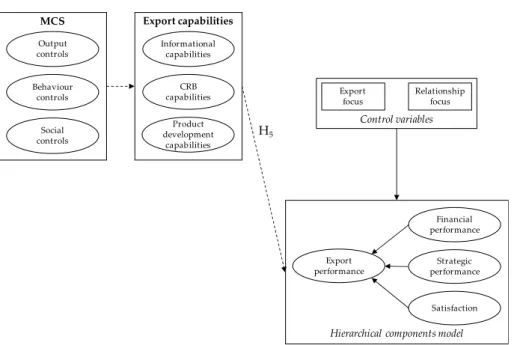
Ballesteros and Rehman et al. [98,101] empirically argue that capabilities can mediate the impact of MCSs on performance. Since MCSs are implemented to support users in their managerial process, the effect of these systems on export performance depends at a high level on the capacity of firm’s managers to effectively and efficiently use resources; that is, on export capabilities. Thus (Figure4): Hypothesis 5 (H5).Export capabilities mediate the relationship between MCSs and export performance.
Sustainability 2019, 11, x FOR PEER REVIEW 8 of 26
the effect of these systems on export performance depends at a high level on the capacity of firm’s managers to effectively and efficiently use resources; that is, on export capabilities. Thus (Figure 4): Hypothesis 5 (H5). Export capabilities mediate the relationship between MCSs and export performance.
Figure 4. Hypothesis H5. Source: Authors.
3. Research Design
3.1. Sample and Data Collection
For data collection purposes, in 2008, a cross-sector survey was administrated online to Spanish export firms. From a population of 2355 exporters obtained from a governmental trade office, several filters were applied to guarantee (1) the regularity in international activity, together with (2) the use of foreign intermediaries to approach export markets. As a result, an initial population of 656 firms was identified; 224 of them declined to participate, so the target sample included 432 firms.
Survey design followed recommended steps by [102] on data quality, including: (i) an extensive literature review; (ii) ten initial interviews to academics and professional in the field of international business management; and (iii) a pre-test, and refinement of the initial designed questionnaire by eight academics, three employees from the governmental trade office and six export managers in order to guarantee its clarity and content validity. We conducted two rounds of interviews with eight SME export managers from different industries, a foreign employee from a governmental trade office, and a consultant on international marketing; the selected firms were recommended to the research team by the governmental trade office with the aim of obtaining a representative sample of the diversity of the exporting companies. In addition, we also carried out two export management forums in which various firms, consultants, and managers discussed MCS matters
Mid-level managers with responsibility in finance and accounting tasks and leading MCS implementation were identified as key informants. In terms of information acquisition and support for monitoring, coordination and decision-making managerial functions, these managers are usually key players in any organization; furthermore, they play an important role, on the one hand, in internationalization decisions supplying information to support them [29] and, on the other hand, in supporting managerial processes in inter-firm relationships [103], even collaborating in the boundary definition and links between parties [104–106]. Following previous literature, respondents were asked to focus on an intermediary of secondary importance [65,107–109], who delivered a specific product/service to a market [110]. Such a product/market orientation tries to focus respondents on
Financial performance Strategic performance Satisfaction Export performance
Hierarchical components model Export focus Relationship focus Control variables Output controls Behaviour controls Social controls MCS H5 Informational capabilities CRB capabilities Product development capabilities Export capabilities
Figure 4.Hypothesis H5. Source: Authors. 3. Research Design
3.1. Sample and Data Collection
For data collection purposes, in 2008, a cross-sector survey was administrated online to Spanish export firms. From a population of 2355 exporters obtained from a governmental trade office, several filters were applied to guarantee (1) the regularity in international activity, together with (2) the use of foreign intermediaries to approach export markets. As a result, an initial population of 656 firms was identified; 224 of them declined to participate, so the target sample included 432 firms.
Survey design followed recommended steps by [102] on data quality, including: (i) an extensive literature review; (ii) ten initial interviews to academics and professional in the field of international business management; and (iii) a pre-test, and refinement of the initial designed questionnaire by eight academics, three employees from the governmental trade office and six export managers in order to guarantee its clarity and content validity. We conducted two rounds of interviews with eight SME export managers from different industries, a foreign employee from a governmental trade office, and a consultant on international marketing; the selected firms were recommended to the research team by the governmental trade office with the aim of obtaining a representative sample of the diversity of the exporting companies. In addition, we also carried out two export management forums in which various firms, consultants, and managers discussed MCS matters
Mid-level managers with responsibility in finance and accounting tasks and leading MCS implementation were identified as key informants. In terms of information acquisition and support for monitoring, coordination and decision-making managerial functions, these managers are usually key players in any organization; furthermore, they play an important role, on the one hand, in internationalization decisions supplying information to support them [29] and, on the other hand, in supporting managerial processes in inter-firm relationships [103], even collaborating in the boundary definition and links between parties [104–106]. Following previous literature, respondents were
Sustainability2019,11, 3241 9 of 26
asked to focus on an intermediary of secondary importance [65,107–109], who delivered a specific product/service to a market [110]. Such a product/market orientation tries to focus respondents on the management of a relationship, avoiding bias towards the most successful experience or the average of all export ventures [1,111].
Managers received an e-mail including a specific password to complete the online survey, which was administered over 5 weeks, including several reminder calls and an incentive of a 5€charitable donation. Finally, 85 firms provided a valid response to the questionnaire, which represent a response rate of 13%, similar to other research in supply chain management studies [112,113]; 53% of these companies exported agrifood products, approximately 26% non-agrifood consumer products, 16% industrial production goods and the remaining ones provided services.
3.2. Construct Measures
The final questionnaire (see AppendixA) included 42 items that measure finance directors’ perceptions on export resources, export capabilities, MCS design, and export performance; as Xie and Suh [6] argue, managers’ perceptions play a major role in a SME’s decision-making processes regarding internationalization. All constructs were measured as reflective, but performance was operationalized as a second-order hierarchical mixed (reflective–formative) factor. As far as possible, previous validated scales in management control research literature were considered and adapted to the specific export framework; due to the absence of a large body of research on inter-organizational relationships, some well-known scales from intra-organizational settings were initially considered and adapted to the specific export environment [114].
Export resources and capabilities. Export resources and capabilities were measured using [1] proposal. A list of 10 items (see AppendixA) concerning four areas of competitive resources was defined, including experiential resource (3 items), scale of operation (2 items), physical resources (3 items) and financial resources (2 items). Three different export capabilities were asked in the questionnaire: informational capability (4 items), customer relationship building (2 items) and product development (3 items). Finance managers were asked to rank the position of the firm compared to main direct competitors using a 7-point Likert scale ranging from “1—much worse” to “7—much better”. These relative assessments assumed that respondents had an explicit reference frame in comparison with competitors, in accordance with the RBV, and to more easily assess their responses [54].
MCS design.MCSs were measured using a scale by Aulakh and Gencturk [25] for both formal and informal controls: outcome-based control (5 items), behavior-based control (4 items), and social control (5 items). These definitions represent an adaptation to the international settings of the widely accepted formal control definitions by [115]. A 7-point Likert scale was used to measure items.
Export performance. Export performance is broadly defined as the outcome of a firm’s activities in export markets [116]. However, there is no universal measure of export performance [111,117] that captures the multi-dimensionality of performance [118]. Conceptual definitions of export performance include export effectiveness, efficiency, and continuous engagement in exporting [119]. Measures of export performance have included a myriad of indicators, with export intensity, export sales growth, export profit level, export sales volume, export market share, and export profit contribution as the most used measures of export performance [117,120,121]. Ling-Yee and Ogunmokun [122] add management’s perceived export advantages as an important determinant of export performance.
Since individual measures are not enough to capture the rich complexity of the export performance construct, multidimensional measures emerge as a useful alternative. Following this view, Zou et al. [118] developed a broad export performance measure, the EXPERF scale, which incorporates the major perspectives used in previous studies and includes three dimensions to measure export performance that can be aggregated into a global measure of performance trying to overcome the difficulties of performance measurement [121]: financial, strategic and perceived performance.
Due to the absence of a widely accepted definition of export performance, we used a multi-dimensional EXPERF scale by [118] that considers three different dimensions: financial
Sustainability2019,11, 3241 10 of 26
performance (3 items), strategic performance (3 items), and perceived performance/satisfaction (3 items). This scale is considered one of the most comprehensive export performance scales, gathering insights from the literature in strategy, management, marketing and exporting. As a result of the multiple nature of export performance, it was measured as a second-order factor, which includes three first-order variables (performance dimensions being individually reflective) that act as formative to build the overall performance construct.
Control variables. Two control variables were included for validity issues. First, the firm’s export importance as a proxy for export intensity which measures internationalization; this index is determined by the ratio of sales from export to total sales revenue, as used in most international studies [123–125]. Second, export relationship’s importance, measured by the percentage of sales from this relationship with the foreign intermediary; this variable indicates the total exposure to potential opportunism and the requirements for coordination with the intermediary [126].
3.3. Non-Response and Common Method Bias
Non-response bias could become a serious problem if differences between respondents and non-respondents arise, and if such differences affect the results. Non-response bias was tested by comparing responses between early and late respondents with respect to any construct in the model, together with primary demographic features (SIC code, firm size). On the assumption that late respondents are similar to non-respondents [127], a t-test for two independent samples was run, showing no statistical difference between group averages; as a result, no evidence of structural differences between sample and population characteristics was found (p>0.05).
Common method bias was also a concern since respondents are asked about dependent and independent variables at the same time. Following the recommendation by [128], Harman’s single-factor test was used to assess common method bias; all items were loaded to an un-rotated principal component analysis (eigenvalues greater than 1.0). The results reported nine factors accounting for 74.87%; since the first factor does not account for the majority of variance (32.43%), common method bias is not considered as a major concern [128].
4. Results and Discussion
Partial Least Squares (PLS) was used for model testing, using Smart PLS 2.0. M3 software [129]. PLS was selected due to several advantages over covariance-based SEM techniques that suit this research [130]: (i) PLS allows testing theories in an early stage of development, where models are more exploratory than confirmatory in nature [131]; (ii) PLS is suitable for analyzing small samples but a large number of latent construct and manifest variables [132]; (iii) PLS is an adequate technique to test models that include both formative and reflective constructs [133]; (iv) PLS does not require data from a multivariate normal distribution [134]. Finally, PLS tests both the measurement model and the structural model simultaneously.
4.1. Measurement Model
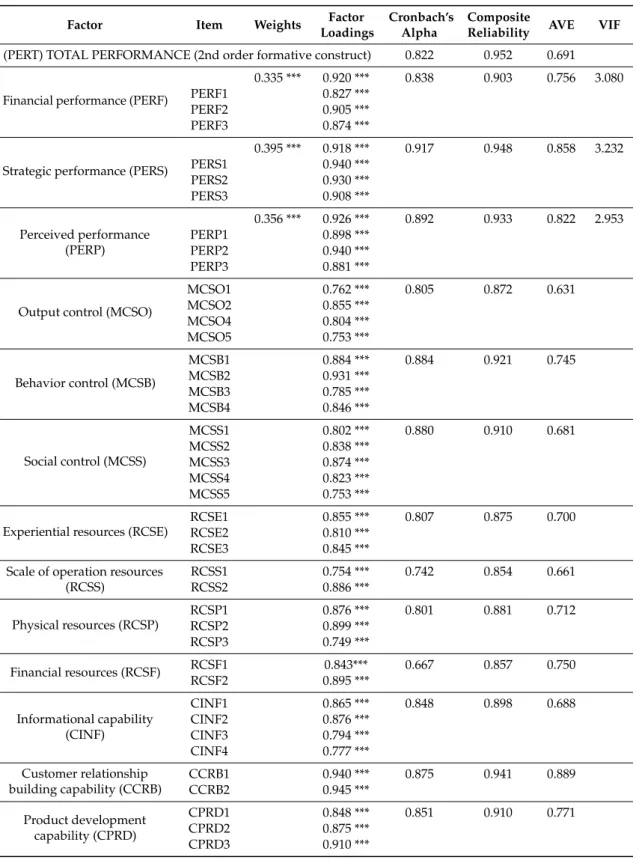
As a first stage in evaluating the measurement model, construct validity was assessed for any theoretical variable (Table1). For the purpose of increasing model reliability, one item was removed from the final model since it was not found to be reliable to measure the underlying construct (MCSO3 in output control variable).
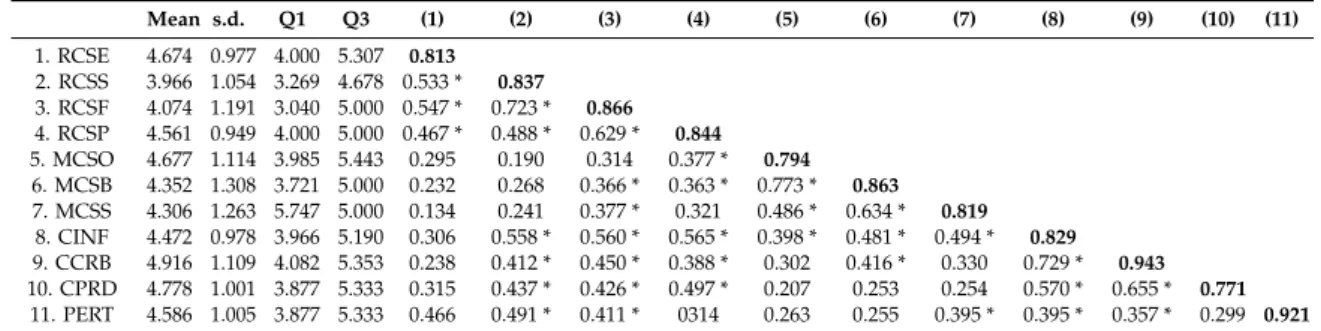
For reflective constructs, any standardized factor loading was over 0.7, supporting indicator reliability; a non-parametric bootstrapping procedure was also used to assess statistical significance (5000 samples) [135]. Internal consistency was assessed using Cronbach’s alpha and composite reliability measures; both measures are over the recommended value of 0.70 [136]. Discriminant validity was assessed by comparing the squared root of the average variance extracted (AVE) for each construct with the correlation between it and any other construct [137]; each construct showed a
Sustainability2019,11, 3241 11 of 26
greater variance with items measuring it (square root of the AVE) than with another different constructs (Table2). Besides, AVE values were over the 0.5 value recommended to guarantee convergent validity.
Table 1.Measurement model.
Factor Item Weights Factor
Loadings
Cronbach’s Alpha
Composite
Reliability AVE VIF
(PERT) TOTAL PERFORMANCE (2nd order formative construct) 0.822 0.952 0.691
Financial performance (PERF)
0.335 *** 0.920 *** 0.838 0.903 0.756 3.080 PERF1 0.827 ***
PERF2 0.905 *** PERF3 0.874 ***
Strategic performance (PERS)
0.395 *** 0.918 *** 0.917 0.948 0.858 3.232 PERS1 0.940 *** PERS2 0.930 *** PERS3 0.908 *** Perceived performance (PERP) 0.356 *** 0.926 *** 0.892 0.933 0.822 2.953 PERP1 0.898 *** PERP2 0.940 *** PERP3 0.881 ***
Output control (MCSO)
MCSO1 0.762 *** 0.805 0.872 0.631 MCSO2 0.855 *** MCSO4 0.804 *** MCSO5 0.753 *** Behavior control (MCSB) MCSB1 0.884 *** 0.884 0.921 0.745 MCSB2 0.931 *** MCSB3 0.785 *** MCSB4 0.846 *** Social control (MCSS) MCSS1 0.802 *** 0.880 0.910 0.681 MCSS2 0.838 *** MCSS3 0.874 *** MCSS4 0.823 *** MCSS5 0.753 ***
Experiential resources (RCSE)
RCSE1 0.855 *** 0.807 0.875 0.700 RCSE2 0.810 ***
RCSE3 0.845 *** Scale of operation resources
(RCSS) RCSS1 0.754 *** 0.742 0.854 0.661 RCSS2 0.886 *** Physical resources (RCSP) RCSP1 0.876 *** 0.801 0.881 0.712 RCSP2 0.899 *** RCSP3 0.749 *** Financial resources (RCSF) RCSF1 0.843*** 0.667 0.857 0.750 RCSF2 0.895 *** Informational capability (CINF) CINF1 0.865 *** 0.848 0.898 0.688 CINF2 0.876 *** CINF3 0.794 *** CINF4 0.777 *** Customer relationship building capability (CCRB) CCRB1 0.940 *** 0.875 0.941 0.889 CCRB2 0.945 *** Product development capability (CPRD) CPRD1 0.848 *** 0.851 0.910 0.771 CPRD2 0.875 *** CPRD3 0.910 ***
***p<0.001 (SmartPLS 2.0.M3, 5000 bootstrapping samples; [129].
A two-step approach based on the repeated use of manifest variables was used to build the hierarchical mixed factor [132,138,139]. Due to the formative nature of the second-order factor,
Sustainability2019,11, 3241 12 of 26
alternative measures were used to assess construct validity. Firstly, items’ relative contribution was assessed in terms of indicator weights [140], any of them being statistically significant. The significance of factor loadings was also tested as a complementary analysis to the weights [130]. Multicollinearity was assessed in terms of variance inflation factors (VIFs); following [130] recommendations, any VIF was under the critical 5 value, so multicollinearity does not seem to be a problem for the performance construct.
Table 2.Descriptives and correlations.
Mean s.d. Q1 Q3 (1) (2) (3) (4) (5) (6) (7) (8) (9) (10) (11) 1. RCSE 4.674 0.977 4.000 5.307 0.813 2. RCSS 3.966 1.054 3.269 4.678 0.533 * 0.837 3. RCSF 4.074 1.191 3.040 5.000 0.547 * 0.723 * 0.866 4. RCSP 4.561 0.949 4.000 5.000 0.467 * 0.488 * 0.629 * 0.844 5. MCSO 4.677 1.114 3.985 5.443 0.295 0.190 0.314 0.377 * 0.794 6. MCSB 4.352 1.308 3.721 5.000 0.232 0.268 0.366 * 0.363 * 0.773 * 0.863 7. MCSS 4.306 1.263 5.747 5.000 0.134 0.241 0.377 * 0.321 0.486 * 0.634 * 0.819 8. CINF 4.472 0.978 3.966 5.190 0.306 0.558 * 0.560 * 0.565 * 0.398 * 0.481 * 0.494 * 0.829 9. CCRB 4.916 1.109 4.082 5.353 0.238 0.412 * 0.450 * 0.388 * 0.302 0.416 * 0.330 0.729 * 0.943 10. CPRD 4.778 1.001 3.877 5.333 0.315 0.437 * 0.426 * 0.497 * 0.207 0.253 0.254 0.570 * 0.655 * 0.771 11. PERT 4.586 1.005 3.877 5.333 0.466 0.491 * 0.411 * 0314 0.263 0.255 0.395 * 0.395 * 0.357 * 0.299 0.921
Source: Authors. Notes: Bivariate Pearson correlations with Bonferroni adjustment (* significant atp<0.05); square root of average variance extracted (AVE) being included in bold.
4.2. Structural Model
Table 3 summarizes results for the structural (path) model, where bootstrapping was also performed to test the statistical significance of path models; both individual performance dimensions and overall performance are considered, respectively.
Table 3.Structural model. Paths.
Full Model (Partial Mediation) MCS Export Capabilities PERT MCSO MCSB MCSS CINF CCRB CPRD RCSS −0.118 0.003 −0.022 0.335 ** 0.179 0.234 * 0.366 ** RCSE 0.178+ 0.020 −0.066 −0.097 −0.026 0.025 0.379 ** RCSF 0.125 0.215 * 0.348 * 0.035 0.149 −0.016 −0.127 RCSP 0.280 * 0.221 * 0.154 0.303 ** 0.126 0.374 * −0.008 MCSO 0.022 −0.077 −0.050 0.078 MCSB 0.117 0.293 * 0.034 −0.251 MCSS 0.254 ** 0.061 0.083 0.425 ** CINF −0.105 CCRB 0.220 * CPRD −0.078 Control variables
% sales export activ. −0.035
% sales relationship −0.118
R2 0.182 0.166 0.169 0.547 0.304 0.314 0.464
Q2 0.117 0.125 0.117 0.344 0.227 0.214 0.367
GoF 0.479
**p<0.01; *p<0.05;+p<0.1. Source: Authors.
The results suggest that the model has good predictability in terms of R2for export performance
(46.38%), also for export capabilities. The results reveal that the 54.65% of the informational capability variance, 30.35% of the CRM capability variance, and 31.35% of the product development capability variance are explained by the model. Finally, R2values are more reduced for MCSs constructs, with the explained variance being slightly below 20%.
Sustainability2019,11, 3241 13 of 26
Besides, Q2 values obtained by blindfolding procedures are largely over 0, suggesting the predictive relevance of the model (Q2>0, [140,141]). Finally, the goodness of fit (GoF) index reaches 0.479, which exceeds the cut-offvalue of 0.36 for large effects proposed by [136], providing a pseudo global fit measure for PLS path modelling [135]. However, the GoF index has been criticized by recent literature, since inconsistencies have been observed in different simulation analyses [142]; as a result, fitting conclusions based on GoF must be used with precaution.
On PLS path coefficients, total effects and indirect effects were finally computed. Hypotheses testing is discussed in terms of statistically significant effects (p<0.05); weak effects are also highlighted where available (p<0.10).
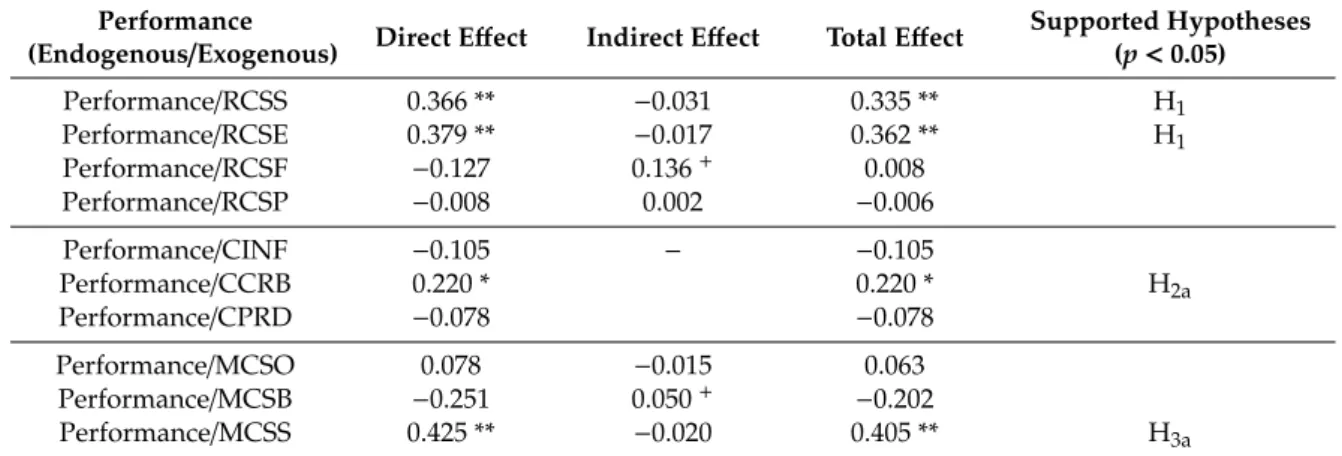
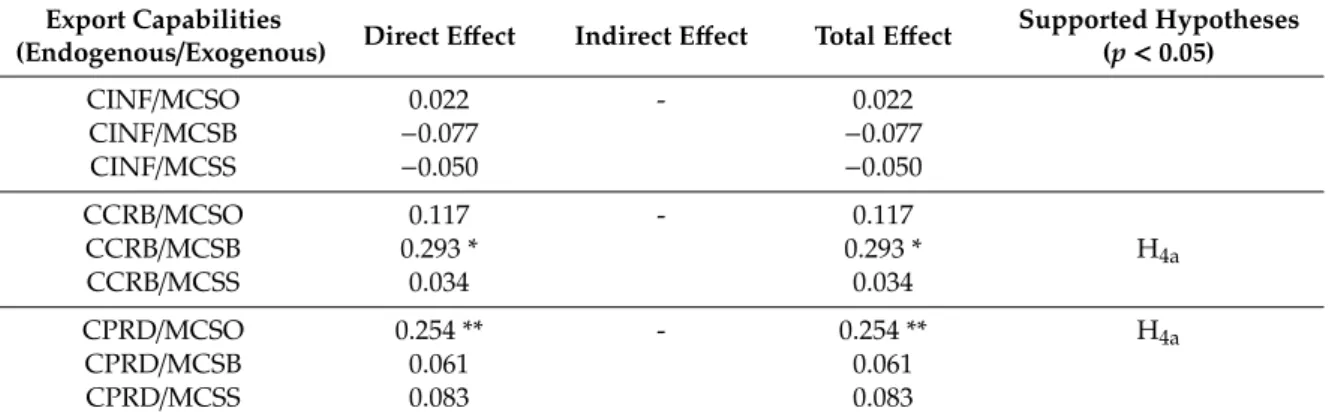
Total effects are summarized in Table4for H1, H2aand H3atesting, and in Table5for H4atesting.
As observed (Table4), both the scale of operations and experiential resources have a positive and significant effect on performance, supporting H1. However, no significant effects of financial or physical
resources are observed on performance, so not one of them are indispensable to be successful in foreign markets, which is particularly important for SMEs with restriction to access finance. Besides, building customer relationships is found to be the key capability to achieve superior performance in export markets (H2a); on the contrary, informational and product development variables are not found to have
a significant impact on export performance. So, having information is not enough to produce benefits if firms do not use data for reaching the customer, building and nurturing a long-term relationship; besides, having an adapted/differentiated product is not enough to gain performance if the firm is not able to offer it adequately to each client, considering specific customer relationship characteristics. In regard to MCSs, social (informal) control on the foreign intermediary relationship is found to have a strong and positive effect on performance (H3a), while formal controls do not have a significant impact
on it. Regarding the total effects of MCSs on export capabilities, Table5shows partial support for H4a: there are significant and positive direct effects of both behavior control on customer relationship
building (CRB) capabilities and output control on product development capabilities, suggesting formal MCSs impact positively on developing export capabilities.
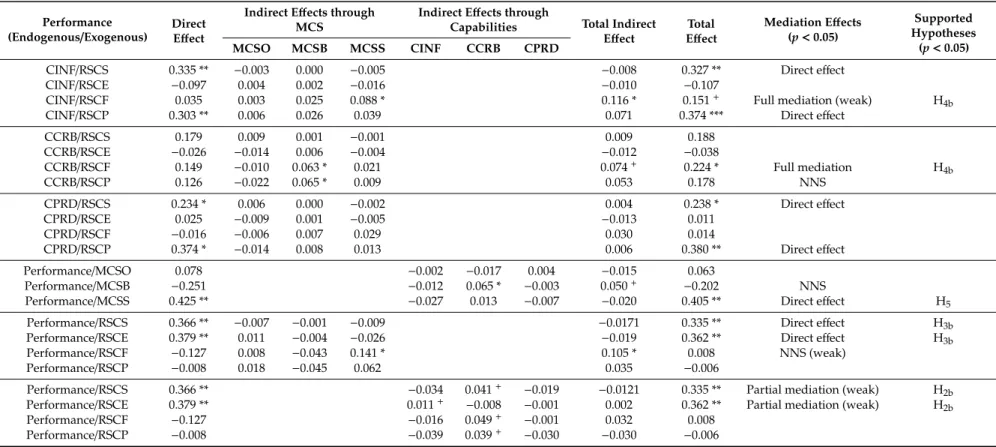
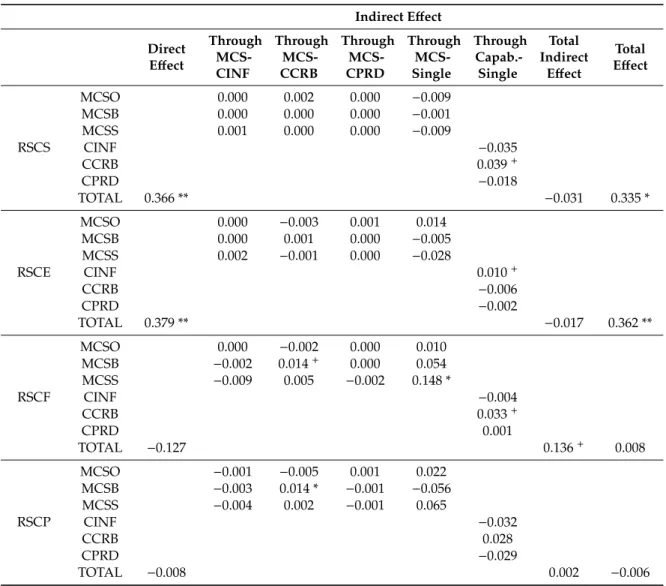
Tables6and7summarize the mediation effects, which help to better understand how total effects are built. Indirect effects were estimated using bias-accelerated bootstrapping procedures (5000 subsamples) that generate robust estimates in the presence of non-normality samples [143]. In order to analyze the double mediation of export resources on performance—first by MCSs and second by capabilities—we used a step-by-step analysis [144]. Firstly (Table6), we consider each mediator (MCSs and Capabilities) separately. Secondly (Table7), we separate each mediating effect into two different components: double indirect effect, which considers the joint influence of both mediators through the sequential impact of one on another; and single indirect effect, which measures the residual indirect effect of each mediator once the double effect is excluded.
Table 4.Hypothesis testing. Total effects (H1, H2aand H3a).
Performance
(Endogenous/Exogenous) Direct Effect Indirect Effect Total Effect
Supported Hypotheses (p<0.05) Performance/RCSS 0.366 ** −0.031 0.335 ** H1 Performance/RCSE 0.379 ** −0.017 0.362 ** H1 Performance/RCSF −0.127 0.136+ 0.008 Performance/RCSP −0.008 0.002 −0.006 Performance/CINF −0.105 − −0.105 Performance/CCRB 0.220 * 0.220 * H2a Performance/CPRD −0.078 −0.078 Performance/MCSO 0.078 −0.015 0.063 Performance/MCSB −0.251 0.050+ −0.202 Performance/MCSS 0.425 ** −0.020 0.405 ** H3a **p<0.01; *p<0.05;+p<0.1. Source: Authors.
Sustainability2019,11, 3241 14 of 26
Table 5.Hypothesis testing. Total effects (H4a).
Export Capabilities
(Endogenous/Exogenous) Direct Effect Indirect Effect Total Effect
Supported Hypotheses (p<0.05) CINF/MCSO 0.022 - 0.022 CINF/MCSB −0.077 −0.077 CINF/MCSS −0.050 −0.050 CCRB/MCSO 0.117 - 0.117 CCRB/MCSB 0.293 * 0.293 * H4a CCRB/MCSS 0.034 0.034 CPRD/MCSO 0.254 ** - 0.254 ** H4a CPRD/MCSB 0.061 0.061 CPRD/MCSS 0.083 0.083 **p<0.01; *p<0.05. Source: Authors.
The results show that CRB, besides having a positive effect on performance by itself, weakly mediates the relationship between any resource (but experiential) and performance (H2b) (p<0.1). Thus,
export resources could help building profitable customer relationships by providing the initial means to access and manage clients. A weak indirect effect is also found between the experiential resource and performance through informational capability; it suggests that export experience impacts on performance both directly but also indirectly by helping to produce valuable information about markets. MCSs also impact on the relationships between resources and export performance. An indirect effect of financial resources on performance is found through social control (H3b); as a result, financial
resources act as a needed (but not sufficient) condition to increase performance. In the presence of high financial resources, social controls are stimulated; such a result could be due to the fact that establishing social controls (as foreign visits) is more expensive than formal controls, so an extra bundle of money could be needed to implement them. In addition, when in place, such informal mechanisms make the difference over formal controls to increase benefits.
Similarly, social control is a full mediator of financial resources on informational capability (H4b);
through its impact on social control, financial resources were found to help develop informational capabilities on the foreign market, even if just a weak total effect is found (p<0.1). Besides, financial resources were found to have a positive and significant effect on CRB through behavior control (full mediation). An indirect effect of physical resources on CRB through behavior control is also observed, even if total effect is not found to be significant. Therefore, the bigger the tangible resources (as plant, capacity, or money), the more intense the control on intermediary behavior to assure customer relationships are being nurtured as planned so resources are not wasted; besides, positive effects of the scale of operations and physical resources were found on both informational and product development capabilities, even if no mediation effects through MCSs are found. Also, the results show an indirect effect of behavior control on performance through CRB (H5), even if such a control is just necessary
(but not sufficient) to increase performance.
As a result of previous sequential effects, a significant double indirect effect is found between financial resources, behavior control, CRB, and performance (p<0.10). Also between physical resources, behavior control, CRB, and performance (p<0.05); however, such double indirect effects are not enough to generate a positive impact of physical resources on performance. On the contrary, previously reported indirect effects of social control and CRB on performance were found to be single effects, where no synergies between MCSs and capabilities emerge.
Sustainability2019,11, 3241 15 of 26
Table 6.Hypothesis testing. Mediating effects. Performance
(Endogenous/Exogenous)
Direct Effect
Indirect Effects through MCS
Indirect Effects through
Capabilities Total Indirect Effect Total Effect Mediation Effects (p<0.05) Supported Hypotheses (p<0.05) MCSO MCSB MCSS CINF CCRB CPRD
CINF/RSCS 0.335 ** −0.003 0.000 −0.005 −0.008 0.327 ** Direct effect
CINF/RSCE −0.097 0.004 0.002 −0.016 −0.010 −0.107
CINF/RSCF 0.035 0.003 0.025 0.088 * 0.116 * 0.151+ Full mediation (weak) H4b
CINF/RSCP 0.303 ** 0.006 0.026 0.039 0.071 0.374 *** Direct effect CCRB/RSCS 0.179 0.009 0.001 −0.001 0.009 0.188 CCRB/RSCE −0.026 −0.014 0.006 −0.004 −0.012 −0.038 CCRB/RSCF 0.149 −0.010 0.063 * 0.021 0.074+ 0.224 * Full mediation H4b CCRB/RSCP 0.126 −0.022 0.065 * 0.009 0.053 0.178 NNS CPRD/RSCS 0.234 * 0.006 0.000 −0.002 0.004 0.238 * Direct effect CPRD/RSCE 0.025 −0.009 0.001 −0.005 −0.013 0.011 CPRD/RSCF −0.016 −0.006 0.007 0.029 0.030 0.014 CPRD/RSCP 0.374 * −0.014 0.008 0.013 0.006 0.380 ** Direct effect Performance/MCSO 0.078 −0.002 −0.017 0.004 −0.015 0.063 Performance/MCSB −0.251 −0.012 0.065 * −0.003 0.050+ −0.202 NNS
Performance/MCSS 0.425 ** −0.027 0.013 −0.007 −0.020 0.405 ** Direct effect H5
Performance/RSCS 0.366 ** −0.007 −0.001 −0.009 −0.0171 0.335 ** Direct effect H3b
Performance/RSCE 0.379 ** 0.011 −0.004 −0.026 −0.019 0.362 ** Direct effect H3b
Performance/RSCF −0.127 0.008 −0.043 0.141 * 0.105 * 0.008 NNS (weak)
Performance/RSCP −0.008 0.018 −0.045 0.062 0.035 −0.006
Performance/RSCS 0.366 ** −0.034 0.041+ −0.019 −0.0121 0.335 ** Partial mediation (weak) H2b
Performance/RSCE 0.379 ** 0.011+ −0.008 −0.001 0.002 0.362 ** Partial mediation (weak) H2b
Performance/RSCF −0.127 −0.016 0.049+ −0.001 0.032 0.008
Performance/RSCP −0.008 −0.039 0.039+ −0.030 −0.030 −0.006
***p<0.001; **p<0.01; *p<0.05;+p<0.1; SmartPLS 2.0.M3, 5000 bootstrapping samples [129]. Indirect effects based on bias-corrected accelerated bootstrap estimates t(4,999) [143]. Source: Authors. Note: in this table, total indirect effect for each mediator (e.g., MCSs) includes double indirect effects (MCSs and capabilities) and single indirect effects (MCSs excluding the relationship MCSs–Capabilities). As a result, the accumulated total indirect effect in Table7is not the arithmetic sum of the total indirect effects of each mediator, since the double indirect effect would be repeated. See Table7for a more detailed analysis. NNS: necessary but not sufficient.
Sustainability2019,11, 3241 16 of 26
Table 7.Single, double, and joint indirect effects (details).
Indirect Effect Direct Effect Through MCS-CINF Through MCS-CCRB Through MCS-CPRD Through MCS-Single Through Capab.-Single Total Indirect Effect Total Effect RSCS MCSO 0.000 0.002 0.000 −0.009 MCSB 0.000 0.000 0.000 −0.001 MCSS 0.001 0.000 0.000 −0.009 CINF −0.035 CCRB 0.039+ CPRD −0.018 TOTAL 0.366 ** −0.031 0.335 * RSCE MCSO 0.000 −0.003 0.001 0.014 MCSB 0.000 0.001 0.000 −0.005 MCSS 0.002 −0.001 0.000 −0.028 CINF 0.010+ CCRB −0.006 CPRD −0.002 TOTAL 0.379 ** −0.017 0.362 ** RSCF MCSO 0.000 −0.002 0.000 0.010 MCSB −0.002 0.014+ 0.000 0.054 MCSS −0.009 0.005 −0.002 0.148 * CINF −0.004 CCRB 0.033+ CPRD 0.001 TOTAL −0.127 0.136+ 0.008 RSCP MCSO −0.001 −0.005 0.001 0.022 MCSB −0.003 0.014 * −0.001 −0.056 MCSS −0.004 0.002 −0.001 0.065 CINF −0.032 CCRB 0.028 CPRD −0.029 TOTAL −0.008 0.002 −0.006
**p<0.01; *p<0.05;+p<0.1; t(4,999), SmartPLS 2.0.M3, 5000 bootstrapping samples [129]. Indirect effects based on bias-corrected accelerated bootstrap estimates [143].
5. Conclusions
The present study examined the mediating influence of formal and informal control mechanisms and export capabilities on the relationship between resources and export performance. Our findings revealed that social control played a partially mediating role, acting as a significant intermediate variable between resources (financial) and capabilities (informational) on export performance in SMEs. In line with [13], social control is found to be the critical (informal) control that managers should promote to increase performance when managing international export relationships. SMEs are used to be less formalized, even in relation to management control practices [72]; particularly, social and informal mechanisms play a relevant role complementing formal elements when firms handle uncertainty in their environment [145] and exports markets [34,61], being significant as a source of information and collaborating in sustaining inter-firm relationships [146]. Also, MCSs have been found to be affected by export resources: a higher level of committed physical resources (as technology equipment or production capacity) leads to establishing higher formal controls; besides, higher financial resources help to establish wider social controls. Customer relationship building capability has been identified as key to increase performance; behavior control has a direct effect on such a capability and mediates the impact of financial resources to build CRB. Also, the scale of
Sustainability2019,11, 3241 17 of 26
operations and experiential resources were found to be the key resources to increase performance; besides, a weak indirect effect of financial resources through social control is observed.
Our study extends other studies, rooted in transaction cost economics [66,147], showing a picture about the role of MSCs as a catalyst that orients the combinations of resources in order to build capabilities and increasing export performance. Following the RBV framework, our analysis supports that MCSs play a significant role to manage international relationships, being able to improve export performance when SMEs use intermediaries to gaining access into international markets. Furthermore, this research provides empirical evidence about the influence of MCSs on exporting SMEs, the connections of the management control within inter-organizational relationships aimed at aligning the interests and actions of boundary spanners [28,148] expanded to an international context, and about how the selection of proper information through the implementation of MCSs affects organizations [149] and the international inter-organizational relationship [20,25,46]. These findings have clear implications not only for managers but for governmental trade agencies that should promote the implementation of control tools in SMEs both through training for managers focused on design and use and by helping to implement IT that support them. In addition, since control systems play an important role in measuring, monitoring and coordinating companies’ operations in order to manage resources efficiency, these systems encompass sustainability issues not only related to the proper management of resources consumptions, but they can also supply visibility about environmental and social impacts [150,151], and supporting sustainable decision-making processes [152].
6. Limitations and Further Research Avenues
Conclusions and implications are subject to several limitations, providing further research avenues in this setting. Firstly, this study was carried out among SMEs, which compose the production base in modern developed economies. Future studies could search for differences with larger exporters, who have more resources, qualified personnel, bargaining power, etc., and more options for internationalization. Secondly, it could be interesting to take into consideration the views of foreign intermediaries, not only the perspective of the exporting firm.
Thirdly, it is often hard to differentiate the managerial influence of formal and informal mechanisms [153], and, even in SMEs, formal elements are likely for a high integration, therefore being more difficult to empirically separate them. Literature recognizes interactions between control types as complementary, supplementary or even opposite elements affecting organizational [153] and inter-organizational [85] outcomes. For example, Araujo et al. [34] find that in social interactions based on the visits made by the manufacturing companies’ export managers to intermediaries’ facilities, information provided by formal mechanisms (for example, on goals, sales, customers and products) is discussed, facilitating the coordination and monitoring of the export channel; Yang et al. [36] suggest that outcome-based control complements informal control to enhance export performance when combined; and Kim and Tiwana [154], analyzing the effect of controls on salesperson performance, find that informal mechanisms condition the context in which formal devices are deployed, and hence how the interaction of these elements affects performance. Therefore, control mechanisms’ impact on export performance is likely to be examined in combination, analyzing the joint effects of controls and so assuming a holistic perspective that regards MCSs as a control system package [64,155].
Lastly, studies by [12,34,46] have shown evidence about how MCSs collaborate in improving export performance in an externalized channels context assuming the export manager’s point of view. However, literature has not researched this issue by adopting the perspective of managers with responsibility in finance and accounting tasks and leading MCS implementation; although recent studies have explored some emergent roles of MCSs and controllers, also identifying some factors that might affect them [106,156–158], knowledge about how MCSs implemented by controllers in SMEs impact on export performance in an interorganizational context has been scarce. Although our research was not addressed to this issue, we have shed light on this issue even though more specific research is required. In line with authors that suggest that the role of the controller and the role of MCSs are