ZIDS - A Privacy-Preserving
Intrusion Detection System using
Secure Two-Party Computation
Protocols
Salman Niksefat
1, Babak Sadeghiyan
1, Payman Mohassel
2and Saeed Sadeghian
21
Computer Engineering and Information Technology Department, Amirkabir University of Technology, Tehran, Iran
2
Computer Science Department, University of Calgary, Calgary, AB, T2N1N4, Canada Email: [email protected]
We introduce ZIDS, a client-server solution for private detection of intrusions that is suitable for private detection of zero-day attacks in input data. The system includes an IDS server that has a set of sensitive signatures for zero-day attacks and IDS clients that possess some sensitive data (e.g. files, logs). Using ZIDS, each IDS client learns whether its input data matches any of the zero-day signatures, but neither party learns any additional information. In other words, the IDS client learns nothing about the zero-day signatures and the IDS server learns nothing
about the input data and the analysis results.
To solve this problem, we reduce privacy-preserving intrusion detection to an instance of secure two-party oblivious deterministic finite automata evaluation (ODFA). Then, motivated by the fact that the DFAs associated with attack signature are often sparse, we propose a new and efficient ODFA protocol that takes advantage of this sparsity. Our new construction is considerably more efficient than the existing solutions and at the same time does not leak any
sensitive information about the nature of the sparsity in the private DFA. We provide a full implementation of our privacy-preserving system which includes optimizations that lead to better memory usage and evaluate its performance on
rule sets from the Snort IDS.
Keywords: Secure Two-Party Computation; Oblivious DFA Evaluation; Privacy-Preserving Intrusion Detection; Zero-day Signatures
1. INTRODUCTION
Vulnerabilities are typically found and reported by “white hat” hackers through a range of techniques such as fuzz testing, reverse engineering or source code analysis. Some organizations are even willing to offer financial incentives in return for new vulnerabilities. An example of a program encouraging hackers to report their bugs is the TippingPoint’s Zero Day Initiative (ZDI) [1], which pays for new vulnerabilities discovered in existing systems. Other examples include Mozilla’s Security Bug Bounty Program [2], or a similar program by Google for security of its web applications [3].
New (zero-day) vulnerabilities are often discovered months before an attack outbreak. But, due to the complexity of the existing software products, or simply due to bad security practices, designing the appropriate patches and incorporating them into the
existing systems takes a long time. In fact, patch development times can vary from a few days to several years in worst cases, and several months of delay between the time a vulnerability is reported and when a patch becomes available to the users seems to be a reasonable estimate (e.g. see the following statistics from Trapkit [4]).
Hence, it is critical for security vendors and service providers to closely watch the development of new vulnerabilities and to provide their customers with the necessary protection in a timely manner. Commonly, once a new vulnerability is discovered and reported, security vendors generate and distribute the relevant filters (signatures) to their customers through the deployed intrusion prevention and detection systems (IPS/IDS).
Privacy of Signatures. There are strong reasons for keeping IDS signatures private. Firstly, the signatures can be analyzed by attackers who could potentially use them to learn the vulnerabilities and design their own exploits. This is specially the case for signatures of zero-day exploits. In other words, the IPS/IDS devices can become a source of information for attackers who wish to learn and design new attacks. The following quote from ZDI’s disclosure policy demonstrates that security experts are well aware of the sensitivity of such information:
“TippingPoint may share technical details of the vulnerability with other security vendors ... Such a security vendor must show they are able to provide security protection for vulnerabilities, while at the same time not revealing the technical vulnerability details in their product updates.”
Secondly, many security vendors consider their pro-tection mechanisms proprietary and are not willing to make it accessible to their competitors. However, ensur-ing that the product updates do not reveal the sensitive details of the vulnerabilities and/or hide the informa-tion considered proprietary by the vendors can be a challenging task in the traditional setting.
Zero-Day Detection as a Remote Service. A natu-ral solution is to provide a customized intrusion pro-tection/detection service for zero-day vulnerabilities, through a remote server that allows the security ven-dors to keep the sensitive information on their side and hide the details of the vulnerabilities from their users. Privacy of Client’s Data. On the other hand, a remote solution would require the users to share their suspicious data with the service provider, which raises privacy concerns of its own. Users may not be willing to share their input with the IPS/IDS providers since this data could include private network activities, URLs, personal files and emails. The client side privacy concerns are valid even if the IDS device is not managed remotely, since there is the possibility of exporting users’ data by untrusted IDS devices.
Privacy of the Analysis Results. Besides the privacy of client’s input data, the outcome of the intrusion analysis itself can be considered sensitive information, specially for zero-day vulnerabilities. Many companies prefer not to reveal the specifics of the vulnerabilities present in their systems since such information could be misused to penetrate and attack the company’s internal infrastructure. Hence, a desirable feature of such a solution for clients is to keep the outcome of the analysis hidden even from the service provider.
In this paper, we aim for a solution that meets the privacy needs of both the service providers and their clients. We emphasize that, not surprisingly, a solution
with such a strong privacy guarantee comes with its own costs and overheads, and hence should be utilized only in cases when privacy concerns necessitate. In particular, we believe that such a solution should only be considered as a special service and be applied to a small subset of sensitive signatures (e.g. associated with zero-day attacks), while still allowing the rest of the IDS service to operate in the normal fashion.
1.1. The Problem Statement
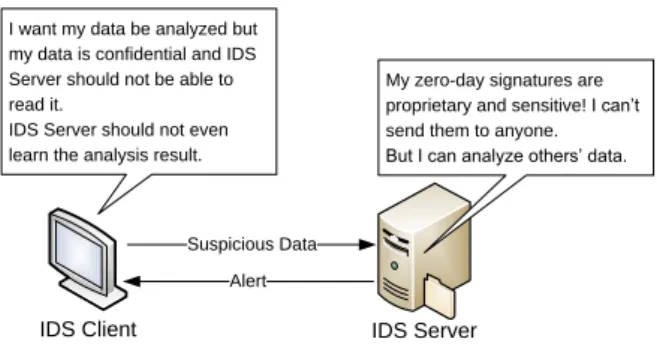
Motivated by the above discussion, we consider the following problem. An IDS server who holds a set of signatures (rule set), and an IDS client who wants to check his data against this rule set. The goal is for the IDS client to receive the appropriate alert if his input data is infected or anomalous, but nothing else. The IDS server should not learn any information about the client’s input data (See figure 1).
The security and efficiency requirement are as follows.
IDS Client
Suspicious Data I want my data be analyzed but my data is confidential and IDS Server should not be able to read it.
IDS Server should not even learn the analysis result.
Alert
IDS Server
My zero-day signatures are proprietary and sensitive! I can’t send them to anyone. But I can analyze others’ data.
FIGURE 1. The basic architecture of ZIDS
Security. We borrow our security requirements from secure two-party computation and require the protocols to be secure against malicious clients and servers who may deviate from the steps of the protocol. In essence, these requirements guarantee that any information that a malicious IDS client can learn in the privacy preserving IDS protocol is simulatable given only the final alert (full security against malicious clients). It also implies that a malicious server’s view in the protocol is indistinguishable for any two inputs held by the client (privacy against a malicious server).
Efficiency. Since the size of the server’s rule set turns out to be the main contributor to the complexity of the protocol, our two main efficiency items are: (i) the client’s computation be small and independent of the size of the server’s rule set, and (ii) the total online computation of both parties combined be small. Finally, to keep the protocols non-interactive, we aim for a small round complexity and ideally, only asingle round.
ZIDS - A Privacy-Preserving Intrusion Detection System ... 3 General-purpose solutions. The above problem can
be formulated as an instance of secure two-party computation. When solving any problem in secure two-party computation, an important point of comparison is a generic construction based on Yao’s garbled circuit protocol [5]. In recent years it has been demonstrated [6, 7, 8] that secure two-party protocols based on Yao’s garbled circuit construction may be practical when the function being computed can be expressed with a reasonably sized boolean circuit. As we will see in section 6, however, this is not the case for our IDS applications where the circuits can be very large. Yao’s garbled circuit protocol has the additional drawback of requiring both the client and the server to perform the same amount of computation (i.e. proportional to the size of the circuit they evaluate) which renders it unsuitable for client-server applications.
1.2. Our Contributions
Transforming the Problem to Oblivious DFA Evalua-tion. Our first contribution is to reduce the privacy-preserving IDS problem introduced above to an instance of the oblivious DFA evaluation problem (ODFA). In an ODFA protocol, one party holds an input stringX, while the other party holds a DFA Γ. Their goal is for the input holder to learn Γ(X) and for the DFA holder to learn nothing. Recently, several construc-tions of ODFA protocols were introduced [9, 10, 11, 12] but their motivating application revolves around the string/pattern matching problem and its use in pro-cessing DNA data. To the best or our knowledge, our work is the first to consider the use of ODFA protocols in privacy-preserving IDS applications.
As will be shown in section 3, our privacy-preserving IDS construction can be naturally divided into an offline and an online phase. In the offline phase, the client’s input has not entered the system yet, but the IDS’s rule set is known. In the online phase, however, a specific client input is analyzed for intrusion. The online phase turns out to be extremely efficient in our construction, for both the server and the client. We elaborate on the different components of the construction next.
From Attack Signatures to DFAs. We propose tech-niques for converting each rule in an IDS’s rule set into a DFA. In other words, we generate a DFA that transits to an accepting state if the attack patterns correspond-ing to the rule exists in the input strcorrespond-ing and transits to a non-accepting state otherwise. As we will discuss in section 4, this is done by chaining the content process-ing elements associated with each rule in a serial and/or parallel manner.
The generated DFAs are then fed to aDFA Combiner module that combines them into a single DFA that has multiple accepting states, each labeled with a specific
attack pattern’s ID. The alternative of invoking the ODFA protocol separately for each attack pattern has two main drawbacks: (i) it leaks additional information since the client learns a different output each time, and (ii) it is less efficient, since the DFA combiner algorithm yield DFAs with much smaller sizes than the sum of the sizes of each input DFA.
Finally, we reduce the number of states of the DFA via DFA-minimization techniques. This turns out to yield a significant reduction in computation and communication, since the efficiency of the ODFA protocol is directly dependent on the DFA size. A new ODFA Protocol for Sparse DFAs. Our empirical studies show that the DFAs generated via combining multiple attack patterns are quite sparse. See section 5.1.2, and Table 2 for the sparsity parameters we extracted for DFAs generated for various number of Snort rules. Our experiments show that the maximum number of outgoing edges in the resulting DFAs is a factor of 4-9 smaller than the alphabet size. We design a new ODFA protocol that takes advantage of this reduction in the outdegree of the states in the DFAs. To show the efficiency of this new construction, we first extend the protocol of [12] (originally designed for binary alphabets) to work with ASCII characters. A naive extension of their construction results in a factor of 128 increase in both the computation and the communication. We then propose the new protocol that takes advantage of DFA’s sparsity. The resulting protocol is considerably (a factor of 3-9) more efficient both in terms of communication and computation compared to the naive extension, and at the same time, does not leak any useful information about the nature of the sparsity in the DFA.
Implementation and Evaluation. We fully implement our privacy-preserving IDS system outlined above and evaluate its performance on real data. Our implementation can process arbitrary rule sets from Snort and analyze ASCII strings for potential intrusion. We significantly reduce the memory usage of our ODFA construction during offline phase by a semi-pipelining technique. In particular, every time the server processes and garbles a single row of the DFA matrix and sends it over to the client. As a result, the server only stores a single row at each point in time, therefore memory usage becomes a non-issue in our implementation (a similar technique was used in a recent implementation of Yao’s garbled circuit protocol [8]). We report on the performance of our system on different input sizes in section 6.
1.3. Related Work in Privacy Preserving IDSes
To the best of our knowledge, our paper is the first work that proposes a privacy preserving IDS in a two-party setting with such strong privacy requirements. That is,
both the privacy of server sensitive signatures and the client input data should be preserved simultaneously.
Most of the research in the field of privacy preserving intrusion detection consider the preserving of user identities during intrusion analysis [13, 14, 15, 16]. That is the IDS should not identify the identity of users while analyzing their behavior. This is generally done by replacing the user identity fields with pseudonyms. Apparently in these works, the privacy of the IDS signatures or client input data (other than identity fields) are not preserved. There are other works that focus on collaborative and privacy preserving techniques for building signatures [17] rather than private detection.
2. BACKGROUND
In this section, we introduce the notations, definitions and primitives used in the rest of the paper.
2.1. Notations
Throughout the paper, we use k and κ to denote the computational security parameters for the symmetric and asymmetric encryptions respectively. We use sto denote the statistical security parameter for the OT extension. We denote an element at rowiand columnj
of a matrix byM[i, j]. If the element itself is a tuple we useM[i, j, z] to denotez-th value of the tuple. Vectors are denoted by over-arrowed lower-case letters such as~v. We usea||bto denote the concatenation of the stringsa
andb. Byabwe mean concatenatingaby itselfbtimes.
We use λ to denote an empty string. Also let “←” denote assignment and “s $
←S” denote the assignment tosof a randomly chosen element of setS.
We denote a random permutation function byP erm.
~v ← P erm(Q) takes as input a set of integers Q = {1, . . . ,|Q|}, permutes the set uniformly at random and returns the permuted elements in a row vector v of dimension|Q|. We call a matrix a permutation matrix if all of its rows are generated in this way. The following simple algorithm (Algorithm 1) can be used to generate a permutation matrix P ER with n rows from the set
Q. We denote thei-th row ofP ERbyP ER[i].
Algorithm 1GenPerm(n, Q) for1≤i≤ndo P ER[i]←P erm(Q) end for returnP ER 2.2. DFA
A deterministic finite automaton (DFA) [18] is denoted by a 5-tuple Γ = (Q,Σ,∆, s1, F), where Q is a finite set of states, Σ is a finite input alphabet,s1∈Qis the initial state, F ⊆ Q is the set of final states, and ∆ denotes the transition function. Thus |Q| denotes the
total number of states. We represent states by integers in Z|Q|. ∆(j, α) returns the next state when the DFA
is in state j ∈ Q and sees an input α ∈ Σ. A string
X = x1x2. . . xn ∈ Σn is said to be accepted by Γ if
the state sn = ∆(. . .∆(∆(s1, x1), x2). . . , xn) is a final
statesn∈F. A binary DFA is a DFA with Σ ={0,1}. 2.3. Oblivious Transfer
Our protocols use Oblivious Transfer (OT) as a building block. We mostly focus on protocols that run in a single round. A one-round OT involves a server holding a list of t secrets (s1, s2, . . . , st), and a client holding a
selection index i. The client sends a query q to the server that responds with an answera. Usingaand its local secret, the client is able to recoversi.
More formally, a one-round 1-out-of-t oblivious transfer (OT1t) protocol is defined by a tuple of
P P T3 algorithmsOT1t= (GOT,QOT,AOT,DOT). The protocol involves two parties, a client and a server where the server’s input is a t-tuple of strings (s1, . . . , st) of
lengthτ each, and the client’s input is an indexisuch that 1 ≤ i ≤ t. The parameters t and τ are given as inputs to both parties.
The algorithms GOT, QOT and DOT are invoked by the client for the operations of OT key generation, OT query generation and OT answer decryption respectively. The algorithm AOTis used forOT answer generation and is invoked by the server. The protocol proceeds as follows:
1. The client generates a pair of keys, i.e. one public and one private, (pk, sk)←GOT(1κ), computes an
OT queryq←QOT(pk,1t,1τ, i), and sends (pk, q)
to the server.
2. The server computes an OT answer a ← AOT(pk, q, s1, . . . , st) and sendsato the client.
3. The client computes and outputs DOT(sk, a) which equals tosi.
Whent= 2, in case of semi-honest adversaries many of the OT protocols in the literature are one-round protocols (e.g. see [19, 20]). In case of malicious adversaries (CRS model), one can use the one-round OT protocols of [21].
For t > 2 we use a construction of Naor and Pinkas [22] to reduce the computation to logt
invocations of OT2
1 and t symmetric-key operations. We also take advantage of OT extension of [23] to perform many OT2
1 protocols simultaneously and more efficiently.
2.4. Pseudorandom Generator
A computationally secure pseudorandom generator (PRG) is a (deterministic) map G : {0,1}k → {0,1}n
where k is the “seed length” and n−k ≥ 0 is the “stretch”. G should be polynomial-time computable
ZIDS - A Privacy-Preserving Intrusion Detection System ... 5 and for any PPT distinguisher D the following should
be negligible ink
|Pr[D(Un) = 1]−Pr[D(G(Uk)) = 1]|
where Un denotes a uniformly random string in
{0,1}n. Here the stringU
k is called the “seed”.
3. SYSTEM OVERVIEW
In this section we present an overview of our proposed privacy preserving IDS system (ZIDS) and the steps performed by both participants. Figure 2 depicts the architecture as well as the different components of the proposed system. IDS client’s input is typically a suspicious payload extracted from a log file, or captured from a network. The IDS server’s input is a set of attack signatures or patterns of malicious behavior. The aim is for the IDS client to learn whether the suspicious input matches any of the attack signatures. In fact the client learns 0 (No attack) or the ID of the attack pattern found. The IDS server should not learn anything about the client’s payload. Moreover, the IDS client should not learn any additional information about the attack signatures. Optionally, the result of the intrusion analysis could only be revealed to the client in which case, the server would not learn whether the input matches any signatures or not.
Please note that as we discussed earlier, the client’s output in the ZIDS is the ID of the attack pattern found. However, this could help a client who runs the protocol multiple times on slightly modified inputs to learn additional information about the attack pattern with a specific id. Alternatively, we can also consider the case that the client learns only whether any of the attack patterns matches or not. This can be accomplished by having the client to learn a “1” instead of the ID of the attack pattern.
A Note on the IDS Client’s Input. We note that the actual input data processed by IDSes often contains additional metadata, such as user identities and IP headers in case of captured network traffic. The privacy concerns with such metadata have been studied in prior work and can be addressed using well-known techniques such as pseudonymization and omission [13, 16, 14]. Therefore, in this paper we focus on preserving the privacy of the payload data rather than the accompanying metadata.
In particular, the obvious solution to protect privacy within such metadata is that the client and server have an initial interaction in which the client hides such identifying fields by omission and pseudonymization and sends the IP headers to server. Then for additional content processing on payload the client and server proceed with ZIDS. It is noteworthy to mention that the existing techniques fail to address the privacy concerns with payload data since the IDS needs to analyze the payload in order to detect intrusions, and omission or
pseudonymization techniques limit the ability of the IDS in performing such analysis.
We divide the steps of the protocol into the offline and theonlinephases, and give a high level description of the different components involved in each step.
3.1. The Offline Phase
The offline phase occurs before the client’s suspicious input enters the system, and can be precomputed by the server without the knowledge of the client’s input. The different components of the offline phase are numbered in the order they are used in the system.
• Parameter Setup (Step 0 - offline): In this step, the required cryptographic keys (for the base OTs) and parameters used by the primitives are exchanged. • Snort Rule-to-DFA Module (Step 1 - Offline):
This component converts the content processing elements of a Snort rule to an equivalent DFA. Each DFA transits to an accepting state if the corresponding attack pattern is present in the input string and will transit to a non-accepting state, otherwise. We describe the details of the Rule-to-DFA module in section 4.1.
• DFA Combiner Module (Step 2 - Offline): This component takes as input a number of DFAs and combines them into a single DFA. This step is necessary to prevent multiple invocation of the ODFA protocol, one for each DFA. As a result, a single DFA that represents all attack signatures will be evaluated obliviously by the IDS client and server. The resulting DFA has a number of accepting states, each labeled with a specific attack pattern ID. More details on combining multiple DFAs into a single DFA are discussed in section 4.2. • DFA Optimizer Module (Step 3 - Offline): This component is responsible for optimizing the resulting DFA of step 2 by reducing its size and extracting the sparsity parameters. This is quite important since both the computation and the communication of the ODFA protocol are directly affected by it. We discuss the details of the DFA minimization and sparsity analysis in sections 4.3 and 5.1 respectively.
• Key Generator Module (Step 4 - Offline): This component generates the random keys used in the garbled DFA builder component. The keys are also used as input strings in the OT response builder. • GDFA Builder (Step 5 - Offline) This component
builds a garbled DFA according to the description of the oblivious DFA evaluation protocol discussed in section 5.
3.2. The Online Phase
These components are performed only after the client’s suspicious input enters the system. Note that before starting the online phases some additional parameters
OT Query Builder
OT Response Builder
GDFA
Evaluator GDFA Builder
DFA Optimizer Snort Rule to DFA Key Generator Keys DFA Sparse DFA OT Query OT Response GDFA K e y s Suspicious Payload Zero-day Signatures (RegExps) Keys DFA Combiner M u lt ip le D F A s
Result Oblivious DFA Evaluation Protocol for Sparse DFAs
Parameter Setup
ID
S
C
lie
n
t
ID
S
S
e
rv
e
r
1 2 3 0 4 6 7 5 8 Offline Online Offline Offline Offline Offline Offline Online Online (Online) (Offline)FIGURE 2. The architecture of ZIDS
(in addition to step 0) such as DFA sparsity parameters need to be exchanged.
• OT Query Builder (Step 6 - Online): This component is run as part of the ODFA protocol. It generates the OT queries based on the IDS client’s input. (Refer to section 2 for definition of the OT primitive and section 5 for its use in the ODFA protocol). The OT queries are then sent to the IDS server.
• OT Response Builder (Step 7 - Online): This component which is also a part of the ODFA protocol, builds the OT responses upon receiving the OT queries from the client. The OT responses are sent back to client. The client can retrieve a key per each input symbol.
• GDFA Evaluator (Step 8 - Online): Using this component, the client can decrypt a “transit path” in the GDFA matrix using the keys received through the OT. The last element of the transit path decrypted by the client is the result of DFA evaluation. This is either equal to 0 which would mean there is no attack pattern in the suspicious payload, or equals to an ID of an attack pattern found in the suspicious payload.
Note that steps 1, 2 and 3 can be amortized over multiple protocol runs, while steps 0, 4 and 5 cannot. This is because for each protocol run, a new set of symmetric keys has to be used in the garbling phase to ensure the security of the protocol. However as we mentioned earlier, these computations can be done in the offline phase.
4. REPRESENTING RULE SETS USING
DFAS
As we noted in section 3, in our proposed privacy preserving IDS, the attack patterns are converted to
DFAs so that they can be processed by the oblivious DFA evaluation protocol. The attack patterns are generally part of the rule set of an IDS such as Snort [24]. Each rule in Snort’s rule set consists of both heading and content processing elements. The conditions such as protocol type (tcp, udp, icmp), source and destination IP addresses, and ports are examples of header processing fields. The pcre (perl compatible regular expressions) and content elements are the main content processing elements. The content option specifies a string to be matched in the payload. The pcre is used to find more complex patterns in a payload and is expressed using regular expressions. Table 1 depicts thepcre andcontent elements in three sample rules of the Snort IDS. These rules are used to detect various types of web application attacks.
In order to generate a single DFA from the rule set for an IDS such as Snort, the following three steps are performed by the IDS server.
4.1. Generating each rule’s DFA from its
content and pcre fields.
In this step, our goal is to build a unique DFA for each Snort rule. To do this, we first convert the pcre and content fields into their equivalent DFA representations using standard RegExp-to-DFA conversion algorithms [25, 18]. Note that the content field can be considered as a simple regular expression that only contains a string.
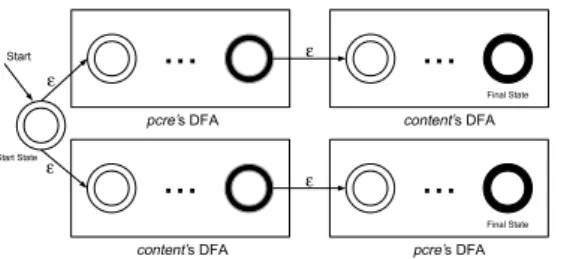
In order to build the unique DFA of each rule, our idea is to chain the pcre and content DFAs by connecting the accepting states of the first DFA to the starting state of the second one, with an -transition. This yields a non-deterministic finite automata (NFA) that only accepts a string if it is accepted by both DFAs (Figure 3). The resulting NFA can then be converted to an equivalent DFA using standard
NFA-ZIDS - A Privacy-Preserving Intrusion Detection System ... 7
TABLE 1. Sample Snort rules and their content processing elements (pcre andcontent)
Snort Rule-set Content Field pcre Field Attack Description
web-php graph image.php /rra id=(?!(\d+|all|)([\x26\s]|$))/smi cacti graph image SQL injection attempt
sql xp cmdshell - SQL xp cmdshell attempt
web-misc /sharepoint/ /sharepoint[\n]∗ \x22\s∗ \x29\s∗ \x3b/Ui Sharepoint cross site scripting attempt
to-DFA algorithms [18, 26].
...
content’s DFA pcre’s DFA
...
Start...
pcre’s DFA content’s DFA
...
ε
...
content’s DFA pcre’s DFA
...
ε ε ε Start ε Start State Start State Final State Final State Final StateFIGURE 3. The DFA generated by chaining content’s DFA before pcre’s DFA
In the above, we have implicitly made the assumption that thecontent string appears before thepcre pattern in a malicious payload, so we place the content’s DFA as the first DFA in the chain. If for a specific rule, the pcre should appear first, then the DFAs can be chained in the opposite order. For rules where the order of the elements is not important, we can construct the two chains (pcre-content and content-pcre) and generate a new starting state that connects to the starting states of both chains by-transitions. This can be viewed as OR-ing the two chains (Figure 4).
...
content’s DFA pcre’s DFA
...
Start...
pcre’s DFA content’s DFA
...
ε
...
content’s DFA pcre’s DFA
...
ε ε ε Start ε Start State Start State Final State Final State Final StateFIGURE 4. The DFA generated by chaining and ORing the pcre and content DFAs
4.2. Combining the DFAs for all rules to a single DFA.
As discussed before, to avoid a separate invocation of our ODFA protocol for each rule, we combine the DFAs into a single DFA for the whole rule set. To function as intended, for any input string that matches an attack pattern in the rule set, the new DFA should transit to an accepting state. Hence, the new DFA can be viewed as an OR of the DFAs for each rule. Similar to the previous transformation, to create this new DFA, we generate a new starting state and connect it to the starting state of each rule’s DFA by an-transition. Then we convert the resulting NFA to an equivalent DFA using standard NFA-to-DFA algorithms.
To distinguish the different accepting states in the newly generated DFA, we assign a label to each state that specifies the attack ID of the matching rule.
4.3. Optimizing the generated DFA.
In this step we reduce the size of the DFA generated in the previous step and also perform sparsity analysis to extract sparsity parameters of the generated DFA. This step helps to improve the efficiency of the ODFA protocol. DFA minimization is the task of transforming a given DFA into anequivalent DFA that has the least number of states possible. Two DFAs are equivalent if they describe the same regular language [18].
Several different algorithms for DFA minimization are known such as Hopcroft’s algorithm [27] and Watson and Daciuks’s algorithm [28]. According to the empirical results of [29], Watson and Daciuks’s algorithm performs better than the others when the alphabet size is more than 10 symbols, which is the case for our DFAs since Snort uses ASCII characters as its alphabet.
The details for the sparsity analysis come in the next section.
5. AN OBLIVIOUS DFA EVALUATION
PROTOCOL FOR SPARSE DFAS
Existing solutions [9, 11, 12, 10] for oblivious DFA eval-uation mainly consider a binary alphabet. Although these solutions can be extended to support an ASCII alphabet, these extensions generally yield schemes that have a higher computation or communication complex-ity. In particular, increasing the size of the alphabet increases the complexity of these protocols by a factor of O(Σ) which is a significant overhead. For example, consider the protocol of [12] which is computationally quite efficient, due to the limited use of public-key op-erations. When the alphabet size is Σ, the communica-tion and the server-side computacommunica-tion of their protocol is O(N · |Q| · |Σ| ·k) bits whereN is the client’s input size,|Q|is the number of DFA states, andkis the secu-rity parameter. When the alphabet size grows from 2 (binary) to 256 (ASCII), this translates to a factor 128 times increase in the complexity of the protocol.
In this section, we propose a new protocol that is significantly more efficient than existing ODFA solutions when the DFA is sparse and has almost the same computation and communication complexities when the DFA is dense. In fact, the more sparse a DFA is, the more efficient our new protocol is, compared
to existing solutions. Our goal is to design this more efficient protocol without having to reveal any sensitive information about the structure of the sparse DFA. In particular, the only additional information leaked to the input holder about the DFA is two sparsity parameters, outmax and cmax which we explain in more detail, shortly.
Our work is based on the recent construction of [12] who design an efficient protocol for binary alphabets. Their protocol runs in one round and only requires a small number of exponentiations (O(s)) for both parties, wheresis a statistical security parameter. The basic idea is to represent the DFA as a DFA matrix, and then have the server permute and encrypt this matrix and send the resulting garbled matrix to the client. Given his input keys, the client can decrypt a single transit pathin this garbled matrix and compute the final result. As this solution is proposed for binary alphabet, an extension to ASCII alphabet is needed. To extend it to ASCII alphabet, the elements in each matrix cell should be increased from 2 to 256 and a 1-out-of-256 OT should be used to retrieve each input key. This yields a protocol with high communication complexity, as the size of the garbled matrix will be 256·N· |Q| ·k, compared to the original size of 2N· |Q| ·k.
5.1. Using Sparsity of the DFA to Gain Efficiency
We take advantage of the sparsity of the input DFA to design a more efficient protocol. In sparse DFAs, a group of characters in the alphabet can transit from a single state to the same next state. This is unlike a dense DFA in which each character transits the DFA to a different state. Intuitively, if a DFA is sparse, the number of outgoing edges from each state is small compared to the size of Σ. As discussed in section 5.1.2, generally, the DFAs used to represent attack patterns are sparse. Figures 5 and 6 depict samples of sparse and dense DFAs, respectively.
Si a z b . . . Si ∑-{a } a FIGURE 5. Sample of a sparse DFA Si a z b . . . Si ∑-{a } a FIGURE 6. Sample of a dense DFA
5.1.1. DFA Sparsity Parameters
For the DFA Γ(Q,Σ,∆, s0, F), we define the notion of a character group as the set of characters in Σ, for which, there exists a stateqi where the transition from
qi using any of the characters in the group yields the
same destination state qj. More formally, we say that a and b are in the same character group if ∆(qi, a) =
∆(qi, b) =qj. We denote the set of character groups of
a state i as Ci = {Ci[1], Ci[2], ...} where Ci[1] denote
the first character group of state i, Ci[2] the second,
and so on. We denote by C =C1∪...∪C|Q| , the set
of all character groups of the DFA Γ.
We denote the set of character groups that have the character x ∈ Σ as a member with Cx = {Cx[1], Cx[2], ...} where Cx[1] is the first character group of x,Cx[2] the second, and so on.
outmax is the maximum out-degree of states in Γ. Formally, outmax = maxi∈Q(|Ci|). Also cmax is the
maximum number of character groups that a character is member of. Formally, cmax = maxx∈Σ(|Cx|). We call (C, cmax, outmax) the sparsity parameters of Γ.
For example the sparsity parameters for the DFA of figure 7 are as follows. C1 = {{a},{Σ − a}}, Ca = {{a},{Σ},{Σ − c}}, and C = {{a},{b},{c},{d},{Σ},{Σ− a},{Σ −c},{Σ− {a, b}},{Σ− {a, d}}}. Furthermore, outmax= 3, and
cmax= 5 sincec is member of 5 groups inC. 5.1.2. DFAs for Attack Patterns are Small
We start with showing that for any regular expression corresponding to a fixed pattern or patterns containing only the∗operator, the out-degree of the resulting DFA is at most 3. In other words, theoutmaxparameter for such DFAs is at most 3 regardless of the size of the alphabet (figure 7 is one such example for the regular expression/ab∗cd/). The following Theorem formalizes this statement.
Theorem1.For any regular expression correspond-ing to a fixed pattern or patterns containcorrespond-ing only the ∗ operator, the out-degree of its equivalent DFA is at most 3.
Proof. To prove this, consider a general regular expression p = p1p2· · ·pm· · ·pn that has a wildcard
operator at locationm(pm=∗ andpi ∈Σ fori6=m).
Here we construct its equivalent DFA Γp that has outmax= 3. Note that ΓphasnstatesS1· · ·Sm· · ·Sn.
The first state has a transition with label Σ− {p1} to itself and another transition with label p1 toS2. Each stateSi(i < n) has one transition with labelpitoSi+1,
the second transition with label p1 toS2 for (i6=m, n andp16=pi). Finally states can have a third transition
with label Σ− {p1, pi+1} to S1 for (i 6= m, n). Sm
has a transition with label Σ− {pm+1} to itself and a transition with label pm+1 to Sm+1 (outmax = 2). The last state has a transition with label Σ to itself (outmax = 1). Therefore the outmax parameter for the resulting DFA does not exceed 3.
For more general patterns, it is not easy to have a formal study on the sparsity of signatures due to the fact that they don’t have any obvious mathematical
ZIDS - A Privacy-Preserving Intrusion Detection System ... 9 a Si a z b
.
.
.
Si ∑-{a } a S1 S2 S3 S4 a b c d Start ∑-{c} a ∑-{a,b} ∑-{a,d} S5 ∑ ∑-{a}FIGURE 7. The DFA for the pattern/ab∗cd/
TABLE 2. Sparsity Parameters for some DFAs representing IDS signatures
Sig File DFA States DFA Edges cmax outmax
Sig 2 16 4096 11 4
Sig 6 45 11520 17 6
Sig 10 87 22272 26 8
Sig 20 176 45056 46 13
characteristics. Therefore, we only rely on experimental studies. Our empirical studies reveal that the DFAs generated via combining multiple attack patterns are also quite sparse, even if the patterns are described using more general regular expressions. Table 2 shows theoutmaxandcmax parameters for DFAs generated by combining various number of rules, from a sample snort rule set (2-20 signatures)4. Note that outmax degrees are a factor of 20-60 smaller than the alphabet size of 256. Next, we design a protocol that takes advantage of this reduction in outdegree while only revealing the valuesoutmaxandcmaxbut nothing else.
5.2. DFA Matrix
Our proposed oblivious evaluation protocol for sparse DFAs takes advantage of a matrix representation of DFAs. Next we briefly review the notions of a DFA matrix and a permuted DFA matrix which we use throughout the paper. The binary version of these notions are first introduced in [12]. Here we extend these notions to ASCII alphabet and incorporate the concept of character group into them.
5.2.1. DFA Matrix
Assume that the input string of a DFA Γ = (Q,{Σ},∆, s1, F) is a stringX =x1x2. . . xn ∈ {Σ}n. Then we can
represent the evaluation of Γ on an arbitrary inputXof lengthnas a matrixMΓ of sizen× |Q|. For 1≤i≤n, theith row ofMΓ represents the evaluation ofxi.
In particular, the element MΓ[i, j] stores the tuple (∆(j, Cj[1]),∆(j, Cj[2]),· · ·,∆(j, Cj[|Cj|])) which
encodes the indices of the next states to be visited (at rowi+ 1) for each character group of state j.5 At row
n where the last character xn is processed, instead of
storing the indices of the next states, we place a 1 (or possibly a positive integer of a specific length) if the next state is an accepting state and a 0 otherwise.
4We used the first 20 rules (withpcrefield) inweb-php.rules
of snortrules-snapshot-2904[30].
5Note that here we assume the transition function (∆) can
take a character group as its second argument.
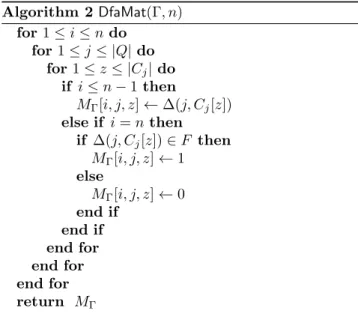
Algorithm 2 describes the function DfaMat(Γ, n) which takes a DFA Γ and the input size n, as its input and generates the DFA matrixMΓ.
Algorithm 2DfaMat(Γ, n) for1≤i≤ndo for1≤j≤ |Q| do for1≤z≤ |Cj|do if i≤n−1 then MΓ[i, j, z]←∆(j, Cj[z]) else if i=nthen if ∆(j, Cj[z])∈F then MΓ[i, j, z]←1 else MΓ[i, j, z]←0 end if end if end for end for end for return MΓ
Evaluation using the DFA Matrix. One can use
MΓ to efficiently evaluate Γ on any inputX of length
n. We start at MΓ[1,1]. Ifx1 is a member of the z’th character group of the first state (x1 ∈C1[z]), thez’th index of the tupleMΓ[1,1] (MΓ[1,1, z]) is used to locate the next cell to visit at row 2. Then by considering the chosen tuple in row 2 and the value of x2, we can find the next pair to visit in row 3. This process is repeated until we reach row nand read either 0 or 1 which will be the result of the evaluation of X on Γ.
When evaluating an input string X using a DFA matrix, we call the set of tuples visited starting from row 1 upto row na transit path forX. A transit path either ends with 1 which shows thatX is accepted by Γ or ends with 0 which shows that X is not accepted by Γ.
5.2.2. Permuted DFA Matrix
A permuted DFA matrix P MΓ is generated by randomly permuting the elements in each row i of
MΓ and updating the associated indices in row i−1 accordingly to point to the new permuted indices of row
i. In order to do this, we first generate a permutation matrix P ER of size n × |Q| using the Algorithm 1 (GenPerm). Then, algorithm 3 is invoked to convert a DFA matrixMΓto an equivalent permuted DFA Matrix
P MΓ.
Evaluating an input using the permuted DFA matrix is almost identical to the normal DFA matrix with the exception that the evaluation begins at P MΓ[1, P ER[1,1]].
Next, we present an overview of our proposed protocol.
Algorithm 3PermDfaMat(MΓ, P ER) for1≤i≤ndo for1≤j≤ |Q|do for1≤z≤ |Cj|do if i≤n−1then P MΓ[i, P ER[i, j], z]←P ER[i+ 1, MΓ[i, j, z]] else if i=nthen P MΓ[n, P ER[n, j], z]←MΓ[i, j, z] end if end for end for end for return P MΓ
5.3. Overview of the Protocol
We start with a high level overview of our protocol. As discussed before, the idea is to use the sparsity of the DFA to our advantage. We start with the construction of [12] which transforms a DFA to a DFA matrix before garbling it. In our proposed scheme, we generate a significantly smaller size garbled DFA matrix. As discussed above, the trivial extension of [12] to ASCII alphabet has to have 256 elements in each matrix cell. We reduce this number to outmax elements in each matrix cell, which reduces the total size of the DFA matrix from O(256· |Q| ·N ·k) bits to O(outmax· |Q| ·N·k) bits where outmax <<256. The challenge is to do so without compromising the privacy of the DFA holder. In particular, we do not want to leak any information besides the outmaxand
cmaxparameters to the client while still enabling him to evaluate his input on the DFA.
In contrast to the construction of [12], we assign a unique random key to each character group instead of each character in the alphabet, and then use this key to encrypt each element in the DFA matrix. The content of each element in the DFA matrix is the same as the basic protocol: an index to the next cell in row i+ 1 and a random pad.
In the basic protocol, the client receives a key for each input character, while in our proposed protocol, the client receives a set of keys corresponding to all the character groups that have the input character as a member. As discussed earlier, we denote the maximum number of such character groups by cmax. This set of keys is sent to the client by invoking a 1-out-of-256 OT protocol between the client and the server. One of these keys can be used to decrypt the next element in conjunction with its pad. The client tries these keys one by one, finds the appropriate key and learns the next state index at rowi+ 1 and its pad (Table 3 shows basic differences between our proposed protocol with [12]).
In the following, we give a more detailed (but still informal) description of the steps involved in our pro-tocol. In each step, we also point to the related lines of the formal protocol (section 5.4) to help reader better
TABLE 3. A comparison of our proposed protocol with [12]
[12] Our Protocol No. of elements per GDFA cell |Σ| outmax
GDFA size (bit) |Σ| · |Q| ·n·koutmax· |Q| ·n·k
No. of keys in each OT string 1 cmax
follow the protocol steps.
Client encrypts his inputs using OT queries, and sends them to the server. Client invokes GOT to generate a key pair (Line 1 of step 1 in the formal protocol), and then invokes QOT for each of its input characters to compute the corresponding OT query qi
(Lines 2-4 of step 1). The inputs to the QOTalgorithm are the public key, number of server strings, length of each string (Each string contains cmax keys, each of length k0) and the value of xi. The client then sends
the public key and the query answer vector to the server (Line 5 of step 1).
Server garbles the DFA by forming a gar-bled DFA matrix. The idea behind this step is to garble the DFA matrix before sending it to the client. This idea was used previously in [12] for DFAs with binary alphabets, but here we propose a differ-ent garbling technique. A simple extension of [12] for ASCII alphabet requires Σ elements in each matrix cell. As discussed before, this would impose a high communication and computation cost. In our proposed method, we reduce the number of elements in each cell to outmax(outmax <<Σ).
The garbling phase proceeds as follows: First for each row we assign a key to each character group (Lines 1-6 of step 2.1 in the formal protocol). Also we generate a random pad for each cell of the DFA matrix (Lines 7-12 of step 2.1).
Then we generate a permuted DFA matrix P MΓ from Γ by invoking the algorithmsDfaMat,GenPermand PermDfaMatrespectively (Lines 13-18 of step 2.1).
Next, the garbled DFA matrix is computed (Step 2.2 of the protocol). First, for the states that have fewer character groups than outmax, we add random elements to their corresponding cell in DFA matrix so all cells have exactlyoutmaxelements (lines 4-8 of step 2.2). For the row 1≤i≤n−1 of the garbled matrix, each element of each cell is filled with the permuted next index and pad at row i+ 1. The trailing zeros are also added to detect correct decryption (Lines 9-13 of step 2.2). For the row n, we just expand the elements of P MΓ that have the output values of 0 or 1, to the appropriate length (Lines 14-17 of step 2.2). Then each element is encrypted by its corresponding character group key (Line 19 of step 2.2). Finally all the elements of each cell are randomly permuted and further encrypted by the appropriate pad from the
ZIDS - A Privacy-Preserving Intrusion Detection System ... 11
Server computes the OT answer vector and sends it as well as the garbled DFA matrix to the client. For each OT queryqi, the server prepares
its corresponding OT answerai. To do this, the server
should first computes its|Σ|strings (S1,i· · ·S|Σ|,i) used
in OT (one for each x ∈ Σ). Each Sx,i is formed by
concatenating and permuting the keys of the character groups that contains character x (Lines 3-7 of step 3 of the formal protocol). If a character xis member of less than cmaxcharacter groups, we expandSx,iwith
random bits so each Sx,i has exactly cmax ·k0 bits
(Lines 8-11 of step 3). Then server computes the OT answers by invoking AOT (Line 12 of step 3). Finally, the server sends the resulting OT answer vector plus the garbled DFA matrix and the index and pad of the starting cell in row 1 to the client (Line 14 of step 3).
Client retrieves the keys and computes the final result. In this step the client first invokes DOT for each OT answer ai to learn KEY S, the set of
character group keys forxi (Line 4 of step 4).
Then the client starts evaluating the garbled DFA matrix. First it uses the pad of the starting cell to partially decrypt it (Line 6 of step 4). Then the client uses thecmaxkeys it retrieved through OT, to decrypt one of theoutmaxvalues in the starting cell. To to this, it tries these keys one by one, finds the appropriate key and learns the next state index at row 2 and its pad. Note that if a key is found the client stops and goes to next cell (Lines 15-18 of step 4). The client repeats this process, moving along the transit path for input
X until it reaches the last row and recovers the final output (Lines 8-22 of step 4).
First, note that for all the cells not on his transit path, client does not learn the corresponding random string in the P AD matrix and hence those elements remain garbled to him. For those cells that appear on his path, he can only decrypt one of theoutmaxvalues using one of thecmaxkeys he has retrieved at the OT stage. Next, we present the formal description of our proposed protocol.
5.4. The Protocol
Server’s Input: A DFA Γ = (Q,Σ,∆, s1, F) and the set of character groupsC.
Client’s Input: A stringX=x1x2...xn∈Σn. Common Input: The computational security pa-rameter k, the OT security parameter κ and the size of DFA |Q|. The sparse DFA parameters cmax and
outmax. We letk0 = 2k+ log|Q|throughout the pro-tocol. Parties also agree on a 1-out-of-|Σ|OT protocol
OT = (GOT,QOT,AOT,DOT) (we explain how we im-plement the 1-out-of-|Σ| OT protocol, shortly) and a PRGG:{0,1}k → {0,1}outmax·k0.
1. Client encrypts his inputs using OT queries, and sends them to server. (OT Query Builder Component)
Sending OT Queries to server
1: Client computes (pk, sk)←GOT(1κ) 2: for1≤i≤ndo 3: qi←QOT(pk,1|Σ|,1cmax·k 0 , xi) 4: end for
5: Client sendspkand~q= (q1, q2, . . . , qn) to server. 2. Server Computes a Garbled DFA matrix
GMΓ. (Key Generator and GDFA Builder
Components)
2.1. Generating random pads, character groups keys and a permuted DFA matrixP MΓ
1: Server generates random keys for the charac-ter groups: 2: for1≤i≤ndo 3: for1≤j≤ |C|do 4: (KC[j],i) $ ← {0,1}k0 5: end for 6: end for
7: Server generates a random pad matrix
P ADn×|Q|: 8: for1≤i≤ndo 9: foreachj∈Qdo 10: P AD[i, j]← {$ 0,1}k 11: end for 12: end for
13: server generates a DFA matrixMΓ:
14: MΓ←DfaMat(Γ, n)
15: server generates a random permutation matrix
P ERn×|Q|:
16: P ER←GenPerm(n, Q)
17: server generates a permuted DFA matrixP MΓ:
18: P MΓ←PermDfaMat(MΓ, P ER)
2.2. Computing the Garbled DFA Matrix
GMΓ fromP MΓ 1: for1≤i≤ndo 2: foreachj∈Qdo 3: for1≤z≤outmaxdo 4: if z >|Cj|then 5: GMΓ[i, j, z]← {$ 0,1}k 0 6: //Skip to nextz 7: continue; 8: end if 9: if 1≤i≤n−1then
10: //Add the next index, next pad and trailing zeros
11: nextindex←P MΓ[i, j, z]
12: nextpad←P AD[i+ 1, nextindex] 13: GMΓ[i, j, z]←nextindex||nextpad||0k
14: else if i=nthen
15: //Expand Last Row to Appropriate Length
16: GMΓ[n, j, z]←(P MΓ[i, j, z])(k+log|Q|)||0k
17: end if
18: //Encrypt GMΓ with the character groups keys.
19: GMΓ[i, j, z]←GMΓ[i, j, z]⊕KCj[z],i 20: end for
21: //Permute each cell and encrypt it using pads
22: randperm←P erm({1, ..., outmax}) 23: for1≤z≤outmaxdo
24: GMΓ[i, j, randperm[z]]←GMΓ[i, j, z]
25: end for
26: GMΓ[i, j]←GMΓ[i, j]⊕G(P AD[i, j])
27: end for
3. Server computes the OT answers ~a, and sends(~a, GMΓ, P ER[1,1], P AD[1, P ER[1,1]])to
client. (OT Response Builder Component)
Sending OT Answers and the Garbled Matrix to client
1: for1≤i≤ndo
2: for1≤x≤ |Σ|do
3: //Concatenating and permuting keys for the character groups of characterx:
4: randperm←P erm({1, ...,|Cx|}) 5: z0←randperm[z] 6: Sx,i←λ 7: for1≤z≤ |Cx|do 8: Sx,i←Sx,i||KCx[z0],i 9: end for
10: //Expanding Sx,i if its size is less than
cmax×k0: 11: KR← {$ 0,1}k0·(cmax−|Cx|) 12: Sx,i←Sx,i||KR 13: end for 14: ai=AOT(pk, qi, S1,i,· · ·, S|Σ|,i) 15: end for
16: Server sends (~a, GMΓ, P ER[1,1], P AD[1, P ER[1,1]])
to client where~a= (a1, a2, . . . , an).
4. Client retrieves the keys and computes the final result. (GDFA Evaluator Component)
Computing the Final Output
1: state←P ER[1,1] 2: pad←P AD[1, P ER[1,1]] 3: for1≤i≤ndo
4: KEY S←DOT(sk, ai)
5: K1|| · · · ||Kcmax←KEY S
6: GMΓ[i, state]←GMΓ[i, state]⊕G(pad)
7: //Trying to decryptGMΓ[i, state]using differ-entKz’s:
8: for1≤j≤outmaxdo
9: for1≤z≤cmaxdo
10: ifi < nthen
11: newstate||newpad||tail ← Kz ⊕
GMΓ[i, state, z]
12: else if i=nthen
13: result||tail←Kz⊕GMΓ[i, state, z]
14: end if
15: //Exit from the two outer FORs if decryption is successful: 16: iftail= 0kthen 17: break 2 18: end if 19: end for 20: end for 21: pad←newpad 22: state←newstate 23: end for
24: Client outputsresultas his final output.
5.5. Complexity Analysis
Round Complexity: The protocol consists only 1 round of communication between the client and server.
Asymmetric Computations: The only asymmet-ric computation we perform in our protocol is for the OTs. Since each OT requires a constant number of ex-ponentiations and there areninvocations of such OTs, the overall number of exponentiations in our protocol
is bounded byO(n) for both server and client. We re-duce this toO(s) using the OT extension of [23], where
s is the statistical security parameter (at the cost of adding an extra round). This improves the efficiency significantly when n >> s, which is the case for our IDS application.
Symmetric Computations: The only symmetric computation in our protocol is PRG invocations. The server and client perform O(n · Q) and O(n) PRG invocations whereQis the DFA size. This is due to the fact that the garbled DFA matrix hasn·Qcells and for each cell the server performs one PRG invocation. On the other hand, the client invokes one PRG for each row of the garbled matrix to decrypt exactly one element per each row.
Communication Complexity: The communica-tion overhead of our proposed protocol consists of OT communication and garbled DFA transfer. The OT communication is O(n· cmax ·k) bits and the size of the garbled DFA matrix is O(n·Q· outmax·k) bits. Therefore the total communication cost would be
O(n·k·(cmax+Q·outmax)) bits.
5.6. Security
The security proof of our proposed protocol is almost the same as the ODFA protocol of [12]. Specifically, as long as the oblivious transfer protocol used is secure, so is our protocol. Particularly, if the OT is secure against malicious (semi-honest) adversaries when executed in parallel, our oblivious DFA evaluation protocol described above is also secure against malicious (semi-honest) adversaries. The following Theorem formalizes this statement.
Theorem 2.In the OT-hybrid model, and given a computationally secure PRG G, the above protocol is fully-secure against a malicious client and is private against a malicious server.
Proof skecth. We sketch the ideas for proving full-security against a malicious client and privacy against a malicious server.
Full-security against a malicious client. Our proof follows the ideal/real world simulation paradigm. In particular, for any PPT adversary B controlling client in the real world, we describe a simulator SB
who simulates B’s view in the ideal world. Since the proof and the simulator are almost the same as [12], here we describe a sketch of the proof and highlight the differences:
• SB runs B on inputs X, k,|Q| as well as the
sparsity parametersoutmaxandcmax. This is one difference with proof of [12], since here the sparsity parameters are learned by the parties.
•Since we operate in the OT hybrid model, B sends an input X0 = x01. . . x0n to the OT’s trusted party. SB generatesn random set of keys
ZIDS - A Privacy-Preserving Intrusion Detection System ... 13 (S1,i, S2,i, ..., S|Σ|,i) for 1≤ i ≤n and sends Sxi,i
back toB.
• SB generates a Garbled DFA matrix GM0 that
has outmax elements in each cell instead of the Σ elements as in [12]. Intuitively, all the element values in GM0 are set to random k0-bit strings except for the values on the transit path for B’s inputX0.
•S then sends (GM0, f irststate, f irstpad) to B. Note thatSB did not need the description of Γ to
generate the above garbled DFA matrix.
•Now it is straightforward to prove thatB cannot distinguish between his view during the real execution and his interaction with SB. To prove
this one can consider a sequence of distributions
D0,· · · , Dn where D0 is B’s view in the real execution while Dn is his view during his
interaction with SB. The goal is to show that
D0
c
≡ Dn. This can be done through a simple
hybrid argument where it is shown thatDt c
≡Dt+1 for 1≤t < n. ForDt, the garbled DFA matrix is
generated in the same way asDt−1 except that we place uniformly random strings for all values in row
t except for the single value that appears on X0s transit path. Readers are refered to [12] for the full discussion on the indistinguishability of views.
Privacy against a malicious server. Since the only message client sends to server during the protocol execution is his OT queries, client’s privacy against a malicious server readily follows from the assumed privacy of the OT protocol used.
6. IMPLEMENTATION AND EVALUATION
In this section we explain the details of our implemen-tation, evaluate the proposed system and provide some comparison with alternative implementations.
6.1. Implementation Details
The implementation of ZIDS is done using C++ and the Crypto++ library v.5.61 [31].
OT Implementation. Our ODFA protocol uses a 1-out-of-256 OT as a sub-protocol. To reduce the number of public-key operations needed for the OTs, we use the construction of Naor and Pinkas [22] to efficiently reduce n invocations of the 1-out-of-256 OT to 8n
invocations of 1-out-of-2 OT.
For our 1-out-of-2 OT protocol, we implement the Naor-Pinkas amortized OT protocol (See section 3.1 of [19]) which requires one exponentiation for each transfer. We implement their protocol over Elliptic Curves (EC) for better efficiency. The EC curve we use is the NIST recommended curve P-192 (see section D.1.2.1 of [32]).
We have taken advantage of the OT extension of [23] in our implementation for improved efficiency. There are two different extensions in [23]. The first one is concerned with extending the number of OTs efficiently (section 3 of [23]) while the second extension (Appendix B of [23]) reduces oblivious transfer for long strings to oblivious transfer of shorter strings. Both implementations of the mentioned extensions rely on the use of a hash function (in the random oracle model). We have chosen SHA-256 for this implementation. As a result, regardless of the input or the DFA sizes, the number of exponentiations necessary for the OTs does not exceed O(s) where s is a statistical security parameter. We lets= 80.
Offline Computations. For efficiency reasons, we precompute several components of the protocol that do not depend on the client’s input, such as the DFA garbling phase. Note that the IDS server does not need to have the IDS client’s OT queries in order to calculate the garbled matrix. Therefore, the IDS server precomputes the garbled DFA and sends it to the client in an offline phase. This leads to a significant decrease in the online overhead of our protocol.
We also use the OT precomputation technique of [33] to precompute the OT’s expensive operations (exponentiations) and only perform XOR operations in the online phase.
Reduction of Memory Usage. Since the DFA matrix corresponding to real-life rule sets can be quite large, it is critical to avoid the storage of the whole DFA matrix by the server. Note that the server might have several clients, each with a separate DFA matrix, and therefore optimizing the memory usage for the server seems very useful. To achieve this, we implement our protocol such that in the offline phase, the server generates and garbles exactly one row of the matrix; sends it to the client over the network and discards the computed row. So at each point, the server only stores a single row of the matrix. Note that here the client has to retain the full DFA matrix in order to later use it in the online phase.
6.2. Data Sets
IDS Server attack patterns. For the attack patterns, we used the latest Snort signature set (snortrules-snapshot-2904) [30] and extracted the content process-ing elements from web-php,web-misc,web-cgi,sql.rule, netbios andexploit rule files.
We have converted the content processing elements of each rule to its equivalent DFA. The rules’ DFAs are then combined and optimized to form a unique DFA that can be fed to our proposed ODFA protocol. IDS Client Input. In our experiments the content of client’s input does not affect the efficiency of the
protocols. The only important factor is the size of his input string. As a result, various random strings of different sizes are considered as the IDS client’s input in our experiments.
6.3. Experiment Set Up
We have used two equivalent PCs as the IDS client and IDS server connected via a Gigabit Ethernet. Each PC has an Intel Core2 Duo E6750 with @2.66Ghz CPU, and 4GB of RAM. Both PCs have Linux CentOS 5.5 installed as their Operating System.
6.4. Experiment Results
We performed a number of experiments to evaluate the efficiency of our proposed system. In our experiments, we combined a different number of signatures, leading to a different number of states in the resulting DFAs. As discussed, we have tried to push the computation and communication to the offline phase. Garbling the DFA by server and the OT precomputation by both parties is done in the offline phase. As a result, the online time complexity of our protocol is quite low (usually less than 1 second).
In our experiment we use the combination of two and six signatures respectively. For the zero-day detection scenario this is usually a reasonable number of signatures. For each of these combinations, we increase the size of the input and record the result. Since the target of this paper is to detect zero-day type patterns, we have considered an input size suitable for detecting the common vulnerabilities. It is known that beside IP packets, many of the new targets for zero-day attacks are PDF or office documents. The vulnerability in these types of files usually resides in the first segments of the files, which has a fairly small size. Hence we consider input sizes ranging from 500 to 4kbytes. Table 4 shows the results of this experiment.
According to this table, the total online time of the protocol is less than 100 ms for the 16 states DFA and less than 5 seconds for the 45 states DFA, which is quite efficient in practice. For the online interaction, the client and server should perform the OT’s online computation and the client has to evaluate the garbled matrix to learn the result. Note that the online component of the OT only requires XOR operations. As for the offline computation, the client’s time is still below 5 seconds, while the server’s ranges from 23 seconds to 5 minutes. Our experiments confirm that client’s work is fairly small in both the online and the offline phase, and that due to the precomputation phase, we can optimize the online response time of the server to a large extent.
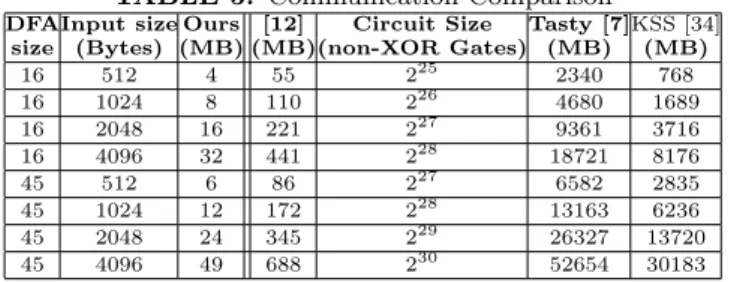
Communication Results. Table 5 shows the communi-cation overhead of ZIDS and compares it with alterna-tive solutions. According to this table, the online
com-munication for a DFA of 45 states, and a 512 byte in-put is around 6 MB. Although the communication size is still far better than the alternative solution, it can grow with the input size and become the bottleneck of the protocol when network resources are limited. For these scenarios, we have considered a tradeoff that consid-erably reduces the online communication, in exchange for one symmetric-key encryption on the client side for each input byte. Considering the fast implementations of AES in software and also in modern CPUs, it is not a computationally expensive task for the client to per-form an additional encryption per each input character. Next we explain this technique.
6.5. Online Phase Key Size Optimization
The idea is to send the encryption of long keys in the offline phase, and in the online phase send the shorter keys required to decrypt the corresponding long keys. This technique proceeds as follows. Let’s denote the keys which are normally used as input to OT in online phase byK. In the offline phase, server uses the smaller keys K0 to encrypt all such keys, ek = EK0(K) and sends ek’s to the client. In the online phase client already possesses the encrypted version of all keys. So instead of performing the OTs on the original keys
K, server will use much smaller keys K0 in the online phase. Client will use Ki0 that received with OT to decrypt the corresponding eki and recover the keyKi.
This yields a factor ofcmaximprovement in the online communication.
6.6. Comparison with Garbled-circuit-based Implementations.
As we discussed in the introduction, one can use the general-purpose protocols for secure two-party computations as a tool for building privacy preserving IDSes. However, it turns out that the general solutions are too inefficient for the IDS applications we consider in this paper. To show this, we compare our modified ODFA protocol with a number of most recent implementations of Yao’s garbled circuit protocol [7, 8, 34].
In order to do a somewhat concrete comparison, we first generate the garbled circuit required for evaluation of a DFA with various input sizes using the compiler of [34] and then counted the number of non-XOR gates. Note that in these new implementations the XOR gates can be evaluated for free, therefore we do our analysis based on the number of non-XOR gates only. Then, given that these papers use machines with similar (or even stronger) CPU, and RAM capabilities to ours we calculated approximate computation and communication costs involved in evaluating these garbled circuits using the estimates and performance numbers given in these papers. Authors of [8] estimated a computation time of 10 micro seconds per gate,
ZIDS - A Privacy-Preserving Intrusion Detection System ... 15
TABLE 4. Computation Times
DFAInput Sizecmaxoutmax OT Client. Total Client Server tasty[7]fastgc[8][12] KSS[34]
size (Bytes) Time (s)Eval. (s)online (s) offline (s)offline (s) (s) (s) (s) (s)
16 512 11 4 0.004 0.006 0.010 0.62 23.62 1892 430 557 164 16 1024 11 4 0.007 0.010 0.017 1.10 47.25 3783 860 1112 360 16 2048 11 4 0.014 0.017 0.031 2.07 94.31 7567 1720 2217 792 16 4096 11 4 0.043 0.031 0.074 4.09 188.65 15134 3439 4434 1743 45 512 17 6 0.557 0.007 0.564 0.64 39.40 6984 1587 600 604 45 1024 17 6 1.069 0.012 1.081 1.14 78.66 13967 3174 1197 1330 45 2048 17 6 2.093 0.022 2.115 2.27 162.20 27934 6349 2467 2925 45 4096 17 6 4.141 0.042 4.183 4.54 320.3 55868 12697 4965 6435
TABLE 5. Communication Comparison
DFAInput size Ours [12] Circuit Size Tasty [7]KSS [34]
size (Bytes) (MB) (MB)(non-XOR Gates) (MB) (MB)
16 512 4 55 225 2340 768 16 1024 8 110 226 4680 1689 16 2048 16 221 227 9361 3716 16 4096 32 441 228 18721 8176 45 512 6 86 227 6582 2835 45 1024 12 172 228 13163 6236 45 2048 24 345 229 26327 13720 45 4096 49 688 230 52654 30183
while [7] and [34] provide result tables with performance numbers for different circuit sizes.
The results show that in some cases, our proposed scheme performs up to 1000 times better than the general-purpose solutions both in terms of communication and computation.
7. CONCLUSION
In this paper we proposed ZIDS, a client-server solution for private detection of intrusions. The system consists of an IDS server that has a set of sensitive signatures for zero-day attacks and IDS clients that possess some sensitive data. Using ZIDS, each IDS client learns whether its input data matches any of the zero-day signatures, but neither party learns any additional information.
ZIDS needs an efficient cryptographic protocol for oblivious evaluation of DFAs in order to privately check the IDS client input data against sensitive zero-day signatures of the IDS server. We proposed such a protocol that meets the standard security requirements of secure two-party computation and is also quite efficient compared to existing ODFA protocols. To the best or our knowledge, our work is the first to consider the use of ODFA protocols in privacy-preserving IDS applications.
Our implementation can process arbitrary rule sets from the Snort’s IDS and analyze input strings for po-tential intrusions, privately. We evaluate the perfor-mance of our implementation on varying input sizes and provide both analytical and concrete comparisons to al-ternative solutions, in some cases showingseveral orders of magnitude (several thousand times) improvement in computation and communication cost.
REFERENCES
[1] TippingPoint. Zero day initiative. http://www.
zerodayinitiative.com/.
[2] Mozilla. Security bug bounty program. http://www.
mozilla.org/security/bug-bounty.html.
[3] Google. Web application security research.
http://googleonlinesecurity.blogspot.com/2010/ 11/rewarding-web-application-security.html.
[4] TRAPKIT. Patch development time statistics. http:
//www.trapkit.de/advisories/pdts.php.
[5] Yao, A. C. (1982) Protocols for secure computations.
Proceedings of SFCS ’82, Chicago, IL, 3-5 November, pp. 160–164. IEEE Computer Society, Washington, DC. [6] Malkhi, D., Nisan, N., Pinkas, B., and Sella, Y. (2004) Fairplay - a secure two-party computation system.
Proceedings of USENIX Security ’04, San Diego, CA, 9-13 August, pp. 20–20. USENIX Association, Berkeley, CA.
[7] Henecka, W., K¨ogl, S., Sadeghi, A.-R., Schneider, T., and Wehrenberg, I. (2010) TASTY: tool for automating
secure two-party computations. Proceedings of CCS
’10, Chicago, IL, 4-8 October, pp. 451–462. ACM, New York.
[8] Huang, Y., Evans, D., Katz, J., and Malka, L. (2011) Faster secure two-party computation using garbled
circuits. Proceedings of USENIX Security ’11, San
Francisco, CA, 8-12 August, pp. 35–35. USENIX Association, Berkeley, CA.
[9] Troncoso-Pastoriza, J. R., Katzenbeisser, S., and Celik, M. (2007) Privacy preserving error resilient DNA searching through oblivious automata. Proceedings of CCS ’07, Alexandria, VA, 28-31 October, pp. 519–528. ACM, New York.
[10] Frikken, K. B. (2009) Practical private DNA string searching and matching through efficient oblivious
automata evaluation. Proceedings of DBSec ’09,
Montreal, P.Q., Canada, 12-15 July, pp. 81–94.
Springer-Verlag, Berlin.
[11] Gennaro, R., Hazay, C., and Sorensen, J. S. (2010) Text search protocols with simulation based security.
Proceedings of PKC ’10, Paris, France, 26-28 May, pp. 332–350. Springer-Verlag, Berlin.
[12] Mohassel, P., Niksefat, S., Sadeghian, S., and
Sadeghiyan, B. (2012) An efficient protocol for oblivious
DFA evaluation and applications. Proceedings of
CT-RSA ’12, San Francisco, CA, 27 February – 2 March, pp. 398–415. Springer-Verlag, Berlin.
[13] Biskup, J. and Flegel, U. (2000) Transaction-based pseudonyms in audit data for privacy respecting

![TABLE 3. A comparison of our proposed protocol with [12]](https://thumb-us.123doks.com/thumbv2/123dok_us/1872293.2773282/10.892.71.429.128.368/table-comparison-proposed-protocol.webp)