14
:
200Supported By
World Bank Institute
Implementing Agency :Infrastructure Professionals Enterprise (P) Ltd.
C-2 , Green Park Extension New Delhi – 110016 Ph: 26568607/ 08/ 13, Fax : 26969478www.infrastructureindia.com
CONTENTS
SUMMARY ...VI
1 BACKGROUND & PROGRAM OBJECTIVES ... 1
1.1 Background ... 1
1.2 Program Objectives... 2
2 TRAINING NEED ASSESSMENT OBJECTIVES & METHODOLOGY ... 1
2.1 Training Need Assessment Objectives ... 1
2.2 Training Need Assessment Methodology... 1
2.2.1 Consultation with Municipal and State Government Officials on deficiency in SWM services and gaps in their capabilities to take corrective measures... 2
2.2.2 Training Need Assessment Survey among Municipal Officials ... 4
2.2.3 SWM Experts Opinion on SWM Training Needs ... 4
2.2.4 Analyzing Target Group Specific Training Needs... 5
2.2.5 Finalization and Validation of Training Needs and Finalize contents ... 5
3 EXISTING TRAINING DELIVERY FRAMEWORK IN INDIA AND TRAINING DELIVERY GAPS... 6
3.1 Assessment of Institutional Framework for delivery of Training... 6
3.2 Source of Funding: - ... 23
3.3 Target audiences ... 23
3.4 Outreach... 24
3.5 Training on 7 MSWM steps... 24
3.6 Subjects covered in the training programmes and workshops... 25
3.7 Participation Response... 26
3.8 Methods used for enhancing participation... 26
3.9 Parent Institutional Support to the participants... 27
3.10 Provision of support materials ... 27
3.11 Duration ... 28
3.12 Training Delivery Gaps vis a vis Areas of Entry of SWM Learning Program28 4 TARGET SPECIFIC TRAINING NEEDS ASSESSMENT (TNA) RESULTS 30 4.1 Chief Administrative Officers... 30
4.2 Elected Representatives ... 34
4.3 Health Officials... 38
4.4 Engineering Officials ... 42
4.5 Sanitary Officials ... 46
4.6 Accounting & Finance Officials ... 50
4.7 Summary table indicating the training needs of each category of ULB Officials and Elected Representatives ... 53
5 CONCLUSION OF THE ASSESSMENT AND OUR FOLLOW-UP STRATEGIES ... 57
Solid Waste Management Learning Programme in India iii
ANNEX
Annex-2.1. Target Group Specific TNA Questionnaire Used Annex 3.1. List of Institutions Contacted/Visited
INDEX – TEXT BOXES
Box 1 The reasons for doing training needs assessment Box 2 Subjects covered in the MSWM manual
Box 3 Institutions recognized with MoUD Box 4 SWM Publications brought out by CPCB
Box 5 ULBs with Good Initiatives on SWM with CPCB’s Support Box. 6 ULBs’ Responsibilities for MSWM
Box 7 Course contents SWM - HSMI Box 8 Course Content SWM -Toxic Links
Box 9 Educational materials developed on SWM - CEE
INDEX - TABLE
Table 1 Training Programmes Supported by MoEF during 2005 – 06 Table 2 PHE Courses run by MoUD
Table 3 Training programmes conducted by National Productivity Council,
Table 4 State level Workshops conducted by UEIR, US AEP/USAID to improve SWM services
Table 5. Training Programme -AIILSG
INDEX- FIGURES
Fig 1.1 Status of compliance of MSW Rules 2000 by class-1 cities as on 1.4.2004.
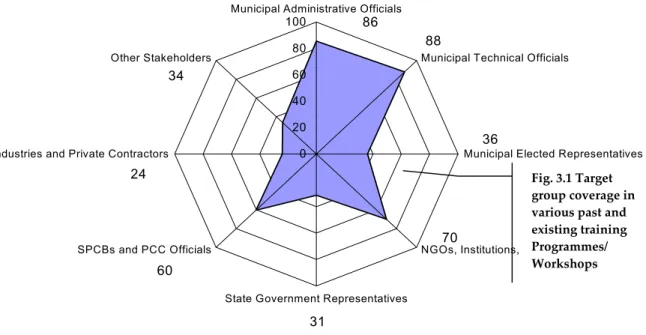
Fig. 3.1 Target group coverage in various past and existing training Programmes/ Workshops
Fig. 3.2 Outreach -Existing Training Programmes
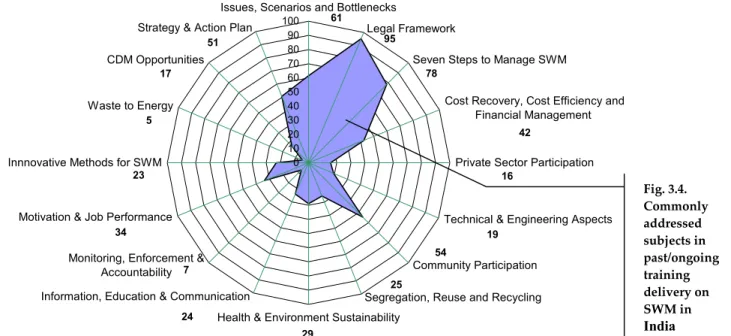
Fig. 3.3 Commonly addressed subjects in past/ongoing training delivery on SWM in India
Fig. 3.4 Ongoing coverage on 7 MSWM steps
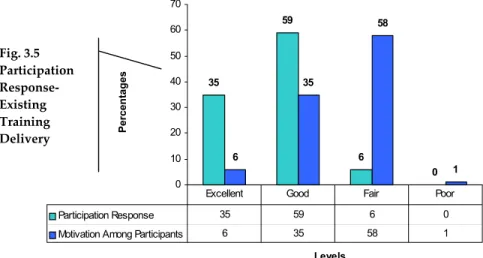
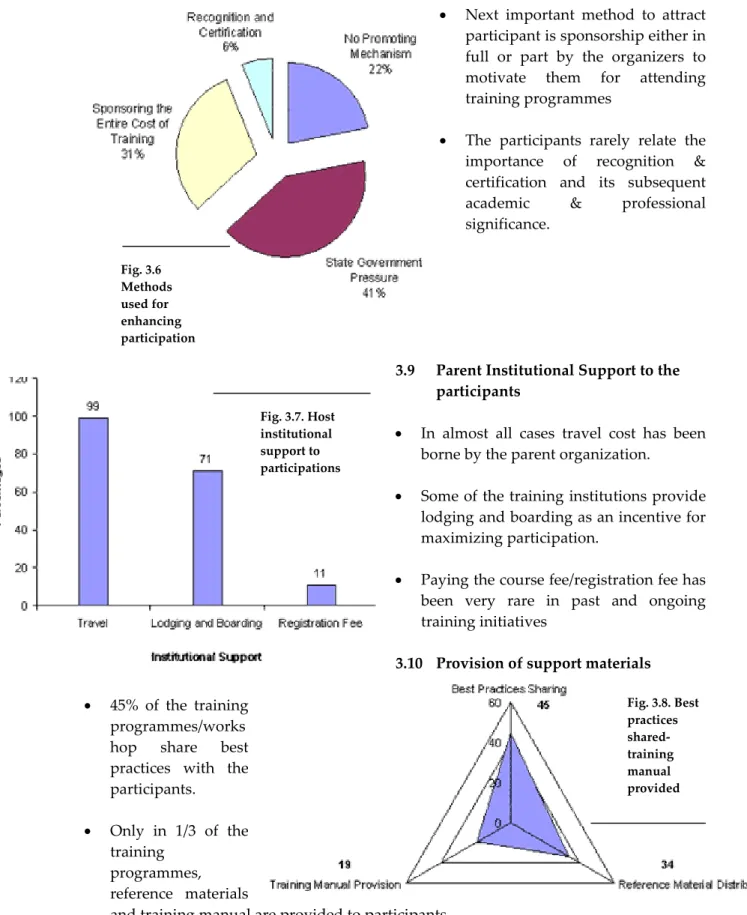
Fig. 3.5 Participation Response to Existing Training Delivery Fig. 3.6 Methods commonly used for enhancing participation Fig. 3.7 Host institutional support to participations
Fig. 3.8 Best practices shared - training manual provided Fig. 3.9 Duration of Existing Training Programs
Fig. 4.1.1 Chief Administrative Officers - Responsibilities
Fig. 4.1.2 Chief Administrative Officers - Ability Gaps – Self Assessment Fig. 4.1.3 Chief Administrative Officers - Preferred areas of training Fig. 4.1.4 Chief Administrative Officers - Preferred duration of training Fig. 4.2.1 Elected Representatives – Responsibilities for SWM
Solid Waste Management Learning Programme in India iv Fig. 4.2.2 Elected Representatives – Ability Gaps for SWM – Self Assessment
Fig. 4.2.3 Elected Representatives – Preferred Areas of Training for SWM Fig. 4.2.4 Elected Representatives – Preferred duration of training
Fig. 4.3.1 Health Officers – Responsibilities for SWM
Fig. 4.3.2 Heath Officers – Ability Gaps for SWM – Self Assessment Fig. 4.3.3 Health Officers – Preferred Areas of Training
Fig. 4.3.4 Health Officers – Preferred Duration of Training Fig. 4.4.1 Engineering Officials – Responsibilities for SWM
Fig. 4.4.2 Engineering Officials – Ability Gaps for SWM – Self Assessment Fig. 4.4.3 Engineering Officials – Preferred Areas of Training on SWM Fig. 4.4.4 Engineering Officials – Preferred Duration
Fig. 4.5.1 Sanitary Officials – Responsibilities for SWM
Fig. 4.5.2 Sanitary Officials – Ability Gaps for SWM –Self Assessment Fig. 4.5.3 Sanitary Officials – Preferred Areas of Training
Fig. 4.5.4 Sanitary Officials – Preferred Duration of Training Fig. 4.6.1. Accounting & Finance Officials – Responsibilities Fig. 4.6.2 Accounting & Finance Officials – Ability Gaps
Fig. 4.6.3 Accounting & Finance Officials – Preferred Areas of Training Fig. 4.6.4 Accounting & Finance Officials – Preferred Duration
Solid Waste Management Learning Programme in India v
Abbreviations Used
AIILSG All India Institute of Local Self Government
ASSOCHAM Associated Chambers of Commerce and Industry of India
CEE Centre for Environment Education
CII Confederation of Indian Industries CPCB Central Pollution Control Board
CPHEEO Central Public Health and Environmental Engineering Organization HSMD Hazardous Substance Management Division
HSMI Human Settlement Management Institute HUDCO Housing & Urban Development Corporation IPE Infrastructure Professional Enterprise (P) Ltd. JICA Japanese International Cooperation Agency MNES Ministry of Non-conventional Energy Sources
MoEF Ministry of Environment & Forests, Government of India MoUD Ministry of Urban Development & Poverty Alleviation, GoI
MSW Municipal Solid Waste
MSWM Rules Municipal Solid Waste Management & Handling Rules, 2000
MSWM Municipal Solid Waste Management
NEERI National Environmental Engineering Research Institute NIUA National Institute of Urban Affairs
NPC National Productivity Council
TAG Technology Advisory Group
TERI The Energy Research Institute
TL Toxic Links
TNA Training Need Assessment
ULB Urban Local Bodies
USAEP United Stated Asia Environment Partnership
WBI World Bank Institute
Solid Waste Management Learning Programme in India vi
SUMMARY
Inappropriate systems of SWM, ineffective institutional arrangement, poor financial health of urban local bodies and apathy of citizens are primarily responsible for very poor SWM services in India has been a matter of great concern and area of improvement. According to Municipal Solid Waste Management (Management and Handling) Rules, 2000, all local bodies which are about 4378 in number, need to implement improved systems of waste management as spelt out in the rules. Keeping in view current situation of solid waste management in India and the status of compliance of MSWM Rules 2000, the Solid Waste Management Learning Programme in India is initiated by the World Bank Institute in 10 states to address the immediate need of raising inhouse capacity of municipal officials and solid waste operators/specialists to effectively address the problems of solid waste management and implement integrated and sustainable SWM systems in their respective cities.
Various aspects of solid waste management are proposed to be covered in training program which include storage of waste at source, primary collection of waste including source segregation and recycling of waste, transfer techniques; secondary storage, fleet management; transportation of waste, treatment and disposal technologies; community, NGO and private sector participation, institutional strengthening; cost recovery and financial management; economic instruments, including carbon finance; regulatory framework etc.
To validate the needs in proposed subjects, training need assessment has been conducted. Primary focus of this training need assessment/analysis has been to determine the gap in capabilities of municipal authorities, various institutions, operators and consultants in solid waste management in the country to improve solid waste management systems in terms of municipal solid waste (Management and Handling) rules 2000.
Training needs assessment was conducted through consultation with municipal officials at various local bodies, elected representatives and state government officials. As a part of this exercise, municipal officials were consulted in groups through training need assessment workshops organized in few selected states i.e. Tamlinadu, Rajasthan, Gujarat and Madhyapradesh. Stock of existing levels of SWM services & compliance to rules was taken and officials were asked to narrate their training needs in various subjects, duration of training that they consider appropriate. Simultaneously, they were consulted on the constraints, bottlenecks in improving the SWM services and their future plan of action for improving compliance of seven steps prescribed to MSWM rules to examine the areas of training needs of municipal officials at various levels as well as elected representatives. Institutional arrangements and ongoing training delivery assessment indicated the training delivery trends and helped in identifying gaps in terms of funding mechanism, subjects covered, duration of training on SWM, best practices documented/shared, reference material/manual developed/distributed, institutional competency to handle SWM issues, through community, NGO & private sector participation. Analysis results
Solid Waste Management Learning Programme in India vii indicated that ongoing training delivery has been largely addressing legal framework i.e. Municipal Solid Waste (Management and Handling) Rules, 2000 and other allied rules but emphasis need to given to provide a clear understanding of the process of compliance to rules of waste management in the country. Subjects like role of private sector participation, contracting mechanisms, segregation, reuse & recycling, IEC activities, monitoring, enforcement and accountability, technical aspects of treatment and disposal, innovative SWM systems, institutional aspects, reflected training gaps and hence need to be included in the proposed module and training delivery.
With the view to get individual feedback on the training needs, target group specific training needs assessment was carried out, for which a special questionnaire was developed, tested and used. The questionnaire included the sections educational background, Job profile, responsibilities, abilities awareness levels, areas of training needs to meet operational goals & preferred duration and mode of training for each target group. Target group specific surveys were used in preparing responsibility charts, identify ability gaps, preferred areas of training to analyze the subjects and duration of training for each category of municipal official and elected representatives. Training need of SPCBs/NGOs/CBOs and Private Contractors were also assessed on the basis of roles, responsibilities, areas of interests, competency and ability gaps and preferred areas of training needs.
Looking at the educational levels, technical competencies, years of experience, responsibilities, abilities gaps, areas of training needs and preferred duration of training, the training modules and important subjects have been worked out and summarized in for each category.
1 BACKGROUND & PROGRAM OBJECTIVES
1.1 Background
The systems of solid waste management adopted by Indian cities are very inefficient and outdated, as the municipal authorities have given very little importance to the subject of waste management. Inappropriate systems, ineffective institutional arrangement, poor financial health of urban local bodies and apathy of citizens are some of the principal reasons for inefficiency of services. In view of the pathetic situation of waste management in the country, the matter was taken to the Supreme Court of India through public interest litigation in year 1996, where Hon’ble Supreme Court appointed an expert committee to look into all aspects of SWM in class-1 cities, identify the deficiencies and make recommendations to improve the situation.
Keeping in mind the recommendations made by the expert committee, the Ministry of Environment and Forests has also issued Municipal Solid Waste Management (Management and Handling) Rules, 2000 under the Environment Protection Act of 1986, mandating, not only class I cities of India, all municipal authorities which are about 4378 in number, to implement improved systems of waste management as spelt out in the rules.
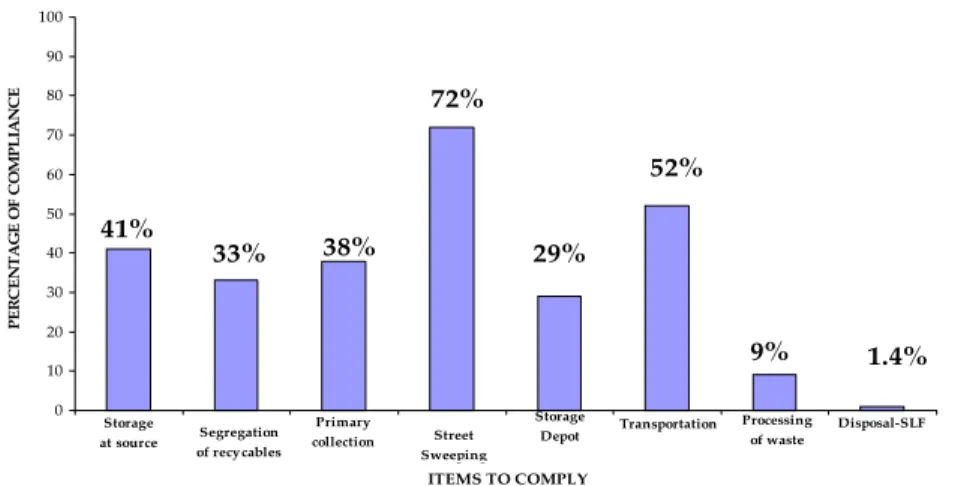
To facilitate implementation of MSWM Rules, the Ministry of Environment and Forest as well as Ministry of Urban Development have extended technical support in the form of comprehensive manual on solid waste management and technology advice through several workshops. Consistent efforts by Ministry of Urban Development & Poverty Alleviation, the Ministry of Environment & Forests, directives from Honorable Supreme Court of India from time to time and the regulatory efforts by the Central Pollution Control Board, and State Pollution Control Boards have yielded some noticeable results during last five years as could be seen from the outcome of a study carried out for class-1 cities as under.
Figure 1.1: Status of compliance of MSWM Rules 2000 by class-1 cities as on 1.4.2004.
SWM learning program in India
Disposal-SLF Processing of waste Transportation Storage Depot Street Sweeping Primary collection Segregation of recycables Storage at source 0 10 20 30 40 50 60 70 80 90 100 ITEMS TO COMPLY P E RC E N T AGE OF C O M P L IANC E 41% 33% 38% 72% 29% 52% 9% 1.4%
Keeping in view current situation of solid waste management in India and the status of compliance of MSWM Rules 2000, the Solid Waste Management Learning Programme in India is initiated by World Bank Institute in 10 World Bank Presence states to address the immediate need of raising inhouse capacity of municipal officials and solid waste operators / specialists to address the problems of solid waste management effectively and implement integrated and sustainable SWM systems in their respective cities.
1.2 Program Objectives
The program aims at improving the capacity of municipal officials at various levels and upgrading the professions skills of local solid waste managers, operators, contractors, and consultants to implement integrated and sustainable SWM systems in India. It also aims at promoting national and regional networks of specialists and practitioners to exchange the ideas and disseminate best practices, linking those with existing international solid waste associations.
The program presently aims at focusing on general urban solid waste of a non-hazardous nature. However, the training will lay the foundation for eventual inclusion of any type of solid waste (e.g., medical wastes, construction debris, disaster debris, slaughter wastes, household hazardous wastes, and industrial hazardous wastes)
The specific goals of this program are to:
• Consolidate existing relevant and appropriate knowledge, materials, and other resources in a comprehensive and easily accessible manner.
• Support the preparation of relevant country-specific case studies capturing good practice examples of solid waste management.
• Prepare highly interactive training materials that can be adapted by local consultants and used for certification purposes of officials and practitioners.
• Built the capacity of local training institutes and specialists to deliver training courses, initially with support from the World Bank and other international institutions, but with the goal of self-sustainable training capacity.
• Develop activities and lay the foundation for associations / networks to facilitate long-term interaction and exchange of information between solid waste managers and operators, private sector service providers, commercial / industrial waste generators, and consultants at the national, regional, and local level.
• Develop criteria and procedures to certify trainers and solid waste operators and practitioners according to national standards, with a goal toward longer-term international standards.
Training Material:
The training materials will be based on internationally available training courses and on locally developed case studies. Among the themes identified are: storage of waste at source, primary collection of waste including source segregation and recycling of waste, transfer techniques; fleet management; transportation of waste, treatment and disposal technologies; community, NGO and private sector participation, institutional
strengthening and inter-municipal arrangements; cost recovery and financial management; economic instruments, including carbon finance; regulatory framework etc. Infrastructure Professionals Enterprise (IPE) Pvt. Ltd.. New Delhi in association with Centre for Environment Education (CEE) have been entrusted the responsibility to carry out this programme.
This Training Need Assessment Report has been divided into following sections:-
Chapter 1: Background & Program Objectives Chapter 2: TNA Objectives & Methodology
Chapter 3: Existing Training Delivery Framework in India and Existing Training Delivery Gaps
Chapter 4: Training Need Assessment (TNA) Results - Target group specific training needs, the subject needs to be covered and duration of training for each category, etc.
2 TRAINING NEED ASSESSMENT OBJECTIVES & METHODOLOGY
2.1 Training Need Assessment Objectives
The primary focus of this training need assessment/analysis is to determine the gap in capabilities of municipal authorities various institutions, operators and consultants in solid waste management in the country to improve solid waste management systems in terms of municipal solid waste (Management and Handling) rules 2000.
A training need exists when there is a gap between what is required of a person to perform competently and what he actual knows. A “training needs assessment”, or “training needs analysis”, is the method of determining if a training need exists and if it does, what training is required to fill the gap. The expectation of knowledge, skills and abilities of officials at different levels is different so there training needs are also different. Training needs assessment has therefore to be for different target groups for exactly knowing what training is required for each group.
The purpose of conducting a needs assessment is to validate the hypothetical judgment with actual training needs to ensure that solution addresses the most needed subjects and effectively focuses the appropriate resources, time and effort toward targeted solutions. Training need assessment is to
identify the gap between the model situation and the actual situation and the way in which it can be bridged.
As the gaps are identified, they are evaluated to determine the manner in which the gaps can be bridged. Some situations will indicate training needs. Some may need non–training solutions (e.g., financial aspects, institutional strengthening, providing the right tools etc.). The results of training needs analysis will highlight the subject wise need to bridge the gap to, help in the preparation of training modules and facilitate in the development of SWM Learning Program.
2.2 Training Need Assessment Methodology
Keeping in view the status of solid waste management in the country and the constraints expressed by the municipal authorities, following steps were taken for conducting training needs assessment.
1. Consultation with Municipal and State Government Officials on deficiency - in the SWM services and gap in their capabilities to take corrective measures.
Box 1. The reasons for doing training needs assessment is: - • To determine whether any training is needed
• To determine the areas in which training is needed • To determine the gap to be bridged
• To determine desired training outcomes • To provide a basis of monitoring and evaluation
2. Training Need Assessment Survey among Municipal Officials 3. SWM Experts Opinion on SWM Training Needs
4. Analyzing Target Group Specific Training Needs
5. Assessment of Institutional Capabilities to provide Training 6. Validation of Training Needs
2.2.1 Consultation with Municipal and State Government Officials on deficiency in
SWM services and gaps in their capabilities to take corrective measures.
The objective of consultations with municipal and state government officials is to assess the current status of SWM & shortcoming in the level of services in the urban local bodies. It was experienced that municipal authorities do not generally respond expeditiously if they are asked to send their views or
comments on any issue, besides they are unable to comprehend and give their views on their training needs. Looking to the existing situation, it was felt appropriate to personally interact with group of municipal officials, identified the deficiencies in the SWM system, reasons for deficiencies, the legal requirements they are expected to meet, and then learn from them, their training needs to meet expectations of good quality of services as per the legal provisions.
Group of Municipal officials were summoned to interact with them. They were asked to narrate their systems of solid waste management, their deficiencies in service in terms of MSWM Rules 2000 and the reasons of their shortcomings etc. We activated their thought process to formulate their views on the actions that they need to take for improving the situation. Simultaneously the interaction was held with state level officials who are responsible for ensuring implementation of SWM Rules in their respective states and to learn from them, their perception of training needs of municipal officials at various levels. Individual interviews with different levels of municipal officials were also taken in addition to collective interviews to address the training needs.
As a part of this exercise, we had the consultations with Municipal Officials through training need assessment workshops organized in four states i.e. Tamlinadu, Rajasthan, Gujarat and Madhyapradesh on following dates.
1st Week of February 2006 – Tamilandu
13th April2006 – Madhyapradesh
17th April2006 – Rajasthan
Consultations with entire state of Tamil Nadu in four sittings, dividing 156 municipal authorities provided their inputs. The elected representatives, the chief executives, the engineer in-charge of the respective cities and the sanitary officers were explained the prevalent situation of waste management in the urban areas and were thereafter
appraised of various directions contained in the Supreme Court Committee Report and Municipal Solid Waste Management and Handling Rules, 2000 and were asked to narrate their training needs as well as the needs in various subjects, duration of training that they consider appropriate.
During consultation in the state of Gujarat, Madhya Pradesh, Rajasthan, Chief Administrative Officers from 90 Urban
Local Bodies of different sizes provided the information on the compliance levels to the 7 steps of municipal solid waste management prescribed by Municipal Solid Waste & Handling Rules. Assessment included system design for storage of waste at sources, its primary collection, secondary storage, transportation and treatment and disposal in an environmentally acceptable manner. The representatives also suggested the areas of improvements for betterment of SWM systems i.e. cost recovery & cost efficiency, public/private partnerships and private sector participation in SWM sector, contractual mechanisms, training and capacity building, IEC activities, public participation, etc.
Besides this, Team Leader have had consultations on the SWM scenarios, constraints, bottlenecks and future plan of action for improving compliance of seven steps prescribed to MSWM rules
urban local bodies. He has discussed the training needs and plan of action for training delivery with state governments of Tamilnadu, Andhrapradesh, Madhyapradesh, Gujarat, Rajasthan.
2.2.2 Training Need Assessment Survey among Municipal Officials
With the view to have individual feedback on the training needs, target specific training needs assessment was carried out for which a special questionnaire was developed, tested and used. The views of 143 municipal officials and elected representatives from more than 100 different sized local bodies were obtained in the questionnaire with the help of respective state governments.
The questionnaire included the following sections (Provided as Annex-2.1)
• Educational background, technical qualifications and experience levels of the respondent.
• Job profile, main duties and/or tasks related to solid waste management of the respondent.
• Abilities for fulfillment of assigned responsibilities • Awareness to MSWM rules and seven steps
• Areas of training needs to meet operational goals, fulfilling responsibilities and improving service delivery and management.
• Preferred duration and mode of training
Following categories of ULB staff were requested to fill up the questionnaires.
• Chief Administrative Officials i.e. Commissioners, Assistant Commissioners, Zonal
Officers, Executive Officers and other Senior Administrative officials
• Elected Representatives i.e. Mayors, Chairmen, Councilors and other elected
representatives.
• Health Officers i.e. Chief Medical Officers, Medical Officers and Assistant Medical
Officers
• Engineering Officials i.e.Engineers, Assistant Engineers, Junior Engineers and other
Engineering Staff
• Sanitary Officials i.e. Chief Sanitary Inspectors, Inspectors, Assistant Sanitary
Inspectors and other Sanitary Officials
• Accounting and Finance official i.e. Accounts officers, Auditors, Head clerks and
other concerned Accounting Staff.
2.2.3 SWM Experts Opinion on SWM Training Needs
Structured interview were conducted with knowledgeable experts, institutions and NGOs involved in SWM activities at national level. This provided perceptions regarding SWM training needs for various stakeholders involved in the SWM at various levels. Their views were obtained on the current status of the SWM, areas of improvements and the training needs of various target groups for improvement of government institutions, local bodies, private sector participation, community, NGO, CBOs, etc.
Structured interviews were conducted with knowledgeable Experts in Government bodies, Institutions and NGOs involved in SWM activities like Ministry of Environment & Forests, (MoEF), Ministry of Urban Development, Central Pollution Control Board (CPCB), National Institute of Urban Affairs (NIUA), Human Settlement Management Institute (HSMI), National Productivity Council (NPC), The Energy Research Institute (TERI), Toxic Links (TL), Confederation of Indian Industries (CII), Centre for Environment Education (CEE) involved in SWM activities at State and National Level. This provided us their perceptions regarding SWM training need for various stakeholders involved in the SWM at various levels. Their specific views were also be obtained on the current status of the SWM, the short comings in the systems, areas of improvements and training needs of specific target audiences.
2.2.4 Analyzing Target Group Specific Training Needs
After collecting the feedback through institutional visits, state level interactions, city consultations, questionnaire survey, we analyzed the data of identified areas of improvements, target group specific training needs and preferred training delivery mechanisms.
Institutional arrangements and ongoing training delivery assessment indicated the training delivery trends and helped in identifying gaps in terms of funding mechanism, subjects covered, duration of training on SWM steps, best Practices documented/shared, reference material/manual developed/distributed, institutional competency to handle SWM issues, through community, NGO & private sector participation.
City level consultations and compliance status analysis has also indicated the areas where training is necessary for different level of stakeholders..
Target group specific surveys were converted to prepare responsibility charts, identify ability gaps, preferred areas of training to analyze the subjects and duration of training programmes for each category of municipal official and elected representatives
Training need of SPCBs/NGOs/CBOs and Private Contractors were also identified on the basis of roles, responsibilities, areas of interests, competency and ability gaps and preferred areas of training needs.
2.2.5 Finalization and Validation of Training Needs and Finalize contents
All target groups specific training needs would be summarized in the form of preferred training modules. A consultation workshop would be organized to validate the results of the TNA, SWM experts, local, state and national level training institutes, organizations, Government agencies and World Bank officials would be involved in the process of reviewing the TNA results. In consultation with advisory committee, we would finalize the training needs and course content for each module that would be developed accordingly for imparting training to various target groups.
3 EXISTING TRAINING DELIVERY FRAMEWORK IN INDIA AND TRAINING DELIVERY GAPS
3.1 Assessment of Institutional Framework for delivery of Training
The details of institutions engaged in training and capacity building programs and their mandates for improving SWM systems have been compiled through secondary and primary sources. We have also collected the information on training and capacity building initiatives undertaken by various agencies and institutions in the country.
With the help of institutional linkages, information on all types of training Programs, which have been/are being conducted by various institutions, NGOs and Government Bodies has been collected. Information on course contents, coverage, target groups, outcomes, etc. has also been collected through primary sources. This has helped in the assessment of missing links/gaps in the existing framework. By visiting a few institutions, information has also been collected on the institutional capacities.
Thus information on 75 past and ongoing training programmes has been collecting on the following aspects: -
• Type and nature of the programme
• Duration • Source of funding • Target audiences • Outreach • Subjects covered • SWM steps Covered
• Best Practices documented/shared
• Reference material/manual developed/distributed
• Institutional Subject Competency
• Participation Response in the training programmes
• Motivation to Learn - amongst participants
• Level of self/institutional sponsorships
• Suggestion to enhance participation
• Feedback or training evaluation mechanism
• Suggested areas of future training
• Training of trainers
This exercise helped us in assessing the ongoing training delivery and identification of the missing links, gaps and constraints in effective training delivery. This also indicated the areas of competency, interests and subject trends of training delivery.
Role and initiatives taken by various government & non-government institutions/ organisations is discussed hereunder.
Ministry of Environment & Forests (MoEF)
The Ministry of Environment and Forest is the nodal agency of the Central Government, for the protection of environment and for the planning, promotion, co-ordination and overseeing the implementation of environmental laws in India. The Hazardous Substances Management Division (HSMD) of the Ministry has the responsibility for Solid Waste Management besides two other main thrust areas, viz. Biomedical Waste Management, Chemical Safety and Hazardous Wastes Management.
Although the primary mandate of MoEF is to develop legislation but it also provide technical advice and financial assistance for training and capacity building to the States and Municipalities. This Ministry has notified comprehensive Municipal Solid Waste (Management and Handling) Rules, 2000 under the Environment Protection Act, 1986. MoEF has taken several direct and indirect initiatives for the facilitation of implementation of MSWM Rules.
As the deadlines set under Schedule 1 of MSWM Rules 2000 in respect of the improvement in the existing landfill sites and identification of a new landfill sites for future use are already over in December 2003 and the compliance status all over the country is still very still dismal. The Ministry has sponsored training programmes to effectively implement the Municipal Solid Waste (Management and Handling) Rules 2000 and Recycled Plastic Manufacture and Usage Rules 1999.
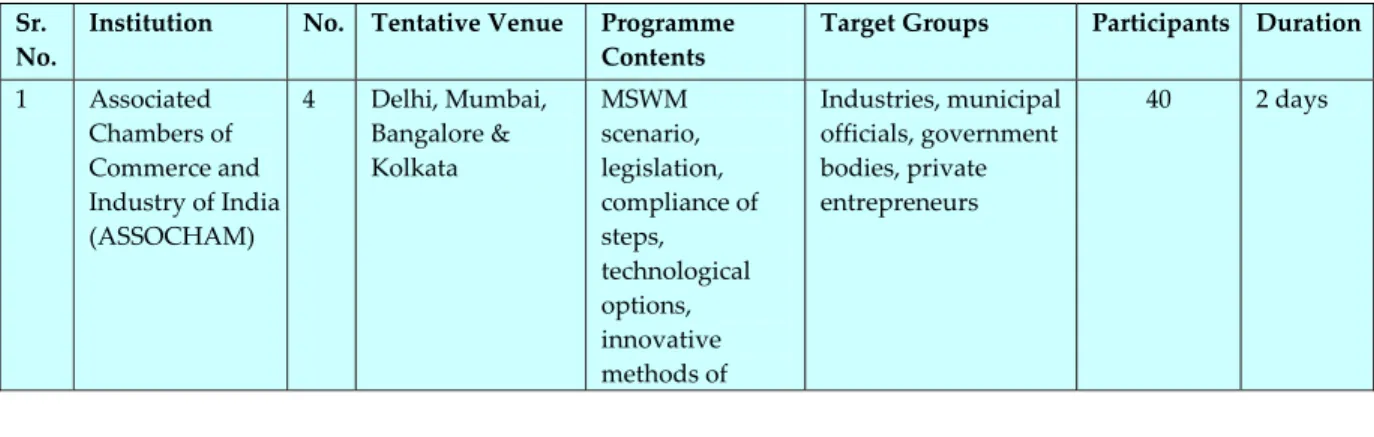
MoEF has provided financial assistance to 7 institutions i.e. ASSOCHAM, New Delhi, HRD Foundation, New Delhi, CII, New Delhi, Disaster Management Institute, Bhopal, Multi Disciplinary Centre on Safety, Health & Environment, Bhubaneswar, Environmental Planning and Coordination Organization, Bhopal and TERI, New Delhi. List given below shows the number of training programmes undertaken, states covered, subjects covered, target groups, number of participants and duration of each training programme being organised by these institutions.
Role and initiatives taken by various government and non government institutions / organizations is described hereunder:
Table 1: - Training Programmes Supported by MoEF during 2005 - 06 Sr.
No.
Institution No. Tentative Venue Programme Contents
Target Groups Participants Duration 1 Associated Chambers of Commerce and Industry of India (ASSOCHAM) 4 Delhi, Mumbai, Bangalore & Kolkata MSWM scenario, legislation, compliance of steps, technological options, innovative methods of Industries, municipal officials, government bodies, private entrepreneurs 40 2 days
Sr. No.
Institution No. Tentative Venue Programme Contents
Target Groups Participants Duration MSWM, monitoring, role of corporate, community, NGOs and authorities in MSWM and plastic waste management 2 HRD Foundation 6 Delhi, Shimla, Agra, Dehradun, Ahmedabad & Indore. Legislation, segregation and community participation, new techniques for collection, transportation and treatment and management of waste Municipal engineers, health officers, senior Sanitary inspectors, NGOs, SPCBs, hospitals, hotel and township builders 25 2 days 3 Confederation of Indian Industry, (CII) 4 Delhi, Bangalore, Pune and Bhubaneswar Best practices, waste to energy, opportunities in CDM, private partnerships models. Industries, private entrepreneurs, SPCBs, NGOs, municipal officials 40 1 day 4 Disaster Management Institute, Bhopal 3 Bhopal, Indore and Gwalior Legislation, compliance status, bottlenecks, treatment technologies, experience sharing Municipal Officials, NGOs, state institutions and other stakeholders 30 2 days 5 Multi Disciplinary Centre on Safety, Health & Environment, 6 Puri, Balasore, Rayagada, Balangir, Bargarh and Bhawanipatna Legislation, compliance status, issues and constraints options for treatment technologies, strategy formulation Municipal Officials, NGOs, state institutions and other stakeholders 50 2days each 6 Environmental Planning Coordination Organization 4 Bhopal, Indore, Gwalior and Jabalpur MSWM scenario, legislation, compliance of steps, innovative methods of MSWM, monitoring,, role of various
State and city government representatives,. Municipal Officials, NGOs, state institutions and other stakeholders 30 1 day
Sr. No.
Institution No. Tentative Venue Programme Contents
Target Groups Participants Duration stakeholders
7 The Energy and Resources Institute (TERI) 4 Chandigarh, Bangalore, Guwahati and Raipur 30 2 days
Ministry of Urban Development & Poverty Alleviation (MoUD &PA)
This ministry formulates policies, sponsors and supports programmes, coordinate the activities of various Central Ministries, State Governments and other nodal authorities and monitor the programmes concerning all the issues of urban development and housing in the country including SWM
activities.
In this ministry “Technology Advisory Group (TAG)” was constituted on the advise of Supreme Court of India, and given the task to collect information on appropriate tools and equipments and various proven technologies for processing and disposal of wastes. Expected to identify, appropriate cost effective technologies and provide technical guidance to State Governments and Urban local bodies. The Technology Advisory Group as under constituted three core groups: 1) Appropriate technologies, 2) Research and development
group,
3) Financial resources and private sector participation,
4) Capacity building, human resource development, information, education and communication.
The report of Technology Advisory Group has recently been released for the guidance of municipal authorities in the Country. The Central Public Health & Engineering
Box 2. Subjects covered in the MSWM manual • Principles of municipal solid waste management
• Composition and quantity of solid waste
• Construction and demolition waste
• Slaughter house waste and dead animals
• Industrial solid waste
• Biomedical waste
• Sorting and material recovery
• Storage of waste at source
• Primary collection of waste
• Street cleansing
• Transportation of waste
• Composting
• Energy recovery from municipal solid
• Emerging processing technologies
• Landfills
• Community participation
• Institutional aspects & capacity building
• Prospects of private sector participation
• Economic and financial considerations
• Environmental and health impact
• Assessment
• Legal aspects
• Policy guidelines
• Preparation of a municipal solid waste management plan
Organization, MoUD brought out a detailed manual on MSWM to provide guidance to ULBs in regard to all the essential steps to be taken to improve solid waste management service. This manual was prepared by an expert group constituted by Ministry of Urban Development. The members comprised of advisor Central Public Health and Environmental Engineering Organization (CPHEEO), Additional Director Central Pollution Control Board (CPCB), Representation from National Environmental Engineering Research Institute (NEERI), Senior Scientist, Ministry of Non-Conventional Energy Sources (MNES), Municipal Corporations, World Health Organization (WHO), academic institutes, Housing & Urban Development Corporation (HUDCO) and United Stated Asia Environment Partnership (USAEP). Local bodies in India are extensively using this manual.
The MoUD has also constituted an inter-ministerial task force on integrated plant nutrient management using city compost. The task force has prepared a detailed report on the existing composting plants and has come out with the reasons for failure of composed plants or inadequate utilization of the treatment facilities and has made recommendations for improving the efficiency of the composed plants and marketing of composed.
The 12th Finance Commission has allocated
to State Governments devaluation of grants for the urban local bodies to the tune of Rs. 5000 crores for the period 2005-2010 out of this amount Rs. 2500 crores have been earmarked for setting up of SWM Systems in Urban areas to ensure the management of MSW in accordance with MSWM Rules. CPHEEO on its part made efforts to launch and promote PHE Training Programme from 1956. The coverage of these activities has increased considerably over the years. In order to cater to the needs of training of
various Public Health Engineering Departments, Water Supply & Sanitation Boards, Urban Local Bodies, State Pollution control Boards and other Water Supply & Sanitation agencies like Jal Sansthans, the following training programmes have been introduced and are being conducted through research & academic Institutes and field departments: • Post Graduate Course in Public Health Engineering/Environmental Engineering. • Short Term Course in Public Health Engineering/Environmental Engineering
• Refresher courses on various aspects of design, construction, operation and maintenance of water supply and sanitation facilities, including solid waste management.
Box 3. Institutions recognized with MoUD MoUD recognized eleven academic institutes so far as listed below. The annual intake capacity in 11 Institutes is 88. During the year 2005-2006, 58 refresher courses are proposed through 20 recognized Institutes. The duration of refresher courses vary from one week to four weeks. Intake capacity in refresher courses vary from course to course from 15 to 30 candidates in each course which depend upon the level of participants, nature of course, duration etc.
Table 2. PHE Courses run by MoUD
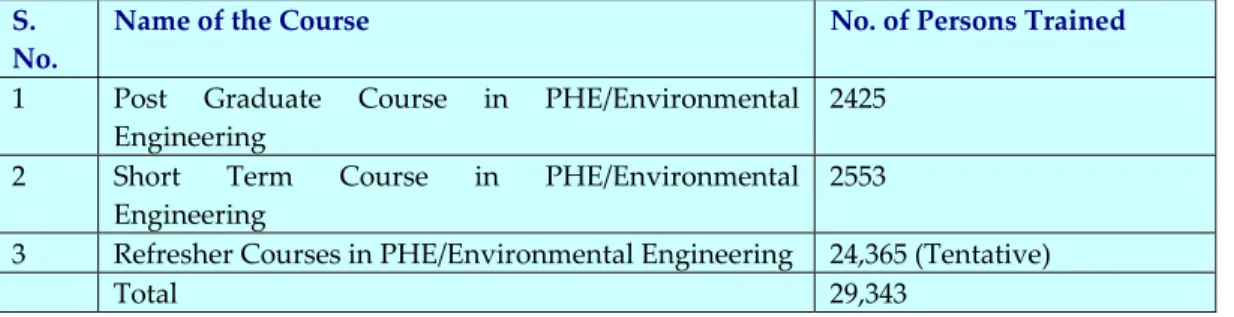
The number of in service Public Health Engineers & Para-Engineering staff trained under the PHE Training programme of the Ministry in Post Graduate Course, Short Term Course & Refresher Courses till 31st March, 2005 is as under:
Central Pollution Control Board (CPCB) The Central Pollution
Control Board (CPCB), a statutory organization has a mandate to promote prevention, control and abatement of various types of pollution. It also provides technical services to the Ministry of Environment and Forests as per the provisions of the Environment Protection Act, 1986.
The responsibility for implementation of MSWM Rules lies with the Pollution Control Planning Division. The Central Pollution Control Board,
through the State Pollution Control Boards is responsible for the enforcement of the MSWM Rules. They also
provide necessary technical advice through various publications and guidelines to the Urban Local Bodies. With the technical guidance from CPCB, initiatives have been taken S.
No.
Name of the Course No. of Persons Trained
1 Post Graduate Course in PHE/Environmental Engineering
2425
2 Short Term Course in PHE/Environmental
Engineering
2553
3 Refresher Courses in PHE/Environmental Engineering 24,365 (Tentative)
Total 29,343
Box 4. CPCB has completed the following studies and brought out these publications on solid waste management during last few years: -
• Guidelines for constructing sanitary landfills
• Reference manual on technology and processing of municipal waste
• Reference manual on MSWM Rules for urban local bodies
• Report on assessment of health in conservancy staff and other communities associated with handling of MSWM
• Characterization of compost quality and its application in agricultural crops.
• Report on assessment of methane emission from landfill sites
• Status of solid waste management in 59 metro cities and capitals
• Characterization of compost quality prepared from Municipal Solid Wastes.
• Recycling of plastics waste and using it in construction of roads
Box 5. ULBs with Good Initiatives on SWM with CPCB’s Support
Some of the local bodies who have taken good initiatives are in the states of Maharashtra (Pune, Nasik, Nagpur), West Bengal (North Dum Dum, Barrackpore, Kumar-hati, Kulti, Suri) Gujarat (Ahemdabad, Surat, Bejalpur), Nagaland (Kohima), Chandigarh (UT), Goa (Panjim), Andhra Pradesh (Hyderabad, Vishakhapatnam, Vijaywarda, Suryapet), Tamil Nadu (Tiruppur, Namakkal, Udumalpet, Udagamandalam).
by many local bodies to create awareness among the citizens for proper collection, segregation, storage and transportation of waste.
Through Human Resource Development Programme (HRDP), training and capacity building programmes were organized on various environmental planning and management issues. This aimed at capacity building of planning institutions and authorities, consultants and stakeholders. Through institutions like CSIR, NEERI, ITRC, ICMAR, NIOH, DMI, etc, it organized training programme on environment management for different stakeholders.
Ministry of Non Conventional Energy Sources (MNES)
MNES is the nodal agency of the Government of India for all matters relating to non-conventional/ renewable energy. It undertakes policymaking, planning, promotion and coordination functions relating to all aspects of renewable energy, including fiscal and financial incentives. Ministry of Non-Conventional Energy Sources is promoting setting up of Waste-to-Energy projects through National Programme on Energy Recovery from Urban and Industrial Wastes and a UNDP/ GEF assisted project on Development of High Rate Biomethanation Processes as a means of reducing Green House Gases emission. The National Programme on Energy Recovery from Urban and Industrial Wastes was launched during the year 1995-96 with the objectives to create conducive conditions with financial and fiscal regime to promote, develop and demonstrate the utilization of wastes for recovery of energy; improve the waste management practices through adoption of renewable energy technologies for processing and treatment of wastes prior to disposal and promotion of projects for recovery of energy from wastes from Urban and Industrial sectors.
Ministry of Agriculture
The Ministry of Agriculture is responsible for the formulation and implementation of National policies and programmes aimed at achieving rapid agricultural growth through optimum utilization of the countryʹs land, water, soil and plant resources. The Department of Agriculture undertakes all possible measures to ensure timely and adequate supply of inputs and services such as fertilizers, seeds pesticides, agricultural implements and also provides agricultural credit, crops insurance and ensures remunerative returns to the farmer for his agricultural produce. Ministry’s interest in solid waste is related to the fact that biodegradable stream of the municipal solid waste can be used for producing compost which can be used as organic fertilizer by the farmers and others.
State Pollution Control Board (SPCBs)
The functions of the SPCBs include planning and execution of programs for prevention and control of water and air pollution, advising the State Government on matters concerning abatement of water pollution, laying down standards for water and air quality,
ensuring compliance with various laws, ensuring legal action against the polluters and evolving techno-economic methods for treatment, disposal and utilization of effluents. The SPCBs are responsible for prevention and control of water, air and land pollution. They advise the State Government on matters concerning the prevention, control of water and air pollution and improvement of the quality of air and water.
Municipal Solid Waste (Management and Handling) Rules 2000 put additional responsibilities on the SPCBs with respect to management of municipal solid waste. According to the Rules, the SPCBs or a Committee formed under it are required to monitor the compliance of the standards regarding ground water, ambient air quality, and leachate quality.
The State Board or the Committee is also supposed to look into applications from the municipal authority or the operator of a facility for setting up waste processing and disposal facility including landfills and grant authorization. These authorities also conduct training workshops from time to time to educate Municipal Officials on the scientific management of municipal solid waste.
Urban Development Department of State Governments
Urban Development Departments in the states are responsible for formulation of state level policy and oversee the implementation of State level regulations pertaining to management of urban issues. It also provides necessary guidance and assistance to the functioning of the Municipalities and Corporations in the State. The Secretary in-charge of the Department of Urban Development has the overall responsibility of the implementation of MSWM Rules in the municipal corporations and the District collectors are made responsible for implementation of the rules in the municipalities under their jurisdiction. The department reviews the position of
implementation of MSWM Rules in their states.
Box. 6. According to the MSWM Rules, Municipal Authorities or the ULBs are responsible for following functions: -
• Implementation of the Rules at the municipality level including Infrastructure development for segregation, collection, storage, transportation, processing and disposal of MSW.
• Applying for grant of authorization for setting up waste processing and disposal facilities including landfills from the State Pollution Control Board or Committee.
• Notify the waste collection schedule to the generators of these wastes, to help them comply.
• Organize awareness programmes for citizens to promote reuse or recycling of segregated materials and community participation in waste segregation.
• Write an annual report and submit to a) Secretary-in-charge of the Department of Urban Development of the State or Union Territory in case of metropolitan cities. b) The District Magistrate or the Deputy Commissioner in case of non-metropolitan cities. The State Pollution Control Board or Committee on or before June 30 of every year.
Urban Local Bodies
Urban Local Bodies, being responsible for complying to MSWM rules are required to undertake primary collection of waste from the waste generators, street sweeping, secondary storage, transportation, processing and disposal of solid waste. However, due to lack of accountability services provided by local bodies are inadequate. Some of the key problems faced by the municipalities include lack of resources, technical know-how, planning and attitudes towards management of waste. The decision makers do not consider this subject worth their personal attention though solid waste management consumes large part of the municipal budget. In most municipalities, up to 75% (in some up to 90%) of the SWM budget goes towards the staff salaries. The productivity of the staff engaged in Solid Waste Management, is extremely low, partly due to indifference of the staff and liberal labour laws, in particular, and union activities having political patronage. In most ULBs, 30-50% of the total municipal staff is engaged in waste management. It is established that the ULBs spend Rs. 500 to Rs. 1500 per tonne for collection, transportation, treatment and disposal of solid waste. About 70-75% of this amount is spent on collection, 20-30% on transportation and less than 5% on final disposal of waste. The administrative and supervisory structure for solid waste management varies with different municipalities.
To improve the solid waste management services, the capacity of the municipal staff needs to be built to manage the entire system of solid waste management. This can be done through training programmes for the municipalities.
There seems to be very little interaction between the key governmental agencies and ULBs in the matter of Solid Waste Management Systems and technologies that must be adopted. NGO/ Research Institutes
National Institute of Urban Affairs (NIUA)
This is an institute created by the Government of India to assist and advise the Central Government on Urban issues it carries out studies and research on urban issues to facilitate the Government of India to take appropriate decisions. NIUA, through conferences, seminars, workshops, symposia and lectures provide an important platform for policy advocacy, academic exchange and sharing of research findings and experiences. Institute has been providing support to the All India Mayors’ Council, International City/Country Management association (ICMA) and different city Manager’s association in India, in conducting seminars and workshops on urban infrastructure related subjects. NIUA assesses training requirements of urban organizations, conduct the training and also produces the necessary training material for distribution among the participants. NIUA has conducted following seminars and conferences concerning functioning of local bodies.
National Workshop on State Finance Commissions Policy Seminar on Property Tax Innovations in India Seminar on Pricing and Cost Recovery of Urban Services Seminar on Capacity Building for Urban Governance
Under Indo-USAID collaborative programme, it conducted training workshops, seminars and research under the, the Financial Institutions Reform and Expansion (FIRE-D) programme. It sensitized the State Governments to the concept of full cost recovery for directly chargeable urban infrastructure and motivated city governments to increasingly go in for credit rating. Under this programme, it has been providing regular support for imparting capacity building training to elected representatives, top and middle level functionaries of municipal bodies and professionals of urban infrastructure agencies in a wide range of areas.
NIUA has developed a network of more than 15 state level training institutions in the country. A few relevant areas covered in training programme conducted/supported by NIUA
Municipal Finance & Accounting
Project formulation for Urban Infrastructure Management of Urban Environment
Management of Urban Services Financing Urban Infrastructure
Resource Mobilization, Public Private partnership and Pricing and Cost Recovery Empowerment of Municipal Government
Solid Waste Management Project Development
Resource Mobilization for Empowerment of City Government
NIUA has brought out a study document of the innovative initiatives taken by the local government of selected cities of India to improve solid waste management through various measures including improving efficiency, finding administrative and technical solutions to improving waste collection and disposal, involving the private sector and NGOs in improving the service and exploring new ways of financing investment.
Currently, NIUA is also working as a coordination agency for implementation of project called “National Strategy for Urban Poor-NCR Component” supported by United Nations Development Programme (UNDP). In this project support has also been provided to 6 agencies for demonstrating community based solid waste management through training and capacity building of target groups.
Human Settlement Management Institute (HSMI)
HSMI has conducted a large number of programmes on SWM for Government of India as well as other international agencies. HSMI has also been conducting customized programmes for various ministries and international agencies.
HSMI has a network with all the state level training institutions in the country and has a HUDCO chair in all institutions. They have residential facilities for participants at Delhi and also in states. HSMI’s training
programme responds to the felt needs of housing and urban development sector. They aim at improving the knowledge, skills and attitudes of the middle, senior level mid career professionals engaged in SWM sector working as administrators, professionals, researchers, economists. Architects, computer professionals and community development agents with state and local governments, private sector, NGOs, CBOs, and civil society as also for the employees of the corporation on selected themes.
Some of the training programmes organized by HSMI are as follows: -
• Training on SWM on Kohima, Nagaland for state of Nagaland -This one week long training programme covered municipal waste management and planning as applicable to small and medium towns.
• Capacity building of the Urban Environment, Institute for Housing and Urban Development Studies, Totterdam, the Netherlands- for development of national capacity building strategies.
• PHE Training, Ministry of Urban Development & Poverty Alleviation, Government of India- training programme in the area of solid waste management, waste recycling and cost recovery.
• Preparation of training manual on solid waste management – sources, collection, transport and treatment & disposal options for SWM.
National Productivity Council (NPC)
NPC is a Government of India undertaking. It is created to enhance productivity of industries and in associated sectors. Besides providing professional services to several industries and organizations it also provides training to municipal authorities, pollution control boards, financial institutions, policy makers and other stakeholders in all aspects of municipal solid waste management.
NPC assisted CPCB, SPCB and more than 1000 industries in building their capacity for managing environmental issues.
Box 7. Course contents of Courses run by HSMI:
-• Basic issues in solid waste management Option for domestic waste water disposal
• Technological interventions for waste disposal
• Recovering wealth from waste
• Best practices in waste collection, transportation and disposal
• Social and environmental aspects of waste handling and recycling
• Life cycle analysis for urban waste management
• The Government policies and support in waste management
It has published:
• Compendium of success stories on waste minimization/cleaner technology implementation in India.
• “Waste to Profit” generic waste management manual.
• Industrial sector specific “from Waste to Profit” waste minimization manual.
Table 3. Training programmes conducted by national productivity council, in the area of municipal solid waste management
Programme Contents covered
Five- day Training Programme on Municipal Solid Waste Management for the ULBs from India, sponsored by Central Pollution Control Board.
MSW Introduction -Composition & Quantification MSW Management -Regulatory Requirements Segregation, Collection and transportation of MSW Biomedical Waste Management
Plastic Waste Management
Industrial Hazardous Waste Management
Municipal Solid Processing Technologies - Composting Municipal Solid Waste Incineration
Seven Step Strategy for Municipal Solid Waste Management for a City Municipal Solid waste management –Role of Public & NGO’s
Environmental Impact Assessment of Existing Dumpsites and up-gradation – A Case Study
Field / Site Visits
Design and Development of Sanitray Landfill Facility GIS and Remote sensing techniques in Site selection Group Discussions
Presentation on Group Discussion and & Discussions on Field visit Summary and valedictory
One-day workshop on Situation Analysis, Strategies to implement Municipal Solid Waste Rules, 2000 in Gujarat
Review of status of Municipal Solid Waste Management practices Assessment of gaps & strategies to implement MSWM rules in Gujarat Concept of regionalisation for setting up of disposal facilities through state government funds
Adoption of public & private partnerships for Operation & Maintenance of MSW management facilities
Cost-recovery of solid waste management aspects
Training needs assessment in human resources development with respect to MSW management in ULBs
One day Training Programme on Municipal Solid Waste Management for the municipal Engineers of Nagpur Municipal Corporation
MSWM Rules 2000,
Up-gradation plan for existing dumpsite at Nagpur, Principles and components of Sanitary Landfill Facility & operation of SLF.
One-day workshop on Municipal Solid Waste Management for the ULBs in Gujarat
Legal Framework & Provisions of MSWM Rules, 2000 Municipal solid waste management overview in Gujarat Waste processing & disposal facilities – technical details Financing for municipal solid waste management projects Municipal solid waste minimization – issues & strategies.
Programme Contents covered One day programme on
Municipal Solid Waste Management for the municipal engineers and solid waste in-charges of ULBs
Overview of municipal solid waste management scenario in India & Abroad
Municipal Solid Waste Management Rules and its interpretation Sanitary Landfill Facility – Concepts, sitting & operational aspects Assessment & up-gradation of existing MSW dumpsites
NPC case studies on MSW Management Two -day programme on
Municipal Solid Waste Management for the municipal engineers and solid waste in-charges of ULBs
Requirements & interpretations of MSW Rules
Overview of municipal solid waste management scenario in India & Abroad
Segregation, Collection & transportation of MSW Sanitary Landfill Facility – Design & operational aspects
EIA for site selection, Assessment & up-gradation of MSW dumpsites – Case Studies
Overview of MSWM composting technologies Industrial Hazardous waste Management Machinery for Municipal Solid Waste Disposal Plastic Waste Management
Training programme on Municipal Solid Waste Management – Development & operation of processing & disposal facility for officials of CIDCO, Navi Mumbai.
Requirements & features of MSWM rules, 2000
Principles of integrated Sanitary Landfill Processing & Disposal Facility . Operation & Maintenance of Sanitary Landfill Facility
Training programme on MSW Management for the officials of Ferozpur Cantonment Board
Training programme on MSW Management for the officials of Bareilley Cantonment Board
Overview of Municipal Solid Waste Management practices MSW Rules 2000
Municipal Solid Waste Processing & Disposal Principles & elements of Sanitary Landfill Facility
Do One Day Workshop on Municipal Solid Waste Management for the Urban Local Bodies of Chhattisgarh State
One Day Workshop on Municipal Solid Waste Management for the Urban Local Bodies of Madhya Pradesh State
Municipal Solid Waste management -Overview
Municipal Solid Waste (Management & Handling) Rules, 2000
Municipal Solid Waste Management – Storage, collection and transportationMunicipal Solid Waste Processing and disposal
Best Practices in Municipal Solid Waste Management
UEIR/USAEP/USAID
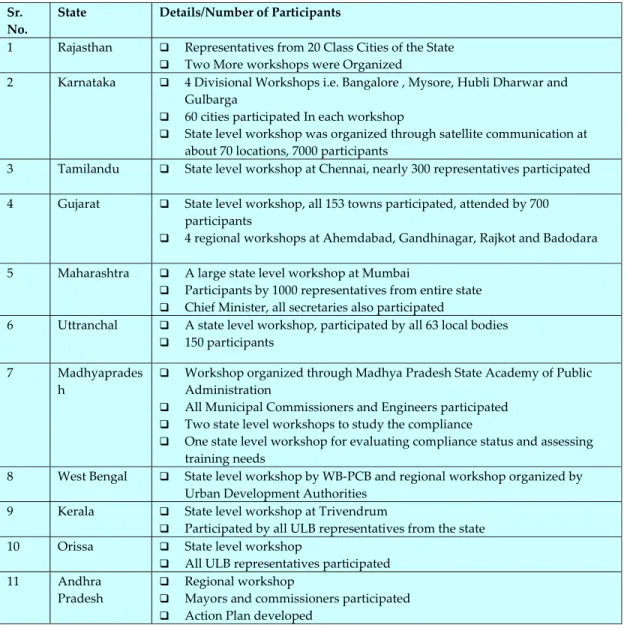
It has organized workshops in many states of India. Through these workshops, they have been providing the training to city and state government bodies/institutions. Participants include elected representatives, municipal commissioners, administrative officers, health officers and engineers.
Table 4. State level Workshops conducted by UEIR, US AEP/USAID to improve SWM services Sr.
No.
State Details/Number of Participants
1 Rajasthan Representatives from 20 Class Cities of the State
Two More workshops were Organized
2 Karnataka 4 Divisional Workshops i.e. Bangalore , Mysore, Hubli Dharwar and Gulbarga
60 cities participated In each workshop
State level workshop was organized through satellite communication at about 70 locations, 7000 participants
3 Tamilandu State level workshop at Chennai, nearly 300 representatives participated 4 Gujarat State level workshop, all 153 towns participated, attended by 700
participants
4 regional workshops at Ahemdabad, Gandhinagar, Rajkot and Badodara 5 Maharashtra A large state level workshop at Mumbai
Participants by 1000 representatives from entire state
Chief Minister, all secretaries also participated
6 Uttranchal A state level workshop, participated by all 63 local bodies
150 participants 7 Madhyaprades
h
Workshop organized through Madhya Pradesh State Academy of Public Administration
All Municipal Commissioners and Engineers participated
Two state level workshops to study the compliance
One state level workshop for evaluating compliance status and assessing training needs
8 West Bengal State level workshop by WB-PCB and regional workshop organized by Urban Development Authorities
9 Kerala State level workshop at Trivendrum
Participated by all ULB representatives from the state 10 Orissa State level workshop
All ULB representatives participated 11 Andhra
Pradesh
Regional workshop
Mayors and commissioners participated
Action Plan developed Toxic Links
Toxics Link is and NGO working on Toxics, hazardous waste and bio-medical waste sector. It has also developed training manual and other reference material for implementing, scaling and sustaining community-based municipal solid waste management projects. In the training context for MSWM, currently it is holding a series of awareness and knowledge workshops in different regions
of the country. It is organizing a series of 8 skill share workshop for up-scaling people’s
Box 8. Course Content-Toxic Links
Contents of the training programmes are designing and implementation of community based SWM systems, concept and principles of zero garbage systems, rules, regulations and policies, community mobilization, financial sustainability, role of NGOs, composting challenges and future, challenges and strategy for action.
participation in solid waste management. It has already conducted 4 programmes at Coiambatore, Shilong, Kolkata and Lucknow.
The Energy Research Institute (TERI)
TERI (The Energy Research Institute) has been working in research and consulting related to policy, status and institutional aspects of solid waste management in the country. TERI is funded by both national and international agencies. They also raise funds through seminars, training programmes and consulting services. TERI prepared a Plastic waste management plan for Delhi for Department of Environment and a study on community participation in urban solid waste management: a framework for action.
TERI Organized a 15 days programme on waste management addressing all technical, institutional and financial aspects related to municipal solid waste, biomedical and hazardous waste management.
Asian Centre for Organization Research and Development (ACORD)
ACORD is an NGO based at Delhi facilitated series of thematic workshops on segregation of waste at source during “Bhagidari” meetings. The Bhagidari system is a forum for the urban local bodies and citizens to initiate a dialogue and take joint decisions to improve the quality of life in Delhi. Multi stakeholder workshops included representatives from resident welfare association, school eco clubs, NGOs, employees of Municipal Corporation from all zones in Delhi. The purpose of the workshop was to draw up an action plan for segregation of waste at source, based on various issues or problems perceived by the various “stakeholders”, and identify some core issues to be agreed upon by all involved in the discussions. Although, it is a good starting point, the Municipal Corporation is not prepared themselves to maintain segregation throughout the waste management chain. Centre for Environment Education (CEE)
CEE is an NGO having its head quarter at Ahmedabad and several nodes outside Ahmedabad. CEE has been involved in several initiatives that deal with better environmental management of resources. Such as garbage management, environmental improvement of slums and human development, cleaner production in industries, healthcare waste management and conservation of natural resources through reduction, reuse and eco-friendly recycling and energy management.
CEE has developed a large number of educational and awareness materials on solid waste management and bio-medical waste. Through it training and capacity building initiatives, it has trained municipal officials and elected representatives. It has also targeted concerned government bodies, NGOs, rag pickers, slum dwellers, and other disadvantaged groups, citizens, schools, colleges both teachers and students, govt. officials and NGOs from South Asian countries.