1
1 6
6 7
7
Ondrej Schneider
I m p l i c i t P u b l i c D e b t o f t h e C z e c h
S o c i a l - S e c u r i t y S y s t e m
^
not necessarily those of CASE.
This paper was prepared for the research project No. P96-6089-R (ACE PHARE Programme 1996) on "The Medium and Long-term Perspectives of Fiscal Adjustment of Selected Central European Countries".
© CASE – Center for Social and Economic Research, Warsaw 1999
Graphic Design: Agnieszka Natalia Bury
DTP: CeDeWu – Centrum Doradztwa i Wydawnictw “Multi-Press” sp. z o.o.
ISSN 1506-1701, ISBN 83-7178-137-7
Publisher:
CASE – Center for Social and Economic Research ul. Sienkiewicza 12, 00-944 Warsaw, Poland
tel.: (4822) 622 66 27, 828 61 33, fax (4822) 828 60 69 e-mail: [email protected]
Abstract 5
1. Introduction 6
2. Social-security Systems at Crossroads 6
3. Czech Pension System – Deficits in the Pipeline 8
4. Change of the System 10
5. Estimation Methodology 11
6. Calibration 11
7. Results 13
8. Conclusions 15
Ondrej Schneider
Education: Prague School of Economics (master degree in 1989), Cambridge University (Mphil. degree in 1993) and CERGE of Charles University (PhD. in 1998).
Appointments: researcher at the Czech Academy of Sciences (1989–1996), assistant researcher at the NBER in Cambridge, MA (1995), lecturer at the Charles University (1995–present), adviser to the Minister of Economy (1995-1998), consultant to the World Bank (1996–1997), chief economist at the Patria Finance (1998–present).
Abstract
The Czech social-security system is hampered by the ageing population, similarly as all European systems. The discussion of remedies is still very rudimentary. Pro-reform arguments concentrate on the non-sustainability of the current system in the long term and on the miserable returns the system produces for the taxpayers. Funded systems are consequentially quoted as a viable alternative. The main argument of the non-reformers, on the contrary, rests with the sky-high costs of such a reform and on the societal instincts that may clash within an attempt.
In this paper, we try to carry out an objective and comprehensive appraisal of the implicit debt of the Czech social-security system. Such an estimate would be crucial if a reform, at least partially based on the switch to a funded system, were to be conceived. Currently, the government is considering no such reform. Therefore, for the short-term fiscal outlook, costs of unreformed system should be taken into account. In a longer-term, though, future governments will have to deal with the pension system and implement some aspects of the pension reform.
We show that the current social-security system based on the PAYG principle is heavily indebted, though the debt is thus far ”implicit”. Taken all parts of the system together, the Czech social security system has accumulated debt in excess of 250% GDP, level similar to other European countries. The debt level is, indeed sensitive to the valorisation coefficient. Should the future governments apply very restrictive policies and keep social security benefits fixed in real terms, the overall implicit debt would decrease to 199% of GDP. On the other hand, more generous valorisation by 4% in real terms would lift the implicit debt to 324% of GDP.
1. Introduction
The Czech social-security system embodies the very same flaws now facing all developed industrialised countries. Its current framework is shaped by the slowly expiring contract between generations, based on the underlying assumption of ever-increasing wages and a stable or slightly rising active population’s share. Those conditions have proved short-lived, however, and all countries now struggle to amend their social-security systems; firstly, through pension reform. The main pro-reform argument concentrates on the non-sustainability of the current system in the long term and on the miserable returns the system produces for the taxpayers [1]. Funded systems are consequentially quoted as a viable alternative [2]. While many reforms have been attempted, a systematic and comprehensive reform remains rare. The main argument of the non-reformers, on the contrary, rests with the sky-high costs of such a reform and on the societal instincts that may clash within an attempt.
In this paper, we try to carry out an objective and comprehensive appraisal of the implicit debt of the Czech social-security system. Such an estimate would be crucial if a reform, at least partially based on the switch to a funded system, were to be conceived. Currently, no such reform is being considered by the Czech government that even campaigned for rolling back a few reforms which had been implemented by previous governments. Therefore, for the short-term fiscal outlook, costs of unreformed system should be taken into account. In a longer-term, though, future governments will have to deal with the pension system and implement some aspects of the pension reform discussed below.
We should note, however, that our estimate reflects extreme costs, which would be incurred only if the current system were terminated immediately and entirely for all citizens, working or retired. It should, therefore, serve as a benchmark rather than a reform cost estimate.
2. Social-security Systems at Crossroads
The Czech social-security system, which distributes more than 20% of its GDP, is going through a turbulent and extremely important phase of development. While the underlying [1] It is to be noted, however, than the PAYG systems often do produce excellent returns for low-income workers.
trends are as worrying as elsewhere in the developed and transition countries, the short-term accounts look almost balanced and a thorough reform does not seem imminent. For the purpose of this paper we leave aside the health-care system, currently spending as much as 8% of the Czech GDP. The health system has been separated from the state budget and is run by a quasi-governmental organisation quango(General Health Insurance). Instead, we concentrate on the pension system and the system of social security for the disabled. These two systems consume almost one third of the government budget and 14% of GDP (CZK 235 bn in 1999, CZK 223 bn in 1998). Therefore, concentrating on them we cover the bulk of the Czech social-security system. Moreover, only old-age and disabled pensions represent a proper insurance scheme and may be dealt with as insurance programmes.
Governments in the transition countries often stress that private agents are not ready to embrace full-scale pension reform, as they are used to the old, state-dominated systems. Officials maintain that depending exclusively on voluntary private savings would bring the pension system, and indeed the whole of the economy, to a collapse. The main argument cited is individual behaviour – the short-sightedness of people who do not save adequately for their old age and are dependent on state assistance. Inadequate financial instruments, the propensity of the financial institutions in transition countries to fail, and information gaps are also cited as obstacles for private savings along side state-social security. If we add the classical market failure arguments – adverse selection, moral hazard – the case for private old-age insurance seems almost lost.
Nevertheless, these arguments fail to address the scale of the problems faced by the state-pension systems in the transition countries, as well as in the developed countries. The high and rising cost of the current social-security system already represents a main obstacle to a more dynamic economic growth in the transition countries that would hoist the economies to levels approaching those of the developed countries. First, the transition countries are just beginning to feel the demographic pinch of the increasing shares of pensioners as their populations’ age [3]. Second, the relatively generous pension benefits promised by these states hamper development of the private-pension funds and the insurance market at large. Third, widespread manipulation and evasion seriously affect the social-security systems. This results in higher benefits paid and a lower contribution collected by the state and thus exacerbates the social-security balance. Last, but not least, social-security systems in the transition countries are perilously under funded. The reason is that they operate on [3] This does not hold for Russia, where the expected lifetime has been actually decreasing for last years. Though this development does relieve the Russian pension system of some acute problems, it is not to be envied.
the Pay-As-You-Go (PAYG) basis, which is ill suited to cope with the ageing of populations and raising costs.
It is fair to say that PAYG pension systems can be altered to accommodate the changing demographic environment. The most discussed modification of the basic PAYG system would be to set contributions on a long-term equilibrium level, which would take into account future demographic changes. As this “long-term” level appears to be above the current contribution level in all countries, it is a politically ungrateful task, requiring formidable foresight from a government.
3. Czech Pension System – Deficits in the Pipeline
The pension system in the Czech Republic is as fallible as any other mature PAYG system operating in an ageing society. As the share of elderly in the entire population increases financing the pension system form payroll taxes begins to be too expensive. If the future governments keep the current level of contributions (26% of the wage bill), the PAYG exhibits consistent deficits – see Table 1. Assuming a 3% real return on investment (or 3% real interest rate to be paid later on loan), the system would accumulate a debt of more than 40% of GDP in 2020. The debt would be equal to 100% of GDP around the year 2035 and more than 180% of GDP in 2060. The sheer size of these numbers suggests that the current system is not sustainable.
Table 1. Annual Deficits of the Czech Pension System in 1999–2010 (CZK bn and %GDP)
As seen from the table, the Czech pension system runs consistent deficits below 1% of GDP until 2007. This is the year when the retirement age will reach 62 for men and 59–61 for women. As of now, the retirement age should then be fixed at these levels.
1999 2000 2001 2002 2003 2004 Deficit (CZK bn. 94 prices) -8.0 -8.5 -9.0 -9.5 -10.0 -11.1 Deficit (% GDP) -0.7 -0.7 -0.7 -0.7 -0.8 -0.8 2005 2006 2007 2008 2009 2010 Deficit (CZK bn. 94 prices) -10.3 -11.7 -12.9 -19.6 -23.4 -27.5 Deficit (% GDP) -0.7 -0.8 -0.8 -1.2 -1.3 -1.5
However, as the population continues to grey costs of the pensions will balloon and the deficit will reach 1,5% of GDP in 2010 (and 3,2% of GDP in 2020).
There is an alternative, of course. The pension system could be kept balanced by raising the contribution rate on a regular basis. If we ignore all general equilibrium effects of higher contributions (lower employment, shadow economy…), the contribution rate would have to increase from current 26% of wages to 31% in 2010 (and to 36,7% in 2020) – see Table 2.
Table 2. Social Security Contributions Balancing the Czech Pension System in 1999 – 2010 (% of wage)
The situation was not too different in other transition countries. However, as Hungarians and Poles have introduced pensions reforms based on the three-pillar system, their systems are undergoing a systematic change, which is dealt by in the Gomulka’s paper. However, regardless reforms, the sheer scale of the welfare-state cash provisions, which have been left over from the previous regimes, is alarming given the economic position of the countries concerned. Pensions consume about 10% of GDP in Hungary and Czech Republic and even 14% of GDP in Poland, and contribution rates are as high as 30% of wages in Hungary and Poland. These shares are even higher than in a number of the OECD countries and bear no comparison to shares in the newly industrialised countries of East Asia. The scale of the welfare state negatively influences saving rates [4], discourages labour mobility and hampers the development of capital markets. As a result, the growth potential of these countries is seriously reduced. While the various measures aimed at trimming costs are highly desirable and help to maintain the overall balance, the need for a thorough reform is mounting.
While the Poles and Hungarians have seemingly understood the flaws within the PAYG pension systems, Czechs have remained faithful to the system, so far. However, the fiscal strains will force a change in the system, regardless of the tinkering on the margin. PAYG systems currently predominant are doomed to be abandoned, at least in their dominant role, sooner or later. Meanwhile, countries need to concentrate on building [4] See Feldstein (1996) “The Missing Piece in Policy Analysis: Social Security Reform”, Richard T. Ely Lecture, American Economic Revue, May 1996.
1999 2000 2001 2002 2003 2004
Rate (% of wages) 27.2 27.1 27.3 27.5 27.7 27.8
2005 2006 2007 2008 2009 2010
prerequisites for a system that would be sustainable in the long term, enable the retired to maintain a decent living standard and which would, at the same time, reduce the risk of myopic behaviour of the younger generations.
4. Change of the System
An alternative is to switch from the PAYG system to a funded (or actuarial fair) system. The funded systems are better suited to cope with the demographic shocks that the industrialised countries are now facing. Moreover, the funded systems facilitate higher rates of savings, which in turn support higher capital investment, higher returns to labour and, consequently, a higher rate of economic growth. Last, but not least, the funded systems have a distinctive appeal in that they limit government clout over the economy, facilitate individuals’ responsiveness and economically rational behaviour, punish myopic and reckless behaviour, and by all these means, abate the moral hazard problems which are hampering the state-run PAYG systems.
However, a change from the current system, based on the PAYG principle, to a funded system would make explicit the so-far implicit debt accumulated by the old system, which does not provision for future payments. This debt is often cited as the insurmountable barrier for any reform proposal. It is, however, rarely estimated, as any estimate has to rely on a number of assumptions. Nevertheless, we believe that an estimate is needed and may provide an indication as to what problems the current system is headed.
The implicit debt consists of two parts. First, the currently retired pensioners have to be paid their pensions in the future as they have not created the savings to provide for themselves. The capital missing for the payment of future pensions is a potential public debt, but it is not officially acknowledged. Second, all current workers have already acquired some pension rights. The capital represented by those rights is another form of the implicit public debt of the present pension system.
We strive to estimate the two classes of implicit public debt using methodology proposed by Gomulka and Jaworski [5]. We have adopted several modifications, though, as the Czech social-security system diverges from the Polish one in some aspects. Nevertheless, the results are comparable in all-important aspects.
5. Estimation Methodology
For each of the two classes of debt we use a specific method. For the class of people who are already pensioners we use the following approach. Suppose a specific benefit in the initial year is Y0, and assume that its rate of growth gwill be constant in the future for all types of pensions, regardless of the age or sex of the pensioner. Following Gomulka and Jaworski, we estimate the amount of capital that would guarantee to pay benefits Y1, Y2,…,YTduring an expected lifetime T. The solution to this problem is:
(1) The required initial capital is thus the present value of all future payments: Y1, Y2…,YT,
with the rate of return r being the discount rate. To make our estimate as precise as possible, we use both Y0and Tspecific for a particular group of pensioners in 1998, which we take as the year when the pension system is reformed. We assume 41 age groups (cohorts) for each sex and for all pension types. There are old-age pensions, full- and partial-disability pensions and survivor’s pensions. All these pensions are awarded to men and women, but so far men survivors’ pensions do not figure in the system. The capital
K0is estimated separately for each group, characterised by age, type of pension, and sex category. The numbers Y0and Tvary as between groups, but both are assumed to be common for all members of any single specific group.
The pension rights of those not yet retired are estimated using a similar methodology. However, we had to include all age groups beginning with those aged 20, as they have already accumulated pension rights. These rights were estimated as either the average pension people from the same age cohort are awarded when they retire (applicable for cohorts above age 50) or either as the proportional part of the average pension awarded in 1998. Proportion was taken as a share of a cohort working age (actual age – 20 years) in the average lifetime working time. Having estimated these ”accrued pension rights“ it is straightforward to apply the same methodology for people still working as for those already retired.
6. Calibration
Crucial parameters in the models described above are coefficients of pensions’ valorisation gand the discount rate r. In our model, we assume that the valorisation
∑
= + + = T 1 i i 0 0 ) r 1 g 1 ( Y Kcoefficient g is identical for all types of pensions, as has been the case in the Czech Republic since 1993. The average real valorisation in the last five years was 2%, which we take as the benchmark value. For a comparison, we estimated the implicit debt with other valorisation indexes, namely 0% and 4%. The discount factor, r, is taken to be equal 3%, in order to be comparable to other calculations by other authors and following Gomulka and Jaworski.
We used data provided by the Ministry of Labour and Social Affairs that included information on old-age pensions, disability (full and partial) pensions and survivors’ pensions. Old-age pensions are broken down to 41 age cohorts from 50- to 90-year-old pensioners, disability and survivors’ pensions are reported for age cohorts from 20 to 90 years.
The age distribution of newly granted old-age pensions is fascinating. It shows that the so-called ”new pensioners“ are granted pensions much higher than an average pension (CZK 6540 for men and CZK 5440 for women). Highest pensions are awarded to men aged 55–57, i.e., early-retiring men. This presents a ”double burden“ for the pension system, as these men not only draw pensions longer than others do, but they also receive higher pensions. This is a result of the pension act amendment, passed in 1997. The development in newly retired women’s pensions is less pronounced, as the maximum pensions are awarded to women aged 59.
Women are granted an earlier retirement than men are in the Czech system, even though women live longer. This peculiarity, common to all transition countries, translates in higher requirements of capital needed for financing women’s old-age pensions. On the
3800 4300 4800 5300 5800 6300 6800 7300 7800 51 53 55 57 59 61 63 65 67 69 71 73 75 77 79 81 83 85 87 89 Ag e Pension Men Women Figure 1. Pensions Awarded by Age and Sex
other hand, however, the average pension granted to women is significantly lower than for men (see Figure 1). This aspect more than eliminates the lower lifetime aspect and the capital needed for financing pensions is generally lower for a woman of the same age than for a man.
Survivors’ pensions were previously granted to widows only, but since 1993 the pension has been extended to widowers, as well. The data we used, however, included the very low number of widower’s among the survivors’ group. In doing so, we negligibly over-estimate the implicit capital needed for financing widowers’ pensions, as their expected lifetime is lower than that of widows of the same age. Given the relatively low amount required for the survivors’ pensions, this omission does not influence our results in a significant manner.
The life-expectancy data are taken from the MLSA as well, and they cover annual cohorts of men and women aged 20 to 90. They significantly influence results, as the higher expected lifetime requires a higher capital to cover financing pensions for a longer period. It is remarkable how life expectancy has increased significantly since 1989 in the Czech Republic (by almost 4 years for men and by 2 years for women).
7. Results
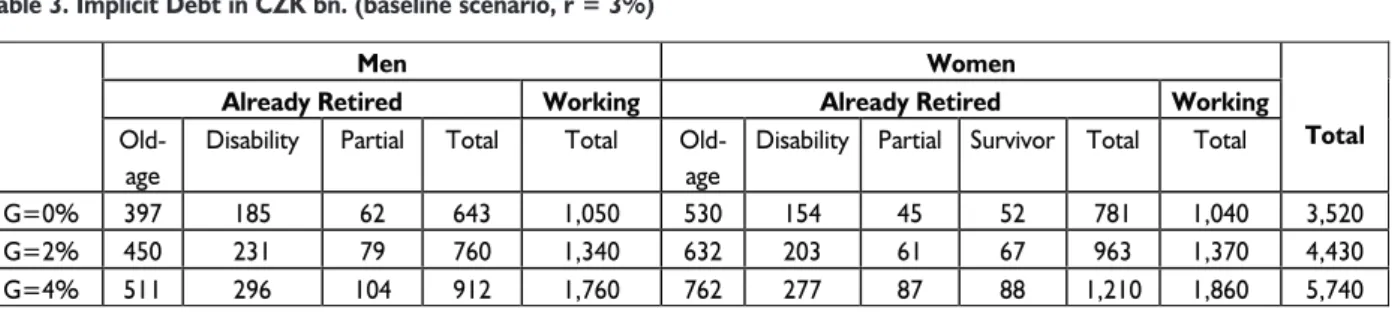
Tables 3 and 4 summarise main results of our simulations. In both tables, we present results of three different simulations, in which we alter the valorisation coefficient g. As the benchmark alternative should serve the medium one, with valorisation equal to 2% annually. Results show that the Czech social security system is indeed heavily indebted. Main culprit is pension system, which promises too high pensions in future without actually provisioning for it. As the Table 4 shows, implicit debt amounts to 76% of GDP for men still employed and 77% of GDP for women employed. In other words, these workers have already accrued rights exceeding 150% of the whole GDP.
In addition, already retired pensioners rely on the system for their future pensions, but the system has no provisions for this, either. Taking retired males and females together, the pension system has created additional implicit debt 61% of GDP. Lastly, the Czech social security system provides disability (full and partial) and survivors’ pensions. Their future financing would require setting 37% of GDP aside.
Taken altogether, the Czech social security system has accumulated debt in excess of 250% GDP, level similar to other European countries (see Herd, den Noord 1993). The debt level is, indeed sensitive to the valorisation coefficient. Should the future
^
Men Women
Already Retired Working Already Retired Working
Old-age
Disability Partial Total Total
Old-age
Disability Partial Survivor Total Total Total
G=0% 397 185 62 643 1,050 530 154 45 52 781 1,040 3,520
G=2% 450 231 79 760 1,340 632 203 61 67 963 1,370 4,430
G=4% 511 296 104 912 1,760 762 277 87 88 1,210 1,860 5,740
Men Women
Already Retired Working Already Retired Working
Old-age
Disability Partial Total Total
Old-age
Disability Partial Survivor Total Total Total
G=0% 22% 10% 3% 36% 59% 30% 9% 3% 3% 44% 59% 199%
G=2% 25% 13% 4% 43% 76% 36% 11% 3% 4% 77% 77% 251%
G=4% 29% 17% 6% 52% 99% 43% 16% 5% 5% 69% 105% 324%
Table 3. Implicit Debt in CZK bn. (baseline scenario, r = 3%)
governments apply very restrictive policies and keep social security benefits fixed in real terms (i.e. set the valorisation coefficient to 0%), the overall implicit debt would decrease to 199% of GDP. On the other hand, more generous valorisation by 4% in real terms would lift the implicit debt to 324% of GDP. Therefore, the medium estimate, 251% of GDP, seems a reasonable compromise.
8. Conclusions
We have shown that the current social-security system based on the PAYG principle is heavily indebted, though the debt is thus far ”implicit.“ However, this implicit debt represents an estimate of costs that will be faced by Czech taxpayers in future. It will be either in the form of higher taxes and/or lower pensions, or in the form of debt incurred during a pension reform. While it is clear that the costs of pension reform are very high, the current system accumulates debt that reform costs would pale in comparison.
Furthermore, a pension reform could increase the long-term rates of growth and thus benefit future generations, as it has been argued elsewhere [6]. There seems to be broad agreement that the reform can even be done in a Pareto-efficient way, so that current pensioners and older contributors would not suffer a loss in their lifetime income. To achieve these desired results, the reform needs not only careful planning but also a well functioning network of private financial institutions that would facilitate private savings and secure returns on savings that would encourage the further development of the private-pension schemes. As the Czech experience seems to suggest, it is extremely unlikely that such a strong network would emerge without a substantial and radical pension reform which would divert a major part of pension savings to the private-pension funds. It remains to be seen whether the Czech Republic will find the courage and determination to reform its inadequate pension system. It needs to do so, sooner rather than later.
[6] See, for example, Kotlikoff, Laurence J., Privatization of Social Security: How It Works and Why It Matters, NBER Working Paper, 1996; or Averting the Old Age Crisis, World Bank Policy Research Report, Oxford University Press, 1994.
0 20 00 0 0 40 00 0 0 60 00 0 0 80 00 0 0 1 00 00 0 0 1 20 00 0 0 1 40 00 0 0 22 32 42 50 52 54 56 58 60 62 64 66 68 70 72 74 76 78 80 82 84 86 88 Figure 2. Capital Requirement – Working Men
0 200000 400000 600000 800000 1000000 1200000 22 32 42 50 52 54 56 58 60 62 64 66 68 70 72 74 76 78 80 82 84 86 88 Figure 3. Capital Requirement – Working Women
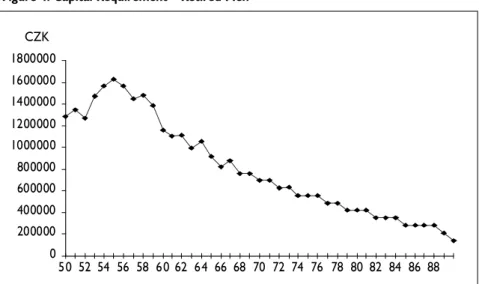
0 200000 400000 600000 800000 1000000 1200000 1400000 1600000 1800000 50 52 54 56 58 60 62 64 66 68 70 72 74 76 78 80 82 84 86 88 CZK
Figure 4. Capital Requirement – Retired Men
0 20 00 00 40 00 00 60 00 00 80 00 00 10 00 00 0 12 00 00 0 14 00 00 0 52 55 58 61 64 67 70 73 76 79 82 85 88 C ZK
0% 10% 20% 30% 40% 50% 60% 70% 80% Current Pensioners-Men Current Pensioners-Women Current Disabled-Men Current Disabled-Women Future Pensioners-Men Future Pensioners-Women
Figure 6. Implicit Debt of the Czech Social Security (in % of GDP)
0 200 400 600 800 1000 1200 1400 Current Pensioners-Men Current Pensioners-Women Current Disabled-Men Current Disabled-Women Future Pensioners-Men Future Pensioners-Women
References
Aaron, Henry. (1966). ”The Social Security Paradox”. Canadian Journal of Economics and Political Science.
Barr, Nicholas. (1994). ”The Social Safety Net During Economic Transition in Central and Eastern Europe”. STICERD, LSE Working Paper EF, No.9.
Borsch-Supan, Axel. (1993). ”Aging in Germany and the United States”.International Comparisons NBER Working Paper, No.4530.
Chand, Sheetal K. (1996). ”Aging populations and Public Pension Schemes”. IMF Occasional Paper No. 147, December 1996.
Diamond, Peter A. (1996). ”Proposals to Restructure Social Security”. Journal of Economic Perspectives.
Feldstein, Martin S. (1990). ”Fiscal Policy and the Dynamic Inconsistency of Social Security Forecasts”. American Economic Revue.
Feldstein, Martin S. (1996). ”The Missing Piece in Policy Analysis: Social Security Reform”.American Economic Revue.
Gomulka, Stanis³aw and Jaworski, Piotr (1998). ”Implicit Public Debt of the Polish Social Security System”. CASE-CEU Working Papers Series No. 14.
Gramlich, Edward, M. (1996). ”Different Approaches for Dealing with Social Security”.Journal of Economic Perspectives.
Hagemann, Robert P.; Nicoletti, Guiseppe. (1989). ”Population Ageing: Economic Effects and Some Policy Implications for Financing Public Pensions”. OECD Economic Studies, No.12.
Herd, Richard; Van den Noord, Paul. (1993). ”Pension Liabilities in the Seven Major Economies”. OECD Working Paper, No.142.
Holzmann, Robert. (1993). ”Reforming Old-Age Pension Systems in Central and Eastern European Countries in Transition”. Public Pension Economics.
Jelinek, Tomas and Schneider Ondrej (1997). ”Pension Reform and Pension Funds in the Czech Republic”. Transition.
Jelinek, Tomas and Schneider Ondrej. (1997). ”Reforma duchodu v Ceske republice”. (in Czech). EkonomNo.8, Prague.
Jenkins, Glenn P (1993). ”Implications of Economic Transition and Demographics for Financing Pensions in the Former Socialist Economies”. Public Finance.
Kotlikoff, Laurence J. (1996). ”Privatization of Social Security: How It Works and Why It Matters”. NBER Working Paper.
Schneider, Ondrej. (1996). ”Harmonization of Public Pension Schemes – Perfect and Imperfect Labour Mobility Cases”. CERGE Working PaperNo. 102.
Schneider, Ondrej. (1996). ”Dynamic Simulation of Pension reform”. CERGE Working PaperNo. 88.
Schneider, Ondrej (1996). ”Pension Reform in the Czech Republic: Gradualistic Czechs”. Central European Banker, Budapest, December 1996.
”Ageing Populations – The Social Policy Implications”. (1988). OECD, Paris. ”Averting the Old Age Crisis”. (1994).World Bank Policy Research Report. Oxford University Press.
ïðåäïðèÿòèé â Ãðóçèè
94 A. Czarczyñska, K. ledziewska-Ko³odziejska, Ewolucja form wspó³pracy
walutowej w Europie
95 Rola i status banku centralnego w Polsce (Opracowa³ P. Dobrowolski)
96 È. Ñèíèöèíà, Ïðîáëåìû ðåôîðìèðîâàíèÿ ñîöèàëüíîé çàùèòû è ñîöèàëüíîé èíôðàñòðóêòóðû â Ãðóçèè
97 Polityka kursowa i jej rola w ograniczaniu inflacji (Opracowa³a A. Czarczyñska)
98 Ê. Êë¸ö, Öåíòðàëüíûé áàíê è áàíêîâñêàÿ ñèñòåìà â Êûðãûçñêîé Ðåñïóáëèêå (1994-1996)
99 Ð. Ãîðòàò, Äåìîêðàòèÿ ñ ãîð Òÿí-Øàíÿ
100 Ê. Êë¸ö Ðåîðãàíèçàöèÿ è ëèêâèäàöèÿ ãîñóäàðñòâåííûõ ïðîìûøëåííûõ ïðåäïðèÿòèé â Êûðãûçñòàíå
101 A. B. Czy¿ewski, W. M. Or³owski, Scenariusze makroekonomiczne rozwoju
gospodarki polskiej w latach 2000-2005
102 Â. Åðìàêîâè÷, Þ. Ïàíüêóâ Ïðèâàòèçàöèÿ â Êûðãûçñòàíå â 1992-1996 ãã.
103 W. Jermakowicz, P. Kozarzewski, Privatization in Mongolia
104 Â. Åðìàêîâè÷, Ìîäåëè ìàññîâîé ïðèâàòèçàöèè 105 Ì. Ìàðêåâè÷, Ð. Ìîãèëåâñêèé, ß. Öóêðîâñêè, Ïåðñïåêòèâû ðîñòà äîõîäîâ ãîñóäàðñòâåííîãî áþäæåòà Êûðãûçñêîé Ðåñïóáëèêè â 1997-2000 ãã. 106 Ð. Àíò÷àê, Ì. Äîìáðîâñêè, Ì. Ìàðêåâè÷, ß. Öóêðîâñêè, Ïåðñïåêòèâû ôèíàíñèðîâàíèÿ áþäæåòíîãî äåôèöèòà Êûðãûçñêîé Ðåñïóáëèêè â 1997-2000 ãã. 107 Ì. Ìàðêåâè÷, Ïåðñïåêòèâû ðàçâèòèÿ ðûíêà öåííûõ áóìàã â Êûðãûçñêîé Ðåñïóáëèêå 108 Ì. Ìàðêåâè÷, Ð. Ìîãèëåâñêèé, ß. Öóêðîâñêè, Ãîñóäàðñòâåííûå ðàñõîäû Êûðãûçñêîé Ðåñïóáëèêè: ïåðñïåêòèâû íà 1997-2000 ãã.109 , Ë. Òàðêõèíèøâèëè, Ãðóçèÿ: ïóòü ê äåìîêðàòèè? 110 È. Ñèíèöèíà, Ôèñêàëüíàÿ ïîëèòèêà è îðãàíèçàöèÿ ñôåðû ãîñóäàðñòâåííûõ ôèíàíñîâ Ãðóçèè
114 M. Jarociñski, A. Jirny, Monetary Policy and Inflation in Georgia (1996-1998) (in Russian also available)
115 L. Landy, Developing Sound Banks in Transitional Economies: Structural Reforms in Ukraine 116 ß. Êóçüìà, Áþäæåòíûå äîòàöèè ê êîììóíàëüíûì óñëóãàì â Êûðãûçñòàíå 117 Á. Öóêðîâñêà, ß. Öóêðîâñêè, Ðåôîðìà îðãàíèçàöèè è ôèíàíñèðîâàíèÿ ñèñòåìû çäðàâîîõðàíåíèÿ â Êûðãûçñòàíå 118 Ï. Êîçàðæåâñêèé, Ïðèâàòèçàöèÿ ïðîìûøëåííîñòè â Êûðãûçñêîé Ðåñïóáëèêå 119 Ïeòp Êîçàðæåâñêèé, ßðîñëàâ Êóçüìà, Ïðèâàòèçèðóåìûå è ïðèâàòèçèðîâàííûå ïðîìûøëåííûå ïðåäïðèÿòèÿ Êûðãûçñòàíà
120 Wojciech Maliszewski, Central Bank Independence in Transition Economies 121 Przemys³aw Woniak, Relatives Prices and Inflation in Poland 1989-1997
122 Ìàðåê Äîìáðîâñêè, Ôèñêàëüíûå ïðîáëåìû â ïåðèîä òðàíñôîðìàöèè
123 Âëîäçèìåæ Ïàíüêóâ, Áàðáàðà Ãîí÷àæ, Ãåîðãèé Ìîðãîøèà, Ãåîðãèé
Àõàëàäçå, Êøèøòîô Ïîëîìñêè, Òðàíñôîðìàöèÿ ïðåäïðèÿòèé â Ãðóçèè
124 Ðîìàí Ìîãèëåâñêèé, ßöåê Öóêðîâñêè, Íàëîãîâûå ëüãîòû â Êûðãûçñêîé
Ðåñïóáëèêå: êîëè÷åñòâåííàÿ îöåíêà
125 Robert S. Kravtchuk, Budget Deficits. Hyperinflation and Stabilization in Ukraine 126 Georges de Menil, Boris Najman, Andrew Jirniy, Oleksander Rohozynsky, A Model
of Ukrainian Macroeconomic Indicators
127 Ma³gorzata Markiewicz, Wp³yw polityki fiskalnej na proces dezinflacji w gospodarkach przechodz¹cych transformacjê
128 Magdalena Tomczyñska, Exchange Rate Regimes in Transition Economies 129 Jaros³aw Bauc, Effectiveness of Capital Inflow Sterilization in Poland 130 Dilemmas of Exchange Rate Policy in Central Europe: Lucjan T. Or³owski,
Exchange Rate Policies in Central Europe in Response to the EMU, Wojciech Maliszewski, Implicit Target Zone and Exchange Rate Behaviour in Poland (May, 1998)
Jakubiak, International Trade and Real Exchange Rate in Poland; Maryla Maliszewska, Modelling Real Exchange Rate in Transition: the CASE of Poland and Romania; Mateusz Walewski, Exchange Rates and Economic Growth in East Asian Countries in Years 1950-1992. Lesson for Post-communist Economies (May, 1998)
132 Krzysztof Rybiñski, Capital Inflows in Central and Eastern Europe: Inflation, Balance of Payments and Recommended Policy Responses (May, 1998) 133 Polityka kursowa w okresie transformacji: Ma³gorzata Antczak, Rola kursu
walutowego w procesie dezinflacji w krajach przechodz¹cych transformacjê gospodarcz¹; Lucjan T. Or³owski, Realny kurs z³otego a struktura bilansu obrotów kapita³owych Polski (May, 1998)
134 Rudiger Ahrend, Vadym Lepetyuk, Forecasting Real GDP and the Current Account in a Transition Economy: Two Simple Econometric Methods and their Application to Ukraine (June, 1998)
135 Ðîáåðò Áðóäçûíüñêè, Çàèð ×îêîåâ, Ìàëãîæàòà Ìàðêåâè÷, Ïóáëè÷íûé äîëã
Êûðãûçñêîé Ðåñïóáëèêè
136 Marek Jarociñski, Skutki nierównomiernego opodatkowania sektorów w Polsce analiza w równowadze ogólnej (June, 1998)
137 Ma³gorzata Antczak, Urban Górski, The Influence of the Exchange Rate Stability on Inflation: A Comparative Analysis (July, 1998)
138 Ðîìàí Ìîãèëåâñêèé, ßöåê Öóêðîâñêèé, Îöåíêà ñòîèìîñòè ëüãîò, ïðåäîñòàâëÿåìûõ íåêîòîðûì êàòåãîðèÿì ãðàæäàí Êûðãûçñêîé Ðåñïóáëèêè (September, 1998) 139 Ðîáåðò Áðóäçûíüñêè, Ìàëãîæàòà Ìàðêåâè÷, Ýêîíîìè÷åñêèå ðåôîðìû â Êûðãûçñòàíå â 1997-1998 ãã.(September, 1998) 140 Åìèð Äæóãåëè, Èðàêëèé Ãâàðàìàäçå, «Íóëåâûå» àóêöèîíû: öåëè è àíàëèç ðåçóëüòàòîâ (September, 1998) 141 Ïðèâàòèçàöèÿ çà ëþáóþ öåíó. Àíàëèç îïûòà Ðåñïóáëèêè Ãðóçèÿ â 19971998 ãîäàõ. Ïîä ðåäàêöèåé Âëîäçèìåæà Ïàíüêóâà è Áàðáàðû Ãîí÷àæ 142 Èðèíà Ñèíèöèíà, Ìàðåê ßðî÷èíüñêè, Áþäæåòíî-íàëîãîâàÿ ñèñòåìà è ãîñóäàðñòâåííûå ôèíàíñû Ãðóçèè â 19971998 ãã.
144 Robert Brudzyñski, Investment Risk in Branches of the Kyrgyz Economy 145 Magdalena Tomczyñska, Ewa Sadowska-Cielak, Zmiany w polskim systemie
finansowym w ramach przygotowañ do integracji z UE
147 Krzysztof Rybiñski, Mateusz Szczurek, Current Account Inflation Trade-Off. Lessons for Poland and Other Transition Economies
148 Urban Górski, The Interbank Money Market in Ukraine
149 Jaros³aw Neneman, The Reform of Indirect Taxation in Hungary, the Czech Republic, Poland and Romania
150 Rafa³ Antczak, Ma³gorzata Antczak, The Case of Gradual Approach to Foreign Trade Liberalisation in Transition Economies
151 Wojciech Maliszewski, Medium-Term Fiscal Projection for Selected Countries in Transition
152 Rafa³ Antczak, Monetary Expansion in Transition Economies and Their Influence on Inflation Performance
154 Krzysztof Rybiñski, Thomas Linne, The Emerging Financial System of Poland: Institutional Constraints and External Links
155 Jacek Cukrowski, Jaros³aw Janecki, Financing Budget Deficits by Seigniorage Revenues: the Case of Poland 1990-1997
158 M. D¹browski (ed.), M. Dekhtiarchuk, U. Górski, P. Kovalev, Y. Kuzmin and K. Sultan, Ukraine: From Fragile Stabilization to Financial Crisis
159 M. D¹browski, U. Górski, M. Jarociñski, Inflationary Consequences of Devaluation Crises in Russia and Ukraine: The First Observations
161 Magdalena Tomczyñska, Comparative Analyses of Direct Tax Systems in Selected Central European Countries: Poland, Czech Republic, Hungary and Romania 162 Joanna Siwiñska, Public Debt Structure and Dynamics in the Czech Republic,
Hungary, Poland and Romania
167 Ondrej Schneider, Implicit Public Debt of the Czech Social Security System