! !
!"#$%&'()*+,# -./
(
0+#%1(-2/3(
!
=>+1"#%&'(?#"+"<9(@*9,8(*&;(A*<8,8(":(?#"+"<9(%&(B++,#C
D,4"&;*#E(F"4*9%"&*1(D45""18(
G",(H*"I(J"&'K,%(H%I(L%&>%<(M5*&'I(J<*&(!*&'I(A5<(H*&'I(H*"N%*&'(D5%I(G*K,8(
A5<I()#*85*&9(L"E*1$*I(D4"99(@"O,11,
( (0P89#*49
!"#$%&'()*"!#$%&'()*+,-.!&/!)*/(!0,1,%$2&/3!'$4/5-&,.!-,3*-0!422,-6.,'$/0*-(!5,'7/&'*%!*/0! 1$'*5&$/*%!,04'*5&$/!*/0!5-*&/&/3!89:;9<!*.!*!+,(!,%,),/5!&/!,'$/$)&'!3-$=57!*/0!2$1,-5(! -,04'5&$/"!>/?$-54/*5,%(@!57,-,!&.!,1&0,/',!57*5!57,!A4*%&5(!$?!9:;9!2-$3-*).!&/!0,1,%$2&/3! '$4/5-&,.!&.!%$="!B%57$437!57,-,!*-,!*!/4)C,-!$?!&/0&'*5$-.!$?!%$=!A4*%&5(@!$/,!&/0&'*5$-!&.! .540,/5!0-$2$45"!97,!$1,-*%%!3$*%!$?!57&.!.540(!&.!,D*)&/,!$/,!0&),/.&$/!$?!57,!A4*%&5(!$?! E7&/*F.!9:;9!.'7$$%.!C(!.540(&/3!57,!0-$2$45!C,7*1&$-!$?!9:;9!.540,/5."!9$!),,5!57&.!3$*%@!=,! 7*1,!57-,,!.2,'&?&'!$CG,'5&1,."!H&-.5@!=,!.,,+!5$!2-$04',!A4*%&5(!,.5&)*5,.!$?!0-$2$45!-*5,.! *)$/3!.540,/5.!&/!E7&/*F.!9:;9!.'7$$%."!I,'$/0@!=,!.,,+!5$!&0,/5&?(!=7&'7!.540,/5.!0-$2!$45! ?-$)!9:;9"!97&-0@!=,!5,.5!=7,57,-!?&/*/'&*%!'$/.5-*&/5.@!)*57!*/0!'$)245,-!*'7&,1,),/5@!*/0! 2*-,/5*%!,04'*5&$/!*/0!)&3-*5&$/!.5*54.!'$--,%*5,!=&57!9:;9!0-$2$45"!J-*=&/3!$/!0*5*!?-$)!*! /*5&$/*%!.4-1,(!$?!K@LML!422,-6.,'$/0*-(!9:;9!.540,/5.@!=,!0-$2$45!-*5,.!$?!MN"KO!*'-$..! E7&/*!*.!*!=7$%,!*/0!*.!7&37!*.!PPO!&/!2$$-,-!&/%*/0!*-,*.@!.433,.5&/3!)*G$-!3*2.!*/0! 0&.2*-&5&,.!&/!E7&/,.,!9:;9!A4*%&5("!H4-57,-)$-,@!=,!?&/0!57*5!C*.,%&/,!*'*0,)&'!2,-?$-)*/',! */0!)*5,-/*%!,04'*5&$/!*/0!)&3-*5&$/!.5*54.!*-,!.5-$/3!'$--,%*5,.!?$-!.540,/5!0-$2$45"! Q,ER"#;8S(1$'*5&$/*%!.'7$$%&/3Q!7&37!.'7$$%Q!0-$2$45Q!E7&/*! ! G=L(A";,8S(RMSQ!RPSQ!TPLQ!USExploring the Dropout Rates and Causes of Dropout in Upper-Secondary Vocational Schools in China
Policymakers in many developing countries regard upper-secondary technical and vocational education and training (TVET) as a key element in economic growth and poverty reduction. For example, the Brazilian government recently launched the National
Program of Access to Technical Education and Employment (Pronatec), which will invest more than 600 million US dollars in upper-secondary TVET and expand enrollment by 8 million students before 2014 (National Congress, 2011). The Indonesian government aims to increase the share of TVET in upper-secondary education to 70% (from 30%) by 2015 as a means to reduce youth unemployment (Ministry of National Education, 2006). International development organizations, including the Asian Development Bank (ADB) and the United Nations
Educational, Scientific and Cultural Organization (UNESCO), have advocated for TVET as an effective means to promote economic growth and poverty reduction in developing countries (ADB, 2008; UNESCO, 2012).
Education officials in China, like elsewhere in the world, have made it clear that TVET is supposed to play an important role in the nation’s education strategy. In fact, China has one of the most ambitious TVET programs in the world today. During the early 2000s, enrollment increased from 5 million students (in 2000) to 7.3 million students (in 2011) (National Bureau of Statistics, 2001, 2012). During this time period, spending per student in TVET also increased dramatically. In 2000, government spending per upper secondary TVET student was roughly 300 dollars (National Bureau of Statistics, 2001). In 2011, government spending per upper secondary TVET student increased to more than 850 dollars (National Bureau of Statistics, 2012).
Despite the high profile of TVET in China (and elsewhere) over the past decade, policymakers and researchers have been concerned that the quality of many of China’s TVET
schools is low (Guo and Lamb, 2010; Kuczera and Field, 2010; Wang, 2012). One of their key concerns is that TVET dropout rates remain high In fact, similar to the situation in a number of other developing countries (e.g. Pakistan, India, Ethiopia, Kenya and Albania, see Janjua and Irfan, 2008; ACE Europe, 2008; Jordan et al., 2009; UNESCO-UNEVOC, 2012), high dropout rates in upper secondary TVET have begun to be reported (Wang, 2012; Gao, 2011). This is despite steady increases in financial aid and reductions in tuition rates, which reduce the cost of attending TVET (Fo and Xing, 2011). To the extent that students and their guardians are making the assessment that the benefits of staying in TVET programs are less than the costs (which have been decreasing), dropout rates could reflect deficiencies in TVET quality.
There are two studies, each with their own limitations, which have attempted to measure the dropout rate in TVET schools in China. First, using data reported by local county
governments and schools, Wang (2012) finds that the dropout rate for the three years of upper secondary vocational schooling in 2007 was 18.7% across the nation and 28.0% in western China. Second, based on a survey of one TVET school in Jiangsu province, Gao (2011) reports that the cumulative dropout rate is 15%. While these findings are important, the first study is limited by the fact that data reported by local county officials and schools has been shown to lead to downwardly biased estimates of dropout (Yi et al., 2012). This is because school and local government officials may be incentivized to overstate the numbers of their enrollments and graduates. The second study is limited by its lack of generalizability (as it was focused on dropout rates only at one school). Hence, to the extent that high rates of dropout are a warning sign about the quality of TVET (in particular that students do not believe the benefits of staying in school exceed the cost of schooling), further studies of the rates of dropout from China’s TVET schools are needed.
More importantly, beyond knowing the rate of dropout, it is also important to study the correlates of dropout. An analysis of who is dropping out of TVET is essential in identifying high-risk students. Knowing why students drop out is a first step in designing interventions to curb dropout rates. Surprisingly, to our knowledge, no study has attempted to explore the potential determinants of dropout in the Chinese context. Although a few studies (such as Gao 2011; Gao, 2010; Ye, 2002) offer qualitative assessments on why students drop out as well as policy suggestions for preventing dropout, these case studies may lack external validity. Moreover, studies relying on data reported by local officials and schools may be unable to perform analyses on the determinants of dropout, as they lack sufficiently detailed data on student, teacher, and school background factors.
The overall goal of this study is examine one dimension of the quality of China’s TVET schools by studying the dropout behavior of TVET students. To meet the goal, we pursue three specific objectives. First, we seek to produce high-quality estimates of dropout rates among students in China’s TVET schools. Second, we seek to identify which students drop out from TVET. Third, we explore the potential determinants of TVET dropout.
To achieve our objectives, we collected and analyzed panel data from a large and representative survey of TVET students and schools in one western and one eastern province of China. Our descriptive results indicate that dropout rates are especially high in western China compared to eastern China. The results imply that the quality of TVET is lower in western China as compared to eastern China. Our multivariate results indicate that dropout is not primarily determined by financial constraints but is rather determined by the level of education and
migration status of the parents of the students. Dropout is also shown to be negatively associated with student achievement.
The remainder of the paper is structured as follows. Section 2 discusses our hypotheses for why students in TVET are dropping out. Section 3 describes our data and statistical methods. Section 4 presents our results. Section 5 concludes.
Hypotheses
Our first hypothesis is that students drop out because they are financially constrained: families are unable to shoulder the financial costs (whether direct or indirect) of attending TVET in China.Although compulsory education (grades 1-9) in China was made free in 2008, upper secondary education was not, and thus high school fees still must be paid out of pocket
(Connelly and Zheng, 2003; Hannum, 2003; Liu et al., 2009). The cost of attending TVET, including tuition fees, room and board and textbooks, can reach as high as 4000 RMB per year (Kuczera and Field, 2010). Indeed, the direct costs of attending upper secondary schooling, in general, can be a substantial portion of annual household disposable income for poor families (Liu et al., 2009).
Although financial aid has been offered for TVET students in recent years (Kuczera and Field, 2010), not all students receive this support. China’s TVET policies state that poor students should receive 1,500 yuan (240 USD) in each of the first two years at school (Kuczera and Field, 2010). The policy also suggests that students under a poverty threshold also should receive full tuition waivers (Fo and Xing, 2011). The government pledged nearly 4.5 billion yuan (750 million dollars) to subsidize upper-secondary vocational schooling for poor students in 2010 (China State Council, 2010). However, in a recent study, Yi et al. (2013) found that more than 34% of the poorest students in TVET schools did not receive any financial aid.
Our second set of hypotheses is that TVET students drop out more frequently when they are from families with parents that have characteristics associated with placing less value toward education. For example, it is known from the international literature that if parents have low levels of education, they are less likely to value education for their children (Filmer, 2000). These results have also been shown to hold true in the context of rural China (Jamison and van der Gaag, 1987; Yi et al., 2012). Specifically, parents with lower levels of education may believe that education is unnecessary for future success in the labor market (Brown and Park, 2002). In addition, parents with low educational attainment may lack the ability to aid their children in learning (e.g. helping with homework), having never received the same level of education (Connelly and Zheng, 2003). It is for this reason that we hypothesize that students with parents with low levels of education will have higher rates of dropout.
Moreover, the migration status of students’ parents might be associated with dropout. Parents in rural areas may be migrating to cities to work: one study shows that one or both parents of 18.1% of junior high school students are migrating (Du, Park and Wang, 2005). Unfortunately, migrating parents are less able to care for or supervise their children’s education, which in turn may potentially increase students’ chances of dropping out (Hanson and Woodruff, 2003). In addition, migrating parents may serve as “role models,” attracting children to migrate themselves and perhaps increasing the probability of finding a job (Du, Park and Wang, 2005). Indeed, a previous study of China by Yi et al. (2012) found junior high students (as opposed to TVET students) are at risk of dropping out when their parents migrate. Battistella and Conaco (1998) and McKenzie and Rapoport (2011) provide similar evidence from the Philippines and Mexico, respectively.
Our third hypothesis is that students drop out from TVET because of low achievement. Low achievement may suggest to students that they are not capable of learning; or are unwilling to do so (Vallerand et al., 1997). If students feel they are not capable of learning, they may perceive low returns to attending school. This is especially true in competitive school systems, like that in China (Yi et al., 2012). In addition, low achievers may learn less in TVETs and decide to drop out because they predict their learning gains in TVET to be lower than other students (Clarke et al., 2000; Rumberger and Lim, 2008). For these reasons, low achievers may decide to drop out.
Data and Approach
This paper draws on panel survey data collected by the authors in October 2011 and May 2012. To maximize external validity, we sampled TVET schools from two provinces (Shaanxi and Zhejiang). The two provinces differ greatly in terms of geography and economic
development. Shaanxi province is an inland province in Northwest China. It has a Gross Domestic Product (GDP) per capita of 33,427 yuan (5,305 US dollars—National Bureau of Statistics, 2012). Shaanxi ranks 15th among all provinces in terms of GDP per capita and has been among the slowest growing provinces in China during the 2000s (National Bureau of Statistics, 2012). By contrast, Zhejiang is a rich coastal province with a GDP per capita of almost twice that of Shaanxi: 59,157 yuan (9,390 dollars—National Bureau of Statistics, 2012).
Zhejiang is the fifth richest province in terms of per capita GDP after Tianjin, Shanghai, Beijing and Jiangsu (National Bureau of Statistics, 2012).
After selecting the two provinces, we chose the most populous prefectures within each province (three in Shaanxi and four in Zhejiang). The seven prefectures had more than 1,000
vocational schools. Resource constraints prevented us from sampling all majors. As such, using administrative data, we identified the most popular major (i.e. the major with the largest
enrollment) among secondary vocational schools in each province: computers. Using official records, we excluded schools that reported having no computer majors.1 We then called the remaining schools to ask about the number of new (first-year) students enrolled in each school in autumn 2011. Schools that had fewer than 50 first-year students enrolled in the computer or computer-related major were also excluded. We ultimately sampled 52 schools in Shaanxi and 55 schools in Zhejiang for our study.
The next step was to choose which students in each school would be surveyed. In each school, we randomly sampled two first-year computer major classes (one class if the school only had one computer major class). We sampled a total of 186 classes and a total of 7,172 first-year students in these classes. The sample is representative of larger upper-secondary vocational schools with computer majors in the most populous prefectures in Zhejiang and Shaanxi provinces.
In October 2011 (the beginning of the 2011-2012 academic year), our survey team administered a four-block student survey at each school (which we call the baseline survey). The first block collected information about family assets and access to financial aid. Students were asked to fill out a checklist of household durable assets. We subsequently assigned a value to each asset (based on the National Household Income and Expenditure Survey which is organized and published by National Bureau of Statistics, 2011), and calculated a single metric of the value of family asset holdings for each student. This metric is used to measure student poverty. Other
!!!!!!!!!!!!!!!!!!!!!!!!!!!!!! !!!!!!!!!!!!!!!!!!!!!!!!!!!!!! !
"!We defined computer or computer-related majors by whether the official name of the major contained the word
“computer.” The most common major included was titled “computer applications,” followed by computer maintenance, computer design, and computer programming. !
questions covered students’ financial aid status, including how much need-based aid they received; schooling expenses, including tuition and housing costs per semester.
The other three blocks addressed issues of family/student characteristics and achievement in school. The second block gathered information on basic student information, including gender, age, and ethnicity. This block also included questions asking whether students had ever worked as a migrant worker. The third block asked about the families of students. This block included questions eliciting information about the education of parents and their migration status (whether parents stayed at home Jan-Aug 2011), the occupation of the parents, and the number of siblings. The fourth block was used to collect our measures for achievement: two 25 minute standardized mathematics and computer examinations. We administered the examinations ourselves (such that students had no time to prepare for the examinations beforehand) and proctored students closely. In May 2012 (the end of the 2011-2012 academic year), we returned to these schools and administered a similar survey (which we call the endline survey). One of the primary purposes of the endline survey was to collect information on dropout behavior. To track students who
participated in our baseline survey, our enumerators filled in a student tracking form for each class. This form contained a list of all the students who completed our baseline survey. During the endline survey, our enumerators marked each student as present, absent (e.g. sick),
transferred (e.g. to another school), on leave, or dropped out. Initially, student leaders (in
Chinese called ban zhang or class monitor) in the class provided this information. In most of the
cases, the student leaders were sure about the status of the students that were absent. To ensure the quality of the responses, however, we exerted additional effort. If students were marked “dropped out” on our tracking form, our enumerators called the parents or guardians of the students to further ascertain whether students in fact dropped out. All (100%) of dropouts were
verified in this manner, with no discrepancies found. This procedure allowed us to accurately identify dropouts.
Statistical Approach
In the first part of our analysis, we calculate simple descriptive statistics. The means of student and family background variables are estimated for the group of students that dropped out and the group of students that did not. We then conduct a two-tailed t-test to compare students who dropped out and those that did not for each variable. The standard errors for these t-tests are corrected for clustering at the school level.
To explore the determinants of dropout in a multivariate framework, we first use ordinary
least squares (OLS) to estimate the following equation:2
We call this model our OLS model. Our dependent variable y is a binary variable equaling 1 if
student i dropped out by the end of the 2011-2012 academic year in school s (and 0 otherwise).
The independent variables are the three possible vectors, representing our three hypotheses of
poverty (P), parental education and migration status (E), and achievement (A), as described in
the hypothesis section.
The vector P includes variables for household asset ranking (the variable equals 1 if the
household is in the lowest decile and equals 0 if the household is higher than the lowest decile), and access to financial aid (equals 1 if the student reports receiving any financial aid and 0 if not).
The vector E includes parental education (two variables that equal 1 if the students’ mother and
father finished junior high school, respectively, and 0 if not) and parental migration status (two variables that equal 1 if the students’ mother and father were away from home between January !!!!!!!!!!!!!!!!!!!!!!!!!!!!!! !!!!!!!!!!!!!!!!!!!!!!!!!!!!!! !
#!$%!&'(!)*+,-&%(--!.'(./!0)(1*)&(2!+(3*456!4(!)(1*)&!&'(!)(-,3&-!*7!8!3*9:&!;*2(36!9:<(%!&'(!3:;:&(2!%8&,)(!*7!*,)!2(1(%2(%&!
to August 2011, respectively, and 0 if not). The vector A includes math and computer test scores (standardized across the entire sample of test-takers, such that the mean is 0 and standard
deviation is 1).
While we focus on the three sets of determinants above (poverty, parental education and migration status, achievement), we also control for other student background characteristics in
our OLS model. Specifically, we add the vector Swhichincludes the students’ age (in years),
gender (equals 1 if the student is male and 0 if female), ethnicity (equals 1 if the student is Han Chinese and 0 if otherwise), residential status (equals 1 if the student has rural residential status and 0 if urban), migration status (equals 1 if the student has migrated before and 0 otherwise), number of siblings, parental occupation (equals 1 if both parents are subsistence farmers and 0 if not), and where the student attends school (equals 1 if the student attends school in Zhejiang and 0 if in Shaanxi).
Because schools vary in quality, we also examine the three determinants of dropout after controlling for school fixed effects. Including school fixed effects allows us to correct bias due to students sorting across schools based on the three sets of determinants. For example, students from poor families may attend lower quality schools because they are financially constrained. More importantly, as high school entrance exam scores are important criteria for being accepted
into TVET, low achievers are likely sorted into poor quality schools. Our school fixed effects
model is specified as follows:
!"! #"" #"# #"$ #$ #% &&&&&&&&&&'
In equation 3, we add the school fixed effects term $( to compare students only within the same
schools. In all our equations, we use standard errors adjusted for clustering at the school level. Results
What is the dropout rate in Chinese TVET?
According to our data, the dropout rate in our sample TVET schools is substantial. Of the 7,172 secondary TVET students, 768 of them dropped out in the first year (between our baseline and endline surveys). In others words, 10.7% of the sample TVET students that participated in the baseline survey dropped out before finishing their first year of school.
The dropout rate also varies across provinces, prefectures and schools. The results of our survey demonstrated that the dropout rate is 14.1% in Shaanxi. This was substantially higher than the dropout rate of 8.7% in Zhejiang. The higher dropout rate in Shaanxi compared to Zhejiang should not be surprising if any (or some or all) of the three hypotheses are valid. The poverty rate in Shaanxi Province (8.5%) is much higher than that in Zhejiang Province (1.3%—
National Bureau of Statistics 2012).3 According the Yi et al. (2013), the academic achievement
of TVET students in Zhejiang are also higher than those in Shaanxi. In the discussion below, we use non-aggregated, student-level data to understand exactly what types of students are dropping out.
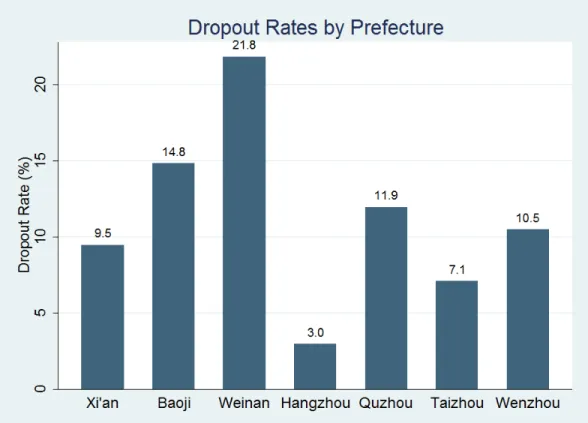
The dropout rate also varies greatly across prefectures and schools. Almost 22% of students in one of the sample prefectures in Shaanxi dropped out before finishing their first year of TVET. In contrast, fewer than 3% of students in one of the sample prefectures in Zhejiang dropped out (Figure 1). The dropout rates among schools with Shaanxi and Zhejiang also vary sharply. The range in Shaanxi is between 10% (the school in Shaanxi with the lowest rate of dropout) and 22%. The range in Zhejiang is between 3% and 12%. The fact that the dropout rate differs greatly by prefecture and even by school underlines the importance of controlling for school fixed effects in our analyses below.
!!!!!!!!!!!!!!!!!!!!!!!!!!!!!! !!!!!!!!!!!!!!!!!!!!!!!!!!!!!! !
C!In the Statistical Yearbook, the poverty rate is calculated by dividing the number of individuals who participate any
In summary, then, while our sample only covers two provinces and seven prefectures, if these numbers reflect a broader trend, among the 20.4 million upper-secondary TVET students in 2011, a dropout rate of 10.7% would mean that more than 2.2 million students are leaving school before completing one year. It would also imply TVET schools in western China have dropout rates 60% higher than those in eastern China. If the dropout rates continue to increase in year two and three, such high rates of dropout should also raise concern that a large share of students has decided the benefit of attending TVET schools is less than the cost.
Who is dropping out?
With so many students dropping out, an important question to resolve is whether certain (and which) subgroups are more at risk of dropping out. In this subsection, we compare the factors of dropout one at a time to identify what kinds of students are more likely to drop out.
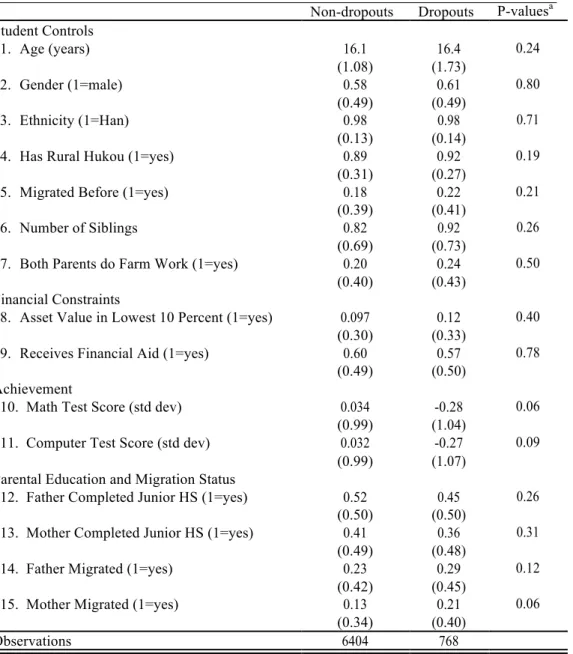
Our descriptive results show that dropouts and non-dropouts do not differ in terms of financial constraints. For example, although dropouts are about 2 percentage points more likely to be among households in the bottom decile in terms of household asset value, when subjected to a two-tailed t-test, this difference is not statistically significant (Table 2, row 8). In terms of financial aid, although students who dropped out were 3 percentage points less likely to receive financial aid when compared to non-dropouts, this difference is not statistically significant (row 9). In sum, dropouts do not seem to experience more financial constraints than their non-poor peers.
While dropouts do not necessarily have parents with lower educational attainment, their parents participate in migration at higher rates. Although only 45% of dropouts had fathers with junior high degrees, compared to 52% of non-dropouts (a 7 percentage point difference—Table 2, row 12), this difference is not statistically significant. The same is true for mothers’ education:
dropouts are 4 percentage points less likely to have mothers with a junior high degree (row 13), but this finding is not statistically significant. By contrast, in terms of migration status, dropouts are less likely to have parents who were at home. Dropouts were less likely to have their fathers living at home with them: 29% of dropouts’ fathers migrated, compared to only 23% among non-dropouts (row 14). Likewise, whereas 21% of mothers among non-dropouts migrated, only 13% among non-dropouts did so (row 15), a finding significant at the 10% level. In sum, dropping out seems to be associated with parents with lower educational attainment and/or not at home
(because they are migrating to cities to work).
Finally, dropouts are lower achievers in terms of math and computer scores. At the time of our baseline examination, dropouts had lower scores on both computer and math-standardized exams than dropouts. Dropouts performed at -0.28 standard deviations (SDs), while non-dropouts performed at +0.034 SDs. In other words, non-dropouts scored 0.314 SDs lower [0.034 – (-.28)] than on their non-poor counterparts in terms of mathematics (Table 2, row 10).
Non-dropouts also scored 0.301 (0.032 + 0.027) SDs higher on their computer skills test (row 11). As both of these findings are significant at the 10% level, we conclude that low-achieving students are therefore more likely to drop out of TVET.
OLS and Fixed Effects Models: Further Examinations of the Hypotheses
Similar to our bivariate results, our OLS and fixed effects models (both of which adjust for student control variables) show that financial constraints do not correlate with student dropout. In our OLS model, students living in households ranking in the lowest 10% in terms of household assets are only 0.7 percentage points more likely to drop out, a finding not statistically significant at the 10% level (Table 3, column 1, row 9). Furthermore, the OLS results show that
dropouts and non-dropouts are exactly alike (0 percentage point difference) in terms of whether they receive any financial aid (column 1, row 10).
To further test this finding, we include school fixed effects (Table 3, column 2). The adjusted fixed-effects model also shows that being poor does not predict dropout: students living in households ranked in the bottom decile are only 0.9 percentage points more likely to drop out (row 1, column 9). Moreover, they continue to be identical in terms of their access to financial aid (Table 3, row 2, column 10). Taken together, our analyses show that neither poverty nor access to financial aid correlate with student dropout. In other words, financial constraints do not seem to be driving students to drop out.
When examining our achievement-dropout hypothesis, our OLS results also mirror our descriptive results. Low math and computer test scores strongly predict dropout. For example, an increase of one SD in math scores decreases dropout rates by 1.8 percentage points (Table 3, column 1, row 11), a finding significant at the 1% level. Likewise, an increase of one SD in computer test scores decreases dropout rates by 1.3 percentage points (column 1, row 12), a finding significant at the 5% level.
In our fixed effects model, we find that only computer scores (technical skills in the major) predict student dropout. That is, the coefficient for math test scores (0.6 percentage points) becomes statistically insignificant (column 2, row 12). However, within the same school and controlling for student characteristics, an increase of one SD on the computer test continues to reduce drop out by 1.3 percentage points, a finding significant at the 10% level (Table 3, column 2, row 12).
When examining the association between parental education/occupation and dropout, our OLS results differ slightly from our descriptive findings: we find that both parental education
and migration status are associated with student dropout. Students whose fathers finished junior high are 1.9 percentage points less likely to drop out (significant at the 10% level—Table 3, column 1, row 13). Moreover, students whose mothers finished junior high are 2.4 percentage points less likely to dropout (significant at the 5% level—column 1, row 14). Although students whose fathers migrated are 0.5 percentage points less likely to drop out, this finding is not statistically significant at even the 10% level (column 1, row 15). In contrast to fathers, we find that students whose mothers migrated are 6.5 percentage points more likely to drop out (column 1, row 16). This result is significant at the 1% level.
In the fixed effects model, we find that only mothers’ education and migration status matter. Although students whose fathers completed junior high schools are still less likely to drop out (by 1.6 percentage points), the finding is no longer significant (Table 3, column 2, row 13). Likewise, students whose fathers migrated are 1 percentage point less likely to drop out. However, this finding also is not statistically significant (column 2, row 15). On the other hand, if a student’s mother finished junior high school, the student was 2 percentage points less likely to drop out, a finding significant at the 10% level (column 3, row 2). Moreover, if mothers migrate, their children are 6.2 percentage points more likely to drop out, a finding significant at the 1% level (column 3, row 2). In sum, mothers’ (but not fathers’) education and migration status seem to protect student against dropout.
Robustness Checks
Although our outcome for dropout (whether a student was present in October 2011 but dropped out by May 2012) is a binary variable, we have reported OLS estimates. We do so for ease of interpretation, combined with the fact that all covariates in equation (1) (with the exception of student age, number of siblings, and math / computer achievement) are dummy
variables. In the extreme case of a fully saturated model (where all variables are dummy variables), the linear probability model is completely general and has the fitted probabilities within the interval [0,1] (Angrist, 2001; Wooldridge, 2001). As a robustness check, we conducted logit school fixed effects, reporting marginal effects at the mean. The results are substantively identical to our OLS results, with the statistically significant results in our fixed effects model consistent with the statistically significant results in the logit model (Appendix Table 1).
Discussion and Conclusions
Using a large dataset collected in two provinces, we find that the dropout rate among first-year students at Chinese upper-secondary TVET is 10.7%. The dropout rate is higher in Shaanxi (14.1%) than in Zhejiang (8.7%), and different prefectures have widely varying dropout rates (from 3% to 22%). If these dropout rates remain roughly identical for all three years of TVET, then TVET dropout rates may be as high as 32% for all three years of VET. In other words, only 2 out of 3 students who enter TVET will graduate.
Our study also allowed us to identify the determinants of dropout. After controlling for a number of student background factors (and even school fixed effects), we find that there are two strong determinants of student dropout in TVET. First, students with low achievement tend to drop out. Second, students whose mothers lack a junior high degree or migrate are more likely to dropout. In most basic terms, low achievers and students that lack maternal care are most
susceptible to dropout.
One of the surprising findings in this study is that financial constraints do not seem to correlate with dropout. In fact, students in the lowest decile of asset values had an average asset
value of 1,835 yuan, which is roughly one year of direct costs to attend TVET. Moreover, receiving financial aid (which alleviates financial constraints) does not seem to correlate with lower dropout rates. Why, then, don’t financial constraints matter?
One reason why financial constraints may not matter is that students who could not afford to attend TVET may have dropped out before upper-secondary school. In other words, a
selection process exists, where only students from relatively well-off households enroll in upper-secondary education. Brown and Park (2002) find in their sample of primary and junior high school students that 13.9% primary school students are poor and credit constrained while only 6.9% junior high school students are (Brown and Park’s data was from 1999, before primary and junior high school were made free). We cannot make the same comparison with our data, but we think that the same process exists for the junior high school to TVET transition. That is to say, the most financially deprived students do not choose to enroll in TVET.
Moreover, all the students entering TVET already made a decision to forego more wages in the workforce. That is, students who are enrolled in TVET are a self-selected group who has weighed the benefits of attending TVET against both direct and indirect costs. Unlike in junior high, where students may drop out because of opportunity costs, students who wanted to enter the workforce because of financial concerns likely did so before entering their first year. As such, financial constraints seem to play a much smaller role than it does in other educational contexts in China (see, for example, Wong et al., 2013; Mo et al., 2012).
A second surprising result was that mothers’ education and migration status matters but not fathers’. Why is it that mothers matter but not fathers? The importance of maternal education over paternal education on child’s education is documented in previous studies (see, for example, Knight and Song, 2000; Li et. al, 2005). While we cannot say for sure, it may be that maternal
education correlates positively with the quality of mother-child interaction and maternal
supervision over children’s schooling. These factors may be the ones that contribute to keeping kids in school. If a father is less involved with his child’s education (as is often the case in rural China) compared to the mother, his level of education may have less effect on student dropout. Our results also seem to suggest that if mothers are actively engaged in encouraging the student to stay in school, maternal care is indeed a protective element against dropout. This care, of course, is lost when the mother migrates away from home. It is perhaps for this reason that the effect of mother’s migration status is so large and statistically significant.
Third, students with low achievement in technical skills tend to drop out. One of the most likely reasons for their decision is that these students feel like they are the least prepared to do well in their major in TVET. Whereas doing well in mathematics is not critical to their success in TVET, they might see that the returns to continuing in TVET fall below the costs.
The reasons underlying why students may be dropping out of TVET suggest certain policy directions. Governments should begin focusing attention on students at risk of dropping out: those lacking maternal care and low achievement (especially in terms of their technical skills). Vocational schools may consider programs focusing on emotional or social needs of students, such as counseling programs encouraging them to persist in school or helping them identify their future goals. Remedial tutoring might be offered for students who are not keeping up in class.
More fundamentally, the high rates of dropout just during the first year (10.7%, and up to 22% in some prefectures) point to potential problems in TVET quality. That is, students (and their parents) may decide that they gain little knowledge or skills from attending TVET and thus decide to dropout. For this reason, we recommend that aggressive expansion of TVET be
balanced with equal policy attention to educational quality in schools. Indeed, the high dropout rate is undermining the massive investments in TVET today.
References
ACE Europe. 2008. “Evaluation of the TVET Policy and Practice of ICCO, Woord en Daad and Edukans.” Technical Report, ACE Europe.
Angrist, Joshua D. 2001. “Estimation of Limited Dependent Variable Models With Dummy Endogenous Regressors,” Journal of Business & Economic Statistics, 19 (1), 2–28.
Asian Development Bank. 2008. “Education and Skills: Strategies for Accelerated Development in Asia and the Pacific.” Technical Report, Asian Development Bank.
Battistella, Graziano and Ma. Cecilia G. Conaco. 1998. “The Impact of Labour Migration on the Children Left Behind: A Study of Elementary School Children in the Philippines.” Sojourn: Journal of Social Issues in Southeast Asia, 13 (2), 220–241.
Brown, Philip H. and Albert Park. 2002. “Education and Poverty in Rural China.” Economics of Education Review, 21 (6), 523 – 541.
China State Council. 2010. “National Outline for Medium and Long-term Education Reform and Development (2010-2020).”
Clarke, Marguerite, Walter Haney, and George Madaus. 2000. High Stakes Testing and High School Completion, Vol. 1. National Board on Educational Testing and Public Policy. Connelly, Rachel and Zhenzhen Zheng. 2003. “Determinants of School Enrollment and
Completion of 10 to 18 Year Olds in China.” Economics of Education Review, 22 (4), 379 – 388.
Du, Yang, Albert Park, and Sangui Wang. 2005. “Migration and Rural Poverty in China.” Journal of Comparative Economics, 33 (4), 688 – 709. Symposium: Poverty and Labor Markets in China.
Filmer, Deon. 2000. “The Structure of Social Disparities in Education: Gender and Wealth.” World Bank Policy Research Working Paper, 2000, (2268).
Fo, Zhaohui and Hui Xing. 2011. “Survey on the Implementation of the National Stipend Policy in Secondary Vocational Schools,” in Dongping Yang, ed., The China Educational
Development Yearbook, Vol. 3. Brill, Leiden, The Netherlands.
Gao, Rui. 2010. “Student Dropout in One Secondary Vocational School in Northwest Region.” Chinese Vocational and Technical Education, 10, 37–39.
Gao, Shenmiao. 2011. “Causes and solutions for secondary vocational school dropout,” Vocational Education Research, 11, 54–56.
Guo, Zhenyi and Stephen Lamb. 2010. International Comparisons of China’s Technical and
Hannum, Emily. 2003. “Poverty and Basic Education in Rural China: Villages, Households, and Girls’ and Boys’ Enrollment.” Comparative Education Review, 47 (2), 141–159.
Hanson, Gordon H. and Christopher Woodruff. 2003. “Emigration and Educational Attainment in Mexico.” Working Paper, University of California, San Diego.
Jamison, Dean T. and Jacques Van der Gaag. 1987. “Education and earnings in the People’s Republic of China.” Economics of Education Review, 6 (2), 161 – 166. Special Issue: Economics of Education: Tackling the New Policy Issues-The Dijon Papers.
Janjua, Yasin and Mohammad Irfan. 2008. “Situation Analysis to Support the Program Design Process for National Skills Strategy of the Islamic Republic of Pakistan.”
Jordan, Marine, Nadia Lamamra, and Jonas Masdonati. 2009. “Dropout Rates in Vocational Education and Training: A Failure of the School-to-Work Transition?” in Felix Rauner, Erica Smith, Ursel Hauschildt, and Helmut Zelloth, eds., Innovative Apprenticeships: Promoting Successful School-to-Work Transitions, LIT Verglag Berlin September, 57–61. Knight, J. and L. Song. 2000. “Differences in Educational Access in Rural China.” in “American
Economics Association Annual Meeting”, 7–9.
Kuczera, Ma!gorzata and Simon Field. 2010. “Learning for Jobs OECD reviews of Vocational
Education and Training: Options for China.” Technical Report, Organization for Economic Cooperation and Development.
Li, Hongbin, Xianguo Yao, Junsen Zhang, and Li-An Zhou. 2005. “Parental Childcare and Children’s Educational Attainment: Evidence from China.” Applied Economics, 37 (18), 2067–2076.
Liu, Chengfang, Linxiu Zhang, Renfu Luo, Scott Rozelle, Brian Sharbono, and Yaojiang Shi. 2009. “Development Challenges, Tuition Barriers, and High School Education in China.” Asia Pacific Journal of Education, 29 (4), 503–520.
McKenzie, David and Hillel Rapoport. 2011. “Can Migration Reduce Educational Attainment? Evidence from Mexico.” Journal of Population Economics, 24 (4), 1331–1358.
Ministry of National Education. 2006. “Rencana Strategis Departemen Pendidikan National Tahun 2005-2009.” Ministry of National Education.
Mo, Di, Linxiu Zhang, Hongmei Yi, Renfu Luo, Scott Rozelle, and Carl Brinton. 2012. "School Dropouts and Conditional Cash Transfers: Evidence from a Randomized Controlled Trial in Rural China’s Junior High Schools." The Journal of Development Studies, 49 (2), 190-207. National Bureau of Statistics. 2001. China Statistical Yearbook 2000. China Statistics Press,
Beijing, 2001.
National Bureau of Statistics. 2012. China Statistical Yearbook 2011. China Statistics Press, Beijing, 2012.
National Congress. 2011. “Institui o Programa Nacional de Acesso ao Ensino Técnico e Emprego (Pronatec).” Law 10.
Rumberger, Russell and Sun Ah Lim. 2008. “Why Students Drop Out of School: A review of 25 Years of Research.” California Dropout Research Project, Policy Brief 15.
UNESCO. 2012. “Transforming Technical and Vocational Education and Training: Building skills for work and life.” UNESCO Working Document.
UNESCO-UNEVOC. 2012. “World TVET Database: Netherlands.” URL http://www.unevoc.unesco.org/worldtvetdatabase1.php?ct=NLD
Vallerand, Robert J, Michelle S Fortier, Frédéric Guay et al. 1997. “Self-determination and Persistence in a Real-life Setting: Toward a Motivational Model of High School Dropout.” Journal of Personality and Social psychology, 72, 1161–1176.
Wang, Rong. 2012. “To Phase in Free Vocational Secondary Education for All: Not so Fast.” Education & Economy, 2, 1–6.
Wooldridge, Jeffrey M. 2002. Econometric Analysis Cross Section Panel. MIT press, Cambridge. Wong, Alex, Renfu Luo, Linxiu Zhang, Scott Rozelle. 2013. "The Impact of Vouchers on
Preschool Attendance and Elementary School Readiness: A Randomized Controlled Trial in Rural China." Economics of Education Review, forthcoming.
Ye, Sheng. 2002. “Analysis of Secondary Vocational School Dropout,” Vocational & Technical Education Forum, 7, 60–62.
Yi, Hongmei, Linxiu Zhang, Chengfang Liu, Ai Yue, Chu Yang, James Chu, Prashant Loyalka, May Maani, Jianguo Wei. 2013. “A Report Card: How Are Secondary Vocational Schools in China Measuring Up to Government Benchmarks?” China and the World Economy, forthcoming.
Yi, Hongmei, Linxiu Zhang, Renfu Luo, Yaojiang Shi, Di Mo, Xinxin Chen, Carl Brinton, and Scott Rozelle. 2012. “Dropping Out: Why Are Students Leaving Junior High in China’s Poor Rural Areas?” International Journal of Educational Development, 32 (4), 555 – 563.
Figure 1: Dropout rates across different prefectures
Table 1: Summary statistics
Obs. Mean SD Min Max
Student Controls
1. Age (years) 7149 16.2 1.17 12.3 42.9
2. Gender (1=male) 7172 0.58 0.49 0 1
3. Ethnicity (1=Han) 6859 0.98 0.13 0 1
4. Has Rural Hukou (1=yes) 7110 0.89 0.31 0 1
5. Migrated Before (1=yes) 7079 0.19 0.39 0 1
6. Number of Siblings 7172 0.83 0.70 0 5
7. Both Parents do Farm Work (1=yes) 6889 0.20 0.40 0 1
Financial Constraints
8. Asset Value in Lowest 10 Percent (1=yes) 7172 0.100 0.30 0 1
9. Receives Financial Aid or Waivers (1=yes) 7112 0.59 0.49 0 1
Achievement
10. Math Test Score (std dev) 7164 -4.7e-09 1.00 -3.76 1.33
11. Computer Test Score (std dev) 7160 2.1e-09 1.00 -4.02 3.04
Parental Education and Migration
12. Father Completed Junior HS (1=yes) 6742 0.51 0.50 0 1
13. Mother Completed Junior HS (1=yes) 6650 0.41 0.49 0 1
14. Father Migrated (1=yes) 6815 0.24 0.42 0 1
15. Mother Migrated (1=yes) 6722 0.14 0.35 0 1
!
Table 2: Results from t-test of differences between dropouts and non-dropouts, 2011-2012
Non-dropouts Dropouts P-valuesa
Student Controls 1. Age (years) 16.1 16.4 0.24 (1.08) (1.73) 2. Gender (1=male) 0.58 0.61 0.80 (0.49) (0.49) 3. Ethnicity (1=Han) 0.98 0.98 0.71 (0.13) (0.14)
4. Has Rural Hukou (1=yes) 0.89 0.92 0.19
(0.31) (0.27)
5. Migrated Before (1=yes) 0.18 0.22 0.21
(0.39) (0.41)
6. Number of Siblings 0.82 0.92 0.26
(0.69) (0.73)
7. Both Parents do Farm Work (1=yes) 0.20 0.24 0.50
(0.40) (0.43)
Financial Constraints
8. Asset Value in Lowest 10 Percent (1=yes) 0.097 0.12 0.40
(0.30) (0.33)
9. Receives Financial Aid (1=yes) 0.60 0.57 0.78
(0.49) (0.50)
Achievement
10. Math Test Score (std dev) 0.034 -0.28 0.06
(0.99) (1.04)
11. Computer Test Score (std dev) 0.032 -0.27 0.09
(0.99) (1.07)
Parental Education and Migration Status
12. Father Completed Junior HS (1=yes) 0.52 0.45 0.26
(0.50) (0.50)
13. Mother Completed Junior HS (1=yes) 0.41 0.36 0.31
(0.49) (0.48)
14. Father Migrated (1=yes) 0.23 0.29 0.12
(0.42) (0.45)
15. Mother Migrated (1=yes) 0.13 0.21 0.06
(0.34) (0.40)
Observations 6404 768
a All p-values calculated by a two tailed t-test (adjusted for clustering by school) for
differences between the means of the two groups. Source: Author's Survey
! ! ! ! ! ! ! !
Table 3: Correlation of student dropout to financial constraints, student achievement, and parental education / migration status: OLS and Fixed Effects Models (2011-2012)
OLS (1) School Fixed Effects (2) Student Controls
1. Attend School in Zhejiang (1=yes) -0.072*** (0.011) 2. Age (years) 0.001 -0.004 (0.004) (0.004) 3. Gender (1=male) -0.044*** 0.061*** (0.009) (0.013) 4. Ethnicity (1=Han) 0.022 0.009 (0.033) (0.042)
5. Has Rural Hukou (1=yes) 0.022 0.014
(0.012) (0.012)
6. Migrated Before (1=yes) 0.017 0.021
(0.011) (0.012)
7. Number of Siblings 0.010 0.010
(0.006) (0.007) 8. Both Parents do Farm Work (1=yes) -0.007 -0.013
(0.011) (0.009) Financial Constraints
9. Asset Value in Lowest 10 Percent (1=yes) 0.007 0.009 (0.016) (0.015) 10. Receives Financial Aid or Waivers (1=yes) -0.000 -0.000
(0.008) (0.012) Achievement
11. Math Test Score (std dev) -0.018*** -0.006 (0.004) (0.005) 12. Computer Test Score (std dev) -0.013** -0.013* (0.005) (0.005) Parental Education and Migration Status
13. Father Completed Junior HS (1=yes) -0.019* -0.016 (0.009) (0.010) 14. Mother Completed Junior HS (1=yes) -0.024** -0.020* (0.009) (0.008) 15. Father Migrated (1=yes) -0.005 -0.010
(0.011) (0.012) 16. Mother Migrated (1=yes) 0.063*** 0.062***
(0.015) (0.016)
Constant 0.074 0.114
(0.078) (0.081)
Observations 6009 6009
R2 0.030 0.092
*p<0.1,**P<0.05,***p<0.001. Robust standard errors (adjusted for clustering by school) in parentheses.
Appendix Table 1: Correlation of student dropout to financial constraints, student achievement, and parental education / migration status: logit school fixed effects model
Odds Ratio Margins (at the mean) Student Controls 1. Age (years) -0.041 -0.010 (0.040) (0.040) 2. Gender (1=male) 0.746*** 0.176*** (0.139) (0.139) 3. Ethnicity (1=Han) 0.102 0.024 (0.471) (0.471)
4. Has Rural Hukou (1=yes) 0.189 0.045
(0.169) (0.169)
5. Migrated Before (1=yes) 0.235* 0.055*
(0.119) (0.119)
6. Number of Siblings 0.092 0.022
(0.071) (0.071)
Financial Constraints
8. Asset Value in Lowest 10 Percent (1=yes) 0.090 0.021
(0.144) (0.144)
9. Receives Financial Aid or Waivers (1=yes) 0.011 0.003
(0.122) (0.122)
Achievement
10. Math Test Score (std dev) -0.054 -0.013
(0.053) (0.053)
11. Computer Test Score (std dev) -0.139* -0.033*
(0.060) (0.060)
Parental Education and Migration Status
12. Father Completed Junior HS (1=yes) -0.179 -0.042
(0.118) (0.118)
13. Mother Completed Junior HS (1=yes) -0.249 * -0.059*
(0.107) (0.107)
14. Father Migrated (1=yes) -0.072 -0.017
(0.118) (0.118)
15. Mother Migrated (1=yes) 0.616*** 0.145***
(0.138) (0.138)
Observations 5609 5609
Pseudo R2 0.028 0.028
*p<0.1,**P<0.05,***p<0.001. Robust standard errors in parentheses. Source: Author’s Survey