MULTI-TENANT ACCESS CONTROL FOR CLOUD SERVICES
APPROVED BY SUPERVISING COMMITTEE: Ravi Sandhu, Ph.D., Chair Kay A. Robbins, Ph.D. Gregory B. White, Ph.D. Weining Zhang, Ph.D. Jaehong Park, Ph.D. Accepted:
Copyright 2014 Bo Tang All right reserved.
DEDICATION
I would like to dedicate this dissertation to all my family and friends. A special feeling of gratitude to my loving parents for their words of encouragement and supports of great love. My grandparents have always been building themselves as examples for me to understand the greatness of life and future. My aunts, uncles and cousins have never left my side and are special.
I also dedicate this dissertation to my many friends who have supported me throughout the process. I will always appreciate all they have done, especially Tom and Mary Misuraca for helping me adapt to the life in San Antonio and go through hard times with their wisdom and care. Lijuan Dai, Yun Zhang, Fang Wang, Hui Shen, Yuan Xu, Jun Ye, Zhen Gao, Wenyuan Xiao, Jian Cui, Zhenxin Zhan, Li Xu, Weiliang Luo, Xin Jin, Xiaohuang Zhu and many more have shared with me their wonderful journey of pursuing further education and better life across the oceans and are important to my growth.
MULTI-TENANT ACCESS CONTROL FOR CLOUD SERVICES
by
BO TANG, M.S.
DISSERTATION
Presented to the Graduate Faculty of The University of Texas at San Antonio
In Partial Fulfillment Of the Requirements
For the Degree of
DOCTOR OF PHILOSOPHY IN COMPUTER SCIENCE
THE UNIVERSITY OF TEXAS AT SAN ANTONIO College of Sciences
Department of Computer Science August 2014
ACKNOWLEDGEMENTS
Sincere gratitude is hereby extended to the following individuals and organizations who help me accomplish this dissertation with their supervision, companionship and sponsorship.
Dr. Ravi Sandhu, for his wisdom, guidance and support of both my research and life throughout my doctoral studies. Dr. Qi Li, for his mentoring of my research skills and co-authorship of my first papers. This dissertation would not have been accomplished without their inspiring ideas, critical comments and constant encouragement.
The other committee members of this dissertation: Dr. Kay A. Robbins, Dr. Gregory B. White, Dr. Weining Zhang, Dr. Jaehone Park and Dr. Rajendra V. Boppana (in Proposal), for their insightful comments and the time they devoted to reading this dissertation.
My fellow Ph.D. students in the Institute for Cyber Security (ICS) lab: Yuan Cheng, Xin Jin, Dang Nguyen, Khalid Zaman Bijon, Yun Zhang, Tahmina Ahmed, Prosunjit Biswas, Navid Pustchi, Zhenxin Zhan, Li Xu, Qingji Zheng, Weiliang Luo and many more, for their companion-ship, sharing of ideas and passion.
Farhan Patwa, director of ICS, for his patient help on the OpenStack implementation and active connections with the OpenStack community.
Dolph Mathews, the Program Technical Lead (PTL) of Keystone, for his reviews and comments of the OSAC model and the domain trust blueprint.
This work is partially supported by grants from the National Science Foundation and AFOSR MURI program and the UT TRANSFORM program. Parts of Chapter 3 and Chapter 4 have appeared as [52, 53, 55]. Chapter 5 has been accepted and will appear in NSS 2014 as [54].
This Doctoral Dissertation was produced in accordance with guidelines which permit the in-clusion as part of the Doctoral Dissertation the text of an original paper, or papers, submitted for publication. The Doctoral Dissertation must still conform to all other requirements explained in the “Guide for the Preparation of a Doctoral Dissertation at The University of Texas at San An-tonio.” It must include a comprehensive abstract, a full introduction and literature review, and a final overall conclusion. Additional material (procedural and design data as well as descriptions of equipment) must be provided in sufficient detail to allow a clear and precise judgment to be made of the importance and originality of the research reported.
It is acceptable for this Doctoral Dissertation to include as chapters authentic copies of pa-pers already published, provided these meet type size, margin, and legibility requirements. In such cases, connecting texts, which provide logical bridges between different manuscripts, are manda-tory. Where the student is not the sole author of a manuscript, the student is required to make an explicit statement in the introductory material to that manuscript describing the student’s contri-bution to the work and acknowledging the contricontri-bution of the other author(s). The approvals of the Supervising Committee which precede all other material in the Doctoral Dissertation attest to the accuracy of this statement.
MULTI-TENANT ACCESS CONTROL FOR CLOUD SERVICES
Bo Tang, Ph.D.
The University of Texas at San Antonio, 2014 Supervising Professor: Ravi Sandhu, Ph.D., Chair
Multi-tenancy is one of the key features of cloud computing. In order to protect data se-curity and privacy for each customer (tenant), cloud service providers (CSPs) apply multi-tenant schemes to their shared services. Basically, a tenant, in its lifespan, owns a share of on-demand cloud resources such as users, virtual machine (VM) instances and storage containers. With the service-oriented architecture (SOA), all the services in a cloud need to support multi-tenancy and conform with a consolidated authorization model. We call such models as multi-tenant access control (MTAC) models which are compatible with the features of the cloud, namely, centralized facility, agility, homogeneity and out-sourcing trust. MTAC models should be able to address both intra-tenant and cross-tenant accesses. The former provides authorization schemes for single-tenant scenarios. The latter enables collaboration among single-tenants, which is an emerging trend of cloud evolution.
Multi-domain access control in traditional environments has been researched in various aspects such as role-based models, policy composition and decomposition, enforcement models and so on. However, the prior work is not directly applicable in the cloud environment or requires extra infras-tructure for operation and administration. Furthermore, it is challenging for existing multi-domain models to encompass attribute-based access control (ABAC) which provides more expressiveness and flexibility especially meaningful in the cloud.
In this dissertation, we present a systematic research of MTAC models with a top-down ap-proach. Our contributions are categorized into three layers: policy, enforcement and implemen-tation (PEI). Starting from the policy (P) layer at the top, we propose a suite of MTAC models including role-based models, attribute-based models and cross-tenant trust models. The role-based models, MT-RBAC and MTAS, extend the traditional RBAC model to function in multi-tenant
cloud environment and integrate two kinds of trust relations between tenants. Cross-tenant trust models provide a taxonomy of trust relations in terms of authorization for cross-tenant accesses. The trust models are also applicable to the attribute-based model, MT-ABAC, which similarly ex-tends the ABACα model by means of cross-tenant trust. The P layer work builds a theoretical
foundation and a framework of trust relations in cloud-based collaborative access control.
The enforcement (E) layer in the middle addresses the architecture of how the policies in the upper layer can be enforced to the implementations in the lower layer. Since the cloud has logically centralized infrastructure, we propose a novel Multi-Tenant Authorization as a Service (MTAaaS) to accommodate all the multi-tenant access control needs in a centralized service. The performance and scalability of this service is assured by the cloud. In this setting, the policies are stored in the central service along with the policy decision point (PDP). Each cloud service has a policy enforcement point (PEP) sending access requests to the PDP and enforcing responses from the PDP in a multi-tenant fashion. This architecture is prototyped using XACML implementation in cloud environment.
The implementation (I) layer at the bottom integrates the MTAC models into the real-world cloud system. We investigate OpenStack, one of the most popular open-source cloud systems and extend its identity service, Keystone, with a domain-trust module which enables multi-domain access control for OpenStack services. The domains in OpenStack are identical with tenants from our point of view. The results of experiments show minimum performance overhead with this newly introduced functionality.
TABLE OF CONTENTS
Acknowledgements . . . iv
Abstract . . . vi
List of Tables . . . xi
List of Figures . . . xii
Chapter 1: Introduction . . . 1
1.1 Motivation . . . 2
1.2 Problem Statement . . . 4
1.3 Scope and Assumptions . . . 6
1.4 Thesis . . . 7
1.5 Summary of Contributions . . . 7
1.6 Organization of the Dissertation . . . 9
Chapter 2: Related Work . . . 10
2.1 Centralized Approaches . . . 10
2.2 Decentralized Approaches . . . 11
2.3 Attribute-Based Approaches . . . 12
2.4 Enforcement and Implementation . . . 13
Chapter 3: Multi-Tenant Access Control (MTAC) Models . . . 15
3.1 MTAS . . . 15
3.1.1 Formalization . . . 15
3.1.2 Administrative MTAS (AMTAS) Model . . . 21
3.2 MT-RBAC . . . 27
3.2.1 Overview . . . 27
3.2.2 Base Model—MT-RBAC0 . . . 30
3.2.3 Trustee Independent Public Role—MT-RBAC1 . . . 32
3.2.4 Trustee Dependent Public Role—MT-RBAC2 . . . 34
3.2.5 Administrative MT-RBAC (AMT-RBAC) model . . . 35
3.3 CTTM . . . 37
3.3.1 Motivation . . . 37
3.3.2 On-Demand Self-Service in the Cloud . . . 38
3.3.3 Tenant Trust Relations . . . 39
3.3.4 Formalized Model . . . 42
3.3.5 Role-Based CTTM . . . 45
3.4 MT-ABAC . . . 48
3.4.1 MT-ABAC Components . . . 48
3.4.2 Formal MT-ABAC Model . . . 50
3.4.3 MT-RBAC Configuration . . . 55
3.5 Discussions . . . 56
3.5.1 Role-Based Trust Models . . . 56
3.5.2 Constraints . . . 58
3.5.3 Trusts in AWS and OpenStack . . . 59
Chapter 4: Multi-Tenant Authorization as a Service (MTAaaS) . . . 61
4.1 MTAaaS Architecture . . . 61
4.2 Policy Specifications . . . 62
4.2.1 MTAS Policy Specification . . . 62
4.2.2 MT-RBAC Policy Specification . . . 64
4.4 Discussions . . . 70
Chapter 5: OpenStack Domain Trust Implementation . . . 72
5.1 Background and Motivation . . . 72
5.2 OpenStack Access Control Model . . . 76
5.3 Domain Trust Model . . . 82
5.4 Prototype and Evaluation in OpenStack . . . 86
Chapter 6: Conclusion and Future Work . . . 89
6.1 Summary . . . 89
6.2 Future Work . . . 90
Bibliography . . . 91 Vita
LIST OF TABLES
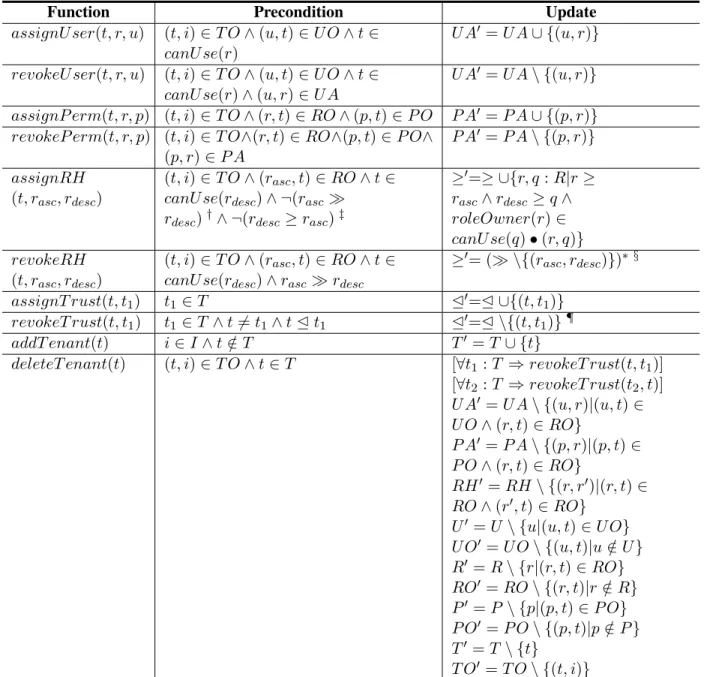
Table 3.1 Administrative Functions in AMTAS . . . 22 Table 3.2 Administration functions available to tenanttin AMT-RBAC . . . 36 Table 3.3 Trust Model Comparison. A and B represent two entities in RT or
ten-ants in MTAS and MT-RBAC.Arepresents the resource owner andB the requester. . . 57
LIST OF FIGURES
Figure 1.1 An out-sourcing case illustrating multi-tenant accesses . . . 2
Figure 1.2 MTAC Framework Structure . . . 8
Figure 3.1 An abstracted model of the MTAS system. . . 16
Figure 3.2 MT-RBAC Model . . . 27
Figure 3.3 Example multi-tenant assignments in the out-sourcing case. The differ-ences among the MT-RBAC models are also illustrated in terms of E’s exposed roles. . . 30
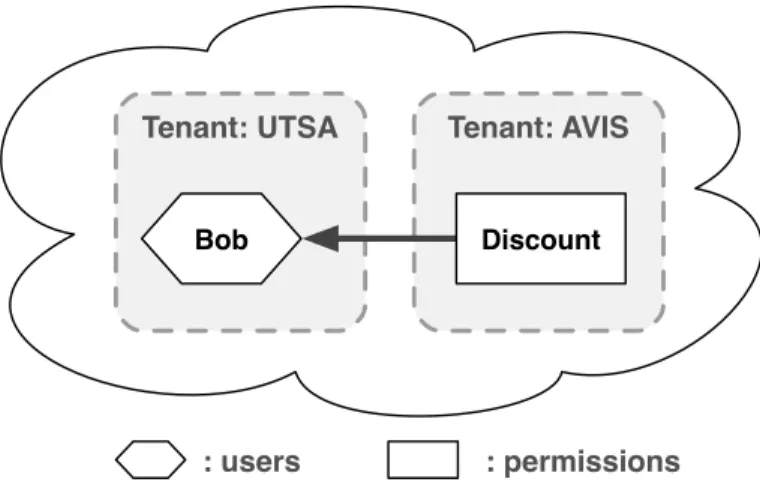
Figure 3.4 A car rental example of cross-tenant access. . . 38
Figure 3.5 Cross-Tenant Trust Model . . . 42
Figure 3.6 Role-Based Cross-Tenant Trust Model . . . 45
Figure 3.7 Multi-Tenant Attribute-Based Access Control (MT-ABAC) Model . . . 48
Figure 3.8 Multi-tenant accesses with Type-γ trusts . . . 52
Figure 4.1 MTAaaS Architecture . . . 61
Figure 4.2 Example MTAS policy structure with trust relationOS .Eas highlighted. 63 Figure 4.3 The MT-RBAC2policy enables two independent authorization paths: cross-tenant user assignment (UA) and cross-cross-tenant role hierarchy (RH), wheretr trustste. . . 65
Figure 4.4 MTAaaS Testbed Architecture . . . 67
Figure 4.5 Performance and scalability evaluation results . . . 68
Figure 5.1 An DevOps use case of cross-domain accesses. . . 73
Figure 5.2 Core OpenStack Access Control (OSAC) model with domain trust. . . 77
Figure 5.3 An example administrative role hierarchy. . . 81
Chapter 1: INTRODUCTION
The growing predominance of cloud computing impacts every aspect of the information technol-ogy (IT) industry [46]. It facilitates business agility and lowers costs for information systems by using virtualization techniques over shared infrastructures in an on-demand self-service manner. Due to the shared infrastructure, multi-tenancy is introduced as the key functioning model of cloud services [43] segregating customer data and work space for security and privacy purposes. Thus, the access control mechanisms supporting multi-tenant services are similar to those for distributed environments, but they are still different because of the following characteristics of typical cloud systems.
• Centralized Facility. Cloud services are usually presented as a pool of computing resources which are centralized in the CSP managed facility. The consumers (tenants) should be autho-rized full control of their temporarily “owned” resources including administration privileges. In other words, a tenant can create users within its scope and arbitrarily grant access to them. Hence, in this setting, pure decentralized models [40, 58] are not suitable.
• Self-Service Agility. The creation and deletion of tenants are not controlled by the CSP. A tenant may be created by the consumer for temporary use and deleted immediately after-wards. Thus, the authorization model, especially for cross-tenant accesses, has to be flexible enough to cope with such agility.
• Homogeneity. For the service operation of a cloud to meet a standard service level agree-ment (SLA), the CSP tend to build and maintain cloud systems with homogeneous archi-tecture while only the customer configurations are different. Therefore, the access control model in different tenants should be identical with each other while the policies are cus-tomizable.
• Out-Sourcing Trust. Cloud users intrinsically out-source part of their IT infrastructures to CSPs so that trust relations between these two parties are already established.
Collabora-tions among tenants also need similar trust relaCollabora-tions, which can be developed through their common trust in the CSP.
The above listed features distinguish the cloud from other distributed systems in terms of multi-tenant authorization. It follows that access control models developed for previous distributed en-vironments are not directly applicable to the cloud. Moreover, since multi-tenant collaborations are essential in the cloud [37], the multi-tenant access control (MTAC) models should address not only intra-tenant but also cross-tenant accesses. In particular, fine-grained secure resource sharing among tenants is not enabled in today’s commercial clouds [34, 39].
1.1
Motivation
Before we discuss the multi-tenant access control problem, we need to clarify the definition of tenants. We see from the CSP’s perspective that a tenant is a billable account owned by an orga-nization, a department of an organization or even an individual. A tenant is not only a scope of operations but also an independent authority and an accessing entity. As a result, unlike domains in distributed environments, tenants in the cloud should be treated as entity components in the model rather than an attribute of users or objects. The formal definition of tenants is given in Chapter 3.
Intra-Tenant Access Cross-Tenant Access
Auditor
Developer Owner
ENTERPRISE (E) AUDITING FIRM (AF)
OUT-SOURCING COMPANY (OS) Dev.E Acc.E HR.E Charlie Alice Bob Cloud Storage Service Dev.OS Acc.AF Web Portal Web Portal
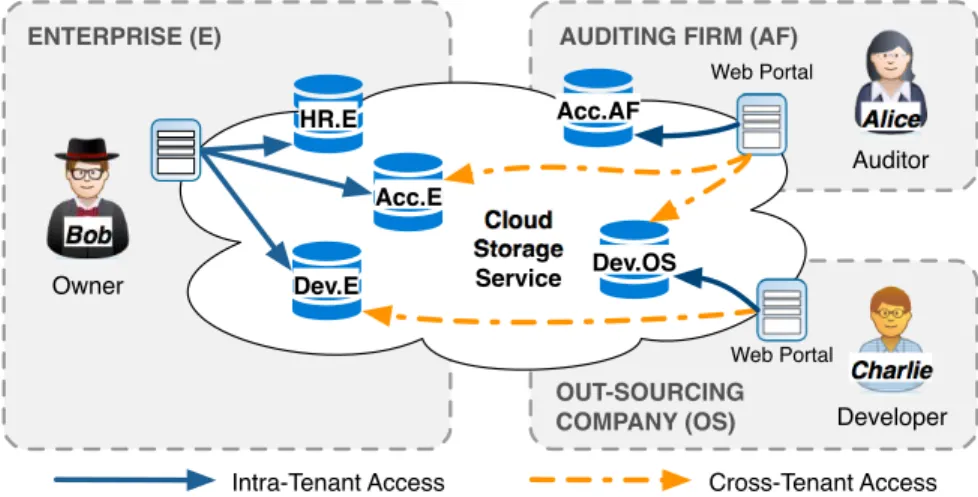
Figure 1.1: An out-sourcing case illustrating multi-tenant accesses
To better explain the problem, we use an out-sourcing example, as shown in Figure 1.1, in which theEnterprise(E), theOut-Sourcing company(OS), and theAuditing Firm(AF) are three
collaborating parties sharing a common cloud storage service.Eout-sources part of its application development work to OS and external auditing tasks toAF. The cloud storage service provides storage services for the development department of OS, the accounting department of AF, and three of E’s departments, development, accounting, and HR, as segregated tenants. Let “.” de-note the affiliation relation between the tenant and its organization (also called issuer) so that, for example,Dev.E represents the tenant ofE’s development department. The example cross-tenant accesses for collaborations are as follows.
C1. Charlieas adeveloper inOShas to access the source code stored inDev.E to perform his out-sourcing job;
C2. Aliceas anauditorinAF requires read-only access to financial reports stored inAcc.E; and C3. Alice needs read-only accesses to Dev.E and Dev.OS in order to audit the out-sourcing
project.
For simplicity, in our examples we assume all the tenants are created on a single cloud service, bringing homogeneous architecture which is often the case in cloud environments [28]. But, we do not exclude the potential of heterogeneous collaborations among multiple cloud services or even among multiple service models: Software as a Service (SaaS), Platform as a Service (PaaS), and Infrastructure as a Service (IaaS) [43]. As a common collaboration need suggests, a user may test and deploy the source code stored in Dev.E directly on another tenant of a PaaS service. This function requires secure collaborative accesses between the two services. In fact, SaaS services are often hosted on PaaS clouds in which the SaaS services are regarded as tenants. A similar situation holds between PaaS and IaaS. Thus, we treat accesses among multiple tenants, clouds, or even service models equivalently in the abstraction level as multi-tenant accesses upon which access control mechanisms should be enforced.
Currently, CSPs use Single Sign-On (SSO) techniques to achieve authentication and simple authorization in federated cloud environments, but fine-grained authorization is typically not sup-ported. NASA has integrated role-based access control (RBAC) into Nebula [42], a private cloud
system. While traditional RBAC enables fine-grained access control mechanisms in clouds, it lacks the ability to manage collaborations. IBM [26] and Microsoft [25] proposed a resource sharing ap-proach in data-centric clouds using database schema, but this apap-proach is specialized to databases and cannot be directly applied to other types of services. Collaboration models in traditional ac-cess control models, such as RT [40] and dRBAC [29], use credentials to securely communicate among collaborators. The management of credentials remains a problem which could be avoided in cloud environments because of the existence of centralized facilities. Consequently, in order to enable secure multi-tenant collaborations in the cloud, we need a general fine-grained access control model for this purpose.
To achieve collaborations among cloud services, Calero et al [22] proposed a multi-tenancy authorization system by extending RBAC with a coarse-grained trust relation. The authorization policies and trust assertions are stored in a centralized knowledge base. The authorization decisions are also made in a centralized policy decision point (PDP). Calero et al described an authorization model and a trust model in an informal way, while noting that the trust relation is coarse-grained and open for extensions.
1.2
Problem Statement
Contemporary cloud systems extend the role-based access control (RBAC) model to address multi-tenant authorization. This exercise matches the centralized facility and homogeneity characteristics of the cloud, since RBAC is intrinsically a centralized model initially designed for a single orga-nization. However, in terms of self-service agility and out-sourcing trust, these models limit the flexibility of the cloud and typically disallow cross-tenant accesses or support these only minimally. The permissions in RBAC are presented as operations against objects which are not identifiable in the policy since they are temporary. As a result, the authorization policies can only specify the relation between roles and operations as role-permission assignments so that a role can only be as-sociated with a set of operations in a tenant. Moreover, current cloud systems apply limited control on the cross-tenant accesses. Some of them treat cross-tenant accesses more or less identical as
intra-tenant accesses with no extra control which is obviously needed. Hence, the current access control solutions in cloud systems do not meet all the requirements and characteristics of the cloud environment identified here.
In order to cover the major multi-tenant authorization requirements and cloud characteristics, we feel it necessary to build a generic formal model since the previous models are not directly applicable to the cloud. This model is a mixture of centralized and decentralized models. On the one hand, all the tenants in all the services of a cloud have to comply with a uniform model which is established by the CSP and enforced by each service. On the other hand, each tenant has full control of the cloud computing resources within its scope. The model should be feasible in all the three cloud service models: IaaS, PaaS and SaaS. Since IaaS is the foundation of the other two models and less complicated in use cases, it is a reasonable environment to begin experimenting with. Also, there are requirements for finer-grained access control. It is challenging to allow administrators to specify authorization policies based upon objects before they are created. This can be achieved using attribute-based access control (ABAC) approaches.
In order to develop the model described above, we still have some challenges in front of us. Here follows the challenges we identify.
• Common Vocabulary.During the process of specifying cross-tenant authorization policies, a tenant needs to understand the roles or other attributes in the context of another tenant and vice versa. As a result, establishing a common vocabulary between tenants is essential. • Policy Conflicts. The policies specified in the user tenant and the object tenant of an access
may conflict with each other. The policy decision point (PDP) should resolve the conflict using a predefined algorithm.
• Centralized or Decentralized PDP.The policy enforcement points (PEPs) are distributed in each service in a multi-tenant fashion. The PDP can be hosted either in each cloud service or in a centralized authorization service. The former needs communication between services to retrieve information needed in the policy decision process but is more efficient since the PDP
is closer to the cloud resources. The major drawback of the latter is the performance issue since all the services will communicate with the authorization service for each access so that the implementation have to be scalable in order to meet the high performance requirements. • Administration Model. The administration of authorization policies is the concern of most access control models. In multi-tenant cloud environments, the administration model should allow the CSP to conduct daily operations but not intervene with tenant policies.
• Constraints.The tenants may also need to specify constraint policies to better control multi-tenant accesses. For example, separation of duty (SoD) in a single multi-tenant can be covered by local tenant policies but in a multi-tenant scenario, the same problem may require CSP level policies or remote policies to specify the constraint.
1.3
Scope and Assumptions
This research is conducted based on the following assumptions.
Standardized APIs. The CSP should have a set of standardized APIs and other necessary facilities, in order to functionally enable cross-tenant accesses. Our research mainly focuses on the access control of these APIs.
Authenticated Users. All the users requesting accesses are assumed to have been properly authenticated.
These two assumptions are more or less necessary for any treatment of cross-tenant trust. The rest of the assumptions below could be relaxed or removed but are convenient for an initial inves-tigation of cross-tenant trust models.
One Cloud Service. For simplicity, we assume cross-tenant accesses are between tenants of a single cloud service. We believe our models are extensible beyond a single cloud but multi-cloud considerations are outside the scope of this dissertation.
Two Tenant Trust. For simplicity we only consider trust relations between two tenants. More generally, there may exist trust relations for more than two tenants forming a community, a
coali-tion, or a federation [18].
Unidirectional Trust Relations. Each trust relation is unidirectional (like follow in Twitter) as opposed to bidirectional (like friend in Facebook).
Unilateral Trust Relations. Each trust relation is established unilaterally by the trustor, and remains under exclusive control of the trustor. Specifically, the trustor and only the trustor can create, modify, and revoke a trust relation. In general, it seems unreasonable for the trustee to unilaterally assert a trust relationship. However, it may be reasonable for a trustee to agree before a trustor can assert trust. Also, it may be reasonable for a trustee to unilaterally revoke trust with respect to a trustor. Treatment of these cases is outside the scope of this dissertation.
1.4
Thesis
The central thesis of this dissertation is as follows.
The problem of multi-tenant access control in the cloud can be partially solved by integrating various types of unidirectional and unilateral trust relations between tenants into role-based and attribute-based access control models.
1.5
Summary of Contributions
The contributions in this dissertation are summarized into three aspects.
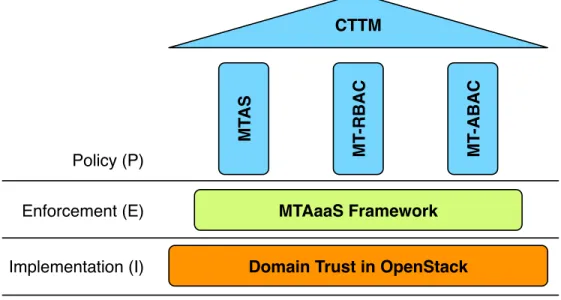
• Policy.The multi-tenant authorization system in [22] was formalized as a role-based MTAS model and extended with finer-grained trust relations between tenants. Furthermore, we developed another model, the Multi-Tenant Role-Based Access Control (MT-RBAC) model, similar to MTAS but with a different type of trust relation. We proposed a taxonomy of the Cross-Tenant Trust Models (CTTM) in multi-tenant access control. Finally, the Multi-Tenant Attribute-Based Access Control (MT-ABAC) model was developed to integrate more flexibility and granularity into the policy.
MTAaaS Framework MT AS MT -RBAC MT -ABAC
Domain Trust in OpenStack Policy (P)
Enforcement (E)
Implementation (I)
CTTM
Figure 1.2: MTAC Framework Structure
as a Service (MTAaaS) to enforce the policy layer models in the cloud. The specifica-tion of policies were composed in standard eXtensible Access Control Markup Language (XACML). Also, we built a prototype system based on SUN’s XACML implementation and conducted experiments to validate the feasibility of the models and the service architecture. • Implementation. We presented the OpenStack Access Control (OSAC) model in our
per-spective and integrated a novel domain trust relation in the implementation of Keystone, the identity service of OpenStack. In the identity service API v3 [7], domain is equivalent to tenant in our models. The PDP was implemented in both centralized and decentralized ways. The experiments were conducted over the decentralized architecture because it is con-sistent with the Havana release [6] of OpenStack. The results show that the extended domain trust implementation introduces minimum performance overhead and thereby maintains the scalability of Keystone.
Following the PEI framework for application-centric security [47], we organize our research in three layers: Policy (P), Enforcement (E) and Implementation (I). The entire structure of our work towards multi-tenant access control is illustrated in Figure 1.2. The accomplished works are mainly inP layer andE layer. In future work, we plan to keep developing the P layer models
and refining the MTAaaS framework in the E layer as well. The models shown in P layer in Figure 1.2 are not an exhaustive list. Additional multi-tenant access control models are planed to be investigated in future work. Then, our eventual goal is to bring anI layer MTAaaS platform to cloud users and developers leveraging OpenStack.
1.6
Organization of the Dissertation
Chapter 2 gives a literature review of the related works including multi-domain, delegation and Grid solutions. Chapter 3 presents the policy layer works including MTAS, MT-RBAC, CTTM and MT-ABAC. Chapter 4 describes the MTAaaS architecture enforcing multi-tenant access control models in the cloud. Chapter 5 gives the formal definition of OSAC model, the domain trust extension and experiment results of the implementation. Chapter 6 concludes the dissertation and discusses the future work.
Chapter 2: RELATED WORK
Multi-tenant access control shares some basic problems with multi-domain secure interoperation approaches in traditional distributed environments. Some solutions have already been proposed in multi-domain circumstances. We summarize these approaches into four categories: centralized approaches, decentralized approaches, attribute-based approaches and enforcement models.
2.1
Centralized Approaches
Role-based access control (RBAC) [27] enabling fine-grained access control does not encompass the overall context associated with any collaborative activity [56]. Many RBAC extensions have been proposed to address multi-domain access control in the context of roles. A typical way to solve the context mismatch during multi-domain authorization process is establishing a common centralized authority for all the domains collaborating with each other.
Shafig et al [49] propose a set of policy composition mechanisms using role mapping and integer program (IP) to solve heterogeneity issues in secure multi-domain information sharing. This approach introduces graph-based specification model for RBAC and clarifies the fundamental problems in cross-domain authorization through roles. Zhang et al [59] propose a scalable role and organization based access control model (ROBAC) to scale up RBAC for modeling security policies spanning multiple organizations. ROBAC is designed specifically for organizations with homogeneous structure in a hierarchical way. It aggregates roles and assets with organizations and asset types respectively significantly shrinking the size of role-based access control policies. Another RBAC extension, the group-based RBAC model (GB-RBAC) [41], is designed to foster dynamic collaborations in distributed environments such as the Grid. With the group entity in-troduced, GB-RBAC allows a user to be assigned a permission either through system-level roles or group-level roles. The former is consistent with the user-role assignment in RBAC while the latter is extended to accommodate groups of users. In this way, the administration is effectively separated into two levels, the group-level and system-level, so that some administrative privileges
can be delegated to group-level administrators. In the above approaches, a centralized author-ity is required to specify or mediate cross-domain policies. However, in cloud environment, the only existing centralized authority is the Cloud Service Provider (CSP) who should maintain the generic policies for all the tenants rather than for specific ones since the tenants are temporary and self-service oriented. Thus, these approaches are not directly applicable in the cloud.
2.2
Decentralized Approaches
In order to facilitate access control in distributed systems, another line of work advocates decen-tralized authorities extending RBAC. Role-based trust management framework (RT) [40] provides localized authority over roles, delegation in role definition, linked roles and parameterized roles using a few simple credential forms. It is theoretically expressive and adaptive to distributed sys-tems. Similarly, distributed RBAC (dRBAC) [29] utilizes PKI credentials to define trust domains, roles to define controlled activities, and role delegation across domains to represent permissions to these activities. It is designed for highly dynamic coalition environments with multiple orga-nizations or entities that are unwilling to rely on a third party to administer trust relationships. Permission-Based Delegation Model (PBDM) [58] extends RBAC with flexible role and permis-sion level delegations. In PBDM, a security administrator specifies the permispermis-sions that a user (delegator) has authority to delegate to others (delegatees), then the delegator creates one or more temporary delegation roles and assigns delegatees to particular roles. This mechanism provides clear separation of security administration and delegation. It allows transitive delegations giving control of permissions to user for decentralized management. Barka et al [17] propose a frame-work for role-based delegation models giving a taxonomy of delegation models. This frameframe-work clarifies the basic characteristics of delegation and its usage in RBAC.
The delegation approach requires additional administration. All the delegations of a permission need to be kept track of well in a graph. If any of the nodes (users) change, the entire graph of authorization will change unexpectedly.Thus, the delegation approaches also lack support of the agility in the cloud.
2.3
Attribute-Based Approaches
The benefit of Attribute Based Access Control (ABAC) is prominent in multi-domain access con-trol [33]. In RBAC and many other previous models, access to an object has to be individually granted to locally identified subjects so that the external subject’s identity has to be pre-provisioned in the object’s domain prior to the access request. However, ABAC avoids the need for explicit authorizations to be directly assigned to specific subjects but to subjects with certain attributes. Thus, with ABAC the authorization policies for both intra-domain and cross-domain accesses are unifiable as long as the data sharing agreements and infrastructures are established.
The concept of ABAC has existed for many years. It is anticipated to be the next generation of dominant access control models. From our perspective, ABAC is more generic than RBAC since the role is an attribute of users as well as permissions. Some of the attributes can be conveyed as roles but a lot more cannot be. For example, the context attributes such as the accessing location and time are not straightforward to be described by roles. At the same time, the flexibility of attributes further complicates the access control problems. As a result, a commonly accepted unifying ABAC model does not yet exist.
Although ABAC models are still under development, its core entities and basic concepts have already been specified. The earlier approach is to add attributes to the existing RBAC model. Al-Kahtani et al [13] add attribute feature into the user-role assignment process enabling dynamic and automatic assignments. The composite model is capable to express Mandatory Access Control (MAC). Kuhn et al’s work [38] summaries and compares the possible ways to integrate attributes with RBAC (RBAC-A). In general, there are three approaches namely dynamic roles, attribute-centric and role-attribute-centric to achieve the RBAC-A models. Recently, Xin et al [36] propose a unified ABACα model covering DAC, MAC and RBAC. The ABACα model clearly describes the
rela-tions among users, subjects and objects, as well as their attributes using its policy configuration language. There are three configuration points in ABACα for specifying attribute constraint
a more recent work of these authors [35], the ABACβ model is proposed to cover more traditional
models including a considerable number of RBAC extensions.
2.4
Enforcement and Implementation
Besides the policy layer work in the literature, there is significant related work in enforcing and implementing access control mechanisms in multi-domain environments, especially in the cloud. Federated identity and authorization services are included in the architecture of distributed sys-tems to facilitate collaborative access control. Federated identity [19, 24] enables authenticating strangers by sharing identity information among federated parties. The federation relation is intrin-sically an equal trust relation which is meaningful in some use cases but cumbersome in supporting the variety of collaborations. For example, the trust relation betweenEandOSin Figure 1.1 is ap-parently not an equal trust since the ultimate owner of the resources to be accessed isE. Moreover, the maintenance of federation relation becomes costly when it has to cope with the agility feature in clouds. Some tenants are created temporarily and deleted upon completion of their jobs, while the federation relation has to be updated accordingly. Authorization services, such as VOMS [14], PERMIS [23] and CAS [44], aim to secure resource sharing among virtual organizations (V Os) in grid computing systems leveraging cryptographic credentials. Although such credential-driven approaches are viable and effective, the overhead of maintaining the public-key infrastructure for credentials is expensive and not necessary in the cloud environment due to the existence of cen-tralized facility and homogeneous architecture.
To enforce access control in web environments, Yuan et al [57] propose an ABAC enforcement model. The architecture contains a centralized policy decision point (PDP) and distributed policy enforcement points (PEP). The attributes and authorization policies are specified by distributed attribute authorities and policy authorities. This enforcement model is designed for web services but also feasible in other SOA systems.
As a critical part of the evolving cloud technology, authorization mechanisms for multi-tenant collaborations are emerging in both academia and industry. Multi-tenancy in the cloud features
homogeneity, centralized facility, and agility comparing to the traditional multi-domain environ-ments. Utilizing the centralized facility feature in clouds [15, 22, 30, 51] it is possible to develop authorization services with scalable policy management modules and PDPs in a central location. Moreover, to better clarify the trust relationships in authorization domains for cloud computing, Perez et al [45] recently propose 29 different trust models and 8 fine-grain models in terms of con-ditions, subjects and targets applying to a universal trust operator. They also give a centralized trust manager architecture for IaaS clouds. This enforcement model is consistent with this dissertation.
Chapter 3: MULTI-TENANT ACCESS CONTROL (MTAC) MODELS
In this Chapter, we propose a suite of four MTAC models including two role-based models, one trust model and one attribute-based model, as shown in the Policy layer of Figure 1.2. All the role-based and attribute-based models use various types of tenant trust relations, as described in the Cross-Tenant Trust Model (CTTM), to bridge authorization between tenants. CTTM defines three types of tenant trust relations as Type-α, Type-β and Type-γ trust. The role-based mod-els, Multi-Tenant Authorization System (MTAS) and Multi-Tenant Role-Based Access Control (MT-RBAC), use Type-β and Type-γ trust respectively. The attribute-based model, Multi-Tenant Attribute-Based Access Control (MT-ABAC), is compatible with all the three types of trust rela-tions.
3.1
MTAS
In this section we formalize the multi-tenancy authorization system informally described in [22]. We call the resulting model as the MTAS model for ease of reference and continuity. We also develope an administration model for MTAS (called the AMTAS model). Further, we propose two feasible enhancements to the trust model of MTAS.
3.1.1 Formalization
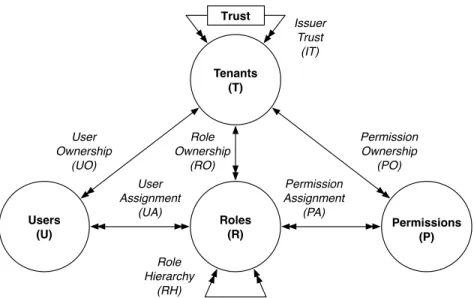
Towards the goal of a general model of multi-tenant role-based access control in the cloud, we start by abstracting the MTAS system [22] into a formalized model, as shown in Figure 3.1. There are four entity components: tenants(T),1users(U),permissions(P) androles(R). In addition to
classic RBAC2, the role hierarchy model [27], thetenantcomponent is introduced to express au-thorization in multi-tenant environments, while other components need to be modified accordingly. In particular the traditional RBAC entities ofusers,permissionsandroleshavetenantattributes so that they can be identified uniquely in a multi-tenant cloud environment. This is depicted by the
Users (U) Tenants (T) Roles (R) User Assignment (UA) Permission Assignment (PA) Role Hierarchy (RH) Permission Ownership (PO) Issuer Trust (IT) Role Ownership (RO) User Ownership (UO) Permissions (P) Trust
Figure 3.1: An abstracted model of the MTAS system.
U O,ROandP O relations in Figure 3.1. U O,RO andP O are many-to-one relations fromU,R
andP respectively toT.
TENANTS. Atenant represents an organization, a department of an organization or even an individual who uses the cloud services. From the CSP point of view, eachtenantis an independent customer.The data and operations of a tenant are isolated from each other. For example, in the out-sourcing case described in Figure 1.1,Eas an organization owns three tenants:Dev.E,Acc.E
and HR.E. They are used for different departments in E but the CSP treat them uniformly as cloud storage service customers.
USERS. A user is an identity for an individual. It is authenticated as a federated ID [19] which is universally unique for all the tenants in the community. Every user has an owner attribute indicating the tenant who provides the identity. The identity is also usable by other tenants.
PERMISSIONS. Apermissionis a specification of a privilege to an object on a tenant, which is specified as a service interface. A permission is denoted in a 3-tuple (privilege, tenant, ob-ject). For example, (read, Dev.E, /root/) represents a permissionof reading the “/root/” path on
Dev.E. Because the tenant attribute of a permission belongs to only onetenant, everypermission is associated with a singletenantwhile one tenant may have multiple permissions.
ROLES. Aroleis a job function (role name) with an tenant. A role is denoted asrole(tenant, roleName), e.g. role(Dev.E, dev)represents a developer role in tenantDev.E. Arolebelongs to a singletenantwhile antenantmay own multipleroles.
SESSIONS.2Asessionis an instance of access created by auser. The owner attribute of the useris inherited to thesession. A session, in its lifespan, is regarded as the subject of the access. A subset ofrolesthat theuseris assigned to can be activated in asession. In a multi-tenant cloud environment, note that the user and the active roles in a sessionmight not all be from the same tenant.
Crucially, an additional tenant trust relation (T T ⊆ T ×T, also written as “.”) establishes tenant to tenant trust as will be described and formalized in detail later in this section. For ∀tr, te, tf ∈T,T T relation is reflexive
tr .tr (3.1)
but not transitive
tr .te∧te .tf ;tr .tf (3.2)
and it is neither symmetric
tr .te ;te .tr (3.3)
nor anti-symmetric
tr .te∧te .tr ;tr =te. (3.4)
Fortr .te, we calltrthe trustor andtethe trustee. In MTAS model, trust is always established
by the trustor allowing the trustee to view and use its own authorization statements. Therefore, the trustee can grant one of the trustor’s roles, sayrr, a trustee’s permission, saype. This role to
permission assignment enables all users inrrto inheritpe. Further the trustee can make one of the
trustee’s roles, sayreto be junior to one of the trustor’s roles, sayrr. The effect of this role to role 2The session component was not discussed in [22], but we feel it indispensable in a complete formal model which
builds on RBAC, so it is included and some session related components are added in the formalization, as described in Definition 2.
assignment is to make all users inrr members ofreso that the permissions ofre in the trustee are
also inherited by the users ofrrin the trustor. The definition of MTAS trust model is given below.
Definition 1. LetA andB denote two tenants. By establishing a tenant trust relation (T T) with
B (A . B), Aexposes its entire role hierarchy toB so thatB is able to make the two following assignments:
1) assigningB’s permissions toA’s roles; and 2) assigningB’s roles as junior roles toA’s roles.
For example, in the out-sourcing case as described in Figure 1.1, Bob, representing the re-source ownerDev.E, could allow certain developers in OSto access the source code files stored in Dev.E for them to conduct the out-sourcing job. Assume the proper permission in Dev.E
for the out-sourcing job, (edit, Dev.E, /src/) is associated to the role role(Dev.E, dev). In or-der to achieve this cross-tenant access, with the presence of Dev.OS . Dev.E relation, Bob
can assignrole(Dev.E, dev)to be a junior role of an appropriate developer role inDev.OS, say
role(Dev.OS, dev). In this way, the users associated torole(Dev.OS, dev) are able to edit the files under the/src/ directory inDev.E.
The trust model solves the two key problems in collaborative role-based access control: de-centralized authority and semantic mismatch. Since the collaborators are independent, the tenants (decentralized authorities) desire to maintain control of their resources including data and autho-rization settings. But in most collaborations, some level of resource sharing is inevitable and that is why we need a trust model to keep the resource sharing process secure. By establishing a trust relation described in Definition 1, the trustor exposes its authorization settings to the trustee while the trustee assigns permissions of its data to the trustor. In this way, both sides contribute to cross-tenant assignments and the accesses are under mutual control.
The semantic mismatch issue refers to the fact that the definitions of roles vary in different domains so that no proper assignment could be made by a single authority without additional communication with each other. In the trust model of MTAS, this issue is mitigated, because the
authorization settings, i.e. the role hierarchy and the role members, of the trustor are exposed to the trustee upon the creation of the tenant trust relation. Consider the out-sourcing case. With the presence of Dev.OS . Dev.E, Dev.E’s administrator Bob may examine the members of
Dev.OS’s roles and decide which role is appropriate to assign the permission to. The formal definition of MTAS model is as follows.
Definition 2. The MTAS authorization model has the following components:
• U,R,P,T andS (users, roles, permissions, tenants and sessions respectively);
• U O ⊆U×T, a many-to-one relation mapping each user to its owning tenant; correspond-ingly, userOwner(u : U) → T, a derived function mapping a user to its owner where
userOwner(u)∈ {t ∈T|(u, t)∈U O};
• RO ⊆R×T, a many-to-one relation mapping each role to its owning tenant; correspond-ingly, roleOwner(r : R) → T, a derived function mapping a role to its owner where
roleOwner(r)∈ {t ∈T|(r, t)∈RO};
• P O ⊆ P ×I, a many-to-one relation mapping each permission to its owning tenant; cor-respondingly, permOwner(p : P) → T, a derived function mapping a permission to its owner wherepermOwner(p)∈ {t∈T|(p, t)∈P O};
• T T ⊆T ×T, a reflexive relation onT called tenant trust relation, also written as.; • canU se(r :R)→2T, a derived function mapping a role to a set of tenants who can use the
particular role. Formally,canU se(r) ={t∈T|roleOwner(r).t}; • U A⊆U ×R, a many-to-many user-to-role assignment relation;
• P A⊆P×R, a many-to-many permission-to-role assignment relation requiring(p, r)∈P A
only ifpermOwner(p)∈canU se(r);
• RH ⊆R×Ris a partial order onRcalled role hierarchy or role dominance relation, also written as≥, requiringr≥r1, only ifroleOwner(r1)∈canU se(r);
• user(s:S)→U, a function mapping each session to a single user which is constant within the life-time of the session; and
• roles(s : S) → 2R, a function mapping each session to a subset of roles, roles(s) ⊆ {r|(∃r0 ≥r)[(user(s), r0)∈U A∧userOwner(user(s))∈canU se(r)]}, which can change withins, andshas the permissionsS
r∈roles(s){p|(∃r
00 ≤r)[(p, r00)∈P A]}.
Note that since we are formalizing an extension of pure RBAC model [27], the user permission assignment described in [22] is ignored in the formalization.
Role activation mechanisms determine the executable permissions inherited by a session. Be-cause a role may inherit permissions from its junior roles in the role hierarchy, when a role is activated in a session, its inherited roles may be either automatically activated (implicit activation) or require explicit activation. Theoretically the former scenario is transformable to the latter by re-cursively executing explicit activation for the junior roles. The choice between the two approaches is left as an implementation issue in the NIST RBAC model [27]. In the RBAC96 model implicit activation is specified [48]. In MTAS we choose to specify explicit activation in theroles(s) com-ponent. In a session, only the permissions of the explicitly activated roles are executable to the user.
Since every user identity is available to all the tenants, U A assignments bear no constraints on tenants. Thus, the U A assignments are always issued by the role owners as discussed in the administration of the MTAS model in Section 3.1.2.
The trust model is embedded in the canU se function which takes effect in P A and RH as-signments in the MTAS model. As the name suggests, thecanU se(r)function returns the tenants who can user to make authorization assignments. The returned tenants are the trustees who are trusted byr’s owner, sayi. In order to issueP A, permission owner has to beiitself or one of the trustees of i. Therefore,r is only assigned to permissions of i or its trustees. Similar conditions require that only the roles ofior its trustees can be assigned as junior roles of rinRH. P Aand
Based on the formalization of MTAS model, we also develop a formal administrative model and finer-grained trust models, as presented in the following sections.
3.1.2 Administrative MTAS (AMTAS) Model
The administration model, AMTAS is tightly coupled with the MTAS model, since the main prob-lem of access control models in distributed environments is how to manage the decentralized ad-ministrative authority. In other words, the adad-ministrative model regulates who are eligible to issue what kind of assignments. Hence, a desirable administrative model should maintain balanced man-agement workload and proper control for both sides.
Definition 3. The Administrative MTAS (AMTAS) model is defined by the following two rules. Assume thatAandBare two tenants andAtrustsB.
• The resource requesterAis responsible for managing the trust relation ofA.B;
• The resource ownerB is responsible for managing the cross-tenant assignments (i.e. P A
andRH) toA’s requesting roles, according to MTAS in Definition 2.
As described in Definition 3, AMTAS maintains the balance of management by introducing “dual control”. In any cross-tenant access, the resource requesting tenant controls the trust rela-tions which decides whether or not to allow cross-tenant assignments. The resource owner keeps the ultimate authority of its resources and issues the assignments based on properly created and maintained trust relations. Both the trust relations and the assignments are crucial in cross-tenant authorization because if either is revoked or altered, the corresponding collaborative accesses will be denied.
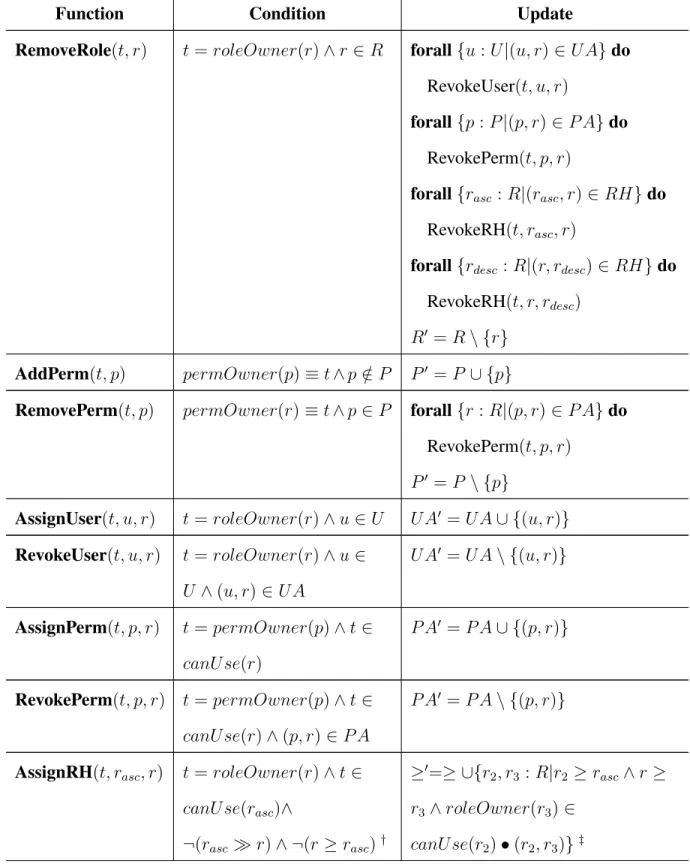
Table 3.1: Administrative Functions in AMTAS
Function Condition Update
Administrative functions available to cloud administrators:
AddTenant(t) t /∈T T0 =T ∪ {t} RemoveTenant(t) t∈T forallte∈T do RevokeTrust(t, te) RevokeTrust(te, t) foralluserOwner(u)≡tdo RemoveUser(t, u) forallroleOwner(r)≡tdo RemoveRole(t, r) forallpermOwner(p)≡ido RemovePerm(t, p) T0 =T \ {t} Administrative functions available to tenantt:
AddUser(t, u) userOwner(u)≡t∧u /∈U U0 =U ∪ {u}
RemoveUser(t, u) userOwner(u)≡t∧u∈U forall{r :R|(u, r)∈U A}do RevokeUser(t, u, r)
U0 =U \ {u} AddRole(t, r) t=roleOwner(r)∧r /∈R R0 =R∪ {r}
Table 3.1: Administrative Functions in AMTAS (Contd.)
Function Condition Update
RemoveRole(t, r) t=roleOwner(r)∧r ∈R forall{u:U|(u, r)∈U A}do RevokeUser(t, u, r)
forall{p:P|(p, r)∈P A}do RevokePerm(t, p, r)
forall{rasc :R|(rasc, r)∈RH}do
RevokeRH(t, rasc, r)
forall{rdesc :R|(r, rdesc)∈RH}do
RevokeRH(t, r, rdesc)
R0 =R\ {r} AddPerm(t, p) permOwner(p)≡t∧p /∈P P0 =P ∪ {p}
RemovePerm(t, p) permOwner(r)≡t∧p∈P forall{r :R|(p, r)∈P A}do RevokePerm(t, p, r) P0 =P \ {p} AssignUser(t, u, r) t=roleOwner(r)∧u∈U U A0 =U A∪ {(u, r)} RevokeUser(t, u, r) t=roleOwner(r)∧u∈ U∧(u, r)∈U A U A0 =U A\ {(u, r)} AssignPerm(t, p, r) t=permOwner(p)∧t∈ canU se(r) P A0 =P A∪ {(p, r)} RevokePerm(t, p, r) t=permOwner(p)∧t∈ canU se(r)∧(p, r)∈P A P A0 =P A\ {(p, r)}
AssignRH(t, rasc, r) t=roleOwner(r)∧t∈
canU se(rasc)∧ ¬(rasc r)∧ ¬(r≥rasc)† ≥0=≥ ∪{r 2, r3 :R|r2 ≥rasc∧r≥ r3∧roleOwner(r3)∈ canU se(r2)•(r2, r3)}‡
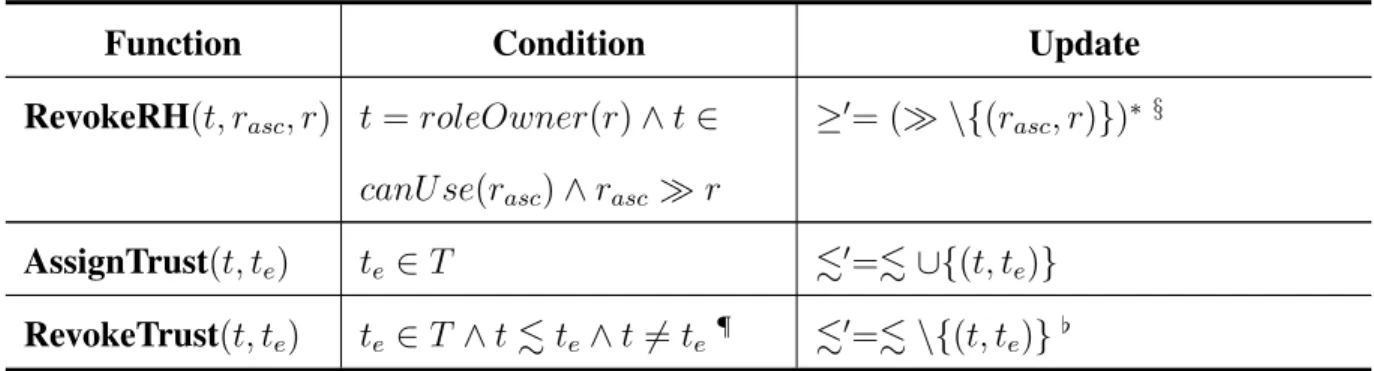
Table 3.1: Administrative Functions in AMTAS (Contd.)
Function Condition Update
RevokeRH(t, rasc, r) t=roleOwner(r)∧t∈
canU se(rasc)∧rasc r
≥0= ( \{(r
asc, r)})∗ §
AssignTrust(t, te) te ∈T .0=.∪{(t, te)}
RevokeTrust(t, te) te ∈T ∧t.te∧t 6=te¶ .0=.\{(t, te)}[
† The notation “” represents an immediate inheritance relation. This condition prevents cycle creation in the role hierarchy.
‡ All the roles senior tor
ascbecome senior to all the roles junior tor. § The notation “∗” represents recursive updates for the entire role hierarchy.
¶ A tenant cannot refuse to trust itself. Otherwise, improper revocation of assignments may occur.
[ By revoking the trust relation, the canUse() function ofttenant’s roles automatically updates
ac-cordingly as well asP AandRH.
Table 3.1 provides the core logic of administrative functions of AMTAS. The functions are presented in a three-column format with function names, conditions and updates. There are two parts of administrative functions available to two different levels of administration. The cloud administrators are roles empowered to add and remove tenants 3. Along with the removal of a
tenant, its correlated trust relations, users, roles and permissions should also be removed. Even though the users are globally available, the removal of their owning tenants will result in removal of the users as well since the identity of the users depends on their owners. The removal of users will result in revocation of correlated U A. As cross-tenant U A is allowed, some assignments authorized by other tenants may also be removed. The same situation happens when a tenant is trying to remove one of its roles. In this way, cross-tenant authorization assignments are controlled 3Although in contemporary clouds the administration commands tend to integrate self-service features without
by the resource owners (the permission owners in AMTAS).
The functions of assigning and revoking trust relations are controlled by the resource re-questers. When a revocation of a trust relation is issued the trustor, the question of whether the correlated cross-tenant assignments (P A andRH) specified by the trustee are automatically re-moved or not are left as an implementation issue. For simplicity of our discussion, we choose the former. It is worth to note that the policy decision results are not affected by the choice since according to Definition 2 the authorization assignments will not function without the proper trust relation when the corresponding cross-tenant accesses are being checked.
3.1.3 Enhanced Trust Models
The trust model discussed in Definition 1 enables collaborative access control among tenants. However, the unnecessary exposure of the trustor’s authorization settings raises privacy issues. Therefore, we propose two natural enhancements to the trust model.
Trustor-Centric Public Role (TCPR)
As the name suggests, TCPR introduces the public role constraint for trustors. The public roles are included in a predefined subset of a trustor’s roles exposed to all of the trustees. It is formally defined as follows.
Definition 4. The trustor-centric public role (TCPR) model inherits all the components from MTAS in Definition 2, while the following modifications are applied:
• PT(t:T)→2R, a function mapping an tenant to a set of its public roles which are the only
roles thatiexpose to its trustees; and
• canU se(r :R)→2T is modified tocanU se(r) = {t} ∪ {t
1 ∈t|t.t1∧r ∈ PT(t)}, where
t=roleOwner(r).
By introducingPT(t), the exposure surface of thet’s roles in TCPR is much smaller than that in
it can only be used internally byt.
Since the public roles in TCPR are defined in terms of the trustort, ifPT(t)is modified, then
all the trust relations with the common trustor are influenced. Hence, in practicePT(t) tends to
contain more public roles than necessary to make sure the availability of all the collaborations that
tis using. Therefore, we give a more fine-grained enhancement to the trust model. Relation-Centric Public Role (RCPR)
In contrast with TCPR, RCPR enforces the public role constraints for trust relations instead of trustors. The public roles are included in a predefined subset of the trustor’s roles exposed to the trustee in a specific trust relation. The formal definition follows.
Definition 5. The relation-centric public role (RCPR) model inherits all the components from MTAS in Definition 2, while the following modifications are applied:
• PR(tt:T T)→2R, a function mapping a tenant trust relation to a set of the trustor’s public
roles; and
• canU se(r :R) →2T is modified tocanU se(r) ={t} ∪ {t1 ∈I|t.t1∧r ∈ PR(t.t1)}, wheret=roleOwner(r).
In RCPR, the public roles of the trustor are defined per trust relation so that the role exposure of the trustor is accurately expressed and enforced. With this fine-grained constraint, MTAS systems may achieve minimum exposure of the trustor’s roles in collaborations.
The tenant trust relation (Type-β) in MTAS allows the trustee to give access to the trustor. It is applicable in some use cases that the trustor is willing to expose its users and roles to the trustee. However, in some other use cases, the trustor treats its users as sensitive information and does not want to disclose even to the trustees. Thereby, we propose another type (Type-γ) of tenant trust relation allowing the trustee to take access from the trustor. In this way, only roles and permission need to be expose to the trustees. Similar to MTAS, MT-RBAC, as proposed in the following section, facilitates multi-tenant access control using Type-γ trust.
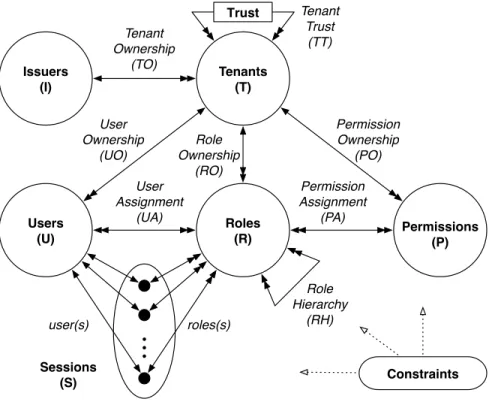
Users (U) Tenants (T) Roles (R) User Assignment (UA) Permission Assignment (PA) Role Hierarchy (RH) Permission Ownership (PO) Tenant Trust (TT) Role Ownership (RO) User Ownership (UO) Sessions (S) Permissions (P) Constraints Trust user(s) roles(s) Issuers (I) Tenant Ownership (TO)
Figure 3.2: MT-RBAC Model
3.2
MT-RBAC
To achieve fine-grained access control for multi-tenant collaborations in the cloud, we develop a family of three MT-RBAC models with increasingly finer-grained trust relations.
3.2.1 Overview
MT-RBAC models, as shown in Figure 3.2, have six entity components: issuers(I), tenants(T), users(U),permissions(P),roles(R) andsessions(S). The traditional RBAC [27] entities of users, permissions and roles now have a tenant attribute so that they can be uniquely identified as depicted by the user-ownership (U O), permission-ownership (P O) and role-ownership (RO) relations re-spectively in Figure 3.2. All three relations are many-to-one relations from users, permissions and roles respectively to their owner tenants. Further, another many-to-one relation representing tenant-ownership (T O) exists between tenants and issuers.
organization or an individual who is able to administer its own tenants in the cloud services. For simplicity, we consider a single cloud scenario in this disseration, so the name of the cloud service is not explicitly specified. For instance, in the out-sourcing example, E, OS and AF represent three issuers respectively in a single cloud storage service.
TENANTS. A tenant is an exclusive virtual partition of a cloud service leased from a cloud service provider. An issuer may own multiple tenants while a tenant belongs to a single issuer. Let “.” denote the tenant-issuer relation. For example,Dev.OSrepresents the tenantDevofOS.4
USERS. A user is an identifier for an individual person associated with a single tenant. An individual can act as different users in different tenants. Let “@” denote the user-tenant relation. For example, [email protected] [email protected] are two different users in tenantsAcc.AF and
Acc.E respectively, even if they belong to a single person, Alice.5
ROLES. A role is a job function (role name) associated with a tenant. A role belongs to a single tenant while a tenant may own multiple roles. Let “#” denote the role-tenant relation
roleN ame#tenant. For example,dev#Dev.E represents a developer role in tenantDev.E. PERMISSIONS. A permission is a specification of a privilege to an object in a tenant. A permission is associated with a single tenant while a tenant may have multiple permissions. Let “%” denote the permission-tenant relation(privilege, object)%tenant. For example,
(read, /root/)%Dev.Erepresents a permission to read the “/root/” path onDev.E.
SESSIONS. A session is an instance of activity established by a user. A subset of roles that the user is assigned to can be activated in a session. Note that in multi-tenant cloud environments the user and the active roles of a session are not necessarily from a single tenant.
Crucially, in order to address collaborations among tenants, MT-RBAC introduces a role-based trust relation, Tenant Trust (T T), as illustrated in Figure 3.2.
T T is reflexive but not transitive, symmetric or anti-symmetric. In MT-RBAC, a trust relation 4In a more general treatment we would identify the cloud service explicitly in a three part name such as Dev.OS.CloudService.
5Other user models are possible. For instance, the users of a same person can be combined into one universal ID
using federated identity [18, 19, 32]. However, since this mechanism is not fully supported in contemporary clouds, MT-RBAC models do not require a universal ID for an individual. The particular user model chosen does not materially impact the essentials of MT-RBAC. For completeness we do need a concrete user model.
is always established by the truster’s issuer. It enables the trustee’s issuer to add trustee’s users to truster’s roles. This can be done directly on a per user basis by assigning one of B’s (trustee’s) users to one ofA’s (truster’s) roles viaU A. Alternately it can be done indirectly by assigning one ofB’s roles, sayr1, to be senior to one of A’s roles, sayr2, viaRH. Thereby all members ofr1 become members ofr2 andA’s permissions associated withr2 are granted to theB’s users inr1. We emphasize that trust is established at the granularity of tenants. For example, if AF asserts
Acc.AF E Acc.E, there is no trust fromAcc.AF toHR.E orDev.E. The formalization of T T
and its effects are described in Definition 6 as follows.
Definition 6. The tenant trust relation, also written as “E”. By asserting A E B, A’s issuer exposesA’s roles toB’s issuer so thatB’s issuer can and can only make the following two kinds of assignments:
• assigningB’s users toA’s roles; and
• assigningA’s roles as junior roles toB’s roles.
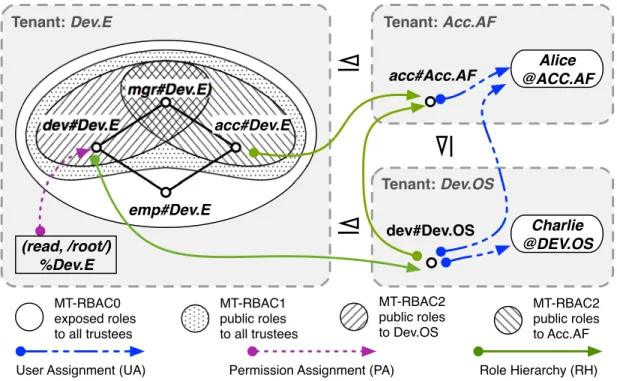
Different MT-RBAC models vary in the granularity of the trust relations, specifically in the truster’s role exposure. The left part of Figure 3.3 shows the role hierarchy ofDev.E in the out-sourcing example. Since MT-RBAC0 does not enforce any constraint on the trust relation, the entireDev.E role structure is exposed to allDev.E’s trustees (more precisely to their issuers). In MT-RBAC1, suppose the employee roleemp#Dev.E is a private role while the others are public. The private role is never exposed to other tenants. Conversely, the public roles are exposed to all the trustees’ issuers. Crucially, during cross-tenant accesses, the permissions associated with the private role cannot be inherited directly or even indirectly through the public roles. In MT-RBAC2, public role sets are customized for different trustees. Suppose the accountant role acc#Dev.E
and the manager role mgr#Dev.E have to be exposed in the collaboration with Acc.AF while
mgr#Dev.E and the developer role dev#Dev.E need to be exposed to Dev.OS for the out-sourcing project. Accordingly, as illustrated in Figure 3.3, there are two different public role sets to these two trustees respectively. Note that even ifmgr#Dev.E is public in both collaborations,
⊴
Tenant: Dev.E Tenant: Acc.AF
Tenant: Dev.OS
⊴
⊴
Alice @ACC.AF Charlie @DEV.OS dev#Dev.OS acc#Acc.AF (read, /root/) %Dev.E dev#Dev.E mgr#Dev.E) MT-RBAC0 exposed roles to all trustees MT-RBAC1 public roles to all trustees MT-RBAC2 public roles to Dev.OS MT-RBAC2 public roles to Acc.AF Permission Assignment (PA)User Assignment (UA) Role Hierarchy (RH)
acc#Dev.E
emp#Dev.E
Figure 3.3: Example multi-tenant assignments in the out-sourcing case. The differences among the MT-RBAC models are also illustrated in terms ofE’s exposed roles.
for either one, it only inherits permissions from the junior roles in the corresponding public role set. For example, sinceacc#Dev.E is a private role toDev.OSand a public role toAcc.AF, its permissions are only inherited toAcc.AF but not toDev.OS.
3.2.2 Base Model—MT-RBAC0
In order to enable secure cross-tenant collaborations, the base model is formally defined as follows. Definition 7. The Base Model MT-RBAC0has the following components.
• T, U, R, P and S are finite sets of tenants, users, roles, permissions and sessions respec-tively;
• userOwner(u:U)→T, a function mapping a tenant-specific user to its owning tenant; • roleOwner(r :R)→T, a function mapping a tenant-specific role to its owning tenant; • permOwner(p : P) → T, a function mapping a tenant-specific permission to its owning
• T T ⊆T ×T is a many-to-many reflexive relation onT, also written as “E”;
• canU se(r : R) → 2T, a function mapping a role to a set of tenants who can use the role; formally,canU se(r) = {t∈T|roleOwner(r)Et};
• U A⊆U×R, a many-to-many user-to-role assignment relation requiring(u, r)∈U Aonly ifuserOwner(u)∈canU se(r);
• P A⊆P×R, a many-to-many permission-to-role assignment relation requiring(p, r)∈P A
only ifpermOwner(p) =roleOwner(r);
• RH ⊆R×Ris a partial order onRcalled role hierarchy or role dominance relation, also written as “≥”, requiringr2 ≥r1only ifroleOwner(r2)∈canU se(r1);
• user(s:S)→U, a function mapping each session to a single user which is constant within the life-time of the session; and
• roles(s : S) → 2R, a function mapping each session to a subset of roles, roles(s) ⊆
{r|(∃r0 ≥r)[(user(s), r0)∈U A∧userOwner(user(s))∈canU se(r)]}, which can change with time, andshas the permissionsS
r∈roles(s){p|(∃r
00 ≤r)[(p, r00)∈P A]}.
Note that the introduction of the derivedcanU se function provides convenient means for T T to take effect uponU AandRH. For a given roler ∈R, the statementroleOwner(r)∈canU se(r)
is always true sinceT T is reflexive. Hence, intra-tenant assignments are always under the authority of the tenant’s owner issuer.
A trustee (more precisely its issuer) can assign a truster’s permissions to the trustee’s users only at the granularity of the truster’s roles. In the spirit of RBAC, MT-RBAC does not allow individual permissions of the truster to be assigned to the trustee’s users or roles.
Role activation mechanisms determine the executable permissions in a session. Because a role may inherit permissions from its junior roles in the role hierarchy, when a role is activated in a session, its inherited roles may be either automatically activated (implicit activation) or require