DropTheBeat – a tangible user
interface for cloud computing
resources
Abstract
The advent of streaming platforms following the cloud computing paradigm has resulted in the
dematerialization of multimedia recordings and consequently loss of physical representation, such as missing haptic and tangible experiences. Employing tangible user interfaces could allow a more natural way to interact with cloud computing resources, especially for less technology-savvy users. The DropTheBeat prototype allows users to have tangible interaction with streaming music, by placing real world objects on a Near Field Communication reading device, making the streaming content “touchable. The prototype gives streaming media a real world representation that is customizable, designable, collectable, loanable, shareable and, above all, can be experienced on a physical level, allowing for a more natural way of consuming cloud computing content. This paper presents DropTheBeat, developed as a functional prototype providing tangible interaction with cloud computing resources.
Keywords
Tangible user interfaces, cloud computing, streaming media, Near Field Communication
Copyright is held by the author/owner(s).
CHI 2011, May 7–12, 2011, Vancouver, BC, Canada. ACM 978-1-4503-0268-5/11/05.
Philip Koene
Technische Universität München, Chair for Information Systems, Boltzmannstr. 3, 85748 Garching, Germany [email protected]
Felix Köbler
Technische Universität München, Chair for Information Systems, Boltzmannstr. 3, 85748 Garching, Germany [email protected]
Suparna Goswami
Technische Universität München, Chair for Information Systems, Boltzmannstr. 3, 85748 Garching, Germany [email protected]
Christian Crusius
Libera Università di Bolzano, Faculty of Design and Art, Piazza Università 1, 39100 Bolzano, Italy
Jan Marco Leimeister
Universität Kassel,
Chair for Information Systems, Nora Platiel Str. 4,
34127 Kassel, Germany [email protected]
Helmut Krcmar
Technische Universität München, Chair for Information Systems, Boltzmannstr. 3, 85748 Garching, Germany [email protected]
ACM Classification Keywords
H.5.2 User Interfaces (D.2.2, H.1.2, I.3.6): Haptic I/O, Input devices and strategies.
Introduction
Multimedia recording in general and sound recording in particular have traversed multiple technologies in the last few decades. In recent years technological advances concerning sound recording and playback techniques are dominated by two major trends: digitalization and subsequently, dematerialization of sound recording media. The breakthrough of digital audio encoding formats shifted sound recordings from being bound to physical objects (e.g., compact disc) to being stored on hard drives and copied to multiple hardware devices (e.g., portable MP3 players). In parallel, advances in Internet and telecommunication technologies resulted in novel Internet applications following the cloud computing paradigm [4]. In the business-to-consumer market, the cloud computing paradigm resulted in services like flickr, YouTube and several music streaming platforms (e.g., Deezer, Spotify, songza, last.fm). The advent of such music streaming platforms represents a significant step towards full digitalization and dematerialization of sound recording media by allowing users to listen to, browse and search for music and manage personalized playlists without downloading or storing music files on a local hard disk.
Consequently recorded music is decoupled from a physical object and converted to an intangible good. Besides obvious advantages (e.g., multiple copies on multiple devices, reduced storage space) the
dematerialization of multimedia as a result of the cloud computing paradigm can give rise to certain
disadvantages as well: (1) missing personal connection to a physical recording object, (2) neither collectable nor shareable and, (3) difficulty of use for non-technical users (e.g., elderly people).
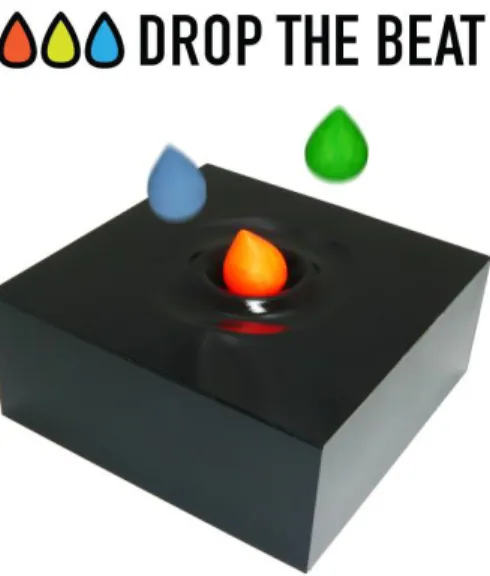
Employing haptic or tangible user interfaces could allow a more natural way to interact with cloud computing resources, especially for less technology-savvy users such as the elderly. Haptic interfaces have been the subject of various research projects since around 1990 and are generally seen as an extension of graphical user interfaces (UI). The concept of using physical, real world objects as input devices to manipulate virtual counterparts is also termed graspable [2] or tangible UI [6]. These tangible UI have supported a large array of functionalities in various research projects [2, 5, 6]. A touch-based, tangible interface paradigm enables a direct and natural interaction and thereby reduces the cognitive load of e.g. a mobile applications´ operation. Our prototype - DropTheBeat - draws from the notion of ubiquitous computing vision [10] that talks about embedding computation and networking into everyday physical objects, and the “Internet of Things” [3] that postulates that Internet can be extended to these objects as well. The basic idea behind the DropTheBeat prototype is that of giving virtual objects, stored in the cloud (in our case multimedia recording data) a physical, real world representation. We call these physical representations Droplets (see figure 1). The Droplets serve the purpose of containment, transport and access of streaming media. The prototype system enables users of music streaming platforms to listen to their favourite songs by placing these Droplets on a Near Field Communication (NFC) reading device which is connected to the streaming platform via the Internet. figure 1. Final, working DropTheBeat
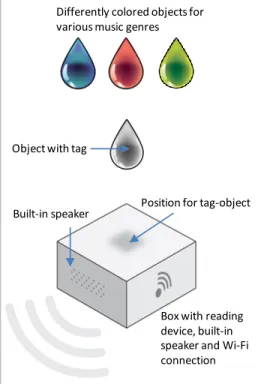
figure 2. Draft of prototype integrating loudspeakers, a NFC-reader and a Wi-Fi-module
The Droplets give a physical form to music playlists and therefore, the DropTheBeat prototype system allows the consumption and handling of streaming media, in particular music in a natural, intuitive way,
counteracting the aforementioned drawbacks of the dematerialization of sound recording media.
Tangible Interface Design Goals
Any interactive UI, especially a tangible UI needs to be appealing and simple at the same time, which can often create design conflicts. Accordingly, we draw on the user interface design goals proposed by Borchers [1] as guidelines for designing tangible streaming media, or cloud computing interfaces. While these design guidelines were formulated for a tangible UI as a museum exhibit, we feel that the guidelines lend themselves rather well to the general design of a tangible interface. Here we outline an array of different design goals, some adapted from Brochers, some our own, relevant to the context of DropTheBeat as a tangible cloud computing interface:
Consistent: Users should be able to operate the system and its various functions in a uniform way, ideally without having to change between different input devices.
Innovative/Fun: The system should promise new, unusual experiences that can be considered novel and fun. In the case of DropTheBeat, this influenced our choice of the input mechanism (Droplets) as a playful metaphor to a musical experience.
Explorable: Users should be able to explore the system on their own with minimal guidance.
Intuitive/Natural: The interaction principle should be easy to grasp and use in order to have minimal
reliance on instructions and external help. It should feel natural in the given usage context. Therefore, in the case of DropTheBeat the metaphor or drops creating a ripple on a surface was chosen to represent music. Non-technical: In a technology intensive-world, a tangible user interface for cloud computing resources should not be construed as a modern technological artifact. This concern is especially valid for less technologically-savvy user groups. Designing the interface in a non-technical way could help in assuaging concerns regarding “computers, taking over every aspect of human lives”, especially for something as simple as consuming multimedia.
Ability-neutral: The prototype should be usable by users of all ages and abilities irrespective of their computer or Internet browsing skills and expertise. Exposable: The prototype should be robust and maintainable. The system should be sufficiently rugged to survive sustained everyday use, including occasional accidents. It should require minimum effort to configure and keep it up and running. In the case of
DropTheBeat, this influenced us to design the Droplets to be robust and easily transferable from one person to another in any given context.
DropTheBeat Prototype
After considering various hardware designs for the DropTheBeat prototype and the Droplets, we decided to fashion the Droplets into water drops, made out of colored Styrofoam with a Radio Frequency identification (RFID)-tag inside. We provided the DropTheBeat prototype with a corresponding rippled surface that mimics the shape a water drop creates on a water surface. The central cavity is designed to hold the Droplet that is currently playing, and the surrounding Differently colored objects for
various music genres
Object with tag
Position for tag-object Built-in speaker
Box with reading device, built-in speaker and Wi-Fi connection
ripples serve as storage space for other, frequently used Droplets (see figure 1). The hardware design was chosen with the objective of providing an intuitive, explorable, ability-neutral and fun way of interacting with the prototype, since we believe that the drop-on-water interaction metaphor is easily understandable by users in the context of listening to music.
The DropTheBeat prototype in its final form will have built in speakers and wireless connectivity (see figure 2), but the functionality is currently realized via a personal computer (PC) terminal, that runs the software, connects to the streaming platforms and outputs the music. In its current form, the prototype device holds an NFC-reader, situated under the central cavity (the black cubical structure seen in figure 1) and supports play, pause and skip functionality via the means of the Droplets. Placing a Droplet into the central cavity starts the corresponding music playlist (either on last.fm or on youtube.com). Removing the same Droplet pauses the music stream, and replacing the Droplet within three seconds skips to the next song in the accessed playlist. This enables a very natural and intuitive way of interacting with the device and enables very easy interruption-handling by simply removing the Droplet from the central cavity. Currently, playlists are stored on the Droplets via a J2ME midlet on a NFC-enabled mobile phone. This process will be made more intuitive, by using the DropTheBeat device itself, along with a browser-based graphical UI.
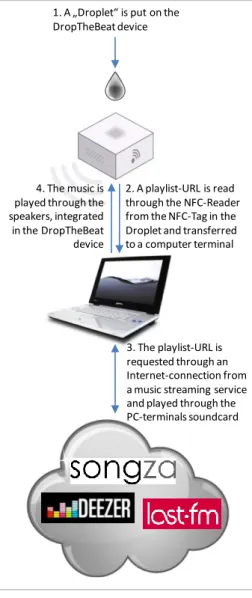
The basic interaction process of the prototype consists of four steps (see also figure 3):
1. The user puts a Droplet onto the DropTheBeat device. The contents of the NFC-tag inside the Droplet
is read through the built-in NFC-reader, and transmitted via cable to a PC terminal.
2. The software component of the prototype, running on the PC terminal reads the content of the NFC-tag (playlists of a music streaming web service) it receives from the DropTheBeat device. These playlists can be created by the user through the web-interface of a music streaming platform and then stored on the Droplet trough the DropTheBeat prototype system. 3. The DropTheBeat application then requests the music stream trough an Internet connection from the music streaming platform. Playback functions like play/pause can now be invoked by the user by removing and replacing the Droplet onto the device. The playback functions are provided by interfacing with APIs from the music-streaming web-services.
4. The music is played on the speakers of the DropTheBeat device through the soundcard of the PC terminal running the DropTheBeat software.
We evaluated the DropTheBeat prototype through semi-structured interviews with 12 potential users, i.e., persons who frequently listen to streaming music. Each participant got a chance to use DropTheBeat for about four hours in their natural work environment, a setting where streaming music is consumed and where a quick and reliable interaction and control of the system is paramount (e.g., stopping the music when work-related calls are incoming). The Droplets where preconfigured with different genre-playlists to suit most of the subjects taste in music. Following their interaction with the device, each participant was interviewed by a member of the research team asking them about their experience and feedback. Each interview lasted between 15–30 minutes. All 12 participants 3. The playlist-URL is
requested through an Internet-connection from a music streaming service and played through the PC-terminals soundcard 1. A „Droplet“ is put on the
DropTheBeat device
2. A playlist-URL is read through the NFC-Reader from the NFC-Tag in the Droplet and transferred to a computer terminal 4. The music is
played through the speakers, integrated in the DropTheBeat device
figure 3. DropTheBeat prototype interaction process
summarized their experience with the DropTheBeat prototype as being mostly positive, with an emphasis on the interaction being enjoyable, playful and intuitive and the prototype concept being novel and innovative. All participants reacted positively towards the idea of using Droplets to share music or as gifts, best
exemplified by one user’s statement: “That seems like a very good idea, I would lend them (the Droplets) to friends or bring them along to a party”. Two
participants in particular pointed out, that their experience with the system was quite relaxing, and that it was “away from the computer”, which was perceived as positive. One participant stated that he would use the system at home to create playlists that suit different moods and provide him with instant relaxing music after work and by placing the
corresponding Droplet on the device. All participants recommended expanding the prototype with additional playback functionality, such as seeking, scratching or changing the volume directly with the Droplet.
Discussion
The DropTheBeat prototype demonstrates the concept of a tangible UI for accessing cloud computing
resources. It makes music playlists touchable for potential users. The current implementation of the prototype system is limited in its degree of
interoperability to multiple music streaming platforms, since it is not possible to combine different platforms in one playlist. Future improved versions of the prototype software and hardware will incorporate interoperability of different cloud computing resources by extending to different streaming media types such as images and video. Since most modern television sets now possess Internet connectivity, the notion of sharing personal videos and photo albums with friends and family via
Droplets, containing a link to YouTube or Flickr seems promising.
For providers of music streaming platforms the proposed novel hardware device integrating NFC technology might display new means to increase customer retention with the platform and provide an additional channel of distribution expanding their service-dominated portfolio with physical products. Through a possible diversification of portfolios, streaming music platform providers could evolve from pure service to product service system providers and establish new business models around their offerings, and also attract the less technology-savvy elderly users.
As reflected by the preliminary user study, the
DropTheBeat prototype shows the potential to fulfil the goals of providing users with touchable, shareable, and designable representation of streaming media, thus allowing the consumption and handling of cloud
computing content in a natural, intuitive way. However, more in-depth, longitudinal studies, with different user groups (such as elderly users) are required to fully evaluate the potential of the DropTheBeat concept. We believe that tangible UI, realized with NFC technology have, due to a very natural and intuitive interaction modality the potential to disclose cloud computing resources in the form of streaming
multimedia to a wider, less technology-savvy audience.
Acknowledgements
The DropTheBeat prototype was developed in the context of the research project Mobil50+, funded by the German Federal Ministry of Education and Research
(BMBF - FKZ: 01FC08046). For further information, see www.projekt-mobil50.de.
Citations
[1] Borchers, J.O. WorldBeat: designing a baton-based interface for an interactive music exhibit. In Proc. CHI 1997, ACM Press (1997), 131-138.
[2] Fitzmaurice, G.W., H. Ishii, and W.A.S. Buxton Bricks: laying the foundations for graspable user interfaces. In Proc. CHI 1995, ACM Press (1995), 442-449.
[3] Gershenfeld, N., R. Krikorian, and D. Cohen The Internet of things. Scientific American291,4 (2004), 76-81.
[4] Leimeister, S., et al. The Business Perspective of Cloud Computing: Actors, Roles, and Value Networks. In Proc.ECIS2010, University of Pretoria, Department of Informatics (2010), ECIS2010-0402.
[5] Mugellini, E., E. Rubegni, and O.A. Khaled Tangible interaction based on personal objects for collecting and sharing travel experience. In Proc. HCI International: interaction platforms and techniques2007, Springer-Verlag (2007), 873-882.
[6] Ullmer, B., H. Ishii, and D. Glas mediaBlocks: physical containers, transports, and controls for online media. In Proc. GRAPH1998, ACM Press (1998), 379-386.