Limitations of Highly-Available
Eventually-Consistent Data Stores
Hagit Attiya
Computer Science Department Technion
Faith Ellen
Department of Computer Science University of Toronto
Adam Morrison
Computer Science DepartmentTechnion
ABSTRACT
Modernreplicated data storesaim to provide high availabil-ity, by immediately responding to client requests, often by implementing objects that expose concurrency. Such objects, for example, multi-valued registers (MVRs), do not have se-quential specifications. This paper explores a recent model for replicated data stores that can be used to precisely spec-ify causal consistency for such objects, and liveness prop-erties likeeventual consistency, without revealing details of the underlying implementation. The model is used to prove the following results:
• An eventually consistent data store implementing MVRs cannot satisfy a consistency model strictly stronger than observable causal consistency (OCC).
OCC is a model somewhat stronger than causal con-sistency, which captures executions in which client ob-servations can use causality to infer concurrency of op-erations. This result holds under certain assumptions about the data store.
• Under the same assumptions, an eventually consistent and causally consistent replicated data store must send messages of unbounded size: Ifsobjects are supported bynreplicas, then, for everyk >1, there is an execu-tion in which an Ω(min{n, s}k)-bit message is sent.
Categories and Subject Descriptors
C.2.4 [Computer Systems Organization]: Distributed Systems
Keywords
Replicated data store; causal consistency; eventual consis-tency
1.
INTRODUCTION
Distributed data storage provides fault-tolerant access to objects by replicating them over a wide-area network. A
replicated data store needs to balance between availability
Copyrightc Owner/Authors, 2015. This is the authors’ version of the work. It is posted here by permission of ACM for your personal use. Not for redistribution. The definitive version was published in PODC’15, July 21–23, 2015, Donostia-San Se-bastián, Spain, http://dx.doi.org/10.1145/2767386.2767419.
PODC’15,July 21–23, 2015, Donostia-San Sebastián, Spain.
Copyright is held by the owner/author(s). Publication rights licensed to ACM. ACM 978-1-4503-3617-8 /15/07 ...$15.00.
http://dx.doi.org/10.1145/2767386.2767419.
of data (i.e. accesses to data return without delay), and its
consistency, while tolerating message delays. TheCAP the-orem[8,18] demonstrates the difficulty of achieving this bal-ance, showing that strongConsistency (i.e.atomicity) can-not be satisfied together with highAvailability andPartition tolerance.
One aspect of data consistency is a safety property re-stricting the possible values observed by clients accessing dif-ferent replicas. The set of possible executions is called a con-sistency model. For example, causal consistency [2] ensures that the causes of an operation are visible at a replica no later than the operation itself. (A precise definition appears in Section 3.) A smaller set of possible executions means that there is less uncertainty about the data. So, one consistency model isstrictly stronger than another if its executions are a proper subset of the executions of the other.
Some weak consistency models can be trivially satisfied by never updating the data. Therefore, another aspect of data consistency is a liveness property, ensuring that updates are applied at all replicas. The designers of many systems, e.g., Dynamo [13] and Cassandra [1], opt for a very weak live-ness property called, somewhat confusingly, eventual con-sistency [5, 9, 10, 29]. Eventual consistency only ensures that each replica eventually observes all updates to the object, a property also referred to asupdate propagation [11].
Several data stores [4, 6, 16, 21, 22] satisfy causal consis-tency, motivated by the assumption that it is the strongest consistency model possible with eventual consistency. To-wards resolving this assumption, this paper shows that an eventually consistent data store cannot satisfy a consistency model strictly stronger than observable causal consistency
(OCC). This is done within a precise model of replicated data stores, exposing assumptions and inherent costs.
A challenge in modeling replicated data stores is that many of them implement objects that cannot be specified se-quentially. For example, in amulti-value register(MVR) [13], a read returns the set of values written by currently conflict-ing writes, i.e., writes that are not causally related. Similarly, anobserved-remove set(ORset) [27] specifies that whenever
a remove and an add of the same element are concurrent,
the add“wins.” By exposing concurrency in the specifica-tion, such objects are leaking low-level scheduling details to the client.
Specifying these objects independently of their implemen-tation is particularly challenging in the context of causal consistency, whose definition relies on visibility of opera-tions. Visibility of operations, in turn, depends on message sending and delivery, which are governed by the
implemen-tation. Following [10], we separate theabstract execution, as observed by clients of the replicated data store, from the
concrete execution, which happens “under the hood” of the system.
This paper shows that a consistency model strictly stronger thanOCCcannot be satisfied by an eventually con-sistent data store implementing MVRs. OCC captures ex-ecutions in which client observations can use causality to infer concurrency of operations (see Section 5). This result holds under certain assumptions about the data store: read operations do not modify the state, and messages are gen-erated only following an operation. Without these assump-tions, a data store may trivially satisfy a consistency model stronger thanOCC (and causal consistency) by ruling out some causally consistent executions. For example, a data store in which reads may modify replica state can prevent the execution in which replicaRwrites a valuevto an MVR and then another replicaR0 reads this value, by not expos-ingvatR0 untilKadditional operations have been applied atR0.
Our result is related to theCAC theorem[23,24], showing that natural causalConsistency is the strongest model that can be satisfied together with highAvailability and one-way
Convergence. (One-way convergence is a stronger liveness property than eventual consistency.) Our proof, and the as-sumptions it exposes, show that the CAC theorem has an implicit model for the way implementations are structured. Counter-example implementations like the one mentioned above demonstrate that deviating from this structure allows a consistency model stronger than causal consistency to be satisfied. (A detailed comparison appears in Section 5.3.)
We also prove that causally consistent and eventually con-sistent stores implementing MVRs require messages of un-bounded length. Specifically, if s objects are supported by
n replicas, then, for every k > 1, there is an execution, whose length grows withk, in which an Ω(min{n, s}lgk)-bit message is sent. This extends a result of Charron-Bost [12], showing that ordering Ω(n2) events on n nodes using m -tuples (i.e. vector clocks [17,25]) requiresm≥n. In contrast, our result does not assume that messages have a particular format, and we show that, even for a fixed number of replicas and objects, the message length is unbounded.
2.
MODEL
We model a highly-available replicated data store as a message-passing system, consisting of replicas that handle client operations on the replicated objects, and communi-cate the changes to each other with messages. We assume replicasbroadcasttheir messages to all other replicas; repli-cas can implement point-to-point communication by ignor-ing messages for which they are not the intended recipient. Our model is mostly standard, with the following excep-tion: Replicas handle client operationsimmediately, without communicating with other replicas. This models the crucial
high-availability property of the data store—completion of a client operation must not depend on communication with another replica, so that the data store remains available de-spite network failures.
Replicas: We model a replica as a state machine R = (Σ, σ0, E,∆), where Σ is a set ofstates,σ0 ∈Σ is theinitial
state, E is a set of possible events, and ∆ : Σ×E → Σ is a (partial)transition function. We say that an eventeis
enabled in state σ if ∆(σ, e) is defined. A state transition is a local step of a replica, describing how the state of the replica changes in response to an enabled event. Three kinds of events model interactions of the replica with its clients and with other replicas:
• do(o,op,v): a client of the replica invokes operationop
on replicated object o and immediately receives re-sponsevfrom the replica,
• send(m): the replica broadcasts messagem, and
• receive(m): the replica receives messagem.
Theaction, act(e), of an eventespecifies which kind of event (do, send, or receive) it is. Each send(m) and receive(m)
eventehas message attribute msg(e) =m. Eachdo(o,op,v)
event e has attributes obj(e) = o, which is the object the client is operating on, op(e) =op, which is the operation of the client, and rval(e) =v, which is the response the client receives.
We assume that the content of a message sent by a replica is a deterministic function of its state: if ∆(σ, send(m1)) =
σ1 and ∆(σ, send(m2)) = σ2, then m1 = m2 and hence,
σ1=σ2.
Executions: Anexecutionis a (possibly infinite) sequence of events occurring at the replicas. It is an interleaving of a sequence of events occurring at each replica. We denote byR(e) the replica at which an eventeoccurs. A (finite or infinite) sequence of events,e1, e2, . . ., occurring at a replica
R= (Σ, σ0,∆) iswell-formedif there is a sequence of states,
σ1, σ2, . . ., such that σi = ∆(σi−1, ei) for all 1 ≤ i ≤ the length of the sequence. If this sequence has length n, then
σnis thestate ofR at the end of the sequence. We consider only well-formed executions.
Definition 1. An executionαiswell-formedif for every replica R= (Σ, σ0,∆), (1) the subsequence of events at R,
denoted α|R, is well-formed, and (2) for every receive(m)
event eatR, a send(m)event at replicaR06=Rprecedese
inα. Ifαis finite thenthe state of replicaRat the end of
αis the state ofR at the end ofα|R.
Well-formed executions only prohibit messages from ap-pearing out of thin air or being received before they are sent. Messages may be dropped, delivered out of order, or delivered multiple times.
Recall the happens-before relation [20]:
Definition 2. Letα be an execution. Event e∈α hap-pens before event e0 ∈ α (written e −−−→hb(α) e0, or simply
e−→hb e0 if the context is clear) if one of the following condi-tions holds:
(1) Thread of execution: R(e) =R(e0)andeprecedese0
inα.
(2) Message delivery: e = send(m) and e0 =
receive(m).
(3) Transitivity: There is an eventf∈α, such thate−→hb
f andf−→hb e0.
Proposition 1. Let α be an execution, and e an event
inα. Then the following sequences of events are well-formed executions:
1. β, the subsequence ofαconsisting of all eventse0such thate6−→hb e0.
2. γ, the subsequence ofαconsisting of all eventse0 such that e0−→hb e.
Further, for any replicaR,β|Randγ|R are prefixes ofα|R. Network partitions: Eventually consistent data stores require that every operationeventuallypropagates to every other replica. To facilitate eventual consistency, we must re-quire that the network is not partitioned from some point on. We assume that this cannot occur ininfiniteexecutions. Specifically, we consider only infinite executions in which the network issufficiently connected, as defined below.
We say that a replicahas a message pending in stateσif some eventewith act(e) =sendis enabled inσ. We assume that a replica does not have a message pending following a send event. In other words, a send event relays everything the replica has to send. Given an executionαand an event
e∈α, we say that a replicaRhas a message pending in e
ifRhas a message pending in the state at the end ofα0|R, whereα0is the prefix ofαending withe.
Definition 3. The network is sufficiently connected in an infinite well-formed execution α if the following condi-tions hold:
(1) Eventual transmission: no replica has a message pending in all events of some (infinite) suffix ofα, and
(2) Eventual delivery: if replica R sends message m, then every replicaR06=R eventually receivesm.
Thus, if a replica wants to send a message, i.e. it has a message pending in some state, then either it eventually broadcasts the messageorit transitions into a state with no message pending without sending the message. This could happen, for example, if a client invokes an operation which cancels a previous operation that had not yet propagated to other replicas.
3.
REASONING
ABOUT
REPLICATED
DATA STORES
This section describes a framework for reasoning about highly-available replicated data stores, following Burckhardt et al. [10].
3.1
Specifying Replicated Objects
Replicated data stores are often used to implement objects which have some underlying notion of concurrency, and so cannot be specified sequentially. They generalize standard sequential specifications [19] as follows. A sequential specifi-cation of a deterministic object determines the return value of an operation from the sequence of prior operations applied to the object. However, with a replicated object, operations executing at different replicas might have inconsistent no-tions of “prior operano-tions”, e.g., because updates made on one side of a partition do not propagate to the other side. We therefore specify the return value of an operation based on operations that arevisible to it: prior operations at the same replica, and remote operations whose effects have prop-agated to the replica through the network.
Visibility is defined in the context of an abstract execu-tion. An abstract execution contains only the histories of operations invoked by the clients, i.e., onlydoevents:
Definition 4. Anabstract executionis a tuple(H, vis), where H is a sequence of do events and vis ⊆ H ×H is
an acyclic visibility relation(where(e1, e2)∈visis denoted
by e1 vis
−−→e2) that satisfies (1) ife1 precedes e2 in H and
R(e1) =R(e2), thene1 vis −−→e2, (2) ife1 vis −−→e2,e2 precedes e3 in H, and R(e2) = R(e3), then e1 vis −−→ e3, and (3) if e1 vis −−→e2 thene1 precedes e2 inH.
We decouple visibility—when an operation becomes ob-servable by the client—from the low-level happens-before relation (Definition 2), defined for receiving and sending messages between replicas, because having happens-before imply observability of an operation would place excessively strict demands on the data store. It would mean that re-ceiving a message sent after an operationopmakesopand
all its transitive dependenciesobservable. This disallows, for example, buffering received information and not “exposing” it immediately, an implementation technique used in many causally consistent data stores to avoid sending the depen-dencies with each message [4, 6, 16, 21, 22] and to satisfy con-sistency conditions [11, 15, 26].
The reason for including both the visibility relation,vis, and a total order of the events, H, is that some specifica-tions need a total order on events to resolve conflicts created by concurrent operations, i.e., those that are not related by visibility.
Definition 5. LetA= (H, vis)be an abstract execution. An abstract executionA0= (H0, vis0) is a prefixofAif (1)
H0 is a prefix of H and (2) vis0 =vis∩(H0×H0). A set S of abstract executions isprefixed-closedif A∈ S implies thatA0∈S for every prefixA0 ofA.
An abstract executionA= (H, vis) iso-onlyif obj(e) =o, for alle∈H.
Definition 6. Areplicated object specificationof an
ob-jectois a prefix-closed setS(o)ofo-only abstract executions.
The specification,S(o), of an objectois defined using the notion of anoperation context[10]. Theoperation contextof an operation on an objectoconsists of the prior operations onothat are visible to the operation:
Definition 7. LetA= (H, vis)be an abstract execution, ande∈H. The operation context ofe inA is the abstract execution ctxt(A, e) = (H0, vis∩(Ve×Ve)), where Ve =
n
e0∈H | e0−−→vis e∧obj(e0) =obj(e)
o
∪ {e}, andH0 is the subsequence of H containing only events in Ve. Ife0 ∈ H,
we say thate0∈ctxt(A, e)iffe0∈H0.
We specify the return value,rval(e), of adoevente ap-plying an operation to objectoas a function of its operation context,ctxt(A, e):
rval(e) =fo(ctxt(A, e)).
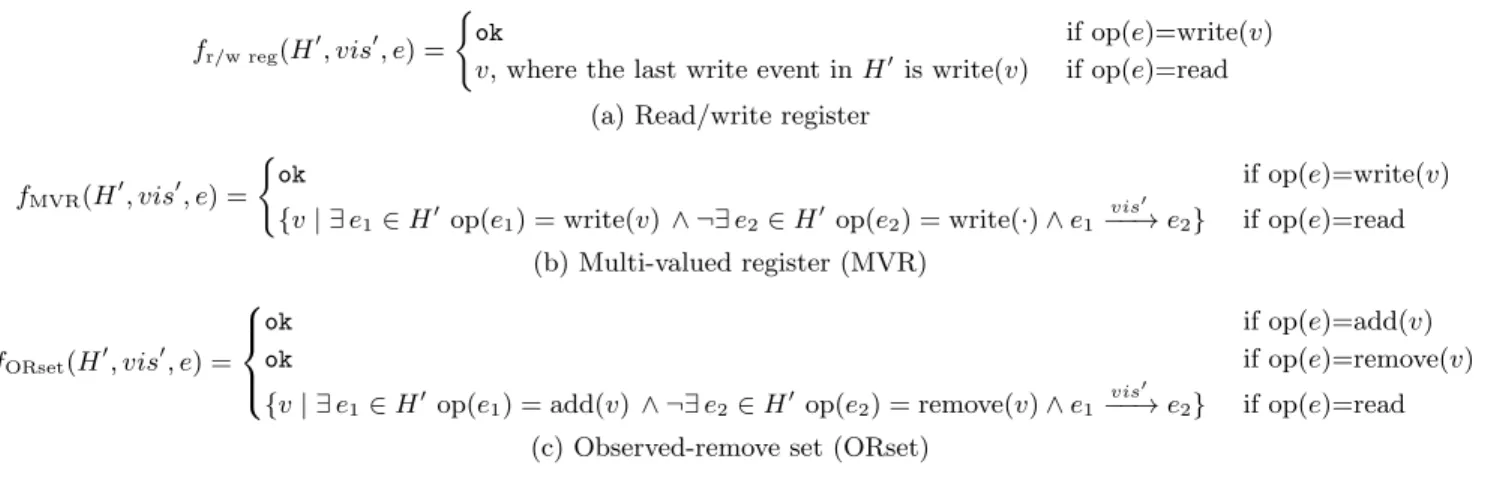
Figure 1 shows examples of such functions, including those of themulti-value register (MVR) and theobserved-remove set (ORset). In an MVR, a read returns the set of values written by currently conflicting writes—i.e. writes that are not causally related. Similarly, an ORset specifies that when-ever aremoveandaddare concurrent, theadd“wins”—i.e.,
removeonly removes items that it observes.
The specification S(o) contains abstract executions in which every operation’s response is as specified above:
fr/w reg(H0, vis0, e) =
(
ok if op(e)=write(v)
v, where the last write event inH0 is write(v) if op(e)=read (a) Read/write register
fMVR(H0, vis0, e) =
(
ok if op(e)=write(v)
{v| ∃e1 ∈H0 op(e1) = write(v) ∧ ¬∃e2∈H0op(e2) = write(·)∧e1 vis0 −−→e2} if op(e)=read (b) Multi-valued register (MVR) fORset(H0, vis0, e) = ok if op(e)=add(v) ok if op(e)=remove(v)
{v| ∃e1∈H0 op(e1) = add(v) ∧ ¬∃e2∈H0op(e2) = remove(v)∧e1 vis0
−−→e2} if op(e)=read (c) Observed-remove set (ORset)
Figure 1:Functions specifying replicated objects:ctxt(A, e) = (H0, vis0, e).
S(o) ={A |A= (H, vis) is ano-only abstract execution, and
∀e∈H,rval(e) =fo(ctxt(A, e))}
3.2
Consistency Models
Informally, a safety property ensures that nothing “bad” happens in an execution, and hence, the same is true for any of its prefixes. We are interested in safety properties of abstract executions, e.g.correctness, which says that all objects conform to their specification.
Definition 8. An abstract executionA= (H, vis)is
cor-rectif for every objecto,
A|o= (H|o, vis∩(H|o×H|o))∈ S(o),
where H|o is the subsequence of H consisting of events e
with obj(e) =o, andS(o)is the specification ofo.
The definition of correctness, like other definitions soon to follow, aims to restrict the responses returned by a data store to high-level object operations, while leaving the low-level details of message transmissions unspecified. We can apply these definitions to a data store execution by considering the abstract execution in which the high-level operations occur in the same order on each replica and return the same responses:
Definition 9. Executionαcomplies withan abstract ex-ecution A = (H, vis) if for every replica R, H|R = α|doR,
where α|do
R denotes the subsequence of do events by replica
R.
Definition 10. A data storeDis correctif every
execu-tionαofD complies with a correct abstract execution.
Henceforth, we consider only correct data stores.
We say that abstract executions A = (H, vis) and A0 = (H0, vis0) are equivalent, orA≡A0, if for every replicaR,
H|R =H0|R. (Notice that if an executionα complies with
A, then any abstract executionA0thatαcomplies with it is equivalent toA.) Aconsistency modelis a prefix-closed set of abstract executions that is closed under equivalence. It ex-tends the concept of object specification to handle multiple objects. Analogously,satisfying a consistency modelextends the concept of correctness for a data store:
Definition 11. A data store D satisfies a consistency modelCif every executionαofDcomplies with someA∈ C.
Causal consistency guarantees that effects are visible only after their causes. In other words, if e1 is visible toe2 and
e2is visible toe3, thene1 is visible toe3:
Definition 12. A correct abstract execution A = (H, vis)is causally consistentif vis is transitive: ife1
vis −−→ e2 ande2 vis −−→e3, thene1 vis −−→e3.
Causal memory [2] can be seen as a special case of this definition, capturing only read/write registers. It has been widely adopted in distributed key/value stores [4, 6, 14, 16, 21, 22, 30], but extending to general, replicated data types seems to require using a framework like the one used here.
3.3
Eventual Consistency
Informally, a liveness property promises that something “good” eventually happens in an execution. The distinguish-ing feature of liveness is that it cannot be violated by any finite execution [3]—it is always possible that the required “good thing” will occur in the future. In our context, a “good thing” is an operation becoming visible.
Definition 13. An infinite abstract execution A =
(H, vis) is eventually consistent if for every event e ∈ H, there are only finitely many eventse0∈Hsuch that obj(e0) =
obj(e)ande6−−→vis e0.
Observe that eventual consistency is a property of ab-stract executions because visibility is defined for abstract executions only. In other words, while our network model guarantees eventual message delivery, the delivery of a mes-sage about some operation does not guarantee that the data store will choose to make that operation visible. As with consistency models, we bridge the high-level and low-level worlds using compliance:
Definition 14. A data storeD is eventually consistent
if, for every infinite executionαofD, every abstract execu-tion thatαcomplies with is eventually consistent.
3.4
Exposing Concurrency in Specifications
Perrin et al. have shown that a replicated object can be implemented so that client operations appear to be totallyordered (by breaking ties between concurrent operations in the same manner in every replica). They thus argue that replicated objects should be specified with sequential specifi-cations [26]. Indeed, with a single object, concurrency can be “hidden,” in the sense that the client cannot detect that con-current operations exist and are being arbitrarily ordered.
Imagine that a data store implementing a single MVR object arbitrarily orders concurrent writes and exposes only one of them to the clients—in effect, implementing a read-/write register instead of an MVR. The clients cannot detect that this is happening, because there is always an MVR ab-stract execution consistent with their observations.
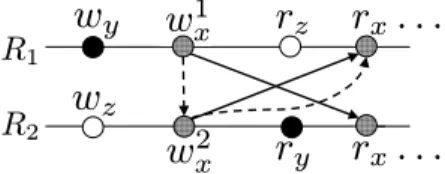
In contrast, with multiple objects, the combination of causal and eventual consistency allows clients to infer con-currency of operations even if the data store tries to “hide” it by ordering them. Figure 2 shows how the causal and eventual consistency requirements enable the client to infer concurrency of operations if multiple objects are supported. In the execution depicted, there are three MVRs shown as differently shaded circles. The data store must return⊥as a response torz sincewz6
hb
−→rz (Proposition 2 in Section 4), and similarly forry. Suppose the data store ordersw1xbefore
w2
x, and thus reads fromxreturnw2x. The client can still in-ferwx1 andw
2
x are concurrent, because hadw 1
xbeen visible atR2 when w2x was executed,ryshould have returned wy. (A symmetric argument applies ifw2
x is ordered beforewx1.) Therefore, since we consider multiple objects and causal consistency, we use replicated object specifications that in-corporate concurrency.
w
yw
zw
1 xw
2xr
yR
1r
x. . .
R
2r
zr
x. . .
Figure 2:Causal links (dashed arrows) implied byrx returning only the value ofw2
xcontradict information flow in messages (solid arrows), since they imply thatryshould returnwy’s value.
4.
WRITE-PROPAGATING DATA STORES
Awrite-propagatingdata store is an eventually consistent data store whose implementation (i.e., replica state machine) satisfies two properties, invisible reads and op-driven mes-sages, defined next. Every highly-available replicated data storage system we are aware of [6, 10, 13, 14, 16, 21, 28, 30] has these properties, when viewed in our model (i.e., ignoring is-sues such as timeouts for retransmitting dropped messages). A data store hasop-driven messages if it generates mes-sages only as a result of a client operation, and not in re-sponse to a received message:
Definition 15. A data store D hasop-driven messages
if for any replicaR = (Σ, σ0, E,∆), (1)R does not have a
message pending inσ0, and (2) if∆(σ1, receive(m)) =σ2
andRdoes not have a message pending inσ1, thenR does
not have a message pending inσ2.
A data store hasinvisible readsif a client read operation does not change the state of the replica:
Definition 16. A data storeD hasinvisible reads if for
any replicaR= (Σ, σ0, E,∆), if∆(σ1, e) =σ2 and op(e) =
read, thenσ1=σ2.
In this paper, we concentrate on data stores providing MVRs, as they expose concurrency and are used in real sys-tems [10, 13, 21]. To simplify notation, we begin the names of events invoking write operations with w and begin the names of events invoking read operations with r. We as-sume that each write event writes a different value, so we do not distinguish between the event w = do(o, write, v) and its valuev; e.g., we say thatw∈ rval(r), instead of saying that the value written by the eventwis in rval(r).
We proceed to prove several key properties of write-propa-gating data stores, which serve as building blocks for the proofs of our main results.
A basic property, which holds foranydata store provid-ing MVRs, is that if read r returns some writew, then w
happens beforer.
Proposition 2. Let D be a data store providing MVRs and α be an execution of D. LetA = (H, vis) an abstract execution that α complies with. Let r be a do(o,read, V)
event andwbe ado(o,write, v)event such thatv∈V. Then
w−→hb r.
We show (in Corollary 4 below) that write-propagating data stores, i.e. with invisible reads and op-driven messages, satisfy the original definition of eventual consistency [29], i.e., that “if clients stop issuing update requests, then the replicas will eventually reach a consistent state.” We first definequiescent executions, in which no message is “in flight.”
Definition 17. A finite execution α is quiescent if for every replicaR, (1)Rdoes not have a message pending after its last event in α, and (2) every message R sends in αis received by every replica R06=R.
Now we show that if the execution is quiescent, then all replicas are in a consistent state, in the sense that a client operation receives the same response regardless of the replica that executes it.
Lemma 3. Let D be an eventually consistent data store with invisible reads. Letαbe a quiescent execution ofD. If two reads of the same MVR at different replicas are appended toα, then both reads return the same response.
Finally, we show that ifDhas op-driven messages, we can extend a finite executionαofDinto a quiescent execution
α0 by (1) sending any message pending at any replica, and then (2) delivering each message in flight to every replica but its sender. There are no messages pending at the end ofα0, sinceD has op-driven messages. Therefore, α0 is quiescent. This establishes the following corollary of Lemma 3.
Corollary 4. Let D be an eventually consistent data
store with invisible reads and op-driven messages. Let αbe a finite execution ofD. Thenαcan be extended to an exe-cution in which, for any object o, a read ofothat occurs at the end of the extended execution returns the same response no matter at which replica it is performed.
In most real data store systems, a replica generates a mes-sage following a client write operation to propagate the write
to remote replicas. We show that a write-propagating data storemust, in fact, do this, if the execution appears quies-cent from the replica’s perspective. To reason about individ-ual messages that a replica receives in a given execution, we use the notatione−−→rcv e0 to denote that the first message sent byR(e) aftereis received byR(e0) beforee0.
Lemma 5. LetD be an eventually consistent data store with invisible reads and op-driven messages. Let α be an execution ofD whose last event is a writew at replica R. Suppose that inα, e−→hb w =⇒ e−−→rcv w for anydoevent
e. ThenR has a message pending followingw.
5.
LIMITS OF SATISFIABLE
CONSIS-TENCY MODELS
We explore thestrength of consistency models satisfiable by eventually consistent replicated data stores. A consis-tency model C0 is stronger than consistency model C if
C0 ⊂ C
, that is,C0
prohibits some abstract executions that
Cadmits, but not vice versa. We show that a strengthening of causal consistency,observable causal consistency(OCC), is the strongest consistency model satisfiable by a write-propagating data store implementing MVRs. To prove that no consistency model stronger thanC is satisfied by a data storeD, it suffices to show that, for every A ∈ C, at least one executionαofDcomplies withA. (This is because any executionA0 thatαcomplies with is equivalent toA. Since
A ∈ C and C is closed under equivalence, A0 ∈ C. Thus, it cannot be that D satisfies a stronger consistency model
C0⊂ C .)
5.1
Observable causal consistency
Intuitively, in an MVR abstract executionA = (H, vis),
visspecifies some information flow between replicas that dic-tates which prior writes are visible to each executed read, which dictates the return value of each read given this avail-able information. Indeed, for write-propagating data stores, one can construct an execution in which, for each (non-transitive)vis edge (w, r) between events in distinct repli-cas, R(w) transmits a message after w and R(r) receives this message beforer (Section 5.2). In other words, we can reconstruct the information flow given in any MVR abstract execution.
A data store wishing to avoid generating an execution that complies with A = (H, vis) (e.g, to implement a stronger consistency model that does not includeA) must return dif-ferent responses for some of the reads in this execution. How can this be achieved? One way, for example, is to ignore the received information (for a while). However, a data store with invisible reads cannot do this (Section 5.3).
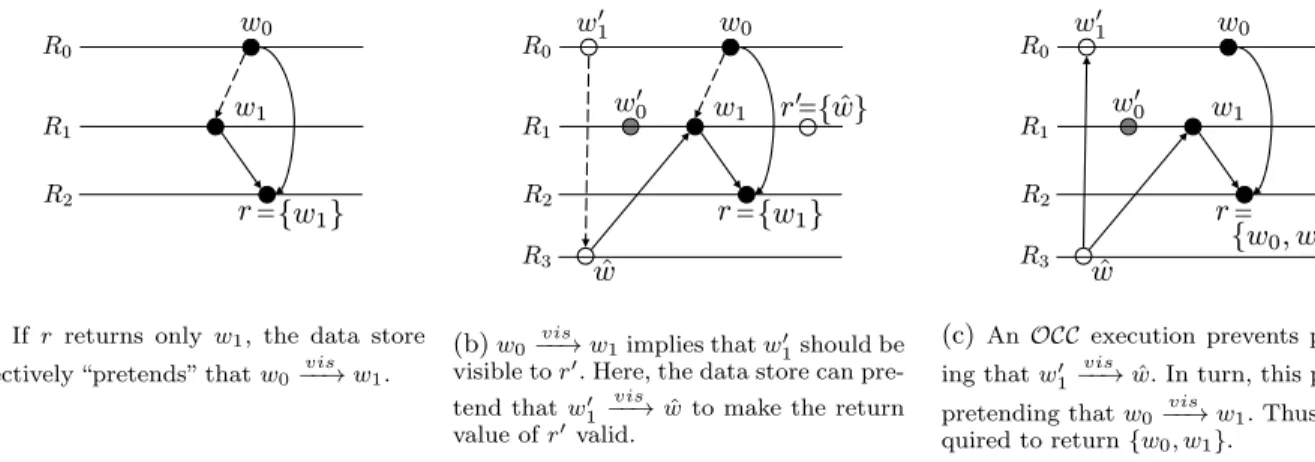
Another option is to “hide” concurrency. For example, if read r returns {w0, w1} in A, the execution we construct will havew0andw1concurrent according to happens-before. The data store could still haverreturn justw1, but it must make sure that the response it generates complies withsome
abstract execution. As Figure 3a shows, this means finding an abstract execution in which these writes areordered. In-tuitively, the data store is pretending thatw0 is visible to
w1even thoughw06 hb −→w1.
This kind of pretense has casuality implications, as demonstrated in Figure 3b. Ifw0
vis
−−→w1, then w10 should be visible tor0because of transitivity. However,r0does not
know aboutw01. To remain correct, there has to be a write ˆw visible to r0 which can be artificially ordered afterw01, just likew0 andw1 were ordered.
Observable causal consistency (OCC) contains abstract ex-ecutions whose induced information flow is such that con-current writes cannot be “hidden” in this way.OCCcontains causally consistent abstract executions that expose concur-rency between operations only when the clients can infer this concurrency from their observations, and so it cannot be hidden.OCCachieves this by requiring that whenever a read returns{w0, w1}, there must exist writesw00 andw
0 1 to different objects, such thatw01is visible tow0but not tow1 (and w00 is visible to w1 but not tow0), and any write ˆw to obj(w10) that is visible tow1 cannot be concurrent with
w01, i.e., must be visible tow10 (again, symmetrically forw00). This guarantees thatw1 cannot be ordered afterw0 norw0 ordered afterw1, as shown in Figure 3c.
Definition 18. A causally consistent abstract execution A= (H, vis) is observably causally consistent(OCC) if for any read r of some MVR o for which rval(r) ⊇ {w0, w1},
there existw00andw 0
1such that the following conditions hold:
1. w0i is a write that is visible tow1−i but to a different
object thano:w0i vis
−−→wi−1 and obj(w0i)6=o,
2. w00 and w 0
1 are writes to different objects: obj(w 0 0) 6= obj(w01), 3. w0iis not visible to wi: wi06 vis −−→wi,
4. no write to obj(w0i) occurring concurrently with w0i is
visible towi: for anywˆ, if obj( ˆw) =obj(w0i)andwˆ vis −−→
wi, thenwˆ vis −−→wi0.
5.2
Impossibility of Stronger Consistency
than
OCCTheorem 6. Let D be an eventually consistent data
store, providing MVRs, with invisible reads and op-driven messages. Then D does not satisfy a consistency model stronger than observable causal consistency (OCC).
To prove the theorem it suffices to show that for any ab-stract execution A ∈ OCC, there is an execution α of D
that complies with A. Thus, let A = (H, vis) ∈ OCC be an observably causally consistent execution. (In particular,
A is causally consistent.) We will construct an executionα
that complies with A. We obtainαby a recursive process, in which we deliver messages generated after events to en-sure thathb(α)⊆vis. The crux of the proof is to show that
Dcannot add “fake” visibility edges, and, hence, every read returns the same response inαas it does inA.
5.2.1
Revealing Executions
An MVR abstract execution A = (H, vis) is revealing, if for every write operation w ∈ H, the operation R(w) performs immediately beforewis a read operationrwof the same object and, for everye∈H,rw
vis
−−→e =⇒ w−−→vis e
ife6=w, ande−−→vis w =⇒ e−−→vis rw ife6=rw. That is,w and rw are identical with respect to the visibility relation. Consequently,rw“reveals” the state of the MVR when the writewis applied. This enables us to reason about the write operations that are visible tow, which is otherwise difficult. (In contrast, writes visible to a read can be inferred from the read’s response.) The following lemma, proved in the full version, formalizes this intuition:
R0 R1 w0 w1
r
R2{
w
1}
=
(a) If r returns only w1, the data store effectively “pretends” thatw0
vis −−→w1.
r
w
ˆ
w 1 R0 R1 w0 w1r
ˆ
w
w 0 R2 R3=
{
w
1}
=
{ } (b)w0 vis−−→w1implies thatw01should be visible tor0. Here, the data store can pre-tend thatw01−−→vis wˆ to make the return value ofr0valid. w 1 R0 R1 w0 w1
r
ˆ
w
w 0 R2 R3{
w
0, w
1}
=
(c)AnOCCexecution prevents pretend-ing thatw10 −−→vis wˆ. In turn, this prevents pretending thatw0−−→vis w1. Thusris re-quired to return{w0, w1}.
Figure 3:Observable causal consistency:motivation for definition. Circles of the same color correspond to operations on the same MVR object. Solid arrows represent−−→vis edges induced by information flow in messages (i.e., are also−hb−→edges). Dashed arrows represent additional−−→vis edges required to make the execution comply with the MVR specification.
Lemma 7. LetA = (H, vis) be a causally consistent re-vealing MVR abstract execution,r∈H be a read operation inA, andA0 = (H0, vis0), be the operation context ofr in
A(Definition 7). Letβ be an execution ofD such that, for all w ∈ H0, rw, w ∈ β. Then for any causally consistent
MVR abstract executionAˆ= ( ˆH,visˆ) thatβcomplies with,
w0−−→vis w =⇒ w0−−→visˆ wfor anyw0, w∈H0.
Without loss of generality, we assume the OCC abstract executionA we consider in our proof is revealing. (Due to invisible reads, we can always obtain a revealing abstract ex-ecutionA0by adding the appropriaterwoperations andvis edges toA, without affecting the response of existing reads inA. Then, for any execution α0 of D that complies with
A0, the executionαobtained by removing therwoperations fromα0 is an execution ofD that complies withA.)
5.2.2
Recursive Construction of
αWe construct the executionαby induction on the length of
H. In the base case,H =ε, we takeα=ε. For the recursive step, letH=H0e, and letR=R(e). That is,op= op(e) is the last high-level operation invoked inα, and it is invoked at replicaR on the MVR obj(e). LetA0 = (H0, vis0) be a prefix ofA. (By Definition 5, ife1
vis
−−→e2, eithere1 vis0 −−→e2 or e2 =e.) Let α0 be the execution of D our construction returns forA0. We defineαby extendingα0in three steps: (1) Message delivery. Consider the events e0 such that
e0 −−→vis e, in the order they occur in H. Let me0 be the first message sent byR(e0) aftere0inα0, if such a message exists. Ifme0 is not delivered toR inα0, we deliver it toRinαby appending areceive(me0) event atR.
(2) Invoking op(e). Let ˆebe the transition in which op(e) is invoked atRon obj(e). We append ˆe. (The crux of the proof will be to show that ˆe=e, i.e., that rval(ˆe) = rval(e).)
(3) Message sending. If R has a message m pending as a result of ˆe, we append asend(m) event atR. Before proving that ˆe=e, we state some properties ofα.
Proposition 8. For any do events e0, e1 ∈ α, e0 hb −→
e1 =⇒ e0 vis
−−→ π(e1) and, if e0 and e1 are at different
replicas, thene0 hb −→e1 =⇒ e0 rcv −−→π(e1), whereπ(e1) =e if e1= ˆe, ore1 otherwise.
Write operations have an even stronger property: if a write
wis visible to some operatione0 inA, thenw−→hb e0 inα:
Proposition 9. Let w, e0 ∈ H. Ifw −−→vis e0 thenw −→hb
π−1(e0
), whereπ−1(e0
) = ˆeife0=e ore0 otherwise.
5.2.3
αComplies with
AWe prove by induction on A that the constructed exe-cution α of D complies with A. The base case, H = ε, is vacuously true. For the inductive step, let H = H0e,
A0 = (H0, vis0) be a prefix of A, andα0 the output of our construction onA0. From the induction hypothesis,α0 com-plies withA0. We must therefore prove that ˆe, thedoevent we invoke at replicaRwhen extendingα0toα, returns the same response as the evente inA. If op(e) = write, then rval(e) = ok because the only response the MVR specifica-tion allows for a write isok. Thus, becauseD is correct, it is also the case that rval(ˆe) = ok. The remaining case, when op(e) = read, follows from the next two lemmas.
Lemma 10. w∈rval(ˆe) =⇒ w∈rval(e).
Proof. Suppose thatw∈rval(ˆe) butw6∈rval(e). Then w−→hb eˆ(Proposition 2) and thusw−−→vis e (Proposition 8). But, asw6∈rval(e), there exists somew1∈rval(e) such that
w−−→vis w1 vis
−−→e. Thenw1 hb
−→eˆby Proposition 9.
Letα0be the execution obtained by removing fromαany event e0 such that e0 6−→hb ˆe. (By Proposition 1, α0 is an execution of D.) Letα1 = α0eˆ. Then α1 is an execution ofD.R does not have a message pending at the end ofα1 (by construction of α and since D has invisible reads and op-driven messages). IfR06=Rsends a messageminα1,R
receives m inα1 (by Proposition 8). Letβ =α1α2 be an execution ofDobtained by appendingreceiveevents toα1 in some arbitrary order, so that, inβevery replica receives
every message sent by another replica in α1. Then β is a quiescent execution, and R receives no messages inα2, so its state at the ofβis the same as its state at the end ofα1. Now, consider the execution β∞ = βrˆ1ˆr2 . . . in which we append toβa sequence of read operations of the MVR obj(ˆe) atR. Thenβ∞is an execution of D and ˆri= ˆe for alli≥ 1 (as D has invisible reads). Since D is eventually consistent,β∞complies with some causally consistent MVR abstract execution ˆA= ( ˆH,visˆ ) such that, for somej≥1, for anydoevente0∈β,e0−−→visˆ rˆj.
By Proposition 9, for anyw∈ctxt(A, e),w−→hb eˆ, and so
rw hb −→ˆe(sincerw hb −→w). Thus,rw, w∈β(and sorw, w∈ β∞). Sincew vis
−−→w1, Lemma 7 implies thatw ˆ vis
−−→w1. Yet
w∈ rval(ˆrj) = rval(ˆe), althoughw ˆ vis −−→ w1 ˆ vis −−→ rˆj, which contradicts the MVR specification.
Lemma 11. w0∈rval(e) =⇒ w0∈rval(ˆe).
Proof. Suppose that w0 ∈ rval(e) but w0 6∈ rval(ˆe). Let rval(ˆe) ={w1, . . . , wk}. Observe thatw0, w1, . . . , wk ∈
ctxt(A, e). This follows because (1) for any w0 ∈ rval(e),
w0 −−→vis e (MVR specification), (2)w0 ∈ rval(e) by defini-tion, and (3) for 1≤i≤k,wi∈rval(e) by Lemma 10.
Now, for any 1 ≤ i ≤ k, {w0, wi} ⊆ rval(e), and A ∈ OCC, so, by Definition 18, there exists a writewi0 byR(w0) precedingw0 such that obj(wi0)6= obj(w0) andw
0 i 6
vis −−→wi. Notice thatw0i∈ctxt(A, e) sincew
0 i vis −−→w0 vis −−→e.
Letα0be the execution obtained by removing fromαany event e0 such that e0 6−→hb eˆ. (By Proposition 1, α0 is an execution of D.) Let α1 = α0ˆe. Then α1 is an execution ofD.R does not have a message pending at the end ofα1 (by construction of αand since D has invisible reads and op-driven messages). IfR06=Rsends a messageminα1,R
receivesm inα1 (by Proposition 8). Let β =α1α2 be an execution ofDobtained by appendingreceiveevents toα1 in some arbitrary order, so that, inβ every replica receives every message sent by another replica in α1. Then β is a quiescent execution, and R receives no messages inα2, so its state at the ofβis the same as its state at the end ofα1. Letβ0be the execution obtained fromβby adding a read
r0iof the MVR obj(wi0) atR(wi) immediately afterwi. (Since
Dhas invisible reads,β0 is a quiescent execution ofD.) Now, consider the execution β∞ = β0rˆ1ˆr2 . . . in which we append toβ0 a sequence of read operations of the MVR obj(ˆe) atR. Thenβ∞is an execution of D and ˆri= ˆe for alli≥ 1 (as D has invisible reads). Since D is eventually consistent,β∞complies with some causally consistent MVR abstract execution ˆA= ( ˆH,visˆ) such that for somej ≥1, for anydoevente0∈β0,e0−−→visˆ rˆj.
Notice that for any w ∈ ctxt(A, e), w −→hb eˆ(by Propo-sition 9), and sorw hb −→ ˆe(sincerw hb −→w). Thus,rw, w∈ ctxt(A, e) =⇒ rw, w ∈β =⇒ rw, w∈ β0 =⇒ rw, w ∈
β∞. We can thus apply Lemma 7 toβ∞.
Since R(wi) does not receive any messages between wi andr0i, w 0 i hb(β0) −−−−→ri0 ⇐⇒ w 0 i hb(β) −−−→wi ⇐⇒ w0i hb −→ wi. However, w0i ∈ rval(r0i) implies w0i
hb(β0)
−−−−→ r0i (by Proposi-tion 2), which implies wi0
hb
−→ wi and, thus, w0i vis −−→ wi (by Proposition 8), which is impossible since w0i 6
vis −−→ wi. Thusw0i6∈rval(ri0) for all 1≤i≤k.
Now, sincew0 ˆ vis
−−→ˆrjyetw06∈rval(ˆrj) = rval(ˆe), it must be that w0 ˆ vis −−→ wi ˆ vis
−−→ ˆrj for some 1 ≤ i ≤ k (by the MVR specification). However,w0i ˆ vis −−→w0 (from w0i vis −−→w0 and Lemma 7). Since ˆAis causally consistent andw0
ˆ vis −−→wi, w0i ˆ vis −−→wi ˆ vis −−→ri0. Yetw 0 i6∈rval(r 0
i). Hence, there must exist a write ˆwsuch thatw0i
ˆ vis
−−→wˆ−−→visˆ ri0, for some ˆw∈rval(r0i). Thus, ˆw hb(β
0)
−−−−→ r0i (Proposition 2), implying ˆw hb(β)
−−−→ ri0, which in turn implies ˆw−→hb wi (asR(wi) receives no mes-sages betweenwiandri). Thus, ˆw
vis
−−→wi(Proposition 9). Then ˆw−−→vis w0iby the definition of OCC(Definition 18). Lemma 7 implies that ˆw−−→visˆ wi0. Butw
0 i
ˆ vis
−−→wˆ(by defini-tion of ˆwabove), which means that ˆvisis cyclic—a contra-diction.
This implies that ˆe=e, proving Theorem 6.
5.3
Comparison to the CAC Theorem
Mahajan, Alvisi and Dahlin’s CAC theorem [23,24] shows that a certain class of data stores cannot implement a con-sistency model stronger thannatural causal consistency, in which the causal order (i.e., visibility) does not violate the real-time order of operations. Respecting real-time order is a stronger demand than we make: interpreted in our frame-work, natural causal consistency requires that an execution complies with an abstract executions in which events occur in exactly the same order, as opposed to our requirement for identicalper-replicaorder.
Our result applies to eventually consistent data stores, whereas the CAC theorem applies to one-way convergent
data stores. These satisfy a stronger liveness property, es-sentially stating that any pair of replicas can converge to the same state with two steps of one-way communication. This difference is relevant in practice, as some systems weaken their liveness guarantee to satisfy stronger consistency than natural causal consistency—e.g., GSP, which globally orders write operations [9, 11].
Both proofs construct an execution meant to comply with a specific abstract execution, by delivering messages accord-ing to the visibility relation. Both proofs require invisible reads; ours also requires op-driven messages.
Having invisible reads is inherently required for The-orem 6 and the CAC theThe-orem to hold. Without invis-ible reads, the data store D can avoid producing cer-tain causally consistent executions and thus satisfy a consistency model which is stronger than causal consis-tency (and OCC). For example, suppose that D does not “expose” a write by returning it in response to a read until K read operations have been applied locally.
{⊥} {w} rK = w rK−1= r1= R0 R1 {⊥} w
r
=
{
w
}
R0 R1 This is illustrated in the top figure, where a visedge is shown as a dashed arrow and anhbedge that is not avisedge is shown as a solid arrow. Then
D still satisfies eventual consistency, but no execu-tion of D complies with the causally consistent ab-stract execution in which
for all i∈[1, . . . , n0] for all j∈[1, . . . , k] doi(xi,write(hj, ii),ok) sendi(mij) (a)β for all i∈[1, . . . , n0] for all j∈[1, . . . , g(i)] receiven−1(mij) don−1(xi,read, v)//v=hj, ii don−1(y,write(1),ok) sendn−1(my) (b)γg for all p6=i,1≤p≤n0 for all j∈[1, . . . , k] receiven(mpj) receiven(my) for all j∈[1, . . . , k] receiven(mi,j) don(y,read, v) if v= 1 don(xi,read,hu, ii)//u=g(i) outputg(i) =u (c)di
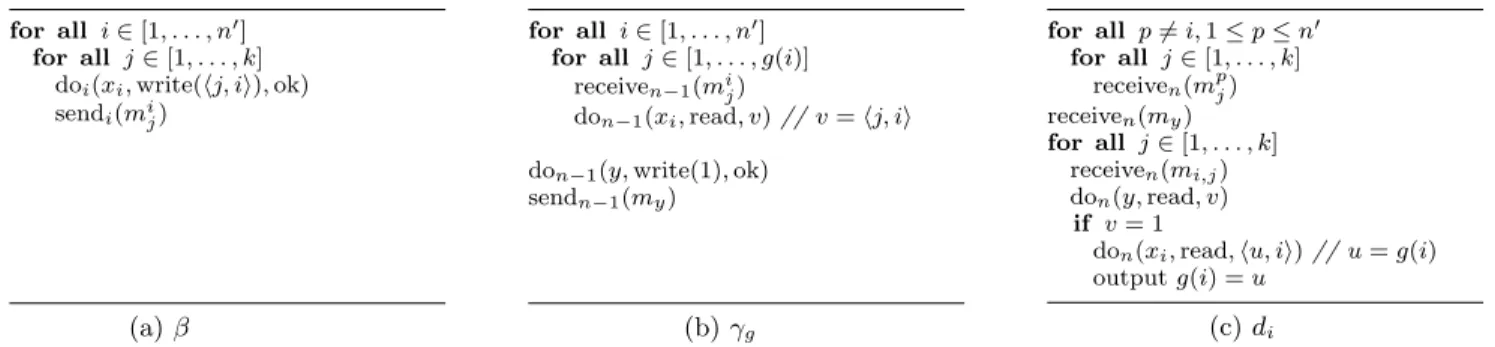
Figure 4:Generating executionαg=β γg, which encodesg, and the transition sequencedi, which decodesg(i). We subscript an event with the id of its replica, e.g.,doifor adoevent atRi.
R0 writes andR1 immediately reads the value written (il-lustrated in the bottom figure). In contrast, we do not have an example of a data store without op-driven messages that satisfies a stronger consistency model than OCC. Whether this assumption can be relaxed is an interesting question.
6.
LOWER BOUND ON MESSAGE SIZE
We bound the size of messages used by write-propagating eventually consistent data stores. IfsMVRs are supported bynreplicas, then, for everyk >1, there is an execution in which an Ω(min{n, s}k)-bit message is sent. When s ≥n, this matches the complexity of the causal consistency al-gorithm of [2]. Messages in their alal-gorithm contain vector timestamps [17, 25] ofncomponents, each of which is loga-rithmic in the number of operations in the respective replica, yielding messages of sizeO(nk), when there are 2k opera-tions. This leaves open the question of designing a data store usingO(sk)-bit messages, whens∈o(n).
Theorem 12. LetDbe a causally consistent and
eventu-ally consistent data store with invisible reads and op-driven messages. Suppose thatDprovidessMVRs and hasn repli-cas. Then for everyk ≥min{n−2, s−1}there is an exe-cutionαk in whichD sends a message containing
min{n−2, s−1}lgk bits.
Proof. Letn0= min{n−2, s−1}. For everyg: [n0]7→
[k], we construct an executionαg that ends with a message
mg being sent. We prove thatgcan be decoded givenmg, which implies that for someg, mg contains at leastn0lgk bits. The basic idea is that, in αg, each replica Ri, 1 ≤
i≤n0, performsk writes,wi
1, . . . , wik to the MVRxi.Rn−1 performs a writewyto the MVRyafter observing theg(i )-th write of Ri, for every 1 ≤ i ≤ n0. The message Rn−1 subsequently broadcasts ismg. We can decodegusingmgas follows. To outputg(i) for somei, we start with all replicas in their initial state, and execute the writeswi1, . . . , wik for all i. (They are independent of g.) We deliver to Rn all messages but those sent byRi, followed bymg. Due to causal consistency,Rn cannot returnwy in response to a read of
y, sincewy depends onwig(i), andRn does not “know” this value. But if we now deliverRi’s messages toRn, reading
yafter each message is received, the result of the read ofy
will containwyafter theg(i)-th message has been delivered. Thus, we can findg(i) given onlymg.
Now we describe the construction and decoding procedure more formally.
Construction of αg: For anyg, αg = β γg, where β is independent ofg, andγg ends withRn−1 sendingmg. Inβ (Figure 4a), the sequence of events for each replicaRi con-sists of a write operationwjiwritinghj, iito MVRxifollowed by broadcasting a message mji, for 1≤j ≤k . (Lemma 5 implies each mji exists.) In γg (Figure 4b), Rn−1 receives, for eachRi, the messagesmi1, . . . , mig(i), while performing a read rij of xi after receiving each message. In the full ver-sion, we prove that wi
j ∈ rval(rij). Finally, by Lemma 5,
Rn−1 writes 1 to registeryand broadcastsmg.
Decoding g frommg (Figure 4c): Decodingg(i) given
mg is performed by going through a sequence of transi-tions at Rn that ends with a do(xi,read,hg(i), ii), which providesg(i). We begin by havingRnreceive the messages
mp1, . . . , m p
kfor eachp6=i. (These messages can be obtained fromβ, which does not depend ong, so do not need to be provided explicitly.) We then obtaing(i) by deliveringmij forj in increasing order, performing a read ofyafter each message delivery. IfRnreads 1, we readhu, ii fromxi and returng(i) =u. Letdi=e1, . . . , elbe this sequence of tran-sitions at Rn. To show that the execution α0 = β γgdi is well-formed, we prove in the full version that α0|Rn =di. Thus,g(i) can be computed givenmg, which impliesgcan be computed givenmg, and the theorem follows.
One can prove Proposition 2, Lemma 3, and Lemma 5 for read/write registers (see Section 4), and these imply analogs of Theorem 12 for a data store providing read/write regis-ters, as well as a combination of MVRs and registers.
7.
SUMMARY
We present a framework for specifying highly-available replicated data stores, for objects that can expose concur-rency. For write-propagating data stores, representing many real systems, we show that an eventually consistent data store cannot satisfy a consistency model strictly stronger thanOCC. An important open question is to implement an eventually consistentOCCdata store, which will show that
OCC is the strongest possible consistency model for even-tually consistent data stores. We also prove that the data store must send messages whose size grows with the number of replicas and the number of operations.
In the full version of the paper, we also extend the space lower bounds proved by Burckhardt et al. [10] for replicas implementing certain objects, like MVRs and ORsets. While
their results seemingly imply the space optimality of existing implementations of these objects [7, 27], they hinge on prop-erties that many networks do not exhibit:redelivery and re-orderingof messages. We extend these lower bound proofs so that they do not require message redelivery and reordering. Thus, they hold even for relatively well-behaved networks that only delay or delete messages.
We have focused on MVRs, and left other objects, like read/write (last-writer wins) registers and ORsets, to future work. It would be interesting to determine whether rem 12 applies to ORsets, and more importantly, if Theo-rem 6 holds for other objects besides MVRs.
Acknowledgements: This work is supported by the Is-rael Science Foundation (grants 1227/10 and 1749/14), by Yad HaNadiv foundation, and by the Natural Science and Engineering Research Council of Canada. Faith Ellen was supported in part at the Technion by a Lady David Fellow-ship. Adam Morrison was supported in part at the Technion by an Aly Kaufman Fellowship.
8.
REFERENCES
[1] The Apache Cassandra Project.
[2] M. Ahamad, G. Neiger, J. E. Burns, P. Kohli, and P. W. Hutto. Causal memory: definitions,
implementation, and programming.Dist. Comp., 9(1), 1995.
[3] B. Alpern and F. B. Schneider. Defining liveness.Inf. Process. Lett., 21:181–185, October 1985.
[4] P. Bailis, A. Fekete, A. Ghodsi, J. M. Hellerstein, and I. Stoica. The Potential Dangers of Causal
Consistency and an Explicit Solution. InSoCC ’12, pages 22:1–22:7.
[5] P. Bailis and A. Ghodsi. Eventual consistency today: Limitations, extensions, and beyond.Commun. ACM, 56(5):55–63, May 2013.
[6] P. Bailis, A. Ghodsi, J. M. Hellerstein, and I. Stoica. Bolt-on Causal Consistency. InSIGMOD ’13, pages 761–772.
[7] A. Bieniusa, M. Zawirski, N. Pregui¸ca, M. Shapiro, C. Baquero, V. Balegas, and S. Duarte. An Optimized Conflict-free Replicated Set. Technical Report
RR-8083, INRIA, Oct. 2012.
[8] E. A. Brewer. Towards robust distributed systems. In
PODC ’00, page 7.
[9] S. Burckhardt.Principles of Eventual Consistency. Found. and Trends in Programming Languages, 2014. [10] S. Burckhardt, A. Gotsman, H. Yang, and
M. Zawirski. Replicated data types: Specification, verification, optimality. InPOPL ’14, pages 271–284. [11] S. Burckhardt, D. Leijen, J. Protzenko, and
M. F¨ahndrich. Global Sequence Protocol: A Robust Abstraction for Replicated Shared State. InECOOP ’15.
[12] B. Charron-Bost. Concerning the Size of Logical Clocks in Distributed Systems.Inf. Process. Lett., 39(1):11–16, July 1991.
[13] G. DeCandia, D. Hastorun, M. Jampani, G. Kakulapati, A. Lakshman, A. Pilchin, S. Sivasubramanian, P. Vosshall, and W. Vogels.
Dynamo: Amazon’s Highly Available Key-value Store. InSOSP ’07, pages 205–220.
[14] J. Du, S. Elnikety, A. Roy, and W. Zwaenepoel. Orbe: Scalable causal consistency using dependency matrices and physical clocks. InSOCC ’13, pages 11:1–11:14. [15] J. Du, C. Iorgulescu, A. Roy, and W. Zwaenepoel.
GentleRain: Cheap and Scalable Causal Consistency with Physical Clocks. InSoCC ’14, pages 4:1–4:13. [16] J. Du, C. Iorgulescu, A. Roy, and W. Zwaenepoel.
Closing The Performance Gap between Causal Consistency and Eventual Consistency. InProceedings of the 1st Workshop on Principles and Practice of Eventual Consistency, 2014.
[17] C. J. Fidge. Partial orders for parallel debugging.
ACM SIGPLAN Notices, 24(1):183–194, 1989. [18] S. Gilbert and N. Lynch. Brewer’s conjecture and the
feasibility of consistent, available, partition-tolerant web services.SIGACT News, 33(2):51–59, June 2002. [19] M. P. Herlihy and J. M. Wing. Linearizability: a
correctness condition for concurrent objects.ACM Trans. Prog. Lang. Syst., 12:463–492, July 1990. [20] L. Lamport. Time, Clocks, and the Ordering of Events
in a Distributed System.Commun. ACM, 21(7):558–565, July 1978.
[21] W. Lloyd, M. J. Freedman, M. Kaminsky, and D. G. Andersen. Don’t Settle for Eventual: Scalable Causal Consistency for Wide-area Storage with COPS. In
SOSP ’11, pages 401–416.
[22] W. Lloyd, M. J. Freedman, M. Kaminsky, and D. G. Andersen. Stronger Semantics for Low-Latency Geo-Replicated Storage. InNSDI ’13, pages 313–328. [23] P. Mahajan.Highly Available Storage with Minimal
Trust. PhD thesis, The University Of Texas at Austin, Austin, TX, USA, May 2012.
[24] P. Mahajan, L. Alvisi, and M. Dahlin. Consistency, Availability, and Convergence. Technical Report TR-11-22, The University of Texas at Austin, 2011. [25] F. Mattern. Virtual time and global states of
distributed systems. In M. Consard and P. Quinton, editors,Parallel and Distributed Algorithm, pages 215–226. North-Holland, 1989.
[26] M. Perrin, A. Most´efaoui, and C. Jard. Brief Announcement: Update Consistency in Partitionable Systems. InDISC ’14, pages 546–547.
[27] M. Shapiro, N. Pregui¸ca, C. Baquero, and
M. Zawirski. A comprehensive study of Convergent and Commutative Replicated Data Types. Technical Report RR-7506, INRIA, Jan. 2011.
[28] M. Shapiro, N. Pregui¸ca, C. Baquero, and
M. Zawirski. Conflict-free Replicated Data Types. In
SSS ’11, pages 386–400.
[29] W. Vogels. Eventually consistent.Commun. ACM, 52(1):40–44, Jan. 2009.
[30] M. Zawirski, A. Bieniusa, V. Balegas, S. Duarte, C. Baquero, M. Shapiro, and N. Pregui¸ca. SwiftCloud: Fault-Tolerant Geo-Replication Integrated all the Way to the Client Machine. Technical Report RR-8347, INRIA, Aug. 2013.