i
Integrated Framework of Knowledge Discovery and Knowledge
Management for E-health In Saudi Arabia: Supporting Citizens
with Diabetes Mellitus
Saleh Naif Almuayqil
Staffordshire University
A Doctoral Thesis submitted in partial fulfilment of the
requirements of Staffordshire University for the degree of Doctor of
Philosophy
i
Saudi Arabia experiences insufficient effort in terms of patients’ education in relation to a number of prevalent diseases, including diabetes mellitus, musculoskeletal disorders and upper respiratory tract infections. In addition, the number of studies related to e-health initiatives to support patients in the Kingdom are limited and only benefit patients of a few hospitals. This situation leads to deficient application of self-management and education strategies to empower patients to manage their diseases. Unfortunately, such a deficiency can affect the health status in the Kingdom negatively as diabetes mellitus is reported as the first cause of death in the Kingdom among all other prevalent diseases.
Although knowledge management has been proven to be a valuable approach to sharing knowledge and educating users to manage their illnesses, it has not been implemented appropriately to support the increasing number of diabetic citizens in Saudi Arabia. In this research, knowledge management is integrated with knowledge discovery to support specific needs of the diabetic community in the Kingdom. Such an integration constitutes an e-health initiative to support diabetic citizens and healthcare professionals to manage this expanding illness in Saudi Arabia. Knowledge discovery is implemented through data mining to elicit useful knowledge related to specific diabetes complications encountered by diabetic citizens in the Kingdom. The integrated framework applies the SECI model to capture and disseminate useful diabetes self-management and educational expertise to support the management of diabetes complications.
This integrated approach to knowledge management and knowledge discovery has provided a valuable tool implemented in terms of a web portal. This has facilitated the exchange and dissemination of tacit and explicit knowledge of the diabetic community in the forms of strategies, guidelines and best practices. It has also overcome the issues faced by the organisational and national cultures affecting knowledge management practice in Saudi Arabia.
Key words: knowledge management, knowledge discovery, diabetes mellitus, Saudi Arabia, e-health.
ii
Foremost, all thanks to Almighty Allah who granted me favour and guidance that helped me in completion of this research.
I would also express my thanks and appreciation to my first supervisor, Professor Anthony Atkins and my second supervisor, Professor Bernadette Sharp, for their supervision and guidance. Your support throughout this research is appreciated and has been great motivation to achieve this end.
Big thanks to the Ministry of Education in Saudi Arabia who granted me this opportunity to expand my knowledge and expertise in academic research at Staffordshire University. My parents, my mother Aisha and father Nayef, thank you for your support, motivation and thank you for all that you have done for me in order to reach this stage. Thanks to all my family members in Saudi Arabia for your continuous help.
To my wife, Manahil, there are no words that can express my appreciation to you. Your support and motivation have always been the greatest influence on me. Your dedication and sacrifices will always be remembered and valuable. Thank you.
Finally, I would like to thank my friends and colleagues who provided me with support and guidance.
iii
This research is dedicated to: My mother, Aisha
My father, Nayef My brothers and sister
My wife, Manahil My daughter, Hanai
iv
Almuayqil, S., Atkins, A.S. & Sharp, B. (2016). Ranking of E-Health Barriers Faced by Saudi Arabian Citizens , Healthcare Professionals and IT Specialists in Saudi Arabia. Health. (July). p.pp. 1004–1013.
Almuayqil, S., Atkins, A.S. & Sharp, B. (2015). Integrated Framework of Knowledge Management and Knowledge Discovery to Support E-health for Saudi Diabetic Patients.
International Journal on Advances in Life Sciences. 7 (3). p.pp. 111–121.
Almuayqil, S., Atkins, A.S. & Sharp, B. (2015). Knowledge Management Framework for E-Healthcare in Saudi Arabia. In: eTELEMED 2015. [Online]. 2015, Lisbon: eTELEMED 2015, The Seventh International Conference on eHealth, Telemedicine, and Social Medicine,
pp. 112–117. Available from:
v
Best paper award at eTELEMED 2015, The Seventh International Conference on eHealth, Telemedicine, and Social Medicine, held in Lisbon, Portugal - February 22 - 27, 2015. Paper title “Knowledge Management Framework for E-health in Saudi Arabia”.
vi Abbreviation Extended Name
CKO Chief Knowledge Officer CoP Community of Practice
CPOE Computerised Provider Order Entry CRM Customer relationship Management
DESMOND Diabetes Education and Self-Management for On-going and Newly Diagnosed DM Data Mining
DSMKSA Diabetes Self-Management in the Kingdom of Saudi Arabia EHR Electronic Health Record
EMR Electronic Medical Record HIS Health Information Service
ICT Information and Communication Technology IS Information System
KD Knowledge Discovery KM Knowledge Management KS Knowledge Sharing MOH Ministry of Health
PHC Primary Healthcare Center
SECI Socialisation, Extenuation, Combination and Internalisation WHO World Health Organisation
vii Abstract ... i Acknowledgement ... ii Dedication ... iii Publications ... iv Awards ... v Glossary ... vi
List of Figures ... xii
List of Tables ... xiv
Chapter One: Introduction ... 1
1.1 Introduction ... 1
1.2 Research Motivation ... 2
1.3 Aim and Objectives ... 6
1.4 Research Design ... 7
1.5 Research Contributions ... 9
1.6 Research Methodologies ... 10
1.6.1. Research philosophy ... 10
1.6.2. Research approach ... 11
1.6.3. Research method and time horizons ... 11
1.7 Ethical Consideration ... 13
1.8 Thesis Structure ... 14
Chapter Two: Literature Review of E-health and Diabetes Mellitus in Saudi Arabia ... 17
2.1 Introduction ... 17
2.2 Overview of Healthcare in Saudi Arabia ... 17
2.3 Health Situation in Saudi Arabia ... 22
2.4 E-health in Saudi Arabia ... 26
2.5 Diabetes Mellitus... 33
2.6 Conclusion ... 41
Chapter Three: Knowledge Management and Knowledge Discovery ... 42
3.1 Introduction ... 42
3.2 Knowledge Management ... 42
3.3 Data Mining ... 56
viii
3.3.1.3. The Cross-Industry Standard Process for DM... 63
3.3.2. DM modelling approaches ... 66
3.3.2.1. Data description and summarisation ... 67
3.3.2.2. Segmentation ... 68 3.3.2.3. Concept description ... 69 3.3.2.4. Classification ... 69 3.3.2.5. Prediction ... 70 3.3.2.6. Dependency analysis ... 71 3.3.3. DM algorithms ... 76 3.3.3.1. C4.5 ... 77 3.3.3.2. k-Means ... 77
3.3.3.3. Support Vector Machine ... 78
3.3.3.4. Apriori ... 79 3.3.3.5. Expectation-Maximisation ... 81 3.3.3.6. PageRank ... 81 3.3.3.7. AdaBoost ... 82 3.3.3.8. K- Nearest Neighbour ... 82 3.3.3.9. Naïve Bayes... 83
3.3.3.10. Classification and Regression Tree ... 83
3.4 Conclusion ... 84
Chapter Four: Integrated Framework of Knowledge Discovery and Knowledge Management ... 86
4.1 Introduction ... 86
4.2 Knowledge Management and Knowledge Discovery Framework ... 86
4.2.1. Overview of the framework ... 86
4.3 Framework components and issues ... 89
4.3.1. E-health barriers as layer 1 ... 89
4.3.2. Knowledge management ... 92
4.3.3. SECI model layer ... 94
4.3.4. Knowledge discovery layer ... 96
4.4 Knowledge Discovery and Knowledge Management Integration ... 98
4.5 Framework Structure ... 101
ix
4.6 Potential Benefits ... 105
4.7 Diabetes Web Portal ... 107
4.8 Validation of the Framework ... 108
4.9 Conclusion ... 108
Chapter Five: A Study of E-health Barriers in Saudi Arabia ... 110
5.1 Introduction ... 110
5.2 Investigation of E-health Barriers in Saudi Arabia ... 110
5.2.1. Questionnaire design ... 110
5.2.2. Ethical considerations ... 114
5.2.3. Pilot study ... 114
5.3 Data Analysis ... 114
5.3.1. Respondents’ profile ... 114
5.3.2. Results of business component ... 117
5.3.2.1. Failure of adoption of health information services (HIS) ... 118
5.3.2.2. Medication safety ... 118
5.3.3. Results of human component ... 118
5.3.3.1. Human barriers ... 118
5.3.3.2. Cultural barriers ... 119
5.3.4. Results of technological component ... 120
5.3.4.1. Connectivity of information systems ... 120
5.3.4.2. Technical expertise and computer skills ... 121
5.3.4.3. Security and privacy ... 122
5.3.5. Results of financial component ... 123
5.4 Discussion ... 124
5.4.1. Citizens’ views ... 124
5.4.2. Healthcare professionals’ views ... 125
5.4.3. IT specialists’ views ... 127
5.5 Conclusion ... 130
Chapter Six: Data Mining Pilot Study for Diabetic Citizens in Saudi Arabia ... 131
6.1 Introduction ... 131
6.2 Data Mining Pilot Study ... 131
6.2.1. Business understanding ... 132
x
6.2.5. Validation ... 145
6.2.6. Discussion ... 152
6.2.7. Deployment ... 153
6.3 Conclusion ... 157
Chapter Seven: Web Portal for Diabetes Self-management and Education in Saudi Arabia ... 158
7.1 Introduction ... 158
7.2 Web Portal for Diabetes Self-management and Education in Saudi Arabia ... 158
7.3 Web Tools for the SECI Model ... 161
7.4 Web Portal Development ... 165
7.4.1. Planning of DSMKSA ... 166 7.4.2. Content of DSMKSA ... 167 7.4.3. Design of DSMKSA... 170 7.4.3.1. Home page... 171 7.4.3.2. About DSMKSA ... 172 7.4.3.3. Forum ... 173 7.4.3.4. Official documents ... 173 7.4.3.5. Diabetes data ... 174 7.4.3.6. Blogs ... 175 7.4.3.7. Diabetes videos ... 175 7.4.3.8. Diabetes Q&A ... 176
7.4.3.9. Diabetes Mellitus Daily ... 177
7.4.3.10. Contact us ... 177
7.4.4. Construction of DSMKSA ... 178
7.4.5. Testing of DSMKSA ... 179
7.5 DSMKSA Screenshots ... 184
7.6 Conclusion ... 188
Chapter Eight: Validation of the Framework and Evaluation of the Web Portal ... 190
8.1 Introduction ... 190
8.2 The Framework Validation ... 190
8.3 Validation Proses... 191
8.3.1. Design of the validation ... 191
xi
8.4.2. Knowledge discovery about diabetes issues ... 196
8.4.3. Knowledge dissemination ... 196
8.4.4. Qualitative feedback ... 198
8.5 Validation Results Summary and Improvement of the Framework ... 198
8.6 DSMKSA Evaluation ... 203
8.7 Evaluation Process and Design ... 203
8.8 Evaluation Findings... 205
8.8.1. Socialisation ... 205
8.8.2. Externalisation ... 206
8.8.3. Combination ... 208
8.8.4. Internalisation ... 209
8.9 Evaluation Results Summary ... 210
8.10 Conclusion ... 214
Chapter Nine: Conclusion ... 216
9.1 Introduction ... 216
9.2 Research Summary ... 216
9.2.1. Context of investigation ... 216
9.2.2. Theoretical underpinning ... 217
9.2.3. Investigation of the research problems ... 218
9.2.4. Addressing the research problems ... 218
9.2.5. Framework validation and web portal evaluation ... 219
9.3 Research Contributions ... 222
9.4 Research Limitations ... 226
9.5 Opportunities for Future Research ... 227
References ... 229
Appendices ... 269
Appendix A: E-health Questionnaire ... 269
Appendix B: Data Mining Study ... 302
xii
List of Figures
Figure 1.1 Research steps of the current thesis ... 9
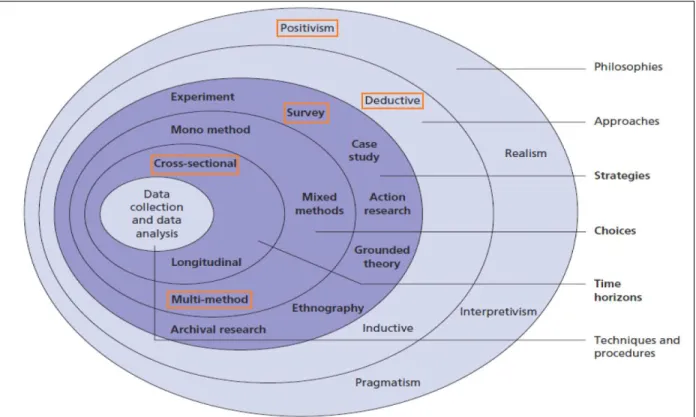
Figure 1.2. Research Onion with our Selection of Research Methodologies for the Current Thesis 13 Figure 1.3 Thesis structure ... 16
Figure 2.1. Location of Saudi Arabia ... 18
Figure 2.2. Flag and national emblem of Saudi Arabia ... 18
Figure 2.3. Number of healthcare facilitates provided by MOH in Saudi Arabia in 2015 and 2016 19 Figure 2.4. Hospitals provided by MOH and other governmental sectors in Saudi Arabia in 2010-2014 ... 20
Figure 2.5. Hospitals provided through public and private sectors in Saudi Arabia in 2015 and 2016 ... 21
Figure 2.6. Private healthcare facilitates licensed by the MOH in 2016 ... 22
Figure 2.7. Outpatients' visits to PHCs in Saudi Arabia ... 23
Figure 2.8. Emergency cases of respiratory diseases in MOH hospitals from 2011 to 2014 ... 24
Figure 2.9. Visits to MOH hospitals due to musculoskeletal disorders from 2011 to 2014... 25
Figure 2.10. E-health barriers in Saudi Arabia ... 31
Figure 2.11. Categories of e-health barriers in Saudi Arabia ... 32
Figure 2.12. Visits to MOH hospitals due to diabetes mellitus from 2011 to 2014 ... 35
Figure 2.13. Non-health related complications of diabetes mellitus ... 37
Figure 3.1 The SECI Model ... 49
Figure 3.2. Heart disease diagnosing system ... 56
Figure 3.3. KDD general steps ... 61
Figure 3.4. CRISP-DM ... 64
Figure 4.1. Initial framework designed to overcome e-health barriers ... 88
Figure 4.2. Inclusion of diabetes mellitus, KD, the SECI model, e-health barriers and the web portal in our framework ... 100
Figure 4.3 Integrated framework of KD and KM for diabetes mellitus in Saudi Arabia ... 101
Figure 4.4. Diabetes non-health-related complications ... 103
Figure 4.5. The KM layer ... 104
Figure 5.1. Profile of respondents to the questionnaire ... 116
Figure 5.2. Ranking of e-health barriers in Saudi Arabia from citizens’ perspective ... 125
Figure 5.3. Ranking of E-health barriers in Saudi Arabia from the healthcare professionals’ perspective ... 127
Figure 5.4. Ranking of e-health barriers in Saudi Arabia from IT specialists’ perspective ... 128
Figure 5.5. E-health barriers encountered by citizens, healthcare professionals and IT specialists in Saudi Arabia ... 129
Figure 6.1. CRISP- DM steps... 132
Figure 6.2. Examples of irrelevant open source datasets ... 134
Figure 6.3. Participants’ profile information ... 138
Figure 6.4. Data transformation of DFemale from Excel to CSV. ... 139
Figure 6.5. Web tools to support the SECI model... 156
Figure 7.1. Embodiment of the KM layer of our framework in a web portal ... 161
Figure 7.2. Application of the SECI model in the web ... 165
xiii
Figure 7.4. Design of About DSMKSA page in DSMKSA ... 172
Figure 7.5. Design of the forum link in DSMKSA ... 173
Figure 7.6. Design of the official documents page in DSMKSA ... 174
Figure 7.7. Design of the diabetes data page in DSMKSA ... 174
Figure 7.8. Design of the blog page in DSMKSA... 175
Figure 7.9. Design of the videos page in DSMKSA ... 176
Figure 7.10. Design of the diabetes Q&A page in DSMKSA ... 176
Figure 7.11. Design of the diabetes daily page in DSMKSA ... 177
Figure 7.12. Design of the Contact us page in DSMKSA ... 178
Figure 7.13. Home page of DSMKSA ... 184
Figure 7.14. About DSMKSA page ... 185
Figure 7.15. Official documents page in DSMKSA ... 185
Figure 7.16. Diabetes datasets page in DSMKSA... 186
Figure 7.17. Diabetes videos page in DSMKSA ... 186
Figure 7.18. Blog page in DSMKSA ... 187
Figure 7.19. Questions and answers page in DSMKSA ... 187
Figure 7.20. Diabetes Daily news page in DSMKSA ... 188
Figure 7.21. Contact us page in DSMKSA ... 188
Figure 8.1. Validation slides ... 191
Figure 8.2. Scenario of framework and web portal implementation using real results from our study ... 192
Figure 8.3. Experience of participants in healthcare ... 194
Figure 8.4. Feedback of participant groups to stamens related to the first layer ... 195
Figure 8.5. Feedback of participant groups to stamens related to the second layer ... 196
Figure 8.6. Feedback of participant groups to stamens related to the third layer ... 198
Figure 8.7. Participants' views to framework layers ... 200
Figure 8.8. Overall participants' views to the framework components ... 201
Figure 8.9. Participants' feedback to each function of the framework ... 202
Figure 8.10. Improved framework after participants' feedback ... 202
Figure 8.11. DSMKSA evaluation slides ... 204
Figure 8.12. Participants’ feedback to statements related to the application of socialisation in DSMKSA ... 206
Figure 8.13. Participants’ feedback to statements related to the application of externalisation in DSMKSA ... 207
Figure 8.14. Participants’ feedback to statements related to the application of combination in DSMKSA ... 209
Figure 8.15. Participants’ feedback to statements related to the application of internalisation in DSMKSA ... 210
Figure 8.16. Participants views to the application of the SECI model in DSMKSA ... 212
Figure 8.17. Participants' views to DSMKSA using the mean scores of their answers. ... 213
Figure 8.18. Participants' feedback to the application of each web tool in DSMKSA ... 214
xiv
List of Tables
Table 3.1 Suggestions to adopt the SECI model in the Saudi Arabian context. ... 55
Table 3.2. Steps of KDD, SEMMA and CRISP-DM ... 59
Table 3.3 Weather Table ... 74
Table 5.1. E-health barriers ... 112
Table 5.2 Profile of respondents to the questionnaire ... 117
Table 6.1. Profile information of participants ... 136
Table 6.2. Participants’ non-health-related complications of diabetes mellitus ... 137
Table 6.3. Transformation process of the age attribute ... 139
Table 6.4. Best association rules extracted from DFemale ... 142
Table 6.5. Best association rules extracted from DMale ... 144
Table 6.6. Number of transactions in training and testing subsets ... 146
Table 6.7. Two-fold cross-validation results of RFemale ... 149
Table 6.8. Two-fold cross-validation results of RMale ... 151
Table 6.9. Summary of deployable new associations discovered from our survey... 153
Table 7.1. Extracted non-health-related complications encountered by diabetic female citizens in Saudi Arabia ... 159
Table 7.2. Extracted non-health-related complications encountered by diabetic male citizens in Saudi Arabia ... 160
Table 7.3 Web tools to support Socialisation, externalisation, combination and internalisation .... 171
Table 7.4. Rating of the heuristic evaluation... 180
Table 7.5. Participants' profile in our web portal evaluation study ... 181
Table 7.6. DSMKSA evaluation form and participants' feedback ... 182
Table 8.1. Profile information of participants to the validation study of our framework ... 193
Table 8.2. Participants' feedback to the framework based on each layer and each participants' group ... 199
Table 8.3. Participants' feedback to the web portal evaluation ... 211
1
1.
Chapter One: Introduction
ـــــــــــــــــــــــــــــــــــــــــــــــــــــــــــــــــــــــــــــــــــــــــــــــــــــــــــــــــــــــــــــ ـــــــــــــــــــــــــــــــــــــــــــ
ــــــــــــــــــــــــــ
1.1
Introduction
Saudi Arabia has been reported for the increased prevalence of a number of diseases, including diabetes mellitus. The prevalence of these diseases in the Kingdom requires daily monitoring and continuous care to prevent its complications. An effective way to manage these diseases is the application of management and education strategies. The term self-management in the medical domain is used to emphasise the patients’ role to control their diseases. However, its application in the Kingdom is deficient and doesn’t meet the required effort to control these diseases.
The application of self-management and education in healthcare can be supported by Knowledge Management (KM). KM can facilitate the sharing of knowledge among different organisations and individuals through communications. Despites its advantages, KM in Saudi Arabia face several factors related to national and organisational aspects that hinder its implementation and limit its practices in different domains including healthcare. Lack of KM practice in Saudi Arabia limits the application of several activities associated with self-management and education to support patients who have different diseases in the kingdom. Nonaka and Takeuchi (1995) proposed the knowledge creation model that facilitates the interaction of tacit and explicit knowledge by applying the four conversion modes of socialisation, externalisation, combination and internalisation (SECI). The SECI model is a well-known approach in the area of KM and has been successfully applied to manage knowledge in a variety of domains including healthcare. The SECI model can be utilised to integrate KM and Knowledge Discovery (KD) to support patients and healthcare professionals in Saudi Arabia in managing several chronic diseases such as diabetes mellitus. Such an integration applies KD to elicit tacit complications encountered by diabetic individuals whereas KM helps overcome these complications through the transfer of useful guidelines and best practices among patients who have diabetes and healthcare professionals. Data Mining (DM) implementation in healthcare is well documented in the literature. However, utilisation of the SECI model in the healthcare domain is still deficient. The model
2
has been utilised in different domains for the purpose of knowledge creation and dissemination. Several studies have shown successful applications of the knowledge creation model. Nevertheless, the successful implementation in different domains requires similar application within the healthcare sector in Saudi Arabia, which is seen to have slower KM practice than other healthcare sectors in developed countries.
Although the SECI model is recognised as a valuable approach for knowledge creation, the concentration of the model tends to have a primary focus on social interactions to share human knowledge; yet there is rich knowledge embedded in databases and documents to be mined and shared using this model, making use of many available software tools. In this research, the focus is on how the SECI model can disseminate such knowledge using a set of web tools. Internet technologies are widely utilised in order to self-manage illnesses and learn from other patients’ experiences. Therefore, the application of the SECI to support effective interaction between patients and healthcare professionals can be achieved through the utilisation of many related web tools. Such an approach can assist in promoting the sharing of guidelines and best practices among patients and healthcare professionals to manage diseases and improve their wellbeing.
This chapter introduces the situation of e-health and diabetes mellitus in Saudi Arabia. The chapter starts with describing the motivation of this study. The aim and objectives of this study are presented followed, by the research steps. The research contributions are also described. The current chapter also discusses the research methodologies utilised in this study and highlights the ethical consideration in this thesis. The final part of this chapter outlies the chapters of this thesis, with the perceived outcomes of each chapter.
1.2
Research Motivation
E-health has brought many advantages to the health sector, and the benefits of using Information and Communication Technologies (ICT) in health organisations and institutions to support patients with their illnesses are widely documented in the literature. In addition, e-health helps fill the gaps and addresses issues affecting traditional health services. Saudi Arabia is adopting e-health to benefit from its advantages and usefulness. A number of new initiatives have emerged focusing on many aspects of healthcare, ranging from creating
3
electronic files for patients, statistical monitoring of infectious diseases, connecting all hospital systems using technologies of cloud computing and monitoring the arrival of pilgrims and vaccines given to each pilgrim in their home country (Ram, 2014).
Saudi Arabia seeks to implement different e-health solutions in the healthcare domain. Such an implementation can produce several advantages in the Kingdom. One significant advantage of e-health is to help in controlling a number of the prevalence diseases in the Kingdom including diabetes mellitus, upper respiratory tract infection, musculoskeletal disorders, heart diseases, cancers and strokes.
The expenditure of the Ministry of Health (MOH) in Saudi Arabia is increasing yearly as a result of the MOH’s aim to improve its services by adopting different ICT initiatives. The budget of the MOH in 2016 had an increase over £492,000 sterling from 2015 (Ministry of Health, 2016a). However, the healthcare sector in Saudi Arabia is still impacted by many hindrances related to e-health, as highlighted below.
Non-connectivity of Information Systems (ISs)
Some healthcare organisations are using information systems (Almalki et al., 2011). However, the effort to connect these information systems in order to build up a national healthcare system is deficient (Altuwaijri, 2008).
Lack of Technical Expertise and Computer Skills
This barrier is mainly related to the lack of experience in using computer applications among healthcare staffs and healthcare professionals. Other factors related to this barrier includes a lack of guidelines to handle Electronic Medical Records (EMRs), poor maintenance of computers and networks and slow computers, data entry problems, unfriendly designed interface, and insufficient computer terminals (Khalifa, 2013).
Failure of Adoption Health Information Services (HISs)
This barrier refers to the gap between planning to adopt HIS’s and the implementation in Saudi Arabia and poor technical support and over-running of time and/or cost schedules (Khalifa, 2013; Altuwaijri, 2011).
Human Barriers
Human barriers include the negative beliefs of healthcare professionals, the resistance to change and lack of trust by medical staff in using technologies in healthcare (El Mahalli, 2015).
4 Cultural Barriers
Cultural factors contribute to the failure in adopting e-health because of limited human interaction (Aldraehim et al., 2012). Aldraehim and Edwards (2013) explain that Saudi Arabian people are extremely influenced by their culture and therefore prefer physical interaction to virtual contact.
Medication Safety
This barrier is related to two major e-health issues: communication gaps among healthcare institutions and the limited use of technology whose consequences occur in illegible handwriting. Computerised Provider Order Entry (CPOE) can solve this problem; however, this is being adopted slowly (Aljadhey et al., 2013).
Financial Barriers
Transmitting traditional paper medical records to electronic system can be very costly (Amatayakul, 2010). Such high expenditure, which needs to be spent on the adoption of IT in health, may lead to the slow uptake of e-health applications (Khalifa, 2013).
Security and Privacy
This focuses on the easy of accessing the EMRs of patients, due to the fact that some medical records of patients can be disseminated to others without permission of the patient or the doctor (Khalifa, 2013).
In Saudi Arabia, diabetes mellitus constitutes a major health issue as the Kingdom is in the list of the top ten countries in the prevalence of diabetes mellitus. The prevalence of diabetes mellitus in Saudi Arabia was 16.8% in 2010 (Shaw et al., 2010), whereas in 2014 the prevalence of this disease in the Kingdom constituted 20.5% of the population (International Diabetes Federation, 2014). In 2015, the prevalence of diabetes mellitus among people between 20 and 79 represented 20% of this age range (International Diabetes Federation, 2015b). Diabetes mellitus is causing a number of complications to diabetic citizens in Saudi Arabia and the disease is considered the first reason for death among all diseases (Centers for Disease Control and Prevention, 2016). Therefore, diabetes mellitus was chosen as the domain of application of the current thesis.
5
Diabetes mellitus constitutes another motivation of this research. The chronic disease is seen to be affecting over 350 million people globally and the number is expected to increase in the coming years (Lotfy et al., 2017). Diabetes mellitus can result in serious health complications such as heart and kidney failure, strokes, blindness and amputations. Nevertheless, people with this chronic disease struggle with its non-health-related complications. The later complications are associated with the adherence to medication and coexisting with the life style of diabetes mellitus.
Different diabetic individuals encounter one or more complications, including difficulties controlling eating habits, deficient knowledge in the correct way of using medications, doubt regarding insulin preciseness and time schedules for antidiabetics (Péres et al., 2007). In addition, patients with diabetes encounter problems in identifying the right medications and understanding prescriptions, especially when patients asked to change medication (Onwudiwe et al., 2014). Moreover, Blonde (2005) highlighted other non-health-related complications of diabetes mellitus, including patient failure to adhere to lifestyle measures and pharmacologic therapies, as the most common reasons cited for failure to achieve glycaemic goals. Blonde (2005) also indicated that diabetic patients may not be able to identify the right blood glucose target. Besides this, diabetic individuals in Muslim societies may face another non-health-related complication in the holy month of Ramadan where they are require to fast from sunrise until sunset for 30 days. These complications include identifying appropriate medication times and the right medication amount. Additionally, diabetic patients in Ramadan encounter a problem regarding finding an appropriate diet and eating habit (Hassanein et al., 2017).
The non-health-related complications of diabetes mellitus can result in serious health related complications. For example, poor adherence to diet and physical activities can cause diabetes complications including arteries diseases (Sharaf et al., 2013). Inappropriate usage of medication can lead diabetic patients to mortality. Onwudiwe et al. (2011) mentioned another disadvantage of these complications as inadequate health literacy, which can lead to an inefficient use of health services whereas deficient adherence to diabetes medication can result in cost waste in healthcare services.
Scholars have suggested solutions to overcome the non-health-related complications of diabetes mellitus. The mostly cited solutions is diabetes self-management and education
6
where diabetic individuals can be educated to use their expertise and skills to self-manage their diabetes on an ongoing basis (Powers et al., 2017). This includes different aspects as patients’ learn how to use medication and when, the appropriate diet and physical activities, and how to manage diabetes during Ramadan.
Different studies have studied the complications caused by diabetes mellitus, including studies underpinning the situation of diabetes mellitus in Saudi Arabia (Fareed et al., 2017 ; Sweileh et al., 2014 ; Aljumah et al., 2013 ; Appuhamy et al., 2013) . However, the literature lacks a discussion of diabetes non-health-related complications of diabetes mellitus in the context of Saudi Arabia, which is considered a major country in terms of diabetes prevalence. In addition, the effort on patients’ education in relation to their diseases and how they can be managed is deficient in Saudi Arabia (Alshammari, 2016). Furthermore, e-health systems in Saudi Arabia to support patients with different diseases, including diabetic patients, are few and limited to few hospitals (Alsulame et al., 2016).
To investigate the issues that hinder e-health and empower diabetic citizens to self-manage their diabetes, this research has developed a framework to integrate KM and KD. The framework is an attempt at addressing some of the e-health challenges highlighted above. This integrated framework of KD and KM constitutes an e-health initiative to support not only diabetic citizens in Saudi Arabia, but also healthcare professionals who aim to help diabetic citizens control and manage their illness. IT professionals are also involved in the investigation to understand the barriers to e-health in the healthcare sector in Saudi Arabia. In this thesis, KD is limited to DM; other approaches, such as text mining, web mining and link mining are to be incorporated in future work.
In addition, this framework adopts a KM model for the purpose of disseminating valuable knowledge related to diabetes self-management and education extracted from diabetic citizens and healthcare professionals. The SECI model is applied as an appropriate model which can provide effective collaboration and dissemination of knowledge related to diabetes management and education. To demonstrate the viability of our approach, a web portal is developed with diabetic citizens and healthcare professionals in mind.
1.3
Aim and Objectives
7
Q1. Can the integrated framework of KM and KD overcome the barriers in relation to e-health in Saudi Arabia?
Q2. Can the integrated framework of KM and KD address the difficulties of citizens with diabetes in Saudi Arabia?
The scope of the thesis is intended to support diabetic citizens in the Kingdom of Saudi Arabia. The aim of the research is to develop a framework to integrate KM and KD to support the e-healthcare of diabetes mellitus citizens and health professionals in the Kingdom. The following objectives are to be carried out:
To conduct a literature review and identify barriers to e-health in Saudi Arabia. To investigate e-health barriers in Saudi Arabia from the perspectives of citizens, healthcare professionals and IT specialists through a statistical study.
To conduct a literature review for KM and KM models and applications in the healthcare sector.
To conduct a literature review for KD to identify methods and applications in the healthcare sector.
To conduct a literature review for diabetes mellitus and its complications and prevalence globally and in Saudi Arabia.
To collect related data to investigate current non-health related complication for diabetes mellitus in Saudi Arabia.
To carry out a DM analysis of the collected data of diabetes mellitus. To develop a framework of KM which can integrate DM analysis. To conduct a literature review for web tools that apply the SECI model.
To build a web portal to support diabetes education and self-management in Saudi Arabia.
To validate the developed framework. To evaluate the designed web portal.
1.4
Research Design
The research in the current thesis undertakes a set of sequential steps in order to achieve all its objectives. The steps of the research are listed as follows and summarised in Figure 1.1 afterward:
8
1. Literature review about e-health in Saudi Arabia. The literature review focuses on the healthcare situation in Saudi Arabia and identifies trends in relation to e-health implementation in the Kingdom through a secondary research. This step concentrates mainly on identifying barriers hindering e-health utilisation in the Saudi Arabian healthcare domain. This step of the research is presented in Chapter Two.
2. Literature review about KM. This step utilises secondary research to define knowledge and its management. In addition, this step concentrates on reviewing the SECI model and its challenges as a well-known and highly utilised KM theory. This step of the research is presented in Chapter Three.
3. Literature review about DM. This step utilises secondary research for the purpose of defining DM and reviewing its various methodologies, techniques and algorithms. This step of the research is presented in Chapter Three.
4. Statistical study of e-health barriers in Saudi Arabia. This step conducts a primary research to investigate e-health barriers from the perspectives of citizens, healthcare professionals and IT specialists via a questionnaire. This step of the research is presented in Chapter Five.
5. Literature review about diabetes mellitus. This step utilises secondary research in order to define diabetes mellitus and its types and complications. In addition, this step concentrates on the prevalence of diabetes mellitus globally and in Saudi Arabia. An important outcome of this research step is to identify non-health related complications of diabetes mellitus. This step of the research is presented in Chapter Two.
6. Development of the integrated framework of KM and KD. The framework integrates DM as a KD approach with the SECI model as a KM theory to produce an e-health initiative for supporting the community of diabetes mellitus in Saudi Arabia. This step of the research is presented in Chapter Four.
7. DM study. This step conducts a primary research to extract non-health related complications encountered by diabetic citizens in Saudi Arabia. The analysed data is acquired through a survey published to diabetic citizens in the Kingdom. This step of the research is presented in Chapter Six.
8. Literature review of SECI model application through web technology. This step focuses on identifying a number of web technologies to apply the four modes of the
9
SECI model from a secondary research. This step of the research is presented in Chapter Seven.
9. Diabetes portal design. This step concentrates on planning, designing and testing of a web portal. The web portal applies a number of web tools to simulate the modes of the SECI model. This step of the research is presented in Chapter Seven.
10.Framework validation. In this step, the framework is validated through a workshop with diabetic citizens, healthcare professionals and IT professionals in Saudi Arabia. This step of the research is presented in Chapter Eight.
11.Web portal evaluation. The evaluation study focuses on the implementation of the SECI model on the web portal. The evaluation study is conducted through a workshop with diabetic citizens, healthcare professionals and IT specialists. This step of the research is presented in Chapter Eight.
Figure 1.1 Research steps of the current thesis
1.5
Research Contributions
The research makes a number of academic contributions. The first contribution is the development of an integrated framework of DM and KM to support e-health in Saudi Arabia. The framework is the first to integrate the two separate fields in the domain of diabetes
10
mellitus in Saudi Arabia. Besides the development of the framework, the research generates the following contributions to academic knowledge:
Ranking of e-health barriers in Saudi Arabia from the perspectives of Saudi citizens, healthcare professionals and IT specialists.
Increasing KM practice and applying the SECI model in the Saudi Arabian healthcare domain.
The utilisation of DM to extract diabetes non-health related complications.
Fulfilling the gap in relation to patients’ education in Saudi Arabia.
The implementation of the SECI model to disseminate useful knowledge related to diabetes self-management and education.
Generation of an open-source dataset for diabetes research.
Extension of the SECI model to convert and disseminate knowledge stored in technological media.
Increasing studies in the area of e-health systems in Saudi Arabia.
Moreover, the current thesis make the following contribution to the clinical practice in the domain of diabetes mellitus in Saudi Arabia.
Designing of a web portal to support the community who have diabetes mellitus using the SECI model.
1.6
Research Methodologies
In this research, we will utilise the Research Onion introduced by Saunders et al. (2009). The research methodologies discussed by Saunders and his collegues include research philoshophy, approaches, strategies, choices and time horizons. The selection of these aspects in relation to the current thesis is discussed in the following sub-sections.
1.6.1.
Research philosophy
Saunders et al. (2009) explained that a research philosophy carries out assumptions related to how you see the world. There are four types of research philosophies. The choice to adopt any of them depends on the research question of the research. These are positivism, realism, interpretivisim and pragmatism.
11
In the positivism philosophy, the researcher works with an observable society and the researcher is acting as an independent in the data collection processes and has no pressure to alter the substance of the collected data and does not affect the study being undertaken. The positivist philosophy claims that the researcher is value-free and has no feelings towards the study. Realism philosophy is similar to positivism in that it assumes a scientific approach to the development of knowledge. This philosophy assumes that what we see as reality is the truth and the reality is always independent from the mind. The Interpretivisim philosophy, however, emphasise the differences between humans in our role as human actors. Pragmatism argues that the research question is the major determinant of epistemology, ontology and axiology. According to Saunders et al. (2009), pragmatism philosophy can be perfectly utilised when the research question does not suggest using positivism or interpretivisim philosophies.
In this research, the positivism philosophy is adopted. The chosen philosophy is suitable to study an observable social reality, such as the current thesis. In addition, the positivism philosophy allows us to undertake this research in a value-free way, which means the researcher is independent and has no impact on the study.
1.6.2.
Research approach
Saunders et al. (2009) have described two approaches: deductive and inductive. The inductive approach is concerned with building a theory whereas the deductive approach is about testing an existing theory. The deductive approach is suitable for our study since it focuses on identifying e-health barriers and diabetes mellitus difficulties in Saudi Arabia from the literature review and overcomes them by using a web portal which will utilise our proposed framework.
1.6.3.
Research method and time horizons
There are three major research methodologies: quantitative, qualitative, and mixed approach (Williams, 2007). The quantitative research approach is used by investigators who need to quantify numeric data and help in creating new knowledge. Methods of the quantitative approach tend to be descriptive research method, correlational, developmental design, observational studies, and survey research (Williams, 2007). The qualitative research
12
methodology is an approach used to discover knowledge from actual experiences (Creswell, 2013). It is less structured and involves describing, explaining, and interpreting collected narrative data (Williams, 2007; Leedy and Ormrod, 2001). The third research methodology is the mixed approach where the collected data from quantitative and qualitative research approaches are analysed in a single research study (Creswell, 2003; Williams, 2007). Thus, the mixed approach uses numeric and narrative data types.
According to Saunders et al. (2009), the posistivism research philosophy is usually used with the quantitative research methodology, which is based on data collected through the questionnaire and analysed to extract important trends. Moreover, survey studies, which include questionnaires, are usually associated with the deductive approach. Consequently, the research choice for our study is multi-method quantitative, where we will use two questionnaires to collect appropriate data quantitatively. The first questionnaire investigates the barriers in adopting e-healthcare in Saudi Arabia, whereas the second questionnaire is related to the study of diabetes mellitus with respect to the barriers. The time horizon of the current study is cross-sectional, as the study is being undertaken in a particiular time and not aware of studying change or development. Figure 1.2 illustrates our research methodology choices for this thesis:
13
Figure 1.2. Research Onion with our selection of research methodologies for the current thesis Source: (Saunders et al., 2009)
1.7
Ethical Consideration
The research complies with the ethical standards produced by Staffordshire University to prevent any ethical breaches. The ethics committee at Staffordshire University has approved two ethical forms (see appendices A.3 and B.1). The first ethical form was approved prior to the questionnaire study, whereas the second ethical approval was obtained before we started gathering data for the DM study. Participants in both studies were adults from Saudi Arabia and their participation was anonymous. In addition, participation in this study is optional and participants were allowed to withdraw their participation at any stage. This thesis does not seek any participation from children, people with communication or learning difficulties, patients, people in custody, people who can be considered vulnerable or people engaged in illegal activities.
Besides this, the framework validation and the web portal evaluation took place in a workshop at a Primary Healthcare Center (PHC) in Saudi Arabia. The PHC has granted us a
14
written consent to access its facilities, for the participants who participated in both sessions (see Appendix C.3).
1.8
Thesis Structure
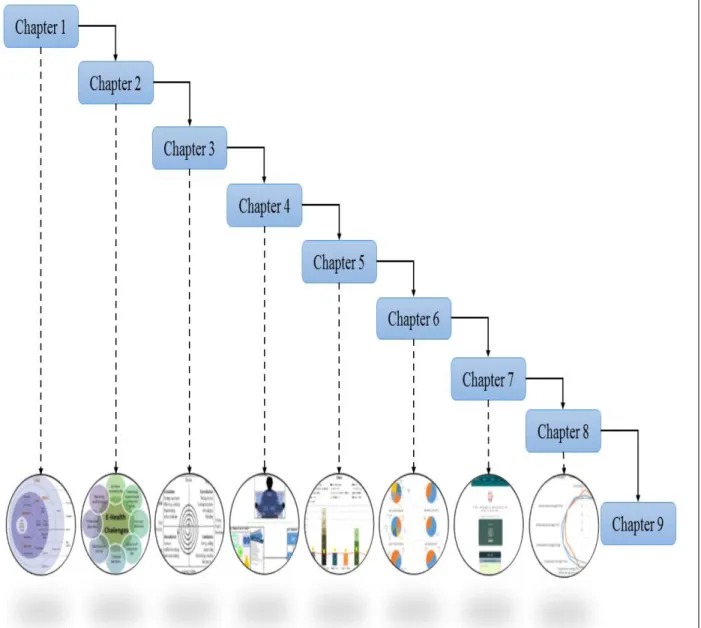
The thesis is organised into nine chapters (see Figure 1.3). The content of each chapter are summarised as follows:
Chapter One: this chapter concentrates on the motivation of the current thesis. Chapter One also presents the aim and objectives as well as the research design of this study. In addition, Chapter One discusses the research methodologies used in this study, outlines its contributions and highlights its ethical consideration.
Chapter Two: this chapter provides a literature review of e-health and diabetes mellitus in Saudi Arabia. The e-health literature review concentrates on defining e-health along with its advantages, the situation of e-health implementation in Saudi Arabia and identifying e-health barriers in the Kingdom. The literature review of diabetes mellitus focuses on defining the diseases, its complications and the prevalence of the disease in Saudi Arabia. This chapter also provides an overview of Saudi Arabia and its healthcare system.
Chapter Three: this chapter underpins the theoretical bases of this research. Chapter Three provides a review of KM and DM. The KM review focuses on defining knowledge and KM. In addition, this chapter discusses KM advantages, KM hindrances, the SECI model and discusses its issues. The DM review defines DM and discusses its methodologies, techniques and algorithms.
Chapter Four: this chapter presents the integrated framework proposed in this thesis. The chapter also discusses the framework components, domain of application and provides a real case scenario to show how the framework should work in the real world. It also highlights the potential benefits of the framework, the embodiment of the framework in a web portal, the framework validation and contributions to knowledge generated by developing this framework.
Chapter Five: this chapter presents the questionnaire study of e-health barriers in Saudi Arabia. In this chapter, the barriers of e-health in Saudi Arabia are investigated and ranked
15
from the perspectives of three stakeholders: citizens, healthcare professionals and IT specialists.
Chapter Six: this chapter presents the DM pilot study to analyse the non-health related complications encountered by diabetic citizens in Saudi Arabia. The chapter utilises a DM methodology, technique and algorithm in order to reveal frequent complications from the collected data.
Chapter Seven: this chapter demonstrates the design of a diabetes web portal. The web portal is designed to disseminate diabetes self-management and educational guidelines, best practices and strategies in order to support citizens and healthcare professionals of diabetes mellitus in the Kingdom. The web portal utilises a number of web tools to apply the four modes of the SECI model. Therefore, a variety of web tools are also reviewed in this chapter.
Chapter Eight: this chapter presents the validation and evaluation of this study. In this chapter, the framework is validated in a workshop in Saudi Arabia with nine participants. In addition, the designed web portal is also evaluated in this chapter in the same workshop and with the same participants.
Chapter Nine: this chapter summarises the research and discusses the research contributions. Moreover, this chapter highlights the challenges encountered through this research and identifies areas of future work.
16
Figure 1.3 Thesis structure
17
2.
Chapter Two: Literature Review of E-health and Diabetes
Mellitus in Saudi Arabia
ـــــــــــــــــــــــــــــــــــــــــــــــــــــــــــــــــــــــــــــــــــــــــــــــــــــــــــــــــــــــــــــ ـــــــــــــــــــــــــــــــــــــــــــــــــــــــــــــــ
ــــــ
2.1
Introduction
E-health plays an important role in improving healthcare services in many countries. Saudi Arabia is one of those countries that aims to implement different e-health solutions to enhance its healthcare services. However, different barriers are seen to be affecting successful implementation of different e-health solutions. In addition, diabetes mellitus has a high prevalence in many countries including Saudi Arabia. Besides the health complications of this chronic diseases, diabetes mellitus has another type of complications related to adhering to medications and lifestyle. The first part of this chapter provides brief information about Saudi Arabia’s healthcare system. This is followed by a discussion regarding its e-health status and a literature review of e-health barriers in Saudi Arabia. The last sections of this chapter cover diabetes mellitus and its various complications globally and in Saudi Arabia in particular as this is the domain application of this thesis.
2.2
Overview of Healthcare in Saudi Arabia
The Kingdom of Saudi Arabia is one of the largest countries in the Middle East area. Saudi Arabia is located in the southwest corner of Asia and it is the largest country in the Arabian Peninsula (see Figure 2.1). According to the General Authority for Statistics in Saudi Arabia, the population of Saudi Arabia amounted 31,742 million in 2016 (General Authority for Statistics, 2017b). Saudi Arabia covers two million square kilometres, which equals one-fourth the size of the United States. Saudi Arabia is surrounded by Jordan, Iraq and Kuwait to the north; the Arabian Gulf, Qatar and the United Arab Emirates to the east; Oman and Yemen to the south and; the Red Sea in the west. Saudi Arabia has 13 districts. The capital of Saudi Arabia is Riyadh, which is located in the Riyadh district. The Kingdom has other major cities including the two cities of the two holy mosques, Mecca and Medina.
18
Figure 2.1. Location of Saudi Arabia
The flag of Saudi Arabia is designed with a green background with the Islamic testimony in the middle ‘There is no god but Allah, Mohammed is the messenger of Allah’ written in the Arabic language which is the official language of the country. An Arabic sword is placed underneath the testimony. The national emblem of Saudi Arabia consists of two crossed swords, which represents strength and sacrifice, headed by a palm tree, which represents prosperity and growth (see Figure 2.2).
Figure 2.2. Flag and national emblem of Saudi Arabia (General Authority for Statistics, 2017a)
19
The healthcare system in Saudi Arabia is given significant attention by the government of Saudi Arabia. The MOH is responsible for about 60% of health services in the Kingdom. These services are supported by 7.2% from the annual budget of the government of Saudi Arabia (Ministry of Health, 2016a). The MOH is organised in 13 general directorates of health affairs distributed among the 13 administrative regions of Saudi Arabia. The MOH plays a significant role in the development and improvement of healthcare services in Saudi Arabia. This includes ensuring that there is a sufficient number of healthcare facilities in the Kingdom to achieve a better quality of healthcare services. The number of PHCs reached 2282 in 2016. The number of hospitals increased from 271 hospitals in 2015 to 274 hospital in 2016. The total number of beds in these hospitals is 41,297, including 2,598 beds related to seven specialist hospitals and medical cities. The number of medical staff in the public healthcare sector is 122,323 in 2016 (see Figure 2.3).
Figure 2.3. Number of healthcare facilitates provided by MOH in Saudi Arabia in 2015 and 2016 Source: (Ministry of Health, 2016a)
271 2281 40,502 274 2282 41,297 0 5000 10000 15000 20000 25000 30000 35000 40000 45000
MOH hospitals PHCs Beds
Healthcare Facilitites in the Public Sector
20
Besides the MOH, there are other governmental authorities that provide public healthcare services in Saudi Arabia. These governmental authorities are the National Guard Health Affairs, the security forces’ medical services, army forces medical services, Ministry of Higher Education hospitals (teaching hospitals), Royal Commission for Jubail and Yanbu health services, ARAMCO hospitals, school health units of the Ministry of Education and the Red Crescent Society (Almalki et al., 2011). Other governmental sectors have provided 42 hospitals, with the capacity of 12,032 beds. Figure 2.4 compares the number of hospitals provided by the MOH and other governmental sectors in Saudi Arabia from 2010 to 2014.
Figure 2.4. Hospitals provided by MOH and other governmental sectors in Saudi Arabia in 2010-2014
Source: (Ministry of Health, 2014)
Besides the healthcare services provided by the public sector, number of healthcare facilities are developed and provided through the private sector in Saudi Arabia. The kingdom witnessed increases in the number of healthcare facilitates provided through both sectors,
249 251 259 268 270 39 39 39 41 41 0 50 100 150 200 250 300 2010 2011 2012 2013 2014
Comparison of Hospitals by MOH and other Govermental Sectors
21
public and private, over the last two years (see Figure 2.5). According to the MOH (2016), the ministry has licensed many facilitites in the private sector in 2016. This includes licensing 145 hospitals, 1,670 medical complexes, 1,000 specialised medical compexes and 77 private clinics. Moreover, the MOH has liscensed other private facilitites including 104 laboratories and 96 physiotherapy clinics and 7,815 pharmacies (see Figure 2.6).
Figure 2.5. Hospitals provided through public and private sectors in Saudi Arabia in 2015 and 2016 Source: Ministry of Health (2016)
271 141 274 145 0 50 100 150 200 250 300
MOH hospitals private hospitals
Hospitals in public and private sectors in 2015 and 2016
22
Figure 2.6. Private healthcare facilities licensed by the MOH in 2016 Source: (Ministry of Health, 2016)
2.3
Health Situation in Saudi Arabia
Despite the effort of providing different healthcare facilities, Saudi Arabia has reported a number of health diseases among people living in the Kingdom. Saudi Arabia indicated a considerable number of people with diseases visiting different healthcare facilities including PHCs, MOH hospitals and emergency departments of MOH hospitals. The variety of these diseases includes, but is not limited to, strokes, heart conditions, cancers, hypertensive diseases, infectious and parasitic diseases. However, the MOH has reported that most visits to PHCs in Saudi Arabia are associated with upper respiratory tract infection followed by musculoskeletal disorders and diabetes mellitus (Ministry of Health, 2011) (see Figure 2.7). In this thesis, diabetes mellitus is chosen as a domain of application to overcome its complications through our proposed framework due to the prevalence of the disease and its mortality consequences. Upper respiratory tract infection and musculoskeletal disorders, however, can be addressed in future work as illustrated in Chapter Nine.
145 1670 1000 77 104 96 7815
Number of the Licensed Facilities in the Private Sector
Hospitals Medical complex Specialisedmedical compex Private clinics Laboratories Physiotherapy clinic Pharmacy
23
Figure 2.7. Outpatients' visits to PHCs in Saudi Arabia Source: (Ministry of Health, 2011)
The upper respiratory tract has a number of infections that can affect the nose, paranasal sinuses, pharynx and trachea which can be caused by different viruses and parasites (Sherif B, 2013; Masavkar and Naikwadi, 2016). According to the World Health Organisation (WHO), 235 million people suffer from diseases related to upper respiratory tract infection worldwide (WHO and Marko, 2017). In Saudi Arabia, the number of visits to PHCs due to respiratory disease was over 10,2 million visits in 2011 (Ministry of Health, 2011). Official reports from the MOH in Saudi Arabia lacks provision of the number of visits to its hospitals due to upper respiratory tract infections for the last five years. However, the number of emergency cases in the MOH hospitals shows similarity in the period from 2011 to 2014. (see Figure 2.8).
24
Figure 2.8. Emergency cases of respiratory diseases in MOH hospitals from 2011 to 2014 Source: (Ministry of Health, 2011, 2012, 2013, 2014)
Musculoskeletal disorders are common health conditions in many countries and include different syndromes such as tendon inflammations, nerve compression disorders, osteoarthritis, myalgia and lower back pain (Punnett and Wegman, 2004). The number of visits to PHCs in Saudi Arabia due to these disorders constituted over 2 million visits in 2011 (Ministry of Health, 2011). The number of visits to MOH hospitals due to Musculoskeletal disorders has risen from 1,089 million in 2011 to 1,095 in 2014 (see Figure 2.9).
5,087,208 5,183,575 5,400,007 5,188,784 4,000,000 4,100,000 4,200,000 4,300,000 4,400,000 4,500,000 4,600,000 4,700,000 4,800,000 4,900,000 5,000,000 5,100,000 5,200,000 5,300,000 5,400,000 5,500,000
Emergency Cases in the MOH Hospitals Due to Respiratory Diseases
25
Figure 2.9. Visits to MOH hospitals due to musculoskeletal disorders from 2011 to 2014 Source: (Ministry of Health, 2011, 2012, 2013, 2014)
Diabetes mellitus is the third highest cause of visits to PHCs in Saudi Arabia in 2011. According to the MOH, the number of visits to PHCs due to this disease was over 1,8 million (Ministry of Health, 2011), placing this chronic disease in the third place as the most common health condition in the Kingdom. Despite the prevalence of this disease being after respiratory tract infections and musculoskeletal disorders, diabetes mellitus constitutes more of a life threat in Saudi Arabia. Global reports indicated that diabetes mellitus is the major cause of death, above all other diseases in Saudi Arabia according to the Centers for Disease Control and Prevention (2016), constituting a serious health issue in the Kingdom that can affect life expectancy records. More details about diabetes mellitus and its prevalence are discussed in Section 2.5. 1,089,297 1,063,367 1,066,367 1,095,055 950,000 970,000 990,000 1,010,000 1,030,000 1,050,000 1,070,000 1,090,000
Number of Visits to MOH Hospitals Due to Musculoskeletal Disorders
26
2.4
E-health in Saudi Arabia
E-health plays an important role in the healthcare domain nowadays. Many healthcare organisations around the globe have started utilising e-health as part of their healthcare systems. E-health was defined in the literature review in different ways and different countries differ in the definition of e-health (Lau and Kuziemsky, 2016). However, the majority of e-health definitions agree on the utilisation of technology in the healthcare domain to improve healthcare services.
E-health is the term that refers to the use of technology in the healthcare sector. One of the most widely used definitions for e-health is from the WHO has stated “the use, in the health sector, of digital data - transmitted, stored and retrieved electronically- in support of health care, both at the local site and at a distance.” According to WHO (2014), e-health is the transfer of health resources that includes the following:
1. Delivering health information via the internet and telecommunication. 2. Using IT and e-commerce to improve health services.
3. Managing health systems through using e-business and e-commerce practices. WHO has further described e-health as the utilisation of ICT for health (WHO, 2014). E-health requires working with regional or global partners to increase the use of ICT as part of the development of the healthcare services.
The utilisation of e-health offers many advantages to patients, healthcare staffs and healthcare organisations over the traditional delivery method of healthcare services. These advantages include increased communication between patients and medical staffs, engagement of patients when providing information, reduced stigmatisation of drugs use and enhanced privacy (Carra et al., 2014, 2016). Moreover, e-health can increase commitments to drugs and facilitate the preventive strategies through taking advantage of electronic devices, which are commonly used by young people (Gustafson et al., 2014; Carra et al., 2016). Besides all these advantages, the literature has highlighted several potential benefits of e-health and ICT utilisation in the healthcare domain. These benefits are listed as follows:
27
Improved quality of healthcare. Quality of care is defined as doing the right action at the right time and in the right way for the right person to get the best possible outcomes (Menachemi and Collum, 2011). New e-health technology plays a significant role in in this regard. E-health technologies such as Decision Support System (DSS) increase medics’ adherence to the guidelines of provision of care to patients. In addition, electronic reminders to medication can increase patients’ adherence to medications and vaccines. Furthermore, e-health solutions can reduce error in healthcare such as reducing prescription errors through the use of CPOE (Aljadhey et al., 2014).
Facilitation of access to healthcare services and facilities. One of the major advantages of using ICT in healthcare is the increased accessibility and availability of healthcare services (Carra et al., 2014, 2016). New e-health technologies enable access to healthcare at any time. Electronic records, for example, facilitates access of patients to their medical records and enables them to access their medical history at any time. Telemedicine is another technology used in e-health and helps in providing healthcare services for people at a distance, such as those who live in rural areas, through the use of ICT (WHO, 2010). According to Aardoom et al., (2016), with the new technologies being adopted in healthcare there is no more need for face-to-face interview with healthcare professionals and e-health initiatives have introduced new method of diagnoses and treatments, some of which includes the intervention of internet-based technology to provide healthcare services for the treatment of different disorders.
Cost reduction of healthcare delivery. The integration of ICT technologies in healthcare significantly reduces the costs of healthcare. For example, the implementation of electronic records prevents patients from performing redundant tests at more than one hospital. Electronic records, such as Electronic Health Records (EHRs), collect the medical history of patients. This includes all test results and medications the patients have received. The results of implementing such an initiative is the prevention of patients from taking redundant tests and therefore reducing the cost of healthcare services (Menachemi and Collum, 2011). Another way in which e-health reduces the cost of e-healthcare services is the reduction of billing errors. New
28
e-health technologies, such as electronic records, enable bills to be captured in a timely manner and this results in decreased billing error. In addition, electronic records improve revenue to healthcare organisations by increasing cash-flow, as well as reducing billing errors. Smit et al. (2011) indicated a clearer example of cost-effectiveness of e-health solutions. They introduced a new system using e-health intervention to curb alcohol use in the Netherlands. The findings from their study found that e-health intervention could save € 68 million compared to the face-to-face methods, with a slightly higher impact on people’s health. The study concluded that e-health provides an increased return-to-investment on health compared to old healthcare systems using traditional methods.
Increased research. Many ICT means being used in healthcare improve the ability to conduct research (Menachemi and Collum, 2011). The reason for this is the ability of e-health solutions to store patients’ data electronically. For example, EHRs increases research as it increases the availability of data which is stored electronically. The potential of research in the medical domain is to provide better ways to monitor different health conditions and to improve surveillance of critical diseases (Kukafka et al., 2007).
Raised life expectancy. According to the WHO, global life expectancy was 66.4 years in 2000 and has increased to 71.4 in 2015 (WHO, 2016c). This means that the percentage of people who reached the age of 60 or over has increased from 18.7% in 2000 to 20% in 2015. One interpretation of this increase is the utilisation of different computing innovations in the healthcare domain. New ICTs including monitoring systems, databases and web networking technologies play significant role in improving healthcare facilities and providing various ways to deliver better health services (Car et al., 2008). In Saudi Arabia, life expectancy can be considered through addressing prevalent diseases (see Section 2.3). Adopting e-health solutions to improve healthcare services can play a significant role in the treatment and prevention of these diseases. Consequently, life expectancy in Saudi Arabia can be raised significantly.