PRE
+: Dual of Proxy Re-encryption for Secure Cloud Data Sharing
Service
Xu An Wang
∗School of Telecommunications Engineering, Xidian University, P. R. China
Key laboratory of Information and Network Security, Engineering University of Chinese Armed Police Force, P. R. China
Email: [email protected] ∗Corresponding author
Fatos Xhafa
Department of Computer Science, Technical University of Catalonia, Spain Email: [email protected]
Jianfeng Ma
School of Cyber Engineering, Xidian University, P. R. China Email:[email protected]
Yunlong Ge
Officer College of Chinese Armed Police Force, P. R. China Email:[email protected]
Abstract:With with the rapid development of very large, diverse, complex, and distributed datasets generated from internet transactions, emails, videos, business information systems, manufacturing industry, sensors and internet of things etc., cloud and big data computation have emerged as a cornerstone of modern applications. Indeed, on the one hand, cloud and big data applications are becoming a main driver for economic growth. On the other hand, cloud and big data techniques may threaten people and enterprises’ privacy and security due to ever increasing exposure of their data to massive access. In this paper, aiming at providing secure cloud data sharing services in cloud storage, we propose a scalable and controllable cloud data sharing framework for cloud users (called:Scanf). To this end, we introduce a new cryptographic primitive, namely,PRE+
, which can be seen as the dual of traditional proxy re-encryption (PRE) primitive. All the traditionalPRE schemes until now require thedelegator(or the delegator and thedelegateecooperatively) to generate the re-encryption keys. We observe that this is not the only way to generate the re-encryption keys,the encrypter also has the ability to generate re-encryption keys. Based on this observation, we construct a newPRE+ scheme, which is almost the same as the traditionalPREscheme except the re-encryption keys generated by the encrypter. Compared withPRE, ourPRE+scheme can easily achievethe non-transferable property and message-level based fine-grained delegation. Thus ourScanfframework based onPRE+can also achieve these two properties, which is very important for users of cloud storage sharing service. We also roughly evaluate ourPRE+scheme’s performance and the results show that our scheme is efficient and practica for cloud data storage applications.
Keywords:Secure cloud data sharing service; Dual of proxy re-encryption; Non-transferable property; Message-level based fine-grained delegation.
Referenceto this paper should be made as follows: Wang, X., Ma, J., Fatos, L. Barolli, X., Ge Y., ‘PRE+: Dual of Proxy Re-encryption for Secure Cloud Data Sharing Service’,Int. J. Int. J. of Web and Grid Services, Vol. x, No. x, pp.xxx–xxx.
2
Biographical notes:Xu An Wang now is an associate professor in the Engineering University of Chinese Armed Police Force. His main research interests include public key cryptography and cloud security.
Fatos Xhafa now is a professor in Technical University of Catalonia. His main research interests include cloud computation and big data analysis. He has published about 200 papers in the field of grid, internet, cloud and big data computation.
Jianfeng Ma now is a professor in Xidian University. He is also a Yangtze River scholar in China. His main research interests include cyber engineering security. He has published about 150 papers in the field of public key cryptography and cloud security.
Yunlong Ge now is a lecturer in Officer College of Chinese Armed Police Force. His main research interest are public key cryptography and provable security.
1 Introduction
Nowadays cloud computation has become commonplace for data storage, processing, service sharing for individuals, institutions, and enterprises world wide. As regards the computation and processing, the core novelty of this technology is its ability of enabling heavy computation tasks, which can be distributed to large slave computation nodes under the management of master computation nodes, like the system structure of Map-Reduce. Scalability in its vertical and horizontal dimensions, is the essential property of cloud computation, while enterprises can maintain their data warehouse and run information systems on it in the cloud just like running the local information systems. Cloud computing is also referred to as 5th utility computing as it enables end-users to use and pay the cloud storage/computation service just like using gas, water and electrical power utilities. Generally speaking, in the Cloud services are offered through the paradigm of “Everything as a Aservice", an examples of this are Software-as-a-Service (SaaS), Platform-as-Software-as-a-Service (PaaS), Infrastructure-as-Software-as-a-Service (IaaS) and Data-as-Software-as-a-Service (DaaS), to name a few.
1.1 Proxy Re-encryption for Secure Cloud Data Sharing Service
Here we focus on a very common kind of cloud service: Data-as-a-Service (DaaS), aimed at providing convenient data storage and sharing service for data owners. Data owners like individuals, institutions and enterprises can outsource their data to the cloud server without maintaining the local data copy and the complicated software/hardware management. However, when data owners outsource their data to the cloud, they run some risks on the privacy and security of their data hosted at cloud data centres. Thus, it is often a reasonable practice to first encrypt the data locally and then outsource the ciphertexts to the cloud. However, although in this way the outsourced data can be secure, but it becomes more difficult to operate with the data such as sharing the encrypted data, processing and mining, etc..
In order to enable sharing data among cloud data users, recently researchers have proposed a new data sharing framework based on a cryptographic primitive named proxy re-encryption. Proxy re-encryption (PRE), allows a semi-trusted proxy to transform a ciphertext originally intended for Alice into the one which can be decrypted by Bob. The proxy inPREis given a re-encryption key with which he/she can perform the conversion without knowing the corresponding plaintexts. APREscheme isbidirectionalif the proxy can use the re-encryption key to divert ciphertexts from Alice to Bob and vice versa. Otherwise, it is calledunidirectional. According to how the conversion is performed,PREcan be classified asmulti-hopandsingle-hop. A multi-hopPREscheme supports “re-encryption chain", namely any ciphertexts converted by the proxy during the re-encryption phase can be re-encrypted to the ciphertexts of someone else. In other words, the re-encryption phase in multi-hopPREcan be conducted as many times as needed. This differs from a single-hopPREscheme, where ciphertexts converted by the proxy cannot be re-encrypted again.
1.2 The Dilemma
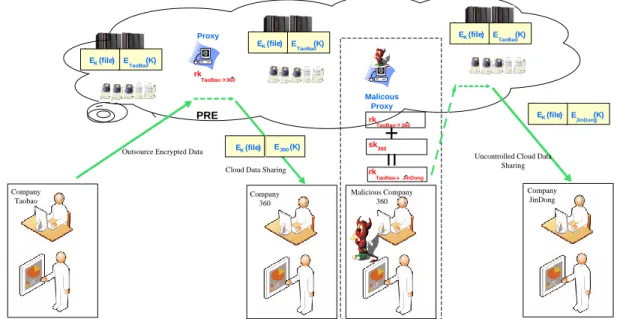
We can roughly see how to use PRE for secure cloud data sharing service and its dilemma from Fig. 1. First we describe a typical scenario for secure sharing cloud storage by using PRE as follows:
PRE : Dual of Proxy Re-encryption for Secure Cloud Data Sharing Service 3 1. Data owner Company TaoBao want to use cloud services for managing its very large business related data sets, such as the consumers’ preference, products selling prices, analytics of logistics for goods etc. These data sets are very sensitive and the Company TaoBao is not willing to outsource them in plaintext form. Thus, it prefers to first encrypt the data setsf ileby using block cipher such as AES and then encrypt the block cipher keyK by using public keyT aoBao, after that it outsources the ciphertexts to the cloud.
2. Later, the Company TaoBao signs a contract on data sharing with another business, the Company 360, for evaluating its information system and data warehouse’s security. Certainly the Company TaoBao is not willing to directly share its secret keyskT aoBaowith the Company 360. Proxy re-encryption is a good mechanism for
this purpose. Company TaoBao just computes the re-encryption keyrkT aoBao→360by using its secret key and
the Company 360’s public key, and outsources it to the cloud.
3. The cloud re-encrypts the ciphertext from(EK(f ile)||ET aoBao(K))to be(EK(f ile)||E360(K))and sends
them to data user Company 360. After obtaining these ciphertexts, it can decrypt them by using his own secret key and thus can run its evaluation. Furthermore, data owner Company TaoBao can use conditional proxy re-encryption, which is a variant of PRE for fine-grained control on the sharing content for the Company 360.
E TaoBao(K) EK(file) E360(K) rk TaoBao360 PRE
+
Proxy Company 360 Outsource Encrypted DataCloud Data Sharing
Company JinDong Malicous Proxy Malicious Company 360 rk TaoBao 360 sk360 rk TaoBaoJinDong
=
E TaoBao(K) EK(file) E TaoBao(K) EK(file)Uncontrolled Cloud Data Sharing Company Taobao E JinDong(K) EK(file) EK(file)
Figure 1 PRE for secure cloud data sharing service and its dilemma
Almost all existing frameworks of PRE for secure cloud data sharing service follow the above paradigm. However, there is a dilemma these proposals have to face to, which can be described as follows:
1. Suppose the Company JinDong, which is a competitor of Company TaoBao, wants to know some critical contents of Company TaoBao’s data sets. It corrupts both the cloud and Company 360 by paying large amount of money.
2. The cloud and Company 360 can collude to derive a new re-encryption keyrkT aoBao→J inDongfrom the old
re-encryption keyrkT aoBao→360and Company 360’s secret keysk360.
3. By using the new re-encryption key rkT aoBao→J inDong, the cloud can transform ciphertext from
(EK(f ile)||ET aoBao(K))to be(EK(f ile)||EJ inDong(K)).
4. After obtaining(EK(f ile)||EJ inDong(K)), Company JinDong can decrypt the ciphertexts to obtain the data
4
One might wonder if Company 360 can directly send the data content to Company JinDong, why it first colludes with the cloud to derive the new re-encryption key, and then the cloud implements the ciphertext transformation? The reason lies in the auditing capability: in the first case, Company 360 needs to be online always and thus can easily be traced; while in the second case, Company 360 can be always offline and untraceable, and the cloud can claim it is innocent on the new re-encryption key.
1.3 Our Contribution
Aiming at solving this dilemma, we propose a new primitivePRE+and a new frameworkScanffor secure data sharing service at cloud. Our framework can be employed as a middleware component for effective handling data storage on demand with organizational separation of the provider and consumer for the newly rapidly emerging DaaS cloud service. Separating data usage from the software to access the data is a very common practice but it is at the same time a challenging problem for modern DaaS cloud service. By employing thePRE+primitive and theScanfframework, the cloud can achieve scalable control on which data consumer can access the encrypted the data. Furthermore, this access can be controlled without worrying about further potential leakage of the data by the data consumers, for this leakage can be audited. Concretely our contributions are the following:
1. We first point out the dilemma faced by almost all existing secure cloud storage sharing service based on proxy re-encryption, that is, the malicious delegatee and proxy can collude to re-delegate the re-encryption right to other users, which can be denoted as the transferable delegation problem.
2. We introduce a new primitivePRE+which can be seen as dual of traditional proxy re-encryption, where we also discuss some interesting properties such as non-transferability and message-based fine-grained control on the delegation. We further analyse why this primitive can be used to solve the transferable delegation problem. 3. We give the definition and security modelPRE+. We also construct a concrete chosen ciphertext securePRE+
scheme in the random oracle model and prove its security as well as analyse its features and performance. 4. Finally, we propose ascalable andcontrollable cloud data sharingframework for cloud users, denotedScanf,
based on ourPRE+scheme and provide a rough analysis of its security.
1.4 Related Work
The firstPREscheme was proposed by Blazeet al. in Eurocrypt’98 [7]. But due to some undesirable properties of this scheme such asbidirectionalandcollusion-unresistant(the delegatee and the proxy can collude to get the delegator’s secret key), it did not receive much attention from researchers. In NDSS’05, Atenieseet al. proposed new unidirectionalPREschemes, discussed nine desirable properties forPRE, namely,unidirectional, non-interactive, proxy invisibility, original-access, key optimal, collusion-safe, temporary, non-transitive, non-transferableand finally explored its potential applications especially in distributed secure file systems [1, 2]. Since then,PREattracts more and more attention from the researchers in the field. As a matter of fact, many interesting results aboutPREhave been achieved. From the point view of theoretic construction, different versions ofPREhave been proposed, such as CCA-securePRE[8, 13, 30, 33, 34, 49, 48, 35],PREin the identity based setting [11, 16, 32],PREin the attribute based setting [29],PREin the broadcast setting [12], conditionalPREor type-basedPRE[45, 12, 46, 39, 21], key privatePRE[3],PREwith keyword search [36] etc. From the point view of practical application,PREhas found many interesting applications, such as in encrypted e-mail forwarding [8], key escrow [14], distributed secure file systems [1, 2], security in publish/subscribe systems [25], multicast [10], secure certified email mailing lists [23, 24], interoperable architecture of DRM [40], access control [41], privacy for public transformation [17], and securely obfuscating re-encryption [19] etc. Recently researchers are showing increased interest on using PRE for secure cloud storage sharing. Lianget al. [27] first proposed the notion of deterministic finite automata-based functional proxy re-encryption, which combines the feature of DFA-based functional encryption with proxy re-encryption and discuss its application in secure public cloud data sharing. Later, they also [27] proposed a privacy-preserving ciphertext multi-sharing control for big data storage mechanism, which is based on the cryptographic primitive of anonymous multi-hop identity based conditional proxy re-encryptionAMH-IBCPREscheme. Shao etal. [38] discussed how to use proxy re-encryption for secure mobile cloud service, they designed a framework, which can
PRE : Dual of Proxy Re-encryption for Secure Cloud Data Sharing Service 5 support fine-grained privacy-preserving location-based service framework for mobile devices. At Infocom15 [37], they designed a fine-grained data sharing mechanism in cloud computing for mobile devices.
1.5 Paper Organization
The rest of the paper is organized as follows. In Section 2, we start by informally introducing our new primitive PRE+ and a rough analysis on its properties. In Section 3, we give some preliminaries which are necessary for understanding our concrete construction forPRE+. In Section 4, we give the definition and security notions for PRE+. In Section 5, we give a concrete single-hopPRE+scheme and prove its security as well as its extension to multi-hop variants. We also roughly analyse our scheme’s performance and features. In Section 6, we propose a framework Scanf for secure sharing data in cloud storage. Finally, we conclude our paper with some interesting open problems in Section 7.
2 A New Primitive
PRE
+: Dual of Proxy Re-encryption
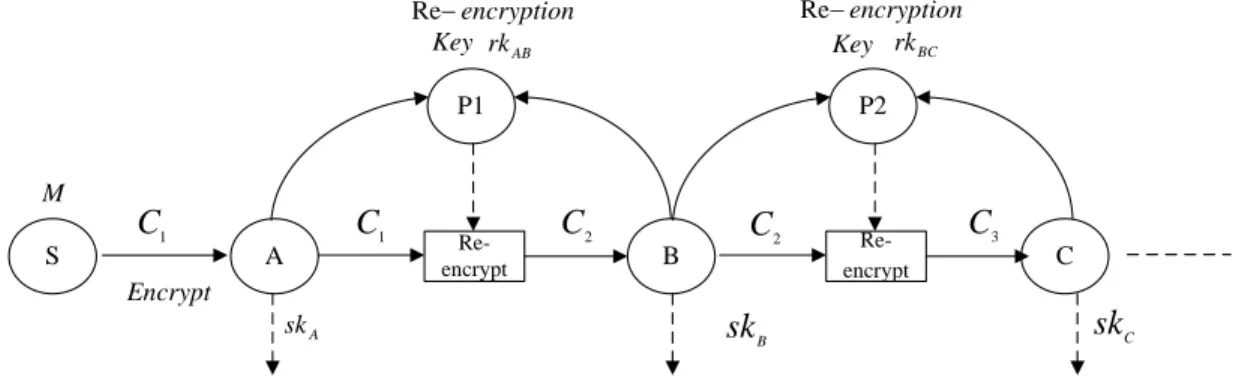
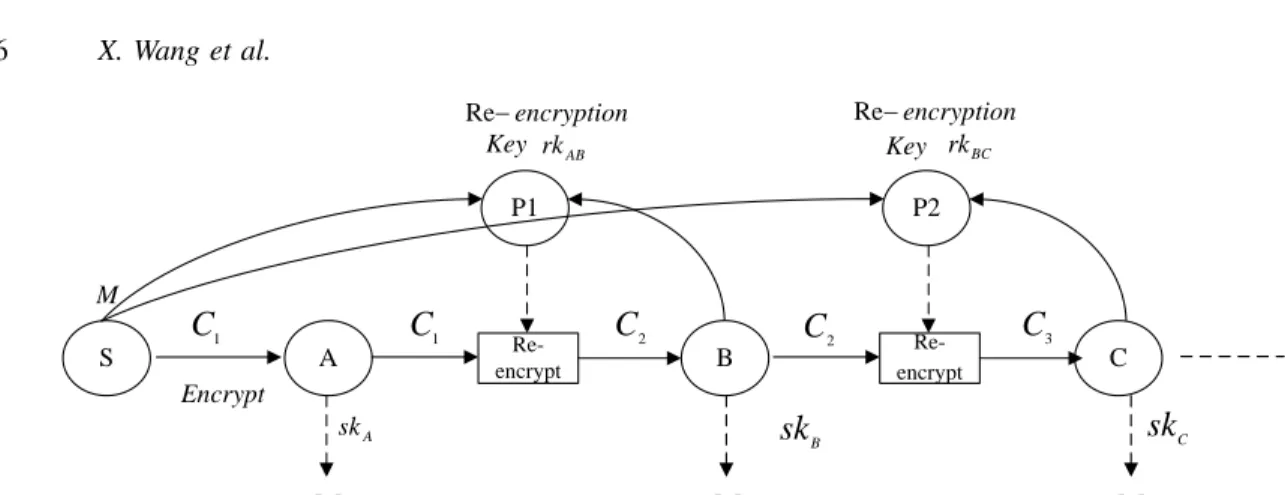
The rationale for proposing a new scheme is based on the following observation. We observe that all thePREschemes until now require the delegator (or the delegator and the delegatee cooperatively) to generate the re-encryption keys, which can be seen in Fig. 2. However this is not the only way to generate the re-encryption keys.The encrypter also has this ability, after all, it has the full control on his plaintext and its corresponding ciphertext. We exploit the possibility of constructing such aPREscheme, which we denotePREasPRE+. A graphical description onPRE+ can be seen in Fig. 3.
A encryptRe- B S P1 C Re-encrypt P2 M Encrypt encryption − Re Key encryption − Re Key 1
C
C
1C
2C
2C
3 A sk Bsk
sk
CM
M
M
AB rk rkBCFigure 2 Traditional proxy re-encryption
Intuitively, thePRE+is the dual of the traditionalPRE. In the traditionalPRE, the receiver of the ciphertexts (delegator) delegates the decryption right to the delegatee. While in the newPRE+, encrypter-the sender of the ciphertexts delegates the decryption right to the delegatee. NaturallyPRE+can be categorized as thesingle-hop andmulti-hopvariants. At first sight, thePRE+seems to be not useful for practical applications. The encrypter can directly encrypt the message to the delegatee, why there is needed for PRE+ to delegate the decryption rights? The answer lies in the following facts: First, this delegation can considerably improve the computation and communication efficiency compared with the twice encryption method. Secondly, thePRE+can solve some long standing open problems inPRElike delegation transferability and fine-grained delegation. Thirdly, considering the multi-hop variants ofPRE+, it runs like broadcast encryption except it relies on some semi-trusted proxies. And these semi-trusted proxies can be easily found in modern networks. Thus it can be well suited for some particular applications. Finally,PRE+ schemes also have many interesting applications like secure cloud computation and multicast, etc. Compared with the traditionalPRE,PRE+has the following advantages:
• Fine-grained delegation.ForPRE, all the proposed schemes so far can only achieve time-based (such as [1, 2, 30, 16]) or condition-based (such as [45, 12, 46, 39, 21]) fine-grained delegation. But this situation is not
6 A Re- B encrypt S P1 C Re-encrypt P2 M Encrypt encryption − Re Key encryption − Re Key 1
C
C
1C
2C
2C
3 A sk Bsk
sk
CM
M
M
AB rk rkBCFigure 3 PRE+: Dual of proxy re-encryption
fully satisfactory, for the proxy in these schemes can still re-encrypt the delegator’s ciphertextinfinitelytimes if and only if it is in the valid time or with the valid condition. Many practical applicationsdo notneed this property as it is preferable that the delegator can control on the messages the proxy can re-encrypt. Using our PRE+scheme this problem can be easily solved. Indeed, inPRE+, the value that can control the delegation is the encrypter’s ephemeral randomness. If we follow this principle, then the encrypter needs to use the same ephemeral randomness for the delegated messages. If the encrypter wants to allow the proxy to re-encrypt the message, it encrypts the message with the “same” ephemeral randomness. Otherwise it encrypts the message with a “different” ephemeral randomness. Thus, we can see that the encrypter can easily achieve message-based fine-grained control on the delegation.
• Non-transferable delegation.Non-transferable delegation means that, if the delegator A delegates the re-encryption right for the delegateeBto the proxyP,P andBcan not collude to delegate, representingA, new re-encryption right for any other user. ForPRE, all the schemes until now cannot solve this problem naturally. For example, in [30], the authors remarked that constructing systems withstanding thetransfer of delegation attacks remained as open problems. Although some researchers try to solve this open problem [44, 43, 18] in the identity based setting, but their proposals heavily rely on the PKG, which is not a very natural solution. Again in ourPRE+scheme this problem can be solved very naturally. In thePRE+, the encrypter computes the re-encryption key by using his ephemeral randomness for the messages and the delegatee’s public key. The normal ciphertext receiverAwill now be independent with the delegateeBand the proxyP, now ifBandP
can not collude to derive the ephemeral randomness, it will be non-transferable.
The multi-hop PRE+ runs likely the broadcast encryption (BE), for both primitives can be viewed as the encryption primitive dealing with one encrypter but many receivers. We here also discuss the difference between PRE+andBE. Obviously, multi-hopPRE+relies heavily on the physical objects, the semi-trusted proxies. But we remark thatPRE+has its own advantages compared withBEfor some particular applications.
• Scalability.Generically speaking,BEis a primitive tailorable to the scenario of one encrypter (encrypting messages) to many receivers. When designing theBEschemes, researchers focused on its efficiency including the communication cost such as the ciphertext length, public/private key size and the computation cost, while payed little attention on its scalability. When a new user joins or an old user leaves the receiver set, in some cases, the encrypter has to compute and send the ciphertext again for the whole receiver set or the whole system setup has to be rebooted. For multi-hopPRE+, the scalability issue can be solved smoothly. If a new user joins or an old user leaves the receiver set, what is needed to do is the delegator (encrypter) adjust the new user’s nearest proxy’s re-encryption key, which is a very easy task.
• Efficiency.In currentBEschemes, researchers always have to make some trade-off between size of the ciphertext and public/private keys, for example, The best known fully collusion resistantBEscheme is theBGWscheme, proposed by Boneh, Gentry and Waters in Eurocrypt’05 [5], which can achieveO(√n)-size ciphertexts and
PRE : Dual of Proxy Re-encryption for Secure Cloud Data Sharing Service 7 public key; others chemes can achieve constant size ciphertext,O(n)-size public key and constant size private keys. While in thePRE+scheme, the constant size of ciphertext and public/private keys can be easily achieved.
3 Preliminaries
3.1 Bilinear Map
LetGandGT be two groups of orderpfor some large primep. A bilinear mape:G×G→GT between these
two groups satisfies the following properties:
• Bilinear: We say that a mape:G×G→GT is bilinear if e(aP, bQ) =e(P, Q)ab for all P, Q∈Gand
a, b∈ZZp.
• Non-degenerative: The map does not send all pairs inG×Gto the identity inGT. We observe thatG,Gare
groups of prime order, this implies that ifPis a generator ofGthene(P, P)is a generator ofGT.
• Computable: There is an efficient algorithm to computee(P, Q)for anyP, Q∈G.
We denoteBSetupas an algorithm that, on input the security parameter1k, it outputs the parameters for a bilinear map as(p, g,G,GT, e), wherep∈Θ(2k).
3.2 Complexity Assumptions
Let(p, g,G,GT, e) be a bilinear group of prime orderpandP be its generator. Here we define the extended decisional bilinear Diffie-Hellman (eDBDH) assumption, extended decisional linear (eDL) assumption and variant of discrete logarithm (vDL) assumption.
eDBDH Problem. Let (p, g,G,GT, e)←BSetup(1k) The eDBDH problem is as follows: given given
(g, ga, gab, gcd/b, gcde/b, gcf, gb/e, gued/bgsf, T) or random. for some a, b, c, d, e∈Zp∗ and T ∈GT, decide
whetherT =e(g, g)ad. An algorithmAhas advantagein solving eDBDH problem if
|P r[A(g, ga, gab, gcd/b, gcde/b, gcf, gb/e, gued/bgsf, e(g, g)ad) = 0]
−P r[A(g, ga, gab, gcd/b, gcde/b, gcf, gb/e, gued/bgsf, T) = 0]| ≥
where the probability is over the random choices ofa, b, c, d, e, u, f, sinZp∗, the random choices ofT inGT, the
random choice ofg∈G∗, and the random bits ofA.
Definition 3.1: (eDBDH Assumption)We say that the -eDBDH assumption holds if no PPT algorithm has advantage at leastin solving the eDBDH problem.
eDL Problem. Let (p, g,G,GT, e)←BSetup(1k). The eDL problem is as follows: Given
(g, gα2, gα1α2α4, gα3, gα1α3α5, gα1α4u), decide whetherT =gα5−α4. An algorithmAhas advantagein solving
eDL problem if
|P r[A(g, gα2, gα1α2α4, gα3, gα1α3α5, gα1α4u, gα5−α4) = 0]
−P r[A(g, gα2, gα1α2α4, gα3, gα1α3α5, gα1α4u, T) = 0]| ≥
where the probability is over the random choices ofα1, α2,· · · , α5, uinZp∗, the random choices ofTinGT, the
random choice ofg∈G, and the random bits ofA.
Definition 3.2: (eDL Assumption)We say that the-eDL assumption holds if no PPT algorithm has advantage at leastin solving the eDL problem.
8
vDL Problem. Let (p, g,G,GT, e)←BSetup(1k). The vDL problem is as follows: Given
(gβ1, guβ2/β1, gβ2−β3, gβ2/β1), compute(β
2, β1), An algorithmAhas advantagein solving vDL problem if
|P r[A(gβ1, guβ2/β1, gβ2−β3, gβ2/β1) = (β2, β1)]| ≥
where the probability is over the random choices ofβ1, β2, β3, uinZp∗, the random choice ofg∈G, and the random
bits ofA.
Definition 3.3: (vDL Assumption)We say that the-vDL assumption holds if no PPT algorithm has advantage at leastin solving the vDL problem.
4 Definition and Security Model for PRE
+4.1 Definition
Definition 4.1: PRE+ (Dual of proxy re-encryption) scheme is a tuple of algorithms PRE+.KeyGen,
PRE+.ReKeyGen, PRE+.Enc, PRE+.ReEnc, PRE+.Dec)
PRE+.KeyGen(1k)→(pk, sk): On input the security parameter1k, this algorithm outputs the decrypter’s public
key/secret key pair (pk1,sk1) and the delegatee’s public/secret key pair (pk2,sk2). Here we emphasis that
in PRE+, the delegator is the encrypter, while in traditional PRE the delegator is the decrypter (ciphertext receiver).
PRE+.Enc(pk
1, m)→C2: On input a public keypk1, ephemeral randomness consisting of(r, r0)1, a message
m∈ {0,1}n, this algorithm (the encrypter) outputs a second-level ciphertextC 2.
PRE+.ReKeyGen(r0, pk
1, pk2)→rk1→2: On input ephemeral randomness r0 for pk1, public key pk2, this
algorithm (the encrypter) outputs a re-encryption keyrk1→2.
PRE+.ReEnc(rk
1→2, C2)→C1: On input a re-encryption keyrk1→2and a ciphertextC2, this algorithm (the
proxy) outputs a first-level ciphertextC1or the error symbol⊥.
PRE+.Dec
2(sk2, C2): On input a secret keysk2and a second-level ciphertextC2, this algorithm (the decrypter)
outputs a messagem∈ {0,1}nor⊥.
PRE+.Dec
1(sk1, C1): On input a secret keysk1 and a first-level ciphertextC1, this algorithm (the delegatee)
outputs a messagem∈ {0,1}nor⊥.
Roughly speaking, the correctness requires that, for all(pki, ski)←PRE+.KeyGen(1k)and(pkj, skj)←
PRE+.KeyGen(1k), it holds that
PRE+.Dec2(ski,PRE+.Enc(pki, m)) =m.
PRE+.Dec1(skj,PRE+.ReEnc(PRE+.ReKeyGen(r0, pk1, pk2),PRE+.Enc(pki, m)) =m.
4.2 Security Models
We start by giving some definitions.
Definition 4.2: (CCA-security for the Second-level Ciphertext).A single-use unidirectionalPRE+scheme is
CCA-secure for the second-level ciphertext if the advantage of any PPT adversaryAin the following game played between a challengerCandAis negligible in the security parameterk. Note that we work in the static corruption model, where the adversary should decide the corrupted users before the game starts.
PRE : Dual of Proxy Re-encryption for Secure Cloud Data Sharing Service 9
Phase 1:The adversaryAadaptively issues queriesq1,· · ·, qn1 where queryqiis one of:
• Opk: On input an indexi, the Challenger takes a security parameterk, and responds by running algorithm
PRE+.KeyGen(1k)to generate a key pair(pk
i, ski), givespkitoAand records(pki, ski)in tableTK.
• Osk: On inputpkibyA, wherepkiis fromOpk, ifpkiis corrupted, the Challenger searchespkiin table
TKand returnsski; otherwise, the Challenger returns⊥.
• Ork: On input(pki, pkj)byA, wherepki,pkj are fromOpk, the Challenger returns the re-encryption
keyrkpki→pkj =PRE
+.ReKeyGen(r0, pk
i, pkj), whereskiis the secret key corresponding topki.
• Ore: On input (pki, pkj, C) by A, where pki, pkj are from Opk, the Challenger returns the
re-encrypted ciphertextC0 =PRE+.ReEnc(PRE+.ReKeyGen(r0, pki, pkj), C), whereskis the secret key
corresponding topk.
• Odec: On input (pki, Ci), where pki is from Opk, the Challenger returns PRE+.Dec1(ski, Ci) or
PRE+.Dec
2(ski, Ci), whereskiis the secret key corresponding topki.
Challenge: Once the adversaryAdecides that Phase 1 is over, it outputs two equal length plaintextsm0,m1from
the message space, and a public keypk∗ on which it wishes to challenge. There are three constraints on the public keypk∗, (i) it is fromOpk; (ii) it is uncorrupted; (iii) if(pk∗,F)did appear in any query toOrk, then
Fis uncorrupted. The Challenger picks a random bitb∈ {0,1}and sets C∗ =PRE+.Enc(pk∗, m
b) It sendsC∗as the challenge toA.
Phase 2:The adversaryAadaptively issues more queriesqn1+1,· · ·, qn, but with the following restrictions.
• Ork: On input(pki, pkj)byA, the following requirements should be all satisfied.
– pkiandpkjare fromOpk;
– ifpki=pk∗, thenpkjis uncorrupted.
• Ore: On input(pki, pkj, Ci)byA, the following requirements should be all satisfied.
– pkiandpkjare fromOpk;
– if (pki, Ci) is a derivative, the Challenger outputs ⊥. Otherwise the challenger returns C0=
PRE+.ReEnc(PRE+.ReKeyGen(r0, pk
i, pkj), Ci). Derivatives of(pk∗, C∗)are defined as follows:
1. (pk∗, C∗)is a derivative of itself.
2. If(pk, C)is a derivative of(pk∗, C∗)and(pk0, C0)is a derivative of(pk, C), then(pk0, C0)is a derivative of(pk∗, C∗).
3. IfAhas queriedOreon input(pk, pk0, C)and obtained(pk0, C0), then(pk0, C0)is a derivative of
(pk, C).
4. If A has queried Ork on input (pk, pk0), and C0=PRE+.ReEnc(Ore(r0, pk, pk0), C), then
(pk0, C0)is a derivative of(pk, C).
• Odec: On input(pki, Ci), if the following requirements are all satisfied, the Challenger responds as in
Phase 1; otherwise, the Challenger outputs⊥.
– pkiis fromOpk;
– (pki, Ci)is not a derivative of(pk∗, C∗).
Guess: Finally, the adversaryAoutputs a guessb0∈ {0,1}and wins the game ifb=b0. We define adversaryA’s advantage in attackingPRE+as
AdvP RE2CCA+=|Pr[b=b0]−
1 2|.
10
Definition 4.3: (CCA-security for the First-level Ciphertext.)A single-use unidirectional PRE+ scheme is
CCA-secure for the first-level ciphertext if the advantage of any PPT adversaryAin the following game played between a challengerCandAis negligible in the security parameterk. Note that we work in the static corruption model, where the adversary should decide the corrupted users before the game starts.
Setup:The Challenger sets up the system parameters.
Phase 1:The adversaryAadaptively issues queriesq1,· · ·, qn1 where queryqiis one of:
• Opk: Same as the above definition.
• Osk: Same as the above definition.
• Ork: Same as the above definition.
• Ore: Same as the above definition.
• Odec: On input(pki, Ci), wherepkiis fromOpk, the Challenger returnsPRE+.Dec1(ski, Ci), whereski
is the secret key corresponding topki.
Challenge: Once the adversaryAdecides that Phase 1 is over, it outputs two equal length plaintextsm0,m1from
the message space, and two public keyspk∗,pkon which it wishes to challenge. There are two constraints on the public keypk∗, (i) it is fromOpk; (ii) it is uncorrupted. The Challenger picks a random bitb∈ {0,1}and
sets
C∗=PRE+.ReEnc(PRE+.ReKeyGen(r0, pk, pk∗),PRE+.Enc(pk, mb)) It sendsC∗as the challenge toA.
Phase 2:The adversaryAadaptively issues more queriesqn1+1,· · ·, qn, but with the following restrictions.
• Ork: On input(pki, pkj)byA, the following requirements should be all satisfied.
– pkiandpkjare fromOpk;
• Odec: On input(pki, Ci), if the following requirement is satisfied, the Challenger responds as in Phase 1;
otherwise, the Challenger outputs⊥.
– pkiis fromOpk;
Guess: Finally, the adversaryAoutputs a guessb0∈ {0,1}and wins the game ifb=b0. We define adversaryA’s advantage in attackingPRE+as
AdvP RE1CCA+=|Pr[b=b0−
1 2|.
Remark 1. In the first-level ciphertext security game, the challenge ciphertext is a re-encrypted ciphertext. Note that, in a single-hop unidirectionalPRE+scheme, since the first level ciphertext cannot be re-encrypted, the
adversary should be allowed to obtain any re-encryption keys, even including those from the target public keypk∗ to other public keys which are corrupted. Furthermore, sinceAis allowed to obtain any re-encryption keys, there is no need to provide the re-encryption oracle and the second level decryption oracle for him.
Definition 4.4: (Collusion Resistant Security.)A single-use unidirectionalPRE+is collusion resistant under an adaptive chosen ciphertext attack if no polynomial bounded adversaryAhas a non-negligible advantage against the Challenger in the following game. Here, we also work in the static corruption model.
Setup:The Challenger sets up the system parameters.
Find: Almost the same as Phase 1 in the above game, except that there is no re-encryption oracle in this game,
PRE : Dual of Proxy Re-encryption for Secure Cloud Data Sharing Service 11
Output: Finally, the adversaryAoutputs the randomness, which used to generate re-encryption key (According to
the above algorithm notation, we can denote it asr0), and wins the game if the corresponding public keypkis uncorrupted.
We define adversaryA’s advantage in attackingPRE+as
AdvCRP RE+ =Pr[Awins].
5 Our Scheme Construction
5.1 The Proposed Single-hop PRE
+Scheme
Our construction is based on [22] and the following is our concrete scheme:
1. Setup(k): On input the security parameter k, the setup algorithm outputs the system parameter (g, p,G,GT, e)→BSetup(k), hash functionsH1,H2,H3and a random generatorg0∈G, where H1(·) :
{0,1}∗→Z∗
p, , H2(·) :GT → {0,1}l, H3(·) :G2×GT × {0,1}l×G4→G.
2. KeyGen(k):On input the security parameterk, the key generation algorithm outputs a (public key, private key) pair(pk1=gx1, sk1=x1)for the decrypter, a (public key, private key) pair(pk2=gx2, sk2=x2)for
the delegatee wherex1, x2∈Zp∗.
3. Encrypt(m, pk1):On input a messagem∈ {0,1}l, fixed randomness(t, r1)and unfixed randomness(r, k1, π)
fromZp∗, and a public keypk1, the regular encryption algorithm outputsC= (c1, c2, c3, c4, c5, c6, c7, c8, c9)
where r=H1(m, h), c1=gr, c2=gtr, c3=h·e(g, g)rr1, c4=m⊕H2(h), c5=pk r1 t 1 , c6=pk k1r1 t 1 , c7=pk1π, c8=g t k1, c9=g0 k1r1 t H3(c1||c2||c3||c4||c5||c6||c7||c8||pk1)π
wherehis a random element fromGT.
4. ReKeyGen(pk2, Randomness(r1, t),pk1):The encrypter gives the proxy the re-encryption key
rkpk1→pk2= (pk r2
t 2 , g
r2g−r1, g0rt2, gt)
wherer2is a random number fromZp∗.
5. ReEnc(C, rkpk1→pk2):On input the ciphertextC, the proxy outputsC0= (c01, c02, c03, c04, c05, c06, c07,
c08, c09): c01=c1, c02=c2, c03=c3·e(c1, gr2g−r1) =h·e(g, g)rr2, c04=c4, c05=pk r2 t 2 , c 0 6=pk k2r2 t 2 , c 0 7=pk π0 2 , c 0 8=g t k2, c09=g0k2tr2H3(c0 1||c 0 2||c 0 3||c 0 4||c 0 5||c 0 6||c 0 7||c 0 8||pk2)π 0 whereπ0,k
2. are randomly chosen fromZp∗.
6. Decrypt(C, sk):it runs as follows:
12
– First check whether
e(c9, pk1) =e(g0, c6)e(H3(c1||c2||c3||c4||c5||c6||c7||c8||pk1), c7)
if it does not hold, output⊥and terminate, otherwise do the following.
– Computeh=c3/e(c2, c5) 1 x. – Computem=c4⊕H2(h). – Computer=H1(m, h). – Outputm, ifc1=gr,⊥otherwise.
• On input a first-level ciphertextC0, and a secret keysk2, the decryption algorithm decrypts as the above,
for these two level ciphertexts share the same structure.
Remark 2.Roughly speaking, this scheme can be viewed as combining two parts: the BF-IBE part and the Waters signature part. Note thatc4is computed by the scheme BF [4], andc6, c7, c9are computed by the strongly
unforgeable variant [6] of Waters scheme [42]. Thus our scheme’s security roughly can be based on the security of BF-IBE and Waters signature.
Remark 3. By combing randomness(r, r1, π) and the introduced randomness(k, t), we can instantiate the
concept ofPRE+ and prove its security. It should be noted that our scheme can be simplified or more natural schemes in the standard model can be constructed, we leave them as important open problems.
5.2 Security Analysis
Theorem 5.1: Our proposal is PRE+-CCA-secure in the random oracle model for the second level ciphertext
under assumptions that the eDBDH problem and eDL problem are hard.
Proof.We incrementally define a sequence of games starting at the real attack (GameG0), and ending up at
GameG9, which clearly shows that the adversary cannot break the system. We defineEito be the eventb=b0in
GameGi, wherebis the bit involved in the challenge phase, andb0is the output ofAin the Guess phase. Note in our
scheme, the two-level ciphertexts share the same structure, thus the decryption oracle for the first level ciphertext and the decryption oracle the second level ciphertext are same, thus in the following Games, we just consider one decryption oracle.
• GameG0.This game corresponds to the real attack. By definition,
|P r[E0]−1/2|=Adv2CCAP RE+(k) (1)
• GameG1.In this game, we modify the hash functions to the random oracles.
– Oh1: On input a stringS, the Challenger checks whether(S, r(1))exists in TableTh1. If it is, the Challenger
returnsr(1); otherwise, the challenger chooses a random numberr(1)fromZ∗
p, returnsr(1), and records
(S, r(1))into TableTh1.
– Oh2: On input a string S, the Challenger checks whether(S, R
(2))exists in TableT
h2. If it is, the Challenger
returns R(2); otherwise, the Challenger chooses a random numberR(2) from{0,1}l, returnsR(2), and
records(S, R(2))into TableTh2.
– Oh3: On input a string c1||c2||c3||c4||c5||||c6||c7||c8||pk, the Challenger checks whether
(c1||c2||c3||c4||c5||||c6||c7||c8||pk, R(3),∗) exists in Table Th3. If it is, the Challenger returns R (3);
otherwise, the Challenger chooses a random number r(3) fromZp∗, returns R(3) =pkr (3)
, and records (c1||c2||c3||c4||c5||||c6||c7||c8||pk, R(3), r(3))in TableTh3.
• GameG2.In this game, we modify Oh1 and the challenge phase by settingh=h
∗, wherehis a random number fromZp∗.
PRE : Dual of Proxy Re-encryption for Secure Cloud Data Sharing Service 13
– Oh1: On input a stringmb||h∗, the Challenger aborts. Other performances are the same as those inOh1
which we first mention.
– Challenge: The Challenger setsh=h∗, other performances are the same as those inOh1 which we first
mention.
It is easy to see that only if the adversary never queriesOh1 withmb||h
∗,GameG
2andGameG1are
indistinguishable. Hence, we have
|P r[E2−E1]≤
qh1
p
whereqh1is the maximum number of queries toOh1(including the number the Challenger queriesOh1).
• GameG3.In this game, we setg0=g+1(6=g) =gu, whereuis chosen randomly fromZp∗. The Challenger
knows a valuelogg−1
g = 1/usatisfyinge(g−1, g+1) =e(g, g). It is easy to see thatGameG3andGameG2
are indistinguishable.
P r[E3] =P r[E2]
• GameG4.In this game, we modify the re-encryption oracle and the decryption oracle as follows.
– Ore: On input (pki, pkj, C), if (pk∗, C∗) = (pki, C) andpkj is uncorrupted, the Challenger records
(pkj, Encrypt(pkj, Odec(pki, C)))into TableTre. Other performances are the same as that inGameG3.
– Odec: On input(pki, Ci), ifpkiis uncorrupted, the Challenger checks whether(pki, Ci)exists in Table
Tre. If yes, the Challenger outputs⊥. Other performances are the same as that inGameG4. Note that
TableTreis used to record the derivatives of the second level challenge ciphertext fromOre.
we can easily obtain that
P r[E4] =P r[E3]
• GameG5.In this game, we modify the decryption oracle as follows.
– Odec: The Challenger only changes the method of doing the decryption for the uncorrupted public keys
as follows, and other performances are the same as that inGameG4.
1. Set a setS=φ. 2. Find(S, r(1))in TableT
h1, such thatg r(1) =c
1, m0||h0=S, c4=m0⊕H2(h0).
3. IfS=φ, then output⊥and terminate. Otherwise, do the following. 4. Choose the first pair(S, r(1))fromS, and setS=S/(S, r(1)).
5. Ifh0 =c3/e(c9/cr (3) 7 , c8)r
(1)/u
ande(c9, pki) =e(g0, c6)e(H3(c1||c2||c3||c4||c5||c6||c7||c8||
pki), c7)both hold, outputm0and terminate; otherwise, go to Step 3. Note thatr(3)is the associated
value to(c1, c2, c3, c4, c5, c6, c7, c8, pki)inTh3, and
H3(c1||c2||c3||c4||c5||c6||c7||c8||pki) =pkr (3) i
InGameG5, the Challenger decrypts the ciphertext not by using the secret key but the random oracles (Oh1,
Oh2andOh3). Hence,GameG5andGameG4would be different, if the adversary guessed the correct value
ofH1(m||h)without queryingOh1 or guessed the correct value ofH2(h)without queryingOh2 or guessed
the correct value ofH3(c1||c2||c3||c4||c5||c6||c7||
c8||pki)without queryingOh3. The probability of this issue is(qh2/p+qh3/2
l+q
h3/p)at most. As a result,
we have that
|P r[E5]−P r[E4]| ≤qdec(qh2/p+qh3/2l+qh3/p)
whereqh1, qh2, qh3is the maximum number of queries toOh1, Oh2, Oh3(including the number the Challenger
queriesOh1, Oh2, Oh3).
14
– It is almost the same as that inGameG5, except that ifpkiis corrupted, and the plaintext is⊥obtained
in the previous performances, the Challenger additionally performs the following.
1. If e(c9, pki) =e(g0, c6)e(H3(c1||c2||c3||c4||c5||c6||c7||c8||pki), c7) holds, do the following steps;
otherwise, output⊥and terminate. 2. SetS1=S2=S20. 3. Search (rk1 pk∗→pk i, rk 2 pk∗→pk i, rk 3 pk∗→pk i, rk 4 pk∗→pk
i) in Table Trk (where Trk records the
re-encryption keys which have returned to the adversary), and put all(rk1 pk∗→pk i, rk2 pk∗→pk i, rk 3 pk∗→pk i, rk 4 pk∗→pk
i)into the setS1.
4. Search(S, r(1))in TableT
h1, such thatm0||h0=S,c4=m0⊕H2(h0), andc1=gr (1)
, and then put all(S, r(1))into setS
2andS20.
5. IfS1=φorS2=φ, then output⊥and terminate. Otherwise, do the following.
6. Choose the first pair (rkpk1 ∗→pki, rk2pk∗→pki, rkpk3 ∗→pki, rk4pk∗→pki) from S1, and set S1=
S1/(rkpk1 ∗→pki, rk2pk∗→pki, rkpk3 ∗→pki, rk4pk∗→pki)
7. Choose the first pair(S, r(1))fromS2, and setS2=S2/(S, r(1)).
8. Ifc03=c3e(c9/cr (3) 7 , g t k1)r (1)
u wherer(3)is the associated value to(c1, c2, c3, c4, c5, c6, c7, c8,
pki)inTh3.
9. IfS1=φ, output⊥; otherwise, do the following steps.
10. IfS2=φ, then setS2=S20 and go to Step 5; otherwise, go to Step 6.
Note that if the input regular ciphertext is computed fromReEnc, the verifying equation in step 8 must hold. Hence, the modification in this game does not makeGameG6different fromGameG5. As a result, we have
that
P r[E6] =P r[E5]
• GameG7. In this game, we continue to modify the re-encryption key generation oracle as follows.
– Ork: On input(pki, pkj), ifpki 6=pk∗, then the Challenger returns(pk r2/t
j , g
r2g−r1, g0r2/t, gt)where
(r1, t)are fixed randomness chosen by the challenger in advance, andr2is randomly chosen fromZp∗.
Other performances are the same as those inGameG6.
It is easy to see thatGameG7andGameG6are indistinguishable. Hence, we have that
P r[E7] =P r[E6]
• GameG8. In this game, we modify the re-encryption oracle as follows.
– Ork: On input (pki, pkj), if pki=pk∗, the pkj is uncorrupted, then the Challenger returns
(A, B, C, D, pkj)whereA, B, Care random elements fromG, ande(A, g0) =e(C, pkj)andDis fixed
asgt. Other performances are the same as those inGameG 7.
We have the following analysis on the difference betweenGameG7andGameG8.
– OdecandOredo not use the secret keys of the uncorrupted users inGameG7.
Note that due to the modification inGameG6, the decryption oracle cannot help to verify the modification
onOrk. InGameG6, it is guaranteed that the first level ciphertexts fromReEnc(Ork, C)can be decrypted
properly.
Hence, if the adversary without knowing1/ucan verify the modification onOrk, we can build an algorithm
to solve the eDL hard problem. In particular, set t= 1/α1, pki=gα2, r1=α4, pk r1/t
i =g
α1α2α4, pk
j=
gα3, r
2=α5,(pkj)r2/t=gα1α3α5,(g0)r2/t=gα1α4u, we can not calculate the value ofgr2g−r1 =gα5−α4.
PRE : Dual of Proxy Re-encryption for Secure Cloud Data Sharing Service 15 these value all are completely random for randomness(r,(r, h), k1,(k1, π), r,(r, h), k2,(k2, π0)). Hence we
have that
|P r[E8]−P r[E7]| ≤qrk·eDL
whereqrkis the maximum number of queries toOrk.
• GameG9. In this game, we modify the challenge phase as follows.
– Challenge: The challenge ciphertext is
r=a, c∗1=gr=ga, t=b, c∗2=gtr=gab, c∗3=h∗T, c∗4=mb⊕H2(h∗), pk1=gc, r1=d, c∗5=pk r1/t 1 =g cd/b, k 1=e, c∗6=pk k1r1/t 1 =g cde/b, π=f, c 7=pk1π=g cf, c8=gt/k1 =gb/e, H3(c1||c2||c3||c4||c5||c6||c7||c8||pk1) =gs, c9=g0 k1r1 t H3(c1||c2||c3||c4||c5||c6||c7||c8||pk1)π=gued/bgsf
The rest of performances are the same as those in previous game. Note that in the above we implicitly set H1(m, h) =a, and T is a random number. If the adversary can distinguish Game G9 and Game
G8, we can build an algorithm B that solves the eDBDH problem. The eDBDH problem is, given
(ga, gab, gcd/b, gcde/b, gcf, gb/e, gued/bgsf, T)and decide ifT =e(g, g)ador random. it is clear thatGame
G9is the same asGameG8. Hence, we have that
|P r[E9]−P r[E8]| ≤eDBDH
Furthermore, it is clear that inGameG9
P r[E9] = 1/2
sinceT is a random element.
As a result, combining the above equations among the Games, we get the theorem proved.
Theorem 5.2: Our proposal is PRE+-CCA-secure in the random oracle model for the first level ciphertext under
assumptions that the eDBDH problem and eDL problem are hard.
We can use a similar method in the proof of the above Theorem 5.1 to prove this theorem, for the first level ciphertext and the second level ciphertext share the same structure, here we omit the details..
Theorem 5.3: Our PRE+proposal is collusion-resistent under assumption that vDL problem is hard.
Here when the proxy and the delegatee collude, they can compute(grt2, gr2g−r1, g0 r2
t , gt), but this does not
help them compute(r1, t)under the eDL problem, which is the randomness used to generate re-encryption keys.
The vDL problem is, given(gβ1, guβ2/β1, gβ2−β3, gβ2/β1), compute(β
2, β1), which is difficult. Thus our PRE+
proposal is collusion-resistent.
5.3 Feature Comparison and Performance Analysis
In this subsection, we first give the feature comparison results with related work, which can be seen in Table 1. From this table, we can see that our scheme can achieve most useful properties for cloud storage, such as being unidirectional, CCA-secure, supporting conditional delegation, collusion-safe, without cost bilinear pairing, non-transferable and fine-grained message-level delegation. Especially, for the last two properties, non-transferability and message-level delegation, until now almost no natural proxy re-encryption schemes could be achieved.
Further, we give the performance analysis results, which can be seen in Table 2. Here we just compare with scheme [22], on which we construct our scheme. Heretmdenotes the computation time for modular exponentiation
andtpdenotes the computation time for bilinear pairing,|G|denotes the length of one group element in|G|,|GT|
16
Table 1 Feature Comparison
Schemes Unidirectional (R)CCA-secure Conditional Collusion-safe Without pairing Non-transferable Message-level delegation
[1] Yes No No Yes No No No
[8] No Yes No No No No No
[13] No Yes Yes No Yes No No
[22] Yes Yes Yes Yes Yes No No
[31] Yes Yes No Yes No No No
[46] Yes Yes Yes Yes No No No
Our Yes Yes Yes Yes No Yes Yes
H2’s output (our scheme can be easily modified to handle arbitrary length message). From this table we can see
that our scheme is a little less efficient than scheme of [22], but our scheme can achieve many other interesting properties, while their scheme can not achieve them. Furthermore, we believe that there can be far more efficient PRE+schemes than this scheme, which is just a proof of concept, we leave designing such schemes as our future work.
Table 2 Computation cost
Scheme Enc Check Reenc Dec Ciph-Len
1ndCiph 2ndCiph 1stCiph 2ndCiph
[22] 2tm+ 1tp 2tp 5tm+ 1tp 2tp 4tp+ 3tm 4|G|+ 1|GT|+|l| 3|G|+|l| Our 1tp+ 8te 3tp 5tm+ 1tp 2tm+ 4tp 2tm+ 4tp 7|G|+ 1|GT|+|l| 7|G|+ 1|GT|+|l|
5.4 Extention to a Multi-hop Variant
Our single-hopPRE+scheme can be easily extended to a multi-hop variant. Below is the concrete scheme: 1. Setup(1k):Same as the single-hop scheme.
2. Keygen(1k):Same as the single-hop scheme.
3. Encrypt(m, pki−1):Same as the single-hop scheme.
4. ReKeyGen(pki, Randomness(ri−1, t),pki−1):The encrypter gives the proxy the re-encryption key
rkpki= (pk ri
t
i , g
rig−ri−1, g0rit, gt)
whereri is a random number from Zp∗, and the encrypter recordsri for the next hop’s re-encryption key
generation.
5. ReEnc(C, rkpki−1→pki):Same as the single-hop scheme.
6. Decrypt(C, ski):Same as the single-hop scheme.
Remark 4.Note in this scheme the ciphertext remains constant no matter how many times it has been re-encrypted. This is a very desirable feature in practical applications. We emphasise the construction of constant-size ciphertext multi-hop CCA-secure traditionalPREscheme remains as a very important open problem until now. We also note the encrypter needs to remember the randomnessrifor the(i+ 1)hop’s re-encryption key generation, which will
restrict its employment. We leave construction of new multi-hopPRE+ scheme, which need not remember the randomness as an important open problem.
PRE : Dual of Proxy Re-encryption for Secure Cloud Data Sharing Service 17
6 Scanf: A scalable and controllable secure cloud data sharing framework
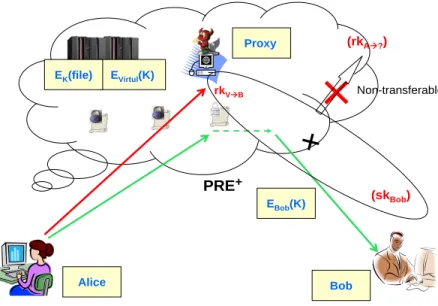
In this section, we describe a scalable and controllable secure cloud data sharing framework, denoted asScanf, based on the primitivePRE+, which can be seen in Fig. 4.
EVirtul(K) EK(file) EBob(K) rkVÆB PRE+ (skBob)
+
(rkAÆ?)×
Non-transferable Alice Bob ProxyFigure 4 PRE+in Secure Cloud Computation
In this framework, there are four kinds of parties. The first kind is the client users, denoted as Alice, which outsources data contents to the Cloud. The second one is the infrastructure provider, the Cloud, which stores and manages client users’ outsouring data contents. The third one is the data users (sharers), denoted as Bob, which will access Alice’s data contents. The final one is the access controller, denoted as proxy, which does the ciphertext transformation process (note here the proxy can be the Cloud). In order to protect her outsourced data’s privacy, Alice first encrypts her data contents. Here we assume Alice first constructs a virtual user Virtual, which she knows its private/public key. Then Alice encrypts her data content under a symmetrical keyK, and then encryptsK under the public key of Virtual, and outsources them to Cloud. After knowing Bob’s public key, she assigns the re-encryption keyrkv→Bto the proxy. When data user Bob wants to access the content of Alice, he relies on the
proxy doing the re-encryption fromV toBwithrkv→B. In this process, the proxy cannot know the content, neither
he can get any information on private keys of Virtual and Bob.
One might argue that the traditionalPREcan also do this job. But our point is that our Scanf framework based onPRE+performs very well on thenon-transferable and message level based fine-grained delegation issues. In the current state of the art, almost there exist noPREschemes with non-transferable property, and noIBPRE schemes with non-transferable property without the help ofPKG[44], while relying onPKGis not a good choice for practical applications. That means, if usingPREin this framework, the proxy and Bob can collude to representing Alice, to make new delegations to new users. Obviously, this contradicts Alice’s original intention. Similarly, in the current state, all thePREschemes cannot handle the fine-grained delegation at themessage based level. This will be inconvenient as Alice has no control on which content will be re-encrypted. She has to incorporate the condition or type or time information in her content if she uses the conditional or type or time basedPRE. While inPRE+, Alice can easily control on which content will be re-encrypted and which will be not. Thus our framework can achieve good scalability and controllability, which is important for secure data sharing in cloud storage.
18
7 Conclusion
In this paper, we have introduced a new primitive:PRE+, which is the dual ofPRE. We have discussed the differences with existing primitivesPRE andBE. We also give the definition and a security model for this new primitive, construct a concrete single-hop scheme and prove itsIND-CCAsecurity, and finally,extend it to a multi-hop scheme. Based on our scheme, we proposed a scalable and controllable secure cloud data sharing framework, denoted Scanf, which is useful for practical applications of data storage.
In our future work we would like to explore other issues such as finding interesting applications ofPRE+, constructing other variants of single-hop and multi-hopPRE+schemes based on different assumptions, exploring the relationship betweenPRE+and other cryptographic primitives like proxy encryption, etc.
8 Acknowledgements
The authors would like to express their gratitude thanks to Dr. Xiaoqi Jia, Dr. Qianhong Wu, Dr. Jian Weng, Dr. Jun Shao, Dr. Licheng Wang for many helpful comments. This work was supported by Natural Science Foundation of Shaanxi Province (Grant No. 2014JM8300), the Changjiang Scholars and Innovation Research Team in University (Grant NO. IRT 1078), the Key Problem of NFSC-Guangdong Union Foundation (Grant NO. U1135002), the Major Nature Science Foundation of China (Grant NO. 61370078), China 863 project, the Fundamental Research Funds for the Center Universities (Grant NO. JY10000903001), Nature Science Foundation of China (Grant NO. 61103230, 61272492, 61402531).
Fatos Xhafa’s work has been supported by the Spanish Ministry for Economy and Competitiveness (MINECO) and the European Union (FEDER funds) under grant COMMAS (ref. TIN2013-46181-C2-1-R).
References
[1] G. Ateniese, K. Fu, M. Green and S. Hohenberger. Improved proxy re-encryption schemes with applications to secure distributed storage. InACM NDSS 2005, pages 29–43, 2005.
[2] G. Ateniese, K. Fu, M. Green, and S. Hohenberger. Improved proxy re-encryption schemes with applications to secure distributed storage. InACM Transactions on Information and System Security, no. 1, pages 1–30. 2006.
[3] G. Ateniese, K. Benson, and S. Hohenberger. Key private proxy re-encryption. InCT-RSA 2009, volume 5473 ofLNCS, pages 279–294, 2009.
[4] D. Boneh and M. Franklin. Identity-based encryption from the Weil pairing. InCRYPTO 2001, volume 2139 ofLNCS, pages 213–229, 2001.
[5] D. Boneh, C. Gentry and B. Waters. Collusion resistant broadcast encryption with short ciphertexts and private keys. InCRYPTO 2005, volume 3621 ofLNCS, pages 258–275, 2005.
[6] D. Boneh, E. Shen, and B. Waters. Strongly unforgeable signatures based on computational Diffie-Hellman. InPKC 2006, volume 3985 ofLNCS, pages 229-240, 2006.
[7] M. Blaze, G. Bleumer and M. Strauss. Divertible protocols and atomic proxy cryptography. InEUROCRYPT 1998, volume 1403 ofLNCS, pages 127–144, 1998.
[8] R. Canetti and S. Hohenberger. Chosen ciphertext secure proxy re-encryption. In ACM CCS 2007, pages 185–194, 2007.
[9] R. Canetti, S. Halevi and J. Katz. A forward-secure public-key encryption scheme. InEUROCRYPT 2003, volume 2656 ofLNCS, pages 255–271, 2003.
PRE : Dual of Proxy Re-encryption for Secure Cloud Data Sharing Service 19 [10] Y-P.Chiu, C-L. Lei, and C-Y. Huang. Secure multicast using proxy encryption. InICICS 2005, volume 3783
of LNCS, pages 280–290, 2005.
[11] C. Chu and W. Tzeng. Identity-based proxy re-encryption without random oracles. InISC 2007, volume 4779 ofLNCS, pages 189–202, 2007.
[12] C. Chu, S. Chow, J.Weng, J. Zhou, and R. H. Deng. Conditional proxy broadcast re-encryption. InACISP 2009, volume 5594 ofLNCS, pages 327–342, 2009.
[13] R. Deng, J. Weng, S. Liu and K. Chen. Chosen ciphertext secure proxy re-encryption without pairing. In CANS 2008, volume 5339 ofLNCS, pages 1–17, 2008.
[14] A. Ivan and Y. Dodis. Proxy cryptography revisited. InInternet Society (ISOC): NDSS 2003, 2003.
[15] L. Fang, W. Susilo and J. Wang. Anonymous conditional proxy re-encryption without random oracles. In PROVSEC 2009, volume 5854 ofLNCS, pages 47–60, 2009.
[16] M. Green and G. Ateniese. Identity-based proxy re-encryption. InACNS 2007, volume 4521 ofLNCS, pages 288–306, 2007.
[17] T. S. Heydt-Benjamin, H. Chae, B.Defend, and K. Fu. Privacy for public transportation. InPET 2006, volume 4258 of LNCS, pages 1–19, 2005.
[18] Y. He, T. Chim, L. Hui and S. Yiu. Non-Transferable Proxy Re-Encryption Scheme for Data Dissemination Control. Available at Cryptology ePrint Archive, Report 2010/192, 2010.
[19] S. Hohenberger, G. N. Rothblum, A.Shelat, and V. Vaikuntanathan. Securely obfuscating re-encryption. In TCC 2007, volume 4392 of LNCS, pages 233–252, 2007.
[20] S. Hohenberger, B. Waters. Realizing hash-and-sign signatures under standard assumptions. InEUROCRYPT 2009, volume 5479 of LNCS, pages 333–350, 2009.
[21] L. Ibraimi, Q. Tang, P. Hartel, and W. Jonker. A type-and-identity-based proxy re-encryption scheme and its application in healthcare. InSDM 2008, volume 5159 of LNCS, pages 185–198, 2008.
[22] X. Jia, J. Shao, J. Jing and P. Liu. CCA-secure type-based proxy re-encryption with invisible proxy. In2010 10th IEEE International Conference on Computer and Information Technology (CIT 2010), pages 1299–1305. [23] H. Khurana, A. Slagell, and R.Bonilla. Sels: A secure e-mail list service. InACM SAC 2005, pages 306-313,
2005.
[24] H. Khurana and H-S.Hahm. Certified mailing lists. InASIACCS 2006, pages 46–58, 2006.
[25] H. Khurana and R. Koleva. Scalable security and accounting services for content-based publish subscribe systems. InInternational Journal of E-Business Research, 2(3), 2006.
[26] K. Kurosawa and Y. Desmedt. A new paradigm of hybrid encryption scheme. InCRYPTO 2004, volume 3152 ofLNCS, pages 426–442, 2004.
[27] K. Liang, W. Susilo, J. K. Liu. Privacy-Preserving Ciphertext Multi-Sharing Control for Big Data Storage. In IEEE Transactions on Information Forensics and Security, Vol. 10, No. 8, pages 1578–1589, 2015.
[28] K. Liang, M. H. Au, J. K. Liu, W. Susilo, D. S. Wong, G. Yang, T. Phuong, Q. Xie. A DFA-Based Functional Proxy Re-Encryption Scheme for Secure Public Cloud Data Sharing. InIEEE Transactions on Information Forensics and Security, Vol. 9, No. 10, pages 1667–1680, 2014.
[29] X. Liang, Z. Cao, H. Lin, and J. Shao. Attribute based proxy re-encryption with delegating capabilities. In AISACCS 2009,pages 276–286, 2009.
20
[30] B. Libert and D. Vergnaud. Tracing malicious proxies in proxy re-encryption. InPairing 2008, volume 5209 ofLNCS, pages 332–353, 2008.
[31] B. Libert and D. Vergnaud. Unidirectional chosen ciphertext secure proxy re-encryption. InPKC 2008, volume 4939 ofLNCS, pages 360–379, 2008.
[32] T. Matsuo. Proxy re-encryption systems for identity-based encryption. InPairing 2007, volume 4575 ofLNCS, pages 247–267, 2007.
[33] J. Shao and Z. Cao. CCA-secure proxy re-encryption without pairing. InPKC 2009,LNCS 5443, pages. 357–376, Springer–Verlag, 2009.
[34] J. Shao, Z. Cao, P. Lin. Generic construction for CCA-secure unidirectional proxy re-encryption. In Security and Communication Networks, no. 2, pages 1-16, 2009.
[35] J. Shao, Z. Cao and P. Lin. CCA-secure PRE scheme without random oracle. Cryptology ePrint Archive, Report 2010/112, 2010. Available at http://eprint.iacr.org.
[36] J. Shao, Z. Cao, X. Liang and H. Lin. Proxy re-encryption with keyword search. InInformation Science 2010, Doi: 10.1016/j.ins.2010.03.026, 2010.
[37] J. Shao, R. Lu, X. Lin. Fine-grained data sharing in cloud computing for mobile devices. InINFOCOM 2015, 2677-2685, 2015.
[38] J. Shao, R. Lu, X. Lin. FINE: A fine-grained privacy-preserving location-based service framework for mobile devices. InINFOCOM 2014, 244-252, 2014.
[39] Q. Tang. Type-based proxy re-encryption and its construction. InINDOCRYPT 2008, volume 5365 ofLNCS, pages 130–144, 2008.
[40] G. Taban, A. A. Cardenas, and V. D. Gligor. Towards a secure and interoperable drm architecture. InACM DRM 2006, pages 69–78, 2006.
[41] A. Talmy and O. Dobzinski. Abuse freedom in access control schemes. InAINA 2006, pages 77–86, 2006. [42] B. Waters. Efficient identity-based encryption without random oracles. InEurocrypt 2005, volume 3494 of
LNCS, pages 114–127, 2005.
[43] L. Wang, L. Wang, M. Mambo, E. Okamoto. New identity-based proxy re-encryption schemes to prevent collusion attacks. InPairing 2010, volume 6487 of LNCS, pages 327–346, 2010.
[44] X. Wang, X. Yang, F. Li. On the Role of PKG for Proxy Re-encryption in the Identity Based Setting. Available at Cryptology ePrint Archive, Report 2008/410, 2008.
[45] J. Weng, R. H. Deng, C. Chu, X. Ding, and J. Lai. Conditional proxy re-encryption secure against chosen-ciphertext attack. InACM ASIACCS 2009, pages 322–332, 2009.
[46] J. Weng, Y. Yang, Q. Tang, R. Deng, and F. Bao. Efficient conditional proxy re-encryption with chosen-ciphertext security. InISC 2009, volume 5735 ofLNCS, pages 151–166, 2008.
[47] J. Weng, M. Chen, Y. Yang, R. Deng, K. Chen and F. Bao CCA-secure unidirectional proxy re-encryption in the adaptive corruption model without random oracles. In Science China Information Sciences, 53:593-606, 2010.
[48] J. Weng, M. Chen, Y. Yang, R. Deng, K. Chen and F. Bao CCA-secure unidirectional proxy re-encryption in the adaptive corruption model without random oracles. Cryptology ePrint Archive, Report 2010/265, 2010. Available at http://eprint.iacr.org.
[49] S. Chow, J. Weng, Y. Yang, R. Deng Efficient unidirectional proxy re-encryption. InAFRICACRYPT 2010, volume 6055 ofLNCS, pages 316–332, 2010.