Worcester Polytechnic Institute
Digital WPI
Interactive Qualifying Projects (All Years) Interactive Qualifying Projects
March 2019
Teaching Middle School Science Through Project
Based Learning
Cameron Gould
Worcester Polytechnic Institute
Jillian Sze-en Chu
Worcester Polytechnic Institute
Nahomy Medrano
Worcester Polytechnic Institute
Follow this and additional works at:https://digitalcommons.wpi.edu/iqp-all
This Unrestricted is brought to you for free and open access by the Interactive Qualifying Projects at Digital WPI. It has been accepted for inclusion in Interactive Qualifying Projects (All Years) by an authorized administrator of Digital WPI. For more information, please [email protected].
Repository Citation
Gould, C., Chu, J. S., & Medrano, N. (2019).Teaching Middle School Science Through Project Based Learning. Retrieved from
Teaching Middle School Science
Through Project Based Learning
An Interactive Qualifying Project submitted to the faculty of
Worcester Polytechnic Institute
in partial fulfillment of the requirements for the Degree of Bachelor of Science
By
Jillian Chu
Mechanical EngineeringCameron Gould
Mechanical EngineeringNahomy Medrano
Chemical Engineering DateApproved:
Dr. Arne Gericke, Advisor
Department Head of Chemistry and BiochemistryShari Weaver, Advisor
Director, Teacher Prep Program
This report represents the work of three WPI undergraduate students submitted to the faculty as evidence of completion of a degree requirement. WPI routinely publishes these reports on
Abstract
In the Spring of 2013, the Next Generation Science Standards (NGSS) were released. These standards focused on switching the topics of science, technology, engineering, and mathematics (STEM) from being taught through basic facts, vocabulary, and memorization to an approach of learning through ‘doing’. The goal of the NGSS is to refocus pK-12 science to improve STEM career readiness and the ability of all members of society to make informed decisions. This Interactive Qualifying Project (IQP), “Teaching Middle School Science Through Project Based Learning” strives to translate WPI’s principles of project-based learning (PBL) to middle school students while judging both the effectiveness of PBL as well as students’ attitudes toward STEM. The goal of this project is to create a lesson through PBL that addresses all of the standards that apply to the group of students being taught here and to evaluate the effectiveness of the created project. In order to do this, an anonymous Pre and Post-Test exam were administered to the students on the topic of weather. There were five separate science classes that the lesson plan was implemented in, which contained different skill levels, and the team found that there was an undeniable improvement in the students’ scores in each of the classes. The basic lesson plan is to teach the students through group work and activities that lead up to a larger final game created by the team for the students to apply their newly developed skills in the topic of weather and to encourage them to get excited about learning, in turn, increasing and improving their attitude towards STEM. An anonymous questionnaire about the student's feelings towards STEM was also given at the beginning of the week. Overall, this project using PBL proved to be beneficial for the students and the team hopes that in the future this project and others like it will be implemented in classrooms around the world to help the next generation of engineers and scientists become more prepared to enter the workforce.
Acknowledgments
This IQP team would like to thank their faculty advisors, Dr. Arne Gericke and Ms. Shari Weaver, for their invaluable insight, guidance, and assistance throughout the process of creating and executing this project. They would also like to thank Ms. Karin Loach for welcoming them into her classroom with an open mind and taking time out of her busy schedule to work with them to implement the project-based unit they created in her classroom.
Table of Contents
Abstract 1
Acknowledgments 1
Table of Contents 3
List of Figures 4
Introduction and Background 5
Massachusetts Science Standards 5
Project Based Learning and Integrated Stem 6
The Five Criteria of PBL 7
The Goal 8
The Project 8
Methodology 9
Initial Idea Creation 9
From Ideas to Lesson Plans 9
Implementation 12
Results 15
Surveys and Other Method of Testing 15
Assessment 19
Interview 20
Discussion 21
Analysis and Interpretation 21
Validity of Interpretation 22
Conclusions and Recommendations 23
Effectiveness in Teaching 23
Accessibility of Recreation 23
Challenges Encountered and Future Implementation 24
Final Remarks 26 References 26 Authorship 28 Attitude Survey 29 Pre/Post-Test 31 Pre/Post-Test Answers 34
Slides and Answers 37
Game Rules 48
Weather Information 52
Student Data Collecting Sheet 55
Scoring Rubric 56
Game Board Answers 57
Pictures of Game Boards, Cards, and Sample Weather Data Collected 60 Weather Data Sheet Examples and Game Board Example 85
List of Figures
1 Massachusetts Eighth Grade Earth’s Systems Standards………...….6
2 Class Breakdown………...14
3 STEM Attitude Survey Science Results……….…...17
4 STEM Attitude Survey Math Results………..…..18
5 STEM Attitude Surveys Engineering and Technology Results………...…..19
Introduction and Background
In today’s fast paced and constantly changing world the need for a scientifically literate public is ever increasing in order to fight a growing culture of misinformation and distrust of both the media and scientists. It is becoming more important than ever to start teaching children about STEM concepts as young as possible to solidify a scientific curiosity. You might be asking what exactly is STEM; one definition states “STEM education is an interdisciplinary approach to learning where rigorous academic concepts are coupled with real world lessons as students apply science, technology, engineering, and mathematics in contexts that make connections between school, community, work, and the global enterprise” (Tsupros, 2009). Unfortunately, the more traditional style of teaching where a teacher lectures to a class full of students taking notes, does not encourage the type of inquisitive minds needed to navigate the modern workplace. Luckily, a lot of people are realizing this and are moving towards emphasizing the importance of hands-on project-based learning (PBL), especially at the high school level. However, this same level of detail is not given to the students at the middle school level. According to ITEST learning resource center, it was said that most students had decided whether or not a career in STEM was viable for them by the age of nine (Dorsen, 2006). This is why middle school is arguably one of the most important times to get students excited and invested in learning about a STEM career. One theory as to why this happens is that people will not consider a career an option unless they can see themselves in that professional setting (Packard, 2003). STEM careers can often be seen as abstract or unattainable, especially by younger children, but this is where PBL can help. By having students take an active role in their education and by applying their STEM knowledge to real world problems, it can become a lot easier for these students to see themselves in an engineering career or other areas in the STEM field. This project is meant to look at the advantages and disadvantages of using PBL, a more hands-on and collaborative approach to STEM education, to see its effect on both students’ performance and attitudes towards STEM.
Massachusetts Science Standards
In 2016, Massachusetts overhauled their pK-12 standards for STEM to better reflect the necessary emphasis on STEM in order for students to succeed not only at higher levels of education but also in the more technical workforce. Due to the changes being so recent, the team decided that sticking as close to these standards as possible would ensure the best results for the students. The main focus of this standard revision was to “focus on conceptual understanding and application of concepts” (Massachusetts Science and Technology/Engineering (STE) Standards, 2016). This was exactly what this project set out to do. This means that the students not only need to understand the topics being taught in isolation, which is how more traditional teaching operates, but they also need to know how to apply these topics to real world problems.
For this specific project, the teacher assigned the group the unit on weather and in looking through the standards the team found the only standard applicable to this topic was MS-ESS2-5.
Figure 1: Massachusetts Eighth Grade Earth’s Systems Standards
In the team’s time researching this project they noticed that a lot of the teachers the team spoke to said something along the lines of weather is typically a hard section to teach students because their students were not excited about the topic of weather. The team thought that this probably means that more traditional styles of teaching this topic were no longer working for these teachers and probably many more. With weather becoming a more important topic as the years go on due to the increase in extreme weather from global warming, the need to get young students interested in weather as a topic is exponentially growing. The team decided that in order to combat this disinterest that they would develop a board game that would both teach the students key concepts about weather, as well as help keep them engaged.
To address the first section of this standard the team was sure to include tools for how each set of data is collected, as well as a brief explanation on how these tools work. The team included all of the standard’s variables in the board game created so that the students would understand how these values interact and affect not only the weather but the other variables as well. Humidity was included in the lesson plans but not in the board game since time did not allow for the team the properly incorporate humidity into the game in a way that would benefit the students. To address the second section of the standard, the students were given a substantial amount of information about how pressure affects a storm’s movement and incorporated this into the board game to encourage the students to learn for themselves the effect of pressure and its relation to weather. The final standard was addressed by showing the students real weather reports and asking them for their predictions based on a weather map and their knowledge of weather so far. This allowed them to be the ones taking observations “in the field” and gain confidence in themselves which became a large part of the project game.
Project Based Learning and Integrated Stem
Project-Based Learning (PBL) encourages students to learn through decision making, investigative activities, and problem-solving. In John W. Thomas’ paper “A Review of Research on Project-Based Learning,” he examines research related to this teaching and learning model popularly referred to as “Project-Based Learning.” His review covered several topics that will be touched upon on this section. PBL is “a dynamic classroom approach to teaching in which students actively explore real-world problems and challenges to acquire a deeper knowledge and
understanding for the topic at hand” (Thomas, 2010). He formulated five criteria that a project must have in order to be considered an example of PBL: centrality, driving question, constructive investigations, autonomy, and realism.
The Five Criteria of PBL
John W. Thomas, Ph. D, states that PBL projects have to be “central, not peripheral to the curriculum, as projects are the curriculum” (Thomas, 2010). Students should be learning the central concepts of the discipline via the project. “PBL projects are focused on questions or problems that “drive” students to encounter (and struggle with) the central concepts and principles of a discipline” (Thomas, 2010). In this project, the team focused on the central project curriculum revolving around a game that the team created from scratch that includes every part of the new science standards. The students were asked to design an emergency response protocol based on data that they collect. The game the team created is the vehicle by which the students gained the data that they use to make their decisions as a group. This part of the project was created to help the students learn and understand how temperature, precipitation, wind speed, and pressure interact to create weather patterns with their driving question being “where is the storm and what is the protocol?”. As stated in the review paper, PBL must involve students in a constructive investigation. “An investigation is a goal-directed process that involves inquiry, knowledge building, and resolution” (Thomas, 2010). Different forms of investigating include design, decision-making, problem-finding, problem-solving, discovery, or model-building processes. In this project, the team focused on helping the students practice the importance of group decision-making and problem-solving. In order to qualify as a PBL unit, the central activities of the project must involve “the transformation and construction of knowledge”. The team constructed the game in such a way that the students would have to use the knowledge that they had gained throughout the week to solve this new set of problems. This gets into the next two criteria of PBL because the project implemented here was student-driven to a significant degree and held a footing in the “real world”.
Integrating STEM is one of the most important concepts in this new era of teaching. It involves the application of science, technology, engineering, and math to solve real-world, relevant problems. The integration of STEM into students’ basic subjects makes STEM more approachable for the students that are not naturally inclined to STEM. In this project, the team applied basic math and conversion skills throughout the days of implementation to allow for multiple attempts to cement the concepts into their minds. In prior years, there has not been an abundance of intertwining of concepts that are integral to some topics into other subjects. In this project, integrated STEM was a large area of focus for the team coming from a heavy math background. In the students’ math classes, they were learning to manipulate algebraic equations, so the team took that opportunity to have them practice that skill by changing different temperature equations to get the desired results.
The Goal
In the Spring of 2013, the Next Generation Science Standards were released, aiming to move away from middle school science being taught through the memorization of fact and more towards three-dimensional learning and integrating disciplinary core content with science and engineering practices. These new standards worked towards a more integrative method of teaching by presenting the students with concepts of math and science when learning new topics. Teaching engineering principles as a part of the science curriculum became an objective in the new standards. When it comes to the time and money, teachers have to implement new course material in particular there is simply not enough, considering the number of topics middle school teachers are required to teach in a school year. The aim of this project is to translate WPI’s PBL principles and align with the Next Generation Science Standards to the middle school classroom in hopes of inspiring and exciting the students about STEM.
This lesson plan will be a multi-day project designed to teach the students in a hands-on manner that is used to encourage them interact with the lesson and each other. For this lesson to be effective the plan is to address all of the standards that apply to the eighth graders. Given the topic of weather this project addressed all of the standards related to weather for eighth grade students: ESS2. Earth’s Systems: 8.MS-ESS2-5 (Massachusetts Department of Elementary and Secondary Education, 2016). The team made an outline lesson plan for the middle school teacher to implement to all of her eighth-grade science classes. The team gauged the effectiveness of the project by observation, Pre and Post-Test assessments, and anonymous surveys. Since this was the first time this project was implemented, upon completion of the implementation, the team revisited the lesson plan to refine it based on the teacher’s comments and notes taken throughout the process. This would enable any future implementations of the project to run smoother and more effectively in any classroom the project is used.
The Project
After a teacher was recruited, the team met with her to discuss the topic the students would be learning during implementation. The topic given was weather, specifically describing weather and weather patterns. After teaching the students a bit about the weather in a more traditional format, the team created a game in which the students acted as meteorologists, traveling around different counties to collect data to help them identify a storm and what areas would be affected by it. In this game, the students were placed into teams of 2-3 people that would work together by moving around the game board collecting data on temperature, precipitation, pressure, and wind speed and recording it on their team data collection sheet. Their goal was to predict which of the three possible severe weather events was occurring on their board and where the storm was going in order to correctly administer evacuations, warnings, and watches to the necessary counties using the least amount of money possible. Throughout the rest of the week the students would also be prompted to complete sentence frames, participate in group work, and work through simple math problems and thought exercises to promote active learning and the uses of
multiple subjects to solve a problem. Integrating the principles of the standards with PBL motivated and engaged the students.
Methodology
Initial Idea Creation
In order to teach students with project-based learning, a teacher must be found who will be willing to work with the team in implementing the project on their students. One of the advisors, Shari Weaver, was able to contact a teacher whom she had worked with previously. This teacher teaches 8th grade science in Massachusetts.
The team discussed the goals and expectations for the project with this teacher, as well as the overall classroom climate and lessons to cover during implementation. The teacher stated that the topic the team would be developing the lesson plan for is weather. This unit includes:
1. Understanding different variables of weather, such as pressure, temperature, humidity, precipitation, and wind and how they interact with each other.
2. Understanding how air masses move, and how they may affect weather.
The teacher was very open to any type of ideas the team would come up with and what part of the weather unit that those ideas would cover. The student body was very diverse in their abilities. This means that there is no official separation between the students based on their academic ability.
Now that the subject was known, it was possible to start brainstorming ideas for the project implementation. The most promising ones were expanded upon to critique their feasibility. The final idea was a board game about finding and predicting the movement of severe weather patterns on a map. This idea was chosen because it seemed to be the most engaging and educational compared to the rest. The rules, boards, and game pieces were created to be used in game testing. After game testing and getting feedback from the teacher, the rules were optimized and finalized in order to be ready for students to play.
Though playing a board game may not fall under the traditional category for PBL, the team felt that it functioned in a similar way while being able to teach the topic of weather. Other ideas that more strictly followed the project-based learning category were unable to be educational enough to warrant being used. The topic of weather was very restrictive in the projects that could be used so relaxing on the definition of PBL was necessary to compensate for this tight restriction.
From Ideas to Lesson Plans
In addition to the creation of the board game, a main lesson plan needed to be designed. It was agreed upon between the team members and the teacher that a total of five days could be
allocated for the entire implementation. The teacher provided her past lesson plans to the team for this unit as a loose guideline, from which demonstrations, lecture slides, and worksheets were created. Many of the topics covered in these materials were topics not covered in the board game, since the units provided were too long to include every concept that needs to be taught in a single project. These included the knowledge of the different types of clouds, the names of different air masses, and an understanding of how weather fronts work. The following five sections are the detailed lesson plans created by the team for the teacher to implement in her classes.
Day 1: Introduction to the Topic
The plan for the first day of implementation is to start with the teacher administering a STEM attitude survey, as seen in Appendix B, to the students that will be kept anonymous. This survey will allow the team to get an understanding of the interests, strengths, and weaknesses of the students in topics in STEM. The survey will be followed by a Pre-Test, that can be found in Appendix C, on the material that will be taught throughout the following week of implementation. These Pre-Test results will be used to evaluate the students’ understanding of weather before the unit is taught. This is important because it allows for a direct comparison of the performance of the students before and after the project once the Post-Test is taken at the end of the week. Without such data, the effectiveness of the project would not be able to be quantitatively measured. After taking the survey and Pre-Test, the lesson will continue with the students spending the rest of the class time reading Chapter 4, Lesson 1 in their textbook. The reading will be followed by the students filling out Unit 1 of the fill in the blank packet they will be given after the reading has been completed; said packet can be found in Appendix E. The packet will go over the different vocabulary words that will be used throughout the weather unit, as well as an overview of common weather variables, measuring tools, and phenomena. The slides the students do not finish during class time will be assigned for homework. This section’s work will be completed before moving onto Unit 2 to help build a foundation of knowledge in weather.
Day 2:
Temperature, Density, and Weather
The lesson plan for the second day will start with a demonstration for the class. A tank will be provided by the teacher that has a partition that is inserted into the center that allows it to be split into two separate sections. Two separate containers will be prepared, with one containing warm, almost boiling water that will be dyed yellow, and the other containing ice, cold water that will be dyed blue. These containers of water will then be poured into the single container with the partition inserted into the center, simultaneously, to avoid the dyed water leaking to the other side as the partition is not completely watertight. Once both sides of the container are filled to around the same water level, the students will be asked to make educated predictions as to what
they believe will occur once the partition is removed. When this discussion is over, the partition will be removed, allowing for the demonstration to begin where the warm, yellow water shifts to float to the top of the container while the cold, blue water sinks to the bottom underneath the yellow. After a short amount of time a green layer should become visible where the layers come into contact. The rising and sinking of warm and cold water, respectively, will demonstrate to the students a visual simulation of the behavior of warm and cold air fronts. It will show the students how drastically different temperature air fronts behave when they come into contact. The rest of the class time will be used to read Unit 2 and work on the second part of the slides packet. The plan is for day two to end like day one did, with the students working to finish the packet seen in Appendix E and completing the entire packet for homework if they do not finish by the end of class. Along with finishing the packet, the students will be given a worksheet that will explain how high- and low-pressure systems work. These homework assignments will ensure that all the students have time to process the same content.
Day 3: High and Low Pressure Systems
The lesson plan for the third day will be to start the class by reviewing the answers for the packet to ensure that all of the students have the correct answers and reviewing the other worksheet that was given on day 2. The worksheet will consist of six questions that can be answered using the textbook. This worksheet will help the students understand how high- and low-pressure systems work and allow them to have more time with this topic as it is one that the teacher had previously told the team she wanted them to understand. The students will grade both their own packet and worksheet as it is reviewed as a class so that the students can go through the work again and ask for any clarifying questions they encounter. The rest of the day will be used to review all the previous lessons that they have learned throughout these three days.
Day 4: Content Review and Game Introduction
The fourth day is added to the lesson plan to allow room for buffer in case a section of this project takes longer than the team originally expects. If the project is on track, this fourth day will be used to sharpen the students’ unit conversion and equation manipulation skills. The final game requires players to convert between Celsius and Fahrenheit to simplify their problem and distinguish small changes in temperature from county to county. To ensure that the students are ready for this task, a set of temperature conversions will be given to them as practice. When the students are done solving the conversions, the game will be introduced to the class. A handout of the game rules will be given to each student so they can look at it when they get home and familiarize themselves with the concepts of the game.
Day 5: The Game
The fifth and final day of implementation the team will set up the board games so that they are prepared for the students. A picture of the board game setup can be found at the end of the Appendix. The class will start with the students splitting into their groups of six to eight students, with three-four people per team (depending on the size of the class) and sitting around one of the prepared boards. They will have most of the rest of class time to play the board game. Any questions that the groups have can be directed to any one of the team members that will be present and walking around the classroom ready to help the students if they get too stuck. The groups that finish their game earlier than others will be asked to give feedback on their thoughts on the project as a whole. After the rest of the class finishes their game the team will ask for their feedback as well. It is important to gather qualitative data in order to understand how engaged the students are during implementation. On this day the students will also take the same test that they had taken on the first day so that the team will be able to see quantitative data on the results of the project.
Implementation
Before the implementation of the project in the real classroom, the group was able to find students at their university that were currently enrolled in a teacher prep program for middle school students. These college students were able to do a dry run of the project so that the team could see if the project would be able to be completed by others that did not design the project or knew what the desired outcome was. Auburn Middle School operates on a rotating schedule where each of the five classes is taught every day but at different times from day to day. Class periods 1, 2, 4, 5, and 6 were the five classes Mrs. Loach taught science to and is the numbering system the team stuck to to collect and analyze data. Implementation of this unit took a total of five days to execute in the classroom, therefore, the following section contains a summary and analysis of implementation broken down into each of the five days.
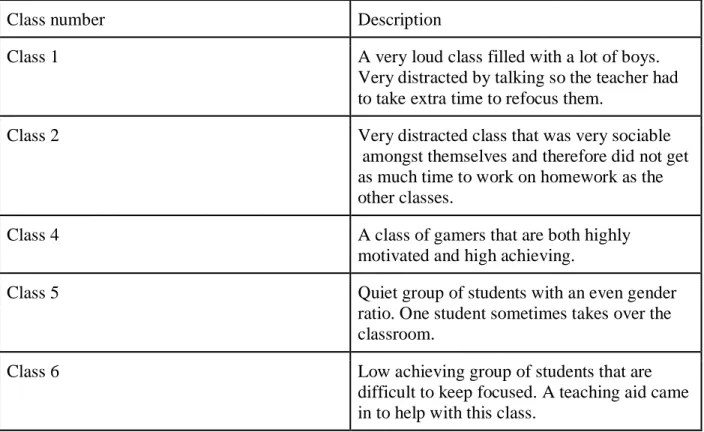
Class number Description
Class 1 A very loud class filled with a lot of boys. Very distracted by talking so the teacher had to take extra time to refocus them.
Class 2 Very distracted class that was very sociable amongst themselves and therefore did not get as much time to work on homework as the other classes.
Class 4 A class of gamers that are both highly motivated and high achieving.
Class 5 Quiet group of students with an even gender ratio. One student sometimes takes over the classroom.
Class 6 Low achieving group of students that are difficult to keep focused. A teaching aid came in to help with this class.
Figure 2 - Class Breakdown
Day 1
The Monday, the first day of implementation, the students were introduced to the team and the class began with them taking the STEM Attitude Survey, appearing in Appendix B, for the team's specific research purposes. After this, the students took a Pre-Test (Appendix C) that was made by the team based on the teacher's past exam style so that the students would be comfortable taking it and the students were not expected to know the answers to the Pre-Test. Based on the teacher’s knowledge of her classes and students, she determined what the best method of reading would be best for each class, with class sizes being 18 students at the minimum and the largest class being 24 students. For Classes 4 and 5, the students gathered around Mrs. Loach and each student was called to read at least a paragraph from the textbook and some people volunteered to read multiple times. Class 6 had a teacher’s assistant that would come in and move between a couple of classrooms as extra help for a few special education students. This class was split up into four groups to read the lesson. Two of the team members were present for this class and each took a handful of students and the two teachers took slightly larger groups of students. Without the authority of the teacher, some students were more vocal about not wanting to read at all whereas some were perfectly okay with reading multiple paragraphs to the group in a row. For Classes 1 and 2, the classes were also split into small groups again for reading and both proved to be slightly more difficult for the team because reading out loud was something very few students seemed to find interesting. None of the classes were told to read alone because Mrs. Loach had told the team that in the past it would lead to students spending the entire class time reading or talking to peers and not finishing the given
work. Whether the reading happened as a class or in small groups, the reading for lesson one was completed in every class and the students were given the Slides (Appendix E) afterwards to complete the section labeled Unit 1. Most students in every class had enough time left to finish the lesson one slides at the end of class and those that did not were told to take the slides home and complete them for homework. Classes 4, 5, and 6 showed fairly even gender ratios whereas Classes 1 and 2 contained more boys than girls.
Day 2
The second day of implementation began with a review on the reading and slides by projecting the slides onto the broad and going through the answers as a class. Mrs. Loach supplemented the team’s slides with a few of her own from past years when the lesson material developed by the team did not put enough emphasis on a specific topic as much as she wanted them to. For example, she showed the class her slides on how different precipitation forms and told them stories about real life and her own experiences. After reviewing by having the students answer questions, the “air” front demonstration was then presented to the class. The students found the demonstration to be very cool and were excited to see it happen. The students then went on to reading lesson 2 and filling in the sentence frames from the slides in the same way they had done on day one. In some classes, some students did not do their homework from day one and there were also students who wanted to get ahead and start the packet while they were reading. Again, most students were able to finish the slide packet during class and were told to complete it for homework if they did not.
Day 3
The third day began the same as day two did with reviewing the slides and sentence frames as a class. This day the teacher also supplemented with her past slides on the chapter because she said the students needed more visuals and examples to help them solidify their understanding of the topics. The rest of the day was used for students to ask clarifying questions and for the students that had not caught up on the sentence frames to finish them in class.
Day 4
On the fourth day students came into class and began work on the practice problems of converting temperature between different units. There were 6 problems in total, 4 were of normal difficulty just going from one unit to the other directly. The other two problems were considered to be more difficult bonus problems for those higher achieving students which entailed going from one system to an intermediate system then to the final solution. For example, one of the problems included starting in degree Fahrenheit going to degree Celsius then going to Kelvin for the final answer. One thing that really excited the students was the fact that Mrs. Loach brought
dry-erase markers so that they could solve these problems by writing on their desks. One student even went as far as remarking that “I feel smarter when I get to write on the desk” showing that this change of pace was helping to cement these new ideas in the students. This took up most of the class time but with what class time was left the group selected a couple students at random to play a demonstration of the game for the rest of the class. This was done with every group except the first because they took too long with the conversion practice problems. Most groups understood the game as a whole but had a few clarifying questions that the practice game helped to address. There was no homework going into the final day so the kids were happy to hear about that.
Day 5
The fifth day of implementation was the day the students finally got to play the weather game and take their Post-Test. In addition to the Post-Test, students gave qualitative feedback when time allowed. The students really seemed to enjoy the game a lot and some even said that it helped them better understand not only the concept of pressure but also how weather fronts move. However, due to time constraints some of the students in the first group barely finished their game before the bell rang so to simplify the game for the students the group decided to keep the hurricane boards as a challenge for those students who really understood the game and finished their initial game with a lot of time to spare. Once these small implementation changes were done every group finished at least one game with a decent amount of time to spare. When the students were taking the Post-Test this time it was on their iPad using Socrative; a website that Mrs. Loach uses to make and administer all of the student’s tests. She suggested the team do this instead of a paper copy not only “for the groups own sanity” but also because that is the test taking format her students were used to in this class. The only problem that arose during the test is that initially Mrs. Loach randomized the order of the questions so that the pictures on the board were not lining up with the questions being asked but once she reset that and put the questions back in numbered order the Post-Test went very smoothly.
Results
Surveys and Other Method of Testing
Before the implementation began, the team completed WPI’s form for the Institutional Review Board (IRB) and received approval from the board on the overall project, along with all surveys and testing methods used throughout this entire project. On the very first day the students were given a STEM attitude survey to see the general feeling toward STEM in this particular group of students. The survey had 32 questions all about whether or not they found STEM useful or enjoyable. The students could respond with one of 5 answers “strongly disagree”, “disagree”,
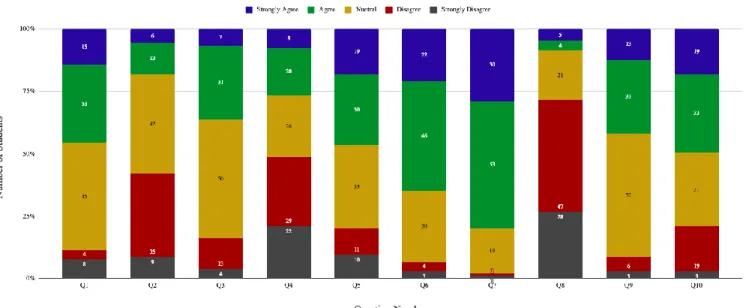
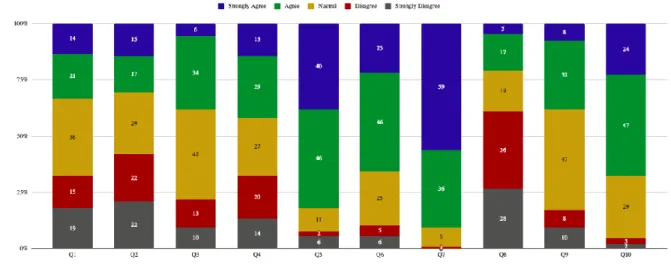
“neutral”, “agree”, “strongly agree” which were given scores 1 through 5 with 1 being strongly disagree and 5 being strongly agree. The only questions that were framed negatively towards STEM were questions 8 of both the science and math sections of the survey which you can see clearly in the charts below. For example, science is my least favorite subject or I don't find math useful while the remaining questions were worded more positively toward STEM. Below are the results from all the student’s responses with a sample size of 105 students. The data labels are referring to the number of students that gave the indicated response and not the percentage of students that did so.
Figure 3 - STEM Attitude Survey Science Results
The numbers on the bar graph represent the number of students that gave each response to the corresponding question below out of 105 students. As you can see question 8 appears different from the rest but this is because it is the only question worded “negatively”. There is an overall neutral to positive view of science for this group of students.
Questions
1. Science is exciting.
2. Science is my favorite subject.
3. I am sure of myself when I do science. 4. I would consider a career in science.
5. I expect to use science when I get out of school. 6. I care about learning about science.
7. Science is an important subject. 8. Science is my worst subject. 9. I look forward to science class.
Figure 4 - STEM Attitude Survey Math Results
The numbers on the bar graph represent the number of students that gave each response to the corresponding question below out of 105 students. As you can see question 8 appears different from the rest but this because it is the only question out of this set to be worded negatively towards math. There is an overall neutral to positive view of math for this group of students.
Questions
1. Math is exciting.
2. Math is my favorite subject.
3. I am sure of myself when I do math.
4. I would consider a career that uses a substantial amount of math. 5. I expect to use math when I get out of school.
6. I care about learning math. 7. Math is an important subject. 8. Math is my worst subject. 9. I look forward to math class.
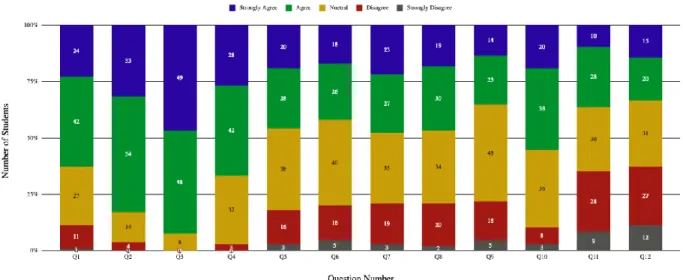
Figure 5 - STEM Attitude Surveys Engineering and Technology Results The numbers on the bar graph represent the number of students that gave each response to the corresponding question below out of 105 students. The most positive response was to question 3 which asked the students if they thought engineering was important with 97 out of 105 students responding with agree or strongly agree with no students disagreeing or strongly disagreeing.
Questions
1. Engineering sounds exciting.
2. I know what engineering is.
3. Engineering is important to the world.
4. Technology is exciting.
5. I want to learn about engineering in high school and/or college.
6. I am interested in what makes machines work.
7. I like (or would) like to build/fix things
8. I am curious about how electronics work.
9. Physics interests me.
10. I would like to use creativity and innovation in my future work. 11. Computer science sounds interesting.
Assessment
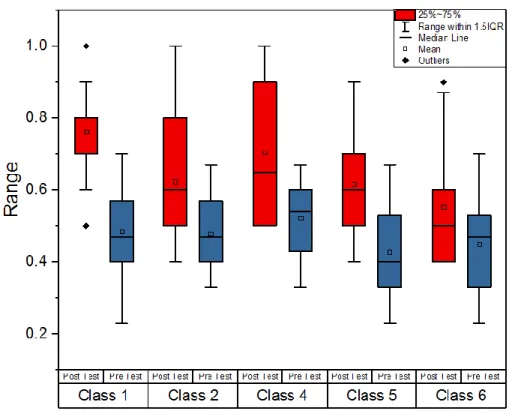
The following section includes the results of the students Pre and Post-Test. These results were recorded anonymously which ensured the students were not linked to their specific scores. These scores did not impact their grade in the class and were given with the sole intent to see the students’ growth over the course of the lesson. In figure 6 below, the Pre and Post-Test scores from the students are divided by class. The median line, beginning of the second quartile, and the end of the third quartile fall on multiples of five for the post test data but not the Pre-Test data, because of the switch from administering the test on paper and grading by hand to the students taking the Post-Test online and receiving no partial credit.
Figure 6 - Pre and Post Test Scores
The range on the side is the students’ scores in percent which means a 0.6 on this chart corresponds with a 60% on the test. You can see from all the classes there is an improvement from Pre to Post-Test with the greatest improvement being for Class 1.
As you can see there is a trend of improvement over the lesson for all classes which was expected as they were taught the material. The team saw the greatest improvement from Class 1. Not only did they perform more consistently but they raised their average from a 48% to a 76% which is the biggest improvement from any of the groups. Class 4 is the closest thing to an honors class the teacher had, and on the Pre-Test they did better than all of the other classes with an average score of 52% which is almost 8% higher than the next best class. However, as you can see they are the most inconsistent class going from a standard deviation of 11 on the Pre-Test
to more than 18 on the Post-Test. Class 6 is the class with the most students that have some type of learning disability and as you can see from the graph they were the group that improved the least from Pre to Post-Test, only improving the average score 10 points from a 45% to a 55%. All of these topics will be covered in more detail as part of the discussion section.
Interview
After the project implementation had reached its conclusion, the students and teacher were interviewed. These interviews are important to gain qualitative data that will give insight into how the project altered the student’s perspective and view on science and how effective the teacher thought the project was. Such data gives context to the quantitative data collected from the surveys and assessments. Without this context, conclusions drawn from raw data are less likely to be valid; it would be difficult to separate correlations from causations.
Immediately after playing the game, the students were asked to provide feedback on the board game. Overall the students felt that the game helped them learn, stating that something interactive like a game helped them learn about weather better than simple lectures and worksheets do. They also found the board game very fun and engaging; many wanted to play more after the class was over. Though most were having fun with the game, some did not enjoy it. These students were largely confused about how to play the game and ended up not participating as much. This means that they would not strategize with their team and would move their game pieces at random.
Soon after the implementation week was over, the teacher was asked to give feedback on the project. She said that the schedule had a lot more material than her students are used to, but that it was not too difficult for her to follow since weather is not a new subject for her. She would have normally spread out the lesson over the course of three weeks, rather than one. The tight schedule made many of her students step up to the challenge. The schedule was initially even more packed, which made her nervous, but she was relieved when the team was willing to adjust the lessons based on her feedback. The teacher also mentioned that the lecture slides were too wordy. The students have a hard time paying attention when the slides have too many words compared to other content (such as pictures and graphs). The majority of the students are visual learners, so having too many words per slide is not ideal. The teacher also said that the team should have given special attention to the students who require more help, such as IEP and ELL students, as well as give them the notes pre-filled out for them.
The teacher said that the game itself was perfect. It was very engaging and accessible for both high and low achieving students, which prepared them for the weather assignments that they were given after the project implementation. They were grouped so that the quieter students would be engaged, which positively impacted the overall enjoyment of the game. The only thing that the teacher said that she would change about the game would be to simplify the game rules and explanations. Having the team present for the project implementation made the teacher more
comfortable in implementing this new teaching style. The students also enjoyed the extra attention that came with the presence of the team.
Discussion
Analysis and Interpretation
In the assessment, the students had an overall improvement in their scores in the Post-Test, as was expected. Despite having the highest Pre-Test scores (52%), Class 4 did not score the highest on the Post-Test (71%). Class 4 also has the highest standard deviation for the Post-Test (18.3), despite having a fairly normal standard deviation for the Pre-Test (11.1). This class was considered, by the teacher, to be the highest achieving class, so the two previous statements may give insight into the shortcomings of PBL. It may be that many students of Class 4 excelled at traditional, non-PBL styles of teaching, and are less proficient in PBL. This would explain their high standard deviation and partially explain their lower than expected Post-Test scores. Those in Class 4 that seemed to be more used to a traditional style of being taught would be high achieving since that education system is catered to their learning style. Using this logic, that would mean that these students would be contributing to the lower scores seen in the Post-Test when they are given a teaching style that is no longer suited for their learning. On the other hand, some of the high achieving students are truly exceptional and can excel in all types of learning. A study in the University of Kentucky, in 2015, can give evidence to the latter statement. When given several different types of learning (though PBL was absent), high achieving students seemed to perform similarly, despite the different learning styles, whereas lower achieving students greatly benefited from non-traditional learning styles. It should be noted, however, that this study was performed on college students.
High-achieving students performed just as well on both multiple-choice and short answer exam questions regardless of instructional group. Low-achieving students in the OPBI (Open Problem-Based Instruction) group performed better on multiple choice and short answer exam questions compared with both LI (Lecture-style Instruction) and GPBI (Guided Problem-Based Instruction) groups (Frabjlin, Xiang, Collett, Rhoads, & Osborn, 2015). This type of student would be contributing to the higher scores. In fact, some of the students in Class 4 had very outstanding scores, which would imply that PBL excelled at teaching them the material. This duality of students would explain the dramatically large standard deviation.
At the exact opposite of the spectrum, Class 6 had low scores in both the Pre-Test and Post-Test. The teacher noted that this class is generally lower achieving. Throughout the week, it was observed that this class did not engage in much of the class material, including the board game. This would conclude that PBL should be conducted in a way that is as engaging as possible, so as to minimize any number of uninterested students. Even though it may be generally more efficient to learn through PBL, the content must still be presented in an interesting way.
Class 1 had a stark improvement in their average Post-Test score (76%) compared to their average Pre-Test score (48%). They also had fairly normal standard deviations for both (15.0 for Post-Test and 12.5 for Pre-Test); some students had perfect scores. Class 2’s scores are similar to Class 4’s, but with a lower overall average score (47% for Pre-Test and 62% for Post-Test) and slightly less extreme standard deviation for the Post-Test (17.6). The last class, Class 5, had the lowest average for the Pre-Test (43%) but improved as expected for the Post-Test (62%). The data for most of the classes seem to show that PBL can be extremely effective when teaching students. During the implementation week, Class 1 was observed to contain more energetic children than the other classes and often times they would get distracted with side conversations. However, their high energy could have contributed to their higher test scores. Since they are usually energetic, playing a game and engaging in interactive learning material would be more suited for them. This gives them a fun task to exhaust their endless energy on. This would give evidence to the conclusion that PBL is most effective with high energy students.
Validity of Interpretation
Though the final data suggests that the students improved due to PBL, there are some key assumptions and flaws in the way data was collected. One of this project’s biggest flaws is that there was no data collected on Pre and Post-Tests from students that were taught this Unit through the traditional method of teaching since the project was implemented in all of the teacher’s science classes. The first assumption is that the presence of the team did not affect the results in a significant way. The presence of teaching aids that are not normally there has the potential to change the classroom dynamic in ways that are impossible to measure. When adults other than the normal teacher are around, the students may become distracted by the attention that they are getting from new people. Being watched by new observers may also make the students either motivated or nervous. Being judged by strangers can make students either want to try harder to impress the observers, or crack under pressure. Which one happens is dependent on the personality of the student. A shy student is more likely to fail under this new pressure, while an attention loving student is more likely to try harder to impress the team. The teacher did note that her students “enjoyed the extra attention” from the team members. It is unknown if this means that the students were distracted from the extra attention or felt more motivated from it.
The assessments had some vague wording for one of the questions. Question 9 said: “Circle all the variables that do NOT describe weather:” with several examples of variables that describe weather and others that do not. There were three variables that had to be circled. Since the question did not state that there were three variables, a decision about how to give partial credit had to be made. Due to the lack of specificity in how many variables to circle, some students ended up circling more than three variables. It was decided to give one-third credit for each correctly circled variable for the Pre-Test. Extra circled variables were ignored and did not count against the final score. This would mean, theoretically, that someone who circles all of the variables would get full credit. None of the students circled much more than three variables, however, so this was not too much of an issue. The Post-Test was taken online, through the
students’ iPad app. The app automatically scored the tests and did not give partial credit. This discrepancy in scoring was unexpected since the team was not familiar with the app.
The third and final major flaw in the project was the fact that the week was not 100% PBL. The project ended up this way because of the broad subject being taught. A single project could not cover the entire subject being taught, so the supplemental material was presented in a more traditional manner. This means that the final data is not a complete reflection of pure PBL, rather it reflects a blended approach of both PBL and traditional teaching styles which has become typical in many classrooms.
Conclusions and Recommendations
Effectiveness in Teaching
A primary goal of this project was ensuring that the new standards, ESS2. Earth’s Systems: 8.MS-ESS2-5, were met. In the interview held after the implementation, the teacher told the team that she really enjoyed the way this project went about meeting the standards within the time frame available for implementation. She also talked about the fact that most, if not all of the students seemed to enjoy this method of teaching and many students that did not usually show engagement were engaged during this week. As discussed previously, the numerical results obtained from the Post-Tests demonstrated grades that were lower than desired across all five classes. There is something to be said about the fact that this was possibly some student’s (if not all) first time encountering the style of PBL teaching in the subject of science. Although the students at Auburn Middle School have engineering class and STEM based math class that cater towards PBL, and a definitive study on the effectiveness of PBL cannot occur from one single unit or a week of lessons. Despite this, the teacher found the unit helped noticeably in her inclusion class with the increased engagement and participation of several students. The team concluded that the project created for this unit was effective in addressing all of the Massachusetts standards that were sought to be taught in this project. The teacher said that upon completion of the implementation the students were saddened to see the team leave. Many were excited to hear that the team gifted the game boards and other material to the teacher so that they were able to play during their free time to see if they could improve their skills more.
Accessibility of Recreation
One of the major components of this project was to create a project-based lesson plan that would be accessible to teachers monetarily and in terms of ease of implementation. This project was able to be made spending around fifty dollars, excluding the costs of printing the cards which was done through the university. The fifty dollars bought six blank 18” x 18” game boards and 100 plastics colorful game pieces from Amazon, and colored cardstock from Staples. There were more game pieces than necessary for the classes but it was to ensure there would be enough
available in case pieces ever got lost after future implementation of the lesson. Extra cardstock was also left with the game that the teacher could use to print more cards if they were ever lost or damaged. The team had originally planned on laminating the cards to increase the longevity of the game but found the cost of laminating too steep at the time of creation. Only three versions of the game were made but a second copy was made for each three version so that the entire class would be able to play at once. In the end the team found this to be a reasonable price for a project that lasted an entire week and was used by five classes. All of the materials are reusable, which was considered during the creation because of the goal of accessibility to most teachers.
This project was fairly easy to implement and was successful in most ways. The teacher at the middle school was a huge help because she was available and willing to help throughout the entire process of creating the lesson plan to provide the team of college students with insight in understanding how to effectively teach and engage middle school students. There were small bumps along the way, which was to be expected from a project that is being implemented for the first time. Upon completion of implementation, the teacher and the team were able to see the amount of information that was packed into a week of classes. The teacher told the team in an interview after implementation that her tests are usually of the entire chapter instead of the two units the team covered. Something that the team did not originally have in place in the lesson plans was how the team showed and explained the game before the students attempted it for themselves. The teacher said during implementation that she would always plan a demonstration before attempting to have her classes do any sort of project like this one. Based on this first implementation, the engagement of the students, and the teacher comments, the project team believes that this lesson plan can be easily implemented by most eighth grade science teachers if they are able to spend money and time purchasing and making the game boards.
Challenges Encountered and Future Implementation
One of the main challenges found by the students is the lack of experience they possess working in groups in a PBL style, making it difficult for them to switch to a PBL teaching style after having multiple years of learning in the more traditional classroom method. In Thomas’ review, he found that many students that went through different processes had trouble generating meaningful scientific questions, managing complexity and time, transforming data, and developing a logical argument to support claims. One of the challenges the team found in implementing the project was that it required the students’ willingness to possibly be wrong at first, which a lot of students have a hard time with, and in turn learn from the mistake. As observers, the team walked around the classroom to help answer questions since it was the first time implementing the project to allow for smoother progress. Although these students were accustomed to doing some projects, it was clear that their background of education was laid in a more traditional sense of learning and it took time for some students to adjust to being a more active participant in their education. A note often made by teachers who are attempting to apply more project-based lessons is that they can often struggle with “the allotted time given to them
being more effectively used to allow students to pursue their own investigations or to cover the state-prescribed curriculum” (Thomas, 2010). No prevalent challenges of this kind were encountered by this teacher during the implementation of this project.
This Interactive Qualifying Project aimed to create a lesson plan and project that focuses on the PBL style of teaching, meet the new 2016 Massachusetts Science Standards, and create clear directions that could be followed by other middle school science teachers to teach and engage their students in an alternative method to traditional lectures. As was expected, small issues arose during the implementation of this project since this was the first implementation executed. The following are observations, critiques, and recommendations made by the project team, the teacher, and others that assisted throughout the creation of this project, like the two advisors and the college students that completed the first dry run of the game. The team believes that incorporating these recommendations and adjustments would lead to smoother implementation and better results.
1. Time Allocation
To meet the new standards with this project and introduce the knowledge the students needed to effectively complete the game, the team had to incorporate two units into the week of implementation. The teacher told us that she would usually spend at least two weeks on a topic before testing the students’ knowledge. Under ideal circumstances the team believes that this lesson plan would have better results with more time. This would allow the students to play multiple rounds and/or try the two other versions of the game. There were only two groups that finished with enough time to attempt another round of the game which they told the team that they really enjoyed since they understood what needed to be done. An entire day to introduce the game and have the students become comfortable with its concepts could vastly improve the results. Originally, the team had wanted to give the students time to discuss and make a short presentation to the entire class about their findings and explain why they went about collecting data the way they did and what they would change next time to be even more efficient. With the time allotted for the implementation the team quickly realized that this would be too much for the students to do in that time. The teacher also already had a project like this in mind for the students in the next section so the team did not want to be redundant with the additional project.
2. Improvements on the Game
As far as the game specifically is concerned, there were small things that can be changed for the future to allow for smoother game play. The rules were very thorough, but they were too long and could have been condensed more to allow the students to figure out some of the project on their own and some students did not want to finish it because they wanted to get to the game. The impromptu demonstration the day before worked better than having them read rules. This also applies to the Weather Information packet given to the students to have during the game.
The team asked the college students that played the first dry run of the game to give critiques upon completion of the game. Most of their critiques were included into the game before the boards were brought to the middle school. Some critiques that the team believes could be beneficial (that were not able to be done before implementation) was to cut the cards of the board game smaller. When the cards were picked up they would push others out of the way and the game would get very messy, very quickly. The college students also suggested digitizing everything such as the Weather Data Collecting Sheets, the Game Rules, and Weather Info to increase the longevity of the game even more and for cleaner game play.
Final Remarks
By the end of this project’s implementation the team felt that they were able to achieve the goals that they sought to meet. Although the results were not as high as the team hoped, each class showed clear signs of improvement and the students were engaged every day, and intrigued about what the next day would bring. Having the students continued engagement is arguably one of the biggest difficulties in teaching. Giving the students a game to play as a method of learning the unit, encourages the students to have continued participation and engagement so that the lesson stood out to them amongst there other classes that are not as hands-on. This project-based lesson shows that the idea of PBL can be a great way of teaching students in a way that encourages engagement.
References
1. Dorsen, J., Carlson, B., & Goodyear, L. (2006, February). Connecting Informal STEM Experiences to Career Choices: Identifying the Pathway. Retrieved from
http://www.yingtrsef.org/wp-content/uploads/ITEST_Literature-Review-Stem-career-choice-2.pdf
2. Franklin, B. M., Xiang, L., Collett, J. A., Rhoads, M. K., & Osborn, J. L. (2015). Open problem-based instruction impacts understanding of physiological concepts differently in undergraduate students. Advances in Physiology Education,39(4), 327-334.
doi:10.1152/advan.00082.2015
3. National Science Teachers Association - NSTA. (n.d.). NSTA Position Statement. Retrieved from https://www.nsta.org/about/positions/ngss.aspx
4. Packard, B. W.-L. and D. Nguyen (2003). "Science Career-Related Possible Selves of Adolescent Girls: A Longitudinal Study." Journal of Career Development 29(4): 251-263.
5. Thomas, J. W. (2010, March). A Review of Research on Project-Based Learning. Retrieved January 21, 2019, from
http://www.bie.org/images/uploads/general/9d06758fd346969cb63653d00dca55c0.pdf
6. Tsupros, N., R. Kohler, and J. Hallinen, 2009. STEM education: A project to identify the missing components, Intermediate Unit 1 and Carnegie Mellon, Pennsylvania.
7. 2016 Massachusetts Science and Technology/Engineering (STE) Standards Frequently Asked Questions. (2017, September 7). Retrieved from
Appendix
Authorship 29
Attitude Survey 29
Pre/Post-Test 31
Pre/Post-Test Answers 34
Slides and Answers 37
Game Rules 48
Weather Information 52
Student Data Collecting Sheet 55
Scoring Rubric 56
Game Board Answers 57
Pictures of Game Boards, Cards, and Sample Weather Data Collected 60 Weather Data Sheet Examples and Game Board Example 850
A. Authorship
Section Author
Abstract Nahomy Medrano
Introduction and Background Cameron Gould and Nahomy Medrano
Methodology Jillian Chu
Results Cameron Gould and Jillian Chu Implementation Nahomy Medrano and Cameron Gould
Discussion Jillian Chu
B.
Attitude Survey
Stem Attitude Survey
There are no “right” or “wrong” answers. The only correct responses are those that are true for YOU.
SCIENCE
Strongly Disagree
Disagree Neutral Agree Strongly Agree
Science is exciting.
Science is my favorite subject.
I am sure of myself when I do science.
I would consider a career in science.
I expect to use science when I get out of school.
I care about learning about science.
Science is an important subject.
Science is my worst subject.
I look forward to science class.
The skills I’m learning in science could be important to my future career.
MATH
Strongly Disagree
Disagree Neutral Agree Strongly Agree
Math is exciting.
Math is my favorite subject.
I am sure of myself when I do math.
I would consider a career that uses a substantial amount of math.
I expect to use math when I get out of school.
I care about learning math.
Math is my worst subject.
I look forward to math class.
It is important to use math in science classes.
ENGINEERING and TECHNOLOGY
Strongly Disagree
Disagree Neutral Agree Strongly Agree
Engineering sounds exciting.
I know what engineering is.
Engineering is important to the world.
Technology is exciting.
I want to learn about engineering in high school and/or college.
I am interested in what makes machines work.
I like (or would) like to build/fix things.
I am curious about how electronics work.
Physics interests me.
I would like to use creativity and innovation in my future work.
Computer science sounds interesting.
I would consider a career in an engineering field.
C. Pre/Post-Test
Name:______________________________________Class:______________Date:_________ Weather
Indicate the answer choice that best completes the statement or answers the question.
1. Although typically wind speeds in tornadoes are faster than wind speeds in hurricanes, hurricanes inflict much more damage. Why is this?
a. Hurricanes are much larger than tornadoes. b. Hurricanes last for a longer time than tornadoes.
c. Hurricanes are associated with flooding since they cause high waves and strong rains.
d. All of the above
2. What front is being forecast for this state?
a. cold front b. warm front c. stationary front d. occluded front
3. Areas of low-pressure usually have __________. a. cloudy weather b. good weather c. descending air d. none of the above