Making the Most of Kindergarten:
Present Trends and Future Issues in the
Provision of Full-day Programs
by Debra J. Ackerman, W. Steven Barnett, and Kenneth B. Robin
Today, more than 93 percent of all 5-year-olds attend kindergarten,1but those kindergarten classes vary widely. A key difference, and one with significant implications for state budgets, parents, and children, is whether the class is a full-day or half-day program. Some kindergarten classes meet for up to six hours per day, following the same full-day schedules found in the lower primary grades. Other kindergartens use a half-day schedule, meeting for only two to three hours per day, as either a morning or afternoon session.2
It seems obvious that a longer school day would benefit children and families. In the best programs, a longer day would enable children to receive more individualized, academically-focused instruction from teachers, as well as more time interacting with their peers—both of which can lead to long-term benefits.3 For working parents, a longer school day could mean fewer family expenses for child care and less worry about transporting children from one setting to another during the day. Program administrators and policymakers considering a switch from half-day to day programs, however, may wonder how day programs should be structured to ensure that children benefit, and whether the advantages of full-day programs outweigh the additional costs.
This brief addresses these questions and highlights: • Trends in the provision of full-day kindergarten
• Activities in full- and half-day kindergarten programs
• Research on children’s academic and social outcomes in half- versus full-day kindergarten programs • The need for additional research
N I E E R
[Policy
Report]
What we know:
• Today, more than 60 percent of kindergartners are enrolled in a full-day program.
• Full-day kindergarten—defined as a daily program of 4.5 to 6 hours in length—is permitted in every state, but is most prevalent in the southern United States.
• Just nine states require districts to offer a full-day program.
• Twenty-nine states and the District of Columbia provide additional funding for full-day kindergarten programs.
• Children in full-day kindergarten have more time to participate in meaningful learning activities than children in half-day programs do. The best evidence indicates that children who attend for a full day learn more in kindergarten and have lower retention rates in the primary grades.
• Full-day schedules may help increase kindergarten enrollment for families that might keep their children out of half-day programs because they are unable to arrange child care or transportation.
• Full-day kindergarten can present the opportunity for all children to spend more time engaged in meaningful learning activities. Children from disadvantaged backgrounds have been found to benefit most from a full-day schedule.
• State funding for kindergarten in many states is less than the funding provided to districts for Grade 1. • True experiments have not been conducted on the benefits of full-day versus half-day kindergarten
programs, and some important questions remain unresolved about the specific kinds of teacher training, curriculum, and learning activities that can make the most of a full-day schedule.
Recommendations:
• Full-day kindergarten programs deserve serious consideration as a means of improving achievement. Of course, the costs of switching from a half- to full-day programs must be weighed against the likely benefits of full-day programs for specific populations, taking into account current kindergarten readi-ness rates, percentage of children retained in kindergarten or the primary grades, and the numbers of children who are at risk for school failure. Also, the needs of working families and kindergarten partici-pation rates must be considered.
• When states or districts offer full-day kindergarten, they should enact policies and support program strategies to ensure that full-day kindergarten is taught in ways that maximize its benefits, particularly for children at risk for low achievement or with marginal readiness skills.
• Additional research studies are needed to better understand how the extra time afforded by full-day programs can be used to the maximum benefit of children. Such studies should use strong experimental designs, including multi-site, randomized trials.
The Prevalence of Full-day Kindergarten
Full-day kindergarten is generally defined as a program that meets for 4.5 to 6 hours per day, five days per week, and follows the same school calendar as the early primary grades. Half-day programs usually meet for between 2 to 3 hours per day, five days per week. On average, children attending half-day programs are in school approximately 16 hours per week, whereas full-day students are in class 32 hours per week.4
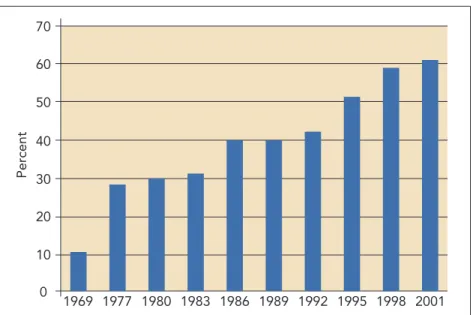
Enrollment in full-day programs has been steadily increasing over the past 35 years. As shown in Figure 1, just 11 percent of kindergartners were enrolled in full-day programs in 1969.5Despite the fact that only nine states—Alabama, Arkansas, Georgia, Louisiana, Maryland, Mississippi, North Carolina, South Carolina, and West Virginia—have mandatory full-day kindergarten programs,6that percentage more than quintupled by 2001, when more than 60 percent of all kindergartners enrolled in such a program.7
Figure 1. Kindergartners Enrolled in Full-Day Programs, 1969 – 20018
Enrollment in full-day kindergarten more than quintupled from 1969 to 2001.
Although more private schools offer full-day kindergarten than public schools, researchers examining data from the Early Childhood Longitudinal Study-Kindergarten Class of 1998-1999(ECLS-K)—a study based on a sample of more than 20,000 children from across the United States—found that 57 percent of all public schools offer a full-day program.9Similarly, 60 percent of public school kindergarten teachers report that they teach in a full-day class.10
While every state permitsschool districts to offer full-day kindergarten,11the actual provision of full-day programs varies by region quite a bit (see Figure 2). For example, 84 percent of all public schools in the South offer full-day kindergarten, compared to just 57 percent in the Midwest and only about one-third of public schools in the Northeast and West.12The high percentage of full-day programs in the South is driven by the fact that eight of the nine states that require districts to offer kindergarten on a full-day
1969 1977 1980 1983 1986 1989 1992 1995 1998 2001 0 20 10 30 40 50 60 70 Percent
Figure 2. Percent of Public Schools Providing Full-Day Kindergarten by Region14
More than 80 percent of public schools in the South provide full-day kindergarten, where eight of the nine states that mandate such a schedule are located. Just 57 percent of Midwest public schools provide full-day kindergarten, as well as about one-third of schools in the West and Northeast.
Provision of full-day programs also varies by type of community. At least 63 percent of cities and small towns or rural communities offer full-day kindergarten, in contrast to only 46 percent of suburban districts.15
Not surprisingly, state funding levels influence whether or not districts implement full-day kindergarten. Twenty-nine states and the District of Columbia encourage districts to offer a longer schedule by providing funding that exceeds that offered for half-day programs (see Figure 3). In some cases, full-day funding levels are equal to—or even greater than—the amounts provided for Grade 1. Conversely, 19 states offer less funding for kindergarten programs—regardless of the length of day—than for Grade 1. In these states, kindergarten per-pupil funding is typically about half of the amount provided for students in Grade 1, serving as a “disincentive” to the provision of a full-day program. The majority of these latter states are located in the Northeast and the West, where the percentages of full-day kindergarten provision are the lowest.16
South Midwest West Northeast
0 20 10 30 40 50 60 70 80 90 Percent of Public Schools U.S. Region
Figure 3. State Funding for Full-Day Kindergarten17
The states that are shaded blue provide financial incentives to encourage local districts to offer full-day kindergarten programs, with the states shaded darkest offering the greatest incentives. The nine states that require districts to offer day kindergarten are cross-hatched. The highest percentage of full-day kindergarten programs are located in the South, where state regulations and financial incentives align to encourage full-day kindergarten.
HI MT WA OR CA AK NV ID WY CO NM TX OK KS NE SD ND MN WI IL MI OH KY TN MS MS ALAL GAGA SC SC NC NC VA NJ VTNH MA CT DE RI MD WV WV FL PA NY ME IN IO MO AR AR LA LA UT AZ MS AL GA SC NC WV AR LA HI MT WA OR CA AK NV ID WY CO NM TX OK KS NE SD ND MN WI IL MI OH KY TN MS MS ALAL GAGA SC SC NC NC VA NJ VTNH MA CT DE RI MD WV WV FL PA NY ME IN IO MO AR AR LA LA UT AZ MS AL GA SC NC WV AR LA
Full-day funding levels are greater than both Grade 1 & half-day funding
Full-day funding levels equal Grade 1 funding & are greater than half-day funding All Kindergarten funding levels are greater than Grade 1 funding
All Kindergarten funding levels equal Grade 1 funding
Full-day funding levels are greater than half-day funding, but less than Grade 1 All Kindergarten funding is less than Grade 1 funding
Hawaii’s schools are not separated into school districts and there is therefore no traditionalfunding formula; Rhode Island bases district funding on amounts received in fiscal year 1997-1998
State enrollment figures for full-day kindergarten reflect state funding levels. For example, in states such as Delaware,18Ohio,19and Indiana20—where kindergarten funding is less than funding for Grade 1—the percentage of public school kindergartners enrolled in full-day programs is 23 percent, 15 percent, and 12 percent, respectively. In Wisconsin, however—where the funding for full-day programs is equal to that provided for Grade 1 and higher than that provided for half-day kindergarten—63 percent of districts offer full-day programs exclusively, and an additional 25 percent offer both half- and full-day schedules.21
The prevalence of full-day kindergarten also varies with socioeconomic backgrounds and ethnicity of children served. For example, nationally, 76 percent of public schools whose student population is at least 75 percent minority offer full-day programs. More than 90 percent of private schools that enroll a similar percentage of minority students also offer kindergarten on a full-day basis. Similarly, 69 percent of public schools that have a majority of low-income students offer full-day kindergarten.
While the percentage of children from families living below the poverty threshold attending full-day programs is greater than those from higher income families, the percentage of students enrolled in such a schedule from specific disadvantaged backgrounds is uneven. For example, 79 percent of African-American children in public school attend full-day kindergarten, compared to just 46 percent of Hispanic children. Forty-five percent of kindergartners who are English Language Learners are enrolled in half-day programs. These enrollment rates are similar to the percent of caucasian (49 percent) and Asian (40 percent) children in full-day kindergarten.22
Activities in Full- and Half-Day Kindergarten
Full-day programs offer twice as much instructional time on average as do half-day programs,23but children will only benefit from the longer programs if that extra instructional time is devoted to activities that promote learning and development. The ECLS-K data provide information on how teachers and children spend their time in full-day programs. Results suggest that, with the extra hours, teachers allocate more time to academic activities, and children also are able to spend more time in self-selected activities—a learning approach that is effective in promoting greater learning and better long-term outcomes for children.24
Time Spent in Academic Activities.In both full- and half-day programs, kindergartners spend most of
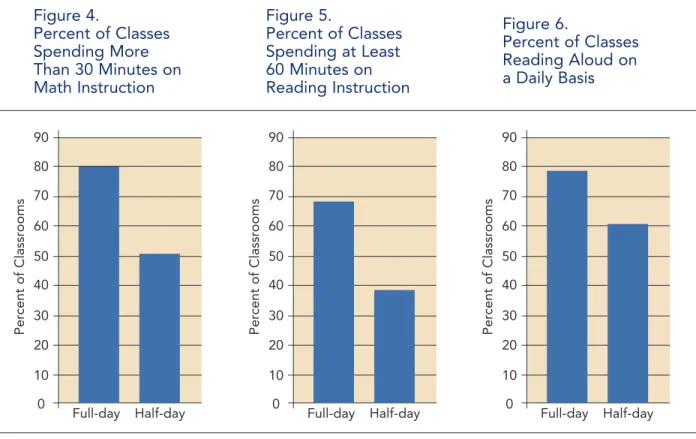
their class time working on reading, language arts, and math activities, but the total number of minutes teachers devote to specific subjects differs (see Figures 4, 5, and 6). For example, fully 80 percent of full-day but only about 50 percent of half-full-day programs devote more than 30 minutes each full-day to mathematics instruction.25Sixty-eight percent of full-day but only 37 percent of half-day classrooms dedicate at least 60 minutes to reading instruction each day. Perhaps most striking, 79 percent of full-day teachers read aloud to their students every day, compared to 62 percent of half-day teachers.26Reading aloud is a critical activity in helping to develop children’s reading skills.27 Additional research shows children’s literacy learning is enhanced in full-day programs, as the full-day schedule “provide[s] a more intensive, ongoing, enriched language and literacy experience for the young child.”28
Figure 4. Percent of Classes Spending More Than 30 Minutes on Math Instruction Full-day Half-day 0 20 10 30 40 50 60 70 80 90 Percent of Classrooms Full-day Half-day 0 20 10 30 40 50 60 70 80 90 Percent of Classrooms Full-day Half-day 0 20 10 30 40 50 60 70 80 90 Percent of Classrooms
More time is devoted to reading and math in full-day than in half-day classes
Figure 5. Percent of Classes Spending at Least 60 Minutes on Reading Instruction Figure 6. Percent of Classes Reading Aloud on a Daily Basis
Time Spent in Teacher-Directed versus Self-Selected Activities.Research also indicates that children in
full-day programs spend many more total minutes per day in self-directed activities—precisely the kind of activities that are shown by a variety of studies to be linked with long-term learning.29For example, while children in full-day kindergarten programs enjoy 57 minutes per day in self-selected activities, children in half-day programs spend just 32 minutes in these activities.30Relative to total time spent in school, children in full-day programs spend 16 percent less time engaged in large-group, teacher-directed activities and 7 percent more time engaged in child-initiated learning such as free play.31
Research on Kindergarten Outcomes
The data show that full-day programs expose children to more learning opportunities than do half-day programs. Do the children actually benefit from those experiences? Results of research focusing on this issue are mixed, but they generally indicate that full-day programs outshine half-day programs. Parents and teachers prefer them, and children who are enrolled in full-day programs do better academically than children in half-day programs.
Parent and Teacher Perceptions.Parents and teachers report greater satisfaction with full-day programs. Greater percentages of full-day versus half-day kindergartners’ parents express satisfaction with their child’s curriculum,32and more report that their children experienced a great deal of growth in kindergarten.33 Teachers—whether they teach half- or full-day kindergarten programs—see full-day programs as more beneficial in helping children transition to first grade, and affording more flexibility in the types of learning activities that can be offered.34
Academic outcomes.The results of research on children’s short-term academic outcomes after participating
in full-day kindergarten are mixed, but the weight of the evidence indicates that full-day kindergarten produces positive effects for children generally, and especially for children from disadvantaged backgrounds.
Studies indicate that children who attend full-day kindergarten receive better report card grades in literacy, math, general learning skills, and behavior.35They also have found statistically significant differences in full-day kindergarten students’ literacy development as compared to those who only participated in half-day programs.36
Full-day kindergartners also outscore children in half-day programs on standardized achievement tests both while they are in kindergarten and for up to two years after that. The percentile point advantage on cognitive achievement tests of math and reading can be as much as 17 percentile points while children are in kindergarten, and as much as 15 points while children are in Grade 1 and 2.37The second grade read-ing and math scores of full-day kindergartners on the Iowa Test of Basic Skills were also higher by four to five points.38
Further, an early review of studies examining the effects of kindergarten scheduling on children’s outcomes —as well as additional analyses of the ECLS-K data—find that while full-day kindergarten is beneficial for all children, it may be particularly beneficial for children from disadvantaged backgrounds.39For example, ECLS-K data reveal statistically significant advantages in mathematics and reading score gains for children who attended public school full-day kindergarten. Full-day kindergartners showed a 22 percent advantage in their math score gains and a 32 percent advantage in their reading score gains. These gains held even after controlling for children’s poverty status and their initial reading and math abilities.40
Nevertheless, some studies fail to find short-term benefits for full-day kindergarten, while others find that benefits fade as children grow older.41These studies tend to suffer from some methodological weakness such as small sample sizes, use of non-random and non-matched groups, and high rates of attrition, but are noted in order to illustrate the challenge inherent in interpreting this mixed research literature.
Even when sample sizes are large, some studies have compared achievement outcomes within the first year of instituting a full-day program, but have not reported on whether teachers received any professional development in regard to how they might best use the extra time afforded by a full-day schedule. Some less-positive findings may be the result of inadequate training for full-day teachers, as many educational leaders conclude that teachers need professional development to enhance and upgrade their classroom practice when implementing new curricula or teaching strategies.42
For example, in a study of 114 full-day kindergartners, one group of teachers received professional devel-opment specifically related to how they might implement curricular and instructional changes in their full-day classes, as well as additional supports. The other cohort of full-day teachers did not receive either the focused training or supports. When teachers were subsequently asked to rate children on academic competence and exhibition of prosocial behaviors, ratings were higher for those children who were in classrooms where teachers received training and support.43
Other researchers have summarized the research literature by using a statistical technique called meta-analysis.44Two meta-analyses of the kindergarten literature have been conducted, and both find moderate to large positive effects on achievement test scores for full-day kindergarten. In the first, an analysis of 22 studies examined children’s math, language, and literacy outcomes in kindergarten and found a moderate positive effect for full-day over half-day.45The second analysis—which used six of the same studies plus an additional 17—found an even larger average effect.46
Most of the studies included in these meta-analyses focused on samples with high percentages of disad-vantaged students. Because the effect sizes reported in the meta-analyses are larger than those reported in studies such as the ECLS-K—which encompass a broader range of students—the meta-analyses confirm the finding mentioned above: a full-day kindergarten schedule is especially beneficial for disadvantaged students. Full-day kindergarten may therefore help mitigate achievement inequality by reducing gaps in learning as children move to first grade.
Grade retention and placement in special education classes.Ideally, scores on achievement tests and
report card grades should translate into positive changes in children’s promotion to the next grade and decreased special education placements. While the research is positive with respect to promotion, it is equivocal with respect to special education placements.
The most recent national data shows approximately 5 percent of kindergartners have been retained in that grade.47The three studies that explored the effect of full-day kindergarten on promotion and retention rates all show benefits for day. In the first study, nine low-income Alaskan schools implemented full-day kindergarten, and placement in a modified primary grade and retention rates in Grade 1 fell from 17 percent to 11 percent over a two-year period.48A second study of nearly 1,000 second grade children in a large Midwestern school district found that those who had attended full-day kindergarten were retained in grade less frequently in kindergarten, first, or second grades than those who had attended a half-day program. Retention rates for both groups remained high, but only 25 percent of full-day students were retained as compared to 34 percent of half-day students.49
The third study examined kindergarten through Grade 4 retention rates in Ohio during the 1980s. Researchers reviewed the cumulative school records of more than 8,000 elementary school students in 27 school districts and discovered that just 4 percent of full-day students were retained, versus 9 percent of half-day attendees, and 6 percent of alternate-day students (full-day, but every other day).50
Research findings do not establish a clear or consistent association between full-day kindergarten and special education placements. Even studies that yield positive results on cognitive, social, and retention outcomes have not found a relationship between participation in full-day kindergarten and provision of special educational services.51
Social outcomes.Studies have also examined the role of kindergarten in shaping children’s social outcomes.52 As is true for the literature on academic and school-related outcomes, the results of these studies are mixed. For example, studies indicate small but significant positive behavioral outcomes in areas such as independent learning, involvement in classroom activities, and approach to teacher.53In addition, kindergarten report card grades in social skills slightly favor full-day students, and teachers rate full-day students slightly more ready for first grade.54
Nevertheless, in a study using ECLS-K data but focused solely on initial adjustment to kindergarten, those attending full-day kindergarten were more likely than half-day attendees to complain about school, be reluctant to attend, or pretend to be sick in order to remain at home. The difference between these two groups on these three measures ranged from two to five percentage points. Interestingly, although the ECLS-K data demonstrates that a higher percentage of full-day kindergartners experience initial adjustment problems, other non-ECLS-K related research suggests that by the end of the kindergarten year full-day students experience more regular attendance than half-day students.55
Some studies fail to find significant differences in the social outcomes of full- and half-day kindergartners, suggesting that the length of day has little impact in this area. For example, a comparison of teacher ratings of more than 500 kindergartners on 17 domains showed that the length of the kindergarten day did not contribute to children’s ability to focus on tasks, work and play both cooperatively and independently, or practice and show respect for rules.56The ECLS-K study also failed to find differences in the percentages of kindergartners who demonstrated skills such as accepting peer ideas, making friends, or comforting others.57
Conclusions and Recommendations
Full-day kindergarten is on the rise, although much of this enrollment is still concentrated in the South. Research shows that teachers take advantage of the extra time afforded by full-day kindergarten programs to spend more time engaging students in reading, language arts, and math activities. Children also tend to have more time to participate in self-selected activities, which can produce a better balance between teacher-directed and child-initiated activities. The extra time provided by a full day appears to benefit children’s learning and development, at least in the short-term. Overall, studies find substantial gains in literacy and mathematics and reductions in retention rates as a result of full-day kindergarten. Indeed, the test score gains due to full-day kindergarten sometimes are as large as the gains found in some studies of the short-term effects of preschool programs for disadvantaged children.58
Despite these positive results, more and better research is needed. Informed decisions about kindergarten require methodologically rigorous, multi-site randomized trials that examine both outcomes and the mechanisms by which moving from a half-day to a full-day kindergarten can improve learning and development. In short, although more studies demonstrating the impact of full-day kindergarten would be helpful, studies are also needed that show the variables contributing to that outcome, including the types of learning activities offered to children, the number of children in each classroom, and teachers’ pre-service training and ongoing professional development. Policymakers could then weigh the specific
Beyond looking at the effects of full- and half-day kindergarten on children’s achievement, researchers should also examine the consequences of full- and half-day kindergarten programs for overall kindergarten enrollment rates. Half-day programs exacerbate the challenges working parents face in finding and trans-porting their children to well-supervised, enriching before- or after-school care for their children.59Studies should therefore examine how enrollment rates—particularly for children of low-income working parents —are affected by length of day. Given that only nine states require children to attend school at age five,60 it is possible that parents facing the transportation and child care barriers created by a half-day kinder-garten program will elect not to enroll their children in kinderkinder-garten at all. How many children this affects and just how much it affects their school success is not yet known.
Of particular interest to policymakers will be questions about the financial benefits and costs of full-day kindergarten. Despite the positive research about the benefits of full-day programs, many policymakers may assume too quickly that they cannot afford to implement full-day kindergarten or that substantially raising the cost of kindergarten will outweigh the potential benefits of a full-day schedule. Better research could test these assumptions about costs and benefits. Once effects on transportation costs, enrollment changes, and grade retention and other remedial efforts are figured in, full-day kindergarten might turn out to be much less costly than policymakers might think.
Kindergarten plays an important role as one of the first steps toward educational success, yet kindergarten policies and schedules vary widely across and within states. The best evidence indicates that a full-day kindergarten schedule can have positive benefits for children’s kindergarten enrollment, academic outcomes, and subsequent retention rates. These benefits seem to be greater for disadvantaged children, and the expected benefits—and costs—may therefore vary from one community to another. Thus, length of the kindergarten day deserves a closer look by policymakers where full-day kindergarten has not already been adopted. Just as importantly, when policymakers do decide to implement full-day programs, they should also commit the resources and institute the policies necessary to ensure that full-day programs are educationally effective.
Endnotes
1 U.S. Census Bureau. (2004). School enrollment—Social and economic characteristics of students: October
2002[website]. Retrieved July 27, 2004, from http://www.census.gov/population/socdemo/school/cps2002/ tab02-1.pdf.
2 Some districts offer alternate-day preschool, where children attend full-day sessions every other day of the week. This brief, however, focuses only on the distinction between full- and half-day programs. 3 Graue, E., Clements, M. A., Reynolds, A. J., & Niles, M. D. (2004). More than teacher directed or child initiated: Preschool curriculum type, parent involvement, and children’s outcomes in the Child-Parent Centers. Education Policy Analysis Archives, 12(72). Retrieved January 24, 2005 from http://epaa.asu.edu/ epaa/v12n72/. Huffman, L. R., & Speer, P. W. (2000). Academic performance among at-risk children: The role of developmentally appropriate practices. Early Childhood Research Quarterly, 15,167-184. 4 Lee, V. E., Burkam, D. T., Honigman, J. J., Ready, D., & Meisels, S. J. (2004). Full-day vs. half-day
kindergarten: In which program do children learn more?Ann Arbor, MI: University of Michigan
5 Jamieson, A., Curry, A., & Martinez, G. (2001). School enrollment in the United States—Social and economic characteristics of students. Washington, DC: U.S. Census Bureau.
6 Education Commission of the States. (2004b). State statutes regarding kindergarten[website]. Retrieved July 14, 2004, from http://www.ecs.org/clearinghouse/49/99/4999.htm.
7 Jamieson et al. (2001). Wirt, J., Choy, S., Rooney, P., Provasnik, S., Sen, A., & Tobin, R. (2004). The
condition of education 2004(NCES 2004-077). Washington, DC: National Center for Education Statistics. 8 Jamieson et al. (2001). Wirt et al. (2004).
9 Walston, J., & West, J. (2004). Full-day and half-day kindergarten in the United States: Findings from the
Early Childhood Longitudinal Study, Kindergarten class of 1998-1999.Washington, DC: National Center for Education Statistics.
10 Germino-Hausken, E., Walston, J., & Rathbun, A. H. (2004). Kindergarten teachers: Public and private
school teachers of the kindergarten class of 1998-1999.Washington, DC: National Center for Education Statistics.
11 Education Commission of the States (2004b). 12 Walston & West (2004).
13 Education Commission of the States (2004b). 14 Walston & West (2004).
15 Walston & West (2004).
16 Education Commission of the States. (2004a). How states fund full-day kindergarten[website]. Retrieved September 7, 2004 from http://www.ecs.org/clearinghouse/52/30/5230.htm.
17 Education Commission of the States (2004a).
18 Fifield, S., & Shepperson, B. A. (2004). The status and nature of full-day kindergarten in Delaware. Newark, DE: Delaware Education Research & Development Center.
19 Legislative Office of Education Oversight. (1997). An overview of full-day kindergarten.Columbus, OH: Author.
21 Wilcenski, D., Heus, J., Dussault, N, & Westfall, J. (2001). A review of full-day versus half-day kindergarten:
Sheboygan area school district.Sheboygan, WI: Department of Student & Instructional Services. 22 Walston & West (2004).
23 Gamoran, A., & Milesi, C. (2003). Quantity of schooling and educational inequality: Full-day kindergarten
in the USA.Paper presented at the meetings of the Research Committee on Social Stratification, International Sociological Association, March, Tokyo.
24 Graue et al. (2004). Huffman & Speer (2000). Schweinhart, L. J., & Weikart, D. P. (1997). The High/Scope preschool curriculum comparison study through age 23. Early Childhood Research Quarterly, 12,117-143. 25 Walston & West (2004).
26 Walston & West (2004).
27 Xue, Y., & Meisels, S. J. (2004). Early literacy instruction and learning in kindergarten: Evidence from the Early Childhood Longitudinal Study-Kindergarten Class of 1998-1999. American Educational Research Journal, 41,191-229.
28 Morrow, L. M., Strickland, D. S., & Woo, D. G. (1999). Literacy instruction in half- and whole-day
kindergarten: Research to practice.Newark, DE: International Reading Association, p. xi. 29 Graue et al. (2004). Huffman & Speer (2000). Schweinhart & Weikart (1997).
30 Walston & West (2004).
31 Elicker, J., & Mathur, J. (1997). What do they do all day? Comprehensive evaluation of a full-day kindergarten. Early Childhood Research Quarterly, 12,459-480.
32 Elicker & Mathur (1997). 33 Wilcenski et al. (2001). 34 Elicker & Mathur (1997).
35 Cryan, J. R., Sheehan, R., Wiechel, J., & Bandy-Hedden, I. G. (1992). Success outcomes of full-day kindergarten: More positive behavior and increased achievement in the years after. Early Childhood Research Quarterly, 7,187-202. Elicker & Mathur (1997). Hough, D., & Bryde, S. (1996). The effects of full-day kindergarten on student achievement and affect.Paper presented at the 1996 Annual Meeting of the American Educational Research Association, New York, NY.
36 Da Costa, J. L., & Bell, S. (2001). A comparison of the literacy effects of full day vs. half-day kindergarten. Paper presented at the 2001 Annual Meeting of the American Educational Research Association, New Orleans, LA. Da Costa, J. L., & Bell, S. (2000). Full day kindergarten at an inner city elementary school: Perceived and actual effects.Paper presented at the 2000 Annual Meeting of the American Educational Research Association, New Orleans, LA.
37 Division of Early Childhood Education, Ohio State Department of Education. (1992). The effects of
preschool attendance & kindergarten schedule: Kindergarten through grade four, a longitudinal research study.Columbus, OH: Author.
38 Gullo, D. F. (2000) The long term educational effects of half-day vs full-day kindergarten. Early Child
Development and Care, 160,17-24.
39 Karweit, N. (1989). Effective kindergarten programs and practices for students at risk.In R. E Slavin, N. L. Karweit, & N. A. Madden (Eds.), Effective programs for students at risk (pp. 103-142). Boston: Allyn and Bacon. Yan, W., & Lin, Q. (2005). Effects of class size and length of day on kindergartners’ academic achievement: Findings from Early Childhood Longitudinal Study. Early Education & Development, 16,49-68.
40 Walston & West (2004). Note: Overall, about two-thirds of full-day kindergarten students in this study experienced gains of between 5 and 6 points in math and reading respectively between fall and spring of their kindergarten year. When contextual differences are taken into account, the difference in gains for full-day students versus their half-day counterparts is 1.11 points in mathematics, (.22 of a standard deviation), and almost 2 points in reading (.32 of a standard deviation).
41 Alber-Kelsay, K. (1998). Full-day kindergarten vs. half-day kindergarten: The outcome of first grade reading
achievement.Union, NJ: Unpublished Master’s thesis. Division of Early Childhood Education, Ohio State Department of Education (1992).Holmes, C. T., & McConnell, B. M. (1990). Full-day versus half-day kindergarten: An experimental study.Paper presented at the 1990 Annual Meeting of the American Educational Research Association. Karweit (1989). Rathbun, A., & West, J. (2004). From kindergarten through third grade: Children’s beginning school experiences (NCES 2004-007).Washington, DC: National Center for Education Statistics.
42 Cohen, D. K., & Hill, H. C. (2001). Learning policy: When state education reform works.New Haven, CT: Yale University Press. Spillane, J. P., & Thompson, C. L. (1997). Reconstructing conceptions of local capacity: The local education agency’s capacity for ambitious instructional reform. Educational Evaluation and Policy Analysis, 19,185-203.
43 Gullo, D. F., & Maxwell, C. B. (1997). The effects of different models of all-day kindergarten on children’s developmental competence. Early Child Development and Care, 139,119-128.
44 The advantage of a meta-analysis over a traditional literature review is that it can quantify the benefits of an intervention based on the results of a wide range of studies, even those that vary in methods, populations, and sample sizes. In a meta-analysis, researchers calculate an effect size to translate results of different studies into a common metric (the standard deviation). Generally, in the social sciences, an effect size of .2 standard deviations is defined as small, .5 as moderate, and .8 or greater as large [Cohen, J. (1983).
Statistical power analysis for the behavioral sciences.Hillsdale, NJ: Erlbaum.]
45 Jones, S. S. (2002). The effect of all-day kindergarten on student cognitive growth: A meta analysis. Unpublished doctoral dissertation. Average effect size was .56.
46 Fusaro, J. A. (1997). The effect of full-day kindergarten on student achievement: A meta-analysis.
Child Study Journal, 27,269-279. Average effect size was .77.
47 Reaney, L. M., West, J., & Denton, K. L. (2001). Is time a gift? Cognitive performance of kindergarten
children who repeat kindergarten or whose entry is delayed.Paper presented at the Annual American Educational Research Association Conference, April 11, Seattle. Zill, N. (1999) Promoting educational equity and excellence in kindergarten. In R. C. Pianta & M. J. Cox (Eds.), The transition to kindergarten
(pp. 67-105). Baltimore: Paul H. Brookes Publishing Company.
48 Stofflet, F. P. (1998). Full-day kindergarten study: A follow-up of the kindergarten classes of 1987-88,
1988-89, and 1989-90.Anchorage, AK: Anchorage School District. 49 Gullo (2000).
50 Division of Early Childhood Education, Ohio State Department of Education (1992). 51 Cryan et al. (1992). Gullo (2000).
52 Bowman, B. T. (1999). Kindergarten practices with children from low-income families. In R. C. Pianta & M. J. Cox (Eds.), The transition to kindergarten (pp. 281-301). Baltimore: Paul H. Brookes Publishing Company.
53 Cryan et al. (1992). As stated by Hildebrand, “approach to teacher” is a term describing “the extent to which students rely on their teacher for support.” Hildebrand, C. (2000). Effects of all-day, and half-day kindergarten programming on reading, writing, math, and classroom social behaviors.Kearney, NE:
University of Nebraska, p. 4. 54 Elicker & Mathur (1997). 55 Hough & Bryde (1996). 56 Hough & Bryde (1996).
57 West, J., Denton, K., & Reaney, L. M. (2001). The kindergarten year: Findings from the Early Childhood
Longitudinal Study, Kindergarten class of 1998-1999.Washington, DC: National Center for Education Statistics.
58 Campbell, F. A., Helms, R., Sparling, J. J., & Ramey, C. T. (1998). Early-childhood programs and success in school: The Abecedarian study. In W. S. Barnett & S. S. Boocock (Eds.), Early care and education for children in poverty.Albany: State University of New York Press. Campbell, F. A., & Ramey C. T. (1994). Effects of early intervention on intellectual and academic achievement: A follow-up study of children from low-income families. Child Development, 65,684-698.
59 Cappizano, J., Tout, K., & Adams, G. (2000) Child care patterns of school-age children with employed
mothers (Occasional paper number 41).Washington, DC: The Urban Institute. 60 Education Commission of the States (2004b).
About the Authors
Debra J. Ackerman
Debra J. Ackerman is a research associate at NIEER and a Ph.D. candidate in education at Rutgers University. Her research focuses on early care and education workforce issues, including the professional development model used in the U.S. military's child development centers.
W. Steven Barnett
W. Steven Barnett is director of the National Institute for Early Education Research. His research has focused on the long-term effects of preschool programs on children’s learning and development, the educational opportunities and experiences of young children in low-income urban areas and benefit-cost analyses of preschool programs and their long-term effects.
Kenneth B. Robin
Kenneth B. Robin is a research associate at NIEER and a New Jersey certified school psychologist. His research focuses on preschool program policy, specifically intensity and duration of services.
This document was prepared with the support of The Pew Charitable Trusts. The Trusts’ Starting Early, Starting Stronginitiative
seeks to advance high quality prekindergarten for all the nation’s three- and four-year-olds through objective, policy-focused research, state public education campaigns and national outreach. The opinions expressed in this report are those of the authors and do not necessarily reflect the views of The Pew Charitable Trusts.