Title:
Teacher Enrollment in MIT
x
MOOC
s: Are We Educating
Educators?
Authors:
Daniel T. Seaton1*, Cody A. Coleman2, Jon P. Daries1, Isaac Chuang2-4
Affiliations:
1Institutional Research Group, Office of the Provost, Massachusetts Institute of Technology,
Cambridge, MA 02139.
2Department of Electrical Engineering and Computer Science, Massachusetts Institute of
Technology, Cambridge, MA 02139.
3Department of Physics, Massachusetts Institute of Technology, Cambridge, MA 02139. 4Office of Digital Learning, Massachusetts Institute of Technology, Cambridge, MA 02139.
*Correspondence to: [email protected].
Key points:
• Surveys of 11 MITx courses on edX in the Spring of 2014 indicate 1 in 4 (28.0%)
respondents identify as past or present teachers, while nearly one in ten (8.7%) identify as current teachers.
• Despite representing only 4.5% of the nearly 250 thousand enrollees, survey responding teachers generated 22.4% of all discussion forum comments. More notably, 1 in 12 comments are from current teachers, and 1 in 16 comments are from teachers with experience teaching the subject.
Introduction
Participants in Massive Open Online Courses (MOOCs) come from an incredibly diverse set of backgrounds and act with a wide range of intentions (Christensen 2013, Ho 2014). Interestingly, our own recent surveys of 11 MITx courses on edX in the spring of 2014 show that teachers
(versus traditional college students) are a significant fraction of MITx MOOC participants. This suggests many ways to improve and harness MOOCs, including the potential arising from the collective professional experience of participants, opportunities for facilitating educator networks, MOOCs as a venue for expert-novice interactions, and possible added value from enhancing teacher experience through accreditation models and enabling individual teacher re-use of MOOC content. Here, we present data in detail from these teacher enrollment surveys, illuminate teacher participation in discussion forums, and draw lessons for improving the utility of MOOCs for teachers.
MOOCs past and present
One of the earliest precursors to modern MOOCs was intended for high school teachers in the United States. In 1958, a post-war interpretation of introductory physics called “Atomic-Age Physics” debuted at 6:30AM on the National Broadcasting Company’s (NBC) “Continental
Classroom”. Daily viewership was estimated at roughly 250,000 people (Randall 1959, Lacey 1959, Kelley 1962, Carlisle 1974) and over 300 institutions partnered to offer varying levels of accreditation for the course. Roughly 5,000 participants were certified in the first year (Gross 1966, Carlisle 1974) and teachers were estimated to be 1 in 8 of all certificate earners (Kelley 1962), indicating reach beyond the target demographic of high school teachers. Through its expansion of courses between 1958 and 1963, the Continental Classroom represented a bold approach in utilizing technology to address national needs in education reform. In contrast, the current MOOC era has largely focused on student-centric issues like democratizing access (Agarwal 2013) and reducing costs in higher education.
Nevertheless, a few scholars have reaffirmed the tremendous potential for engaging teachers within the current MOOC movement. Douglas Fisher highlights the sense of community emerging from the “nascent and exploding online education movement” (Fisher D. H. 2012), while summarizing his perspective on using MOOC resources from another university in his classes. Others have begun to recognize the substantial role that MOOCs could play in reforming teacher professional development (Kleiman 2013, Jobe 2014). More pragmatically, Samuel Joseph has described the importance of community teaching assistants (TAs) within edX, along with his own efforts to support and organize contributions of over 250 volunteer TAs in a single MOOC (Joseph 2013).
MOOCs are generating unprecedented dialogue about the current state and future of digital education (Pappano 2012), and it is clear that interest goes beyond typical scholars studying education. One may even argue that MOOCs are an ideal hub for hosting enthusiastic educators to discuss, refine, and share pedagogy. Paramount to such an ideal is a simple question: are a substantial number of educators already enrolling?
Enrollment Surprises in MITx courses on edX
At MITx (MIT’s MOOC organization), early MOOC experiments have indicated that teachers are indeed enrolling. The MITx course known as 8.MReV: Mechanics Review, which derived from an introductory on-campus physics course at MIT, was initially advertised as a challenging course for high school students. Upon completion, however, course staff recognized that high school teachers were an active contingent (Fredericks et. al 2013). In response, the 8.MReV team went so far as to partner with the American Association of Physics Teachers to offer Continuing Education Units (CUEs) in subsequent offerings.
A widely covered anecdotal example of teacher enrollment involved the inaugural MITx course, 6.002x: Circuits and Electronics. An MIT alumnus teaching electrical engineering to high school students in Mongolia enrolled in 6.002x alongside his students. He used the online content to flip his classroom, asking his students to complete all assignments related to the 16-week course. This experiment even led to one exceptional student from this class being admitted to MIT in 2013 (Pappano 2013). Such an example raises questions regarding how many other teachers, not just alumni, may be practicing similar strategies without the knowledge of MOOC providers. The examples above represent only fractions of courses and participants, but provide signals that an important demographic may be hidden to MOOC providers and course developers. If a substantial number of teachers are indeed enrolling in MOOCs, the educational possibilities are
considerable: expert-novice pairings in courses, networking educators around pedagogy or reusable content, and generally tailoring courses to satisfy the needs of teachers. In response to these initial, anecdotal findings, we used a systematic survey protocol to address specific
questions related to teacher enrollment, their backgrounds, and their desire for accreditation and access to materials to use in their own courses.
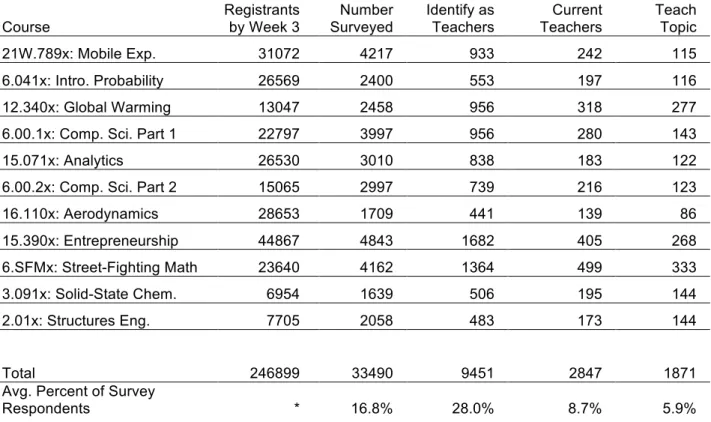
Table 1: Surveys of teacher enrollment were distributed in 11 MITx courses on edX in the Spring of 2014. The questions identified three categories: past or present teachers, current teachers, and teachers with experience teaching the course’s topic. These categories are not mutually exclusive. Totals and average percentages across courses are provided relative to survey respondents.
Survey Methodology and Forum Analysis
In the spring of 2014, entrance and exit surveys addressing the motivations and backgrounds of participants were given in 11 MITx courses. Although these surveys addressed multiple issues concerning participants, teacher enrollment was a significant concern with questions addressing the following broad themes:
1) Are a significant number of teachers enrolling in MITx open online courses? 2) If so, do these teachers come from traditional instructional backgrounds?
3) Do teachers completing a course desire accreditation opportunities and broader usability of MITx resources? Course Registrants by Week 3 Number Surveyed Identify as Teachers Current Teachers Teach Topic 21W.789x: Mobile Exp. 31072 4217 933 242 115 6.041x: Intro. Probability 26569 2400 553 197 116 12.340x: Global Warming 13047 2458 956 318 277
6.00.1x: Comp. Sci. Part 1 22797 3997 956 280 143
15.071x: Analytics 26530 3010 838 183 122
6.00.2x: Comp. Sci. Part 2 15065 2997 739 216 123
16.110x: Aerodynamics 28653 1709 441 139 86 15.390x: Entrepreneurship 44867 4843 1682 405 268 6.SFMx: Street-Fighting Math 23640 4162 1364 499 333 3.091x: Solid-State Chem. 6954 1639 506 195 144 2.01x: Structures Eng. 7705 2058 483 173 144 Total 246899 33490 9451 2847 1871
Avg. Percent of Survey
Over 33,000 participants responded to the entrance surveys, which focused largely on themes 1 and 2. The exit surveys had over 7,000 respondents, with questions addressing theme 3 for current teachers. The survey questions used to address these broad themes can be found in supplementary material (see supplementary material).
In addition to survey data, a tremendous amount of participant interaction data is available. Discussion forums entries and click-stream data allow one to check if participating teachers are actively pursuing an important aspect of their profession, namely, instructing other participants within a course. Using the responses to the entrance surveys, we can compare the behavior of teachers versus non-teachers.
Entrance Survey: Teachers “are” enrolling in MITx courses
Recent entrance surveys of over 33,000 participants in 11 MITx courses from the Spring of 2014 reveal a substantial number of enrolling teachers (Table 1). Cross-course averages indicate
28.1% of respondents identify as past or present teachers, while 8.8% identify as current
teachers, and 5.9% have taught or currently teach the course subject. Note, these percentages are even more striking when enumerated. Across all survey respondents, there are 9,628
self-identifying teachers, 2,901 practicing teachers, and 1,909 participants that have or currently teach the topic. The average survey response rate was 16.9%, meaning that if respondents were a random sample of registrants, the actual numbers of teachers would be approximately 6 times larger. Although teachers are likely to respond at greater rates, we argue that the baseline numbers are themselves numerically significant.
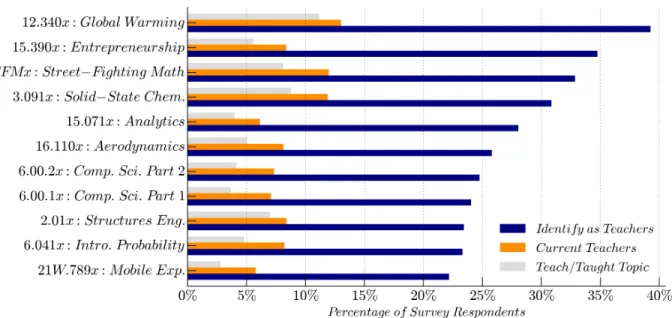
Figure 1: Percentage of self-identifying teachers, whether they have or currently teach the course topic, and the percentage of currently practicing teachers. Percentages are relative to the number of survey respondents.
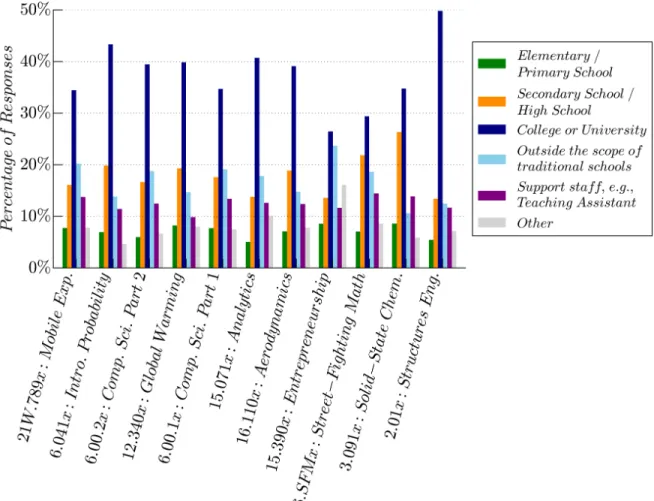
The entrance surveys also included questions contextualizing respondents’ instructional backgrounds. Figure 2 contains distributions of response options, where 73.0% of responses indicate what we consider traditional teaching backgrounds: Primary/Secondary School,
College/University, or Support Staff, e.g., Teaching Assistant. A notable exception is Entrepreneurship (15.390x), which has only 60.2% of respondents with traditional teaching backgrounds (also see supplementary material). The course topic may offer a signal that explains the variation of teacher enrollment across courses. One can make alternative arguments that the large enrollment in Global Warming (12.340x) and Street-Fighting Math (6.SFMx) may be partially explained by interest of teachers in seeing materials and alternative views on instruction.
Taking a closer look at the breakdown of instructional backgrounds (see Figure 2), “College or University” teachers account for the largest populations, but may range from faculty to teaching assistants. The size of the “College or University” population is likely due to all surveyed courses being college level. K-12 teachers make up 25.0% of instructional context found in Figure 2 (found by summing Primary School and Secondary School categories). The categories “Outside the scope of traditional schools” and “Other” indicate respondents that consider
themselves teachers outside the available choices within the survey (see supplementary material). Free response submissions were allowed within the “Other” category, and a number of
respondents identified as tutors or working in corporate training. Each category provides a number of hypotheses for “who” enrolls in these courses, but future must dig deeper into “why”.
Figure 2: Instructional context of self-identifying teachers. Survey question allowed for multiple responses. All percentages are relative to total number of responses within each course.
Exit Survey: Course completing teachers desire accreditation and use of resources
Within the last two weeks of each course, questions related to teachers were added to exit surveys assessing the course impact on teachers, and whether course developers were missing opportunities to provide professional development and accreditation for participating teachers. Out of 7,149 survey respondents, 1,002 (15.6%) again identified as current teachers and answered questions pertaining to accreditation, course influence, and use of MITx MOOC resources. Across all 11 MITx courses on edX, an average of 53.9% (560) of current teachers answered “yes” to having interest in accreditation opportunities, while 15.1% answered “no” and
26.4% answered “unsure” (see supplementary material). Greater than 70% of responding teachers slightly-agree or strongly-agree they will use MITx material in their current teaching, and greater than 70% would be interested in using material from other courses. Even so, many MOOC providers have yet to adopt Open Educational Resource (OER) models (Parr 2013) aimed at facilitating content sharing.
Discussion Forum Analysis: Teachers are actively discussing
Each MITx MOOC employed a threaded discussion forum to support enrollee interactions. Any participant can contribute written content, and it is of central interest whether teachers are
actively engaging with other participants. Forum data collected by the edX platform allow us to monitor such activity in the form of three allowed interactions: “posts” initialize a discussion thread, “comments” are replies within those threads, and “upvotes” allow users to rate a post or comment. Comments are often generated as a response to help seeking, representing an
interaction that a teacher would be well suited to undertake. We focus on comments below – noting that similar analyses applied to posts were found to be nearly identical.
One way of framing teacher behavior in the forums is simply counting their total number of textual contributions relative to all participants, i.e., what is the likelihood of a participant receiving a comment from a teacher. For all participants –teacher respondents, non-teacher respondents, and non-respondents – a total of 57,621 comments were generated across all 11
MITx courses. Figure 3 highlights the percentage of comments relative to population sizes. Despite representing only 4.5% of the total population, teacher respondents generated 22.4% of all comments. Non-teacher respondents generated 33.8% of total comments, but were twice as large a population (10.3%). All other participants (non-respondent) generated 43.8% of total comments, but made up 85.2% of the population
More notably, 1 in 5 comments were written by survey responding teachers, 1 in 12 were by a current teacher, and 1 in 16 were by teachers who teach or have taught the subject. It must be noted that MITx course staff did not advertise to attract teachers, nor did they make special considerations for their contributions to a course.
In addition, we have also analyzed distributions of posts, comments, and overall discussion activity to search for statistically significant trends between teacher and non-teacher respondents. The mean number of discussion comments by teacher respondents is statistically higher than non-teacher respondents in 4 out of 11 courses (see supplementary material), but not statistically distinguishable in the others. We note that distributions of forum activity are often highly
skewed, typically due to only a few users contributing the majority of text (Huang 2014). For example, course staff members designate community-teaching assistants to moderate discussion forums and generate a tremendous amount of textual contributions (Joseph 2013). Of the 15 participants assigned this duty within the 11 MITx courses studied here, 10 took the entrance survey, 5 of which identified as teachers.
Finally, we note that trends found through analysis of posts – initializing a discussion thread – are nearly identical to those found above for comments. This implies that teachers do not reserve their forum behavior to only replies in threads, but are also actively initializing discussion (see supplementary material).
Figure 3: (Left) Average percentages of enrollees that were teacher respondents, non-teacher respondents, and non-respondents across MITx courses on edX in the Spring of 2014, and (right) average percentage of comments across courses that the aforementioned groups made. Although survey respondents identifying as teachers represent only 4.5% of the overall population (left), they generate 22.4% of all comments (right). Categories are based on the entrance survey.
Discussion
Implications for Courses: Networked Instruction
Teacher enrollment and participation has implications for platform design in terms of how educators are networked with other participants. Forums could be optimized to promote expert-novice dialogue, while novel assessment types such as peer grading (Piech 2013) could make use of participant profile information in assigning graders. In addition, platforms could provide tools that allow teachers to discuss specific content or pedagogy, while simultaneously contributing feedback to course staff. The collection and maintenance of profile information will be crucial, with questions remaining for platform designers on whether such information should be collected publicly (e.g., LinkedIn for MOOCs) or privately (surveys). Public and private data collection issues are particularly relevant considering the recent discussion of student privacy in MOOCs (Daries 2014).
Teacher enrollment also has implications for course design, where participating teachers could begin taking on aspects of group discussion or tutoring sessions within a course. A recent
experiment in the HarvardX course on Copyright (Fisher, W. W. 2014) has begun experimenting with such ideas using cohorting tools to divide participants into small-enrollment sections, each led by a Harvard Law School student. When considering worldwide enrollment in MOOCs, it makes sense that teachers from specific cultural background could lead students from their own regions. Within any model of networked instruction, consideration of the impact on both teachers and students should be taken into account.
Teacher Professional Development (Vrasidas 2004) is an ongoing focus of federal educational policy (Schmidt 2011, Bauer 2012). A recent report from the Center for Public Education emphasized that educational reform movements like the Common Core Standards require equal reform for teacher professional development (Gulamhussein 2013). Key issues include moving away from one-day workshops, delivering professional development in the context of a teacher’s subject area, and developing peer (or coaching) networks to facilitate implementation of new classroom techniques.
Already, MOOCs directly related to professional development (Kleiman 2013) are emerging; Coursera has launched a “teacher professional development” series serving pedagogical needs of a variety of educators, and edX has just announced a professional development initiative
focusing on AP high school courses (CITE Whitehouse ConnectEd). Nonetheless, the huge catalogue of available courses raises the question of whether professional development should be provided within the context of a specific topic. For example, a 2009 survey indicated that only 25% of high school physics teachers were physics majors (White 2010). Because of the
tremendous amount of content being produced for MOOCs, it seems quite possible that teacher training could leverage this technology to be performed within a Pedagogical Content
Knowledge framework (Schulman 1986).
Providers will face challenges in addressing the broad meaning of accreditation and professional development in regard to worldwide access and the diversity of teacher backgrounds (Bauer 2012). In the United States, MOOC participation will also need to be defined in the context of current accreditation models. Costs of Continuing Education Units (CEUs) are often charged by contact hours in workshop formats taking place over one to two days; how does one translate a 16 week MITx course where mean total-time spent by certificate earners is 100 hours (Seaton 2014)? However, exploring this issue may help MOOC providers identify potential revenue models; spending estimates for professional development in the United States range between $1000 and $3000 per teacher per year (Jobe 2014).
Teacher Utilization of MOOC Resources
One of the central themes of the teacher survey respondents is a strong desire to be able to use the MITx course materials in their own teaching. This suggests that ideally, teachers would be able to employ a personalized sub-selection of assessment problems, text, and video content, of a given MOOC, and provide this with their own schedule of material release and due dates,
synchronized with their own classrooms schedules, and in harmony with local curricula. Moreover, perhaps ideally, teachers would also be able to enroll their own personal cohort of students, and be able to see their student’s progress and scores. And in such an environment, students would likely benefit from being able to discuss the content in the personalized cohort of individuals defined by the teacher.
Unsurprisingly, however, MOOC platforms like edX have not been designed to work this way. On the other hand, the Khan Academy does offer “coach’s” functionality, which provides essentially all these ideal capabilities to successfully engage teachers. This presents an excellent model that MOOC providers might emulate,.
In many ways, what is needed is mechanisms for MOOCs to easily transform into “Personal Online Courses,” dropping the “massive” and “open,” to enable teachers to become a strong point of contact between students and the rich content of MOOCs such as that provided by MITx courses on edX. Such personal online courses could also be natural stepping stones to
transforming the digital learning assets of MOOCs into open educational resources, opening doors not just to re-use, but also, collaborative authoring and “social coding” of course content by teachers building off each others’ work.
Conclusions
Teachers are heavily enrolled and engaged in MITx courses on edX, and evidence indicates that they are playing a substantial role in discussion forums. Measuring the current impact of teachers on other participants is an important area for future research, and one that might help develop learning frameworks that better partner teachers with course staff and other participants. The motivations of teachers will play a key role, whether engaging in life-long learning, life-long instruction, or searching for new pedagogy and peer support. Regarding pedagogy and peer support, adoption of new teaching practices is a major challenge facing teachers and school districts in the United States (Green 2014). MOOCs targeting the needs of teachers and
providing mechanisms for MOOCS to become Personal Online Courses, can potentially provide a space for educators to overcome adoption barriers, and a sustainable foundation for the
continued existence of MOOCs.
Teacher enrollment clearly represents an unrecognized, meaningful audience for MOOC providers. Recent reports have largely focused on demographics within MOOCs (Christensen 2013, Ho 2014), even leading to criticism that the typical participant is older and in possession of an advanced degree (Emanuel 2013). Recognition of the significance of large teacher
enrollments in MOOCs may shift perspectives toward course design and MOOC platform capabilities more attuned to expert participants. Teacher participants in MOOCS are a resource to be respected and valued.
References and Notes:
1. Abdal-Haqq, I. (1996). Making Time for Teacher Professional Development. ERIC Digest.
2. Agarwal, A. Online Universities: it’s time for teachers to join the revolution. Retrieved July 29, 2014: http://www.theguardian.com/education/2013/jun/15/university-education-online-mooc
3. Bauer, J., & Prenzel, M. (2012). European teacher training reforms. Science, 336(6089), 1642-1643.
4. Carlisle, R. D. (1974). College Credit Through TV: Old Idea, New Dimensions. 5. Christensen, G. and Steinmetz, A. and Alcorn, B. and Bennett, A. and Woods, D. and
Emanuel, E. J., The MOOC Phenomenon: Who Takes Massive Open Online Courses and Why? (November 6, 2013). SSRN: http://ssrn.com/abstract=2350964 or
6. Daries, J. P., Reich, J., Waldo, J., Young, E. M., Whittinghill, J., Ho, A. D., Seaton, D. T., & Chuang, I. (2014). Privacy, anonymity, and big data in the social sciences.
Communications of the ACM, 57(9), 56-63.
7. Emanuel, E. J. (2013). Online education: MOOCs taken by educated few.
Nature, 503(7476), 342-342.
8. Fisher, D. H. (2012, November 6). Warming up to MOOC's. Retrieved March 20, 2014,
from http://www.chronicle.com/blogs/profhacker/warming-up-to-moocs/44022
9. Fisher, D. H. (2014 in press). AI Teaching in the Cloud for AI Teaching on Campus. In
AI Magazine, Vol. 35; for Educational Advances in Artificial Intelligence column.
10. Fisher, William W., HLS1X: CopyrightX Course Report (January 21, 2014). HarvardX Working Paper Series No. 5. Available at SSRN: http://ssrn.com/abstract=2382332 or
http://dx.doi.org/10.2139/ssrn.2382332
11.Fredericks, C., Rayyan, S., Teodorescu, R., Balint, T., Seaton, D., & Pritchard, D. E. (2013). From Flipped to Open Instruction: The Mechanics Online Course. In Sixth Conference of MIT’s Learning International Network Consortium.
12.Green, E. (2014, July 23). Why do American Stink at Math? Retrieved August 6, 2014, from http://www.nytimes.com/2014/07/27/magazine/why-do-americans-stink-at-math.html?_r=2
13.Gross, R., & Murphy, J. (1966). Learning by television.
14.Gulamhussein, A. (2013). The Core of Professional Development. American School Board Journal,197(1), 22-6.
15.Ho, A. D., Reich, B. J. F., Nesterko, S. O., Seaton, D. T., Mullaney, T. P., Waldo, J. H., & Chuang, I. (2014). HarvardX and MITx: The First Year of Open Online Courses, Fall 2012-Summer 2013.
16.Huang, J., Dasgupta, A., Ghosh, A., Manning, J., & Sanders, M. (2014, March).
Superposter behavior in MOOC forums. In Proceedings of the first ACM conference on Learning@ scale conference (pp. 117-126). ACM.
17.Jobe, W., Östlund, C., & Svensson, L. (2014, March). MOOCs for Professional Teacher Development. In Society for Information Technology & Teacher Education International Conference (Vol. 2014, No. 1, pp. 1580-1586).
18.Joseph, S. (2013, August 5). Supporting Communities of Teaching Assistants (TAs) and Students in MOOCs. Retrieved March 20, 2014, from
https://www.edx.org/blog/supporting-communities-teaching
19.Kelley, John J. "A preliminary report on the evaluation of continental classroom." Science Education 46.5 (1962): 468-473.
20.Kolowich, S. (2013, November 20). MOOCs are Largely Reaching Privileged Learners,
Survey Finds. Retrieved July 30, 2014, from
http://chronicle.com/blogs/wiredcampus/moocs-are-reaching-only-privileged-learners-survey-finds/48567
21.Kleiman, G. M., Wolf, M. A., and Frye, D. (2013). The Digital Learning Transition MOOC for Educators: Exploring a Scalable Approach to Professional Development. White Paper retrieved on July 29, 2014 from:
http://all4ed.org/wp-content/uploads/2013/09/MOOC-Ed.pdf
22.Lacey, A. L. (1959). “Continental classroom” and the small science department. Science Education, 43(5), 394-398.
24.Pappano, L. (2013, September 13). The Boy Genius of Ulan Bator. Retrieved August 4, 2014, from http://www.nytimes.com/2013/09/15/magazine/the-boy-genius-of-ulan-bator.html?pagewanted=all&_r=0
25.Parr, C. (2013, April 4). US MOOC platforms’ openness questioned. Retrieved August 4, 2014, from http://www.timeshighereducation.co.uk/news/us-mooc-platforms-openness-questioned/2002938.article
26.Piech, C., Huang, J., Chen, Z., Do, C., Ng, A., & Koller, D. (2013). Tuned models of peer assessment in MOOCs. arXiv preprint arXiv:1307.2579.
27.Randall, R. H. (1960). A Look at the “Continental Classroom”. American Journal of Physics, 28(3), 263-269.
28.Schmidt, W. H., Houang, R., & Cogan, L. S. (2011). Preparing future math teachers.
Science, 332(603), 1266-1267.
29.Seaton, D. T., Bergner, Y., Chuang, I., Mitros, P., & Pritchard, D. E. (2014). Who does what in a massive open online course?. Communications of the ACM, 57(4), 58-65. 30.Shulman, L. S. (1986). Those who understand: Knowledge growth in
teaching.Educational researcher, 4-14.
31.Waldrop, M. M. (2013). Massive open online courses, aka MOOCs, transform higher education and science. Scientific American. Retrieved July, 2014.
32.White, Susan, and Casey Langer Tesfaye. "Who Teaches High School Physics? Results from the 2008-09 Nationwide Survey of High School Physics Teachers. Focus
On." Statistical Research Center of the American Institute of Physics (2010). 33.Vrasidas, C., & Glass, G. V. (Eds.). (2004). Online professional development for
teachers. IAP.
Acknowledgements:
The authors thank the Institutional Research group at MIT, the Office of Digital Learning at MIT, and the HarvardX Research Committee for their support.