QUARTERLY NEWSLETTER
New York Flora Association - New York State Museum Institute
Editor: Aissa Feldmann; Assistant Editors: Steve Young and Connie Tedesco
Correspondence to NYFA, 3140 CEC, Albany, NY 12230
Vol. 22 No. 2 Spring 2011 e-mail: [email protected] Dues $20/Year
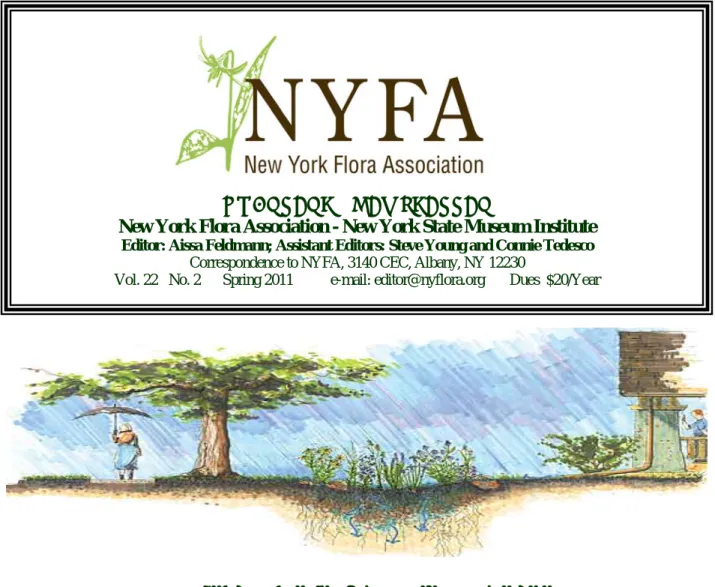
Native Plants for Rain Gardens
Emily DeBolt, owner Fiddlehead Creek Native Plant NurseryIllustration by Doug Adamson, RDG Planning & Design
What is a rain garden?
A rain garden is a vegetated depression that collects
stormwater runoff. Rain gardens are a great DIY pro‐
ject for homeowners to manage small amounts of
stormwater on their own property. By directing run‐
off into the garden, the rain that falls on rooftops,
driveways, and other impervious surfaces on your
property infiltrates into the ground, recharging local
and regional aquifers, instead of running off across
the surface and eventually polluting local waterways.
Rain gardens are beneficial in many ways!
In addition to helping keep local waterways clean by
filtering stormwater runoff, rain gardens also can
help alleviate problems with flooding and drainage.
Rain gardens are pretty and functional, enhancing
the beauty of yards and communities and providing
valuable habitat and food for wildlife like birds and
butterflies when planted with native plants. Rain gar‐
dens can reduce the need for expensive stormwater
Selecting Plants for the Garden
Since a rain garden is flooded periodically, you need
plants that can live in both wet and dry conditions.
Plants in the middle of the garden where it is deep‐
est should be the most adapted to very wet condi‐
tions, being able to be inundated for short periods of
time. Plants on the edges of the garden should be
able to be briefly inundated. Be sure to stabilize the
berm around your garden that holds the water with
grass or dry‐tolerant native plants as well. Right Plant, Right Place
You should consider whether your site is sunny or
shady when selecting plants. Remember – you need
6 hours or more of sun to be considered ‘full sun’. It
is easiest to find plants that work well for rain gar‐
dens that need sun, so keep this in mind when plan‐
ning out the location of your rain garden. Just like
with any other garden, think about what variety of
height, color, and blooming period you would like as
well. Mix a variety of flowers, grasses, and sedges for
different shapes and textures above and different
root depths below the surface. Shrubs are great in
rain gardens too if you have the space. Consider
planting flowers in masses of color to attract birds
and butterflies. Follow the tricks the professionals
use and group plants in odd‐number clumps, using 3,
5, or 7 of the same plants together. This way your
rain garden not only stops stormwater runoff but
also provides you with a beautiful landscape to enjoy
all summer long. After you are done planting, mulch
the garden. Don’t use bark mulch in the garden – it
will float away. Hardwood mulches and pea gravel
work well.
Native Plants for Rain Gardens
Native plants are a great choice for rain gardens.
Planting natives helps protect New York’s biodiver‐
sity by providing food and habitat for birds, butter‐
flies, and other wildlife. Natives have evolved in our
environment over many years and many of our wet‐
land and riparian species are adapted to alternating
periods of wet and dry. The deep roots of natives
absorb and filter runoff more effectively than the
short roots of many turf grasses and other ornamen‐
tal plants – making them a perfect fit for rain gar‐
dens! Swamp Milkweed (Asclepias incarnata). Photo by Emily DeBolt
Here are some plants native to New York that are
great for rain gardens. (These lists are by no means
exhaustive).
For the very wet zone in the middle of the bottom of the garden
• Blue Flag Iris (Iris versicolor)
• Buttonbush (Cephalanthus occidentalis)
• Cardinal Flower (Lobelia cardinalis)
• Common Boneset (Eupatorium perfoliatum)
• Ninebark (Physocarpus opulifolius)
• Northern Bayberry (Myrica pensylvanica)
• Red Twig Dogwood (Cornus sericea)
• Sensitive Fern (Onoclea sensibilis)
• Swamp Milkweed (Asclepias incarnata)
• Swamp Rose Mallow (Hibiscus moscheutos)
• Switch Grass (Panicum virgatum)
Cardinal Flower (Lobelia cardinalis). Photo by Steve Young
Blue Flag Iris (Iris versicolor). Photo by Steve Young Buttonbush (Cephalanthus occidentalis). Photo
If you’d like to learn more about rain gardens, check out these great step by step how‐to manuals available
online (just remember, their plant lists do not necessarily contain species native to New York).
• Rain Gardens: A how‐to manual for homeowners.
http://www.dnr.state.wi.us/org/water/wm/dsfm/shore/documents/rgmanual.pdf
• Rain Gardens: A design guide for homeowners in Connecticut.
http://www.sustainability.uconn.edu/pdf/raingardenbroch.pdf • The Vermont Rain Garden Manual.
http://www.vacd.org/~winooski/VtRainGardenManual.pdf
If you have questions about native plants for rain gardens, you can contact Emily at
[email protected]. Fiddlehead Creek Native Plant Nursery, in Hartford, NY, carries a wide selec‐
tion of New York native plants for rain gardens.
For the moderately wet zone around the edge of the garden
All plants from the very wet list above work here as
well as:
• Blue Lobelia (Lobelia siphilitica)
• Cinnamon Fern (Osmunda cinnamomea)
• Cut‐leaf Coneflower (Rudbeckia laciniata)
• Indian Grass (Sorghastrum nutans)
• Joe‐Pye Weed (Eutrochium fistulosum, E. maculatum, E. purpureum)
• Marsh Marigold (Caltha palustris)
• Royal Fern (Osmunda regalis)
• Spicebush (Lindera benzoin)
• Summersweet (Clethra alnifolia)
• Swamp Azalea (Rhododendron viscosum)
• Turtlehead (Chelone glabra)
• Winterberry (Ilex verticillata)
• Woodland Phlox (Phlox divaricata) Turtlehead (Chelone glabra). Photo by
Emily DeBolt
Blue Lobelia (Lobelia siphilitica). Photo by Emily DeBolt
Recently I was looking at species of Rosa in the New
York Flora Atlas. When I looked at the genus I
noticed that the genus map had Cortland County as
the only county without a record of any species of
Rosa. That made me curious to find out if any other
common genera had been recorded in all but a few
counties. I decided to look through Mitchell’s 1997
checklist and pick out common genera—ones that
had one or more pages of species listed for them. I
looked in the atlas at each one and recorded those
that had fewer than 5 counties where no species had
been recorded in the atlas. The genera are listed
below in taxonomic order followed by the counties
that have no records. Thalictrum – Wayne Ulmus – Allegany, Seneca Quercus – Herkimer, Cortland
Betula – Seneca, Schuyler, Cortland, Chenango
Silene – Broome, Allegany, Wyoming
Stellaria – Franklin, Steuben, Wyoming, Orleans Rumex – Herkimer
Hypericum – Schuyler
Cardamine – Cortland, Sullivan, Schoharie Lysimachia – Cortland, Orleans
Ribes – Broome, Schuyler, Ontario, Orleans Amelanchier – Livingston
Geum – Wayne, Seneca, Broome, Franklin Potentilla – Cortland, Seneca, Wyoming, Orleans Rosa – Cortland
Trifolium – Herkimer, Schenectady, Cortland, Seneca Acer – Cortland
Asclepias – Cortland, Wayne
Scutellaria – Schuyler, Cortland, Broome, Schoharie Veronica – Orleans
Galium – Orleans
Lonicera – Wayne, Wyoming Bidens – Broome, Schuyler
Potamogeton – Broome, Schoharie Scirpus – Wyoming, Orleans
Muhlenbergia – Broome Panicum – Franklin Trillium – Kings
Cypripedium – Fulton, Seneca, Orleans
Cortland County appeared most often in this list
with Orleans County second. I think they would be
good candidates for additional flora work. Maybe
you can find other less common genera that also
have gaps in just a few counties. If you are out
collecting plants in some of these counties this
summer, make sure you collect these common
genera and deposit your specimens in a NY
herbarium to fill the gaps in the atlas. Happy botanizing!
Genus Rosa map with the Cortland County gap. Map from New York Flora Atlas.
New York Counties Lacking Records for Common Genera.
Let’s Fill the Gaps!
Did you know that New York State DEC regulations
(Part 193.2) protect only one individual tree? Can
you name the tree?
Some hints:
• It is the oldest of its species in the Eastern US. • It was once thought to be a Balm of Gilead tree,
giving rise to the name of the settlement that
grew up around it.
• The tree is over 300 years old and is said to have
been visited regularly by Franklin Delano
Roosevelt.
Copied directly from the DEC regulations: “The
following trees, by reason of their rarity, uniqueness,
scarcity or endangered status, shall be protected
pursuant to section 9‐1503 of the Environmental
Conservation Law: Balmville Tree (eastern
cottonwood x carolina poplar) located at the
intersection of River Road, Balmville Road and Grand
Avenue in the unincorporated community of
Balmville, Town of Newburgh, Orange County.”
Did You Know...
Submitted by Troy Weldy, Eastern New York Chapter, The Nature Conservancy
NYFA A
NNUAL
M
EETING
N
OTES
Kimberly Smith and Steve Young, New York Natural Heritage Program
The 2011 NYFA Annual Meeting took place during
the Northeast Natural History Conference at the Em‐
pire State Plaza Convention Center in Albany on April
7th. We had a great turn‐
out, and it was an opportu‐
nity for botanists from
around the state to con‐
nect and share ideas. The
board elections took place,
and two new board mem‐
bers were officially elected.
Welcome to Aissa
Feldmann and Steve
Daniel! Aissa is an ecologist
with the New York Natural
Heritage Program and has
already been doing a won‐
derful job with the newslet‐
ter. Steve is an accom‐
plished botanist and natu‐
ralist with Nature Discoveries in Pittsford. Three re‐
turning board members, Joe McMullen, Connie
Tedesco, and Priscilla Titus, were re‐elected.
The highlight of the meeting was a presentation by
Rob Naczi, Curator of North American Botany at the
New York Botanical Garden, on his work revising
Gleason & Cronquist’s Manual of Vascular Plants of Northeastern United States and Canada (1991).
Great advances in botany in the past two decades
have made the time ripe for its revision. Particularly
compelling justifications for revision are 1) improve‐
ments in understanding relationships among families
and genera, 2) continued taxonomic discovery in the
region at the specific and infraspecific level, and 3)
field discoveries of an increasing number of non‐
native species that have become established in the
region, including invasive plants.
The goals of this project are to produce a compact,
one‐volume Manual intended for field use, as well as
to create an accompanying online Flora. The online
Flora will expand on the contents of the Manual by
including discussions, photographs, citation of litera‐
ture, etc. The region of cov‐
erage for the new Manual is
the same as for Gleason &
Cronquist—a vast area of
northeastern North America
including the entirety or por‐
tions of 22 states of the
U.S.A. and 5 provinces of
Canada. The total area cov‐
ered is about 860,500 mi2,
which is equivalent to 29% of
the area of the 48 contiguous
states of the U.S.A.
The botanical scope of the
new Manual is also the same
as its predecessors: all vascu‐
lar plants growing spontaneously and established in
the geographic area covered. Included will be an esti‐
mated 5000 species and 200 families of vascular
plants (about 25% of all North American species and
nearly 65% of all North American families).
Several innovations distinguish the new Manual, in‐
cluding collaboration by a team of taxonomic and
floristic experts, and inclusion of etymologies of ge‐
neric names and specific epithets, conservation
status for each species, morphologic synapomor‐
phies for families, and new identification tools. Rob
suggested that botanists could help by submitting
specimens and photographs, as well as offering assis‐
tance if we are experts in a particular taxonomic
group. We are all very excited that this invaluable
flora of our region is being revised, and look forward
to using it. An intrepid field biologist using Gleason and Cronquist.
2011 N
EW
Y
ORK
F
LORA
A
SSOCIATION
A
WARDS
NYFA NENHC Awards
The New York Flora Association was pleased to present three awards, each for
$150, for presentations and posters at the Northeast Natural History Conference. Best Overall Talk: Sean Robinson, SUNY‐Albany/SUNY‐Oneonta. “Immigration and
contemporary dispersal of the peat moss, Sphagnum pylaesii, in the Adirondack
Mountains.”
Honorable mention: Matthew Pace, Institute of Systematic Botany.
“Rediscovering the Flora of the New York Botanical Garden Forest, Using the
Steere Herbarium.”
Best Student Talk: Hazel Stark, College of the Atlantic. “Plants and People of New
England: Our Contemporary Reliance on Traditional Knowledge.”
Honorable mention: James Furlaud, Institute of Systematic Botany. “Taxonomic Status of Stout Smart‐
weed, Persicaria robustior (Polygonaceae).”
Best Poster: Elizabeth Coffey, SUNY‐Albany. “The Effects of Stress‐induced Plant Responses on Leaf and Soil
Composition.”
Honorable mention: Luka Negoita, College of the Atlantic. “The Flora of Little Duck Island, ME.”
Honorable mention: Nava Tabak, Hudsonia, Ltd. “Salvia glutinosa Naturalized in Southeastern New York.”
NYFA Small Grants Award
The New York Flora Association's Small Grants Program has selected Megan
Ward of SUNY Plattsburgh as this year's grant recipient! Megan, a junior Biology
major and president of SUNY Plattsburgh's Student Chapter of the Botanical So‐
ciety of America, submitted a proposal entitled "The Current Status of a New
Potential Invasive Plant Species in Clinton County, New York: Mycelis muralis
(Asteraceae)." Known commonly as wall‐lettuce, M. muralis is an abundant com‐
ponent of understory communities in at least three sites in Clinton County.
Megan's field research, planned for this summer, will establish distribution and
habitat‐preference data for the species, in addition to quantifying the impact it
is having on co‐occurring native species.
NYFA A
NNOUNCEMENTS
Announcing the 2011 New York Flora Association field
trip and workshop calendar!
For
full
details
and
registration
information,
see
the
"field
trips
and
workshops"
tab
on
the
NYFA
webpage:
http://www.nyflora.org/field
‐
trips
‐
and
‐
workshops/
May 21‐22 (Saturday and Sunday), 2011: Salix (willow) workshop based
out of Ithaca (Tompkins Co.), led by David Werier. Co‐sponsored with the
Bailey Hortorium, Cornell University.
June 4 (Saturday), 2011: High Valley Farm field trip, Columbia County, led
by Troy Weldy, Claudia Knab‐Vispo, and Richard Ring.
June 19‐23 (Sunday‐Thursday), 2011: Joint field meeting of the Botanical
Society of America ‐ Northeastern Section, Torrey Botanical Society, and
Philadelphia Botanical Club based out of Ithaca (Tompkins Co.). (Also see flyer in this newsletter.)
June 24‐26 (Friday‐Sunday), 2011: Botrychium (grape fern and moonworts) workshop based out of Ithaca
(Tompkins Co.), led by Art Gilman.
June 29‐July 1 (Wednesday‐Friday), 2011: Sedge workshop based out of Geneva (Ontario Co.), led by Tony
Reznicek.
July 23‐24 (Saturday‐Sunday), 2011: Flat Rock field trip (Clinton Co.), led by Anne Johnson, Chris Martine,
and Scott LaGreca.
July 31‐August 1 (Sunday‐Monday), 2011: Bergen Swamp / Letchworth field trip (Genesee, Wyoming, and
Livingston Cos.), led by Steven Daniel and Doug Bassett.
August 28 (Sunday), 2011: Cryptogam Committee trip to Burrows Cave, Newcomb, NY (Essex Co.), led by
Scott LaGreca.
September 10 (Saturday), 2011: Hubbard Creek Marsh & vicinity, Suffolk Co., Long Island, Joint field trip be‐
tween NYFA and Long Island Botanical Society, led by Eric Lamont.
September 17 (Saturday), 2011: Aster and goldenrod workshop based out of the Niagara Falls region, led by
John Semple.
Don’t
forget
to
check
the
NYFA
Calendar
of
Events
for
other
field
outings
and
activities:
http://www.nyflora.org/calendar
‐
of
‐
events/.
Friday
Field
Group
trips
begin
on
April
29
with
a
trip
to
Joralemon
Park
in
Albany
County!
Invitation to the 2011 Joint Field Meeting of the
Botanical Society of America - Northeastern Section,
Torrey Botanical Society, and Philadelphia Botanical Club
Cosponsored with the Finger Lakes Native Plant Society and the New York Flora AssociationJune
19
‐
23,
2011
(Sunday
‐
Thursday)
at
Ithaca
College,
Ithaca,
New
York
The 2011 Field Meeting will examine the flora of Tompkins County and vicinity in upstate New York. Located
at the southern end of Lake Cayuga, Ithaca is in the heart of the extremely scenic Finger Lakes region. The
city is home to the campus of Cornell University, including the Cornell Plantations, a remarkable botanical
garden and arboretum as well as owner of numerous natural areas. Tompkins County also is renowned for
three state parks with magnificent gorges and waterfalls, plus many additional designated natural areas that
are open to the public.
Accommodations are in double‐occupancy dormitory rooms of Ithaca College. The rooms are in “traditional
style residence halls” (non‐air conditioned rooms, shared bath facilities). There are also several nearby mo‐
tels. Participants wishing to stay in a motel will need to make their own arrangements. Box lunches are in‐
cluded for each day of field trips (Monday through Wednesday). Also included are two breakfasts and a buf‐
fet dinner. The remaining meals will be purchased individually at a food court on the campus, or at nearby
restaurants and stores. Transportation will be by a rented bus and by car‐pooling.
Our field trip coordinator and leader is Mr. David Werier of the Finger Lakes Native Plant Society and the New
York Flora Association. The sites he has chosen represent a diversity of vegetation types and will include
• Lime Hollow Nature Center, Marl Ponds, and Chicago Bog: acidic bog, limy marl ponds, rich woods;
• Bear Swamp Sempronius: calcareous rich shrub fen, cool rich northern forests;
• Michigan Hollow: sedge meadows, rich peat swamp, rich and acidic woods;
• Thatcher’s Pinnacles and Biodiversity Preserve: rich forests with older trees, terminal moraine
deposits, steep slope with native red pine, dry rim with dwarfed southern‐affinity forests;
• Taughannock Falls State Park: impressive gorge and waterfall, rich forests, talus slopes;
• South Hill Swamp Natural Area: swamp white oak swamp, diversity of sedges.
In place of the first two, we may include these recommendations from Mr. F. Robert Wesley, Natural Areas
Manager at the Cornell Plantations:
• Landers' Corners Bog: Carex pauciflora, Listera australis, Orontium aquaticum;
• Jam Pond Bog: large open bog surrounded by red maple‐black spruce‐tamarack peatland forest.
There will also be a variety of evening lectures. An optional informal trip to the Cornell Plantations is planned
for the morning after the meeting on Thursday June 23.
For further information contact: Larry Klotz, Chair [email protected] or Robynn Shannon, Co‐chair rndshan‐
2011
Joint
Botanical
Field
Meeting
Registration
Form
deadline:
Tuesday,
May
10,
2011;
limit
54
participants
Please note: Unlike previous years, there will be no paper mailings of this invitation and registration
form. If necessary, the Chairperson can provide individual copies upon request. Registration for this meeting is open
to all interested parties.
Name(s):_____________________________________________________________________________
Address: _____________________________________________________________________________ ____________________________________________________________________________________ Phone: _____________________________ Email: _____________________________
Reminder: The first three options below include the meals listed on the previous page. Participants wishing to stay in a
motel will need to make their own arrangements.
_____ participants X $269.00 basic rate, double occupancy………$____________
_____ participants X $373.00 basic rate, single occupancy……….…….……$____________
_____ participants X $165.00 without room……….………$____________
_____ participants X $70.00 without room and meals ……….…$____________
Mail your check for the full amount made out to Botanical Society of America with the completed Registra‐
tion Form to:
Dr. Larry Klotz
Shippensburg University – Department of Biology,
1871 Old Main Drive, Shippensburg, PA 17257
Please include here the name of the person with whom you wish to share a room, or indicate that we may assign a
roommate:
______________________________________________________________________________
Please include here the name and phone number of a person to be notified in case of an emergency:
______________________________________________________________________________ Check membership(s) of the participant(s) named above in Botanical Organizations:
Botanical Society of America ____ Torrey Botanical Society ____ Philadelphia Botanical Club ____
Other botanical organization: _____________________________________________________
In making this application, participants affirm that they are in general good health, are physically able to keep up with the group in
the ordinary course of field activities, accept as their personal risk the hazards inherent in any outdoor activity, and will not hold the
Botanical Society of America, or other sponsoring organizations, or the trip leaders responsible for the same.
R
EMINDERS
It’s easy to stay up to date on the latest in New York state plant sightings, plant related events, job postings, conservation issues, and many other
top-ics throughout the state by visiting: http://nyflora.wordpress.com/
NEW YORK FLORA ASSOCIATION BLOG
Reporting on the Flora of New York
http://www.cafepress.com/nyflora
Don’t forget to promote awareness of NYFA by proudly purchasing and wearing Café Press items.
Countless individuals and institutions have provided data, effort, and funding to make the New York Flora Digital Plant Atlas available, incorporating information from over 70 herbaria. Why not take advantage of this unparalleled resource and explore New York’s floral riches by visiting
the website at : http://newyork.plantatlas.usf.edu
Become a fan of the New York Flora Atlas on Facebook! Just enter “New York Flora Atlas”
into search from your Facebook page. It is a great place to connect with other fans, and upload photos you would like others to help you
identify.
Please note that all programs and trips are posted on the NYFA
calendar at:
www.nyflora.org/Calendar.html
Let us know if your have any others you would like to post by sending
them to Steve Young at: young @nynhp.org
NYFA Board of Directors
David Werier – President: Term Expires: 2013 Steve Young – Vice-President: Term Expires: 2012 Kimberly J. Smith – Treasurer: Term Expires 2013
Anna M. Stalter – Secretary: Term Expires: 2013 Ed Frantz– Past President: Term Expires: 2013
Directors Steven Daniel - 2014 Aissa L. Feldmann - 2014 Ed Frantz - 2013 Eric Lamont -2013 Christopher T. Martine - 2012 Joseph M. McMullen - 2014 Andrew P. Nelson - 2012 Richard Ring - 2012 Connie Tedesco - 2014 Priscilla Titus - 2014 Troy Weldy - 2012
Go Green with an Electronic Newsletter!
If you don’t need to renew at this time and would like to receive the newsletter electronically in .pdf format, send an e-mail to: [email protected] and put "NYFA electronic newsletter" in the subject line. We appreciate your efforts to save paper, money, and time by receiving your newsletter electronically. An electronic membership has the added advantage of delivery before paper copies are sent out and includes full color photographs. To date more than half of our members receive the newsletter electronically. In the future, we hope to convert most of our members to the electronic newsletter format!
NEW YORK FLORA ASSOCIATION MEMBERSHIP FORM 2011
Annual Membership dues: _____ New $20
_____ Renewal $20 per year
_____ New Student Members Free the First Year. School: ___________________________________ _____ Additional donation to support NYFA efforts like botany presentation awards and small grants. _____ Total $
Name:_____________________________________________________________________________ Address:___________________________________________________________________________ Address:___________________________________________________________________________ City: _______________________________________________ State: ______Zip Code:___________ We encourage you to receive your newsletter electronically. If you can, please enter your email address here: _____________________________________________________________________________ Check here if you already receive your newsletter electronically:_____
Today’s date: _____________
Make checks payable to the New York Flora Association OR, if you would like to use your credit card, please fill in the information below:
Card type (circle one): VISA MASTERCARD DISCOVER AMEX
Name on Card: ______________________________________________________________________ Amount Charged: ____________________________________
Credit Card Number: _________________________________ Expiration Date:___________ Control Number on Back of Card: _________
Mail this form to: NY Flora Association, 3140 CEC, Albany, NY 12230
MUSINGS
Do you have a photograph, article or poem, or pondering that
you would be willing to share with other NYFA members?
We are always looking for interesting contributions for our
newsletter and blog. Please send your contributions and
suggestions to:
[email protected]
Awake, thou wintry earth -
Fling off thy sadness!
Fair vernal flowers, laugh forth
Your ancient gladness!
~Thomas Blackburn, "An Easter Hymn"
“If future generations are to remember us with
gratitude rather than contempt, we must leave
them more than the miracles of technology. We
must leave them a glimpse of the world as it
was in the beginning, not just after we got
through with it.”
- President Lyndon B. Johnson, upon
signing the Wilderness Act, 1964
Spring is sooner recognized by plants than by men.
Chinese proverb