Higher Education Development Project (HEDP)
Higher Education Management Information System (HE-MIS)
ERP System Implementation Support
for:Human Resource including Payroll System
Financial Management System
Logistics System through:
Change Management
- Outline -
Recipient: Issued by:
The Hashemite Kingdom of Jordan, Amman Name: Egon Fleischer National Centre for Human Resources Development
(NCHRD)
Higher Education Development Project (HEDP)
Address: Uhlbergstr. 103 70794 Filderstadt Germany
Eng. Munir Asad Tel: 0049 (0) 711/2205 133
Project Task Manager Fax: 0049 (0) 711/2205 297
E-mail: [email protected]
Date and place of issue: 09.04.2006; Amman, Jordan UPDATE:
Content
Content ... 2
I. Principles of Change Management... 3
1. Levels of Change ... 3
2. Skills Needed to Master Change Management... 4
3. Basic Change Management Strategies ... 5
4. Supporting Change through Stakeholder Analysis... 6
5. Change Management Methodology... 8
6. Change Activities Timeline ... 9
7. Conclusion ... 9
II. ProposaL for Supporting ERP System Implementation by Change Management in the Ten Public Jordanian Universities ...10
1. General ...10
2. Approach...10
3. Change Activity Recommendations ...10
4. Change Management Time Schedule ...11
5. Change Management Team and Deployment Plan ...11
6. Logistics & Infrastructure ...11
7. The Project Management Setup ...11
8. Change Management Reports...12
CHANGE MANAGEMENT FOR HEDP - OUTLINE
I. PRINCIPLES OF CHANGE MANAGEMENT
1. Levels of Change
Change Management can be described as the process, tools and techniques to manage the people-side of change processes, to achieve the required outcomes, and to realize the change effectively within the affected individual, the inner team, and the wider system. In this context, three levels to become sustainable:
Figure 1: Levels of Change Self
Change Management starts and ends with individuals. As the system theory says, one cannot really predict how a person reacts to a certain stimulus. So, if change shall be introduced into a system, one will most likely need to think about what skills, behaviours and belief systems the members of the system will need to be part of the change effort.
Team
At the heart of modern organizations are teams that share the responsibility and the resources for getting things done. We know that teams can either perform at their peak, or can be terribly inefficient. Teams are also the second smallest unit of a change process.
Larger Systems
Either individuals or small teams mostly initiate change processes, but the focus of change is one, which goes beyond that small unit. It is directed towards the entire organization, or towards other organizations.
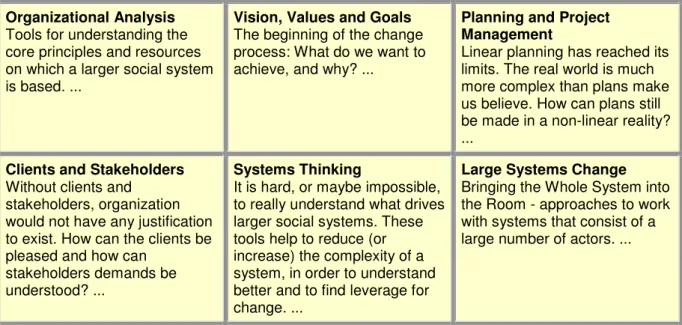
How to understand such social systems, which have their own principles, how to, plan and implement change, is divided into six parts:
Organizational Analysis Tools for understanding the core principles and resources on which a larger social system is based. ...
Vision, Values and Goals The beginning of the change process: What do we want to achieve, and why? ...
Planning and Project Management
Linear planning has reached its limits. The real world is much more complex than plans make us believe. How can plans still be made in a non-linear reality? ...
Clients and Stakeholders Without clients and
stakeholders, organization would not have any justification to exist. How can the clients be pleased and how can
stakeholders demands be understood? ...
Systems Thinking
It is hard, or maybe impossible, to really understand what drives larger social systems. These tools help to reduce (or increase) the complexity of a system, in order to understand better and to find leverage for change. ...
Large Systems Change Bringing the Whole System into the Room - approaches to work with systems that consist of a large number of actors. ...
Figure 2: Larger Systems
2. Skills Needed to Master Change Management
Managing the kinds of changes encountered by and instituted within organizations requires an unusually broad and finely honed set of skills, chief among which are the following: Political Skills: Organizations are first and foremost social systems. Organizations are hotly and intensely political. Lose sight of this fact and failure of change agents is predictable. Analytical Skills: Those who would be change agents had better be very good at analysis. A lucid, rational, well-argued analysis can be ignored and even suppressed, but not successfully contested and, in most cases, will carry the day. Two particular sets of skills are very important here:
1. workflow operations or systems analysis, and 2. financial analysis.
Change agents must learn to take apart and reassemble operations and systems in novel ways, and then determine the financial and political impacts of what they have done.
People Skills: As stated earlier, people are the sine qua non of organization. The skills most needed in this area are those that typically fall under the heading of communication or interpersonal skills. More important, we have to learn to see things through the eyes of these other inhabitants of the organizational world. Part of the job of a change agent is to reconcile and resolve the conflict between and among disparate (and sometimes desperate) points of view.
System Skills: To organize is to arrange. A system reflects organization and, by the same token, an organization is a system. There are two sets of systems skills to be mastered.
Many people associate the first set with computers and it is exemplified by “systems analysis.” This set of skills, by the way, actually predates the digital computer and is known elsewhere as “systems engineering.” The second set of system skills associated with a body of knowledge generally referred to as General Systems Theory (GST) and it deals with people, organizations, industries, economies, and even nations as socio-technical systems. Business Skills: Simply put, one should understand how a business works. This entails an understanding of money — where it comes from, where it goes, how to get it, and how to keep it. It also calls into play knowledge of markets and marketing, products and product development, customers, sales, selling, buying, hiring, firing, and just about anything else one might think of.
3. Basic Change Management Strategies
For managing the change, there are four basic change management strategies that one can adopt. Generally speaking, there is no single change strategy. One can adopt a general or what is called a "grand strategy" but, for any given initiative, some mix of strategies best serves one.
Strategy Description
Empirical- Rational
People are rational and will follow their self-interest — once it is revealed to them. Change is based on the communication of information and the proffering of incentives.
Normative- Reeducative
People are social beings and will adhere to cultural norms and values. Change is based on redefining and reinterpreting existing norms and values, and developing commitments to new ones.
Power- Coercive
People are basically compliant and will generally do what they are told or can be made to do. Change is based on the exercise of authority and the imposition of sanctions.
Environmental - Adaptive
People oppose loss and disruption but they adapt readily to new circumstances. Change is based on building a new organization and gradually transferring people from the old one to the new one.
Figure 3: Change Management Strategies
Which of the preceding strategies to use in your mix of strategies is a decision affected by a number of factors. Some of the more important ones follow.
Degree of Resistance: Strong resistance argues for a coupling of power-coercive and environmental-adaptive strategies. Weak resistance or concurrence argues for a combination of empirical-rational and normative-reeducative strategies.
Target Population: Large populations argue for a mix of all four strategies, something for everyone so to speak.
The Stakes: High stakes argue for a mix of all four strategies. When the stakes are high, nothing can be left to chance.
The Time Frame: Short time frames argue for a power-coercive strategy. Longer time frames argue for a mix of empirical-rational, normative-reeducative, and environmental-adaptive strategies.
Expertise: Having available adequate expertise at making change argues for some mix of the strategies outlined above. Not having it available argues for reliance on the power-coercive strategy.
Dependency: This is a classic double-edged sword. If the organization is dependent on its people, management's ability to command or demand is limited. Conversely, if people are dependent upon the organization, their ability to oppose or resist is limited. (Mutual dependency almost always signals a requirement for some level of negotiation.)
4. Supporting Change through Stakeholder Analysis
Stakeholder Analysis is the technique used to identify the key people who have to be won over. The first step in Stakeholder Analysis is to identify who stakeholders are. The next step is to work out their power, influence and interest, so one knows who one should focus on. The final step is to develop a good understanding of the most important stakeholders so that one knows how they are likely to respond, and so that one can work out how to win their support. After having created a stakeholder map, planning on how communication will be made with each stakeholder. The steps of Stakeholder Analysis are explained below.
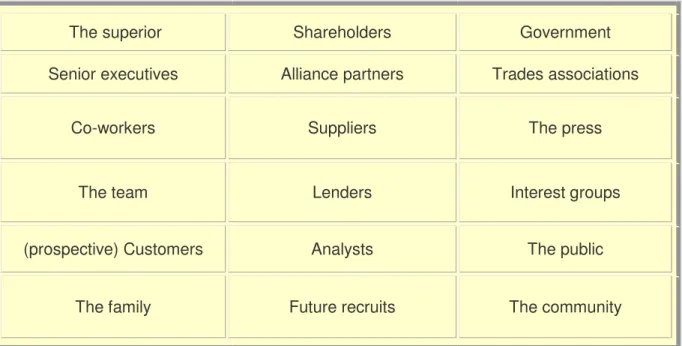
A. Identifying Stakeholders: The first step in stakeholder analysis is to brainstorm who stakeholders are. As part of this, it necessary to think of all the people who are affected by the implementation work, who have influence or power over it, or have an interest in its successful or unsuccessful conclusion. The table below shows some of the people who might be stakeholders in a project:
The superior Shareholders Government
Senior executives Alliance partners Trades associations
Co-workers Suppliers The press
The team Lenders Interest groups
(prospective) Customers Analysts The public
The family Future recruits The community
Figure 4: Potential Stakeholders
It should be kept in mind that although stakeholders may be both organizations and people, ultimately one must communicate with people. The change manager should sure that he identifies the correct individual stakeholders within a stakeholder organization.
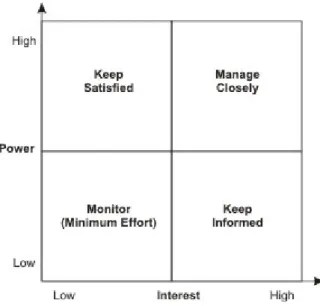
B. Prioritising Stakeholders: First, a long list of people and organizations that are affected by the project needs to be established. Some of these may have the power either to block or advance. A good tool is mapping out the stakeholders using the Power/Interest Grid shown below, and classifying them by their power over the project work and by their interest in the project.
Figure 5: Power/Interest Grid for Stakeholder Prioritisation
Someone's position on the grid shows the actions needed to take with them:
High power, interested people: these are the people the change manager must fully engage and make the greatest efforts to satisfy;
High power, less interested people: putting enough work in with these people to keep them satisfied, but not so much that they become bored with the change manager’s message;
Low power, interested people: keeping these people adequately informed, and talking to them to ensure that no major issues are arising. These people can often be very helpful with the detail of the project;
Low power, less interested people: monitoring these people, but not bore them with excessive communication.
C. Understanding key stakeholders: Change managers now need to know more about their key stakeholders. It is necessary to know how they are likely to feel about and react to the change project. It is also necessary to know how best how to engage them in the project and how best to communicate with them. Key questions that can help understand stakeholders are:
What financial or emotional interest do they have in the outcome of the project? Is it positive or negative?
What motivates them most of all?
What information do they want from the change manager?
How do they want to receive information from the project? What is the best way of communicating messages to them?
What is their current opinion of the project? Is it based on good information?
Who influences their opinions generally, and who influences their opinion of the project team? Do some of these influencers therefore become important stakeholders in their own right?
If they are not likely to be positive, what will win them around to support the project? If it is not possible to win them around, how will one manage their opposition?
Who else might be influenced by their opinions? Do these people become stakeholders in their own right?
The findings may be summarized on the stakeholder map, so that the change manager can easily see which stakeholders are expected to be blockers or critics, and which stakeholders are likely to be advocates and supporters of the project.
5. Change Management Methodology
It might be useful adopting a change methodology for IT projects which incorporates two vital components:
1. First, there is the need for a continuous set of activities which occur along a Change Continuum, and
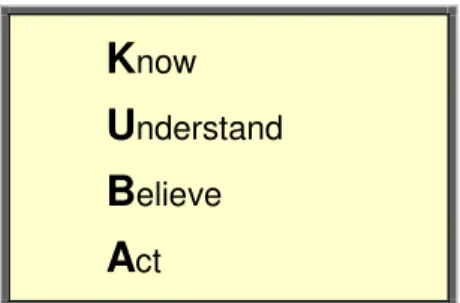
2. Second, it looks at the various audiences to identify where they are on the K.U.B.A curve.
K.U.B.A stands for:
Know
Understand
Believe
Act
and it helps the team assess selected audiences in terms of their commitment to change and to identify the types of activities most likely to bring users up the adoption curve. A visual representation of the methodology is shown below:
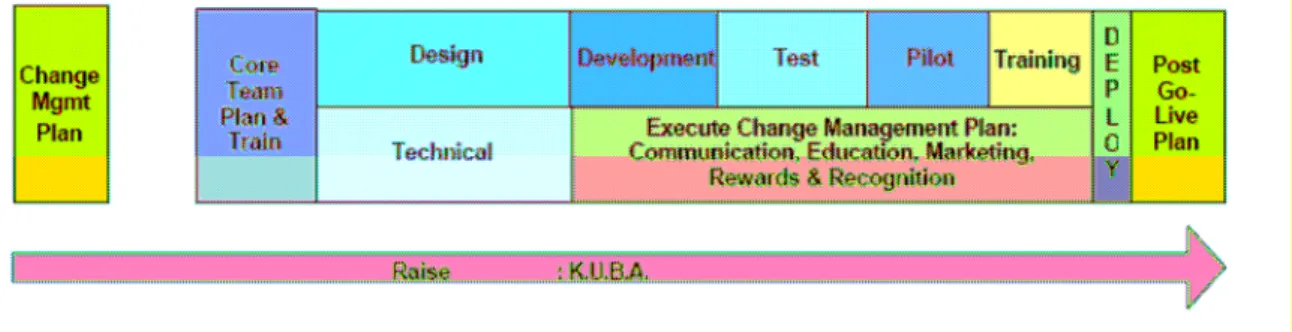
6. Change Activities Timeline
Implementing and assigning activity timelines is a key in any adoption plan. It is important to align change activities with the overall project activities. Below is the detailed change
activities overlapped with the known technical project activities.
Figure 7: Activity Timeline
7. Conclusion
Managing change is seen as a matter of moving from one state to another, specifically, from the problem state to the solved state. Diagnosis or problem analysis is generally acknowledged as essential. Goals are set and achieved at various levels and in various areas or functions. Ends and means are discussed and related to one another. Careful planning is accompanied by efforts to obtain buy-in, support and commitment. The net effect is a transition from one state to another in a planned, orderly fashion. This is the planned change model.
II. PROPOSAL FOR SUPPORTING ERP SYSTEM IMPLEMENTATION BY CHANGE MANAGEMENT IN THE TEN PUBLIC JORDANIAN UNIVERSITIES
1. General
The Consultant is proposing a Change Management Strategy to ensure successful implementation and user learner adoption of the new MIS for all public Jordan Universities. A detailed Change Management Plan is required in order to build and execute the change systems that are necessary to reach the diverse stakeholder groups across all institutions and all hierarchies.
2. Approach
A seven-step work plan approach is proposed which is based on best practices in ERP Implementation and Change Management. The steps include:
1. Initiating the Change Management work stream of the project by engaging the core project team; holding a workshop designed to define goals and success measures for Change Management; identifying key stakeholders and establishing a framework for communications;
2. Assessing organizational readiness through interviews with key stakeholders;
3. Assessing at a high level, the business process change that the ERP system will bring, and consulting with University and MoHESR representatives in workshops around ‘future’ processes, roles and responsibilities and their reactions to the change;
4. Carrying out an Impact Analysis and identifying risks associated with the change and develop recommendations to mitigate risks through the ERP system implementation; 5. Conducting Change Workshop with business representatives to verify findings of the
change impact analysis and gathering input and reactions to recommended risk mitigation activities;
6. Creating a presentation designed to communicate findings of the Change Management Strategy to top level decision makers on work to-date (above activities) including preliminary plans for reaching and relating to all business areas with the ERP system implementation;
7. Developing a Detailed Change Management Plan that will provide a clear roadmap for building all required change components that will support users through the stages of change into the future state of university administration.
3. Change Activity Recommendations
While the detailed change activities have been defined as: a. General Communications
b. Education c. Marketing
it is also important to highlight the type of work effort associated with delivering the activity. Qualifying work effort will help ensure that activities are aligned to team member’s capabilities.
The following steps need to be taken to ultimately determine which activities should be included to ensure adoption of the ERP occurs:
1. Stakeholders rated effectiveness of all activities 2. Estimate work efforts for effective activities 3. Activities categorized
4. Overall rating assigned to activity
5. Ease of personalization to respective audiences.
4. Change Management Time Schedule
Implementing and assigning activity timelines is a key in any adoption plan. It is important to align change activities with the overall project activities. For a detailed listing of all the planned change activities, please refer to Attachment xx.
5. Change Management Team and Deployment Plan
Key to all further change activities is the right team (both in expert profiles and team composition). It is recommended that the Consultant employ one assistant on permanent basis to keep in touch with the project stakeholders, organise the activities on site and take care for translation services and keeps track of all ERP project developments. The Consultant himself will prepare and roll out the change management activities intermittently in accordance with the HEDP Task Manager and the ERP project requirements. The deployment plan of the team is shown in Attachment xx.
6. Logistics & Infrastructure
For the logistics it is proposed that one office for two experts is provided by the HEDP at NCHRD premises. The usual equipment should comprise telephone, Internet access, access to printing, copying and faxing facilities. There should be made available a budget for car rental so that the experts are sufficiently flexible in their mobility.
The experts themselves will provide personal workstations/notebooks. The assistant should be capable of providing translations and interpretation.
7. The Project Management Setup
The proposed management structure for the change project should be built up by the following:
ERP Steering Committee: This Committee, already responsible for the ERP Implementation Project should be as well the responsible arm for the Change Management project;
ERP Implementation Team: The change management team should be always in close touch with the ERP implementation team so that all activities for implementing the ERP solution are solidly underpinned by change management activities;
Change Management Team: This team, to be set up of two permanent experts (consultant and assistant) shall carry out the usual work for the change management project. Other experts, on as-needed-basis may join in for specific duties.
8. Change Management Reports
Inception Report: This first report will outline the detailed change management activities best suited to ensure adoption of the new ERP system in the MoHESR and each University individually. The report presents recommended activities, accountabilities, work-effort estimates (including costs, where applicable), best practices and recommended rollout timelines. Further this report is meant to serve as a reference document, which includes historical insights around the creation of the detailed change management plan. In short it is meant to serve as the primary change activities project reference giving stakeholders a quick and easy glimpse into the activities being conducted and the rationale behind.
Intermediate Reports: For each major milestone to be achieved in the implementation project, an Intermediate Change Management Report shall be written and submitted to the Task Manager of the HEDP, representing the HEDP Steering Committee. The Report, to be submitted at least each six months, shall encompass statements regarding the achievements, the backlogs and the difficulties encountered by the ERP system implementation project. As an important part, it shall be reported on the change activities carried out and on how stakeholder acceptance of the ERP implementation project is developing. Further, if necessary, the Report shall recommend corrective measures for a smooth and successful ERP system implementation. Finally, the Report shall comprise the detailed planning of further change management activities and steps towards full implementation support.
Ad-hoc Reports: Shall be submitted upon request to the HEDP Task Manager in the event that exceptional situations may occur and need pro-active management to handleand bring back the project on track..
Final Report: Shall be submitted at the end of change project, which optimally should comply with the ending of the ERP system implementation project. The Report shall encompass all activities carried out, a brief summary of all preceding reports and an final general statement on achievements and recommendations regarding future measures to maintain the quality of the ERP systems implemented.
9. Cost Estimates
Assessing cost estimates is an important element of implementing any plan. Costs have been broken down into the following categories:
Consulting, Marketing,
Office & Stationary,
Workshops & Roadshows, and Miscellaneous.
For more information on the breakdown of budgets please refer to Cost Estimates Breakdown in Attachment yy.