Miroslav Mitev
Supervisors: Martin Reed, Arsenia Chorti A thesis submitted for the degree of PhD
School of Computer Science and Electronic Engineering University of Essex
The increasing demands for Internet of things (IoT) applications and the tremendous in-crease in the volume of IoT generated data bring novel challenges for the fifth generation (5G) network. Verticals such as e-Health, vehicle to everything (V2X) and unmanned aerial vehicles (UAVs) require solutions that can guarantee low latency, energy efficiency, massive connectivity, and high reliability. In particular, finding strong security mecha-nisms that satisfy the above is of central importance for bringing the IoT to life.
In this regards, employing physical layer security (PLS) methods could be greatly beneficial for IoT networks. While current security solutions rely on computational plexity, PLS is based on information theoretic proofs. By removing the need for com-putational power, PLS is ideally suited for resource constrained devices. In detail, PLS can ensure security using the inherit randomness already present in the physical chan-nel. Promising schemes from the physical layer include physical unclonable functions (PUFs), which are seen as the hardware fingerprint of a device, and secret key generation (SKG) from wireless fading coefficients, which provide the wireless fingerprint of the communication channel between devices.
The present thesis develops several PLS-based techniques that pave the way for a new breed of latency-aware, lightweight, security protocols. In particular, the work proposes: i) a fast multi-factor authentication solution with verified security properties based on PUFs, proximity detection and SKG; ii) an authenticated encryption SKG approach that interweaves data transmission and key generation; and, iii) a set of countermeasures to man-in-the-middle and jamming attacks. Overall, PLS solutions show promising perfor-mance, especially in the context of IoT applications, therefore, the advances in this thesis should be considered for beyond-5G networks.
I would like to thank the University of Essex, School of Computer Science and Electronic Engineering (CSEE) Doctoral Training Programme for sponsoring my studies and made my dream of pursuing a PhD degree reality.
I would like to sincerely thank my supervisors, Dr Martin Reed and Dr Arsenia (Ersi) Chorti for their valued advice and motivation while conducting this research, thanks to their continuous guidance I enjoyed a stress-free working environment. They let me freely choose my research directions and demonstrated a great deal of support. Our meetings and discussions were the key that brought this thesis to life. Furthermore, I would like to express my gratitude for the networking and travelling opportunities which greatly contributed in enhancing my research experience.
My sincere thanks also go to the members of staff of the School of Computer Science and Electronic Engineering and the Department of Mathematical Sciences, University of Essex who provided me the opportunity to become a Graduate teaching assistant and Graduate lab assistant. This was an amazing experience which helped me to advance with my PhD studies.
I would like to thank my co-authors Dr. Leila Musavian and Dr. Veronica Belmega for their insightful comments and support. I would also like to thank Dr. Mahdi Herfeh for our ongoing collaboration and future publication on the short-block length solution which is not fully contained in this thesis.
Finally, I wish to express my deepest gratitude to my family members, my friends, my colleagues, and my life-partner Elena, for their constant support throughout writing this thesis.
Abstract i Acknowledgments ii Notations vi Abbreviations viii List of figures x List of tables xv 1 Introduction 1 1.1 Motivation . . . 1
1.2 Approach of this thesis . . . 3
1.3 Contributions . . . 5
1.4 Outline of thesis . . . 7
1.5 List of publications . . . 8
2 Background 9 2.1 Physical layer security within the 5G framework . . . 9
2.2 Key-based and key-less physical layer security . . . 12
2.2.1 Key-based PLS: secret key generation . . . 13
3 Multi-factor authentication 23
3.1 Introduction . . . 24
3.2 Respective background . . . 25
3.2.1 Cryptographic primitives . . . 25
3.2.2 Physical unclonable functions . . . 27
3.2.3 0-RTT protocols . . . 31
3.2.4 Proximity detection . . . 32
3.2.5 Security verification . . . 35
3.3 Employed methods and system model . . . 39
3.4 Authentication protocol . . . 50
3.4.1 Enrollment phase . . . 50
3.4.2 Authentication phase . . . 52
3.4.3 Resumption protocol . . . 55
3.5 Security analysis . . . 57
3.5.1 Informal security analysis . . . 58
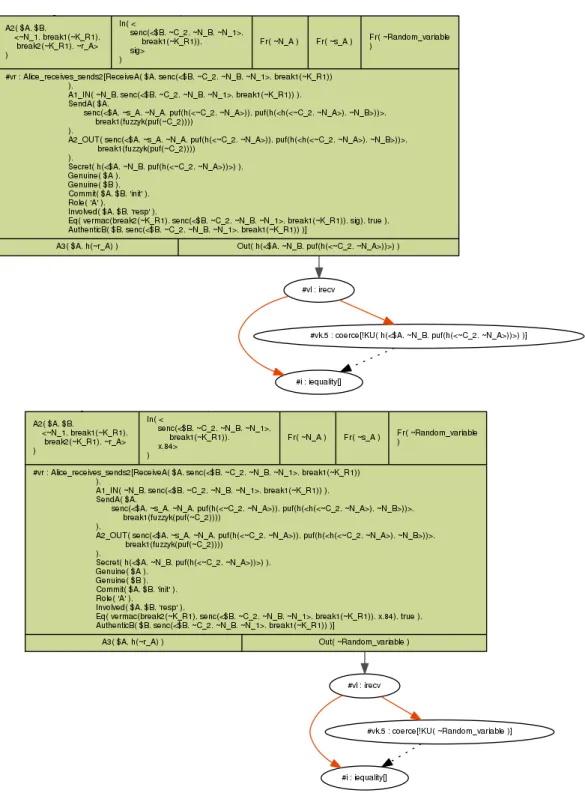
3.5.2 Formal security analysis using BAN logic and Tamarin prover . . 61
3.6 Brief discussion . . . 81
3.7 Summary . . . 82
4 Optimised key generation for delay-constrained wireless systems 83 4.1 Introduction . . . 84
4.2 Respective background . . . 85
4.2.1 Optimisation methods . . . 85
4.2.2 Effective capacity . . . 88
4.3 Employed methods and system model . . . 90
4.4 Authenticated encryption protocols using SKG . . . 94
4.5 Pipelined SKG and encrypted data transfer . . . 96
4.6.1 Optimal allocation under security and power constraints . . . 102
4.6.2 Optimal allocation under security, power and rate constraints . . . 114
4.6.3 Optimal allocation under security, power, rate and delay constraints 123 4.7 Summary . . . 134
5 Man-in-the-middle and denial of service attacks in PLS systems 137 5.1 Introduction . . . 137
5.2 Respective background . . . 139
5.2.1 Jamming attacks . . . 139
5.2.2 Countermeasures . . . 140
5.2.3 Game-theoretic analysis of active attacks . . . 141
5.3 Employed methods and system model . . . 143
5.4 MiM in SKG Systems: Injection Attacks . . . 144
5.5 Jamming Attacks on SKG . . . 150
5.5.1 Optimal Power Allocation Strategies . . . 151
5.6 Summary . . . 160
6 Perspectives 161
A Introduction to Tamarin prover 166
Variables, vectors and matrices
x scalar x vector |x| size of a vector X matrix XT transpose of a matrix I identity matrixSets
N the set of natural numbers
R the set of real numbers
C the set of complex numbers
X the set of elements
{x1, . . . ,xN} set with elementsx1, . . . ,xN
Hash hashing
Es encryption algorithm
Ds decryption algorithm
Sign signing algorithm
Ver verification algorithm
Gen fuzzy extractor generate function
Rep fuzzy extractor reproduce function ⊕ bitwise exclusive-OR operation {x||y} concatenation of vectors
b·c rounding operator returns integer less than or equal to a given number
d·e rounding operator returns integer greater than or equal to a given number
Probability
Pr(X) probability of eventX
Pr(X|Y) probability of eventXunder conditionY Pr(X, Y) joint probability of eventsX andY E[x] expectation ofx
E[x|y] expectation ofxunder conditiony H(x) entropy ofx
I(x|y) mutual information ofxandy cov(x|y) covariance ofxconditioned ony
0-RTT Zero-round-trip-time
3GPP 3rd Generation Partnership Project
5G Fifth generation mobile network
AE Authenticated encryption
AES Advanced encryption standard
AWGN Additive white Gaussian noise
B5G Beyond 5G
BF Block Fading
BLE Bluetooth low energy
BR Best response
CRP Challenge-response pair
CSI Channel state information
DHE Diffie Hellman
DoS Denial of service
DY Dolev-Yao
EAP-TLS Extensible authentication protocol-transport layer security
ECC Elliptic curve cryptography
EH Energy harvesting
FE Fuzzy extractor
HMAC Keyed-Hash Message Authentication Code
MAC Message authentication code
MB logic Mao and Boyd logic
MiM Man-in-the-middle
NB-IoT Narrowband Internet of things
NE Nash equilibrium
NIST National Institute of Standards and Technology
OFDM Orthogonal frequency division multiplexing
PHY Physical layer
PKE Public key encryption
PLS Physical layer security
POWF Physical-one way function
PUF Physical unclonable function
QoS Quality of service
QPSK Quadrature amplitude phase shift keying
RSA Rivest-Shamir-Adleman
RSS Received signal strength
RSSI Received signal strength indicator
SE Stackelberg equilibrium
SKG Secret key generation
SNR Signal to noise ratio
SSH The secure shell
STEK Session ticket encryption key
SW Slepian Wolf
TLS Transport layer security
URLLC Ultra-reliable low-latency communications
1.1 Today’s security architecture . . . 3
1.2 Roadmap of contributions. . . 5
2.1 During the coherence time of the channel Alice and Bob observe highly correlated channel responses. Eve’s observation is uncorrelated to their observations. zA,zB,zE represent the AWGN noise variables observed by Alice, Bob and Eve, respectively. . . 14
2.2 Secret key generation process between Alice and Bob. . . 16
2.3 Alice and Bob exchange pilot signals over a Rayleigh fading channel with realisationh = [h1, . . . , hN]in order to distill a shared secret key. . . 19
2.4 Wyner’s wiretap channel model. Alice sends information to Bob, who observes channel with noisezB. Eve acts as an eavesdropper and observes degraded version of Bob’s channel. . . 20
2.5 One radio frame of the NB-IoT TDD standard . . . 22
3.1 Arbiter PUF. . . 29
3.2 Proximity detection . . . 33
3.3 Kalman filter steps . . . 35
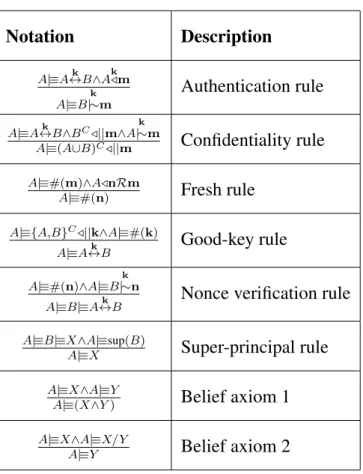
3.4 Notation of the MB logic for protocol analysis. . . 38
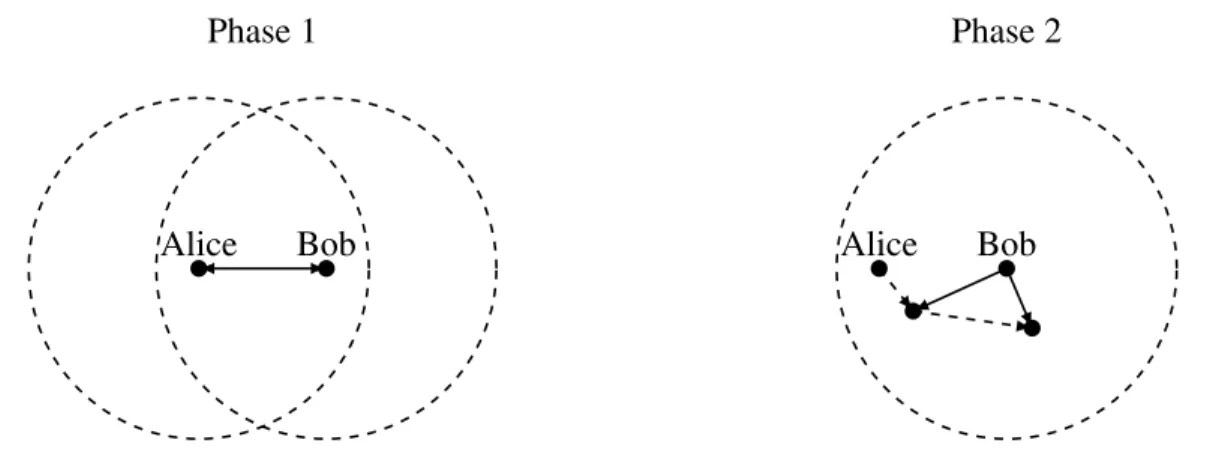
3.5 Enhanced proximity detection - phase 1: Alice and Bob perform prox-imity detection; phase 2: Alice performs two additional measurements at different locations. . . 40
6meters. The measurement noise variance is set toσR = 0.1. . . 41
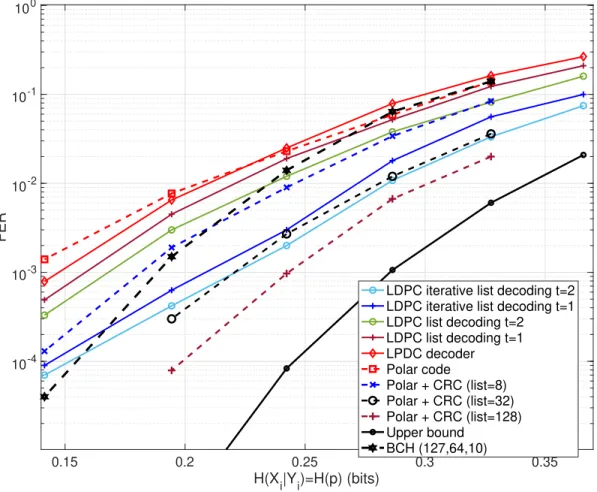
3.7 Comparison of FER performance over the reconciliation rate of different coding schemes to the upper bound given in Eq. (3.10) using the deriva-tion of the channel dispersion as in Eq. (3.13). . . 46
3.8 System model of the proposed multi-factor authentication scheme, where Alice is a resource constraint IoT device and Bob is a resourceful server. . 49
3.9 Enrollment phase (note using a secure channel) . . . 51
3.10 Multi-factor authentication protocol . . . 53
3.11 Resumption protocol . . . 56
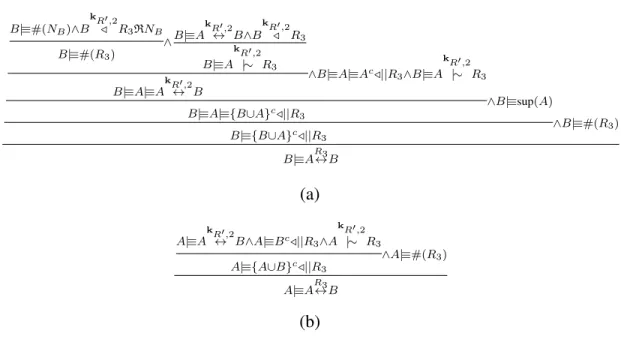
3.12 Proof of authentication (a)B toA(b)AtoB. . . 64
3.13 Secrecy proofs: (a)B believesR3 is a good shared secret betweenAand B (b)AbelievesR3is a good shared secret betweenAandB . . . 65
3.14 Secrecy proofs: (a)AbelievesNB is a good shared secret betweenAand B (b)B believesNBis a good shared secret betweenAandB . . . 65
3.15 Example of protocol definition in Tamarin . . . 66
3.16 Enrollment phase modelled in Tamarin . . . 67
3.17 Link establishment between Alice and Bob in Tamarin . . . 68
3.18 Defining compromising action in Tamarin . . . 68
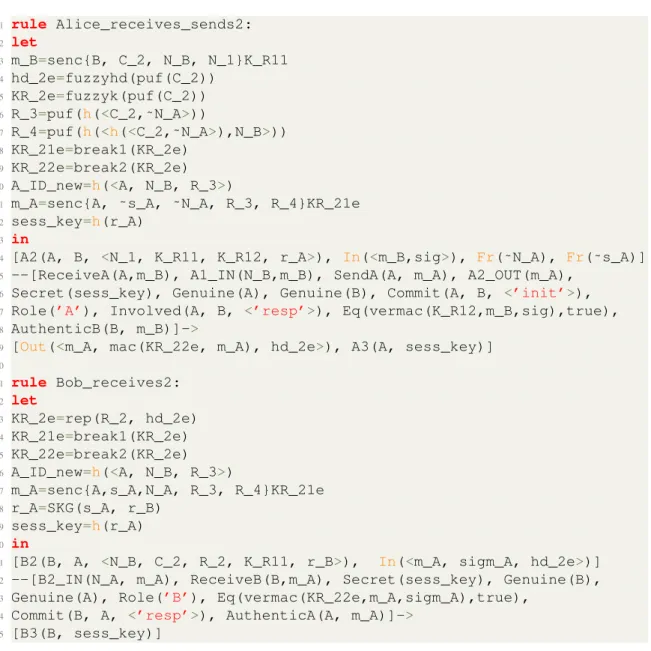
3.19 Message exchange between Alice and Bob in Tamarin. Alice sends au-thentication request to Bob and he replies with a challenge. . . 69
3.20 Message exchange between Alice and Bob in Tamarin. Alice receives the challenge from Bob and sendsMAin response. . . 71
3.21 Restrictions within the protocol definition. . . 72
3.22 Lemma used to prove executability property of the protocol definition. . . 72
3.23 Proof for executability of the protocol definition. . . 74
protocol definition. . . 75
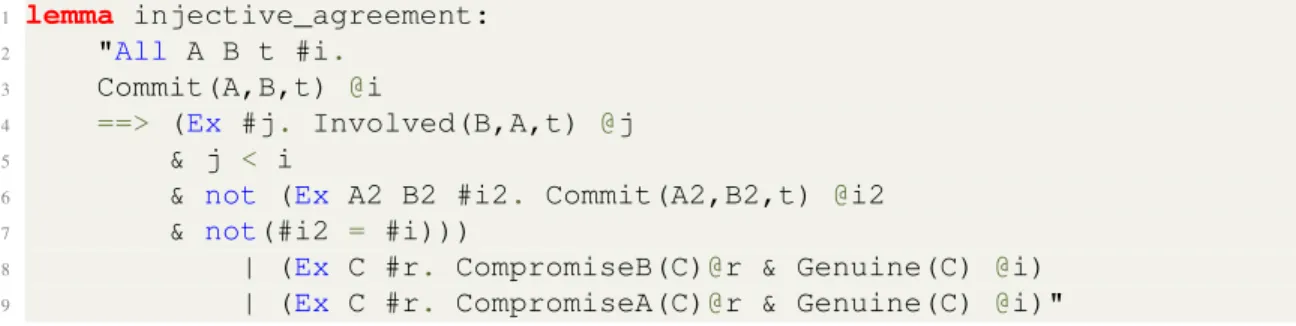
3.26 Lemma used to prove non-injective agreement between Alice and Bob within the protocol definition. . . 76
3.27 Lemma used to prove injective agreement between Alice and Bob within the protocol definition. . . 76
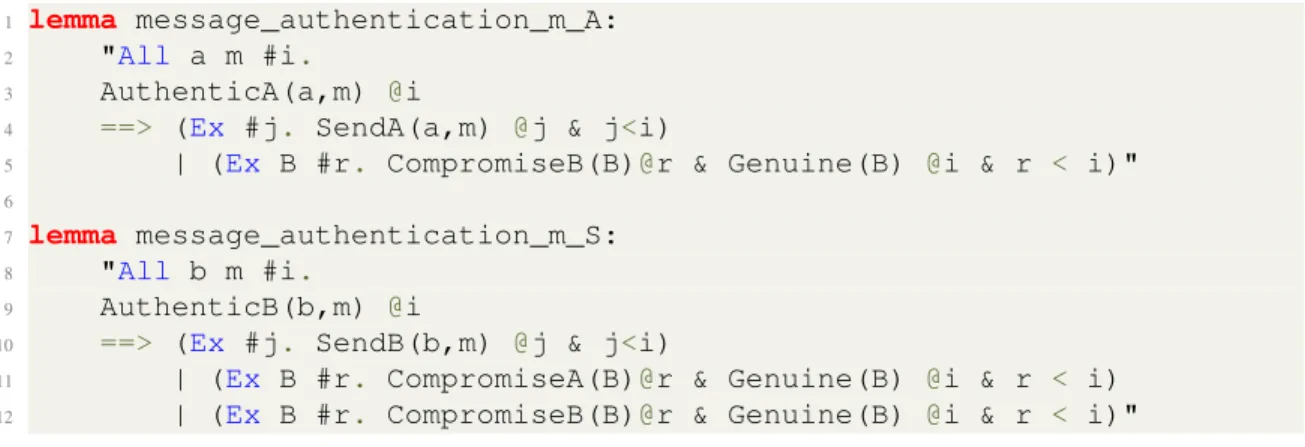
3.28 Lemmas used to prove message authentication ofMAandMS, respectively. 77 3.29 Proof for observational equivalence: TOP: Using left parameter; BOT-TOM: using the right parameter. . . 79
3.30 Lemmas used to prove perfect forward secrecy of the session key, from Alice’s and Bob’s, perspective. . . 80
3.31 Verification of all modelled properties. . . 80
4.1 Roadmap from Chapter 3 to Chapter 4. . . 84
4.2 Secret key generation between Alice and Bob. . . 93
4.3 Pipelined SKG and encrypted data transfer between Alice and Bob. . . . 95
4.4 Parallel approach . . . 99
4.5 Sequential approach . . . 101
4.6 Case 1: Achievable sum rate CD averaged over 10,000 simulations for different values of β, defined in (4.33), number of subcarriers used for data transmission and for SKG. Parameters:(p1+· · ·+pD)/D = 5, σ2 = 1, N = 100. . . 110
4.7 Case 2: Achievable sum rate CD averaged over 10,000 simulations for different values of β, defined in (4.33). Parameters: N = 100, D = 99,(p1+· · ·+pD)/D = 5, σ2 = 1. . . 111
4.8 Case 1: Achievable sum rate CD for different values of β, defined in (4.33), number of subcarriers used for data transmission and for SKG. Parameters: (p1+· · ·+pD)/D = 5, σ2 = 1, N = 10. . . 112
4.10 Efficiency comparison forN = 12, the transmit SNR=10dB andκ= 2. . 118 4.11 Efficiency comparison forN = 64, the transmit SNR=10dB andκ= 2. . 119 4.12 Efficiency vsκ, forN = 24, SNR=10dB. . . 120 4.13 Size of setDfor different SNR levels andσ2e whenN = 24. . . 121 4.14 Size of setDfor different values ofκwhenN = 24. . . 122 4.15 Effective data rate achieved by the parallel heuristic approach and the
sequential approach when, SNR= 10dB andκ= 2andN = 12. . . 128 4.16 Effective data rate achieved by the parallel heuristic approach and the
sequential approach when, SNR= 0.2dB andκ= 2andN = 12. . . 129 4.17 Effective data rate achieved by the parallel heuristic approach and the
sequential approach when, SNR= 10dB andκ= 2andN = 64. . . 130 4.18 Effective data rate achieved by the parallel heuristic approach and the
sequential approach when, SNR= 0.2dB andκ= 2andN = 64. . . 131 4.19 Effective data rate achieved by parallel and sequential approaches when
N = 12, SNR= 5dB,κ= 2andθ = 0.0001. . . 132 4.20 Effective data rate achieved by parallel and sequential approaches when
N = 12, SNR= 5dB,κ= 2andθ = 100. . . 133 4.21 Effective data rate achieved by parallel and sequential approaches when
N = 64, SNR= 5dB,κ= 2andθ = 0.0001. . . 134 4.22 Effective data rate achieved by parallel and sequential approaches when
N = 64, SNR= 5dB,κ= 2andθ = 100. . . 135 5.1 Roadmap from Chapter 4 to Chapter 5. . . 138 5.2 Alice and Bob are communicating over a Rayleigh fading channel with
realisationh. A MiM, Mallory, act as an active adversary, trying to inter-rupt their communication. . . 145
pilot signalsxover a Rayleigh fading channel with realisationh. A MiM, Mallory, with multiple transmit antennas can inject a suitably pre-coded signalPxJ, such that the received signal at both Alice and Bob coincide
w=hATP=hBTP. . . 146
5.4 UP: SE policy compared to always transmitting with either full power or with pth. DOWN: FunctionsD and F vsP. In both sub-figures, pth = 2,Γ = 4, N = 10, σ2 =σJ2 = 1. . . 156
5.5 Relative gain of playerJ, evaluated by function E, for strategic pth and fixedpth = 2whenN = 10,σJ2 = 1and UP:Γ = 4, DOWN:σ2 = 1. . . . 159
5.6 Relative gain of playerJ, evaluated by functionE, for different values of pth forN = 10,σJ2 = 1andΓ = 4. . . 160
A.1 Example of common commands used in the Tamarin environment. . . 167
A.2 Example of message theories in Tamarin . . . 168
A.3 Example of protocol definition in Tamarin . . . 169
A.4 Example of security properties in Tamarin . . . 170
A.5 Restriction example in Tamarin . . . 171
A.6 Notation used by Tamarin’s GUI . . . 172
A.7 Proving secrecy of messagem: Part 1 . . . 173
A.8 Proving secrecy of messagem: Part 2 . . . 173
A.9 Proving secrecy of messagem: Part 3 . . . 174
A.10 Proving secrecy of messagem: Part 4 . . . 175
A.11 Proving secrecy of messagem: Final part . . . 176
3.1 Inference rules adopted from Mao and Boyd logic . . . 62 3.2 Comparison of existing PUF-based solutions for authentication . . . 81
Introduction
1.1
Motivation
The physical layer security (PLS) paradigm dates back to Wyner’s pioneering work in the late 1970’s [1]. However, after decades of advancement, it is just recently that PLS is being considered as an enabling technology in a large set of applications such as: ve-hicular communications [2, 3], underwater communications [4], optical fiber [5], visible light communication [6] and many more as summarised in [7, 8]. The aim of PLS [9–11] is to make use of the inherent randomness in the physical layer, including the commu-nication channel and electronic circuits, and achieve improvements in critical security aspects. In particular, PLS can offer: i) user and message authentication [12]; ii) symmet-ric key generation and key agreement solutions [13, 14]; iii) countermeasures to jamming attacks [15, 16]; and, iv) confidentiality [17].
The increasing interest in PLS has been stimulated by many practical needs. Notably, many critical IoT networks require fast authentication, e.g., in autonomous driving and vehicle to everything (V2X) applications, telemedicine and haptics. However, standard cryptographic schemes, particularly those in the realm of public key encryption (PKE), are computationally intensive, incurring considerable overheads and can rapidly drain
the battery of power constrained devices [18–20]. For example, the recent (2019) third generation partnership project (3GPP) technical report “Study on the Security of URLLC” [21], mentions that all aspects related to low-latency authentication remain open and no solutions have so far been standardised. In this regard, PLS has been explicitly mentioned in the first white paper on 6G [22]: “The strongest security protection may be achieved at the physical layer” and more importantly, it is stated as an enabling technology in the IEEE International Network Generations Roadmap [23].
A further challenge comes from quantum computing, which has seen significant prog-ress after massive investment by companies such as Google, Intel and IBM to build prototypes with more than 50 qubits. In October 2019 Google published in the jour-nal “Nature” their quantum computer experiments showing they have achieved quan-tum supremacy for a particular set of problems [24]. In this aspect, PLS, that relies upon information-theoretic security proofs, could resist quantum computers, unlike corre-sponding asymmetric key schemes relying on the (unproven) intractability in polynomial time of certain algebraic problems [25]. Even state-of-the-art elliptic curve cryptography (ECC) schemes [26], that require substantially shorter keys than Rivest-Shamir-Adleman (RSA) [27] or Diffie Hellman (DHE) [28] schemes, are still considerably more intensive computationally than their PLS counterparts and have not been shown to be post-quantum secure.
Another motivation in improving PLS solutions stems from the fact that a number of vulnerabilities, e.g., jamming during the beam allocation in mmWave [29], arise during the establishment of the radio link. In this aspect, standard security protocols that build on the premise that the communication link has already been established, cannot offer solutions when this is not the case, whereas, PLS schemes can be seamlessly incorporated (e.g., can be interwoven with channel estimation).
In conclusion, PLS provides a new opportunities of security for IoT networks. How-ever, it has not been completely developed and efficiently integrated yet. Therefore, the proposal of novel PLS based solutions for future networks security is highly pertinent.
Secured Why do we need PLS?
Application
Transport
Network
Link
Physical
Figure 1.1: Today’s security architecture1.2
Approach of this thesis
The architecture of today’s wireless systems uses layers. As it can be seen in Fig. 1.1 the layers above the physical layer enable security by various methods. In this sense, the nat-urally arising question is: Why do even need PLS?. In fact the higher layer cryptography mechanisms have numerous of advantages: i) there are no known feasible attacks; ii) they are widely employed and tested; iii) they provide trustworthy authentication. However, these methods have some disadvantages: i) they are built on unproven assumptions about the difficulty of the certain computation problems; ii) they are built on the assumption that the physical connection is already established; iii) they require significant infrastruc-ture. Therefore, the answer to the above question is that PLS will be used in emerging technologies.
In the past years, PLS [9–11, 14, 30, 31] has been studied as a possible alternative to classic, complexity based, cryptography. Signal properties can be exploited to allow for confidential data transmission [32–34]. Therefore, work in the present thesis, proposes to move some of the security core functions down to the physical layer, exploiting both the communication radio channel and the hardware, as unique entropy sources.
a valid, inherently secure source that may be used in a key agreement protocol between two communicating parties. The principle of secret key generation (SKG) from correlated observations was first studied in [35] and [36]. A straightforward SKG approach can be built by exploiting the reciprocity of the wireless fading coefficients between two termi-nals within the channel coherence time [37,38] and this thesis builds upon this mechanism and proposes an optimised SKG mechanism for delay-constrained systems. This is per-tinent to many forthcoming beyond 5th generation mobile (B5G) applications that will require a strong, but nevertheless, lightweight security key agreement.
However, unauthenticated key generation is vulnerable to man-in-the-middle (MiM) attacks. In this sense, physical unclonable functions (PUFs), firstly introduced in [39] (based on the idea of physical one-way functions [40]), can provide authenticated en-cryption and furthermore can decrease the computational cost and have a high impact on reducing the authentication latency in constrained devices [41]. Consequently, this thesis provides a full PUF-based authentication solution. Finally, SKG schemes are known to be malleable over the so called “advantage distillation” phase, during which observations of the shared randomness are obtained at the legitimate parties. As an example, an active attacker can inject pilot signals and/or can mount denial of service attacks (DoS) in the form of jamming. Therefore, this thesis investigates the impact of injection and reactive jamming attacks in SKG and presents set of countermeasures.
To conclude, conventional cryptography mechanisms are a vital element for securing wireless networks. However, they are computationally intensive and require significant infrastructure to extract high entropy keys. On the other hand, the physical layer provides a source of domain-specific information which can be used to complement and improve conventional security methods. The mechanisms proposed within the present thesis, could be easily incorporated in today’s security architecture as a substitute to today’s authenti-cation protocols (Chapter 3) and session key generation mechanisms (Chapters 4, 5).
Chapter
3
Chapter
4
Chapter
5
SKG
authentication
Multi-factor
to jamming attacks
Countermeasures
resource allocation
Optimised
allocation power Strategic encryption authenticated Fast initiation session SecureFigure 1.2: Roadmap of contributions.
1.3
Contributions
The contributions of the present thesis are illustrated in Fig. 1.2 and can be summarised as follows:
Chapter 3
Lightweight and low latency security mechanisms are becoming increasingly impor-tant for a wide range of IoT applications. Promising schemes from the physical layer in-clude (i) PUF, (ii) localisation based authentication, and, (iii) SKG from wireless fading
coefficients. The work in Chapter 3 proposes a complete, fast, multi-factor authentication protocol that uniquely combines PUFs, proximity estimation and SKG. It focuses on short blocklengths and provides a novel closed form expression for the channel dispersion in the SKG setting. Furthermore, the SKG keys are incorporated in a forward secure zero-round-trip-time (0-RTT) resumption protocol for fast re-authentication. All schemes of the proposed mutual authentication protocol are shown to be secure through formal proofs using Burrows, Abadi and Needham (BAN) and Mao and Boyd (MB) logic as well as the Tamarin-prover [42].
Chapter 4
In computational complexity and latency constrained emerging 5G applications,e.g., autonomous vehicles, haptic communications and enhanced reality, SKG at the physical layer could be considered as an alternative to currently used key agreement schemes. In this framework, the work present in Chapter 4 proposes i) a novel authenticated encryp-tion (AE) using SKG, and, ii) a pipelining mechanism of the AE SKG and the encrypted data transfer in order to reduce latency. Implementing the pipelining at the physical layer, the work investigates aparallelSKG approach for multi-carrier systems, where a subset of the subcarriers are used for SKG and the rest for data transmission. The parallel ap-proach is evaluated under power, security, rate and delay constraints. The amount of data that can be transmitted with a single key is determined by the cryptographic suites used, so that realistic key rate constraints can be identified. This allows to formulate the subcarrier allocation as a subset-sum0−1knapsack optimisation problem that is solved using i) the standard dynamic programming approach, and, ii) a greedy heuristic approach of linear complexity. Numerical evaluation shows that the proposed heuristic induces virtually no loss in performance. Furthermore, a comparison with a baseline scheme in which secret key generation and data transfer are performed sequentially, shows that the proposed par-allel approach offers gains in terms of efficiency. All of the proposed mechanisms, have the potential to pave the way for a new breed of latency aware security protocols.
Chapter 5
realisations), is a well established scheme that can be used for session key agreement. SKG approaches can be of particular interest in delay constrained wireless networks and notably in the context of ultra reliable low latency communications (URLLC) in B5G sys-tems. However SKG schemes are known to be malleable over the so called “advantage distillation” phase, during which observations of the shared randomness are obtained at the legitimate parties. As an example, an active attacker can act as a MiM by injecting pilot signals and/or can mount denial of service attacks (DoS) in the form of jamming. In this sense, Chapter 5 investigates the impact of injection and reactive jamming attacks in SKG. First, it is demonstrated that injection attacks can be reduced to – potentially less harmful – jamming attacks by using pilot randomisation; consequently, a novel sys-tem design with randomised quadrature amplitude phase shift keying (QPSK) pilots is presented. Subsequently, the optimal jamming strategy is identified in a block fading ad-ditive white Gaussian noise (BF-AWGN) channel in the presence of a reactive jammer, using a game theoretic formulation. It is shown that the impact of a reactive jammer is far more severe than that of a simple proactive jammer.
1.4
Outline of thesis
This thesis is structured as follows:
Chapter 2, highlights the elements of the problems discussed in the present thesis. The following three chapters contain the main contributions of the present thesis. The organ-isation of these chapters is inspired by the sequence of actions taken in an actual system,
i.e., 1) authentication; 2) session key generation; 3) attacks during the key generation process. In this sense, Chapter 3, proposes a novel PUF-based authentication mechanism that is initialised by location confirmation approach. Furthermore, building on the SKG process it provides a forward secure resumption protocol to quickly “resume” sessions. The concept of the work presented in this chapter was published in [12], whereas the full solution is under review for publication in the “IEEE Internet of things journal”. Next, chapter 4 presents a physical layer resource allocation method that jointly optimised data
rate and key generation rate. This chapter is based on works presented in [12–14, 43] and involves collaboration with Dr. Leila Musavian. Chapter 5 presents countermeasures to active attacks in wireless networks through a game-theoretic approach. This chapter is based on works presented in [15] and involves collaboration with Dr. Veronica Belmega. Finally, my perspectives for future research are presented in Chapter 6.
1.5
List of publications
Journals
M. Mitev, A. Chorti, M. Reed, L. Musavian, “Authenticated Secret Key Generation in Delay Constrained Wireless Systems”, EURASIP Journal on Wireless Communications and Networking, June, 2020.
M. Mitev, M. Herfeh, A. Chorti, M. Reed, “Fast Multi-factor Physical Layer Security Authentication in the Short Blocklength”, under review, IEEE IoT journal.
Conferences
M. Mitev, A. Chorti, V. Belmega, M. Reed, “Man-in-the-Middle and Denial of Service Attacks in Wireless Secret Key Generation”, IEEE Global Communications Conference (Globecom), Dec 2019.
M. Mitev, A. Chorti, M. Reed, “Subcarrier Scheduling for Joint Data Transfer and Key Generation Schemes in Multicarrier Systems”, IEEE Global Communications Conference (Globecom), Dec 2019.
M. Mitev, A. Chorti, M. Reed, “Optimal Resource Allocation in Joint Secret Key Generation and Data Transfer Schemes”, IEEE International Wireless Communications and Mobile Computing Conference (IWCMC), Tangier, Morocco, Jun 2019.
Posters
M. Mitev and A. Chorti and M. Reed, “Optimal resource allocation in secure multi-carrier systems”, Munich Workshop on Coding and Cryptography (MWCC), Germany, invited poster presentation, Apr 2018.
Background
This chapter summarises only the general background in which this thesis was built. It provides an overview of physical layer security highlighting its applicability within IoT networks. The relative background to each study presented within the present thesis is provided later as part of the respective chapter.
2.1
Physical layer security within the 5G framework
The fifth generation (5G) communication technologies such as ultra-reliable low-latency communications (URLLC) and massive machine-type communications (mMTC) are ex-pected to enable numerous IoT applications [44]. IoT devices are distributed in our daily life environment gathering information that ranges from temperature to location mak-ing security and privacy of critical importance [45]. However, despite the continuous improvement of security protocols, there are still open issues that have not been fully ad-dressed [46]. In this sense, transforming the security design bottom up starting from the physical layer, will provide additional level of protection which can help overcome the security hurdles [47]. PLS mechanisms can enhance the security of IoT networks from several aspects. Authentication is central in building secure IoT networks; confirming the
identity of devices and their role in the network hierarchy eliminates the possibility of numerous attacks [48]. However, the low-latency and computational power constraints present in many IoT systems [20], renders the design of IoT authentication mechanisms a challenging task. Current solutions rely on modulo arithmetic in large fields and typi-cally incur considerable latency, in the order of tens of milliseconds [49]; as an example, it has been reported that verifying digital signatures on a vehicle with a 400 MHz pro-cessor takes around 20 msec [50], exceeding the delays that are tolerated in vehicle to everything (V2X) communications [51]. In that direction PLS schemes exploit physical layer entropy sources, including both in the hardware, as well as in the communication medium [12–15]. With respect to the former, physical unclonable functions (PUFs) are hardware entities harnessing entropy from physically unclonable variations that occur during the production process of silicon [39, 52]. These unique and unpredictable vari-ations allow the extraction of uniformly distributed binary sequences [53]. Due to their unclonability and simplicity, PUFs are seen as lightweight security primitives that can offer alternatives to today’s authentication mechanisms [54, 55]. With respect to authen-tication, the research presented in Chapter 3 includes multi-factor authentication protocol with PUFs, wireless fingerprinting and localisation. The necessary background on PUFs are given in Section 3.2.2. Furthermore, a novel PLS-based resumption protocol that allows for data exchange within 0-RTT is proposed.
In numerous IoT scenarios mobility is an important factor [56]. In applications such as V2X and drone connectivity the objects of interest may leave or enter the network in a random manner [2, 57–59]. This requires strong security mechanisms with low overhead. Furthermore, the massively distributed IoT devices have limited resources and therefore, cannot employ complex cryptography [46, 60]. In this sense, IoT networks could greatly benefit from employing PLS solutions. Since the wireless channel is reciprocal, time-varying and random in nature, it offers a lightweight, inherently secure source for secret key distribution protocols [7, 8, 61]. In fact, it has been experimentally validated that mo-bility could highly increase the entropy of PLS generated keys [62,63]. Furthermore, new 5G wireless methods will employ advanced channel state information (CSI) estimation
techniques towards optimal beamforming and improved reliability [64, 65]. In this re-gards, Chapter 4 within the present thesis, shows that the CSI measurements can be used simultaneously towards both: generation of secret keys and reliable data transfer.
The roll-out of 5G mobile networks and the forthcoming the beyond 5G (B5G) will bring about fundamental changes in the way we communicate, access services and con-sume entertainment [66]. With respect to the latter, the multi-fold increase in the service data rates will provide users with ultra high resolution in video-streaming, multi-media and virtual reality, offering immersive experiences [67, 68]. However to support such a large variety of services, requires novel solutions that will enable higher resource effi-ciency [69]. From that perspective, Chapter 4 within the present thesis proposes a novel optimised PLS resource allocation algorithm that jointly optimises data and key genera-tion rates.
A further motivation in exploring PLS solutions stems from the fact that a number of vulnerabilities may impact the reliability of the exchanged information [70, 71]. For example, jamming attacks in URLLC may provoke re-transmission and increased overall delay [15, 72], furthermore, jamming during the beam allocation in mmWave [29] may disrupt the establishment of the radio link. A common assumption of security protocols is that the communication link has already been established, however, this may not be the case. Consequently, PLS offers several counter-jamming techniques, including: jamming detection mechanisms and counter-jamming measures in the form of i) energy harvesting (EH) [16,73], ii) channel hopping [74] and power spreading [75,76], further approaches to counter jamming attacks include iii) friendly jamming [77, 78], and iv) localisation [79]. In fact, studies [16, 73] are carried in a game-theoretic framework. The legitimate users, who have EH capabilities, act as a single player who aims at maximizing the transmis-sion rates while the jammer aims at minimizing it. It is demonstrated that, for specific scenarios, the legitimate users could benefit from the harvested jamming energy by sub-sequently using it to boost their transmission. On the other hand, channel hopping [74] and power spreading [75, 76], are commonly used technique to counter jamming attacks. The legitimate users can use channel hopping in a random fashion in order to avoid most
of the jamming interference, however, depending on the scenario, it may be more benefi-cial to spread their power over the entire spectrum rather than concentrating it on a single channel. In this sense, Chapter 5 of the present thesis explores jamming attacks during a PLS SKG process and gives a set of countermeasures.
Overall, the physical layer properties carry important information which is directly re-lated to security and privacy of today’s systems. The intelligence of any actual system in the physical world relies on its physical infrastructure. Important questions that naturally arise are then: “how to turn the collected data into useful knowledge?”; and, “why the characteristics of the physical channel are used in enhancing the systems’s reliability but are not used towards improving security?” In response to this questions, the present thesis proposes a set of techniques that could be employed independently or as a complement to existing techniques, with minimal changes in the control plane. The physical layer solutions developed within the premise of this thesis include: a lightweight PUF authen-tication mechanism, fast proximity detection, a resumption protocol based on physical layer SKG, an authenticated encryption (AE) SKG approach, a pipelining algorithm that interweaves data transmission and SKG, a near-optimal subcarrier allocation algorithm of linear complexity, pilot randomisation as a countermeasure to injection attacks and optimal power allocation policy in the presence of active jammers.
2.2
Key-based and key-less physical layer security
As discussed, current security solutions: are focused at the higher layers of the com-munication systems; are computationally intensive; and, are not suitable for resource constrained devices, such as in an IoT scenario. In this sense, PLS has proven itself as a lightweight information theoretic secure mechanism regardless of the adversary’s re-sources [80, 81]. This section gives an introduction to the two basic PLS methods [82]: key-based PLS and key-less PLS.
2.2.1
Key-based PLS: secret key generation
Due to the nature of radio waves, wireless communication remains vulnerable to different types of attacks. Passive attacks such as eavesdropping or traffic analysis can be per-formed by anyone close to the area of communication. Furthermore, wireless devices can be targeted by active attacks such as jamming [15, 74] or spoofing which can cause interference or even disruption of the device (summary of attacks and countermeasures in wireless systems can be found in [83] and [84], respectively). Therefore, to ensure confidentiality, data encryption is vital for communication security. However, most of the traditional public-key encryption primitives such as RSA [27] and ECC [26] have high computational complexity and are not suitable for portable and battery-driven devices, such as in an IoT system.
In this sense, key-based PLS [85] methods are seen as a lightweight alternative for secret key generation (SKG)1by using the properties of the wireless medium. The reci-procity of wireless medium can be used as a tool for key generation between two parties (Alice and Bob), as shown on the block diagram in Fig. 2.1. In this case, Alice and Bob perform pilot exchanges that take place over the coherence time of the channel2. During this period, Alice and Bob observe highly correlated channel states, as opposed to Eve, whose observations are uncorrelated to the main channel. Following from that, Alice and Bob can use their observations to generate a shared secret key between them. Important properties that support the above mechanism are:
i) in order to reduce the key mismatch rate, each round of the pilot exchange must be within the coherence time of the channel. One round refers to one pilot sent in each direction, i.e., during each round, two pilots are sent, one from Alice and one from Bob;
1The term SKG throughout this thesis refers to the key-based PLS mechanism introduced in this section. 2 The coherence time corresponds to the interval during which the multipath properties of wireless
channels (channel gains, signal phase, delay) remain stable [3, 86, 87]. It is inversely proportional to the Doppler spread, which on the other hand, is a dispersion metric that accounts for the spectral broadening caused by the user’s mobility (for more details and derivation please see [87]).
Alice Bob zB
zA
Eve zE
Figure 2.1: During the coherence time of the channel Alice and Bob observe highly correlated channel responses. Eve’s observation is uncorrelated to their observations. zA,zB,zE represent the AWGN noise variables observed by Alice, Bob and Eve,
respec-tively.
ii) in order to have uncorrelated key bits, the time interval between rounds must be greater than the coherence time of the channel.
Overall, the SKG mechanism could greatly benefit from the time-variability property of the wireless channels [82, 88]. In fact, the security key is generated from the variations in the received signal (i.e., fading). Therefore, time-varying signals could produce secret keys with higher entropy.
However, in some static scenarios, Alice and Bob may struggle to extract enough bits from the channel. To overcome this, instead of transmitting publicly known pilot signals, one or two-way randomised signal transmission can be performed which can be used as an additional source of randomness [89]. Furthermore, Chapter 5 within the present thesis will show how randomised pilot exchange can be used as a countermeasure to injection attacks.
Commonly used parameters as source of shared randomness are the received signal strength (RSS) and the full CSI [90] (some channel estimation techniques can be found in [90]). However, RSS-based schemes are open to predictable channel attacks [86, 91] whereas CSI-based approaches, have proven to be resistant [92]. Therefore, this work assumes the usage of a CSI-based SKG, which has been practically investigated in nu-merous scenarios [92–95] as briefly described below.
ad-ditive noise, antenna gainsetc., between two devices. To overcome this, a non-reciprocity component is evaluated during a learning phase before the SKG process. Based on this, the authors present a channel gain complement scheme which eliminates the impact of non-reciprocity in both indoor and outdoor environments.
Another important step in a practical implementation is to build a suitable unit for pre-processing in order to decorrelate the signals in the time / frequency and space domains. As an example, some recent works have shown that the widely adopted assumption [96] that a distance equal to half of the wavelength (which at 2.4 GHz is approximately 6
cm [92]) is enough for two channels to decorrelate, may not hold in reality [86].
In [93] the problem caused by the similarity of the characteristics (phase and ampli-tude) of neighboring subcarriers is addressed. This effect can cause a high correlation in the CSI measurements which may lead to security issues. To overcome this a three-step protocol for wireless SKG between two entities is proposed: i) CSI measurements are converted to bits; ii) universal hash function is applied to the bit strings and, iii) if the resulted bit strings after hashing differ, part of the bits on both sides are recombined until same bit sequence is observed at each of the parties. This final step helps remove the correlation of bits generated from neighbouring subcarriers.
A further measure addressing correlation between the eavesdropper and communicat-ing devices is role reversal [94]. The party that initiates the SKG process is considered to be a leader, while the follower is trying to match the leader’s bit stream. If an eavesdrop-per is close to the leader her channel might be correlated to the main one, thus she could obtain part of the key bits. With role reversal the legitimate parties change their roles – from leader to follower and vice versa – during the process and the obtained bit strings are concatenated at the end. This step prevents leak of key bits through eavesdropping.
To summarise, the impact of channel correlation on SKG needs to be explicitly ac-counted in actual implementations. However, in this thesis its effect is neglected as its im-pact on SKG has been treated in numerous contributions in the past [62,63,93–95,97–100] and will not enhance the problems formulated in the following chapters.
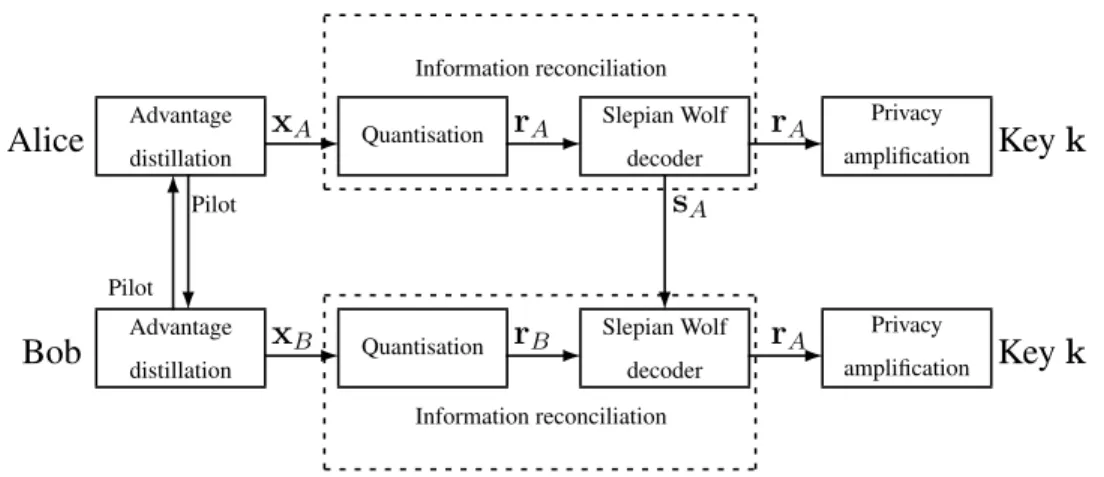
pro-Alice Bob distillation Advantage distillation Advantage Pilot Pilot xA xB Quantisation Quantisation rA rB decoder Slepian Wolf decoder Slepian Wolf Information reconciliation Information reconciliation sA rA rA amplification Privacy amplification Privacy Keyk Keyk
Figure 2.2: Secret key generation process between Alice and Bob.
cess, alternative quantisation schemes have been proposed [95]. In [95] two legitimate parties divide their observations into two bit streams and perform quantisation on two different levels. Next, one of the streams is used as error correction data and the other is used as a key generation string.
SKG process
The SKG process takes an important part of the work presented throughout the present thesis. In fact, Chapter 3 employs the SKG method to built a quick authentication pro-tocol; Chapter 4 proposes an optimised SKG method for delay-constrained networks; Chapter 5 introduces a set of countermeasures to jamming attacks performed during the SKG process. The SKG system model within this thesis assumes that two legitimate parties, Alice and Bob, who wish to establish a symmetric secret key using the wireless fading coefficients as a source of shared randomness (See Fig. 2.2). Generally, the SKG procedure encompasses three phases: advantage distillation, information reconciliation, andprivacy amplification[35, 36, 101–103] as described below:
1) Advantage distillation: This phase takes place during the coherence time of the channel. The legitimate nodes sequentially exchange constant probe signals to obtain es-timates of their reciprocal CSI. Note that, the pilot exchange phase can be made robust with respect to injection type of attacks (that fall in the general category of MiM) as
anal-ysed in Chapter 5 [15, 38]. At the end of this phase, Alice and Bob obtain observation vectorsxAandxB, respectively, over a set ofN subcarriers. On the other hand, an
eaves-dropper (Eve) observesxE. The work within the present thesis assumes a rich Rayleigh
multipath environment, such that Eve’s channel measurement remains uncorrelated to main channel.
2) Information reconciliation: At the beginning of this phase Alice’s and Bob’s ob-servations, xA,j, xB,j, respectively, are quantised to binary vectors3 rA,j, rB,j, where
j = 1, . . . , N [104–106], so that Alice and Bob distill rA = [rA,1||. . .||rA,N]and rB =
[rB,1||. . .||rB,N], respectively. Due to the presence of noise, rA and rB will differ. To
reconcile discrepancies in the quantiser local outputs, side information needs to be ex-changed via a public channel. Using the principles of Slepian Wolf decoding [107], the distilled binary vectors can be expressed as
rA=d+eA, (2.1)
rB =d+eB, (2.2)
where eA,eB are error vectors that represent the distance from the common observed
(codeword) vectordat Alice and Bob, respectively.
Numerous practical information reconciliation approaches using standard forward er-ror correction codes (e.g., LDPC, BCH, etc.,) have been proposed [37], [108]. As an example, if a block encoder is used, then the error vectors can be recovered from the syndromessAandsB ofrAandrB, respectively. Alice transmits her corresponding
syn-drome to Bob so that he can reconcilerB torA. It has been shown that the length of the
syndrome|sA|is lower bounded by |sA| ≥ H(xA|xB) = H(xA,xB)−H(xB)[36], note
that H(·) denotes entropy. This has been numerically evaluated for different scenarios and coding techniques [105, 109–111]. Following that, the achievable SKG rate is upper bounded byI(xA;xB), whereI(·)denotes mutual information.
3) Privacy amplification: The secret key is generated by passing rA through a
way collision resistant compressionfunctioni.e., by hashing. Note that this final step of privacy amplification, is executed locally without any further information exchange. The need for privacy amplification arises in order to suppress the entropy revealed due to the public transmission of the syndrome sA. Privacy amplification produces a key of length
strictly shorter than|rA|, at least by|sA|. At the same time, the goal is for the key to be
uniform,i.e., to have maximum entropy. In brief, privacy amplificationreduces the size of the sequencewhile at the same timeincreases its entropy per bit– compared to the input. The privacy amplification is typically performed by applying either cryptographic hash functions such as those built using the Merkle-Damgard construction, or univer-sal hash functions and has been proven to be secure, in an information theoretic sense, through the leftover hash lemma [112]. As an example, [86, 113] use a 2-universal hash family to achieve privacy amplification. Summarising, the maximum key size after pri-vacy amplification is [12]:
|k| ≤H(xA)−I(xA;xE)−H(xA|xB)−r0, (2.3)
whereH(xA)represents the entropy of the measurement,I(xA;xE)represents the mutual
information between Alice’s and Eve’s observations, H(xA|xB) represents the entropy
revealed during information reconciliation andr0 > 0is a safety parameter that ensures
uncertainty on the key at Eve’s side. For details and estimation of these parameters in a practical scenario please see [114]. Some practical implementations can be found in [8, 61].
SKG rate
During the advantage distillation phase, illustrated on Fig. 2.3, Alice and Bob commu-nicate over a BF-AWGN channel that comprises N orthogonal subcarriers. The fad-ing coefficients h = [h1, . . . , hN], are assumed to be independent and identically
dis-tributed (i.i.d), complex circularly symmetric zero-mean Gaussian random variableshj ∼
CN(0, σ2
Alice Bob h
Figure 2.3: Alice and Bob exchange pilot signals over a Rayleigh fading channel with realisationh= [h1, . . . , hN]in order to distill a shared secret key.
signals with equal powerP on all subcarriers4, to obtain estimates of their reciprocal CSI. Alice and Bob obtain observation vectorsxA = [xA,1, . . . , xA,N],xB = [xB,1, . . . , xB,N],
respectively, so that: xA= √ Ph+zA, (2.4) xB = √ Ph+zB, (2.5)
wherezAandzB denote zero-mean, unit variance circularly symmetric complex AWGN
random vectors, such that zA ∼ CN(0, NAI) and zB ∼ CN(0, NBI). Finally, as
dis-cussed in the previous section the SKG rate can be expressed as I(xA;xB). While the
final result is standard, the full derivation is not clearly given elsewhere, therefore, it is added here as follows:
I(xA;xB) =H(xA) +H(xB)−H(xA,xB) (2.6) = 1 2log22πe(σ 2+N A) + 1 2log22πe(σ 2+N B)− 1 2log2(2πe) 2|K x| = 1 2log2(2πe) 2(σ2+N A)(σ2 +NB)− 1 2log2(2πe) 2(N ANB+NAσ2+NBσ2) = 1 2log2 (σ2+NA)(σ2+NB) NANB+NAσ2+NBσ2 = 1 2log2 Ç σ2(NA+NB) +NANB NANB+NAσ2+NBσ2 + σ 4 NANB+NAσ2+NBσ2 å = 1 2log2 Ç 1 + σ 4 NANB+NAσ2+NBσ2 å = 1 2log2 1 + σ2 NA+NB+ NAσN2B ! . (2.7)
Alice Bob zB
zE
Eve
Figure 2.4: Wyner’s wiretap channel model. Alice sends information to Bob, who ob-serves channel with noisezB. Eve acts as an eavesdropper and observes degraded version
of Bob’s channel.
Assuming a unit variance noise, the rate can be represented as function of the transmitted power as [37, 74]: I(xA;xB) = 1 2log2 1 + P σ2 2 + P σ12 ! . (2.8)
This is a key result that is used later in Chapter 4 and Chapter 5.
2.2.2
Key-less PLS: secrecy capacity
Key-less PLS is based on the information theoretic concept known as secrecy capacity. The secrecy capacity is the metric which defines the achievable rate for reliable and se-cure transmission. It was firstly introduced in the seminal works of Wyner [1], where he introduced the wiretap channel model, illustrated in Fig. 2.4. The model assumes: Alice (transmitter) and Bob (receiver) exchange data over a main channel while Eve observers degraded version of the same channel (i.e., Eve’s channel outputs are noisier that Bob’s). Given Bob’s “advantage”, Alice can encode the data in a way that Eve is unable to de-code. Later, this concept was generalised for AWGN channels in [115], where the secrecy capacity is estimated as the difference between Bob’s and Eve’s achievable rates. Given that, the secrecy capacityCS can be expressed as:
CS = log(1 +SNRB)−log(1 +SNRE), if SNRB >SNRE 0, if SNRB ≤SNRE, (2.9)
where SNRB and SNRE, denotes the SNR level at Bob’s and Eve’s sides, respectively.
Building on that premise, the work in [116] evaluates the outage secrecy capacity for different practical scenarios versus the SNR and the distances Alice – Bob and Alice – Eve. Today, various techniques such as artificial noise at Eve’s side [117–119] and wiretap coding schemes [120–122] are used in order to achieve positive secrecy capacity.
Nevertheless, key-less PLS has several drawbacks such as reduced rates and increased overhead with respect to the security feature, plus until recently there were no existing coding scheme exist only for finite blocklength [82] (note that recent advances show promising result, however, these are still in the domain of very large blocklengths, there-fore not suitable for IoT applications [123, 124]). Furthermore, a major limitation of the secrecy capacity compared to the SKG presented in the previous section, is that it re-quires knowledge of the adversary channel and capabilities. In this regards, using the time-variability of the physical channel, the SKG process allows the legitimate users to quickly generate secret keys and use them in existing encryption algorithms. Due to the above, the rest of this thesis focuses on key-based PLS approach in the form of SKG presented in the previous section.
2.3
Possible deployment scenario for SKG:
Narrow-Band IoT
Narrow-band Internet of things (NB-IoT) is a standard developed by 3rd Generation Part-nership Project (3GPP) in 2015 [125]. It main focus is on low cost indoor applications for battery-driven devices. The NB-IoT physical resource block (subframe) consists of12
subcarriers with15kHz spacing, resulting into 180kHz transmission bandwidth. In or-der to have efficient use of the spectral resources, NB-IoT can use three different modes,
i.e., stand-alone, in-band and guard-band. While stand-alone mode is intended to replace GSM carriers with NB-IoT ones, in-band and guard-band modes uses LTE carriers, i.e., allowing LTE and NB-IoT traffic to coexists in the same frequency band.
Subframe 0
DwPTS GP UpPTS
Subframe 2 Subframe 3 Subframe 4 Subframe 5
DwPTS GP UpPTS
Subframe 7 Subframe 8 Subframe 9
Figure 2.5: One radio frame of the NB-IoT TDD standard
The NB-IoT standard has two frame structures: one based on frequency division du-plex (FDD) and the other based on time division dudu-plex (TDD). This makes NB-IoT suit-able for the physical layer SKG method described in Section 2.2.1. While FDD frames use different frequency bands for uplink and downlink, the links in a TDD frame are separated in time and not frequency. As discussed earlier, the SKG approach within the present thesis is based on the reciprocity of the wireless channel, i.e., using the method described in Section 2.2.1 Alice and Bob extract a shared secret from their channel re-sponses. The responses are highly correlated during the coherence time of the channel which allows Alice and Bob to exploit the reciprocity of the wireless channel, using the TDD based frame and perform the SKG process. On the other hand, the work within the present thesis assumes that there is no correlation between neighbouring channels, there-fore, Alice and Bob would not be able to extract shared secret using the FDD based frame, making this approach not suitable.
The NB-IoT frame type 2 (based on TDD) is given in Fig. 2.5. It can be seen that there is a special subframe divided into three parts: Downlink pilot time slot (DwPTS), Guard period (GP) and Uplink pilot time slot (UpPTS). Therefore, the obtained information during the pilot exchange in DwPTS and UpPTS can be used towards both: generation of secret keys and channel estimation.
This ends the general background of this thesis. As discussed earlier the relative background for each chapter is provided at the beginning of the respective study. Next, Chapter 3 will show how the key-based PLS approach can be employed in a lightweight authentication protocol.
Multi-factor authentication
This chapter introduces a novel PHY-based authentication mechanism. The mechanism provides provably secure and lightweight session establishment. The concept of the work presented in this chapter was published within the “Springer EURASIP Journal on Wire-less Communications and Networking” [12]. The full solution is under review for publi-cation within the “IEEE Internet of things journal”.
This study introduces the joint use of PUFs and SKG in a secure authentication mech-anism. Furthermore, these mechanism are combined in a 0-RTT [126, 127] approach, allowing to build quick resumption mechanisms with forward security. The resumption protocol is important as it significantly reduces the use of the PUF to the initial authenti-cation, thus, overcoming the limitation of a PUFs’ challenge response space [128, 129].
The contributions of this chapter are as follows:
1. Proposal of a fast PUF-based authentication mechanism.
2. Combination of an initial proximity-based check with the PUF authentication as a counter measure to impersonation attacks.
3. Proposal of a forward secure 0-RTT-type of resumption protocol to quickly “re-sume” sessions.
4. Verification of the security properties of the protocol are provided using Tamarin prover and BAN logic.
5. Derivation of a closed form expression for the information theoretic bound of the SKG rate at the finite blocklength
This chapter proposes a novel use of the SKG and does not discuss improvements of the SKG itself. Next, in Chapter 4 the SKG mechanism is considered in detail and optimised.
Note that the following assumptions are made for the purpose of this study: i) the as-sumed network topology is a 1-hop communication between Alice and Bob who want the authenticate each other; ii) the main part of this study assumes that initial communication between Alice and Bob has already been established. During this initial communica-tion, named enrolment phase, they have exchanged set of parameters, such as RSSI0,
challenge-response pairs etc (more details on the exchanged parameters are given in Sec-tion 3.4.1). The important assumpSec-tion for the success of the proposed methods, within
this study, is that the enrolment phase must be carried out over a secure channel. This can be achieved by using traditional cryptographic primitives, however, this falls out of the scope of the current thesis and therefore is assumed that Alice and Bob have already performed this step; iii) Furthermore, without loss of generality, the system model is sim-plified assuming that neighboring subcarriers of the communication channel are assumed to be independent.
3.2
Respective background
3.2.1
Cryptographic primitives
The cryptographic process of transforming a message (plaintext) into an encoded cipher-text is called encryption. The reverse process where plaincipher-text is obtained from a ciphercipher-text is called decryption. The processes of encryption and decryption in this thesis are denoted as Esand Ds, respectively. To perform the transformation from plaintext to ciphertext and vice versa both algorithms rely on the cryptographic keys. The secrecy properties of the algorithms rely on the secrecy of the keys. Cryptographic systems are divided into two types: symmetric and asymmetric. In detail, asymmetric encryption uses pair of keys (public, private), one for each transformation, symmetric encryption assumes the usage of a single key in both transformations Es and Ds. The work presented in this thesis assumes the use of symmetric encryption, as the largely used block cipher advanced en-cryption standard (AES) is considered post quantum for key lengths of256 bits. On the other hand, no asymmetric key encryption cipher is considered to be post-quantum. An-other motivation for using symmetric encryption algorithms throughout this thesis is the fact that, they require less processing power for computations and are “almost1000times faster than asymmetric algorithms” [130]. This makes the use of symmetric encryption suitable for lightweight and latency aware IoT applications. The following gives a brief introduction to the cryptographic primitives used throughout this section.
Symmetric encryption
As mentioned the work presented in this thesis assumes the usage of symmetric encryp-tion. Hence, two legitimate parties (Alice and Bob) posses identical and uniformly dis-tributed key sequences{0,1}|k|– where|k|is chosen such that a simple brute force attack
should be impractical. An example for symmetric encryption mechanism considered to be post-quantum secure is|k|= 256[131]. Given that, a symmetric encryption algorithm, is denoted byEs:K × M → CT whereKdenotes the key space,Mdenotes the message
space and CT denotes the ciphertext space. The corresponding decryption algorithm is
Ds:K × CT → M.
One of the mostly used symmetric cryptographic scheme used today is the AES [132– 134]. AES was established by the U.S. National Institute of Standards and Technology (NIST) in 2001 by the name Rijndael [135]. Several sub-types of AES were standardised,
i.e., AES-128, AES-192, AES-256. Each of these symmetric-key mechanisms takes as input a128-bit (16-byte) block size, but they use different key lengths: 128,192and256
bits, respectively. The key size determines the number of rounds used to transform the plaintext to ciphertext. The output size is determined by the length of the plaintext. The AES algorithms ensures that all blocks are with16-byte size even if the length of plaintext is not exact multiple of16bytes. This is achieved by using padding mechanisms and it is done to prevent adversaries from knowing the length of the message [136].
Message authentication code
A message authentication code (MAC) is additional information sent with ciphertext to verify the authenticity of the message [137]. The MAC can be constructed by a pair of algorithms, one for signing, Sign, and one for verification, Ver. The two algorithms rely on a pre-shared secret key kMAC between the communicating parties and ensures integrity and authenticity of the message m. While data integrity assures, the accuracy and consistency of data,i.e., it has not been modified by a malicious third party, authen-ticity verifies the identity of the sender. This is achieved by applying the MAC scheme as
follows: first, the sender signs the message usingkMAC, then the intended receiver must confirm that the signed message corresponds tom. A reason for verification failure could be the manipulation of the message while in transit or receiving a message not signed from a malicious node.
Following from the above a pair of message authentication code (MAC) algorithms is denoted bySign : KMAC× M → T, where T denotes the space of signed messages, with a corresponding verification algorithmVer:KMAC× M × T →(yes, no). Further information about standardised MAC algorithms can be found in [138].
Hash function
Hash functions are used to transform messages with various length into fixed output hash value. The study presented in this thesis assumes the use of one-way hash functions [139, 140]. One-way hash functions are irreversible, i.e., having the initial message one can obtain the corresponding hash value, however, if only the hash value is available one cannot obtain the original message. Furthermore, a one-way hash function should satisfy collision-free property. This means two different inputs should not produce the same hash value. The collision-free property is denoted as follows:
Hash(x)6=Hash(y). (3.1)
The output of one-way hash functions is pseudorandom meaning that outputs are inde-pendent and one should not be able to distinguish a hash value from a random sequence. Finally, one-way hash functions are used to protect data from modification. For example they are used in the Keyed-Hash Message Authentication Code (HMAC) [141] which is part of security protocols such as SSH [142].
3.2.2
Physical unclonable functions
The idea of physical one-way function (POWF) was introduced in [143]. The authors proposed a simple challenge-response authentication protocol. It assumes that an
identi-fier (e.g. server, that will authenticate a user) generates a set of challenges which are run on a user’s equipment. These challenges are then stored by the identifier along with the corresponding set of responses,i.e., as challenge-response pairs (CRPs). Next, when the user sends an authentication request to the identifier chooses one of the previously stored CRPs and “challenge” the user to produce a response. The authentication is successful, if the response is identical to the one previously stored in the identifier’s database. The structure proposed in [143] is based on the usage of a laser beam as input of their system. This beam propagates through a three-dimensional micro-structure and the final resulting pattern determines the output of the system. A challenge to this scheme could define the angle of the transmitted beam.
Later, the authors of [144] brought this idea to integrated circuit (IC) structures by introducing the silicon physical unclonable function (PUF). Its idea is to utilise the fact that every integrated circuit differs to others due to manufacturing variability [52, 145] and cannot be cloned [54]. A challenge to this scheme can refer to delay at each gate, power-on state and other variable features. Nowadays, due to its randomness and un-clonable properties, PUFs continues to attract the researches’ attention and since the in-troduction of PUFs in [144], numerous PUF architectures have been proposed many of which suitable for IoT applications. A few of these architectures are: arbiter PUF [146], ring oscillator PUF [39], transient effect ring oscillator PUF [147], static random-access memory PUF [148], hardware embedded delay PUF [149] and more [53, 128].
As mentioned above, each PUF can be used as a challenge – response scheme, mean-ing that a PUF takes a challenge as input, runs it and outputs the correspondmean-ing response. Depending on the number of CRPs that each PUF can support, two types of PUFs can be differentiated: i) strong PUFs, suitable for authentication and ii) weak PUFs, which can be used for secret key generation. Intuitively, a weak PUF can process a small number of challenges, while a strong PUF is capable of processing a large set of CRPs. Further requirement for a strong PUF is backward secrecy, meaning that if some of the previous CRPs are revealed, an attacker should not be able to predict the response of any future challenges. Throughout this thesis PUFs will refer to strong PUFs from this point
on-. on-. on-. Arbiter 0or1
Challenge: 0 1 1 0
Figure 3.1: Arbiter PUF. wards.
To familiarise the readers with the basics of PUFs, two structure examples are pre-sented. The structure ofArbiterPUF was presented in [146]. In this scheme the authors propose the usage of the delay variations of wires and transistors within integrated cir-cuits. The idea is based on transmitting rising edge signals through two “identical” delay paths which consist of several switching elements. Due to variation properties the delay will slightly differ at each path. Finally, an arbiter determines the corresponding “win-ner”,i.e., the signal that arrived first at the end of the trace. The produced response (output bit) depends on the “winner”. A challenge to this scheme is composed by choosing the configuration of each switching element as illustrated on Fig. 3.1. Another PUF scheme, called recombined oscillator PUF, was proposed in [150]. The scheme calculates fre-quency differences between pairs of oscillators which produces set of random variable. The challenge to this scheme determines the sign in front of each random variable. To produce the response to a specific challenge the scheme calculates the sum of all random variables and compares it to a pre-defined threshold. Similarly, [151] proposed an im-proved scheme which increases the secrecy of the output by choosing a different subset of the oscillators each time (defined by the challenge).
Following from the above, a typical PUF-based authentication protocol consists of two main phases, namelyenrolment phaseandauthentication phase[152–156].
During the enrolment phase each user runs a set of challenges C on his PUF and characterises the variance of the measurement noise in order to generate helper datahd. Next, a verifier creates and stores a database of all CRPs(C,R)for each user’s PUF within its network. A CRP pair in essence consists of an authentication key and related helper
datahd. Within the database, each CRP is associated with the ID of the corresponding user. The enrolment phase is a one-time operation and it is assumed to be done on a secure channel. Later, during theauthentication phasean user sends its ID to the verifier requesting to start a communication. Receiving the request, the verifier checks if the received ID exists in its database. If it does, the verifier chooses a random CRP(Ci, Ri)
that correspond to this ID and sendsCi to the user. The user computes the responseRi
by running the challengeCi on its PUF, as follows Ri = PUF(Ci), and sends Ri to the
verifier. However, the PUF measurements at the user are never exactly the same due to measurement noise, therefore, the verifier uses the new PUF measurement and the helper datahdR,istored during the enrollment to re-generate the authentication key. Finally, the
verifier compares the re-generated key to the one in the CRP and if they are identical the authentication of the node is successful. In order to prevent replay attacks, once used, a CRP is deleted from the verifier database.
A widely used method for helper data and key generation is by employing fuzzy extractors (FE). FE are method that allows for key derivation from nonuniform noisy sources [157]. Due to their properties they are referred as a common technique to cope the noise present in biometric data and PUF measurements [158–162]. A so called(m, l, t, )
FE is built from a pair of randomised functions, namely Generate Gen and Reproduce
Rep. The function Genrequires a single inputR ∈ Rand produces two outputs, helper datahdRand a keykR ∈ {0,1}l. The functionRepis deterministic reproduction and can
reproduce the keykR by using the helper datahdRand a sequence closely associated to
R,i.e.,R0. The correctness of theRepfunction can be satisfies if onlyD(R, R0)≤ t(D refers to Hamming distance). On the other hand, when hdR is public the key sequence
kR is close to uniformly random only if the min-entropy of R is at least m. This
im-plies the following condition on the statistical distance between kR and the universe of
sequences with lengthl, wheneverhdRis public SD((kR,hdR),(Ul,hdR)) ≤ . More
details about FEs’ parameters and bounds can be found in [157, 163, 164].
To summarise, as it is possible to construct a PUF that does not require any complex operations, it can be used as a lightweight mechanism to generate an unclonable and