ADVANCED RESOURCE PLANNING Nico J. Vandaele
Faculty of Applied Economics University of Antwerp Antwerp, 2000, Belgium
Abstract:
Advanced Resources Planning hits the bottom of what we know as aggregate planning. This approach differs from other approaches in the way that it explicitly recognizes the stochastic nature of manufacturing systems. Therefore it is an ideal high level tuning and planning tool which can be used in various planning environments like MRP, ERP, JIT, Load Oriented Planning, Theory of Constraints, Finite Scheduling, POLCA systems, and perhaps many more. The main purpose is to set aggregate planning parameters right before diving into any other operational planning decision. In this sense, we opt to offer realistic lead time estimations, lot sizes, utilization levels, customer service levels and quoted delivery times.
The underlying approach is a waiting line network, which is heavily adapted in order to make it useful for planning purposes. The main feature is that both input parameters and output parameters are considered as stochastic variables. In this way it allows us to model manufacturing environments in a more realistic and intuitive way, including all kinds of uncertainty and variability. As a consequence, the output of the planning effort is also a stochastic variable: it has an average, a variance entire lead time distribution. The latter makes it possible to obtain customer service level or to establish realistic delivery times, which can be met with a high probability.
This mathematical approach as such is not suited for people operating a manufacturing system. We translated the theoretical foundations into what is called ‘Capacity and Variability Analysis, (CVA)’. We illustrate the approach with software, named i-CLIPS, and we review some implementations.
Keywords: queueing networks, aggregate planning 1. Introduction
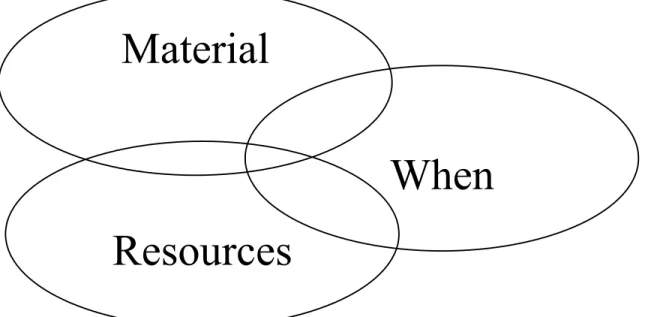
Before we go into the details of the Advanced Resource Planning approach, we have to go back and revisit the very basics about planning. Once these are put forward in an indisputable manner, the advantages and the shortcomings of the current planning approaches can become clear. Subsequently, suggestions for improvements can be made. Planning has al to do with putting activities on the time axis: management has to decide the ‘what’ in terms of the ‘when’. As this is fundamentally is so easy to grasp, it turns out to be extremely difficult in practice. The reason is that the activities which have to be planned are usually consuming resources. Resources are usually not abundant available, causing competition for the resources and planning has to be involved to organize this. More precisely, the ‘what’ breaks down into two basic categories: material decisions and resource decisions, as can be seen in figure 1.1.
Figure 1.1: Basic dimensions of planning
Material is considered to flow through the system and will be related to the product or service provided (examples are products in a manufacturing company, patients in a hospital, messages in a computer system, a file in a bank,…). Material usually comes from out the system, is transformed in the system and gets out of the system. In this sense, performance measures like lead time, inventory, value adding for the customer and customer service play a role. Resources basically remain part of the system and make the material flow (resources typically are machines, computer systems, employees, subcontractors, transportation equipment, …). Resources are provided by the system and are put there to generate value for the owner. Therefore performance measures like utilization, efficiency, availability etc. are of primary interest.
It should be clear that this becomes complex: on the one hand, material relations can be very complicated: deep and wide bill-of-materials, variety, customization, component commonalities, modularity, supplier issues, assembly. As can be understood from these issues: a lot of material planning decisions are dependent and make planning far from easy. Some well-known efforts from the past include MRP, ERP, DRP, SCM and similar approaches try to cope with material complexity. They try to plan material on the time axis. Unfortunately, they overstate the importance of material (or equivalent, neglect the importance of resources) so that more and more these planning systems are facing difficulties in catching up with today’s dynamics and evolutions.
On the other hand, resources are not simple either: their relationships are for instance technical (order of operations, mix of different processes), dependent (like man-machine interrelationships), limited in availability so that resources force to do the various operations in a sequential manner. There are systems that are specialized in planning resources over time: advanced planning and scheduling approaches, theory of constraints, just-in-time approaches only to mention a few. Although this sounds reasonable, mostly these resource oriented approaches stress resources too much (assume that material is a secondary problem e.g. like just-in-time) or limit themselves to some crucial resources (bottleneck approaches). What most of the advanced planning and scheduling system are overlooking is the fact that resources are some kind of a fixed and deterministic availability, which is may only be true on the very short term (and even in this case it can be inappropriate).
Material
When
Resources
Finally, we may not forget that both material and resource decisions themselves are highly interdependent. This dependency is not without speculation: high utilization levels (appreciated by the resource management) is devastating for lead times (appreciated by the customer). This inherent conflict in objectives further complicates the planning activities. Concluding, any effective planning system must address material and resources simultaneously and both should be considered together when they are put on the time axis. So the first thing to do is to find out what ‘time’ information you need for appropriate planning. We call this the ‘total characterization of the lead time’ where lead time is defined as the time material spends on resources.
2. A primer on lead time and lead time determinants 2.1. Total characterization of lead time
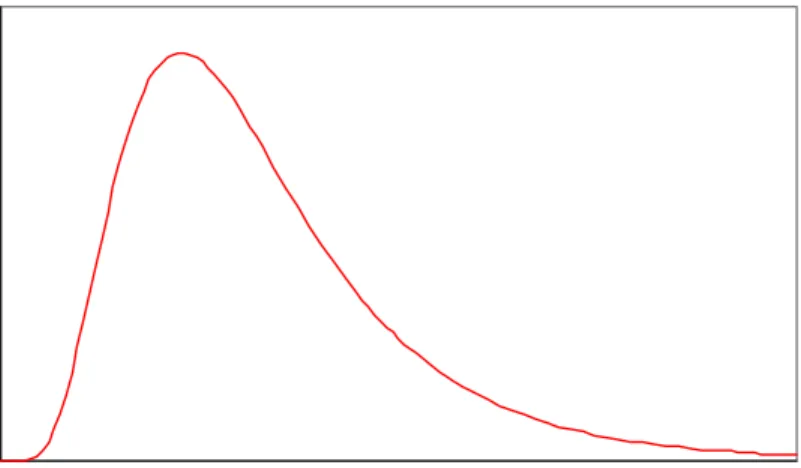
Lead time is a consequence of loading demand (material) on capacity (resources). In very general terms, we can expect that lead time has a distribution as pictured in figure 2.1. As can be seen the lead time is presented with al its characteristics, which all can be derived from its probability distribution or density function. Basic elements are the technical minimum lead time to perform an operation (under ideal circumstances), the mode (most likely lead time), the expected or average lead time (as the main summary statistic of the lead time), the lead time variance (indicating fluctuations around the average) and the lead time percentiles (crucial for determining the customer service for a given agreed lead time and equivalently, quoting a lead time to a customer for a predetermined service level). Note that we intentionally do not assume a symmetric distribution, as this is not realistic for a lead time. Lead times are characterized by an asymmetric distribution, mostly skewed to the right. This means that if something happens in the system, the impact on the lead time is mainly negative: longer lead times will be observed more often than shorter ones (the average is larger than the mode). As systems are usually interested in the higher service levels, automatically this skewness is under the consideration of management: the heavy right tail is the clue towards relevant customer service levels.
Figure 2.1: Total lead time characterization 2.2. The lead time determinants
The lead time pictured in figure 2.1 is the result of confronting load and capacity. We must investigate what makes the lead time behave in the above described way. With being complete, a list of important determinants is given below:
• Demand factors:
o Demand volume (quantity) o Demand timing (frequency)
• Capacity factors o Processing times o Setup times o Number of resources o Shift patterns o Outsourcing capabilities • Amplifiers o Stochasticity o Variability o Heterogeneity o Complexity • Management intervention o Lot sizing o Sequencing o Release mechanism
For a long time, it is well known that utilization is one of the main determinants of lead times: lead times increase in a strongly non-linear manner as a function of the utilization. What is more important, a designated insight in the various components of both demand and capacity are necessary. Demand consists out of two dimensions: quantity and timing. Both taken together they constitute the load put on the system. The capacity itself consists of the available time compared to the demand time axis (usually twenty four-seven basis). Availability is determined by shift patterns, calendars, breaks, maintenance, breakdowns (repair), setups, etc. From this available time, the natural processing time and the number of resources determine the effective capacity of the system. Or vice versa, the effective processing time is the processing time including all time losses. This leads to the concept of effective utilization (which is larger than the natural/productive utilization), a crucial value in Advanced Resources Planning.
The concept of (effective) utilization is typically an average concept. The non-linear effects of utilization on the lead time will further be amplified if some or all of the following occur:
• All the average parameters (both from demand and capacity) are not deterministic; they deviate from the average. This means that all these parameters behave stochastic and have their own specific distribution. From the literature it is known that even if average circumstances are under control, stochastic realities cause the systems to demonstrate waiting. The more stochasticity, the longer the lead times will be.
• A lot of variability effects take place in operational systems. These are events that have a strong negative impact on the system such as breakdowns, planned maintenance, rework, scrap, setups, etc. It is important to model these events explicitly (and separated from the natural stochasticity), because only then their impact can be quantified and corrective action can be directed. Their main impact is that they artificially increase the utilization and thus deteriorate lead times. Note that the variability parameters (for example repair and setup times) are stochastic themselves. In this way amplifying effects stimulate one another.
• A third category of amplification consists of heterogeneity. This means that due to the fact that demand volume is made up of a mix of products, this mix causes all parameters to be more or less deviating. For example demand quantity (timing) distributions differ from product to product. As a consequence, the capacity figures (like processing times) differ from product to product. The same holds for variability factors: it is obvious for scrap rates and setups being dependent on the product, but also breakdown and maintenance may be susceptible to difference among the products. All this taken together leads to the phenomenon of shifting or wandering bottlenecks, which only can occur if different products have different impacts on the system.
• A last category contains the amplifier called complexity. Complexity means that general aspects form the systems such as routings, bill of materials, production characteristics,
precedence relations, shop floor layout, etc. are not the best suited ones for the current demands. In many occasions this has historical reasons and companies hope that when refurbishing systems they can eliminate these heritages from the past. Unfortunately, given the dynamics of the current markets and technologies, it is extremely difficult to avoid complexity in the future. Not the least are shifting product mixes and volatile markets enforcing companies to use systems which are not the best suited because they have been designed under different circumstances. Complexity is difficult to measure but is always implicitly modeled by the structure of the current system.
A fifth amplifier could be management intervention. However because we assume that the intervention from management can work in both favorable and unfavorable directions, we like to keep this as e separate category of determinants. These management interventions share some common features. Both the advantages and disadvantages from respectively wise and wrong decision making can be substantial. In addition, as by the definition of management, they can usually easily be adjusted by changing a company policy and/or a software code. On the other hand, implementing them can be very hard due to corrosive human behavior and long standing management beliefs or myths. We give some examples below:
• Lot sizing:
o Process batching: it is now already well known that process batching involves a convex relationship of the lead time as a function of the processing batch. As a consequence, there exists an optimal process batch, minimizing lead time. If management decides to deviate from this optimal process batch, the effects can be substantial, especially under circumstances of high utilizations and stochasticity. Moreover, this convex relationship is not symmetrical, meaning that a deviation above and below the optimal do not have the same impact on the lead time.
o Transfer batching: it is also known that shipping smaller quantities than the process batches can enhance the flow of material through a system. Again, the effect is not always substantial. Its effects depends the relative processing and setup times between the resources. As decisions in terms of transfer batches have far-reaching effects on some investments (transportation, container, storage,…) and policies (ordering and delivery relationships with suppliers and customers), transfer batching is an important management decision.
• Sequencing policy
o Most stochastic modeling techniques assume first-in/first-out disciplines, because it is mathematically tractable. Fortunately, on the mid term horizon, this policy makes sense or is at least a staring point. However, in the short term, managers like to deviate from this discipline and they like to do this for numerous reasons. Some reasons are readily justified as for instance to save on sequence dependent setups. However, the result of setting dynamic priorities (for example pure expediting in terms customer calls and yells) may cause more trouble than it deserves and consequently ruining up the net result for the system as a whole. Behind this is the reality that each decision to expedite contains immediately a number of decisions to de-expedite. It is not clear that for the entire material flow this is a good way to go: even if it keeps the average delivery under control the effects on the variability of delivery are less clear cut. Details can be found in Dupon, Vannieuwenhuyse and Vandaele [1].
• Release policy
o Management may decide to release work onto the system in various ways and for various objectives. At this point it would lead us to far to analyze this but it should be clear that this can have a substantial impact on lead times. Think of a policy that releases every order as soon as it is available. This will cause work-in-process to pile up, explode lead lead times and undermine customer service. Release policies should take into account customer elements (e.g. due dates) and load elements
(demand versus capacity). Systems like kanban, POLCA, CONWIP, load based policies try to accomplish this.
2.3 Advanced Resource Planning
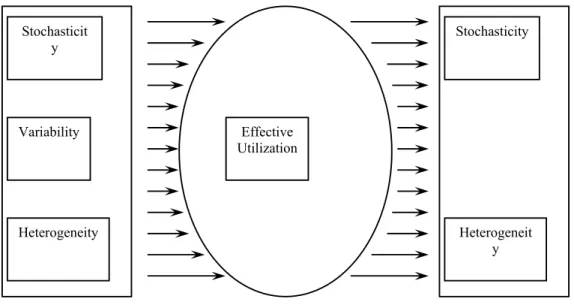
As we have an idea about the input parameters of a system, the output parameters and the way input parameters are transformed into output parameters, we can summarize the content of advanced resource planning in the following figure 2.2.
Figure 2.2: The content of Advanced Resource Planning
This is what Advanced Resource Planning is about: finding the stochastic behavior of the system in order to obtain important mid term performance measure values to direct the short term planning and scheduling decisions. Methodologically, we rely on queuing networks, which are adapted towards these system management characteristics. A key concept in this approach is the notion of effective capacity, a concept extensively described by Hopp and Spearman [7]. Effective capacity tries to capture all capacity losses and reformulates the input parameters (like processing times) accordingly. Examples of this queuing approach can for instance be found in Lambrecht, Ivens and Vandaele, Vandaele and Lambrecht, Vandaele, De Boeck and Callewier. What is important for this paper is the use of the output of this modeling effort for planning purposes. The output takes on the form of the total lead time characterization, optimized lot sizes, utilization levels and other derivatives. Without going into detail, we will illustrate this for some well known planning systems used today:
• Material Requirements Planning (or ERP and the like). None of these systems give some indication on how lead times (for the material off-setting in the explosion process) should be set. On the contrary, these systems assume that this lead time information is known, deterministic and static. None of these is true. Given the above discussion about the lead time determinants, in many systems lead times are not appropriately calculated. Moreover, lead times are stochastic variables themselves, meaning that only a lead time percentile is a correct way to import them into an MRP calculation. On top of that, as both demand and capacity are dynamic, lead times behave accordingly. As a consequence, MRP off-setting lead times should be adopted regularly if conditions evolve. MRP systems rely also heavily on lot sizes, but how these have to be obtained is not determined at all. Advanced Resource Planning provides optimized lot sizes that can be considered as target values for the short term decision making. Stochasticit y Variability Heterogeneity Heterogeneit y Stochasticity Effective Utilization
• Just-in-time. In these systems the production lines have to be capacitated in such a way that in many cases the instantaneous pull signal can be fulfilled without much delay (i.e. within the tact time interval). Even in the best designed production lines, variations in the parameters are hard to exclude so that each station will have to take a capacity ‘cushion’ into account in order to be responsive to the just-in-time calls. This cushion has everything to do with the consideration that the lead time on the station is stochastic (due to both demand and process fluctuations) and that a pull signal must be fulfilled within the tact time with a high probability. Therefore the results of the above discussion on lead time determinants are a necessity. Lot sizing is a kind of anomaly in just-in-time systems as a lot size equal to one is the ultimate goal. It is worthwhile to mention that due to the fact of mass-customization and the increasing product diversity (i.e. heterogeneity) lot sizes equal to one are not always the predicate anymore. In these circumstances, the lot size information from Advanced Resource Planning can help, because it minimizes the overall average lead time being one of the main objectives of just-in-time.
• Theory of constraints. In this approach the defined bottleneck governs the rate of the entire system. The non-bottleneck machines work in accordance to the bottleneck directions in terms of schedules and material provision. Without going into further detail, the fact that in ‘Theory Of Constraints’-systems the material should be available in front of the bottleneck with a very high probability (to protect the bottleneck form loosing throughput, which will otherwise automatically make a loss for the entire system) is nothing else than a lead time percentile over the routing feeding the bottleneck. In other words, the concept of a rope (both the constraint, the assembly as the shipping rope) is exactly the information the advanced resource planning provides. The Theory Of Constraints does not effectively deals with the lot sizing issue. Especially because on bottlenecks lot sizing is strongly limited (lack of capacity) while on non-bottlenecks lot sizing is less stringent, one has to be very careful not to create artificial bottlenecks by performing to many setups (too small lot sizes). It is clear that this compromising lot size only can be obtained by an integrated approach over the entire network. • Detailed Scheduling. For each manufacturing order, these short term schedulers need a release and a due date (defined as the time window for the order) from outside the scheduling system. It is known that if these windows are too small, scheduling engines face difficulties in solving the scheduling problem and will end up with a lot of orders over due (which may be unavoidable in the given circumstances). If these windows are too large, scheduling will be easier but at the price of early releases, high levels of work-in-process and long lead times. The latter is hard because more extended forecasts will be needed and thus inducing (unnecessary!) uncertainty in the planning system. In addition, finite schedulers must be fed with the appropriate lot sizes, because if this job is left for the scheduling engine, the solution power drops dramatically as the number of combinations/alternatives astronomically explodes. Applications of these ideas are written in Lambrecht, Ivens and Vandaele [2], Vandaele, Lambrecht, De Schuyter and Cremmery [5] and Vandaele and Lambrecht [4].
There are many more applications of the output of an Advanced Resource Planning system. Basically it can be summarized as follows: it provides the integrated, stochastic approach of handling material and capacity planning decisions simultaneously, providing a totally characterized lead time, completed with adequate information on lot sizes, utilizations and tuning opportunities. The latter consists of the possibility of running easily what-if’s to find out how an unacceptable situation can be remedied. 3. A software implementation: i-CLIPS
The queuing network which is the backbone of Advanced Resource Planning approach is described extensively in other work (see Vandaele and Lambrecht [4] for an extensive reference in relation to scheduling). The software implementations can take many forms, mainly depending on the type of operational system one is considering. The i-CLIPS software is typically developed for job shop environments e.g. metal working. However, we like to stress that other environments have
analogue needs and can benefit from the use of the Advanced Resource Planning concept. We studied examples in concrete production, hospital management (see Vandaele, Vannieuwenhuyse and Cupers [6]), automated packing (see Vandaele, De Boeck and Callewier [3]), brewing processes and pharmaceutical industries.
4. Conclusion
We described a novel approach named Advanced Resource Planning. It starts with the general observation that all planning systems share the same issues, namely planning both material and capacity simultaneously on the time axis. Up till now, this complicated task has not been appropriately dealt with. What we need is a transformation of both demand and capacity parameters of an operational system into to the determination of performance measures like the lead time, utilization, inventory, etc. On top of that we stressed the importance of obtaining all characteristics of a lead time: not only the average, but also the variance and the entire distribution in order to obtain lead time percentiles. The latter is fundamental input for any planning system, as we illustrated in the case of MRP, JIT, TOC and finite scheduling. As Advanced Resource Planning is not an easy thing, advanced mathematics of queuing networks is involved. We developed a software, named i-CLIPS, mainly intended for job shop environments. Nevertheless a lot of other environments, including services, may benefit from the approach.
The authors like to thank K. Verhelst for numerous supporting activities and suggestions. References
[1] DUPON A., VANNIEUWENHUYSE I. and VANDAELE N. (2001), ‘The Impact of Sequence Changes on Product Lead Time’, Flexible Automation and Intelligent Manufacturing, Dublin. [2] LAMBRECHT M., IVENS .P and VANDAELE N. (1998), ’ACLIPS: A Capacity and Lead Time
Integrated Procedure for Scheduling’, Management Science, 44 (11), 1548-1561.
[3] VANDAELE N., DE BOECK L. and CALLEWIER D. (2000), ‘An Open Queueing Network for Lead Time Analysis’, IIE Transactions.
[4] VANDAELE N. and LAMBRECHT M. (2002), ‘Planning and Scheduling in an Assemble-to-Order Environment: Spicer Off-Highway Products Division’, Supply Chain Structures: Coordination, Information and Optimisation, edited by J.S. Song and David D. Yao, Kluwer Academic Publishers, 2001, 61 pp..
[5] VANDAELE N., LAMBRECHT M., DE SCHUYTER N. and CREMMERY R. (2000,)‘Improved Lead Time Performance at Spicer Off Highway’ Interfaces, 10(1), 83-95.
[6] VANDAELE N., VANNIEUWENHUYSE I. and CUPERS S., (2002)‘Optimal batching at a Nuclear Magnetic Resonance Scanner’, European Journal of Operational Research, Submitted. [7] HOPP W. and SPEARMAN M. (2000), ‘Factory Physics’, Irwin McGraw-Hill, 668p..