Charles University in Prague
Faculty of Mathematics and Physics
MASTER THESIS
Rudolf Rosa
Automatic post-editing of phrase-based
machine translation outputs
Institute of Formal and Applied Linguistics
Supervisor of the master thesis: RNDr. David Mareˇ
cek, Ph.D.
Study programme: Informatics
Specialization: Mathematical Linguistics
I would like to thank all my colleagues at Institute of Formal and Applied Linguistics for providing me with support. I would especially like to thank Mgr. Ondˇrej Duˇsek, Mgr. Aleˇs Tamchyna, Mgr. Martin Popel and doc. Ing. Zdenˇek ˇ
Zabokrtsk´y, Ph.D., who directly helped me with several parts of Depfix. And most of all, I would like to thank my advisor, RNDr. David Mareˇcek, Ph.D..
Another thanks go to Karel ˇSkoch, Tina Resslerov´a, Alˇzbˇeta Stˇr´ıbrn´a, Zuzana ˇ
Skardov´a, Lucie Kadeˇr´abkov´a, and Vendulka Michl´ıkov´a, the post-editors and annotators who post-edited and evaluated several thousands of sentences for the evaluation of Depfix.
Most of all, I would like to thank my girlfriend for support and patience throughout the countless hours spent on this work.
I declare that I carried out this master thesis independently, and only with the cited sources, literature and other professional sources.
I understand that my work relates to the rights and obligations under the Act No. 121/2000 Coll., the Copyright Act, as amended, in particular the fact that the Charles University in Prague has the right to conclude a license agreement on the use of this work as a school work pursuant to Section 60 paragraph 1 of the Copyright Act.
N´azev pr´ace: Automatick´a post-editace v´ystup˚u fr´azov´eho strojov´eho pˇrekladu Autor: Rudolf Rosa
´
Ustav: ´Ustav form´aln´ı a aplikovan´e lingvistiky
Vedouc´ı diplomov´e pr´ace: RNDr. David Mareˇcek, Ph.D., ´Ustav form´aln´ı a aplikovan´e lingvistiky
Abstrakt: Pˇredstavujeme Depfix, syst´em pro samoˇcinnou post-edititaci v´ystup˚u fr´azov´ych strojov´ych pˇreklad˚u z angliˇctiny do ˇceˇstiny, zaloˇzen´y na jazykovˇedn´ych znalostech. Nejprve jsme rozebrali druhy chyb, kter´ych se dopouˇst´ı typick´y strojov´y pˇrekladaˇc. Pot´e jsme vytvoˇrili sadu pravidel a statistickou komponentu, kter´e opravuj´ı takov´e chyby, kter´e jsou bˇeˇzn´e nebo z´avaˇzn´e a m˚uˇze pˇrich´azet v ´uvahu jejich oprava pomoc´ı naˇseho pˇr´ıstupu. Pouˇz´ıv´ame ˇradu n´astroj˚u pro zpracov´an´ı pˇrirozen´eho jazyka, kter´e n´am poskytuj´ı rozbor vstupn´ıch vˇet. Nav´ıc jsme reimplementovali z´avislostn´ı analyz´ator a nˇekolika zp˚usoby jej upravili pro prov´adˇen´ı rozboru v´ystup˚u statistick´ych strojov´ych pˇrekladaˇc˚u. Provedli jsme automatick´a i ruˇcn´ı vyhodnocen´ı, kter´a potvrdila, ˇze kvalita pˇreklad˚u se zpracov´an´ım v naˇsem syst´emu zlepˇsuje.
Kl´ıˇcov´a slova: automatick´a post-editace, strojov´y pˇreklad, z´avislostn´ı rozbor, Treex
Title: Automatic post-editing of phrase-based machine translation outputs Author: Rudolf Rosa
Department: Institute of Formal and Applied Linguistics
Supervisor: RNDr. David Mareˇcek, Ph.D., Institute of Formal and Applied Linguistics
Abstract: We present Depfix, a system for automatic post-editing of phrase-based English-to-Czech machine translation outputs, based on linguistic knowledge. First, we analyzed the types of errors that a typical machine translation system makes. Then, we created a set of rules and a statistical component that correct errors that are common or serious and can have a potential to be corrected by our approach. We use a range of natural language processing tools to provide us with analyses of the input sentences. Moreover, we reimplemented the dependency parser and adapted it in several ways to parsing of statistical machine translation outputs. We performed both automatic and manual evaluations which confirmed that our system improves the quality of the translations.
Keywords: automatic post-editing, machine translation, dependency parsing, Treex
Contents
1 Introduction 5 1.1 A Brief Example . . . 7 1.1.1 Input . . . 7 1.1.2 Analysis . . . 7 1.1.3 Fixes . . . 7 1.1.4 Output . . . 8 1.2 Thesis Structure . . . 9 2 Related Work 11 2.1 Statistical Machine Translation and its Quality . . . 112.2 Statistical Post-editing of Rule-based MT . . . 12
2.3 Statistical Post-editing of SMT . . . 12
2.4 Rule-based Post-editing of SMT . . . 12
3 Error Analysis of Statistical Machine Translation Outputs 15 3.1 Related Work . . . 15
3.2 Lexical Errors . . . 16
3.2.1 Missing Reflexive Verbs . . . 16
3.2.2 Fake Named Entities . . . 17
3.2.3 Wrong Part-of-speech . . . 17
3.3 Word Form Errors . . . 18
3.3.1 Agreement Errors . . . 18
3.3.2 Valency Errors . . . 20
3.3.3 Errors in Transfer of Meaning to Morphology . . . 20
3.3.4 Noun Clusters . . . 26
3.3.5 Casing Errors . . . 26
3.3.6 Tokenization Errors . . . 27
3.4 What We Decided to Fix in Depfix . . . 27
4 Morphological Layer 29 4.1 M-nodes, Lemmas and Tags . . . 29
4.1.1 Czech Morphological Tags . . . 29
4.1.2 English POS Tags . . . 31
4.1.3 Lemmas . . . 31
4.2 Analysis, its Errors and their Fixes . . . 32
4.2.1 Analysis Pipeline . . . 32
4.2.2 Fixing The Tokenization Errors: Tokenization Projection 33 4.2.3 Fixing The Tagging Errors: Fixing Morphological Number of Nouns . . . 34
4.2.4 Lemmatization Errors . . . 37
4.2.5 Fixing The Alignment Errors: Adding Missing Alignment Links . . . 37
4.3 Translation fixes on morphological layer . . . 38
4.3.1 Source-aware Truecasing . . . 38
4.3.2 Vocalization of Prepositions . . . 40
4.3.3 Sentence-initial Capitalization . . . 40
5 Parsing to Analytical Layer 43 5.1 Analytical Trees . . . 43
5.2 Analysis to Analytical Layer . . . 45
5.3 Reimplementing the Maximum Spanning Tree Parser . . . 46
5.3.1 The Unlabelled Parser . . . 46
5.3.2 Second Stage Labelling . . . 47
5.3.3 The Basic Features . . . 47
5.4 Worsening the Training Data . . . 50
5.4.1 Related work . . . 51
5.4.2 Creating the Worsened Parser Training Data . . . 51
5.4.3 The Monolingual Greedy Aligner . . . 51
5.4.4 Evaluation . . . 52
5.5 Adding Parallel Information . . . 52
5.5.1 Related Work . . . 53
5.5.2 Parallel Features . . . 53
5.5.3 Manually Boosting Feature Weights . . . 55
5.6 Adding Large-scale Information . . . 56
5.6.1 Pointwise Mutual Information of Parents and Children . . 57
5.6.2 Definition of the New Feature . . . 58
5.6.3 Cutting Off Low Counts . . . 58
5.6.4 Conclusion and Future Work . . . 58
5.7 Modifying the Loss Function . . . 59
6 Fixes on Analytical Layer 61 6.1 Common Parts of A-layer Fixes . . . 62
6.1.1 Named Entities . . . 62
6.1.2 Morphological Generator . . . 62
6.1.3 A Simple Static Translator . . . 63
6.1.4 Identifying Time Expressions . . . 63
6.1.5 Removing Negated Auxiliary Verbs . . . 63
6.2 Analysis Fixes . . . 64
6.2.1 Fixing Reflexive Tantum . . . 64
6.2.2 Rehanging Children of Auxiliary Verbs . . . 65
6.2.3 Prepositional Morphological Case . . . 66
6.2.4 Preposition Without Children . . . 67
6.3 Agreement Fixes . . . 69
6.3.1 Preposition - Noun Agreement . . . 71
6.3.2 Subject - Predicate Agreement . . . 72
6.3.3 Subject - Past Participle Agreement . . . 72
6.3.4 Passive - Auxiliary ‘be’ Agreement . . . 73
6.3.6 Noun - Adjective Agreement . . . 75
6.4 Translation Fixes . . . 75
6.4.1 Missing Reflexive Verbs . . . 75
6.4.2 Translation of ‘by’ . . . 76
6.4.3 Translation of ‘of’ . . . 77
6.4.4 Translation of Passive Voice . . . 78
6.4.5 Translation of Possessive Nouns . . . 78
6.4.6 Translation of Present Continuous . . . 79
6.4.7 Subject Morphological Case . . . 80
6.4.8 Subject Categories Projection . . . 81
6.5 Ordering of the Rules . . . 82
7 Tectogrammatical Layer 83 7.1 Tectogrammatical Trees and Valency . . . 83
7.1.1 Tectogrammatical Dependency Trees . . . 83
7.1.2 Formemes . . . 84
7.1.3 Grammatemes . . . 85
7.1.4 Valency . . . 86
7.2 Analysis . . . 87
7.2.1 Original Verb Tense Analysis . . . 87
7.2.2 Our Adaptations of the Verb Tense Analysis . . . 87
7.3 Rule-based Fixes . . . 89
7.3.1 Negation Translation . . . 90
7.3.2 Subject Personal Pronouns Dropping . . . 91
7.3.3 Tense Translation . . . 93
7.4 Statistical Fixes . . . 97
7.4.1 Evaluation of Existing SPE Approaches . . . 97
7.4.2 Valency Models . . . 98
7.4.3 Correcting Valency Errors . . . 99
7.4.4 Correction Types and Thresholds . . . 100
7.4.5 Choosing the Models . . . 102
7.4.6 Future Work . . . 104 8 Evaluation 107 8.1 Evaluation Methodology . . . 107 8.1.1 Evaluation Datasets . . . 107 8.1.2 Manual evaluation . . . 108 8.1.3 Automatic Evaluation . . . 109
8.1.4 Development Manual Evaluation . . . 109
8.2 Evaluation of the Whole Depfix System . . . 110
8.2.1 Manual Evaluation . . . 110
8.2.2 Automatic Evaluation . . . 111
8.3 Evaluation of Individual Parts of Depfix . . . 113
8.4 Evaluation of the Parser and Labeller . . . 117
8.4.1 The Base Parser . . . 117
8.4.2 The Modified Parser . . . 117
Bibliography 123
List of Terms and Abbreviations 131
Attachments 133
A Examples of Depfix outputs . . . 135
B Scenarios . . . 139
B.1 Analyses and Fixing on M-layer . . . 139
B.2 Parsing to A-layer . . . 139
B.3 Fixing on A-layer . . . 140
B.4 Analysis to T-layer . . . 140
B.5 Fixing on T-layer . . . 142
B.6 M-layer Translation Fixes . . . 142
B.7 Detokenization . . . 142
C The Feature Set for the Parser and Labeller . . . 145
C.1 Base Feature Set . . . 145
Chapter 1
Introduction
Statistical machine translation (SMT) has become the state-of-the-art approach to machine translation in many languages. However, it is primarily not linguistically motivated, and its outputs contain many errors that rule-based translation systems would probably not make.
In this thesis, we present Depfix, a complex automatic post-editing system, which uses linguistic knowledge to correct errors in English-to-Czech statistical machine translation outputs. As shown in the blocksheme in Figure 1.1, the input to Depfix is both the target (Czech) sentence produced by an SMT system, and its source (English) sentence. Its output is the corrected Czech sentence.
We focus on correcting errors that are serious and/or frequently appear in SMT outputs. However, we only attempt to fix errors that seem to be caused by a lack of linguistic knowledge incorporated in the SMT system, as there is a high chance of Depfix, being linguistically motivated, to be able to correct such errors. Usually these are grammatical errors, especially in morphological agreement. We employ both a rule-based and a statistical approach to fixing the errors, depending on which seems to be more appropriate for the respective error type.
We implemented the system in Treex (Popel and ˇZabokrtsk´y, 2010), a natural language processing framework in Perl. The framework supports many languages, but focuses primarily on English and Czech. It is built upon the theory of Functional Generative Description (Sgall, 1967), which was adapted upon creating the Prague Dependency Treebank (Hajiˇc, 1998), and later adapted again for the use in Treex. It defines three layers of language representation: the morphological (word analysis) layer, the analytical (surface syntax) layer, and the tectogrammatical (deep syntax) layer.1 We follow this division in our work, describing the Depfix system from the perspective of these layers.
To analyze and correct the input sentences, Depfix makes use of a range of tools that are incorporated in Treex, such as taggers and parsers. However, the performance of the tools is not optimal when applied to the outputs of SMT systems, as these are often erroneous, whereas the analysis tools are trained on gold-standard data which are not erroneous. To account for that, we try to improve the performance of the tools by applying rule-based post-processing of their outputs that corrects some of the errors often made by the tools.
1In Treex, the morphological layer was merged with the analytical layer, but in our work we
English sentence SMT output (Czech sentence) SMT system Depfix output (corrected Czech sentence) Depfix
One of the tools that Depfix heavily relies on is a dependency parser. To get a high-performance parser for Czech SMT outputs, we reimplemented the Maximum Spanning Tree Parser (McDonald et al., 2005) and adapted it in many ways for that specific task by adding several types of new features and modifying its training data.
We evaluated the performance of the Depfix system both automatically and manually on outputs of 13 English-to-Czech machine translation systems that participated in the WMT translation task (Callison-Burch et al., 2010, 2011, 2012). The evaluations show that Depfix is able to correct many errors in the outputs of most today’s SMT systems, leading to an improvement of translation quality, which is around 0.4 BLEU points on average.
1.1
A Brief Example
To introduce Depfix quickly, let us show how it works when processing one short sentence. This example also allows us to introduce some basic terminology which we then use throughout the thesis.
Please note that the example does not contain any detailed descriptions – these constitute the major part of this thesis.
1.1.1
Input
The input for Depfix is a source English sentence, and its Czech translation produced by an SMT system (the target sentence), as shown in Example 1.1. The sentences, as most of the examples in the thesis, are adapted from our development data: the WMT10 dataset (Callison-Burch et al., 2010) translated by an English-to-Czech version of the Moses phrase-based machine translation system (Koehn et al., 2007), which was adapted by Bojar et al. (2012a). We denote this system as Moses throughout the thesis.
Source: All the winners received a diploma. SMT output: Vˇsem v´yherc˚um obdrˇzel diplom.
Gloss: To all the winners he received a diploma. Example 1.1
1.1.2
Analysis
To be able to inspect and correct the structure of the sentences and their individual words, Depfix analyzes both the English and the Czech sentence. The most important result of the analysis are analytical dependency trees, shown in Figure 1.2.
1.1.3
Fixes
The translation contains several errors, which is typical for most sentences produced by today’s SMT systems. However, Depfix is able to fix the errors,
a-tree zone=en All Atr PDT the AuxA DT winners Sb NNS received Pred VBD a AuxA DT diploma Obj NN . AuxK . a-tree zone=cs Všem Atr PLXP3 výhercům Sb NNMP3 obdržel Pred VpYSXRA diplom Obj NNIS1 . AuxK Z:
Figure 1.2: English and Czech analytical trees, word-aligned, with analytical functions and tags.
as can be seen in Example 1.2. The errors in this particular sentence are fixed by subsequently applying three fix rules:
1. “Subject morphological case” (Section 6.4.7), which changes the morphological case of the subject ‘v´yherc˚um’ (‘winners’) from dative to nominative (‘v´yherci’)
2. “Noun - adjective agreement” (Section 6.3.6), which changes the morphological case of the adjective-like pronoun ‘vˇsem’ (‘all’) from dative to nominative and sets its morphological gender to masculine animate (‘vˇsichni’), to match the morphological case and morphological gender of the subject
3. “Subject - past participle agreement” (Section 6.3.3), which changes the morphological gender of the predicate ‘obdrˇzel’ (‘received’) from singular to plural and its morphological gender from masculine to masculine animate (‘obdrˇzeli’), to match the morphological case and morphological gender of the subject
The word forms are then regenerated according to the new morphological categories.
1.1.4
Output
The output of Depfix is the corrected sentence. It does not contain any errors anymore, as Depfix was able to correct all of the errors in this sentence, without making any incorrections (i.e. paradiorthoses).
Source: All the winners received a diploma. SMT output: Vˇsem v´yherc˚um obdrˇzeldiplom.
Gloss: To all the winners he receiveda diploma. Depfix output: Vˇsichni v´yherci obdrˇzeli diplom.
Gloss: All the winners receiveda diploma.
Example 1.2
1.2
Thesis Structure
Chapter 2 provides a description of work related to automatic post-editing of machine translation outputs. Chapter 3 contains error analysis which motivates our work, described in the following chapters. Depfix description is divided by the layer on which the fixing is performed: the morphological layer, where only forms, lemmas and tags are present (Chapter 4), the analytical (shallow-syntax) layer, which adds the dependency tree structure (Chapter 5 and Chapter 6), and the tectogrammatical (deep-syntax) layer, providing some abstractions over the analytical layer (Chapter 7). Chapter 8 evaluates Depfix performance in detail and contains both automatic and manual evaluations. The thesis is concluded by Chapter 9.
We include a set of examples of Depfix outputs in Attachment A, the Treex scenarios used in Depfix in Attachment B and the feature sets used by our parser and labeller in Attachment C.
Chapter 2
Related Work
This chapter discussed work of other authors that is related to the task of automatic post-editing of statistical machine translation (SMT) outputs. We begin with a brief section on the quality of translations produced by SMT systems (Section 2.1). We then describe the existing research in the area of statistical post-editing of rule-based machine translation (Section 2.2), statistical post-editing of SMT (Section 2.3), and rule-based post-editing of SMT (Section 2.4).
Please note that the work related to error analysis of SMT outputs is part of Chapter 3, and dependency parsing related work is included directly in the sections of Chapter 5.
2.1
Statistical
Machine
Translation
and
its
Quality
Statistical Machine Translation (SMT) is the current state-of-the-art approach to machine translation (MT) and its performance has been on a steady rise for several years – see e.g. (Callison-Burch et al., 2010, 2011, 2012). State-of-the-art SMT systems, such as Google Translate1 or Moses-based SMT systems (Koehn et al., 2007), are successfully being employed into everyday use both by individuals and business, signalling that their performance has reached a level of being more useful than harmful.
However, the SMT outputs are still typically significantly worse than human translations, containing various types of errors, both in lexical choices and in grammar (see Chapter 3). Therefore, in real-world applications, SMT is usually employed only as one part of a more complex translation scenario, which is often represented by a computer-aided translation (CAT) tool (Langlais et al., 2000; Koehn, 2009b). CAT combines the power of an SMT system with the expertize of a human translator and has been shown by Koehn (2009a) to be more efficient than pure human translation – not only is the translation performed quicker, but also its quality is usually higher.
2.2
Statistical Post-editing of Rule-based MT
The first reported results of automatic post-editing of MT are (Simard et al., 2007) where the authors successfully performed statistical post-editing (SPE) of rule-based machine translation (RBMT) outputs. To perform the post-editing, they used a phrase-based statistical machine translation (SMT) system in a monolingual setting, trained on the outputs of the RBMT system as the source and the human-provided reference translations as the target, to achieve massive translation quality improvements. The authors also compared the post-edited RBMT performance to directly using the SMT in a bilingual setting, and reported that the SMT system alone performed worse than the post-edited RBMT. The authors also tried to post-edit the bilingual SMT system with another monolingual instance of the same SMT system, but concluded that no improvement in quality was observed.2.3
Statistical Post-editing of SMT
The first known positive results in SPE of SMT are reported by Oflazer and El-Kahlout (2007) on English to Turkish machine translation. The authors followed a similar approach to Simard et al. (2007), training an SMT system to post-edit its own output. They use two iterations of post-editing to get an improvement of 0.47 BLEU points (Papineni et al., 2002). The authors used a rather small training set and do not discuss the scalability of their approach.
To the best of our knowledge, the best results reported so far for SPE of SMT are by B´echara et al. (2011) on French-to-English translation. The authors start by using a similar approach to Oflazer and El-Kahlout (2007), getting a statistically significant improvement of 0.65 BLEU points (Papineni et al., 2002). They then further improve the performance of their system by adding information from the source side into the post-editing system by concatenating some of the translated words with their source words, eventually reaching an improvement of 2.29 BLEU points. However, similarly to Oflazer and El-Kahlout (2007), the training data used are very small, and it is not clear how their method scales on larger training data.
In Section 7.4.1, we evaluate the utility of the approach of B´echara et al. (2011) for the English-Czech language pair and observe no improvement.
2.4
Rule-based Post-editing of SMT
All of post-editing systems known to us perform statistical post-editing (SPE), typically by training an SMT system in a monolingual setting. To the best of our knowledge, we are the first to have created a full rule-based post-editing (RBPE) system,2 which we first presented in (Mareˇcek et al., 2011).
2We believe that rule-based post-editing of rule-based machine translation is hard to define
properly, as any rule-based block used to post-edit outputs of a rule-based MT system can be regarded as a part of the system itself. Therefore, we assume that RBPE can only be performed on outputs of statistical MT systems.
The approach of RBPE of SMT can be seen as being complementary to SPE of RBMT as performed by Simard et al. (2007) and thus can similarly benefit from the difference in issues of the rule-based and statistical approach, combining them to outperform both of them.
It is clear that even statistical MT systems contain rule-based components. However, these are typically only very simple scripts, performing such tasks as tokenization and detokenization or sentence-initial capitalization, and a set of such scripts cannot classify as a full post-editing system. If SMT systems try to tackle the same issues as we do, such as morphological agreement, they try to do so by statistical means.
An SMT system coupled with a RBPE system could also be classified as a hybrid MT system (Eisele et al., 2008), such as TectoMT (Popel and ˇZabokrtsk´y, 2010). Hybrid MT systems combine RBMT and SMT systems or their parts in various ways, trying to improve over both of the approaches by exploiting both the linguistic knowledge present in RBMT systems and large-scale text analysis performed by SMT systems. While our work builds on similar assumptions on partial complementarity of the two approaches, it differs from the hybrid MT approach. Most importantly, our target is not a full MT system, but a standalone post-editing system to be used on top of an SMT system, which we treat as a black (or grey) box.
Chapter 3
Error Analysis of Statistical
Machine Translation Outputs
Our work on Depfix is motivated by an analysis of error in SMT outputs, which we present in this chapter. We start from SMT error analyses performed by other researchers, which we describe in Section 3.1. We continue with two sections that describe errors that we found in the outputs of Moses on the WMT10 dataset, which we classify into two categories: lexical errors (Section 3.2, and word form errors (Section 3.3). We conclude with an overview of the results of the error analysis and detail our choice of errors that we attempt to correct by Depfix in Section 3.4.
Most of the examples of Moses errors presented in this chapter reappear later in the thesis when the part of Depfix that fixes the error is presented, together with the output that Depfix produces.
3.1
Related Work
Detailed error analyses of SMT systems have already been performed by several researchers. The first set of error analyses was done by Vilar et al. (2006), who analyzed errors of their SMT system (Vilar et al., 2005) on English to Spanish, Spanish to English and Chinese to English translation. The authors notice that the error statistics differ for different language pairs and translation directions.
An overview of existing SMT error analyses is given in (Fishel et al., 2012). The authors present a collection of corpora with annotations of translation errors for translation directions: French to German, German to English, English to Serbian, and English to Czech. Only the last direction is relevant for Depfix; however, this analysis was already presented in more detail in (Bojar, 2011).
The work by Bojar (2011) is of high interest for us, as, apart from analyzing the translation direction that we attempt to post-edit, it even analyzes the errors of a variant of Moses, i.e. the system that we post-edit in Depfix.
The analysis identifies the word form errors (or morphology errors) and the lexical errors (or lexical choice errors) as the first and second most common type of errors in outputs of Moses, respectively, with the lexical errors being very serious at the same time. This helped us to narrow our focus, disregarding error types that are both infrequent and not seen as serious, such as errors in word-order or in punctuation.
Moreover, the analysis also makes it clear that purely statistical MT systems, such as Moses, are generally better in lexical choices but worse in generating the correct word forms when compared to fully or partially rule-based systems, such as TectoMT (Popel and ˇZabokrtsk´y, 2010). This makes us believe that Depfix, being a rule-based system for post-editing of SMT outputs, should focus on word form errors rather than lexical errors.
3.2
Lexical Errors
Lexical errors are, according to Bojar (2011), the second most common error type in Moses outputs, at the same time being one of the most severe errors. As a lexical error, we understand an incorrect lexical choice, a missing content word, or an extra content word.
We did not perform a detailed analyzes of lexical errors, as we decided not to focus on them in Depfix, as a higher gain is to be expected by correcting word form errors for reasons already mentioned in Section 3.1. Still, we detail three lexical error types that we noticed in our data and that we believe could be successfully addressed even by a rule-based post-editing system, provided that the system is able to perform translations of individual words, probably even using only a simple lexicon.
3.2.1
Missing Reflexive Verbs
We observed one kind of error that a rule-based system which employs at least basic linguistic analysis should be at least able to detect. This is the error of a missing reflexive verb, shown in Example 3.1.
Source: . . . a thousand protestersgathered before the DTP’s buildings in Diyarbakir. . .
SMT output: . . . tis´ıce demonstrant˚u se pˇred DTP je budovy v Diyarbakiru. . .
Gloss: . . . thousands of protesters themselves before the DTP is buildings in Diyarbakir. . .
Correct: . . . tis´ıce demonstrant˚use shrom´aˇzdilypˇred DTP budovami v Diyarbakiru. . .
Gloss: . . . thousands of protesters gathered themselves before the DTP buildings in Diyarbakir. . .
Example 3.1
A reflexive verb in Czech is a verb which carries a reflexive particle ‘se’ or ‘si’. The particle is always a separate token, although it usually apeares near the verb.
SMT systems usually use unsupervised word-alignment, such as the one provided by GIZA++ (Och and Ney, 2003), to find out which word or phrase in one language corresponds to a given word or phrase in the other language. We believe that the error type being described is caused by the aligner erroneously
aligning the English verb to the Czech reflexive particle only, which can easily happen if the two are not adjacent. This can then lead to the SMT system translating the source verb by the particle only.
3.2.2
Fake Named Entities
A fake named entity error is an error where a word was not translated although it should have been, and is capitalized instead. Such a word is probably an out-of-vocabulary item of the Moses translation model, which has no other option than to leave the word untranslated. The statistical truecaser in Moses then encounters the untranslated word and capitalizes it, presumably believing it to be a named entity.
We believe that this error arises because Moses lowercases all its input, which makes it harder for it to detect named entities correctly.
See Example 4.8, where Moses probably mistook the word ‘unleashed’ for the title of a 2005 film,1 although in the source sentence, ‘unleashed’ is used as a verb and is not even capitalized, making its interpretation as a named entity highly improbable.
Source: Having unleashed 238 world records since February 2008. . . SMT output: S Unleashed 238 svˇetov´e rekordy od ´unora 2008. . .
Gloss: With Unleashedas the title of the film 238 of world records
since February 2008. . .
Correct: S uvolnˇen´ım 238 svˇetov´ych rekord˚u od ´unora 2008. . . Gloss: With unleashing 238 world records since February 2008. . .
Example 3.2
3.2.3
Wrong Part-of-speech
A type of error that is somewhere in between a lexical error and a word form error is an error in the part-of-speech, although the lexical choice is correct. We most often observed the part-of-speech error in a situation where a verb was incorrectly translated as a noun, as in Example 3.3. This typically leads to a predicate-less sentence, which is, according to some researchers, such as (Lo and Wu, 2011), one of the most serious errors that an SMT system can make.
In English there is often much ambiguity between nouns, verbs and adjectives. See Example 3.4, where the word ‘school’ is used as three different parts of speech, also providing the correct Czech translations.
Source: . . . whoplace wreaths on graves at Arlington. SMT output: . . . kter´y m´ısto vˇence na hroby v Arlingtonu. Gloss: . . . wholocation wreaths on graves at Arlington. Correct: . . . kteˇr´ıpoloˇzili vˇence na hroby v Arlingtonu. Gloss: . . . whoplaced wreaths on graves at Arlington.
Example 3.3 Noun: I go to school.
Czech: Chod´ım doˇskoly. Adjective: I use theschool bus. Czech: Pouˇz´ıv´amˇskoln´ıautobus. Verb: I school my students. Czech: ˇSkol´ım sv´e studenty.
Example 3.4
3.3
Word Form Errors
The errors in word form are, according to Bojar (2011), the most common type of errors in the outputs of Moses, and are expected to be easier to correct by a rule-based system.
Word form errors are errors where the lexical choice made by the SMT system is correct, but the word form is not correct because of a wrong inflection of the word. Typically, this would be an incorrect morphological number, morphological case, morphological gender, person or tense, i.e. an error in a value of a morphological category of the word’s morphological tag, as defined in Section 4.1; we also include errors in negation into this category, as negation is also expressed by the morphological tag.
We also understand an incorrect, missing or extra auxiliary word, such as an auxiliary verb or a preposition, to be a word form error. Using the notion of tectogrammatics, described in Section 7.1, a word form error is defined as an error which can be corrected without changing any t-lemma and without adding or removing any t-node.
3.3.1
Agreement Errors
One of the most common type of error that we observe in our data is an agreement error.
The rules of Czech grammar require morphological agreement among many parts of a sentence, such a predicate and its subject (‘trpasl´ıci zp´ıvaj´ı’ – ‘the dwarfs sing’), a preposition and its noun (‘bez penˇez’ – ‘without money’), or a noun and its attribute (‘velik´a ostuda’ – ‘a big shame’). The words typically have to agree in one or more morphological attributes, such as the morphological
number (singular/plural), the morphological gender (masculine/feminine/. . . ), the morphological case (nominative/genitive/. . . ), and other.
Source: . . . the totalbonuses awarded by the business this year, despite today’s announcement, exceeds 20 billion dollars.
SMT output: . . . celkov´e odmˇeny udˇelovan´e byznys letos navzdory dneˇsn´ı ozn´amen´ı,pˇresahuje 20 miliard dolar˚u.
Gloss: . . . the total bonusespl awarded the business this year despite today announcement, exceedssg 20 billion dollars.
Correct: . . . celkov´e odmˇeny udˇelovan´e letos byznysem pˇresahuj´ı, navzdory dneˇsn´ımu ozn´amen´ı, 20 miliard dolar˚u.
Gloss: . . . the total bonusespl awarded this year by the business
exceedpl, despite today’s announcement, 20 billion dollars.
Example 3.5
However, the outputs of SMT systems often contain a lot of errors in agreement, especially on long-distance dependencies, such as the subject-predicate pair in Example 3.5 where the agreement in morphological number is violated. In the example, there are at least 9 tokens between the subject and the predicate on the source side and at least 6 tokens on the target side, which is beyond both the translation model phrase length and the language model n-gram length of a typical today’s SMT system. To capture such a long-distance agreement, the MT system typically has to employ a more advanced approach than a simple phrase-based one, such as a support for gapped phrases, or a very strong language model.2 Moreover, the agreement is often violated even on adjacent word pairs, as shown by the violated noun-adjective agreement in morphological gender in Example 3.6.
Source: . . .this half-hearted increase will bear the same fruit. . . SMT output: . . .tato poloviˇcat´a n´ar˚ust bude n´est stejn´e ovoce. . .
Gloss: . . .thisfem half-heartedfem increasemasc will bear the same fruit. . .
Correct: . . .tento poloviˇcat´y n´ar˚ust ponese stejn´e ovoce. . .
Gloss: . . .thismasc half-heartedmascincreasemasc will bear the same fruit. . .
Example 3.6
2However, a strong language model with a poor translation model can lead to serious hidden
errors, as such an SMT system often produces translations that are fluent and grammatically correct, but convey a different meaning than the source sentence.
3.3.2
Valency Errors
Another type of errors that we often encountered in our data are errors invalency. The term valency, explained in detail in Section 7.1.4, stands for the way in which governing words and their arguments, typically predicates and their noun arguments, are used together. In Czech, valency is usually expressed in choice of prepositions and morphological cases on the arguments; in English, it is typically the prepositions only.
Source: . . . we need tospend on our middle schools. SMT output: . . . mus´ımeutr´acet naˇse stˇredn´ı ˇskoly. Gloss: . . . we mustdestroy our middle schools. Correct: . . . mus´ımeutr´acet za za naˇse stˇredn´ı ˇskoly. Gloss: . . . we mustspend on our middle schools.
Example 3.7
Example 3.7 shows Moses making an error in the valency of the ‘utr´acet – ˇskola’ (‘spend – school’) pair. The missing preposition changes the meaning dramatically, as the verb ‘utr´acet’ is polysemous and can mean ‘to spend (esp. money)’ as well as ‘to kill, to destroy (esp. animals)’. The seriousness of valency errors is usually not so high (although similar cases are not completely uncommon), but they are a common error type in our data and lower the quality of the output.
SMT systems are typically good at capturing valency correctly by means of both the translation model and the language model, provided that it is expressed locally enough to fit into a reasonable phrase length and/or n-gram length. For example, the phrase translation ‘spends on’ – ‘utr´ac´ı za’ is likely to be contained in the translation tables, and the ‘za ˇskoly’ (‘on schools’) n-gram or even the ‘utr´ac´ı za ˇskoly’ (‘spends on schools’) n-gram is likely to be assigned a high enough score by the language model, together enabling the SMT system to yield a correct translation. However, even a single inserted word, such as ‘middle’ (‘stˇredn´ı’), significantly increases data sparseness, and can thus introduce a new phrase boundary and/or make the n-gram scores much less reliable, which in turn often leads to translation errors.
We generally believe that treating translation of valency frames by statistical methods is reasonable. In our opinion, it is the lack of linguistic abstraction, especially in determining the governor-argument relations, which accounts for the observed high frequency of valency errors.
3.3.3
Errors in Transfer of Meaning to Morphology
There is a large group of various errors which could be described as errors in transferring a meaning from the source sentence into morphological attributes of a word or words in the target sentence.
A typical example of such an error is the translation of a subject. Here, the meaning is the property of a word being a subject to a predicate. In English,
a subject is typically marked by being a left constituent of the predicate, while in Czech, a subject is marked by being in the nominative morphological case. Without a proper analysis of the source sentence, which is able to distinguish the source subject, and an approach to Czech morphology able to put the target subject into the nominative morphological case, SMT systems often fail in transferring the meaning correctly, as shown in Example 3.8.
Source: At a time when Swiss voters have called for a ban on the construction of minarets. . .
SMT output: V dobˇe, kdy ˇsv´ycarsk´e voliˇce vyzvali k z´akazu v´ystavby minaret˚u. . .
Gloss: At a time, when Swiss votersacc were called to ban the
construction of minarets. . .
Correct: V dobˇe, kdy ˇsv´ycarˇst´ı voliˇci vyzvali k z´akazu v´ystavby minaret˚u. . .
Gloss: At a time, when Swiss votersnom called for a ban on the
construction of minarets. . . Example 3.8
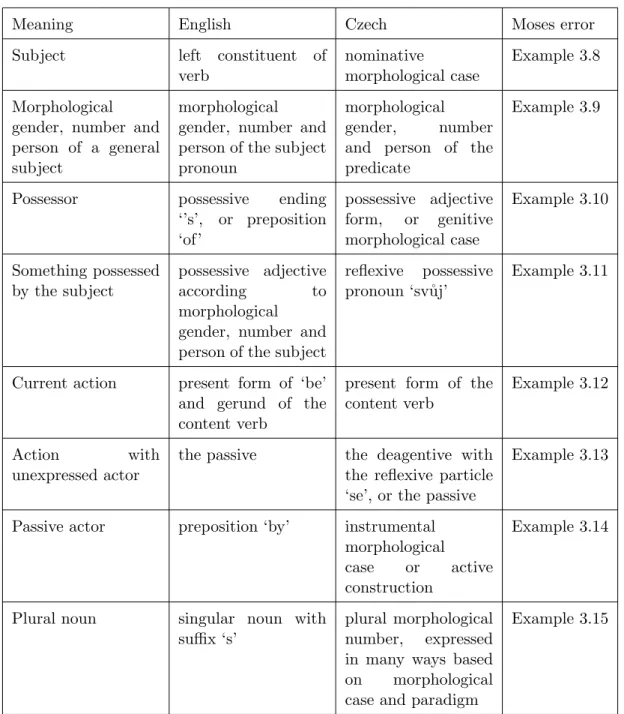
We found many similar situations where a meaning, expressed by various means in English, is to be expressed by specific values of morphological attributes in Czech, but the transfer is often not performed correctly by Moses. We list such cases in a simplified way in Table 3.1, which is accompanied by a set of examples showing Moses making an error in the transfer of the meaning.
Transfer of verb tenses and transfer of negation are more complicated, therefore they are not included in the table but are described separately.
Source: I don’t blame them. SMT output: J´a se jim nediv´ım.
Gloss: I them don’t-blame1st person sg. Correct: Nediv´ım se jim.
Gloss: Don’t-blame1st person sg them. Example 3.9
Errors in transfer of verb tenses
The systems of verb tenses in English and Czech are very different, and there is no exact one-to-one or many-to-one correspondence between them. Moses does not handle verb tenses explicitly. It neither employs analysis of the verb tenses nor even tries to translate a whole compound verb form as a one unit. The result is that the transfer of tenses is not consistent and sometimes is even rather random – consider Example 3.16 and Example 3.17, where the past and present tenses are switched in both directions. In the data, we have seen all kinds of tenses
Meaning English Czech Moses error Subject left constituent of
verb
nominative
morphological case
Example 3.8
Morphological gender, number and person of a general subject
morphological gender, number and person of the subject pronoun
morphological gender, number and person of the predicate
Example 3.9
Possessor possessive ending ‘’s’, or preposition ‘of’ possessive adjective form, or genitive morphological case Example 3.10 Something possessed by the subject possessive adjective according to morphological gender, number and person of the subject
reflexive possessive pronoun ‘sv˚uj’
Example 3.11
Current action present form of ‘be’ and gerund of the content verb
present form of the content verb
Example 3.12
Action with unexpressed actor
the passive the deagentive with the reflexive particle ‘se’, or the passive
Example 3.13
Passive actor preposition ‘by’ instrumental morphological case or active construction
Example 3.14
Plural noun singular noun with suffix ‘s’
plural morphological number, expressed in many ways based on morphological case and paradigm
Example 3.15
Table 3.1: The differences in ways in which some meanings are usually expressed in English and in Czech, with references to examples of Moses errors in the transfer of the meaning.
Source: . . . unsustainable deficit levelof public finances. SMT output: . . . neudrˇziteln´a ´uroveˇn schodkuveˇrejn´e finance. Gloss: . . . unsustainable deficit levelpublic financesnominative.
Correct: . . . neudrˇziteln´a ´uroveˇn schodkuveˇrejn´ych financ´ı. Gloss: . . . unsustainable deficit levelof public financesgenitive.
Source: During the Triassic period, the dinosaurs still shared their
habitat with a large amount of other reptiles. . .
SMT output: Bˇehem doba triasu, dinosauˇri st´ale sd´ıleli jejich stanoviˇstˇe s velk´ym mnoˇzstv´ım dalˇs´ı plazi. . .
Gloss: During the Triassic period, the dinosaurs still shared
theirpossessivehabitat with a large amount of other reptiles. . .
Correct: Bˇehem doby triasu, dinosauˇri st´ale sd´ıleli sv´e stanoviˇstˇe s velk´ym mnoˇzstv´ım dalˇs´ı plaz˚u. . .
Gloss: During the Triassic period, the dinosaurs still shared
one’sreflexive possessive habitat with a large amount of other
reptiles. . .
Example 3.11
Source: . . . she is explaining mathematical equations. . . SMT output: . . .je vysvˇetlovat matematick´e rovnice. . .
Gloss: . . . she is explaininfinitive mathematical equations. . .
Correct: . . .vysvˇetluje matematick´e rovnice. . . Gloss: . . . she explains mathematical equations. . .
Example 3.12
Source: . . . a wave of them was expected. SMT output: . . . vlna z nich oˇcek´av´a.
Gloss: . . . a wave from them expects. Deagentive: . . . vlna se jich oˇcek´av´a.
Gloss: . . . a wave of them expects itself. Passive: . . . vlna jich byla oˇcek´av´ana. Gloss: . . . a wave of them was expected.
Example 3.13
Source: The timing of his strategy is foiled by his voluntarism. SMT output: Naˇcasov´an´ı jeho strategie je zmaˇrena jeho voluntarismu. Gloss: The timing of his strategy is foiledof his voluntarismgenitive.
Correct: Naˇcasov´an´ı jeho strategie je zmaˇreno jeho voluntarizmem. Gloss: The timing of his strategy is foiled by his
voluntarisminstrumental.
Source: . . . a slander suit against three ˇCSSDcommissioners. SMT output: . . . soudn´ı proces proti tˇrem ˇCSSDkomisaˇri.
Gloss: . . . a suit against three CSSDˇ
commissionersingular dative/plural nominative.
Correct: . . . soudn´ı proces pro pomluvu proti tˇrem ˇCSSDkomisaˇr˚um. Gloss: . . . a slander suit against three CSSDˇ
commissionersplural dative.
Example 3.15
switched in translation, including switching past tenses with future tenses, as in Example 3.18.
Source: The generalsare defending themselves. . . SMT output: Gener´alov´e se br´anili. . .
Gloss: The generalswere defending themselves. . . Correct: Gener´alov´e se br´an´ı. . .
Gloss: The generalsare defending themselves. . .
Example 3.16
Source: Amnesty also cited the case of a former detainee. . . SMT output: Amnesty rovnˇeˇz cituje pˇr´ıpad b´yval´eho vˇeznˇe. . . Gloss: Amnesty also citesthe case of a former detainee. . . Correct: Amnesty rovnˇeˇz citovala pˇr´ıpad b´yval´eho vˇeznˇe. . . Gloss: Amnesty also citedthe case of a former detainee. . .
Example 3.17
Compound verb forms, such as the present continuous or past simple passive, are often mistranslated by Moses. The most common error is that he auxiliary verbs (‘be’, ‘have’) are translated literally, while usually the way in which the corresponding verb forms are composed in English and in Czech are different. Example 3.12 showed a case where ‘is explaining’ is translated word-by-word by Moses, instead of using the correct one-word verb form.
Errors in transfer of negation
Errors in negation, especially verb negation, are uncomfortably frequent. It should be noted that a negation error is a rather serious one: a missing or extra negation typically inverts the meaning of a phrase or even of the whole sentence, and, to make matters worse, such error can be very difficult to spot by the user. Therefore, the user can be seriously misled by the translation, putting them in a
Source: . . . the direct service from Prague - Letohrad will be cut
dramatically.
SMT output: . . . pˇr´ım´e spojen´ı z Prahy - letohrad se dramaticky sn´ıˇzil. Gloss: . . . the direct service from Prague - Letohrad was lowered
dramatically.
Correct: . . . pˇr´ım´e spojen´ı z Prahy do Letohradu se dramaticky sn´ıˇz´ı. Gloss: . . . the direct service from Prague to Letohrad will be
lowered dramatically.
Example 3.18
much worse situation than an incomprehensible translation: an incomprehensible translation’s value is close to none, while a value of a misleading translation is negative.
A missing negation, such as the one in Example 3.19, is much more frequent than an extra negation, although both of them occur in our data.
Source: . . . he feels that he does not wholly deserve it. SMT output: . . . c´ıt´ı, ˇze si plnˇe zaslouˇz´ı.
Gloss: . . . he feels that he wholly deserves. Correct: . . . c´ıt´ı, ˇze si ji plnˇenezaslouˇz´ı.
Gloss: . . . he feels that he wholly does not deserveit.
Example 3.19
The error is most probably caused by difficulties in aligning the negation correctly, as in Czech it is usually expressed by a negative prefix, ‘ne-’, while English often uses the word ‘not’. Therefore, the English positive verb is often aligned to the Czech negative verb and ‘not’ stays unaligned. This poses two threats:
• In case of a positive English sentence, there is the threat of translating the English verb by a negative Czech verb. This does not happen too often as the positive Czech verb is likely to occur more frequently in the training data than the negative one, and it is therefore more probable that the decoder will select the positive Czech verb as the translation. However, this error does occur, especially when the verb is rare in the training data.
• In case of a negative English sentence, there is the threat of leaving out the ‘not’ word and translating the English verb by a positive Czech verb. This happens quite often, as, for aforementioned reasons, the decoder is likely to select the positive Czech verb as a more probable translation than the negative one.
To the best of our knowledge, Moses does little to overcome this issue. Thus, the translation model probably often generates both the positive and the negative
Czech verb as possible translations (the positive one presumably having a higher score than the negative one), and it is up to the language model to choose, which variant is better. Obviously, the language model is rather unsuitable for making such a choice (apart from fixed expressions), and it should therefore not be surprising that the choice is often erroneous.
3.3.4
Noun Clusters
A common error of Moses is translating English noun clusters by Czech noun clusters, as shown in Example 3.20 (although many of the noun clusters were translated correctly). A noun cluster is a chain of nouns with the head noun at the end, the preceding nouns being modifiers of the following nouns. Although noun clusters are starting to appear even in Czech language, as in ‘O2 mobiln´ı internet sada’ (‘O2 mobile internet set’), they are typically considered incorrect, and should usually be translated by a structure with the head noun being the first one and the modifiers put after the head noun, typically in the genitive morphological case, such as ‘sada mobiln´ıho internetu O2’ (‘set of mobile internet of O2’). Usually, the correct order of the nouns in Czech is reverse to their order in English.
Source: . . . the chairman of the Litomˇeˇrice1 Nature2 Protection3 Society4 civil association5. . .
SMT output: . . . pˇredseda obˇcansk´eho sdruˇzen´ı5 Litomˇeˇrice1 ochrana3
pˇr´ırody2 spoleˇcnosti4. . .
Gloss: . . . the chairman of the civil association5 Litomˇeˇrice1
protection3 of nature2 society4. . .
Correct: . . . pˇredseda obˇcansk´eho sdruˇzen´ı5 Spoleˇcnost4 ochrany3
pˇr´ırody2 Litomˇeˇrice1. . .
Gloss: . . . the chairman of the civil association5 Society4 of
protection3 of nature2 Litomˇeˇrice1. . .
Example 3.20
3.3.5
Casing Errors
The casing of words is often incorrect, and, although such an error is typically not serious, it can occasionally mislead the user of the translation. Most often, a word is not capitalized even when it should be; usually it is a word that exists as a lowercase word in Czech, but in the particular sentence it is a part of a named entity and therefore should be capitalized. For example, the word ‘psa’ can be a form of the word ‘pes’ (‘dog’), but it can also be the shortcut for ‘Peugeot Soci´et´e Anonyme’, as in Example 3.21.
We believe that the main cause of the casing errors is the fact that Moses is case-insensitive: it lowercases all its input prior to any processing, and only performs statistical truecasing on its final output. Moreover, the standard MT quality metrics are typically case-insensitive, and therefore the researchers in
Source: Suicides at France Telecom, PSAand Renault. . . SMT output: Sebevraˇzdy na France Telecom,psa a renault. . . Gloss: Suicides on France Telecom, a dog and renault. . . Correct: Sebevraˇzdy ve France Telecom,PSA a Renaultu. . . Gloss: Suicides at France Telecom, PSAand Renault. . .
Example 3.21
SMT are not motivated by the automatic evaluation to provide correctly cased outputs.
We also observed cases where words are capitalized even if they should not. We already discussed these cases, referred to as fake named entities, in Section 3.2.2.
3.3.6
Tokenization Errors
To decrease the amount of out-of-vocabulary items, Moses uses an aggressive tokenization strategy, which is most apparent in splitting English dash-separated compounds into separate tokens. This strategy allows it to translate the individual words that form the compound, even if the whole compound is unknown to the system, and is therefore generally good.
However, Moses pays little attention to detokenizing its output, leaving many superfluous spaces in the translation, as shown in Example 3.22. Although such errors are of a very low importance and are unlikely to confuse the user of the translation, they still may distract them, and they can consider the subjective quality of the translation to be lower.
Source: on-line al-Somali Jean-Marie
SMT output: on - line al - Somali Jean - Marie Example 3.22
We noticed that tokenization errors are severely penalized by the automatic translation quality evaluation metrics, as these are typically token-based.
3.4
What We Decided to Fix in Depfix
We found that outputs of Moses contain many errors of many types, which we divided into two categories – the lexical errors and the word form errors.
The lexical errors are very common and at the same time one of the most serious errors in SMT outputs, and fixing them would probably bring a very high improvement of translation quality. However, they are generally hard to fix by rule-based methods, as the statistical systems typically outperform rule-based systems in lexical choices. Still, there are two types of lexical errors that we decided to try to fix in Depfix. These are the missing reflexive verbs, which we try to fix in “Missing reflexive verbs” (Section 6.4.1), and fake named entities, which
we address in “Source-aware truecasing” (Section 4.3.1). In future, we would like to research the possibilities of detecting and correcting the part-of-speech errors described in Section 3.2.3.
We decided to focus on word form errors in our work, as they are both the most common type of error of Moses and are typically better approached by rule-based systems than by purely statistical systems. Probably the most frequent are the errors in morphological agreement, which we address by a set of 7 rules in Section 6.3, and in valency, for the correction of which we decided to employ a statistical approach, described in Section 7.4, as valency most probably cannot be captured by a small set of rules.
There are also many errors in the transfer of a meaning that is to be expressed by means of morphology in Czech, such as a verb tense or possessiveness. We address these errors by a set of rules described in Section 6.4, except for the transfer of verb tenses and of negation, which have to be handled on a deeper analysis level and are described in Section 7.3.
Some of the least serious errors that we encountered, although quite frequent, are the errors in casing and tokenization. We decided to try to fix them only in cases where the correct casing or tokenization can be simply projected from the source to target, as described in Section 4.2.2 and Section 4.3.1, as the effort necessary to employ such fixes is minimal.
There are still many error types, such as the translations of noun clusters or the usage of the reflexive possessive pronoun ‘sv˚uj’, that we decided not to address in Depfix. In our opinion, these errors usually belong neither to serious nor common errors (such as the lexical or agreement errors), and do not seem to be completely trivial to fix either (such as the casing errors), and therefore we decided to focus on other error types instead. However, we believe that even the error types that are disregarded by Depfix should be addressed in future, as correcting them would probably lead to a small but still positive change of the translation quality.
Chapter 4
Morphological Layer
The morphological layer, or m-layer, as defined in PDT (Hajiˇc et al., 2006), is the first layer on which the input, i.e. the English source sentence and the Czech target sentence, are analyzed and fixed.
We describe the representation of the sentences on this layer in Section 4.1. Section 4.2 details the analysis steps that construct the m-layer representation, and the way we fix them for an improved performance. In Section 4.3, we detail Depfix fix rules that operate on m-layer.
4.1
M-nodes, Lemmas and Tags
The m-layer representation of a sentence is flat. It only describes the morphology of individual tokens of the sentence, represented by m-nodes, without any relations between them.
Each m-node corresponds to one word or to one piece of punctuation. It contains several attributes that describe the represented token, the most important being:
• the form, which is identical to the token as it appears in the sentence
• the tag – morphological tag for Czech m-nodes (see Section 4.1.1), or the POS tag for English m-nodes (see Section 4.1.2
• the lemma (see Section 4.1.3)
The other attributes are rather technical, specifying the order of the token in the sentence, whether it is followed by a space, etc.
4.1.1
Czech Morphological Tags
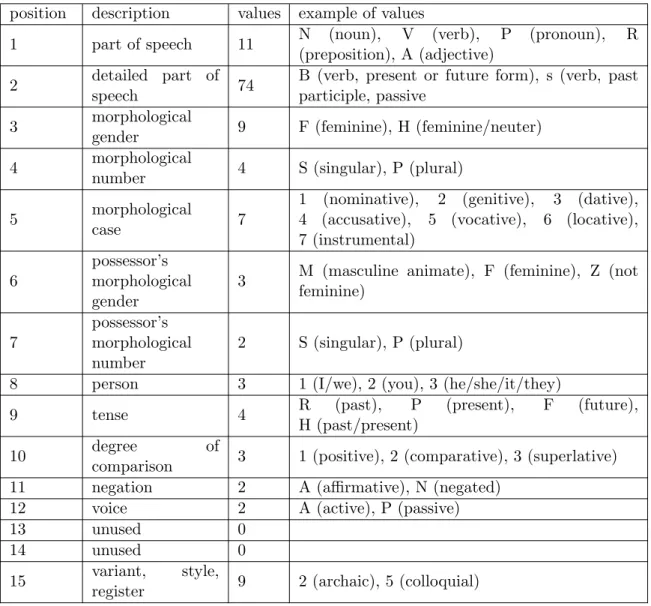
The Czech tagset uses positional morphological tags. The tag contains full morphological analysis of the respective word. We present a brief overview of the structure of the morphological tag in Table 4.1; a full description can be found in the PDT 2.0 manual (Hajiˇc et al., 2006).1 The default value is usually “-”, meaning “not relevant”, and there is also a universal “X” value, meaning “any or
position description values example of values
1 part of speech 11 N (noun), V (verb), P (pronoun), R (preposition), A (adjective)
2 detailed part of
speech 74
B (verb, present or future form), s (verb, past participle, passive
3 morphological
gender 9 F (feminine), H (feminine/neuter) 4 morphological
number 4 S (singular), P (plural) 5 morphological
case 7
1 (nominative), 2 (genitive), 3 (dative), 4 (accusative), 5 (vocative), 6 (locative), 7 (instrumental)
6
possessor’s morphological gender
3 M (masculine animate), F (feminine), Z (not feminine) 7 possessor’s morphological number 2 S (singular), P (plural)
8 person 3 1 (I/we), 2 (you), 3 (he/she/it/they)
9 tense 4 R (past), P (present), F (future),
H (past/present)
10 degree of
comparison 3 1 (positive), 2 (comparative), 3 (superlative) 11 negation 2 A (affirmative), N (negated)
12 voice 2 A (active), P (passive)
13 unused 0
14 unused 0
15 variant, style,
register 9 2 (archaic), 5 (colloquial)
Table 4.1: An overview of morphological tags, used on the target side. Adapted from the PDT 2:0 manual (Hajiˇc et al., 2006).
Tag Meaning
NN Noun, singular or mass NNS Noun, plural
NP Proper noun, singular NPS Proper noun, plural POS Possessive ending MD Modal
VB Verb, base form VBD Verb, past tense
VBG Verb, gerund or present participle VBN Verb, past participle
VBP Verb, non-3rd person singular present VBZ Verb, 3rd person singular present
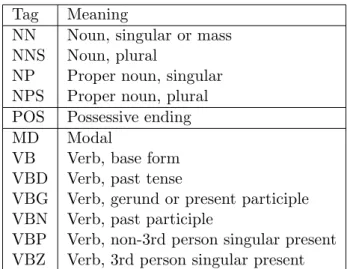
Table 4.2: Some of the POS tags, used on the source side
not recognized” (these two values are not included in the count of possible values in the table).
The tagset is very suitable for the purpose of Depfix, since it is very easy to both check and change the individual morphological categories. At the same time, the large number of possible combinations of the values and thus of possible morphological tags makes some of the tags very sparse.2
4.1.2
English POS Tags
For English, we use the Penn Treebank tagset (Marcus et al., 1993), which defines 45 different tags. Table 4.2 lists some of the tags, focusing on the ones that we use in the text of this work; a full description can be found online.3
4.1.3
Lemmas
The lemma is the base form of a word, common for all inflections (but not derivations) of the word. It typically is the form with the following properties, if appropriate for the given part-of-speech, listed according to their importance in descending order: nominative morphological case, singular morphological number, masculine (animate) morphological gender, infinitive, affirmative, present tense, 1st person.
The level of abstraction of Czech lemmas is slightly higher than that of the English ones. For example, the Czech pronouns ‘j´a’ (‘I’), ‘ho’ (‘him’) and ‘jejich’ (‘their’) all share the same lemma, ‘j´a’, whereas in English, each of the pronoun forms is its own lemma.
The lemma can have a “tail”, i.e. a string appended to the form that further specifies it. It can specify the variant of a polysemous lemma, the type of named entity represented by the lemma, etc. However, we disregard the tails in Depfix, stripping them for most subsequent processing steps.
1http://ufal.mff.cuni.cz/pdt2.0/doc/manuals/en/m-layer/html/ch02s02s01.html 2There are several thousands of possible morphological tags.
A pair of a lemma and a tag unambiguously defines a word form (except for a small number of exceptions), which significantly simplifies further processing.
4.2
Analysis, its Errors and their Fixes
The morphological layer is the first layer on which the input, i.e. the English source sentence and the Czech target sentence, are analyzed. We use a pipeline of state-of-the-art NLP tools integrated in Treex, as described in Section 4.2.1.
However, the analysis of the Czech sentences provided by the tools is far from perfect. One of the reasons is that all of the tools are intended to be used on correct sentences, which the target sentence is often not. In such a setup, the performance of the tools can be expected to be lower.
We therefore proceed with correcting some of the errors of the tools, typically by exploiting the information from the source sentence, as the tools themselves are typically monolingual and are unable to make use of the knowledge of the English sentence. Most of the corrections are performed during the analysis, immediately after getting the output from the tool that they fix, as the subsequent processing phases typically rely on the outputs of the previous ones.
4.2.1
Analysis Pipeline
The sentences are processed by the following pipeline of NLP tools integrated in Treex:
1. tokenization of the English and Czech sentences, performed by a rule-based tokenizer,
2. tagging and lemmatizationof each token, performed:
• by the Featurama tagger4for the Czech sentence, using the morphology created by Hajiˇc (2004),
• by the Morˇce tagger (Spoustov´a et al., 2007) for the English sentence, 3. word alignment of each pair of source sentence and target sentence, performed by GIZA++ (Och and Ney, 2003); we use the intersection symmetrization, which means that each token can be aligned to at most one other token in the parallel sentence,
4. named entities recognition on the English sentence, using the Stanford named entity recognizer (Finkel et al., 2005); there is currently no good named entity recognizer for Czech in Treex.
Please note that this description only lists the important parts of the analysis process, omitting several steps that are rather technical. The full Treex scenario is shown in Attachment B.
4.2.2
Fixing The Tokenization Errors:
Tokenization
Projection
The target sentence tokenizer does not make use of the source sentence, and therefore sometimes tokenizes the target sentence differently from the source sentence – see Example 4.1. This makes the subsequent word-alignment step unnecessarily harder, which in turn lowers the performance of many following processing phases (all that make use of both source and target).
Source: on-line al-Somali Jean-Marie
SMT output: on - line al - Somali Jean - Marie Example 4.1
This kind of errors probably should not be considered to be a shortcoming of the tokenizer, but of the Moses system, which makes frequent errors in tokenization, as described in Section 3.3.6. In fact, it is highly beneficial in many applications if the tokenizer is simple and consistent, even if this means that the tokenization is not always correct theoretically. However, for the needs of Depfix, the blame is irrelevant. What is relevant is the fact that such cross-lingually incoherent tokenization poses unnecessary obstacles for Depfix, increasing the risk of incorrections. Therefore, we attempt to fix such errors in the tokenizer output, partially retokenizing the target sentence according to the source sentence.
We therefore apply a preprocessing phase before invoking the tokenizer, performing “Tokenization projection” by removing superfluous spaces from the target sentence to match the source sentence. This leads to the words that are identical in the source and the target, which are mostly named entities, to be tokenized in the same way – such as the ones in Example 4.1. To further increase the recall, we also assume the words to match if they are identical after removing the diacritics and lowercasing, as in Example 4.2.
Source: The RATP segment runs from Saint-Germain-en-Laye and Nanterre to Boissy-Saint-L´eger and Marne-La-Vall´ee.
SMT output: RATP segment bˇeˇz´ı od Saint - Germain - en - Laye a Nanterre naBoissy - Saint - L´egeraMarnˇe - La - Vall´ee. Depfix output: RATP segment bˇeˇz´ı odSaint-Germain-en-Layea Nanterre
na Boissy-Saint-L´eger aMarnˇe-La-Vall´ee.
Example 4.2
The rule is language-ignorant, i.e. it does not account for any language-specific tokenization differences, such the different ways to tokenize units in English and in Czech. It therefore makes occasional incorrections, as shown in Example 4.3.
However, for Depfix processing, such consistent tokenization is actually better than the correct one. We therefore do not try to avoid the errors, but we employ a clever detokenizer at the end of the pipeline which corrects the tokenization of
Source: He weighs 130kg. SMT output: V´aˇz´ı130 kg. Depfix output: V´aˇz´ı130kg. Correct: V´aˇz´ı130 kg.
Example 4.3
units.5 Thus, the processing steps in Depfix benefit from the higher similarity of the tokenizations of the two sentences, but the tokenization on the output is usually correct.
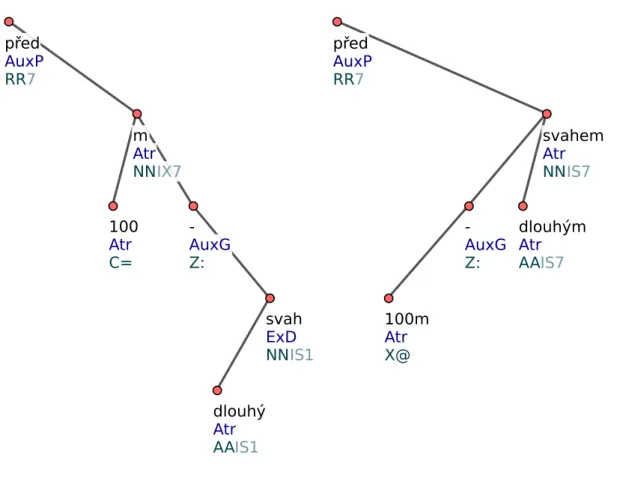
Example 4.4 shows such case. If “Tokenization projection” is not applied, the parser parses the sentence incorrectly, and “Preposition - noun agreement” (Section 6.3.1) cannot be applied as the noun ‘svah’ (‘slope’) is not a child of the preposition ‘pˇred’ (‘before’). However, changing the tokenization helps the parser, the sentence is parsed correctly, and “Preposition - noun agreement” can be applied. Both the incorrect and the correct parse trees are shown in Figure 4.1.
Source: . . . a short jump ramp before a100m-long slope. SMT output: . . . kr´atk´y skok rampy pˇred 100 m - dlouh´y svah. Gloss: . . . a short ramp jump beforeloc 100m - a long slopenom.
Depfix output: . . . kr´atk´y skok rampy pˇred 100 m - dlouh´ym svahem. Gloss: . . . a short ramp jump beforeloc a100m-long slopeloc.
Example 4.4
This rule serves mainly as an analysis fixing rule for our purposes, but it also changes the final output by removing some intra-word spaces. The effect on the quality of the translation is not crucial, but it leads to an increase of automatic scores, since they are typically token-based and penalize different tokenization severely.
4.2.3
Fixing The Tagging Errors: Fixing Morphological
Number of Nouns
The morphological tags assigned by the tagger often contain errors, especially in morphological number and morphological case. Such errors are generally common, since in Czech, there is much homonymy here – see Table 4.3 for a few examples. However, the errors are significantly more frequent in the analysis of SMT outputs. Because of the erroneousness of SMT outputs, ambiguity in selecting the correct morphological tag is higher – if the word form is wrong, it is often impossible to tell the morphological case and morphological number that it is in. Nevertheless, the tagger often produces analyses that are clearly wrong.
5We created a list of common units that the detokenizer recognizes and retokenizes, which
před AuxP RR7 100 Atr C= m Atr NNIX7 -AuxG Z: dlouhý Atr AAIS1 svah ExD NNIS1 před AuxP RR7 100m Atr X@ -AuxG Z: dlouhým Atr AAIS7 svahem Atr NNIS7
Figure 4.1: Tokenization projection
Word Possible analyses form number case hrad singular nominative
singular accusative hradu singular genitive singular dative singular locative feny singular genitive plural nominative plural accusative plural vocative
We believe that the source sentence should be used to provide additional information that could help with the disambiguation of the possible analyses. We implement this idea in Fixing morphological number of nouns, where we try to use the morphological number of the English words to choose the correct morphological number analysis for the Czech words.
It would be nice to also use the source sentence to choose the correct morphological case analysis, but this would be much less straight-forward to do. It could probably be done by finding an approximate mapping from English analytical functions and prepositions to Czech morphological cases, but we have not followed this research path – however, we take a similar approach in correcting valency errors, as described in Section 7.4.
Fixing morphological number of nouns assumes that the word form is correct, only the morphological tag is incorrect, and performs only such fixes that preserve the word form. Moreover, it is applied only if the Czech noun is singular and the aligned English noun is plural (the NNS POS tag), as the inverse case performs poorly on our development data – this is mostly because English often uses the singular morphological number even when referring to multiple entities by uncountable nouns, whereas Czech often uses the plural morphological number in such cases. Of course, the same problem does exist even in the other direction, i.e. an English plural noun corresponding to a Czech singular noun, but is much less common.
The rule first tries to only switch the Czech morphological number from singular to plural and checks whether the new morphological tag is consistent with the word form. If it is not, it tries to also change the morphological case, trying out all of the Czech morphological cases, until it finds a morphological case that is consistent with the word form and the plural morphological number. If such an alternative analysis is found, it is assumed to be correct (or at least better than the original analysis) and the morphological tag of the noun is changed.
See Example 4.5, where the noun ‘komisaˇri’ is first reanalyzed from ‘comissionersg dative’ to ‘comissionerpl nominative’, based on the plural in source. A subsequent application of “Preposition - noun agreement” (Section 6.3.1) then correctly changes the morphological case of the noun to dative, based on the morphological case of the preposition ‘proti’ (‘against’). Note that if Fixing morphological number of nouns was not applied, the morphological case would not be fixed by Preposition - noun agreement, as the original analysis indicated the noun to already bear the correct morphological case.
Source: . . . a slander suit against three ˇCSSDcommissionerspl. SMT output: . . . soudn´ı proces proti tˇrem ˇCSSD komisaˇri.
Gloss: . . . a slander suit againstdative three CSSDˇ
commissionersg dative.
Depfix output: . . . soudn´ı proces proti tˇrem ˇCSSD komisaˇr˚um.
Gloss: . . . a slander suit againstdative three CSSDˇ
commissionerspl dative.