Does an Individual’s Myers-Briggs Type Indicator Preference
Influence Task-Oriented Technology Use?
Pamela Ludford and Loren Terveen
University of Minnesota, Department of Computer Science and Engineering
4-192 EE/CS Building, 200 Union Street SE, Minneapolis, MN 55455, USA
{ludford | terveen}@cs.umn.edu
Abstract: Technology innovators face the challenge of finding representative groups of users to participate in design activities. In some cases, software applications will target an audience of millions, and the characteristics of the vast number of potential users are unclear to the design team. In other cases, a technology is so new that the target market of potential users is not known. The Myers-Briggs Type Indicator (MBTI) measures individual personality preferences on four dimensions and is used by psychologists to explain certain differences in human behavior. The definitions of the MBTI dimensions suggest they could be a factor explaining why individuals take different approaches to using software applications. This study explores whether MBTI preferences affect behavior when individuals perform tasks using three different software applications. We find a person’s MBTI type influences how they organize email and the informational features they rely on when using a decision support system.
Keywords: Participatory design, Myers-Briggs Type Indicator, MBTI, persona, personality, collaborative filtering, recommender system.
1 Introduction
An outstanding challenge in Human Computer Interaction (HCI) practice is to understand differences in how individuals use technology. This is necessary since successful technology development requires input from a representative set of potential users. The set of potential users should span the range of differences among individuals that may influence technology. For various applications, these factors may include age, gender, job function, language, culture, etc. In this work, we explore the use of another factor, the MBTI personality preference. We investigate the extent to which MBTI personality dynamics affect technology use and propose it should be considered when selecting users for design activities.
1.1 The MBTI personality dimensions
The MBTI, based on the theories of psychologist Carl Jung, measures an individual’s personality preferences over four dimensions, and is often used by psychologists in career counseling and group dynamics analysis. The four dimensions are outlined as follows.
(1) Extraversion /Introversion
A person’s Extravert1/Introvert preference indicates how
he/she gathers energy. Extraverts find themselves energized by people and activities in the world external to themselves. Conversely, Introverts gather energy from their own internal world of thoughts, ideas, and viewpoints.
(2) Sensing /Intuition
A Sensor notices and attends to details. Sensors respond best to facts, actualities, and react to exactly what was said rather than implication. On the other hand, Intuitors are big picture people. They notice patterns, like to make sense of complexity, and read between the lines.
(3) Thinking/Feeling
The Thinking/Feeling characteristic describes information individuals’ use in decision-making. The Thinker uses logic to reach decisions, while the Feeler considers values, beliefs, and how actions affect other people when making decisions. The Thinker tends to be objective, whereas the Feeler is more likely to have a subjective bias.
1 Preferred spelling when referring to the Myers-Briggs Type Indicator.
(4) Judging /Perceiving
The Judging/Perceiving dimension describes how people organize their lives. Judgers manage their time by defining schedules and using “to-do” lists. Being on time is important to the Judger, and they prefer to make decisions quickly in order to achieve closure. The Perceiver prefers spontaneity, likes to leave their options open, and tends to be less affected when faced with unexpected events.
The labels used to describe the Myers-Briggs personality dimensions differ from their traditional meanings in the English language. For example, an MBTI ‘Extravert’ is not necessarily talkative, an MBTI ‘Feeler’ is not necessarily emotional, and an MBTI ‘Judger’ is not necessarily judgmental. When using the MBTI as an instrument for developing technology, it is important to understand the characteristics measured by each dimension so the tool can be applied effectively.
1.2 The MBTI as a psychological instrument
A body of empirical research establishes the MBTI’s soundness as a psychological measure. The MBTI has an 85% reliability rate, where reliability measures the ability of the instrument to reproduce similar results on subsequent applications (Briggs Myers et al, 1998). The validity of the MBTI, the degree to which the instrument measures what it intends to measure, is estimated at over 75% based on feedback from psychologists who administer the test and interpret results (Briggs Myers et al, 1998). The reliability and validity of the MBTI are considered very good among psychological instruments available today.
Psychologists who administer the MBTI are careful to warn there are situations when it is inappropriate to use the MBTI to explain or predict behavior. For example, MBTI preference cannot predict whether an individual will be a good manager (Neuman 2003)2.
Next, the MBTI is suited for use in technology design because it describes personality traits that transcend culture. Societal differences are important when designing technologies for international use, an increasingly common design scenario (Dray, 2002; Russo, 1993). When Carl Jung first described psychological types that make up the MBTI preferences, he believed he depicted preferences common to the human race. Research shows the MBTI preferences are exhibited in all cultures (McCalley, 1993) although the prevalence of MBTI type can vary depending on the culture (McCaulley, 2002). As of the year 2000, the MBTI was available in 30 languages (McCalley, 2002). Therefore, if MBTI proves to be a factor in explaining
2Personal Communication with Dr. Jody Neuman, Outreach & Consultation Program Director at University of Minnesota Counseling & Consulting Services. Dr. Neuman also confirmed that our use of the MBTI in this study was appropriate.
different technology use patterns, its use in design will not be limited to one culture.
The preferences measured by the MBTI, its acceptance in the psychological community as an effective instrument, and the assertion that MBTI preferences exist in all cultures provide motivation to explore whether MBTI type affects how individuals use computers. This study explores whether the MBTI affects computer use by targeting how people use three different software applications to perform a varied set of tasks.
2 Previous work
2.1 Applying psychological measures
To date, most studies of Human Computer Interaction and personality type have focused on broad uses of technology, rather than relating personality type to more specific, task-oriented technology use. For example, prior studies have examined how MBTI preferences affect an individual’s propensity to adopt computers in day-to-day living and work environments (Pocius, 1993). The studies look at attitude, aptitude, and inclination to use computers in a general sense, and do not address MBTI preference with reference to specific software applications or ways of using them.
Other work has focused on MBTI type and performance in computer based learning and testing environments (Chu and Spires, 1991). The Homenet project examines psychological factors affecting computer use, but does not use the MBTI as a study instrument (Kraut et al., 1998). In addition, several research studies quantify MBTI preferences common to Information Technology professionals (Weldon, 1995; Pocius, 1993) but do not present implications for HCI design.
A body of three studies (Isbister and Nass 2000; Nass and Lee 2000; Nass and Lee 2001) examine whether a person’s introvert/extrovert3 style influences
the computer interface they prefer in various circumstances. Subjects interact with computer-animated characters and text-to-speech (TTS) interfaces that mimic either introvert or extrovert human behavior. The objective is to determine whether subjects like cartoons and voices that act/sound similar to themselves. The studies combine use of the MBTI and the Wiggins personality tests, relying mostly on constructs from the Wiggins instrument, which differs significantly from the MBTI.
One study with a narrower scope examines correlation of email message content and MBTI preference (Bail, 1995). In this study, a university professor notices patterns in course-related email content from students preferring Introversion or Judging. The researcher later disqualifies the study
results because the participant student group contains a large number of non-native English speakers, and he believes the observed behavioral differences might be affected by native language instead of, or in addition to, MBTI preference.
Another body of research examines how personality traits and MBTI preference affect team dynamics (Barry and Sewar, 1997; Huszczo, 1996). The studies show how individual personality styles influence the ease and effectiveness with which a group accomplishes assigned tasks. However, neither study examines this effect in relation to technology use.
2.2 Modeling diverse user populations
In order to characterize users of software that will be mass-marketed to large, international audiences, recent work describes use of Personas, which are commonly used in marketing to typify product users (Grudin and Pruitt, 2002). A Persona is a detailed portrayal of a fictional person who developers believe is, or will be a product user. In technology development, design teams build use cases around Personas, helping the team to visualize user needs during development. Second, a related study found managers, administrative assistants, and individual contributors had different work activity patterns that caused them to value different sets of features when using electronic calendars (Grudin, 2003). The work showed organization status and role affected use of a single software application, and concluded that design should encompass users from different levels of the workplace.
Our research also attempts to better understand diverse software users. Rather than using conceptual Personas or job responsibility to predict differences in how individuals approach using technology applications, it uses MBTI preferences. Obviously, MBTI preference will not be the only factor differentiating technology use; our research investigates whether it might be one factor. Our study differs from others examining Human Computer Interaction and MBTI preference in three ways. First, it looks at individuals’ use of three specific computer applications: (1) email, (2) Amazon.com, and (3) the Movielens personalized movie recommender system. Second, it focuses on common tasks people perform using the applications, rather than on general computer use. Finally, our work differs from the extrovert/introvert studies of Isbister, Nass, and Lee mentioned earlier in that we use the MBTI instrument exclusively, rather than combine it with another psychological instrument.
3 Methodology
Twenty subjects participated in three research exercises, with participation time ranging from 1 ½ - 3 hours per subject. Our plan was to determine their individual MBTI preferences, analyze their use of three software applications, and look for patterns of use that correlated
with MBTI preference. Our research methods included a combination of ethnographic, interview and controlled study techniques. We considered studying a variety of software applications, choosing three where we believed differences in MBTI preferences would be likely to result in different user behaviors.
Task 1: Using the work of Whittaker and Sidner (1996) as a base, we asked subjects to describe and demonstrate their email management habits, focusing on job-related email. The studies took place in subjects’ offices or other locations where they had access to their work email. Participants were encouraged to reference their email and show examples of their organization habits. Participants provided quantitative information about their email messages, including the number of email messages presently in their Inbox, Sent, Deleted Item, and Task lists. Subjects also supplied the number of folders they had created and the number of items in selected folders.
Task 2: Participants evaluated at least two books and one music compact disc (CD) of their own choice on Amazon.com. Participants were told the goal was to use information available to decide whether the book or music CD held personal interest, rather than to decide if they wanted to make a purchase on Amazon.com. In some cases, Amazon provided little information about a participant’s book or music selection; when this happened, subjects were asked to find a different book or music CD to review. Task 3: Recommender systems provide product and service suggestions tailored to individual users. Subjects used a movie recommender system, Movielens, which employs collaborative filtering to provide personalized movie recommendations. After receiving a list of suggested films from Movielens, participants discussed their reactions to the film recommendations and to the Movielens web site content.
Subjects performed all three tasks and took the MBTI Form M test. The order in which the subjects performed the exercises was varied across conditions to avoid bias. Scores from the MBTI test were made available to the researcher and subject when the study exercises were complete.
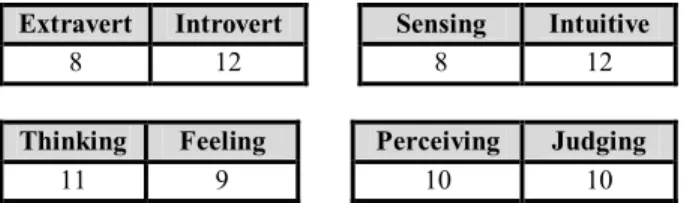
The 20 study participants consisted of 13 information technology professionals, 1 first level manager, 1 financial planner, 1 elementary school teacher, 1 public relations consultant, 2 airline schedule planners, and 1 mechanical engineer. Sixteen of the participants were employees of a major airline. All participants considered email an important workplace communication tool, received at least 5 email messages a day, used Microsoft Outlook as their email manager, and used the Internet at least 2 hours a week. The MBTI preferences of the participant group were relatively balanced, as illustrated in Table 1.
Extravert Introvert Sensing Intuitive
8 12 8 12
Thinking Feeling Perceiving Judging
11 9 10 10
Table 1: Participant group MBTI preferences ___________________________________________________
3.1 Hypotheses
The MBTI preference definitions suggest differences in use of certain major software applications. First, the MBTI Judging/Perceiving distinction describes differences in individual organization style. The first study hypothesis recognizes that email volume causes users to develop techniques such as using email folders to organize their correspondence. We postulate that subject’s email management habits will reflect their MBTI Judging/Perceiving preference.
Second, the MBTI Thinking/Feeling distinction describes what type of information people use in decision-making. With Amazon.com serving as an information portal in the study, the second study hypothesis proposes that the information subjects use to assess books and recorded music on Amazon.com will differ based on their MBTI Thinking/Feeling preference.
Third, the personalized film recommendations provided to Movielens users triggers an implicit decision-making process for the user: “Should I act on the recommendation or not?”. Swearingen and Sinha (2001) found recommender system users value availability of extra information related to recommendations, as it helps them determine whether the recommendations make sense. With this in mind, subjects would use information available on Movielens and a related site, the Internet Movie Database, to decide whether they would act on film recommendations. They would then be asked if there were additional features Movielens could provide to help in their decision. The third study hypothesis proposes that suggestions for additional Movielens features reflect the subject’s MBTI Thinking/Feeling preference.
_______________________________________________
MBTI dimension Task Technology
Application
Judging/Perceiving organization email Thinking/Feeling decision-making Amazon.com Thinking/Feeling decision-making Movielens
Table 2: Summary of exercises and hypotheses
Post study analysis took a broader view, and examined whether there were relationships between application use and MBTI preferences that were not reflected in the three hypotheses. No unexpected correlations were found.
4 Observations
4.1 Email management
When describing their habits for email management, subjects discussed and demonstrated the norms they had developed for handling different types of email, as well as practices they had adopted for periodically cleaning their Inbox and email archives.
The study addressed how participants handled task-related and informational mail, mail of indeterminate status (Whittaker and Sidner, 1996), and social invitations.
First, task-related email contains either an implicit or explicit request for the recipient to perform a work-related task. It includes threads of email sharing the same subject line where recipients exchange information about the task and related issues. Second, informational email encompasses work-related mail that is purely informational and does not require the recipient to take action upon receipt. Third, mail of indeterminate status includes mail that has been read, but where the recipient has not determined what action should be taken as a result. For example, Mary receives an email asking her to run a report for the Business Expense project, but her co-worker Bob is assigned to the project. She decides she will check with Bob before handling the email. Prior to checking with him, the mail is in indeterminate status. Finally, social invitation email includes correspondence that invites the recipient to attend a social event.
Participants described occasions when they had received each of the four types of email, explaining what typically happened to each type of mail after it had been received and read. The study showed that handling of informational mail, mail of indeterminate status, and social invitation mail was unaffected by MBTI preference. Task-related email management, however, corTask-related with the subject’s MBTI Judging/Perceiving preference, supporting our first hypothesis.
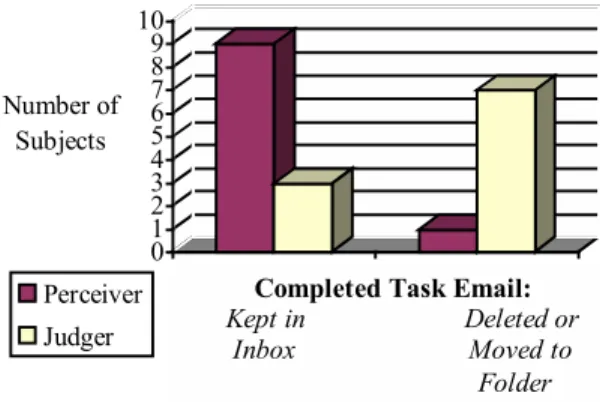
All study participants, regardless of MBTI preference, kept task-related email in their Inbox while the task was in progress. When the related task was complete, however, the majority of participants who were MBTI ‘Judgers’ reported a preference for either deleting the email, or moving it to a folder for reference. In contrast, most MBTI ‘Perceivers’ preferred to keep email related to completed tasks in the Inbox for lengths of time varying from several days to more than a year. ‘Perceivers’ had varied rationales for keeping completed tasks in the Inbox.
“I have to report how much time I spent on projects I’m working on every week, and I can remember what I worked on by looking at what was in my Inbox that week.”
“The server that my Inbox is on is backed up every night, so if there’s a crash I won’t lose my email.”
“I need a computer with lots of space. I keep almost everything in my Inbox forever. If I need to find the email
address of somebody who sent me mail last June, I sort my Inbox by date and find their email from last June, and there it is.”
The difference between Judgers and Perceivers handling of task-related emails is significant with p = (.01) using a Fisher Exact test. Results are shown in Figure 1.
During the email management study exercises, participants provided an implicit description of how they used their Inbox as a task manager and/or reference point (Whittaker and Sidner, 1996). For various reasons, all study participants considered Inbox space to be valuable electronic real estate.
“I know it’s time to clean my Inbox when I have to scroll down to see everything in it. I use my Inbox as a reminder of things I have to do, and if I can’t see everything, I might forget to do something important.”
“I like to keep as much as possible in my Inbox because it is easier to sort and find things there … it’s all in one place.”
The above examples illustrate two uses of the Inbox, first, as a task manager and second, as a reference point providing easy retrieval. ‘Perceivers’ were apt to use the Inbox as a storage point for completed task-related email, while ‘Judgers’ did not exhibit the same behavior, and restricted use of the Inbox to that of a current task manager.
It seems logical that MBTI preference could predict habits for handling email. Because ‘Judgers’ like finishing tasks to achieve closure, deleting task-related email or moving it to a folder upon task completion seems symbolic of their preference for closure. In contrast, ‘Perceivers’ like to keep their options open, and may regard keeping completed tasks in the Inbox upon completion as analogous to leaving open the option to find and refer to them again.
A valid question would be whether ‘Perceivers’ used folders to archive email. According to quantitative data collected, there was no difference between the amount of folders ‘Judgers’ and ‘Perceivers’ had created, or the amount of email in the folders. The difference was ‘Perceivers’ delayed moving task-related emails from the Inbox to folders longer than ‘Judgers’ did.
A factor that could influence how people handle incoming email is the number of messages their Inboxes. To test whether this affected our results, we recorded the number of messages in each subject’s Inbox at the time the experiment was conducted, and found no significant difference in ‘Judgers’ and ‘Perceivers’ Inbox sizes (t-test, p = .15, df = 18, t = 1.50). So, number of mails in the Inbox did not have a bearing on email management behavior. The average number of emails a person receives could also affect how they manage their email, and a future study could address whether this factor is influential.
We found behavior differences between ‘Perceivers’ and ‘Judgers’ exist within a single job description. In
studying email management, we observed two study subjects, both Data Warehouse Analysts at the same company, one an MBTI ‘Perceiver’ and the other an MBTI ‘Judger’, had very different habits for organizing their email. As summarized earlier, the ‘Perceiver’ preferred using her Inbox as a long-term storage device for completed task email, while the ‘Judger’ was careful to move completed task mail out of the Inbox on completion. This result suggests that characterizing users based soley on job function is not sufficient, and further research incorporating this finding with other user characterization models is clearly needed.
0 1 2 3 4 5 6 7 8 9 10 Number of Subjects Perceiver Judger
Figure 1: Task-related email handling differences. Results significant with p = (.01), using Fisher Exact test
_______________________________________________
4.2 Amazon.com as a decision support vehicle
The Amazon.com web site merchandises a variety of products, including books and recorded music, and provides a wide variety of information about individual products offered for sale. In addition to price, customers evaluating books on Amazon can view excerpts from the book, read editorial and customer reviews, and view recommendations for books. Amazon provides similar information about music CDs, with track listings and audio samples also available.
In this part of the study, participants evaluated at least two books and one music CD of their own choice on the Amazon.com web site. When selecting products to evaluate, subjects were asked to avoid viewing products they already owned or had already decided they wanted to acquire. A goal of this part of the study was to compare information used in product evaluation by MBTI type. Subjects examined information available on Amazon, speaking out loud about information they noticed and used in their assessment.
Varying amounts of information is available for Amazon merchandise. For example, the ‘Look Inside’ feature that allows one to view excerpts from a book is available for many, but not all Amazon.com book selections. To account for differences in available information for individual books and music CDs, subjects
Completed Task Email:
Kept in Deleted or Inbox Moved to Folder
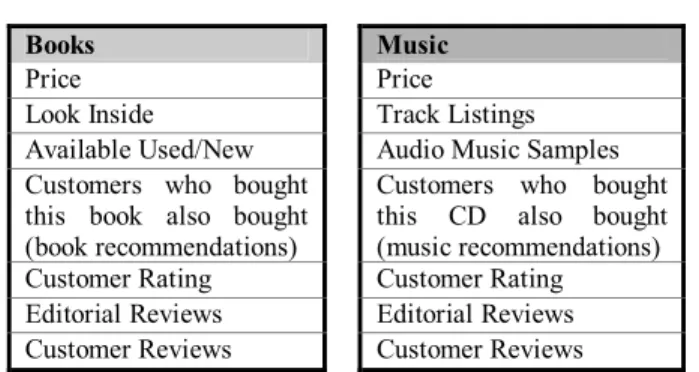
looked at books and CDs that contained at least the following features.
________________________________________________
Books Music
Price Price
Look Inside Track Listings Available Used/New Audio Music Samples Customers who bought
this book also bought (book recommendations)
Customers who bought this CD also bought (music recommendations) Customer Rating Customer Rating Editorial Reviews Editorial Reviews Customer Reviews Customer Reviews
Table 3: Minimum set of Amazon.com features available for evaluated items
________________________________________________ Data evaluation included looking for trends between MBTI preference and the criteria subjects used to evaluate books and music CDs. As hypothesized, the correlations discovered related to the individual’s Thinking/Feeling preference.
Books: Subjects with an MBTI ‘Feeling’ preference were more likely to read and use Customer Review content when assessing their interest in a book than MBTI ‘Thinkers’ were. The results were significant using a Chi square test with 1 degree of freedom, with p = (.02), and are shown in Table 4. Some of the subjects using Customer Reviews in product assessment explained they read the review, made a determination if they shared a common viewpoint with the reviewer, and when they did, they considered the contents of the review in their evaluation. In contrast, MBTI test subjects preferring ‘Thinking’, made comments about Customer Reviews that reflected their preference for logic and objectivity, as illustrated below.
“I bet these reviews are only from people who liked the book. If they’re trying to sell books, why would they put a bad review out here?”
“It looks like people can write anything that want in these. I wouldn’t use that.”
“Who is this person? Why should I listen to them?” Participants preferring ‘Thinking’ did, however, use Editorial Reviews when assessing books, so ‘Thinkers’ differentiated between available reviews based on the authority of the reviewer.
Study participants who used Amazon Customer Reviews in book evaluation volunteered suggestions for improving them. For example, two study participants noted that Customer Reviews were unstructured, free-form text, and explained it would be useful to them if the contents were categorized. Additionally, participants explained there
was risk in reading Customer Reviews because there was a possibility the reviewer might give away too much of the plot. Both comments provide implications for interface and content design, and illustrate different technology needs reflecting MBTI preference.
The outcome suggests MBTI ‘Feelers’, interested in the views of other Amazon customers, might have a general interest in collaboration interfaces and/or online communities as a resource in decision-making, and is an avenue for further exploration.
Music: When it came to recorded music evaluation, those with an MBTI ‘Thinking’ preference were more likely to read and use Editorial Review content than MBTI ‘Feelers’. The results were significant using a Chi square test with 1 degree of freedom, with p = (.02), and are shown in Table 4. Many ‘Feelers’ explained they employed different criteria to evaluate books and music. They said they acquired music CDs because they had heard a song or two from a CD, liked what they heard, and bought the CD based on that. Many volunteered they rarely considered Editorial or Customer Reviews when it came to choosing music CDs.
The results of the Amazon.com music evaluation exercise seem plausible: people with an MBTI ‘Feeling’ preference are more likely to make decisions based on instinct. When they choose music based on hearing it and liking it, it follows that their decision is based on their instinctive sense about the music. On the other hand, the MBTI ‘Thinker’ subjects in the study sought to confirm their partiality for the music with a professional critic’s review before making a decision.
________________________________________________
Used Customer Reviews Used Editorial Reviews Thinking Feeling Thinking Feeling
Books 3/11* 7/9* 9/11 7/9
Music 3/11 2/9 8/11* 2/9*
Table 4: Selected results from Amazon.com task. Significant differences are noted by *.
For each result, significance was determined using a Chi square test, 1 degree of freedom, with p = (.02).
________________________________________________ One interesting and unexpected result of the Amazon task was that individuals used distinctly different information to evaluate books and music online. Because both entities often serve as personal, leisure, or entertainment vehicles, the prediction might be that individuals use similar information to assess them. As it turns out, the evaluation criteria were unique to the product, and reflected MBTI preference. Previous research (Swearingen and Sinha 2001) shows users value and rely on supporting information about a product provided by a recommender system. Additional research is needed to understand which types of information are most valuable
for particular content domains, user tasks, and user personality types. The difference between the book and movie domain found in our study is one specific topic that deserves further investigation. Results of additional research would allow recommender system designers to improve their systems and/or target them to particular users.
Finally, because the Internet and other electronic information portals have proven to be valuable information resources for decision-makers (Sellen et al., 2002), and because the MBTI Thinking/Feeling preference describes information differing individuals use in decision-making, future work could compare features individuals use and prefer in other types of decision support systems.
4.3 MovieLens observations
Recommender systems provide personalized product and service suggestions. The Movielens application (Herlocker, et al., 2000) recommends films to individuals by using collaborative filtering to match an individual’s historical movie preferences with other application users who have expressed similar tastes. Movielens users rate films they have viewed in the past, and based on their ratings, Movielens recommends other movies of potential interest to the individual.
Study participants, none of whom had used Movielens prior to the exercise, began by rating 10 films they had seen in the past. Movielens then provided fifteen personalized film recommendations to the subject. Participants discussed their reactions to the recommendations, and also shared their views about the Movielens web site content.
Most subjects did not recognize several of the suggested movies, so participants chose two unfamiliar films, and viewed information about them on Movielens and/or the www.imdb.com web site. The IMDB (Internet Movie Data Base) provides plot summaries, cast listings, professional critic reviews, user reviews, and other movie information. Participants explained what information was useful in evaluating the movie, and also explained what (if any) further information could have been provided to help them decide whether or not they would act on the recommendation.
The suggestions received did not correlate to participant MBTI preference, and the study’s third hypothesis was not supported. A wide variety of ideas were verbalized, including expansion of plot summaries, adding genre to the list of recommended films, direct links from Movielens to professional critic reviewers websites or local theater show times, and many others. Perhaps the open ended nature of the question, the large universe of possible answers, and the limited amount of time participants had to consider their response resulted in what appeared to be a long list of good suggestions, but without pattern based on MBTI preference.
Exploration of the same topic using a different methodology might provide different results. For example, a future study might examine if participants who use
Movielens over an extended period of time make different suggestions for improvements to the web site than those found in this study. Results could be cross-checked with MBTI preference in order to determine if new feature suggestions follow MBTI preference. Further study could also address whether MBTI preference affects the likelihood that users follow recommender system suggestions.
Conclusion
There is little similar work examining how MBTI preferences influence task-oriented technology use. Therefore, our study contributes to HCI practice both by raising issues for inquiry and by presenting some initial results
First, we found that two people with the same job function may use applications differently, and the differences, as observed in this study, can be explained by MBTI preference. Designing with the assumption that people with the same job function use software in a similar fashion will fail to provide a complete picture. Additional work could explore how MBTI preference could be combined with other types of user characterizations, such as Persona or activity patterns, to produce a rich blend of typical user traits for application in technology design.
Empirical research proving MBTI preference affects how people use technology might help justify the cost of participatory design. While proponents of participatory design understand the benefits of focusing technology development on user practices, it can be difficult to convince those inexperienced with the method it is necessary to include a varied set of users in the process. Research results can establish individuals have different styles for using technology, can illustrate how the differences are rooted in individual personality, and can show broad inclusion of users in participatory design has merit.
Research has shown MBTI preferences are exhibited in all cultures. If future technology design were to include features satisfying users with varied MBTI preferences, the prediction is that applications would translate well across cultures. With much at stake in release of major technology, future work could confirm if this prediction is true.
We believe more research is needed to understand how all four MBTI dimensions predict technology use. With little or no empirical work directed at the first two MBTI dimensions, Extravert/Introvert and Sensing/Intuition, these areas invite further study. For example, the Extravert/Introvert personality dimension suggests the possibility of behavioral differences in electronic communication and collaboration. Because the Judging/Perceiving dimension describes how individuals organize their lives, technology applications such as electronic calendars and Personal Digital Assistants may be improved by considering MBTI differences.
In conclusion, we have shown some cases where software use reflected MBTI personality preference, and have uncovered patterns of use not identified by other methods. As a result, we have illustrated that choosing users with diverse MBTI personality characteristics can enrich HCI design practice.
Acknowledgements
Special thanks to the study participants who so willingly volunteered their time for the project. Thanks also to Jody Neuman who shared her MBTI expertise, and Jamelyn Johnson at the CAPT library. Finally, we express our appreciation to Jon Nelson and Dan Cosley, who provided valuable editorial comments.
References
Bail, F.T. (1995). An Exploration of Relationships Among Psychological Type, Ethnicity and Computer-Mediated Communication. In R.A. Moody (Ed.), Psychological Type and Culture- East and West: A Multicultural Research Symposium (p. 221-228).
Barry, B. and Stewar, G.L. (1997). Composition, Process, and Performance in Self-Managed Groups: The Role of Personality. Journal of Applied Psychology, 82, 62-78.
Briggs Myers, I., McCaulley, M., Quenk, N., Hammer, A. (1998). MBTI Manual (A), A Guide to the Development and Use of the Myers-Briggs Type Indicator. Consulting Psychologists Press, Inc.
Chu, P. C. & Spires, E. E. (1991). Validating the Computer Anxiety Rating Scale: Effects of cognitive style and computer courses on computer anxiety. Computers in Human Behavior, 7(1-2), 7-21.
Dray, Susan (1996). Designing for the Rest of the World: A Consultants Observation. CHI Interactions, March 1996. p. 15-18.
Grudin, J., Pruitt, J. (2002) Personas, Pariticipatory Design, and Product Development: An Infrastructure for Engagement.
Proc. Participatory Design Conference 2002, p.144-161.
Grudin, J. (2003). Managerial Use and Emerging Norms: Effects of Activity Patterns on Software Design and Deployment.
http://www.research.microsoft.com/research/coet/Roles/TRs /01-91.pdf
Huszczo, G. (1996). Tools for Team Excellence: Getting Your Team into High Gear & Keeping It There. (Eds.) Davies-Black Publishing, Palo Alto, CA, USA.
Herlocker, J., Konstan, J., and Riedl, J. (2000). Explaining Collaborative Filtering Recommendations. Proceedings of the ACM 2000 Conference on Computer Supported Cooperative Work.
Isbister, K., Nass, C. (2000) Consistency of personality in interactive characters: Verbal cues, non-verbal cues, and user characteristics. International Journal of Human-Computer Studies, 53 (2), p. 251-267.
Kraut, R., Mukhopadhyay, T., Szczypula, J., Kiesler, S., Scherlis, W., (1998). Communication and Information: Alternative Uses of the Internet in Households. Proc. CHI 1998, Extended Abstracts, p. 368-375.
McCaulley, M. H. (1993, October). Does a country or a culture have a type? Gainesville, FL: Center for Applications of Psychological Type.
http://www.capt.org/Research/Home.cfm
McCaulley, M. (2002). Consider How Far We’ve Come in 25 Years. Bulletin of Psychological Type 23:7, Fall 2002 p. 20-22.
Nass, C., Lee, K.M. (2000) Does computer-generated speech manifest personality? An experimental test of similarity-attraction. Proc. CHI 2000, p. 329-336.
Nass, C., Lee, K.M. (2001) Does computer-synthesized speech manifest personality? Experimental test of recognition, similarity-attraction, and consistency-attraction. Journal of Experimantal Psychology: Applied, 7 (3), p. 171-181.
Pocius, K. (1991). Personality Factors in Human-Computer Interaction: A Review of the Literature. Computers in Human Behavior, 7(3), p. 103-135.
http://www.capt.org/Research/Home.cfm
Swearingen, K., Sinha, R. (2001). Beyond Algorithms: An HCI Perspective on Recommender Systems. In SIGIR workshop on Recommender Systems.
Russo, P., Boor, S. (1993). How Fluent is Your Interface? Designing for International Users. InterCHI, 1993 p. 342-347
Sellen, A., Murphy, R., Shaw, K. (2002). How Knowledge Workers Use the Web. Proc. CHI 2002. Extended Abstracts,
p. 227-234.
Weldon, D. (1995). A Mutual Understanding. Computerworld, May 1, 1995. p. 103-111.
Whittaker, S. and Sidner, C. (1996). Email overload: exploring personal information management of email. Proc. CHI 1996. Extended Abstracts p. 276-283.