Representation and Reorganization of Web Accessibility
Guidelines Using Goal Graphs and Design Patterns
by
Imran Kabir
Thesis submitted in conformity with the requirements for the degree of Masters in Information Studies Graduate Department of Faculty of Information Studies
Acknowledgments
This work would not have been possible without the support and encouragement of Professor Eric Yu, my supervisor for this thesis. During a class lecture of FIS 1342 we were discussing the Non-Functional Requirements Framework and its ability to represent web accessibility goals. I had an interest in web accessibility and its guidelines. The discussion initiated the possibility of conducting this research. Professor Yu and I
exchanged our ideas; this thesis is a result of that exchange. During our regular meetings, Professor Yu provided me with the encouragement, guidance, and direction. I would like to express my gratitude to Professor Yu for his support and assistance in the completion of this work.
Ms. Jutta Treviranus, the second reader of this thesis, has provided enormous support along the way. As the director of the Adaptive Technology Resource Center (ATRC) at the U of T, and the chair of ATAG working group, her involvement in this research enriched my knowledge of accessibility significantly. She also helped me identify some key participants of the study.
I appreciate the support of Professor Steve Easterbrook, the external reviewer of this thesis. He took the time to attend the Early Requirements Engineering presentation and provided me with some insightful feedback.
I would like to thank my supervisors at work, Susanne Tabur and Lynn Deegan, who have supported me throughout the process, and provided the flexibility for me to work on my research when it was required.
And finally, I would like to thank my other half, my beautiful wife. It is only because she was always next to me, holding me tight in difficult moments, and sharing the joy at every achievement, that I could complete my work.
Representation and Reorganization of Web Accessibility
Guidelines Using Goal Graphs and Design Patterns
Masters in Information Studies, 2008 Imran Kabir
Faculty of Information Studies University of Toronto
Abstract
Web accessibility guidelines have textual representation and provide little support in systematic analysis and usage. The study hypothesizes that the guidelines can be
reorganized and represented using the goal oriented technique and design patterns which will allow their usage in a more systematic manner and accommodate detailed analysis of the guidelines with other competing goals. For this study, knowledge from web
designers’ experiences in using the guidelines, researchers’ findings, and the actual guidelines have been amalgamated. Six web designers have been consulted on a one-on-one basis and difficulties in using the guidelines for (1) specific scenarios, (2) systematic application, and (3) detailed systems analysis have been reported. Goal oriented modeling and design patterns have been introduced for (1) graphical representation of the
guidelines using goal graphs, and (2) keeping the technical details separate from the goal graphs. The proposed representation allows for the accessibility guidelines to be
systematically applied into interface design, and systems design using the goal oriented modeling technique.
Table of contents
Acknowledgments... iii
Abstract ... iv
List of tables... viii
List of figures... ix
Chapter I: Introduction... 1
I.1 Statement of the problem... 1
I.2 Statement of the purpose ... 1
I.3 Research questions ... 2
I.4 Significance of the study ... 3
I.5 Limitations of the study... 4
Chapter II: Literature review ... 5
II.1 Web accessibility and guidelines ... 5
II.1.1 Web accessibility... 5
II.1.2 Web accessibility guidelines ... 9
II.1.3 Accessibility validation tools ... 15
II.2 Goal Models and the NFR Framework ... 15
II.3 Design patterns... 20
Chapter III: The Approach... 23
III.1 Shortcomings of the accessibility guidelines and their usage... 23
III.1.1 Ambiguity in interpretation of guidelines... 23
III.1.2 Web designers not making full use of guidelines ... 24
III.1.3 Difficulty in dealing with textual representations... 26
III.1.4 The guidelines are too generic ... 26
III.1.5 No given technique for application... 27
III.1.6 Difficult to determine conflicting requirements ... 28
III.1.7 Lack of alternative solutions... 29
III.2.1 A simple case ... 30
III.2.2 Applying the concepts from NFR framework ... 32
III.2.3 Understanding a goal graph ... 34
III.3 Using design patterns for accessibility ... 36
III.4 General overview of the approach ... 38
III.4.1 Reorganization and representation of the accessibility guidelines ... 38
III.4.2 Application of the reorganized guidelines ... 39
III.4.3 Notations for application of guidelines... 40
Chapter IV: Methodology ... 43
IV.1 Research design ... 43
IV.2 Data collection and sampling... 44
IV.2.1 Web designers... 44
IV.2.2 Expert knowledge in publications ... 45
IV.2.3 Guidelines, de facto standards, and standards ... 46
IV.3 Data analysis and model construction ... 47
Chapter V: Results of the study of web designers ... 48
V.1 Introduction... 48
V.2 Job descriptions of participants... 48
V.3 Classification of mechanisms used in designing accessible web contents ... 50
V.4 Observations of participants in general... 52
V.4.1 WCAG 1.0 is outdated ... 53
V.4.2 Accessibility guidelines are bulky ... 53
V.4.3 No specific method for applying guidelines in design... 53
V.4.4 Same guideline is applied in all cases regardless of situation... 54
V.4.5 Guidelines applied cannot be traced back... 54
V.5 Analysis... 55
V.6 Implications of the study... 56
Chapter VI: Reorganizing the guidelines using goal graphs and design patterns... 57
VI.1 Deconstructing the guidelines... 57
VI.2 Creating goal graphs ... 62
VI.4 Linking goal graphs and design patterns ... 76
VI.4.1 Creating the pattern network ... 76
VI.4.2 Linking the patterns to goal graphs ... 80
VI.4.3 Optimizing the goal graphs, patterns and their linking... 84
Chapter VII: Applications of the reorganized goal graphs ... 90
VII.1.2 Integrating the guidelines into system design ... 99
VII.1.3 Performing accessibility evaluation using goal graphs ... 105
VII.2 Case study: eHealth ... 108
VII.2.1 Description of the domain and interface ... 108
VII.2.2 Safety: an important requirement for eHealth records ... 111
VII.2.3 Application of the guideline and other goals... 112
VII.2.4 A modified interface... 117
Chapter VIII: Conclusion... 118
VIII.1 Filling the apparent gap in research ... 119
VIII.2 Goal orientation in authoring tools ... 119
VIII.3 Goal orientation in policy making ... 120
VIII.4 Future work ... 121
References... 123
Appendices... 133
Appendix A: Other web accessibility guidelines... 133
IBM accessibility ... 133
Section 508... 133
Research-Based Web Design & Usability Guidelines... 134
Appendix B: Notations ... 135
Part I: Notations for the conventional Goal Oriented Modeling... 135
Part II: Notations for the proposed technique ... 136
Appendix C: The reorganized guidelines ... 137
Principle 1.1 ... 138
Principle 2.4 ... 139
List of tables
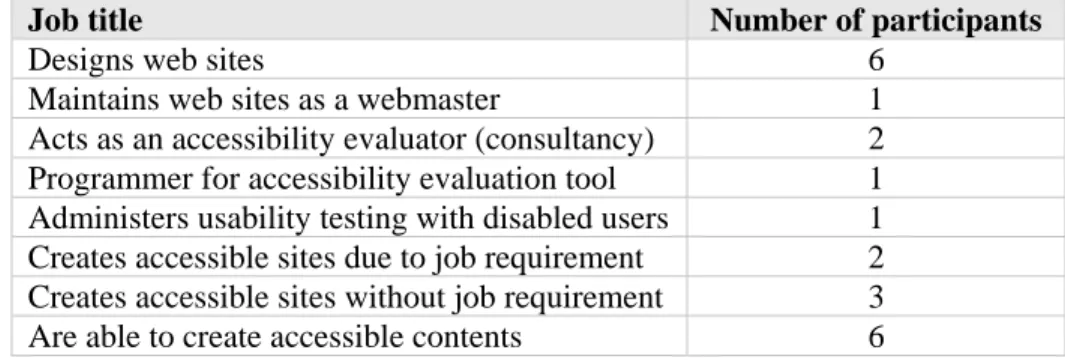
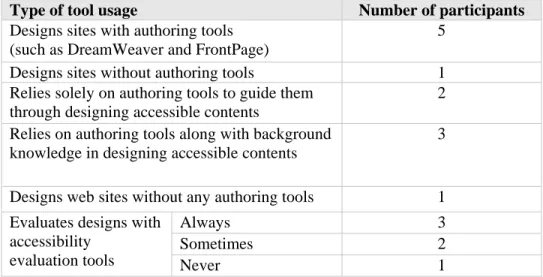
Table II.1: A comparison between WCAG 1.0 and WCAG 2.0 in their approach for representing the guidelines ... 13 Table V.1: Number of participants in each category of job task ... 50 Table V.2: A table showing the breakdown of authoring tool usage among the
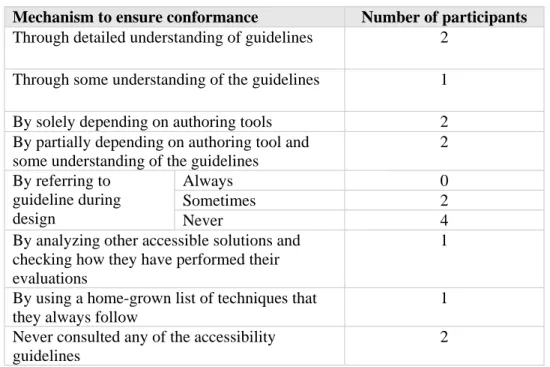
participants... 51 Table V.3: A table indicating the number of participants who evaluate each design for accessibility conformance using automated tools... 51 Table V.4: A table indicating the mechanisms that designers take in ensuring their
conformance to accessibility guidelines ... 52 Table VI.1: The four possible ways of assigning pattern numbers... 77
List of figures
Chapter I: Introduction... 1
Chapter II: Literature review ... 5
Figure II.1: The interdependent components of web accessibility (W3C, 2006d) ... 7
Figure II.2: The interdependent components that work to achieve web accessibility using alternative texts ... 8
Figure II.3: Guideline 4 of WCAG 1.0 (Chisholm, Vanderheiden, & Jacobs, 1999)... 11
Figure II.4: Principle 3 of WCAG 2.0 (Caldwell et al., 2007a)... 12
Figure II.5: A simple goal graph... 17
Figure II.6: A graphical representation of design pattern relationships (Gamma et al., 1995, 12) ... 22
Chapter III: The Approach... 23
Figure III.1: The model depicting a holistic approach proposed by Kelly et al. (2004)28 Figure III.2: An NFR network dealing with visibility (type) of page components (topic) ... 31
Figure III.3: An NFR graph depicting design goals for accessibility ... 35
Figure III.4: Representation of two design patterns in a relationship... 37
Figure III.5: Notation used for goals that reference a design pattern. ... 41
Figure III.6: The notations used for applying the reorganized guidelines ... 42
Chapter IV: Methodology ... 43
Chapter V: Results of the study of web designers ... 48
Chapter VI: Reorganizing the guidelines using goal graphs and design patterns... 57
Figure VI.1: Guideline 2 of WCAG 1.0 (underlined text are hyperlinked)... 58
Figure VI.2: Goal graph for the top-level goal ... 59
Figure VI.3: Goal graph indicating a HELP link for contribution... 59
Figure VI.4: Goal graph depicting several alternatives, with only one of them operationalized... 60
Figure VI.6: Goal graph depicting more operationalized goals, but still with some
without being operationalized... 62
Figure VI.7: Two situations described in guideline 1.1.1 of WCAG 2.0 ... 63
Figure VI.8: A goal graph representing the Situation A and B of guideline 1.1.1 ... 64
Figure VI.9: A goal graph representing the Situation C of guideline 1.1.1... 65
Figure VI.10: Demonstration of how situations A, B, and C of guideline 1.1 of WCAG 2.0 can be brought together... 66
Figure VI.11: Providing an AND contribution link to remove duplicate goals... 67
Figure VI.12: The goal graph showing guideline 1.1 of WCAG 2.0... 69
Figure VI.13: A sample general pattern... 72
Figure VI.14: A sample specialized pattern... 74
Figure VI.15: Conceptual view of a pattern relationship in the proposed approach .... 75
Figure VI.16: A generalized pattern indicating its pattern ID ... 79
Figure VI.17: A specialized pattern indicating its pattern ID... 80
Figure VI.18: Placing checkmarks on the patterns that have been linked ... 82
Figure VI.19: A goal graph with links to the appropriate design patterns... 83
Figure VI.20: Conceptual view of decomposition of a specialized pattern into two further specialized patterns ... 85
Figure VI.21: Linking the updated design patterns with the goal graph ... 86
Figure VI.22: Comparing techniques G94, G95, and G82 ... 87
Figure VI.23: The technology specific techniques for providing a short and long text alternatives (Caldwell et al., 2007a) ... 88
Figure VI.24: A goal graph demonstrating the links to patterns on how to provide short text alternatives ... 89
Chapter VII: Applications of the reorganized goal graphs ... 90
Figure VII.1: A simple user interface for signing up for online banking ... 91
Figure VII.2: Demonstrating a simple application of the perceivability goal graph .... 94
Figure VII.3: Demonstrating a simple application of the perceivability goal graph .... 97
Figure VII.4: Demonstrating a simple application of operability goal graph... 98
Figure VII.5: A sample interface for web-casting a live event... 100
Figure: VII.7: Cost limitations imposed on the web design ... 102 Figure VII.8: Evaluation of the accessibility goals along with cost reduction goal ... 103 Figure VII.9: Satisficing the accessibility goals along with cost reduction goal using alternative techniques... 104 Figure VII.10: Using the navigability goal graph for performing accessibility
evaluation... 106 Figure VII.11: The user interface of a possible eHealth system (CHI, n.d., p 7) ... 109 Figure VII.12: The goal graph that relates to patient safety in an eHealth situation .. 111 Figure VII.13: Demonstrating the combination of navigability graph with safety graph to be applied for analyzing the interface... 114 Figure VII.14: Demonstrating the combination of understandability graph with safety graph to be applied for analyzing the interface... 116 Figure VII.15: The redesigned interface... 118
Chapter I: Introduction
I.1 Statement of the problem
The study analyzes the representation of the current web accessibility guidelines used by the web designers to analyze the effort that the designers are required to put in
understanding the guidelines, and the difficulties in achieving compliance to the guidelines. Through this greater understanding, alternate and supplementary
representations of the accessibility guidelines are analyzed and developed. Specifically, the study considers the use of goal graphs and design patterns as possible means for representing the guidelines in a reorganized manner.
I.2 Statement of the purpose
The purpose of this study is to perform an analysis of the way that goal graphs can be used in conjunction with design patterns to reorganize the web accessibility guidelines. As a result of this reorganization, the other purposes of the study are to:
explore the possible applications of the reorganized guidelines using goal graphs in designing accessible web contents
analyze the abilities of the reorganized guidelines to be included in the design phase of system design process
assess the ability of the reorganized guidelines to be applied for accessibility evaluations
analyze the ability of the reorganized guidelines to promote a holistic approach in performing accessibility designs
explore the possible extensions to the conventional goal oriented modeling for making it applicable to the user interface design process
I.3 Research questions
The study explores the different possibilities and tries to meet its purpose by asking the following research questions at different stages of the research:
What is the current form of representation of web accessibility guidelines, and what are the possible difficulties that web designers may face in using such guidelines?
Is goal oriented modeling technique applicable in conveying the web
accessibility principles as goals, so that they can be analyzed, prioritized, and achieved by the means of goal operationalization? And if so, can design patterns be used to help this reorganization of accessibility guidelines and make their application easier for the web designers?
What are the possible techniques that one can use the reorganized guidelines in using the goal graphs and design patterns? And what are the extensions to conventional accessibility research that is required for one to do so? What are the possible areas (such as performing goal analysis, designing
information systems, and applying in a holistic approach) where the existing accessibility guidelines cannot be used in a systematic manner? Can the newly reorganized guidelines take advantage of their representations and be used in such areas?
I.4 Significance of the study
The Web Accessibility Initiative (WAI) by the World Wide Web Consortium (W3C) in 1997 has successfully raised awareness in the web design community about issues related to access to information on the web by disabled users. It raises awareness about certain types of barriers to receive information over the web and aims at proposing solutions that will reduce the barriers significantly.
Barriers to receiving free information may fall under government discrimination acts in many countries. For example, the Disability Discrimination Act (DDA) in the UK (Hackett, Parmanto, & Zeng, 2005), Americans with Disabilities Act (Johnson & Ruppert, 2002) in the US, and the Australian Disability Discrimination Legislation (Wallis, 2005) in Australia consider that web contents be equally accessible to all citizens of their nation. In Canada, the government has taken a step forward in creating any of its governmental sites with accessibility features since 1995 (Slatin & Rush, 2003), thus making compliance to accessibility guidelines a requirement at the government level. Web content accessibility guidelines have been in use for several years in many governmental and non-governmental organizational web sites, and have successfully raised awareness about accessibility of web site contents in the research community. Even though it has been in use for several years, it has not been successfully adopted by the web design community. Many studies have been done in attempts to find the reason for the failure of these guidelines to be successful in the design community. However, there has not been any definitive answer to the problem.
By building on observations by researchers that the guidelines are often too bulky (Thatcher, 2002; Lazar et. al., 2004), that accessibility may be considered as a quality requirement (Schimiguel, Melo, Baranauskas & Medeiros, 2005), and that goal oriented modeling technique can provide an excellent mechanism for representing the quality
requirements (Chung, Nixon, Yu & Mylopoulos, 2000), this study considers the fact that the representation of web content accessibility guidelines using goal graphs and design patterns may provide significant help in using the accessibility guidelines in web design. This study aims at filling an apparent gap in research on how the accessibility guidelines can be graphically represented using certain modeling techniques. Furthermore, it aims at filling the gap in research by providing a systematic approach using which accessibility guidelines can not only be applied in web designs, but can also be used for system designs, and for performing accessibility evaluations in a detailed manner.
I.5 Limitations of the study
There are two limitations of the study. First, the participants of the research do not represent the entire web designers’ population as it only involves the participation of six web designers. However, the consultations with the web designers have not been used empirically in the research. They have rather been used in guiding the reorganization of the accessibility guidelines.
Second, the study only considers the Web Content Accessibility Guidelines (WCAG) and their representation. Although it briefly looks at other types of accessibility guidelines, such as the User Agent Accessibility Guidelines (UAAG), and Adaptive Technology Accessibility Guidelines (ATAG) (discussed in the literature review), the study does not consider these accessibility guidelines at a deeper level for increased understanding. However, the reorganization of the accessibility guidelines proposed in this research can potentially be applied for representing all types of accessibility guidelines. Furthermore, the study does not aim at performing a research on accessibility, as its aim is only to perform a research on how their representations are made and how they are being used.
Chapter II: Literature review
II.1 Web accessibility and guidelines
In this part, I shall start by providing a detailed understanding on the background of web accessibility. I shall then discuss about the accessibility guidelines that have been
proposed by research groups. Since this research is concerned with the ability of the guidelines to provide sufficient guidance to web designers in designing accessible web sites, I shall begin by critiquing these guidelines based on relevant research findings. The critique of these guidelines will help in guiding the discussion towards the two techniques that can help mitigate some of the problems around the usage of the guidelines by the web designers.
II.1.1 Web accessibility
Accessibility, as it refers to the usage in the web environment, has been defined by different researchers in quite different ways. Milne (2005) describes web accessibility as the ability of a diverse range of users to be able to use web contents. Hackett, Parmanto, and Zeng (2005) define web accessibility in similar terms, except that they explicitly include persons with disabilities into the diverse user groups. Brajnik (2004) takes the concept a step further by specifying the requirement of the user to be able to perceive, operate, and understand its contents, regardless of their disability. Considering the three definitions of accessibility, it can be said that accessibility is the ability of a diverse set of users, including users with or without induced disabilities, to be able to perceive, operate, and understand the contents of a web site.
The term disability is often misleading in the case of accessibility research. Disability can be considered to be based on visual, physical, or mental capabilities of a subject. While Hackett, Parmanto, and Zeng (2005) consider only visual and physical impairments as disabilities, Hanson et. al. (2005) assume that age-based impairments should also be considered as disabilities. This is because, with age, users may become physically less capable. Hansen et al. (2005) argue that people have different combinations of problems that may term them as disabled, but they nevertheless are not commonly called disabled. Thus, for the purpose of this research, disability is going to be considered as an induced problem, or a set of induced problems, that may limit a user from accessing web contents in an effective manner.
Since different types of disabilities limit certain aspects of the usage of a web site, they require different mechanisms for accessing a web site. While visually disabled users use technologies such as screen readers (Slatin & Rush, 2003) to access web contents, physically disabled users may use technologies such as alternative pointing devices for navigating web contents (Lazar, Dudley-Sponaugle, & Greenidge, 2004). Sometimes, a set of different types of disabilities, such as blindness along with motor disability, may create unique situations where these accessibility technologies may simply fail (Hanson et. al., 2005). From this perspective, it becomes evident that it is difficult to respond to such a diverse set of user requirements based on their capabilities to use web sites. This is because, while blindness may require some aspects of web contents to be interpretable in one way, motor disability may require the web contents to be interpreted in a different way.
It may be already evident that web accessibility research revolves around making web contents available to all users irrespective of their difficulties in perceiving the contents of the web. If it is looked at from a different perspective, it becomes evident that the issue revolves around different presentation techniques of the same web content, where the different presentation techniques will help present the contents to users with different disabilities in rendering the web contents. Noting this, Hull (2004) proposes a radical idea which considers making web contents accessible to technologies first, and then to the
users that use it. The underlying idea is that web contents be separated from its
presentation, such that the contents can be used via a technology of the user’s choice. The view of web contents as separate from its presentation brings into light the different components that are necessary to coordinate well in order for web contents to be
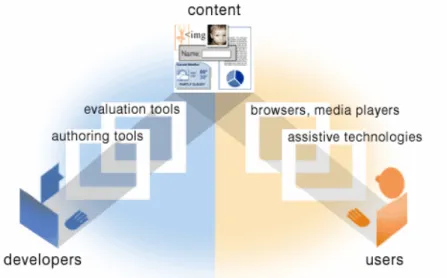
accessible. The Web Accessibility Initiative (WAI) (W3C, 2006a) is an initiative that has been taken to coordinate the strategies, guidelines, and resources to help make accessible web contents. This is an initiative taken by the World Wide Web Consortium (W3C), and considers approaching web accessibility from three interdependent perspectives
(Chisholm & Henry, 2005).
Figure II.1: The interdependent components of web accessibility (W3C, 2006d)
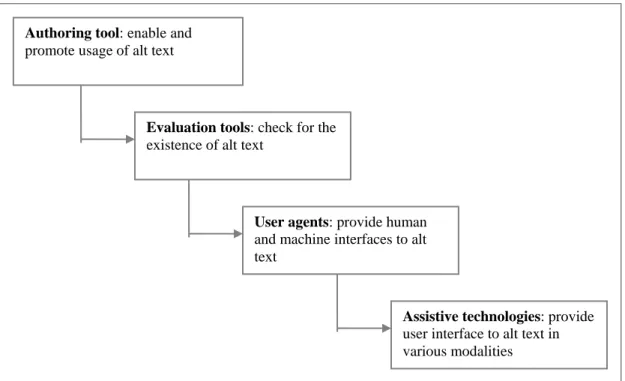
The interdependencies between the components shown in the figure II.1 are based on not only the users’ usage of web contents, but also the developers’ ability to produce such contents. The dependency can be seen by taking the example of an alternative text (known as alt text in HTML) that is shown in figure II.2.
Evaluation tools: check for the existence of alt text
User agents: provide human and machine interfaces to alt text
Assistive technologies: provide user interface to alt text in various modalities
Authoring tool: enable and promote usage of alt text
Figure II.2: The interdependent components that work to achieve web accessibility using alternative texts
Alternative texts are textual components that can act as representations for non-textual components of a web page. Since web sites can contain multimedia components, such as images and videos, textual components are necessary for different types of users. For example, for a blind user, the alternative text of an image will be able to tell the user what the image is about. However, the user is dependent on not only the ability of the assistive technologies (in the case of a blind user, it may be a screen reader) to be able to interpret the alternative texts into a format the user can understand. Since authoring tools are the ones that are used to produce web page contents, the user is dependent on its ability to accept alternative texts for non-textual components of the web page from its designers. The user is also dependent on the ability of evaluation tools to check the availability of alternative texts for all non-textual components of a web page, and the user agents to be able to provide an interface between the user and the machine for the alternative text.
II.1.2 Web accessibility guidelines
Based on the interdependent components required to achieve web accessibility, we can perceive it in similar terms to that of WAI. That is, we can consider accessibility to be based on the web contents by themselves, the authoring tools that have been used for making such accessible web contents, and the user agents that are used to access the web contents.
II.1.2.1 Guidelines for accessible web contents
The most commonly used guideline for accessible web contents is the Web Content Accessibility Guidelines (WCAG) 1.0. It has become available in 1999 (Chisholm, Vanderheiden, & Jacobs, 1999), which consisted of 14 guidelines (Hackett, Parmanto, & Zeng, 2005) in three levels of checkpoints on creating accessible web sites.
WCAG 1.0 has three levels of checkpoints, Level A, AA, and AAA (Clark, 2003). Level A provides some general guidelines that may be able to make a web site accessible to the minimum. Some of the issues that Level A covers are alt texts for images, text color being irrelevant in providing meaning for the text, issues with identification of the rows and column headers of tables, equivalent description of multimedia contents in text, audio, and any usable formats, and the suggestion to create an alternative page for accessibility if the regular page design cannot be compromised (Clark, 2003). Level AA of the specification includes requirements for color contrast between back and
foregrounds, use of markup rather than images for conveying information, not to use tables for page layout unless the linearized form of the table would not flow in the day that the designer has envisioned, and having scripts and applets accessible to assistive technologies (Clark, 2003). Level AAA of the specification is firm several specific issues, such as the use of abbreviation of terms in documents that it first occurs in, logical tab order set up for forms and other fields in the page, and allowing users to search at different levels of complexities according to different user needs (Clark, 2003).
To meet level A conformance, the design has to meet all the requirements imposed in that level. Level AA conformance, however, requires that the design meets all the
requirements of level A and all the requirements of level AA. Finally, level AAA requires that the design meets level A and AA requirements (Clark, 2003; Hackett et. al., 2005). Version 2.0 of WCAG (Vanderheiden & Chisholm, 2002) is a working draft and
addresses accessibility issues in more depth. It has made a few significant changes in its approach from that of version 1.0. The working draft of WCAG 2.0 published on December 11, 2007 suggests that it builds on its preceding version by making the
guideline more broadly applicable to different web technologies (Caldwell et al., 2007a). The guideline takes a rather principle-centered approach rather than the technique-centered approach taken by its predecessor (WebAim, n.d.). By principle-technique-centered approach, it means that the guidelines start by looking at a principle and its breakdowns, and then provides an approach as a solution for that principle. There are clearly a few major additions to the guideline that are worth noting. Since the approach is now
principle-centered, the guideline has now been made more technology independent. Thus, the solutions are more related to a recommendation of how things should be, rather than how it is done in a specific technology (such as HTML).
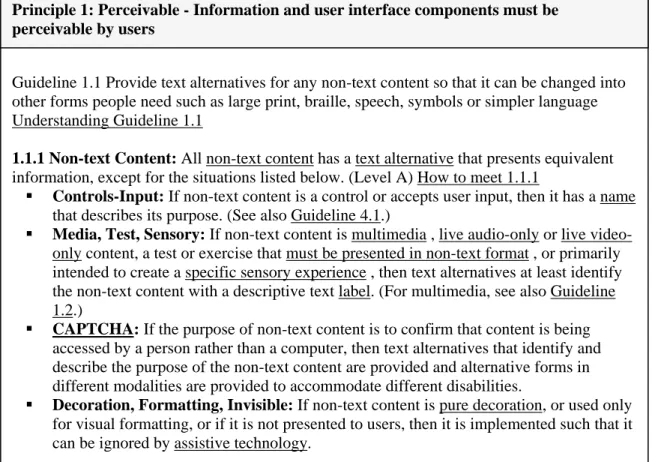
For a better understanding of the differences between WCAG 1.0 and WCAG 2.0, following are two guidelines from the two versions. The first one is guideline 4 from WCAG 1.0 which aims at making it easier for users to identify the natural language used in the web contents. The second one is a portion of principle 3 which aims at solving similar issues as the first one. Both guidelines are represented textually1, and require the user of the guidelines to read and comprehend the message that these guidelines are trying to convey. They both make good use of hyperlinks (shown using the underlined
1
One reason for the textual format of an accessibility guideline is presumably for the need of the guideline to be accessible itself. See the study by Colwell and Petrie (2001), which assesses accessibility of WCAG.
texts in figures II.3 and II.4) for relating to another guideline or to guide the user to a better understanding on the meaning of a term, phrase, or the guideline itself.
Use markup that facilitates pronunciation or interpretation of abbreviated or foreign text. When content developers mark up natural language changes in a document, speech
synthesizers and braille devices can automatically switch to the new language, making the document more accessible to multilingual users. Content developers should identify the predominant natural language of a document's content (through markup or HTTP headers). Content developers should also provide expansions of abbreviations and acronyms.
In addition to helping assistive technologies, natural language markup allows search engines to find key words and identify documents in a desired language. Natural language markup also improves readability of the Web for all people, including those with learning disabilities, cognitive disabilities, or people who are deaf.
When abbreviations and natural language changes are not identified, they may be indecipherable when machine-spoken or brailled.
Checkpoints:
4.1 Clearly identify changes in the natural language of a document's text and any text equivalents (e.g., captions). [Priority 1]
For example, in HTML use the "lang" attribute. In XML, use "xml:lang". Techniques for checkpoint 4.1
4.2 Specify the expansion of each abbreviation or acronym in a document where it first occurs. [Priority 3]
For example, in HTML, use the "title" attribute of the ABBR and ACRONYM elements. Providing the expansion in the main body of the document also helps document usability. Techniques for checkpoint 4.2
4.3 Identify the primary natural language of a document. [Priority 3]
For example, in HTML set the "lang" attribute on the HTML element. In XML, use "xml:lang". Server operators should configure servers to take advantage of HTTP content negotiation mechanisms ([RFC2068], section 14.13) so that clients can automatically retrieve documents of the preferred language.
Techniques for checkpoint 4.3
Guideline 4. Clarify natural language usage
Figure II.3: Guideline 4 of WCAG 1.0 (Chisholm, Vanderheiden, & Jacobs, 1999)
Guideline 3.1 Readable: Make text content readable and understandable Understanding Guideline 3.1
3.1.1 Language of Page: The default human language of each Web page can be programmatically determined. (Level A) How to Meet 3.1.1 Understanding 3.1.1
3.1.2 Language of Parts: The human language of each passage or phrase in the content can be programmatically determined except for proper names, technical terms, words of
indeterminate language, and words or phrases that have become part of the vernacular of the immediately surrounding text. (Level AA) How to Meet 3.1.2 Understanding 3.1.2
3.1.3 Unusual Words: A mechanism is available for identifying specific definitions of words or phrases used in an unusual or restricted way, including idioms and jargon. (Level AAA) How to Meet 3.1.3 Understanding 3.1.3
3.1.4 Abbreviations: A mechanism for identifying the expanded form or meaning of abbreviations is available. (Level AAA) How to Meet 3.1.4 Understanding 3.1.4 3.1.5 Reading Level: When text requires reading ability more advanced than the lower secondary education level, supplemental content, or a version that does not require reading ability more advanced than the lower secondary education level, is available. (Level AAA) How to Meet 3.1.5 Understanding 3.1.5
3.1.6 Pronunciation: A mechanism is available for identifying specific pronunciation of words where meaning is ambiguous without knowing the pronunciation. (Level AAA) How to Meet 3.1.6 Understanding 3.1.6
Principle 3: Understandable - Information and the operation of user interface must be understandable
Figure II.4: Principle 3 of WCAG 2.0 (Caldwell et al., 2007a)
The differences between the two guidelines based on an analysis of their approach in providing the information to the user of the guidelines are provided in table II.1. Essentially, the two guidelines take two very different approaches at conveying the message to the audience. The guideline in figure II.3 starts with a quite elaborative analysis of the requirement of the guideline. This may provide the reader with an
understanding of the overall situation on why this guideline may be used. In contrary, the guideline in figure II.4 seems to get the reader involved into acting based on principles. In contrary to the checkpoints used in the guideline in the first guideline, this guideline provides the user with the ability to achieve a goal that is represented using a principle.
WCAG 1.0 WCAG 2.0 The guideline starts with a detailed
understanding of the reason why the certain accessibility feature is necessary.
The guideline lists the principles that it aims at approaching, but provides a hyperlink to a page with information on the need of having the guideline
The guideline is comprised of checkpoints The guideline is comprised of principles Each guideline is provided with its own priority
level; priority levels determine the impact of a guideline on accessibility;
Each guideline belongs to a general principle that is to be met
Each guideline has checkpoints using which the conformance level (A, AA, AAA) of an accessible design is determined
Each principle has guidelines that clearly determine its conformance level (A, AA, AAA), thus allowing conformance levels to be met for each principle
Each checkpoint provides a general overview of the technique
Each principle provides a goal that it aims to meet
Each checkpoint provides a link to a page with specific techniques it can use
Each principle provides two links; one for better understanding the principle, and the other for techniques that it can use for achieving the principle
Each checkpoint provides a technology specific approach, such as HTML attributes, for solving an accessibility issue
Each principle takes a non-technical view at the accessibility issue in hand, and then provides the user with information on solving the issue
Table II.1: A comparison between WCAG 1.0 and WCAG 2.0 in their approach for representing the guidelines
Other types of web content accessibility guidelines are also available. They are listed in Appendix A.
II.1.2.2 The Authoring Tool Accessibility Guidelines
ATAG 1.0 (Treviranus, McCatherieNevile, Jacobs & Richards, 2000) provides guidelines for making authoring tools friendly to the overall accessibility situation. Version 1.0 of this guideline was published in 2000. It suggests that authoring tools should themselves be accessible, and they should promote and produce accessible web contents by default.
ATAG 2.0 is a working draft (W3C, 2006b), and is expected to be published in 2007. Macromedia DreamWeaver and Microsoft FrontPage are commonly used tools for authoring web contents. Content management systems (CMS) are alternatives to authoring tools that traditionally run on individual computers, and they provide the environment to author web pages directly from within a web site. Many web sites are built by embedding Macromedia Flash animations into HTML documents for providing an interactive user interface (Clark, 2004).
II.1.2.3 The User Agent Accessibility Guidelines
UAAG 1.0 (W3C, 2006c) provides the guidelines for making user agents that can help people access web contents effectively. This set of guidelines provides a comprehensive set of checkpoints that look into accessibility of web contents, users’ control over
rendering of the contents, users’ control over the user interface, and recommendations for standard programming interfaces for compatibility with assistive technologies. Assistive technologies such as Bobby (Slatin & Rush, 2003) can understand the standard
components of a web site and read the contents to blind users.
II.1.2.4 Other accessibility guidelines
Some other accessibility guidelines include XML accessibility guidelines (Dardailler, Palmer, & McCathieNevile, 2002), and the Accessibility features of SMIL (Koivunen & Jacobs, 1999), SVG (McCathieNevile, & Koivunen, 2000), and CSS (Jacobs & Brewer, 1999).
II.1.3 Accessibility validation tools
There are automated tools2 such as RAMP, In-Focus (or InFocus), and A-Prompt (Lazar, Dudley-Sponaugle, & Greenidge, 2004), that can be used to check accessibility of web contents. These tools are old, and use WCAG 1.0. A-Checker is a new tool produced by Adaptive Technology Resource Center (ATRC) at the University of Toronto. It uses the working draft of WCAG 2.0 for validation of web contents, and can be used to verify that the content of a web site is accessible.
II.2 Goal Models and the NFR Framework
An approach to deal with the organization of design knowledge of web accessibility is by considering it as a non-functional requirement (NFR) (Chung et al., 2000). Just like there are functional requirements (FR) to a system3, there are also requirements that are non-functional. The distinction between FR and NFR primarily lies in the way that they are considered in a design specification. While FR typically refers to what a system can do, NFR refers to how it is done (Cysneiros & Yu, 2003). That means, while FR refers to requirements that are stated explicitly, NFR refers to requirements that are stated rather qualitatively.
The problem that is encountered in requirements specification is primarily due to the representation of these requirements in modeling schemes. Since NFRs deal with quality requirements, they often contradict with other FRs and NFRs. Qualities of an information system may include NFRs such as security, usability, accessibility, interoperability,
2
O’Grady and Harrison (2003) offer a good overview of other accessibility evaluation tools and the basis on which the tools can be selected. Brajnik (2004) also provides some systematic approach in picking an appropriate tool.
3
maintainability, scalability, and evolvability. These can be termed as the ‘abilities’ of an information system, where the abilities only refer the absolute vague idea of what they actually mean in terms of system development. What security may mean to a banking system may not be the same for a social web site (such as Facebook).
The NFR framework provides one with the ability to represent the implicitly defined quality requirements more explicitly. Using this technique, the explicitly defined system qualities can be analyzed for possible areas of conflicts.
Following are the important concepts for the goal oriented modeling technique. Figure II.5 is a sample representation of a graphical representation of system goals. The notation used in this technique is illustrated in appendix B part I.
Goal: The requirements specified by NFRs represent are considered as design goals. These goals are qualitative in nature, and thus help represent certain qualities that a system should achieve. They are often referred to as softgoals (Cysneiros, Yu & Leite, 2003) to represent their qualitative nature. Goals are achievable through alternative means, and so it allows a designer to make choices among such alternatives.
Goal graph: Goals are represented in a goal graph, where other goals also appear. Figure provides a sample goal graph. It allows for visualization of the goals of a system. Such graphs help in showing the relationships of goals among each other (Chung et al., 2000). Figure II.5 provides a simple example of a goal graph.
Contribution links: Goals graphs allow goals to be represented in a way so that their relationships can be analyzed. System goals can often be conflicting or complementary to each other (Chung et al., 2000). Such contributions can be presented in the goal graphs using HELP link (representing complementary goals) and HURT links (representing conflicting goals) between the related goals.
Goal refinement: A goal is something that can be achieved in multiple ways. To achieve a goal, one may have to do multiple things, and may also have to achieve other more specific goals (Chung et al., 2000). Thus, it is necessary to see how a goal can be refined into more specific ones for achieving its purpose. This can be done by refining a goal using links such as AND, OR, and MAKE links. Figure II.5 illustrates refinement of the top goal using such links.
Reduce waiting period [patients] Reduce waiting period [emergency patients] Reduce waiting period [scheduled patients] And An d Increase nurses [emergency patients] Allow treatment without checking-in [emergency patients] Hel p H el p Perform treatment by following strict procedures
required by law Hurt Provide treatment before checking-in M a k e Check medical history before any
treatment H e
lp
Figure II.5: A simple goal graph
Goal operationalization: In the NFR graph in figure II.5, two types of clouds are used. The thin lined clouds refer to the goals that have not been sufficiently decomposed as there may still be different ways of achieving it. However, the thick lined clouds refer to goals that have been dealt with sufficiently, and the knowledge in such NFRs can be used
in the development of the system. This level of decomposition of NFRs is known as its operationalization (Chung et al., 2000).
Goal satisficing: Note that the term used here is ‘satisficed’, and not ‘satisfied’. Chung et al. (2000) mention that it is rarely possible to fully satisfy an NFR, since many NFRs are only qualitatively achievable. Since qualities are subjective and they conflict with other quality requirements, some of the qualities may only be dealt with to some degree. By satisficing a goal, it is meant that the goal has been sufficiently evaluated and dealt with in the known context. A goal must be satisficed in a way that it does not conflict with other satisficed goals.
Goal evaluation: Since a goal cannot be satisficed if it is in conflict with other satisficed goals, it must be appropriately evaluated against other goals. Evaluation of a goal allows for evaluation and prioritization of related goals, and propagation of the goal evaluation. Propagation of the goal evaluation is a technique where evaluation of the goals is
propagated across the goal graphs to check whether the original goals have been dealt with sufficiently.
Let us consider an example. Assume that two goals, A and B, are in conflict with one another. It may not be possible for goal one to achieve A and B together without looking for alternative means. Through alternative means, it may be possible for both A and B to be satisficed. However, if no alternatives remain, the designer has to prioritize on which goal to satisfice and which one not to. Moreover, prioritization of the goals can be done using the goal graphs by analyzing which goal has more impact in the system and helps achieve other system goals. The goal evaluation technique allows one not only to evaluate the operationalized goals, but also allows the designer to propagate the
evaluation across the goal graph. For example, if goal A decomposes into goal B and C using AND decomposition links, it means that both B and C must be satisficed to achieve goal A.
In figure II.5, the goal of reducing waiting period of patients decomposes into two goals using AND decomposition links. These goals are reducing waiting period of scheduled patients and reducing waiting period of emergency patients. Using goal evaluation technique, the designer has to make sure that both the decompositions are satisficed before s/he can satisfice the top goal. Please refer to Chung et al. (2000) and the Masters thesis of Horkoff (2006) for more details on the goal evaluation technique.
Goal types and topics: Goals can be decomposed into other goals. Such decomposition can happen by type and topic (Chung et al., 2000). Type refers to the kind of ability that is in discussion. Topic refers to the subject matter, which the quality is being described for. Decompositions may take place in different ways depending on the situation. NFR graphs can thus help model the requirements in a manner that can represent the following design knowledge (Gross & Yu, 2001).
Requirements as design goals: This is achieved through the use of the goal graphs to represent different functional and non-functional requirements. Analyzing such goals collectively can reveal alternatives that are important for a design process. Relationships among the goals: The interaction among different goals that show
how one goal may positively or negatively contribute to other goals.
Implicit or intermediate goals: New goals can be identified through interaction of different goals. Such new goals can be incorporated into the NFR graphs for a more appropriate analysis.
Decompose using type and topic in goals: Goal decomposition using type and topic can help see the different ways in which the goals can be viewed. This can be seen as a refinement process, where the decomposition is a step closer to our understanding of the overall goal.
Reasoning for solution achieved: It can show how a solution is reached via reasoning depicted in the NFR graphs. Goal decomposition (by type and topic), their interaction, and their operationalizations can help provide the reasoning.
Unintended correlation among goals and solutions: Unintended side effects can be identified through goal interaction among goals that were previously not thought to have any impact on other goals.
Analyze the alternative solutions: Different alternatives can have different ways of achieving the goals. Alternatives can have different correlations with other goals. Such correlations can be used to analyze the impact of one alternative over the other.
Qualitative reasoning for goal achievement: Starting from the most refined nodes, the goals can be evaluated as to how well it has been achieved. Through
evaluation of more specific goals, the more abstract goals can be evaluated. Elaboration of design goals: NFR graphs allow design goals to be elaborated
through goal decomposition and subsequent operationalization.
II.3 Design patterns
It is unusual for designers to reinvent the solution to a particular problem that they deal with on a regular basis. While there are problems that are particular to specific cases, there are also problems that appear in similar ways under different circumstances. In such cases, there are patterns of problems that can be kept by the designers who can design a solution to it with a design pattern. Design patterns can describe a commonly recurring solution to a general design problem in a particular context (Buschmann et al., 1996). Design patterns can be represented in many forms as long as they discuss the context, the problem, and the solution to the problem. A commonly cited work is by Gamma et al. (1995), who describes Gang-of-Four (GoF). This work describes reusable solutions to recurring problems in software design. GoF has been utilized and extended for usage with Object-Oriented designs4 and human-computer interaction designs5.
4
Since design patterns deal with problems in different contexts, the solution provided by a particular pattern may affect the solution of another related problem. To deal with these, design patterns can fall into families of similar problems (Buschmann et al., 1996), where the solutions to the patterns can express design problems that affect each other. For this reason, patterns can appear in relationships with other patterns that they help resolve their problems, and also the patterns that they are at conflict with. These interdependencies can be classified and categorized for better organization when there are many patterns that exist in the pattern system6.
Pattern relationships can be used for organizing patterns. They can be represented graphically (Gamma et al., 1995) to show a general pattern system. A sample pattern graph is shown in figure II.6. The rectangular boxes represent each pattern, and the arrows show the pattern’s relationship with another pattern. This pattern system is a relatively simple one. There can be more complex patterns that can have many more relationships with other patterns within the pattern system.
5
See the work of Teuber and Forbig (2004) for an example of incorporating design patterns in human-computer interaction design.
6
A pattern system is an organized structure, where the constituent patterns are tied together into a system of patterns (Buschmann, 1996).
Abstract Factory Prototype configure factory dynamically Factory Method implement using single instance Singleton Facade single instance Table Method often uses
Figure II.6: A graphical representation of design pattern relationships (Gamma et al., 1995, 12)
Design patterns may be expressed by clearly stating the context, the problem, and the solution to the problem (Buschmann et al., 1996). Along with these three components, a fourth component can also be added (Teuber & Forbig, 2004) that deal with the ‘forces’ which has led the design pattern to solve the problem in a manner that it does. In this component, goals and qualities (such as availability to mobile disabled users, conformity to business objective of textual components, etc) of the design pattern may be mentioned. Using these can help in forming knowledge of solutions to design problems in certain contexts.
Patterns may not be static, and they may become outdated with additional patterns being added to the system. Their descriptions may change over time. Updating a pattern
description may cause the pattern to have more associations with other patterns within the system, and new relationships may arise while old relationships may not hold true
anymore (Buschmann, 1996). This is also true for new patterns being added to the pattern system (Buschmann, 1996).
Chapter III: The Approach
I shall now describe the approach that I have taken in this research. To do that, it is first necessary to provide a critique of the accessibility guidelines which will surface issues around their representation and application. Following that, I shall describe the possible ways that the goal models and the design patterns can help solve the problems that have surfaced during the critique of the accessibility guidelines.
III.1 Shortcomings of the accessibility guidelines and their usage
Even though much work has been done on accessibility research, it is still remains a vaguely enquired area as to why the guidelines have not yet been able to make an impact in the web design community.
III.1.1 Ambiguity in interpretation of guidelines
One of the major problems of any of such guidelines, as Paddison and Englefield (2004) indicate, is the ambiguity that lies in the qualitative representation of the guidelines. Since guidelines often make use of terms such as ‘appropriately’, ‘equivalency’, and ‘relativity’, it is often difficult to make such terms explicit to achieve quality use of the guidelines. Research indicates that this problem is being reported by many others, including Lazar et. al. (2004), and Hanson et al. (2005). It leaves designers to ponder the question as to how appropriate does something need to be appropriate.
The difficulty in comprehending the qualitative terms in the guidelines become apparent when the case of using alternative texts for images is considered. Assume that a designer
has used spacer images7 in his/her design and names each one of them “spacer” or “space1ccceee.jpg” (reflecting the name of the image). According to WCAG 1.0, all images need to be appropriately8 described in the alternative text. Based on UAAG recommendations, a screen reader software will generally read the image name to the user when an alternative text is missing. However, combining these two guidelines, it is difficult for a designer to determine what WCAG 1.0 means by “appropriately” in this context. It turns out that the solution to this problem (provided by many researchers) is to use a blank alternative text. The blank alternative text represents a null value (Clark, 2003; Thatcher, 2002), which screen reading software are not going to read out to the user. Although WCAG 2.0 is more detailed in considering such cases, it is still necessary to point out that situations like these do come up, and the guidelines are unable to provide with effective help in such cases.
III.1.2 Web designers not making full use of guidelines
According to the Web Accessibility Integration Model (WAIM) (Lazar, Dudley-Sponaugle & Greenidge, 2004), there may be three reasons for the increasing
inaccessibility of web pages. WAIM considers web accessibility from three aspects. They are9 the social foundation, stakeholder perception, and the web development process.
7
Some web designers rely on images in their web design, where the images are solely used for creating appropriate spaces for the desired presentation of the web page contents.
8
The term ‘appropriately’ is the emphasis here. The question that can be raised here, as I shall discuss in the following, is how appropriate does something need to be for being appropriate enough. Do the three levels of checkmarks in WCAG 1.0 (priority 1, 2, and 3) means three levels of appropriateness? It actually does mean three levels of appropriateness, since the three priority levels mean three levels of accessibility. However, the appropriateness of an alternative text is referred to the suitability of the alternative text in relation to the component it is describing.
9
The first is social foundation, which looks at how the society looks at disability and the importance they give. Second is the stakeholder perception, which suggests that it depends on the web developer knowledge and the knowledge of the client. Third is the web development process, which includes guidelines and tools, initial sited design, and the management and redesign of the web site.
Societal foundation about accessibility is under serious consideration at government level in many countries around the world. Barriers to receiving free information may fall under government discrimination acts such as the Disability Discrimination Act (DDA) in the UK (Hackett, Parmanto, & Zeng, 2005), Americans with Disabilities Act (Johnson & Ruppert, 2002) in the US, and the Australian Disability Discrimination Legislation (Wallis, 2005) in Australia. Based on such substantial governmental support, it can be safely said that the laws for discrimination against disability exist due to the societal view that such discrimination is inappropriate and wrong.
For stakeholder perception, it can be argued that an economic benefit that generates more revenues (by providing access to their products to all user profiles) may be the driving force into creating their commercial site accessible. Consider the case of Amazon. In 2002/2003, Amazon had advertised the launch of an accessible web site. It was soon found10 that the primary motive of their move towards an accessible web site was due to generating more revenues by making their web site contents available to mobile devices (Slatin & Rush, 2003). Nevertheless, the improved site with accessibility features has successfully made itself available to the 400,000 visually disabled Americans too (Lazar, Beere, Greenidge, & Nagappa, 2003).
The third aspect in WAIM involves the web development process. In a study of 50 Mid-Atlantic US web sites (Lazar et al., 2003) in 2002, 49 of them revealed violations of accessibility guidelines. Notably, the worst accessibility issues have been found in web sites for organizations in web development and information technology field (Lazar et al., 2003). When Lazar and Greenidge (2006) have been back to the same sites for a follow-up study a year later, the only accessibility issue that has improved from the 2002 study is the presence of alternative texts for images. Otherwise, all other accessibility issues have deteriorated. And this time, the web development organizations seemed to have further
10
In a research conducted by Slatin and Rush (2003) on Amazon’s web site, it was found that the Amazon web pages contained meta tags describing the site to be friendly to mobile devices. The cited book describes this in detail.
increase in accessibility issues than the study done in 2002. This has led Lazar and Greenidge (2006) to argue that there is an increasing lack of technical knowledge in accessibility guidelines for the web developers in web development organizations. As mentioned earlier, there is sufficient push by governments and profit-making organizations towards creating accessible web sites. However, there is little
understanding within the research community for whether web developers involved in designing accessible web sites actually make sufficient use of the guidelines that are available to them. And based on the literature available at the time of this research, it seems plausible that the web designers are not making appropriate use of the web accessibility guidelines to their full potential.
III.1.3 Difficulty in dealing with textual representations
The accessibility guidelines are textual representations, organized using a given criteria. As noted earlier, the organization of WCAG 1.0 is based on the techniques, while in the case of WCAG 2.0 it is based on the principles. To add to that, there are complaints by many researchers that these guidelines are lengthy (Thatcher, 2002; Lazar et. al., 2004) and potentially require great time investments in understanding the issues and problems. Since the guidelines are textually represented, a major problem that can be faced is how the guidelines can be applied in making web designs. It requires narrative understanding of the guidelines, and the designers are left with no given technique to apply the
guidelines systematically. Rather, the designers have to find their own way for integrating the guidelines in their designs.
Accessibility guidelines are quite generic in assuming their concerns about accessibility. Referring back to guideline 4 of WCAG 1.0 and principle 3 of WCAG 2.0 discussed earlier, there seems to be very little guidance provided to the web developers for which accessibility guidelines are intended to help what type of disability. The target audience of a web site may play a major role in the development of the web site. In a study (Kelly, Phipps, & Swift, 2004) on the application of accessibility guidelines on an eLearning system, it was found that using WCAG 1.0 may come into a conflict of interest when a blind student is going to take a web based exam. To cite the specific example used in this paper, if a student is being tested by showing an image and the student’s understanding about the subject matter presented in the image, it may not be appropriate for the image to include an alternative text to describe it. Thus, the conflict remains between the goals of providing accessibility features and the goal of testing a student.
Kelly et al. (2004) have argued that even though WAI has successfully brought the issues with accessibility under scrutiny, they have not been able to provide the best way to approach this. In their paper, they have suggested the use of a holistic approach where accessibility is considered as a feature that needs to be properly analyzed with other needs, such as the needs of the users, local factors, usability issues, user experiential outcomes, and finally the quality assurance for the system in place. Figure III.1 shows the proposed model by Kelly et al (2004).
III.1.5 No given technique for application
In the study by Lazar and Greenidge (2006), they have found that the web development organizations seemed to have increasing accessibility issues. Web development
organizations build web sites on a contractual basis, and they may deal with multiple types of web sites from different domains offered to multiple types of audiences. Thus, designing web sites for different types of domains and for different types of audiences may require that the guidelines are applied differently, based on the situation. The study by Kelly et al. (2004) noted in the previous section indicates an aspect of this very issue.
Figure III.1: The model depicting a holistic approach proposed by Kelly et al. (2004)
Given the situation that the accessibility guidelines need to be applied by the web designers in different scenarios and for different target audience, the need of a reference model becomes apparent. Given that guidelines such as WCAG 1.0 and WCAG 2.0 are long textual documents, it may be difficult for designers to use these guidelines as quick references. There is a requirement of time investment that the designers must keep in mind when they use the guidelines. Depending on a web development project, a designer may not have enough time to spend on meticulously reading through the accessibility guidelines. Without proper time investment, it is difficult for anyone to be able to use the available guidelines appropriately.
As it has been pointed out earlier, users with different types of disabilities require different mechanisms to support their usage of web pages. Requirements for different disabled users may conflict with one another. Pertaining to this notion of conflicting requirements, it is almost impossible to provide a solution that will meet the requirements of all types of disabilities. Thus, for designers to make quality use of accessibility
guidelines, they need to be able to choose the type of qualities they need to satisfy for making their web pages accessible to their selected target audience. However, none of the accessibility guidelines tell the designers which qualities to satisfy for a given target audience. Rather, there is a vague mention about the types of disabilities that a specific guideline11 may help serve. In fact, most of the accessibility guidelines refer to
accessibility as a generic term that can help the disabled users in general.
III.1.7 Lack of alternative solutions
Further to the problem of disability specific accessibility, very rarely do the guidelines provide alternative solutions to certain accessibility issues. For example, in the sample guideline provided in figure II.3, the checkpoints are not alternative ways of achieving accessibility, but are different levels of accessibility that can be achieved if the
checkpoints are followed sequentially. Similarly, the guidelines provided in figure II.4 are merely principles that must be satisfied, but the alternatives are not provided for application based on the merit of the situation.
When there are conflicting requirements for users with different types of disabilities, alternative solutions may allow a designer to evaluate alternative approaches in trying to accommodate multiple disabled users with conflicting requirements.
11
This can be seen in WCAG 1.0. For example, for guideline 1 (provide equivalent alternatives to auditory and visual content) there is a mention about raw text for synthesized speech, which can help blind users use screen readers, and deaf users to visually benefit from the text. However, raw text can also be useful to motor disabled users, who cannot scroll through the web pages for getting to their content. These users may rely on screen readers to read out the page contents to them.
The challenge of creating web sites with specific target audience may face yet another difficulty along the road when there is a change in target audience, and the web site now needs to provide a design that would allow the modified target audience to be able to access the web site content. The difficulty here involves understanding the new requirements for the modified target audience. In other words, there is very little guidance for providing variability with changing user groups in using the guidelines.
III.2 Using Goal Graphs for organizing accessibility design
knowledge
Looking at the issues around web accessibility, the web accessibility guidelines and the shortcomings of the guidelines, a few questions arise. Since many of the arguments raised about accessibility guidelines refer to how the guidelines are organized to provide
suitable help to the designers in making design decisions, the question that arises is, whether there is a better way of organizing such knowledge into a format that can be easily used by the designers. Can the guidelines be organized in a way that will allow them to be applied more systematically? Can the guidelines help a designer make choices on its application based on the target audience and the usage environment? Is it possible for designers to choose from alternative solutions to feature on accessible web designs?
III.2.1 A simple case
To see how goal oriented modeling can be used in accessibility research, let us consider a sample representation of a possible guideline. Figure III.2 shows an example of a goal
graph which deals with visibility as a quality requirement for web page components. Note that this example is only for demonstration purposes only; the graph is developed from a very general understanding of the current guidelines. Chapter VI of this paper
demonstrates a step-by-step process for developing the goal graphs from the guidelines.
Hel p H el p And d An And An d Help Hel p
Figure III.2: An NFR network dealing with visibility (type) of page components (topic)
Figure III.2 shows how visibility can be helped by using text size as greater than or equal to twelve. However, this network further shows that only making text size larger is not going to help, but that it requires the web page component colors to be visible as well. The approach that is used to organize such design knowledge in a goal graph is discussed in the following.
III.2.2 Applying the concepts from NFR framework
In section II.2, I have discussed the main concepts of the NFR framework. Here, I shall demonstrate how the concepts from the NFR framework fit in organizing accessibility guidelines.
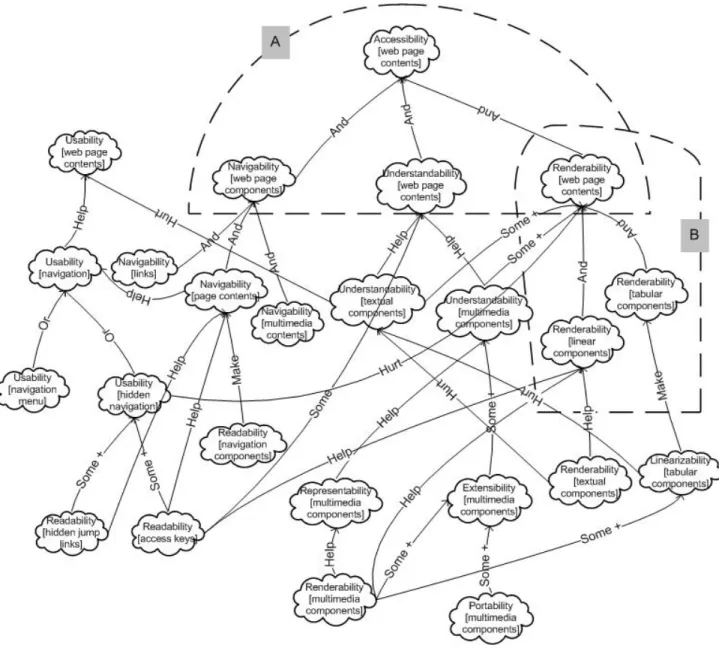
Use of goals: As it is seen in figure III.2, visibility is a goal, which needs to be achieved for providing accessibility. The same applies for other issues that need to be resolved for providing accessibility. For example, navigability, understandability, and renderability are all goals, and they are all potential candidates for solving accessibility issues. Use of goal graphs: Earlier in this chapter, I have argued that since accessibility
guidelines are textual representations, their usage require thorough understanding of the natural language in which the guideline is represented. Using goal graphs as
demonstrated in figure II.2, such design knowledge can be represented graphically.
Use of contribution links: There are two goals that help achieve the top goal (visibility of page components). These two goals are connected to the top goal using HELP links. Furthermore, the goals for checking the three types of color blindness all help achieve the goal of maintaining an appropriate level of color contrast between the background and foreground colors of web page components. Thus, they are all connected with the goal of good color contrast between background and foreground color using HELP links as well. Use of the goal refinement technique: As mentioned earlier in section II.2, goals can be refined to see how more specific goals can be used in achieving a bigger goal. This is apparent in figure III.2 where the goal of checking for main color blind types can be achieved by achieving the three goals connected to it using the AND links. This makes it easier for the user of this model to see that all three goals (checking for protanopia,