Case Study Aventis Pharma
Implementation of a tool-based
Capital Expenditure Process
Enrico Senger
Institute for Information Management, University of St. Gallen
About „The Electronic Collaboration Study“
“The Electronic Collaboration Study” is a joint project of the Institute for Information Management of the University of St.Gallen (Switzerland) and the Center for Digital Stra-tegies at the Tuck School of Business at Dartmouth, Hanover, NH (USA).
Both institutions develop case studies about interorganizational electronic co-operation that demonstrate how companies are able to achieve competitive advantage by deploying information technology. The results are options for action for a successful electronic co-operation.
The scientific charge of the project is incumbent on Prof. M. Eric Johnson, PhD, director of the Center for Digital Strategies at Tuck and Prof. Dr. Hubert Österle, director of the Institute for Information Management and Chief Technology Officer of “The Information Management Group” (IMG). Further the goals of the project are supported by Prof. Dr. Walter Brenner and Prof. Dr. Elgar Fleisch, University of St. Gallen, as well as Prof. Hans Brechbühl and Prof. Stephen Powell, PhD, Tuck School of Business.
About the author:
Enrico Senger is Research Assistant at the Competence Center Customer > Knowledge > Performance at the Institute for Information Management of the University of St.Gallen (Switzerland), e-Mail: [email protected]
Further Reading
Case study data base: http://cases.iwi.unisg.ch
Center for Digital Strategies: http://www.tuck.dartmouth.edu/digitalstrategies Institute of Information Management: http://iwi.unisg.ch
Table of contents iii
Table of contents
Abstract ... ivZusammenfassung... iv
1 Company and challenges ... 1
2 Starting Point ... 3
3 Project Capex e-Care ... 5
4 Capex with the e-Care tool ... 7
5 Learnings... 12
Abstract iv
Abstract
The Aventis Group, one of the largest pharmaceutical corporations worldwide, was cre-ated in 1999 by a merger between Hoechst AG and Rhône-Poulenc S.A. The Group’s spectrum of products includes prescription drugs, vaccines and therapeutic proteins as well as animal health products. As part of the post-merger integration, Corporate Control-ling introduced a tool-supported reporting process for investment controlControl-ling (capital ex-penditure) of all national organizations and business units. The figures are collected by the project managers. There is no direct hierarchical relationship between the project managers and the central controlling department, so in the context of a multinational cor-poration, preparation of the accounts can be seen as a collaborative process.
Flat consolidation increases data quality (measured in terms of the variance compared to the accounting figures) twelve-fold. Technical system support improves the information available to decision-makers through individualized evaluations and improves the protec-tion of sensitive data against unauthorized access. At the same time, 25% less time is re-quired for preparing the quarterly reports.
Zusammenfassung
Der Aventis-Konzern, eines der weltweit grössten Pharmaunternehmen, entstand 1999 durch die Fusion der Hoechst AG und mit der Rhône-Poulenc S.A. Zum Leistungsspekt-rum des Konzerns gehören rezeptpflichtige Arzneimittel, Impfstoffe und therapeutische Proteine sowie Produkte für die Tiergesundheit. Im Zuge der Post-Merger-Integration führte das Konzerncontrolling einen toolgestützten Reportingprozess für das Investitions-controlling (Capital Expenditure) aller Landesgesellschaften und Geschäftseinheiten ein. Die Zahlen werden von den Projektverantwortlichen erfasst. Zwischen den Projektver-antwortlichen und der zentralen Controllingabteilung besteht keine direkte hierarchische Beziehung, so dass die Erstellung der Abschlüsse vor dem Hintergrund eines multinatio-nalen Konzerns als Kooperationsprozess betrachtet werden kann.
Die flache Konsolidierung erhöht die Datenqualität (gemessen in der Varianz von den buchhalterischen Zahlen) auf das zwölffache. Die systemtechnische Unterstützung ver-bessert die Information der Entscheidungsträger durch individualisierte Auswertungen und verbessert den Schutz der sensiblen Daten vor unberechtigtem Zugriff. Gleichzeitig wird 25% weniger Zeit für die Erstellung der Quartalsberichte benötigt.
1 Company and challenges 1
1
Company and challenges
Company. The Aventis Group, one of the largest pharmaceutical companies in the world, arose from a merger between Hoechst AG and Rhône-Poulenc S.A. in 1999. The com-pany’s spectrum of products includes prescription drugs, vaccines and therapeutic pro-teins as well as products for animal health.
Aventis
Foundation Arose from a merger between the German Hoechst AG and the French Rhône-Poulenc S.A. in 1999
Headquarters Strassbourg (France)
Industrial Sector Pharma
Business Fields Core Business: prescription drugs, vaccines, therapeutic proteins, products for animal health
Business Structure The four core businesses of Aventis are organized into divisions: Prescription-only medicine (Aventis Pharma),
Vaccines (Aventis Pasteur),
Therapeutic proteins (Aventis Behring)
Animal health (Merial: Joint venture with Merck & Co.)
Homepage http://www.aventis.com
Sales 2001: ca. 33,755 billion CHF (+4 %) 22,941 billion €
Result 2001: ca. 2,214 billion CHF (%) 1,505 billion €
Market share The market share in the world’s largest and most important pharmaceutical market, in the USA, is l3,1 per cent, or 14th overall.
Employees By 31.12.2001: worldwide 91,729
Cooperation Process(es) Finance
Sub Process(es) Investment control
Software Solution Data Entry: Self-development based on Arcplan Insight Data Analysis: SAP BW (Business Warehouse) Table 1-1: Brief overview of Aventis
Challenges. Each of Aventis’ divisions has a global network of subsidiary companies, branch offices and participations with which to accomplish their business aim. The effi-cient allocation of financial means to the different groups’ activities and the control there-of from various financial considerations is the duty there-of Capital Management. Aventis also records quarterly expenditures on projects in management units worldwide and provides the data in consolidated form to the respective decision-makers. Capital Expenditure (abbreviated to Capex) describes this process of internal investment control (Management Reporting), which serves as a supervision of the budget and supports the responsible managers in decision-making and -steering. Parallel to Capex is an investment calcula-tion, or rather an invested goods calculation (Legal Reporting, Accounting). It uses the same initial figures, but prepares them after the respective legal regulations for company external stakeholders (for example, revenue authorities) have been complied with.
1 Company and challenges 2 For Capex Reporting, the Capital Management Unit of Aventis summarizes all single ac-tivities subjected to expenses under the project definition (for categorization, see Table 1-2).
Capex project categories at Aventis
Category Brief Description
Compliance Covers all investments that are connected to the registration of pharmaceutical products, environmental protection aspects and working protection aspects, or to the observance of “good manufacturing practices“ customary in this industry Maintenance and
Improvement of Business Covers investments for the replacement of obsolete investment goods or for the qualitative improvement of the investment goods (for example, software up-dates)
Revenue and Profitability
Growth Covers projects with a directly measurable profit through product or process improvements or through savings in costs Post-Merger Synergies covers all projects that serve the realization of synergies
Table 1-2: Capex Project Categories at Aventis
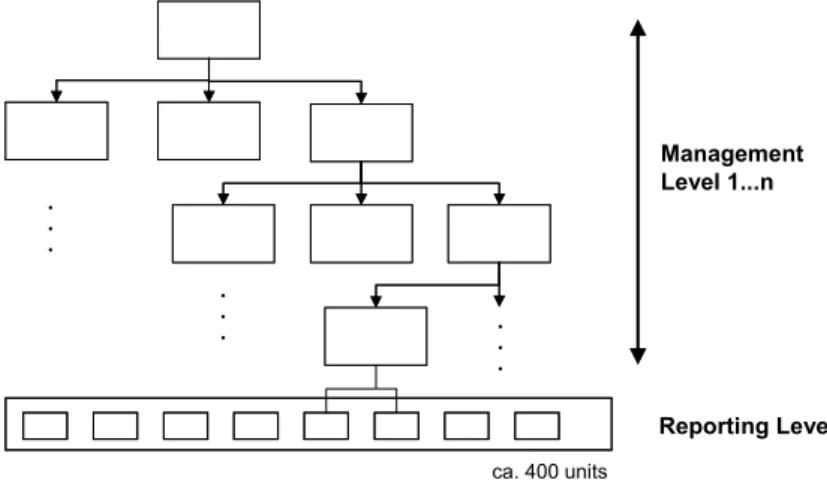
At the Reporting Level there are about 300 management units which settle their project accounts in the local currency on a quarterly basis. The projects’ scope can vary consid-erably. The reporting figures of a project cover, amongst others, the yearly budget, the current year’s prior expenses and the following year’s interim planning figures. These figures are then consolidated over multiple hierarchical levels for Capex, (see Figure 1-1). The suitability of these figures for guidance and decision support depends essentially on the quality and actuality of the prepared figure material. An indication of the quality of the Capex process is the variation in the group-wide consolidated figures of the Capex Reporting and Accounting.
Management Level 1...n Reporting Level ca. 400 units • • • • • • • • •
Figure 1-1: Management and Reporting Level of the Capex process
The Capex process exhibits characteristics of a collaborative process in which, beside Capital Management as a subsection of the Corporate Controlling Department, approxi-mately 300 not disciplinary subordinated Capex coordinators at the Reporting Level and
2 Starting Point 3 management unit decision-makers on different hierarchical levels are involved. That is why Capital Management considers the design of the Capex process and the technical support of Capex coordinators as essential factors to guarantee the quality of the figure material provided to decision-makers.
2
Starting Point
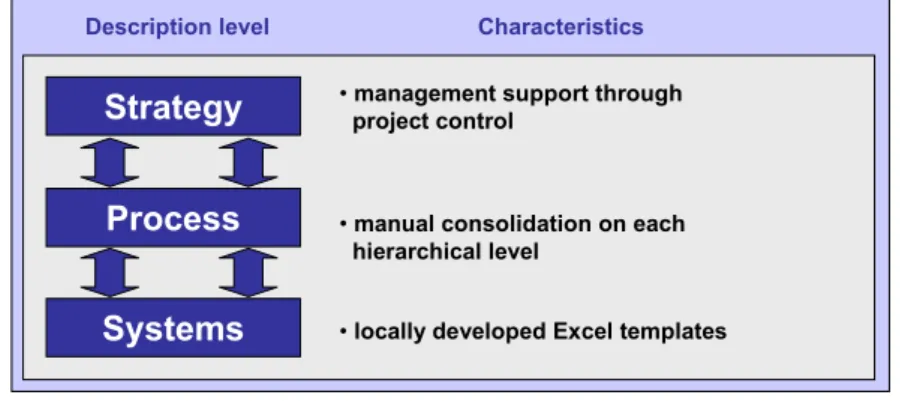
Strategy. Up to now, the Capex-account has served (as well) as decision guidance for the efficient allocation of funds in the different projects.
Strategy Process Systems
•management support through project control
•manual consolidation on each hierarchical level
•locally developed Excel templates
Description level Characteristics
Figure 2-1: Short characteristic of the previous Capex process
Process. Those responsible on each Reporting Level captured the required data in Excel sheets. The figures were then converted into the group’s currency (see Figure 2-2). An automatic verification of the given data’s plausibility did not occur. Furthermore, the standardized templates didn’t provide sufficient protection and allowed unauthorized ma-nipulations.
2 Starting Point 4
Reporting Level Corporate
Controlling Management Leveln-1 Management Leveln
Settle projects Record project figures in local currency Consolidate project figures in one currency Consolidate project figures in one currency Consolidate project figures in group currency Release project figures
Use project figures for leadership
assistance
Use project figures for leadership
assistance Use project figures
for leadership assistance
Figure 2-2: Current process of the survey and use of Capex data
Systems. The Capex Reporting was carried out with Excel sheets, that consisted of stan-dard tables. But some sectors had developed their own transfer mechanisms, which facili-tated the Capex Reporting for them.
Business pains. Excel proved sufficiently flexible for adjustment to the needs of the dif-ferent sectors, but overall it proved to be unsuitable for the Capex process. The Excel so-lution couldn’t guarantee that the relevant persons had used the same databases, and, con-sequently, that they were talking about the same figures. On top of this, there were no me-chanisms to fully protect the Capex data from unauthorized intervention.
The Reporting figures’ consolidation on each hierarchical level was not only time-consuming, but highly susceptible to errors as well. Besides this, the conversion of local currencies into Euro occurred on a decentralized basis, thus using different exchange rates. The variation between the consolidated figures of the investment controls (Man-agement Reporting) and the investment accounting (Legal Reporting) totaled 6% in spite of their having the same initial figures.
3 Project Capex e-Care 5
3
Project Capex e-Care
Aims. Eric Marmonier, responsible for Capital Management in the merged companies, recognized the necessity to improve the Capex process’s quality with suitable tool sup-port. One of the declared aim was the reduction of the variance between the Controlling Department’s Capex figures and the corresponding figures of the investment accounting. The project experienced top-management support through Aventis Pharma AG’s Chief Finance Officer Daniel Camus.
Capex e-Care’s initiative was grouped under the “e-magine project”, which is a dedicated finance re-engineering project to support the merger of the two partners. Although origi-nally the goal was to make the capex figures available in the Intranet portal “My e-magine”, the Controlling figures proved to be only relevant to those who work with the new Capex tools anyway. Ultimately, integration with “My e-magine” was rejected. Realization. The e-Care project started in January 2001 and was due to be completed by June 2001, but extended initial problems led to the timetable being adjusted. The project team implemented the critical functionalities in June 2001 and finished the project in Sep-tember 2001.
Besides his daily duties Eric Marmonier was also responsible for the project’s business side and, with five colleagues, for the specification of the new Capex process. As a first step, they planned to acquaint the internal computer specialist with the technical manage-ment of the project. Those at Capex who were responsible for the project wanted someone who would be a competent support person for the technical features, because IT projects were rather unusual for them. As no experienced IT internal resource was available at that time, it was decided to outsource the IT project leadership to Harald Burghard of the ex-ternal management consulting company IMG.
At this point there were already contracts for the technical implementation of the IT pro-ject with the companies Plaut OSS Consulting GmbH and GIS Consulting GmbH. At first the project team’s employees did not know one another. This led to communication prob-lems between the business experts and the technical employees. The IT team members too were inevitably divided into different groups with varying interests and (expert) lan-guages. This led to the resources needed being exceeded as a result of a miscalculation. The programmer of one component misjudged the problem’s complexity and, as a result, had drawn up a too small budget. This resulted in the termination of the project - highly unusual - being discussed for some time.
The authorization concept was the crucial technical challenge, since the figures’ reliability required strict regulations as to which users have access to which data at what time. An
3 Project Capex e-Care 6 important part of the project has been the training of future users. The relevant Capex em-ployees are dispersed worldwide, just as the business units are, and they have to be able to use the new system with the least expenditure possible. First a short documentation of the new Capex tool was sent to all users. It described the normal work procedure by means of screen shots of the system. Next the know-how transfer of users was supported: 10 groups, each consisting of approximately 25 users chosen on regional grounds (for exam-ple, time zone factors), received mainly telephonic training. During the one-hour tele-phone conferences, the training documents were discussed step by step and questions were answered. The telephonic training was well suited to the Capex context, because of the comparatively little input of project figures. Together with other forms of indoctrina-tion, approximately 300 employees have been introduced to the use of e-Care.
Critical success factors. In a heterogeneously composed project team, such as in the case of e-Care, stringent project planning and clear demarcation of responsibilities are espe-cially important for the attainment of the project’s aims.
In Harald Burghard’s point of view, a methodical procedure is an essential requirement for the conversion of preconditions of time and quality. Some of the developers were used to so-called “Rapid Prototyping”. This describes an implementation base that starts during the analysis and conception phase with the programming of the software solution and which carries out incremental extensions until it reaches the finished solution. This kind of procedure was, however, unsuitable. Not only did it lack a methodic foundation, but also contained an unacceptably high risk of undesirable development.
A definition of the project requirements, based on Excel and free of technical implemen-tation aspects, was essentially for communication between business and IT. When it came down to discussions, both project managers made their decision based on this business requirements. Furthermore, during the project, the description of the Capex process’s work flows, which were developed with the help of experts, was gradually extended by means of screenshots of the developed Capex tool. They formed the foundation for the creation of documentation and training documents.
A clear documentation of the project’s results, including essential intermediate steps, was part of the methodical procedure utilized to minimize future expenditures on introduction, maintenance and running. Additionally, the procedure included a role-based, competence-oriented assignment of duties for the project team’s members. For example, at the begin-ning the idea was to delegate the input of the master figures to the IT team, but they were not qualified for this task. The importance of the master figures’ quality forced Aventis to assign this duty to the Capital Management Department’s employees and to support the
4 Capex with the e-Care tool 7 process of the master figures’ manipulation with an administrative tool, developed as a follow-up order.
According to Eric Marmonier another important success factor of the project was the cul-ture of handling mistakes. He advices, that the team members should not understand mis-takes as a personal defeat for which a guilty party had to be found. Rather, special empha-sis was given to finding a quick and constructive solution to the problem.
4
Capex with the e-Care tool
Strategy. The importance of the project controls has not changed, but with the implemen-tation of a more efficient Capex Reporting process, the quarterly figure are of a higher quality and are available earlier than previously to support decisions.
Strategy Process Systems
Description level Characteristics new Charakteristics old
• management support through project control
• manual consolidation on each hierarchical level
• locally developed Excel templates • management support through
project control
•web frontend DCT
•connection with SAP BW
•data entry on reporting level
•input validation
•automated consolidation
Figure 4-1: Comparative overview
Process. The Capex coordinators at the Reporting Level register the data online through a so-called Data Communication Tool (see systems). A history of all quarters, in other words, the inputs of past periods, can be easily transferred where there are no changes. A release mechanism inspects the entries, warns the user in the case of unusual values (for example, negative expenses) and prevents the data from being filed in the central database when defined rules have not been followed (for example, an unauthorized exceeding of the budget within the management units).
The consolidation of partial, individual reports and their conversion into Euro occur automatically on the central database. After release, the Capex figures are available to authorized persons who have access to SAP. The managers can then retrieve consolidated reports for their units. If required, the reports can be specified according to different filter-ing criteria and are always based on the most recent figures (see Figure 4-2).
4 Capex with the e-Care tool 8
Reporting Level Corporate
Controlling Management Leveln-1 Management Leveln
Settle projects Record project figures in local currency Consolidate project figures in group currency Release project figures
Use project figures for leadership
assistance
Use project figures for leadership
assistance Use project figures
for leadership assistance
Figure 4-2: Capex process with e-Care
Systems. Scenarios that envisaged a connection between Excel and the management in-formation system ALEA [www.alea.com] were evaluated during the evaluation of the system. However, since SAP R/3 and SAP BW had been generally introduced in the fi-nancial part and because SAP software is regarded as a strategic product family, a combi-nation of Data Communication Tool (DCT), based on Arcplan Insight, and SAP Business Warehouse prevailed against ALEA. With the decision to use the existing, in-house sys-tem, the IT division’s support could be guaranteed. The ALEA solution would have re-quired extensive customizing to illustrate the Aventis Capex process as well, without guaranteed in-house support.
The tool, providing the data entry interface (Data Communication Tool) for the relevant Capex coordinators is self-developed by Aventis. It based on Arcplan Insight [www.arcplan.com], a tool with which to prepare management information. The appear-ance of the interface is adjusted to suit the identity of the respective division. First, the user has to login, via the main menu he then accesses a list of projects that are available to him. A Validation Monitor and a Release Monitor provide the functionality to support the release process. Furthermore, the user has the opportunity to first capture the report’s fig-ures in Excel and thereafter to upload them into the DCT. This option allows an offline capturing of data as well. In each instance, the captured project figures are stored in a SQL database until their release. The scheduled delivery of the quarterly figures is sys-tem-technically supported by a so-called Tracking Monitor.
4 Capex with the e-Care tool 9
Figure 4-3: Main menu of the Capex Data Communication Tools
After the release of the project figures, a SAP Business Warehouse (SAP BW) aggregates the quarterly figures and converts the local currencies into the group’s currency, Euro. This transfer is process-based for performance reasons. However, all project figures have to be deposited with the DCT three days after the so-called country clearing.
SAP BW provides authorized persons with analyses of and reports on different specifica-tion levels. Addispecifica-tionally, there is the possibility to prepare one’s own reports from the data. Direct data entry and manipulation in the SAP BW program are prevented for con-sistency’s sake. Figure 4-4 provides an overview of the e-Care architecture.
SAP BW-DB
•convert local currencies
•Data Aggregation SAP BW Reporting GUI DCT SQL-DB •Validation •Release DCT-Data Entry GUI
DCT SAP Business Warehouse Front-end Back-end Interface Read only
4 Capex with the e-Care tool 10
Costs and Benefits. Aventis e-Care (electronic Capex Reporting) improves the Capex Re-porting process’s efficiency, while simultaneously increasing the figure material’s quality and the analysis opportunities for preparation and management decisions.
A survey of the Capex coordinators responsible for the data entries, which was held after the completion of the project, showed that 62% of these users had a time saving of an av-erage of 1,5 hours per quarter. The sporadically reported additional expenditure in Capex reporting time (7%) was the result, among others, of the too narrow network bandwidth, or of the deactivating of specialized Excel solutions for a special reporting unit. In two cases the overall load of the users increased because they had to take on the duties of third parties, who were no longer involved in Capex Reporting.
It also became possible to eliminate the manual consolidation of the figures from the dif-ferent management levels. This freed the employee who had previously been responsible for this duty in Capex Reporting.
Table 4-1 provides a systematical overview of the realized benefits and compares them with the project and the current operations’ expenses. Some categories of project benefits haven’t as yet been qualified by Aventis. It is also the Corporate Controlling Depart-ment’s opinion that the costs of quantifying e-care’s benefits, considering the potential benefits of a more detailed analysis, are not justified.
Further development. At present, no extension of the e-Care solution to related processes, for example the budget planning, are envisaged. Continuous attention is paid to the con-cept of authorization for the decision-makers. Besides the attention paid to the authorized groups, tests are currently being run on how the technical protection of the sensitive Ca-pex data may be improved.
4 Capex with the e-Care tool 11
Overview Aventis e-Care Expenditures:
Project
Duration 9 months (6 months planned)
Project team Department IT
13 people 6 people
7 people ( 5 of them external) Project expenditures (person-days,
PD)
Development (IT)
Project management and Process design (IT)
Process works dapartment representa-tives
340 PD + Expenditures dapartment representatives 255 PD
85 PD not recorded
Project costs 650'000 EUR
Expenditures on schooling about 40 PD (Assuming 1 hour telephone-shooling at an average of 2 hours working through the documents)
Operating No especial expenditures reported Realized profit by e-Care
Capital Management Management units
STRATEGY Employees
Operability Achieved (according to an inquiry
among employees) Achieved (according to an inquiry among employees) Reduction of routine work Achieved by automatisation via
monitoring of the report process and the validation of the data entry)
Reduction of the individual work load for 67% of the report’s officers Organization
Support of
post-merger-integration --- Achieved by the harmonization of the investment-controlling process COLLABORATIVE PROCESS
Process costs --- Saving of personnel costs by
abol-ishing the hierarchic consolidation
Velocity Reduction of cycle time by 25% (15
instead of 20 days) Reduction of pentry on report level) by about. 1,5 rocess time (data hours / quarter)
Quality Reduction of variance for
book-keeping by the factor 12 (0,5% instead of 6%) by
- flat consolidation
- improved possibilities for analy-sis
- Monitoring of the reporting
- improved data security by an autorisation concept
Achieved by:
- individualized reports
- improved possibilities for analy-sis
5 Learnings 12
5
Learnings
Aventis e-Care leads to a “direct” connection of data creation and data use in the Capital Expenditure Reporting’ sector. The elimination of media breaks allows a flat consolida-tion of the reporting figures, excludes unnecessary steps in between and increases the speed of the process. The utilization of a common database increases the quality of the Capex quarterly figures. An authorization concept ensures user-specific provision of re-quired data and also increases the protection of the sensitive company data by decreasing the chances of unauthorized access.
For cost and time reasons, Aventis has decided against an extension of the e-Care solution to the budgeting process, which will continue to be characterized by the exchange of Ex-cel sheets that will now be consolidated in ALEA.
• The examined cooperation process addresses the company’s internal control. The
cooperation within different management units and hierarchical levels leads (de facto) to a process with varying stakeholders whose aims have to be balanced out.
• The business case didn’t quantify all project benefits. Interesting in this connection is the fact that specifically the Corporate Controlling division initiated a project that delivers a difficult to quantify but visible benefit. This raises the question of a useful cost-benefit ratio of ROI calculations.
• Different cultural backgrounds can be a weakness, but also a strength when they
are properly managed. This not only requires the development of a common
Interviews 13
Interviews
Marmonier, Eric, Corporate Controlling, Business Project Manager, Aventis, Frankfurt am Main, April, 11th, 2002
Burghard, Harald, e-Care IT-Project Manager, The Information Management Group (IMG), by phone, April, 25th, 2002