A R C H I V E S
o f
F O U N D R Y E N G I N E E R I N G
Published quarterly as the organ of the Foundry Commission of the Polish Academy of SciencesISSN (1897-3310)
Volume 14
Special Issue
3/2014
85 – 89
17/3
The Application of Numerical Methods to
Evaluate the Viscosity of the Coating Using
the Model Extraction Iida
S. Biernat
a,*, A. W. Bydałek
b, ca
State Higher Vocational School in Głogów, ul. Piotra Skargi 5, 67-200 Głogów, Polska
b
AGH University of Science and Technology, Faculty of Non-Ferrous Metals, Al. Mickiewicza 30. 30-059 Kraków, Polska
c
University of Zielona Góra, Faculty of Mechanical Engineering, ul. Podgórna 50, 65-246 Zielona Góra, Polska
*
Corresponding author. E-mail address: [email protected]
Received 12.06.2014; accepted in revised form 22.08.2014
Abstract
The article presents a reflection on the viscosity of the coating extraction using numerical methods. The viscosity of the coating slag is a factor affecting a high degree on the quality of the ongoing process of refining. Too high a viscosity will restrict the diffusion of impurities from the metal to the slag, in turn, too low a viscosity will cause spreading of slag in the vicinity of the furnace wall, and thus exposing the mirror of the liquid metal which may result in adverse effects of an oxidizing atmosphere. You should also remember that too low a viscosity can increase the loss of metal in the slag as well as hinder its recovery during casting. Using the materials database and numerical methods it is possible to determine the level of selected blends of slag viscosity. Additionally, in order to determine their usefulness in refining the values obtained can be confronted with laboratory tests using derivatograph. On the basis of the designated energy index Ew and mass index r can determine the suitability of a mixture of slag and its impact oxidizing or reducing agents..
Keywords: Computer aided manufacturing casting, Numerical methods, Viscosity, Iida model, The program SLAG - PROP, Refining
capacity
1. Introduction
Viscosity is one of the very important properties of the slag. It is important both in metallurgical processes, metallurgical - processing and casting. It exerts an important influence on the phenomenon of refining, as well as through the work of the furnace, through the impact of corrosion on the lining of its adverse impact on the material of the crucible, it can also hinder the recovery of the slag shell before spilling into the vat. In addition, also affects the size of the resulting melting loss. Thing is, therefore, reasonable to use numerical methods to evaluate the
viscosity of coatings extraction in order to select the most favorable value.
2. Current state of knowledge
It is important that the viscosity of the slag used was relatively low [1,2,3]. It was also found that the diffusion of impurities from the metal to the slag can be represented Stockes formula (Einstein - Smoluchowski) [4÷9]:
D =
∙∙π∙ ∙
∙
η (1)where:
D – diffusion coefficient
Rg – gas constant (8,31 J/(mol*K))
T – temperature
rD – a moving radius of the particle
Na – Avogadro's number (6,022*1023 mol-1)
η - the viscosity of the slag
As is clear from the formula (1) and research [15,16,8,10 ÷ 14], the viscosity depends on the temperature of the slag, the composition of gases in the atmosphere and the effects of the refined alloy. There are various methods for determining the viscosity of the liquid. These include the method of Stokes flow through a tube (Engler), vibration, using a rotameter, and finally the method of concentric cylinders appropriately modified and patented by AGH in Krakow [17]. Not all of the classic methods of measurement is, however, possible to use in the metallurgical industry, due to the nature of high-temperature measurement, and thus appropriate selection of materials for certain parts of the measuring apparatus.
The variety of research methods and the nature of the refining process result in discrepancies in determining the value of slag viscosity. The viscosity of the slag can vary considerably, not only with the temperature (Fig. 1a) [16], but also their composition [18,19] (Fig. 1b).
As can be seen in Figure 1a, the slag having the composition 55% SiO2, 13% Al2O3, 14% CaO, 7% MgO and 3% other
compounds difference in viscosity in the temperature range from about 1525 K to about 1625 K was more than 30 poise. In turn, sub-paragraph b) for the selected instance (marked white point) of the following composition 37,6 SiO2; 16,5% CaO; and 9,41% Fe;
3,03% Pb; 4,36% Cu, and the symbol of the black point of the composition 33,1% SiO2; 15,0% CaO; and 9,21% Fe; 5,80% Pb;
6,72% Cu) difference in viscosity was approximately 20 - 30 poise, with a small percentage change in the system under study.
Interestingly presents a semi-empirical model proposed by Iida viscosity [20,21] for the liquid slag, that contains in its composition CaF2. It is based on the assumption that the viscosity of the slag viscosity is the sum of its individual components, and the ratio of the slag basicity. It includes 2 additional parameters that are a function of temperature and are properly aligned for the class of slags.
Fig. 1. a) Slag viscosity changes with temperature b) slag viscosity change at a given temperature at the various configurations [16, 18]
3. The concept of the method
The overriding aim is to use an application that uses numerical methods based on semi-empirical model Iida, allowing the selection of optimal physical and chemical properties of coatings for the extraction of these processes. On the basis of studies conducted and appropriate material basis can create original tool by which to gain the ability to precisely determine the melt viscosity of the system also those areas that have not been unequivocally confirmed experimentally.
Obtaining such a tool will result in the selection of the optimal values of the viscosity of coatings extraction. As a result, it will no longer need to perform laborious and costly tests to determine the level of refining slag viscosity. By entering the appropriate
search for optimal configurations possible mixtures of slag, as well as modify the most appropriate line-ups for new ingredients and chemicals.
As an indicator of optimal viscosity values provided by the program can use the concept of refining capacity assessment coatings extraction using derivatograph developed by A.W. Bydałek [22 ÷ 30].
4. Results
After starting the program, the user should first indicate the direction of the analysis of the properties of slag. Because the search criterion will be in the areas of viscosity coatings extraction should choose an area served criteria. Then the user must select the type of slag, which will be analyzed. The proposed composition of the refiner will be described as a system of base containing essential components of slag matrix oxide Al2O3 –
CaO – SiO2. Another important choice is to indicate the type of
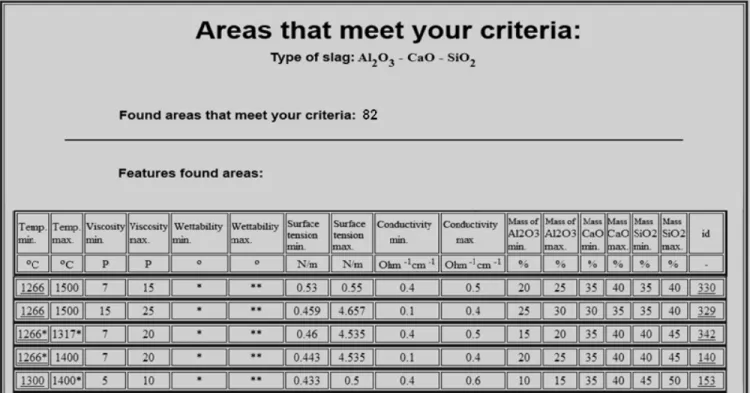
alloy, which will be refined - copper, and select the type of atmosphere in which treatments will be carried out. The adopted set the example that it would be inert atmosphere. The final step is to choose your search criteria, or selection "viscosity" as the search area. In the next window, you can enter the minimum and maximum viscosity indicated a mixture of slag. In the present system in order to select the widest possible group of compounds introduced minimum value at 3 P, and the maximum value of 50 P. Thanks so posed boundary conditions program sought out 82 areas meeting the criteria specified by the user. The results are presented in tabular form (Fig. 2). At the same time it can be seen that they relate to a specific area of 3 - component adhesives chart Gibbs, which for better illustrate the example shown in the figure below and highlighted in light – gray.
Fig. 2. Areas designated by the program (light - gray - the designated viscosity, dark - gray - testing the ability of refineries)
Thanks to this performance, you can browse the various formations of mixtures of slag in terms of physicochemical properties and refineries. When analyzing the data collected in the table shown in Figure 2, it can be seen that the viscosity of the mixture components increases with decreasing amounts of CaO
.
For example, the sequence number indicated by a mixture of 116, of the composition of 15 - 20% Al2O3, 50 - 55% CaO, 30 - 35%
SiO2 has a viscosity of 3 - 20 poise at 1500 0
C. Meanwhile blend numbered 371, having a composition of 5 - 10% Al2O3, 30 - 35%
CaO, 55 - 60% SiO2 has a viscosity of 30 - 50 P at 15000C.
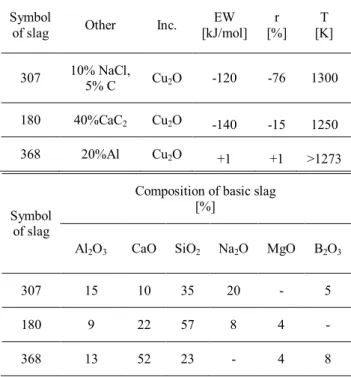
It can therefore raise the question, which of the presented compound slag will be exhibited the best ability of refiners. For this purpose have been tested three compounds, the compositions of which are located on the outskirts of the study area. Location of test samples is shown in dark - gray in the above figure 3. Table 1.
The experimental results Symbol
of slag Other Inc.
EW [kJ/mol] r [%] T [K] 307 10% NaCl, 5% C Cu2O -120 -76 1300 180 40%CaC2 Cu2O -140 -15 1250 368 20%Al Cu2O +1 +1 >1273 Symbol of slag
Composition of basic slag [%]
Al2O3 CaO SiO2 Na2O MgO B2O3
307 15 10 35 20 - 5 180 9 22 57 8 4 - 368 13 52 23 - 4 8
The first area designated by order number 307, was characterized by unfavorable refining abilities. In this case the region of interest obtained energy index EW 1 kJ/mol and mass index r = 1%. This means that the compound has the impact oxidizing slag. It should be noted that this area is located in the immediate vicinity of the slag mixtures of lower viscosity values.
The next two mixtures were analyzed at opposite ends of the analyzed area. One of them is designated order number 180, which corresponds to that of 10 - 15% Al2O3, 25 - 30% CaO, 60 -
Fig. 3. The results sought out areas that meet the criteria specified by the user specified by the program
achieved high refining capacities.
The energy index of this area was -140 kJ/mol, and the mass index r = 15%. This blend is on the border of the area is characterized by a higher viscosity value of up to 50P. To check the dependence analyzed another mix indicated sequence number 368, whose composition was as follows: 20 - 25% Al2O3, 15 - 20% CaO, 55 - 60% SiO2. Also,this blend achieves good refining capacities. The energy index was, in this case -120 kJ/mol, while the mass index r = -76%. This means that a mixture of the following composition has a high reducing ability.
The results of verification areas are summarized in Table 1. It is worth noting that these mixtures. Speedway has been enhanced with additional components, which improve their properties and act as promoters or catalysts.
5. Summary
Summarizing the above considerations it can be concluded that the optimum extraction physicochemical properties of coatings, including their level of viscosity is a very important factor in the economics of the enterprise. Too high viscosity will hinder the diffusion of pollutants into the shell slag and thus hamper will carry out the process of refining. On the other hand, too low a viscosity will cause not only the slag melting behavior of the coating in the vicinity of the oven walls, which will cause the liquid metal mirror discovery that at this point would be exposed to harmful effects of the external atmosphere, but also
The Polish copper smelters of produced annually is over 400,000 Mg post - process slags. Assuming the possibility of increasing the "yield" of copper only at the level of 0.1% represents a 400 Mg metallic copper allocated directly to the refining fire. Put it in the lowest price of scrap copper allows it to estimate the expected profits from the project to develop the technology, only costs directly resulting from the increase in copper recovery from slag, at about 2 million zł per year. In addition, gains will be achieved by shortening the process and to reduce the weight of slag processed again in shaft furnaces, which ultimately will reduce energy consumption.
Due to the use of new technological solutions leading to the reduction of the amount of copper in the slag excludes the need to post-process the further processing in metallurgical conditions (a process called. "Recycle") will also considerably reduced consumption of materials previously used, including the weight of the dolomite. This will affect the possibility of limiting the extraction of these minerals which will also bring tangible benefits to both environmental and economic - reducing the amount of material transported to the smelter batch.
References
[1] Wang, X. Bao H. & Hong, W.L. (2002). Estimation of viscosity of ternary-metallic melts. Metallurgical and
Materials Transactions. 33(10 ).
Simulation. Metallurgical and Materials Transactions .
35(4).
[3] Staronka, A. (1960). Viscosity of liquid silicate slag and their
structure. Kraków: Wydawn. AGH. (in Polish).
[4] Coulson, J.M., Richardson, J.F. & Butterworth-Heinemann, (2002). An imprint of Elsevier Science, Linacre House, Jordan Hill, Chemical Engineering vol 2, Fifth edition, Oxford OX2 8DP, 225 Wildwood Avenue, Woburn, MA 01801-2041
[5] Smoluchowski, M. (1914).
Gultgikeitgrenzen of the
second law of heat theory
, Berlin – Leipzig. (in German) [6] Iida, T., Guthrie, R. & Tripathi, N. (2006). A Model forAccurate Predictions of Self-Diffusivities in Liquid Metals, Semimetals, and Semiconductors", Metallurgical and
Materials Transactions. 37(4).
[7] Curiotto, S., Pryds, N.H. & Johnson, E.B. (2006). Liquid-Liquid Phase Separation and Remixing in the Cu-Co System.
Metallurgical and Materials Transactions, 37. 8
[8] Staronka, A. & Piekarska, M. (1994).
The influence of
surface phenomena on transition metal inclusions into
the slag refining
. Mat. II Konferencji – Zjawiskapowierzchniowe w procesach odlewniczych. Poznań –
Kołobrzeg. (in Polish)
[9] Turkdogan, E.T. (1980). Physicochemical properties ofmolten salts, United Stats Stel Corporation, Acd. Press Pensylwaniam, Monreville.
[10] Kowalczyk, J., Mróz, M., Warczok, A. & Utigard, T.A. (1995). Metallurgical and Material Trans. B. 26 B
[11] Ankudowicz, B.. Bydałek, A Chorzępa, S. & Romankiewicz, F. (1974).
Selected sections of non-ferrous metallurgy:
materials for exercises.
Wrocław: Wydaw. Politechniki Wrocławskiej. (in Polish)[12] Kondratiev, A. & Jak, E. (2005). A Quasi-Chemical Viscosity Model for Fully Liquid Slags in the Al2O3
-CaO-FeO-SiO2 System. Metallurgical and Materials
Transactions, 36(5).
[13] Nogueira, P. & Fruehan, R.J. (2004). Blast Furnace Burden Softening and Melting Phenomena: Part I. Pellet Bulk Interaction Observation. Metallurgical and Materials
Transactions. 35(5).
[14] Park, J.H. Dong, J.M. & Song, H.S. (2002). The effect of CaF(2) on the viscosities and structures of CaO-SiO(2)(-MgO)-CaF(2) slags. Metallurgical and Materials
Transactions. 33(5).
[15] Seetharaman, S. Sridhar, S. & Du Sichen. M. (2000). Estimation of liquidus temperatures for multicomponent silicates from activation energies for viscous flow.
Metallurgical and Materials Transactions. 31(1).
[16] Bydałek, A.W. (1998). Slag and oxide-carbon systems in the
process of melting copper and its alloys, Zielona Góra, Seria
Monografie nr 86, Politechnika Zielonogórska. (in Polish)
[17] Benesch, R. Delekta, J. Janowski, J. & Kopeć, R. (1968). Patent No.: 55186. Urząd Patentowy PRL, Polska Rzeczpospolita Ludowa.
[18] Zajączkowski, A. Bratek, S. Botor, J. & Czernecki, J. (2010). The impact of the reduction in the value of the slag slurry viscosity. Rudy i Metale Nieżelazne. 1. (in Polish)
[19] Vidacak, B. & Du Sichen, S.S. (2001). An experimental study of the visosities of AI(2)O(3)-CaO-"FeO" slags.
Metallurgical and Materials Transactions. 32(4)
[20] Kalicka, Z. Kawecka-Cebula, E. & Pytel, K. (2009). Application of the Iida model for estimation of slag viscosity for Al2O3-Cr2O3-CaO-CaF2 System. Archieves of Metallurgy
and Materials. 54(1).
[21] Iida, T., Sakai, H., Kita, Y. & Shigeno, K. (2000). An equation for Accurate Prediction of the Viscosities of Blast Furnance Type Slags from Chemical Composition, ISIJ
International. Supplement, 40, 110-114.
[22] Biernat, S. & Bydałek, A.W. (2010). The estimation of quality refining covers. Archives of Foundry Engineering. 10(spec. 1), 181-188.
[23] Biernat, S., Bydałek, A.W. & Schlafka, P. (2011). The propriety estimation of the copper alloys refining slag with the stimulators addition use the database. Archives of
Foundry Engineering. 11(2), 9-12.
[24] Biernat, S., Bydałek, A.W. & Schlafka, P. (2012). Analysis of the possibility of estimation ecological slag propriety with use the DATABase. Metalurgija-Metallurgy. 51(1), 59-62. [25] Biernat, S., Bydałek, A.W. & Schlafka, P. (2010).
Impact
assessment
reaction
promoters
slag
extraction
conditions
. Archives of Foundry Engineering. 10(2), 23-26. (in Polish)[26] Biernat, S. & Bydałek, A.W. (2009). Analysis of the possibility of estimation slags propriety with use the database. Archives of Foundry Engineering.
[27] Biernat, S. & Bydałek, A.W. (2009). The programme of estimation slags propriety.Archives of Foundry Engineering. 9(3), 9-12.
[28] Biernat, S. & Bydałek, A.W. (2012). The estimation of quality refining slag for the Brass Gas – Slag Refining.
Archives of Foundry Engineering. 12(2), 15-18.
[29] Biernat, S., Bydałek, A.W. & Schlafka, P. (2013). The Analysis of the Chloride and Fluoride Influences one the Reducer Refinement Processes (Carbo – N – Ox) Aluminum Alloys. Archives of Foundry Engineering. (3), 9-14.
[30] Biernat, S., Bydałek, A., Bydałek, A.W. & Schlafka, P. (2013). Assessment of the possibility of utilising waste materials from the aluminium production in the copper alloys refining processes. Archives of Foundry Engineering.13(4), 15.
![Fig. 1. a) Slag viscosity changes with temperature b) slag viscosity change at a given temperature at the various configurations [16, 18]](https://thumb-us.123doks.com/thumbv2/123dok_us/9913861.2883966/2.855.443.791.128.698/viscosity-changes-temperature-viscosity-change-temperature-various-configurations.webp)