Materialization Strategies for
Web Based Search Computing
Applications
Sr
an Zagorac
“A thesis submitted to Auckland University of Technology in fulfilment of the Doctor of Philosophy”
2014
School of Computer and Mathematical Sciences
Acknowledgements
As Henry Ford said "Anyone who stops learning is old, whether at twenty or eighty. Anyone who keeps learning stays young." - Henry Ford
By the time I commenced my PhD I was what some would consider too old to be embarking on such a journey at that stage of my life, however life has a funny way of presenting opportunities at what seems to be the most inopportune of times. Then again this no longer comes as a surprise to me, unexpected opportunities present themselves along the way and that is life. As I have become older and - I hope - wiser, I realize that rarely does life follow the straight path of destiny without taking you down a winding road with some diversions along the way. A bit like taking the scenic route, you eventually get to your destination just some time later. This is exactly how I fell into yet another period of studies.
I commenced my academic career studying medicine in Croatia. This was interrupted by the war breaking out in my old country and my family moving to New Zealand. So with a future so clearly mapped out at first, my roadmap suddenly was diverted. I then went on to complete a Bachelor of Science degree in Physiology and Pharmacology at the University of Auckland. At that time my academic thirst somehow remained unquenched and I decided to combine my medical background with my old passion for Informatics and I embarked on yet another period of Postgraduate study this time in Computer Science.
Then as I was once again living a happy life, another opportunity presented itself and I embarked on a period of research work at the Knowledge Media Institute (KMi) part of The Open University where I worked on the Pharos Project with many inspiring people from around the world. It was some of these very people who encouraged me to consider culminating all of my years of study and research into a PhD. I would like to thank all those colleagues and friends I met over the years at KMi and Pharos who contributed to my research. It was during this time I met Alessandro who I would like to thank enormously for the opportunity to commence my research at Politecnico di Milano and consequently my PhD study. I am eternally grateful to Alessandro
ii
because without his guidance not only with my PhD topic but his guidance on how to navigate my research in Italy I may never have come to this point in my life. I continued my PhD at Auckland University of Technology and I will forever be grateful for the help from Peter Sumich who gave his utmost support and believed in me and finally but most importantly my Supervisor Russel Pears who has been a constant source of encouragement and guidance without whom I would never be here today.
My family is incredibly important to me, and always will be. It is my parents who initially instilled my thirst for knowledge and who ensured my sister and I would have a bright and happy future. I want to thank my parents for their unfathomable love and unselfish support sacrificing everything for their children’s future. I would like to particularly mention my mother Saša’s courageousness and persistence in all her life endeavours, and my father Jure’s analytical mind and patience. I can only hope one day I master each of these gifts.
I want to thank my sister Ðorija for her support and encouragement and always believing in her older brother. To my darling wife Josephine and Sydney, my biggest supporters, thank you so much for your belief in me, your patience and your unconditional love and support for which I am eternally grateful. I hope that my achievements will provide some inspiration to Sydney as he embarks upon his studies with passion and any big challenges he faces in his life.
Henry Ford was right I still feel young in my mind, if only the body would not ache so sometimes, but I would like to report my carpal tunnel intact surprisingly after all this writing.
I can only say after my own country going through war and how that caused my family’s life to take a detour and consequently my own that I wholeheartedly agree with Confucius when he said "Education breeds confi-dence. Confidence breeds hope. Hope breeds peace." - Confucius
iii
Abstract
In this thesis we provide a characterization of view materialization in the con-text of multi domain heterogeneous search application. Web data view ma-terialization is presented as a solution for technical constraints and problems implied by the unknown structure of the web data sources. The web data ma-terialization model extends the search computing (SeCo) multi-layered model, where the search services are registered in a service repository that describes the functional (e.g. invocation end-point, input and output attributes) infor-mation of data end-points.
Our first research goal is to solve the problem of finding a sequence of access patterns, which when executed produces a materialization output.
Our second research goal is the optimization of the materialization process so that the most optimal sequence in terms of materialization output efficiency and quality, executes at all times. As each access patterns can be mapped to several services each differentiated by its performance and materialized data domain characteristics, the services sequence needs to be monitored in ma-terialization run-time by gathering and analysing predefined mama-terialization metrics. According to materialization run-time metrics the materialization process is optimized by switching between available services.
For the first research goal we make the following novel contributions: 1) Formulation of the building blocks for the materialization feasibility analy-sis; 2) Definition of the materialization feasibility analysis method and the accompanying algorithms; 3) A detailed empirical study conducted on a set of materialization tasks ranging in their schema dependencies complexity.
For the second research goal we make the following novel contributions: 1) Formulation of a set of performance dimensions and their metrics for web source materialization; 2) A cost model that utilizes optimization metrics in order to qualitatively differentiate between web services in terms of materialization time; 3) A query optimization procedure that explores the characteristics of the underlying source data domain in order to prioritize the execution of the most productive queries in terms of their data harvesting power; 4) Materialization process optimization strategies based on the web
iv
source performance dimension metrics and query optimization procedure; 5) A detailed empirical study conducted on several relevant web based data sources that clearly shows the effectiveness of the proposed solution.
Contents
1 Introduction 1 1.1 Overview. . . 1 1.2 Motivation . . . 3 1.3 Research Goals . . . 8 1.3.1 Materialization Formulation . . . 9 1.3.2 Solution Feasibility . . . 10 1.3.3 Solution Optimization . . . 10 1.4 Thesis Contributions . . . 11 1.5 Thesis Structure. . . 131.6 Publications from the thesis . . . 14
1.7 Chapter Summary . . . 14 2 Methodology Overview 15 2.1 Introduction . . . 15 2.2 View Materialization . . . 15 2.2.1 Access Patterns . . . 17 2.2.2 Query languages . . . 19
2.3 Web Service Composition . . . 20
2.3.1 Petri Net . . . 22
2.4 Caching . . . 25
2.5 Sampling. . . 26
2.6 Web Crawling . . . 28
2.7 Chapter Summary . . . 32
3 Web Materialization in Search Computing Context 34 3.1 Introduction . . . 34
3.2 Search Computing . . . 35
3.3 Web Materialization Approaches. . . 39
3.4 Web Materialization Dimensions . . . 40
Contents vi
3.5 Chapter Summary . . . 53
4 Web Materialization: Building Blocks 54 4.1 Introduction . . . 54
4.2 Service Representation in SeCo . . . 55
4.2.1 A Multi-level Model for Data Materialization . . . 58
4.3 Service Materialization Model . . . 61
4.3.1 Service Materialization Model Formalization . . . 64
4.4 The Materialization Process . . . 68
4.5 Materialization Scenarios . . . 75
4.5.1 Single pattern multi service (SPMS) . . . 76
4.5.2 Multi pattern multi service (MPMS) . . . 77
4.5.3 Execution models . . . 77
4.6 Chapter Summary . . . 82
5 Strategies for Data Surfacing - Domain Coverage 83 5.1 Introduction . . . 83
5.2 Case Study . . . 83
5.2.1 Strategies for Data Surfacing . . . 88
5.2.2 Evaluation Algorithms . . . 90
5.2.3 Materialization Module Architecture . . . 104
5.2.4 Evaluation Results . . . 108
5.3 Chapter Summary . . . 113
6 Modelling Feasible Solutions 114 6.1 Introduction . . . 114
6.2 Service Materialization Feasibility Model . . . 115
6.2.1 Feasibility Analysis SDF Transformation . . . 117
6.3 Feasibility Analysis Formalization . . . 125
6.3.1 Single Access Pattern . . . 125
6.3.2 Multiple Access Patterns . . . 128
6.4 Feasibility Analysis Model . . . 130
6.4.1 Initial access pattern . . . 130
Contents vii
6.4.3 Connection patterns between access patterns . . . 134
6.4.4 Proposed Feasibility Analysis Model . . . 135
6.4.5 Algorithms . . . 140 6.5 Empirical Study. . . 142 6.5.1 Experimental Settings . . . 143 6.5.2 Discussion . . . 146 6.6 Chapter Summary . . . 148 7 Materialization Optimization 149 7.1 Introduction . . . 149 7.2 Optimization approach . . . 150 7.3 Optimization Strategy . . . 151
7.3.1 Optimization Metrics Differentiation . . . 152
7.3.2 Optimization Cost Model . . . 164
7.4 Empirical Study. . . 169
7.4.1 Coverage Efficiency for serial single queue (SSQ) execu-tion model . . . 172
7.4.2 Coverage Efficiency for serial multi queue (SMQ) exe-cution model . . . 175
7.4.3 Time efficiency for SSQ and SMQ execution models . . 177
7.4.4 Live large data source evaluation . . . 178
7.5 Chapter Summary . . . 183
8 Limitations and Future Work 185 8.1 Introduction . . . 185
8.2 Research Limitations and Future Lines of Work . . . 185
8.2.1 Enhanced Optimization by feasibility analysis variables 187 8.2.2 Query expansion . . . 188
8.2.3 Materialization maintenance . . . 194
8.3 Chapter Summary . . . 196
9 Conclusions 197 9.1 Introduction . . . 197
Contents viii
9.3 Practical Application . . . 201 9.4 Final Remarks. . . 203
A Appendix 204
A.1 Optimization Result Sets . . . 204
List of Figures
1.1 Formulation of the Materialization solution process. . . 9
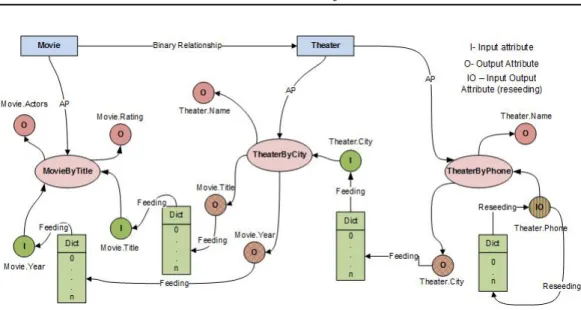
3.1 SDF illustration - MovieByTitle and TheaterByCity joined via Movie.Title connection pattern. . . 39
3.2 Dependencies between materialization dimensions. . . 52
4.1 An Example of Service Description Framework for a Movie Search Application. . . 55
4.2 Schema representing the materialization scenario. . . 62
4.3 Materialization Process before optimization. . . 68
4.4 Example of the sequence of materialization calls and corre-sponding AVG graph. . . 71
4.5 Typical multi pattern multi service (MPMS) layout with input and output domain dependencies. . . 78
4.6 Serial Single Queue execution example. . . 79
4.7 Serial Multi Queue execution example. . . 79
5.1 Example of the materialization problem. . . 85
5.2 Left - Child Insertion Policy; Right - Sibling Insertion Policy. . 90
5.3 Depth-first: "Sibling Insertion Policy" run-time visualization. . 94
5.4 Depth-first: "Child Insertion Policy" run-time visualization. . . 97
5.5 Breadth-first: "Sibling Insertion Policy" run-time visualization. 100 5.6 Breadth-first: "Child Insertion Policy" run-time visualization.. 103
5.7 Architecture of the materialization module.. . . 105
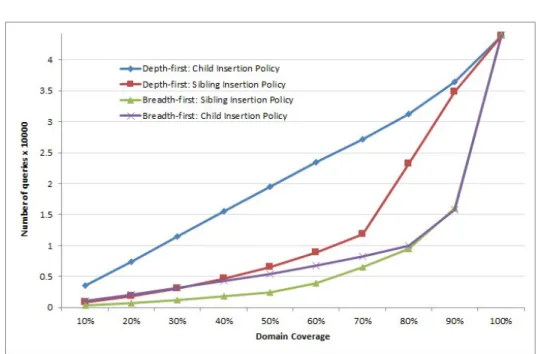
5.8 Experimental Results for SPSS domain coverage. . . 109
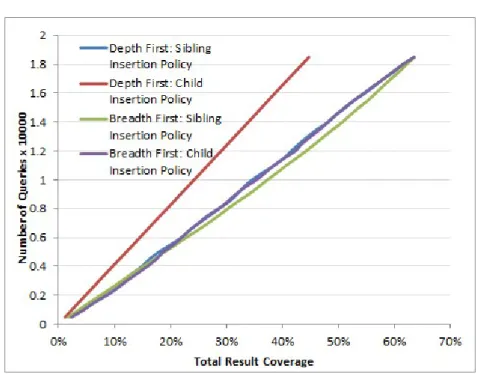
5.9 Experimental Results SPSS - Total Result Coverage - page size 10. . . 110
5.10 Experimental Results SPSS - Total Result Coverage - page size 100. . . 111
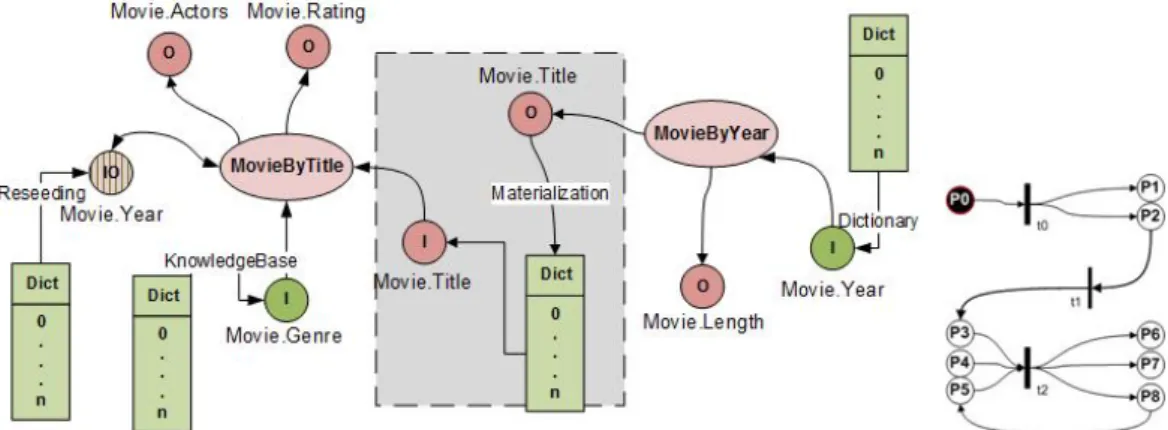
6.1 Example of schema of the materialization problem at AP level and its Petri Net representation. . . 115
List of Figures x
6.2 Example of schema of the materialization problem at AP level
and its Petri Net representation. . . 118
6.3 Bipartite graph representation of the access patterns . . . 119
6.4 Petri Net representation of the MPMS example scenario with token in p0 . . . 119
6.5 Petri Net pnap reachable firing sequence with input output do-main connection. . . 127
6.6 Petri Net pnap reachable firing sequence. . . 127
6.7 Petri net that is unbounded. . . 128
6.8 MPMS Net reachable solution. . . 129
6.9 Unbounded MPMS Net Places . . . 129
6.10 TheaterByPhone - initial AP. . . 130
6.11 TheaterByCity - initial AP . . . 130
6.12 MovieByTitle - initial AP . . . 130
6.13 Petri Net model of the topology with added connection pattern 132 6.14 Two sub-topologies derived on the basis of the new connection pattern. . . 132
6.15 Reversal of the connection pattern flow between sub-topologies 132 6.16 More than one connection pattern per access pattern . . . 134
6.17 Two initial access patterns as a seed . . . 134
6.18 Transient Initial Place M0(d1) . . . 136
6.19 M0(d1) reachable position. . . 136
6.20 Ergodic Initial Place M0,e . . . 137
6.21 M0(d3) reachable position. . . 137
6.22 Boundedness proposition example.. . . 138
6.23 Step 1 Base case start position. . . 140
6.24 Step 1 Base case reachable position. . . 140
6.25 Step 1 Complex case start position. . . 141
6.26 Step 1 Complex case reachable position. . . 141
6.27 Step 2 Base case. . . 142
6.28 Step 2 Complex case. . . 142
6.29 ‘Reallocation search’ multi domain search scenario. . . 144
List of Figures xi
6.31 No of scp vs No Of Executed Queries.. . . 145
7.1 Materialization Process after optimization. . . 151
7.2 Distribution of duplicates over two performed materializations. 153 7.3 Total vs unique tuples in Mat1. . . 154
7.4 Total vs unique tuples in Mat2. . . 154
7.5 Total result coverage obtained with page size 10 and 100. . . . 155
7.6 Distribution of query response times per number of queries in Mat1. . . 157
7.7 Snapshot of query response times per number of queries distri-bution. . . 157
7.8 Disjoint graphs distribution in materialization Mat1. . . 160
7.9 Disjoint graphs distribution in materialization Mat2. . . 161
7.10 SSQ Service Optimization vs Full (service selection and query queue) Optimization. . . 173
7.11 SSQ performance Full (service selection and query queue) op-timization results. . . 173
7.12 SMQ Service Optimization vs Full (service selection and query queue) Optimization. . . 175
7.13 SMQ Full (service selection and query queue) optimization per-formance results. . . 176
7.14 SSQ Time optimization performance result. . . 177
7.15 SMQ Time optimization performance result. . . 178
7.16 SSQ Full optimization performance results. . . 180
7.17 SMQ Full optimization performance results. . . 180
7.18 SSQ Time optimization performance result. . . 182
7.19 SMQ Time optimization performance result. . . 182
8.1 Shortest Distance metrics example. . . 187
A.1 Serial single queue random runs. . . 205
A.2 Serial single queue parallel runs. . . 206
A.3 Serial single queue full optimization runs. . . 207
List of Figures xii
A.5 Serial single queue service optimization runs. . . 209
A.6 Serial single queue service greedy optimization runs. . . 210
A.7 Serial multi queue random runs. . . 211
A.8 Serial multi queue parallel runs. . . 212
A.9 Serial multi queue full optimization runs. . . 213
A.10 Serial multi queue full greedy optimization runs. . . 214
A.11 Serial multi queue service optimization runs. . . 215
List of Tables
5.1 Example SI configuration for reseeding scenario materializationwith dependencies. . . 86 7.1 Services materialization metric differentiation. . . 165 7.2 Output domain value metrics differentiation. . . 166 7.3 Relevant properties configuration of the experimental source
databases. . . 171 8.1 User Driven Maintenance Procedure sample heuristics. . . 195
Attestation of Authorship
“I hereby declare that this submission is my own work and that, to the best of
my knowledge and belief, it contains no material previously published or
written by another person (except where explicitly defined in the
acknowledgements), nor material which to a substantial extent has been
submitted for the award of any other degree or diploma of a university or other
institution of higher learning.”
Srđan Zagorac
Signed: _____________________________________ Auckland 24/11/2015
Chapter 1
Introduction
1.1
Overview
Web based data sources represent a segment of the web commonly interfaced by HTML forms or web service APIs. Recent research has estimated the size of this type of web data to be an order of magnitude larger than the size of the surface web [Madhavan 2008] i.e., the information accessible via the static URL links. This vast amount of data is commonly referred to as the deep or hidden web. In other words the deep web might be seen as a myriad of heterogeneous web based data sources commonly accessible via web forms or web API calls.
The aim of search computing [Ceri 2010] is to answer multi domain queries by accessing heterogeneous web based data sources typically found in the deep web. The usual scenario for answering such queries is to identify domains contributing to answering of the query; identify web based data sources related to those domains; query the web sources by invoking their web forms or APIs; collect the results and join them in order to answer the original query.
A major difficulty facing multi-domain query search is our inability to control query execution upon its submission to a remote data source. Often, the search process is affected by the high latency due to the Internet network congestion, routing problems or simply slow responsiveness of the ’other’ side. Involved services may also restrict the number of daily accesses or impose time delays between search requests. Further, the obtained data might suffer from low coverage and high level of duplicates, thereby requiring multiple invocations of multiple sources, if available, in order to harvest the required data corpus for answering the given query.
1.1. Overview 2
process in terms of result delivery time and the result quality itself as the decreased availability of web sources might cause just a subset of the required result to be obtained.
Search Computing (SeCo) [Ceri 2010] addresses the specific problem of search service integration in order to answer multi-domain queries: the task in hand is a complex data integration process, where data comes from Web based data sources (commonly accessible through Web forms or Web APIs) that return paginated and ranked result lists. Unfortunately the access to Web data repositories is typically constrained by the data provider, e.g., by limiting the number and frequency of allowed daily service invocations; moreover, the Web service query interface constrains the set of accessible data to a subset of the whole corpus.
Obviously, the existence and quality of a search process depends on those constraints: as users expect good results provided in a timely and reliable way, a response delay or the unavailability of the allocated data sources degrades the performance of the search, thus, slowing down the processing of search results and, ultimately, causing degraded user experience. In order to alle-viate the problems possibly introduced by these technical constraints while providing an efficient execution environment for multi-domain query answer-ing, we aim at designing a solution for materializing queries as views, i.e., locally stored answers that can be, in turn, queried.
Techniques for dealing with high latency data sources involve caching mechanisms that materialize the result of queries over the data sources. While caching can increase the performance of a search system [Cambazoglu 2010], its effectiveness can be limited by its very nature; typically, cache items (query results) are stored according to a hash that is calculated from the query. While several techniques (e.g., cold start), can be employed in order for the cache in-frastructure to become effective, cache items are not reused unless the queries issued are identical to those results already cached, thus, severely limiting the utility of the caching mechanism.
Data integration systems working on open Web data sources like SeCo instead, need to have the capability of exploiting already answered queries as well in order to compute a response to different queries that may be presented
1.2. Motivation 3
to the engine in the future. Recently there have been efforts to integrate a vast amount of structured data found on the Internet in the form of HTML tables [Cafarella 2009] and by surfacing information hidden behind web forms [ Mad-havan 2008]. To the best of our knowledge, none of the proposed approaches addressed the materialization of data provided through search interfaces where results are ranked and paginated for the purposes of integration.
An alternative approach can be found in the literature of data integration systems where data access limitations due to schema normalization or data distribution are addressed using view materialization. A view can be mate-rialized by storing the tuples of the view in the database or any persistent storage medium. Index structures can be built on the materialized views, thereby providing a much faster access to the materialized data. The data integration systems described in [Levy 1996,Duschka 1997a,Kwok 1996, Lam-brecht 1999] followed an approach in which the contents of the data sources were described as views over a mediated schema. The mediated schema acted as a virtual bridge between the actual search application and the remote sources. Other works consider answering queries over materialized views as a key role in developing methods for semantic data caching in client-server systems [Jonsson 1996,Keller 1996,Adali 1996].
In this thesis we elaborate on the challenges raised and present solutions to the problem of query results materialization in a multi-domain search setting such as SeCo.
1.2
Motivation
Search Computing is concretely implemented through a search computing ap-plication, a vertical Web search system that leverages on the SeCo framework for enabling multi-domain search capabilities. The application typically re-sides on a SeCo installation and consists of a configuration of one or more multi-domain queries over the existing service repository.
As a search computing application deals with a large amount of concurrent end user requests, a sub-second response time and scalability are of primary importance. Therefore, high-performance architectures and deployment
envi-1.2. Motivation 4
ronments able to satisfy these requirements must be part of the solution. Short response times and time-to-screen are crucial to guarantee system responsiveness. These parameters are affected by two main factors in SeCo: internal query processing time and remote services invocation time. The for-mer can be reduced by executing a query on multiple nodes in parallel by exploiting inter-query and also intra-query parallelism.
Service invocation time instead, can be reduced by minimizing and opti-mizing communications with services, possibly avoiding them altogether. At a physical level, invocation times can be reduced by efficiently using available communication protocols. HTTP in particular, provides facilities for caching Web server responses and pipelining requests to Web servers [EvenDar 2007]. At a higher level the communication problem has been addressed in meta-search systems, where a crawl meta-meta-search hybrid approach [Craswell 2004] has been proposed to reduce Web search costs by indexing low-turnover and small data sources while meta-search the other ones. In a meta-search, the query is forwarded from the central server to each of the component sites and their returned answers are merged and presented as if they had been identified centrally.
A similar approach can be adopted for Search Computing by recurring to
materialization of frequently accessed services that provides access to small amounts of data changing infrequently.
Hence, to efficiently execute search requests and deliver answers to the users in a timely manner, SeCo search application requires an efficient and reliable data access mechanism. In order to overcome the constraints imposed by these uncertainties, while providing an efficient execution environment for multi-domain query answering, we intend to define and characterize a system for materializing queries as views, i.e., locally stored answers that can, in turn, be queried. Such a system has to be able to source the already answered queries as seen in typical caching approaches as well as for any future queries that might be presented to the search engine.
We approach the web data source query materialization as a novel concept that has not yet been explored as a solution to the aforementioned problem.
1.2. Motivation 5
is to combine the most desirable features from each into a novel web data materialization approach which will satisfy search application need for uncon-strained data access.
Whilst caching techniques offer advantages such as faster access to cached resources therefore saving on network resources or imposing controls on the content access and providing resources when the original web source is unavail-able, they are constrained by the one to one query-result nature as the cached result is unique to this query and cannot be reused for other semantically similar queries.
As a contrast, a nature of the materialization view of providing a base table of the executed query enables materialized views to deliver a much more sophisticated rewrite algorithm. A cached result is only reused if the identical query or query fragment is executed again. Queries that benefit from query rewrite against materialized views may still roll-up data from materialized views, join back to tables or other materialized views and apply additional predicates, or in other words provide sophisticated rewrite capabilities.
Materialized view can be contained and containing, thus, providing subset or superset of the queried result. They can also be further expanded provid-ing options for materializprovid-ing a view for a particular ’expanded query’, in order to answer several containing queries. For instance materialization of a query ’Select all restaurants in Auckland’ against some restaurant rating web service can expand ’all’ to any restaurant type, while location ’Auckland’ expands to any areas within Auckland. Thus, we can provide answers to queries about all Indian or Italian or Thai restaurants in Ponsonby, CBD or any other Auck-land area as the original materialized query contains a wide geographic and restaurant type area. This feature is particularly valuable as in practice one cannot afford to materialize all possible views in a real-life system. The reason is that (at least) two major types of system resources may be insufficient for servicing the selected views: (1) the storage space needed for the materialized views; and (2) the system costs of maintaining the materialized views (to keep them up to date) with respect to changing base data.
Further, a materialized view preserves the data in the database storage, whereas on-line result caches are in memory. They do not use more disk
1.2. Motivation 6
space and they disappear when the database instance is shut down or the space inside the result cache is exhausted. Materialized view represents a base table of the executed query therefore, it is possible to build indexes against the tabled view and further apply DB self-tuning and self-management techniques such as AutoAdmin [AutoAdmin 2014] or IndexAdvisor [IndexAdvisor 2014]. From the maintenance perspective a cashed result can be replaced as a whole and refreshed at some regular time intervals, whereas materialized views can be updated on a more atomic result row by result row basis. Thus, materialized view provides means of fine tuning change propagation. The nature of the materialization view in providing a base table for the executed query also enables us to handle duplicates in materialized data set, and to better cope with computation of view derivations [Gupta 1999].
Transposition of the concept of view materialization as a natural embodi-ment of the ideas of pre-computation and caching in databases into the deep web domain represents the first and to our knowledge unique attempt.
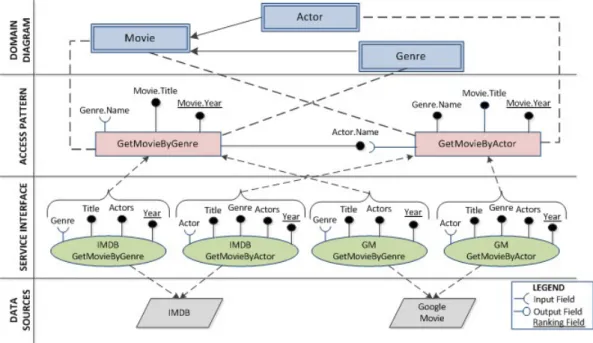
Challenges. We observe web materialization challenges through a view-point of SeCo search application. Search applications approach the web data corpus via the multi-layered model of the SeCo Service Description Frame-work (SDF) [Brambilla 2011]. Here search services are typically registered in a service repository that describes the functional (e.g., invocation end-point, input and output attributes) information of data end-points. To illustrate the search process in the SDF context we consider a SeCo query expressed in a natural language "What are the cinemas showing comedies in Auckland". At the top, conceptual level of the SDF model - the query features as:
SELECT Cinemas showing comedies in Auckland. At the middle, access ptern level - the query is further differentiated by the input and output at-tributes of the related access patterns MovieByTitle (AP1) and CinemaByC-ity(AP2)
AP1 MovieByTitle: SELECT output attributes (Movie.Genre, Movie.Year, Movie.Rating) where input attribute(Movie.Title), order by Movie.Genre.
AP2 CinemaByCity: SELECT output attribute (Cinema.addr, Movie.Title) where input attribute(Theater.city).
pat-1.2. Motivation 7
terns, logical connections established by means of input and output attributes in common domain. Thus, attribute Movie.Title logically joins access pat-terns TheaterByCity and MovieByTitle.
Final query presents as:
SELECT M.Movie.Genre, M.Movie.Year, M.Movie.Rating, T.Cinema.addr, T.Movie.Title FROM MovieByTitle as M, CinemaByCity as T WHERE M.Movie.Title=T.Movie.Title AND T.Cinema.City = ’Auckland’ ORDER BY M.Movie.Genre.
Lastly the query is executed against the allocated service interface - bottom SDF level, which in turn maps to an external data source. In the example above we notice the effect of possible data retrieval delays or low quality of the retrieved data due to duplicates saturation on each of the involved services. In case the theater service is affected this prevents timely execution of the movie service that is dependent on the latter’s results to form its own queries and retrieve results. Ultimately the whole search process is delayed and fails on account of untimely delivery of search results to the end-user.
Our intention is to approach materialization challenges at all SDF lev-els. At a physical level where service interfaces directly wrap service calls, materialization process deals with an issue of acquiring data in an efficient and effective way. Our intention is to apply methods similar to hidden web crawling techniques [Madhavan 2008] to query the target data source and iter-atively uncover its content. Here the critical challenge is to acquire optimum data source coverage while maintaining a minimum level of communication with the target source. The level of coverage is measured by the completeness of the answers produced by querying the materialized data set in comparison with the answers obtained against the actual data-set. Hence, the adoption of appropriate query reinforcement techniques is essential for this challenge [Zerfos 2005,Wu 2006]. We intend to exploit semantic relations within source input and output query attributes in order to achieve desired level of query expansion, thus, retrieving the most out of each data source invocation. An-other issue at the service interface level is the maintenance of currency and relevance [Peralta 2008] of the materialized data corpus. We need to be aware of changes in the actual sources and in a timely and efficient manner
prop-1.3. Research Goals 8
agate those changes within the materialized data so that the accuracy and correctness of answers is preserved.
At a logical level one or more service interfaces refer to a common access pattern described in terms of domain entities. Here we are presented with the task of integrating data obtained from different sources following the same access pattern (schema). The differences in ranking functions between the materialized data sets have to be considered and all the materialized data sources belonging to the same access pattern should be assigned the same rank. Another problem lies in the object identification and record matching. There is a level of semantic ambiguity present at a lexical, spatial and temporal level, thus, obscuring the differences or similarities within materialized data that have to be assessed and dealt with.
At a conceptual level collection of service marts serve as a hub for access patterns referring to the same types of entities. Here we deal with material-ized data that shares the same focus while it is described by different access patterns and ranks. The aim is to reconcile the access pattern (or schema) differences and re-rank using one domain specific unifying ranking function. Thus, we remain with one semantically cohesive and schema uniform materi-alized data corpus referring to the same concept.
1.3
Research Goals
As illustrated above this sequence of service calls or communication between SeCo search and external data sources is subject to factors influencing con-nection pattern joins which in turn affects performance and accuracy of the search. These factors are beyond SeCo engine control mechanism and can be put into two main categories: the environmental constraints of the Internet and internal rules of the mapped sources. Often the search process is affected by the high latency due to the Internet network congestion, routing problems or simply slow responsiveness of the ’other’ side. Mapped services may have their own rules as in limited number of daily accesses or self-imposed time delays between search requests.
prob-1.3. Research Goals 9
lem of finding a sequence of access patterns which when executed produces a materialization output. Our second research goal is the optimization of the materialization process so that the most optimal sequence in terms of mate-rialization output efficiency and quality, executes at all times. As each access pattern can be mapped to several services each differentiated by its perfor-mance and materialized data domain characteristics, the services sequence needs to be monitored in materialization run-time by gathering and analyz-ing predefined materialization metrics. Accordanalyz-ing to materialization run-time metrics the materialization process is optimized by switching between avail-able services.
We define individual research objectives in the next section.
1.3.1
Materialization Formulation
Materialization formulation deals with building factors of the materialization solution. First, it considers all access patterns in SDF that contain the desired materialization output in their output domains. Second, access patterns are analysed in terms of satisfiability of input and output domains dependency. Third, feasibility analysis produces a combination of access patterns in the form of a reachability graph i.e., a combination of access patterns for which the full materialization is possible [Zagorac 2014]. Last, all of the services mapped to the selected access patterns are taken into consideration and used during the materialization process, according to arun-time optimization pro-cedure. Figure 1.1outlines the steps of the materialization solution. First, for
1.3. Research Goals 10
a given taskT it considers all access patterns in the service description frame-work (SDF) - described in Chapter 4 section 4.2 - that contain the wanted materialization output in their output domains. Secondly, the access pattern selection is analysed in terms of their input and output domain dependences - feasibility. Thirdly, the analysis produces the feasible combination of access patterns - a reachability graph i.e., a combination of access patterns for which the full materialization is possible. Lastly, all of the services interfaces (SI) mapped to the selected access patterns are taken into consideration and used during the materialization process, according to the run-time optimization procedure that achieves materialization M.
1.3.2
Solution Feasibility
In this thesis a feasibility analysis is performed with two distinct objectives in mind. Firstly, the objective of the analysis is to establish which of the AP combinations is capable of producing the desired materialization output for the given set of input dictionaries. In order to perform the analysis the concept of reachability is explored [Murata 1989]. A combination of access patterns is observed as a network in which input and output of the APs represent the nodes and the query execution instigates propagation of the values - network tokens through the network. By determining the furthest access pattern that can be reached by a single query execution the reachability of the solution is established.
Secondly, all reachable combinations of APs are further analysed to deter-mine the network nodes whose position shapes the network coverage - bound-edness - in terms of the number of queries this AP combination executes [Murata 1989].
1.3.3
Solution Optimization
A given materialization scenario may result in a reachability graph that in-volves access patterns with several available service interfaces. In this situation it is necessary to further differentiate between services belonging to the same access pattern on the basis of service properties.
1.4. Thesis Contributions 11
The goal of optimization is to minimize the running time of the materi-alization process, while maximizing the produced materialization output and maintaining the right leverage between the performance and the quality of the obtained materialization.
As each access pattern can be mapped to several services, the material-ization sequence needs to be monitored in materialmaterial-ization time by gathering and analysing predefined materialization metrics. According to materializa-tion run-time metrics the materializamaterializa-tion process can be adjusted by switching between available services so that the most optimal sequence in terms of mate-rialization output efficiency and quality executes at all times. In this situation it is necessary to further differentiate between services belonging to the same access pattern.
In this thesis we look at the optimization variables and potential metrics
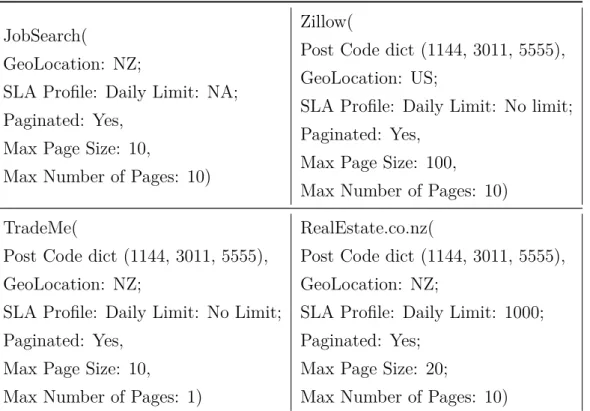
across service interface properties, materialized data characteristicsand prop-erties derived from the solution feasibility analysis. Each service interface is characterized by a set of properties defining their Uniqueness, Performance
and Service Level Agreement features.
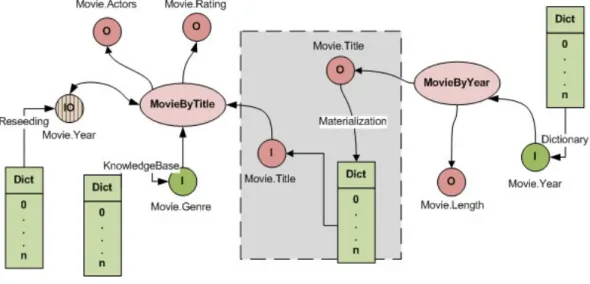
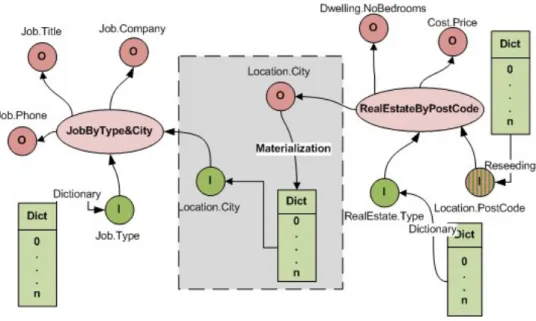
Materialized data domain characteristics are specific to each output do-main whereby each output dodo-main logically connected to the input dodo-main is characterized by the properties of the attribute values in the domain and how they appear in the materialization discovery. This information is used in self-sustainable materialization scenarios where output domain values are used to generate - reseed - new materialization queries.
1.4
Thesis Contributions
As a main contribution this thesis delivers a novel concept of web data view materialization as a well-defined and promising solution for ensuring the qual-ity of the dependent heterogeneous, multi-domain query response in a search-computing application context. To our knowledge this is a first attempt in this field that provides a set of solutions unique to search computing.
The primary focus of this work is to characterize the novel concept of ma-terializing web queries as views i.e., locally stored answers that can be queried
1.4. Thesis Contributions 12
in order to provide a reliable data source bed for associated heterogeneous, multi-domain search.
The overall goal of the thesis is to define and characterize materialization dimensions, their properties, and their influence on effectiveness of web data materialization. This goal is driven by the motivation to overcome the con-straints imposed by web data access limitations, and their effect on efficient execution of multi-domain query answering.
We make the following contributions in this thesis:
• Definition of web materialization dimensions and underlying challenges,
• Formulation, characterization and formal definition of the service and materialization properties relevant to the materialization process through all levels of SeCo Service description framework,
• Formulation of the building blocks for the materialization feasibility analysis,
• Definition of the materialization feasibility analysis method and the ac-companying algorithms,
• Web data materialization optimization approach that aims at specific materialization dimensions in the materialization process context,
• Formulation and formal definition of a set of performance dimensions and their metrics for web source materialization,
• A cost model that utilizes optimization metrics in order to qualitatively differentiate between web services in terms of materialization time,
• Materialization process optimization strategies and algorithms based on the web source performance dimension metrics and query optimization procedure.
Concise materializations are required to satisfy needs of domain focused, spe-cific results driven search scenario such as SeCo search application search. To deliver this and provide desired level of precision the search application needs
1.5. Thesis Structure 13
a reliable data source provider. We believe that the above achieved contri-butions provide the search computing process with these exact means, thus, making it valuable and complementing to the field.
1.5
Thesis Structure
This thesis consists of eight chapters, followed by appendices and references. Chapter 1 details the research problems, questions, objectives and contri-butions of this thesis.
Chapter 2 gives insight into the search computing research context and the research methods that either complements or contrasts this work.
Chapter 3 emphasizes the materialization dimensions and the underlying challenges; it outlines the approaches for its resolution including the literature review of the proposed approaches.
Chapter 4 presents the building blocks of the novel concept of web data materialization. It expands on the service and materialization models; it presents service and materialization properties, materialization scenarios and the materialization process.
Chapter 5 delivers a case study that focuses on one of the building block dimensions and illustrates a potential problem solution.
Chapter 6 presents a materialization feasibly analysis; the consequent fea-sibility model; the empirical study and a discussion on the efficiency of the proposed model.
Chapter 7 is focused on the materialization optimization; it delivers the materialization optimization metrics, the cost model and consequent optimiza-tion algorithms. The chapter is concluded by an exhaustive empirical study proving validity of the proposed algorithms.
Finally, Chapter 8 presents a discussion of the implications of the results and a summary of the research. In addition, Chapter 8 presents a discussion of potential future research, limitations of this study and conclusions based on the contributions that have been made by this thesis.
1.6. Publications from the thesis 14
1.6
Publications from the thesis
The following research papers have been written and published during the course of this research.
Zagorac, Sran & Pears, Russel. Web Data Source Materialization: Optimization Approaches. Elsevier - Data and Knowledge Engineering Journal. Under review.
Zagorac, Sran & Pears, Russel. Web Materialization Formulation: Modelling feasible solution. In Database and Expert Systems Applica-tions (pp. 366-374). Springer International Publishing.
Bozzon, A., Ceri, S., & Zagorac, Sran. Materialization of web data sources. In Search Computing (pp. 68-81). Springer Berlin Heidelberg, 2012 Barbieri, D. Bozzon, A. Brambilla, M. Ceri, S.; Pasini, C. Tettamanti, L. Vadacca, S. Volonterio, R. & Zagorac, Sran. Exploratory Multi-domain Search on Web Data Sources with Liquid Queries. In Web Engineering (pp. 363-366). Springer Berlin Heidelberg.
1.7
Chapter Summary
This chapter has provided a summary that forms the foundation of this thesis including an introduction to the research problem and the primary research objective. The next chapter examines the web data materialization in the search computing context and presents related research areas.
Chapter 2
Methodology Overview
2.1
Introduction
In this chapter, we review main themes of literature related to the contribu-tions made in this thesis. Firstly, we discuss previous research in the view of the materialization area that holds the most significance to this work. Then we assess significance of binding schemas (access patterns) in the materialization context.
Further, we introduce web service composition, an area of relevance to the materialization formulation feasibility solution as web data sources closely re-assemble relations within web services. In the same context we introduce Petri nets as a modelling tool of preference for web services composition analysis.
Special consideration is given to query languages; we present an overview of relevant query languages and their involvement in deep web querying and data integration areas.
Further, we review previous research in the area of search engine caching in contrast to our approach. We then present the research related to the sampling of the hidden web data sources and discuss its relevance to our work. Lastly we discuss web crawling in the context of web data materialization and the data acquisition dimension.
2.2
View Materialization
Traditionally, in a relational database context views are needed because the actual schema of the DB is normalized for implementation reasons and the queries are then executed on one or more de-normalized relations that better represent the real world. Then, defining a new relation that encapsulates
2.2. View Materialization 16
the denormalized relations as a single unified view allows queries to be more intuitively specified.
A view can be materialized by storing the tuples of the view in the database or any persistent storage medium [Gupta 1999]. Index structures can be built on the materialized views [Agrawal 2000]. Consequently system ac-cesses to the materialized view can be much faster than re-computing the view [Amiri 2003]. A materialized view is therefore like a cache - a copy of the data that can be accessed quickly.
A materialized view provides fast access to data [Aouiche 2009]; the speed difference might be critical in applications where the query rate is high or the views are complex or the physical access to data is affected by network bottlenecks or latency.
The task of view generation and materialization is mainly observed through the problem of answering queries using views. Informally the problem is as follows: Given a query Q over a data source schema and a set of view defini-tions V1, ..., Vn over the same schema, is it possible to answer the query using only the answers to views V1, ..., Vn? Alternatively, we can also ask what is the maximal set of tuples in the answerQthat we can obtain from the views? If we have access to both the views and the data source relations, what is the cheapest query execution plan forQ?
Historically, there have been two sets of application that rely on the prob-lem of answering queries using views. The first class, query optimization and database design, utilizes materialized views for speeding up query processing. Such savings are significant in decision support algorithms when the views and queries contain grouping and aggregation.
In the context of database design, view definitions provide a mechanism for supporting the Independence of the physical view of the data from its logical view. This independence enables us to modify the storage schema of the data without changing its logical schema and to model more complex types of indices [Valduriez 1987]. Hence several authors describe the storage schema as a set of views over the logical schema [Yang 1987,Tsatalos 1996]. Given these descriptions of the storage the problem of computing a query execution plan involves deducing how to use the views to answer the query.
2.2. View Materialization 17
The second class of applications is in the area of data integration. The task of data integration is to provide a common interface to a collection of heterogeneous data sources. Users of such systems do not pose queries in terms of a mediated schema. The mediated schema is a set of relations that is designed for a specific data integration application and contains the salient aspects of the domain under consideration. The data integration systems described in [Levy 1996,Duschka 1997a,Kwok 1996,Lambrecht 1999] follow an approach in which the contents of the sources are described as views over the mediated schema.
The data sources can vary from database systems and legacy systems to -XML based - structured files. Such sources are commonly fronted and effec-tively hidden by interface programs or web APIs found on World Wide Web [Baru 1999,Ives 1999,Manolescu 2001,Naughton 2001,Yu 2004].
As opposed to the traditional database application, where the database schema is modelled by the requirements of the application, the data inte-gration encounters pre-existing data sources with its own data schemas and specifics.
2.2.1
Access Patterns
In the context of data integration where data sources are modelled as views, we may have limitations on possible access paths to data. For example when querying the Internet Movie Database (IMDB) we cannot simply ask for all the tuples in the database. Instead, we must supply one of several inputs (actor, director etc.) and obtain the set of movies in which they are involved. We can model limited access paths by attaching a set of adornments to every data source. If a source is modelled by a view withnattributes, then an adornment consists of a string of length n, composed of the lettersb (bound) and f (free). The meaning of the letterb in the adornment is that the source must be given values for the attribute in that position. The meaning of the letter f in an adornment is that the source does not have to be given a value for the attribute in that position. For example, an adornment bf for a view (A, B) means that tuples of V can be obtained only by providing values for
2.2. View Materialization 18
attributes A.
Previous research has considered the problem of answering queries using views when the views are also associated with adornments describing limited access patterns. In [Rajaraman 1995] it is shown that the bound given in [Levy 1996] on the length of a possible rewriting does not hold anymore.
[Rajaraman 1995] shows that in the presence of access-pattern constraints it is sufficient to consider a slightly larger bound on the size of the rewriting: n+v, where n is the number of sub goals in the query and v is the number of variables in the query.
The situation becomes more complicated when we consider maximally contained rewritings. As the following example given in [Kwok 1996] shows, there may be no bound on the size of a rewriting. In the following example, the relationDBpapersdenotes the set of papers in the database field, and the relation AwardPapers stores papers that have received awards (in databases or any other field). The following views are available:
DBSourcef(X) :−DBpapers(X) CitationDBbf(X, Y) :−Cites(X, Y) AwardDBb(X) :−AwardP aper(X)
The first source provides all the papers in databases, and has no access-pattern limitations. The second source, when given a paper, will return all the papers that are cited by it. The third source, when given a paper, returns whether the paper is an award winner or not.
The query Q(X) asks for all the papers that won awards:
Q(X) :−AwardP aper(X). (2.1) Since the viewAwardDBb(X) requires its input to be bound, we cannot query it directly. One way to get solutions to the query is to obtain the set of all database papers from the view DBSource, and perform a dependent join with the view AwardDBb. Another way would be to begin by retrieving the papers in DBSource, join the result with the view CitationDB to obtain all papers cited by papers in DBSource, and then join the result with the view AwardDBb. As the rewritings below show, we can follow any length of citation
2.2. View Materialization 19
chains beginning with papers in DBSource and obtain answers to the query that were possibly not obtained by shorter chains. Hence, there is no bound on the length of a rewriting of the query using the views.
Q0(X) :−DBSource(X), AwardDB(X)
Q0(X) :−DBSource(V), CitationDB(V, X1), ..., CitationDB(Xn, X), AwardDB(X).
However, as shown in [Duschka 1997a,Duschka 1997b], we can still find a finite rewriting of the query using the views, although a recursive one.
In [Duschka 1997a] it is shown that a maximally-contained rewriting of the query using the views can always be obtained with a recursive rewriting. In [Friedman 1997,Lambrecht 1999] the authors describe additional optimiza-tions to this basic algorithm.
2.2.2
Query languages
Query languages can be defined as specialized programming languages for se-lecting and retrieving data from "information systems". These are (possibly very large) data repositories such as file systems, databases, and (are all or part of) the World Wide Web [Bailey 2005]. Query languages are specialized insofar they are simpler to use or offer only limited programming functional-ities that aim at easing the selection and retrieval of data from information systems.
With the emergence of the Web in the early 1990s as a heterogeneous in-formation source, query languages are undergoing a renaissance motivated by new objectives: Web query languages have to access structured data that are subject to structural irregularities (semi-structured data) to take into account rich textual contents while retrieving data, to deliver structured answers that may require very significant reorganizations of the data retrieved, and to per-form more or less sophisticated per-forms of automated reasoning while accessing or delivering meta-data.
Logic-based Web query languages such as the experimental language Xcerpt [Berger 2003,Berger 2004,Guha 1998] have been proposed, and
Se-2.3. Web Service Composition 20
mantic Web query languages such as RQL, RDQL, and SPARQL [ Prudhom-meaux 2005] clearly have logical roots. Furthermore, language optimizers and evaluators of XPath and XQuery [Robie 2001,Trombetta 2004] exploit tech-niques formerly developed, thus, bringing these languages back to the logical roots of query languages. At the beginning of this ongoing query language renaissance, a principled and summarized presentation of query language foun-dations surely makes sense.
In the context of search computing, queries are expressed in a con-junctive declarative query language over service interfaces named SeCoQL [Braga 2011]. SeCoQL, an SQL variant elected as the most compact and readable conjunctive formulation for both experts and developers, easily gen-erated by the UI modules and easily parsed by the underlying SeCo modules.
2.3
Web Service Composition
Historically, answering queries over independent data sources has been the re-search object of parallel or distributed query processing [Ives 2004,Özsu 2011, DeWitt 1990]. Two main techniques have emerged in this research field: code shipping and data shipping. While code shipping to Web services is not feasi-ble, data shipping is feasible and allows the feeding of results coming from one service in the access plan to another service in the plan. The latter technique is heavily leveraged in search computing applications, as data are shipped in pipelines from one service to another, so as to maximize parallelism.
Web services are loosely coupled, platform-independent, self-describing software components that can be published, located and invoked via the Web infrastructure using a stack of standards such as SOAP (Simple Object Access Protocol), WSDL (Web Service Description Language) and UDDI (Universal Description, Discovery and Integration). Recently, Web services have been recognized as the next generation framework for building agile distributed ap-plications over the Internet. One of the most promising advantages of Web service technology is the possibility of creating value-added services by com-posing existing ones. Several techniques have been proposed in this area [Dustdar 2005] [Milanovic 2004].
2.3. Web Service Composition 21
The coordinated execution of distributed Web services is the subject of Web services composition, which comes in two different flavours: orchestration and choreography [Daniel 2006]. The distributed approach of choreographed services (e.g., using WS-CDL [WSCDL 2005] or WSCI [WSCI 2002]) does not suit our query processing problem, because choreographies are not executable and require the awareness of and compliance with the choreography by all the involved services. The centralized approach of orchestrated services (e.g., using BPEL [OASIS 2007]) suits better the research problem addressed in this thesis, as orchestrations are executable service compositions (i.e., feasible solution in our terminology) and services need not be aware of being the object of query optimization and execution. In the specific case of BPEL, however, its workflow-based approach does not provide the necessary flexibility when the invocation order of services needs to be computed at runtime, as is our case (e.g., dynamically fixing a number of fetches to be issued to a service remains hard).
There is a growing amount of semantic approaches to the runtime com-position of Web services (e.g., [WSMO 2010] or [Confalonieri 2004]), but their focus is typically on functional requirements or quality of service [ Bian-chini 2006] and less on data. Inspired by the work presented in [ Srivas-tava 2006,Tatemura 2007] introduce the idea of continuous query over service-provided data feeds (e.g., through RSS or Atom). The goal is to mash up and monitor the evolution of third-party feeds and to query the obtained result. Their mash-up query model is articulated into collections of data items and collection-based streams of data (streams also track the temporal aspect of collections and allow the querying of the history of collections). Suitable se-lect, join, map, and sort operators are provided for the two constructs. The described system consists of a visual mash-up composer, an execution engine, and interfaces for users to subscribe to mash-up feeds equipped with person-alized queries.
Finally, Yahoo! Pipes [YahooPipes 2014] and IBM Damia [Altinel 2007] are a data integration services that enable a Web 2.0 approach to com-pose ("mash up") queries over distributed data sources like RSS/Atom feeds, comma separated values, XML files, and similar. Both approaches come with
2.3. Web Service Composition 22
user-friendly and intuitive Web interfaces, which allow users to draw workflow-like data feed logics based on nodes representing data sources, data transfor-mations, operations, or calls to external Web services. Both Yahoo! Pipes and IBM Damia require the user to explicitly specify the query processing logic procedurally, which is generally not a trivial task for unskilled users, especially for the case of joins, which have to be explicitly programmed by the user. Instead, with our approach we automatically derive a plan from a declarative query formulation.
It is worth noting that the previous service querying approaches effectively enable users to distribute a query over multiple Web services, but they do not specifically focus on the peculiarities of search services, such as ranking and chunking. In this thesis we look into chunking or pagination as one of the essential service properties. Service pagination is treated as essential part of the query generation techniques and data surfacing strategies.
Also while these examples are useful first sources for looking for services, many service directories that can be found on the Web are not stable, fail to adhere to UDDI and, with time, become unreliable. Moreover, centralized registries suffer from problems associated with having centralized systems such as a single point of failure, and bottlenecks.
2.3.1
Petri Net
The Petri net [Petri 1962,Peterson 1981] is a well founded process modelling technique that has formal semantics. It has been used to model and analyse several types of processes including protocols, manufacturing systems, and business processes [Aalst 1999]. A Petri net is a directed, connected, and bipartite graph in which each node is either a place or a transition. Tokens occupy places. When there is at least one token in every place connected to a transition, we say that the transition is enabled. Any enabled transition may fire removing one token from every input place, and depositing one token in each output place.
A Web service behaviour is basically a partially ordered set of operations. Therefore, it is straightforward to map it to a Petri net. Operations are
2.3. Web Service Composition 23
modelled by transitions and the state of the service is modelled by places. The arrows between places and transitions are used to specify causal relationships. Work by Benatalah and Hamadi [Hamadi 2003] assumed that a Petri net, which represents the behaviour of a service, contains one input place (i.e., a place with no incoming arcs) and one output place (i.e., a place with no outgoing arcs). A Petri net with one input place, for absorbing information, and one output place, for emitting information, will facilitate the definition of the composition operators and the analysis as well as the verification of certain properties (e.g, reachability, boundedness, deadlock, and liveness).
The work presented in this thesis relates to analysis of web data mate-rialization feasibility as a propagation of tokens through a bipartite of in-terconnected places and can, thus, be modelled using Petri Nets. The main difference is the possibility of a service access pattern to contain sets of input and output places with a composition operator joining these two sets.
There are mainly two compatibility considerations [De Backer 2004, Narayanan 2002] between different web services (web data sources). First, syntactically, web services can be composed only if the provided interfaces specified by WSDL (schema) with port types operations, and message types match the required interfaces of the other web services. The second one is be-havioural including equivalence and usability. Two web services are equivalent if one service can be replaced by another while the remaining components stay unchanged. Web services are usable if the interactions among them guarantee compatibility.
The syntactical compatibility refers to the conformance of access signa-tures between the two web services. For instance, if one web service invokes an operation of the second one, it is necessary that the parameters, their number and type match each other. Data-driven based methods are often adopted for the syntactic consideration. Data mapping is to relate equivalent data elements of two messages so that two interfaces that belong to different services can be linked. Two services can be composed by specifying the output message of one interface as the mirror image of the input message of another one. In order to solve the problems of integrating data models and message formats, Extensible Stylesheet Transformations (XSLT) can be used. Nezhad
2.3. Web Service Composition 24
et al. propose a solution for mismatches between service interfaces based on schema matching [Nezhad 2007]. They first identify the relationships between messages in partner web services and then specify mapping functions. A work by [Tan 2009] proposes a method to automatically check and mediate the messages sent and received by two web service parties during the interaction. A satisfaction of syntactic requirement is not enough for successful inter-action. To illustrate, let us consider two on-line restaurant rating web services with simple matching access schema that take cuisine type and location as an input and return a list of restaurants and locations ranked by user ratings. The first web service expects an area name as a location input e.g., Auckland, Ponsonby or Auckland, Parnell while the other service takes post code as a location input eg., 1010 or 1134. Consequently, interaction between these two ends up in deadlock. This kind of problem is also classified as a non-local choice problem [Ben-Abdallah 1997]. Thus, the behaviour of web services must be taken into account when analysing the compatibility of web services. Since the textual specification of BPEL is not suitable for computer aided verification for behaviour incompatibility, current methods mainly follow two steps, i.e., modelling and analysis.
As an appropriate method for modelling and analysing distributed business processes [Van der Aalst 1998], Petri nets are also an adequate modelling tool for web service behaviour. As shown in [Hamadi 2003], they are able to define and verify usability, compatibility and equivalence of web services. In partic-ular, their semantics for BPEL are proposed [Hamadi 2003,Martens 2005b]. Since BPEL is becoming the industrial standard for modelling web service based business processes, a Petri net based method is, thus, directly applica-ble to real world examples.
Ouyang et al. [Ouyang 2005] transform BPEL into Petri nets represented in the Petri nets markup language and perform WofBPEL to support three types of analysis, i.e., reachability analysis, competing message-consuming activities and garbage collection of queued messages by generating the full state space. They adopt Petri net reduction rules to reduce a model before generating its state space [Ouyang 2007].
2.4. Caching 25
Petri net (BPN) and presents a decision algorithm for the controllability of a BPN model based on a communication graph (c-graph). A c-graph is a directed, bipartite graph in which nodes denote reachable states of the BPN and edges denote messages that the BPN is able to send or receive. Martens transforms the check of interaction between the composed BPEL processes into the verification of deadlock-freeness of a BPN. After all parts that yield a deadlock are cut off, the remaining part of BPN is proven to be controllable. Koenig et al. [Kónig 2008] point out that the BPEL specification distin-guishes two kinds of business processes, i.e., executable and abstract. Most of the previous work [Hamadi 2003,Martens 2005b] focuses on abstract ones. Their work permits the occurrence of incompatible cases. When it happens, it is detected by the analysis method based on the Petri net-based model, and then, two BPEL profiles for composition re-design can be applied, i.e., the ab-stract process profile for observable behaviour from bottom-up viewpoint and the abstract process one for templates from top-down viewpoint. Their main idea is to substitute an erroneous service with a correct one. The efficiency of this - substitute - based approach depends upon how to find out the exactly right web service from thousands of candidate web services with the exact behaviour that conforms to the other web services. In general, these methods may become complex, considering that a single error of a certain web service may affect the compatibility of the whole BPEL process.
We approach the web service compatibility issues by focusing on a) reacha-bility and b) boundedness analysis in the search computing service description framework context.
2.4
Caching
Search engines use optimization in form of caching to speed up result delivery. This optimization occurs in search engines at two levels. A query enters the search engine via a query integrator node that is in charge of forwarding it to a number of machines and then combines the results returned by those machines. Before this is done, however, a lookup is performed into a cache of previously issued queries and their results. Thus, if the same query has been recently