Fingerprint Verification System Using
Support Vector Machine
S. Adebayo Daramola, Tola Sokunbi and A.U Adoghe
Department of Electrical and Information Engineering Covenant University
Ota, Nigeria.
Abstract—Efficient fingerprint verification system is needed in many places for personal identification to access physical facilities, information etc. This paper proposes robust verification system based on features extracted from human fingerprints and a pattern classifier called Support Vector Machine (SVM). Three set of features are fused together and passed to the classifier. The fused feature is used to train the system for effective verification of users fingerprint images. The result obtained after testing 100 fingerprints is very encouraging.
Keywords-fingerprint, fused feature, Support Vector Machine and verification I. INTRODUCTION
Personal identification based on fingerprint image is one of the most important research areas in the field of pattern recognition. Fingerprint image is a viable biometric physiological feature and it had been used by many researchers to develop recognition systems. Each person has unique fingerprint pattern. Fingerprint images can be obtained using ink impression on substances or through scanning using biometric sensor connected to a computer.
A fingerprint image can be described as pattern of interleaved ridges and valleys lines. In grayscale fingerprint image the valleys are shown as white lines while the ridges are the black lines. These lines form various types of pattern. The pattern can be classified as left loop, right loop, arch, whorl and tented arch. The ridges are characterized by unique feature called minutia. Minutia points occur at ridges ending or bifurcation. Bifurcations are points at which a ridge split into two lines.
Fingerprint recognition systems had been developed by many researchers using combination of different feature extraction methods and pattern classifiers. In some cases features are extracted from the whole fingerprint image [1][2][3][4][5]. On other hand it involves extraction of minutia points from ridges. Matching of test features with user template is achieved using prominent classifiers like Support Vector Machine (SVM), Artificial Neural Network (ANN), Hidden Markov Model (HMM) and Euclidean distance[2][3][4].
In [2] fingerprint recognition system based on embedded Hidden Markov Model is proposed. Feature in form of orientation angle is extracted from image block matrix by scanning with sampling window form left to right and top to bottom of the whole image. Whereas in [5] fingerprint recognition system using combination of feature extracted from sectorized cepstrum fingerprint image and Euclidean distance is presented. In many cases features are extracted from fingerprint minutia points and thereafter used as input to template matching algorithm [6][7][8][9][10][11][12].
The feature extraction method proposes in this paper is different from the one that had been done before. In many existing systems false minutiae are wrongly treated as true minutiae. In this paper the whole pattern points are used to obtain the features. Three features are extracted from fingerprint block images. These features capture the trait of human fingerprint at local and global level.
The rest of the paper is organized as follows: section 2 provides detail information on the proposed system which includes image preprocessing, feature extraction method, training and classification algorithm based on Support Vector Machine. Section 3 shows the experimental results and finally conclusion is presented in section4.
II. PROPOSEDFINGERPRINTVERIFICATIONSYSTEM
A. Description of Proposed System
The proposed fingerprint verification algorithm flow chart is as shown in Fig.1. The first component of the system is the biometric input sensor. It is used to acquire digital image from human fingerprint. The acquired grayscale fingerprint image is sent to preprocessing stage. The third stage is the feature extraction algorithm where robust features are extracted from the preprocessed image. The next stage is the training process, where
model is generated for each of the users. The last component is the verification algorithm based on Support Vector Machine.
end
Figure 1. Proposed fingerprint verification system flow chart
B. Fingerprint Image Acquisition Device
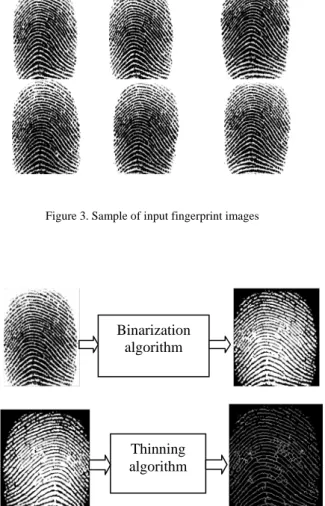
The fingerprint capture device used in this work is Secugen Hamster Plus Fingerprint Scanner produced by SecuGen Biometric Solutions. The device is as shown in Fig2. It uses an advance technique called Surface Enhanced Irregular Reflection (SEIR). It produces an 8-bit grayscale image of size 260x300pixels. It has an effective resolution of 500 dpi +0.2%. The Secugen sensor features auto-on and smart capture technology. The auto-on feature automatically switches on the scanner whenever a finger is detected. The smart capture technology improves the quality of the images captured [13]. Samples of fingerprint images captured by the device are as shown in Fig.3.
C. Preprocessing of Fingerprint Image
Two morphological operations are performed on the input grayscale fingerprint image. The first operation is called binarization. Binarization is used to separate the foreground information from the background. That is it converts the grayscale image to binary image by setting the threshold value so that gray value below the threshold is change to ‘0’ and those value above the threshold is change to ‘1’. After then the binary fingerprint images are passed to the thinning algorithm. The thinning operation help to rind
Preprocessing algorithm
Feature extraction: fused feature formed from three new features
Verification algorithm based on SVM SVM models Matched fingerprints Mismatched fingerprints System decide Input image
the foreground pixels from the ridges until each of the ridges is at least one pixel wide. The preprocessing operation is as shown in Fig.4.
Figure 2. Biometric fingerprint sensor
Figure 3. Sample of input fingerprint images
Figure 4. Preprocessing operation. Binarization
algorithm
Thinning algorithm
D. Feature Extraction Algorithm
In this paper, three set of new features are extracted from thinned fingerprint image blocks. The whole fingerprint image pattern is partitioned into smaller image blocks. The extracted features are used to capture position and direction of pixels in fingerprint image. The algorithm for the feature extraction is as follows:
(i) Calculate centre of gravity of the thinned fingerprint image using (1).
(1)
(ii) Partition the fingerprint image into four smaller image blocks
(a) Through point x and y make a vertical and horizontal splitting across the image. (b) Obtain four block images B1, B2, B3 and B4.
(iii) Calculate the centre of gravity of block images B1, B2, B3 and B4 using (1).
(a) Through point x and y make a vertical and horizontal splitting across each of the block images.
(b) Obtain sixteen smaller block images from B1, B2, B3 and B4 as shown in Fig. 5. (iv) Extract three set of features named:
(a) The number of connected pixels (C) in the fingerprint block image. (b) City-block distance (D) of the pixels in the fingerprint block image.
The city block distance between points (x1,y1) and (x2,y2) :
(2) (c) The area (A) of each of the sixteen fingerprint block images :
(3) (v) Fuse the three features (C, D and A ) to obtain 48dimentional feature vector (F).
Figure 5. Graphical User Interface shows sixteen fingerprint image blocks.
E. Support Vector Machine for Verification
Support Vector Machine (SVM) is a feature classification technique. It has ability to split feature space into two major classes, via optimal hyper plane such that the expected generalization error is minimized. An optimal hyper plane is represented by the largest margin of separation between the two classes. The training feature vectors have to lie outside the margin, a small subset of the feature vectors that lie exactly on the margin are the support vectors. Application of SVM in fingerprint image classification problem consists of two phases: training and testing. During training, the SVM takes as input fingerprint image data that consist of positive and negative samples and the problem of separating a set of training vectors belonging to two separate classes is solved by training algorithm. The algorithm searches for an optimal hyper plane such that the distance to the support vectors is maximized. Verification of query fingerprint image is determined by classify each of user query fingerprint feature as belong to any of the two classes. The decision is based on the distance of the query data from the hyper-plane.
III. EXPERIMENTALRESULT
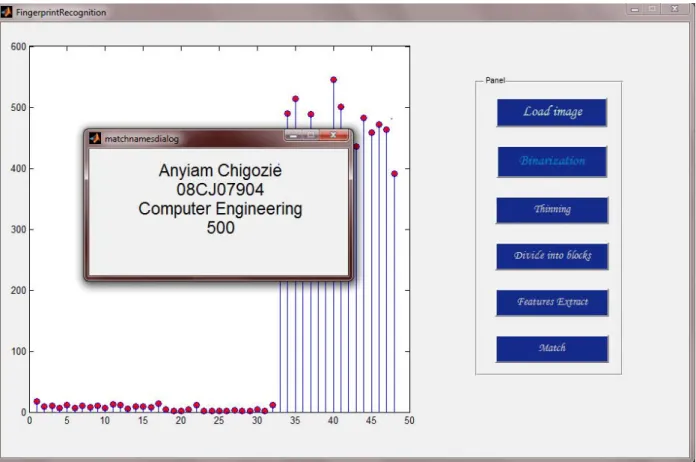
Experiments are performed to determine the effectiveness of the proposed system. Training and testing of the system algorithm are carried out using our database. Six fingerprint images are collected from each of the fifty students of Covenant University Ota, Nigeria. Four fingerprint images are used during training to produce model for each of the users. 100 fingerprint images are tested, 80 fingerprint images are correctly matched while 20 fingerprint images are mismatched. Fig.6 shows the stem plot of test feature of a particular user and corresponding matched user detail. The implementation of the system algorithms is carried out using MATLAB R2012a platform [14].
Figure 5. Graphical user interface shows matched result.
IV. CONCLUSION
Fingerprint verification system based on Support Vector Machine is proposed for effective personal identification. Fingerprint image is partitioned into smaller blocks at moderate resolution in order to capture predominate feature at local and global level. The performance of the proposed system which depends majorly on the robust features extracted from the whole fingerprint pattern is very encouraging.
REFERENCES
[1] C.Lakshmi Deepika, Dr. A Kandaswamy, C. Vimal, and B. Sathish “Invariant feature extraction from fingerprint biometric using pseudo zernike moments”. International Journal of Computer Communication and Information System Vol.2. No1, July – Dec 2010. [2] D. Singh, P.K Singh and R.K Shukla “Fingerprint recognition system based on mapping approach” International Journal of Computer
Applications, Vol 5, No.2, pp1-5, 2010.
[3] J.K Gupta and R.Kumar, “An efficient ANN based approach for latent fingerprint matching”, International Journal of Computer Applications, Vol. 7, No.10, pp18-21, 2010.
[4] S. A Daramola and C .N Nwankwo “Algorithm for fingerprint verification system”, Journal of Emerging Trends in Engineering and Applied Sciences, Vol. 2(2), 2011.
[5] B Kekre, T. Sarode and R. Vig, “Fingerprint identification using sectorized cepstrum complex plane”, International Journal of Computer Applications, Vol.8-No.1,pp12-15,2010.
[6] Ching-Tang Sieh, Shys-Rong Shyu “Principal Component Analysis for minutiae verification on fingerprint image”, Proceedings of the 7th WSEAS International Conference on Multimedia Systems & Signal Processing, Hangzhou, China, April 15-17, 2007. [7] J. Ravi, K.B Raja, K.R Venugopac, “Fingerprint recognition using minutiae score matching”, International Journal of Engineering
Science and Technology, Vol.1(2), pp35-42,2009.
[8] Manvjeet Kaur, Mukhwinder Singh, Akshay Girdhar, and Parvinder S. Sandhu “Fingerprint verification system using minutiae extraction technique”, World Academy of Science, Engineering and Technology, 2008.
[9] Dr. Neeraj Bhargava, Dr. Ritu Bhargava, Prafull Narooka, Minaxi Cotia “Fingerprint recognition using minutia matching”, International Journal of Computer Trends and Technology, Vol.3, Issue4, 2012.
[10] Raju Rajkumar, K Hemachandran “A secondary fingerprint enhancement and minutiae extraction” Signal & Image Processing: An International Journal (SIPIJ) Vol.3, No.2, April 2012.
[11] Dhole S.A. and Patil V.H. “Minutiae based fingerprint identification”, Journal of Signal and Image Processing Volume 3, Issue 3, pp122-125, 2012.
[12] Smital D.Patil1 and Shailaja A.Patil “Fingerprint recognition using minutia matching”, World Journal of Science and Technology, Vol.2(4), pp178-181, 2012.