Infusing Photonics to Increase Enrollment in Electronics Engineering
Technology
Chrys A. Panayiotou, Indian River Community College, 3902 Virginia Ave, Fort Pierce, Florida 34981,[email protected] Fred P. Seeber, Camden County College, New Jersey 08012, [email protected]
Abstract:During the last 15 years most of the electronics engineering technology programs across the nation have experienced a constant decline in enrollment. Today’s high school students do not seem to consider a career in electronics engineering appealing enough to commit to a field of study in desperate need of new students. They still associate electronics programs with the electronics section of a department store; televisions, stereo systems, DVD and VCR players, and other disposable electronics. While the downward trend continues across the nation, Indian River Community College (IRCC) has been able not only to stop it but to reverse it by attracting a new generation of students. By introducing high school students to new and emerging technologies, their perception of established degrees has changed and their interest has been stimulated.
Photonics is one of those technologies capturing students’ attention. IRCC, a partner college in the National Center for Optics and Photonics Education (OP-TEC), with the assistance of other colleges like Camden County College which already offers an Associate in Applied Science degree in Photonics, has created a Photonics specialization under the Electronics Engineering Technology program. The targeted marketing of this new specialization has led to an increase in enrollment of 50% in 2005, 80% in 2006, and for 2007 it is projected it to be over 100%. An interesting comparison can be made concerning enrollment at colleges with a full AAS program in photonics like Camden County College and IRCC which uses photonics as an enabling
technology. This analysis could lead to a new approach in restructuring engineering technology degrees with the infusion of photonics throughout many technology fields. This presentation will discuss the plan of action that made possible this initiative at Indian River Community College and new program directions at Camden County College, Blackwood, New Jersey.
1. Introduction
Photonics education has been delivered in two modes: the full fleshed AAS degree in photonics/optics as at Camden County College, and the infusion of photonics courses in existing engineering AAS degrees as at Indian River Community College. Below we will examine both approaches.
1.1 The IRCC approach.
Beginning with the 1990s, the state of Florida experienced a constant decrease in the enrollments of electronics engineering technology (EET) programs [1]. This decline in enrollment was not only local to Florida, but was common throughout most of the United States of America [2]. Even though everyone understands that the type and the kind of electronic equipment and devices we use in our daily routines are on the rise, we yet experience a reduction in interest in the study of electronics engineering. At many community colleges across the nation, electronics programs shut their doors without much of a struggle. Indian River Community College could not accept defeat without putting up a good fight. The problem was examined from all its angles in order to figure out its root causes, and then a solution and a strategic plan was devised. Out of the traditional electronics program the Robotics and Photonics Institute (RPI) was created and started in the fall of 2006 with 100% capacity. The photonics curriculum was developed with assistance from OP-TEC which offers a complete series of books with associated laboratory experiments in basic optics and lasers [3]. We are now in the middle of our recruiting campaign for the fall 2007 term which is going so well that we will have the luxury of selecting the best 24 out of a total of 60 applicants. This paper presents the successful approach of Indian River Community college in solving a problem that has distressed many electronics departments of community colleges throughout the United States.
1.2 The Camden County College approach
This paper will also discuss existing full photonics technology programs, particularly at Camden County College, Blackwood, New Jersey, and their attempt to maintain adequate enrollment numbers. It is our hope and desire to help any other college that is experiencing similar problems as we did both as photonics infusion programs or full photonics AAS degree programs and provide advice and suggestions on how to overcome them.
The photonics/fiber optics department of Camden County College was started in 1976 and has steadily grown to be one of the most advanced centers of learning and training in photonics and fiber optics in the country. In 1989, it moved into its own building - the Laser Institute of Technology for Education and Research. Over these three decades, the department has received many grants from federal and state organizations as well as photonics industries. Dr. Fred Seeber, Professor Emeritus of Photonics/Physics, is the main architect of the growth of this department and has chaired it for nearly three decades. The department can boast of practically every type of laser system and detectors. In the fiber optics division, every type of equipment necessary for optical communications is available. The faculty, both full-time and adjunct, are well qualified, and most of them possess doctorates and many years of experience in their specialty.
Student enrollment has fluctuated over the years with enrollment levels as high as 50 students per semester to about 15 each semester. Currently a total of 27 students are enrolled in the program. The cause of this fluctuation is difficult to determine not only at CCC but at many other full AAS Photonics programs around the country. Some have suggested that four year institutions have started their own programs offering degrees in photonics engineering and technology. Others point to the curriculum difficulty and prerequisite requirements of a photonics program as compared to others offered at the community colleges. A main focus of OP-TEC is to try to determine some of the causes related to low enrollment figures. The lack of enrollment is certainly not because of the job market. It has been generally strong in most areas of the photonics industry. Graduates have done extremely well in their careers, many of them graduating from four year colleges and universities and becoming presidents of their own start up companies or attaining high positions in established firms.
2. The problem as identified by IRCC
The low enrollment in the electronics programs is caused by the following factors: the students do not understand the depth and breadth of the electronics industry, curriculum was not updated to include the new technologies, and the marketing of the electronics programs was non-existent or inadequate. Even though many educators identified one or more of these problems the bureaucratic system of most community colleges was slow to react and remedy the problem fast enough before the “death” of the program [4].
2.1 Students do not understand the depth and breath of the electronics industry
The electronics industry has been around for more than 100 years and became the under-grid of almost all modern technologies such as telecommunications, biomedical, biotechnology, genetics, computing, industrial automation and controls, robotics, electro-optics, lasers, fiber optics, entertainment electronics, warfare and anti-warfare electronics, electronic publishing, laboratory instrumentation, and many others. To most people though, the word electronics brings to mind the electronics section of a department store, and that is where the problem begins. The department store electronics belong to the consumer electronics sector which needs no technicians any more because of the disposable nature of these products. The word electronics has been stereotyped to the television, VCR, DVD, audio systems, and all the other home appliances that the cost of repair is higher than the cost of a newer appliance with more features and usually cheaper than the one it is replacing. To change this stereotypical misconception an intensive educational and, at the same time a promotional campaign has to be undertaken. All promotional material produced needs to avoid association with the consumer electronics sector, but present and emphasize the new technologies of lasers, photonics, robotics, biotechnology, medical electronics etc.
2.2 Modernizing and revisiting the curriculum
Many instructors and institutions are reluctant to change the curriculum. They are so adamant about not modifying the curriculum, they almost consider blasphemous any attempt to change it [4]. The Photonics Advisory Committee at Camden County College consists of members from both the photonics industry and universities. Former Camden
County College graduates sit as members of this important committee. The committee meets at least once a year and its recommendations are incorporated into the curriculum. It is these individuals who can advise the faculty of a photonics program about how to proceed in the future. The curriculum must change every so many years in order to add the new technologies in our AS or AAS degree programs. The fact that these degree programs have to remain at the length of two years and at a fixed number of credit hours makes it imperative that we revisit the existing
curriculum and remove what is no longer needed to make room for the new knowledge. In the 1970’s, for example, in a digital electronics course we taught the discrete transistor circuitry that made up an individual AND gate. In the 1980’s we stopped teaching what is “under the hood” of the AND gate because we had to make room for decoders, encoders, multiplexers and demultiplexers. As more digital devices have been invented we had to always go back and take something out in order to make room for the new. The same systematic approach has to be applied to the entire electronics program. First the new technologies that need to be introduced have to be identified, and then a review of the curriculum has to take place, to determine what has to be removed without loss in quality of the technician we will produce. All the core courses of DC and AC circuits, Discrete and Integrated Analog circuits, need to be revaluated, their scope has to be aligned to the needs of today’s industry, and all the non essential circuit analysis and design needs to be removed to make room for the new courses. The fields of photonics and robotics are very attractive and are very well received by young and older prospective students. Courses in these modern specialties need to be added to the curriculum, and promotional materials need to be produced showing that
education in these new technologies will lead to high wage paying jobs in the service area of the college and beyond. 2.2 Marketing of the modernized program
Most community colleges spend very little in the marketing of their electronics programs and do not have a professional marketing person or even a marketing department. The marketing effort in most of the colleges with enrollment problems consists of creating unattractive, single color brochures that are stacked up in a few display areas around the college. In some colleges an additional effort is made to take these brochures to different area high schools and distribute them to students. Community colleges will seldom place ads on television or on the radio for marketing programs and recruiting students. In contrast to this, private electronics colleges advertise on television regularly on prime-time, and on the radio more frequently. Even though the cost of attending these private colleges is usually more than four times the cost of a community college, the private schools have not experienced as dramatic a decrease as community colleges have. The reason is the intense and effective marketing effort of the proprietary colleges. These for-profit colleges have a coordinated marketing campaign consisting of attractive colorful print publications, professionally produced interactive websites, and trained marketing people who are paid well only if they produce results. Community colleges can stand against this professionally organized campaign of the proprietary schools by selling their strong points, which are: much lower cost to the student, better equipped labs, better educated faculty which typically has higher scholarly credentials, and accreditation by high caliber accreditation boards. This has to be emphasized with appealing colorful print and electronic promotional material.
3. The Idea of the Robotics and Photonics Institute
At Indian River Community College, the electronics department, in consultation with its industrial advisory committee, decided to infuse the emerging fields of robotics and photonics into the traditional electronics engineering technology AAS degree
program. The electronics program consists of 68 credit
hours out of which 15 are devoted to general education courses. The remaining 53 credit hours are technical courses required to produce a quality technician. The 53 credit hours of technical courses had been divided into two groups: the major field core and the
major field electives, as shown in figure 1. Figure 1. Breakdown of the Electronics Eng. Tech. Program AAS Degree in
Electronics Engineering Technology 68 credits
General Education 15 credits
Major Field Core 34 credits
Major Field Specialization 19 credits
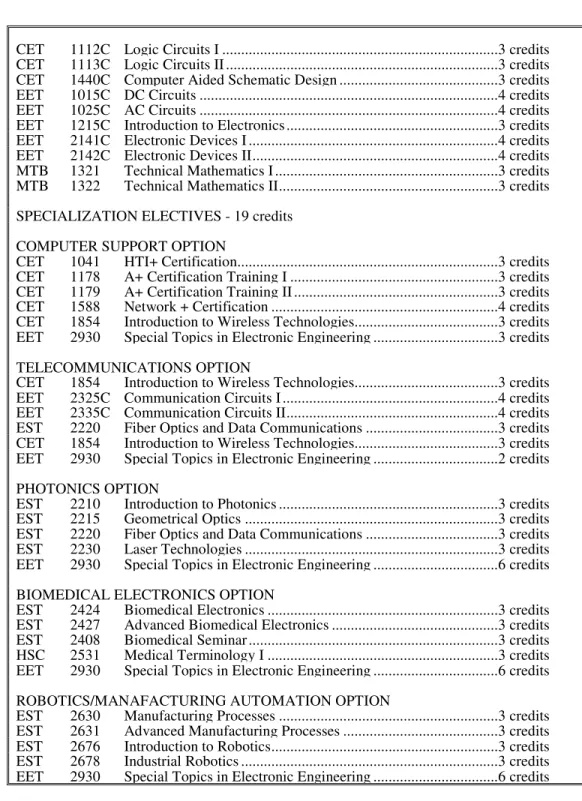
In the major field electives group, we had the specializations of telecommunications, computer support and biomedical options. We added the Photonics option and the Robotics/Manufacturing option. Each one of these options consists of a group of courses totaling 19 credit hours as shown in figure 2.
CET 1112C Logic Circuits I ...3 credits CET 1113C Logic Circuits II ...3 credits CET 1440C Computer Aided Schematic Design ...3 credits EET 1015C DC Circuits ...4 credits EET 1025C AC Circuits ...4 credits EET 1215C Introduction to Electronics ...3 credits EET 2141C Electronic Devices I ...4 credits EET 2142C Electronic Devices II...4 credits MTB 1321 Technical Mathematics I ...3 credits MTB 1322 Technical Mathematics II...3 credits SPECIALIZATION ELECTIVES - 19 credits
COMPUTER SUPPORT OPTION
CET 1041 HTI+ Certification...3 credits CET 1178 A+ Certification Training I ...3 credits CET 1179 A+ Certification Training II ...3 credits CET 1588 Network + Certification ...4 credits CET 1854 Introduction to Wireless Technologies...3 credits EET 2930 Special Topics in Electronic Engineering ...3 credits TELECOMMUNICATIONS OPTION
CET 1854 Introduction to Wireless Technologies...3 credits EET 2325C Communication Circuits I ...4 credits EET 2335C Communication Circuits II...4 credits EST 2220 Fiber Optics and Data Communications ...3 credits CET 1854 Introduction to Wireless Technologies...3 credits EET 2930 Special Topics in Electronic Engineering ...2 credits PHOTONICS OPTION
EST 2210 Introduction to Photonics ...3 credits EST 2215 Geometrical Optics ...3 credits EST 2220 Fiber Optics and Data Communications ...3 credits EST 2230 Laser Technologies ...3 credits EET 2930 Special Topics in Electronic Engineering ...6 credits BIOMEDICAL ELECTRONICS OPTION
EST 2424 Biomedical Electronics ...3 credits EST 2427 Advanced Biomedical Electronics ...3 credits EST 2408 Biomedical Seminar ...3 credits HSC 2531 Medical Terminology I ...3 credits EET 2930 Special Topics in Electronic Engineering ...6 credits ROBOTICS/MANAFACTURING AUTOMATION OPTION
EST 2630 Manufacturing Processes ...3 credits EST 2631 Advanced Manufacturing Processes ...3 credits EST 2676 Introduction to Robotics...3 credits EST 2678 Industrial Robotics ...3 credits EET 2930 Special Topics in Electronic Engineering ...6 credits
Figure 2. The modified AAS Degree Program
After the student completes the general education and the major field required core, he can choose any one of the four specializations or “cherry pick” courses from the four specializations, totaling 19 credit hours. After studying the needs of the local industry and carefully planning a marketing campaign, we decided to create the Robotics and
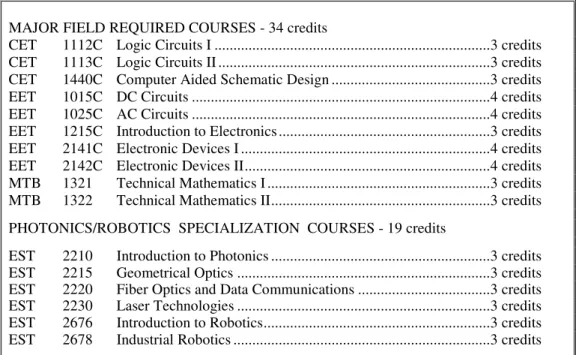
Photonics Institute that would consist of the 15 credit hours of general education, the 40 of major required courses, 12 hours of photonics and 7 hours of robotics as shown in figure 3.
MAJOR FIELD REQUIRED COURSES - 34 credits
CET 1112C Logic Circuits I ...3 credits CET 1113C Logic Circuits II ...3 credits CET 1440C Computer Aided Schematic Design ...3 credits EET 1015C DC Circuits ...4 credits EET 1025C AC Circuits ...4 credits EET 1215C Introduction to Electronics ...3 credits EET 2141C Electronic Devices I ...4 credits EET 2142C Electronic Devices II...4 credits MTB 1321 Technical Mathematics I ...3 credits MTB 1322 Technical Mathematics II...3 credits PHOTONICS/ROBOTICS SPECIALIZATION COURSES - 19 credits
EST 2210 Introduction to Photonics ...3 credits EST 2215 Geometrical Optics ...3 credits EST 2220 Fiber Optics and Data Communications ...3 credits EST 2230 Laser Technologies ...3 credits EST 2676 Introduction to Robotics...3 credits EST 2678 Industrial Robotics ...3 credits
Figure 3. Robotics and Photonics Curriculum
4. Marketing and Promotional Campaign
Colorful flyers were produced which explained the program in detail, educating the reader about the many high wage jobs awaiting upon graduation. A point was made to compare the high cost of the proprietary schools to the cost of attending IRCC. The newly packaged program was marketed as the Robotics and Photonics Institute (RPI), a selective admission program that required an application process with minimum entrance requirements. The courses for RPI were scheduled Mondays through Fridays from 8:00 a.m. to 12:15 p.m. and the applicants commit to taking all the courses as a cohort group from the beginning to the end of the degree. The RPI was presented by a college recruiter to four high schools and the workforce retraining office. An open house event, which many students and parents attended, took place in the Spring semester of 2006, and three one-week summer camps in emerging technologies were offered in July 2006. The local newspapers were contacted and three different articles were published about the new program between April and July of 2006. The RPI term by term schedule is displayed in figure 4.
FIRST YEAR
FALL TERM Days Time Cr SPRING TERM Days Time Cr
EET1215C Intro to Electronics M/W 8:00- 9:15 3 CET1140C Schematic Design M/W 8:00- 9:15 3 MTB1321 Tech. Mathematics I M/W 9:30- 10:45 3 MTB1322 Technical Mathematics II M/W 9:30- 10:45 3 CET1112C Logic Circuits I M/W 11:00- 12:15 3 CET1113C Logic Circuits II M/W 11:00- 12:15 3 EET1015C DC Circuits (Fall A) T/R 8:00- 11:00 4 EET2141C
Electronic Devices I (Spring A)
T/R 8:00- 11:00
4 EET1025C T/R 8:00- 4 EET2142C Electronic Devices T/R 8:00- 4
AC Circuits (Fall B) 11:00 II (Spring B) 11:00
Term Total: 17 Term Total: 17
SUMMER TERM ENC1101 English Composition I 3 PHY1020 Principles of Physics 3 SECOND YEAR
FALL TERM Days Time Cr SPRING TERM Days Time Cr
EST2542 Programmable Logic Controllers I M/W 8:00-9:15 3 EST2544 Programmable Logic Controllers II M/W 8:00- 9:15 3 EST2676 Introduction to Robotics M/W 9:30- 10:45 3 EST2630 Manufacturing Processes M/W 9:30- 10:45 3 EST2210 Intro to Photonics M/W 11:00-12:15
3 EST2215 Geometrical Optics M/W 11:00- 12:15 3 Social/Behavioral Science Elective T/R 8:00- 9:15
3 Humanities Fine Arts Elective
T/R 8:00- 9:15
3 Humanities Fine Arts
Elective
T/R 10:00- 11:15
3 EET2930
Special Topics (Spring I)
T/R 9:30-10:20
1
Term Total: 15 Term Total 13
Program Total: 68 Cr
Figure 4.Photonics and Robotics Institute Program of Study
Camden County College Programs
The photonics AAS degree program in both Laser/Electro-Optics Technology Degree and Fiber Optics Technology Option Degree Camden County College are listed below.
Photonics
Laser/ Electro-Optics Technology Option Degree: Associates in Applied Science
Code Course Credits
First Year / First Semester
LFO-101 Introduction to Photonics & Photonic Safety 4 MTH-125 College Algebra & Trigonometry or
MTH-140 Calculus I1 4
ENG-101 English Composition I 3
PHY-101 Physics I or
PHY-201 Physics III1 4
... Humanities Elective 3
18 Second Semester
EET-101 Electrical/Electronic Principles 4 MTH-132 Statistics for Technology or
MTH-150 Calculus II1 4
ENG-102 English Composition II 3
LFO-201 Photonics Materials 3
PHY-102 Physics II or
PHY-202 Physics IV1 4
18 Second Year / First Semester
LFO-211 Photonic Optic Principles & Components 4
LFO-212 Pulsed & CW Lasers 3
LFO-231 Photonic Measurements 3
EET-211 Electronics I 3
LFO-241 Intro to Fiber Optics 3
HPE... Health & Exercise Science Elective 1 17 Second Semester
LFO-292 Photonics Seminar 1
LFO-221 Photonic & Electro-Optic Devices 3 LFO-251 Laser Electronics or
EET-212 Electronics II 3
………. Social Science elective 3
... Computer Programming Elective 3 HPE... Health & Exercise Science Elective 1 14
1All students transferring to Rowan University or NJIT must take the Calculus I, II track and Physics III, IV track.
Photonics
Fiber Optics Technology Option Degree: Associates in Applied Science
Code Course Credits
First Year / First Semester
LFO-101 Introduction to Photonics & Photonic Safety 4 MTH-125 College Algebra & Trigonometry or
MTH-140 Calculus I1 4
ENG-101 English Composition I 3
PHY-101 Physics I or
PHY-201 Physics III1 4
... Humanities Elective 3 18 Second Semester
EET-101 Electrical/Electronic Principles 4 MTH-132 Statistics for Technology or
MTH-150 Calculus II1 4
ENG-102 English Composition II 3
LFO-201 Photonics Materials 3
PHY-102 Physics II or
PHY-202 Physics IV1 4
18 Second Year / First Semester
LFO-211 Photonic Optic Principles & Components 4 LFO-241 Introduction to Fiber Optics 3
LFO-231 Photonic Measurements 3
EET-211 Electronics I 3
... Social Science Elective 3 HPE... Health & Exercise Science Elective 1
17 Second Semester
LFO-292 Photonics Seminar 1
EET-221 Digital Circuits 3
LFO-294 Fiber Optic Project 3
LFO-242 Advanced Fiber Optics 3
... Computer Programming Elective 3 HPE... Health & Exercise Science Elective 1 14
1All students transferring to Rowan University or NJIT must take the Calculus I, II track and Physics III, IV track.
5. The Fruits of Our Labor
By the middle of July 2006, the RPI was full to capacity and we had to direct many applicants to our evening program. Because of the size of our labs we could only accept 24 students in the first RPI cohort group. The group consisted of 22 men and two women. The age distribution ranges from 18 to 55 years old, with 19 of the students being under 26 years old and five between 30 and 55 years old. The cohort arrangement brought the students close to each other, and a strong feeling of camaraderie is evident in the classroom. They all help each other towards their common goal which is graduation and landing of a good paying job. The students form their own study groups and assist each other, not only with college activities, but give each other private personal assistance.
In our departmental website used for instructional purposes, we have added general information about the robotics and photonics industry, how to transfer to a bachelor’s degree program at the University of Central Florida, and we also keep an active bulletin board posting part and full-time jobs. All these synergistic activities generate a productive spirit of care and cooperation between the students and the faculty of our department. Camden County College experienced similar success in past years with like endeavors in its full AAS Photonics programs. However, as environments change both at the high schools and four year colleges and universities as well as industry,
modifications are almost constantly required for maintaining enrollment.
6. Future Plans and OP-TEC
We are planning to add a third course in the photonics option that will consist of several modules of laser technology applications. These modules are under development by OP-TEC with the support of the National Science
Foundation. We are also developing a series of videos of the experiments for the first course of OP-TEC,
“Fundamentals of Light and Lasers”. We will make these videos available to colleges that are interested in infusing photonics in their curricula. The location of IRCC on the Atlantic coast of Florida, and its proximity to three world class ocean research institutions, prompted the exploration of a cutting-edge application of photonics in
bioluminescence. We are in discussions with all of our research partners with the purpose of creating educational materials for these technologies, training technicians for their special needs, and assisting them in their mission of exploring and protecting our oceans. IRCC as a principal partner with OP-TEC, is chartered to produce educational modules in the areas of homeland security. CCC is chartered to produce educational modules in applications of lasers in medical electronics.
7. Conclusion
Electronics engineering technology education is a moving target. One cannot rest after a successful implementation of a program. We always need to be vigilant and continually scan the horizon for the new technologies that are appearing and taking root. Curriculum must be revisited, updated, and modernized to not only satisfy the needs of today’s industry, but anticipate the new needs created by the emerging technologies. Engineering departments need to be visionary, forward looking, risk taking, and flexible in the creation and delivery of new knowledge. Industry cannot wait for the slow bureaucratic wheels to turn. Community colleges have to deliver at the speed of industrial changes and not the speed of intra-college mechanisms. The presentation and marketing of our educational programs is as important as the technical content of our degrees. Full AAS Photonic Technology programs need to reassess their course offerings and develop career pathways to make sure curriculum offerings meet the needs of
their industrial employers and to honor articulation agreements for transfer to four year colleges and universities. Efforts should also be made to infuse photonics into other technical areas as suggested in this paper.
References
[1] Florida Community Colleges 2006 Fact Book, available at:
http://www.firn.edu/doe/arm/cctcmis/pubs/factbook/factbook_main.htm [2] Science and Engineering Indicators 2006, National Science Board http://www.nsf.gov/statistics/seind06/
[3] OP-TEC, http://www.op-tec.org/
[4] L. Frenzel, “The Dissapering Associate Degree Program in Electronics technology”, Proceedings of the American Society for Engineering Education Annual Conference & Exposition, (2003)