Effectively Utilizing
BC’s Licensed Practical Nurses
and Care Aides
15 August 2007
EXECUTIVE SUMMARY
During 2006 policy discussions between the Ministry of Health, the Health Employers Association of BC, health care employers and the Facilities Bargaining Association, representatives discussed many of the factors that contribute to effective utilization of Licensed Practical Nurses (LPNs) and Care Aides. Based on these discussions the Ministry of Health agreed to fund a report (the Report) to: 1) examine the evolving utilization of LPNs and Care Aides across the province, 2) identify some current approaches that promote effective utilization and 3) recommend strategies that would support optimal utilization of LPNs and Care Aides in the future. A series of focus groups with LPNs and Care Aides and interviews with practice leaders from rural and urban areas throughout BC were conducted to gain a better understanding of the factors that influence the optimal utilization of LPNs and Care Aides. While both employee and employer groups discussed the benefits of newly emerging or enhanced roles for LPNs and Care Aides, both groups also acknowledged that there are often
challenges with the implementation of these changes. As a result, this Report focuses on strategies that would assist change management, as well as support optimal utilization of LPNs and Care Aides.
A Strategic Approach to Change Management
A majority of participants talked about the need for a planned change
management process when new roles are being introduced and/or skill mix is being reconfigured. Participants were clear that change requires planning, time and energy. Factors and opportunities that are important considerations include:
• Use a change management process
• Assemble a leadership team
• Attend to roles and responsibilities of all staff
• Communicate and encourage input from staff
• Support and evaluate change
• Review decision making processes
• Set reasonable time limits
Optimal Utilization of LPNs and Care Aides
Additionally, initiatives that would further support the optimal utilization of LPNs and Care Aides and assist with the change management inherent in enhanced roles or reconfiguring skill mix are:
• Transition to practice opportunities for new graduate LPNs
• Professional development and education opportunities for LPNs
and Care Aides
• Leadership training and leadership opportunities for LPNs
• Collaborative practice opportunities to assist LPNs’ and Care
Aides’ participation in clinical practice issues
• Participation of LPNs and Care Aides on formal
decision-making structures, as appropriate
• Mechanisms to support the on-going sharing of promising
practices and change management successes
A follow-up to this Report is being planned for January 2009 to learn about the progress and development of these Recommendations and other
initiatives that will support the optimal utilization of LPNs and Care Aides in British Columbia.
TABLE OF CONTENTS
EXECUTIVE SUMMARY ... 1
TABLE OF CONTENTS ... 3
ACKNOWLEDGMENTS ... 4
Terminology and Acronyms ... 4
Similar Terms... 5 INTRODUCTION... 6 Objectives ... 6 Approach... 6 Scope ... 7 Associated Projects ... 8
About this Report ... 8
CHAPTER 1 THE CURRENT LPN WORKFORCE ... 10
Nature of Work...10
Role in the Health Care Team ...10
History...10
Education ...11
Workforce Size and Distribution ...13
CHAPTER 2 THE CURRENT CARE AIDE WORKFORCE ... 15
Nature of Work...15
Role in the Health Care Team ...15
History...15
Education ...15
Workforce Size and Distribution ...16
CHAPTER 3 CHANGING SKILL MIX... 18
Skill Mix Decision Making ...18
The Importance of Change Management ...18
Case Study - A Systematic Approach to Skill Mix Changes at Vancouver Island Health...21
CHAPTER 4 CHALLENGES & OPPORTUNITIES ... 29
LPNs ...29
Historical Perceptions...29
Case Study - Letting Off Steam: How Kootenay Boundary Regional Hospital is Transforming Frustration into Empowerment...34
Shared Skill Sets between RNs and LPNs ...38
Education and Training ...42
Rewards of the Job...45
Care Aides ...47
Recognition and Inclusion in the Care Team ...47
Work Responsibilities...51
Case Study - Care Aides Selected for Skilled Tasks in Emergency Department...52
Advocacy and Engagement...57
Education and Training ...59
CHAPTER 5 – RECOMMENDATIONS... 62
APPENDIX A ... 65
Membership of the FBA Joint Policy Committee and the LPN/CA Utilization Sub Committee ...65
ACKNOWLEDGMENTS
The preparation of this Report was one of the terms of reference of the FBA Joint policy Committee (FBAJPC). The FBAJPC would like to express its appreciation to the numerous individuals and organizations that participated in the preparation of this Report. We are grateful for the time, effort and expertise that was contributed by health sector employees and employers who took part in the interviews and focus groups and candidly discussed their past and present experiences. Their contributions form the substance of this Report.
We would also like to thank the College of LPNs of BC , Camuson College, HEABC, and the consultants involved in the Care Aide Competency Project and the “Let’s Talk” project for providing information and data during the preparation of this Report.
The FBAJPC is also appreciative of the work of the Utilization Subcommittee which provided guidance and direction in the research and writing of this Report. The membership of the FBAJPC and the Utilization Subcommittee is contained in Appendix A to this Report. The FBAJPC would also like to express its gratitude to Wynona Church and Christine Vandebeek, managing partners of Howegroup Public Sector Consultants, for conducting action research with Practice Leaders, LPNs and Care Aides across BC, presenting the challenges and opportunities that were identified with these participants, and suggesting recommendations to the Utilization Subcommittee.
The FBAJPC is also grateful to the Chief Nursing Officers of the Province for their dialogue and support of the Report and the Recommendations. Finally, the FBA JPC would also like to thank the Nursing Directorate, Ministry of Health for providing funding for the work of the FBAJPC and this Report.
Terminology and Acronyms
This Report has endeavored to keep acronyms and jargon to a minimum. These acronyms are used in the paper:
LPN Licensed Practical Nurse (also called Registered Practical Nurse
in Ontario)
RN Registered Nurse
RPN Registered Psychiatric Nurse
CLPNBC College of Licensed Practical Nurses of BC
CRNBC College of Registered Nurses of BC
HEABC Health Employers Association of BC
HEU Hospital Employees’ Union
FBA Facilities Bargaining Association
FBAJPC Facilities Bargaining Association Joint Policy Committee
Similar Terms
Unless otherwise specified, the term “nurse” is used to refer to the following
regulated nursing professions: RNs, RPNs and LPNs.
The term “Care Aide” is used to refer to the combined group of terms used by
Practice Leaders and Care Aides themselves and in health employer’s job descriptions including Health Care Aides (HCAs), Resident Care Aides (RCAs); Patient Care Aides or Personal Care Attendants/Assistants (PCAs); Nurse aides and Nursing attendants.
INTRODUCTION
Health care in British Columbia and in Canada has undergone considerable change over the last few years and more change is expected. Population growth, an aging population and technological advances in diagnosis and treatment contribute to increasing demands for health services. British Columbia, like all other provinces, is
currently facing nursing shortages and waiting lists for health services. This pressure is expected to continue in the future and is leading governments to explore alternative options for the delivery of high quality health care. The BC government and health care employers are actively seeking opportunities to improve the utilization of all health care personnel, including Licensed Practical Nurses and Care Aides. In 2006, the Facilities Bargaining Association Joint Policy Committee was established, with representatives from the FBA; Ministry of Health; health care employers; and the Health Employers Association of BC,
all collaborating to enhance the utilization of LPNs and Care Aides.i
Objectives
The objective of Effectively Utilizing BC’s Licensed Practiced Nursesand Care Aides is to support decision makers in effectively utilizing
LPNs and Care Aides across BC.
Research on Roles and Utilization: LPNs and Care Aides in BC (the “2000 Report”), a report jointly prepared in 2000 for the FBA and
HEABC, is an important reference point for this current work.
Particular attention has been paid in this Report to identifying progress and emerging roles for LPNs and Care Aides since 2000.
This Report provides:
9 Identification of some challenges and opportunities for
effective utilization of LPNs and Care Aides.
9 Retention and recruitment strategies for LPNs and Care Aides
in BC – with particular emphasis on improving the profile of LPNs and Care Aides in the care team.
9 Factors that promote career satisfaction for LPNs and Care
Aides in BC.
9 Examples of optimal utilization of LPNs and Care Aides through
the use of case studies and “promising practices” that are being utilized by health employers in BC.
9 Recommendations for implementing strategies that promote
optimal utilization of LPNs and Care Aides in BC.
Approach
The FBAJPC appointed a sub-committee, called the Utilization Sub-committee, to oversee the research and writing of this Report. The Howe Group was retained to interview Practice Leaders, conduct focus groups and interviews with LPNs and Care Aides, present keychallenges and opportunities that arose in this research to the
Utilization Subcommittee and describe the history and current state of both LPN and Care Aide workforces in draft reports.
To understand the challenges and opportunities for LPN and Care Aide utilization, interviews were conducted between February and June 2007 with the following:
• 7 health care executives
• 12 directors / site managers
• 1 Clinical Nurse Educator
• 1 Clinical Nurse Specialist
• 1 union representative
• 1 educator
• the Utilization Subcommittee
BC’s Chief Nursing Officers were asked to identify 2 to 3 Practice Leaders from their Health Authorities to participate in in-depth interviews. Members of the Utilization Subcommittee facilitated recruitment of LPNs for focus groups and Care Aides for focus groups and interviews. In February and March 2007, 25 LPNs and Care Aides from Health Authorities participated in three focus group sessions and individual interviews to discuss their perceptions of their work
environments as well as barriers to and enablers of effective utilization. Additionally, between May and July 2007, sites that demonstrated approaches that promoted effective utilization of LPNs and Care Aides were identified by Practice Leaders who were
interviewed to obtain their expertise and discuss these approaches. Additionally, a meeting was held with the Chief Nursing Officers of the Province to discuss the Report and recommendations prior to
finalization. The Report was finalized by the Utilization Subcommittee in alignment with the strategic direction of the FBAJPC.
A follow-up to the Report is planned for January 2009 to learn about the progress and development of the Recommendations and other initiatives that will support the optimal utilization of LPNs and Care Aides in British Columbia.
Scope
This Report outlines the key themes that arose in the focus groups and interviews regarding the challenges and opportunities foreffectively utilize LPNs and Care Aides across BC. It does not provide staffing ratios. The literature and Practice Leaders all agreed that decisions must be made at a local level, based on the demographics of the health region and patient needs, as well as financial and human resource considerations.
As noted, this project was initiated through policy discussions related to the Facilities Health Services Subsector. As a result, it addressed the role of LPNs and Care Aides in acute and continuing
care/residential facilities only. Therefore, the perspective of employers, LPNs and Care Aides working in home care and the community were not solicited or included in this Report.
Associated
Projects
This document complements three associated projects that were underway at the time of this Report’s production:
1. The Care Aide Competency Project, conducted by the
Ministry of Health, will describe competencies for Community Health
Workers and Resident Care Aides in BC. The Care Aide Competency Project focuses on describing the broad based responsibility of Care Aides, their day-to-day activities, how they should carry out each activity (indicators of competent performance) as well as the skills and knowledge needed to carry out their work. A new provincial curriculum and standards for training Care Aides and Community Health Workers are being developed that will reflect these competencies. Effectively
Utilizing BC’s Licensed Practiced Nurses and Care Aides supplements
the Care Aide Competency Project by describing approaches for effectively utilizing Care Aide competencies.
2. The Responsive Shift Scheduling Initiative, another FBAJPC
endeavour that is part of the 2006-2010 FBA Policy Discussions, is underway to assess interest and feasibility in responsive shift
scheduling for LPNs, Care Aides and employers. The Responsive Shift Scheduling Initiative aims to increase awareness, openness, and understanding of responsive scheduling with respect to LPNs and Care Aides across BC.
3. Let’s Talk, another FBAJPC project that is currently underway, will
provide tools to support collaborative practice in the workplace.
Directed to all members of the health care team, the guide is intended to improve communication among all health care workers through the use of structured communication tools that are broadly understood and consistently used by the entire health care team.
About this
Report
The report is organized into five chapters.
♦ Chapter 1 describes the current state of the LPN workforce,
including the employment characteristics of the LPN workforce, education, scope of practice and legislation related to the work of LPNs.
♦ Chapter 2 provides a general description of the current state
of the Care Aide workforce.
♦ Chapter 3 discusses changing skill mix and identifies the need
for change management strategies.
♦ Chapter 4 details the challenges in the dynamics of health
care teams and opportunities for improving the status of LPNs and Care Aides and their utilization.
♦ Chapter 5 provides recommendations for implementing
strategies to promote optimal utilization of LPNs and Care Aides in BC.
Also Contained
in this Report
Promising Practices – Approaches that Promote Effective LPN and Care Aid Utilization1. An LPN Pioneers Clinical Guidelines for Her Peers - Fraser
Health
2. Introducing LPNs as Integral Contributors to Unit Operations –
Vancouver Island Health
3. Developing Distinct Roles and Responsibilities - Fraser Health
4. Handing Off In Ways That Work - Vancouver Coastal Health
5. Shared Learning: A New Approach to Practice Education –
Vancouver Coastal Health
6. Learning Together Enhances Geriatric Care - Provincial
Networks
7. An Established Culture of Relying on Care Aide Observations -
Vancouver Coastal Health
8. Including Care Aides in Care Planning - Fraser Health
9. Including Care Aide Expertise in Policy Development - Northern
Health
10.Learning Together Creates Teamwork - Providence Health
Care’s Youville Residence
11.Promoting Care Aide Leaders - Vancouver Coastal Health
12.An Upsurge of Support for Care Aide Training - Northern Health
Case Studies
1. A Systematic Approach to Skill Mix Changes at Vancouver
Island Health
2. Letting off Steam: How Kootenay Boundary Regional Hospital
Nurses Traded in Frustration for Empowerment (Interior Health)
3. Care Aides Selected for Skilled Tasks at the Royal Columbian
CHAPTER 1 THE CURRENT LPN WORKFORCE
Nature of
Work
LPNs are regulated health care professionals who provide nursing services to individuals, families and groups of all ages. LPNs are now, and have historically been, a necessary part of the health care workforce in BC’s hospitals, long-term care facilities, and other organizations that provide health care services. LPNs combine nursing knowledge, skills and judgment to assess patients/residents, promote health, prevent illness, provide palliative and/or rehabilitative care, and assist patients/residents to achieve an optimal state of health. LPNs assess, plan, implement and evaluate care for patients/residents throughout all stages of life. LPNs practice in a variety of settings and contexts including hospitals,
residential care facilities, public health units, community nursing agencies, private practices, clinics, physicians’ offices, industry, schools, adult day-care centres, private homes and community health centres.
LPNs are regulated health professionals who work along side other health care personnel, including physicians, allied health professionals, RNs, RPNs and Care Aides. Under the current regulatory framework, LPNs must carry out all nursing services “under the direction of a medical
practitioner” or “under the supervision of an RN”.ii At the same time, LPNs
are regulated by their own professional College and responsible for their own practice. Over time, LPNs have been increasingly undertaking leadership roles in residential care facilities, health authority leadership teams, policy committees, and CLPNBC professional development initiatives.
Role in the
Health Care
Team
The Canadian Nurses Association first gave recognition to Practical Nurses in BC in 1914. In 1951, the Practical Nurses Association was established (now the Licensed Practical Nurses Association of BC). In the same year, the BC legislature passed the Nurses (Licensed Practical) Act to regulate the practice of Practical Nursing but the Act did not take effect until 1965. This Act established the BC Council of Licensed Practical Nurses (BCCLPN) as the licensing body for practical nurses and represented the first time that Practical Nursing was recognized as a self-regulating profession. Several amendments were made to the legislation over the years and the requirement that Practical Nurses pass a national exam to obtain licensure was introduced in 1977.
History
In the 1980s, the health care system moved to a more RN-focused model
of care which resulted in LPN displacements, especially in acute care.iii
During this period, many health care facilities opted to hire RNs instead of LPNs due to scope of practice and financial considerations at that time. Despite this, LPNs continued to advance as a professional body. In 1986, a Disciplines Committee was established under the Nurses (Licensed Practical) Act to oversee LPN conduct and licensure became mandatory. Practical Nurses with on-the-job training and some orderlies were “grandparented” into the BCCLPN through a conditional license without writing the registration exam. In 1989, “LPN” became a restricted professional title that could only be used by those registered with the BCCLPN. At that time, some Practical Nurses continued to work under that
title and were not required to register with the BCCLPN. Nonetheless, this was the first of multiple steps to ensure all Practical Nurses working in BC belonged to the regulatory body.
At the start of the 1990s, the Seaton Royal Commission recognized the underutilization of LPNs and called for increased scope and staffing for
LPNs in the acute, long-term care and community settings.iv The 1991
Report of the British Columbia Royal Commission on Health Care and Costs (Seaton Commission) noted that the existing legislation governing
the health care professions created persistent jurisdictional disputes and a distinct lack of cooperation among the health professions, despite the fact that all health professional colleges have the same mandate - to protect
the public from preventable harm.v In the same year, the BCCLPN was
created as a regulatory body of the Ministry of Health. A Code of Ethics and Standards of Practice for LPNs in BC were developed between 1992 and 1994. In 1996 the BCCLPN was designated under the Health
Professions Act and the name was changed to the College of Licensed
Practical Nurses of BC.
The 2000 Report on LPN and Care Aide utilization represented an important collaboration between health care employers and unions regarding the utilization of LPNs and Care Aides. The 2000 Report made several recommendations, including:
Increase awareness among managers and staff about the roles
and competencies of the different nursing groups (LPNs, RNs and RPNs).
Provide funding and Clinical Nurse Educators to support the
continuing education of Care Aides and LPNs.
Standardize provincial home support/Care Aide education.
Facilitate improved communication and collaborative practice at
the site level.
Professional Advancement
LPNs are now taking on a wider scope of responsibilities, including taking physician orders and administering medications. Under prescribed
conditions, LPNs can also pronounce death. As LPNs’ scope has expanded
so has demand for their services.vi Additionally, increased attention has
been placed on effectively utilizing LPNs due to shortages of RNs and the expansion of LPNs into leadership roles in long-term care.
The new licensing standards have required educational upgrades for LPNs to achieve their full scope of practice. By 2005, LPNs who previously held a conditional license were no longer allowed to practice as LPNs unless they completed upgrading courses and successfully passed the
registration exam required for full licensure. Although LPN became a restricted title in 1989, it was not until the start of 2007 that all practical nurses in BC were required to register with the CLPNBC.
Education
BC’s inaugural Practical Nursing Program at Vancouver Vocational Institute (VVI) issued its first diplomas in 1948. Practical Nurses in BC currently complete a 12-month program that includes skills oriented training – such as observations and measurement of vital signs,catheterizations, dressings, and resuscitation measures, as well as critical thinking and independent problem-solving. Since LPNs may practice in a variety of settings or contexts, the curriculum includes a 4-month focus
on each of the following three components of the health care system:
1. Health promotion and illness prevention.
2. Gerontology.
3. Medical-surgical health.
The curriculum for Practical Nurses has advanced considerably in recent years. Since 1992, public educational institutions have offered a standard provincial curriculum and since 1998, the Provincial Practical Nursing Articulation Committee has met annually to discuss provincial curriculum
and ensure that it continues to meet BC’s changing health care needs.vii
In the 2000 Report, Role and Utilization of LPNs and Care Aides in BC, employers and faculty from public educational institutions expressed concern about the lack of supervised clinical learning experiences in these programs. The program now includes 605 hours of practicum and
preceptorship experience in a variety of contexts including
medical-surgical, pediatrics, obstetrics, gerontology, palliative and community care for residents across the lifespan with various health care needs.
BC offers LPN education programs through public educational institutions, as well as private educational institutions, with 6 of the 16 educational
institutions being private.viii As of 1996, all entry level education programs
for LPNs must be approved by the CLPNBC
BC’s 12-month program is shorter in length than other provinces. For example, the LPN program is 16 months in Manitoba, Saskatchewan and
Nova Scotia and 2 years in Alberta, Ontario and New Brunswick.ix Despite
the shorter program, BC graduates had a higher pass rates for the
national exam in 06/07 than the national average.x
As the complexity of patient/resident care has increased, so has the demand to intensify areas of LPN continuing and post basic education. Educational institutions and employers have responded by offering additional courses, including foot care, palliative care, psychogeriatrics, and tracheostomy care, to name just a few.
Implementing steps to support increased utilization of LPNs across BC is seen as a critical part of the solution to the current nursing shortage. Some steps in supporting the enhanced utilization of LPNs have already been taken and include:
1. Funding LPN Upgrading: From 2002 until 2007, the Nursing
Directorate established the LPN Upgrade Fund. It provided funding for more than 100 LPNs per year to complete pharmacology and physical assessment modules that enable LPNs to practice at their full scope.xi
2. Developing LPN Leaders: In 2006/2007, coming out of the FBA
joint policy committee discussions, the Nursing Directorate funded the LPN Leadership Program for 160 LPNs to take the Fundamental
Leadership Skills for Licensed Practical Nurses course at Vancouver
Community College (VCC).xii
3. Operating Room LPNs: In2005 the Nursing Directorate funded a
pilot project to provide post-basic training for LPNs to work in the operating room.
4. Ongoing LPN Education: Between 2006 and 2010, the BC Health
Education Foundation has $3.5 million dollars to be granted for LPN
specialty and continuing education. xiii
Workforce
Size and
Distribution
According to estimates from the Canadian Institute of Health Information (CIHI), there were 4,844 active practicing LPNs in BC in 2005. This figure, however, is lower than the total number of active LPN licenses and
number of jobs held by LPNs.xiv Table 1 compares figures from various
sources.
Table 1: 2005 LPNs in BC
Source Measure Total
CIHI Number of active,
practicing LPN registrations received in first 6 months of
2005 4,884 Health Sector Compensation Information System (HSCIS) Number of LPNs employed by health employers who are HEABC members received funding from MOH in 2005
5,278
CLPNBC Total Number of Active Full
LPN Licenses in 2005 5,590
Data from BC Stats Population Forecastxvshows thatthere are about six
times as many RNs as there are LPNs per 100,000 people in the BC population. Since 1998 the number of LPNs in comparison to RNs has increased so that ratio has changed from 6.4:1 in 1998 to 5.7:1 in 2005. However, the ratio of RNs per LPNs is still higher in BC than in most other provinces. The number of LPN graduates from BC educational programs has risen consistently in past years, from 247 in 2001 to 746 in 2006,
Figure 1: Ratio of RNs per LPN by Province, 2005 5.4 5.7 5.0 3.9 4.3 3.7 3.9 2.4 2.9 2.8 2.0 9.5 -1 2 3 4 5 6 7 8 9 10 YT BC AB SK MB ON QB PEI NB NS NL NWT
Source: CIHI Workforce Trends of Regulated Nurses in Canada, 2005
As shown in Table 2, the majority of LPNs work within BC hospitals. Compared to 1998 more LPNs are being used in residential settings while the proportion of LPNs working in acute care has decreased. Today, at least one-third of LPNs work in residential settings.
Table 2: LPN Place of Work, 1998 to 2005
1998 2002 2003 2004 2005
Hospital 70% (2,639)62% (2,460)56% (2,520)52% (2,667)55%
Nursing Home / Long
Term Care 15% (27% 1,158) 32% (1,400) 35% (1,658) 34% (1,667)
Other Place of Work 15% 11% (465) 12% (531) 13% (633) 11% (550)
Sources: Role and Utilization of LPNs and Care Aides in BC (1998 figures only) and CIHI Workforce Trends of Licensed Practical Nurses in Canada, 2002-2005
In summary, LPNs are regulated health care professionals who provide nursing services to individuals, families and groups of all ages. LPNs are now, and have historically been, a necessary part of the health care workforce in BC’s hospitals, long-term care facilities, and other organizations that provide health care services. As LPNs’ scope of responsibilities has expanded so has demand for their services.
Additionally, increased attention has been placed on optimally utilizing LPNs due to shortages of RNs and the expansion of LPNs into leadership roles in long-term care. Opportunities for the enhanced utilization of LPNs, is a seen as a critical part of the solution to the current nursing shortage.
CHAPTER 2 THE CURRENT CARE AIDE WORKFORCE
Nature of
Work
Care Aides are an important part of a health care team. In hospitals, residential care facilities, and other health care institutions. Care Aides provide patients/residents with assistance in activities of daily living, such as bathing, dressing and grooming. Care Aides provide basic
patient/resident care, which includes answering patient/resident call signals and supplying and emptying bed pans. Sometimes they serve meal trays and assist patients/residents with meals. To help
patients/residents recover, they lift, turn and position patients/residents, and may also supervise patient/residents’ exercise routines. As directed by nursing staff, they take basic measurements, such as blood pressure, temperature and pulse. They collect specimens, such as urine, feces or sputum, administer suppositories, colonic irrigations and enemas, and perform other procedures. They transport patients/residents in
wheelchairs or stretchers for treatment or surgery, carry messages, reports, requisitions and specimens from one department to another, and maintain an inventory of supplies. In acute care as well as in long term care settings, some Care Aides with training perform procedures, such as catheterization and sterile dressings, under the direction of a nurse.
Role in the
Health Care
Team
Care Aides, unlike nurses and allied health professionals, are not regulated under the Health Professions Act of BC. As such, Care Aides work under the supervision of a regulated health care professional, including nurses, physicians and other health care professionals.
History
Care Aides are now, and have historically been, a necessary part of the health care workforce in hospitals, long-term care facilities, and other organizations that provide health care. Although health support workers have been used in BC for more than a century, there is little in the literature about the introduction, practice, work, demand or efficient utilization of the Care Aide. Throughout Canada, there appears to havebeen an increase in the patient care roles of Care Aides in the 1980s.xvii
Care Aides were, and still are, employed mainly in residential care facilities, such as long term care facilities, extended care facilities, intermediate care facilities and community living settings for people with mental and/or physical disabilities. Traditionally Care Aides employed in hospitals were used mainly as porters and ward aides. However, with the current shortage of RNs and LPNs, there is now an increased interest in Care Aides fulfilling some patient/resident care roles in acute care hospitals.
Education
Care Aides were traditionally trained "on the job". Most Care Aides today have completed an educational institution program, about six months in duration, which includes training in personal care and support for seniors and other patients/residents in short-term hospital stays or long-term care. The certificate program for Care Aides, the Resident Care Attendant program, is offered by 10 publicly funded colleges and at least as manyprivate training facilities in BC. xviii Beginning in the 1990s, the public
colleges and some private colleges have followed a provincial curriculum. The curriculum, designed as a combined Resident Care Aide and
Community Health Worker (e.g. Home Support Worker) credential, is currently 23 weeks in length.
In the late 1990s, the unions worked with educators to develop a bridging education program, the ‘LPN Access’ Program, which was developed to enable Care Aides to bridge into the LPN program with credit given for their previous education and experience.
A provincial Home Support/Resident Care Attendant Program Articulation Committee meets annually to discuss entry requirements, curriculum and student mobility between programs. This provides the essential link between autonomous institutions offering Home Support/Resident Care Attendant programs. In BC, oversight of private colleges is limited to a voluntary accreditation process by the Private Career Training Institutions Agency (PCTIA). PCTIA offers consumer protection but puts educators under no obligation to use provincial curriculums or maintain standards and consistency across programs, including standards for English
proficiency as an admission requirement.
As previously noted, the Care Aide Competency Project that is currently being conducted by the Ministry of Health will describe competencies for Community Health Workers, Home Support Workers and Resident Care Aides in BC. A new curriculum and standards based on these
competencies are currently under consideration.
Education programs for Care Aides are available through in-service
workshops and educational college courses. While some resources exist, it is challenging at the local level to release Care Aides to take these
courses. Additional opportunities for education have come into greater demand as Care Aides are:
Taking on more personal care roles in acute care.
Caring for patients/residents of an increasingly high acuity in every
care setting.
Required to use new technology.
Workforce
Size and
Distribution
As an unregulated health care workforce there is no single database providing information about the number of Care Aides in the province. Information about the size and employment characteristics of this
workforce must be obtained from a variety of different sources. According
to the 2001 census, there were 19,117 nurse aides in BC.xix Today, it is
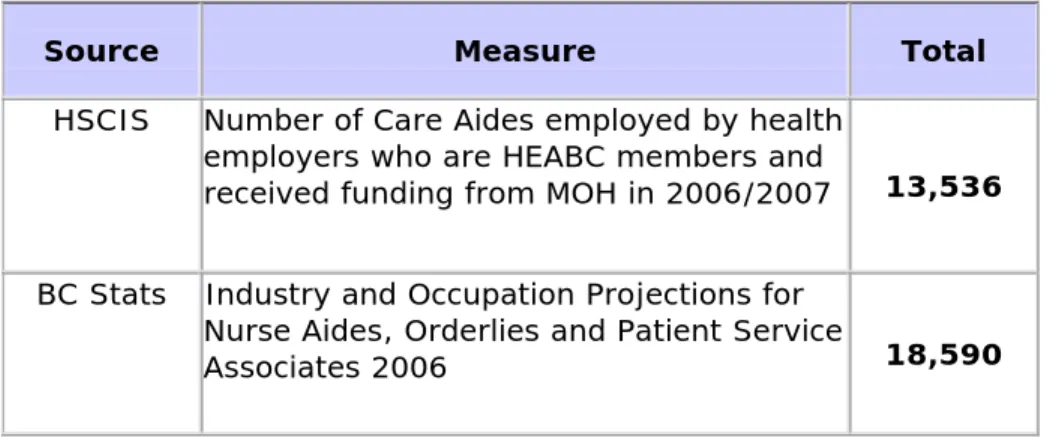
estimated that there are between 19,000 and 21,000 Care Aides in BC. Approximately, 7 out of 10 of Care Aides in the province are captured in HSCIS as shown below in Table 3.
Table 3: Estimated Care Aides in BC, 2006
Source Measure Total
HSCIS Number of Care Aides employed by health
employers who are HEABC members and
received funding from MOH in 2006/2007 13,536
BC Stats Industry and Occupation Projections for Nurse Aides, Orderlies and Patient Service
Associates 2006 18,590
While the HSCIS data does not account for every Care Aide in BC, it does indicate the care settings in which Care Aides are relied upon most. As shown in Table 4 below, nearly half of Care Aides are primarily employed in long-term care. However, the past few years have brought increased utilization in acute care settings with some employers and educational institutions providing education and training in acute care skills for Care Aides.
Table 4: Care Aides Place of Work, 2005 to 2007
Place of Work 2005/2006 2006/2007
Acute Care 29% 32%
Residential Care* 55% 54%
Mental Health 2% 2%
Other 14% 12%
*Residential care includes long-term, extended and privately-operated care. Source: Health Sector Compensation Information System
In summary, Care Aides are an important part of the health care team in today's hospitals, residential care facilities, and other health care
institutions. Care Aides provide patients/residents with assistance in activities of daily living and provide basic patient/resident care. Most Care Aides in BC are employed in residential care facilities; however the past few years have brought increased utilization in acute care settings. Based on the nursing shortage and the aging of the population, there is every indication that both the demand for care aides and their utilization in a broader range of settings will increase in the future.
CHAPTER 3
CHANGING SKILL MIX
Skill Mix
Decision
Making
Appropriate skill mix is an important component in providing quality health care. Effectively achieving appropriate skill mix can present some challenges. Practice leader interviews provided the following insights into some of the factors to be considered.
“Putting LPNs or Care Aides in a work environment where they haven’t traditionally been seen is a matter of organization and a system, unit or program being prepared to take that feeling of discomfort on and test it out.”
- Practice Leader
“There is not enough time spent upfront before changing the care delivery models or skills mix at sites. In health care, we tend to want to get on with things. There is more time trying to fix the resulting problems than pre-empting them by investing in appropriate change management and people development up front.”
- Senior Nurse Leader
“In part, [a review of staff mix] is financially driven; part of it is driven by a shortage of nurses, LPNs or RNs. We also look at it when we’re developing a new program. That is the best time to look at it because that allows us to look at what it is that the resident needs and who is the best health care provider to do that work.” - Practice Leader
The
Importance
of Change
Management
The implementation of a new skill mix can improve the utilization of Care Aides, LPNs, RPNs and RNs. New skill mix configurations can also result in changes for patient care delivery, staff satisfaction, workload, teamwork, communication within and between workgroups and
education and professional development. Because of this multi-faceted impact, health care leaders and focus group participants agreed that a planned change management process is necessary to facilitate the effective implementation of new roles and/or changes in skill mix. Practice Leaders pointed towards a project management approach as key to a successful change. Taking a structured approach sets the expectations for commitment from the Executive, site directors, managers, and staff. Without a project management approach, required skill mix changes may take a second priority to other
initiatives directors and site managers are responsible for and/or may not be understood or supported by all of the affected staff.
As in the 2000 Report, this current Report also wishes to highlight the need for a planned change management process when new roles are being introduced or skill mix is being reconfigured. The planning process is very important for successful integration of new roles and/or a new staffing mix.
Participants in this Report were clear that change requires planning, time and energy and that the factors and challenges that were
identified in the 2000 Report continue to be important considerations. Additionally, participants in this Report stressed the need for the leadership team to promote and sustain the changes, for effective communication to occur and for staff to provide input into strategies. A useful outline of the factors and opportunities to consider is as follows:
9 Use a change management process:
Develop a plan that includes key stakeholders and
apply change theory
Examine successful models of change
Research different models of care delivery and
choose what works best based on patients/residents needs, and staff and the unit/facility resources
9 Assemble the leadership team:
Ensure support for the change from senior
management and dedicated resources to lead the change management process
Develop a leadership structure focused on the change
management process
9 Attend to roles and responsibilities:
Describe and define team, partnership, and
collaboration
Clarify roles and responsibilities in the team and
differences between roles
Develop clear job or role descriptions
Develop job routines
Introduce LPN practice as independent and in
collaborative partnership with RN
Consider the roles of other direct care and support
staff in the team
9 Communicate and encourage input from staff:
Develop tools and processes for communicating
changes to staff at each stage of the process
Provide opportunities for staff to provide constructive
input into the change process and throughout the project
9 Support and evaluate change:
Develop guiding principles for the change
management process and evaluate against them
Bring in resources as necessary, such as the joint
Support groups through the transition with education and on-going support
Support the development of collaborative
partnerships
Recreate teams and provide team building sessions
Evaluate change and outcomes
9 Review decision making:
Develop protocols for decision making about
patient/resident care within the nursing team
Define who makes what decisions
9 Set reasonable time limits:
Don’t proceed too quickly
Give adequate time for training, communication and
The following case study provides an exemplary model for deploying a structured project management framework.
Case Study - A Systematic Approach to Skill Mix
Changes at Vancouver Island Health
Royal Jubilee Hospital
ABOUT THE SOUTH ISLAND - VICTORIA GENERAL HOSPITAL & ROYAL JUBILEE HOSPITALS
Vancouver Island Health (VIHA) serves approximately 700,000 residents (17% of BC’s population) on Vancouver Island. The South Island comprises over half of VIHA’s population and is home to VIHA’s two tertiary care hospitals: Victoria General Hospital (VGH) and the Royal Jubilee Hospital (RJH). A network of services currently exists between RJH and VGH to provide medical and surgical services and significant sub-specialty care. This allows the two hospitals to operate as one tertiary facility.
THE CHALLENGE
VGH and RJH are the only two sites providing tertiary care services in VIHA. VIHA is facing the challenge of having to serve an increasing older population with higher nursing care needs while under ongoing financial and human resource constraints. The leadership of VIHA recognized the need to evaluate the current nursing strategy, capacity and care delivery model, in order to meet this challenge. A preliminary review revealed the need to change the model from a predominantly Registered Nurse (RN) model to a combined RN/Licensed Practical Nurse (LPN) model of care. The purpose of this new nursing approach was to maintain patient/resident centric care while promoting sustainability and
appropriateness of services within VIHA’s medicine program.
THE STORY: HOW TO EFFECTIVELY INTRODUCE LPNs ONTO A MEDICAL INPATIENT UNIT
In 2005, VIHA’s Director of Medicine introduced LPNs onto multiple medical inpatient units at RJH and VGH. In an environment where four out of seven medical units in the South Island were utilizing LPNs, the Director of Medicine sought out lessons learned from these sites to ensure that this implementation process was well -planned, well-executed, and in the best interest of patient care. The following steps illustrate the project management methodology VIHA chose to implement.
Step 1: Strategically Research and Assess Care delivery model
The Director of Medicine chose one of her patient care managers to act as Project Lead because of her recent experience in introducing LPNs to her service area and thus her ability to bring valuable lessons learned to the project. The Project Lead was asked to recommend the care delivery model for each of the three medical units that were undergoing change. Over the next eight months, the Project Lead conducted a literature review for information on:
staff models;
patient classification systems / patient
acuity;
nursing workload; and
the interdependencies between these
three factors.
The Project Lead’s recommendations were guided by a 2004 internal report
commissioned by the VIHA Chief Nursing Officer that examined Nursing Service Delivery in the South Island. The Project Lead also reviewed current activity data (available beds, average occupancy,
(approved FTEs and nursing hour patient day for each unit). Focus group were conducted with staff from each of the three units involved in the project, a well as a group of float nurses who worked in all areas. The focus group were intended to support the understanding of workload, pa
and complexity differences between the units.
The Pro
patient acuity) and staffing data
s per s
s s tient acuity
ject Lead was a member of the al er n. commended staffing of odel was or
tep 2: Build the Foundation by
VIHA’s Care Delivery Model Working Group mandated to investigate optim care delivery models for VIHA’s diverse care settings. This relationship allowed h to inform and be guided by other care delivery reviews occurring in the regio She shared her research findings and the Working Group, in turn, shared their research findings.
The Project Lead re
that was customized to the specialty, patient acuity and complexity for each the three medical units. The
recommended care delivery m
presented to and approved by the Direct of Medicine in consultation with the Chief of Professional Practice and Nursing. The next steps were to plan the roll out of the new care delivery model in each medical inpatient unit.
S
Creating an Effective Leadership
Structure
Under the direction of the Director of a and ittee. tice e uals, Medicine (who served as the Project Sponsor), the Project Lead assembled
Steering Committee comprised of
Managers, Professional Practice staff, allied health professionals. A Terms of
Reference was developed that clearly
outlined the mandate and roles and responsibilities of the Steering Comm The mandate of the Steering Committee was to plan, oversee, facilitate, and evaluate the implementation of a collaborative multidisciplinary prac model in the specified medical units. Th Steering Committee outlined key deliverables, such as resource man and oversaw plans for communication, Victoria General Hospital
education, orientation, team development and evaluation.
The Director of Medicine, together with the Project Lead, hired a full-time Project Coordinator to manage the
implementation processes required to change the care delivery model on the medical inpatient unit. The Project
Coordinator was recruited from her role as a front line staff nurse. This allowed her to quickly establish a rapport with the nurses in her new role, understand points of resistance, identify needs for additional support and liaise with the Steering Committee. The full-time Project Coordinator was also responsible for reporting on progress with respect to the activities and milestones outlined in the project plan. After the intensive 6-month project planning period, the Project Coordinator’s time commitment was reduced to 0.6 FTE.
Step 3: Intimately Understand the Current Situation by Engaging Staff
The first order of business for the Project Coordinator was to survey the staff for baseline data on their perceptions of the work environment prior to changing the care delivery model. Questions focused on workload, job satisfaction, utilization of skills, team functioning, knowledge of LPN competencies, and the current quality of patient/resident care. Staff were asked to comment on their overall satisfaction, concerns about the change, and perceptions about different levels of nursing. A one-page paper-based survey was circulated. The Project Coordinator personally spoke with staff to encourage them to complete the survey and to approach her with any questions or concerns.
The survey served a dual purpose: it elicited staff concerns and suggestions related to the change and provided baseline data for comparison post implementation. The results from the survey were used to customize
communication and training strategies for the implementation phase.
Step 4: Communicate with the Team
Based on her previous project experience, the Project Lead knew strong leadership and effective communication were key to the successful introduction of LPNs. The Project Team endeavoured to engage staff through multiple channels:
a) The Project Coordinator developed a
newsletter for staff, the
Collaborative Chronicles. This
newsletter discussed issues related to the care delivery model at all stages of the implementation and was
distributed to all staff in print. This monthly publication included
frequently asked questions (FAQs) on the implementation of the new care delivery model, information on developing a collaborative practice environment, and RN responsibilities when assigning patients/residents to LPNs. Information in the newsletter was also discussed at staff meetings. Staff were provided with opportunities to submit questions or stories for the newsletter. This could be done either anonymously or directly to the Project Coordinator.
b) Staff were made aware of how they
could raise issues in Unit Council meetings or with their direct manager.
c) Through regular team meetings, staff
were encouraged to listen to each other’s opinions and remained focused on patient centric care.
Step 5: Provide Thorough and Appropriate Training and Education
Sessions
In preparing staff for the new care delivery model, a strong emphasis was placed on the Collaborative Practice Model. This model required a foundational understanding of LPN and RN standards and scope of practice, and the ways in which the two nursing roles could work together to complement each other’s skills in the best interest of patient/resident care. The Project Team worked together to offer staff a range of learning
opportunities.
Workshops facilitated by the College of RNs of BC (CRNBC) and the College of Licensed Practical Nurses of BC (CLPNBC)
were held with LPNs and RNs to promote respect and understanding of the
respective roles and functions of each nursing body. The emphasis of the co-facilitated workshops was on the
Collaborative Practice Model for LPNs and RNs. Additionally, RNs and LPNs
from units who were successfully using the Collaborative Care Model were asked to speak with staff from units about to implement this change.
The Project Coordinator developed a series of case studies entitled, If you
were this nurse, as a part of the training
package. The case studies typically examined a patient/resident experience and provided the opportunity to engage staff in scenario planning from the perspective of the RN and the LPN. This allowed the staff to see how LPN and RN nursing team members can effectively contribute to patient/resident care following the assessment, planning,
intervention, and evaluation aspects of RN and LPN scopes of practice. Staff used case study scenarios to understand the respective roles of LPNs and RNs during patient/resident hand-off.
The Project Lead had a Competency,
Assessment, Planning and Evaluation (CAPE) tool for LPNs that was developed
during the initial pilot of LPNs on her medical unit. This tool was made available to the Clinical Nurse Educators (CNEs) for customization to their unit’s specialty and was subsequently adapted for use on two units preparing for implementation. The CAPE tool incorporated standards from the regulatory bodies, and provided a format that promoted reflection, self-assessment and self-directed learning at a practical
level.1 The CAPE tool was used for all new
LPNs and RNs hired for the unit as part of their orientation and as a post-orientation
1 Van Stolk, Dori. (2006). A “Grounded Theory”
Approach Cultivating the Site for IPE & Collaborative Practice. Retrieved from:
http://www.in-bc.ca/docs/forum06/DoriVanStolk.ppt2The Canadian Nurses Association. (2005). Evaluation Framework to Determine the Impact of Nursing Staff Mix Decisions. Retrieved from:
http://www.cna-nurses.ca/CNA/documents/pdf/publications/Evaluatio n_Framework_2005_e.pdf
guide for evaluation of their developing competency. The Project Coordinator also developed a document that outlined differences between RN and LPN scopes of practice. For new LPNs and RNs, this helped to clarify what they could and could not do within their scope of practice on a particular medical unit. The decision support tool rounded out the information available to support staff in this new collaborative practice environment.
The CNEs and Clinical Nurse Leaders were given additional information and education by the Project Coordinator on: 1) LPN and RN scope of practice for appropriate patient/resident assignments and 2) collaborative practice.
VIHA’s Learning and Development Department provided teambuilding
sessions for all staff to facilitate
effective working relationships and support collaborative practice.
A Unit Council was developed on each unit as a subgroup of interested LPNs and RNs. This was intended to problem solve issues and create a knowledge capacity on site. The LPNs and RNs were paid for their time. On one unit, after the
implementation was complete, the Unit Council merged with the existing Nursing Practice Committee that then included LPNs in its membership. On another unit, the Unit Council continued in its original form.
Step 6: Enhanced Orientation
The introduction of LPNs onto the floor was gradual and supported by what the Project Team referred to as “enhanced orientation”. Most orientations include a limited amount of buddying or shadowing of a more experienced care provider. In comparison, the enhanced orientation included:
Structure: The CNE developed an
LPN-specific orientation plan with clear outcomes and timelines. It focused on elements for full scope of practice LPNs as well as skill and knowledge development in the clinical specialty area.
Specialty focus: The involvement of
the CNE ensured that the content of the training was customized to the unit.
More time: LPNs received four,
7.5-hour classroom days (35 7.5-hours total) with the CNE. Each LPN also worked four buddy shifts with an RN. This shadowing period could be extended depending on the comfort level of both the LPN and RN. After the
implementation of LPNs on the unit, new LPN hires would be partnered with an LPN with experience working on that unit.
Checkpoints: On one unit the CNE
instituted ‘boot camps’. Through observation and interaction with the new LPNs, the CNE identified learning needs and then offered focused
sessions on particular areas of practice (e.g. monitoring IV). These “boot camps” were offered on an ad hoc basis or were planned as two-hour drop-in sessions over several days. Staff could attend for as long as they needed or were able. Oral quizzes were used by the CNE to promote learning. In most instances, on-duty staff attended these learning sessions. For a period of weeks following rollout, the CNE, Clinical Nurse Leader, and Project Coordinator continued to monitor learning needs and find ways to meet these needs.
For example, the ongoing monitoring
led the Project Coordinator to
recommend more training on formal LPN/RN reporting and communication. After one month, the LPNs were practicing to their scope on the unit. LPNs were given specific patient assignments during their shifts and were given the authority and responsibility to care for patients according to their scope as outlined by the CLPNBC. During implementation, a representative from an LPN training institution was invited to join the Steering Committee to understand the additional learning requirements that could be integrated in LPN training programs.
Step 7: Evaluate Progress
An evaluation framework was created at
the onset of the implementation plan.2
The summative evaluation framework was developed to measure the following
outcomes over the long term:
Patient/resident outcomes and
quality of care.
Sustainability.
Appropriateness.
Staff Satisfaction and quality of work
life.
Implementation.
Measures and reports around these indicators are being developed at this time.
Step 8: Sustain the Change
The Project Coordinator recognized early on that implementing a new care delivery model within a complex care setting can be challenging enough but sustainability is an even greater challenge. In order to achieve this, the Project Team focused on maintaining the project structure and resources after LPNs had been introduced onto the unit.
1. The Project Coordinator was retained
for four to five months following rollout to:
Provide ongoing coaching at the
bedside.
Address emerging issues.
Develop/modify tools, as required.
Support the evaluation process.
2. After this period, the Project
Coordinator handed over the ongoing advancement of tools, such as
decision-support tools for patient assignment and guidelines on the LPN and RN scope of practice, to the CNE.
3. The Project Coordinator handed over
responsibility to monitor the adoption of practice changes, realize project objectives and coach staff to a dedicated Clinical Nurse Leader, CNE and/or Unit Manager.
4. Unit Councils continued to meet
indefinitely and advance tools and strategies for staff.
SUMMARY
CRITICAL SUCCESS FACTORS
1. Use an effective leadership structure
with executive sponsorship, a Project Coordinator, and an engaged
interdisciplinary Steering Committee to provide overall advice and direction. In December 2005, only three of the
seven medical units in the South Island were utilizing LPNs. One year later, after effectively introducing LPNs at VGH and RJH and transferring the best practices, six of the seven medial units across the South Island are utilizing LPNs.
Implementation on the last of the seven medical units has been postponed pending resolution of pre-existing operational challenges.
2. Apply a project management structure
to the implementation process.
3. Develop an implementation framework
and tools that can be modified to suit a variety of care settings.
4. Where possible, second a well
respected nursing team member to lead the process. Ensure the Project Coordinator role is filled for the duration of the project.
Implementing a new care delivery model is a challenging process. The steps taken by VIHA provide insight into how to introduce LPNs onto a medical inpatient unit. The same principles and processes can be applied when implementing a change in care delivery model to any unit. Careful planning with direction and input from the right people provides the foundation for a successful
implementation. Although staff resistance to the project was relatively average, the Project Team had hoped their
communication and orientation efforts would have produced greater staff engagement on some units. In an era where many health care staff experience change overload, it is ideal to schedule projects at a time that does not coincide with other major operational or
organizational change initiatives. This is rarely feasible, however, in today’s ever changing health care environment Sites undertaking a change in care delivery models are advised not to underestimate the difficulty in successfully engaging staff.
5. Engage staff by providing meaningful
opportunities for input and listening to staff feedback.
6. Use simple and effective
communication tools and continuously evaluate and improve communication tools and methods.
7. Provide training opportunities for staff.
Schedule the training at times where the most staff can attend. Offer multiple training sessions. Pay staff to attend the training.
8. Develop a sustainability plan that
includes comprehensive orientation for new staff joining the care team.
9. Develop a long-term outcome focused
evaluation plan to guide the formal review upon project completion.
ACKNOWLEDGEMENT
Thank you to Anne Gloster, Manager, Renal Services, for her insightful
contributions that guided this case study.
PERMISSION
This case study has been written with permission from Vancouver Island Health.
The VIHA case study itself identifies critical success factors which made that initiative successful and provides useful guidance to others who are embarking on a change management process. Additionally, there are steps within the different phases of the project management process that may improve the effectiveness of the overall process. The project management process can be divided into the following four phases:
♦ Project Initiation
♦ Project Planning
♦ Project Execution
♦ Project Evaluation
Some specific steps to consider in the phases are as follows:
Phase I: Project Initiation Phase
Prepare a workplan detailing the project management, education, and evaluation
resources required as well as milestones/timelines and target outcomes of the project. Resources may include:
• Project coordinator
• Project manager
• Clinical Nurse Educator
• Support from Communications department
• Support from Human Resources department
• Support from Organizational Development department
Obtain Executive sign off on the workplan and commitment to providing the
needed resources.
Phase II: Project Planning Phase
Consult with Organizational Development team within the organization to develop
a vision in support of the change and to determine required staff change-readiness efforts.
Link with union representative(s).
Designate a project manager.
• Collect baseline data that are appropriate to the project scope and
breadth, such as patient/resident outcomes, staff satisfaction, metrics such as amount of overtime, sick time usage, etc.
Present vision for change to staff, the “what’s in it for me” for staff and
commitment to supporting staff throughout the change.
Open up two-way dialogue to determine staff concerns.
Identify formal and informal leaders at all levels that are respected by frontline
staff. Involve leaders in disseminating project goals and objectives and encouraging staff adoption.
Involve frontline staff in developing roles and responsibilities and departmental
policies and unit routines.
Involve the professional practice office, education services, Clinical Nurse
Educators as needed regarding appropriate assessment, education and training for each work group.
Phase III: Project Execution
Ensure team-building and education/training support such as:
• Creation of mentor-mentee pairs,
• Organization of team building sessions,
• Provision of training during work schedules,
• Provision of session(s) on effective communication.
Phase IV: Project Evaluation
Collect and compare data with pre-implementation data.
Present project successes and areas for improvement to all levels of staff who
were involved in the project and to the Executive team.
CHAPTER 4 CHALLENGES & OPPORTUNITIES
The key informant interviews with managers and focus group discussions with LPNs and Care Aides yielded a great deal of information about scope of practice issues, relationships with their own and other
occupational groups, and the importance of education and training. Further interviews, focusing on Promising Practices and case studies, provided additional
information on ways to address some of the challenges and opportunities identified by both management and front line staff.
LPNs
Challenges and opportunities for effective utilization of
LPNs are presented under the following four headings:
1. Historical perceptions.
2. Shared skill sets between RNs and LPNs.
3. Training and education.
4. Rewards of the job.
Historical Perceptions
Challenges
Perceptions about SupervisionOne of the themes that emerged from the LPN focus groups was that a perception still exists in some worksites that LPNs are auxiliary or supporting workers, rather than professional nurses. This was illustrated by LPNs providing examples involving patient/resident observations. Even in circumstances where LPNs were qualified to conduct start of shift patient/resident assessments they reported that they are not always performing this function and that there are often significant differences from unit to unit even within the same facility.
Additionally, LPNs also identified that the apparent “contradiction” of working under the direction of an RN, while at the same time having their own
professional scope, created difficulties for them in how their professional practice was viewed. A theme that emerged from the LPN focus groups was that they
“The biggest thing is respect. [We] want to feel respected for what we do, the knowledge we have, for the ability to deliver quality care, …”
- Female LPN Leader from an Urban, Acute/Long Term Care Setting
“I would like more autonomy. I am regularly overruled in my clinical judgments within my scope of practice.” - Male LPN Leader from a Rural, Long Term Care Setting
were continuously faced with the challenge of having to assert their skills and abilities.
LPNs Depicted as the Cost-Effective Solution
Another theme that arose from interviews with
Practice Leaders and LPN focus groups was a view that the messaging that accompanies a change in skill mix is a critical element in subsequent relationships between RNs and LPNs. At sites where the increase of LPNs was positioned in economic terms or where cost savings were emphasized, rather than in terms of the skills LPNs bring to the team, LPNs felt that they were considered the ‘cheaper labour’ – both by the LPNs themselves and the RNs they worked with.
Participants also identified that this type of messaging may present the dual problem of devaluing LPNs’ contributions to a team and giving rise to RNs’
concern that they could be replaced by LPNs as a “less expensive” nurse resource. Participants identified that a challenge for health care leaders is not only to allocate nursing resources to best support
patient/resident outcomes within a fixed and limited budget, but also to include effective communication about the decision in the change management process to promote good working relationships between LPNs and RNs.
LPNs Lack Profile among Nursing Professionals
LPN participants reported inconsistencies across health care sites, and even within the same site, with respect to how well they are profiled as a member of the nursing team and concerning their role in
patient/resident care. LPNs felt that they are less frequently recognized for their contributions to patient/resident care and often find the recognition going to the RNs. LPNs also expressed disappointment about the extent of provincial recruitment and
retention efforts that were directed towards their profession. Overall, a theme of the LPN focus groups was that they lacked profile among nursing
professionals and they see the consequences of that as providing them with a limited role in
patient/resident care planning and a perpetuation of a culture where they feel lack of respect and poor recognition of their role.
“There has to be a whole culture change at work. We aren’t always referred to as nurses. For example, an announcement will be ‘LPNs and RNs, your medications are ready for pick up.’ I don’t know why they can’t just call us ‘nurses’.”
- Female LPN from a Long-Term Care Setting
“I do not want to have to explain on a daily basis what I can do as an LPN and constantly state ‘I am a nurse.’”
- LPN Leader from an Urban Acute Care Setting