COMPETITION, AUDITOR INDEPENDENCE AND AUDIT QUALITY
A DISSERTATION SUBMITTED TO THE GRADUATE DIVISION OF THE UNIVERSITY OF HAWAI‘I AT MĀNOA IN PARTIAL FULFILLMENT OF THE
REQUIREMENTS FOR THE DEGREE OF
DOCTOR OF PHILOSOPHY IN BUSINESS ADMINSTRATION DECEMBER 2016 By Fujiao Xie Dissertation Committee:
Shirley J. Daniel, Chairperson Boochun Jung
Tawei Wang Jian Zhou Seongah Im
ii
ACKNOWLEGEMENTS
I am very grateful for the guidance and support from the members of my dissertation committee: Shirley J. Daniel (Chair), Seongah Im, Boochun Jung, Taiwei Wang, and Jian Zhou. My dissertation benefited from their advice and commitment to excellence in research.
Especially, I would like to thank my committee chairperson, Shirley J. Daniel, who shared her wisdom and time while continuously encouraging me to achieve more. Without her
unconditional support and inspiration, I would have never accomplished what I did.
I also thank Roger Debreceny, Mark Clatworthy, Wayne Landsman, and the participants at the American Accounting Association Global Emerging Scholar Research Workshop for providing helpful comments and suggestions on my dissertation. I would also like to extend my gratitude to Susanne O’Callaghan, Mary Woollen, and C. Manu Ka’iama for their mentorship and invaluable contributions to my doctoral education. In addition, I would like to acknowledge the many professors who kindly shared their valuable experience and time during my doctoral studies: Liming Guan, Wei Huang, Qianqiu Liu, Thomas Pearson, Ghon Rhee, Hamid Pourjalali, John Wendell and David Yang.
I would further like to thank my fellow doctoral students at the University of Hawai‘i at Mānoa for unforgettable moments of friendship, including but not limited to Kat Anbe, Joshua K. Cieslewicz, Todd M. Inouye, Youngbin Kim, Linyan Li, Juan Qin, Nate Staheli, Tanya Peacock, Eric Wen, Masahisa Yamaguchi, Guo Ying and Lijuan Zhao.
iii
I want to express thanks to Scott Moeller and other colleagues at the Cass Business School Mergers and Acquisitions Research Center (MARC) for their support during my work at MARC. I am also grateful for the support from Grant Kim and other colleagues at the Pacific Asian Management Institution (PAMI) during my work and studies. I would like to extend my appreciation to PAMI and the Shidler College of Business for their generous financial support. I am also grateful for the generous travel sponsorships from Shirley J. Daniel and Roger
Debreceny.
Finally, I am deeply grateful to all of my family who provided never-ending patience and support during my doctoral study. In particular, I thank my wonderful parents, Zhengguang Xie and Manlan Jiang, for their considerable sacrifices to help me in all that I have accomplished throughout my life, as well as my husband and son for their endless love.
iv ABSTRACT
Although regulators have severe concerns about whether the lack of competition in the audit market may reduce audit quality, existing research provides conflicting empirical results on whether competition directly reduces audit quality. In this paper, I employ a novel approach: structural equation modeling (SEM) to construct a latent variable to measure audit quality and also use SEM to simultaneously assess both the construct of audit quality and the overall (both direct and indirect) effects of audit market competition on audit quality. I find that greater audit market competition significantly increases audit quality and that it has significant moderation effects on audit quality through auditor independence, indicated by the provision of non-audit services (NAS) and auditor-client tenure. Specifically, audit market competition negatively moderates the inverse relationship between auditor-client tenure and audit quality. In contrast, competition has a positive moderation effect on the inverse association between the provision of NAS and audit quality. I also discover that audit market competition affects audit quality
indirectly through enhanced auditor independence. Further, the results in the measurement model show that internal control weaknesses, going-concern opinions, restatements, and security class action filings are great proxies for audit quality, while discretionary accruals do not capture audit quality well. The findings of the study not only offer a potential explanation for the mixed results found in prior research, but also provide insightful evidence for regulatory policies on audit market competition.
v
TABLE OF CONTENTS
ACKNOWLEGEMENTS ... ii
ABSTRACT ... iv
TABLE OF CONTENTS ... v
LIST OF FIGURES ... vii
LIST OF TABLES ... viii
CHAPTER 1. INTRODUCTION ... 1
CHAPTER 2. LITERATURE REVIEW AND HYPOTHESIS DEVELOPMENT ... 8
2.1 Agency Theory and Audit Quality ... 8
2.1.1 Definition of Audit Quality ... 8
2.1.2 Agency Theory and the Demand for Audit Quality ... 9
2.1.3 Measurement of Audit Quality ... 10
2.2 Auditor Independence and Audit Quality ... 12
2.2.1 Agency Theory and Auditor Independence ... 12
2.2.2 Auditor Independence and Audit Quality ... 13
2.3 Audit Market Competition and Audit Quality ... 17
2.3.1 The Direct Effect of Audit Market Competition on Audit Quality ... 19
2.3.2 The Moderating Indirect Effects of Audit Market Competition ... 21
CHAPTER 3. RESEARCH DESIGN ... 24
3.1 Sample... 24
3.2 Using Structural Equation Modeling (SEM) to Test the Hypothesized Relationships ... 25
3.2.1 The Advantages of Using SEM ... 25
3.2.2 The Measurement Model and the Structural Model in the SEM ... 27
3.3 Measures of Variables ... 28
3.3.1 Measures of Audit Quality ... 28
3.3.2 Measures of Auditor Independence ... 29
3.3.3 Measures of Audit Market Competition ... 29
CHAPTER 4. DATA ANALYSIS AND RESULTS ... 31
vi
4.2 Tests of the Proposed Measurement Model ... 33
4.3 Tests of the Effects of Auditor Independence on Audit Quality (H1-H2) ... 36
4.4 Tests on the Direct Effects of Audit Market Competition on Audit Quality (H3) ... 37
4.5 Tests on the Moderating Effects of Audit Market Competition (H4) ... 38
CHAPTER 5. ADDITIONAL ANALYSIS ... 41
5.1 Additional Analysis of the Indirect Effects of Audit Market Competition ... 41
5.2 Alternative Measures of Variables in the Analysis ... 42
5.2.1 Alternative Measures of Audit Market Competition ... 42
5.2.2 Alternative Measures of Non-audit Services (NAS) ... 44
5.2.3 The Measurement Model based on Alternative Measures of Discretionary Accruals ... 44
CHAPTER 6. CONCLUSION ... 46
APPENDIX: VARIABLE DEFINITIONS ... 50
vii
LIST OF FIGURES
Figure 1. Theoretical Model... 52
Figure 2. The Proposed Measurement Modeling of Audit Quality ... 53
Figure 3. The Modified Measurement Model of Audit Quality ... 54
Figure 4. Standardized Path Coefficients of the Moderation Model... 55
Figure 5. Theoretical Model of the Indirect Effect Model ... 56
viii
LIST OF TABLES
Table 1. Sample Selection ... 58
Table 2. Sample Distribution ... 59
Table 3. Descriptive Statistics of the Sample... 60
Table 4. Pearson Correlation among Explanatory and Dependent Variables ... 61
Table 5. Standardized Loadings and Reliabilities for the Measurement Model ... 62
Table 6. Moderation Effects of Audit Market Competition on Audit Quality ... 63
Table 7. Additional Tests: Bootstrap Analysis of Indirect Effects of Audit Market Competition ... 64
Table 8. Robustness Test: Alternative Measure of Audit Market Competition in the SEM ... 65
Table 9. Robustness Tests: Alternative Measure of Non-audit Services in the SEM ... 66
1
CHAPTER 1. INTRODUCTION
The audit market has attracted considerable attention and debate from policymakers and practitioners because of its unique characteristics: mandated demand and concentrated supply (Gerakos & Syverson, 2015). Big Four audit firms (Ernst & Young, Deloitte, KPMG, and PriceWaterhouseCoopers) have dominated the audit market in the U.S. and around the world (Audit Analytics, 2014). For example, more than nine percent of Fortune 100 and ninety-eight percent of FTSE 350 companies are audited by the Big Four audit firms, resulting in a highly concentrated audit market (Agnew, 2016; Carousel, 2014). Policymakers and regulators have raised concerns about the potential effects of the concentrated audit market on auditor independence and audit quality (General Accounting Office (GAO) 2003, 2008; United States Treasury, 2008). The concern is that the lack of audit market competition (i.e., high audit market concentration) limits clients’ choice of auditors and encourages auditors to take a less-skeptical approach to the audit, resulting in lower audit quality (GAO, 2008). In 2011, a concept paper proposed mandatory auditor rotation as a possible remedy. However, the Public Company Accounting Oversight Board (PCAOB) faced fierce resistance to mandatory auditor rotation. Opponents claimed that a concentrated audit market does not reduce audit quality and may even improve audit quality; thus mandatory auditor rotation may decrease audit quality. In 2013, after nearly three years of debate, the mandatory auditor rotation proposal in the U.S. was finally abandoned (Ryan, 2014).
2
But the debate on audit market competition continues. Is there a trade-off between competition and audit quality? How does audit market competition affect audit quality? Does competition have an indirect impact on audit quality? Prior research, which examines only the direct effect of audit market competition on audit quality, provides conflicting results. Therefore, in this paper, I investigate moderating indirect effects of audit market competition on audit quality in the United States, in particular through auditor independence. This study contributes both to current regulation debates and to a growing body of research on audit market competition and audit quality.
Finance and accounting theories offer different perspectives on the role of competition. The competition-monitoring view holds that greater competition aligns the interests of the agent (e.g., manager) and the principal (e.g., shareholder)and so reduces agency cost, resulting in a reduction in managers' slackness and improved efficiency (Hart, 1983; Schmidt, 1997; Griffiths, 2001). Similarly, a competitive audit market may align the interests of both auditors and clients' shareholders and encourage auditors to be more independent and provide a higher quality of audit to keep their reputation capital. The competition-impairment view, however, argues that greater competition may reduce a company's profit margin, encouraging management to take more risk in order to increase market share and maintain profitability (Keeley, 1990; Allen & Gale, 2000a, 2000b, 2004; Repullo, 2004). Furthermore, Beams and Killough (1970) state that auditors' economic dependence on their customers is stronger when the audit market is more competitive. Applying this premise to the audit market, intensive competition may put
3
take a higher risk and please their customers by compromising their independence, resulting in lower audit quality (Beams & Killough, 1970; Allen & Gale, 2004).
Empirical research provides conflicting results on the impact of audit market competition on audit quality, arguably reflecting challenges to measuring audit quality and insufficient knowledge of the overall (both direct and indirect) impact of audit market competition. While a few studies investigate the direct effect of competition on audit quality and provide mixed evidence, less is known about its indirect effects. Auditor independence is the cornerstone of the value and credibility of an external audit and thus is perceived as an important and direct factor in guaranteeing high audit quality. Both auditor independence and market competition are linked to audit quality individually in the literature (Frankel, Johnson, & Nelson, 2002; Numan & Willekens, 2012; Koh, Rajgopal, & Srinivasan, 2013). As represented in the overall market environment, audit market competition may also have important potential indirect effects on the association between auditor independence and audit quality. However, whether audit market competition has indirect effects on audit quality through auditor independence remains an unexplored question.
As audit quality is an unobservable variable, studies have widely used five proxies for audit quality: discretionary accruals (Francis & Krishnan, 1999; Frankel, et al., 2002; Ashbaugh, LaFond, & Mayhew, 2003; Kallapur, Sankaraguruswamy, & Zang, 2010; Boone, Khurana, & Raman, 2012), going-concern opinions (DeFond, Raghunandan, & Subramanyam, 2002; Lim & Tan, 2008; Li, 2009), restatements (Kinney, Palmrose, & Scholz, 2004; Paterson & Valencia, 2011; Schmidt, 2012), security class action filings (Lennox & Li, 2014; Rajgopal, Srinivasan, &
4
Zheng, 2015), and internal control weaknesses (Newton, Persellin, Wang, & Wilkins, 2015; Chen, Peng, Xue, Yang, & Ye, 2016). Using different proxies for audit quality may generate different results for the impact of audit market competition on audit quality. For example, Newton, Wang, and Wilkins (2013) find a positive association between audit market
concentration and audit quality, indicated by the likelihood of restatement, while Boone et al. (2012) find audit market concentration to be negatively related to audit quality using a different proxy: discretionary accruals. As emphasized by DeFond and Zhang (2014), because there is no consensus on which measures of audit quality are best, the proxies for audit quality should be validated and evaluated.
To address these issues, I employ structural equation modeling (SEM) to investigate both direct and indirect effects of audit market competition on audit quality through auditor
independence. Because of several significant advantages of SEM over other methodologies (e.g., regression), SEM offers an appropriate and powerful analysis methodology, allowing the
measurement of the unobservable variable (the latent variable) audit quality using several observable measures, and to control for measurement errors, while simultaneously testing both measurement and structural models.
Using a sample of U.S. public companies from the period between 2004 and 2014, I first employ confirmatory factor analysis (CFA) to the measurement model to construct a latent variable, audit quality, indicated by five commonly used audit quality proxies—discretionary accruals (DAC), going concern opinions (GC), restatements (RESTATE), securities class action filings (SAC), and internal control weaknesses (ICW)—which allows me to evaluate these
5
proxies for audit quality. After validating the measures of audit quality, I use the SEM approach to simultaneously examine the construct of the latent variable, audit quality, but also both the direct and indirect effects of audit market competition on audit quality through auditor independence, as indicated by the provision of non-audit services and auditor-client tenure.
I find significant indirect effects of audit market competition on the association between audit quality and auditor independence. Audit market competition not only has a positive and significant direct impact on audit quality but also has significant moderating effects through auditor independence. In particular, audit market competition has a positively moderating effect on the negative association between the provision of non-audit services (NAS) and audit quality, indicating that the provision of non-audit services reduces audit quality less as audit market competition increases, which supports the competition-monitoring view. In a competitive audit market, the adverse impact of NAS to audit quality decreases, suggesting that auditors must demonstrate a higher quality of services both in audit and NAS to maintain those auditor-client relationship. In contrast, audit market competition negatively moderates the negative association between auditor-client tenure and audit quality. That is, long auditor-client tenure reduces audit quality to a greater extent as audit market competition increases, which is consistent with the competition-impairment view. When market competition for audit clients is higher, audit firms are more likely to retain their audit clients by pleasing their clients, which resulting in impaired independence and lower audit quality. Furthermore, the results of additional tests of the indirect effects of audit market competition show that competition indirectly increases audit quality through enhanced auditor independence.
6
The findings of the measurement model provide supporting evidence that GC, RESTATE, SAC, and ICW measure audit quality well. In particular, among the four, ICW is the best proxy. However, DAC is insignificantly related to the latent variable audit quality in the measurement model, suggesting that caution needs to be used when DAC is used to proxy for audit quality.
This study contributes both to regulation decisions and to the existing body of accounting and auditing research in several ways. First, this study advances the theoretical framework on audit quality by incorporating the overall audit environment, audit market competition, and provides a comprehensive understanding of its role. Second, the results of this study provide insights for policymakers, auditors, and academics related to several regulatory debates, particularly the debates over increasing audit market competition, audit firm rotation, and the provision of non-audit services. For example, to reduce the adverse impact of the provision of non-audit services on audit quality, my findings provide empirical evidence that although the provision of non-audit services reduces audit quality, increasing audit market competition mitigates the adverse effects by aligning auditors' interests with their principals (e.g., clients’ shareholders) and encouraging auditors who provide non-audit services to their clients to maintain their independence and ensure high quality in the audit. Thus, regulators may use the “increasing audit market competition” approach to reduce the adverse effects of non-audit services on audit quality. Turning to the issue of long auditor-client tenure, it is important for regulators to notice the negative moderating effect of competition on the negative association between long audit-client tenure and audit quality, another important finding of this study. Policies (e.g., mandatory audit rotation) aimed at increasing audit market competition that ignore the negative moderating impact of competition on audit quality and long audit-client tenure will
7
face challenges. A restriction on maximum tenure may be a key factor in reducing the negative moderating effects of competition when considering the adoption of mandatory audit firm rotation. In sum, my study shows the importance of understanding the moderating effects of audit market competition in different scenarios to help regulators make appropriate policy decisions.
Finally, this study provides evidence for the validity of the five most commonly used proxies for audit quality. The results suggest that ICW, GC, RESTATE, and SAC are good proxies for audit quality, while DAC is not. The findings suggest that extreme caution should be
exercised when DAC is used to proxy for audit quality in future research.
The rest of this paper is organized in the following manner. Chapter 2 provides a
literature review and hypothesis development; Chapter 3 introduces the sample selection and the research design; Chapter 4 provides data analysis and results; Chapter 5 shows additional
8
CHAPTER 2. LITERATURE REVIEW AND HYPOTHESIS DEVELOPMENT
2.1 Agency Theory and Audit Quality
2.1.1 Definition of Audit Quality
DeAngelo (1981) provides a theoretical framework for audit quality and defines audit quality as the joint probability that an auditor will both discover and report material
misstatements in the client's financial statements. The likelihood that an auditor will identify material misstatements can be considered a function of the auditor's competence, including experience, client-specific knowledge, and ability. While DeAngelo (1981) defines auditing quality as a binary process in that auditing will either succeed or fail in detecting material misstatements, DeFond and Zhang (2014) emphasize that audit quality is a continuous variable: an auditor considers not only whether the client's accounting choices and reporting comply with generally accepted accounting principles (GAAP), but also how faithfully the financial
statements reflect the firm's underlying economics. Thus, DeFond and Zhang (2014, page 281) define higher audit quality as "greater assurance that the financial statements faithfully reflect the firm's underlying economics, conditioned on its financial reporting system and innate
9
2.1.2 Agency Theory and the Demand for Audit Quality
Agency theory describes the relationship between a principal and an agent under which the agent performs some service on the principal's behalf (Jensen & Meckling, 1976). Because of the misalignment of interests between principals and agents and information asymmetries,
principals are concerned that agents may pursue their own self-interest at the expense of
principals. To resolve these concerns, principals put into place mechanisms to align the interests of agents with those of principals and reduce information asymmetry and the opportunistic behavior of the agent (Jensen & Meckling, 1976; Watts & Zimmerman, 1983).
Agency problems motivate clients to demand a high quality in the audit. The greater the agency costs, the higher the demand for high audit quality (Craswell, Francis, & Taylor, 1995; DeFond, 1992; Francis & Wilson, 1988). Owners (principals) may discount the value of their initial investments and lower management compensation because of agency problems. Thus clients with greater agency problems are more likely to demand high audit quality to help reduce agency costs and thereby increase company value and management compensation (Francis & Wilson, 1988; DeFond, 1992). In addition, the client-specific quasi-rents that an incumbent auditor gains access to are subject to loss if the auditor is found to provide a lower-than-expected audit quality.
The possibility of the loss of reputation capital may prevent auditors from opportunistic behaviors. DeAngelo (1981b) as well as other audit researchers (Beatty, 1989; Dopuch & Simunic, 1982; Titman & Trueman, 1986) state that auditors in large audit firms have more incentive to maintain their independence and achieve higher quality to maintain their reputation.
10
Furthermore, litigation risk may also impact audit quality. While Datar, Feltham, and Hughes (1991) reason that high-risk clients demand higher audit quality, Simunic and Stein (1996) argue that audit quality decreases as client-specific risk increases, which generates high litigation risk.
2.1.3 Measurement of Audit Quality
Audit quality is unobservable and thus difficult to measure. A number of proxies have been employed to measure it, for example financial reporting quality, particularly earnings quality (i.e. discretionary accruals), is commonly used because of the tight link between audit quality and financial reporting quality. However, there is a debate as to whether earnings quality is an appropriate proxy for audit quality. Proponents argue that earnings quality is conceptually suited for measuring audit quality because of their close links: auditors are required to evaluate within-GAAP manipulations (PCAOB, 2010), especially earnings manipulation, so detecting earnings manipulation is a relevant indicator of audit quality and the value of the audit to users is through accurate financial reporting. Such tight links between earnings reporting quality and audit quality have been supported in the literature. For example, Caramanis and Lennox (2008) find that when audit effort is low, abnormal accruals are larger and more frequent and firms are more likely to meet or beat zero earnings benchmarks. Also, Gunny and Zhang (2013) find that audit firm clients that received a deficient report, issued by the PCAOB if any audit deficiency is discovered, have significantly higher abnormal accruals and are more likely to have future earnings restatements.
Opponents, on the other hand, question the use of earnings quality to measure audit quality. In his review paper in audit research, Francis (2011) explicitly notes that earnings quality
11
metrics (e.g., discretionary accruals) may not an appropriate measure of audit quality because firms with a higher value of discretionary accruals measures do not necessarily imply that their financial statements are misstated. Also, earnings quality as a proxy for audit quality may not fully capture the quality of the auditor's execution of the audit process (Bell, Causholli, & Knechel, 2015). In addition, using earnings quality as a proxy may generate high measurement errors and even bias. DeFond and Zhang (2014) in their review of audit research indicate that discretionary accruals “is farther from the auditor’s influence and suffers from serious
measurement issues… [Page 290].” For example, in using different estimation models and samples, average absolute discretionary accruals ranges from 4% to 10% of total assets, indicating the possibility of high measurement errors (Gul, Fung, & Jaggi, 2009). The debate over whether earnings quality is a great proxy for audit quality remains inconclusive.
In addition to financial reporting quality, proxies widely used to measure audit quality are material misstatements, going-concern opinions, litigation, and internal control weaknesses. Material misstatements (i.e. restatements) and going-concern opinions issued by auditors provide clear and substantial direct evidence of the quality of the audit. For example, issuing a going-concern opinion may directly improve auditor independence and audit quality. When auditors believe the client has a going-concern issue, managers of the firm have an incentive to pressure auditors to issue a clean opinion by indicating they may change audit firms. Resisting client pressure and keeping their independence to report a going-concern opinion may lead to higher audit quality. Internal control weakness opinions are also used to proxy for audit quality, but whether more adverse opinions on the effectiveness of internal controls represents "better" or "worse" audit quality remains inconclusive. Some suggest that finding weaknesses in a client's
12
internal controls indicates the thorough application of audit procedures and thus better audit quality. However, others argue that more adverse opinions on internal control weakness mean poor audit quality (Chan, Farrell, & Lee, 2008; Feng, Li, & McVay, 2009; Goh & Li, 2011). When audit firms aggressively gain market share, individual auditors are encouraged to stay with the firm and accept more clients, even high-risk clients that may have material internal control issues. Under such a scenario, such high-risk clients with material internal control weakness issues are more likely to have lower audit quality. In summary, several proxies are used to measure audit quality in the prior literature, but there is no consensus as to which measures are best and limited guidance on how to evaluate them (DeFond & Zhang, 2014).
2.2 Auditor Independence and Audit Quality
2.2.1 Agency Theory and Auditor Independence
Because external audits independently verify the work of agents, such audits are
considered monitoring mechanisms designed to reduce information asymmetry and agency costs (Jensen & Meckling, 1976). However, the employment of external auditors generates another agency relationship between the auditors (as agents) and the owner (as principals). Antle (1982) is one of the first to view auditors as economic agents of the principal. In his auditor-manager-owner multiperson agency model, he proposes the auditor as an expected utility maximizer. As classic agency theory applies, auditors, like other agents, have their own incentives and motives, which leads to agency problems relating to auditor independence (Antle, 1982; Gjesdal, 1982).
The question of auditor independence is unavoidable when auditors are hired and paid by their clients (Antle, 1984; Baiman, Evans, & Noel, 1987). Audit firms, like other agents, have
13
their own interests that differ from those of their clients and they are motivated to maximize profits, even at the expense of their independence (Bazerman, Moore, Tetlock, & Tanlu, 2006). For example, an auditor may use a low-balling strategy to win a new client. As the auditor continues to provide services and becomes more familiar with the client, the incumbent auditor gains access to a “quasi-rent”, where the production cost of the audit decreases and audit fees usually increase (DeAngelo, 1981). Thus a stronger economic bond is created between auditors and their clients, making auditors less likely to report material misstatements they find in order to accommodate their clients (Geiger & Raghunandan, 2002).
Also, since the 1980's, the trend has been for large accounting firms to merge with each other, resulting in a more concentrated audit market. Currently, the number of big accounting firms has decreased by half, from the Big 8 to the Big 4. These mergers demonstrate firms’ strategy to grow market share and generate profits (Ferguson, 2004; Zeff, 2003). The profit-driven audit firm may put more pressure on auditors to keep current clients, bring in new clients, and sell non-audit services, which leads to impaired auditor independence. Both the too-close business relationship and the economic bond between auditors and clients may impair auditors’ independence and reduce audit quality.
2.2.2 Auditor Independence and Audit Quality
Auditor independence includes independence both in fact and in appearance. That is, independence refers not only to a mental state of objectivity and lack of bias on the part of auditors but also to a reasonable investor’s perception of auditors’ capability of exercising objective and impartial judgment (SEC, 2000). Regulators are concerned that an enhanced
14
economic bond between auditors and their clients through the provision of non-audit services and long auditor-client tenure may impair auditor independence and lead to low audit quality. In November 2000, the United States (US) Security and Exchange Commission (SEC) issued auditor independence rules that require clients to disclose non-audit and audit related fees separately and also restrict particular types of non-audit services that auditors can provide (SEC, 2000). Regulators have currently been considering adopting mandatory audit firm rotation in the US to reduce the adverse effects of long audit-client tenure on auditor independence.
Prior studies provide evidence supporting the direct association between auditor independence and audit quality. As the provision of non-audit services and long auditor-client tenure have been perceived as great threats to auditor independence, previous literature
commonly used the provision of non-audit services and auditor-client tenure to proxy for auditor independence.
2.2.2.1 The Impact of Non-audit Services on Audit Quality
As audit and non-audit fees have been publicly disclosed since 2001, a growing number of studies use audit fee data to investigate the relationship between audit quality and auditor independence as indicated by the provision of NAS, but the results are mixed (Beattie &
Fearnley, 2002; DeFond & Zhang, 2014; Schneider, Church, & Ely, 2006). Frankel et al. (2002) find that providing NAS impairs auditor independence because auditors are more likely to acquiesce to client pressure (e.g., allow earnings management) to gain economic rent. Consistent with Frankel et al. (2002), a few studies find that a high level of NAS is associated with negative market action (Krishnamurthy, Zhou, & Zhou, 2006), a higher cost of debt (Dhaliwal, Gleason,
15
Heitzman, & Melendrez, 2008), a higher possibility of being sanctioned by the SEC for fraud (Markelevich & Rosner, 2013), and more litigation against auditors as well as large settlements (Eilifsen & Knivsfla, 2013; Schmidt, 2012). However, some studies do not find that the
provision of NAS compromises auditor independence (Ashbaugh et al., 2003; Chung &
Kallapur, 2003; Reynolds, Deis, & Francis, 2004), through financial report quality (e.g., DAC) (Huang, Liu, Raghunandan, & Rama, 2007; Mitra, 2007), conservatism (Ruddock, Taylor, & Taylor, 2006), going concern opinion (Callaghan, Parkash, & Singhal, 2009; Geiger & Rama, 2003), and restatement (Seetharaman, Sun, & Wang, 2011). Further, some studies even report the benefits of providing NAS: such as increasing audit efficiency, improving earnings quality, and shortening audit reporting lag, lowering information risk, and better prediction of future cash flows because of knowledge spillover and contractual economics (Simunic, 1984;
Arrunada,1999; Knechel & Sharma, 2012; Koh et al., 2013; Nam & Ronen, 2012).
In summary, prior literature finds mixed evidence for the effect of the provision of non-audit services on non-audit quality and two competing propositions are proposed to explain the conflicting results. On one hand, the provision of non-audit services may not adversely affect audit quality and could even improve audit quality as a result of the auditor’s deeper knowledge of the clients' business and knowledge spillover effects. The other view proposed that providing non-audit services decreases audit quality because of auditors' high economic dependence on clients. Given the mixed evidence on the association between NAS and audit quality in the literature, I propose the following hypothesis, in null form, as follows.
16
2.2.2.2 The Impact of Auditor-client Tenure on Audit Quality
Long auditor-client tenure is perceived as a threat to auditor independence. Regulators have serious concerns that long auditor-client tenure may reduce audit quality, as a close relationship developed through long auditor-client tenure may make auditors reluctant to
jeopardize the significant revenue source from their clients and thus, be more likely to provide a less-rigorous audit and act in their clients’ interest (AICPA, 1978; PCAOB, 2011). Some
research supports these concerns. Specifically, long-tenure auditors are associated with a higher perceived risk in auditing (Kealey, Lee, & Stein, 2007; Dao, Suchismita, & Raghunandan, 2008), poor earnings quality (Chi & Huang, 2005; Davis, Soo, & Trompeter, 2009), a higher possibility of meeting or beating benchmarks, and a lower propensity to issue a GC opinion (Carey & Simnett, 2006; Davis et al., 2009).
However, some research demonstrates that shortening auditors' tenure does not necessarily mean better quality of auditing, as evidenced by more audit reporting failures and higher audit costs (GAO, 2003; Arel, Brody, & Pany, 2005), an increase in auditors' legal risk, and more SEC Accounting and Auditing Enforcement Action/Releases (AAER) received by auditors in a short auditor-client tenure, even in the early stages of auditor tenure (Carcello & Nagy, 2004; Geiger & Raghunandan, 2002). Furthermore, some studies find that long auditor-client tenure does not impair audit quality and may even improve it. Long auditor-auditor-client tenure allows auditors to gain a deeper familiarity with the client's business, develop their expertise, and thus provide a more efficient, less costly audit with higher quality. Clients may value such
17
client pressure and retain their independence (Shockley, 1981; Beck & Wu, 2006). The results of these studies demonstrate that longer auditor-client tenure is related to higher earnings response coefficients (Ghosh & Moon, 2005), lower cost of capital in the bond market (Mansi, Maxwell, & Miller, 2004), a higher level of conservatism (Li, 2010; Jenkins & Velury, 2008), and better earnings quality (Davis et al., 2009; Gul, Jaggi, & Krishnan, 2007; Johnson, Khurana, & Reynolds, 2002; Myers, Myers, & Omer, 2003).
Therefore, prior studies of the association between auditor-client tenure and audit quality remain inconclusive. On one hand, long auditor-client tenure may increase the quality of the audit because of client-specific knowledge and development of auditors' expertise. On the other hand, long auditor-client tenure may reduce audit quality, as a stronger economic bond
developed through long auditor-client tenure may impair auditor independence and increase audit risk. Given the mixed evidence on the association between auditor tenure and audit quality in the literature, hypothesis 2 is proposed, in null form, as follows:
H2: Audit firm tenure does not affect audit quality.
2.3 Audit Market Competition and Audit Quality
Since 1989, a series of mergers have occurred among the major audit firms, reducing the “Big 8” to the “Big 6,” then the “Big 5,” and finally the Big 4 after the demise of Arthur
Andersen in 2002. The mergers among the Big accounting firms increased concentration in the audit market and resulted in more balance among Big accounting firms, but the gap between Big firms and non-Big firms is greater than ever (Wolk, Michelson, & Wootton, 2001; Wootton,
18
Tonge, & Wolk, 1994). Currently, Gerakos and Syverson (2015), who have developed an analytical model to estimate the effect of the exit of a Big audit firm, suggest that the exit of a Big 4 firm would cost client firms $1.4-$1.8 billion more for the same level of services, indicating that more audit market concentration (i.e. lower competition) leads to higher audit fees. Furthermore, two recent studies find that non-Big 4 local firms also affect audit market competition through audit fees in the US setting (Keune, Mayhew, & Schmidt, 2016; Bills & Stephens, 2015). Audit market competition has changed significantly over the last fifteen years, and only a few studies examine the mechanism of competition in the audit market, with
inconclusive results.
Spatial competition theory, representing competition among firms with differentiated products and regional diversification, is widely used in research to extend our understanding of competition in the audit market. Spatial competition theory focuses on "the locational
interdependence among economic agents under the constraints of imperfect competition" (Biscaia & Mota, 2013, p.852). That is, companies compete for clients based on their local location in the same market. Hotelling’s (1929) analytical model is one of the most influential landmarks in spatial competition theory. He theorizes that sellers may choose to minimize
customers' transportation costs in order to compete. Thus the optimal location in the marketplace, in addition to price, enables companies to gain market power and charge premiums. Following Hotelling (1929), Chan (1999) adapts Hotelling's spatial competition model using start-up costs and price discrimination to analyze the effect of start-up costs on auditing competition. Numan and Willekens (2012) propose a spatial competition measure to directly examine the impact of audit market competition through differentiation in audit price and find that audit market
19
concentration does not increase (but rather decreases) audit fees, whereas the distance between competing auditors does increase fees. In summary, spatial competition theory has been widely applied in the audit research to investigate the impact of lack of competition on audit services.
2.3.1 The Direct Effect of Audit Market Competition on Audit Quality
Numerous theoretical work investigates the direction of the effect of audit market competition on productivity with ambiguous predictions. Theoretically, both positive and negative associations are possible. On the one hand, increased competition increases manager's incentives to increase productivity by reducing agency costs, which is referred to as the
competition-monitoring view in this study. On the other hand, the competition-impairment view indicates that an increase in market competition lowers firms' profits and thus reduces incentives to exert effort and may increase risky actions. A large theoretical literature examines how market competition increases management's incentive to increase productivity by reducing agency costs. Hart (1983) compares two types of firms in his model: entrepreneurial firms that are owned and managed by the same person and thus do not have agency problem, and principal-agent firms that have agency costs due to separated ownership. He finds that when the market is competitive, principal-agent firms are more likely to increase efficiency. An increase in competition would increase productivity by reducing agency problems. In addition, Schmidt (1997) develops a model of the informational effects of market competition and shows that the optimal incentive strategy is a function of the degree of market competition. An increase in competition may reduce firms' profits, which may provide managers incentives to exert effort and thus increase efficiency. Further, Griffith (2001) provides supporting evidence that the increase in market
20
competition leads to an increase in efficiency and growth rates, and such increased efficiency only occurred in principal-agent firms. Competition plays an important monitoring role in
reducing agency costs and thus can increase efficiency. Under this competition-monitoring view, when the audit market is more competitive, auditors have strong incentives to improve service quality to differentiate them from other competitors and keep their clients and are more likely to be independent (Kallapur et al., 2010; Newton et al., 2013).
The competition-impairment view, however, states that competition reduces productivity by increasing agency costs and risk-taking. Keeley (1990) provides a theoretical framework that an increase in competition leads to a reduction in monopoly rents, which magnifying agency problems and increasing managers' incentives to take an extra risk. Based on Keeley (1990)'s framework, Allen and Gale (2000) develop a model of competition in the banking sector and find supporting evidence that competition increases manager's preference for risk because of reduced profits in the competitive market. The proposition that competition reduces productivity by increasing agency costs and risk taking can be applied in the audit market research. An increase in audit market competition reduces audit firms' profits and thus increases their preference for risk-taking, which encourages auditors to take on more risky clients, and makes auditors more likely to please the clients, resulting in lower audit quality (Boone et al., 2012; Francis et al., 2013).
A growing number of empirical studies have investigated the direct impact of audit market competition on audit quality, but the evidence is mixed. For example, using a US sample for the period from 2003 to 2009, Boone et al. (2012) find that audit clients are more likely to
21
meet or beat analysts' earnings forecasts in a less-competitive audit market. In addition, in an international setting with 42 countries, Francis et al. (2013) provide cross-country evidence for a negative association between Big 4 competition and audit quality, indicated by accruals quality, the likelihood of reporting a profit, and timely loss recognition. Newton et al. (2015) examine the role of audit market competition on internal control opinion shopping and audit quality and find that greater competition is associated with a higher likelihood of internal control opinion
shopping, resulting in lower audit quality. Most recently, Huang, Chang, and Chiou (2016) investigated the mediation effects of audit market concentration on audit fees and audit quality in the China setting. They find that audit market concentration has a direct negative effect on audit quality but an indirect positive effect on increased audit fees. In contrast, Kallapur et al. (2010) document that higher concentration (i.e. less competition) is related to higher audit quality, and Newton et al. (2013), using a US sample from 2000 to 2009, show that greater concentration (i.e. less competition) is associated with a lower probability of financial restatements.
Therefore, given the competing theories and inconclusive results on the association between audit market competition and audit quality, I propose hypothesis 3, stated in null form, as follows:
H3: Audit market competition does not affect audit quality. 2.3.2 The Moderating Indirect Effects of Audit Market Competition
As both auditor independence and audit market competition link directly to audit quality, I expect that, in addition to a direct effect, competition affects audit quality indirectly through
22
auditor independence. Finance and economics theories has suggested that greater competition aligns the interests of agent and principal and reduces agency costs, reduces management slackness, and motivates managers to improve efficiency so that the company can survive (Machlup, 1967; Jensen, 1986; Jagannathan & Srinivasan, 2000; Bloom, Propper, Seiler, & Van Reenen, 2015; Chhaochharia, Grinstein, Grullon, & Michaely, 2016). Applying such a
competition-monitoring view to audit research, Simunic (1984) explicitly states that the degree of competition is a crucial factor in the association between audit independence and audit
quality. In other words, the relationship between auditor independence and audit quality depends on the level of audit market competition. Under a competition-monitoring view, auditors may have a greater motivation to maintain their reputation to differentiate themselves from other competitors and would be less likely to please their clients when audit market competition is intense. That is, audit market competition positively moderates the association between auditor independence and audit quality.
However, under a competition-impairment view, in a competitive market, auditors face more client-loss pressure, have less bargaining power, and thus are more likely to please their clients by compromising their independence, resulting in reduced audit quality (Beams &
Killough, 1970; Shockley, 1981, 1982). If this is the case, competition has a negative moderating effect on the association between auditor independence and audit quality. Therefore, given the competing theories on the moderating effects of competition, I propose hypothesis 4, stated in null form:
23
H4: Audit market competition does not moderate the association between auditor independence and audit quality.
H4a: Audit market competition does not moderate the association between NAS and audit quality.
H4b: Audit market competition does not moderate the association between audit firm tenure and audit quality.
Figure 1 displays the theoretical model, through which my hypotheses and constructs are operationalized. Based on the previous literature, I propose a theoretical model to test whether audit market competition moderates the association between audit quality and auditor
independence, indicated by the provision of non-audit services and auditor-client tenure. The linkages in the model depict the four hypotheses proposed above.
24
CHAPTER 3. RESEARCH DESIGN
3.1 Sample
Testing of the model was achieved using data from reputable secondary databases. I obtain financial information from Compustat Industrial Annual files to measure two of the variables used in the main model: competition and discretionary accruals (DAC). Audit fee data, auditor information, and other audit-related data are obtained from Audit Analytics. I also hand collect security class action data from the Stanford Law School Security Class Action
Lighthouse website (http://securities.stanford.edu/filings.html). The sample starts in 2004 because the internal control weakness data used in the study is publically available only since 2004. Thus, the sample period is from 2004 to 2014. My initial sample for constructing the measurement model consists of 110,025 firm-year observations. I exclude 49,405 observations in financial industries (SIC code between 6000 and 6999) because the regulations in those
industries substantially differ from those in other industries. I also remove observations whose Compustat data are not available. Finally, after removing observations with missing values for discretionary accruals and the other four indicators of audit quality, the proposed measurement model sample is significantly reduced, to 26,391 observations.
As the results of the proposed measurement model show that DAC is not significantly related to the latent variable audit quality, I drop DAC and construct the revised measurement model. The sample selection process for the revised measurement model and the structural model
25
are explained as follows. Similar to the sample selection in the proposed measurement model, I start with 110,025 firm-year observations for all U.S. public companies whose audit fees and other audit-related information are available in Audit Analytics, and then exclude 49,405 observations in financial industries (SIC code between 6000 and 6999). Additionally, I exclude observations with missing data required for variables. Similar to other studies in audit market competition (Francis et al., 2005; Numan & Willekens, 2012), I also exclude observations in the metropolitan statistical areas (MSA) for each year in which there are fewer than three auditors, to ensure that local audit firms can compete for clients. Thus, the final sample for the structural model in the study is 56,719 firm-year observations for the period between 2004 and 2014. Finally, to mitigate the effects of outliers, I winsorize all the continuous variables at the one percent and the ninety-nine percent levels of their distribution. The sample selection criteria for both the measurement model and the structural model are presented in Table 1.
[Insert Table 1 Here]
3.2 Using Structural Equation Modeling (SEM) to Test the Hypothesized Relationships
3.2.1 The Advantages of Using SEM
SEM is a group of statistical methods that allows simultaneous analysis of a series of structural equations. SEM provides the ability to conduct a more robust test of hypotheses and offers many advantages over other techniques (e.g., multiple regression and path analysis)
26
(Smith & Langfield-Smith, 2004). The power of SEM makes it an increasingly popular methodology to test theoretical models in social science research. One important advantage of SEM is the ability to construct latent variables and check the relations between latent and observed variables. A latent variable is defined as an unobserved concept that can only be approximated by observed variables; therefore, a latent variable usually is constructed from several indicators (observed variables) (Hair, Black, Babin, Anderson, & Tatham, 2006).
SEM usually consists of two models: the measurement model and the structural model. The measurement model uses confirmatory factor analysis (CFA) to measure the loading of each indicator on the latent variable and evaluate the reliability of the measurement of the latent variable and then incorporates the degree of reliability (i.e. specified measurement error
variances) into the structural model. Therefore, SEM helps to provide unbiased estimates in the model by providing explicit estimates of error variance parameters and controlling for
measurement errors, while other traditional multivariate procedures do not (Byrne, 2001). SEM is particularly useful to validate theoretical models by providing several measures of model fit to inform whether the model fits the data well. Furthermore, SEM provides many different
estimation techniques to overcome the multivariate normality violations. Therefore, the
combination of simultaneous tests of measurement reliability and structural relations, the ability to account for measurement error and other advantages over multiple regression techniques makes SEM a more appropriate method used in the study to test the proposed hypotheses. I use MPlus software program in the study, with default maximum likelihood, to estimate the SEM model.
27
3.2.2 The Measurement Model and the Structural Model in the SEM
I use structural equation modeling (SEM) to test hypothesized relationships between the constructs (see Figure 1). SEM consists of a measurement model and a structural model and is commonly a two-step procedure. The first step is to examine the measurement model. I develop a construct of audit quality indicated by five commonly used proxies for audit quality:
discretionary accruals (DAC), going concern opinions (GC), restatements (RESTATE), securities class action filings (SCA), and internal control weaknesses (ICW). Then I use confirmatory factor analysis (CFA) embedded in a structural equation model to evaluate the validity of the construct of audit quality. The coefficient loading of the measurement model demonstrates the contribution of each indicator measure to the latent variable, audit quality. If the coefficient loading of an indicator of the latent variable is not significant, it suggests that the indicator does not capture the variable well and should be dropped from the measurement model.
After the measurement model is satisfied, a structural model that includes all proposed associations among observed variables and latent variables will be tested. As depicted in Figure 1, the structural model shows the links from auditor independence indicated by NAS and auditor-client tenure to audit quality, the direct link from audit market competition to audit quality, and the moderating effects of audit market competition on such links. After both the measurement model and the structural model are created, SEM simultaneously examines both the
measurement model and the structural model.
28 3.3 Measures of Variables
3.3.1 Measures of Audit Quality
To measure audit quality in the study, I construct a latent variable, audit quality, in the measurement model, as indicated by the five most widely used proxies: DAC, ICW, GC, RESTATE, and SAC. The measurement model fit indices and results on the construct of audit quality provide clear evidence of the validity of the construct of audit quality and which proxies are better proxies.
In the construct of audit quality, discretionary accruals (DAC) as an indicator of audit quality is estimated based on the modified Dechow and Dichev (2002) model. Specifically, DAC is computed using the following regression:
TCAi,t = σ0 + σ1CFOi,t-1+ σ2CFOi,t+ σ3CFOi,t+1+ σ4ΔRevenuei,t + σ5PPEi,t+ εi,t
The modified Dechow and Dichev (2002) model incorporates the primary variables from Jones (1991): change in revenue (ΔRevenuei,t) and the amount of property, plant, and equipment (PPEi,t). The residual from estimating the model represents discretionary accruals that do not map into lagged (CFOi,t-1), current (CFOi,t), and future cash flows (CFOi,t+1) after controlling for a change in revenue and property, plant, and equipment (PPE).
The other four indicators of audit quality are dummy variables defined as follows. GC equals one if a firm receives a going-concern opinion during the fiscal year, and zero otherwise. RESTATE is also a dummy variable and equals one if a firm restates its financial statement
29
during the fiscal year, and zero otherwise. The third indicator is SCA, which equals one if a firm has a securities class action filing during the fiscal year, and zero otherwise. The last indicator, ICW, equals one if a firm receives an internal control weakness report during the fiscal year, and zero otherwise.
3.3.2 Measures of Auditor Independence
As the provision of non-audit services and long auditor-client tenure have been perceived as main threats to auditor independence because of close economic bonds created between auditors and their clients, the provision of non-audit services and auditor-client tenure are widely used as proxies for auditor independence (Tepalagul & Lin, 2015). In the study, I employ both the provision of non-audit services and auditor-client tenure as proxies to measure auditor independence. Auditor-client tenure (TENURE) is measured as the length of the auditor-client relationship in years. The provision of non-audit services (NASRT) is calculated as the ratio of non-audit fees to total fees paid to the audit firm in each fiscal year.
3.3.3 Measures of Audit Market Competition
Although a few studies use the Herfindahl index concentration measure as a proxy of competition, the auditing literature acknowledges its limitation and argues that high levels of concentration do not necessarily represent lower competition intensity (Dedman & Lennox, 2009; Numan & Willekens, 2012; Bills & Stephens, 2016). However, Numan and Willekens’ (2012) measure of audit market competition is more appropriate and common, as spatial competition theory (Hotelling, 1929) is applied to measure audit market competition as audit
30
firm's market share relative to the market share of its competitors in the same local market (Metropolitan Statistical Area [MSA]). Therefore, in the study, I employ Numan and Willekens' (2012) measure as the primary measure for audit market competition and use the Herfindahl index concentration measure in the robustness analysis.
Two primary measures of audit market competition are used in the analysis. The first is DISTANCE_MSA, defined as the smallest absolute difference of audit fee market share between the incumbent auditor and its closest competition within its MSA. The second measure is DISTANCE_IND, calculated as the same difference of audit fee market share within an MSA-industry market. In the models, all measures of audit market competition are multiplied by (-1), so that the higher the results, the stronger audit market competition.
31
CHAPTER 4. DATA ANALYSIS AND RESULTS
4.1 Descriptive Results
The sample distribution is presented in Table 2. Panel A shows the year-by-year distribution of the final sample. As each year contains 8 to 10 percent of the sample firms, the sample distribution is even across years. Panel B of Table 2 shows the sample distribution based on the Fama-French 12-industry classification. Approximately 20 percent of the observations come from the Business Equipment industry and 15 percent from the Healthcare, Medical Equipment, and Drugs industries, while only 2 percent come from Consumer Durables and 3 percent from Chemicals and Allied Produces.
[Insert Table 2 Here]
Table 3 reports the descriptive statistics for all variables in my analysis. The average absolute market share distance between an incumbent auditor firm and its closest competitor in the MSA-industry market (DISTANCE_IND) is 22 percent, which is comparable to the mean value reported by Numan and Willekens (2012). The average of market share distance in the MSA market is only 6 percent. These results indicate that audit market competition varies across
32
city-year and city-industry-year groups. In addition, the mean value of audit fee is $1,312,262, and the mean non-audit services fees is $326,018. The average (median) ratios of non-audit fees to total fees (NASRT) are 13 (8) percent, indicating that a significant amount of the fees is earned through audit firms’ non-audit services. The average of an audit firm's tenure is 7.46 years, suggesting that many auditor firms have a long tenure. In my sample, 7,623 going-concern opinions are observed, comprising about 13 percent of the total sample. Further, about 19 percent of firms restated their financial reporting because of errors or a change of estimation within the sample period, 3 percent of firms received an internal control weakness opinion (ICW), and 2 percent of the observations have a security class action filing (SAC). Details of variable definitions are provided in the Appendix.
[Insert Table 3 Here]
Table 4 presents the Pearson correlations between the variables in the study. Both of the two primary audit market competition measures, DISTANCE_MSA, DISTANCE_IND, and an alternative measure, the Herfindahl index HERF (defined in the Chapter 5.2.1), are highly correlated with each other. All three measures of audit market competition are negatively correlated with NAS and TENURE. This provides univariate evidence supporting that competition increases auditor independence by reducing NASRT and TENURE. The largest correlation among variables exists between DISTANCE_MSA and TENURE, with the coefficient
33
of -0.221. In addition, the primary measure of non-audit services (NASRT) is highly correlated with its alternative measure LNNAS (introduced in the Chapter 5.2.2) about 60 percent. Further, the four proxies of audit quality are significantly correlated with each other. For example, GC is negatively correlated with ICW, RESTATE, and SAC, while ICW, RESTATE, and SAC are positively correlated with each other. The correlations between the other variables are not high, suggesting multicollinearity is not a concern in the study.
[Insert Table 4 Here]
4.2 Tests of the Proposed Measurement Model
The primary SEM analyses included two steps. First, the proposed measurement model is tested to determine whether it is an acceptable fit to the data through confirmatory factor analysis (CFA). Once an acceptable measurement model is derived, the structural model is used to
examine the proposed hypotheses. Three commonly used indices are used to assess the goodness of fit of the models: The root mean square error of approximation (RMSEA), the comparative fit index (CFI), and the Tucker-Lewis index (TLI). An RMSEA of less than 0.08 and TLI and CFI close to 1 are considered to indicate a good fit in the SEM (Browne & Cudeck, 1993; Hu & Bentler, 1999).The results of structural equation modeling (SEM), including both the measurement model and the structural model, are discussed below.
34
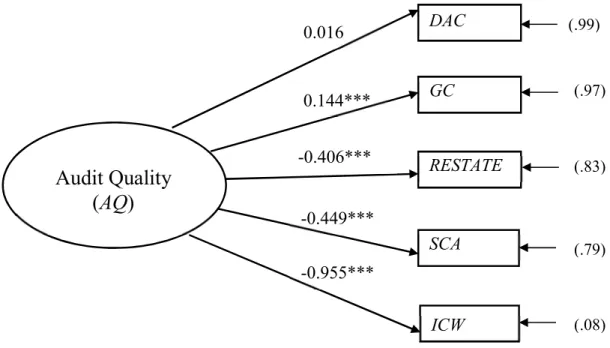
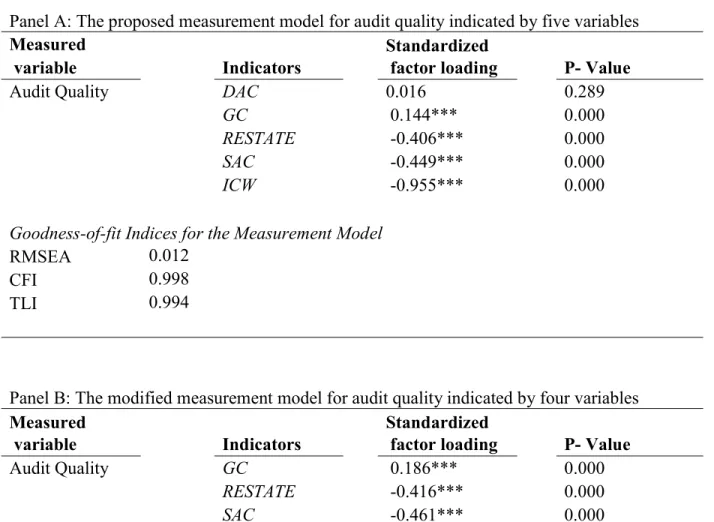
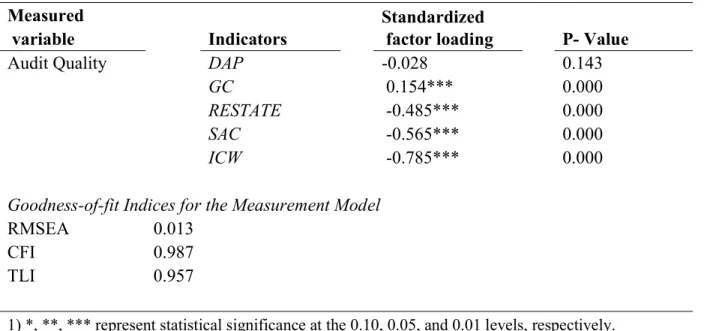
Figure 2 and Table 5 Panel A represent the model fit results of the proposed measurement model, in which the latent variable, audit quality (AQ), is indicated by five variables: DAC, GC, SAC, RESTATE, and ICW. Both CFI (0.998) and TLI (0.994) are close to 1, and RMSEA (0.012) is less than the 0.08 threshold, suggesting a good fit in the proposed measurement model.
However, in the proposed measurement model, the factor loading of discretionary accruals (DAC) is not significant, indicating that DAC is not an adequate indicator to measure the latent variable AQ and should be dropped from the model. Thus, the proposed measurement model is modified by dropping DAC from the AQ construct in the model.
Consistent with the concerns about using earnings quality to measure audit quality, my findings show that DAC is not significantly related to audit quality. Recently, in their review paper, DeFond and Zhang (2014) point out that earnings quality (e.g., discretionary accruals) proxies are less-direct measures of audit quality since auditors' influence on reporting quality is extremely limited. Consistent with DeFond and Zhang (2014), Bell et al. (2015) suggest that earnings quality may not adequately reflect the quality of the auditor's execution of the audit process. Furthermore, earnings quality proxies may generate high measurement error and even bias (Gul et al., 2009; Defond & Zhang, 2014). Overall, my results provide supporting evidence that earnings quality (e.g., discretionary accruals) may not capture audit quality well.
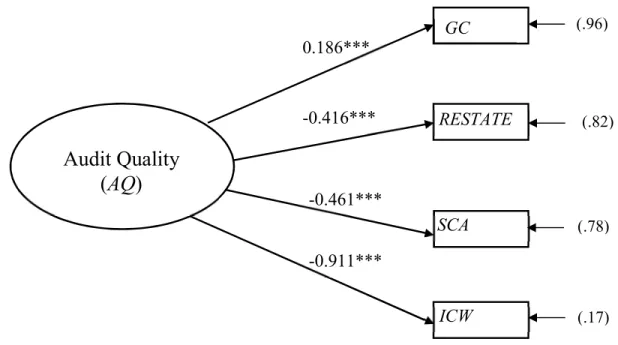
After dropping the indicator DAC from the proposed measurement model, the modified measurement model includes four indicators (GC, RESTATE, SAC, and ICW) to measure the latent variable, AQ. Figure 3 and Panel B of Table 5 present the standardized path coefficients and model fits of the modified measurement model. The modified measurement model fits the
35
data well, as evidenced by a CFI of 0.992, a TLI of 0.975 and an RMSEA of 0.012, and all individual factor loadings from each indicator on the latent construct, AQ, are statistically significant at p < 0.001. The results of these fit indices demonstrate that the modified
measurement model reasonably fits the data and that the latent variable, audit quality, appears to be adequately measured by these four indicators.
Table 5 Panel B shows that ICW has the highest absolute factor loading, -0.911, among the four indicators, followed by SAC (-0.461), RESTATE (-0.416), and GC (0.186). This result implies that ICW is the best indicator of audit quality. In addition, the path loadings from ICW, RESTATE, and SAC on audit quality are negative, indicating that weak audit quality is associated with companies’ receiving an internal control weakness opinion, or restating their financial reports, or being the target of a security class action filed by investors. The results provide evidence for the unclear relations among audit quality and its proxies. For instance, to
aggressively expand their market share, audit firms may adopt a risk-maximization strategy and pressure auditors to accept or retain clients with material internal control weaknesses and high probability to liquidate or restate their financial statements. Under such a situation, more material internal control weakness opinions, restatements or security class action filings indicate that auditors have higher risk customers and their audits are more likely to be lower in quality. Therefore, the negative associations between ICW, RESTATE, and SAC and audit quality found in the paper is consistent with such proposition.
As may be expected, the factor loading from GC to the audit quality construct is positive, which is consistent with one proposition in the prior literature. When auditors consider issuing a
36
going-concern opinion, clients may put pressure on auditors to issue a clean opinion. Under pressure, auditors’ choosing to keep their independence and insisting on issuing a going-concern opinion indicates a higher quality of auditing. Thus, going-concern opinions issued by auditors are positively associated with audit quality, which is similar to the result found in this study.
In summary, these findings from the confirmatory factor analysis show that the revised measurement model is a good fit for the data and provide evidence of the validity of four proxies of audit quality. Among the five indicators of audit quality, DAC does not capture audit quality well, while the other four indicators (GC, RESTATE, SCA, and ICW) are able to measure audit quality well, and ICW is the best proxy. Furthermore, audit quality is positively associated with GC and is negatively associated with RESTATE, SCA, and ICW.
[Insert Table 5, Figure 2, and Figure 3 Here]
4.3 Tests of the Effects of Auditor Independence on Audit Quality (H1-H2)
After the confirmatory factor analysis (CFA) is used to provide evidence as to whether the measurement model fits the data and to assess the reliability of constructs and indicators, a structural model is used to test the proposed theoretical model, i.e., the hypothesized causal relationships among auditor independence, audit quality, and audit market competition. The procedures used to assess the structural model fit are similar to those performed in the
37
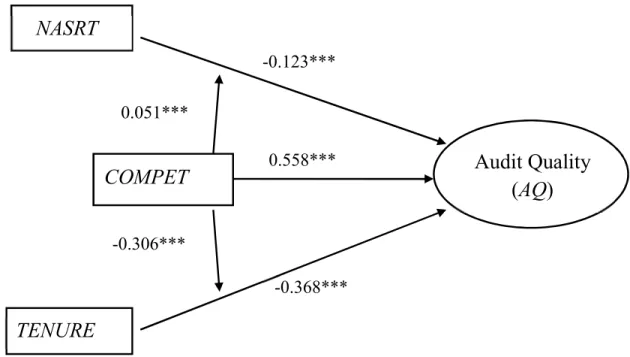
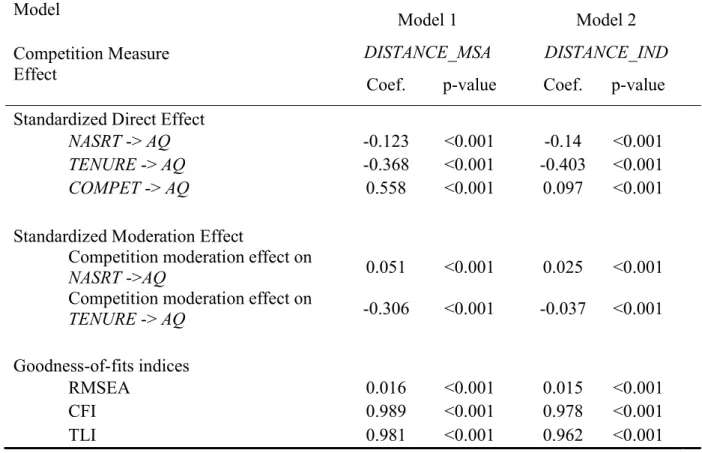
Table 6 and Figure 4. CFI and TLI are 0.989 and 0.981, respectively, which are close to 1. In addition, RMSEA is 0.016 and below the cutoff of 0.08. These model fit indices suggest that the model provides a good fit to the data. Table 6 and Figure 4 reports the standardized path
coefficients that specify the hypothesized causal relationships.
Hypothesis 1 states, in null form, that non-audit services (NASRT) do not affect audit quality (AQ). Similarly, Hypothesis 2 predicts that a long auditor-client tenure (TENURE) does not affect audit quality (AQ). The path coefficients from NASRT to AQ and from TENURE to AQ are central to these two hypothesis tests, respectively. As Table 6 and Figure 4 show, both path coefficients are negative and significant at p <0.001. The results suggest that both non-audit services and long auditor-client tenure reduce audit quality. As both non-audit services and long auditor-client tenure are viewed as threats to auditor independence and used to proxy for auditor independence in the study, the results provide supporting evidence that auditor independence is positively associated with audit quality. The findings are consistent with statements in the prior literature that both the provision of non-audit services and long audit tenure create a strong economic bond between auditors and their clients, which makes auditors more likely to
compromise their independence to please their clients, resulting in reduced audit quality (SEC, 2000; Frankel et al., 2002; Carey & Simnett, 2006; Kealey et al., 2007; Davis et al., 2009; Schmidt, 2012). Thus, null hypotheses H1 and H2 are rejected.
4.4 Tests on the Direct Effects of Audit Market Competition on Audit Quality (H3)
Hypothesis 3 in null format proposes that audit market competition (COMPET) does not affect audit quality (AQ). As shown in Table 6 and Figure 4, the path coefficient from COMPET
38
to AQ is positive (0.558) and significant at the p < 0.001 level, suggesting that more audit market competition improves audit quality. The findings confirm long concerns from regulations and researchers that lack of competition in the audit market makes auditors more likely to become overconfident and they have fewer incentives to improve audit quality (Boone et al., 2012; Francis et al., 2013). Two primary measures of audit market competition (COMPET) are used in the study: DISTANCE_MSA and DISTANCE_IND; the results of both are consistent in the structural model. Thus, audit market competition does increase audit quality, so Hypothesis 3 is rejected.
4.5 Tests on the Moderating Effects of Audit Market Competition (H4)
Hypothesis 4, the moderating role of audit market competition on auditor independence and audit quality, is proposed in a null format. Hypothesis 4a predicts that audit market
competition does not moderate the association between the provision of non-audit services and audit quality. As Table 6 reports, the significant positive path coefficient of 0.051 (p <0.001) indicates that COMPETE moderates the relationship between NASRT on AQ. The findings suggest that audit market competition positively affects the association between NASRT and AQ; that is, audit market competition mitigates adverse effects of the provision of non-audit services on audit quality. The results support the premise of competition as a monitoring mechanism and suggest that a more competitive audit market better aligns interests between auditors and
company shareholders and gives auditors more incentives to provide better quality in both non-audit and non-audit services through client-specific knowledge spillover and improved independence. Therefore, H4a is rejected.