EN
EN
EUROPEAN COMMISSION Brussels, 2.6.2014 SWD(2014) 413 finalCOMMISSION STAFF WORKING DOCUMENT
Assessment of the 2014 national reform programme and stability programme for ITALY
Accompanying the document
Recommendation for a COUNCIL RECOMMENDATION
on Italy’s 2014 national reform programme and delivering a Council opinion on Italy’s 2014 stability programme
2
CONTENTS
EXECUTIVE SUMMARY 3
1. INTRODUCTION 5
2. ECONOMIC SITUATION AND OUTLOOK 6
3. CHALLENGES AND ASSESSMENT OF POLICY AGENDA 7
3.1. Fiscal policy and taxation 7
3.2. Financial sector 16
3.3. Labour market, education and social policies 18 3.4. Structural measures promoting sustainable growth and competitiveness 25
3.5. Modernisation of public administration 32
4. CONLCUSIONS 36
Overview table 38
3
EXECUTIVE SUMMARY
The crisis has exposed and intensified the weaknesses of the Italian economy. Between
2007 and 2013, Italy’s real GDP contracted by 8.7 %, compared to just 1.7 % for the euro area as a whole. Employment did not fall as much as in some other euro-area Member States but there was a sharp reduction in working hours and the unemployment rate doubled from 6.1 % to 12.2 % over that period. According to the Commission 2014 spring forecast, economic growth is expected to turn positive with a modest 0.6 % in 2014 and accelerate to 1.2 % in 2015. The labour market is set to adjust with a lag to the improving economic conditions, starting with a rise in working hours. As the labour supply slightly increases, the unemployment rate is expected to reach its peak this year at 12.8 % to then marginally decline in 2015. The general government debt-to-GDP ratio, after increasing by over 26 percentage points between 2008 and 2013 - also due to the financial assistance to euro-area countries (3.6 % of GDP) - is expected to peak at above 135 % in 2014.
Italy has made limited progress in addressing the 2013 country-specific
recommendations. With regard to public finances, the stability programme postpones the
achievement of the medium-term objective to 2016, whereas, in July 2013, Italy was recommended to achieve it by 2014. Substantial progress was made in improving the functioning of the gas market. Some steps were taken to reduce the tax burden on labour and implement labour market reforms, ease firms’ access to credit, and address the weaknesses of civil justice. Limited progress was made in the other areas. The 2014 national reform programme presents a comprehensive, ambitious and time-bound plan for action over the programme horizon. Implementation of all measures, also those adopted in previous years, needs to be carefully monitored.
Restoring robust growth and reducing the high level of government debt-to-GDP ratio
remain the key objectives for Italy. Thein-depth review of the Italian economy published in
March 2014 highlighted that Italy’s low productivity growth over the last fifteen years has contributed significantly to the emergence of the two identified macroeconomic imbalances: the high level of public indebtedness and the loss of external competitiveness. Weak institutional capacity weighs on competitiveness and growth and is causing delays in the implementation of necessary reforms. Against this backdrop, the challenges for the country have remained broadly unchanged since 2013 while becoming more pressing on the back of the past implementation record.
• Public finances: The high government debt-to-GDP ratio remains a major burden and
a source of financial vulnerability for the Italian economy. While low growth makes it more difficult to put the public finances on a sustainable path, the high public debt may hamper growth prospects, dampen domestic demand and crowd out productive public spending.
• Taxation: The tax burden in Italy weighs heavily on production factors, leaving
considerable scope for improving the efficiency of the tax system by shifting the tax burden away from labour and capital. Low tax compliance, associated with a strong presence of underground economy and undeclared work, further exacerbate the distortive impacts of taxation on the economy.
4
• Financial sector: Non-performing loans have increased strongly during the protracted
crisis, eroding banks' profitability and discouraging banks from extending credit, especially to small and medium-sized enterprises. Capital markets in Italy remain insufficiently developed, rendering it difficult for firms to access alternative forms of financing, in particular for innovation. Furthermore, there are concerns for some segments of the banking sector regarding weaknesses in corporate governance and cost efficiency.
• Labour market. The employment rate is well below the EU average and is still far
from the national Europe 2020 employment target. Also, labour market participation of women remains low. Unemployment continued to increase on the back of the protracted recession and youth unemployment is among the highest in the EU. Sluggish labour productivity growth sustains unit labour cost growth, thereby weighing on cost competitiveness. The high tax wedge on labour further adds to labour costs.
• Education. High drop-out rates and the low level of tertiary education attainment,
indicate substantial shortcomings in the education system. Skill gaps in the adult population limit the innovation capacity of the economy. The transition from education to the labour market remains difficult, including for highly-skilled people.
• Social cohesion. Since the onset of the crisis, Italy has seen one of the largest
increases in the share of people living at risk of poverty and social exclusion in the EU. Due to the strong bias towards pensions, the fragmentation of non-pension expenditure and the lack of effective activation and enabling services, the social protection system is not well equipped at tackling poverty.
• Services and network industries. Italy has substantially improved its product market
regulation over the past 15 years. Acceleration of its effective implementation would help to ensure the beneficial impact of reforms on the ground. Furthermore, competition restrictions in important sectors of the economy remain (including professional services, postal services, insurance, transport and telecommunication, retail and fuel distribution, and local public services). There are infrastructure bottlenecks in energy, transport and telecommunication.
• Public administration and business environment. Weaknesses in public
administration continue to contribute to an unfavourable business environment, discourage foreign direct investment, and hamper the swift implementation of reforms and the proper management of EU funds, notably in southern regions. The main shortcomings include a cumbersome legal framework at various government levels, long-standing weaknesses in the civil justice system (notwithstanding recent progress) and inefficiencies in public procurement. High levels of corruption further weigh on
5
1. INTRODUCTION
In May 2013, the Commission proposed a set of country-specific recommendations for economic and structural reform policies for Italy. On the basis of these recommendations, the Council of the European Union adopted six country-specific recommendations in the form of a Council Recommendation in July 2013. These country-specific recommendations concerned public finances, the implementation of past reforms and the public administration, the financial sector, the labour market, education, social policies, taxation, and market opening in services and network industries. This staff working document assesses the state of implementation of these recommendations in Italy.
This staff working document assesses policy measures in light of the findings of the Commission's 2014 Annual Growth Survey1 and the third annual Alert Mechanism Report2, which were published in November 2013. The Annual Growth Survey sets out the Commission's proposals for building the necessary common understanding about the priorities for action at national and EU level in 2014. It identifies five priorities to guide Member States to renewed growth: pursuing differentiated, growth-friendly fiscal consolidation, restoring normal lending to the economy, promoting growth and competitiveness for today and tomorrow, tackling unemployment and the social consequences of the crisis, and modernising public administration. The Alert Mechanism Report serves as an initial screening device to determine whether macroeconomic imbalances exist or risk emerging in Member States. The Alert Mechanism Report found positive signs that macroeconomic imbalances in Europe are being corrected. To ensure that a complete and durable rebalancing is achieved, Italy and 15 other Member States were selected for a review of developments in the accumulation and unwinding of imbalances. These in-depth reviews were published on 5 March 2014 along with a Commission communication.3
Against the background of the 2013 Council Recommendations, the Annual Growth Survey, the Alert Mechanism Report and the in-depth review, Italy submitted updates of its national reform programme and its stability programme on 22 April 2014. These programmes provide detailed information on progress made since July 2013 and on the plans of the government for the period 2014-2018. The information contained in these programmes provides the basis for the assessment made in this staff working document. The programmes went through a consultation process involving Italian major stakeholders and regional authorities, and were formally endorsed by the national parliament before their submission to the European Commission.
1 COM(2013) 800 final 2 COM(2013) 790 final
3 Aside from the 16 Member States identified in the Alert Mechanism Report, Ireland was also covered by an in-depth review, following the conclusion by the Council that it should be fully integrated into the normal
6
2. ECONOMIC SITUATION AND OUTLOOK
Economic situation
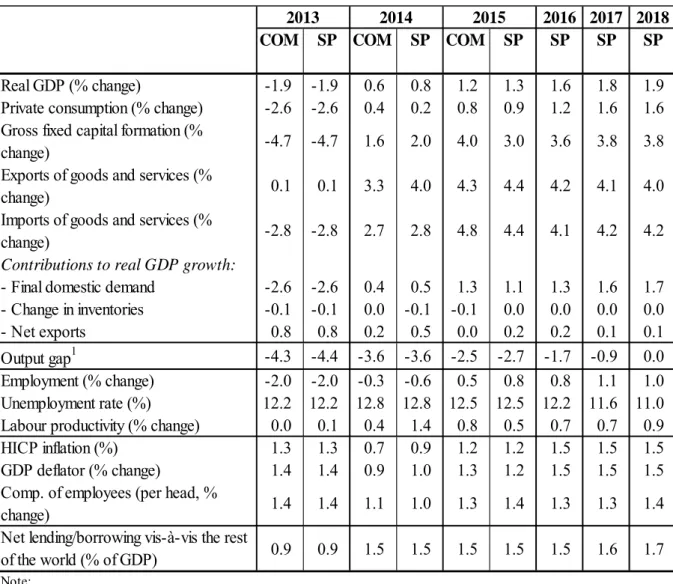
After a severe recession, Italy’s growth continues to be sluggish. The protracted
contraction in output came to a halt in the last quarter of 2013, when GDP increased by 0.1 %. However, according to preliminary estimates, this was followed by a further mild fall in the first quarter of 2014. Over 2013, real GDP has fallen by 1.9 % (after 2.4% in 2012). The strong fall in domestic demand acted as a drag on the economy due to persistently tight financing conditions and high uncertainty holding back consumption and investment. On the back of a stable activity rate, employment fell in 2013, with the unemployment rate on average reaching 12.2 % of the labour force in 2013 (40 % for the youth unemployment rate). Economic outlook
A slow recovery is expected in 2014 and 2015, mainly driven by external demand. The
Commission 2014 spring forecast projects real GDP to grow by 0.6 % in 2014. As external demand strengthens — including demand from euro-area trade partners — industrial activity is expected to increase and the service sector is set to follow suit. Due to persistently difficult labour market conditions, private consumption is expected to rise only gradually, supported by the cut to the labour tax wedge. For 2015, the ongoing consolidation of Italian banks’ balance sheets is set to pave the way for more favourable credit conditions, supporting domestic demand and ultimately output growth, expected to accelerate to 1.2 %. As both exports and imports rise, the current-account surplus is forecast to stabilise at 1.5 % of GDP in 2014-2015. Consumer inflation is expected to reach a historical low in 2014 at 0.7 %, also due to decelerating energy prices, before recovering to 1.2 % in 2015.
Headcount employment is forecast to continue falling in 2014 and then increase slightly
in 2015. The labour market is set to adjust with a lag to the improving economic conditions,
starting with a rise in working hours. Headcount employment is expected to fall further in 2014, although only marginally, implying a modest increase in labour productivity. As the labour supply slightly increases, the unemployment rate is expected to peak this year. The slack in the labour market is expected to restrain wage growth, resulting in a moderate increase in nominal unit labour costs. For 2015, as the economy strengthens, employment is set to expand and unemployment to fall marginally.
Italy's macro projections for 2014-2015 in the stability programme and the national
reform programme are broadly in line with the Commission 2014 spring forecast. Italy’s
stability programme covers the period 2014-2018. The macroeconomic projections are marginally above the Commission 2014 spring forecast for 2014 and 2015. They appear slightly optimistic for the 2016-2018, when real GDP growth is projected to be supported by the impact of the adopted structural reforms. In line with the underlying macroeconomic scenario, the programme projects employment to recover as from next year and the unemployment rate to peak at 12.8 % in 2014 and then to fall progressively. The programme outlook also implies a current account surplus of around 1.5 % of GDP over the programme’s horizon. HICP inflation is expected to be at 0.9 % in 2014 and 1.2 % in 2015, before
7
stabilising at 1.5 % until 2018. The national reform programme and the stability programme share the same macroeconomic outlook.
The stability programme and the national reform programme include an estimation of
the impact of structural reforms. The two programmes include an estimation of the impact
of selected structural reform on real GDP, private consumption, fixed investment and employment as well as on the general government primary balance and debt ratio. The selected reforms are: (i) the labour market, product market and the business environment reforms adopted in 2012 (after factoring in their delayed implementation relative to the impact estimated in the 2013 national reform and stability programmes) as well as in 2013; (ii) the 10% reduction in the regional tax on economic activities (IRAP) and its financing through the increase in the withholding tax on households’ financial income adopted in 2014; and (iii) the announced spending review and the reduction in the tax burden on low-income employees (so far adopted only for 2014). The overall impact of those reforms, assuming their full implementation, on the real GDP level is estimated at 0.3 percentage point by 2014, 0.8 percentage points by 2015 and 2.2 percentage points by 2018. Only the impact of the first set of reforms (see point (i) above) is factored in the macroeconomic scenario of the two programmes (with an impact on the real GDP level of 0.3 percentage points for 2014, 0.6 percentage points for 2015, gradually reaching 1.7 percentage points in 2018). With regard to the additional payment of commercial debt arrears announced for 2014 (EUR 13 billion), only the impact on public debt is factored in. The national reform programme includes also an estimation of the impact of the payment of commercial debt arrears and of the measures to prevent their accumulation in the future on the other variables, which is however not considered in the macro-scenario of the two programmes. All estimations are carried out using well-established macroeconomic models.4 The modelling choices and assumptions are detailed.
3. CHALLENGES AND ASSESSMENT OF POLICY AGENDA
3.1. Fiscal policy and taxation
Budgetary developments and debt dynamics
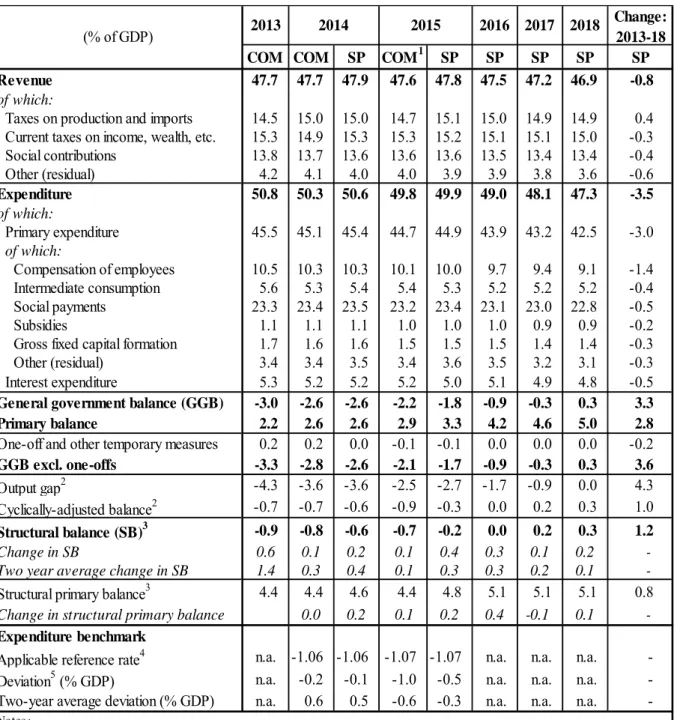
In 2013, despite a sharp economic contraction, the headline deficit remained stable at 3% of GDP thanks to the fiscal adjustment enacted over 2011-2012, slightly short of the
2.9% of GDP targeted in the 2013 programme. The Commission forecast projects the
deficit to decline to 2.6% of GDP in 2014 and to 2.2% in 2015. The 2.6% is in line with the stability programme target, which in turn is 0.1 percentage point of GDP higher than in the 2014 Draft Budgetary Plan submitted in October 2013. The integration in the forecast of the impact of the labour tax wedge cut adopted by decree law5 after the adoption of the stability programme leads to lower revenue and expenditure projections for 2014. For 2015, the Commission forecast, based on a no-policy-change assumption, does not incorporate the tax cut to low-income employees and expenditure savings announced in the stability programme, as details have not been specified yet. A similar approach is used for the additional fiscal
4 The estimations are carried out using the macro-economic models ITEM, IGEM and a country-specific version of the European Commission’s QUEST III.
8
adjustments (0.3 percentage point of GDP) foreseen in the stability programme but still to be enacted and the € 3 bn fiscal adjustment adopted with the 2014 budget law, which has not yet been detailed. The further improvement in the general government balance planned in the stability programme over 2016-2018 is based on an additional 0.3 percentage point of GDP permanent fiscal adjustment planned as of 2016 (still to be specified), declining interest expenditure in 2017-2018, as well as a sustained economic growth.
The expenditure ratio is projected to decline over the programme period. The stability
programme trend projections (based on unchanged legislation) point to an overall decline in the expenditure ratio of 3.5 percentage points of GDP over the 2014-2018 programme period, also thanks to a sustained economic growth. Compensation of employees displays the largest decline (-1.4 percentage points of GDP) also as a result of the unchanged legislation assumption, which implies no further increases in public sector wages up to 2017.6 The decline in the expenditure ratio is supported by lower interest expenditure, following the assumption of continued decline in spreads between yields on Italian and German 10-year bonds (to 150 bps in 2015 and 100 bps as of end-2016). Over the programme period, the revenue-to-GDP ratio is expected to decline slightly (by 0.8 percentage point), mainly due to the projected fall in social contributions and direct taxation. Relative to last year's stability programme, the fiscal adjustment is backloaded, as the lower deficit reduction projected in 2014 is only partly explained by lower than expected growth.
6 The programme also presents a no-policy-change projection for some expenditure items, which shows a smaller decline in the overall expenditure ratio (-2.8 percentage points of GDP) and in compensation of employees (-0.9 percentage point of GDP).
9
Box 1. Main budgetary measures
Revenue Expenditure
2014
• Increase in stamp duty on households' financial assets (0.07% of GDP)
• Increase in taxation on financial sector (0.16% of GDP)
• Increase in tax allowances on employees' PIT (-0.1% of GDP)
• Reduction in social contributions for labour accidents and sickness (-0.06% of GDP)
• Reduction in property taxes (-0.07% of GDP)
• De-indexation of higher pensions (-0.03% of GDP)
• Additional investment expenditure (0.2% of GDP)
2015
• Increase in tax allowances on employees' PIT (-0.1% of GDP)
• Reduction in social contributions for labour accidents and sickness (-0.06% of GDP)
• Reduction in property taxes (-0.07% of GDP)
• De-indexation of higher pensions (-0.12% of GDP)
2016
• Increase in tax-base deductions for financial sector's losses on loans (-0.11% of GDP)
• Increase in tax allowances on employees' PIT (-0.1% of GDP)
• Reduction in social contributions for labour accidents and sickness (-0.06% of GDP)
• Reduction in property taxes (-0.07% of GDP)
• De-indexation of higher pensions (-0.18% of GDP)
Note: The budgetary impact in the table is the impact reported in the programme, i.e. by the national authorities. A positive sign implies that revenue / expenditure increases as a consequence of this measure.
The objective of the budgetary strategy outlined in the 2014 stability programme is the achievement of the medium-term objective of a balanced budgetary position in structural terms by 2016, while complying with the minimum linear structural
10
adjustment required by the debt reduction benchmark (forward-looking element) over
the 2013-2015 transition period. The programme confirms the medium-term objective of a
balanced budgetary position in structural terms, which reflects the objectives of the Stability and Growth Pact. However, the stability programme postpones the achievement of the medium-term objective to 2016, whereas, in July 2013, the Council recommended Italy to achieve it by 2014. The justification of the postponement is argued on the basis of Regulation 1175/2011 (Article 5), in particular the severe economic conditions (i.e. a largely negative output gap, at a level in 2014 still much worse than the Representative Output Gap – ROG7) and unfavourable firms' liquidity conditions, which have pushed the government to accelerate the settlement of commercial debt arrears. The latter is resulting in a further increase in the debt level and, to a lesser extent, in the deficit. The stability programme also advocates the "structural reform clause", given the government's intention to implement several structural reforms eventually leading to a positive impact on potential economic growth and reducing the debt-to-GDP ratio in the coming years. Those reforms would also imply the need of additional resources (already financed and incorporated in the budgetary projections).
The structural balance further improved in 2013 but the adjustment path towards the
medium-term objective is projected to slow down in 2014. In 2013, the structural balance
is estimated to have improved by 0.6 percentage point, to -0.9% of GDP, although the 2013 stability programme planned a larger structural adjustment (of 0.9 percentage point, to -0.5% of GDP) against the background of a projected milder real GDP contraction (-1.3% vs. -1.9%). For 2014, the (recalculated) structural adjustment planned in the stability programme is only 0.2 percentage point of GDP. In 2015, the stability programme plans a 0.4 percentage point of GDP (recalculated) improvement in the structural balance. This compares with the 0.1 percentage point projected on a no-policy-change basis in the Commission forecast, which highlights the risk of significant deviation from the required structural adjustment towards the medium-term objective in 2015. The expenditure benchmark shows a risk of significant deviation in 2015 according to both the stability programme and the Commission forecast. In the case of the stability programme, this is also explained by the fact that expenditure figures provided in the programme are trend projections not consistent with the budgetary targets that include further fiscal adjustment still to be enacted.
The stability programme budgetary targets are subject to downside risks. The main risk
comes from the need to identify and implement through the on-going spending review sizeable and permanent expenditure savings at all levels of government, which will also be needed to finance the announced permanent cut to the personal income tax on low-income employees. In addition, the macroeconomic scenario underpinning the budgetary projections in the programme is slightly optimistic, in particular for the outer years of the programme when growth is projected to be well above the current estimate of potential growth based on the Commission forecast. It is however true that a full and fast implementation of the planned structural reforms could help achieve a real GDP growth close to the projections put forward in the programme (see also below Box 4 "Potential impact of structural reforms on growth – a benchmarking exercise").
7 For an explanation see Public Finance Report 2013
11
The stability programme projects a further increase in 2014 in the general government
gross debt ratio followed by accelerating decline to reach 120.5% of GDP in 2018. In
2014, the debt ratio is projected to reach around 135% of GDP mainly due the on-going settlement of commercial debt arrears. As of 2015, the stability programme projects a steadily and accelerating decline in the debt ratio (to 120.5% of GDP in 2018) thanks to increasing primary surpluses, falling interest expenditure coupled with sustained nominal growth as well as an ambitious privatisation plan of 0.7% of GDP per year over 2014-2017. The Commission forecast points to a somewhat higher debt ratio in 2014, essentially explained by the lower real GDP growth. The lower decline in the debt ratio forecast in 2015 is mainly explained by higher interest expenditure and lower primary surplus, based on a no-policy-change assumption. In addition, the Commission forecast incorporates lower privatisations proceeds (only 0.5% of GDP used to reduce the debt in 2015).
The Commission 2014 spring forecast points to a risk of non-compliance with the debt rule. The (recalculated) structural adjustment planned in the programme to comply with the minimum linear structural adjustment required for the debt reduction benchmark over the 2013-2015 transition period and based on the stability programme debt-to-GDP projections is around 0.3 percentage point of GDP in 2014 and 0.5 percentage point in 2015. This would allow Italy to comply but only thanks to the allowed annual deviation of 0.25 percentage point of GDP. However, the debt projections in stability programme heavily rely on the implementation of the ambitious privatisation plan and sustained economic growth. The Commission spring 2014 forecast points to a risk of non-compliance with the debt reduction benchmark in 2014. The expected structural adjustment (only 0.1 percentage point of GDP) falls short of the required minimum linear structural adjustment that, according to the forecast, would be of around 0.7 percentage point of GDP. This risk of non-compliance with the debt benchmark was already highlighted in the Commission's Opinion on Italy's 2014 Draft Budgetary Plan issued on 15 November 2013. 8 Risks to the stability programme debt projections (above those related to possible higher deficits) are mainly related to the implementation of the ambitious privatisation plan, which remains largely unspecified.
The exemption requested by Italy to deviate from the required path towards the medium-term objective cannot be granted because of the risk of non-compliance with the debt-reduction benchmark, as currently projected in the Commission 2014 spring
forecast. The Commission forecast projects a structural adjustment of only 0.1 percentage
point of GDP in 2014, as it classifies as one-off some of the taxes (mainly from the banking sector) used by the government to finance the enacted cut to the personal income tax on employees in 2014. This falls short of the minimum linear structural adjustment of 0.7 percentage point of GDP in 2014 that, based on the Commission 2014 spring forecast, is needed to comply with the debt benchmark.
Fiscal framework
Following a rapid progress in the development of Italy's fiscal framework, the pace of
reforms has slowed down in the recent past. In particular, there has been a significant delay
in setting up the board of the parliamentary budget office, which will act as independent Fiscal Council in Italy, a key part in delivering on Italy's commitments in particular in the context of the "Two-pack" and the Fiscal Compact. The board was appointed by Parliament
8 C(2013) 8005 final. http://ec.europa.eu/economy_finance/economic_governance/sgp/pdf/dbp/it_2013-11-15_co_en.pdf
12
only at the end of April 2014 after the stability programme adoption; therefore, the projections underpinning the programme have not been endorsed by an independent institution as requested by the two pack. Additional steps are needed to make the Fiscal Council fully operational by September 2014, i.e. in time for the assessment of the 2015 Draft Budgetary Plan. Meanwhile, previous reforms notably aiming at improving coordination between levels of government are yet to fully deliver their expected benefits.
The launch of a comprehensive spending review sets high expectations. With the
nomination of a dedicated Commissioner leading the spending review on a tight schedule, far-reaching scope and aggressive targets, Italy is set to address head-on the quality and efficiency of its public expenditure; however the review will have to demonstrate the feasibility of delivering rapid results in the short term and inscribe them in long-lasting impactful reforms.
Long-term sustainability
Risks to the sustainability of Italy’s government debt are medium-to-low provided that
the current fiscal stance is not eased. Government debt (132.6% of GDP in 2013 and
forecast to rise to 133.9% in 2015) is currently above the 60% of GDP Treaty threshold, and projected to fall by 2030 although remaining above the reference value. The full implementation of the stability programme would accelerate the decreasing path of the debt-to-GDP ratio, although it would remain above the 60% reference value in 2030. In the medium-term, Italy appears to face medium fiscal sustainability risks. The medium-term sustainability gap,9 showing the adjustment effort up to 2020 required to bring debt ratios to 60 % of GDP in 2030, is at 1.5 percentage points of GDP, primarily related to the high level of government debt forecast for 2015. In the long-term, Italy appears to face low fiscal sustainability risks, primarily related to the structural primary balance forecast in 2015. The long-term sustainability gap10 shows the adjustment effort needed to ensure that the debt-to-GDP ratio is not on an ever-increasing path, is at -1.6 percentage points of debt-to-GDP. Risks would be significantly higher in the event of the structural primary balance reverting to lower values
9 See Table V in Annex. The medium-term sustainability gap (S1) indicator shows the upfront adjustment effort required, in terms of a steady improvement in the structural primary balance to be introduced until 2020, and then sustained for a decade, to bring debt ratios back to 60% of GDP in 2030, including financing for any additional expenditure until the target date, arising from an ageing population. The following thresholds were used to assess the scale of the sustainability challenge: (i) if the S1 value is less than zero, the country is assigned low risk; (ii) if a structural adjustment in the primary balance of up to 0.5 p.p. of GDP per year until 2020 after the last year covered by the autumn 2013 forecast (year 2015) is required (indicating an cumulated adjustment of 2.5 percentage point), it is assigned medium risk; and, (iii) if it is greater than 2.5 (meaning a structural
adjustment of more than 0.5 p.p. of GDP per year is necessary), it is assigned high risk.
10 See Table V in Annex. The long-term sustainability gap (S2) indicator shows the immediate and permanent adjustment required to satisfy an inter-temporal budgetary constraint, including the costs of ageing. The S2 indicator has two components: i) the initial budgetary position (IBP) which gives the gap to the debt stabilising primary balance; and ii) the additional adjustment required due to the costs of ageing. The main assumption used in the derivation of S2 is that in an infinite horizon, the growth in the debt ratio is bounded by the interest rate differential (i.e. the difference between the nominal interest and the real growth rates); thereby not necessarily implying that the debt ratio will fall below the EU Treaty 60% debt threshold. The following thresholds for the S2 indicator were used: (i) if the value of S2 is lower than 2, the country is assigned low risk; (ii) if it is between 2 and 6, it is assigned medium risk; and, (iii) if it is greater than 6, it is assigned high risk.
13
observed in the past, such as the average for the period 2004-2013. It is therefore appropriate for Italy to continue to implement measures that reduce government debt.
Tax system
The tax burden in Italy weighs heavily on productive factors and significant less than
the EU average on consumption. In 2013, Italy was recommended to shift the tax burden
away from labour and capital onto consumption, property and the environment in a budgetary neutral manner, also by reviewing VAT and direct tax expenditures and by reforming the cadastral system. Italy was also recommended to pursue the fight against tax evasion, shadow economy and undeclared work, and enhance tax compliance. The analysis in this staff working document leads to the conclusion that Italy has made limited progress in addressing the 2013 recommendation in these areas (for the full assessment of Italy’s response to country-specific recommendations see the overview table in Section 4). Italy continues to face tax-related challenges, which are relevant for the 2014 Annual Growth Survey priorities of growth-friendly fiscal consolidation, tackling unemployment, promoting growth and competitiveness and modernising public administration.
Italy has shifted taxation away from productive factors to a limited extent. This was done
in three steps: first, after the 1 percentage point increase enacted in September 2011, the standard VAT rate was further increased from 21 % to 22 % in October 2013, while leaving the scope and level of reduced rates unchanged; second, a small reduction in taxes on labour was included in the 2014 budget (amounting to around 0.15 % GDP as from 2015); and third, a further reduction in the labour tax wedge was enacted in April 2014 in the form of a cut in the personal income tax for low taxable incomes and a 10 % decrease in the regional tax on economic activities (IRAP). While the IRAP cut is stipulated to be permanent, the personal income tax cut was enacted only for 2014 and the national reform programme commits to making it permanent but not before having identified the financing resources. The reduction in the personal income tax is intended primarily to support private consumption, but in the short term its impact on growth could be offset by the spending savings needed to finance it. The expenditure savings will instead have no negative impact on long-term growth if the on-going spending review manages to effectively tackle the inefficiencies of Italy's public expenditure at all levels of government, preserving growth-enhancing spending like R&D, innovation, education and essential infrastructure projects. The cut to the personal income tax could also have a positive impact on labour demand and competitiveness to the extent that it translates into lower wage claims. In 2013, the recurrent taxation on property, considered the least detrimental to medium/long-term growth, was reformed again after the increase adopted at in end-2011, with revenue expected to decline slightly (the share of revenue from recurrent taxes on immovable property was 1.6 % of GDP in 2012, i.e. broadly in line with the EU average of 1.5 %).
High tax evasion, associated with a strong presence of shadow economy and labour
market irregularities, exacerbate the distortive impact of taxation on the economy. The
VAT gap is estimated at 28% in 2011, among the highest in the EU.11 The Italian statistical
11 CASE (2013), Study to quantify and analyse the VAT gap in the EU-27 Member States. Tax gap is defined as the difference between the theoretical tax liability according to the tax law and the actual revenues collected, as a share of theoretical tax liability.
14
institute (ISTAT) estimated that in 2008 the non-observed economy accounted for about 17% of GDP. Italy has taken some additional tax enforcement measures but decisive action to improve the relationship between taxpayers and the tax administration and to prevent tax evasion is still needed..The 2014 Stability Law provided for the increase of labour inspectors and raised both the minimum and maximum amount of fines for employers employing undeclared workforce. The Italian tax administration has obtained increased access to information on taxpayers’ bank accounts and assets, even those abroad. However, processing all this new information is proving difficult.12 Few measures have been taken to improve tax compliance, modernise the tax administration or speed up the recovery of tax debts. One step taken in this direction is a pilot cooperative compliance programme for high taxpayers. However, tax compliance costs remain high (tax compliance takes 269 hours versus 178 hours on average in the EU for mid-sized companies in 2013), mainly because of burdensome tax obligations and frequent adjustments of tax rules via ministerial decrees instead of systemic tax reform. The burdensome tax obligations also imply that assessments often result in contentious cases, which reduces the credibility and effectiveness of the efforts to fight tax evasion. Uncollected fines, taxes and social security contributions have accumulated over the years and amount now to a stock at face value of EUR600 billion, signalling difficulties with enforced tax debt recovery.13 The rate of enforced recovery of tax arrears was put at 1.94% for 2012, showing a declining trend since 2010. 14 In 2013, the government released a comprehensive report on tax evasion and measures taken to address it.15 The report confirms the declining trend in enforced tax debt collection.16
The enabling law on taxation adopted by the Italian Parliament in February 2013 could
represent a significant step forward, once implemented. The enabling law mandates the
government to review cadastral values according to current market values, which would increase the fairness of property taxation. It also foresees a revision of tax expenditures,
12 Corte dei Conti (2013), Rapporto 2013 sul coordinamento della finanza pubblica.
13 The figure includes all amounts, accumulated over the years that have been contested by the public administration, including those to companies gone out of business and those for which an appeal may have been lodged. Data are quoted in the 2013 annual report of the Court of Auditors on the coordination of public finances, p. 21:
http://www.corteconti.it/_documenti/controllo/sezioni_riunite/sezioni_riunite_in_sede_di_controllo/2013/28_ma ggio_2013_rapporto_2013_finanza_pubblica.pdf.
14 Ibid. The Italian Court of Auditors argues that there are two main explanations for the decline in enforced tax recovery yield: on the one hand, tax debt collection has been affected by the economic crisis, which has made several taxpayers unable to pay taxes due; on the other hand, the Court points that that recent changes made to the Italian tax debt collection system have weakened tax administration’ powers to enforce tax recovery.
15Ministero Economia e Finanze (2013), Rapporto sui risultati conseguiti in materia di misure di contrasto dell’evasione fiscale. Allegato alla Nota di Aggiornamento del Documento di Economia e Finanza 2013. http://www.dt.tesoro.it/export/sites/sitodt/modules/documenti_it/analisi_progammazione/documenti_programma tici/Rapporto_evasione.pdf.
16 Ibid. p. 37. Enforced tax debt recovery decrease by 7% over the period 2011-2012, from EUR 4.5 billion (2011) to EUR 4.2 billion (2012). According to the same report, in 2012 Italy recovered in total EUR 12.5 billion from the fight against tax evasion. This figure covers both enforced tax payments (“ruoli”) and voluntary payments of overdue tax obligations (“versamenti diretti”).
15
including VAT reduced rates, which would help reducing distortions. It further aims at simplifying the tax system through the use of pre-filled tax returns, modernising tax litigation and reforming direct tax expenditure. The enabling law also provides for a rationalisation and increase of environmental and energy taxation, with the twin aim of better protecting the environment and reducing income taxes. Environmental taxation increased by 0.3 % of GDP and, at 3 % in 2012, is only slightly above the EU average. A recent study indicates that there is still scope for additional revenue from environmental taxes, notably with regard to pollution and resource taxes (at 0.03 % of GDP in 2012, among the lowest in the EU ranking), and alignment of fuel taxation according to energy content of fuels. The study also finds scope for removing environmental harmful subsidies, in particular: the preferential treatment of company cars; the reduced rates for gas oil used in agriculture, horticulture, forestry and aquaculture; and the fuel exemptions for the transportation of goods and passengers along national waterways and within EU waters.17 All secondary legislation implementing the enabling law is to be adopted by end of March 2015.
Box 2: Conclusions from the March 2014 in-depth review on Italy
The third in-depth review on Italy under the Macroeconomic Imbalances Procedure was published on 5 March 2014 along with a Commission communication.18 On the basis of the review, the Commission concluded that Italy is experiencing excessive macroeconomic imbalances, which require specific monitoring and strong policy action. The main observations and findings are:
• Persistent low productivity growth is at the root of the country’s declining competitiveness and weighs on the sustainability of public debt.
• The very high government debt is a heavy burden for the Italian economy and a major source of vulnerability.
• The correction of Italy’s current account is mostly driven by falling imports, while export competitiveness has not improved.
• Remaining barriers to competition, inefficiencies in public administration (including justice), and governance weaknesses hinder resource reallocation to more productive firms and sectors. Insufficient development of capital markets holds back technology absorption and innovation further.
• Italy’s human capital endowment is not adapting to the needs of a modern competitive economy, partly due to the difficulty of transition from education to work. Its wage structure favours seniority and thus reduces the return on education for younger cohorts in Italy compared to the rest of the EU.
• The crisis has eroded the initial resilience of the Italian banking sector and has weakened its capacity to support the economic recovery.
17 Eunomia research and consulting and Aarhus University (2014), ‘Study on environmental tax reform potential in 12 EU Member States. See also: OECD (2013), OECD Environmental Performance Reviews: Italy 2013 (the study notes that environmental taxes in Italy do not sufficiently reflect environmental externalities);
Institute for European Environmental Policy (2013), Steps to greening country report: Italy. Report for the
European Commission, pp. 15-16.
16
• Italy’s macroeconomic imbalances have adverse effects on the rest of the euro area. Italy’s slow growth acts as a drag on the recovery of the euro area as a whole and its high debt could impact on the euro area by affecting financial market sentiment and confidence. The in-depth review also discusses the policy challenges stemming from these imbalances and possible avenues for action. In particular, the following points are made:
• Italy has for too long postponed much-needed structural reforms. The decline in financial market pressures and the gradual improvement of the economic outlook represent a window of opportunity to accelerate the pace of reforms.
• Robust productivity-enhancing reforms are necessary to ensure sustainable recovery and unleash Italy’s growth potential. As productivity-enhancing measures take time to bear fruit, levers to address cost pressures in the economy could be explored.
• Reducing the high government debt at a satisfactory pace requires sustained fiscal discipline. Reaching the medium-term objective (MTO) of a structurally balanced budget and achieving and maintaining sizeable primary surpluses for an extended period are essential to put Italy’s high government debt on a steadily declining path while preserving investor confidence.
3.2. Financial sector
The capacity of the Italian banking sector to support the economic recovery and
adjustment has been eroded by the protracted crisis. The long recession has taken its toll
on Italian banks' balance sheets, in particular through a strong increase in non-performing loans (16.7% of customer loans in December 2013), mainly concentrated in non-financial firm exposures. High credit risk and elevated bank funding costs, owing partly to euro-area financial market fragmentation, in addition to common factors such as the phase-in of stricter capital requirements, continue to keep credit conditions tight, affecting small firms in particular. Furthermore, some segments of the banking sector still display weaknesses in corporate governance practices and cost efficiency. Capital markets in Italy, in particular equity markets, are insufficiently developed, rendering it difficult for firms to find adequate external financing for innovative activities and maintaining the dependence of the corporate sector on banks.
The analysis in this staff working document leads to the conclusion that Italy has made some progress in addressing the recommendation Italy received in 2013 (for the full assessment of Italy’s response to country-specific recommendations see the overview table in Section 4). Some progress has been made in addressing the problem of deteriorating asset quality,
in line with the priorities set in the 2014 Annual Growth Survey. From the second half of
2012 until mid-2013, the Bank of Italy conducted a targeted loan-portfolio quality review of 20 large and medium-sized domestic banking groups with lower non-performing loan coverage ratios. This exercise led in particular to an increase in loan-loss provisions. For eight banks, on-site inspections were extended to the entire loan portfolio. The 2014 Stability Law enhanced the tax deductibility of loan-loss provisions and loan write-offs. This is likely to foster a further increase in non-performing loan coverage ratios and limit the impact of deteriorating asset quality on profits. In addition, some large Italian banks have recently announced initiatives to repair their balance sheets, mainly by selling their distressed assets or setting up defeasance structures. Finally, the ongoing comprehensive assessment by the European Central Bank, which includes 15 Italian banking groups, is expected to further
17
increase transparency as to the quality of banks' balance sheets. The assessment has also triggered the announcement of capital increases by several banks and extra loan-loss provisioning at the end of 2013.
Progress in tackling relative weaker cost efficiency has been limited, but some steps has
been taken in strengthening corporate governance. The combination of the Italian banking
sector's relatively lower cost efficiency – linked in particular to high branch density – and subdued profitability has led the Bank of Italy to call on banks to increase their internally generated resources by reducing costs, and to limit dividend payments and executive remuneration. Although banks have made efforts to reduce operating costs and improve efficiency, further steps may be needed to support profitability. As to banks' corporate governance, the Bank of Italy has issued new provisions on the composition and functioning of the banks' management bodies, the self-evaluation process that must be carried out by these bodies, the role of the chairman of the board of directors and the transparency of the procedure to appoint of board members. These provisions are welcome but their effect will depend on their concrete application by the banks and enforcement by the supervisor. Furthermore, a legislative proposal which transposes the new EU Capital Requirements Directive includes provisions aimed at strengthening the Bank of Italy's supervisory powers and rules applicable to transactions which may imply a conflict of interest for shareholders or board members. The proposal also provides for a more thorough and comprehensive framework for the independence, experience and integrity requirements for board members. There has been virtually no progress on the role of bank foundations – which despite their positive role as long-term investors – continue to exert significant and at times opaque influence on banks, partly because of shareholder coalitions, voting right ceilings and cross-holdings. Furthermore, supervision over foundations is also still provisionally in the hands of the Italian Ministry of Economy and Finance, and the foundations’ self-regulatory charter could be strengthened. Finally, corporate governance features such as the one-shareholder-one-vote principle, share ownership ceilings and membership constraints typical of cooperative banks may not be appropriate in the case of large (listed) cooperative banks (namely 'banche popolari') as they may discourage large shareholders from exerting influence and active oversight of management and also represent obstacles to raising new capital. New corporate governance principles specifically targeted at 'banche popolari' to ensure broad shareholder representation have been introduced, but their impact needs to be closely monitored.
Access to finance
Some steps have been made in diversifying firms' access to finance and reducing their bias towards debt financing – both priorities set in the 2014 Annual Growth Survey. Several measures have been taken to diversify firms' sources of external funding away from bank loans. The 2014 Stability Law provides for an increase in the notional return on new equity capital or reinvested earnings (allowance for corporate equity – ACE), which firms can deduct from taxes from the initial 3% introduced in 2012 to 4% in 2014, 4.5% in 2015 and 4.75% in 2016. This could contribute to reducing the relatively high leverage of Italian firms by strengthening their capital base. While recent surveys indicate that the take-up of allowance for corporate equity so far has been modest, enhancing demand prospects and reduced uncertainty are expected to spur equipment investment in the coming months and thus the need for new capital. Nevertheless, there still seems to be some scope for further reducing the debt bias in taxation. The framework for mini-bonds established in 2012 to diversify access to finance of (small) firms has been finalised with the necessary
18
implementing decrees. The take-up of mini-bonds – still limited, in particular by small firms – might benefit from recent measures extending Italy's securitisation framework to bonds and fostering their acquisition by institutional investors. Other positive steps include the entering into force of tax incentives for investing in the capital of innovative start-ups, and the issuing by the Italian financial market regulator (Commissione Nazionale per le Società e la Borsa - CONSOB) of instructions for using equity crowd-funding and of a memorandum of understanding with initiatives to foster the further development of Italian stock markets. As regards funding through traditional financial intermediaries, several initiatives have been taken to ease (small) firms' access to finance. The Guarantee Fund for small and medium-sized enterprises is being further refinanced for the period 2014-2016, while access conditions for firms have been eased andits functioning has been improved. It has also been integrated into the new National Guarantee System and has supported the recapitalisation of Italian collective loan guarantee institution (confidi). In addition, the publicly-controlled bank Cassa
Depositi e Prestiti (CDP) has made available EUR 5 billion extra resources to support lending in view of investment by small and medium-sized enterprises, while eligibility criteria have been broadened. Furthermore, a new debt moratorium was agreed in 2013, extending previous measures to temporarily suspend loan payments and lengthen maturities for viable but financially distressed small and medium-sized enterprises. Other actions include the creation of the 'Fondo di Valorizzazione' which will temporarily invest in and support viable but financially distressed firms, and the refinancing of Italy's Fund for Sustainable Growth for the period 2014-2015. Overall, these measures are helpful but limited in scope, and most maintain the focus on debt financing. The government has made some progress with the repayment of commercial debt arrears, providing liquidity relief to firms (EUR 23.5 billion disbursed at the end-March of 2014 out of EUR 47 billion made available in 2013). The national reform programme includes plans to disburse an additional EUR 13 billion in 2014 and accelerate repayments through financial intermediaries.
3.3. Labour market, education and social policies
Labour market
The unemployment rate has doubled since 2007 and labour market participation
remains very low, while still increasing unit labour costs weigh on competitiveness. The
unemployment rate rose from 6.1 % in 2007 to 12.2 % in 2013. The situation is particularly worrisome for young people. Youth unemployment (age 15-24) reached 40 % in 2013, and the proportion of young people aged 15-29 not in education, employment or training was 24 % in 2012, among the highest in the EU, reaching 50% in the South and 33.6% for non-EU born. The employment rate of 20-64 year-olds (59.8 % in 2013) is well below the EU average and the national Europe 2020 target of 67-69 %. Labour market participation continues to be low among women and young people, especially in southern regions, and the number of persons available for work but not actively seeking it – commonly referred to as 'discouraged workers' thereby implying a wider measure of under-employment than the measure of unemployment alone – also increased substantially during the crisis. The gender employment gap is the second highest in the EU and parenthood still reduces employment among women, especially after the second child. Finally, Italy’s low productivity growth is sustaining unit labour costs, leading to cost competitiveness losses.
In 2013, Italy received a country-specific recommendation concerning the labour market
19
market and wage-setting reforms, take further action to foster labour market participation, especially of women and young people, and improve public employment services. These actions are also in line with the priorities set out in the 2014 Annual Growth Survey. Italy was also recommended to strengthen vocational education and training, improve career and counselling services for tertiary students, step up efforts to prevent early school leaving and improve school quality and outcomes. However, the analysis in this staff working document leads to the conclusion that Italy has made limited progress on measures taken to address these recommendations (for the full assessment of Italy’s response to country-specific recommendations, see the overview table in Section 4).
Disentangling the impact of the 2012 labour market reform from that of the crisis is
difficult. The 2012 reform of the labour market aimed to address the rigidities and dualism of
the labour market by enhancing exit flexibility for workers on permanent contracts through amendments to the rules and procedures regulating dismissals, while regulating entry flexibility by reducing incentives to hire workers on non-permanent contracts. It also introduced a more inclusive insurance-based system of income support for the unemployed, which is gradually entering into force and will be fully operational as of 2017. Italy produced a first monitoring report on the impact of the reform at the beginning of 2014. It shows evidence of enhanced exit flexibility, with reductions in both the length of dismissal procedures and the number of compulsory reinstatements of dismissed workers in firms. While economic uncertainty related to the crisis has contributed to a steady decline in hires on permanent contracts, the use of atypical contracts has also declined somewhat, in line with the aim of the reform. At the same time, a substantial increase in fixed-term temporary contracts19 in combination with still incomplete access to unemployment benefits, notably for semi-dependent, own-account workers and the self-employed, suggest that segmentation remains a challenge for the Italian job market. Furthermore, the new unemployment benefit system is being put under strain by the increase in unemployment and is not supported by effective activation policies.
The government intends to introduce additional measures on contractual simplification,
active labour market policies, unemployment benefits, and disincentives to work. The
government has also put forward a draft enabling law aimed at, inter alia: further streamlining
the existing contractual forms, including by introducing a new permanent contract with increasing entitlements, extending the coverage and duration of unemployment benefits, strengthening conditionality and activation by better linking active and passive labour market policies, preventing moral hazard in the use of wage supplementation schemes (Cassa
Integrazione Guadagni) by adjusting the contributions paid into such schemes to companies’
actual use of them (across and within industries). While many of the proposed actions appear adequate to address Italy's labour market challenges, their effectiveness will depend greatly on their design and subsequent implementation.
Positive steps towards further decentralisation of wage bargaining could be conducive to greater responsiveness of wages to productivity developments and local labour market
conditions. In a country like Italy, characterised by great dispersion in productivity and
labour market outcomes across geographical areas and firms, decentralised bargaining can
19 In 2012, 1.7 million activated fixed-term contracts (17.4 % of the total) had a duration of 1 to 3 days. The level of short-lived temporary contracts increased further up to mid-2013. Source: Ministero del Lavoro e delle Politiche Sociali, ‘Il primo anno di applicazione della legge 92/2012’, Quaderno No 1, January 2014.
20
play an important role in strengthening wage responsiveness to productivity as well as to local labour market conditions. Important agreements were signed by the social partners in 2009, 2011 and 2012, the latter with the support of the government through temporary tax rebates on productivity-related wage increases. A further important agreement was signed in early 2014 to define trade unions' representativeness in collective bargaining, at both sectoral and firm level, but only for the manufacturing sector. The available evidence shows that firm-level contracts still concern a minority of workers and firms, with the share being particularly low in southern regions and having actually decreased during the crisis. 20 The recent 2014 agreement on trade union representativeness could further bring stability in industrial relations and foster decentralisation in the industrial sector. A close and effective monitoring of the impact is necessary.
Action has been taken to tackle youth unemployment but its scope is limited and its
effectiveness uncertain. In June 2013, a package of measures was introduced with the aim of
fostering employment, especially among young people, centred on an incentive scheme to hire disadvantaged young people aged 18-29 on permanent contracts. However, the measures are fragmented and of limited scope, compared to the size of the challenge. Six months after the introduction of the schemes, their take-up was still limited. The government has submitted an implementation plan for the Youth Guarantee initiative, worth EUR 1.5 billion. Its effectiveness depends greatly on the employment services and on the coordination of the various stakeholders.
Box 3: The delivery of a Youth Guarantee in Italy21
The most important challenges to deliver a Youth Guarantee in Italy are:
- Lack of sufficient resources in public employment services, foreseen as the main service provider for the Youth Guarantee, to provide homogeneous service delivery across the country, coupled with limited use of public employment services in job search by jobseekers; - Unclear structure of incentives for non-registered youth not in education, employment or training to register for the services and the ensuing need for a pro-active outreach strategy tailored to the different subgroups;
- Need for effective and continuous coordination between national and regional levels in the delivery of Youth Guarantee measures;
- Necessity to raise the commitment of the private sector and to step up cooperation with education institutions in delivering quality apprenticeships and traineeships.
Although the level of commitment is high, there are substantial concerns that the sustainability of the Youth Guarantee is compromised by the lack of a long-term implementation perspective.
20 Available evidence from OCSEL-CISL suggests that the number of second-level agreements has decreased by around 15% from 2011, and 61% of the agreements reached in 2013 were supported by the tax rebates made available in January 2013. For a more detailed analysis, see Italy's 2014 in-depth review.
21 Italy presented a Youth Guarantee Implementation Plan, entitled "Piano di attuazione italiano della Garanzia per i Giovani" in December 2013:
http://www.lavoro.gov.it/Notizie/Documents/01_08_2014%20%20Piano%20di%20attuazione%20italiano%20de lla%20Garanzia%20per%20i%20Giovani.pdf
21
The conditions for the use of temporary contracts have been partially relaxed. A decree
law22 adopted in March and transformed into law in May 2014 increases entry flexibility compared to the 2012 labour market reform by allowing temporary contracts to be renewed up to five times and for a maximum duration of three years, and removing the obligation to explicit the justification of renewal. At the same time, the decree also introduces a limit of 20% to the proportion of temporary contracts in the total number of permanent employees in firms with more than 5 workers23. This limit, however, can be amended under national collective agreements and exceeded upon the payment of a fine by the employer. 24 A monitoring report by the Ministry of Labour on employment developments, especially focusing on temporary and apprenticeship contracts, is foreseen after one year. Overall, these provisions are intended to respond to the current juncture of labour market weakness and uncertain economic prospects which do not favour the use of permanent contracts. However, they have to be followed by other measures to enhance the take up of permanent contracts to avoid the risk of exacerbating labour market segmentation.
The very low take-up of apprenticeship contracts prompted the government to relax
some of its requirements. The 2012 labour market reform included a reform of
apprenticeship contracts to increase youth employability. However, the take-up of this type of contract has been very low.25 To remedy to this, the March 2014 decree law relaxes the obligation to convert apprenticeship contracts into open-ended contracts before hiring new ones to 20% of the total number of apprentices in firms with more than 50 employees. However, this limit can be amended under national collective agreements. For professional apprenticeships (apprendistato professionalizzante), the training plan that the employer is
required to draft has been simplified, while for training apprenticeships (apprendistato per la
qualifica e il diploma professionale), the salary paid to the apprentice for hours spent in
off-the-job training can be reduced up to 35 % of the contractual wage. All these amendments simplify apprenticeship contracts and make them more flexible. In line with the 2012 labour market reform, in January 2013 a legislative decree set up a national system for the certification of skills, including the identification and recognition of non-formal and informal learning. The implementation of this new system requires a nationwide recognition of the existing regional qualifications. The 2013 decree law on education provides for a national register of regional qualifications, but this has not yet been put in place.
Despite the recently announced measures, policy action to increase women’s
participation in the labour market has been limited so far. Affordable childcare is still
22 Decree law 34/2014
23 Administrative sanctions will apply on firms that do not respect the limit.
24 Public and private research institutes are exempted from this limit as well as from the 3-year maximum duration limit.
25 The number of apprenticeship contracts has decreased from 528 183 in 2010 to 469 855 in 2012. In particular, the share of young workers aged 15-29 with an apprenticeship contract has decreased from 14.7% to 13.9% in the same period. Source: Ministry of Labour – ISFOL – INPS (2013) 14th Monitoring Report on Apprenticeship. http://www.isfol.it/highlights/xiv-rapporto-di-monitoraggio-apprendistato/xiv-rapporto-di-monitoaraggio-apprendistato.-3-i-numeri-dell2019apprendistato
22
insufficient and attendance is low among children under three years old.26 This remains an obstacle to labour market participation, especially for low-income households. Moreover, there has been no significant improvement in the long-term care system, particularly for those with severe care needs. The Stability Law 2014 introduced limited measures to reduce fiscal disincentives for second earners (particularly in ‘disadvantaged’ southern regions) and the draft enabling law on the reform of the labour market discussed in the previous paragraph provides for additional measures to further support working parents and to reduce fiscal disincentives.
The strengthening of public employment services is lagging behind. Public employment
services in Italy are organised at the regional level. This decentralised system has produced disparities in the quality of services provided, with some regions representing best practice and others struggling to fulfil their function of matching supply and demand for labour. In particular, in regions where labour market conditions are the most difficult,27 the number of competent staff may be inadequate. The online platform ‘Clicklavoro’ and the creation of a comprehensive database of active and passive labour policy measures are useful tools that may complement public employment services’ efforts, while the specific division set up in the Ministry of Labour to coordinate the action of the different bodies managing employment measures (struttura di missione) may improve overall governance. The first monitoring report
on public employment services, published in October 2013, is a starting point to identify gaps and take action to comprehensively address their weaknesses.
Education
Education and human capital endowment are weak. Italy’s Public expenditure on
education as a share of GDP is below EU average (4.2% vs. 5.3% in 2012), notably at tertiary level. Although moderately declining, the early school leaving rate (17.0 % in 2013) remains well above the EU average (11.9% in 2013) and the national Europe 2020 target of 16%. The rate is especially high in southern regions, and reaches 40% among non-EU born. 28 Particularly worrying are the low education attainment rates compared to other EU Member States. Italy has one of the highest shares of population aged 25-34 with low education levels across the EU and the share of population with tertiary education in the 30-34 year age group (22.4 % in 2013) is among the lowest in the EU and well below the national Europe 2020 target of 26-27 %. Adult literacy and numeracy skills also underperform the OECD average across all age groups.29 Italy has a very low share of young people studying and working at
26 http://www.minori.it/minori/rapporto-di-monitoraggio-del-piano-nidi-al-31-dicembre-2012.
27 Indagine sui servizi per l’impiego 2013: rapporto di monitoraggio, Ministry of Labour, December 2013. http://www.cliclavoro.gov.it/Barometro-Del-Lavoro/Documents/Rapporto_monitoraggio_SPI_2013.pdf. 28 Early school leaving rate is defined as the share of the population aged 18-24 with at most lower secondary education and not in further education or training.
23
the same time. 30 The transition from education to work is particularly difficult for young graduates. The employment rate of young tertiary graduates (aged 25-29) is well below the EU average and that of young people with upper secondary education.
Some progress was made in improving career and counselling activities and reducing
the dropout rate in secondary and tertiary education. Starting from 2013–2014, career and
counselling guidance for prospective tertiary students became compulsory from the penultimate year of upper secondary education, with some additional resources allocated (EUR 7 million in 2013–2014). This is a positive step towards helping students make a more informed choice and thus contributing to reducing tertiary dropout rates and increasing Italy’s tertiary attainment rate. Furthermore, in September 2013, a decree law on education introduced an integrated programme to counter early school leaving in problematic areas, which also extended schools’ opening hours.31 In the medium term, European structural and investment funds are expected to contribute significantly to the fight against early school leaving in southern regions in the 2014-2020 programming period.
The initiatives to strengthen the vocational education and training system are limited in
scope. As from August 2013, some limited additional funding (around EUR 14 million) has
been provided for some traineeship schemes. The September 2013 decree law on education introduced: (i) a pilot project for 2014-2016 allowing students in the last two years of upper secondary education to participate in on-the-job training periods in companies, using apprenticeship contracts; (ii) the possibility of using the higher apprenticeships (apprendistato
di alta formazione e ricerca) in study programmes of universities and higher technical
institutes (tertiary-level vocational education and training institutions). These measures, however, require implementing acts. Furthermore, their potential impact in promoting effective work-based learning (i.e. traineeships and apprenticeships) at upper secondary level and enhancing the higher technical institutes as an alternative to academic studies at tertiary level is expected to be small.
Monitoring of school quality is still at an early stage and there is no effective progress in
diversifying teachers’ careers. In a medium- to long-term perspective, improving school
quality and outcomes may help reduce early school leaving. In March 2013, Italy established a national system to evaluate school institutions under the coordination of the school evaluation agency (INVALSI). The system requires each school to present a self-evaluation report (using a common framework and quantitative data on pupils’ performance provided centrally) and a plan for improvement (in cooperation with local stakeholders), and to publish a report on the outcome. However, the system is not yet operational. The national reform programme plans to implement it as from the 2014-2015 school year. With regard to teaching, the September 2013 decree law on education included a three-year plan for teacher recruitment but no action has been taken as to teachers’ career development. The issue of raising the status of the teaching profession thus remains largely unaddressed.
Action to improve the quality of universities is hampered by slow implementation. In
2010, a Self-Evaluation, Evaluation and Accreditation System for universities was introduced
30 3.7% of 15-29 year-olds in 2012 as against an EU average of 12.9%. 31 Decree law 104/2013 converted into Law 128/2013