Teacher Evaluation
A Conceptual Framework and
examples of Country Practices
DECEMBER 2009
This paper was prepared for presentation at the OECD-Mexico Workshop Towards a Teacher Evaluation Framework in Mexico: International Practices, Criteria and Mechanisms, held in Mexico City on 1-2 December 2009. It is based on work developed within the context of the OECD Review on Evaluation and Assessment Frameworks for Improving School Outcomes, a project launched in late 2009. The paper is based on three pieces of work: OECD Review on Evaluation and Assessment for Improving School Outcomes: Design and Implementation Plan for the Review (OECD, 2009a); Teacher Evaluation in Portugal: OECD Review (Santiago et al., 2009); Teacher Evaluation: Current Practices in OECD countries and a Literature Review (Isoré, 2009). The paper was prepared by Paulo Santiago and Francisco Benavides of the OECD Secretariat.
TABLE OF CONTENTS
1: INTRODUCTION ... 3
2: CONCEPTUAL FRAMEWORK TO ANALYSE TEACHER EVALUATION ... 3
3: DESIGN AND GOVERNANCE OF A COMPREHENSIVE FRAMEWORK FOR TEACHER EVALUATION ... 7
3.1 Introduction ... 7
3.2 Aims and objectives of teacher evaluation ... 7
3.3 Responsibilities for teacher evaluation ... 9
3.4 Articulation with other components of the evaluation and assessment framework ... 10
4: TEACHER EVALUATION PROCEDURES ... 11
4.1 Introduction ... 11
4.2 Character and nature of teacher evaluation ... 12
4.3 Reference standards, aspects evaluated and evaluation criteria ... 12
4.4 Instruments and information sources ... 14
5: COMPETENCIES FOR TEACHER EVALUATION AND FOR USING FEEDBACK ... 16
5.1 Introduction ... 17
5.2 Evaluators ... 17
5.3 Skill development for evaluation ... 18
6. USE OF EVALUATION RESULTS ... 18
6.1 Introduction ... 19
6.2 Formative use of results ... 19
6.3 Summative use of results ... 19
7. IMPLEMENTATION OF TEACHER EVALUATION ... 20
8. CONCLUDING REMARKS ... 22
REFERENCES ... 23
APPENDIX: EXAMPLES OF COUNTRY PRACTICES ... 25
CHILE………..………26
ENGLAND………..……….………28
ONTARIO (CANADA), New Teachers..………..………..30
ONTARIO (CANADA), Experienced Teachers….……….32
PORTUGAL………...………..34
1: INTRODUCTION
As the most significant resource in schools, teachers are critical to raise education standards. Improving the efficiency and equity of schooling depends, in large measure, on ensuring that teachers are highly skilled, well resourced, and motivated to perform at their best. Raising teaching performance is perhaps the policy direction most likely to lead to substantial gains in student learning (OECD, 2005). In turn, the effective monitoring and evaluation of teaching is central to the continuous improvement of the effectiveness of teaching in a school. It is essential to know the strengths of teachers and those aspects of their practice which could be further developed. From this perspective, the institution of teacher evaluation is a vital step in the drive to improve the effectiveness of teaching and learning and raise educational standards.
Meaningful teacher evaluation involves an accurate appraisal of the effectiveness of teaching, its strengths and areas for development, followed by feedback, coaching, support and opportunities for professional development. It is also essential to celebrate, recognise and reward the work of teachers. TALIS results reveal that the great majority of teachers report that the appraisal and feedback they receive is beneficial, fair and helpful for their development as teachers (OECD, 2009b).
This paper proposes a conceptual framework to analyse teacher evaluation. It elaborates on the main components of a comprehensive teacher evaluation model and explains the main aspects to be taken into account for designing a teacher evaluation model. Following the overall description of the conceptual framework in Section 2, the paper analyses five main aspects: the design and governance of a comprehensive framework for teacher evaluation (Section 3); teacher evaluation procedures (Section 4), competencies for teacher evaluation and for using feedback (Section 5); use of evaluation results (Section 6); and implementation of teacher evaluation (Section 7). Section 8 offers some concluding remarks. Finally, examples of country practices are presented in the Annex in accordance to the conceptual framework developed in the paper.
2: CONCEPTUAL FRAMEWORK TO ANALYSE TEACHER EVALUATION
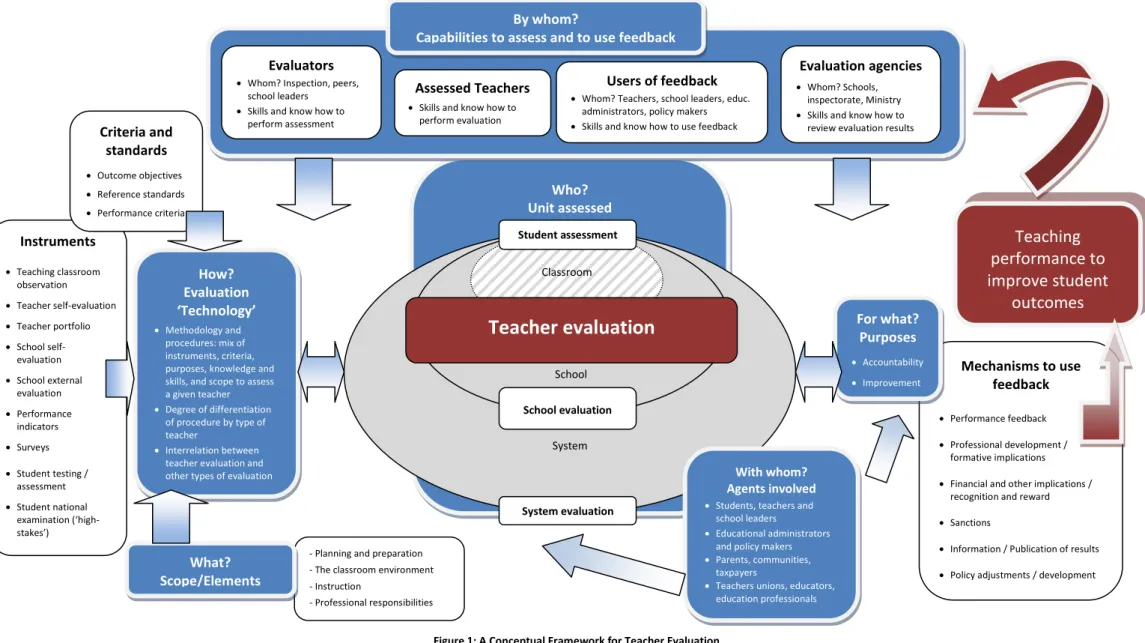
A key challenge is to understand the complex range of features associated with teacher evaluation. Figure 1 provides a conceptual framework summarising the aspects involved and the way they interconnect. The over-arching policy objective is to ensure that teacher evaluation contributes to the improvement of student outcomes through enhanced teaching performance and improved teaching practices. The conceptual framework has six main interrelated aspects.
Unit Assessed: Who? The subject of the evaluation is the individual teacher but teacher evaluation is to be analysed as part of an evaluation and assessment framework which includes other components such as student assessment, school evaluation and system evaluation.
Capabilities to assess and to use feedback: By Whom? This aspect concerns the preparation to evaluate, to be evaluated and to use the results of an evaluation as well as the choice of the groups undertaking these functions. It includes issues such as: the choice of the evaluators and
the development of the skills to perform the assessment of a teacher; the preparation by teachers to be the subject of an evaluation; the development of competencies to effectively use the results of an evaluation for the improvement of teaching practices; and the design of agencies to review teacher evaluation results with a view to hold agents accountable and to inform policy development.
Aspects assessed: What? Teacher evaluation processes concentrate on the core activity of teaching, typically covering areas such as planning and preparation, the classroom environment and instruction itself. But they also cover the remaining responsibilities of teachers such as their contribution to school development, links to the surrounding community and professional development activities.
Evaluation ‘technology’: How? This aspect refers to the features of a given approach to teacher evaluation, that is the mix of instruments, criteria and standards, purposes, knowledge and skills used in a specific teacher evaluation model. For instance, the latter may be based on a range of instruments such as self-evaluation, classroom observation and a teacher portfolio; be focussed on teacher instruction; be undertaken in relation to reference standards for the teaching profession; have both improvement and accountability purposes; and be based on experienced peers. Hence, this aspect refers to the way different aspects are combined to produce a given teacher evaluation model.
Purposes: For what? This encompasses the objectives of a particular teacher evaluation process and the mechanisms designed to ensure that evaluation results are used in a way such objectives are reached. The objectives of a teacher evaluation process typically consist of improvement and accountability. Examples of mechanisms to use evaluation results include performance feedback, professional development plans, and financial and other rewards.
Agents involved: With whom? This mostly deals with the implementation aspects of teacher evaluation procedures. It relates to the involvement of a range of stakeholders such as parents, students, teachers, school leaders, teacher unions, educational administrators and policy makers in the development and implementation of teacher evaluation and assessment processes.
Teacher evaluation issues cannot be studied in isolation. Societal, school system, and school-level factors all influence the design of teacher evaluation policies. These factors influence the design of approaches to teacher evaluation in terms of the needs for new policy initiatives, the factors that constrain policy opportunities, and the factors that influence policy implementation, impact and cost. Without an adequate understanding of the range of factors involved, and the ways they influence the impact of teacher evaluation policies, there is a risk of developing ineffective approaches to teacher evaluation.
Examples of societal factors are: Political environment
Demography and cultural diversity
Economic conditions, labour market trends
Role of media and general perceptions of schooling and teachers Public and private resources for schooling
Who? Unit assessed Instruments Teaching classroom observation Teacher self-evaluation Teacher portfolio School self-evaluation School external evaluation Performance indicators Surveys Student testing / assessment Student national examination (‘high-stakes’) Mechanisms to use feedback Performance feedback Professional development / formative implications
Financial and other implications / recognition and reward
Sanctions
Information / Publication of results Policy adjustments / development - Planning and preparation
- The classroom environment - Instruction - Professional responsibilities System School Classroom
Teacher evaluation
Student assessment School evaluation System evaluation For what? Purposes Accountability Improvement Evaluators Whom? Inspection, peers, school leaders
Skills and know how to perform assessment
What? Scope/Elements
assessed
By whom?
Capabilities to assess and to use feedback
Assessed Teachers
Skills and know how to perform evaluation
Users of feedback
Whom? Teachers, school leaders, educ. administrators, policy makers Skills and know how to use feedback
Evaluation agencies
Whom? Schools, inspectorate, Ministry Skills and know how to
review evaluation results Criteria and standards Outcome objectives Reference standards Performance criteria How? Evaluation ‘Technology’ Methodology and procedures: mix of instruments, criteria, purposes, knowledge and skills, and scope to assess a given teacher Degree of differentiation
of procedure by type of teacher
Interrelation between teacher evaluation and other types of evaluation
Teaching
performance to
improve student
outcomes
With whom? Agents involved Students, teachers and school leaders
Educational administrators and policy makers Parents, communities,
taxpayers
Teachers unions, educators, education professionals
Examples of school system factors are:
Distribution of responsibilities across educational authorities
School governance and autonomy
Structure of schooling
Curriculum, academic standards, learning time Market mechanisms / school choice
Allocation of resources within school system
Career and reward/incentive structures for teachers and school leaders Teacher education and certification policies
Roles and views of stakeholder groups Examples of school-level factors are:
Socio-economic context of schools
Management, leadership and distribution of responsibilities within school Professional activities of teachers and other school personnel
Teaching and learning arrangements
Community and family involvement
Learning conditions, support structures
In the next Sections, this paper will further analyse the five main areas of the conceptual framework. These are central in the development of a comprehensive teacher evaluation model:
Design and governance
Evaluation procedures
Competencies for evaluation and for using feedback Use of evaluation results
3: DESIGN AND GOVERNANCE OF A COMPREHENSIVE FRAMEWORK FOR TEACHER EVALUATION
3.1 Introduction
Designing and governing a comprehensive framework for teacher evaluation entails a range of aspects. First, it needs to be framed in the context of the overall objectives for schooling and the approach to its development depends on a range of established practices in the school system such as the extent of school autonomy, the existence of national curricula and standards, or the culture of evaluation.
Second, the purposes of the teacher evaluation framework need to be clearly defined. In particular, it needs to be clear what aspects teacher evaluation seeks to monitor and improve. The framework also needs to establish strategies to address the tension between the typical purposes of improvement and the accountability. Overall, teacher evaluation contributes to creating a knowledge-rich teaching profession in which teachers develop a research role alongside their teaching role, with teachers engaging more actively with new knowledge, and benefiting from support structures to generate improvement.
Third, there needs to be a clear understanding of the responsibilities of the different educational actors within the teacher evaluation framework. Educational authorities at several levels, agencies in charge of quality assurance such as inspectorates, schools, parents and school communities, teachers and students play different roles in ensuring improvement and accountability in the teaching profession.
Fourth, there needs to be a reflection on the way teacher evaluation articulates with the remaining components of the evaluation and assessment framework such as school evaluation, student assessment and system level evaluation. A particularly important aspect is how teacher evaluation is complementary to, avoids duplication with and is consistent in objectives with the remaining components of the evaluation and assessment framework.
The following three key aspects are analysed in turn: Aims and objectives of teacher evaluation; Responsibilities for teacher evaluation; and
Articulation with other components of the evaluation and assessment framework. 3.2 Aims and objectives of teacher evaluation
Two major purposes
Teacher evaluation has typically two major purposes. First, it seeks to improve the teacher own practice by identifying strengths and weaknesses for further professional development – the improvement function. Second, it is aimed at ensuring that teachers perform at their best to enhance student learning – the accountability function.
The improvement function
Teacher evaluation for improvement focuses on the provision of feedback useful for the improvement of teaching practices, namely through professional development. It involves helping teachers learn about, reflect on, and improve their practice. This typically occurs with account of the school context so professional development opportunities of an individual teacher are aligned with the school development plan.
The accountability function
The accountability function of teacher evaluation focuses on holding teachers accountable for their performance associating it to a range of consequences for their career. It seeks to set incentives for teachers to perform at their best. It typically entails performance-based career advancement and/or salaries, bonus pay, or the possibility of sanctions for underperformance. Teacher evaluation for accountability is summative in nature and usually involves evaluating performance at nodal points in a teacher‟s career. It also works as a means to provide recognition to teachers.
The tension between the improvement and the accountability functions
Combining both the improvement and accountability functions into a single teacher evaluation process raises difficult challenges. When the evaluation is oriented towards the improvement of practice within schools, teachers are typically open to reveal their weaknesses, in the expectation that conveying that information will lead to more effective decisions on developmental needs and training. However, when teachers are confronted with potential consequences of evaluation on their career and salary, the inclination to reveal weak aspects of performance is reduced, i.e.the improvement function is jeopardised. Also, using the same evaluation process for both purposes undermines the usefulness of some instruments (such as self-evaluation), and creates an additional burden on evaluators as their decisions have somewhat conflicting consequences (e.g. tension between improving performance by identifying weaknesses and limiting career progression, if the evaluation prevents teachers from advancing in their career). In practice, countries rarely use a pure form of teacher evaluation model but rather a unique combination that integrates multiple purposes and methodologies (Stronge and Tucker, 2003). These risks are compounded in contexts of lack of maturity of teacher evaluation as when evaluation is not ingrained in the school culture, evaluatees and evaluators have little experience, or evaluators have not had their legitimacy recognised.
To some extent trying to achieve improvement through accountability causes tensions. An emphasis on accountability may in some instances lead teachers to feel insecure or fearful and reduce their appreciation of their work (OECD, 2009b). By contrast, teachers and their unions expect opportunities of social recognition of their work and opportunities for professional growth through the development of a formative system of teacher evaluation (Avalos and Assael, 2006).
Teacher evaluation for improvement purposes is likely to benefit from conditions such as: A non-threatening evaluation context;
A culture of mutually providing and receiving feedback;
Clear individual and collective objectives with regard to improving teaching within the school as well as a sharing of school objectives;
Simple evaluation instruments such as self-evaluation forms, classroom observation, and structured interviews;
Opportunities to enhance competencies as well as resources and means to improve practice; Teacher evaluation integrated in a system of school self-evaluation and quality assurance. In turn, teacher evaluation for accountability is likely to benefit from conditions such as: An independent and objective assessment of the teacher‟s performance;
National-level standards and criteria across schools;
An evaluation component external to the school and more formal processes; Well-established rules regarding the consequences of the evaluation;
Clear individual objectives with regard to all aspects of a teacher‟s performance. Well-trained, competent evaluators of teaching performance;
Impact on professional development plan.
Possibilities for appeal for teachers who feel they have not been treated fairly. 3.3 Responsibilities for teacher evaluation
Responsibilities for teacher evaluation are typically shared between educational authorities, including quality assurance agencies such as inspectorates, schools and their leadership, and teachers themselves. The role of educational authorities
Educational authorities play a major role in the conception and application of teacher evaluation, since they set the national learning outcome objectives, agree standards for the teaching profession and establish the norms that regulate teacher evaluation. In some countries, they play a direct role in the implementation and monitoring of teacher evaluation procedures. This might include the design of specific evaluation tools and instruments, the determination of evaluation criteria, the distribution of evaluation duties, and the follow-up on evaluation results. In other countries, educational authorities establish general principles and guidelines only and give schools considerable leeway to adapt the teacher evaluation model to their particular circumstances (for instance, letting schools define evaluation criteria).
The role of inspectorates
In many countries education inspectorates take full responsibility for teacher evaluation. This includes developing teacher evaluation procedures and undertaking individual teacher evaluations with school inspectors taking the role of evaluators. In others, the inspectorate does not take responsibility for individual teacher evaluations but, instead, has an important role in stimulating both the quality of school leadership and the quality of teaching. This is typically done through feeding back the results of external school evaluation, mostly consisting of feedback on leadership and management, feedback on the quality of the teaching and learning processes, and feedback on school climate. In general, the Inspectorate also has an eminent role in modelling and disseminating good practice in teacher evaluation.
The role of schools and school leadership
The effective operation of teacher evaluation depends to a great extent on the way the concept and practice of school leadership is established in schools. The role of school leaders in teacher evaluation differs across countries. In some countries, it may consist of the simple implementation of centrally-dictated regulations. In this case, real and recognised pedagogical leadership is necessary to use the teacher evaluation process developmentally and avoid the image of a bureaucratic device.
In other countries, school leaders take full responsibility for the evaluation of individual teachers. In Finland, the school director is the pedagogical leader, responsible for the teachers in her school and for the implementation of measures needed to enhance teaching quality. As a result, most of Finnish schools have a system that includes annual discussions aimed at evaluating the teacher‟s fulfillment of individual objectives set up during the previous year and determining developmental needs for the following year (UNESCO, 2007).
The complex interrelationship of personnel and career development and school improvement requires that the evaluation, management, and improvement processes are embedded and integrated in a system of school quality assurance.
The role of teachers
In some systems, teacher evaluation is based on reviews by peers, often more experienced and with more responsibilities. This is more typical of evaluation for improvement purposes. Evidence shows the power of developmental peer observation of lessons with clear foci and effective feedback in making a strong contribution to notching up the quality of instruction. When peers are the evaluators in accountability-driven teacher evaluation procedures, issues of legitimacy are particularly relevant to address.
3.4 Articulation with other components of the evaluation and assessment framework
The individual evaluation of teachers and the collective responsibility for school teaching quality
Since systems of school evaluation and teacher appraisal and feedback have both the objective of maintaining standards and improve student performance, there are likely to be great benefits from the synergies between school evaluation and teacher evaluation. To achieve the greatest impact, the focus of school evaluation should either be linked to or have an effect on the focus of teacher evaluation (OECD, 2009b). Taking forward human resources management is ideally embedded in a system of school quality assurance, where the school strategy and the school self-evaluation results ensure a continuous monitoring and improving of school and teacher quality.
Teacher evaluation may be interlinked with school arrangements to improve teaching quality in a range of ways. First, teacher evaluation can serve the direct purpose of improving the teaching process within the school when teacher evaluation is carried out as part of school internal evaluation, and distinct from the formal individual assessment of teachers. Teacher evaluation for improvement purposes as part of internal school evaluation is usually carried out by the school head or the school management team. Results from this kind of teachers' assessment can be used to identify teaching needs and contribute to the definition of the school plan in order to improve the teaching process within the school.
Second, school arrangements and teacher evaluation are interlinked when the contribution of the individual teacher to school development is assessed as part of the individual assessment of teachers. In a number of countries, teachers are increasingly assessed both as individuals personally responsible for their students and as members of the school teaching staff. Areas of assessment include teachers‟ professional responsibilities such as professional development, contribution to school management, engagement with the surrounding community, etc.
Third, school arrangements and teacher evaluation can also be linked when professional development activities for teachers which result from their individual appraisal are planned in the context of the general development plan of the school. Several countries now link professional development to the developmental priorities of the school and co-ordinate in-service education in the school accordingly (OECD, 2005).
Use made of teacher evaluation results for school evaluation
Results of individual teacher appraisals are seldom used for external school evaluation. This may be explained by the fact that in most countries, teacher evaluation and school evaluation serve distinct purposes. Individual teacher evaluation usually has a limited focus as it is designed to identify priorities for individual professional development. The use of results from individual teacher evaluations is more spread in the context of internal school evaluations. In some countries, such results are taken into account by school heads when assessing teaching quality in their school. Teacher assessments can thus assist with the development of improvement plans for schools.
Articulation between school evaluation, teacher evaluation and student assessment
School evaluation, teacher evaluation and student performance results may also be interlinked. Whether as part of internal or external school evaluation, student results in national standardised assessments are becoming a basis for judging the performance of a school and, indirectly, its teaching team (e.g. Sweden, Scotland). The current shift from processes to results-based teachers' evaluation is a step towards closing the gap between individual and collective forms of accountability. In an increasing number of countries, monitoring mechanisms are concerned with teachers both as individuals and members of the school team (Eurydice 2008). In Chile, for instance, teachers are rewarded collectively when they work in schools which are identified as high-performing by the National Performance Evaluation System of Subsidized Schools (SNED) (OECD, 2005). Policies for the individual appraisal of teachers based on students' results have also emerged but are less common (see Section 4.4 for issues associated with the use of student results for the evaluation of individual teachers).
4: TEACHER EVALUATION PROCEDURES
4.1 Introduction
Establishing effective teacher evaluation procedures is challenging at several levels: accuracy of the measurement, inclusion of all the dimensions of what is meant to be measured, consistency with the goals of the feedback exercise, adaptation to the needs of those who will use the results (teachers, school leaders, educational authorities), cost-effectiveness, and practical feasibility.
Teacher evaluation requires the establishment of reference standards and evaluation criteria to allow proper assessments of performance to be made. In particular, a definition of what „good‟ teaching is needs to be developed. Performance measurement also calls for a judicious choice of instruments and sources of information. For instance, using student results to evaluate individual teachers is particularly challenging since learning outcomes are the result of a multitude of factors including the students‟ socio-economic background.
Teachers have specific needs for feedback, and therefore evaluation procedures need to be designed to meet those needs. Improving teacher evaluation effectiveness implies choosing adequate procedures for given objectives (e.g. internal vs. external process; formative vs. summative process).
The following three key aspects are analysed in turn: Character and nature of teacher evaluation;
Reference standards, aspects evaluated and evaluation criteria; and Instruments and information sources.
4.2 Character and nature of teacher evaluation
Particular features of teacher evaluation procedures include:
Teachers assessed. A particular teacher evaluation model might cover the totality of teachers in the system or a subset of teachers depending on the contract type (e.g. tenured vs. contract teachers), stage of the career (e.g. beginner vs. experienced), level of education (e.g. primary vs.
secondary education), and type of education (e.g. general programmes, vocational programmes of adult education).
Character of evaluation. Teacher evaluation may be mandatory or voluntary. The latter might however be linked to promotion within the career.
Nature of evaluation. Teacher evaluation might be mostly externally-driven or primarily internally-based (or school-based). In the former case, aspects assessed, instruments used as well as evaluation criteria are common across schools and evaluators are predominantly external to the school of the assessed teacher. In the latter case, the school takes responsibility for designing specific evaluation criteria and instruments, following-up evaluation results and evaluators are mostly internal to the school.
Frequency. Teacher evaluation can be carried out at regular intervals (e.g. every two years), at key stages of the career (e.g. for promotion within the career), or on specific occasions such as at the end of the probationary period or for contract renewal for contract teachers.
School-based teacher evaluation vs. externally-driven teacher evaluation
Teacher evaluation which is mostly internal to the school has the advantage of giving the school ownership of the evaluation processes and ensuring that all aspects are carefully considered by the school. It also ensures that the school context is taken into account – the individual teacher is evaluated against reference standards with criteria that account for her school‟s objectives and socio-educational background. However, in systems with little maturity of teacher evaluation, it might have the disadvantage that schools have little expertise in devising evaluation instruments and assessing teaching performance. Also, the use of internally devised instruments is in principle more appropriate for teacher evaluation for improvement. In terms of evaluation for accountability, however, there might be a case for using a national framework and standard procedures in the case the consequences of such teacher evaluation are at the national level and there is a risk that standards might differ across schools.
4.3 Reference standards, aspects evaluated and evaluation criteria Reference standards
A fair and reliable teacher evaluation model needs reference standards to evaluate teachers relatively to what is considered as „good‟ teaching. Teaching competences and responsibilities should be listed in order to build a comprehensive definition of what teachers should know and be able to do in the exercise of their profession. The main reference standards for teacher evaluation typically are:
Teacher professional profiles (general profile of competencies for teachers), including specialised profiles for particular types of teachers (e.g. level of education, subject).
Set of general and professional duties of teachers, including job descriptions.
At the level of the school, school development plan, the internal regulation and the annual activity plan.
The key element is the teacher professional profile, a clear and concise statement of what teachers are expected to know and be able to do. A fundamental precondition for the preparation of a profile of teacher competencies is a clear statement of objectives for student learning. Teachers‟ work and the knowledge and skills that they need to be effective must reflect the student learning objectives that schools are aiming to achieve. There needs to be profession-wide standards and a shared understanding of what counts as accomplished teaching (OECD, 2005).
Teacher profiles often express different levels of performance appropriate to beginning teachers, experienced teachers, and those with higher responsibilities. It is important to note that professional profiles provide the common basis to organise the key elements of the teaching profession such as initial teacher education, teacher certification (e.g. the entry exams), teachers‟ ongoing professional development, career advancement and, of course, teacher evaluation.
Aspects evaluated
The above reference standards are established for key assessment domains. A reference contribution in this area is the Danielson‟s Framework for Teaching (1996, 2007), which is articulated to provide at the same time “a „road map‟ to guide novice teachers through their initial classroom experiences, a structure to help experienced professionals become more effective, and a means to focus improvement efforts”.
The Framework groups teachers‟ responsibilities into four major areas further divided into
components:
-Planning and Preparation: demonstrating knowledge of content and pedagogy, demonstrating knowledge of students, selecting instructional goals, designing coherent instruction , assessing student learning;
-The Classroom Environment: creating an environment of respect and rapport, establishing a culture for learning, managing classroom procedures, managing student behavior and organising physical space;
-Instruction: communicating clearly and accurately, using questioning and discussion techniques, engaging students in learning, providing feedback to students, demonstrating flexibility and responsiveness;
-Professional Responsibilities: reflecting on teaching, maintaining accurate records, communicating with families, contributing to the school and district, growing and developing professionally, showing professionalism.
Each of these components consists of several elements to evaluate. For example, the teacher‟s knowledge of students encompasses elements such as knowledge of characteristics of age groups, knowledge of students‟ varied approaches to learning, etc. This framework has influenced a large number of teacher evaluation systems around the world. For instance, Chile‟s four domains and twenty criteria of
assessment were largely inspired by the Framework (Avalos and Assael, 2006). Another example can be found in the Professional Standards for Teachers in England (TDA, 2007b).
The work of a teacher involves considerably more than the pedagogical activities associated with student learning. It is therefore appropriate that teacher evaluation models consider professional responsibilities less directly related to the teaching itself. This recognises the fact that the demands on schools and teachers are becoming more complex and teachers have their areas of responsibility broadened. Some examples are: working and planning in teams; projects between schools; management and shared leadership; providing professional advice to parents; building community partnerships for learning; and participation in professional development (OECD, 2005).
Evaluation criteria
The essential basis for good practice in evaluation is the existence of clear criteria which are consistently applied by competent (trained and experienced) evaluators. This requires the development of explicit guidelines about what is expected from professional practice.
Teacher evaluation procedures require setting up evaluation criteria to determine the level of performance of individual teachers for each of the aspects assessed. This typically implies the development of indicators and/or standardised forms to record teacher performance. An additional criterion is the weighting of the different aspects assessed in order to compute an overall quantitative rating, in case it is part of the teacher evaluation model. This permits then to associate the quantitative rating to a qualitative scale, e.g. „unsatisfactory‟, „basic‟, „proficient‟, and „distinguished‟.
Some teacher evaluation models establish quotas for the proportion of teachers who can be rated at the top of the scale (e.g. „distinguished‟). Such approach runs counter to a criterion-referenced evaluation. However it might be justified in cases of an incipient culture and tradition of evaluation models to preclude a situation whereby most teachers end up being rated at the top of the scale, in which case the model loses its purpose.
4.4 Instruments and information sources
Gathering multiple sources of evidence about teacher practice meets the need for accuracy and fairness of the evaluation process, taking into account the complexity of what a „good‟ teacher should know and be able to do. A range of instruments and information sources are typically used to evaluate teachers.
Classroom observation
Teaching practices and evidence of student learning are likely to be the most relevant sources of information about professional performance. As a result, teacher evaluation is typically firmly rooted in classroom observation. Most key aspects of teaching are displayed while teachers interact with their students in the classroom. Classroom observations are the most common source of evidence used in OECD countries, whether American (e.g. Canada, Chile, United States), European (e.g. Denmark, France, Ireland, Spain) or Asian-Pacific (e.g. Australia, Japan, Korea). Such instrument shows whether the teacher adopts adequate practices in his more usual workplace: the classroom (Isoré, 2009; UNESCO, 2007).
Objective setting and individual interviews
Most teacher evaluation models require the individual teacher to set performance objectives for a given period of time in agreement with the school management. The evaluation then assesses the extent to which such objectives were met. The setting of objectives, as well as the evaluation itself, typically involve
individual interviews which are an opportunity to trigger critical reflection between evaluators and teachers.
Teacher self-evaluation
Another common instrument used in teacher evaluation is teacher self-evaluation. The perspective of the teacher being evaluated is essential, because it allows teachers to express their own views about their performance, and reflect on the personal, organisational and institutional factors that had an impact on their teaching.
Teacher portfolio
An instrument which typically complements teacher self-evaluation is a teacher portfolio, providing evidence about key aspects of the teacher‟s teaching. Different elements can compose teacher portfolios, including: lesson plans and teaching materials, samples of student work and commentaries on student assessment examples, teacher‟s self-reported questionnaires and reflection sheets (see Isoré, 2009, for a discussion on the use of portfolios including for improvement purposes versus accountability purposes). It should be noted that portfolios are not only a tool for evaluation per se, but also play a role in supporting a reflective approach to teaching practice that is a hallmark of effective teachers.
Standardised form to record teacher performance across a range of dimensions
Comprehensive models of teacher evaluation involve the use of standardised forms to record teacher performance across the aspects being evaluated. These are key tools used in the evaluation process which seek to capture performance across the range of domains under evaluation.
Teacher testing
In some countries, for particular purposes such as the access to a permanent position or entry into the profession, teachers are the subject of testing to assess their general and subject-matter competencies. In some instances, the results of such tests can be used for teacher evaluation.
Student results
Student results are not commonly used as sources of evidence for teacher evaluation in countries (OECD, 2005; UNESCO, 2007). Given that a wide range of factors impact on student results,1identifying the specific contribution of a given teacher is faced with numerous statistical challenges (see Section 3.1 of Isoré, 2009, for a detailed discussion). In this respect, the development of “value-added” models represents significant progress as they are designed to control for the individual student‟s previous results, and therefore have the potential to identify the contribution an individual teacher made to a student‟s achievement. However, in order to be effective, value-added models require vast amounts of data to be collected through large scale national-level student testing across levels of education and subjects, an option with prohibitive costs.
Test-based accountability systems are supposed to strengthen incentives for teachers to commit themselves to helping all students to meet important centrally defined standards and fulfil goals within the national curriculum. However, they may stifle innovation for school/teacher improvement or produce
1 Student learning is influenced by many factors. These include the student‟s own skills, expectations, motivation and behaviour along with the support they receive from their families and the influence of their peer group. In addition to the quality of teachers, other factors include school organisation, resources and climate; and curriculum structure and content. The effect of teachers is also cumulative, i.e. at a given moment in time student learning is influenced not only by the current teachers but also by former teachers.
unintended effects. For instance, they can lead to strategic responses on the part of teachers and schools (e.g. reallocation of efforts among topics or skills to meet the test standards at the expense of improvement, Koretz, 2005). "High-stakes" testing is associated with ambiguous effects on teachers' practices (Jacob and Levitt, 2003). Focus on high-stakes tests may introduce incentives for preemptively retaining students and increasing special education placements of low-performing students in special programmes which are outside the accountability system. Certain practices can reduce the meaningfulness of test scores as indicators of students' performance and lead to "score inflation". Indeed, targeted teaching to those skills that are represented on a test can raise scores without increasing students' mastery of the broader domain (Stetcher, 2002). Focus on high-stakes tests may lead to a narrowing of the curriculum. If the same test form is used repeatedly, teachers may become familiar with the specific items that appear on that form and shift their instruction accordingly ("teaching to the test").
Evidence of student learning progress is fundamental, but student results as an evaluation instrument are likely to be more relevant for whole-school evaluation than for individual teacher performance evaluation. This should not imply that teachers are exempted from providing evidence to demonstrate student progress in their classrooms, for instance, through specific evidence and portfolios. Surveys of students and parents
An instrument that is rarely used in the context of individual teacher evaluation are surveys collecting the views of students and parents. Parents‟ surveys are more relevant for whole-school evaluation than for individual teacher performance evaluation. As explained by Isoré (2009), the little current evidence on this subject shows that parents value teacher characteristics that surprisingly depart from student achievement: „the teacher‟s ability to promote student satisfaction‟ (Jacob and Lefgren, 2005), „humane treatment of students‟, „support for pupil learning‟, and „effective communication and collaboration with parents‟ (Peterson et al., 2003).
5: COMPETENCIES FOR TEACHER EVALUATION AND FOR USING FEEDBACK
5.1 Introduction
The effectiveness of teacher evaluation relies to a great extent on ensuring that both evaluators and evaluated teachers are in possession of the proper skills and competencies. This is crucial, for example, for evaluators to have legitimacy in the eyes of the evaluated teachers. Since teacher evaluation may have strong stakes for the assessed teachers and since school outcomes heavily depend on individual relations and cooperation at the school level, successful evaluation mechanisms require particular attention to developing competencies and defining responsibilities in the evaluation process.
In addition, competencies for using feedback to improve practice are also vital to ensure that teacher evaluation procedures are effective. Teacher assessment for improvement is a key driver required in the process of school development. As a result, for instance, it is pertinent to include training for evaluation in initial teacher education alongside the development of research skills. Particular groups such as inspectorates are also in a good position to engage in modelling and disseminating good practice in teacher evaluation. It is also critical to ensure the availability of vast information and guidelines about teacher evaluation procedures to all involved in them.
The following two key aspects are analysed in turn:
Evaluators; and
Skill development for evaluation 5.2 Evaluators
As explained in Section 3, the role of evaluator is typically played by:
Teachers, either internal or external to the school of the evaluated teacher.
External inspectors. These can take responsibility for the evaluation of individual teachers, the evaluation of teachers playing the role of evaluators, or school leaders.
School leaders. In some instances school leaders evaluate both pedagogic competencies and skills for other duties within the school. In others, school leaders evaluate non-pedagogical competencies only.
The participation of multiple evaluators is often seen as a key to successful practices; at least more than one person should be involved in judging teacher quality and performance (Peterson, 2000; Stronge and Tucker, 2003). Danielson and McGreal (2000) explain that the „360-degree evaluation systems‟, which incorporate the participation of many kinds of evaluators, support the idea that a teacher‟s competence may be seen from several different perspectives and that it should be exemplary (or at least adequate) from all those different angles. The case for involving more than one evaluator strengthens with high stakes evaluation (with a dominance of the accountability function).
In the context of peer review, evaluators are most likely to be „accomplished‟ current teachers who are recognised as having in-depth subject knowledge and pedagogical expertise, as highly proficient and
successful practitioners, able to guide and support others in the teaching process. Peer evaluators are typically compensated for carrying out their role (with teaching duties reduced or extra pay) and are themselves evaluated. They also normally have experience of being evaluated as a teacher and complete a dedicated training programme.
5.3 Skill development for evaluation
An area to which policy often does not devote enough attention is that of skills development for evaluation. This is a crucial area to ensure the legitimacy of evaluators and to make an effective use of evaluation results. Developing skills and competencies for teacher evaluation across the school system necessarily takes time and requires a substantial commitment from both educational authorities and the main actors involved in teacher evaluation. Considerable time is needed for explanation of teacher evaluation, consensus building among stakeholders about the indicators and norms that make up school or teacher quality, preparing and training of evaluators in terms of methodology, techniques and approaches, as well as providing time and resources for schools and teachers to prepare and understand their instruments.
The success of any teacher evaluation system greatly depends on the in-depth training of the evaluators. Experience suggests that evaluators should have a range of characteristics and competencies, including: (i) background in teaching; (ii) knowledge of educational evaluation theories and methodologies; (iii) knowledge of concepts of teaching quality; (iv) familiarity with systems and procedures of educational and school quality assurance, including the role of teaching quality in school quality and the role of teaching quality in personal development; (v) understanding of instrument development, including reliability and validity of observation and other assessment tools; (vi) awareness of the psychological aspects of evaluation; (vii) expertise with the quantitative rating of an assessment; and (viii) mastering of evaluation-related communication and feedback skills. These areas should receive priority for specialised training addressed to evaluators.
Given their crucial pedagogical role, school directors should benefit from dedicated training. Offers targeted at school leaders typically focus on human resources development and school quality assurance, including school self-evaluation. This usually involves personnel management, including aspects such as structured interactions with teachers, setting of objectives, linking school objectives to personnel development plans, making use of various sources of information on teaching quality and functional performance, development of instruments, and management instruments to use evaluation results.
Guaranteeing that teachers are provided with support to understand the evaluation procedures and to benefit from evaluation results is also vitally important. Teachers can benefit from training modules so they know what is expected from them to be recognised as „good‟ teachers, and to be prepared to make the best use of the feedback received. This contributes for teachers to appropriate the process through support and coaching. Evaluation and feedback ought also to be important aspects offered in initial teacher education and regular professional development activities.
6. USE OF EVALUATION RESULTS
6.1 Introduction
Making the best use of teacher evaluation results raises a number of challenges such as feeding information on performance back to those who deliver educational services, most notably teachers and school principals; developing mechanisms for the improvement of teaching practices, notably teacher professional development; establishing rewards, support systems and consequences that flow from evaluation results; and developing the channels which ensure that information generated by teacher evaluation is used for educational policy development. These challenges highlight the importance of knowledge management in any teacher evaluation framework.
The following two key aspects are analysed in turn: Formative use of results; and
Summative use of results. 6.2 Formative use of results
A key objective of teacher evaluation is to identify areas of improvement for individual teachers, leading to the preparation of individual improvement plans (including professional development) which take into account the overall school development plan. Without a link to professional development opportunities, the evaluation process is not sufficient to improve teacher performance, and as a result, often become a meaningless exercise that encounters mistrust – or at best apathy – on the part of teachers being evaluated (Danielson, 2001; Milanowski and Kimball, 2003; Margo et al. 2008). Typically, schools are provided with autonomy to determine how teacher evaluation results feed into teacher professional and school development plans. School pedagogical leadership plays the key role in ensuring the effectiveness of such link (Pont et al., 2008). Another key element are the resources made available for professional and school development.
6.3 Summative use of results
Evaluation of teacher performance can also be used to determine career advancement, award performance rewards or establish sanctions for underperforming teachers. It constitutes an opportunity to recognise and reward teaching competence and performance, which is essential to retain effective teachers in schools as well as to make teaching an attractive career choice (OECD, 2005). In general, teacher evaluation frameworks might have consequences at the following levels:
Career advancement. Most countries do not link directly teacher evaluation results with teacher pay but, instead, to career progression (therefore establishing an indirect link with salaries). An example is England where teachers who meet the standards for “Post Threshold, Excellent and Advanced Skills Teachers” also access the higher pay scale (TDA, 2007a). Most teacher evaluation models relate results to the speed at which the teacher progresses in the career. Typically, ratings in the top categories of the rating scale make the teacher progress faster in the career scale while ratings in the bottom categories of the rating scale lead to no career progression during the period associated with the evaluation.
Decisions at key points in career. The results of teacher evaluation can be used to make tenure decisions at the end of the probationary period, contract renewal decisions for contract decisions and might influence the chances of an application to a given school post.
Performance rewards. Teacher evaluation results might be used to award rewards to teachers. Typical rewards include: the award of a one-off monetary prize (bonus pay); time allowances and sabbatical periods; opportunities for school-based research; support for post-graduate study; or opportunities for in-service education. In some instances the focus of the rewards is on group recognition and rewards are at the school or grade level rather than individual level. The “bonus” pay element should be approached with considerable caution. The evidence of the overall impact of such extra payments is mixed and can be contentious and potentially divisive (OECD, 2005). Sanctions for ineffective teachers. Some countries provide for sanctions for ineffective teachers
beyond the standard consequences for career progression. For example, if underperformance persists following a number of evaluations, sanctions might include the removal from teaching duties (for teachers with civil servant status, this might translate into other functions within the school or another career within the civil service), or simply the termination of the contract. But early identification of underperformance is typically accompanied by a plan for in-service training for the improvement of practice.
However, it needs to be kept in mind that the issues surrounding developing a closer relationship between teacher performance and reward are controversial in all countries; and research in this field is difficult and has produced mixed results. There seems to be agreement that the design and implementation of performance-based rewards are crucial to their success. As explained in Harvey-Beavis (2003), there is a wide consensus that previous attempts at introducing performance-based reward programmes have been poorly designed and implemented (Mohrman et al. 1996; Ramirez, 2001). Problems in developing fair and reliable indicators, and the training of evaluators to fairly apply these indicators have undermined attempts to implement programmes (Storey, 2000). One problem identified is poor goal clarity because of a large number of criteria, which restricts teachers‟ understanding of the programme and makes implementation difficult (Richardson, 1999). Explanations of how, and on what criteria, teachers are assessed may be difficult to articulate. When this occurs, it is almost impossible to give constructive feedback and maintain teacher support for the programme (Chamberlin et al., 2002).
7. IMPLEMENTATION OF TEACHER EVALUATION
There are multiple challenges to successful implementation
Implementation difficulties may arise as a result of a wide range of factors. First, there might be a defensive culture of evaluation, little tradition of peer evaluation, feedback and sharing of teaching practices. This might lead to some resistance to application of teacher evaluation by particular groups in the school system. Second, there might be some technical challenges to implementation, including: limited professional expertise of those with responsibility to evaluate; insufficient preparation of schools to implement evaluation procedures; limited understanding by teachers of the purposes and uses of evaluation; a sense of unfairness by those teachers being evaluated; the excessive workload inherent to the evaluation process; and the reluctance of many teachers to accept the legitimacy of the evaluators. Third, there might be issues of lack of resources for aspects of the teacher evaluation procedures, particularly the time needed for developmental work, observational evaluation and feedback.
While comprehensive teacher evaluation models – e.g. with the multiplication of instruments and evaluators - are more likely to provide a solid basis to evaluate teachers, limited resources make trade-offs inevitable. As explained in Isoré (2009), comprehensive teacher evaluation procedures imply greater direct and indirect costs at every stage of the process: reaching agreements on the design of the system requires time for discussions and consultations with all stakeholders (Avalos and Assael, 2006); training evaluators is expensive and requires time (Danielson, 1996, 2007); conducting evaluation processes induces additional workload for both teachers and evaluators, unless offsetting is made by reducing workload with other responsibilities (Heneman et al., 2006); and aligning broader school reforms such as professional development opportunities requires more educational resources (Heneman et al., 2007; Margo et al., 2008).
It is important to address the challenges of implementation
It is essential to analyse the challenges of implementation of teacher evaluation. This includes reconciling the diverging interests of stakeholders, carefully analysing policy alternatives and their likely impact and discussing them with stakeholders to aim towards consensus.
Adverse effects are particularly prone to occur when consensus has not been reached on the objectives for teacher evaluation, its importance for the performance of the school system, and the practical options for implementation. Consensus is all the more precious to reach since local actors such as teachers and school leaders may be in the best position to foresee unintended consequences or judge what is feasible in practice, and since the effectiveness of teacher evaluation heavily depends on their cooperation.
The role of expertise on the effectiveness of teacher evaluation policies and practices
Teacher evaluation is eminently a technical matter and has a lot to benefit from worldwide evidence on best policies and practices. Some countries bring together educational researchers and distinguished teachers into an advisory group to monitor and guide the implementation of teacher evaluation. Such group is in a good position to recognise „good‟ evaluation practices, to keep abreast of relevant research developments and, as a result, to provide advice based on sound evidence.
The importance of gaining the support of teachers
Teacher evaluation and the resulting feedback, reflection and professional development will only work if teachers make it work. To a great extent it is the motivated teacher who ensures the successful implementation of reforms in schools. Hence, it is imperative to find ways for teachers to identify with the goals and values of teacher evaluation arrangements and practices (OECD, 2006). Teachers must be supported in understanding what the evaluation expects from them to be recognised as good teachers and in preparing adequately for the evaluation process.
8. CONCLUDING REMARKS
Promoting teacher evaluation is clearly in the national interest as well as serving students and their families and communities. Teachers need feedback on their performance to help them identify how to better shape and improve their teaching practice and, with the support of effective school leadership, to develop schools as professional learning communities. At the same time, teachers should be accountable for their performance and progress in their careers on the basis of demonstrated effective teaching practice.
Developing a comprehensive approach may be costly but is critical to conciliate the demands for educational quality, the enhancement of teaching practices through professional development, and the recognition of teacher knowledge, skills and competencies. The expectation is that teachers engaging in reflective practice, studying their own methods of instruction and assessment, and sharing their experience with their peers in schools, becomes regular a routine part of professional life.
REFERENCES
Avalos, B. and J. Assael (2006), “Moving from resistance to agreement: The case of the Chilean teacher performance evaluation”, International Journal of Educational Research, Vol. 45, No. 4-5, pp. 254-266.
Castro Ramos, C. (2009), Teacher Evaluation in Portugal: Country Background Report for OECD, Ministry of Education, Lisbon (available from www.oecd.org/edu/teacherevaluationportugal). Chamberlin, R., T. Wragg, G. Haynes and C. Wragg (2002), “Performance-related Pay and the Teaching
Profession: a Review of the Literature”, Research Papers in Education, 17(1), pp. 31-49.
Danielson, C. (1996, 2007), Enhancing Professional Practice: a Framework for Teaching, 1st and 2nd editions, Association for Supervision and Curriculum Development (ASCD), Alexandria, Virginia. Danielson, C. (2001), “New Trends in Teacher Evaluation”, Educational Leadership, Vol. 58, No. 5, pp.
12-15.
Danielson, C. and T. McGreal (2000), Teacher Evaluation to Enhance Professional Practice, Association for Supervision and Curriculum Development (ASCD), Alexandria, Virginia.
Eurydice (2008), "Levels of autonomy and responsibility of teachers in Europe", European Commission, Brussels, Education DG.
Harvey-Beavis, O. (2003), “Performance-Based Rewards for Teachers: A Literature Review”, paper
distributed at the third workshop of participating countries on OECD Activity “Attracting, Developing and Retaining Effective Teachers”, 4-5 June, Athens, Greece. Available from www.oecd.org/edu/teacherpolicy
Heneman, H., A. Milanowski, S. Kimball and A. Odden (2006), “Standards-Based Teacher Evaluation as a Foundation for Knowledge- and Skill-Based Pay”, Consortium for Policy Research in Education (CPRE) Policy Briefs RB-45.
Heneman, H., A. Milanowski and S. Kimball (2007), “Teacher Performance Pay: Synthesis of Plans, Research, and Guidelines for Practice”, Consortium for Policy Research in Education (CPRE) Policy Briefs RB-46.
Isoré, M. (2009), “Teacher Evaluation: Current Practices in OECD Countries and a Literature Review”,
OECD Education Working Paper No.23, OECD, Paris. Available from
www.oecd.org/edu/workingpapers
Jacob, B. and L. Lefgren (2005), “What Do Parents Value in Education: an Empirical Investigation of Parents‟ Revealed Preferences for Teachers”, NBER Working Paper n°11494.
Jacob, B. and S. Levitt (2003),"Rotten apples: an investigation of the prevalence and predictors of teacher cheating. Quarterly Journal of Economics 118, pp. 843–877.
Margo, J., M. Benton, K. Withers and S. Sodha (2008), Those Who Can?, Institute for Public Policy Research (IPPR) Publications.
Milanowski, A. and S. Kimball (2003), “The Framework-Based Teacher Performance Assessment Systems in Cincinatti and Washoe”, CPRE Working Paper Series TC-03-07.
Mohrman, A., S. Mohrman and A. Odden (1996), “Aligning Teacher Compensation with Systemic School Reform: Skill-Based Pay and Group-Based Performance Awards”, Educational Evaluation and
Policy Analysis, 18(1), pp. 51-71.
OECD (2005), Teachers Matter: Attracting, Developing and Retaining Effective Teachers, OECD, Paris. OECD (2006), “The Teaching Workforce: Meeting Aspirations and Enhancing Motivation”, in Education
Policy Analysis 2005, OECD, Paris.
OECD (2009a), OECD Review on Evaluation and Assessment for Improving School Outcomes: Design
and Implementation Plan for the Review, OECD, Paris [OLIS Document
EDU/EDPC(2009)3/REV1].
OECD (2009b), Creating Effective Teaching and Learning Environments: First Results from TALIS, OECD, Paris.
Peterson, K. (2000), Teacher Evaluation: A Comprehensive Guide to New Directions and Practices, 2nd edition, Thousand Oaks, CA: Corwin Press.
Peterson, K., C. Wahlquist, J. Esparza Brown and S. Mukhopadhyay (2003), “Parents Surveys for Teacher Evaluation”, Journal of Personnel Evaluation in Education, Vol. 17, No. 4, pp. 317-330.
Pont, B., D. Nusche and H. Moorman (2008), Improving School Leadership, Volume 1: Policy and
Practice, OECD, Paris.
Ramirez, A. (2001), “How Merit Pay Undermines Education”, Educational Leadership, 58(5), pp. 16-20. Richardson, R. (1999), Performance Related Pay in Schools: An Assessment of the Green Papers, A report
prepared for the National Union of Teachers, The London School of Economics and Political
Science.
Santiago, P., D. Roseveare, G. van Amelsvoort, J. Manzi and P. Matthews (2009), Teacher Evaluation in
Portugal: OECD Review, OECD, Paris (available from
www.oecd.org/edu/teacherevaluationportugal).
Stecher, B. M. (2002), "Consequences of Large-Scale, High-Stakes Testing on School and Classroom Practices", in L. Hamilton, B. Stecher and S. Klein (eds.), Making Sense of Test-Based
Accountability in Education, RAND, Santa Monica, CA, pp. 79-100.
Storey, A (2000), “A Leap of Faith? Performance Pay for Teachers”, Journal of Education Policy, 15(5), pp. 509-23.
Stronge, J. and P. Tucker (2003), Handbook on Teacher Evaluation: Assessing and Improving
Performance, Eye On Education Publications.
TDA (Training and Development Agency for Schools, 2007a), “Professional Standards for Teachers: Why Sit Still in Your Career?”, United Kingdom.
TDA (Training and Development Agency for Schools, 2007b), Professional Standards for Teachers, The Training and Development Agency for Teachers: London,
www.tda.gov.uk/upload/resources/pdf/s/standards_a4.pdf
UNESCO (2007), Evaluación del Desempeño y Carrera Profesional Docente: Una panorámica de
América y Europa, Oficina Regional de Educación para América Latina y el Caribe, UNESCO