PRESERVING DATA PRIVACY AND INFORMATION
USEFULNESS FOR RFID DATA PUBLISHING
KHALIL AL-HUSSAENI
A THESIS IN
T H E CONCORDIA INSTITUTE FOR INFORMATION SYSTEMS ENGINEERING
PRESENTED IN PARTIAL FULFILLMENT OF THE REQUIREMENTS
FOR THE DEGREE OF MASTER OF APPLIED SCIENCE IN INFORMATION SYSTEMS SECURITY CONCORDIA UNIVERSITY
MONTREAL, QUEBEC, CANADA
SEPTEMBER 2009
1*1
Library and Archives
Canada
Published Heritage
Branch
395 Wellington Street
OttawaONK1A0N4
Canada
Bibliotheque et
Archives Canada
Direction du
Patrimoine de I'edition
395, rue Wellington
Ottawa ON K1A0N4
Canada
Your file Votre reference ISBN: 978-0-494-63082-2 Our file Notre reference ISBN: 978-0-494-63082-2
NOTICE:
AVIS:
The author has granted a
non-exclusive license allowing Library and
Archives Canada to reproduce,
publish, archive, preserve, conserve,
communicate to the public by
telecommunication or on the Internet,
loan, distribute and sell theses
worldwide, for commercial or
non-commercial purposes, in microform,
paper, electronic and/or any other
formats.
L'auteur a accorde une licence non exclusive
permettant a la Bibliotheque et Archives
Canada de reproduire, publier, archiver,
sauvegarder, conserver, transmettre au public
par telecommunication ou par Nnternet, preter,
distribuer et vendre des theses partout dans le
monde, a des fins commerciales ou autres, sur
support microforme, papier, electronique et/ou
autres formats.
The author retains copyright
ownership and moral rights in this
thesis. Neither the thesis nor
substantial extracts from it may be
printed or otherwise reproduced
without the author's permission.
L'auteur conserve la propriete du droit d'auteur
et des droits moraux qui protege cette these. Ni
la these ni des extraits substantiels de celle-ci
ne doivent etre imprimes ou autrement
reproduits sans son autorisation.
In compliance with the Canadian
Privacy Act some supporting forms
may have been removed from this
thesis.
Conformement a la loi canadienne sur la
protection de la vie privee, quelques
formulaires secondaires ont ete enleves de
cette these.
While these forms may be included
in the document page count, their
removal does not represent any loss
of content from the thesis.
Bien que ces formulaires aient inclus dans
la pagination, il n'y aura aucun contenu
manquant.
• + •
Abstract
Preserving Data Privacy and Information Usefulness for RFID Data Publishing
Khalil Al-Hussaeni
Radio-Frequency IDentification (RFID) is an emerging technology that employs radio waves to identify, locate, and track objects. RFID technology has wide applications in many areas including manufacturing, healthcare, and transportation. However, the manipulation of uniquely identifiable objects gives rise to privacy concerns for the individuals carrying these objects. Most previous works on privacy-preserving RFID technology, such as EPC re-encryption and killing tags, have focused on the threats caused by the physical RFID tags in the data collection phase, but these techniques cannot address privacy threats in the data publishing phase, when a large volume of RFID data is released to a third party. We explore the privacy threats in RFID data publishing. We illustrate that even though explicit identifying information, such as phone numbers and SSNs, is removed from the published RFID data, an attacker may still be able to perform privacy at-tacks by utilizing background knowledge about a target victim's visited locations and timestamps. Privacy attacks include identifying a target victim's record and/or inferring their sensitive informa-tion. High-dimensionality is an inherent characteristic in RFID data; therefore, applying traditional anonymity models, such as /^-anonymity, to RFID data would significantly reduce data utility. We propose a new privacy model, devise an anonymization algorithm to address the special challenges
of RFID data, and experimentally evaluate the performance of our method. Experiments suggest that applying our model significantly improves the data utility when compared to applying the traditional if-anonymity model.
Acknowledgments
I would like to take this opportunity to express my deepest gratitude to my supervisor, Dr. Ben-jamin C. M. Fung, for his much-appreciated guidance and continuous support at every step through-out my work on this research. His enthusiasm inspired me, and withthrough-out his valuable suggestions and critical remarks, the completion of this work would not have been possible.
I would like also to say that no matter what words I use in expressing my profound appreciation, I cannot thank my dearest beloved parents and brothers enough for their compassionate uncondi-tional love and support at every stage during my study at Concordia University. In return, I can only offer them the chance to be proud of what I have achieved, and of course, my unconditional love.
Contents
List of Figures ix
List of Tables x
1 Introduction 1 1.1 Motivation 3 1.2 Outline of the thesis 9
2 Literature Review 11 2.1 Relational Data 13
2.1.1 Record Linkage 13 2.1.2 Attribute Linkage . 17 2.1.3 K-anonymity and RFID Data 22
2.2 Transaction Data 23 2.2.1 Transaction Data vs. RFID Data 27
2.3 Trajectory Data 28 2.3.1 Trajectory Data vs. RFID Data 31
2.4 Summary 32
3 Problem Definition 33 3.1 Object-Specific Path Table 33
3.2 Privacy Threats 35 3.3 Privacy Models 37 3.4 Problem Statement 39
3.5 Summary 41
4 The Anonymization Method 42 4.1 Identifying Violations 42 4.2 Anonymization Algorithm 48
4.2.1 Critical Violation Tree 50
4.3 Summary 52
5 Empirical Study 54 5.1 Data Sets 55 5.2 Evaluation Criteria 56
5.2.1 Data Quality . •, 56 5.2.2 Efficiency and Scalability 60
5.3 Summary 61
6 Conclusion 63 6.1 Summary of Contributions 64
6.2 Future Work 64
List of Figures
1 Data Flow in an RFID System 2
2 Taxonomy trees 15 3 A graphical representation of an uncertainty trajectory volume [1] 29
4 CVTof all identified critical violations 51 5 CVT after deleting the winner pair e4 and updating the Score Table 51
6 Subway: Distortion ratio vs. K 57 7 MSNBC: Distortion ratio vs. K 58 8 Scalability (L = 3, K = 30, C = 60%) 60
List of Tables
1 Raw passenger-specific path table T 4 2 Anonymous table V for L=2, K=2, C=50% 4
3 Alumni: external table 12 4 Welfare: private table 12 5 2-anonymous Welfare table 15 6 3-diverse Welfare table 20
Chapter 1
Introduction
Radio Frequency IDentification (RFID) is a prevailing technology for automatically identifying objects in an efficient fashion. RFID technology is composed of two entities; tags and readers. A tag is a small device that can be attached to a manufactured object or to an item carried by someone for the purpose of uniquely identifying that object or that person. A reader is an electronic device that retrieves the information stored in an RFID tag by broadcasting a radio signal. Figure 1 illustrates a typical RFID information system, which is composed of a large collection of tags and readers, and can manage huge amounts of RFID data. The reader scans a tag by emitting a radio signal to which the tag responds by transmitting the stored information, along with its unique Electronic Product Code (EPC) back to the reader [40]. This process causes streams of RFID data records to be dumped into an RFID database, which then grows to a gigantic size. Records take the format of (EPC, loc.t), where EPC is a unique identifier of the tagged object, loc is the location where the reader is positioned, and t is the time when the reader detected the tag. A data recipient/analysis module can submit queries to the query engine to request information on
D) C
3<
Q c .0 o _o o •< o « n Q TagsFigure 1: Data Flow in an RFID System
particular tagged objects or general workflow patterns [19]. Afterwards, the query engine processes the requests and responds back by binding the RFID data to some related object-specific data stored in a separate database.
RFID technology is useful; however, the uniquely identifiable objects raise privacy concerns for the individuals that carry these objects. For example, an adversary might be able to learn about a person's movements, and thereby gain an advantage. Several techniques [54] [6] [23] [50] including privacy-preserving RFID technologies [40], such as EPC re-encryption and killing tags [24], have been proposed to address the privacy issues in the data collection phase where communication between tags and readers takes place. We explore the privacy threats that occur in the data publishing phase, in which a large volume of RFID data is released to a third party, and propose a practical solution, a privacy model, that suits the special nature of RFID data. We present an anonymization approach [7] [8] which entails hiding some data before its release. We
develop anonymization algorithm for the query engine (see Figure 1) to convert the underlying object-specific RFID data from its original raw state to a transformed version that is invulnerable to attacks against individuals' privacy. We assume that a data recipient is a potential adversary (or attacker), who seeks to identify a target victim's record and/or learn about the target victim's sensitive information associated with her record in the published data. This applies to any data recipient whom we often describe as a third party. In RFID data, some particular attributes are considered to be sensitive. This is because these attributes contain sensitive values about their corresponding records' owners. The sensitive value is not be associated with its related individual upon publishing of the data. When we speak of RFID data publishing (or releasing), we refer to situations where the RFID data is shared with specific recipients, e.g., data analysis institutions, or released for public access. The term "data holder(s)" refers to the individual/organization that possesses the data and wishes to publish it. In this thesis we assume that in any given RFID data, each record belongs to only one individual, whom we refer to as the record owner.
1.1 Motivation
We begin by providing a real-life example of sharing person-specific RFID data. This shall demon-strate the potential risk of compromising individuals' privacy when publishing data.
The Oyster Travelcard in Transport for London (TfL), is a successful application of RFID tech-nology in a transit system. Passengers register their personal information when they first purchase their RFID-tagged smart cards. Then, the appropriate fare amount is deducted from their cards every time they use the transport services. Passengers refill their smart card anytime as needed.
EPC 1 2 3 4 5 6 7 8
able 1: Raw passenger-specific path table T
Path (al -» d2 -* 63 -> e4 -> / 6 -> c7) (63 -» e4 — / 6 - • e8) (63 — c7 — e8) (d2 -» / 6 -> c7 -> e8> (d2 -> c5 -» / 6 - • c7) (c5 - • / 6 -» e9) (d2 -> c5 -> c7 -» e9) </6 -* c7 -» e9) Employment Status On-welfare Full-time Full-time Retired On-welfare Retired Part-time Part-time
Table 2: Anonymous table T' for L=2, # = 2 , C=50%
EPC 1 2 3 4 5 6 7 8 Path (63 -> / 6 -» c7) (63 - • / 6 -* e8> (63 -> c7 -» e8) (/6 -» c7 -+ e8> (c5 -> / 6 -^ c7) (c5 - • / 6 - • e9) (c5 -> c7 -+ e9) (/6 - • c7 -> e9) Employment Status On-welfare Full-time Full-time Retired On-welfare Retired Part-time Part-time
The public transit companies utilize the personal journey data (the RFID data) to improve their ser-vices. Analyzing RFID data is a non-trivial task; transit companies often do not have the expertise to perform the analysis themselves but outsource this process and therefore, require granting a third party access to the RFID data and passenger data (object data in Figure 1). The passenger data may contain person-specific (sensitive) information, such as age, disability status, and (un)employment status. TfL does say that it does not associate journey data with named passengers, although they provide such data to government agencies on request [46]. Our goal, in this case, is to answer the question: How can an RFID data holder (e.g., the transit company) safeguard data privacy while keeping the released RFID data useful for analysis? We exemplify this concept with the following scenario.
Example 1.1.1 A transit company wants to share Table 1, the passenger-specific path table, with a third party for the purpose of performing data analysis. The EPCs, passengers' names, and other explicit identifiers are removed from the table to be released. EPCs are included in Table 1 for the sake of clarity. Each record contains a path and some passenger-specific information, where path consists of a sequence of pairs (lociti) indicating the passenger's visited location loci at timestamp £j. For instance, the path associated with EPC#3 is (63 —* cl —• e8), meaning that the passenger has been to locations b, c, and e at timestamps 3, 7, and 8, respectively. We assume that the passenger-specific path table, Table 1, contains only one sensitive attribute, namely Employment Status. In other words, one domain value from the Employment Status attribute is associated with each record in the table. Let On-welfare be the only sensitive value. The goal now is to prepare a version of Table 1 that is immunized against privacy attacks and still useful for data analysis. We will demonstrate how Table 1 is susceptible to privacy attacks and, therefore, compromises the individuals' privacy. •
In Table 1 of Example 1.1.1, some values in the Employment Status attribute are considered sensitive; an adversary is not supposed to associate these sensitive values with their related passen-gers. However, some values are usually considered more sensitive than others, e.g., a passenger might not object to people knowing that her employment status is Full-time, in contrast to the sta-tus of On-welfare. Thus, the data holder specifies a set of sensitive values which is a subset of the domain values of a sensitive attribute in the passenger-specific information. Privacy attacks manifest when an adversarial data recipient attempts to identify the target victim's record and/or sensitive value from the released data. We illuminate the following types of privacy attacks and project their impact on Table 1:
1. Record linkage: record linkage is a privacy attack in which the adversary exploits the unique-ness of a passenger's path in the released data table. If a passenger's path is so specific that it only matches to a small number of other passengers, linking the victim's record from the released RFID data table along with her employment status may become possible. The as-sumption is that the adversary possesses some knowledge about the locations and timestamps (pairs) existing in a victim's path. For example, assume the adversary knows that Alice has been to locations e and c at timestamps 4 and 7, respectively. Since Alice's record is the only record with a path containing e4 and c7, Alice's record and her sensitive value On-welfare can be uniquely identified.
2. Attribute linkage: attribute linkage is another privacy attack that occurs when a group of records that share some combination of pairs contains a frequently appearing sensitive value. Even though a target victim's record might not be identified, inferring the victim's sensitive value from such a group becomes possible. For example, suppose the adversary is aware of the existence of pairs d.2 and / 6 in a target victim's path. A group of three records {EPC#1, 4, 5), which contain d2 and / 6 , has two records with the sensitive value On-welfare. Two out of three records having the same sensitive value allow the adversary to infer that the target victim is on welfare with 67% confidence.
Several privacy models have been proposed to combat record and attribute linkage attacks. These privacy models, however, target a different type of data, i.e., relational data, /('-anonymity [5]
[12] [14] [15] [16] [30] [25] [31] [38] [47] [52] [33] [34], ^-diversity [27], confidence bound-ing [48], and i-closeness [26] are examples of such privacy models. These models assume a pre-determined set of particular attributes in the released data table, called quasi-identifier (QID) [8] [32], that an adversary can use to identify a target individual. We define QID attributes and back-ground knowledge below.
Quasi-identifier (QID) A QID in a table T is a set of attributes which can combine to uniquely identify single or multiple records' owners in T with the help of background knowledge.
Adversary's background knowledge Background knowledge is the information an adversary externally obtains about a particular (or multiple) record owner in T, and can be jointly used with the set of QID in T to identify a target individual.
Despite the fact that the abovementioned privacy models have been proven effective for anonymiz-ing relational data, they become inapplicable for anonymizanonymiz-ing RFID data due to the curse of high dimensionality [2].
High-dimensionality is an intrinsic characteristic of RFID data due to the huge possible com-binations of locations and timestamps. Consider a subway system having 50 stations that operate 20 hours a day. The total number of dimensions of the RFID data table would be 50 x 20 = 1000 dimensions. Each dimension (pair) could be a potential piece of knowledge used by an adversary to perform record or attribute linkages; therefore every dimension is considered a potential quasi-identifying (QID) attribute. If we apply a traditional privacy model, such as /^-anonymity, all dimensions would then be included in a single QID and every path would have to be indistinguish-able from at least K— 1 other paths. In order to achieve K-anonymity, the high dimensional [2] nature of RFID data would likely cause most of the data to be suppressed. Consequently, the utility
of the resultant anonymous data becomes insufficient for further data analysis. As an example, ap-plying X-anonymity to Table 1 for a small value of K — 2, i.e., 2-anonymity, results in suppressing all pairs of al, d2,63, e4, c7, e9 from the table.
As mentioned earlier, in the context of RFID data, all attributes (dimensions) could poten-tially be used by an adversary as background knowledge to launch privacy attacks, i.e., record or attribute linkages. Thus, in traditional if-anonymity and its extended privacy models, the as-sumption would be that all attributes in an RFID data table are included in a single QDD. However, assuming an adversary's knowledge about the entire locations and timestamps in a target victim's path is unrealistic as it requires non-trivial effort to collect such knowledge from a large number of locations at different times. Hence, a real-life scenario would suggest limiting the adversary's background knowledge to a maximum of L pairs of locations and timestamps about a target victim. This is an essential improvement in our privacy model.
We define a novel anonymization privacy model, LKC-privacy, which adapts to the challenge of high dimensionality in RFID data. LKC-privacy provides a practical solution to accounting for an adversary's background knowledge. This is achieved by bounding the amount of information an adversary possesses to a maximum threshold of L pairs. The intuition is that, given an RFID data table T, we need to make sure that for any path in T, every proper subsequence q with maximum length (number of pairs) L appears in at least K records in T. Moreover, the inference confidence of any sensitive value s € S from a group of records that contain q is not greater than C, where S is a set of sensitive values chosen by the data holder from the domains of the sensitive attributes in T. For the three threshold parameters in LKC-privacy, L and K are positive integers and 0 < C < 1 is a real number. When applying L/<C-privacy, an adversary can successfully perform record
linkage attacks with a maximum probability of \jK and successfully perform attribute linkage attacks with a maximum probability of C. These probabilities are based on the assumption that the adversary's background knowledge does not exceed L pairs of locations and timestamps.
Continuing from Example 1.1.1, applying our privacy model to Table 1 to satisfy (2,2,50%)-privacy will transform it into an anonymous version T", Table 2, that adheres to the (2,2,50%)-privacy re-quirement. As shown in Table 2, pairs al, d2, and e4 from Table 1 have been suppressed in order to achieve (2,2,50%)-privacy. In Table 2, there are at least 2 records that share any possible subsequence q (from any path) with a maximum length of 2. In addition, inferring the sensitive value On-welfare from the records that contain q is achieved with a maximum confidence of 50%. Anonymization using (2,2,50%)-privacy preserves a considerable amount of data when compared to traditional 2-anonymity, which requires further suppressing pairs £>3, c7, and e9 from Table 2.
1.2 Outline of the thesis
This thesis is organized as follows. In Chapter 2, we go through some of the prominent privacy models in the context of three common types of data: relational, transaction, and trajectory data. We first discuss an essential privacy model for thwarting record linkages, namely the /('-anonymity paradigm. Then, we discuss methods for thwarting attribute linkages, such as confidence bounding and the ^-diversity principal. We provide illustrative examples for each approach. Furthermore, we perform comparisons between each type of data and RFID data, and state the reason(s) why anonymization methods for different types of data become ineffective for anonymizing RFID data. Chapter 3 formally defines the problem statement. A formal definition is given for the privacy
threats along with a new privacy model, called LKC-privacy, for anonymizing high-dimensional RFID data. Chapter 4 presents an efficient anonymization algorithm for achieving LKC-privacy. We also present the Critical Violation Tree structure, which boosts the efficiency in our anonymiza-tion algorithm. Chapter 5 evaluates the performance of our proposed model in terms of data quality, efficiency, and scalability by employing two different data sets. Data quality is a measure we use to describe the distortion inflicted on the original data set due to anonymization. We present a comparison of data quality between our new LKC-privacy and traditional /^-anonymity. Finally, in Chapter 6 we conclude the work presented in this thesis and point out some possible future research directions.
Chapter 2
Literature Review
In this chapter, we study various approaches that have been proposed to address the problem of privacy preservation in different types of data. Publishing data is important and has a versatile usage, e.g., academic research, statistical studies, information mining, etc. However, due to the potential damage that could arrive if privacy is penetrated, e.g., record and attribute linkages, pre-serving data privacy has become an important topic in the society. We discuss three commonly used types of data; relational, transaction, and trajectory data, each of which, when published, has been shown to be susceptible to revealing information that the recipient is not supposed to acquire. We describe each type along with its respective approaches, explain how these approaches become inapplicable when RFID data is in hand, and end this chapter with a summary of these models and methods.
The goal of privacy-preserving data publishing is to release or share with a third party a person-specific data set (a table in which each record refers to a unique individual) while maintaining the record owners' privacy. Even when removing identifying pieces of information, e.g., SSNs, from
Table 3: Alumni: external table Name Christina Daisy Julia Jordan Douglas Alex Robert Peter Eric DoB Jan 1970 Mar 1970 Aug 1970 May 1965 Jan 1965 Apr 1960 Dec 1960 Dec 1960 Apr 1960 Sex Female Female Female Male Male Male Male Male Male Major Physics Psychology Biology Finance Marketing Marketing Finance Electrical Eng. Industrial Eng.
Table 4: Welfare: private table
DoB Apr 1960 Aug 1960 Apr 1960 Feb 1970 Nov 1970 Mar 1970 Dec 1970 Sex Male Male Male Female Female Female Female Major Marketing Finance Finance Industrial Eng. Electrical Eng. Psychology Psychology Class A B C C B A A
the published data set, some attributes called quasi-identifier (QID) [8] [32] can uniquely combine, hence compromising some record owners' privacy. When successfully identified by using a QID, the victim's record in the released data set can be linked to externally available information per-taining to the same person, thereby revealing information the recipient is not supposed to know. This scenario, called record linkage attack, is illustrated in Example 2.0.1.
Example 2.0.1 Suppose that a welfare agency in a town is sharing Table 4 with an institute for statistical analysis. Table 4 is a list of all the people receiving financial assistance. The amount of financial assistance an individual recieves is described in a category of 3 classes: class A, class B, and class C. People who belong to class A are the most needy thus they receive a larger amount of financial assistance. Class C includes those who need the least assistance. The class that each individual belongs to is not to be disclosed; hence, attribute Class is considered to be sensitive
(attribute Class is not removed because it is required for the analysis task). Therefore, the agency removes identifying pieces of information, e.g., SSNs and phone numbers, from the table to be released. Meanwhile in the same town, a university, UniversityX, is posting an up-to-date table (Table 3) on its website listing information about the university's alumni, including DoB, Sex, and Major. Each record represents the information of a single alumnus. The combinatorial attributes of DoB, Sex, and Major (forming the set of QID attributes) in Table 4 can be jointly used with Table 3 to potentially reveal individuals' identities. For example, Table 4 shows that the first record refers to a man receiving financial assistance of class A. In this case, qid = (Aprl%0, Male, Marketing). With a background knowledge indicating that some people who graduated from UniversityX are currently on welfare, an attacker can use the qid = (Apr1960, Male, Marketing) to narrow down the Alumni list to uniquely point out Alex. •
Based on the QID, Example 2.0.1 shows how information can be linked between released data sets to reveal the identities of record owners even though identifying information was removed. Example 2.0.1 exemplifies a record linkage attack. In Subsections 2.1.1 and 2.1.2, we discuss some of the proposed techniques that attempt to combat record linkage (namely, if-anonymity) and attribute linkage attacks, respectively, in relational data.
2.1 Relational Data
2.1.1 Record Linkage
A decent amount of work has been done toward anonymizing relational data. One notable propo-sition, which emerged in the early stages of research in privacy preservation, is K-anonymity [37]
[39] [43] [25]. Initially proposed by Samarati and Sweeny [39], if-anonymity stipulates that in a relation R, each record must be indistinguishable from at least K - 1 other records. Relation R is the privately held table depicting the data set to be "safely" released, and a record is a row as-sumed to be the only row representing a unique individual. That is, in any record within a table, all attributes' values have to match to a minimum of K — 1 other values (following the same order) in different records. A data set that adheres to if-anonymity (satisfies the if-anonymity requirement) is said to be if-anonymous. A if-anonymous data set guarantees that linking any of its records to externally available information can never exceed the probability of 1/k, since there are K — 1 duplicates of each record. This is equivalent to saying that the probability of a successful record linkage attack is at most 1/k.
In order to achieve if-anonymity, Samarati and Sweeny employed generalization and sup-pression [39]. Both techniques can be used jointly or independently. In generalization, the QID
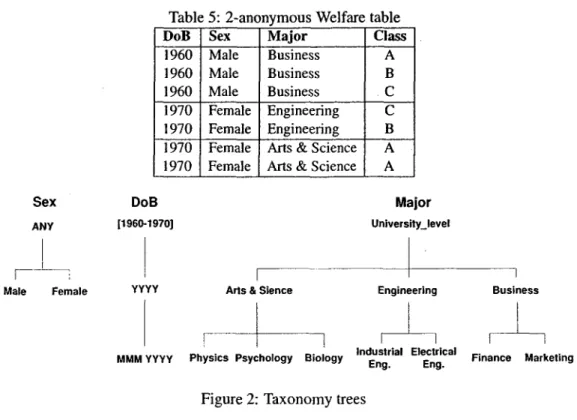
attributes' values are replaced with more general ones based on a data holder's pre-defined taxon-omy tree. The purpose of generalization is to eliminate the potential uniqueness resulting from a combination of QID attributes' values in a record. In a generalized table, more records (a minimum of if) will be grouped under the same qid. Although the data becomes less precise, consistency is maintained. We will use the taxonomy trees presented in Figure 2 to generalize Table 4 on QID — {DoB, Sex, Major} so that it adheres to if-anonymity for K — 2. This process can also be described as anonymizing Table 4 so that it satisfies 2-anonymity, or simply 2-anonymizing Table 4.
As seen in Example 2.0.1, qid = {Aprl%0, Male, Marketing) in Table 4 uniquely identifies the individual it relates to when linked to external information. Table 5 shows that this uniqueness
Table 5: 2-anonymous Welfare table DoB 1960 1960 1960 1970 1970 1970 1970 Sex Male Male Male Female Female Female Female Major Business Business Business Engineering Engineering Arts & Science Arts & Science
Class A B C C B A A
Sex DoB Major
ANY [1960-1970] Universilyjevel
Male Female YYYY Arts & Sience Engineering Business
MMMYYYY Physics Psychology Biology , n d^, r l a l Electrical F j n a n c e M a r k e t i n g
Figure 2: Taxonomy trees
is eliminated as the anonymous table consists of three distinct groups: qid — (I960, Male, Business), qid = (1970, Female, Engineering), and qid = (1970, Female, Arts & Science). Each qid group contains at least two records, making any record indistinguishable from at least one other record in the same group.
Suppression is complementary to generalization [39]. Rather than replacing data, suppression entails removing some data from the table to be released. Samarati and Sweeny suggest enforcing suppression on particular records. That is, when marked as an outlier [39] [5], the entire record in the table is removed. Outlier records are those which still fall short of fulfilling the enforced /^-anonymity requirement even after the table has been generalized.
For example, suppose that Table 4 is to be 4-anonymized to table T". Generalization is en-forced, resulting in Table 5. However, Table 5 is not 4-anonymous; therefore a further sequence
of generalization steps is required. A naive approach is to generalize all the QID attributes' values to the most abstract form (Figure 2). This approach will eventually produce a 4-anonymous table T wherein all of its records have qid = {[I960 - 1970], ANY, Universityjevel). In fact, V is 4-anonymous because any of its records matches at least 4 — 1 other records on QID = {DoB, Sex, Major}. Table T" is indeed then more privacy-preserving than its original version, but it is much less informative as well. Each generalization step results in more data abstraction. To avoid unneeded generalization on Table 5, record suppression suggests removing the first three records. By doing so, we can perform just one more generalization step on attribute Major. The resulting table T" is 4-anonymous with all records having qid = (1970, Female, Universityjevel).
Generalization and suppression are best enforced together. That is, a maximum suppression threshold can be defined by the data holder, and within that threshold suppression is more prefer-able than generalization.
Although suppression minimizes the data abstraction caused by generalization, it affects data integrity by removing specific records from the table to be released. Generalization, on the other hand, preserves consistency in all attributes, but affects all of the records (all values in an attribute domain are replaced by others according to a taxonomy tree). Generalization increases data pri-vacy, but lowers data utility.
Recalling the purpose of anonymization; we want to "safely" release a privately held data set and, at the same time, ensure the data utility. In other words, it is desirable to keep the amount of information held by the anonymous data as large as possible. Optimal anonymization [25] de-scribes the condition at which an anonymous table T" is most informative in comparison to other
anonymous versions of the original table T, with T" being the least anonymous (one generaliza-tion/suppression step from violating a given privacy requirement). Moreover, minimal anonymiza-tion [21] [42] [22] [49] [13] [15] [16] is achieved when T" is least anonymous with respect to a given privacy requirement without necessarily being most informative. Despite the fact that achieving optimal if-anonymization has been proved to be NP-hard [29], a few approaches toward optimality have been proposed [25] [37] [5]. LeFevre et al. [25] proved that achieving optimality is feasible by proposing an algorithm (and a set of its variations) called Incognito that guarantees op-timality using full-domain generalization. Full-domain generalization [37] [43] [25] is a method for achieving K-anonymity with respect to the QID attributes. With this method, if one value from a QID attribute is generalized to some level in the taxonomy tree, then all the other values in that attribute domain are generalized to the same level. For example in Figure 2, if Marketing is generalized to Business, all the leaves of that tree are generalized to their pertinent parent nodes: Business, Engineering, and Arts & Science. Although Incognito maintains optimal if-anonymity, its complexity grows exponentially with the number of QID attributes.
The if-anonymity privacy model can be used to thwart record linkage attacks by making each record indistinguishable from at least K — 1 other records in an anonymous table. Nevertheless, it fails to prevent attribute linkage attacks when a sensitive attribute is present in an anonymous table. Next, we come across some works that counter attribute linkage attacks.
2.1.2 Attribute Linkage
For some QID attributes in a /^-anonymous table, any record is indistinguishable from at least K — 1 other records within a qid group, thereby, preventing an attacker from uniquely identifying
a target victim with the help of external data. However, if all or most of the records of a qid group share the same sensitive value, deducing the target victim's sensitive information will be highly probable. This type of attack is the manifestation of attribute linkage. An illustration follows.
Example 2.1.1 Suppose that Daisy's friend, Bob, is looking at anonymous Table 5. Bob knows that his friend Daisy (2nd record in Table 3) has studied Psychology at UniversityX and was born in March 1970. Bob observes that Daisy's record in the Alumni list, based on QID = {DoB, Sex, Major}, links to 2 records from the 2-anonymous Welfare table. However, both of the latter records indicate that their related individuals belong to class A. In this particular case, Bob is now certain that his friend Daisy receives class A financial assistance - the very piece of information Bob is not supposed to acquire about Daisy. •
To thwart attribute linkage attacks, Wang et al. [48] proposed a new privacy model, confidence bounding, which can work complementarity with if-anonymity. In a if-anonymous table X", confidence bounding prevents the inference of a sensitive value in any qid group from exceeding a certain probability threshold. In other words, the confidence of inferring a sensitive value s is upper bounded by h, a pre-defined confidence percentage determined at the data holder's discretion.
To apply confidence bounding, 7" has to satisfy a set of privacy templates of the form (QID —> s, h), where QID is a quasi-identifier, s is a sensitive value, and h is a confidence threshold. For simplicity, let us assume that T has to satisfy a single privacy template, qid —> s indicates the percentage of inferring s from qid. That is, qid —> s represents the number of records containing the sensitive value s divided by the total number of records grouped by the same qid. This is denoted by conf (qid —> s). The maximum con-f (qid —> s) in any qid group is denoted by
ConfiQID -* s). If Conf{QID -> s) < h, then table T satisfies the privacy template (QID —•
s , / i ) .
For example, for Q7£> = {DaB, Sex, Major}, enforcing the privacy template (QID —> A, 50%) on Table 5 requires that at most 50% of the records in any qid group have sensitive value A. Table 5 has 3 qid groups: (I960, Male, Business), (1970, Female, Engineering), and (1970, Female, Arts k Science). For each group, the percentages of records with sensitive value A are: 33%, 0%, and 100%, respectively. Hence, the aforementioned privacy template is violated because the last group violates the confidence threshold.
Flexibility is an inherent characteristic in privacy templates. The data holder can always lay out different templates for different sensitive values depending on how sensitive some values are than others. For example, in Table 5, one template for inferring A could be (QID —> A, 30%) while another template for inferring C could be (QID —-> C, 80%).
Another approach that has been proposed to thwart attribute linkage attacks is the notion of the ^-diversity principal [27] [35] [9]. Machanavajjhala et al. [27] suggest that for a table to be ^-diverse, every qid group is required to have at least £ "well-represented" records with respect to their relative sensitive values. The reason for describing ^"-diversity as a principal is the possibility of interpreting the privacy requirement "well-represented" via several instantiations. One instance of the ^-diversity principal is to ensure that in every qid group there are at least £ > 2 different sensitive values. In this case, records will be "well-represented" since their associated sensitive values are ^-diverse. In other words, at least £ distinct values of the sensitive attribute are in each qid group. This notion is captured in Example 2.1.2.
Table 6: 3-diverse Welfare table DoB 1960 1960 1960 1970 1970 1970 1970 Sex Male Male Male Female Female Female Female Major University_level University_level Universityjevel University_level Universityjevel University_level Universityjevel Class A B C C B A A
Example 2.1.2 In Example 2.1.1, we illustrated how an attacker can reveal a target victim's sen-sitive information. With the group of qid = (1970, Female, Arts & Science) from Table 5 in-dicating that all its related individuals belong to class A, Bob correctly concluded that his friend Daisy receives class A financial assistance. In order to fix this "flaw", we can enforce 3-diversity over Table 5 to ensure that at least 3 distinct values of the sensitive attribute are present in any qid group. This is demonstrated in Table 6. •
The reason for enforcing diversity over some sensitive values in qid groups is to distribute the frequencies of occurrences of these sensitive values for the sake of eliminating inference with high confidence. The best-case scenario is to have all sensitive values approximately evenly distributed within every qid group. Typically, this is not what we find in practice, mainly because some sensitive values are inherently more (or less) frequent than others. In patients' data, for example, where disease is considered a sensitive attribute, it is natural to have Allergy more frequently than Cancer; generally speaking.
To measure how evenly distributed sensitive values are in every qid group in a table, Machanava-jjhala et al. [27] propose another instantiation of the ^-diversity principal: Entropy ^-diversity. For a table to satisfy entropy ^-diversity, log(£) should not exceed the sum of entropies of every sensitive
value s in each qid group. More formally,
- Y, P(qid, s)log(P(qid, s)) > log{£) (1)
where 5 is the domain of a sensitive attribute and P(qid, s) is the fraction of records containing the sensitive value s in the qid group. Since entropy measures the uncertainty of inferring sensitive values, higher entropy implies a more even distribution of sensitive values in qid groups, and therefore less inference confidences.
For example, in Table 6, the entropy of the first group of qid = (I960, Male,
Universityjevel), is 3 x (-|Zo#(|)) = log(3), and the entropy of the second group of qid — (1970,Female,UniversityJevel), is -\log{\) - \log{\) - \log{\) = log{2.82). Therefore, Table 6 is entropy ^-diverse for £ < 2.82.
Unlike confidence bounding which states a probabilistic inference threshold for some sensitive values, entropy ^-diversity does not provide the data holder with a clear intuitive translation of the diversity measure. For example, as mentioned above, Table 6 satisfies entropy ^-diversity if I < 2.82. However, the data holder will not be able to conclude that 2 out of 4 records in a qid group are associated with class A sensitive value, i.e., a successful attribute linkage attack on class A would be 50%.
If the goal is to ensure low inference confidences of sensitive values through high diversity, clearly I is required to be higher as more records add up to a qid group. However, this also implies a larger qid group size by which further generalization (if it was used) would be needed.
2.1.3 if-anonymity and RFID Data
As mentioned earlier, the if-anonymity privacy model addresses the privacy issue related to re-vealing identities through record linkage attacks in relational data sets. However, /^-anonymity becomes inapplicable when anonymizing RFID data. When we describe the if-anonymity model as "inapplicable", we are referring to its ineffectiveness in achieving useful anonymous data. The following two reasons explain why. First, applying /C-anonymity to high dimensional data will result in poor data quality. RFID data tend to be sparse and high dimensional [2], and the set of quasi-identifing attributes can contain hundreds of attributes, as will be seen later in Chapter 5. Each item in an RFID data set record is a potential quasi-identifier. Therefore, enforcing the if-anonymity privacy requirement would result in anonymizing most of the records, rendering the data utility weak indeed. In Chapter 5 we shall see how relatively huge the amount of distortion is when enforcing X-anonymity. In our proposed model, we overcome this obstacle by assum-ing that the adversary knows up to L pairs of locations and timestamps that a target victim has previously visited. The second reason is that the X-anonymity model does not consider sensitive attributes' disclosure. This adds an extra burden since now the data holder needs to choose an additional appropriate privacy model to mitigate attribute linkage attacks that target sensitive at-tributes. Example 2.1.1 demonstrates the second reason. Accounting for attribute linkage attacks is an essential privacy requirement in our model, enforced by limiting the inference confidence of a sensitive value to a pre-determined threshold.
Up to this point, we have discussed A"-anonymity and some other methods to defend against record and attribute linkages, respectively, in relational data. In the next section, we show some anonymization approaches for releasing high-dimensional transaction data.
2.2 Transaction Data
In transaction data sets, data is organized as a set of transactions. Each record encompasses an arbitrary number of items forming a transaction relating to a distinct individual. A transaction is a subset of a much larger population U of items. Click streams, visited web sites logs, online/offline shopping, and query logs are examples of transaction data where each item indicates an event: clicking a picture, browsing a web site, buying an item (not to be confused with the transactions constituent elements items), and performing a query, respectively. A transaction can describe one's behavior, making the data set an excellent source for mining [20]. However, such rich data raises privacy concerns about its transactions' owners, as illustrated in Examples 2.2.1 and 2.2.2.
Unlike relational data which in practice tend to have a small number of QID attributes (5 or 6 [29]), transaction data is considered to be high dimensional. Each item in a transaction data set is a dimension by itself because it is a potential piece of knowledge/information previously acquired by an adversary and it can be used with a combination of other items to reveal a target victim's identity. Regardless of a transaction's variable length (number of items), all items from the large population U are considered quasi-identifiers. The following example illustrates an attack scenario on high-dimensional transaction data.
Example 2.2.1 Suppose that an online video sharing web site, VidShare, has released an "anony-mous" data set about its users' logs, for research purposes. Each record describes recently watched videos by a distinct user. Brian and Linda are classmates in business school who always watch their favorite movie reviews together on VidShare. In the published data set, Brian noticed a record con-taining the same movie reviews that he and Linda had watched lately. Moreover, the same record
contains videos relating to the same subjects they study in their class. Brian is now certain that the record belongs to his Linda's account as it is unique in the entire data set. Brian also noticed that the (identified) record contains further videos pertaining to uterine cancer. Considering the sensitivity of the matter, Linda may not want to disclose such information about herself. In spite of removing identifying pieces if information from the released data set, e.g., name/nickname, Linda's record has been identified and has leaked sensitive private information. •
We further provide a real-life example of the AOL ' incident that reflects actions data holders might take if users' privacy is compromised.
Example 2.2.2 In a data of search queries released by AOL for academic research purposes, amongst 650,000 AOL users, record No. 4417749 was successfully traced back to its legitimate owner revealing her identity. Ms. Thelma Arnold, a 62-year-old widow, is an AOL subscriber who has conducted many search queries which mirrored her daily activities leading to uniquely identifying her persona. This incident resulted in AOL's retrieval of the data and, more impor-tantly, rendered data holders unenthusiastic about publicly releasing their data even when specific identifying pieces of information are removed from the published data [4]. •
Examples 2.2.1 and 2.2.2 capture two major characteristics about transaction data: (1) tion data is demanded for research purposes especially in the field of data mining and (2) transac-tion data poses privacy concerns, since removing personal informatransac-tion proved a useless precautransac-tion, hence the need for further "processing" before data release. Next, we briefly review some of the proposed anonymization approaches in the context of transaction data.
Some recent studies attempt to tackle the challenges presented when anonymizing high dimen-sional sparse transaction data [45] [17] [52] [53]. Terrovitis et al. [45] extended the X-anonymity paradigm to Km-anonymity. In relational data, K-anonymity assumes that an attacker may be able
to collect background knowledge with respect to the entire QID attributes, but in transaction data this assumption becomes unrealistic for the following reason. As we saw earlier, any item in the population U, which may contain tens of thousands of items, is a potential quasi-identifier. Thus either the attacker has to exert enough effort to collect information about all the items appearing in the target victim's transaction (which is not commonly the case), or the attacker's background knowledge can be limited to some extent. i^m-anonymity assumes that the attacker knows about a target victim's transaction at most m items. The goal then becomes making any transaction with any combination of up to m items indistinguishable from at least K — 1 other transactions in the data set. To achieve this goal, Terrovitis et al. [45] used generalization, by which items are generalized to more abstract values. They present a suite of three algorithms to anonymize trans-action data: optimal anonymization which is inapplicable for real-life data sets due to its expensive computational cost; and two heuristics: direct anonymization and apriori anonymization.
In [45] the authors do not account for the existence of a separate column for sensitive values in the published data, e.g., medical condition, as they consider any item to be potentially sensitive. The works presented in [17], [52], and [53] however, consider the items in U as public quasi-identifiers used by an attacker to identify a target victim's transaction and/or to infer associated sensitive information. To combat such attacks, i.e., record and attribute linkages, [53] proposes a privacy notion to protect the published data under some privacy requirements. (h,k,p)-coherence is a privacy model that restricts the number of items an attacker could have previously gained
about a target victim to p; following the intuition that it is realistic to assume an attacker's partial knowledge about a particular transaction in the data set. In addition, the privacy model requires the existence (or none at all) of at least k— 1 other transactions in the data set that share any combination of up to p items. Within these k transactions, the liklihood of inferring a particular sensitive item must not exceed h percent. If a data set adheres to the (h,k,p) privacy requirements, the data set is said to be (h,k,p)-coherent. Consequently, an (h,k,p)-coherent data set, with attacker's knowledge being up to p items, limits the probability of a successful record linkage to \/k and a successful attribute linkage to h [53].
Xu et al.( [52] and [53]) employ the same privacy notion (h,k,p)-coherence. However, the former work targets preserving frequent itemsets by eliminating moles and withholding as much nuggets as possible. Frequent itemsets are sets of items that frequently occur in the data set and are essential for data mining purposes. Nuggets are up to p-length itemsets (public or sensitive) that occur at least k times in the data set. Moles, on the other hand, are public itemsets that violate the (h,k,p) privacy requirements. Instead of enumerating all possible moles and nuggets, Xu et al. [52] overcome this bottleneck by introducing a novel border-based representation of moles and nuggets which significantly improves scalability. Moles/nuggets are bounded by maximal and minimal itemsets from which they are derived.
Unlike Terrovitis et al. in [45] who use generalization to achieve a privacy requirement, both [53] and [52] use global item suppression. This technique has a prominent advantage over generalization; i.e., suppression is performed on a single (public) item by deleting it from a trans-action. Moreover, suppressing an item is performed globally, that is, when suppressed, all occur-rences of that item in the data set will be suppressed as well. Therefore, consistency is preserved for
all the items appearing in the published data, which shall maintain truthfulness in data analysis or data mining applications. Generalization, however, is applied to all the children of a subtree node, which causes more information loss as the taxonomy tree would be characterized as flat (wide and short) and fan-out (many children for a single node). One last point is that preparing a taxonomy tree for generalization is not a lightweight task, especially in high-dimensional data. For the above mentioned reasons, adopting item suppression is often more practical than generalization.
In [17], Ghinita et al. introduce a permutation-based approach that takes advantage of the sparseness nature of transaction data. Rows (transactions) and columns (every item in a population U) are re-arranged in such a way that items in each transaction appear diagonally. This organization helps to group transactions with similar items, with these items being considered the group's QID. Each group of transactions is then anonymized based on its relevant QID. Sensitive items are treated separately, and any transaction can have none, one, or multiple sensitive items. After anonymization, any transaction within a certain group is associated to any sensitive item in that group with a confidence of up to a maximum (pre-specified) threshold.
2.2.1 Transaction Data vs. RFID Data
In this subsection, we denote the distinction between transaction data and RFID data, and show why the proposed anonymization approaches for the former data type are inapplicable when anonymiz-ing RFID data. Despite the fact that both data types share the characteristic of beanonymiz-ing high-dimensional and sparse, one essential difference is how items are represented in a record (trans-action or RFID record). Basically, a trans(trans-action is a set of items, e.g., merchandise bought by an individual, and an RFID record consists of a sequence of "items". In the next chapter we will see
that an "item" in an RFID record is a pair composed of a location and a timestamp. A sequence of pairs in an RFID record is called a path. Therefore, transactions {a, b} and {b; a} are equivalent, in contrast to paths (a, b) and (b, a).
In addition to the difference between the nature of transactions and paths, a method for anonymiz-ing transaction data may not account for attribute linkages [45], i.e., there is no consideration for associating a particular individual in the data set to some sensitive information (e.g., medical con-dition). As for anonymizing RFID data sets, we will see later that our model considers both attacks; record and attribute linkages.
2.3 Trajectory Data
Trajectory data or moving objects data [1] [44] [55] [28] [36] is a collection of trajectories re-lating to some moving objects collected at certain points of times. Each trajectory belongs to a unique moving object and consists of a sequence of locations the moving object was reported at. An example of how trajectories are collected is the Octopus electronic system2 [44] for Hong Kong residents where each Octopus smart RFID card holder gets to use the card to pay for transportation, shopping, parking, etc.
The trajectory data set can later be published for behavioral or pattern analysis, for example. Of course, users' IDs will be removed along with other identifying pieces of information so that no distinct user can be identified. However, publishing the data as collected may pose privacy threats to users. For instance, if a trajectory in a published data set shows that its pertinent Octopus card user, say Alice, frequently uses the same parking spot every morning for five days a week,
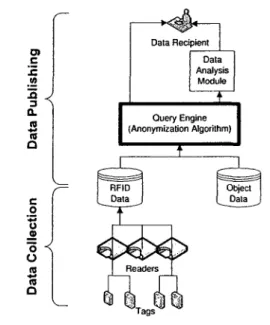
Trajectory
Possible Motion Curve
Uncertainty Area
Figure 3: A graphical representation of an uncertainty trajectory volume [1]
it is highly probable that it is Alice's work place and it is located somewhere near the parking area. Alice's neighbor, Eve, knows where Alice works, and she knows that Alice uses the Octopus system. Moreover, Eve notices that in the same trajectory that person often makes purchases at the neighborhood store. Being unique, the trajectory was not only successfully linked to Alice, but also Eve now can see what other places Alice has been to at different times, revealing personal information Eve is not entitled to acquire.
A few recent works [1] [44] [55] present methods for anonymizing high-dimensional trajectory data based on the concept of K-anonymity [37]. In their work entitled jVever Walk ^41one, Abul
i
et al. [1] exploited the uncertainty in the moving objects' whereabouts via their proposed privacy model (K, 5)-anonymity. In their 3-dimensional space representation, a trajectory is a polyline where the coordinates (x, y, t) of each point in the polyline represent the moving object's location (x. y) at a specific time t, as depicted in Figure 3.
Abul et al.'s (K, 8)-anonymity model requires that within a <5-radius proximity to each trajec-tory, a minimum of K—\ other trajectories co-exist, i.e., the cylindrical volume of radius 5 centered
by a trajectory should encompass at least K trajectories so that no trajectory can successfully be linked to a specific individual with a probability of more than l/K. To achieve the previous pri-vacy requirement for a target data set, Abul et al. [1] use space translation to change the location coordinates of some points on certain polylines.
Terrovitis et al. [44] present a privacy model that treats every location in a trajectory as sensitive information. This is unlike the set of QID in relational data, which is considered public knowledge that an attacker may acquire by different means. The authors assume that different adversaries hold different partial background knowledge about individuals' trajectories. Hence their objective is to prevent adversaries from uniquely identifying individuals based on their background knowledge about target victims' trajectories and, thus further compromising privacy by learning additional information about the target individuals' locations. The privacy model requires a user-defined threshold of breach probability P^ and uses suppression to achieve an anonymous data set. The experimental results in [44] suggest that higher values of P^ (equivalently, less anonymization) result in suppressing fewer location points.
Similar to the work in [44] where the different adversaries' partial knowledge about individu-als' trajectories are considered quasi-identifiers, Yarovoy et al. [55] "personalize" quasi-identifiers for different trajectories. In other words, quasi-identifiers are chosen based on what locations and times adversaries may use to uniquely identify individuals. To produce an anonymous version of the original data set, /{"-anonymity is modeled by means of space generalization. That is, at certain times (QID), locations of a trajectory are generalized to a larger region of locations that contains at least K — 1 other individuals. Consequently, the target victim's exact location becomes indistinguishable from the rest of the other individuals' locations that co-exist in the same region.
2.3.1 Trajectory Data vs. RFID Data
There is not a great difference between trajectory and RFID data types. In fact, the latter is one type of the former, since the movement of the RFID tag holder is reported at different times. We describe here how our proposed method varies from the aforementioned ones.
In the model proposed by Abul et al. [1], namely A/'ever Walk .Alone (J\fWA), the authors assume a continuous trajectory in which the expected location is known at each point of time. As we will see later, this assumption does not commonly hold for RFID data because readers are placed in specific locations where RFID tags are detected and the location of any moving object between two consecutive detections is unknown. Moreover, the MWA framework uses space translation, which entails changing the actual locations of the moving objects to achieve (K, 5)-anonymity, rendering the data untruthful for further analyses. Our model, however, preserves data truthfulness by using suppression.
Another major aspect is the consideration of QID. While our model is built on the assumption that any combination of location and timestamp is public knowledge and may be used by adver-saries to lunch attacks, both [44] and [55] require the different adveradver-saries' background knowledge to already be known to the data holder in order to perform the anonymization. In real-life sce-narios, that assumption becomes unrealistic because it requires exploring potential adversaries and their prior knowledge about each moving object.
One last important point is that none of the three works [1] [44] [55] consider the presence of a sensitive attribute, and thus ignore attribute linkages. In fact, [44] considers any location in a trajectory to be sensitive information. Our model not only anonymizes RFID data, but it is also for anonymizing sequential data, as we will see in Chapter 5.
2.4 Summary
To summarize this chapter, we discussed different types of data that pose privacy threats to indi-viduals when published directly as collected. We presented some of the prominent methods that attempt to tackle the privacy issues concerning each type of data set. Some of the works take the /('-anonymity model as a building block and extend upon it to satisfy certain privacy requirements. There are more techniques and approaches exist in the literature for privacy-preserving data pub-lishing (PPDP); however, it does not serve our objective in this context to discuss these techniques. Fung et al. [11] survey recent and existing techniques for PPDP using descriptive insight and il-lustrative examples. In the following chapter, we present a formal definition of the problem of anonymization in RF1D data, i.e., we formally define the privacy threats and our LifC-privacy model.
Chapter 3
Problem Definition
In this chapter, we formally define our new privacy model - LKC-privacy. We begin by defining the structure of RFID data in the table to be released, which we call an object-specific path table (Section 3.1). Then, in Section 3.2, we formalize the privacy threats that we mentioned in Chap-ter 1, namely record linkage and attribute linkage, in the content of RFID data. Next, we formalize our privacy model and the problem statement in Sections 3.3 and 3.4, respectively.
3.1 Object-Specific Path Table
In this work, we assume that an RFID tag is either attached to a moving object or placed on an item that is carried by a moving person, for example, passengers in a transit system. An RFID reader is placed at location loc. At any time t when a reader detects an RFID-tagged object, the reader creates an RFID data record of the form (EPC, loc, t), where EPC is a unique electronic product code for that object. We assume that each row in an RFID data table represents a distinct
person, and thus, the streams of RFID records relating to the same EPC are grouped together in chronological order constituting a path. A path is a sequence of pairs, where a pair {lociti) indi-cates that the object has visited location loo, at time tt. In a path, denoted by ((lociti).. • (locnt„)),
pairs are grouped in a chronological order according to their timestamps. t* is considered a times-tamp if it is the object's entry time to a certain location. The assumption is that an object stays in the same location until the next pair shows that the object has entered another location at a later timestamp [18]. Therefore, consecutive pairs (duplicates) indicating an object's presence in the same location are removed from the path. There is no restriction on visiting locations; an object can revisit the same location, however, at later timestamps. As an illustration, consider the path (al —> 63 —» 64 —• 66 —> cl —> 68), pairs 64 and 66 should be removed because the object stayed in location 6 for times 3, 4, and 6, thus only the entrance timestamp 3 is considered. Moreover, notice that despite removing 64 and 66, we kept 68 because the object was in a different location, as the pair just before shows. In any path, timestamps are always increasing, so sequences such as al —> 61 are not valid as an object can only be at one location at any point of time.
From this point onwards, whenever we refer to a "record" in the context of data sets or tables, we mean a record of the form
({lociti) -»...—> (locntn)) : si:...,sp:di,...,dm,
where ((locitj) —>...—> (locntn)} is a moving object's path, s* € Si are sensitive attributes, and
d-i 6 Di are attributes containing the object data that form the set of quasi-identifier (QID). In this work, we target the paths and the sensitive attributes. The set of QID attributes is considered to be of a relational data type, and it can be anonymized by using existing anonymization methods [16] [30] [26] [27] [38] [48] for such data. We represent a given data set in an object-specific path table
T. An object-specific path table T is a collection of records taking the abovementioned form, however, we only consider the paths and the sensitive attributes.
3.2 Privacy Threats
In this section, we formally define the attacks on individuals' privacy when the data holder releases an object-specific path table T, e.g., for statistical study or data analysis. To "protect" individuals from being identified, the data holder removes explicit identifiers such as EPC, name, SSN, and DoB. However, we shall see that simply removing explicit identifying information does not protect individuals' privacy. The paths and the object-specific attributes are kept intact because we assume that they are essential for achieving the objective of publishing the data, e.g., data analysis. As we explained in Chapter 1, an adversarial recipient of published data T can attempt to compromise individuals' privacy by identifying their paths and/or sensitive values. We refer to an individual in T for whom privacy is compromised as a target victim V. We also assume that the adversary has gathered information about a target victim V in the form of location and timestamp pairs previously visited by the victim. We refer to such information as the adversary's background knowledge. Discussing the methods that an adversary uses to gather background knowledge about victims is not within the scope of this research. However, a simple example is that people, such as family members, friends, and neighbors, commonly share various types of information about each other. This example can be included under the general term of social engineering [41] [51].
The assumption is that an adversary's background knowledge about a victim V contains at most L pairs, which form a subsequence of the victim's path in T. The background knowledge is
denoted by K = ((lociti) —>...—»• {locztz)), where z < L. K narrows down all the records in T
to a group of records G(K) that "matches" K. In other words, K is a subsequence of each path in the identified group of records. The notion of matching is formally defined as follows.
Definition 3.2.1 (Matching) A pair (lociti) matches a pair (locjtj) if loci = locj and U = tj. A path px covers a path py if, for every pair (loCyty) in py, there exists a pair (locxtx) in px that
matches {loCyty). A record matches K if the path of the record covers K. •
For example if we choose K = (e4 —> c7) in Table 1, we would have a match in EPC#1: (al -+ d2 - • 63 - • e4 -» / 6 -» c7) : On - tueZ/are but not in £ P C # 4 : (d2 - • / 6 -> c7 -* e8) : Retired.
In Chapter 1, Example 1.1.1 illustrated two types of privacy attacks: record linkage and at-tribute linkage. Next, we formally define these privacy attacks. An attacker exploits his back-ground knowledge about a target victim V to build a set of candidate records G(n). One of the records in G(K) is V's record. Based on G(K), an adversary could perform:
1. Record linkage: the size of the set of the candidate records G(K) is denoted by | G ( K ) | . Record linkage takes places when the adversary's background knowledge K renders | G ( K ) | small. If victim V's record is successfully identified, the adversary would be able to learn about all of the pairs in V's path, along with V's sensitive value.
2. Attribute linkage: this privacy threat arises from the ability of an adversary to infer V's sen-sitive value s. The confidence of inferring s from the set G(K) is denoted by Con/(s|G(«)), and is computed as follows:
where the numerator is the number of records from G(K) containing s. The inference con-fidence Conf(s\G(K)) is therefore the fraction of records that contain the sensitive value s in G(K). The privacy threat resulting from this type of attack is proportional to the value of Conf(s\G(n)); high values imply high privacy risks.
3.3 Privacy Models
Our objective is to provide a method that "processes" the object-specific path table T so that it is transformed from its raw state to another version. By "processing" table T, we are referring to anonymization, which is defined in Section 3.4. The resultant version of the anonymized table T, T', should thus be protected against the privacy threats we defined in the previous section. Next, we formalize our privacy model, LKC-privacy, to produce the anonymous table T". But first, we divide LifC-privacy into two privacy models: LK-anonymity and LC-dilution. Each of these privacy models protects against a different privacy threat; record linkages and attribute linkages, respectively. LK-anonymity and LC-dilution are formally defined next. As mentioned earlier, K is the adversary's background knowledge of at most L pairs in length. Thus, any subsequence q having a length of up to L pairs from any path in T could be a potential instance of K.
Definition 3.3.1 (L/^-anonymity) An object-specific path table T satisfies LX-anonymity if and only if\G(q)\ > K for any subsequence q with \q\ < L of any path in T, where K is a positive anonymity threshold. •
Definition 3.3.2 (LC-dilution) Let S be a set of data holder-specified sensitive values from sen-sitive attributes S i . . . Sm. An object-specific path table T satisfies LC-dilution if and only if
Conf(s\G(q)) < Cfor any s G S and for any subsequence q with \q\ < L of any path in T, where 0 < C < 1 is a confidence threshold. •


![Figure 3: A graphical representation of an uncertainty trajectory volume [1]](https://thumb-us.123doks.com/thumbv2/123dok_us/423632.2548657/39.903.286.629.111.354/figure-graphical-representation-uncertainty-trajectory-volume.webp)