HAL Id: hal-02159804
https://hal.archives-ouvertes.fr/hal-02159804
Submitted on 19 Jun 2019
HAL
is a multi-disciplinary open access
archive for the deposit and dissemination of
sci-entific research documents, whether they are
pub-lished or not. The documents may come from
teaching and research institutions in France or
abroad, or from public or private research centers.
L’archive ouverte pluridisciplinaire
HAL
, est
destinée au dépôt et à la diffusion de documents
scientifiques de niveau recherche, publiés ou non,
émanant des établissements d’enseignement et de
recherche français ou étrangers, des laboratoires
publics ou privés.
Constrained discriminative speaker verification specific
to normalized i-vectors
Pierre-Michel Bousquet, Jean-François Bonastre
To cite this version:
Pierre-Michel Bousquet, Jean-François Bonastre. Constrained discriminative speaker verification
spe-cific to normalized i-vectors. Odyssey: The Speaker and Language Recognition Workshop, 2016,
Bilbao, Spain. �hal-02159804�
Constrained discriminative speaker verification specific to normalized i-vectors
Pierre-Michel Bousquet, Jean-Franc¸ois Bonastre
University of Avignon - LIA, France
{pierre-michel.bousquet, jean-francois.bonastre}@univ-avignon.fr
Abstract
This paper focuses on discriminative trainings (DT) applied to i-vectors after Gaussian probabilistic linear discriminant analysis (PLDA). If DT has been successfully used with non-normalized vectors, this technique struggles to improve speaker detection when i-vectors have been first normalized, whereas the latter option has proven to achieve best performance in speaker ver-ification. We propose an additional normalization procedure which limits the amount of coefficient to discriminatively train, with a minimal loss of accuracy. Adaptations of logistic re-gression based-DT to this new configuration are proposed, then we introduce a discriminative classifier for speaker verification which is a novelty in the field.
1. Introduction
Once the i-vector paradigm of low rank total variability fac-tor has been introduced in the field of speaker recognition [1], Gaussian modelings of i-vector have been worked out [2, 3], intended to estimate the latent speaker variable. In the case of single-cut enrollment trial, the formulation of the speaker ver-ification log-likelihood ratio reduces to a quadratic function of the i-vector pair of a trial, that is, a second degree polynomial of i-vector components. This functional form led to attempts to optimize parameters of the model by using a discriminative approach. Discriminative trainings for speaker verification rely on minimization of non-linear objective functions [4, 5, 6].
First Gaussian modeling provided disappointing results. Application of normalization pre-procedures (within-class co-variance and length [1, 7, 8]) to i-vectors allows Gaussian mod-eling to be competitive versus more complicated systems, as heavy-tailed PLDA [2], in terms of performance.
In [9], the same performance than a non-normalized and optimal PLDA system is achieved by using a SVM based-discriminative system, without the need to tune the rank of the PLDA speaker variability subspace. But DT struggles to im-prove accuracy of detection with normalized vectors. Normal-ization techniques are known to improve Gaussianity of i-vector distribution [7], and seem to limit the impact of an additional DT step. [10] remarks that DT may suffer from training data in-sufficiency. Thus, constrained DT systems have been proposed (of order the i-vector dimension, instead of its square), in order to limit the amount of parameters to optimize with respect to the total amount of training data [10, 11]. But it appeared that effectiveness of DT approach may also suffer from over-fitting to development data. Very low order discriminative trainings have been proposed, which only optimize parts of score [10], or matrix scalings of PLDA matrices [11]. Also, constraints on coefficients trained from DT do have to be taken into ac-count, in order to respect properties of PLDA covariance ma-trices (definiteness, positivity/negativity). Finally, [10] points
out that statistical independence between training trials used for DT is questionable, as the need of a large amount of data for DT training obliges to use same speaker and utterances in more than one training trial.
We propose to train a small order DT by taking advantage of normalized i-vector properties. A simple additional normaliza-tion procedure is presented, which does not modify distances between i-vectors and allows to train low order DT classifiers with a minimal loss of accuracy. We adapt two state-of-the-art DT based on logistic regression (LR) to this new configuration, the first is optimizing score coefficients, the second one PLDA parameters.
However, the ability of LR based-discriminative classifiers to improve Gaussian PLDA system by using cross entropy minimization, based itself on Gaussian assumptions, may be questioned, as normalization techniques are known to improve Gaussianity. In order to overcome this issue, a new specific dis-criminative classifier is proposed, based on covariance of tar-get and non-tartar-get trials when they are represented by expanded vectors of score.
This paper is organized as follows. Sec. 2 summarizes the Gaussian generative model for i-vector. State-of-the-art dis-criminative trainings of PLDA hyperparameters are recalled in Sec. 3. In Sec. 4, the additional normalization procedure in-tended to simplify discriminative training is presented, and Sec. 5 proposes discriminative classifiers specific to normalized i-vectors. Experimental results are reported in Sec. 6, and con-clusions are provided in Sec. 7.
2. Gaussian generative model for i-vector
The total variability factor approach for speaker recognition [1] provides a representation of speech segments by low dimen-sional feature vectors (commonly less than 600), independent of the length of the utterance, referred to as i-vector. This approach defers the problem of intersession variability to a second stage. To facilitate accurate comparison in a verification trial, i-vector modelings have been proposed, assuming additive decomposi-tion of speaker and noise components. We focus here on the most commonly used Gaussian model in speaker verification [2]. Introduced in [12, 13], Gaussian PLDA (G-PLDA) is a generative model where latent vectorysrepresenting speakers
is assumed to be distributed according to standard normal prior and ad-dimensional vectorwcan be decomposed as follows:
w=µ+Φys+ε (1) whereΦysand εare assumed to be statistically independent
andεfollows a centered Gaussian distribution with full covari-ance matrixΛ. Speaker factorys can be a full-rankd-vector
con-strained to lie in ther-linear range of thed×rmatrixΦ, re-ferred to aseigenvoice subspace[2].
Using a Bayesian approach, the goal of evaluating hypothe-ses H1 that two i-vectors wi, wj are produced by the same
source andH0 that they are produced by different sources re-duces to estimating the log-likelihood ratio score (LLR):
si,j= log P(wi,wj|H1) P(wi,wj|H0) = log R y Q l=i,j P(wl|µ+Φy,Λ)P(y|0,I)dy Q l=i,j R yP(wl|µ+Φy,Λ)P(y|0,I)dy (2)
For the Gaussian case, the closed-form solution of (2) is the following second degree polynomial function ofwiandwj:
si,j=witPwj+ 1 2 w t iQwi+wjtQwj −µt(P+Q) (wi+wj) +µt(P+Q)µ+1 2log|At| −log|An| (3) where P=Λ−1Φ 2ΦtΛ−1Φ+Ir −1 ΦtΛ−1 Q=P −Λ−1Φ ΦtΛ−1Φ+Ir −1 ΦtΛ−1 At= 2ΦtΛ −1 Φ+Ir −1 An= ΦtΛ −1 Φ+Ir −1 (4) andIrdenotes ther×ridentity matrix. It can be shown that this
formulation is equivalent to those of [5, 6, 7] initially proposed in [13].
As remarked in [2], G-PLDA failed to produce accurate model for vectors. A normalization step, applied before any i-vector modeling, has been incorporated, including within-class covariance matrixW(centering and scaling) and length nor-malization [1, 7, 8]. These transformations involve some prop-erties related to intersession compensation [14, 7, 8]. Perfor-mance of G-PLDA becomes competitive versus the heavy-tailed PLDA [2], when the latter shows a significant higher complex-ity.
3. Discriminative PLDA training
Generative Gaussian PLDA model provides the functional sec-ond degree polynomial of speaker verification score (3). Dis-criminative classifiers aim at enhancing the accuracy of speaker detection by optimizing parameters of this polynomial, accord-ing to an objective function to minimize. The total cross entropy (TCE) of a trial dataset is the log-probability of correctly classi-fying all trials of this dataset. When the trials are made up of all the pairs of an-size training segment set, TCE can be written as [5]: T CE=− n X i=1 n X j=1
αi,jlogσ(ti,jsi,j) (5)
where label ti,j is equal to 1 if wi,wj are from the same
speaker and−1if they are from different speakers,σdenotes the sigmoid activation function and αi,j is used to assign the
weightP(H1)/n1(resp. P(H0)/n0) to same-speaker (resp.
different-speaker) trials, whereP(H1),P(H0),n1,n0are their prior and cardinality, respectively.
Stating TCE as a functionE(ω)of a set of parametersω, then minimizing this loss function, has led in [4, 5] to the case of logistic regression (LR) based DT for speaker verification. Using ahingeloss function has led to the SVM case [6, 5]. Min-imization of the non-linear functionE(ω)is done by gradient-descent. Parametersωto optimize can be the coefficients of the LLR score polynomial, as proposed in [5], or the PLDA param-eters(µ,Φ,Λ)of (1), as proposed in [11]. In the first case, the score can be written as a dot product of anexpanded vector
ϕi,j stacking all the monomials of the second degree
polyno-mial, and a vector stacking all its coefficients. The gradient of
Eis equal to: ∇E(ω) = n X i=1 n X j=1
αi,j(−ti,j)σ(−ti,jsi,j)
∂si,j
∂ω (6)
where, in the first case, ∂si,j
∂ω just gives the expanded vector
ϕi,j. DT uses the conjugate gradient trust region method [15]
as implemented in [16]. Parameterωis currently updated in the field by the following formula:
ω(l+1)=ω(l)− ut.∇Eω(l) utHu ∇E ω(l) (7) whereHis the Hessian anduis estimated by using the Hestenes -Stiefel variant of line search along a direction.
Thus, DT for speaker verification reduces to minimizing anO(d2)parameter function. It is remarked in [10] that these methods can suffer from data insufficiency. Moreover, the large amount of parameters to estimate may cause over-fitting to de-velopment data, recalling limits of the approach. Therefore, constrained DT have been proposed. That is, DT training only a small amount of parameters, of orderO(d)or evenO(1). These approaches have provided interesting performance. In [10], a single coefficient is optimized for each dimension of the i-vector (O(d)DT) or even the fourfeature kindsthat make up score of (3) (O(4)DT). In [11], mean vectorµand only eigenvalues of PLDA matricesΦΦt
andΛare trained by DT and, even, their scaling factors only.
On the other hand, parameters to estimate derive from co-variance matrices of a probabilistic model. Matrices ΦΦt
andΛare positive-(semi)definite, and it has been noticed [7] that matrices P and Qof (4) are positive-(semi)definite and negative-(semi)definite. These properties impose constraints during the DT-minimization phase, keeping in mind that ob-jective functions as TCE rely on Gaussian modeling. Having to handleΦΦtandΛeigenvalues, [11] includes a flooring of
parameters. In [10], working with singular value decomposition of these matrices attempts to respect these conditions.
4. Additional normalization procedure
Once i-vectors have been normalized, their length is equal to
1, but it is also worth noting that their within-class covariance matrixWis almost exactly isotropic [14], i.e.W≈σIwhere
σis a positive real andIis thed×didentity matrix. This entails properties which could be taken advantage of for discriminative classification.
We propose to add a supplementary step to the normaliza-tion procedure. I-vectors of training and test are rotated by the eigenvector basis of between-class covariance matrixBof the
training dataset. By this way, the new between-class covari-ance matrix is diagonal, with its diagonal equal to its eigenvalue spectrum. Moreover, the new within-class covariance matrix re-mains almost isotropic (and therefore diagonal), as the eigen-vector basis is orthogonal. It stems from these remarks that the new total covariance matrix is almost diagonal. We consider that metaparametersΦΦt
,Λof PLDA also become almost di-agonal, and even isotropic for Λ. As a consequence,P and
Qof score (3) are almost diagonal. PLDA score of (3) can be rewritten as: si,j= d X k=1 pkwi,kwj,k+12qk w2i,k+w2j,k −(pk+qk)µk(wi,k+wj,k) +resi,j (8)
wherep∈ Rd(resp. q) denotes the diagonal ofP(resp. Q)
and the residual termresi,jsums all theoff-diagonalterms and
constant offsets. Thus, we assume that the major proportion of variability in this score is contained into theseddiagonal terms. Moreover, if the eigenvector basis ofBused for rotation is sorted in decreasing order of eigenvalues, the firstrterms are approximately those of ther-dimensional eigenvoice subspace of PLDA. This assumption stems from the fact that these firstr
dimensions are approximately those of ther-rank subspace of deterministic LDA, since the LDA solution is ther-range of the first eigenvectors ofW−1B, which is here approximately equal toB. The score can be rewritten as:
si,j= r X k=1 pkwi,kwj,k+12qk w2i,k+w 2 j,k −(pk+qk)µk(wi,k+wj,k) +res0i,j (9)
whereres0i,jsums all the diagonal terms beyond therth
dimen-sion, all the off-diagonal terms and offsets.
Consequently, we assume that the major proportion of score variability is contained into the firstrdiagonal terms of (8). By this way, theO(d2)initial discriminative classifier can be re-placed by a constrainedO(r+ 1)discriminative classifier with a minimal loss of accuracy. This classifier relies on the complete PLDA score (including all its terms) but focuses on its princi-pal components. Section 6 includes an empirical analysis of PLDA parameters diagonality and isotropy, after the additional normalization procedure.
5. Discriminative classifiers specific to
normalized i-vectors
5.1. With logistic regression
Both DT approaches for speaker verification recalled in Sec. 3 can be adapted to the previous score decomposition. First, let define theR3r+1expanded vectorϕi,jequal to:
ϕi,j= w(ir)◦w (r) j w(ir)◦wi(r)+w(jr)◦wj(r) wi(r)+w(jr) res0i,j (10)
where the superscript(r) indicates the firstrcomponents of a vector and the symbol◦denotes the element wise product. The score of (9) becomes: si,j=ϕti,j. p(r) 1 2q (r) −p(r)+q(r)◦µ(r) 1 (11)
Logistic regression based-DT can be performed by optimizing
ω=h p(r) 1 2q
(r) −p(r)+q(r)◦µ(r) 1 it. Second, a(µ,Φ,Λ)PLDA parameter based-DT can be per-formed. AfterB-rotation,ΦΦtandΛare close to be diagonal.
We propose to approximateΦΦtandΛby their diagonal ver-sion. Let denote byδ, λthe diagonal of ther×r-upper-left block ofΦΦt,Λ, respectively. In the score of (3) simplified in (9),p,qand offset become, respectively:
pk= δk 2δkλk+λ2k qk=pk− δk δkλk+λ2k log |Φ tΛ−1Φ+I r| |2ΦtΛ−1Φ+Ir|12 = log δk λk + 1 −1 2log 2δk λk + 1 (12) DT is performed by trainingω= [δ, λ, µ]t. In order to preserve isotropy of the channel component,Λis further constrained by only updating matrix scaling (i.e. λ→ωλλ,ωλreal), so that
ω =
δ ωλ µ t
∈ R2d+1. Assi,j is no longer a
lin-ear function ofω, computation of the HessianHis more com-plicated. The second order derivative ∂ω∂2E(ω)
k∂ωk0 ofE(ω), for 1< k, k0<2d+ 1, is equal to: Hk,k0 = n X i=1 n X j=1 ai,j ∂si,j ∂ωk ×∂si,j ∂ωk0 +bi,j ∂ ∂ωk ∂si,j ∂ωk0 (13) whereai,j =αi,jσ(−ti,jsi,j) (1−σ(−ti,jsi,j))andbi,j =
αi,j(−ti,j)σ(−ti,jsi,j).
AsΦΦt andΛare close to be diagonal, it can be noticed thatδandλare close to their eigenvalues spectra. Thus, this DT method is those proposed in [11] applied to a simplified modeling.
5.2. Orthonormal discriminative classifier
Defining the expandedRr+1vectorϕi,jof a trial(wi,wj)by:
ϕi,j= p(r)◦wi(r)◦w(jr) +12q(r)◦w(ir)◦w (r) i +w (r) j ◦w (r) j −µ(r)◦ p(r)+q(r)◦wi(r)+w(jr) res0i,j (14) score of (9) can be written assi,j = ϕti,j.1r+1, where1r+1 is theRr+1vector of ones. As formulated, PLDA score is
ge-ometrically the projection of an expanded vectorϕi,j onto the
axis1r+1, i.e. onto the normal vectorial line of a separation
hy-perplane. Considering this formulation, speaker detection mea-surement of PLDA score can be reinterpreted. PLDA claims that vector1r+1is, statistically, the best speaker discriminant axis (the more discriminant and the more generalizable) in this ex-panded vector space. That is, that all other axes of this space
are not speaker-discriminant, or too correlated to the latter to improve accuracy of detection. We assume that useful informa-tion could be extracted from the complementary of the normal vector1r+1.
Let denote by(αt, gt,Wt)and(αn, gn,Wn)the order0,1
and2statistics (prior, mean and covariance) of a target and non-target trial expanded vector dataset, respectively. Mean value of this set is equal toαtgt+αngn, within-class covariance matrix
is equal toW = αtWt+αnWnand a straightforward
com-putation shows that its between-class covariance matrix is equal toB=αtαn(gt−gn) (gt−gn)t. In the case of a two-class
classifier, Fisher’s linear discriminant [17] extracts a discrimi-nant axisuby maximizing the following Fisher criterion:
utBu
utWu (15)
This maximization problem has a closed-form solution, given as the eigenvector ofW−1Bcorresponding to the largest eigen-value. It can be shown that the eigenvectoruand eigenvalueλ
provided by this method are equal to:
u=W−1 (gt−gn) λ= u tBu utWu=αtαn(gt−gn) t W−1(gt−gn) (16)
As noticed in [17], the projected data onto the vectorial line of
ucan be used to construct a discriminant score.
As the rank ofW−1Bis equal to1, only one axis can be found out by this method. The resulting score ϕti,j.uwould
yield a poor performance. In [18], a method is proposed to ex-tract more axes than classes, whilst using the Fisher criterion. We refer to this method as “Orthonormal Discriminative (OD) classifier”. Once the unique eigenvector ofW−1B(i.e. the only one corresponding to a non-null eigenvalue) has been extracted, data are projected onto its orthogonal subspace and the Fisher criterion based-extractor is reiterated. Given a training corpus
T of target and non-target trial expanded vectors, the following algorithm describes this method:
fork= 1toK Compute meansg(tk), g (k) n and covariance matricesWt(k),W (k) n ofT.
Extract vectoru(k)so that:
u(k)=α
tWt(k)+αnWn(k)
−1
g(tk)−gn(k)
ProjectT onto the orthogonal subspace ofu(k). This method has been successfully used in fields such as face recognition [19, 20]. It has been noticed that Fisher’s linear dis-criminant is equivalent to the maximum-likelihood parameter estimates of a Gaussian model, under some assumptions. But expanded vectors do not follow Gaussian distribution. It can be shown that the firstrcomponents ofϕi,jgiven an i-vector
wiand i-vector normal prior follow independent non-centralχ2
distributions with1degree of freedom and distinct non-central parameters for target and non-target trials. However, consider-ing the original Fishergeometrical approach, this method may succeed in improving speaker detection accuracy without as-sumptions of Gaussianity for the expanded vector distribution.
OD extracts a set ofK discriminant axesu(1), ..., u(K) . The main issue that needs to be addressed is to combine this set in a unique vectorufor application in speaker verification.
Weights{ωk}Kk=1 have to be estimated, so that the score
be-comes: si,j =ϕti,j. K X k=1 ωku(k) = K X k=1 ωk ϕti,j.u (k) (17)
Instead of a development step intended to estimate these weights, whose robustness could be questioned, we propose the following reasoning: given the random vectorϕof target and non-target trials expanded vectors, let denote byu/kukits length-1resulting vector as defined in (16), and byE its total covariance matrixB+W. The variance of scoresϕt.u/kukis
equal to: var ϕt. u kuk =u tE u kuk2 = utBu+utWu kuk2 =(λ+ 1) kuk2 u tWu =(λ+ 1) kuk2 (gt−gn) tW−1 (gt−gn) = λ(λ+ 1) αtαnkuk2 (18)
This shows that dispersion of OD-scores is a function of the Fisher criterion λ. As this criterion measures the two classes separation and has been shown to decrease along iter-ations [19], we propose to adjust score variance to the value
λ(λ+ 1)/(αtαn), thus to assign the valueW−1(gt−gn)to
u. The weighted sum of extracted vectors provides the follow-ing normal vector:
u= K X k=1 αtW (k) t +αnWn(k) −1 g(tk)−g (k) n (19)
where the decreasing series of score variance is equal to
λ(k)(λ(k)+ 1)/(α
tαn). The optimal number of kept axesK
is determined on a development set.
For fast training, OD-extractor can be parallelized. Given a training datasetT and a partitioning{Tq}q ofT, the mean
vector and covariance matrix(µ,Σ)ofT can be expressed as a combination of means and covariance matrices(µq,Σq)of
Tqsubsets. Moreover, extracting these discriminant axes does
not require to project data onto the orthogonal subspace of the latest axis and to compute their statistics, at each iteration. To our knowledge, this observation has never been made, thus we detail below the fast algorithm used for OD axis extraction:
M=Ir
fork= 1toK
v= (αtWt+αnWn)−1(gt−gn)
u(k)=Mv
Compute matrixVof last(r−k)eigenvectors of kvvk v kvk t . gt=V t gt;gn=V t gn Wt=V t WtV;Wn=V t WnV M=MV
Table 1: Analysis of PLDA parameters before and after the B-rotation additional normalization procedure.
before after male female male female Diagonality of: ΦΦt 0.23 0.15 0.95 0.97 P 0.48 0.25 0.98 0.96 Q 0.41 0.23 0.96 0.97 Isotropy ofΛ 0.98 0.96 0.99 0.97 Residual variance 0.29 0.42 0.004 0.004
We assume that this method could improve accuracy of prob-abilistic model for speaker verification, but only if each com-ponent of the expanded vector has some discriminant power. That is, if its value for target trials is likely higher or lower than for non-target trials. Thus, we do not split the two terms (pk...,qk...) of thekthdimension, so that the expanded vector
of (14) is left intact, except the(r+ 1)thresidual term which is considered as non-discriminant and is dropped. The score becomes a dot product betweenRr expanded vectors and the vectoruestimated by using OD-training.
After OD-extraction, the resulting score can be summarized by the sum of two termss[1]i,j+s
[2] i,jwhere: s[1]i,j= r X k=1 ukpk(wi,k−µk) (wj,k−µk) s[2]i,j= 1 2 r X k=1 ukqk (wi,k−µk) 2 + (wj,k−µk) 2 (20) As written above, we consider that OD would fail to op-timize weights of these two terms, as theR2expanded vector components do not have discriminant power. Thus, in order to optimize these weights, we perform a fusion by logistic regres-sion [16], estimating(ω1, ω2)so that the final score becomes:
si,j=ω1s[1]i,j+ω2s[2]i,j (21)
6. Experiments
Our experiments operate on 19 LFCC parameters augmented with 19 first (∆) and 11 second (∆∆) derivatives. A normal-ization process is applied, so that the distribution of each cep-stral coefficient is 0-mean and 1-variance for a given utterance. The low-energy frames (corresponding mainly to silence) are removed. Gender-dependent 512 diagonal component UBM and total variability matrix of low rank 400 are trained on NIST SRE 2004, 2005, 2006 and Switchboard data. PLDA systems and discriminative classifiers are trained using i-vectors ex-tracted from24100utterances from2012female speakers and
15660utterances from1147male speakers, from the same cor-pus. Results are presented for the extended condition 5 (tel-tel) from NIST SRE 2010 evaluation. The reported numbers are equal error rate (EER), the two minimum decision cost function (DCF) scores corresponding to the two operating points as de-fined by NIST for the SRE 2008 (minDCF08) and SRE 2010 (minDCF10) evaluations [21], andCmin
llr [22]. The minimum
DCF score for 2010 evaluation is normalized by103, whereas the minimum DCF score for 2008 is normalized by10. Separate results are provided for male and female speakers.
Table 1 shows results of an analysis of PLDA matrix pa-rameters, before and after the additional normalization proce-dure ofBbased-rotation presented in Sec. 4, computed with
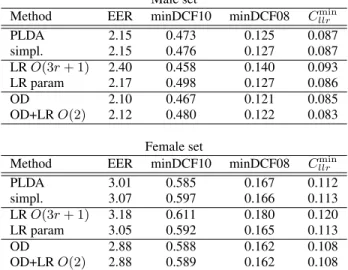
Table 2: Speaker recognition results obtained by the different generative and discriminative systems.
Male set
Method EER minDCF10 minDCF08 Cllrmin
PLDA 2.15 0.473 0.125 0.087 simpl. 2.15 0.476 0.127 0.087 LRO(3r+ 1) 2.40 0.458 0.140 0.093 LR param 2.17 0.498 0.127 0.086 OD 2.10 0.467 0.121 0.085 OD+LRO(2) 2.12 0.480 0.122 0.083 Female set
Method EER minDCF10 minDCF08 Cmin
llr PLDA 3.01 0.585 0.167 0.112 simpl. 3.07 0.597 0.166 0.113 LRO(3r+ 1) 3.18 0.611 0.180 0.120 LR param 3.05 0.592 0.165 0.113 OD 2.88 0.588 0.162 0.108 OD+LRO(2) 2.88 0.589 0.162 0.108
our development data. Here and in all the following, the value ofris fixed to the optimal PLDA eigenvoice rank. Diagonal-ity ofΦΦt,PandQof equations(1) and (3) is estimated, also isotropy ofΛ. Diagonality of a symmetric matrix Acan be measured by the ratio:
T r diag(A)2
T r(A2) (22) whereT r()is the trace operator anddiag(.)denotes the diago-nal “version” ofA(all its off-diagonal values equal zero). This measure is the square-length ratio betweenAand its orthogonal projection onto thed×ddiagonal matrix subspace (which can be identified asRd). The maximal value of1indicates thatA
is exactly diagonal. Table 1 confirms the assumptions of Sec. 4. All these matrices are very close to be diagonal after the ad-ditional normalization procedure, for both genders. To measure isotropy ofΛ, the ratio:
m2Λ
d×T r(Λ2) (23) is computed, wheremΛdenotes the mean value ofΛ-diagonal. Similarly, this measure is the square-length ratio betweenΛ and its orthogonal projection onto the1×1matrix subspace (which can be identified asR). Also, Table 1 confirms thatΛ (which is almost isotropic before rotation, as data have been W-normalized) remains close to isotropy after rotation. Last row of Table 1 shows the ratio of variance between the residual termres0i,j and the whole score of (9). Ratios are close to0
for both gender sets after rotation, confirming that PLDA score can be limited to thisO(r)sum of terms with a minimal loss of accuracy.
Table 2 provides speaker recognition results for the differ-ent systems presdiffer-ented above. 1st row of the Table reports the best performance yielded by PLDA system (the optimal eigen-voice rank is equal to100for female set,200for male set).2nd
row shows performance of a simplified score drawn from (9), in which the residual term has been dropped. Results are equiv-alent to those of PLDA system, confirming the assumptions of Sec. 4 in terms of performance.
3rd and4throw show results of the two logistic regression
parameters training. Both DT fail to optimizing PLDA parame-ters. Performance of the second system, which follows [11], are equivalent to those of PLDA, which raises questions. The first system, based on LLR score coefficients, even degrades per-formance. It seems that this method over-fits to training data, even if the number of parameters to be estimated has been con-strained.
The fact that LR-DT are based on Gaussian assumptions may limit effectiveness of these methods, since Gaussianity of vectors has been significantly improved by pre-normalization, thus brought closer to an optimal Gaussian modeling. 5throw of Table 2 presents results of the OD-classifier, and6throw of
the same system than the5thfollowed by theO(2)LR-classifier of equation (21). The number of kept axes, estimated on a de-velopment set, is equal to7. In order to take into account even-tual distortions of the non-target expanded vector distribution in regions of false alarms, OD model is trained using only the non-target expanded vector subset providing the10%highest PLDA scores. 5th
row shows that this method succeeds in improving PLDA parameters, in terms of speaker detection. The gain is slight for male set, more significant for female set. The addi-tional step ofO(2)LR-DT (6th
row) turns out to be useless. It can be noticed that results of more sophisticated variants of OD (ULDA [23], Foley-Sammon LDA [24]) are not reported here, as they did not yield satisfying performance.
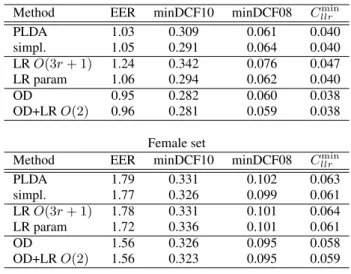
The gap of OD-classifier performance between gender sets raises an issue, about dependency of the method to the config-uration. In order to better assess the ability of OD-classifier to improve PLDA models for speaker verification, we carried out the same experiments with i-vectors2011provided by Brno University of Technology (BUT). Detailed description of their configuration can be found in [25]. The i-vector size is equal to 600and the optimal PLDA eigenvoice rank to80for both gender sets. PLDA training uses21475sessions of1575 speak-ers for male,27155sessions of2012speakers for female. Ta-ble 3 presents results for this configuration. The same observa-tions than for Table 2 apply to the first four systems. For OD-classifier systems, the number of kept axes is equal to3. This method provides significant improvements of performance, in terms of all the detection measures, in particular of EER. The slight gain observed for the previous male evaluation of Table 2 may be explained by a lack of training vectors (about15000 in-stead of more than20000for other sets). 6throw shows that,
again, the additional O(2)LR-DT does not improve perfor-mance once OD-classifier has been carried out.
Furthermore, the training of OD system matricesWtand
Wnpresented in Sec. 5 was parallelized, as proposed in this
section. Splitting the task in 20 processes, less than 30 minutes was needed to train gender system matrices on an usual config-uration. Following extraction of OD-axes required less than 5 minutes with the fast algorithm of Sec. 5.
7. Conclusions
Discriminative training (DT) techniques have proven to be ef-ficient for optimizing parameters of the initial speaker verifi-cation Gaussian modelings based on i-vector (two-covariance model, PLDA). But their benefits become less significant when i-vectors are initially normalized (the most currently used pro-cedures being comprised of within-class covariance and length normalization), while these procedures allow Gaussian systems to achieve best performance. Several work have pointed out that discriminative approaches can suffer from various limita-tions, as data insufficiency, over-fitting on development data or
Table 3: Speaker recognition results with BUT i-vectors 2011. Male set
Method EER minDCF10 minDCF08 Cmin
llr PLDA 1.03 0.309 0.061 0.040 simpl. 1.05 0.291 0.064 0.040 LRO(3r+ 1) 1.24 0.342 0.076 0.047 LR param 1.06 0.294 0.062 0.040 OD 0.95 0.282 0.060 0.038 OD+LRO(2) 0.96 0.281 0.059 0.038 Female set
Method EER minDCF10 minDCF08 Cllrmin
PLDA 1.79 0.331 0.102 0.063 simpl. 1.77 0.326 0.099 0.061 LRO(3r+ 1) 1.78 0.331 0.101 0.064 LR param 1.72 0.336 0.101 0.061 OD 1.56 0.326 0.095 0.058 OD+LRO(2) 1.56 0.323 0.095 0.059
metaparameters conditions, leading to constrained versions. The additional normalization procedure that we propose (a simple rotation by between-class covariance matrix, which does not modify distances between i-vectors) leads to a functional form for verification scores derived from PLDA, which allows us to control the number of trainable parameters. The original discriminative classifier, of order the square of the i-vector size, can be replaced by constrained discriminative classifiers of low order with a minimal loss of accuracy.
Experiments carried out on current NIST evaluations sets show that logistic regression (LR) based-discriminative train-ings, which we adapt to the new normalized distribution of i-vectors, continue to suffer from data insufficiency or over-fitting on development data. Giving up the LR approach, a new method in the field is proposed to extract discriminative axes by using the Fisher criterion (OD). Unlike the usual discrimina-tive classifiers, which attempt to find out a unique normal vector of a separation hyperplane, the proposed method extracts a dis-criminant subspace (by decreasing variance, in a way similar to singular value decomposition), then combine its basis to find out the unique normal vector needed by speaker detection. This combination is done without the need to tune the weights of the discriminant axes set. Experiments show that this method is able to significantly improve performance of Gaussian PLDA systems, even when i-vectors are normalized. As far as training complexity is concerned, OD training also has the advantage of not being demanding in terms of time and memory require-ments.
Future work should test OD method on specific conditions, as short duration or noisy utterances. Accurate estimation of the speaker variability is more difficult with these conditions, and Gaussian PLDA modeling could benefit from this addi-tional discriminative training. Also, it has been shown in [26] that the normalization and PLDA framework can be success-fully applied in speaker diarization to low rank total variability factors provided by a deep neural network. Testing OD method on i-vector-like representations would be of interest.
Acknowledgements
Many thanks to Honza `Cernock´y and Pavel Matˇejka from Brno University of Technology, for letting us use the BUT i-vectors2011.
8. References
[1] Najim Dehak, Patrick Kenny, Reda Dehak, Pierre Du-mouchel, and Pierre Ouellet, “Front-End Factor Analy-sis for Speaker Verification,” IEEE Transactions on Au-dio, Speech, and Language Processing, vol. 19, no. 4, pp. 788–798, 2011.
[2] Patrick Kenny, “Bayesian speaker verification with heavy-tailed priors,” in Speaker and Language Recognition Workshop (IEEE Odyssey), 2010.
[3] Niko Brummer and Edward de Villiers, “The speaker par-titioning problem,” inSpeaker and Language Recognition Workshop (IEEE Odyssey), 2010.
[4] Niko Br¨ummer, Lukas Burget, Jan Honza Cernocky, On-drej Glembek, Frantisek Grezl, Martin Karafiat, David A. Van Leeuwen, Pavel Matejka, Petr Schwarz, and Albert Strasheim, “Fusion of heterogeneous speaker recognition systems in the STBU submission for the NIST speaker recognition evaluation 2006,” IEEE Transactions on Au-dio, Speech, and Language Processing, vol. 15, no. 7, pp. 2072–2084, 2007.
[5] Lukas Burget, Oldrich Plchot, Sandro Cumani, Ondrej Glembek, Pavel Matejka, and Niko Brummer, “Discrim-inatively trained probabilistic linear discriminant analy-sis for speaker verification,” inIEEE International Con-ference on Acoustics, Speech, and Signal Processing, ICASSP, 2011, pp. 4832–4835.
[6] Sandro Cumani, Niko Brummer, Lukas Burget, and Pietro Laface, “Fast discriminative speaker verification in the i-vector space,” in IEEE International Conference on Acoustics, Speech, and Signal Processing, ICASSP, 2011, pp. 4852–4855.
[7] Daniel Garcia-Romero and Carol Y. Espy-Wilson, “Anal-ysis of i-vector length normalization in speaker recogni-tion systems,” in International Conference on Speech Communication and Technology, 2011, pp. 249–252. [8] Pierre-Michel Bousquet, Driss Matrouf, and
Jean-Franc¸ois Bonastre, “Intersession compensation and scor-ing methods in the i-vectors space for speaker recogni-tion,” inInternational Conference on Speech Communi-cation and Technology, 2011, pp. 485–488.
[9] Sandro Cumani, Niko Brummer, Luk´as Burget, Pietro Laface, Oldrich Plchot, and Vasileios Vasilakakis, “Pair-wise discriminative speaker verification in the i-vector space,”IEEE Transactions on Audio, Speech & Language Processing, vol. 21, no. 6, pp. 1217–1227, 2013. [10] J. Rohdin, , S. Biswas, and K. Shinoda, “Robust
discrim-inative training against data insufficiency in PLDA-based speaker verification,” Computer Speech and Language, vol. 35, pp. 32–57, 2016.
[11] B. B¨orgstrom and A. Ahn Mac Cree, “Discriminatively trained bayesian speaker comparison of i-vectors,” in
IEEE International Conference on Acoustics, Speech, and Signal Processing, ICASSP. IEEE; 1999, 2013, pp. 7659– 7662.
[12] Sergey Ioffe, “Probabilistic linear discriminant analysis,”
Computer Vision, pp. 531–542, 2006.
[13] Simon J.D. Prince and James H. Elder, “Probabilistic lin-ear discriminant analysis for inferences about identity,” in International Conference on Computer Vision. IEEE, 2007, pp. 1–8.
[14] Pierre-Michel Bousquet, Anthony Larcher, Driss Matrouf, Jean-Franc¸ois Bonastre, and Oldˇrich Plchot, “Variance-Spectra based Normalization for I-vector Standard and Probabilistic Linear Discriminant Analysis,” inSpeaker and Language Recognition Workshop (IEEE Odyssey), 2012.
[15] Jorge Nocedal and Stephen J. Wright, Numerical Opti-mization, Springer, August 2000.
[16] Niko Br¨ummer. and Edward de Villiers, “The bosaris toolkit user guide: Theory, algorithms and code for binary classifier score processing,” 2011.
[17] Christopher M. Bishop, Pattern recognition and machine learning, vol. 4, Springer, 2006.
[18] T. Okada and S. Tomita, “An optimal orthonormal system for discriminant analysis,” Pattern Recognition, vol. 18, no. 2, pp. 139–144, 1985.
[19] Jinghua Wang, Yong Xu, David Zhang, and Jane You, “An efficient method for computing orthogonal discriminant vectors,” vol. 73, no. 10-12, pp. 2168 – 2176, 2010. [20] Wen Yi Zhao, “Discriminant component analysis for face
recognition,” Pattern Recognition, vol. 2, pp. 818–821, 2000.
[21] National Institute of Standards and Technol-ogy, “Speaker recognition evaluation plans,” http://www.itl.nist.gov/iad/mig/tests/sre/.
[22] Niko Br¨ummer and Johan du Preez, “Application-independent evaluation of speaker detection,” Computer Speech & Language, vol. 20, no. 2-3, pp. 230–275, 2006. [23] Zhong Jin, Jing-Yu Yang, Zhong-Shan Hu, and Zhen Lou”, “Face recognition based on the uncorrelated dis-criminant transformation,” Pattern Recognition, vol. 34, no. 7, pp. 1405–1416, 2001.
[24] D. H. Foley and J. W. Sammon, “An optimal set of dis-criminant vectors,”IEEE Transactions on Computers, vol. 24, no. 3, pp. 281–289, March 1975.
[25] Pavel Matejka, Ondrej Glembeck, Fabio Castaldo, M.J. Alam, Oldrich Plchot, Patrick Kenny, Lukas Burget, and Jan Cernocky, “Full-covariance UBM and heavy-tailed PLDA in i-vector speaker verification,” inInternational Conference on Speech Communication and Technology, 2011, pp. 4828–4831.
[26] M. Rouvier, P.M. Bousquet, and B. Favre, “Speaker di-arization through speaker embeddings,” inEuropean Sig-nal and Image Processing Conference (EUSIPCO), 2015.