Abstract—In our researches [42], we evaluated the influence of the application of industrial engineering methods on increasing the competitive abilities of Czech industrial manufacturing enterprises, and one of the results of my research study based on a selected sample of these Czech enterprises was the following fact: that the exploitation of re-engineering and process management components was woefully inadequate – for the sample of Czech enterprises being tracked. It was for this very reason and - as a consequence of our interest in the given problems and issues in manufacturing production enterprises, that we oriented ourselves on the field of Business Process Management - BPM as well as on the problems and issues involving dramatic changes in enterprises´ processes – i.e. Business Process Reengineering – BPR.
Keywords—Business Process Management, Business Process Reengineering, Business Process Change Management, ARIS (Architecture of Integrated Information Systems), IS/ICT - Information Systems/ Information and Communication Technologies, ERP – Enterprise Resource Planning
I. INTRODUCTION
USINESS process management has at its disposal a number of components which managers have been able to exploit for over a decade now, but these components have been subject to development and improvement over time and the spectrum of firms in which these principles are applicable has also increased dramatically. At the present time, new requirements and opportunities are continuing to appear on the Business Process Management scene, with the promise of providing relatively significant benefits to enterprises which make the most of the opportunities on offer. This is yet another reason for our choice of this and other publication.
Some our researches [42], it was demonstrated that the exploitation of certain of these business process management components (e.g. the measurement of the effectiveness and performance of processes, the exploitation of process teams, etc.) was still very low in Czech industrial manufacturing production enterprises and that this even held true for
large-This paper is one of the research outputs of the project GA402/09/P406 registered at Czech Science Foundation (GAČR).
Zuzana Tučková is with Tomas Bata University Zlin, Department of Enterprise Economics, Mostní 5139, 760 01 Zlín, Czech Republic <email: [email protected]>.
David Tuček is with Tomas Bata University Zlin, Department of Industrial Engineering and Information Systems, Mostní 5139, 760 01 Zlín, Czech Republic <email: [email protected]>.
scale enterprises (as regards their number of employees and turnover).
Apart from this, and also based on the results of our researches [42], it was further possible to state that in the course of the optimization of processes – and above all in the case of manufacturing production processes, it was crucially important for industrial manufacturing production enterprises to attempt to exploit to the maximum the wide range of industrial engineering methods and reengineering methods.
This whole article is composed of two mutually interlinked fields. The first is oriented on the field of Business Process Management - BPM, which is closely linked to the problems and issues regarding the choice and implementation of Enterprise Resource Planning – ERP systems and the concepts that are exploited within the framework of an ERP system itself. The second part of this article is focused on Business Process Change Management.
II. LITERATURE REVIEW
A. BPM – Presentment and Short History
Process management is an approach that today is becoming more popular and gets increasingly implemented in more and more companies. Process management can be understood from two perspectives. One is the process management as a managerial discipline. The second aspect understands the process management as a technology that supports process-oriented management. Process approach allows organizations to eliminate the biggest disadvantage of the traditional functional approach that cannot be considered as an approach appropriately flexible for changes in the corporate environment, variety of procedures, or excessive substitution of workers. Processes are always understood in relation to the customer [40, 43, 44].
The market forces of today’s business process (BP) development have begun to place an important emphasis on business process quality. Evidently, the quality of a business process model (BPM) highly influences the deployed business process. This motivated several researchers to propose metrics to evaluate the quality of BPM.
The aim of Process Management is to develop and to optimise the daily running of an enterprise in a way which defines these work-related procedures (i.e. processes) as a unified flow or cascade of activities throughout the enterprise, where for each and every process its inputs are clearly defined
Necessity of IT and SW Support for Business
Process Management
Zuzana Tu
č
ková, and David Tu
č
ek
as are the outputs or results [4, 41], and where the associated responsibilities and personal responsibilities are assigned for each and every process or activity, while establishing a system for the measurement of the performance of these processes and tracking and evaluating each and every process.
We should begin with the principles. Managers are often confronted, even in renowned magazines, with several similar terms and concepts which may be confusing or at least their correct content and principles may be misinterpreted on the basis of inaccurate information. What do the terms Business Process Management (BPM) and Business Process Reengineering (BPR) mean? What is their application in practice? In this subheading we would like to acquaint you briefly but precisely with these terms and their content.
From the point-of-view of management and Business Process Management development, authors such as King, Fingar, Smith [11] etc. have offered various conceptions in order to comprehend the connections and differences between them. King, for instance, has distinguished between four development waves [37]. He has mentioned the following in his publications:
1) the first wave of BPM – was concentrated on constant improving of the processes and coincides in many ways with the philosophy of TQM (Total Quality Management ), a philosophy which leads to an increase in productivity, a simultaneous increase in quality and increased customer satisfaction while decreasing losses caused by poor quality production. TQM is thus a systematic and consistent application of several methods within the company organization clearly concentrated on quality and customer satisfaction.
2) the second wave of BPM - consisted of a focus on Business Process Reengineering, or in short Reengineering. This is regarded as the second wave involving the trend of management leading towards essential, radical and fundamental changes in the organization of applied work procedures or technologies. The achievement of not merely incremental but has a radical rise in organization productivity as the expected result.
3) the third wave of BPM – the authors Fingar, Smith [11] refer to activities leading to the creation of a process focused organization. This involves the application of main component procedures or process management consisting of the following:
- key process determination including the appointing of process possessors and customers;
-within the process description, their mapping and process map formation (a company process model) for recording process system management;
- the application of process maps (models) for cost intensity evaluation and increases in their efficiency;
- continual process improvement and measuring of efficiency;
- quality in the enterprise is mainly understood as the demand for quality standards which lead off the process
model;
- information technologies considered as the process support in the enterprise;
- while the process model creates the basis of the process management, the strategy management is comprehended as the peak of the “pyramid” of process management;
- competence management is comprehended as the system enabling fulfillment of roles in individual processes (both management and key processes) by those people who have appropriate knowledge and abilities for them.
E.g. Hejduk [16] consequently mentions as crucial: - the process model;
- constantly improved processes – procedures for optimization and improvement of the processes;
- strategy management; - competence management; - quality management.
4) the fourth wave of BPM – is a group of activities leading towards the achievement of competitiveness based mainly and exclusively on the processes.
It is essential to additionally adduce other authors for a better understanding of the differences and links between BPM and BPR; e.g. Scheer, Kruppke, Kindermann [35] when applying this managerial trend they recommend implementing process management in the organization first and consequently focusing on reengineering processes on the basis of the specific priorities of the organization.
According to an entire range of authors, [28, 32] or the consulting companies IDS Scheer, AP Partner Consulting a.s. [21], Plaut Consulting Czech Republic etc., the consistent realization of several steps is recommended for an increase in the process productivity of the company. These three authors agree on this fact in large measure. This procedure can be defined as following:
• endorsement of fundamental rules within the process management application;
• formulation of the sense of such a project;
• identification and endorsement of crucial factors of prosperity;
• identification and endorsement of individual types of company processes;
• simulation of individual types of company processes (according to crucial prosperity factors) with the application of process teams – creation of a process map;
• determination of process priorities;
• measuring of process efficiency;
• optimization of company processes;
• additionally, the projects of the reengineering processes often follow in accordance with an individual scenario.
B. Business Process Change Management
flexible and customer oriented way in order to meet economic challenges and ensure a long term survival of the organization. Therefore organizations move towards business process oriented architectures like defined with the Three-tier Architecture of Business Process Excellence" [19, 33].
On strategy level aspects like the general business process structure and strategy, the planned innovation and the underlying application system architecture are defined. The information is forwarded to the process specification layer, where the blueprint for the resulting business processes is specified, using techniques like simulation, best practice ref-erence models or ABC costing. This process specification is used as the guideline for the implementation of all physical and information handling processes on the execution layer, within and across enterprises. All information systems, based on standard application software packages, individual developments, EAI components, web services, or business process execution engines are based on Fig. 1: Three-Tier Architecture of Business Process Excellence level. If there are differences observed between planned key performance indicators and the actual values, either a continuous improvement process (CPI) is started through the process specification layer or the situation is resolved on a strategic level. The Three-tier Architecture of Business Process Excellence is shown in Fig. 1. [34].
Fig. 1: Three-Tier Architecture of Business Process Excellence [34]
Key advantage of such process-centered organizations is that it enables a fast and flexible reaction to changes. Changes that influence business processes may be caused by:
• new or changing customers, suppliers or other market partners;
• new or changed market offerings (goods, services, information,
• mergers and Acquisitions
• changing legal regulations
• availability of new or modified technologies like
application systems
• outsourcing of specific activities
• new business models
• cultural differences in various enterprise locations
• others
• the business driven use of new technologies like m-business create a tremendous
• change of business processes [20].
What does it mean to be flexible in the context of new economy? In the new economy companies are ought to be able to adapt to differing customers’ demands and fast changing environments. Thus, flexibility of a company is a fundamental factor that enhances competitiveness as a result to fast adjustment to their diverse demands and requirements [30]. Results of some authors say [13], that this factor was measured through two sub-questions: Faster creation of documentation; and faster process flow with fewer mistakes made. Over 67% of the companies believe that faster creation of the documentation has greater or major impact on competitiveness. On the other hand, less than 9% companies questioned expressed that use of internal server does not show benefits in companies’ flexibility. Moreover, second sub-question also proved that flexibility does have important role in achieving enhanced competitiveness.
All the described business changes require according modifications or creations of business processes. Goal of change management is to ensure that the necessary changes of a business process fulfill the following conditions [38]:
• necessary actions are initiated with an acceptable delay after the change has happened (or has been decided to happen, if pro-active change management is needed);
• necessary actions are executed in a fast and effective way;
• all reactions and actions are initiated and executed in a controlled manner.
An effective management of the permanent change becomes a key success-factor for an enterprise [7]. It is of fundamental importance that the people involved in changing processes are able to understand and accept those changes and make them finally happen. Therefore the most appropriate definition of change management is from Hammer and Stanton [15]: Information quality, communication and training. Information quality (IQ). Internal use of IT makes the supplier's processes more reliable because it supports decision making, production planning, and quality management by improving the scanning and monitoring of the internal and external environment [9]. Hence, quality of information as one of the fundamental elements of this process change has a significant impact on evaluation of company’s competitiveness [31].
People have to be informed about the changes. Then their feedback is required. An intense communication starts. And finally people have to be trained to be successful in the new business process environment [38].
begin with an analysis of existing organizational elements and an identification of ways to change the dependencies among them, especially between processes [23]. Therefore, IT is one of the fundamental elements of Business Process Change (BPC) [2, 6, 14, 24]. Its role is significant throughout the entire duration of process change: before the process is designed (IT as an enabler), while the process is being designed (IT as a facilitator) and after the design is complete (IT as an implementer) [2].
Therefore, building a responsive IT infrastructure [6] is the key factor for successful implementation of BPC.
III. IT AND SWSUPPORT OF BUSINESS PROCESS
MANAGEMENT
The aggregate of SW tools for support of process modeling is relatively large and can be found under various names in literature written in English: Business Process Modeling Tools, Business Process Management Tools, Enterprise Modeling Tools, Business Process Management Tools, which are named as a whole as the so-called CABE (Computer Aided Business Engineering) tools. At times, they are incorrectly identified (or mixed up) with the names of the CASE (Computer Aided System Engineering) tools.
These tools, creating process models, are then used to configure the final installation of the information system. Many of these process aware information systems (for example Enterprise Resource Planning (ERP) [22] and Workflow Management (WFM) [1] are designed to support business processes on an operational level and fully benefit from these systems. The process models need to be specified as precisely as possible. The designing, however, of process models in a precise manner is a complicated and error prone task. Fortunately, those process models which are used in different companies, although with similar purposes, often have very similar designs. For this reason, databases have been developed which contain generic process models that can be customized towards company-specific business processes [10]. These process models can serve as a guideline when designing process models in order to implement large information systems, i.e. they serve as a reference for the designer hence the term reference models.
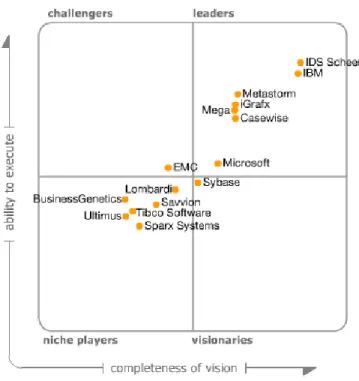
Fig. 2 presents an overview of all of the most well-known world-wide employed tools for analysing business process. This was assembled by the company Gartner Research in the year 2008. The particular tools are evaluated in accordance with their technical success (Ability to Execute) and methodological success (Completeness of Vision). The products are placed into one of the four quadrants according to the level of representation of these two qualities [36].
Fig. 2. Division of tools for analysing of business processes based on Gartner, Inc.
“Niche Player” – includes technically and methodically limited products, which are expected to shift into higher categories;
“Visionary” – comprises of methodically mature products, but technically limited with limited applicability;
“Challenger” – involves technically mature products, but methodically limited, yet successful on the market;
“Leader” – consists of methodically and technically matures tools with sufficient user base, well-organized development and good know-how.
A good opportunity for transition to business process management model may be implementing an integrated information system. In terms of the system, there is more or less emphasis being put today in almost every implementation methodologies on defining enterprise processes, which will be then supported by the functions of information system, automated or supported by performance measurement processes data.
Based on the results of our quantitative survey of business process management in Czech industrial companies, it was confirmed that among the most widely used software tools, which are used in Czech companies to support process modeling, are Microsoft Visio and ARIS. Therefore, we focused in this chapter only on analysing these tools, which proved to occur in our enterprises most frequently. For this reason, we did not analyze the other tools listed in the questionnaire which include: Adonis Casewise, MEGA Process, Micrografix FlowCharter, Popkin, QPR or Eisod and other. These tools did not even occur in the case studies further analyzed within qualitative research: business process management implementation in selected enterprises.
undoubtedly a Dynamic Enterprise Modeler - DEM, which was created by the Baan Company, now owned by SSA Global Technologies. DEM is part of ERP software of SSA Baan ERP, which enables the effective implementation and subsequent adaptation of the corporate information system to the changing external and internal conditions of the company. The ERP system is mainly intended for manufacturing companies.
A specialist in business process modeling is a popular software ARIS from IDS Scheer. It is able not only to model and then optimize the processes, but also to measure their performance. ARIS is a convenient and proven tool for rapid implementation of SAP. It can be used, of course, with other ERP systems as well.
One of the successful products of IDS Scheer in this area was ARIS SmartPath. This was represents a new dimension of default complete solutions. ARIS SmartPath includes both software products and services, and the process reference models that allow the time-saving and cost-efficient implementation of mySAP All-in-One. This solution has the support of IDS Scheer global resources and thus offers a reliable approach that supports local needs and demands on global expansion.
IV. USING SOFTWARE TOOLS FOR SUPPORT OF PROCESS
MANAGEMENT IN THE CZECH REPUBLIC
A. Research Methodology
The research results are listed in summary fashion for all of the researched Czech companies, which were 132 in all. These involved companies in the following branches: machine works, production of foodstuffs, rubber, plastic, wood processing industry as well as services (services and consultations in the area of provision of HW, SW, etc., retail and wholesale activities, construction). When processing this data from the research which occurred at the turn of the years 2006/2007, two forms of statistical induction were employed – estimates and testing of statistical hypotheses [12]. The calculated values of intervals of reliability are listed directly in the graph. The applications JMP 6 and Statgraphics were used for evaluating the determined data. Questionnaire used in the research was complex and long, therefore the response rate is consistent with that reported in previous organizational research [18].
B. Research Results
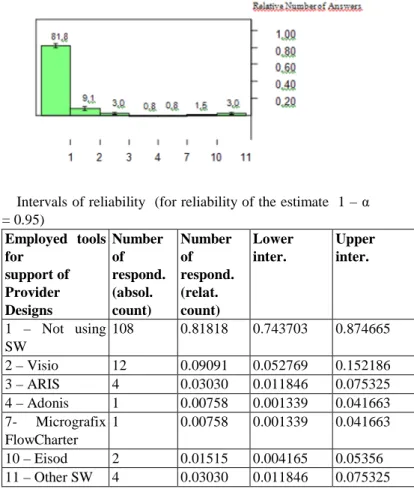
The level of use of SW tools for support of process management, for example, when describing (mapping) processes or when optimality certain types of processes or similar items, is appear in picture 3. The results clearly indicate that almost 82% of companies do not use any tool. 9% of companies in the basic group make use of the easily available with the simple extension of the Microsoft Office – Visio package, made use of in a priority manner for creation of office diagrams. Work with the functional character making possible creation of organizational and process schemes is of particular interest as well for the purposes of support of
process management. IT specialists are also offered manual or automatic creation of network diagrams, designs of software components or databases, etc.
The ARIS tools are used in approximately 3% of the observed bodies which is the most from the tools supporting not only the creation of process maps, but also:
• the recording of elements in the vicinity of the company;
• connections between the elements in the vicinity and the processes;
• testing the consistency of the process models;
• evaluating and comparing the processes;
• defining the actual metrics of the evaluation processes;
• indicating problematic processes;
• a proposal for concrete changes to the processes;
• the connection of the processes with the IS company.
Fig. 3 Employment of SW Tools for Support of Provider Designs
Intervals of reliability (for reliability of the estimate 1 – α = 0.95) Employed tools for support of Provider Designs Number of respond. (absol. count) Number of respond. (relat. count) Lower inter. Upper inter. 1 – Not using SW 108 0.81818 0.743703 0.874665 2 – Visio 12 0.09091 0.052769 0.152186 3 – ARIS 4 0.03030 0.011846 0.075325 4 – Adonis 1 0.00758 0.001339 0.041663 7- Micrografix FlowCharter 1 0.00758 0.001339 0.041663 10 – Eisod 2 0.01515 0.004165 0.05356 11 – Other SW 4 0.03030 0.011846 0.075325 Source: own research
As next comes Eisod (1.5% of enterprises) and Adonis and Micrografix FlowCharter applications (both 0.8%). The remaining 3% of businesses use “other Software”. That means a unique use of the applications listed in Fig. 3
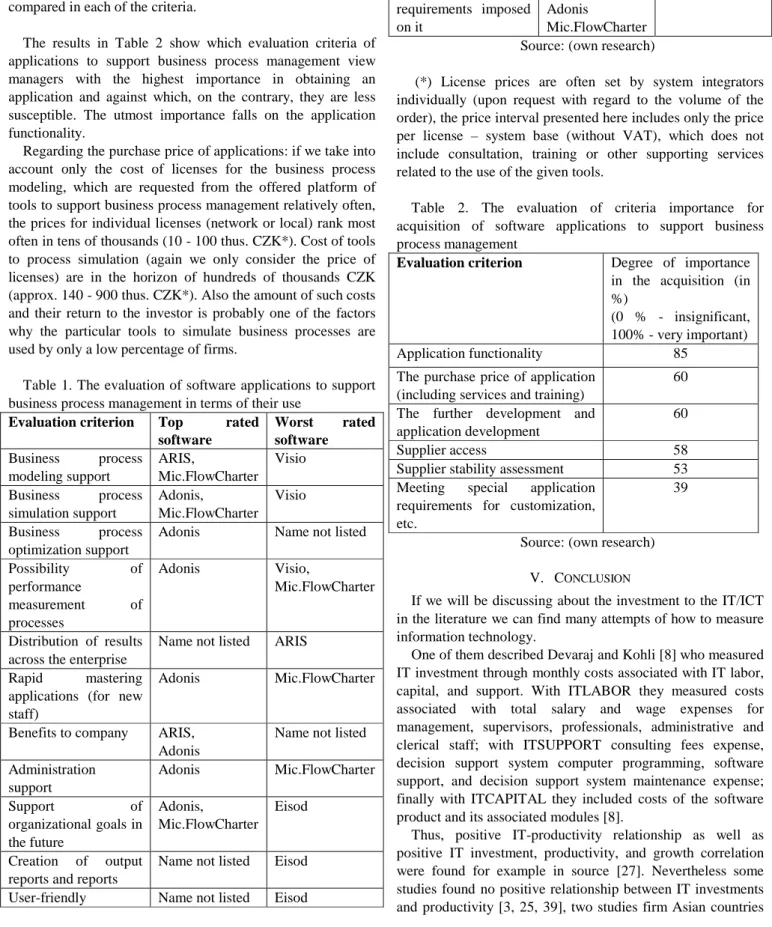
business process management, were asked how convenient the application is for them in terms of several fundamental aspects. Tab. 1 shows which applications appear to its users as the best and the least favorable regarding the evaluation criteria. Only the applications assessable from this perspective were compared in each of the criteria.
The results in Table 2 show which evaluation criteria of applications to support business process management view managers with the highest importance in obtaining an application and against which, on the contrary, they are less susceptible. The utmost importance falls on the application functionality.
Regarding the purchase price of applications: if we take into account only the cost of licenses for the business process modeling, which are requested from the offered platform of tools to support business process management relatively often, the prices for individual licenses (network or local) rank most often in tens of thousands (10 - 100 thus. CZK*). Cost of tools to process simulation (again we only consider the price of licenses) are in the horizon of hundreds of thousands CZK (approx. 140 - 900 thus. CZK*). Also the amount of such costs and their return to the investor is probably one of the factors why the particular tools to simulate business processes are used by only a low percentage of firms.
Table 1. The evaluation of software applications to support business process management in terms of their use
Evaluation criterion Top rated software Worst rated software Business process modeling support ARIS, Mic.FlowCharter Visio Business process simulation support Adonis, Mic.FlowCharter Visio Business process optimization support
Adonis Name not listed Possibility of performance measurement of processes Adonis Visio, Mic.FlowCharter Distribution of results across the enterprise
Name not listed ARIS Rapid mastering
applications (for new staff)
Adonis Mic.FlowCharter
Benefits to company ARIS, Adonis
Name not listed Administration support Adonis Mic.FlowCharter Support of organizational goals in the future Adonis, Mic.FlowCharter Eisod Creation of output reports and reports
Name not listed Eisod User-friendly Name not listed Eisod
environment Stability and performance of application Adonis, Mic.FlowCharter Visio Meeting the requirements imposed on it ARIS, Adonis Mic.FlowCharter
Name not listed
Source: (own research)
(*) License prices are often set by system integrators individually (upon request with regard to the volume of the order), the price interval presented here includes only the price per license – system base (without VAT), which does not include consultation, training or other supporting services related to the use of the given tools.
Table 2. The evaluation of criteria importance for acquisition of software applications to support business process management
Evaluation criterion Degree of importance in the acquisition (in %)
(0 % - insignificant, 100% - very important)
Application functionality 85
The purchase price of application (including services and training)
60 The further development and
application development
60
Supplier access 58
Supplier stability assessment 53 Meeting special application
requirements for customization, etc.
39
Source: (own research) V. CONCLUSION
If we will be discussing about the investment to the IT/ICT in the literature we can find many attempts of how to measure information technology.
One of them described Devaraj and Kohli [8] who measured IT investment through monthly costs associated with IT labor, capital, and support. With ITLABOR they measured costs associated with total salary and wage expenses for management, supervisors, professionals, administrative and clerical staff; with ITSUPPORT consulting fees expense, decision support system computer programming, software support, and decision support system maintenance expense; finally with ITCAPITAL they included costs of the software product and its associated modules [8].
Thus, positive IT-productivity relationship as well as positive IT investment, productivity, and growth correlation were found for example in source [27]. Nevertheless some studies found no positive relationship between IT investments and productivity [3, 25, 39], two studies firm Asian countries
show some positive results in productivity resulting from ITT investment. First study showed enhanced productivity by increase in computer capital stock [17], while second one explained that those countries with higher growth rates in IT investment achieved consistently higher growth rates of GDP and productivity [26]. Furthermore, in a firm-level study Brynjolfsson found that firms that reengineered were significantly more productive than their competitors [5] as well as EC applications have the ability to increase business productivity [29].
REFERENCES
[1] V.M.P. Aalst, and K.M. Hee, Workflow Management: Models,
Methods, and Systems. MIT Press, Cambridge, MA, 2002.7
[2] M. Attaran, Information technology and business-process redesign,
Business Process Management Journal, no. 9, 2003, pp.440-458.1
[3] E. R. Berndt, and C. J. Morrison, High-tech capital formation and
economic performance in US manufacturing industries: An exploratory analysis. 1992.4
[4] C.G. Bonaci, D. Matis, and J. Strouhal, Crisis of Fair Value Measurement? Some Defense of the Best of All Bad Measurement Bases, WSEAS Transactions on Business and Economics, Vol. 7, No. 2, 2010, pp. 114-125.
[5] E. Brynjolfsson, Technology’s true payoff, InformationWeek, no. 496, 1994, pp. 34–36.8
[6] P.S. Chan, and C. Land, Implementing reengineering using information technology, Business Process Management Journal, no. 5, 1999, pp. 311-324.10
[7] J.Ch. Collins, Good to great. Why Some Companies Make the Leap….
and Others don´t. 1st. ed. New York: HarperCollins Publishers Inc.,
2001. 5
[8] S. Devaraj, and R. Kohli, Information technology payoff in the health-care industry: A longitudinal study, Journal of Management
Information Systems, vol. 16, no. 4, 2000, pp. 41-68.15
[9] T. Dewett, and G.R. Jones, The role of information technology in the organization: a review, model and assessment, Journal of Management, no. 27, 2001, pp. 313-346.17
[10] B.F. Dongen, and M.H. Jansen-Vullers, EPC Verification in the ARIS
for MySAP reference model database
http://ftp.informatik.rwth-aachen.de/Publications/CEUR-WS/Vol 167/epk2005-paper2.pdf. 2005.6
[11] P. Fingar, and H. Smith, Business Process Management: The Third
Wave. Tampa. Meghan-Kiffer Press, 2002.14
[12] J. Gill, and P. Johnson, Research Metods for Managers. London: Paul Chapman Publishing, 1991. 3
[13] A. Habjan, and A. Popovic, How internal processes benefit from IT investments and therefore enhance company’s competitiveness – a case study of Slovenian small and medium sized companies, WSEAS
Transactions on Business and Economics, Vol. 5, No. 5, 2008, pp.
233-242 .2
[14] M. Hammer, Reengineering Work: Don't Automate, Obliterate, Harvard
Business Review,1990, pp.104-112.23
[15] M. Hammer, and S. Stanton, The Reengineering Revolution. Glasgow: HarperCollins, 1995. 26
[16] J. Hejduk, Smrtelné hříchy procesního řízení, Business World, vol. IV, no. 5, 2003, pp. 8-12. 18
[17] S.Y. Ho, and K.Y. Tam, An Empirical Examination of the Effects of Web Personalization at Different Stages of Decision Making.
International journal of human–computer interaction, no. 19,
pp.95-112. 28
[18] C. Homburg, and C. Pflesser, A Multiple- Layer Model of Market-Oriented Organizational Culture: Measurement Issues and Performance Outcomes, Journal of Marketing Research, vol. 37, pp.449–462.29 [19] W.Jost, and A.W.Scheer, Business Process Management: A Core Task
for any Company Organization. In. Business Process Excellence - ARIS
in Practice. Berlin, New York, and others 2002, pp. 33-43. 19
[20] R. Kalakota, and M. Robinson, M-Business - The race to mobility. New York e.a., 2002. 25
[21] L. Karmazín, Reengineering podnikových procesů v praxi. In
Efektivnost podnikových procesů. Sborník přednášek ze semináře, Zlín: Optimicon, s.r.o./ TIC s.r.o. 2006, pp. 1-39. 24
[22] G. Keller, and T. Teufel, SAP R/3 Process Oriented Implementation. Addison-Wesley, Reading MA, 1998.9
[23] H.W. Kim, Business process versus coordination process in organizational change, International Journal of Flexible Manufacturing
Systems, vol. 12, no. 4, 2000, pp. 275.30
[24] R. Kohli, and E. Hoadley, Towards Developing a Framework for Measuring Organizational Impact of IT-enabled BPR: Case studies of Three Firms, Database for Advances in Information Systems, vol. 37, 2006, pp. 40-58.32
[25] H. Koski, The implications of network use, production network externalities and public networking programmes for firm's productivity,
Research Policy, vol. 28, no. 4,1999, pp. 423-439.34
[26] K.L. Kraemer, and J. Dedrick, Payoffs from Investment in Information Technology: Lessons from the Asia-Pacific Region, World Development, vol. 22,1994, pp. 1921-31.35
[27] W. Lehr, and F. Lichtenberg, Computer use and productivity growth in U.S. federal government agencies 1987-92, Journal of Industrial
Economics, vol. 46, no. 2, 1998, pp.257-279.37
[28] F. Leymann, and D. Roller, Production Workflow: Concepts and
Techniques. Prentice-Hall PTR, Upper Saddle River, New Jersey, USA,
1999.11
[29] J. Lu, A Model for Evaluating E-Commerce Based on Cost/Benefit and Customer Satisfaction. Information Systems Frontiers, no. 5, 2003, pp. 265-277.38
[30] O. Marjanovic, Supporting the “soft side of business process reengineering,” Business Process Management Journal, vol.. 6, no. 1, 2000, pp. 43-55.39
[31] K.A. Patterson, C.M. Grimm, and M. Corsi, Diffusion of supply chain technologies, Transportation Journal, vol. 43, no. 3, 2004, pp. 5-19.36 [32] M. Robson, and P.Ullah, Praktická příručka podnikového
reengineeringu. 1. vydání. Praha: Management Press, 1998..12
[33] A.W.Scheer, F. Abolhassan, W. Jost, and M.Kirchmer, Business
Process Automation. ARIS in Practice. Berlin: Springer-Verlag: 2004..
20
[34] A.W.Scheer, F. Abolhassan, W. Jost, and M.Kirchmer, Business
Process Change Management. ARIS in Practice. Berlin:
Springer-Verlag: 2003. 21
[35] A.W.Scheer, H. Kruppke, W. Jost, and H. Kindermann, Agility by ARIS
Business Process Management. Berlin: Springer-Verlag, 2006..22
[36] J. Sinur, Magic Quadrant for Business Process Analysis CT: Gartner research, Gartner´s Aplication Developement and maintenance
Research Note M-22-065. Stamford: 2008.31
[37] F. Šmída, Introduction and development of process management in the
company. Praha: Grada Publishing, 2007.. 16
[38] D. Spath, M. Baumeister, T. Barrho, and C. Dill, Change Management
im Wandel. In: Industrie Management - Zeitschrift fuer industrielle
Geschaeftsprozesse, 4/2001, pp. 913. 27
[39] P.A. Strassmann, Information Payoff: TheTransformation of Work in
the Electronic Age, Free Press, 1985.33
[40] J. Strouhal, Reporting Frameworks for Financial Instruments in Czech: Czech Accounting Practices versus IFRS, WSEAS Transactions on
Business and Economics, Vol. 6, No. 7, 2009, pp. 352-361.
[41] J. Strouhal, C. Bonaci, and D. Matis, Fair Value Accounting for Financial Instruments: A Historical Perspective, International Advances
in Economic Research, Vol. 15, No. 4, 2009, pp. 490-491.
[42] D. Tuček, Vantages of the KANBAN in the ERP systems. In Economic Forum 2005 - Summaries of conference’s materials, International scientific conference- Increasing Activity Efficiency Methods and Techniques in Wood Processing Enterprises. Laski: 2005, p.32.13 [43] Z. Tučková, and J. Strouhal, Knowledge-Intensive Services: New Leader
of Production Stages?, WSEAS Transactions on Systems, Vol. 9, No. 4, 2010, pp. 432-441.
[44] Z. Tučková, and D. Tuček, Knowledge Services in Business Process Management: A New Way for Increasing of Productivity?, WSEAS
Zuzana Tučková (Ph.D.) is Senior Lecturer of Department of Enterprise Economics of Tomas Bata University in Zlin. Her major is knowledge economy.
David Tuček (Ph.D.) is Associate Professor of Department of Industrial Engineering and Information Systems of Tomas Bata University in Zlin. His major is business process management (BPM). Currently he is acting vice rector of Tomas Bata University in Zlin.
![Fig. 1: Three-Tier Architecture of Business Process Excellence [34]](https://thumb-us.123doks.com/thumbv2/123dok_us/589238.2570391/3.892.44.450.656.925/fig-tier-architecture-business-process-excellence.webp)