1
Producing credible evidence and
relevant evaluations: Integrating skills
and practices in the study of adult
literacy and numeracy policies and
programmes
Jon David Carpentieri
UCL
2
Declaration
I, Jon David Carpentieri, confirm that the work presented in this thesis is my own. Where information has been derived from other sources, I confirm that this has been indicated in the thesis.
3
Acknowledgements
This PhD by Publication is the product of several years’ research on a number of interesting and exciting research projects, only some of which could be discussed in this submission. My involvement in these projects would not have been possible without the support and
confidence of my colleagues at NRDC (the National Research and Development Centre for Adult Literacy and Numeracy). I wish to offer particular thanks to David Mallows and Jenny Litster, who have been a true pleasure to work with, and to know.
Many thanks to my advisors on this PhD: Ann Hodgson and Karen Evans. Both have provided invaluable guidance.
Finally, and most importantly, my family. In the original draft of this Acknowledgements section, I thanked my wife and daughter for their encouragement and support. But when I showed them what I’d written, they laughed in my face – and rightly so. The truth is, I’d have finished years earlier without them. But my life would be far less rich. Here’s to you, Wendy and Astrid. And here’s to my mom as well.
4
Table of Contents
Producing credible evidence and relevant evaluations: Integrating skills and
practices in the study of adult literacy and numeracy policies and programmes ... 1
Declaration ... 2
Acknowledgements ... 3
Abstract ... 6
Structure of this paper ... 7
Overview of publications and my personal contribution to those publications ... 8
Theoretical framework ... 13
Aims and objectives of my research and this integrative paper ... 17
Background to my research: policy context ... 19
Heightened policy emphasis on adult literacy and numeracy skills ... 19
Practice Engagement Theory ... 23
Publications 1-3: Type 1 evidence of the presence and impacts of low literacy and numeracy skills ... 28
Publication 1: Study on European Terminology in Adult Learning for a common language and common understanding and monitoring of the sector ... 28
Publication 2: Impact of poor basic literacy and numeracy on employers ... 33
Publication 3: International evidence review of basic skills: Learning from high-performing and improving countries ... 38
Publications 4-5: Type 2 evidence of the impacts of adult literacy and numeracy programmes ... 43
Publication 4: Investigating the benefits of English and maths provision for adult learners ... 43
Programme impacts on literacy and numeracy skills ... 44
Programme impacts on literacy and numeracy practices ... 47
Publication 5: Evidence, evaluation and the ‘tyranny of effect size’: a proposal to more accurately measure programme impacts in adult and family literacy ... 50
Type 3 evidence of literacy and numeracy practices as a mechanism for skills gain ... 60
5 Publication 6: Adding new numbers to the policy narrative: Using PIAAC data to focus
on literacy practices ... 60
Integrating practices into policy ... 62
PIAAC data on literacy and numeracy practices ... 64
Conclusion ... 67
How these six publications contribute to research and policy ... 68
Cross-cutting messages and themes in these publications ... 70
How this integrative paper adds to my published research and contributes to the field ... 71
Further research ... 73
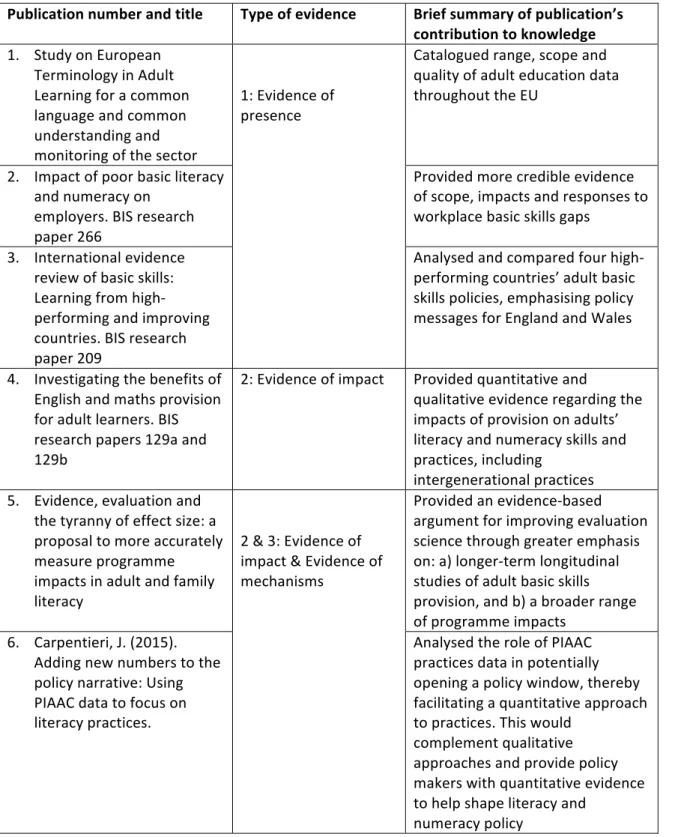
Appendix 1: Types of evidence produced by each publication ... 75
Appendix 2: Statements from authors verifying my personal contribution to co-authored works ... 76
6
Abstract
In this integrative paper I identify my contribution to the production of credible and relevant evidence in the fields of adult education in general and adult literacy and numeracy in particular. By ‘credible evidence’ I refer to evidence that can be believed (Schwandt, 2009). By ‘relevant evidence’ I refer to evidence that is useful to policymakers and programme staff. In describing my work, I draw on and extend Berriet-Solliec et al.’s (2014) typology of three types of evidence that may be generated by research:
• Type 1: Evidence of presence, e.g. of a problem such as low literacy skills in adults. Publications 1-3 in my submission focus on this type of evidence.
• Type 2: Evidence of impact, e.g. the impacts of adult literacy programmes or policies on adults’ skills or other outcomes. Publications 4-5 focus on Type 2 evidence.
• Type 3: Evidence of mechanisms, e.g. the causal processes through which adult literacy programmes may generate impact. Such mechanisms, in the form of literacy and numeracy practices, are discussed in Publication 6, as well as Publication 5. In this paper, I analyse the complex relationships amongst these three types of evidence. In doing so, I show how the proliferation of Type 1 evidence on literacy and numeracy skills, such as that produced by international surveys such as the Program for the International Assessment of Adult Competencies (PIAAC), leads to greater policy emphasis on the
generation of credible and relevant Type 2 evidence, particularly in the form of evaluations of programmes’ impacts on those skills. I argue that while there has been increased
emphasis on Types 1 and 2 evidence, a lack of policy focus on Type 3 evidence of key
mechanisms (especially literacy and numeracy practices) through which adults may improve their literacy and numeracy skills leads to theoretically misinformed programme
7 insufficiently relevant and is at worst non-credible. I then offer a strategy for producing evidence that is more credible, and more useful to policymakers and programme staff.
Structure of this paper
This integrative paper is structured as follows:
• The first section of the paper provides an overview of the six publications included in this PhD submission. That section includes a discussion of my personal contribution to those publications.
• In the second section, I discuss the theoretical framework which underpins this integrative paper.
• The third section details the aims and objectives of my submitted publications. This section also describes the analytical objectives of the integrative paper itself – i.e. the ways in which the integrative paper adds to my published research and contributes to the field.
• The next section provides an overview of the policy context within which my
research has been conducted. As described in this integrative paper, my research has been very policy- and programme-focused, seeking both to respond to policy needs and to support policy and programme development.
• The fifth section discusses Publications 1-3. A primary focus of these three
publications is the generation of credible evidence of adult literacy and numeracy problems and their impacts. These studies thus help policymakers to define, quantify and respond to those problems.
• Section 6 focuses on Publications 4-5. The first of these two publications is a
programme evaluation – i.e. an evaluation of a programme designed to address the problems (low adult literacy and numeracy skills) highlighted in Publications 1-3. Publication 5 is a more theoretical work, which addresses the tensions and challenges associated with generating credible and relevant evaluation evidence.
• In the next section, I discuss Publication 6, which focuses on the potential
8 and further explores issues discussed in the programme evaluation-focused papers in Section 6. As Publications 5 and 6 are theoretical papers reflecting on lessons learned through my empirical work, the discussion in this integrative paper of those two publications serves as the general equivalent of a Discussion section in a typical academic article.
• In the final section, I first summarise the contribution that I have made to the field of ALN through these six publications. I then discuss the ways in which this integrative paper has built on my research, and how the integrative paper itself contributes to scholarly understanding of evidence generation and use in the field of adult
education in general and ALN in particular.
Overview of publications and my personal
contribution to those publications
This integrative paper is based on six publications in the field of adult literacy and numeracy (ALN) and the broader field of adult education. These papers, which consist of one journal article, one book chapter and four research reports, are listed below in the order in which they are discussed in this integrative paper. Publications 1-4 are the products of empirical research studies, with Publication 1 reporting on a research study funded by the European Commission, and Publications 2-4 having been commissioned by England’s Department for Business, Innovation and Skills (BIS). Publications 5 and 6 are academic publications
exploring key issues arising in these four empirical studies and in the field of ALN more generally. Copyright restrictions do not permit the inclusion of these six publications within the final version of this PhD by Publication; however, hyperlinks to all six publication are provided below.
9 1. Litster, J., Carpentieri, J., Brooks, G., Burton, M., Bosche, B., Looney, J. and Vorhaus,
J. (2010). Study on European Terminology in Adult Learning for a common language and common understanding and monitoring of the sector. Brussels: European Commission. https://ec.europa.eu/epale/en/resource-centre/content/study-european-terminology-adult-learning-common-language-and-common
2. Tu, T., Colahan, M., Hale, C., D’Souza, J., McCallum, A., Mallows, D., Carpentieri, J. and Litster, J. (2015). Impact of poor basic literacy and numeracy on employers. BIS research paper 266. London: Department for Business, Innovation and Skills.
https://www.gov.uk/government/uploads/system/uploads/attachment_data/file/49 7544/BIS-16-36-impact-of-poor-basic-literacy-and-numeracy-on-employers.pdf 3. Carpentieri, J., Litster, J. and Johnson, C. (2015). International evidence review of
basic skills: Learning from high-performing and improving countries. BIS research paper 209. London: Department for Business, Innovation and Skills.
http://dera.ioe.ac.uk/21819/1/bis-15-33-international-review-of-adult-basic-skills-learning-from-high-performing-and-improving-countries.pdf
4. Cook, J., Morris, M., Cara, O., Carpentieri, J. and Creese, B. (2013). Investigating the benefits of English and maths provision for adult learners. BIS research papers 129a & 129b. London: Department for Business, Innovation and Skills.
http://dera.ioe.ac.uk/18531/
5. Carpentieri, J. (2013). Evidence, evaluation and the tyranny of effect size: a proposal to more accurately measure programme impacts in adult and family literacy.
European Journal of Education, Volume 48: 4 (December), 543-556. DOI: http://onlinelibrary.wiley.com/doi/10.1111/ejed.12046/full
6. Carpentieri, J. (2015). Adding new numbers to the policy narrative: Using PIAAC data to focus on literacy practices. In Hamilton, M., Maddox, B. and Addey, C. (Eds.)
Literacy as Numbers: Researching the politics and practices of international literacy assessment. Pp. 93-110. Cambridge: Cambridge University Press.
http://www.cambridge.org/catalogue/catalogue.asp?isbn=9781107525177&ss=toc Publication 1 explores the quantity and quality of adult education-related data collection throughout Europe. In this publication, my colleagues and I analysed and catalogued adult
10 education data sources in more than 30 European countries, identified strengths and
weaknesses in these countries’ data collection strategies, and made recommendations for improving data collection in order to better support policy and programme development. I led these efforts, supervising a team of researchers in three countries (UK, France and Germany) and leading on instrument development, data collection, survey data analysis, and write-up of survey results and their implications for policymakers at EU and national levels.
Publication 2 reports on a large-scale study of employers in England, investigating the prevalence of literacy and numeracy skills gaps in English workplaces, and employer and employee responses to those gaps. This study sought to provide policymakers with evidence that would help them improve workplace-related basic skills policy. (In this integrative paper, the term ‘basic skills’ refers to adult literacy and numeracy.) On the mixed methods study yielding Publication 2, I worked primarily as part of the qualitative research team but also contributed to quantitative instrument development. On the qualitative side of this study, I helped to develop the interview schedule, conducted a firm-level case study, and contributed to data analysis, particularly with regard to the ways in which workplace practices may militate for and against the development of employees’ literacy and numeracy skills. I was not a lead author on the report but did play a central role in the conceptualisation and writing of the report. With regard to conceptualisation, I conducted the research review1 which led to that report’s structure and which generated the central
methodological and substantive questions the report focused on.
1 This research review is not included in this submission, but is available at
https://www.gov.uk/government/uploads/system/uploads/attachment_data/file/497550/BIS-16-48-impact-of-poor-english-and-maths-skills-on-employers-literature-review.pdf
11 Publication 3 is an analysis of adult literacy and numeracy policies and programmes in countries that performed well in the 2012 Program for the International Assessment of Adult Competencies (PIAAC) Survey of Adult Skills (OECD, 2013a). The central aim of this study was to identify policy and programme lessons that the English government could learn from in their efforts to improve national adult literacy and numeracy levels. On Publication 3, I am listed as the first author, but I did not run the research project. I served as the research lead for the qualitative strand, meaning that I developed the qualitative interview schedules, did all the qualitative data collection (desk research, document analysis, sample recruitment, and semi-structured qualitative interviews with policy and programme
experts), and led on qualitative data analysis and write-up.
Publication 4 is a programme evaluation report, measuring the impact of the English government’s adult literacy and numeracy programme on participants’ literacy and numeracy skills. This evaluation study also included measures of programme impact on participants’ literacy and numeracy practices, e.g. the frequency with which they read for pleasure and their use maths in their daily lives. (Conceptualisations of literacy and numeracy practices are discussed in detail in Section 4 of this integrative paper.) On Publication 4 I contributed to the quantitative and qualitative research strands. On the former, I led on the development of measures of participants’ literacy and numeracy practices. On the qualitative strand, I played central roles in interview schedule
development, data collection (interviewing participants), data analysis, and write-up. This included analysis of adults’ own perspectives on the impact of the programme on their literacy and numeracy skills and practices. On the project as a whole, I played a central role in the conceptualisation of and focus on literacy and numeracy practices, both at adult level
12 and in terms of the project’s inclusion of measures of intergenerational literacy and
numeracy practices. These built on my work in the field of family literacy (e.g. Carpentieri et al., 2011) not discussed in this integrative paper. I also played a central role in the project’s focus on narratives and narrative analysis, methods which explore and analyse individuals’ use of narratives in their self-construction of their identities, whether as learners, non-learners, parents or other roles (Riessman, 1993). I have used narrative analysis in other projects (Carpentieri and Elliott, 2014; Carpentieri et al., 2016; Carpentieri et al., 2017) not discussed in this integrative paper, as they are outside the field of adult education. I did not lead on the write-up of the final project reports2 for Publication 4, but did make significant contributions to this write-up, working with the lead author to develop the conceptual framework for analysing everyday literacy and numeracy practices.
Publications 5 and 6 are academic publications (one journal article and one book chapter). These publications provide theoretical and methodological explorations of issues arising in the empirical studies discussed in Publications 1-4. In Publications 5 and 6 I reflect on the credibility and relevance of evidence in the field of ALN, advancing arguments on how to improve the quality and usefulness of that evidence and its relevance to policymakers and programme stakeholders. I am the sole author of both publications.
To recap, of these six publications, I am the sole author of two, the lead author of one, and a co-author of three. On two of the publications on which I am a co-author, I played a central role in the theoretical and methodological conceptualisation and conduct of the studies, and an important but less central role in the writing of the reports. On the third report in which I am a co-author, I led the primary research strand, managing a multi-national research team
13 and leading every aspect of that strand of the study, including instrument development, data collection, data analysis and write-up. Appendix 2 contains email statements from the lead authors on all projects for which I am not myself the lead author. These statements attest to my contribution to each project.
Theoretical framework
The six publications in this submission include four empirical studies (Publications 1-4), and two theoretical papers (Publications 5-6). Thus one way of categorising my work would be to group my publications descriptively, under the headings ‘Empirical’ and ‘Theoretical’. However, I have adopted a more analytical approach, drawing on Berriet-Solliec et al.’s
(2014) typology of three types of evidence that may be generated by research:
• Type 1: Evidence of presence, e.g. of a social or economic problem
• Type 2: Evidence of impact, e.g. the impacts of programmes or policies which seek to alleviate social problems
• Type 3: Evidence of mechanisms, e.g. the causal processes through which a programme has positive impacts on a problem.
Type 1 evidence provides policymakers and researchers with evidence ‘on the state of the world’ (Berriet-Solliec et al., 2014, p. 198), i.e. the presence of social or economic problems and/or the impacts of these problems. By enabling policymakers to identify and quantify the scope and impacts of such problems, Type 1 evidence provides a starting point for policies and programmes which seek to make a positive impact on the world. In terms of adult literacy and numeracy, Type 1 evidence may consist of evidence such as the prevalence of low literacy and numeracy in a country, and the impacts of low literacy and numeracy on
14 individuals’ lives and/or the national economy. In the field of ALN, Type 1 evidence is
commonly produced through studies such as national surveys of basic skills, e.g. England’s Skills for Life Surveys (DfES, 2003; BIS, 2012), and international surveys such as the PIAAC Survey of Adult Skills (henceforth referred to as PIAAC) (OECD, 2013a) and its predecessors, the International Adult Literacy Survey (IALS) (OECD, 1995, 1997, 2000) and the
Adult Literacy and Lifeskills Survey (ALL) (2005, 2011). In the UK, birth cohort studies have also produced valuable Type 1 evidence of literacy and numeracy problems, their
antecedents and their impacts (see e.g. Bynner and Parsons, 2006; Parsons and Bynner, 2007).
Type 2 evidence focuses on policy or programme outcomes and impacts, and is often generated through programme evaluations. For example, Publication 4 in this integrative paper reports on an evaluation of England’s national adult literacy and numeracy
programme, the primary aim of which was to improve participants’ literacy and/or numeracy skills. Evaluations such as these seek to produce evidence of programmes’ effectiveness at ‘difference making’ (Berriet-Solliec et al., 2014, p. 198), in these
programmes’ efforts to address the problems identified by Type 1 evidence. A such they focus on the degree to which programmes lead to desired outcomes.
Type 3 evidence focuses not on programme-related outcomes, but on the mechanisms through which those outcomes are achieved. Mechanisms mediate the relationship between programme contexts, inputs and activities on the one hand and programme outcomes on the other (Pawson and Tilley, 1997, 2004; Pawson, 2013). Type 3 evidence of mechanisms thus provides information on the causal pathways through which programme outcomes may be achieved, i.e. the direct and indirect routes through which programmes’
15 inputs and activities may lead to programmes’ effects (De Vaus, 2001). As such, this type of evidence helps policy and programme stakeholders to develop and refine programmes, and the theories these programmes are based on. As will be discussed later in this integrative paper, one potential mechanism for literacy and numeracy skills gain is an increase in literacy and numeracy practices (Reder, 1994, 2009b).
Like Berriet-Solliec et al. (2014), I use this tripartite evidence typology as a descriptive framework. Under the heading ‘Type 1 evidence of the presence and impacts of low adult literacy and numeracy skills’, I have grouped Publications 1-3. These publications include focuses on the cataloguing (Publication 1) and generation (Publication 2) of credible evidence about adult literacy and numeracy problems and the impacts of those problems. While Publication 3 does not focus on the cataloguing or generation of evidence of ALN problems, it does report on a study that was commissioned as a direct result of the
publication of PIAAC findings on low adult literacy and numeracy skills. This study was thus a response to Type 1 evidence.
Publications 4-5 are grouped under the heading ‘Type 2 evidence of the impacts of adult literacy and numeracy programmes’. The first of these publications reports on a programme evaluation; the second explores key theoretical and methodological tensions and issues in the field of ALN evaluation.
Publication 6 focuses on literacy and numeracy practices, and is thus categorised under the heading ‘Type 3 evidence of literacy and numeracy practices as a mechanism for skills gain’. In addition to using the Berriet-Solliec et al. typology to describe my publications and structure this integrative paper, I also use this typology as an analytic framework through
16 which to explore the ways in which these three different types of evidence co-exist, interact and help to shape policy and programmes within the field of adult literacy and numeracy. That is, I use Berriet-Solliec and colleagues’ generic typology to explore and analyse the roles of different types of research evidence within a specific field, and to reflect on the ways in which my own research is positioned within and has contributed to that field. In doing so, I argue that each type of evidence makes an essential contribution to policy and programme development. In particular, I suggest that an increase in the amount and quality of Type 1 evidence has helped policymakers to identify, quantify and attempt to respond to the problem of low adult literacy and numeracy skills. As policymakers have grown more focused on adult literacy and numeracy, so too have they placed greater emphasis on the generation of Type 2 evidence to assess the effectiveness of programmes designed to address ALN problems. Type 3 evidence of programme mechanisms has, I argue, been largely overlooked by policymakers, to the detriment of policy and programme
development.
In addition to describing different types of evidence, Berriet-Solliec and colleagues (2014) highlight the different levels of evidence that researchers may collect. There are a range of approaches to evidence levels in the research literature (see e.g. Cartwright and Hardie, 2012 for a summary), with most such approaches producing hierarchies running from high quality systematic reviews at the top to single case observations and/or expert opinions at the bottom. While this integrative paper does describe and discuss evidence from various levels, ranging from Randomised Controlled Trials (RCTs) to expert opinion, the focus of the paper is not on levels of evidence in the field of ALN but on types of evidence, and the relationships between those types.
17
Aims and objectives of my research and this
integrative paper
A central focus of my academic career has been the complex relationships amongst research, policy making and programme development. In particular, I have focused on the challenges and benefits associated with producing credible and relevant evidence that can facilitate policy and programme improvements in the fields of adult education in general and adult literacy and numeracy in particular. By ‘credible evidence’ I refer to evidence that can be believed (Schwandt, 2009). By ‘relevant evidence’ I refer to evidence that is useful to policymakers and programme stakeholders. Publications 1-3 are underpinned by
policymakers’ need for credible Type 1 evidence in order to craft effective policies. Publications 4-6, which focus on Type 2 and Type 3 evidence of programme impacts and mechanisms, emphasise the importance of relevant (as well as credible) evidence, and highlight the risks of commissioning and conducting evaluations which produce irrelevant or misguided findings.
It has been suggested (Stame, 2004) that, across policy areas, many programme evaluations suffer from a lack of relevance, because these evaluations do not provide sufficient evidence of how and why programmes work. While methodologically sound, such evaluations are theoretically limited, and do not delve into the programme’s ‘black box’ – i.e. they do not provide sufficient evidence of the causal mechanisms through which programmes achieve impact. Nor do they provide sufficient information for programme designers seeking to improve the theories on which programmes are based. As has been argued by a number of evaluation scientists (e.g. Chen, 1990; Weiss, 1995; White, 2009; Pawson, 2013),
18 effective and improvable if based on inaccurate theories of how outcomes are achieved. Stame (2004, p. 58) suggests that evaluation science all too frequently finds itself in a situation in which policymakers, rightly and urgently ‘moved by the need to tackle serious social problems’, focus only on programme outcomes and impacts, and ‘gloss over what is expected to happen [in the programme], the how and why.’ This, she argues, means that evaluations are often insufficiently informative: they do not provide the ideal range and focus of evidence. In Berriet-Solliec et al.’s (2014) terms, which Stame does not use, there is too much Type 2 evidence and not enough Type 3 evidence; thus there may be a glut of evaluations but a paucity of useful evaluations. In my own evaluation work, I have strived to provide both types of evidence. In Publications 5-6, I reflect on the value of doing so, and the dangers of a reductive focus on a limited range of ALN programme impacts. In
particular, I emphasise the potential benefits of a joint focus on ALN skills and ALN practices. This integrative paper thus focuses on two sets of relationships. The first is the relationship between literacy and numeracy skills and literacy and numeracy practices. The second is the set of relationships amongst Berriet-Solliec and colleagues’ three types of evidence. In this paper, I use Berriet-Solliec and colleagues’ typology to extend Stame’s argument about the need to look into the ‘black box’ of programme mechanisms. At the same time, I apply this generic typology of evidence to a specific field: adult literacy and numeracy. In particular, I argue that a lack of policy focus on Type 3 evidence of the mechanisms (literacy and
numeracy practices) through which adults may improve their ALN skills leads to theoretically misinformed programme evaluations, producing Type 2 evidence that is at best
insufficiently relevant and is at worst non-credible. I then propose a strategy for improving the quality of evidence available to stakeholders in the field.
19
Background to my research: policy context
In this section I provide an overview of the policy context within which my research has been conducted. In doing so, I focus primarily on England, as this was the policy setting for five of the publications included in this integrative paper. However, as my own research (Publications 3, 5 and 6) and that of others (e.g. Reder 2009b, 2012) has shown, many of the ALN policy issues and challenges found in England are also found in other developed
countries. These issues include: heightened policy focus on national skills levels; evidence suggesting that ALN policies and programmes have little short-term impact on literacy and numeracy skills; and tensions with regard to the relationship between ALN practices and ALN skills. In discussing these issues, I draw heavily on analyses found in Publications 5 and 6.
Heightened policy emphasis on adult literacy and numeracy skills
Since the mid-1990s, international assessments such as IALS and PIAAC have provided a growing body of Type 1 evidence showing an unexpectedly high prevalence of poor basic skills in all developed countries, including England. These cross-sectional studies have also shown the strong correlations between poor basic skills and negative outcomes such as low wages, unemployment, poor health, and reduced social and political engagement (OECD, 2013a). Longitudinal research in Britain (Bynner and Parsons, 2006; Parsons and Bynner, 2007) has found similarly strong relationships (based on regression analysis) between low basic skills and negative life outcomes across a range of domains. Comparisons of British cohorts born in 1958 and 1970 has further suggested that the negative impacts of poor basic skills have grown over time (Bynner, 2002).
20 In response to such evidence, governments throughout the developed world, including England, have expanded investment in ALN policies and programmes, moving basic skills from the margins to the mainstream of educational policy (Hamilton and Hillier, 2006). In England, for example, poor results on IALS led to the highly influential Moser Report (DfEE, 1999), which proposed the establishment of a national adult literacy and numeracy strategy. This strategy, known as ‘Skills for Life’, featured unprecedentedly high investment in basic skills provision (NAO, 2008; Brooks, 2011). In Ireland, funding for adult literacy programmes increased 18-fold in the six years after the publication of Ireland’s unexpectedly poor IALS results, following years of stagnancy (Bailey, 2006).
Heightened policy interest in ALN, both in England and elsewhere, has brought with it a heightened focus on the outcomes that are most valued by policymakers: skills gains, as measured via standardised tests. In response to the growing body of Type 1 evidence showing basic skills problems and their negative impacts, policymakers in England established extremely ambitious targets for the measurable improvement of national
literacy and numeracy levels (see e.g. Leitch, 2006). As discussed in Publication 3, there have been similar focuses in most other developed countries. A partial exception to this trend has been Scotland, where policymakers have continued to emphasise a ‘social practices’
approach (discussed in the following section) rather than an approach centred on skills gain. But even in Scotland, skills data have been at the heart of policy, as Tett (2014)
demonstrates: a 2009 ‘re-run’ of IALS in Scotland was used as justification for a continued focus on practices – but that justification was based on Scotland’s relatively good scores on skills measures.
21 The focus on skills gains has brought criticism from many stakeholders in the field (e.g. Tett and Maclachlan, 2007), with some arguing that national basic skills policies have been too focused on programme impacts on skills and have not paid sufficient attention to other programme outcomes such as improved confidence, better mental and physical health, and increased social and political engagement. One potential reason for this, I suggest in
Publication 6, is that of policy silos and targets: if the government department responsible for adult literacy and numeracy is judged on the basis of skills outcomes, it has little incentive to focus on or value outcomes in other policy areas, e.g. health and social
engagement. Others, such as Pinsent-Johnson (2015, p. 202), have argued that the focus on quantifiable measures of skills and skills gain has had a detrimental impact on ‘how literacy is conceptualised, taught and valued’.
A discussed in Publications 3 and 6, this heightened policy emphasis on adult literacy and numeracy skills has produced worryingly few indications of impact on national skills levels. For example, a comparison of national basic skills surveys published in 2003 (DfES) and 2011 (BIS) in England and Wales shows no improvement in basic skills levels during that period, despite globally unprecedented policy and programme investment. In Publication 6 I address potential reasons for this phenomenon, which is also evident in other countries, as seen by comparing IALS and PIAAC scores. Looking first at the most common type of adult literacy and numeracy provision, classroom-based courses delivered through colleges, the evidence for programme impact on skills is mixed, at least when those skills are measured immediately after programme completion. Some studies (e.g. Brooks, 2007; Rhys Warner et al., 2008) have found that adult basic literacy and/or numeracy programme participants improved their skills, as assessed on standardised tests delivered near the start and end of
22 the course. However, none of these studies involved comparison groups. Comparison group studies provide less evidence of programme impact. In the US, Sheehan-Holt and Smith (2000) compared individuals who had participated in adult literacy provision in the previous year with a matched sample of adults who had not been on courses, and found no added gains from programme participation. Also in the US, the Longitudinal Study of Adult
Learning (LSAL) (Reder, 2009a) followed 900 randomly selected adult high school dropouts in the Portland (Oregon, USA) area over a seven-year period (Strawn et al., 2007),
comparing skills gains for individuals who either did or did not participate in adult literacy and/or numeracy courses. This study found no short-term impact of programmes on
participants’ skills. Randomised Controlled Trials have produced similarly negative findings – e.g. four such trials discussed in Publication 6 (and later in this integrative paper) found no evidence of programme impact on participant skills.3 Such findings have raised the question of whether adult literacy and numeracy courses represent worthwhile investments of taxpayer money (Sheehan-Holt and Smith, 2000).
Publication 6 also looks at the impacts of workplace literacy and numeracy programmes. Policymakers in England and elsewhere have encouraged firms to make use of such
programmes, in which employers are typically subsidised to work with education providers, e.g. Further Education colleges, to provide basic skills courses for employees. National policymakers have been encouraged in this by organisations such as the Organisation for Economic Cooperation and Development (OECD), which argues that, ‘from a policy
3 In Britain, a mixed methods quasi-experimental evaluation of the impacts of participation in Skills for Life
provision (Metcalf and Meadows, 2009) found no statistically significant impacts of such provision on labour market outcomes four years after programme enrolment. However, this evaluation did not seek to measure skills gain. The evaluation did find programme-related improvements in non-cognitive outcomes such as self-esteem.
23 perspective, developing and maintaining the [basic] skills supply is not only a goal of
education and training systems, but should also be an aim of workplaces’ (OECD, 2013a, p. 212). One perceived advantage of such programmes is that they can attract individuals who would not enrol in classroom-based programmes (Ananiadou et al., 2003). However, while there is evidence that employment itself improves literacy and numeracy skills (Reder 2009b, Bynner et al., 2010), the evidence in favour of workplace ALN programmes doing so is weak at best (Wolf et al., 2010; Vorhaus et al., 2011): workplace programmes have generally shown limited if any positive impacts on employees’ literacy and numeracy skills. Taken together, these findings mean that policymakers now have historically high amounts of Type 1 evidence of the scope and impacts of poor basic skills. However, they appear to have little more knowledge than two decades ago about how to improve those skills.
Practice Engagement Theory
Policymakers’ focus on literacy and numeracy skills (as opposed to practices) is frequently associated with a view of literacy and numeracy as sets of ‘portable, decontextualised’ (Reder and Davila, 2005, p. 172) cognitive and technical skills that individuals can apply relatively consistently across a range of contextual settings, including home and work (Street, 1984; Green and Howard, 2007; Evans et al., 2009). An implicit assumption of this ‘autonomous’ (Street, 1984) approach is that literacy and numeracy skills can be measured via standardised tests, and that these measurements are an accurate reflection of
individuals’ ALN skills.
A competing paradigm views literacy and numeracy not in terms of what people are capable of doing (i.e. skills they can apply) but in terms of what they actually do, i.e. the practices in
24 which individuals engage. At its most straightforward level, a practice-focused approach to ALN focuses on the literacy and numeracy activities that individuals engage in – for example, reading books, writing texts and calculating the cost of one’s groceries. In this
activity-focused approach, practices are conceptualised as ‘common or typical activities or tasks’ (OECD, 1995). This approach to practices has been at the heart of a number of studies, including those by Smith (1995), Kutner et al. (2000), Sheehan-Holt and Smith (2000), Reder (2009a) and Shore et al. (2013). A more complex conceptualisation of ALN practices focuses on literacy and numeracy not primarily as individual-level activities but as social practices (Scribner and Cole, 1981; Street, 1984). Whereas the social practices approach also takes account of the ALN activities that individuals engage in, it places greater emphasis on the contextual nature of those activities and the social roles and meanings ascribed to literacy and numeracy practices by the individuals participating in them (Street, 1984). In the social practices framework, ‘practices’ is thus a more abstract concept – for example, literacy practices are not just ‘what people do with literacy’, nor are they ‘observable units of
behaviour’ (Barton and Hamilton, 2000, p. 7-8) as in the studies cited above; rather, they are ‘cultural ways of utilising literacy’ which involve ‘values, attitudes, feelings and social
relationships’. The social practices approach thus goes beyond ALN practices as individual-level activities, instead emphasising literacy and numeracy as social acts shaped by and embedded in context and community (Barton and Hamilton, 2000). In doing so, the social practices approach typically takes a strong epistemological stance (Esposito, et al., 2014), privileging qualitative approaches to the study of practices, with a particular emphasis on ethnographic studies (e.g. Barton and Hamilton, 1998). This methodological stance contrasts with the quantitatively orientated focus adopted by the OECD, Reder and others.
25 While acknowledging the extremely important contribution of social practices theory to the field’s understanding of adult literacy and numeracy, and while also acknowledging the dangers of viewing practices in reductive terms (Esposito et al., 2014; Reder, 2009b), in this integrative paper I focus on practices in their less abstract sense, i.e. as common or typical activities or tasks that individuals engage in. As will be discussed in greater detail later in this paper, my primary rationale for doing so is a desire to follow Reder and a small number of other researchers (e.g. Sheehan-Holt and Smith; Esposito et al., 2014) in bridging
methodological and theoretical divides in researchers’ and policymakers’ approach to the relationship between practices and skills. In seeking to bridge these divides, I utilise Practice Engagement Theory (PET) (Reder, 1994, 2009b), which focuses on the role of literacy and numeracy practices in supporting the development of literacy and numeracy skills. As operationalized by Reder (2009a, 2009b) PET conceptualises skills and practices as
measurable at the individual level, and posits that ALN practices and skills interact with each other, mutually and reciprocally facilitating each other’s growth over time. PET thus implies that higher levels of engagement in literacy and numeracy practices lead, in the long term, to growth in literacy and numeracy skills. This hypothesis is supported by findings from the Longitudinal Study of Adult Learning (Reder, 2009a). Using longitudinally repeated measures of literacy and numeracy skills and practices, Reder (2009a) was able to test and validate PET’s hypothesis that positive changes in literacy and numeracy practices would lead to improved skills in those domains. The estimated practice engagement effect was positive and statistically significant: increases in literacy and numeracy practices were associated with increases in literacy and numeracy skills at a later time point (Reder 2009a). Because study participants were tracked over a much longer time period than is possible in a typical programme evaluation, LSAL offers, in some ways, a richer picture of programme impacts
26 than can be found in programme evaluations focused on short- or medium-term impacts. Furthermore, as study members participated in a range of basic skills programmes, LSAL may offer greater insights into programme impacts in general, as opposed to the impacts of one programme in particular.
Coupled with the findings from LSAL, Practice Engagement Theory suggests that short-term measures of skills gain (e.g. immediately post-course, or one year later) may underestimate programme impacts on skills (Reder, 2009b). Based on these findings, Reder thus concluded that evaluators should seek to develop robust measures of practice change, and that
programmes should be judged, at least in part, on their ability to bring about those changes (Reder, 2009b, 2012). This suggests a need to rethink the model underpinning programme evaluations (Reder, 2012), in order to take account of intermediary mechanisms (changes in practice) that may lead to the primary outcome desired by policymakers (changes in skill). The evidence in support of Practice Engagement Theory matches findings in the fields of child and adolescent literacy, where it is well documented that an increase in literacy engagement, e.g. through practices such as reading for pleasure, is associated with improved reading proficiency. That is, when children and young people read more, they read better, even taking account of demographic and other background factors (Guthrie and Wigfield, 2000; Cox and Guthrie, 2001; Sullivan and Brown, 2015). The policy
recommendations arising from the OECD’s Program for International Student Assessment (PISA), which measures 15-year-olds’ literacy and numeracy skills and practices, feature a strong emphasis on encouraging literacy and numeracy practices as a means of facilitating skills gains (OECD, 2010). These policy recommendations are underpinned by the theory that practice supports skills gain and vice versa in a virtuous cycle (Stanovich, 1986).
27 However, such theories have gained little policy traction in the field of adult basic skills – to the detriment, Reder (2009b, 2012) argues, of programme design and evaluation.
28
Publications 1-3: Type 1 evidence of the presence and
impacts of low literacy and numeracy skills
Publications 1-3 focus on the cataloguing, generation and response to Type 1 evidence. Publication 1 is an example of the collection and cataloguing of such evidence, so that policymakers can better understand and monitor policies and programmes. Publication 2 is an example of an effort to improve the quality of Type 1 evidence available to policymakers. Publication 3 is a response to Type 1 evidence from PIAAC.
Publication 1: Study on European Terminology in Adult Learning for
a common language and common understanding and monitoring of
the sector
Publication 1 catalogues the Type 1 evidence available to adult education policymakers in Europe. While surveys such as PIAAC have provided a growing body of Type 1 evidence of poor literacy and numeracy skills in OECD countries, there remain numerous evidence gaps in adult literacy and numeracy and the field of adult education more broadly. Publication 1 sought to help address these gaps. The study was funded by the European Commission (EC) under the framework of the Action Plan on Adult Learning (European Commission, 2007), which called for (amongst other objectives) the development of a set of core data to
facilitate the monitoring of adult learning in Europe. In the Action Plan, it was observed that a lack of comparable data across EU countries impeded the monitoring and understanding of the adult learning sector. This, in turn, held back policy development.
To support the Action Plan’s objectives, this study explored national and EU-level data collection and use in what were then the 27 EU Member States, as well as two members of the European Economic Area (Norway and Liechtenstein), and four additional countries
29 (Croatia, Iceland, the Former Yugoslav Republic of Macedonia, and Turkey). A key aim of the study was to create a better understanding of existing good practice in terms of evidence collection and use, and to highlight obstacles to improvements. The study also sought to support the development of evidence-based policies for the adult learning sector through the collection of reliable data. The study’s objectives thus included the:
• Identification of the range and types of data collected in the adult learning sector, including the field of adult literacy and numeracy
• Proposal of a minimum set of data needed for each country to make comparisons at European level and to advance national and EU-level policy making
• Exploration of the feasibility of developing a set of core data for monitoring the adult learning sector across Europe, including an assessment of the difficulties in collecting data, and methodological proposals for collection.
This study included a focus on cataloguing and assessing the quality of Type 1 evidence within the field of adult education, e.g. from sources such as country-level surveys of adult literacy and numeracy skills, and advancing proposals for improving the quality of the evidence available to policy makers. To identify and assess the measurement and
monitoring systems being used across Europe, my research team and I developed an online survey to enable national experts to contribute key details about administrative data and surveys, and to rate the quality of those data sources. In total, information on 65
administrative data sources and 67 survey data sources was gathered, across 29
countries/regions. To the best of my knowledge, this online survey was the first of its kind in Europe.
In addition, my colleagues and I explored the challenges involved in identifying, classifying and collecting data in the adult learning sector. These challenges are considerable. In
30 particular, adult participation in post-compulsory learning differs in key regards to
participation in compulsory education: adults enter and exit learning when they (or their employers) choose, and are not easily tracked after programme completion. Thus it is very difficult to assess programme impacts, particularly in the long term and across a broad range of policy-relevant outcome measures. At national level, my colleagues and I found that countries were at different stages in the development and implementation of adult learning strategies and were at different stages of data collection, in terms of the sophistication of their data strategies. Some countries collected few or no data beyond those required at European level; others had more advanced administrative and survey data systems. Thus some countries were producing more, and more credible, Type 1 evidence of the scope of skills needs.
In each country, survey respondents were asked to rate the quality of their data across a range of domains: participation in adult learning; attainment in adult learning; potential economic impacts of adult learning; potential health and social impacts of adult learning; the adult learning workforce; adult learning institutions; adult learning funding; and adult learning curricula/programmes. Key findings regarding data quality included:
• Only in one area, participation in adult learning, did any country rate the overall quality of their data as very good. Even in this area, in which data might be expected to be of the best quality, only two countries provided a rating of very good, and six countries rated their data as poor or very poor.
• Although instructors are likely to have a significant impact on the quality of adult education, only three countries felt that their data on adult learning instructors was good. All other countries felt that their data in this area was poor or very poor.
31
• Most countries rated the quality of the data collected on the impacts of adult
learning, whether economic, health or social, as poor or very poor, despite the policy emphasis on demonstrating the benefits of adult learning in these areas.
The richest information on learning over the life course came from longitudinal data collected by following individuals over time. Unfortunately, such studies are rare in adult education. One exception is the British birth cohort studies, which collect some (but not extensive) data on participation in lifelong learning (Pearson, 2016).
National policymakers hoping to rely on European and international data sources found that these sources provided a fragmented picture: data were collected from different sets of countries, on different subjects, using different reference periods and different definitions, and taking different focuses. Most existing data sources provided information primarily on the inputs to education and training, such as learner participation, staffing numbers and programme costs. Only a few sources provided data on outcomes such as educational attainment, skill gains and earnings. As very few sources collected data both on inputs and outcomes, there was no clear picture of the relationship between the two.
The survey also collected evidence about barriers to more and/or better data collection on adult learning in each country, indicating whether these barriers rated as small or large obstacles to data collection. The results from this aspect of the survey suggest that neither lack of political will nor lack of policy initiatives in adult learning were seen as major barriers to gathering more and/or better data, and national adult learning systems themselves were not thought to impede data gathering. Lack of capacity in research emerged as a slightly more important barrier, with Eastern European countries more likely to cite capacity as a large or very large barrier. Funding issues were perceived as greater obstacles. A large
32 majority of countries responding to this question (16 out of 21 countries) cited a lack of central funding for administrative data collection as a large or very large barrier to the generation of useful evidence; a similar proportion (15 out of 20) pointed to the high cost of large-scale, high quality surveys. Funding issues were just as likely to be cited by countries with well-established adult education systems as by those with less well-established infrastructures. That said, the majority of Member States were making significant
investments in PIAAC, suggesting that the collection of data on adult literacy and numeracy skills levels was a priority for many countries. However, PIAAC is a cross-sectional survey, and thus was deemed of limited use in demonstrating the economic, social and health benefits of adult learning. Thirteen (out of 22) countries rated difficulties in tracking adults over time, especially after they leave formal education settings, as a large or very large barrier to data collection.
Overall, Publication 1 concluded that at EU and national levels there was a strong need for greater investment in the production and analysis of Type 1 evidence showing the scope and impacts of skills needs. In the field of adult literacy and numeracy, my colleagues and I noted that PIAAC could play an important role in meeting these needs. However, we also concluded that there was a compelling need for longitudinal studies tracking policy and programme impacts over the longer term.
More generally, this first-of-its-kind survey helped to create a clearer picture of the European adult learning data landscape, mapping where data existed, where there were gaps, and where data was considered to be sufficiently credible, robust and reliable to be of use to policymakers. My survey and analysis thus led to a clearer picture of the Type 1 evidence that was available to policymakers throughout Europe. This cataloguing of
33 evidence was seen by the European Commission as an important step in their efforts to support improved policy making in the adult learning sector, including the field of ALN.
Publication 2: Impact of poor basic literacy and numeracy on
employers
One of the issues addressed in Publication 1 was the importance of generating robust evidence on adult literacy and numeracy needs in workplaces, in order to improve
workplace-related skills policies. In many countries, the issue of literacy and numeracy in the workplace has been of great interest to policymakers – e.g. in England, the government has invested heavily in workplace basic skills programmes, on the rationale that:
1. Basic skills gaps in workplaces are high, i.e. there are a large number of workers who lack the literacy and/or numeracy skills needed to do their jobs effectively
2. These gaps have substantial impact on employers and the economy, e.g. through harming productivity.
However, employer and employee uptake of workplace basic skills programmes has been lower than expected by policymakers (Wolf et al., 2010; Wolf and Evans, 2011). While some evidence (Shury et al., 2010) suggests that this may be because few companies experience basic skills gaps, other evidence suggests that low literacy and numeracy is widespread in British workplaces and has major impacts on employers, employees and the economy. Perhaps the most well-known piece of evidence influencing workplace basic skills policy in England is a 1993 study (Adult Literacy and Basic Skills Unit, 1993) that estimated the cost to UK employers of poor basic skills to be £4.8 billion per year, in 1993 currency. The credibility of this estimate has been criticised by many researchers (e.g. Robinson, 1997; Ananiadou et al., 2003). Key criticisms of the ALBSU study, with which I agree (Mallows et al., 2016), include its methodology, which involved extrapolations from a small and likely self-selecting
34 sample to the employer population as a whole. Based on this and other weaknesses, it is likely that while the ALBSU study produced Type 1 evidence of the presence and impact of workplace basic skills gaps, this evidence was not credible: it over-estimated the problem, with potentially deleterious impacts on policy development. A central aim of Publication 2 was to provide more credible estimates of workplace basic skills needs and gaps. Another aim was to investigate the reasons why employer and employee interest in workplace basic skills programmes has been lower than expected by government. The study on which Publication 2 is based thus consisted of:
• An empirical and methodological review of qualitative and quantitative evidence on the prevalence and costs of poor basic literacy and numeracy in the workforce, and the impact on employers of providing workplace basic skills training
• A nationally representative survey of 4,234 workplaces in England to estimate the prevalence of poor basic skills in the workplace, and a survey of 4,239 workplaces that have delivered public-funded basic skills training to estimate the costs and benefit of that training
• Follow-up case studies which combined participant observation and employer and employee interviews at nine purposively sampled workplaces.
In this study, a basic skills gap was defined as a situation in which at least one member of staff was seen as unable to perform certain literacy or numeracy tasks to the level required in their day-to-day job. The quantitative strand of our study found that 12% of workplaces in England reported such a gap. Workplaces were more likely to report a literacy gap than a numeracy gap (8.6% vs 6.6%). Only 3.2% of workplaces reported a gap in both.
To the government funder’s surprise, employers reported little interest in workplace literacy and numeracy schemes, even in the presence of basic skills gaps and government subsidies
35 for programme participation. Less than one-third (32%) of workplaces with a reported basic skills gap offered ALN training, and when employers did provide training, their motives were less skills-focused than the government expected. Only 20% of employers offering training said they did so as in response to employee skills deficiencies, and fewer than half said the training was implemented to reduce waste and improve productivity. Employers were far more likely (83%) to offer basic skills training as a general benefit to staff. These results matched findings from the research review (Mallows et al., 2016), which indicated that employers tend to use workplace basic skills programmes not as a mechanism for improving literacy and numeracy skills but as a means for providing a low-cost or free (because of government subsidies), general benefit to employees.
The qualitative case studies explored employees’ and employers’ lack of interest in workplace basic skills programmes. Key findings from these case studies included:
• Employers view basic skills as important, but as part of a broader package of other equally or more important skills, such as teamwork, communication, timekeeping and positive attitudes.
• Employers and employees alike tend to feel that it is more efficient to develop strategic workarounds for basic skills gaps than to devote time to improving basic skills.
• Employees are keen to engage in additional training to improve their workplace performance, but prefer vocational training to literacy and numeracy training. These three factors were inter-related. My colleagues and I found that workplaces develop coping strategies to compensate for literacy and numeracy gaps among staff. Informal solutions such as peer support allowed firms to compensate for basic skills problems without having to explicitly tackle employees’ literacy and numeracy skills gaps.For
36 grammar might routinely ask for help from a colleague, rather than enrol on a course to improve his or her writing. In recompense, the first employee would seek to provide assistance to the second colleague in other workplace tasks.
My colleagues and I also found that limitations to employees’ numeracy and literacy are masked by the use of ICT tools such as software packages that provide templates for written correspondence. In our analysis, we noted that practices such as peer support and the use of ICT supports were seen as helping the workplace to function smoothly, but might also impede skills gain. PIAAC data on workplace literacy and numeracy practices show a strong correlation between engaging in ALN practices in the workplace and having higher skills (OECD 2013a), and a recent OECD working paper (Grotluschen et al., 2016) suggests that providing more opportunities for literacy and numeracy practices in the workplace may be a key component in facilitating ALN skills gain. Informal workarounds may thus contribute to a low-skills equilibrium within workplaces. This issue is also raised in Publication 3: as a
policymaker interviewed for that publication observed, more efficient technologies in the low-wage service sector mean that some employees engage in fewer workplace literacy and numeracy practices than before. They now only had to learn ‘which buttons to push’. This means that some workers’ literacy and numeracy skills might decline not despite but because of their employment, with potential impacts for future job opportunities. In Publication 2, my colleagues and I found that employers viewed staff literacy and numeracy as part of a broader package of generic employment-related skills, and were willing to accept trade-offs within this broader package. For example, a staff member who struggled to write coherent reports but who was effective in other aspects of his job would be viewed as a ‘good enough’ employee, particularly given the low salaries that many
37 employees with low basic skills were paid. As one employer wryly observed, it was difficult and perhaps even unfair to expect good writing skills when he was paying his staff so little. On a related note, employers and employees alike appeared to view workplace basic skills programmes as low status. For example, one employer said that he would like for some of his staff to take literacy or numeracy courses, but he felt that if he suggested that they do so, they would see it as insulting. This may be related to the stigma associated with poor literacy (EU-HLG, 2012). Employees were keen to engage in work-related training, but expressed strong preferences for vocational training rather than literacy and numeracy instruction. The evidence from our study thus suggests that the supply of literacy and numeracy training needs to be more closely aligned with the demands and interests of the workplace, and more strongly integrated into vocational courses. Other research (Casey, et al., 2006) has found that when adult literacy and numeracy provision is integrated in
vocational courses, learner outcomes in literacy and numeracy are better than in standalone basic skills courses.
Publication 2 addressed an important research gap in the study of workplace basic skills needs and attitudes by providing more robust Type 1 evidence than was previously available in England. This more credible evidence suggests that the workplace basic skills challenge is smaller and more nuanced than previously thought by the English government. It also corroborates other researchers’ (Black, 2002; Evans et al., 2009) findings that even if employees struggle with basic skills, they do not necessarily struggle in the workplace, in part because the potential negative impacts of skills gaps are mitigated by workplace practices. This finding highlights the complex interplay of practices and skills within the workplace.
38 Furthermore, Publication 2 uncovered reasons for the low uptake of workplace basic skills programmes noted by researchers such as Wolf et al. (2010), and provided new quantitative evidence that government policy objectives may not be well aligned with the objectives and perspectives of employers and employees. In Publication 6, I build on my investigations in Publication 2 by providing an analysis of the weaknesses of governments’ workplace basic skills policies: in particular, I argue that an expanded policy emphasis on workplace literacy and numeracy programmes may not contribute to significant gains in national basic skills levels. This is not to say that such programmes are not valuable – Publication 3 highlights their worth in a Norwegian context, for example – but does suggest that they may not make a significant contribution to nations’ basic skills targets in countries such as England.
Publication 3: International evidence review of basic skills: Learning
from high-performing and improving countries
Publication 1 focused on the need for more Type 1 evidence in order to support policy development, and Publication 2 sought to produce higher quality (i.e. more credible) Type 1 evidence than that which had previously informed workplace basic skills policy in England. Publication 3 is an example of a research study commissioned not to catalogue or produce Type 1 evidence, but in response to problems revealed by that evidence.
This study was commissioned by the English government in response to the publication of PIAAC figures (OECD, 2013a) indicating low levels of adult literacy and numeracy skills in England compared to other wealthy OECD countries. While Type 1 evidence helps
policymakers to understand the prevalence and impact of poor literacy and numeracy skills, it does not provide them with guidance on how to address those issues. A central problem for basic skills policy and programmes in England and elsewhere in recent decades has thus
39 been that the growing awareness of the scope and impact of basic skills problems (via Type 1 evidence) has not been matched by an increased understanding of how to solve those problems, which persist despite increased investment in literacy and numeracy
programmes. The aim of Publication 3 was thus to draw policy and programme lessons from countries who performed well on PIAAC. This mixed methods study consisted of three components: a desk review of eight highly-performing countries; quantitative analysis of PIAAC data on literacy and numeracy skills; and qualitative case studies of four of the eight countries reviewed in Stage 1. These four countries were chosen based on the potential relevance of their policy and programme messages for England. The cases studies consisted of document analysis and semi-structured interviews with policy and programme experts in each country.
The quantitative investigation found no single factor or set of factors that distinguished England from high-performing countries. As my own work in this project centred on the qualitative case studies, the discussion in the current paper will focus on messages from those case studies, the subjects of which were Canada, the Netherlands, Norway and the Republic of Korea. Adult basic skills policies and programmes vary greatly across these four countries; however, my analysis revealed a set of consistent themes. Three of these themes are relevant to this integrative paper:
1. The complex and chronic nature of the basic skills problems problem in developed countries makes the problem extremely difficult to ‘solve’, even in the countries which are most successful in terms of PIAAC scores.
2. Governments are increasingly interested in workplace basic skills initiatives, and feel that these initiatives can improve national skills levels. However, this belief is not underpinned by robust evidence.
40 3. Across the different types of adult literacy and numeracy provision, there is a dearth
of high quality evaluation evidence available to policymakers.
Experts in the case study countries emphasised that there is a tendency amongst some policymakers to see the problem of poor basic skills as a ‘crisis’ that can be ‘solved’
relatively quickly if only the appropriate policies and programmes were implemented. One senior Canadian civil servant summarised the opinion of experts across all four case study countries when he suggested that politicians and policymakers without sufficient
understanding of the field tend to see basic skills in somewhat naive terms. The key from this naive perspective is developing or finding a ‘magic bullet’ programme that leads to significant skills gain for most participants. In contrast, more experienced experts in the field characterised basic skills problems as less amenable to rapid solutions than has previously been believed. As the experts in our study argued, national basic skills strategies need to adopt a long-term focus that emphasises skills gains but also skills use, i.e. literacy and numeracy practices. However, it is challenging to adopt such a focus when policy
responsibility for adult literacy and numeracy shifts from one department to another, as it has in some countries. It was also argued that basic skills strategies should focus more on the wider benefits of learning, with these benefits including improved social, civic and political engagement. Again, such a broad policy focus is challenging in situations where departments in charge of adult literacy and numeracy are judged not on achievement of cross-departmental policy aims, but on department-specific education- or employment-related targets.
Publication 3 noted that all countries felt they had significant literacy and numeracy
problems, and were attempting to improve policies and programmes, but did not feel they had the answers they needed to sufficiently improve national skills levels. This was true
41 even for high-performing countries such as the Netherlands. Experts there felt that whereas the country had a good basic skills strategy, there were particular target groups, e.g.
migrants, for whom ALN problems were very difficult to address.
All countries reported a trend towards offering more government subsidised workplace provision. This is in keeping with evidence showing that adults with poor literacy and numeracy are more likely to be employed than unemployed; it is also in keeping with what is known about skills decline over time and the need to use skills or lose them (OECD, 2013a). However, as described in Publications 2 and 6 and earlier in this integrative paper, evidence from England and elsewhere suggests that workplace literacy and numeracy programmes may have limited impacts on national skills levels, both because of the lack of impact on employee skills and their lack of alignment with employee and employer
objectives. Such programmes may potentially be viewed as more successful in countries where policy objectives are better aligned with those of employers and employees. In Canada, I found greater coherence between government and employer perspectives on these issues: adult literacy and numeracy are viewed not as the basic skills, but as part of a broader and equally important package of ‘essential skills’, which include teamwork, timekeeping and communication (Gyarmati et al., 2014). In Norway, the Basic Competence in Working Life initiative funds firms to work with providers to create tailored programmes for employees to improve the literacy, numeracy and digital skills needed for their job role. However, in Norway, this programme is judged not on its short-term impact on these skills, but on programme participation rates, participant satisfaction and programme impacts on non-cognitive characteristics such as self-confidence, self-concept, and literacy and
42 numeracy practices