British Columbia School Trustees' Use of Research
and Information Seeking in Decision Making
1Daniel Laitsch
a& Christine Ho Younghusband
ba
Simon Fraser University,
bUniversity of Northern British Columbia
Abstract
This replication-extension study (Earley & Galluzzo, 2015) examined the information seeking activities
of British Columbia (BC) school trustees in an effort to understand the transmission of research. Trustees
were asked to identify the sources they used for acquiring research and information in the process of
deci-sion-making. The frequency of use, believed most useful, and characteristics of information sources were examined as well as the influence of demographic and school district variables. One hundred and forty school trustees participated in this study. The most frequently used sources of information were briefing materials from the secretary treasurer, briefing materials from the superintendent, and members of the local school board. The source of information believed most useful was briefing materials from the super
-intendent. There were no differences between genders on most items, although females were more likely to consult with the community than their male colleagues. Trustees in smaller districts were more likely
to turn to materials from provincial organizations and the Ministry of Education website whereas trustees
in larger districts tended to turn to local and provincial newspapers. Research reports from university
researchers or think tanks were not primary sources of information for BC school trustees who generally
sought information that was in close proximity from their school board and community.
Keywords: research use, research communication, trustees, decision making
Introduction
Education policy discussions and decision-making in British Columbia (BC) can be polarized and
high-ly contentious (Clarke, 2000; Santos, 2012; Steeves, 2014). Substantial policy debates have occurred
between Government and the education community over testing and assessment, class size and
compo-sition, school funding, and educator accountability (among other issues). Across these debates, policy
positions were frequently determined by political ideology and personal beliefs rather than the application
of research and data. This tendency to rely on personal beliefs and knowledge—rather than academic re
-search—is not surprising, Pan-Canadian studies of evidence use in education decision-making have found
that decision makers typically make decisions based on their political, personal and professional beliefs,
as well as their understanding of local knowledge (Galway & Sheppard, 2015).
One way to moderate such a contentious environment, as well as improve policy and practice, is to
help policymakers and practitioners base their understanding of issues on high quality research and
infor-mation (National Research Council, 2012). Looking at the use of research in Canada, education
1Note: This paper is based on the results of a survey administered in September 2015. Ethics approval was obtained from
Simon Fraser University, and the research itself was funded by a grant from the Social Sciences and Humanities Research Council (SSHRC).
leaders say they value research; however, access and dissemination systems remain weak (Cooper &
Levin, 2013). The capacity for conducting and applying research to solve problems of policy and practice is particularly limited in BC. There is currently no Ministry of Education research department, no system
-atic support for school district research offices, and few open access research publications or research to practice networks at the post-secondary education level (Laitsch & Naylor, 2013). The general approach to education research in Canada can perhaps best be conceptualized as ground-up and based on specific
local needs, rather than top-down and driven by an external demand for evidence-based decision-making
(Nutley & Tseng, 2014).
At the school board level trustees have little direct access to the day-to-day operations of the school district or the local research capacity. As a result, board members are left to determine their own ways to
access the “timely, clear, accurate, reliable, concise and complete information they need to do their job”
(Office of the Auditor General, 2009, p. 12). Our goal with this research was to understand where leaders (specifically school trustees) go to get this information, in an effort to better understand (and ultimately
strengthen) information dissemination networks and better inform the policy and decision-making
dia-logue.
Context
To make fully informed decisions, board members “must first know what information they require and how to access it” (Office of the Auditor General, 2009, p. 7). School trustees in BC are locally elected and
Boards of Education are charged by the Ministry of Education with the responsibility for policymaking
and decision-making within their school districts. There are 60 school districts in BC and trustees are
elected every four years, leaving many K-12 boards with a substantial number of trustees with less than one year of experience, in contrast to other public-sector boards in BC where board members are
appoint-ed and may hold longer terms of office (Office of the Auditor General, 2009). As a result, substantial effort must be made to bring new members into the field of education and familiarize them with available data, research, and information gathering networks.
Research from the Office of the Auditor General (2009) found that first year board members rated the value and availability of information lower than did more experienced trustees (Office of the Auditor General, 2009, p. 20). Furthermore, school trustees reported that they did not have access to information
they required to make informed decisions, largely due to technological barriers, information not existing, information not timely or current, reports not linked to the necessary local information, or the board chair
not ensuring that board members were fully informed on specific decision-making items (Office of the Auditor General, 2009). Trustees need the appropriate information from senior management and other sources, but “more than one in five… trustees reported they did not … [have] … confidence in the accura
-cy of the information they receive from their organization’s management” (Office of the Auditor General, 2009, p. 29).
This study examined the information sources BC school trustees reported that they accessed when
making decisions. In particular it examined informal and personal networks, as well as formal interac
-tions with school district structures and other information gathering activities (i.e., accessing research and
information from various sources, referring to the Ministry of Education website, accessing think tanks
and professional associations, referring to newspapers, etc.). By understanding the information sources
trustees consult, and the ways they access those sources, education scholars can better target their research
to the networks informing policy and practice.
Literature Review
There is a large body of literature on research development, communication, utilization (use), and
dissem-ination that shares a history with the development of learning sciences and research institutions. For this
reason, there are several names that research use literature uses to refer to the process of disseminating knowledge, including but not limited to: knowledge mobilization or mobility (KMb), knowledge transfer,
innovation adoption, knowledge exchange, and evidence informed practice. Because we were interested
primarily in how trustees access information, data, and research, for the purposes of this paper, we drew
primarily from the areas of the research use field that focus most directly on communication, dissemina
said, much of the theoretical work highlights the importance of networks and individual relationships
be-tween researchers and users as effectively a dissemination mechanism in and of itself—where these rela
-tionships exist, research use and innovation is facilitated (Schein, 2010; Scott, et al. 2017; Valente, 1995). Rogers’ (1995) sociological theory of innovation diffusion is a foundational theory used in the liter
-ature on research use. Rogers suggests that the four main elements in the diffusion of innovation process are innovation, communication channels, time, and social system. These last three elements theorize core
components of the survey we used, looking at the channels trustees use to access information, the time they have to access these channels (and the ease of that access), and the social systems (both personal and
organizational) in which they are embedded as they engage in information seeking behaviors.
Rogers’ (1995) theory takes the individual as the unit of analysis; however, it has also been applied using larger levels of analysis, such as organizations. Innovations are communicated through various channels over time and within a particular social context and individuals have different degrees of will
-ingness to adopt innovations. The diffusion of innovations involves both mass media and interpersonal communication channels. Both the setting of the practitioner (such as organizational structure and cultural norms), communication and influence, as well as individual characteristics (including attitude) influence the process of innovation adoption. While Rogers’ (1995) theory extends well beyond communication
and individual and organizational context, these aspects of the theory are of particular use in thinking about how school trustees adopt new ideas, the communication networks they access in exploring new
information and ideas, and the social context in which they are embedded. The survey we used gathered information on trustee access to both media and interpersonal communication channels.
Models of knowledge utilization and dissemination discussed in the literature also focus on four
major information sharing alternatives (Landry, Amara, & Lamari, 2001): a science push model, a de
-mand/pull model, a dissemination model, and an interaction model. According to Johnson and Brown (1986), these models break down into four main groups: (1) the research-development-diffusion models, (2) the problem-solving models, (3) the linkage models, and (4) the social interaction models. Issues of
research utilization, knowledge transfer, and change are raised at a number of levels, with common con-cerns grounded in common theoretical foundations: innovation at the system level, by policymakers and academic researchers; at the organizational level, by decision makers or leaders and teachers; and at the
practitioner level by individual practitioners. The survey we used taps most directly into the demand/pull
(problem solving) and the interaction models, as we are interested in where trustees go for information they can use to address the problems they face, as well as the networks they activate in their information
seeking behavior.
Organizational determinants of innovation diffusion include characteristics of organizations or units within institutions (e.g., size, complexity, administrative support, culture, belief structures, norms), or governance structures of outside institutions, which disseminate and promote use of research findings, such as professional associations and educational institutions (Estabrooks, 2009). In the current study
organizational determinants would include the BC Ministry of Education, the trustees’ school districts,
and their professional organizations, primarily the BC School Trustees Association (BCSTA), BC Public School Employers Association (BCPSEA), and Canadian School Boards Association (CSBA), although these organizational contexts have within them embedded social networks.
In education settings, research also emphasizes the relationship between the characteristics of the environment and the adoption of innovation. Studies suggest that the school districts more likely to adopt
innovations were those that were wealthy, large, and had change-oriented leaders (Deal, Meyer, & Scott,
as cited in Dooley, 1999). The survey we used attempted to gather data in this area through the demo
-graphic section.
Research Framework
This descriptive research study is a replication-extension study that adapted the methods used by previous
scholars (Earley & Galluzzo, 2015) to a new sample (Bonett, 2012). Although less prevalent in the social
sciences, replication of previous research is a core research activity and essential to validating knowledge
(Easley, Madden, & Gray, 2013; Porte, 2013). Additionally, this research project extended prior research by adding a comparative component to examine outcomes across contexts. The original study (Earley & Galluzzo, 2015) was conducted within the Commonwealth of Virginia in the United States (US), while this study was conducted in BC, Canada. Comparative research is designed to gather similar data from
comparable contexts, and then examine the similarities and differences in outcomes to develop a broader understanding of the systems under study (Cadogan, 2010; Sasaki, 2004). Comparative research is partic
-ularly useful in cross-national and cross-cultural studies of public administration systems (Fizpatrick et al., 2011), in this case public school districts.
Both of the contexts in this study are similar in governance structures, with a centralized state gov-erning body (ministry or department of education) responsible for education funding and policy priorities, and with local school districts charged with policy implementation with system oversight provided by
elected school boards. While the Federal influence is arguably stronger in the United States than in Cana
-da, the role of elected board members/trustees is largely the same (Gentzel, 2016).
Research Questions
Survey methods were used to gather data to address the following research questions, which were adapted
to the BC context from the US study:
1. When provided with a list of possible information sources what ones do local school trustees
identify as those they use most often?
2. What characteristics of information sources do school trustees value?
3. Does use of particular information sources vary by school district variables?
4. Does use of particular information sources vary by trustee variables (gender, experience,
leader-ship position)?
Data Sources
The original survey created by Earley and Galluzzo (2015) was revised to fit the Canadian and BC con
-texts (for example, we adjusted terms from school board member to school trustee). The survey was selected to gather data in BC for three reasons: (1) to efficiently gather information in the BC context; (2) to strengthen findings by examining outcomes in light of differing research, professional, and cultural contexts; and (3) to further validate the original instrument.
The survey was adapted to the BC context and pilot tested with former BC school trustees. Ten former trustees were contacted, six agreed to join the pilot test, and four provided feedback. The survey was creat
-ed on Survey Monkey. Minor revisions were made to the survey in response to the fe-edback provid-ed. The
survey looked at formal information sources (research sources and scholars, newspapers, governments, think-tanks, and professional studies) and informal networks (including district employees; colleagues,
friends and relatives; community members; etc.) and gauged both sources consulted (i.e., used by the trustee) and seen as important (i.e., a preferred source of information).
The survey was administered online and the IP address of respondents was not collected to main
-tain blind submission. School trustees currently serving on Boards of Education in BC were invited to participate. Trustee contact information was gathered from public records and in late August 2015 invita
-tions were sent via e-mail to individual school trustees. The invitation to join the research effort was sent along with a detailed study description and consent documents. Survey responses were both confidential and anonymous, with researchers unable to connect users and their participation or non-participation. To further protect the confidentiality of participants, all data is reported in the aggregate to avoid the possibil
-ity of identifying participants based on their reported demographic variables or local context.
The survey opened in September 2015, almost one-year after the municipal election and the election
of school trustees in 2014. Reminder emails were sent mid-month and again three days before the survey closed at the end of the month. From a potential population of 412 trustees, 140 ultimately participated in the survey. Data was analyzed in two phases: descriptive and correlational statistics were examined first in
addition to a qualitative analysis of short answer responses using comment coding and theming to identify issues trustees were facing; next, the results of the BC sample were compared and contrasted with the
results reported by the Earley & Galluzzo (2015) study regarding the US sample. Finally, the implications of our findings were explored for both researchers active in education policy and practice, and for trustees interested in strengthening the research networks they are involved with. Data was analyzed and reported in the aggregate. Analysis was not reported in a way that would allow individual responses to be traced to a specific respondent or school district.
Results
One hundred forty BC school trustees participated in this study, a 34% response rate. In the first phase of
the analysis, we calculated the most frequently used and the believed most useful information sources,
as well as identified the most important information characteristics and the issues trustees face where more and better information would be believed to be most useful. Following this descriptive analysis, a comparison was made looking at any significant differences by gender and size of school district. We then compared results from both of these analyses to the Earley and Galluzzo (2015) study.
Information Sources
Trustees were asked to indicate how often they accessed certain information sources to assist them in
mak-ing school board-related decisions. This was based on a 5-point scale, 5 = very often to 1 = never. Results are reported in Table 1. Trustees accessed briefing materials from the secretary-treasurer (M=4.62) and
superintendent (M=4.61) very often and referred to other local school board members (M=4.16) and com
-munity members (M=4.01) often. Research reports from university researchers (M=2.39) and think tanks
(M=2.37) were rarely accessed. There was a fair amount of disagreement within the numbers regarding materials from the BC Public School Employers Association (SD=1.11), which may reflect the unsettled labour environment and dismissal of the BCPSEA Board of Directors at the time of this research. Similar to the Earley and Galluzzo (2015) study, trustees tended not to turn to national resources (i.e., materials from the Canadian School Board Association (M=1.97)) as a source of information.
Table 1
Most Frequently Used Information Source
Information source Mean SD
Briefing materials from the secretary-treasurer 4.62 0.58
Briefing materials from the superintendent 4.61 0.58
Other local school board members 4.16 0.84
Members of your community 4.01 0.84
Materials from the BC School Trustees’ Association 3.73 0.92
Materials from the BC Public School Employers Association 3.20 1.11
Information on the BC Ministry of Education website 3.15 0.78
Other school board members in BC, but not in your school district 3.07 0.80
Materials from partner associations 2.89 0.94
Friends and/or relatives who work for the school district 2.81 1.07
Local Newspapers 2.72 1.07
Provincial Newspapers 2.65 0.99
National Newspapers 2.41 0.93
Research reports from university researchers 2.39 0.92
Research reports from “think tanks” 2.37 0.93
Materials from the Canadian School Boards Association 1.97 0.80
Others sources of information trustees identified were:
• Internet and general web searches (n=12).
• Magazines and international publications or books (n=7).
• Radio (CBC) and TV news (n=4).
• Locally elected officials (n=4).
• Own training, knowledge, and professional associations (n=4).
• Local parent advisory committees (n=3).
responsibilities as a school trustee. Three-points were allotted to their top choice, two-points for their sec
-ond choice, and one-point for their third choice. Based on a weighted score, the most useful information source was briefing materials from the superintendent followed by the secretary-treasurer (see Table 2). Similar to the Earley and Galluzzo (2015) study, board members in the US relied on information from the superintendent. In this study, information from the superintendent was the second most frequently used information source (see Table 1) and the first most useful source (see Table 2).
Table 2
Most Useful Information Sources
Information source Weighted rank
Briefing materials from the superintendent 275
Briefing materials from the secretary-treasurer 153
Members of your community 81
Other local school board members 71
Materials from the BC School Trustees’ Association 66
Information on the BC Ministry of Education website 49
Materials from partner associations 17
Other school board members in BC, but not in your school district 15
Friends and/or relatives who work for the school district 14
Materials from the BC Public School Employers Association 11
Research reports from “think tanks” 8
Research reports from university researchers 8
Provincial newspapers 5
Local newspapers 2
National newspapers 2
Materials from the Canadian School Boards Association 1
Information Characteristics
Information that was known to trustees to be trustworthy was believed to be an “extremely important” characteristic of information for school trustees (see Table 3). Information that was timely, reflected the values of the community, and was easily accessible was identified was “very important” by school trustees (see Table 3). Information sources being trustworthy, timely, and reflective of the community’s values were also important to board members participating in the Earley and Galluzzo (2015) study. For
the most part, trustees felt that they have the time to be well informed (M=2.28).
Table 3
Characteristics of Information Believed Most Important
Characteristic of information Mean SD
The information is known to me to be trustworthy 4.64 0.62
The information is timely 4.17 0.87
The information reflects the values in my community 4.07 1.01
The information is easily accessible 3.98 1.01
The information is concise (generally a summary of longer
ma-terial) 3.90 1.03
The information includes diverse opinions on the topic 3.82 0.88
Issues of Concern
One hundred eighteen participants identified at least one and up to three issues they were facing as school board members where they felt more and better information would be useful. There were 305 responses and thirteen themes identified. The most pressing issues for trustees were governance, funding, and stu
-dent programs (see Table 4). In the Earley and Galluzzo (2015) study, budget was the most pressing issue for trustees. In BC, student programs and student learning and achievement were identified as one of the most important issues that school trustees face (26.4%), while fewer participants from the US study men
-tioned the achievement gap or poverty as areas of concern (6%)2.
Table 4
Issues Faced by School Trustees
Themes Frequency
Board governancea, role of the trustee/board, and strategic planning 38
Funding, funding formula, and provincial budget 38
Student programsb and student learning, issues, and achievement 37
Budgetc 31
Human resourcesd, bargaining, collective agreements, labour relations 30
New curriculum and the BCEd Plane 27
Research, data, sharing information, access to information 26
Capital projects, facilitiesf, transportation, and school closure 25
Government: relationship, policy, communication, advocacy, MyEdBCg 21
Community engagement and parent involvement 14
Mental health / student mental health 9
Compensation, exempt staff wage freeze, administrative savings 9
aBoard governance includes policy-making and board development. bStudent
pro-grams include Aboriginal Education. cBudget means local budgets and related items. d
Hu-man resources include staffing and staff development. eBCEd Plan = BC’s Education Plan;
https://www2.gov.bc.ca/gov/content/education-training/k-12/support/bcs-education-plan
fFacilities includes technology in schools. gMyEdBC = a single educational record for students;
https://www2.gov.bc.ca/gov/content/education-training/k-12/support/myeducation-bc
Demographic Analyses
We also looked at whether experience, leadership, and gender interacted with trustee disposition to and use of particular information sources. Of the school trustees participating in this study, 73 identified as female and 56 male (11 left blank); 45 (or 32%) have been board chairs and 85 have not (10 left blank); and 44 had less than 2-years of experience while 86 had three or more years of experience (see Figure 1). To examine differences between groups, we used a two-tailed independent t-test for independent means (De Winter & Dodou, 2010; Norman, 2010; Sullivan & Artino, 2013).
Experience. Having 3-years of experience would normally place a trustee within one 4-year term; however, this survey was implemented one year after the 2014 municipal election. In this case, anyone
who indicated that they had 3 to 5 years of experience would have likely have served more than one term
as school trustee (see Figure 1). This is similar to the Earley and Galluzzo (2015) study where most of the participants had served at least one term. The largest group participating in the BC study had less than 2-years of experience, however which, supports the findings of the Office of Auditor General Report (2009); there tends to be more trustees with less than one year of experience in the K-12 sector, likely as a
result of the public election process (as opposed to the appointments process used for other public-sector
boards).
2 Note that these categories may not be directly comparable as they were constructed by different researchers who likely
Figure 1. Years of experience as school trustees.
Leadership. Another similarity with the Earley and Galluzzo (2015) study concerned board chairs, where 40% of the participants in the US study had served as a board chair while in BC that figure was 32%. The large percentage of responding chairs may be related to their already demonstrated commitment to trusteeship. In other words, their willingness to contribute to leadership in the field may also result in their willingness to contribute to research on that field.
Table 5
Most Frequently Used Information Source: Chairs & Non-Chairs (Mean)
Information source Chair Non-chair
Briefing materials from the secretary-treasurer 4.77 4.55
Briefing materials from the superintendent 4.73 4.56
Other local school board members 4.32 4.12
Members of your community 3.95 4.05
Materials from the BC School Trustees’ Association 3.80 3.69
Materials from the BC Public School Employers Association 3.34 3.06
Information on the BC Ministry of Education website 3.11 3.17
Other school board members in BC, not in your school district 3.20 3.00
Materials from partner associations 2.95 2.87
Friends and/or relatives who work for the school district 2.63 2.94
Local newspapers 2.66 2.71
Provincial newspapers 2.64 2.66
National newspapers 2.39 2.44
Research reports from university researchers 2.49 2.33
Research reports from “think tanks” 2.34 2.35
Materials from the Canadian School Boards Association 1.93 1.98
In general, there was very little difference between trustees and chairs in the information sources they used and valued (see Table 5). While there was a statistically significant difference in the value that chairs and non-chairs placed on briefing materials from the secretary-treasurer (t(96)=1.98 p=0.037), it is not
three information sources (see Table 6). Similarly, the top 5 most valued sources were the same, although the order varied.
Table 6
Most Useful Information Sources: Chair and Non-Chair (Rank)
Information source Chair Non-chair
Briefing materials from the superintendent 1 1
Briefing materials from the secretary-treasurer 2 2
Members of your community 4 3
Other local school board members 5 4
Materials from the BC School Trustees’ Association 3 5
Note: Remaining items had fewer than 1/4 of respondents ranking the item and so were not included in the table.
Gender. There was no significance by gender across most information sources accessed for deci
-sion-making. This result was similar to the Earley and Galluzzo (2015) study. However, there was a signif
-icant difference between females (M=4.17, SD=0.41) and males (M =3.83, SD=0.68) regarding preference
toward community consultation (t(131)=2.04, p=0.04).
Both males and females ranked briefing materials from the superintendent as the most important source of information and for males, briefing materials from the secretary-treasurer ranked second while
for females accessing information from the Ministry of Education website ranked second (slightly ahead
of the briefing materials from the secretary-treasurer which ranked third). In the Earley and Galluzzo (2015) study, females were also more inclined to refer to the Virginia Department of Education website,
but males looked to friends and/or relatives who work in the school district while females tended to read
the summaries of research studies or articles.
District Characteristics
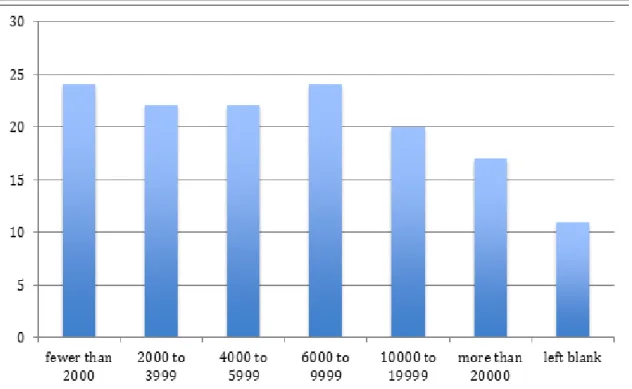
Sixty-eight trustees came from school districts with less than 6,000 students and 61 from school districts with more than 6,000 students (see Figure 2). Twenty-six indicated that the jurisdiction of their school
district represents one municipality whereas 104 said that their school district represented multiple
Figure 2. Number of students in the school district.
To examine differences based on district size, we again used a t-test for independent means. There were several differences between trustees in small districts (fewer than 6,000 students) and trustees in large school districts (more than 6,000 students). Trustees in small school districts were more likely than those in large districts to access materials from the BC School Trustees’ Association (M=3.92, SD=0.62
and M=3.50, SD=0.58; t(124)=2.73, p=0.01) and from the BC Ministry of Education website (M=3.27,
SD=0.47 and M=3.0, SD=0.27; t(124)=1.95, p=0.05). Trustees in large school districts were more likely
to turn to local newspapers than their peers in small districts (M=2.83, SD=0.129 and M=2.48, SD=0.76;
t(112)=-2.43, p=0.02). The results were similar for provincial newspapers, although the difference only approached significance (M=2.93, SD=0.173 and M=2.49, SD=0.67; t(112)=-1.91, p=0.06). Trustees in
large school districts were no more likely to use research reports from think tanks than their peers in small
districts. There was also no difference between trustees in small and large districts in the primary rankings of briefing materials from the superintendent and secretary-treasurer.
Discussion
Research reports from university researchers and think tanks were not a primary source of information for school trustees in BC. Trustees in this study accessed information for decision-making that was in close proximity to the board table. The most frequently used information sources were from the secre
-tary-treasurer, superintendent, and members of the board. Information provided by the superintendent was believed most useful.
While this differs from the Office of the Auditor General (2009) report where more than 20% of trustees did not express confidence in the accuracy of the information received from senior management, it generally aligns with the research that emphasizes the importance of organizational networks. Similarly,
trustees in our study valued information that they felt was trustworthy and timely, but also information that
reflected community values as identified within their personal networks. Other information sources trust
-ees accessed included the Internet, magazine and book publications, and the radio. In general, trust can largely be interpreted as “known to the trustee.” As previous research on research use recognizes, relation
-ships and connections matter (Galway & Sheppard, 2015; Roby, Jacobs, Kertzner, & Kominski, 2014). Further to this point, females were more likely to consult with the community than their male counterparts,
which may not be surprising as prior research has also found female leaders more likely to consult when
superintendent as most useful.
Trustees in small districts were more likely to refer to materials from the provincial association and Ministry of Education website than trustees in larger school districts, who were more likely to refer to local and provincial newspapers, perhaps because of their close proximity to such sources (districts with large student populations tend to be located in urban centers where the provincial news sources are also
located).
In general, BC school trustees seem most comfortable accessing information sources that are close to them, in organizational context or within their personal communities. This holds constant across gender and district size. Briefing materials provided by the superintendent and secretary-treasurer were most fre
-quently used and believed most useful. Governance, funding, and students were important issues faced by school trustees.
Finally, this was a replication-extension study. When comparing the results from the US study and
data collected from BC, there were many similarities: most of the participants had at least one term as a
school trustee; approximately a third served as board chairs; timely information that reflected the values of
the community was important; information from the superintendent was believed most useful; there were
very few gender differences (although females were more likely to access the Ministry or Department of
Education websites); and very few trustees accessed research reports from think tanks or university
re-searchers. One potentially important difference is the focus on student programs, student learning, student issues, and student achievement. For BC school trustees, student issues were one of three major concerns they faced, next to board governance and government funding. In the US study, very few board members identified the student issues such as achievement gaps or educational outcomes as important issues.
Limitations
As with all surveys, the findings are based on the self-reported data, which may diverge from the actual beliefs and demonstrated information-seeking practices of participants. In addition, multiple t-tests were used to compare groups on selected items. The use of multiple t-tests can increase the likelihood of a type
one error in the analysis, and to minimize this risk we only used t-tests where there was a theoretical basis
for testing for differences and where visible inspection of the data suggested there might be a difference. Finally, this research was conducted in British Columbia, Canada, and should be interpreted within the policy context of the Province.
Conclusions
If academics want their research to be relevant to and used by education policymakers and leaders they will need to develop relationships at the local level and tailor their research to the local context. Efforts
to disseminate research through news sources are unlikely to result in increased use, although
partner-ships with superintendents and district staff may increase research use. Similarly, partnerpartner-ships with state/
regional trustee associations (both formal or through conference presentations and publication in print
media) may increase trustee access to education research. This has important implications in university reward structures, which are based primarily on dissemination through scholarly outlets first, with follow up efforts to engage the news media. Relationships with professional practitioner bodies is not currently
prioritized or recognized within university contexts (faculty tenure and promotion structures or university
media outreach).
On the other hand, relationships cannot be left to one party. In our experience as leaders within pro -fessional organizations, these entities carefully protect their membership and generally control the content
they send out (in part a natural aspect of ensuring member value). Professional associations also need to carefully survey their members to identify research needs and develop relationships with researchers. Professional organizations are frequently the targets of agenda-based research and commercial service providers and so may be forgiven for being reluctant to engage when researchers come calling. That said, these organizations can play a key role in advancing research and practice relationships. Relationships,
trust building, and research collaborations require the engagement of all parties if they are to be
success-ful.
Finally, it is interesting to note that the preferred information sources for school trustees are locally
board members. While it makes sense that the most trusted sources are based on strong relationships and
thus tend to be local and at the board table, such a reliance on local community could risk creation of an echo-chamber where trustees remain separated from broader research-informed conversations and
solu-tions. As a result, consideration of local issues may become more polarized and insular over time. Future researchers may want to look at this outcome to explore the extent to which it influences local policy di
-alogue and issue identification. Furthermore, future research may include looking at information sources that the superintendent and secretary-treasurer access to inform their work and decision-making.
As noted, policy discussion and decision-making in BC tends to be polarized and politicized. Careful
examination of the information sources decision makers (in this case school trustees) use and methods through which high quality research can be made available to them may help shift the focus from one based on limited evidence and local mindsets to one informed by data and research, ultimately
strengthen-ing outcomes for students. That said, substantial work to build these relationships and research networks remains.
References
Bonett, D. (2012). Replication-extension studies. Current Directions in Psychological Science 21(6), 409-412.
Cadogan, J. (2010). Comparative, cross-cultural, and cross-national research. International Mar-keting Review, 27(6), 601-605.
Clarke, R. D. (2000). Whose family values?: A study of the use of a family values discourse in the Surrey book banning case. (Master’s thesis). Retrieved from http://circle.ubc.ca/han
-dle/2429/10589
Cooper, A. & Levin, B. (2013). Research use by leaders in Canadian school districts. International Journal of Education Policy & Leadership, 8(7), 1-15. Retrieved from www.ijepl.org De Winter, J. C. F. & Dodou, D. (2010). Five-point likert items: T test versus Mann-Whitney-Wil
-coxon. Practical Assessment, Research & Evaluation, 15(11), 1-16. Retrieved from http:// pareonline.net/pdf/v15n11.pdf
Dooley, K. (1999). Towards a holistic model for the diffusion of educational technologies: An in
-tegrative review of educational innovative studies. Educational Technology & Society, 2(4),
35-45.
Earley, P. & Galluzzo, G. (2015, April). Where do school board members turn for information?
Paper presented at the Annual Meeting of the American Educational Research Association, Chicago, IL.
Easley, R. W., Madden, C. S., & Gray, V. (2013). A tale of two cultures: Revisiting journal editors’ views of replication research. Journal of Business Research 66, 1457-1459.
Estabrooks, C. A. (2009). Mapping the research utilization field in nursing. The Canadian Journal of Nursing Research, 41(1), 218-36.
Fitzpatrick, J., Goggin, M., Heikkila, T., Klingner, D., Machado, J., & Martell, C. (2011). A new look at comparative public administration: Trends in research and an agenda for the future.
Public Administration Review, 71(6), 821-830.
Galway, G. & Sheppard, B. (2015). Research and evidence in education decision-making: A comparison of results from two pan-Canadian studies. Education Policy Analysis Archives, 23(109). Retrieved from http://dx.doi.org/10.14507/epaa.v23.1905
Gentzel, T. (2016). Tom on point: Why school boards? American School Board Journal, 203(2), 4. Retrieved from
http://www.nsba.org/newsroom/american-school-board-journal/tom-point-why-school-boards
Johnson, N. & Brown, W. B. (1986). The dissemination and use of innovative knowledge. Journal of Product Innovation Management, 3(2), 127-135.
Laitsch D. & Naylor, C. (2013, June). Research use in British Columbia: Status, issues, and op-portunities. Panel presentation at the annual meeting of the Canadian Society for the Study of Education, Victoria, BC.
Landry, R., Amara, N., & Lamari, M. (2001). Utilization of social science research knowledge in Canada. Research Policy, 30(2), 333-349.
National Research Council. (2012). Using science as evidence in public policy. In K. Prewitt, T. A. Schwandt, & M. L. Straf, (Eds.). Washington, DC: The National Academies Press.
Norman, G. (2010). Likert scales, levels of measurement and the “laws” of statistics. Advances in Health Science Education, 15(5), 625-32.
Nutley, S. M. & Tseng, V. (2014). Building the infrastructure to improve the use and usefulness of research in education. In K. S. Finnigan & A. J. Daly (Eds.), Policy implications of research in education: Vol. 2. Using research evidence in education: From the schoolhouse door to Capitol Hill (pp. 163-175). Heidelberg, Germany: Springer.
Office of the Auditor General of British Columbia. (2009). Making the right decisions: Informa
-tion use by the boards of the public sector organiza-tions. Victoria, BC: Author. Porte, G. (2013). Who needs replication? CALICO Journal, 30(1), 10-15.
Roby, D. H., Jacobs, K., Kertzner, A. E., & Kominski, G. F. (2014). The California health pol
-icy research program—Supporting pol-icy making through evidence and responsive re
-search. Journal of Health Politics, Policy & Law, 39(4), 887-900. doi:10.1215/03616878-2743263
Rogers, E. M. (1995). Diffusion of innovations. New York, NY: Free Press.
Santos, A. (2012). Considerations for education reform in British Columbia. Canadian Journal of Educational Administration and Policy, 138, 1-16. Retrieved from http://www.umanitoba.ca/ publications/cjeap/pdf_files/santos.pdf
Sasaki, M. (2004). Comparative research. In M. S. Lewis-Beck, A. Bryman, & T. Futing Liao (Eds.), The SAGE encyclopedia of social science research methods (pp. 153-154). Thousand Oaks, CA: Sage Publications, Inc.
Schein, E. H. (2010). Organizational culture and leadership. San Francisco, CA: Jossey-Bass. Scott, J., DeBray, E., Lubienski, C., La Londe, P. G., Castillo, E., & Owens, S. (2017).
Urban regimes, intermediary organization networks, and research use: Patterns across three school districts. Peabody Journal of Education, 92(1), 16-28. doi: 10.1080/0161956X.2016.1264800
Sebastian, J. & Moon, J. M. (2017). Gender differences in participatory leadership: An exam
-ination of principals’ time spent working with others. International Journal of Education Policy & Leadership, 12(8), 1-16. Retrieved from http://journals.sfu.ca/ijepl/index.php/ijepl /article/view/792
Steeves, T. (2014). Public education in British Columbia: The rise of the shock doctrine or kin
-dling for a shock-proof otherwise? Critical Education, 5(12), 1-15. Retrieved from http://ojs.
library.ubc.ca/index.php/criticaled/article/view/185803
Sullivan, G. M. & Artino, A. R. (2013). Analyzing and interpret ion data from likert-type scales.
Journal of Graduate Medical Education, 5(4), 541-2.
Valente, T. W. (1995). Network models of the diffusion of innovations. Cresskill, N.J: Hampton Press.