THE CENTRE FOR MARKET AND PUBLIC ORGANISATION
Centre for Market and Public Organisation
Bristol Institute of Public Affairs
University of Bristol
2 Priory Road
Bristol BS8 1TX
http://www.bristol.ac.uk/cmpo/
Tel:
(0117)
33
10799
Fax:
(0117)
33
10705
E
‐
mail:
cmpo
‐
The Centre for Market and Public Organisation (CMPO) is a leading research centre, combining expertise in economics, geography and law. Our objective is to study the intersection between the public and private sectors of the economy, and in particular to understand the right way to organise and deliver public services. The Centre aims to develop research, contribute to the public debate and inform policy‐making.
CMPO, now an ESRC Research Centre was established in 1998 with two large grants from The Leverhulme Trust. In 2004 we were awarded ESRC Research Centre status, and CMPO now combines core funding from both the ESRC and the Trust.
ISSN 1473‐625X
Evaluating the Provision of School
Performance Information for School Choice
Rebecca Allen and Simon Burgess
June 2010
CMPO
Working
Paper
Series
No.
10/241
Evaluating the Provision of School Performance Information
for School Choice
Rebecca
Allen
1
and
Simon
Burgess
21
Institute
of
Education,
University
of
London
2
CMPO,
University
of
Bristol
June
2010
Abstract
One of the key components of any school choice system is the information given to parents as the
basis for choice. We develop and implement a framework for determining the optimal performance
metrics to help parents choose a school. This approach combines the three major critiques of the
usefulness of performance tables into a natural, implementable metric. The best content for school
performance tables is the statistic that best answers the question: “In which feasible choice school
will a particular child achieve the highest exam score?” We implement this approach for 500,000
students in England for a range of performance measures. Using performance tables is strongly
better than choosing at random: a child who attends the highest ex ante performing school within
their choice set will ex post do better than the average outcome in their choice set twice as often as
they will do worse.
Keywords school choice, performance tables
JEL Classification I21, I28
Electronic version www.bristol.ac.uk/cmpo/publications/papers/2010/wp241.pdf
Acknowledgements
Thanks to Department for Education for access to the NPD data, and to ESRC for funding for Burgess.
Thanks also for comments from seminar participants at CMPO.
Address for correspondence
CMPO, Bristol Institute of Public Affairs
University of Bristol
2 Priory Road
Bristol BS8 1TX
2
1.
Introduction
One of the key components of any school choice system is the information given to parents
as the basis for choice. For example, using both a field experiment and a natural
experiment, Hastings and Weinstein (2008) show that the provision of information on school
performance changed the school choice decisions of disadvantaged families towards high‐
performing schools. The publication of performance information is well established in some
countries: performance tables showing each school’s proportion of pupils gaining five or
more good grades have been published nationally in England since 19921; in the US, the No
Child Left Behind (NCLB) Act of 2001 mandated publication of school‐specific performance
measures as part of a broad drive to greater school accountability. There is evidence that
such information is used by parents, for example Koning and van der Wiel (2010) for the
Netherlands and Coldron et al. (2008) and Burgess et al. (2010) for England. Given the use
and the impact of this information, it is clearly important to get it right: parents should be
given performance data that is both comprehensible,2 meaning it is given to them in a metric
that they can interpret, and functional, meaning it is a useful predictor of their own child’s
likely exam performance. This paper focuses on the latter. Although NCLB and other school
choice policies rely on the assumption that it makes sense for parents to choose schools
based on lists of schools’ test scores, Hastings and Weinstein (2008) comment “the
relationship between school average test scores and student achievement has not been
strongly established.” (p. 1378). We develop and implement a framework for determining
the optimal performance metrics to help parents choose the school where their child is most
likely to succeed academically. We apply this framework to a range of performance
measures to decide which metrics, if any, should be given to parents to inform school
choice. The longevity of performance tables plus the seven years of universe pupil data now
available in England allow us to systematically address this question for the first time.
There is some scepticism that school performance tables are useful in choosing a school and
several lines of critique have been presented by researchers. First, it is argued that simple
tabulations of raw exam performance (such as graduation rates or average student test
1
Since then increasingly sophisticated value‐added or progress measures have supplemented the raw metrics.
Value‐added metrics were first piloted in 1998 and introduced nationally the subsequent year; contextual value‐
added pilots were first published in 2005; and expected progress measures were first reported in 2009.
2
scores) largely reflect differences in school composition; they do not reflect teaching quality
and so are not informative about how one particular child might do at a school. For example,
a school with a high average exam score might simply attract high ability pupils and there
would therefore be no reason to expect any given student to attain a high exam score there.
Kane and Staiger (2002) make this point in the context of performance tables as an
accountability measure. Second, schools might be differentially effective such that even
measures of average teaching quality or test score gains may be misleading for students at
either end of the ability distribution. Different school practices and resources might be more
important for gifted students or others for low ability students, and these important
differences are lost in a single average measure. Indeed, several studies have shown that in
any particular year there is a difference in the estimated school effect at different parts of
the ability distribution, though differences are not consistently found across other
dimensions such as gender or ethnicity (Jesson and Gray, 1991; Sammons et al., 1993;
Thomas et al., 1997; Wilson and Piebalga 2008). Third, it is argued that the scores reported
in performance tables are so variable over time that they cannot be reliably used to predict
a student’s future performance. The problem of instability in performance measures was
highlighted by Kane and Staiger (2002) in relation to the performance‐triggered sanctions in
NCLB; they cite sampling variation and real but transient variation and small sample (school)
sizes as the main reasons for the volatility. Leckie and Goldstein (2009) re‐emphasise this in
the context of school league tables in England, arguing that the six year gap in time between
school choice and exam outcome makes choice using value‐added league tables valueless.
There is also a separate large literature that critiques the role of school performance
information in the framework of school accountability3.
We combine these three critiques into a single question, which we use to evaluate
performance tables as a basis for school choice. This provides a natural metric for judging
the quantitative importance of all these critiques. The question that parents want answered
is: “In which feasible choice school will my child achieve the highest exam score?”. We
argue that the best content for school performance tables is the statistic that best answers
3
Performance tables are seen as part of a performance management system that has implicit or explicit
incentives attached to performance outcomes (Propper and Wilson, 2003). It is argued that certain performance
measures can lead to dysfunctional behaviour such as manipulating admissions (see for example, Figlio and
Getzler (2006) and Cullen and Reback (2006) for the US, West and Pennell (2000) and West (2010) for England)
and excessive teaching to the test (for example, Wiggins and Tymms (2002) for England, Deere and Strayer
4
this question. Furthermore, if no performance measure can provide better guidance than
choosing a school at random, then we would conclude that performance tables in this
context are valueless. We address this using 6 years of universal pupil census data and
adopting a two part empirical strategy. We identify a feasible choice set of schools for each
student, and define a set of school choice decision rules based on different information sets
(school performance tables). These allow us to identify the school that each pupil would
have chosen under each decision rule. We then estimate the counterfactuals: how would
that particular pupil have scored if they had attended that school for the following five
years. Finally, a comparison of that outcome with a choice at random from the feasible
choice set – that is, a choice uninformed by performance tables – tells us whether using that
decision rule was successful for that student. We analyse this comparison across decision
rules and across student types and areas.
We implement this approach for half a million students in England, making a school choice
decision in 2003 for school entry in 2004, and taking their final exams in 2009. We find that
using (some) performance tables is strongly better than choosing at random: a child who
attends the highest performing school within their choice set on 2003 data will ex post do
better than the average out‐turn in their choice set twice as often as they will do worse than
average. We demonstrate two surprising results: first, raw outcome performance tables
outperform sophisticated conditional outcome tables. This result derives mainly from the
low temporal stability in the conditional outcome rankings. Second, we show that
differential performance tables (defined below) do no better in picking the best school than
do average performance tables. We speculate that both of these results depend in turn on
the importance of school composition in influencing school resources and teaching quality.
We also show that performance tables are least useful to students with small choice sets,
and to lower ability and disadvantaged students, though no worse than choosing at random.
The key statistical issue in the paper arises from the difficulty of estimating true school
effects in a context where students are not randomly assigned to schools. The interpretation
of estimated school effects as true school effectiveness is obviously an issue facing all papers
in this field, and there is no additional problem in our approach. We discuss the possible
biases for our results in Section 2.
The remainder of the paper is structured as follows. Section 2 sets out our modelling
describes the data, and section 4 presents the results and our robustness checks. Finally,
section 5 discusses the implications of the results for the appropriate content for school
performance tables, and for school choice.
2.
Modelling
framework
We first set out our model of the production of pupil attainment and school actions. We
then describe the school choice decision rules and the approach to estimating
counterfactual outcomes for pupil attainment.
a. The production of pupil attainment
We adopt a fairly standard education production function, although we allow for a more
flexible form with fewer specification assumptions (Todd and Wolpin, 2003). For example,
we allow for differential effectiveness, allowing the effect of each individual characteristic
on the outcome to vary school by school. The expected exam performance for pupil i in
school s, Eyis, is given by:
(
)
(
i s s s s s s)
s isf
X
X
q
l
r
e
y
=
,
,
μ
,
,
,
Ε
(1)where Xi denotes the pupil’s own characteristics that determine achievement that we
observe in our dataset such as prior attainment, poverty status, gender and so on. Clearly,
there are other factors influencing attainment that are not observable in standard
administrative datasets, such as parental education, and the child’s motivation. denotes
the characteristics of i’s peers, the ‘pure’ peer effect, excluding the component mediated by
school practices which we explicitly consider below. The school effect is μs, which is not
restricted to a simple linear additive effect on top of pupil characteristics. It is useful to
consider explicitly where this school effect comes from, and we assume it derives from a set
of general school practices, Zs, as follows: the quality of teaching and non‐teaching staff (qs);
the quality of leadership practices (ls) such as leadership style, policies towards behaviour,
the strength of governance, and the monitoring of teachers; the amount and quality of
b. The production of school resources
One of the key insights of an economic analysis of schools is that the quality of school
resources and practices derives from the choices of agents – headteachers, governors,
teachers and local government. Governors appoint headteachers and take a more or less
proactive role in school governance; heads accept or reject job offers in particular schools,
they appoint teachers, and provide more or less inspirational and effective leadership;
teachers also accept or reject job offers in particular schools, and help to generate effective
teaching resources in a school. These different decisions will depend on the objectives of the
actors and their constraints. A complete model of the outcome of this is beyond the scope of
this paper, but the key point is that the decisions will almost certainly react to the
environment that the actors are in. This matters because it makes it clear that the degree of
persistence we observe in the data on school quality is behavioural, not an exogenous
statistical process. It will in general depend on the situation a school is in, the degree of
competition and so on. We will return to this analysis in the light of our results below.
We assume a simple reduced form representation of those reactions. For example, although
teachers clearly have heterogeneous preferences for school types, we assume that long‐run
teacher quality depends on the school’s typical or expected composition, ,4 recent past
school exam performance, denoted , leadership, resources and ethos, and the area the
school is in:
Ε
q
s=
g
s(
Ε
X
s,
y
st−,
l
s,
r
s,
e
s,
area
)
(2)We include the area as it captures the effect of the teacher labour market, financial
resourcing and the political control of the LA. These factors are clear influences on the
likelihood of teachers of different quality being offered and accepting a job at a particular
school. Similarly, we assume that the other school practices are determined in the same
way:
4
It is hard to observe whether deprived schools in England actually do have lower quality teachers because
quality is hard to estimate directly. However, several research findings suggest they have higher teacher
turnover and difficulties in recruitment and retention more generally (Smithers and Robinson, 2005; Dolton and
Newsom, 2003).
Ε
Z
s=
g
s(
Ε
X
s,
y
st−,
Z
s−,
area
)
Z
=
q
,
l
,
r
,
e
(3)
where Zs‐ denotes the other three Z variables. Noting the dependence of past exam performance on past school composition and past school quality, the long run solution to
this will be of the form:
Ε
Z
s=
g
s'
(
Ε
X
s,
X
st−,...,
area
)
Z
=
q
,
l
,
r
,
e
(4)That is, schools have a long‐run tendency for the quality of school practices to be strongly
influenced by the peer and social context of the school. Any deviations from this are likely
to be transitory.
Of course, the reverse dynamic is also taking place, and the school’s quality and resources
will probably attract particular sorts of students. We return to this point below when we
discuss selection bias into schools.
c. School choice decision rules
We assume that each student i faces a set ci of schools that can be chosen from. We set out
the empirical implementation of this below. In each potential school σ at the school choice
date t, the distribution of exam outcomes has density function φ(y)σt. Each school choice
decision rule is a decision to choose the highest‐performing school based on a particular
statistic of this distribution, denoted h(φ(y)σt). The aim of this paper is to compare the
implications of different decision rules, that is, the use of different performance statistics.
Below we consider three main types of performance information: the fraction of students
passing at least 5 exams (a threshold variable, a raw outcome measure); the average exam
score of the students in the school (a continuous variable, a raw outcome measure); and a
regression‐based conditional (or contextual) value‐added measure (a continuous,
conditional measure). The first and third of these are the main published measures in
England. We also consider: the average exam score differentiated for groups of students
based on prior ability to introduce a very simple element of conditionality5; a
5
This is a proposal we discuss in more depth elsewhere (Allen and Burgess, 2010); we believe it has a number of
straightforward measure of school ability composition; and performance in maths only, and
English only.
Separately for each decision rule h and for each student i we identify the highest‐performing
school in the choice set based on information available at the time of decision:
( )
(
)
{
t i}
ih = hφ
yσ
∈cσ
* argmax σ (5)d. Estimating school outcomes
We need to predict the exam score outcome for each school in the choice set of each
student. These are counter‐factuals: all bar one of these will therefore be estimated values
for schools that that student did not actually attend (and we actually use an estimate of
attainment for the student’s own school). We use (1) as our starting point and to implement
it most flexibly we estimate separate regressions for each school, and include all the
interactions of individual characteristics we observe (see below). This allows school practices
and resources to affect the impact of, say, prior ability on the final exam test score. The peer
effect and the common impact of school resources are estimated in the constant term in
each school regression.
Having estimated the 3143 school‐by‐school regressions (not reported but summarised in
Appendix Table 2) we use them to predict exam outcomes. We restrict the schools that we
predict for as follows: we produce an estimated outcome only for schools in each student’s
choice set; and we only produce estimated outcomes for schools with a minimum number of
students similar to the focus student (detailed below). These criteria mean that we are not
predicting too far out of sample – only for schools local to the focus student, and which
already have students similar to the focus student. We interpret this quite conservatively to
avoid producing estimated outcomes for contexts (schools) totally alien to the focus
student, and which would therefore be very biased.
There are two main issues with our estimation procedure and we consider first a
comparison of our approach with a matching approach. Our school‐by‐school regression
approach with (almost) all interactions of the student variables in fact gets close to
mimicking a matching approach in allowing for very heterogeneous effects. It is important to
recognise that matching on observables is no better at dealing with the core statistical issue
(the non‐random assignment of students to schools) than regression; we return to this
below. Exact matching on observables would find observationally‐equivalent students. The
method would be to identify such students in other schools in the choice set and take the
mean outcome for that group in that school as the predicted outcome for the focus student.
Even with as much data as we have available, using all the variables at our disposal, exact
matching will produce a lot of empty cells and therefore a lot of null predictions. The trade‐
off would be to use fewer variables to generate more predictions but at the cost of more
uncontrolled heterogeneity. An alternative would be to use propensity score matching to
introduce some smoothness and to include students who were somewhat alike to the focus
student without restricting to exact matches. In practical terms this means running a
matching model to identify students alike to the focus student, which implies a regression
with a dependent variable equal to 1 for just one observation (the focus student). This
regression would be run for each of half a million students to generate the matched set for
each focus student. It seems highly likely that this procedure would be very noisy and
unreliable. Given these issues, we adopt the school‐by‐school regression approach.
The second issue is the potential effects of school selection bias. Students are not randomly
assigned to schools and there are unobserved student characteristics that influence both the
probability of assignment and subsequent exam performance. We cannot model the
assignment process explicitly and so, absent any instrument for school assignment (such as
that used by Sacedote, 2010), we will have biased estimates of school effects. Essentially,
we will overestimate the quality of schools with unobservably good pupils. This means that
we will impute higher scores to the counterfactual pupils not at that school than they would
truly have achieved had they attended. This is a well‐known problem and it faces all
attempts to estimate true school effects; it is not an additional problem for our approach.
We take two practical steps to minimise the bias. First, we use as many observable student
characteristics as possible, including measures of student progress between ages 7 and 11 in
some specifications to capture differences in progress from age 11 to 16. All of these are
interacted with other individual characteristics, again allowing for a varying impact school‐
by‐school. Descriptors for very small neighbourhood are also helpful in refining the
characterisation of the student’s famiy background. Second, we only consider
counterfactual pupils for plausible local schools, and do not retain predictions for schools
10
We can make statements about the nature of the bias if we are prepared to explicitly
parameterise the assignment process. Suppose we assume that the assignment mechanism s is:
allocating student i to school
, ;
(6)
where ε represents unobserved student characteristics. If a() is such that ε and μ are
uncorrelated, then we have no problem. The case for concern is that a() implies that high ε
students get into high μ schools, leading us to overestimate the effectiveness of those
schools. However, while this simple assignment process will lead to biased estimates of the
school effects – and hence of predicted student outcomes – there are important cases when
it will not change the rank ordering of schools. Hence if the biased outcome prediction for
student i for school σ* exceeds the average in ci, we can infer that the unbiased prediction
would too.
W illustrate this as
(7)
e follows. Assume a simplified attainment function:
where X is an observable student characteristic, ε an unobservable student characteristic
with density function θ( ), μs the true school effect and ω is testing noise. For concreteness,
we can think of ε as household income.
We assume a very simple school assignment mechanism as follows. Demand for school
places is increasing in μs. The greater the demand, the more oversubscribed is the school
and hence the closer to the school a family needs to live to win a place under the pervasive
proximity condition. This is more expensive given the equilibrium in the schooling and
housing markets, and so the greater the income required. This simple model can be
represented as: if , where p() is a monotonically increasing function6.
Given this selection, if we estimate (7) by OLS the estimated constant will be:
. (8)
6
This is obviously simplified and for example excludes X from the selection rule. This means that the OLS will
In general, with a sufficiently regular density function θ( ), k() is a monotonically increasing
function. In this case, the ordering of estimated school effects is the same as the ordering of
true school effects, that is implies . Given the simple attainment function
given by (7), it also then follows that if the condition E E | is true
for the estimated the estimated school effects, it will also hold for the true school effects.
There are obviously important cases when this straightforward result will not hold.
Significant variation in the parameters of (6) can be a problem. The school assignment
process in England, which (6) summarises, is complex and varied, involving parental
preferences and local authority rules for tie‐breaking at over‐subscribed schools, plus other
schools that administer their own admissions (see the next section, and also West et al.,
2009). The case where the parameters of (6) are the same within the local area for each
student again presents no problem. However, there is little we can do if the parameters of
(6), and the consequential correlation between ε and μ, vary significantly between schools
within a local area. Secondly, if there are quantitatively important differences in the γ
parameter in (7) between schools, then although the result on the estimated school
constants will still hold, it is no longer true that this carries over automatically to the
comparison of the predicted value in the best school and the choice set mean. But we
emphasise, however, that this is problematic for all attempts to interpret school effects, and
therefore for all analyses of school performance data.
e. Assessing the performance of decision rules
We have a feasble choice set of schools ci, an estimated outcome for each school in that set
, and a decision rule selecting one school as the highest performing according to a
particular performance statistic, ℎ . The final stage of our approach is to assess the success
of alternative decision rules in making good choices for students. The main question we ask
is whether
{
it i}
it Ey c
y ≥Ε ∈
Ε +6,σ* +6,σ
σ
(9)that is, whether the student’s predicted exam performance at the ex ante ‘best’ school is
better than the student’s average ex post exam performance across all schools in their
choice set. The latter is the expected value of choosing in an uninformed way, choosing at
12
favour the mean outcome across the choice set because it is more straightforward to
interpret the odds ratio for small choice set sizes.
We report other metrics, including whether a ‘good’ school chosen at random from the top
half of the child’s choice set is better than the student’s average exam performance and
whether a child would do worse than the average outcome in their choice set if they
selected the school with the lowest performance on the decision rule. We report for how
many students this is true, and for which students.
3.
Data
on
English
secondary
schools
Compulsory education in England lasts for 11 years, covering the primary (age 5 to 11) and
secondary stages (age 11 to 16). Most pupils transfer from primary to secondary school at
age 11, although there are a few areas where this transfer is slightly different due to the
presence of middle schools. Secondary school allocation takes place via a system of
constrained choice whereby parents are able to express ordered preferences for three to six
schools anywhere in England and are offered places on the basis of published admission
criteria that must adhere to a national Admissions Code. Choice is administered by local
authorities about 10 months before pupils start secondary school. So, for example, a cohort
who begin secondary school in September 2004 and complete their education in summer
2009 would choose schools during the autumn of 2003 and would have access to the
summer 2003 school performance tables.
Parents can choose a school in one of two ways: they can choose from within a local
‘feasible’ choice set of schools that it is possible to reach and who would accept them or
they can choose to move house next to a desirable school. The latter phenomenon, known
as ‘selection by mortgage’ is widely believed to be common in England, but recent research
suggests that the extent to which the middle classes move house to gain advantages in
school choice may be overstated (Allen et al., 2010). Not all local schools will accept all local
children. Admissions policies are complex in England, but they generally work as follows.
First priority is usually given to pupils with a sibling already at the school, pupils with
statements of special educational needs and children in public care. Next, the largest
proportion of places is allocated giving priority to children living within a designated area or
on the basis of proximity to school. There are also significant numbers of schools who do
secondary pupils), priority is usually given on the basis of religious affiliation or adherence;
other state schools offer a proportion of places on the basis of ability or aptitude for a
particular subject (including 164 entirely selective grammars schools). Within this very
complex system it is estimated that around half of all pupils will not attend their nearest
school, although this may not have been their preferred choice (Allen, 2007; Burgess et al.,
2006).
a. The National Pupil Database (NPD)
In this analysis we draw pupil‐level data from all eight years (2002 to 2009) of the National
Pupil Database (NPD) to measure school performance in a variety of ways, described below.
NPD is an administrative dataset of all pupils in the state‐maintained system, providing an
annual census of pupils taken each year in January, from 2002 onwards (with termly
collections since 2006). This census of personal characteristics can be linked to each pupil’s
test score history. We use a single cohort to analyse the potential consequences of the
secondary school choices made by over 500,000 pupils who transferred to secondary school
in September 2004, completing compulsory education in 2009. These pupils are located in
3143 secondary schools; we exclude non‐standard schools such as special schools or those
with fewer than 30 pupils in a cohort from the analysis. We drop a small number of pupils
from our analysis because they appear to be in the incorrect year group for their age or they
have a non‐standard schooling career history.
NPD provides data on gender (female), within‐year age (month), ethnicity (asian, black,
othereth), an indicator of whether English is spoken at home (eal) and three indicators of
Special Educational Needs (senstat, senplus, senact, measuring learning or behavioural
difficulties at a high, medium and low level, respectively). It also provides us with two
measures of the socio‐economic background of the child. Free School Meals (fsm) eligibility
is an indicator of family poverty that is dependent on receipt of state welfare benefits (such
as Income Support or Unemployment Benefit). Our FSM variable is a very good measure of
the FSM status of the 12 per cent of our cohort who have it, but it has been shown by Hobbs
14
use the Income Deprivation Affecting Children Index (idaci), an indicator for the level of
deprivation of the household’s postcode.7
Data on individual pupil characteristics are linked to educational attainment at the ages of 7
(Key Stage 1 – KS1), 11 (KS2) and 16 (GCSE or equivalent examinations). The linked test
score data that measures the academic attainment of children in KS2 tests at the end of
primary school serves as a useful proxy for academic success to date. We use an overall
score (KS2) that aggregates across all tests in English, maths and science, as well as the
individual subject scores in our regressions (KS2eng, KS2mat, KS2sci). We also utilise the KS1
data recorded by teachers on children at age 7 in some specifications reported in Appendix
Table 5. There are some concerns about the consistency of these data because a
component of KS1 is teacher assessed, but we believe the data quality is adequate for our
purposes. Summary statistics of our data are presented in Appendix Table 1.
b. Defining the choice set
Our research question analyses the extent to which school performance tables can be used
to make good school choices from within a local choice set. Clearly it is impossible for us to
know which schools any particular parent is actively considering for their child because this
will be a function of their own preferences and constraints and the admissions policies of
the school. Instead, we define a choice set for every pupil that will complete school in
summer 2009 by including a school in the choice set if another (fairly similar) pupil from the
same neighbourhood attended the school during the eight year period of 2002 to 2009 for
which we can observe secondary school destinations.
The pupil’s neighbourhood is defined as a lower layer super output area (SOA), a
geographical unit that is designed to include an approximately equal population size across
the country.8 In our data an average of 123 pupils across eight cohorts live within an SOA.
Our first stage of defining the pupil’s choice set is to calculate an SOA destination matrix for
all 32,481 SOAs. In order to avoid unusual SOA‐secondary school transfers that are caused
by pupils moving house or coding errors, we include a school in an SOA’s destination list if
more than two pupils from the SOA made the transfer to the secondary school over an eight
7
For more information see http://www.communities.gov.uk/documents/communities/pdf/131206.pdf
(accessed 17/05/10).
8
year period. SOAs have between one and 23 schools in their destination list (mean 6.11; SD
3.19).
We base each individual pupil’s choice set on the SOA destination list for their home address
but introduce additional restrictions. First, we want to exclude schools where we know the
transfer would be impossible, so boys schools are excluded from the choice set of girls and
academically selective grammars chools are excluded from the choice set of pupils with low
prior (KS2) attainment. We also need to exclude schools from the choice set if very few
‘similar’ pupils attended the school in the main 2009 cohort because we are unable to
estimate likely pupil outcomes if there are no similar pupils in the school. Therefore, a
school is excluded from a pupil’s choice set if fewer than 1% of that school’s 2009 cohort are
of the same sex, EAL, SEN, ethnicity (white British, Asian, black, other) or KS2 group
(indicating low, middle or high ability). The school must also exist in both 2003 and 2009 to
make the analysis possible; we link school openings and closings for straightforward one‐to‐
one school name/governance changes to retain as many schools as possible. The result of
all these restrictions is that pupil choice sets are slightly smaller than SOA destination lists:
pupils have between one and 18 schools in their choice set (mean 5.07; SD 2.35). Further
descriptives of these choice sets can be found in Appendix Table 2.
c. Calculating decision rules
We use information on the 2003 school performance that would be available to parents
whose children start secondary school in September 2004. These are the decision rules that
we use to establish whether school performance data can help parents make school choices
that maximise their own child’s likely exam performance from within a choice set of schools.
The decision rules that we test include metrics that have been published by the government
and new rules that we have constructed from the underlying pupil‐level data from the
cohort who were age 16 in 2003. Pupils typically take nationally set, high stakes, GCSE or
equivalent examinations in 8 to 10 subjects at the age of 16 and these are measured on an
eight‐point pass scale from grade A*, A, B, ... to F, G. The four main decision rules (DRs) we
report in this paper are:
1. Proportion of pupils achieving 5 or more GCSEs at grades A*‐C, including at least a
16
metric has been used to measure school performance since 1992 (with the inclusion
of English and maths restrictions from 2006 onwards).
2. The average grade score for pupils in their best eight subjects at GCSE
(unconditional DR). This score converts the grade attained by each pupil in every
subject at GCSE and sums across the pupil’s best eight subjects. This capped GCSE is
not currently reported as a metric in school performance tables, but is used as the
outcome measure for ‘contextual value added’ scores (see below). It is regarded as
a broad measure of performance that reflects the overall educational success of the
child is less susceptable to gaming than the threshold measure.
3. The average capped GCSE score for pupils at three points in the national ability
distribution (differential DR). We report the average school performance for pupils
between the 20th and 30th national percentile (low); the 45th and 55th national
percentile (middle); and the 70th to 80th national percentile (high) for each school
and allow parents to use the decision rule that relates to their own child’s ability.
For example, parents with pupils who are in the bottom third of the KS2 distribution
could use the low differential capped GCSE performance measure to choose a
school.9 This new measure of school performance evaluates how the school
performs for pupils at different parts of the ability distribution. In doing so it
approximately holds constant the prior attainment of children and allows for the
possibility that schools are differentially effective.
4. The contextual value added score for the school, similar to that published for all
secondary schools from 2006 (conditional DR). This is essentially a school residual
extracted from a multi‐level regression that conditions on the pupil and peer
characteristics available in NPD (see Ray, 2006). We calculate our own school CVA‐
type scores because it was not published by government in 2003.
d. Predicting attainment across a choice set
The most controversial part of the implementation of our method is our approach to
predicting a pupil’s likely attainment in each school across their choice set. We have 2009
attainment data for this cohort and we combine this contemporaneous data with the 2008
9
Allen and Burgess (2010) has a discussion of the extent to which parents are aware of their child’s relative
cohort’s attainment information to estimate each school’s achievement function through
3143 regressions (variable names defined in Section 3a above):
gcse
i=
β
0+
β
1KS
2
sci
i+
β
2KS
2
mat
i+
β
3KS
2
eng
i+
β
4KS
2
scisq
i+
β
5KS
2
matsq
i+
β
6KS
2
engsq
i+
β
7fsm
i+
β
8idaci
i+
β
9idacisq
i+
β
10female
i+
β
11month
i+
β
12eal
i+
β
13asian
i+
β
14black
i+
β
15otheth
i+
β
16senstat
i+
β
17senact
i+
β
18senplus
i+
β
19female
i*
fsm
i+
β
20female
i*
idaci
i+
β
21female
i*
asian
i+
β
22female
i*
black
i+
β
23female
i*
otheth
i+
β
24fsm
i*
asian
i+
β
25fsm
i*
black
i+
β
26fsm
i*
otheth
i+
β
27fsm
i*
idaci
i+
β
28KS
2
i*
female
i+
β
29KS
2
i*
fsm
i+
β
30KS
2
i*
idaci
i+
β
31female
i*
senstat
i+
β
32female
i*
senact
i+
β
33female
i*
senplus
i+
ε
iWe predict pupil capped GCSE achievement for all pupils who have the school in their choice
set, provided that there is a reasonably similar pupil at that school. For the main
specification we place the constraint that at least 1 percent of pupils at the school must have
the same characteristics in terms of: KS2 group (low, middle, high), SEN type, EAL status or
ethnicity group. These constraints are controversial to the extent that they restrict the
choice set of a pupil to schools attended by somewhat similar pupils, but we clearly face a
trade‐off between wanting to generate estimates across a relevant choice set and needing
to generate estimates that are statistically valid.10 The distribution of estimates for each
coefficient from these school regressions is reported in Appendix Table 3.
In our main specification that we report in the results section we combine attainment data
from the 2008 and 2009 cohorts to estimate the school achievement functions. We do this
to achieve more stable estimates on coefficients, particularly for small schools and schools
with only a small number of pupils with certain characteristics (we do not allow the
effectiveness of a school to vary by pupil type across cohorts). Appendix Table 5 reports
several sensitivities to our main specifications in the appendices, including the use of
unpooled 2009 data and the inclusion of KS1 attainment variables.
4.
Results
This section reports the extent to which decision rules derived from 2003 English school
performance tables are capable of helping parents identify local schools where their child
10
We perform a 98% Winsorisation to constrain extreme estimates. We also set to missing estimates that are
18
will perform well academically in 2009. We demonstrate the performance of our threshold
decision rule and compare its performance to alternative rules. These rules are more
successful for some types of children and we explore why this might be through analysis of
single subject performance and a decomposition of the stability of measures over time.
a. The performance of the threshold decision rule
We present the results in Table 1 for the 515,985 students with more than one school in
their choice set. It shows the chances that this threshold decision rule (DR) identifies a
school that turns out to have been a good choice. We benchmark each decision rule against
an uninformed choice and compute the odds ratio of making a good choice against a bad
choice. In principle we would model an uninformed choice as a choice at random. However,
many students face choice sets with just 2 or 3 schools in and in this case, a literal random
choice will produce a very high percentage of ties. This makes the statistics hard to interpret
because it means the odds of one random choice outperforming another random choice are
not 1.0 (we report all statistics relative to a random choice in Appendix Table 4). For this
reason we compare the outcome of the decision rules with the expected value of a choice at
random, namely the mean outcome for each student over all schools in her/his choice set.
We consider how often choosing the best school according to the threshold DR is at least as
good as a random choice, how often choosing a good school from the tables is at least as
good as random, and whether the school identified by the tables as the worst choice turns
out to be worse than random. We define a good school as one chosen at random from the
top half of the performance table on that decision rule.
Table 1 reports the odds that the threshold DR using 2003 data will produce an outcome
that is better than the predicted mean average performance for the pupil across their choice
set in 2009. Overall, using this decision rule to select the best school in the choice set
correctly identifies a school where the child should outperform the average across their
choice set 1.92 times more frequently than it identifies one where the child performs worse.
Clearly this means that a substantial fraction of students would turn out to be badly advised
by the performance tables; but the number for whom they proved useful is almost twice as
large. Picking a school in the top half identified by the decision rule is at least as good as
random 1.35 times more frequently than it is worse. Similarly, avoiding the school identified
The remainder of the table disaggregates this performance of the decision rule by the size of
the choice set, by the degree of variation in the choice set and by the students’ prior ability.
The performance of this decision rule is notably greater for pupils with high prior attainment
in KS2 tests than it is for pupils with low prior attainment. Picking the best school according
to the decision rule turns out to be better than random with odds of 2.92 for the top third of
KS2 students, compared to the just 1.37 for the bottom third of KS2 students. We return to
explore this relationship further later in the section.
The threshold decision rule performs better when the variation between schools (on the
2003 decision rule measure) is greater. This intuitively makes sense because where there
are greater differences between schools in 2003, there should be a greater chances that the
rank ordering is maintained over time. It is also encouraging as it means a greater success
rate when it matters more.
One issue is to consider how to express uncertainty in this model. Clearly, each individual
school regression belongs in the normal statistical framework, as do predicted outcomes
from those. But our outcome variable, the ratio of the number students that turned out to
have made good choices on the basis of the decision rule to the number whose choices
turned out to be bad, is based on a complex nonlinear function of the predictions of a
number of separate regressions. Analytically computing standard errors for this ratio is
beyond the scope of this paper. Comparing each decision rule to a random decision seems a
natural alternative way to do this. Bootstrapping the entire process would be an alternative,
but involves a number of decisions on the sample draws, for example, whether students
should be reallocated to different choice sets of schools. As an alternative route to
exploring the robustness of the statistics, we report the sensitivity to alternative
specifications in the Appendix.
b. Comparing different decision rules
We now compare the outcome of using the threshold DR to using the unconditional,
differential and conditional DRs. Table 2 is in the same format as Table 1, presenting the
results for picking the best school according to that decision rule relative to the choice set
mean. At the bottom of the table we report the average Spearman’s rank correlation
coefficient for the rank of choice set schools on the 2003 decision rule the 2009 predicted
20
Overall our unconditional DR (this is the school’s average capped GCSE) yields the highest
success rate with good choices 2.04 times more frequently than bad choices. Both the
threshold and unconditional DRs have considerably better predictive power than the
conditional DR, which delivers good choices only 1.33 times more frequently than bad
choices. This conditional DR (called CVA) was introduced to English league tables to capture
the underlying effectiveness of the school, controlling for all measured pupil and peer
characteristics. However, the poor performance of CVA suggests that 2003 underlying
effectiveness is not a particularly strong predictor of a child’s likely 2009 GCSE attainment.
We explore some reasons for this in Table 5.
One surprising finding is that the performance of the differential DR (this is capped GCSE
scores at three different points in the ability distribution) is no better than that of the
unconditional DR on which it is based. Intuition suggests that the provision of more
information should do better; that having information on different parts of the distribution
is more useful than just the average. The idea is that a more finely targeted decision on
which school might be best would provide better information for students: specifically,
students of low or high ability would be directed to schools performing differentially well for
such students.11 However, our results show that this is not true and it actually performs
particularly poorly for high ability pupils.
There are several reasons why this might be the case. It may be because schools are not
differentially effective in a stable manner over time and we explore this further in Table 5.
Also, differential effectiveness measures will not be more informative than raw effectiveness
if only the size, and not the ranking, of school effects varies within a choice set at different
parts of the ability distribution. Within our choice set, schools do indeed have greater
variability on the differential DR at the low ability point than the high ability point. However,
the Spearman's rank correlation within a choice set using our unconditional DR versus our
differential DR at the three ability points is high at an average of around 0.7 for each
pairwise comparison. This observation that slopes of differential effectiveness as a function
of ability often do not cross has been reported in other papers (e.g. Thomas et al., 1997). A
final advantage of the unconditional DR is that it incorporates information about school
composition, whereas scores at different points of the distribution do not. Table 6 explores
11
As discussed in the data section, we assumed that students in the bottom third of the ability distribution would
further why the informational benefit of differential DRs is outweighed by the loss of this
compositional information.
c. Understanding the heterogeneity in prediction outcomes
The decision rules we have considered yield good ex post predictions for a clear majority of
students, but not all. In this section we use the micro data to describe which students the
decision rules are not useful for. Table 3 shows the characteristics of pupils for whom we
make poor predictions using the threshold DR. We report the average differences in
characteristics for these pupils and also the output from a logistic regression of the full set of
measured pupil characteristics.
The logistic regression confirms that location factors are important, and that a smaller
choice set and low variation of the decision rule within the choice set both make it more
likely that the decision rule makes a poor prediction. Our predictions are also poorer for
lower ability pupils, for more deprived pupils, for pupils who speak English as an additional
language and for pupils of black or Asian ethnicity. However, the overall explanatory power
of the model is very low with a pseudo R‐squared of just 6.7% (and only 2.5% if we exclude
the two location variables), so there is a great deal of randomness in the types of pupils for
whom the decision rules make poor predictions.
The poor performance of most decision rules for the lower ability pupils is particularly
interesting. This group of pupils have the greatest opportunity to influence their attainment
through school choice, according to a variety of metrics. For example, the correlation
between a pupil’s own KS2 score and the standard deviation in estimated 2009 outcomes in
the choice set is ‐0.26 in this cohort. However, while it clearly appears to matter where
lower ability pupils go to school, it does not appear to be possible to use published decision
rules to particularly successfully choose a school. This may be because the larger differences
in apparent school effectiveness are actually due to larger unobserved pupil characteristics
that determine attainment for this low ability group. Alternatively, schools are indeed able
to influence attainment a great deal for this group, but do not necessarily do so in a manner
that is consistent over time. Related to this, school exam entry policies for this group of
pupils are more likely to have radically changed in response to changes in the league table
metrics over the past decade. The data presented in Table 5 suggests that the first
22
An alternative explanation of the fact that we are doing a poor job of modelling the
potential outcomes of low ability pupils in high scoring schools is as follows. It might be that
we can only model high performance pupils in high performance schools as it is essentially
only that sort of pupil in those schools, and few low ability pupils actually find themselves in
such schools. This would be troublesome for our approach, but in fact is plainly not the case.
In our data, pupils from each quartile of the ability distribution can be found, in numbers, in
almost every school in our data.12
d. Single subject performance
Table 4 presents information on the single subjects of English and maths to further explore
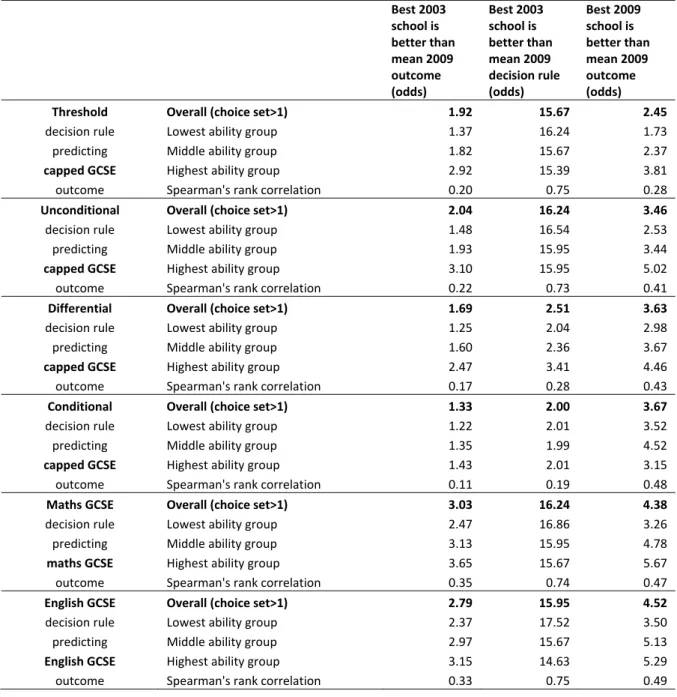
why decision rules often perform poorly. The middle column of data reports the extent to
which using a school’s 2003 average maths GCSE successfully identifies a better than
average child’s 2009 achievement in maths. The odds of this a very high at 3.03, far higher
than for any of the decision rules we have used so far to predict 2009 capped GCSE
attainment. The figure for English GCSE is almost as high at 2.79. This is somewhat
surprising since we usually find that disaggregated measures are unstable compared to an
aggregation of several subjects. Of course we don’t know whether this is because there
relatively high persistent quality in a school’s maths department over a six year period or
because there are unobserved time‐invariant cohort characteristics that strongly predict
maths attainment. Interestingly, maths and English DRs are capable of predicting 2009
capped GCSE attainment almost as well as the unconditional (capped GCSE) DR does. This
would be true if maths or English department quality is highly related to long‐run school
quality. However, the more likely explanation for the relatively poor success of the
unconditional DR is that the capped GCSE measure has been subject to considerable
changes in the criteria about how GCSE equivalent exams are able to count in the measure.
It has also been argued that schools can manipulate a pupil’s performance through
introduction of certain GCSE equivalent subjects (West, 2010) Both of these reasons mean
that capped GCSE scores have not be as stable over time as we might expect, which reduces
the odds of successfully using any decision rules to predict a pupil’s performance on this
outcome measure.
12
With the exception of grammar schools, but these account for fewer than 4% of pupils. For more details on
e. Decomposing the relationship between 2003 decision rule and 2009 expected outcomes
Where a 2003 decision rule performs relatively poorly in explaining 2009 expected outcomes
for a child, it may do so for one (or both) of two reasons. Firstly, schools may not be
particularly stable in their exam performance. This would manifest itself through instability
in the correlation between the decision rule metric in 2003 ℎ , and the same
metric 6 years later, ℎ , . However, the key issue for a parent in choosing a
school, and for our evaluation approach, is just local stability – stability within that parent’s
choice set; stability at a national level as reported by Leckie and Goldstein (2009) is not
relevant to that decision. Also, only instability in metrics that produce changes in ranking are
important since, on our performance metrics, it is the rankings of local schools that
determine how parents choose schools.
The second reason why a decision rule might only poorly predict a pupil’s exam performance
is because the value of the metric for even the contemporaneous cohort, ℎ , , is
only weakly related to our estimate of any one specific pupil’s estimated exam performance
at that school, , , . If the within‐school variance in performance was low and the
between‐variance high we would expect the predictions based on some overall school
metric to be good; if within‐variance is large and between‐variance low then we would
expect poor predictions.
Table 5 decomposes the performance of the decision rules into these two parts. It shows,
for example, that the odds that the school with the highest capped GCSE score in 2003 (i.e.
our unconditional DR) is still above the average capped GCSE in the choice set in 2009 is
extremely high at 16.24. The stability of the all the decision rules that measure some ‘raw’
performance outcome are very high. By contrast, the stability of the differential and
conditional DRs is relatively low within the choice set (odds ratios of 2.51 and 2.00,
respectively). This relatively low local stability of CVA is consistent with the low national
stability reported by Leckie and Goldstein (2009).
As a thought experiment, the final column reports how well using a contemporaneous
decision rule,�