Seton Hall University Seton Hall University
eRepository @ Seton Hall
eRepository @ Seton Hall
Seton Hall University Dissertations and Theses
(ETDs) Seton Hall University Dissertations and Theses
Summer 8-21-2020
The Impact of the Language Allocation Plan on Student
The Impact of the Language Allocation Plan on Student
Outcomes in Two-Way Dual Language Immersion Programs
Outcomes in Two-Way Dual Language Immersion Programs
Bonnie Sue MolinaFollow this and additional works at: https://scholarship.shu.edu/dissertations
Part of the Bilingual, Multilingual, and Multicultural Education Commons
Recommended Citation Recommended Citation
Molina, Bonnie Sue, "The Impact of the Language Allocation Plan on Student Outcomes in Two-Way Dual Language Immersion Programs" (2020). Seton Hall University Dissertations and Theses (ETDs). 2815.
The Impact of the Language Allocation Plan on Student Outcomes in
Two-Way Dual Language Immersion Programs
by
Bonnie Sue Molina Seton Hall University
Dissertation Committee Monica Browne, Ed.D., Mentor Richard Blissett, Ph.D., Committee Member
Renee Whelan, Ed.D., Committee Member Courtney Pepe, Ed.D., Committee Member
Submitted in partial fulfillment of the requirements for the degree
Doctor of Education
Department of Education Leadership Management and Policy Seton Hall University
SETON HALL UNIVERSITY
College of Education and Human Services Office of Graduate Studies
APPROVAL FOR SUCCESSFUL DEFENSE
Doctoral Candidate, Bonnie Sue Molina, has successfully defended and made the required modifications to the text of the doctoral dissertation for the Executive Ed.D. during this Summer Semester2020.
DISSERTATION COMMITTEE (please sign and date beside your name)
Mentor:
Monica Browne, Ed.D.__________________________________________________________ Committee Member:
Richard Blissett, Ph.D.__________________________________________________________ Committee Member:
Renee Whelan, Ed.D. ___________________________________________________________ Committee member:
Courtney Pepe, Ed.D. ___________________________________________________________
The mentor and any other committee members who wish to review revisions will sign and date this document only when revisions have been completed. Please return this form to the Office of Graduate Studies, where it will be placed in the candidate’s file and submit a copy with your final dissertation.
ABSTRACT
This quantitative study investigated the achievement in English language arts (ELA) and math of students in grades four through six in 50/50 two-way dual language immersion (DLI) programs, as measured by the Spring 2018 PARCC assessments. The study builds on previous research indicating that students in DLI programs perform as well or better than their general education counterparts, and expands on that research by investigating two DLI programs with differing language allocation plans as the program variable of interest: a weekly plan in Englewood, NJ, and a daily plan in Woodstock, IL. Linear multiple regression analysis was used to control for gender, race, socioeconomic status (SES), and English learner status. Findings indicate that, in both districts, students in the DLI program outperformed their peers in the non-DLI program on the PARCC ELA and Math assessments, regardless of the language allocation plan. In
comparing the two program models, the positive differences in the scores for students in the DLI program were statistically significant for both assessments in Woodstock, and in Englewood they were statistically significant for PARCC Math and marginally significant for PARCC ELA. In Englewood, the sizes of the differences were larger and represented a larger percentage of the standard deviation. This indicates that there is some evidence that academic outcomes for
students in the DLI program with a weekly language allocation plan were higher, as measured by PARCC. The study offers practical guidance to school districts for the implementation of dual language immersion programs that facilitate positive student outcomes. Limitations and delimitations of the study, as well as suggestions for future research are discussed.
Keywords:academic achievement, bilingual education, dual language education, dual language immersion program, English immersion, language allocation plan, program design and
DEDICATION
This dissertation is dedicated to my husband, Alfredo Mauricio Molina, the first English learner in my life. You have been my endless love and my constant support for more than thirty years. This accomplishment belongs to both of us.
…To my incredible children, Cassidy Rosalia, Alfredo Mauricio, Jr., and Daniel Dominick. I am grateful for every moment that I am blessed to be your mother.
…To my aunt, Susanne Kathleen Doris, who always has a patient ear to listen and who helped me work through the rough spots, as she has done throughout my life.
…To the loving memory of my grandmother by marriage, Leonor Balseca de Quesada (Mami Leonor), whose patience and kindness started me on my journey to becoming bilingual.
…To the loving memory of my grandparents, Martha Ann Denice, Dominick Vincent Denice, Emma May Doris, and Daniel Patrick Doris, who taught me that with hard work and dedication I could accomplish anything. I miss them every day and I know they would be so proud.
…and until we meet again, may God hold you in the palm of His hand.
ACKNOWLEDGEMENTS
This dissertation would not have been possible without the many people who helped me along the way, and I am so thankful.
I would like to thank my dissertation committee for all of their guidance and support. To my mentor, Dr. Monica Browne, I am grateful for your constant enthusiasm and words of
encouragement that helped me navigate through this academic process, pushing me to believe in myself and to never lose faith that I could arrive at the journey’s end. Dr. Richard Blissett, thank you for your expertise, for your constant feedback for Chapter IV, and for being so generous with your time and support. Dr. Courtney Pepe, thank you for your positivity, your
encouragement, and for always sharing your Can-Do attitude! Dr. Renee Whelan, I am grateful for your collegiality and friendship. You were truly an inspiration for me to join the Seton Hall Executive Ed.D. family.
Thank you to Robert Kravitz and Dr. Michael Moan for granting permission for me to conduct research in their respective districts. A special thanks to Keely Kruger, Michelle Stiller, Teresa DiVincent, and Nikki Auriemma who worked patiently to provide me with the data required to conduct my study, even under the most challenging and unimaginable of circumstances. I am so grateful to each of you.
Finally, thanks to Cohort 22 in the K – 12 School Administration Executive Ed.D. program at Seton Hall University, and to all of my professors in the program, especially Dr. Daniel Gutmore, Dr. Charles Mitchell, Dr. David Reid, and Dr. Christopher Tienken. I learned so much from all of you, and this program has been academically, personally, and spiritually transformational.
TABLE OF CONTENTS ABSTRACT ... iv DEDICATION ... v ACKNOWLEDGEMENTS ... vi
TABLE OF CONTENTS ... vii
LIST OF TABLES ……….…….. xi
LIST OF FIGURES ………...……….….... xii
CHAPTER I: INTRODUCTION Context of the Problem ………...……….…………..1
Statement of the Problem and Theoretical Foundations ...3
Demographic Shifts ...4
Achievement Gap or Opportunity Gap ...5
Bilingual Program Models for English Learners ...7
Two-Way Dual Language Immersion Programs ...9
Implementation Factors ...10
Purpose of Study ...11
Significance of Study ...12
Research Questions ...13
Research Design ...14
Limitations and Assumptions ...15
Definition of Terms ...17
CHAPTER II: REVIEW OF THE LITERATURE
Introduction ...24
Historical Background of Bilingual Education ...24
Early to mid-20th Century ...26
Title VII: Bilingual Education Act and Two Legal Precedents ...27
State and Federal Legislation Promoting English Immersion ...28
Standardization and High-Stakes Testing ...30
Instructional Programs for English Learners ...33
Second Language Acquisition Theory ...36
Dual Language Immersion Program Types and Models ...40
Demand and Rationale for Bilingual Education ...43
Economic Rationale and the Seal of Biliteracy ...44
Cognition and Dual Language Immersion ...45
Academic Achievement and Dual Language Immersion ...46
Gaps in the Literature ...54
Chapter Summary ...55
CHAPTER III: METHODOLOGY Introduction ...57
Research Questions ...58
Research Design ... 58
Setting ... 60
Population Sample and Procedures ... 61
Instrumentation ... 62 Data Collection ...63 Data Analysis ... 65 Research Question 1 ...65 Research Question 2 ...65 Research Question 3 ...66
Limitations and Delimitations ...66
Chapter Summary ...67
CHAPTER IV: RESULTS Introduction ... 68 Data Overview ...69 Research Question 1 ...73 Research Question 2 ...79 Research Question 3 ...84 Chapter Summary ...89
CHAPTER IV: CONCLUSIONS AND DISCUSSION Introduction ... 91
Summary of Study ...………...….92
Summary of Findings and Interpretation of Results ………...….95
Research Question 1………..………...…95
Research Question 2 ………....96
Research Question 3 ………....97
Limitations, Delimitations, and Recommendations for Future Research …….……… 102
Conclusion ………...107
REFERENCES ………...………...110
APPENDIX A: Letters of Solicitation ………...………....121
APPENDIX B: Permission Letters ………....123
LIST OF TABLES
Table 1. Typology of Program Models for Bilingual Students ...8
Table 2. Percent of Students Who Met or Exceeded Standards on the 2017 PARCC Test……..32
Table 3. Types and Models of Dual Language Immersion Programs ...41
Table 4. Descriptive Statistics ...69
Table 5. Descriptive Statistics for Control Variables ...71
Table 6. Regression Model Summary – Englewood ...75
Table 7. Regression Model Summary – Woodstock ...81
Table 8. Regression Coefficients Comparison – Dual Language Program Enrollment in Englewood and Woodstock ...85
LIST OF FIGURES
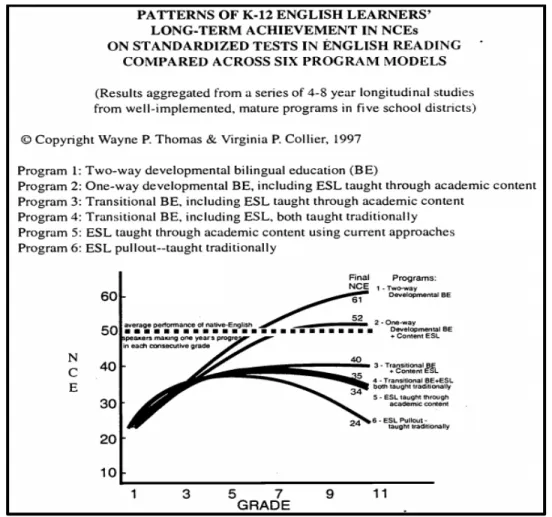
Figure 1. Common Underlying Proficiency Theory, Adapted from Cummins (1981) ...37 Figure 2. The Threshold Theory, Adapted from Cummins (1976) ...38 Figure 3. Patterns of K-12 English Learners’ Long-Term Achievement in NCEs on
CHAPTER 1: INTRODUCTION
Context of the Problem
English learners (ELs) are the fastest-growing segment of the student population in the United States (U.S. Department of Education Institute for Educational Sciences, 2019). Effectively educating this group of students is one of the biggest challenges schools face, particularly with current educational policies that require high standards and strong
accountability for both schools and students (Genesee et al., 2005). Too often, the programs implemented to educate English learners have produced less than adequate results, as evidenced by the gaps in achievement that exist between ELs and general education students. There is an urgency to design innovative programs that address their specific needs in order to close the gaps and achieve educational parity with native English speakers. To meet this challenge, there has been a rapid proliferation of dual language immersion programs, designed to promote the development of students’ linguistic and academic proficiency in two languages and to promote high levels of bilingualism.
Although the political climate in the United States has historically been one in which opposition to bilingual education has been prominent, the growth in the number of dual language immersion programs over the last two decades has been exponential. Bilingual education
programs have traditionally been associated with the education of language-minority students and controversy has surrounded the issue of how best to educate them. Amidst demands for ‘English-only’ educational programs within a conservative political environment wrought with anti-immigrant sentiment, dual language immersion programs have flourished.
Along with the dramatic increase in the number of English learners and the urgent need to provide them with an appropriate education, a number of factors have contributed to the growth and popularity of dual language immersion programs. A considerable body of research indicates that for students enrolled in well-designed dual language immersion programs, the gaps between English learners and native English speakers on standardized measures of achievement can be closed completely, and they can even outperform their general education counterparts (Collier & Thomas, 2004, 2017; Lindholm-Leary, 2001; Lindholm-Leary & Genesee, 2014; Steele et al., 2017; Thomas & Collier, 1997, 2002; Umansky et al., 2016; Valentino & Reardon, 2015). Dual language immersion programs, by design, integrate both language-majority students and language-minority students in a balanced, inclusive educational environment that appeals to the American societal values of diversity and inclusion, and this has garnered greater community support for them (Torres-Guzmán et al., 2005; Valdés, 1997). The societal focus on the
development of citizens who are capable of communicating in more than one language in an increasingly global economy has created a demand for an effective educational model that
promotes bilingualism and biliteracy as a career-readiness skill. Dual language education has the potential to be transformative not only in terms of shifting the mindset from monolingualism to bilingualism in the United States, but also as a “...dynamic (model) of school reform for all students (in which) …minority and majority language students together...prepare for a constantly changing world” (Thomas & Collier, 1997, p. 23).
In order to identify ways to ensure authentic transformation of the instructional
environment that impacts educational attainment and achievement, it is necessary to study the decision-making factors in the design and implementation of dual language immersion programs (Calderón & Carreón, 2000; de Jong, 2002, 2014; Torres-Guzmán et al., 2005). The definition
of a ‘well-designed’ dual language immersion program varies, and there is a lack of research around specific implementation factors and their possible impact on student learning (Howard et al., 2018). One program-level variable is the language allocation plan, or the amount of time that students are exposed to each language within the educational program. The focus of this study was the analysis of the relationship between the language allocation plan and student
achievement in English language arts and math. The purpose was to provide guidance to administrators and teachers around decisions that will ensure the development of effective, sustainable dual language immersion programs that have the potential to fulfill the ultimate goal of education for English learners: long-term educational parity with native English speakers in content-area subjects (Thomas & Collier, 1997).
Statement of the Problem and Theoretical Foundations
Bilingual education has been a controversial issue since the first bilingual program was established in Florida in the 1960s, and a great deal of research has focused on program
effectiveness (de Jong, 2014). The debate is centered around the following question about best practices for the education of English learners: Is English immersion more effective or is bilingual education more effective in educating English learners and narrowing the achievement gap that exists between ELs and native English speakers (Collier & Thomas, 2004; de Jong, 2002; Thomas & Collier, 1997)?
Proponents of English immersion instruction believe that English must be learned quickly to avoid an academic gap in achievement between English learners and their native English-speaking peers. They cite the need for integration with mainstream students, bilingual program costs, a shortage of bilingual teachers, and the lack of bilingual resources as additional factors
that support placing English learners into English immersion programs rather than into bilingual programs (Umansky et al., 2016). On the contrary, proponents of bilingual programs point to research that indicates that students who develop literacy skills in their home language will develop English literacy skills more effectively (Cummins, 2000). They also argue that bilingual programs offer English learners full access to the curriculum while they are learning English, as well as providing them with the opportunity to maintain their native language. They further argue that effective bilingual programs can serve to focus on and build a student’s asset, the potential to be bilingual and biliterate, rather than turning it into a deficit that impedes their performance on academic tasks provided in English without appropriate support (Gándara, 2013; Thomas & Collier, 1997).
Research on the benefits of bilingualism indicates that there are cognitive and social benefits, including but not limited to reduced discrimination, improved self-esteem, stronger cross-group relationships, multiple approaches to problem-solving, broader perspectives in approaching ecological and social science issues, better executive functioning, and lower incidences of Alzheimer's disease (Bialystok, 2011; Thomas & Collier, 1997; Umansky et al., 2016). In fact, according to Bialystok (2011), “…what is clear is the evidence: in controlled studies of cognitive performance across the lifespan, bilinguals consistently outperform their monolingual counterparts.” (p. 229)
Demographic Shifts
The debate about bilingual education is an important one because the demographics of the United States have shifted dramatically over the last few decades, resulting in an exponential increase in the number of English learners enrolled in public schools. Between 1994 and 2017, the population of English learners more than doubled, from 2 million to 5 million students, and
this trend is expected to continue (U.S. Department of Education Institute for Educational Sciences, 2019). This represents an increase in English learners from 5.1% to 10 % of the total student population. One in five school-aged children in the United States speaks a language other than English at home and 44% were born in the United States (Camarota & Ziegler, 2014). By 2025, nearly one out of every four public school students will be an English learner (National Education Association [NEA], n.d.). According to Thomas and Collier (1997), “Schooling must...be made accessible, meaningful, and effective for all students, lest we create an undereducated, under-employed generation of young adults…” (p. 13).
Achievement Gap or Opportunity Gap
These demographic shifts support the belief among many educators and researchers that “...bridging the achievement gap is a national imperative” (Chubb & Loveless, 2002, p. 10). Educators must provide the rapidly-expanding population of English learners, the vast majority of whom speak Spanish, with access to instructional programs that meet their needs
academically, socially, and culturally. School districts across the country are faced with
challenges around programming and best practices to effectively educate this group of students, while the gap in academic achievement between English learners and native English speakers remains as persistent and pervasive now as it was when it was first reported over fifty years ago (Hanushek et al., 2019). One of the ways this gap is measured is by analyzing the scores of the National Assessment of Educational Progress (NAEP), which is administered every two years to students in all states in grades 4 and 8 in reading and math. According to the Office of English Language Acquisition (OELA) (2015), a forty-percentage-point difference in average between the scores of English learners and non-English learners has persisted from 2007 to 2017. While the national graduation rate of English learners improved by about 10% between 2010 and 2016,
there was still a gap: English learners graduated at an average rate of 66.9% and non-English learners graduated at an average rate of 84.1% in 2016 (OELA, 2018). It is imperative that policymakers and educators seek research-based ways to educate this large subgroup of students and narrow these achievement gaps.
Welner and Carter (2013) argue that framing these discrepancies in terms of
‘achievement gaps’ places an emphasis on the symptoms or the measured student outcomes, rather than the causes, which they describe as “...deficiencies to the foundational components of societies, schools, and communities that produce significant differences in educational - and ultimately socioeconomic – outcomes” (p. 3). They posit that such a mindset promotes narrow thinking about groups of students and leads to policies grounded in high-stakes testing without a commitment to providing the educational supports necessary to provide equitable learning opportunities for all groups of students. Instead, they suggest that the achievement gap can best be understood as a predictable result of systemic causes, and that framing these discrepancies in terms of ‘opportunity gaps’ will shift the focus from the problems to possible solutions. They state:
...schools must become part of a larger effort to address unequal opportunities…(and) must respond to students’ actual needs, build on their unique strengths, be culturally responsive, and provide opportunities necessary to give every student a fair chance at academic success. (p. 5)
The question remains: how can educational programs best meet the needs of English learners so that they are provided with equitable opportunities to reach the same levels of academic achievement as their general education counterparts? It has been a challenge for educators to develop and implement programs that adequately address the needs of an increasingly diverse student population. While opponents of bilingual education point to
gap, Baker and Wright (2017) also state that underachievement for this population of students is linked to impoverished economic, social, and educational environments - an opportunity gap that exists for English learners. They state that bilingual education, which capitalizes on the use of the home language, is the ‘cure’ for this underachievement (p. 194). Collier and Thomas (2017) indicate that to close the gap, English learners require, “...peer-equivalent, grade-level bilingual schooling, so that they are not falling behind in cognitive and academic development” (p. 208). Their research indicates that strong forms of bilingual education, such as dual language
immersion programs, can close the achievement or opportunity gaps, and have more of an influence on student achievement than other background variables of disadvantaged students such as socioeconomic status.
Bilingual Program Models for English Learners
While policymakers and educators engage in the debate around English immersion education and bilingual education, proponents of bilingual education seek to understand which model is most effective. Baker and Wright (2017) identify eleven types of education programs for bilingual students that fall into three categories: monolingual, weak, and strong forms of bilingual education (see Table 1). They indicate that dual language immersion is a ‘strong form’ of bilingual education. To contribute to the debate over bilingual education models, research has been conducted to determine which program model is most impactful in narrowing academic achievement gaps (Collier & Thomas, 2004, 2017; Lindholm-Leary, 2001; Lindholm-Leary & Genesee, 2014; Steele et al., 2017; Thomas & Collier, 1997, 2002; Umansky et al., 2016; Valentino & Reardon, 2015). Thomas and Collier (1997; 2002) and Collier and Thomas (2004; 2017) conducted longitudinal research over a period of 32 years, in which they analyzed over 7.5 million student records from 36 school districts in 16 states. They found that English-only and
transitional bilingual programs closed about half of the achievement gap, while “...high quality, long-term bilingual programs (closed) all of the gap after 5 - 6 years of schooling through the students’ first and second languages (L1 and L2)” (p. 203). Other positive effects of dual language immersion programs include better attendance in school, greater interest in school, and higher levels of satisfaction and enjoyment in dual language classes (Collier & Thomas, 2017).
Table 1
Typology of Program Models for Bilingual Students
Monolingual Forms of Education
Type of Program Audience Instruction Goal
English Immersion Language Minority Majority Language English Proficiency English Immersion
with ESL support
Language Minority Majority Language English Proficiency Sheltered English Language Minority Majority Language English Proficiency Segregationist Language Minority Minority Language
(forced, no choice)
Monolingualism Weak Forms of Bilingual Education
Type of Program Audience Instruction Goal
Transitional Bilingual Early Exit
Language Minority Moves from Minority to Majority Language Relative Monolingualism Mainstreaming with World Language Teaching
Language Majority Majority Language with Foreign Language Lessons
Limited Bilingualism Separatist Language Minority Minority Language
(Out of Choice) Limited Bilingualism Strong Forms of Bilingual Education
Type of Program Audience Instruction Goal
Immersion Language Majority Bilingual with Initial Emphasis on Second Language
Bilingualism Maintenance/
Heritage Language Language Minority Bilingual with Emphasis on First Language Bilingualism Two Way/Dual Language Mixed Language Majority and Minority Minority and Majority Bilingualism Mainstream Bilingual Language Majority Two Majority
Languages
Bilingualism
In developing and implementing programs to meet the needs of English learners and achieve educational parity with native English speakers, research indicates that educators should focus on the types of programs that are strong forms of bilingual education, including dual language immersion programs, which they found to be the most successful model.
Two-Way Dual Language Immersion Programs
Two-way dual language immersion programs provide literacy and content instruction to a group of students that are language minority students and a group of language majority students, usually at a ratio of 1:1 in each class. Most dual language immersion programs in the United States are implemented with Spanish as the minority language and English as the majority language. Content area instruction is provided in both languages with the goal of developing high levels of bilingualism for all students in the program (de Jong, 2002). Additional goals include academic performance at or above grade level for both groups of students, and the development of positive cross-cultural attitudes and behaviors among them (Howard &
Christian, 2002). According to Soltero (2016), the promise of dual language immersion lies in the possibility to narrow the achievement gap by providing an additive education program that is enriched and culturally responsive, in which both languages and cultures are valued, promoted, and developed. She states: “...carefully planned and well-implemented dual language programs can provide the type of enriched and culturally responsive education needed to narrow the achievement gap for ELs and other minority groups” (p. 7). Other benefits include: increased flexibility and creativity in thinking, higher self-esteem, and preservation of the minority language (Baker & Wright 2017; Guglielmi, 2008; Honigsfield, 2009; Rumbaugt, Massey, & Bean, 2006, as cited in Babino, 2017).
There has been a rapid proliferation of dual language immersion programs in the United States (Steele, et. al., 2017). In 2000, there were approximately 260 dual language immersion programs in the U.S., and there are now over 2000 dual language immersion programs across the country, with more being implemented each year (Wilson, 2011), in states such as California, Georgia, Illinois, Minnesota, New Jersey, New Mexico, New York, Ohio, Oregon, and Texas. In 2012-13 a majority of states reported having at least one dual language immersion program (Boyle et al., 2015). Statewide dual language immersion program funding initiatives have been established in several states, including Delaware, Georgia, Indiana, Kentucky, Oregon, and Utah. This dramatic increase in the number of programs has led to concerns and questions about how to design and implement effective two-way dual language immersion programs, particularly with regard to the fundamental characteristics that must be in place for the programs to be successful (Howard & Christian, 2002). According the U.S. Department of Education, this has created a need for research-based information around program-level factors in order to guide states, districts, schools, and families so that students enrolled in dual language immersion programs can achieve academic success (Howard et al., 2018).
Implementation Factors
While studies have been conducted to determine the effects of dual language immersion programs on English learners’ academic achievement, few studies have examined the effects of various implementation factors that may differ among dual language immersion programs. One such factor that varies greatly and is key to the success of a dual language immersion program is the language allocation plan (Babino, 2017; Warhol & Mayer, 2012). When school districts design dual language immersion programs, the amount of time dedicated to each language can vary on a daily basis, or on a weekly basis. One of the most common ratios for a language
allocation plan is 50/50; that is, 50% of instruction is in English and 50% of instruction is in the partner language (Baker & Wright, 2017; Freeman, Freeman, & Mercuri, 2018; Thomas & Collier, 1997). Delaware, Indiana, Kentucky and Utah have incorporated this model into their statewide dual language education initiative plans (Boyle et al., 2015). Even this ratio varies among school districts, with some programs indicating a 50/50 weekly language allocation plan in which students are exposed to each language on a week-to-week basis, and others indicating a 50/50 daily language allocation plan in which students are exposed to both languages each day. The language allocation plan must be clearly-defined and correctly implemented in order for the program to be successful (Warhol & Mayer, 2012).
Purpose of the Study
The purpose of the current quantitative study was to examine the relationship between dual language immersion program design and student outcomes in ELA and math in grades four through six, as measured by a state-mandated standardized assessment. The models of interest were two-way dual language immersion programs with a 50/50 daily language allocation plan and two-way dual language immersion programs with a 50/50 weekly language allocation plan. The study also examined the outcomes of each type dual language immersion model as
compared to the general population of students within the respective district, and as measured by a state standardized assessment. A key consideration was the contextualization of dual language immersion programs and their outcomes in order to inform programmatic decisions.
Administrators, program directors, and supervisors need practical guidance as they design their dual language immersion programs and there is a lack of research around the impact of the language allocation plan on student outcomes (Howard et al., 2018). While program
effectiveness research indicates that dual language immersion programs have a positive impact on student achievement, there is a growing need to examine what influence various program-level contextual factors, such as the language allocation plan, may have on student outcomes (Genesee et al., 2005). This study fills a gap in the literature in terms of studying the language allocation plans of dual language immersion programs as a program-level factor, in order to provide practical guidance to policymakers and administrators as they design, implement, and monitor dual language immersion programs (Howard et al., 2018).
Significance of the Study
According to de Jong (2002), research-based program designs are needed to support educators in their efforts to provide access to quality education for bilingual students (p. 80). As the popularity of dual language immersion programs increases in the United States, attention must be paid to specific implementation factors when developing and implementing new programs, or when evaluating existing programs, so that the desired positive student outcomes are facilitated. Administrators must appropriately allocate time in the schedule, as well as available resources for each language of instruction. In order to do so effectively and with fidelity to the model, there is a need for research around implementation factors of successful dual language immersion programs upon which to base program design decisions.
Students in dual language immersion programs have the potential to develop bilingualism and biliteracy, high levels of academic achievement, and cross-cultural awareness. Dual
language immersion is a very complicated and challenging model of education to implement because it involves the provision of instruction in two languages to two integrated groups of students (Howard & Christian, 2002, p. 8). When implemented poorly, especially with regard to
language allocation policies, dual language immersion programs can be ineffective, can lead to misconceptions about the model, and may not experience the longevity needed to produce positive student outcomes (Torres-Guzmán et al., 2005; Warhol & Mayer, 2012). Careful attention must be paid to design and implementation issues, and research around effective program-level implementation factors such as program structure must be considered for the continual program-planning, implementation, and evaluation of the model (Calderón & Carreón, 2000; de Jong, 2014; Howard et al., 2018).
Research Questions
To investigate the achievement in ELA and math of students in grades four through six in two dual language immersion programs, with program enrollment and the language allocation plan as the variables of interest, the following research questions were formulated:
Research Question 1: What is the relationship between student participation in a two-way dual language immersion program with a 50/50 weekly language allocation plan, and student
performance in English language arts and math, as indicated by their scores on a standardized state test in Englewood?
Research Question 2: What is the relationship between student participation in a two-way dual language immersion program with a 50/50 daily language allocation plan, and student
performance in English language arts and math, as indicated by their scores on a standardized state test in Woodstock?
Research Question 3: Does the relationship between the dual language program model and
Research Design
This quantitative study compared student achievement results in the academic year 2017-18 from two suburban districts: one in Englewood, New Jersey that implemented a 50-50 weekly language allocation plan within their dual language immersion program, and one in Woodstock, Illinois that implemented a 50-50 daily language allocation plan within their dual language immersion program. Both programs were two-way immersion programs, with approximately half of the students consisting of English learners and half of the students consisting of native English speakers when they entered the program in kindergarten. The specific districts were chosen in order to control for a number of variables, including stability by way of length of time in existence of the two-way dual language immersion programs, the percentage of English learners in each district, the administration of common state assessments, and the enrollment process to control for student mobility effects.
To measure student achievement, the results from the 2018 PARCC assessments were analyzed, as that was the last year in which New Jersey and Illinois administered a common standardized assessment. Only 50/50 program models were considered, as that is the most common program model and the one that has been studied extensively in seminal longitudinal research (Collier & Thomas, 2004, 2017; Thomas & Collier, 1997, 2002). The grade levels were chosen based on knowledge of second language acquisition theory (see Chapter II) as well as longitudinal research findings which indicate that it takes an average of six years for students enrolled in quality dual language immersion programs since kindergarten, with at least half of their instruction in their native language, to reach grade-level achievement in their second language (Collier & Thomas, 2017).
The data were collected from administrators in the respective school districts who had access to the Student Information System, after proper permissions from each superintendent were granted. Student performance on the PARCC ELA and Math tests for grades four through six were compared to see if there was a significant difference in achievement between students enrolled in a dual language immersion program who were exposed to a 50/50 weekly language allocation plan in Englewood, as opposed to exposure to a 50/50 daily language allocation plan in Woodstock. Achievement results between dual language immersion students and their general education peers within each district were analyzed using an Independent Samples t Test to
determine the influence of program enrollment on student achievement. Linear multiple
regression models were run to control for gender, race, socioeconomic status, and English learner status. The results of the regression models were compared to analyze the differences in student outcomes between the two districts. The methodology and design of the study will be discussed in more detail in Chapter III.
Limitations and Assumptions
This study was limited to student-level data analysis for the academic year 2017-18 in two suburban districts, Englewood, NJ and Woodstock, IL. The results may not be generalizable to student populations in smaller or larger districts, in states in other geographic regions of the United States, or to other academic years. The two-way dual language immersion programs in this study both implemented a 50/50 program model for the percentage of instructional time in each language. Although some programs employ a 90/10 or an 80/20 model for instruction, in which 80-90% of instruction is in the minority language, this is typically utilized in early grades for the purpose of developing a strong foundation in literacy in a one-way program where native
English speakers are not included. Since the focus of the study was on two-way programs in grades four through six, only 50/50 instructional models were included, and the 90/10 program that existed in Woodstock was not included.
The two-way dual language immersion programs in this study included English and Spanish-speakers only, and dual language immersion programs for other languages were not included. One-way dual language immersion programs, such as a program strand that existed in Englewood, were also not included in the study. Special education students were not included in the study. Students were selected for the dual language immersion program in each district through an application process. Students were not selected randomly for the study. They had to be continuously enrolled in the program for at least five years (since kindergarten). The effects on achievement of students who were in the program but did not fall into that category were not analyzed.
The current study assumed that the PARCC assessment was implemented in each district with fidelity, according to the state testing requirements as outlined by New Jersey and Illinois in 2018. It was further assumed that the PARCC assessment was a valid and reliable instrument for assessing reading and math ability of students in grades four through six, and could be utilized as a measure of student achievement to compare the impact of various program models in the area of dual language education. It was also assumed that the researcher was provided with PARCC data and demographic data that were entered into the respective Student Information System and subsequently reported with accuracy, and that participation or non-participation in the two-way dual language immersion program was also accurately coded in the respective systems.
Definition of Terms
In the field of bilingual education, there are many terms whose meaning and use not only vary but also can be confusing to the reader, as many are often used interchangeably. There are also a number of program models for bilingual education. It is necessary to clarify the
definitions of important terms used within the study that are associated with English learners and the various bilingual education program models implemented to educate them.
Achievement Gap (or Gap)
An achievement gap “...occurs when an outcome—for example, average test score or level of educational attainment—is higher for one group than for another group, and the difference between the two groups’ outcomes is statistically significant” (U.S. Department of Education Institute for Educational Sciences, 2019). It is often measured by grades,
standardized-test scores, patterns of course selection, dropout rates, and college completion rates (Ansell, 2011).
Bilingual Education Program
A bilingual education program is a full-time program of instruction in academic content in two languages: a child’s native language (L1) and second language (L2).
Bilinguals
According to Grosjean (2012), bilinguals include “…those who use two or more languages (or dialects) in their everyday lives” (p. 4). This definition puts the emphasis on the use of languages rather than fluency, includes dialects as well as languages, and can include more than two languages.
Dual Language Education
Dual language education is “...a long-term additive bilingual and cross-cultural program model that consistently uses two languages for content instruction, learning, and communication, where students develop high levels of bilingual, biliterate, academic, and cross-cultural
competencies” (Soltero, 2016). Emergent Bilinguals
An alternate term for English Language Learners, or Limited English Proficient students, that emphasizes bilingualism as a positive resource and an advantage with the potential to be developed along a continuum through a bilingual educational program, rather than as a deficit such as is associated with the traditional labels that have been placed on these students (García, 2009).
English as a Second Language (ESL)
A program designed to teach English learners language skills in 4 domains: listening, speaking, reading, and writing. Typically, instruction is provided in English with little or no use of the native language in instruction by a teacher who has earned a special certification to teach ESL.
English Immersion or Monolingual Education Program
English immersion is a program in which English learners are placed in an all-English setting in general education classes with native English-speaking students and are not provided with native language support or development (Umansky et al., 2016).
English Language Learner (ELL or EL)
An English Language Learner (ELL) is a student whose native language is other than English. Typically, these students are not able to communicate fluently or learn effectively in
English and require specialized or modified programs to educate them in their English language development as well as their content-area knowledge. According to the Great Schools
Partnership’s Glossary of Education Reform (n.d.), a number of terms are used to refer to
English Language Learners, including English learner (EL), limited English proficient(LEP) student, non-native English speaker, language-minority student, and either bilingual student or emerging bilingual student. The term English learner (EL) is used throughout this study to refer to students whose native language is not English.
50/50 Daily Language Allocation Plan
A 50/50 daily language allocation plan is a dual language immersion program model in which the language of instruction consists of 50% English and 50% the partner language. The instructional day is divided so that students receive instruction in both languages each day. The district in Woodstock, IL utilized this model in 2017-18.
50/50 Weekly Language Allocation Plan
A 50/50 weekly language allocation plan is a dual language immersion program model in which the language of instruction consists of 50% English and 50% the partner language. The language of instruction alternates from week to week (i.e. ‘English Week’ and ‘Spanish Week’). The district in Englewood, NJ utilized this model in 2017-18.
Heritage Language (L1)
The heritage language (L1) is the student’s first language or L1, and is usually the language of the native country where someone is born.
High-Stakes Testing
A high-stakes test is any test that is used to make important decisions about students, educators, schools, or districts. Typically, they are mandated and used for state and federal
accountability purposes. At the student level, they can be used for program placement, grade-level promotion, or graduation. At the district or state grade-level, they can be used to determine funding eligibility. The use of high-stakes testing is highly controversial, especially in terms of equity for subgroups of students such as English learners, who historically have underperformed on such tests.
Language-Minority Student
A language minority student does not speak the same language as the majority of the population in a community or country. In the United States, students for whom English is not their first language may be referred to as language minority students.
Language-Majority Student
A language majority student speaks the same language as the majority of the population in a community or country. In the United States, students for whom English is their first
language may be referred to as language majority students. One-Way Dual Language Immersion Programs
One-way dual language immersion is a program in which one language group is being educated in two languages. For example, all students enrolled are English learners whose native language is Spanish, and the goal is for them to be bilingual and biliterate in English and in Spanish (Collier & Thomas, 2004). This study did not include one-way dual language immersion programs.
Opportunity Gap
An opportunity gap“...refers to the ways in which race, ethnicity, socioeconomic status, English proficiency, community wealth, familial situations, or other factors contribute to or perpetuate lower educational aspirations, achievement, and attainment for certain groups of
students” (Glossary of Education Reform). These are generally factors that are external to the student.
Partnership for Assessment of Readiness for College and Careers (PARCC)
The Partnership for Assessment of Readiness for College and Careers (PARCC) is a consortium of states that collaboratively developed a common set of assessments to measure student achievement and preparedness for college and careers. In the academic year 2017-18, both New Jersey and Illinois used this standardized assessment to measure English language arts (ELA) and mathematics achievement.
Sequential Bilingual Learners
Learners who acquire another language after they have learned their first language, typically after the age of three.
Simultaneous Bilingual Learners
Learners who have been exposed to two languages since before age 3 and develop fluency in both languages at the same time.
Student Subgroup
The term student subgroup, or subgroup, in education refers to a group of students who share similar characteristics, such as gender, race, socioeconomic status, language ability, or special needs. Federal and state legislation typically defines and collects data for particular subgroups that are employed to track their educational performance and attainment. English learners are typically identified as a subgroup of a district’s general population.
Transitional Bilingual Program
A transitional bilingual program is an educational program in which a student’s native language is used in instruction as a bridge to English language acquisition and to make content
area instruction comprehensible. The goal of this program is to transition students to English as quickly as possible, without an emphasis on maintaining their native language (Umansky et al., 2016). Most bilingual programs in the United States are transitional programs.
Two-Way Dual Language Immersion Programs
Two-way dual language immersion is a type of dual language education program in which both English learners minority students) and non-English learners (language-majority students) are enrolled and the goal is for them to become bilingual and biliterate in both languages (Collier & Thomas, 2004, Umansky et al., 2016).
In a 50/50 program model, half of the student population consists of native English speakers and half of the student population consists of English learners. Researchers have used a minimum balance of 70/30 as a requirement for a study to be considered a two-way dual
language immersion program (Collier & Thomas, 2004). This study focused on 50/50 two-way dual language immersion programs.
Organization of the Study
The current study is organized into five chapters, according to the guidelines provided by Seton Hall University. The present chapter introduced the research topic by providing
background information, contextualizing the problem as it relates to previous research, and outlining the need for research around implementation factors of successful dual language immersion programs upon which to base program design decisions. It also delineated the research questions that were addressed by the study, briefly outlined the research design and its limitations, and clarified important terms that are discussed throughout the study.
Chapter II includes a literature review that outlines the historical background of bilingual education and instructional issues related to educating the growing number of English learners, as well as the various models that have been most effective in educating them. It also focuses on the current research around the effects of dual language immersion on student achievement and the need to study implementation factors in designing effective programs.
Chapter III explains the methodology of the study, including a description of the design of the study, as well as the methods and procedures used to collect and analyze the data.
Chapter IV addresses the research questions by analyzing the results of the study. Chapter V summarizes the statistical findings, interprets their results, and discusses practical applications for the design and implementation of dual language immersion programs by district administrators and teachers. Suggestions for future research to further investigate this topic are also included.
CHAPTER II - REVIEW OF THE LITERATURE
Introduction
Chapter II reviews the existing literature on dual language immersion and the impact of this type of bilingual education program on student achievement. It begins with outlining the impact of legislation and policies around funding and accountability measures on bilingual programming. Then, the various program models that have been implemented in educating English learners are discussed, with a focus on language orientations as a lens through which to view varying programmatic decisions. Next, the review discusses second language acquisition theories that form the basis of dual language immersion program models, as well as the various dual language program types and models. The review presents the economic, cognitive, and academic rationales for dual language immersion programs, with a focus on the results of a number of studies that have been conducted around the cognitive benefits of bilingualism and the effects of dual language immersion on academic achievement. The chapter concludes with the need to study program-level implementation factors as a gap in the research.
Historical Background of Bilingual Education
English learners are the fastest-growing and lowest-performing subgroup in the United States (U.S. Department of Education Institute for Educational Sciences, 2020). The most appropriate model to educate this group of students has been debated since before the Title VII Bilingual Education Act 1968 was passed. The controversy has centered around whether these students acquire English faster in an English immersion setting, or whether bilingual education is more effective in terms of increasing student achievement. This has posed two crucial issues for
both policymakers and researchers: whether bilingual education has a positive impact on language-minority students’ academic performance, and, if so, which types of bilingual education programs result in the largest improvements (Marian et al., 2013).
Over the past 50 years, bilingual education has been influenced by state and federal legislation, with current policies largely based on standardization and funding mechanisms that emphasize accountability for English learners’ progress through high-stakes testing and promote English immersion or transitional bilingual programming (Menken, 2008). At the same time, a movement grounded in research on the benefits of bilingualism and biliteracy, as well as the need for the development of skill sets required by economic globalization, has led to the rapid proliferation of dual language immersion programs across the United States. This has resulted in a great deal of variability in programming for English learners across states and school districts that range from bilingual education options to a complete ban on bilingual education
(Goldenberg, 2008, & Rolstad et al., 2005, as cited in Valentino & Reardon, 2015).
The history of bilingual education in the United States is both complex and controversial, framing an “...effectiveness debate that has plagued bilingual education for many decades” (August & Hakuta, 1997, as cited on de Jong, 2014). The ways in which English learners are educated have been influenced and impacted by federal and state policies that have shifted between a monolingual perspective in which the native language is viewed as a deficit to be overcome, and a multilingual perspective that values bilingualism as an asset to be developed (Beeman & Urow, 2013, Fitts, 2006). Menken (2008) stated: “Like a pendulum swinging between opposing ends, U.S. schooling has historically approached linguistic diversity with alternating restriction and tolerance” (p. 13). In order to understand the current state of bilingual education and the need for well-designed, research-based programs for the education of English
learners, it is necessary to understand the historical context and political movements that have influenced how this group of students has been educated in the United States.
Early to mid-20th Century
As a country of immigrants, the United States has always been characterized by language diversity and, until World War I, this linguistic diversity was often accepted (Wiley & Wright, 2004). While English monolingual education was dominant in the cities at the turn of the century, there were some examples of bilingual education in very specific, isolated areas. Early in the 20th century, factors such as increased immigration patterns, the subsequent movement for assimilation and Americanization, and U.S. entry into World War I led to more restrictive
policies on bilingual education. In 1906, the Nationality Act in Texas established English as the only language to be taught in schools and made the speaking of English a requirement for naturalization (Freeman, Freeman, & Mercuri, 2018; Nieto, 2009). By 1923, English was declared as the sole language of instruction in 34 states.
The political pendulum shifted in the opposite direction later in the 20th century, after the Russian launch of Sputnik. Policymakers began to rethink the need for foreign language
instruction, and in 1958 the National Defense Education Act promoted the teaching of foreign languages in public schools. In the 1960s, the Civil Rights movement and the call for equal opportunity for all people led to the Civil Rights Act of 1964, prohibiting discrimination on the basis of race, color, or national origin. This contributed to the discussion of bilingual education as a civil right (Ruíz, 1984). The spark for the restoration of bilingual education came with the wave of Cuban immigrants into the U.S., and the formation of Coral Way Elementary School in Florida in 1963 as the first modern dual language school (Baker & Wright, 2017). Bilingual programs were also established in Texas, New Mexico, California, and Arizona in the 1960s to
serve the educational needs of Mexican-Americans, and there was a call for legislation regulating bilingual education.
Title VII: The Bilingual Education Act and Two Legal Precedents
The Bilingual Education Act1968 was an amendment, also known as Title VII, to the
Elementary and Secondary Education Act (ESEA) 1965. It was the first federal legislation to address the needs of language-minority groups. It authorized the use of federal funds to educate English learners by developing and implementing language instruction programs to
accommodate their needs, but it did not provide specific guidance on program types or models, and the funds were limited to use for students from low-income families. Although this limit was lifted with the reauthorization of Title VII in 1974, it “…had the unfortunate side effect of linking bilingualism to poverty and remediation.” (Crawford, 1991, as cited in Fitts, 2006)
The Bilingual Education Act 1968 did not require states to participate in the
establishment of educational programs to meet the needs of English learners, but the Supreme Court’s landmark decision in Lau v. Nichols 1974 made it very difficult for states to continue the prevailing practice of English immersion without additional services. The Supreme Court upheld that the San Francisco School District violated the Equal Protection Clause of the 14th Amendment and Title VI of the Civil Rights Act 1964 when it failed to provide approximately 800 Chinese students access to a meaningful education by not providing them with a program that met their linguistic needs (Baker & Wright, 2017; Nieto, 2009). According to the Court, “…there is no equality of treatment merely by providing students with the same facilities, textbooks, teachers, and curriculum; for students who do not understand English are effectively foreclosed from any meaningful education…” (Lau v. Nichols, 1974, p. 566). The type of instructional program required to meet their needs was not specified.
After this ruling, the Office of Civil Rights was tasked to create and enforce a set of guidelines for school districts, called the Lau Remedies, that emphasized the establishment of English as a Second Language (ESL) programs and bilingual education programs. Most
bilingual programs that were implemented were transitional in nature, employing a monolingual perspective and promoting subtractive bilingualism, in which the native language is used as a bridge to English and is then abruptly removed from the educational program once students are determined to be proficient in English (Beeman & Urow, 2013; Fitts, 2006).
The federal court decision in Castañeda v. Pickard 1981, “...upheld the Lau precedent that schools must take ‘appropriate action’ to educate language-minoritized students and that such action must be based on a three-part assessment for English learner education programs. In particular, they must be based on sound educational theory, produce results, and provide
adequate resources, including qualified teachers and appropriate materials, equipment, and facilities (García & Kleifgen, 2018). The Lau Remedies were replaced with these federal guidelines that still remain in effect, but there was still no particular mandate regarding any specific program that would fulfill these requirements.
State and Federal Legislation Promoting English Immersion
In the 1980s, an ‘English Only’ movement was gaining political support in the country, and the emphasis shifted to English fluency as the primary goal of the education program for ‘Limited English Proficient’ students. The 1984 and 1988 reauthorizations of Title VII
incentivized programs that emphasized English instruction, while also imposing limits on the number of years permitted for participation in a transitional bilingual program. The pendulum of support for bilingual education in some states swung very far to the conservative right in 1998 when Proposition 227, also known as the ‘English for the Children’ initiative in California,
became a state law prohibiting bilingual education. English learners were allowed one year of ESL instruction and were then required to be mainstreamed. A similar proposition passed in Arizona in 2000 and in Massachusetts in 2002, but did not pass in Colorado (García & Kleifgen, 2018).
According to García and Kleifgen (2018), “…a space for bilingual education was found during this time in the implementation of ‘dual-language’ programs…” (p. 39). Notwithstanding the political shifts that were evident within each reauthorization of the Bilingual Education Act 1968, dual language immersion programs grew slowly but steadily in the 1970s and 1980s. With the 1994 reauthorization of Title VII, there was greater flexibility and availability of federal funding which increased attention toward bilingual education programs, and dual language immersion programs grew more rapidly (García & Kleifgen, 2018; Torres-Guzmán et al., 2005).
With the reauthorization of the Elementary and Secondary Education Act (ESEA) 2002,
known as the No Child Left Behind (NCLB) Act, federal policy also moved conservatively away from bilingual education, even removing the word ‘bilingual’ completely from federal
legislation. Emphasis was placed on narrowing the achievement gaps of limited English proficient (LEP)students through testing and English immersion (García & Kleifgen, 2018). This ‘subgroup’ of students was required to make ‘adequate yearly progress (AYP)’ based on annual assessments under Language Instruction for Limited English Proficient and Immigrant Students, also known as Title III, which replaced the Bilingual Education Act. Title III
established evaluation procedures to identify English learners in need of services as well as accountability for their academic proficiency and English proficiency. According to Baker and Wright (2017):
NCLB’s use of the term ‘limited English proficient’ (LEP) brought back a deficit view of students, focusing on what they lack (English) rather than who they are
(emergent bilinguals) (and) what they are actively doing (learning English and other languages). (p. 181)
The focus on accountability through high-stakes English-only testing placed pressure on school districts to focus on test-driven content and mastery of English in order to meet AYP
requirements. While there was not specifically a federal ban on bilingual education imposed by this legislation, there was considerably less emphasis on bilingual programming and more emphasis on monolingualism due to accountability requirements (Cervantes-Soon et al., 2017). Standardization and High-Stakes Testing
According to Menken (2008), because the United States does not have an official
language planning policy, most policy decisions that have been made regarding English learners have been driven by a national emphasis on standardized testing and the high-stakes
consequences attached to them. Since high-stakes tests shape the content that is taught in school, including how and in what language content is taught, it is “…an extremely significant language policy issue, because high-stakes tests become de facto language policy in education when schools respond to the pressures they create” (p. 9). Gándara (2013) believes that such policies “…are squandering an asset – students who have potential to be bilingual and biliterate – and turning it into a deficit” (p. 157).
The emphasis on standardization and high-stakes testing in the United States gained momentum in 1983 with the release of A Nation at Risk by the National Commission on Excellence in Education, which claimed that “...the educational foundations of our society are presently being eroded by a rising tide of mediocrity” (National Commission, 1983, p. 112). According to the report, the United States was losing its competitive edge, and to ensure success in the information age, the level of expected learning needed to be raised through the
years policymakers have “...embraced the notion of standardization as the panacea to all of our educational ills” (Rubin & Kazanjian, 2011, p. 102), with the intention of reforming education by narrowing student achievement gaps, improving teacher effectiveness, and ensuring college and career readiness for all students (Tienken, 2017, p. 3).
In 2009, the Race to the Top grant helped to propel the national movement toward the adoption of common standards for college and career readiness by the states as well as common standardized assessments, such as the PARCC assessment, to measure mastery of the English Language Arts and math standards. The Every Student Succeeds Act (ESSA) 2015, a
reauthorization of the Elementary and Secondary Education Act 1968, required states to develop education plans that for the first time included accountability measures for the progress of English learners in both language development and academic content in order to receive federal funding. While there was still an emphasis on addressing the needs of English learners under
Title III through the requirement of ‘effective programming’ for English learners aligned to the guidelines set forth in Castañeda v. Pickard, there was no requirement regarding which specific educational program types or models to implement for this population. Legislation also
continued to require states to implement high-stakes testing as a measure of progress, the results of which formed the basis of federal and state funding formulas.
Proponents of the nationwide standardization of curricula and the implementation of high-stakes testing claim that such policies increase equity by standardizing expectations and providing interventions to improve educational opportunities for disadvantaged students such as English learners. Tienken (2017) calls into question what he refers to as, the “subtle bigotry of standardized expectations” (p. 20). According to Tienken and Zhao (2013), these policy
standards and standardized assessments do not consider the needs of ‘emergent bilinguals’ and the “...dynamic interplay of languages in their repertoires and daily practices” (Kibler, Valdés, & Walqui, 2014, p. 437). They point out that standardized assessments are typically not provided in languages other than English, further discouraging bilingual education. They warn that a lack of emphasis on meeting the needs of individual students according to their language proficiency could lead to increased drop-out rates among English learners, which has historically remained drastically lower than the national graduation rate for general education students. “What
research has been able to show, thus far, is that high-stakes testing is not improving the quality of teaching and learning in schools, and in fact may be having the complete opposite effect,
especially for poor, minority, and ELL students” (Wiley & Wright. 2004, p. 161).
Table 2
Percent of Students Who Met or Exceeded Standards on the 2017 PARCC Test
ELA Math New Jersey Gr 4 Gr 5 Gr 6 Gr 4 Gr 5 Gr 6 English Learners 11 12 7 12 12 10 All Students 56 59 53 47 46 44 Illinois Gr 4 Gr 5 Gr 6 Gr 4 Gr 5 Gr 6 English Learners 6 2 2 6 4 3 All Students 37 37 35 31 30 28
Source: Sugarman & Geary (2018)
Although disadvantaged students continue to drastically underperform on standardized measures of achievement, school districts have narrowed the curriculum to improve test scores, with a focus on the tested areas of English Language Arts (ELA) and math, providing students with fewer opportunities to receive diverse educational experiences tailored to their needs (Tienken & Zhao, 2014). With the pressure of accountability thorough high-stakes testing that