Calhoun: The NPS Institutional Archive
Theses and Dissertations Thesis and Dissertation Collection
2016-12
GSBPP capstone review
Wright, Mathis
Monterey, California: Naval Postgraduate School http://hdl.handle.net/10945/51641
NAVAL
POSTGRADUATE
SCHOOL
MONTEREY, CALIFORNIA
MBA PROFESSIONAL REPORT
GSBPP CAPSTONE REVIEW
December 2016
By:
Mathis Wright
Christopher
Williams
Mark
Toner
Advisors: Kathryn Aten Marco DiRenzo Keith Snider
REPORT DOCUMENTATION PAGE Form Approved OMB No. 0704–0188
Public reporting burden for this collection of information is estimated to average 1 hour per response, including the time for reviewing instruction, searching existing data sources, gathering and maintaining the data needed, and completing and reviewing the collection of information. Send comments regarding this burden estimate or any other aspect of this collection of information, including suggestions for reducing this burden, to Washington headquarters Services, Directorate for Information Operations and Reports, 1215 Jefferson Davis Highway, Suite 1204, Arlington, VA 22202-4302, and to the Office of Management and Budget, Paperwork Reduction Project (0704-0188) Washington, DC 20503.
1. AGENCY USE ONLY
(Leave blank)
2. REPORT DATE
December 2016 3. REPORT TYPE AND DATES COVEREDMBA professional report
4. TITLE AND SUBTITLE
GSBPP CAPSTONE REVIEW
5. FUNDING NUMBERS
6. AUTHOR(S) Mathis Wright, Christopher Williams, and Mark Toner 7. PERFORMING ORGANIZATION NAME(S) AND ADDRESS(ES)
Naval Postgraduate School Monterey, CA 93943-5000
8. PERFORMING
ORGANIZATION REPORT NUMBER
9. SPONSORING /MONITORING AGENCY NAME(S) AND ADDRESS(ES)
N/A
10. SPONSORING / MONITORING AGENCY REPORT NUMBER
11. SUPPLEMENTARY NOTES The views expressed in this thesis are those of the author and do not reflect the
official policy or position of the Department of Defense or the U.S. Government. IRB number NPS.2016.0156-DD-N
12a. DISTRIBUTION / AVAILABILITY STATEMENT
Approved for public release. Distribution is unlimited. 12b. DISTRIBUTION CODE
13. ABSTRACT (maximum 200 words)
The Graduate School of Business and Public Policy (GSBPP) is committed to a process of continuous improvement throughout all business practices, to include its present approach to facilitating student capstones (i.e., projects and theses). The first step in any process improvement effort is to accurately define the existing, as-is state of the process to be improved. The project team seeks to describe the existing GSBPP approach to facilitating student capstones through careful data collection and analysis from multiple sources, including the GSBPP exit survey, archived GSBPP capstones, faculty advisement data, faculty interviews, and a new GSBPP student survey in order to detail the capstone’s process, content, and value to multiple stakeholders. The project team also employs the Plan-Do-Study-Act framework for continuous process improvement throughout. It is not within the scope of this report to understand, control, or improve the current GSBPP approach to facilitating student capstones. Rather, this report only collects and presents data about the current approach so that GSBPP can understand it, control it, and improve itinsofar as GSBPP finds it advantageous to do so.
14. SUBJECT TERMS
continuous process improvement, lean six sigma, plan-do-act-study model, GSBPP capstone, GSBPP project, GSBPP thesis, existing as-is state
15. NUMBER OF PAGES 151 16. PRICE CODE 17. SECURITY CLASSIFICATION OF REPORT Unclassified 18. SECURITY CLASSIFICATION OF THIS PAGE Unclassified 19. SECURITY CLASSIFICATION OF ABSTRACT Unclassified 20. LIMITATION OF ABSTRACT UU
NSN 7540–01-280-5500 Standard Form 298 (Rev. 2–89) Prescribed by ANSI Std. 239–18
Approved for public release. Distribution is unlimited.
GSBPP CAPSTONE REVIEW
Mathis Wright, Major, United States Army Christopher Williams, Major, United States Army
Mark Toner, Lieutenant, United States Navy
Submitted in partial fulfillment of the requirements for the degree of
MASTER OF BUSINESS ADMINISTRATION
from the
NAVAL POSTGRADUATE SCHOOL December 2016
Approved by: Kathryn Aten, Ph.D.
Marco DiRenzo, Ph.D.
Keith Snider, Ph.D.
Rene Rendon, Ph.D.
Academic Associate
GSBPP CAPSTONE REVIEW
ABSTRACT
The Graduate School of Business and Public Policy (GSBPP) is committed to a process of continuous improvement throughout all business practices, to include its present approach to facilitating student capstones (i.e., projects and theses). The first step in any process improvement effort is to accurately define the existing, as-is state of the process to be improved. The project team seeks to describe the existing GSBPP approach to facilitating student capstones through careful data collection and analysis from multiple sources, including the GSBPP exit survey, archived GSBPP capstones, faculty advisement data, faculty interviews, and a new GSBPP student survey in order to detail the capstone’s process, content, and value to multiple stakeholders. The project team also employs the Plan-Do-Study-Act framework for continuous process improvement throughout. It is not within the scope of this report to understand, control, or improve the current GSBPP approach to facilitating student capstones. Rather, this report only collects and presents data about the current approach so that GSBPP can understand it, control it, and improve itinsofar as GSBPP finds it advantageous to do so.
TABLE OF CONTENTS
I. MOTIVATION ...1
A. THE THESIS REQUIREMENT AT NPS AND GSBPP ...1
B. GSBPP SEEKS CONTINUOUS IMPROVEMENT ...1
1. AACSB Accreditation ...2
2. NASPAA Accreditation ...2
3. Research Funding ...3
C. CONTINUOUS IMPROVEMENT REQUIRES A FIRM UNDERSTANDING OF THE EXISTING (AS-IS) STATE ...3
D. PROJECT OBJECTIVE: DESCRIBE THE EXISTING (AS-IS) GSBPP APPROACH TO FACILITATING STUDENT PROJECTS AND THESES ...6
1. Research Questions ...6
2. Data Collection Sources ...6
II. BACKGROUND ...9
A. THESIS REQUIREMENT AT PEER AND ASPIRANT BUSINESS SCHOOLS ...9
B. PROCESS IMPROVEMENT FRAMEWORK: THE PLAN-DO-STUDY-ACT (PDSA) MODEL ...11
C. PERFORMANCE MEASURES: VALUE, CONTENT, AND PROCESS ...11
III. METHOD ...15
A. INTRODUCTION...15
B. PHASE 1: EXIT SURVEYS ...15
1. Analysis Approach ...16
2. Voice of the Customer ...17
C. PHASE 2A: GSBPP ARCHIVED PROJECTS ...18
1. Analysis Approach ...19
2. Voice of the Process ...20
D. PHASE 2B: FACULTY ADVISEMENT DATA ...20
1. Analysis Approach ...21
2. Voice of the Business ...22
E. PHASE 3: INTERVIEW AND SURVEY DESIGN ...22
1. Interview Sample Size and Demographics ...23
2. Interview Questions ...24
3. Interview Analysis Approach...25
5. Survey Sample Size and Demographics ...27
6. Survey Questions ...27
7. Survey Analysis Approach ...27
IV. ANALYSIS AND FINDINGS ...29
A. PHASE 1: EXIT SURVEY ...29
1. Student Overall Satisfaction with their GSBPP Program, 2013–2015...29
2. Student Satisfaction with Their GSBPP Capstone, 2013— 2015...30
3. Student Satisfaction with their Capstone Advisors, 2013 – 2015...32
4. Student Survey Comments, 2013 –2015 ...34
5. Findings ...36
B. PHASE 2A: GSBPP ARCHIVED PROJECTS ...37
1. Capstone Distribution by Capstone Type ...37
2. Capstone Distribution by Funding and Sponsorship ...38
3. Number of Authors, Advisors, Chapters, and Appendices per Capstone ...39
4. Number of Pages per Capstone ...40
5. Capstone Content Elements ...41
6. Findings ...42
C. PHASE 2B: FACULTY ADVISEMENT DATA ...43
1. Average Advisements per Year ...43
2. Workload Distribution ...44
3. Advisement Distribution by Advisor Type ...45
4. Advisement Distribution by Advisor Title ...46
5. Advisement Distribution by Tenure Status ...48
6. Findings ...49
D. PHASE 3: INTERVIEW AND SURVEY ...50
1. Phase 3a: Faculty Interviews ...51
2. Phase 3b: Student Survey ...58
V. PHASE INTEGRATION AND CONCLUSIONS ...75
A. CAPSTONE PROCESS DEFINED ...75
B. CAPSTONE CONTENT DEFINED ...76
APPENDIX A. GSBPP PEER AND ASPIRANT BUSINESS SCHOOLS
REQUESTS FOR INFORMATION ...83
APPENDIX B. THEMATIC ANALYSIS OF EXIT SURVEY COMMENTS ...85
APPENDIX C. FACULTY INTERVIEW LINEAR PROGRAMMING MODEL ...97
APPENDIX D. FACULTY INTERVIEW NOTES ...99
APPENDIX E. STUDENT SURVEY RESULTS ...113
LIST OF REFERENCES ...129
LIST OF FIGURES
Figure 1. NPS 2014 and 2015 Funding Sources. Source: Naval Postgraduate
School Office of Institutional Research, Reporting and Analysis
(IRRA) (2014, 2015a) ...5
Figure 2. Plan-Do-Study-Act (PDSA) Model for Continuous Process Improvement. Source: Aartsengel & Kurtoglu (2013b) ...13
Figure 3. Total Number of GSBPP Capstones (547). Source: Naval Postgraduate School Dudley Knox Library (2016) ...19
Figure 4. Capstone Sample Size Determination (74 Reports). Source: Calculator.net (2016); Raosoft (2016); Select Statistical Services (2016) ...19
Figure 5. Survey Participation Request ...26
Figure 6. Exit Survey Question No. 4 ...30
Figure 7. Exit Survey Question No. 9 ...31
Figure 8. Exit Survey Question No. 14 ...33
Figure 9. Capstone Distribution by Capstone Type ...38
Figure 10. Capstone Distribution by Funding and Sponsorship ...39
Figure 11. Number of Authors, Advisors, Chapters, and Appendices per Capstone (74 Total)...40
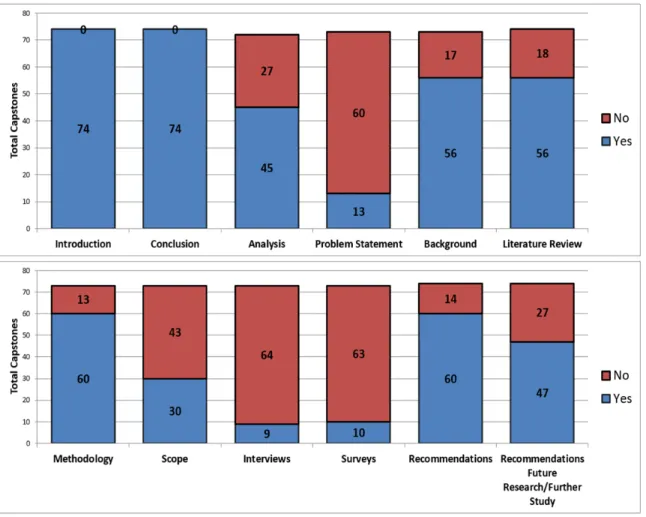
Figure 12. Capstone Content Elements ...42
Figure 13. Workload Distribution ...45
Figure 14. Advisement Distribution by Advisor Type ...46
Figure 15. Student Survey Question No. 6 ...59
Figure 16. Student Survey Question No. 7 ...60
Figure 17. Student Survey Question No. 9 ...61
Figure 18. Student Survey Question No. 5 ...62
Figure 20. Student Survey Question No. 10 ...65
Figure 21. Student Survey Question No. 11 ...66
Figure 22. Student Survey Question No. 12 ...67
Figure 23. Student Survey Question No. 14 ...67
Figure 24. Student Survey Question No. 16 ...68
Figure 25. Student Survey Question No. 13 ...69
Figure 26. Student Survey Question No. 17 ...70
Figure 27. Student Survey Question No. 22 ...71
Figure 28. Student Survey Question No. 21 ...72
Figure 29. Student Survey Question No. 18 ...73
Figure 30. Existing (As-Is) GSBPP Approach to Facilitating Student Projects and Theses ...80
Figure 31. RFI School Responses ...83
LIST OF TABLES
Table 1. GSBPP Peer and Aspirant Business Schools ...10
Table 2. Total GSBPP Capstone Advisements between 2011 and 2015 ...21
Table 3. Desired Interview Sample Size and Demographics ...24
Table 4. Actual Interview Sample Size and Demographics ...25
Table 5. Survey Population Size and Demographics ...26
Table 6. Survey Sample Size and Demographics ...27
Table 7. Academic Program Level of Satisfaction 2013–2015 ...30
Table 8. MBA Project/Thesis Experience Favorability 2013–2015 ...32
Table 9. MBA Project/Thesis Advisor Favorability 2013–2015 ...33
Table 10. GSBPP Exit Survey Comments: Thematic Analysis Illustration ...35
Table 11. Exit Survey Comments Summary ...36
Table 12. Number of Pages Per Capstone...41
Table 13. Average Advisements per Year ...44
Table 14. Workload Distribution ...45
Table 15. Advisement Distribution by Advisor Type ...46
Table 16. Advisement Distribution by Advisor Title ...47
Table 17. Advisement Distribution by Tenure Status ...48
Table 18. Summary of Interviewees’ Assessments of the Value of the GSBPP Capstone ...50
Table 19. Average Monthly Interactions between Students and Advisors ...72
Table 20. Thematic Analysis of Exit Survey Comments ...85
LIST OF ACRONYMS AND ABBREVIATIONS
9MM 9-Month Model
AACSB Association to Advance Collegiate Schools of Business
CI Handbook Handbook on Continuous Improvement Transformation: The Lean Six Sigma Framework and Systematic Methodology for
Implementation
DOD Department of Defense
GSBPP Graduate School of Business and Public Policy IRB Institutional Review Board
JPME Joint Professional Military Education
LSS Lean Six Sigma
NASPAA Network of Schools of Public Policy, Affairs, and Administration NPS Naval Postgraduate School
OPNAVINST Office of the Chief of Naval Operations Instruction PDSA Plan-Do-Study-Act
RFI Request for Information ROI Return on Investment SOF Student Opinion Form V.O.B. Voice of the Business V.O.C. Voice of the Customer V.O.P. Voice of the Process
ACKNOWLEDGMENTS
First and foremost, thanks be to God for His gracious blessings of strength, endurance, and perseverance that allowed us to see this project through.
We also wish to express our sincere gratitude to our project advisors, Kathryn Aten, Marco DiRenzo, and Keith Snider, for providing the vision, intent, and direction that guided our research efforts. Dr. Aten, in particular, was instrumental in shaping our thoughts and actions around a somewhat unconventional MBA project. We could not have achieved our goals without her direct assistance and support.
Thanks also to Commander Todd Sinclair, U.S. Navy, for “sanity checking” some of our statistical representations presented throughout this report. We wish to especially thank Terry Rea, Captain, U.S. Navy (Retired) and present executive assistant to the GSBPP Dean for her responsiveness and constant willingness to support our many, many data collection requests. We greatly appreciate the GSBPP faculty members and students who afforded us the time and opportunity to gather their candid input for incorporation into our study.
Last, but far from least, we would like to thank our wives (Lacey, Angel, and Sarah) and children (Maddison, Mathis, Landon, Braylon, Bellamy, Seth, and Samuel) for their unwavering support, patience, and understanding as we devoted countless hours to this project and our other graduate studies over the previous 18 months. Words fail to express the depths of our gratitude for their constant love and encouragement. Thank you and we love you dearly.
I.
MOTIVATION
A. THE THESIS REQUIREMENT AT NPS AND GSBPP
The requirement for Naval Postgraduate School (NPS) students to complete a thesis (or equivalent) is reflected in the Office of the Chief of Naval Operations Instruction (OPNAVINST) 5450.210D, Naval Postgraduate School Mission and Functions, dated 30 March 2012. The instruction prescribes 31 functions that NPS must
perform. Function #11 states that NPS will coordinate and approve student officer research while maintaining a strong, relevant, and viable faculty research effort to support student and Department of Defense (DOD) research requirements. According to the instruction, student research should aid national defense by developing or advancing processes, materials, and technologies for future military service applications (Office of the Chief of Naval Operations [OPNAV], 2012).
The thesis is the primary instrument for NPS to coordinate, approve, and support student research as prescribed in OPNAVINST 5450.210D. The OPNAVINST instructions inform NPS academic policy—all master degree programs at NPS require “a thesis or its equivalent, except in cases where the Academic Council has specifically approved a course-only option or curricula (Naval Postgraduate School [NPS], 2015b, p. 11).”
Appendix D of the NPS Academic Policy Manual, approved 16 September 2015,
details five requirements for obtaining a Master of Business Administration (MBA) from the Graduate School of Business and Public Policy (GSBPP). The fourth requirement stipulates that each student will complete an acceptable (emphasis added) application
project or thesis as a requisite to earning the MBA degree (NPS, 2015b, Appendix D). From the above, the two main purposes of the thesis (or its equivalent) are summarized as to 1) satisfy NPS graduation requirements and 2) support the national defense through advancing future military service applications.
B. GSBPP SEEKS CONTINUOUS IMPROVEMENT
The drive for continuous improvement at GSBPP may be linked to the NPS strategic plan. In support of its mission and vision, NPS identified four main goals in its
strategic plan, Vision for a New Century, upon which the university will engage its
primary efforts. NPS’s No. 1 goal is to “sustain continuous improvement in the quality and relevance of [its] graduate education and research programs” (NPS, 2008, p. 3). Concerning this goal, NPS has instituted several policies and procedures that are designed to foster continuous improvement at the university. For instance, NPS schools and academic departments conduct recurring curriculum reviews. NPS also maintains university accreditations and collects student opinion forms (SOFs) following each academic term. In turn, GSBPP has adopted many of these practices and has even designed others for its own use, like developing a detailed workload management tool (the 9-month model, or 9MM) that focuses on faculty development.
However, continuous improvement at GSBPP is not only about achieving university goals. Continuous improvement supports GSBPP directly through attaining (and retaining) prominent accreditations and research funding.
1. AACSB Accreditation
Attaining the Association to Advance Collegiate Schools of Business (AACSB) accreditation demands evidence of continuous improvement. Having achieved AACSB accreditation, GSBPP is committed to a process of annual and periodic continuous improvement reviews. During each review, GSBPP must “summarize and document key continuous improvement successes, innovations, and achievements since the last AACSB accreditation review or for at least the past five years produce evidence showing key continuous improvement successes, innovations, and achievements since the last AACSB accreditation review” (Association to Advance Collegiate Schools of Business [AACSB], 2016, p. 15). GSBPP must also document its plans for continuous improvement in the future (AACSB, 2016, p. 16).
2. NASPAA Accreditation
3. Research Funding
Per the 9MM, most GSBPP tenure-track faculty members devote one academic quarter (approximately 2.25 months) to performing reimbursable research for external stakeholders within the DOD. The 9MM further directs GSBPP tenure-track faculty members to dedicate a separate academic quarter for service, research, and advising (funded by the NPS Provost and Academic Dean) (Graduate School of Business and Public Policy [GSBPP], 2009).
Reimbursable research is critical to mission success at NPS considering that reimbursable income is the university’s largest funding source (39 percent, see Figure 1). External stakeholders are encouraged to provide funds to NPS when they perceive that the university adds value for their organizations through its continuous quality improvement efforts.
C. CONTINUOUS IMPROVEMENT REQUIRES A FIRM UNDERSTANDING OF THE EXISTING (AS-IS) STATE
Given the importance of continuous improvement to the institution, GSBPP is committed to a process of continuous improvement efforts. Lean Six Sigma (LSS) Master Black Belt (highest degree), Aristide van Aartsengel, refers to data collection as “the fundamental engine” for any process improvement effort (Aartsengel & Kurtoglu, 2013b, p. 623). In his co-authored text, Handbook on Continuous Improvement Transformation: The Lean Six Sigma Framework and Systematic Methodology for Implementation
(hereafter, CI Handbook), Aartsengel champions effective data collection as the starting point for initiating process improvement projects:
If you cannot collect appropriate data on a process, you cannot understand what that process is doing or your understanding of it is meager. If you cannot understand what the process is doing or your understanding of it is meager, you cannot control it. If you cannot control it, you cannot improve it. (Aartsengel & Kurtoglu, 2013b, p. 624)
What Aartsengel & Kurtoglu is describing here is the existing, as-is state of the “process to be improved”—the specific process, activity, or outcome that the business
enterprise seeks to enhance (p. 27). For our purposes, the process to be improved is the GSBPP approach to facilitating student projects and theses.
It is not within the scope of this report to understand, control, or improve the GSBPP approach to facilitating student projects and theses. Rather, this report only collects and presents data about the current approach so that GSBPP can understand it, control it, and improve itinsofar as the GSBPP finds it advantageous to do so. This is the essence of data collection, “to build, as precisely as possible, a factual understanding of existing process to be improvedconditions and problems or causes of underperformance” (Aartsengel & Kurtoglu, 2013b, p. 75). The CI Handbook discusses three vital sources (or “voices”) for obtaining data about the process to be improved: the voice of the customer, voice of the process, and voice of the business.
According to Aartsengel and Kurtoglu (2013b), the voice of the customer (V.O.C.), “represents the stated and unstated needs, wants, and desires of the customers and stakeholders, generally referred to as the customers and stakeholders’ requirements” (p. 69). For the purposes of this report, V.O.C. is sourced from GSBPP students. However, the project team acknowledges that other V.O.C. sources exist in the form of external DOD stakeholders who sponsor or otherwise benefit from student research. GSBPP alumni can provide V.O.C. data, as well.
The voice of the process (V.O.P.) examines the resources required to transform inputs into outputs (Aartsengel & Kurtoglu, 2013b, p. 69). The project team will examine archived GSBPP projects and theses in order to source the voice of the process.
Aartsengel and Kurtoglu (2013b) describe the voice of the business (V.O.B.) as “the voice of profit and return on investment. Every process improvement project has to enable enterprise business sustainability and meet the needs of the employees and shareholders” (p. 69). For our purposes, the project team sources V.O.B. from the GSBPP faculty. Notwithstanding our selection, the project team acknowledges that additional sources of V.O.B. exist in the form of mission statements, policy memorandums, and similar proclamations from GSBPP.
Figure 1. NPS 2014 and 2015 Funding Sources. Source: Naval Postgraduate School Office of Institutional Research, Reporting and Analysis
D. PROJECT OBJECTIVE: DESCRIBE THE EXISTING (AS-IS) GSBPP APPROACH TO FACILITATING STUDENT PROJECTS AND THESES
The objective of this project—to describe the existing GSBPP approach to facilitating student projects and theses—is distinct from its purpose. The purpose, as stated earlier, is to serve as a jumping-off point for GSBPP’s continuous process improvement efforts. Continuous improvement is important to GSBPP—it helps GSBPP to obtain research funding, attain distinguished accreditations, and accomplish many of its other far-term and near-term objectives. While this report draws heavily upon LSS literature to describe the existing GSBPP approach, it will not venture to meticulously apply LSS methodologies or principles to any GSBPP business process.
1. Research Questions
To achieve our project objective, the team will address the following research questions.
What is the perceived value of the thesis (project) to faculty advisors and students in terms of learning and satisfaction?
What are the current thesis (project) processes? To what degree do these processes vary across faculty advisors and students?
What are the current outcomes in terms of the thesis (project) content? To what degree does content vary across faculty advisors and students?
2. Data Collection Sources
The CI Handbook discusses two general categories for data collection: reactive data and proactive data sources. Currently existing data qualify as reactive data, whereas, proactive data does not currently exist and requires effort to produce. The handbook suggests that project teams begin their research by first examining reactive data sources; thereafter, project teams should fill in information gaps by producing proactive data (Aartsengel & Kurtoglu, 2013b, pp. 80; 125). The project team elected to follow the CI
a. Reactive Data Sources
GSBPP exit surveys, archived GSBPP projects, and GSBPP faculty advisement data each provided reactive (i.e., currently existing) sources from which the project team sourced V.O.C., V.O.P., and V.O.B. data sufficient to describe the existing GSBPP approach to facilitating student theses and projects in rudimentary terms.
b. Proactive Data Sources
The project team employed faculty interviews and a new student survey in order to describe the GSBPP approach to facilitating student projects and theses in terms that are more explicit.
II.
BACKGROUND
A. THESIS REQUIREMENT AT PEER AND ASPIRANT BUSINESS SCHOOLS
As a condition for AACSB accreditation, GSBPP maintains a list of comparable peers and aspirant groups for benchmarking purposes. Comparable peers are schools that have a similar mission to GSBPP, and that GSBPP considers appropriate for performance comparisons. Aspirant schools are those that provide developmental goals for GSBPP, representing management education programs and features that GSBPP hopes to emulate, and that provide a context for GSBPP’s vision and strategy (AACSB, 2016).
Given GSBPP’s connection to its peer and aspirant affiliates, it is appropriate to understand how each treats the thesis requirement. As with any business enterprise, GSBPP has an obvious interest in knowing what its contemporaries are doing. It is not the intent of the project team to infer that either positive or negative connotations exist where variations in thesis treatment are noted between GSBPP and its affiliates.
In order to determine the thesis (or equivalent) requirements at each peer and aspirant business school, the project team sent requests for information (RFIs) to each school via electronic mail. The project team reviewed the RFI responses (see Appendix A) and conducted open source research on the World Wide Web. Our findings indicated that no peer or aspirant school has a formal thesis requirement as a condition to earning a MBA degree (see Table 1). However, 10 of 14 schools have requirements that might be considered equivalent to a thesis, and these generally involved some combination of capstone courses and practical work experiences with private sector clients.
Table 1. GSBPP Peer and Aspirant Business Schools
School Designation Thesis (or Equivalent) Requirement(s)
Old Dominion University Peer Capstone requirement: Strategic Management (MGMT 621) Rensselaer Polytechnic
Institute Peer
Practicum in Management (MGMT 6840): project conducted with a company in the students concentration (3-6 credit hours) Thunderbird School of
Global Management Peer
Thunderbird Experiential Practicum (TGM 596): client facing practicum desired to challenge the knowledge of functional business skills acquired over the course of the program (5 credit hours)
United States Air Force
Academy Peer N/A, no graduate program
Vanderbilt University Peer No thesis or capstone requirements Wayne State University Peer Strategic Management (BA 7080) Willamette University Peer IMAP (Integrative Management Project) Capstone Course College of William and
Mary Peer
Capstone course required. Global
Competitive Strategy; Field Consultancy St. Joseph’s University Peer
Cross Functional Capstone Course (3 credit hours): Global Business Strategy Simulation(MGT 789); Global Business Strategy(MGT795)
University of California –
Irvine Aspirant No thesis or capstone requirements University of California –
Davis Aspirant
Capstone required. Work on a team project for companies ranging from Fortune 500 firms to ultra-fast-paced Silicon Valley start-ups (10 weeks)
Dartmouth College Aspirant
First-year project course: under the guidance of a faculty advisor, students develop practical business skills working with clients that range from early-stage start-ups to non-profits to global industry leaders.
University of Virginia
(Darden) Aspirant No thesis or capstone requirements University of Rochester Aspirant
Two quarter long consulting project; five MBA students partner to provide
B. PROCESS IMPROVEMENT FRAMEWORK: THE PLAN-DO-STUDY-ACT (PDSA) MODEL
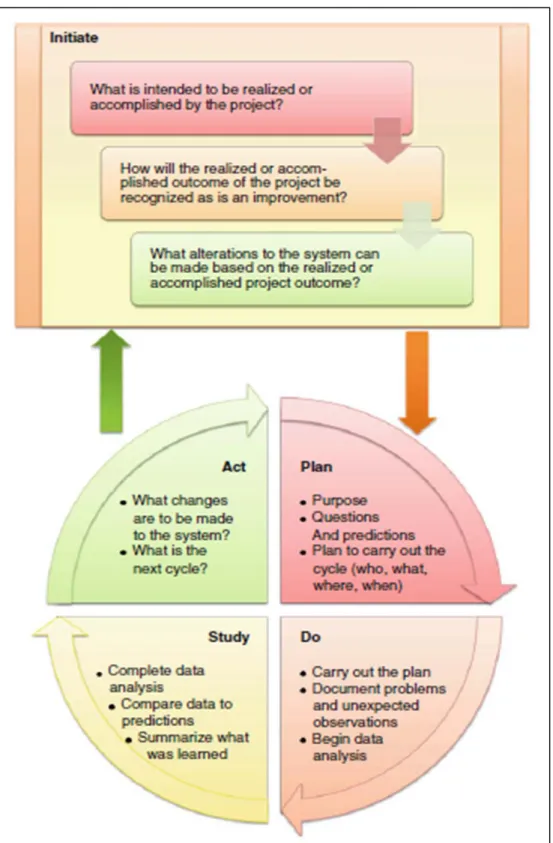
According to Aartsengel and Kurtoglu (2013b), “the PDSA model for improvement is intended to drive all process improvement projects through its Plan-Do-Study-Act (PDSA) Cycle,” illustrated in Figure 2 (p. 28). From a project management perspective, the PDSA model is a framework for the application of knowledge, skills, tools and techniques for “process improvement” teams to meet their “process improvement” project requirements (Aartsengel & Kurtoglu, 2013b, pp. 28–29). In other words, the PDSA model provides the “how-to” guide for leading project teams through the process improvement steps. However, for the purposes of this report, the project team will only proceed through the Plan, Do, and Study phases of the PDSA model. The Act phase (i.e., what the GSBPP ought to do, or should do, about its present approaches to facilitating student projects and theses) is a consideration for GSBPP leadership, faculty and staff.
Planning Phase key tasks include describing the project’s purpose, developing
research questions, and designing the project plan. These tasks are principally described and executed in Chapters I and III.
The Do Phase entails executing the plan, documenting observations, and
beginning data analysis. These steps are chiefly performed in Chapter IV of this report. Finally, during the Study Phase, project teams complete data analysis and
summarize lessons learned. We carry out these actions in Chapter V.
C. PERFORMANCE MEASURES: VALUE, CONTENT, AND PROCESS
In the co-authored text, A Guide to Continuous Improvement Transformation: Concepts, Processes, Implementation, Aartsengel and Kurtoglu discuss the importance of
selecting the “right” performance measures: “Within an enterprise business, there is a variety of things on which performance measures that can be defined. But the right performance measures will provide focus and clarity to the management and the remaining employees” (Aartsengel & Kurtoglu, 2013a, p. 72). Aartsengel and Kurtoglu (2013a) also discuss the downfall of focusing only on generic performance measures:
Defining and developing generic or standard industry-approved performance measures should not be sufficient as these generic performance measures are satisfactory for maintaining the status quo, keeping the enterprise business running, but not for taking the enterprise business to the next stage of maturity and differentiate itself from the competition. In today’s highly competitive and increasingly services-oriented marketplace, it is vital that an enterprise business differentiates itself from the competition. (p. 72.)
In an effort to identify the “right” performance measures, the project team will introduce and develop three performance measures in this report: capstone value, capstone content, and capstone process. None of these measures was developed in a vacuum; rather, they emerged naturally as the project team listened to the voices of process, business, and customer. Consequently, we believe that we have identified the correct performance measures, and we will attempt to qualify and quantify value, process, and content in the coming chapters.
Figure 2. Plan-Do-Study-Act (PDSA) Model for Continuous Process Improvement. Source: Aartsengel & Kurtoglu (2013b)
III.
METHOD
A. INTRODUCTION
As presented in Chapter I, the objective of this project is to describe the existing GSBPP approach to facilitating student projects and theses. To achieve our objective, the project team proceeded through three phases in order to accurately define the existing as-is state. The first two phases allowed the project team to gain a rudimentary understanding of the capstone project; the final phase provided us with a fuller understanding of the existing as-is state. For the remainder of this report, the project team will use the term capstone interchangeably as a word that is inclusive of both GSBPP
projects and GSBPP theses; it does not refer to a course of instruction.
During Phase 1, the project team analyzed observations from a sample of 150 student responses to the GSBPP exit survey (hereafter, exit survey). In Phase 2, we analyzed detailed observations from a sample of 74 published GSBPP projects and theses (hereafter, archived projects). Also during Phase 2, we analyzed observations from NPS faculty advisement data for more than one thousand advisements performed between 2011 and 2015 (hereafter, advisement data).
Our collective observations from the exit survey, archived projects, and advisement data (Phases 1 and 2) highlighted the basic features of the GSBPP capstone project. These same observations guided our development of faculty interview and student survey questions in Phase 3. During Phase 3, the project team sought to define the capstone’s features more precisely by detailing its value, content, and process.
B. PHASE 1: EXIT SURVEYS
Before graduating classes depart, the GSBPP staff attempts to gather student feedback through exit surveys. The exit survey collects feedback as it pertains to specific aspects of the GSBPP program, allowing students to provide their critique on individual courses, Joint Professional Military Education (JPME), intended learning outcomes, and other program elements. The project team obtained three years of exit survey data that
includes 150 total responses from six graduating classes (June ’13, ’14 and ’15; December ’13, ’14 and ’15).
Student responses to the following four exit survey questions had particular relevance to the project team’s study.
1. How would you describe your overall level of satisfaction with your program?
Very Satisfactory
Satisfactory
Neither Satisfactory Nor Unsatisfactory
Unsatisfactory
Very Unsatisfactory
2. Overall, I would rate the MBA Project (or Thesis) experience as…
Outstanding
Very Good
Fair
Poor
3. Overall, I would rate the support from my MBA thesis/project advisors as…
Outstanding Very Good Fair
Poor
4. Make any comments you wish concerning your experience with and/or suggestions concerning the MBA Project (or Thesis).
overall level of satisfaction with his or her GSBPP program—served as a benchmark for evaluating the second question, which specifically targets the student’s level of satisfaction with the capstone itself. The third question asks students to assess the level of support each received from their capstone advisors.
The project team performed a thematic analysis of student responses to the fourth and final question, which asks students to comment on their MBA project or thesis experience (see Appendix B). Our review of all comments revealed that only 79 of the 150 entries were substantial and relevant to our study. We dismissed the remaining 71 entries for one or more of the following reasons.
1. The survey entry is blank.
2. The respondent chose to respond with “no comment” or words to that effect.
3. The survey entry is outside of GSBPP’s direct purview to address (e.g., comments about the Thesis Processing Office; comments about group dynamics within the project team).
4. The survey entry is not relevant to the MBA project or thesis (e.g., comments about GSBPP academic courses).
5. The survey entry is too brief to discern its meaning (e.g., comments such as “very time consuming,” “great program,” and “went just fine”).
6. The survey entry is too particular to ascertain broad generalizations about the holistic MBA project or thesis experience (e.g., comments about specific advisors or about specific topics).
After dismissing the immaterial comments, the project team investigated each relevant comment to identify generalizable themes that might apply holistically to the typical GSBPP student. Our analysis identified three themes (or performance measures) that resonated throughout the bulk of student responses: capstone value, capstone content, and capstone process.
2. Voice of the Customer
The GSBPP exit survey helped the project team to satisfy the voice of the customer (V.O.C.) data collection requirements for applying the Plan-Do-Study-Act (PDSA) model for continuous process improvement. Survey responses provided sufficient and accurate information about the students’ requirements, expectations, and experiences related to the GSBPP capstone. The exit survey comments provided
qualitative V.O.C. data about customer needs as described through the students’ own words and narrative statements, which the project team grouped together by highlighting key words and extracting themes (Aartsengel & Kurtoglu, 2013b, p. 77).
C. PHASE 2A: GSBPP ARCHIVED PROJECTS
Archived projects helped to define the GSBPP capstone’s existing as-is state by describing the typical output (or content) contained within published reports. NPS publishes unclassified reports on Dudley Knox Library’s public website (library.nps.edu/ web/library/nps-theses). The project team reviewed a sample of seventy-four GSBPP projects from 2014: 23 are from March, two are from June, and 49 are from December 2014. The project team selected this sample because it included many of the most recent capstones available for public viewing on the NPS website (at the time of the project team’s study).
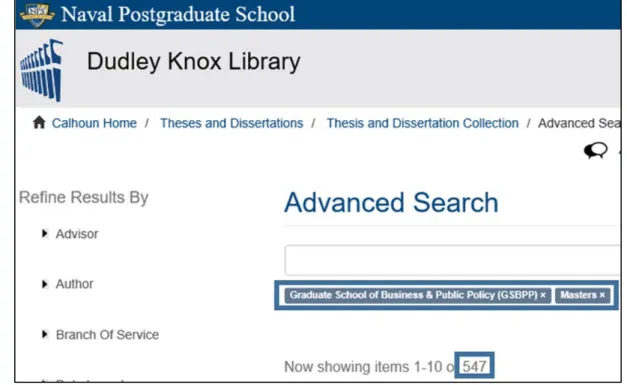
The project team also selected our sample size (74) in order to achieve a desired 90 percent level of confidence that the point estimate represents the population parameter. At the time of the project team’s study, there were 547 GSBPP capstones archived in the NPS repository (see Figure 3). The sample size selected achieves a ± 8.9 percent margin of error that the sample estimate represents the total population of GSBPP capstones. The project team is comfortable with our selected confidence interval given that many researchers typically use confidence levels that range from 80 to 99 percent (Rumsey, 2016). Using free statistical calculations available on the World Wide Web, we determined that 74 capstones is an appropriate sample size (see Figure 4).
Figure 3. Total Number of GSBPP Capstones (547). Source: Naval Postgraduate School Dudley Knox Library (2016)
Figure 4. Capstone Sample Size Determination (74 Reports). Source: Calculator.net (2016); Raosoft (2016); Select Statistical Services
(2016)
1. Analysis Approach
An archived project is similar to a “finished product” that reveals its creation process during product disassembly. Just as manufacturers can learn how to fabricate complex items through reverse engineering, so too did the project team gain insight into how GSBPP capstones are produced by reducing each archived project into its basic
elements. We recorded the common features of archived projects such as the report type, sponsorship status, content elements, and descriptive statistics to identify and document content trends within the collective sample.
2. Voice of the Process
The archived projects helped the project team to satisfy the voice of the process (V.O.P.) data collection requirements for applying the PDSA model. Common capstone features describe the capstone process in explicit and implicit terms. Explicitly, content elements describe the process’s output in the form of finished theses and projects. Implicitly, content elements give inference to the inputs required to produce GSBPP capstones—the number of authors, advisors, and pages needed to produce a typical GSBPP capstone report, for instance. Output (Content) elements provided qualitative V.O.P. data that the project team also summarized by means of counts in order to produce quantitative V.O.P (Aartsengel & Kurtoglu, 2013b, p. 205).
D. PHASE 2B: FACULTY ADVISEMENT DATA
Faculty advisement data is recorded in Python, the web-based education management system that NPS uses to automate and streamline many education management processes. NPS students enter thesis information into Python including advisor names (Naval Postgraduate School, 2009, p. 35). The project team obtained a Python-generated record showing that 1,115 advisements on GSBPP capstones occurred between 2011 and 2015 (see Table 2). “Total advisements” is distinct from “total capstones” because this record does not show if one or more faculty advisors teamed together on any particular capstone, even though project teaming occurs quite often. The record does distinguish between the number of capstone advisors that are full-time GSBPP employees (81), part-time GSBPP employees (18), and employees that are external to GSBPP (62).
Table 2. Total GSBPP Capstone Advisements between 2011 and 2015
Year Total Advisements
2011 185 2012 235 2013 219 2014 240 2015 236 Grand Total 1,115 1. Analysis Approach
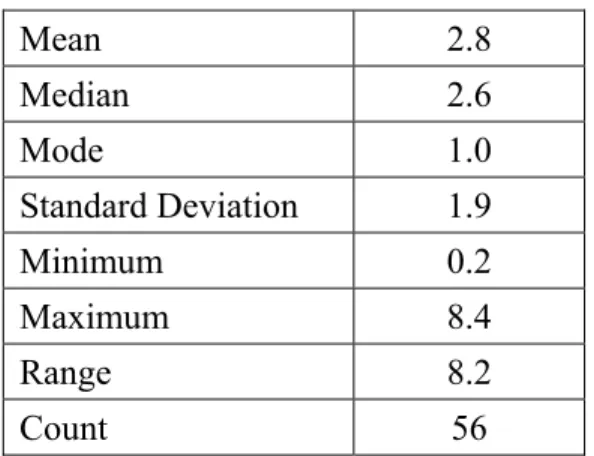
The project team looked for workload distribution trends by comparing average outputs for GSBPP full-time faculty members over time. The project team limited our analysis to full-time faculty members since this population is the focus of the GSBPP’s process improvement efforts. Additionally, the project team noted workload distribution trends by advisor type (i.e., full-time GSBPP faculty, part-time GSBPP faculty, and external (non-GSBPP) faculty types).
The greatest challenge encountered when determining the average output for full-time faculty members concerned “breaks” in advising over full-time. For example, if Advisor X has advisement data entered for 2012, 2013, and 2015 (say, 4, 7, and 4, respectively), but no data is captured for 2011 or 2014 (i.e., the cells are “blank”), does Advisor X’s average output equal 5.0 advisements per year (= (4 + 7 + 4) ÷ 3)? Should it instead equal 3.0 advisements per year for the entire five-year period (= (0 + 4 + 7 + 0 + 4) ÷ 5)? If NPS did not hire Advisor X until 2012, should his average advisements equal 3.75 for the four-year employment period (= (4 + 7 + 0 + 4) ÷ 4)?
In order to determine the appropriate denominator for each GSBPP full-time faculty member, the project team performed the following steps.
1. With the assistance of our project advisors and the Office of the GSBPP Dean, we confirmed that each faculty member contained in our sample was employed by GSBPP in 2015—the latest year for our sample. We
entered a “0” into Microsoft Excel ® if cells were otherwise blank for each faculty member in 2015.
2. We obtained hiring years for most full-time GSBPP faculty members contained in the sample. In instances where the hiring year was not made available, the project team omitted the faculty member from our sample. This action reduced the sample size for full-time GSBPP faculty
employees from 81 to 56 (25 total).
3. The project team computed average outputs that are inclusive of the entire hiring period for each faculty member (i.e., 20XX – 2015). Faculty
members were not “penalized” for not advising projects during years when they were not employed by GSBPP, and we left the Microsoft Excel ® cells “blank” when calculating their averages. However, averages were adjusted (lowered) when breaks in advising occurred after the faculty member was already employed by GSBPP, and we entered a “0” into the otherwise blank cells when calculating their averages. The project team did not attempt to account for reasons why breaks in advising may have occurred, such as authorized sabbaticals, maternity leaves, illnesses, or other excused absences for individual GSBPP faculty members.
2. Voice of the Business
Advisement data helped the project team to satisfy the voice of the business (V.O.B.) data collection requirements for applying the PDSA model. V.O.B. communicates the business’s return on investment (ROI) and the advisement data helped to identify GSBPP’s ROI expressed as the average number of projects advised per full-time employee on-hand. V.O.B. also provides indicators regarding the business’s sustainability and its ability to meet employee needs (Aartsengel & Kurtoglu, 2013b, p. 69). Faculty advisement data gave insight into the sustainability of the current workload allocation for GSBPP capstones, and indicated whether such an allocation is likely to satisfy the needs of GSBPP employees, such as the need to perceive fairness in workload distribution. Advisement data provided quantitative V.O.B.
E. PHASE 3: INTERVIEW AND SURVEY DESIGN
Applying the PDSA model for continuous process improvement involves data collection from three important sources: the voice of the customer (V.O.C.), the voice of
(Aartsengel & Kurtoglu, 2013b, p. 125). According to Aartsengel and Kurtoglu, “Proactive sources include, but are not limited to, interviews…and surveys” (Aartsengel & Kurtoglu, 2013b, p. 80).
The GSBPP exit surveys, archived projects, and advisement data each provided reactive sources for sourcing V.O.C., V.O.P., and V.O.B. data sufficient to explain the existing GSBPP capstone in basic terms. The project team determined that it needed to employ faculty interviews and student surveys if it wished to define the capstone’s features more exactly. The exit survey, archived projects, and advisement data also introduced themes related to the capstone’s value, content, and process. The project team decided to develop these themes further within the interview and survey designs.
1. Interview Sample Size and Demographics
The project team developed a linear programming (LP) model (see Appendix C) in order to determine the minimum number of faculty interviews needed to gather a wide range of perspectives on the capstone’s value, content, and processes. The model generated twelve interviewees with various characteristics (see Table 3 for the desired
interview sample demographics).
The project team requested to interview each faculty member generated by the LP model. Some faculty members accepted the project team’s invitation to interview while others declined. Ultimately, the project team conducted interviews with 11 full-time GSBPP faculty members with various characteristics (actual interview sample
Table 3. Desired Interview Sample Size and Demographics
Advisement Data No.
Average annual advisements greater than μ (2.799 projects per year) 6 Average annual advisements less than μ (2.799 projects per year) 6
Academic Area
Acquisition Management 2
Financial Management 3
Management 3
Manpower and Economics 2
Operations and Logistics 2
Title Assistant Professor 2 Associate Professor 3 Lecturer 2 Professor 2 Senior Lecturer 3 Tenure Status Non-Tenure Track 6 Tenured, Tenure-Track 4 Untenured, Tenure-Track 2 TOTAL INTERVIEWEES 12 2. Interview Questions
The project team developed 13 interview questions about the capstone’s value, content, and processes (see Appendix D). Although interviewees received the questions in advance of the interview, interviewees were not privy to the theme associated with each question.
Value Questions: 3
Content Questions: 2
Process Questions: 8
3. Interview Analysis Approach
The project team reviewed and summarized key findings from audio recordings and handwritten notes collected during faculty interviews. The interviews provided qualitative V.O.B. as described through the faculty members’ own words and narrative statements, which the project team grouped together by highlighting key words and identifying themes. A presentation of our findings from the faculty interviews is found in Chapter IV.
Table 4. Actual Interview Sample Size and Demographics
Advisement Data No.
Average annual advisements greater than μ (2.799 projects per year) 4 Average annual advisements less than μ (2.799 projects per year) 7
Academic Area
Acquisition Management 3
Financial Management 5
Management 2
Manpower and Economics 0
Operations and Logistics 1
Title Assistant Professor 1 Associate Professor 2 Lecturer 3 Professor 3 Senior Lecturer 2 Tenure Status Non-Tenure Track 6 Tenured, Tenure-Track 5 Untenured, Tenure-Track 0 TOTAL INTERVIEWEES 11
4. Survey Population Size and Demographics
The project team distributed the survey electronically to 119 GSBPP students in their sixth academic quarter, which represents the entire GSBPP student population beginning their studies at NPS in the fourth quarter of fiscal year 2015 (minus the three authors of this report). The project team selected this population after determining that sixth-quarter students represented the population most capable of providing
comprehensive feedback on the holistic capstone experience from start to finish. The project team also anticipated receiving a high response rate (30–40 percent or better) because of our established rapport with the target population. Students were invited to participate in the survey via electronic mail request (see Figure 5). The demographic makeup of the survey population is provided in Table 5.
Figure 5. Survey Participation Request
Table 5. Survey Population Size and Demographics
Academic Area Curriculum No.
Acquisition Management (815, 816) 33
Defense Management (818, 820) 5
Defense Systems Analysis (817) 9
Financial Management (837) 24
Financial Management (Energy) (838) 3
5. Survey Sample Size and Demographics
Sixty-seven of 119 students responded to the survey for a response rate of 56.3 percent. The demographic makeup of the survey sample is provided in Table 6.
Table 6. Survey Sample Size and Demographics
Academic Area Curriculum No.
Acquisition Management (815, 816) 21
Defense Management (818, 820) 2
Defense Systems Analysis (817) 7
Financial Management (837) 11
Financial Management (Energy) (838) 3
Information Management (870) 1
Logistics Management (819, 827) 8
Manpower Systems (847) 14
TOTAL SAMPLE 67
6. Survey Questions
The project team developed 20 survey questions about the capstone’s value, content, and processes (see Appendix E).
Value Questions: 5
Content Questions: 2
Process Questions: 13
TOTAL SURVEY QUESTIONS 20
7. Survey Analysis Approach
The project team performed a descriptive analysis of survey responses. The survey responses provided both qualitative and quantitative V.O.C. that the project team used to build a factual representation of the existing GSBPP approach to facilitating student capstones. A full presentation of our findings and analysis regarding the student survey is provided in Chapter IV.
IV.
ANALYSIS AND FINDINGS
A. PHASE 1: EXIT SURVEY
As noted in Chapter III, the GSBPP exit survey helped the project team to satisfy the voice of the customer (V.O.C.) data collection requirements for applying the Plan- Do-Study-Act (PDSA) model for continuous process improvement. The project team analyzed observations from a sample of 150 student responses to the exit survey in order to understand and capture the students’ stated and unstated needs, wants, and desires with respect to the GSBPP capstone. Responses to four exit survey questions, in particular, shed light on the students’ requirements for the capstone.
1. Student Overall Satisfaction with their GSBPP Program, 2013–2015
An exit survey question asked students to rate their degree of satisfaction with their particular GSBPP program (e.g., acquisition management, defense systems analysis, financial management, etc.) using a five-point Likert scale with ordered responses as follows.
How would you describe your overall level of satisfaction with your program?
Very Satisfactory
Satisfactory
Neither Satisfactory Nor Unsatisfactory
Unsatisfactory
Very Unsatisfactory
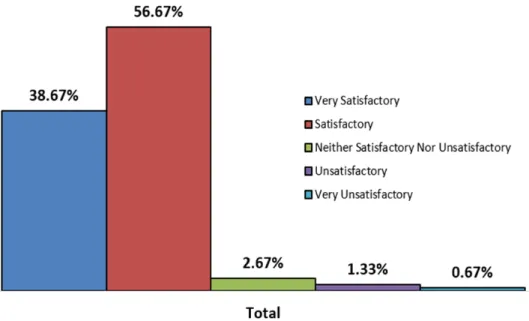
Over 95 percent of respondents replied with either very satisfactory (38.67
percent) or satisfactory (56.67 percent), indicating that GSBPP students had a mostly favorable view of their academic programs (see Figure 6). Moreover, favorability has
Exit survey question No. 4 asked students the following question: How would you describe your overall level of satisfaction with your program?
Figure 6. Exit Survey Question No. 4
Table 7. Academic Program Level of Satisfaction 2013–2015
2013 2014 2015 Total
Row 2 Total Respondents 49 60 41 150
Row 3 Count “Very Satisfactory” 20 21 17 58
Row 4 Count “Satisfactory” 28 34 23 85
Row 5 Count “Favorable”
(Row 3 + Row 4) 48 55 40 143
Row 6 Percent Favorable
(Row 5 ÷ Row 2) 97.96% 91.67% 97.56% 95.34%
Row 7 Delta - 6.29% + 5.89%
Overall, I would rate the MBA Project (or Thesis) experience as… Outstanding
Very Good Fair
Poor
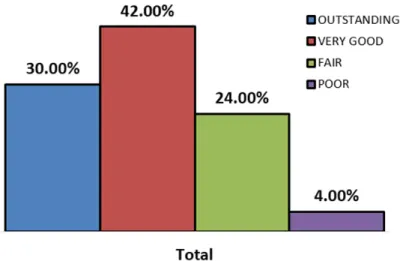
Seventy-two percent of respondents replied with either outstanding (30 percent)
or very good (42 percent), indicating that GSBPP students had a somewhat favorable
view of the GSBPP capstone (see Figure 7). Moreover, survey results show a downward trend in favorability from 81.63 percent in 2013 to 65.85 percent in 2015 (see Table 8, Rows 6 and 7).
Exit survey question No. 9 asked students the following question: Overall, I would rate the MBA project (or Thesis) experience as?
Table 8. MBA Project/Thesis Experience Favorability 2013–2015
2013 2014 2015 Total
Row 2 Total Respondents 49 60 41 150
Row 3 Count “Outstanding” 19 16 10 58
Row 4 Count “Very Good” 21 25 17 85
Row 5 Count “Favorable”
(Row 3 + Row 4) 40 41 27 108
Row 6 Percent Favorable
(Row 5 ÷ Row 2) 81.63% 68.33% 65.85% 72.00%
Row 7 Delta - 13.30% - 2.48%
3. Student Satisfaction with their Capstone Advisors, 2013 – 2015
An exit survey question asked students to rate their degree of satisfaction with their capstone advisors, also using a four-point Likert scale with ordered response levels.
Overall, I would rate the support from my MBA thesis/project advisors as… Outstanding
Very Good Fair
Poor
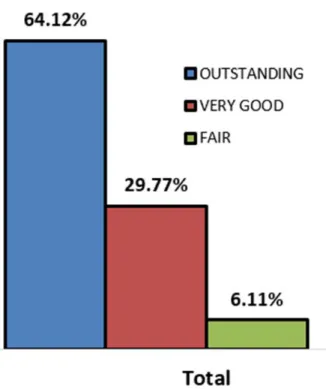
Nearly 94 percent of respondents replied with either outstanding (64.12 percent)
or very good (29.77 percent), indicating that GSBPP students had a mostly favorable
view of their capstone advisors (see Figure 8). Survey results do show wide variations in favorability from one year to the following year (see Table 9, Rows 6 and 7).
Exit question No. 14 asked students the following question: Overall, I would rate the support from my MBA thesis/project advisors as?
Figure 8. Exit Survey Question No. 14
Table 9. MBA Project/Thesis Advisor Favorability 2013–2015
2013 2014 2015 Total
Row 2 Total Respondents 39 51 41 131*
Row 3 Count “Outstanding” 24 33 27 84
Row 4 Count “Very Good” 10 18 11 39
Row 5 Count “Favorable”
(Row 3 + Row 4) 34 51 38 123
Row 6 Percent Favorable
(Row 5 ÷ Row 2) 87.18% 100% 92.68% 93.89%
Row 7 Delta +12.82% - 7.32%
4. Student Survey Comments, 2013 –2015
Through the analysis described below, the project team developed the following key definitions.
1. Capstone Value – the degree of intrinsic and extrinsic usefulness, worth, and importance that one derives from the capstone often with
consideration given to the degree of value derived from other sources. 2. Capstone Content – the composition, arrangement, and presentation of
information within the capstone document.
3. Capstone Process – the series of sequential and concurrent steps, both obligatory and optional, taken by members of the capstone team to produce the capstone document. The capstone team members include, among others, the capstone author(s) and capstone advisor(s).
a. Thematic Analysis of Exit Survey Comments
An exit survey question asked students to comment on their MBA project or thesis experience. The project team performed a thematic analysis of student comments. We highlighted key words and categorized comments by topic to identify themes, shown with examples in Table 10 (see Appendix B for the complete thematic analysis). Our analysis identified three major themes (or performance measures) that resonated throughout the bulk of student responses: capstone value, capstone content, and capstone process.
Each comment also expressed the student’s positive, neutral, or negative reaction to the comment’s associated theme. If the comment expressed the student’s clearly positive reaction to the theme, then the project team assigned a “+” (positive reaction) to the comment. Similarly, the project team assigned a “-” if the student had either a clearly negative reaction to the theme, or if the student recommended corrective actions to rectify some perceived shortcoming. The project team assigned a “N” if the comment was either clearly neutral, or if neutrality resulted from the offsetting of positive and negative reactions communicated through a single response.
Table 10. GSBPP Exit Survey Comments: Thematic Analysis Illustration
Actual Survey Comment Extracted Theme
Reaction (+,N,-)
What’s the difference between an MBA project and a thesis? I’m still trying to figure that out. Was not ever made clear. Recommend GSBPP either go all MBA projects all theses. Unnecessary complication.
Content -
Why do we do this? If I am not being forced to work on a DOD-sponsored project than why do I have to do a thesis? There is no rational I have heard to justify this requirement other than supporting the needs of the fleet - which isn’t even required.
Content -
More guidance on the process. It felt very much like trial and error as to who needed what signatures and when we needed them as well as how the editing would go. There should be some single flow chart that helps explain the process.
Process -
The MBA Project process was very good for me. Our advisor faculty members were very encouraging and helpful throughout the process. The thesis processing office also did great work. My biggest challenge was managing controversy and work equity within my MBA Project team.
Process +
After completing the requirement, I am still uncertain if there was any real value added. In fact, I could argue that the requirement had somewhat forced me to put forth less of an effort in my core MBA courses starting in my 4th quarter. I would prefer additional classes added to the curriculum rather than the MBA Thesis/Project requirement. I feel the additional classes would provide more benefit than the thesis requirement.
Value -
The MBA Thesis allowed me to contemplate the skills I gained, find an area of interest to study, and apply my new tools on a project. The MBA Thesis added value to my education.
Value +
The project team investigated 79 survey comments and categorized five as content-related comments, 34 as value-related, and 40 as process-related comments (see Table 11). These general categories, however, do not supplant the reality that many comments did, in fact, espouse multiple themes. For simplicity, the project team narrowed our analysis and matched each comment to the single theme it most exemplified.
Table 11. Exit Survey Comments Summary
Reaction Content Process Value
Positive (+) 1 3 23
Neutral (N) 1 6 0
Negative (-) 3 31 11
Total 5 40 34
5. Findings
The GSBPP exit survey provided a reactive source for pulling V.O.C. data from student respondents. The students’ stated requirements for the GSBPP capstone include the need to understand its value, processes, and content. Recently, GSBPP students had a
mostly favorable view of their academic programs and capstone advisors (95.34 percent
and 93.89 percent, respectively), but the same pool of respondents had an only somewhat favorable view of the capstone itself (72 percent). This finding suggests that although
GSBPP has largely satisfied the need to provide students with a quality education and advisement support, GSBPP has performed less admirably in satisfying the student’s need to understand the capstone’s value, processes and content.
Regarding capstone value, Table 11 shows that more than twice as many students derived positive value from the capstone (68 percent, or 23 of 34 comments on value) as derived negative value from the capstone (32 percent, or 11 of 34 comments on value). However, students experienced negative overall reactions to capstone processes (78 percent, or 31 of 40 comments on process) and capstone content (60 percent, or 3 of 5 comments on content). The volume of process comments (40 total) in relation to the value and content categories (34 and 5 comments, respectively) suggests that capstone
processes are perhaps the students’ most important measure of GSBPP performance followed by capstone value and finally, capstone content.
B. PHASE 2A: GSBPP ARCHIVED PROJECTS
GSBPP archived projects provided voice of the process (V.O.P.) data for applying the PDSA model. The project team was able to describe the process’s inputs by reviewing content elements within archived projects (e.g., the number of authors, advisors, and pages that are needed, etc.) and the output (i.e., published capstone reports) involved during the creation of GSBPP projects and theses. In order to gain a better understanding of the process, the project team reviewed a sample of 74 archived capstones and identified key components. We recorded common features such as the capstone’s type, funding and sponsorship status, and generated descriptive statistics in order to identify and document content trends throughout the collective sample.
1. Capstone Distribution by Capstone Type
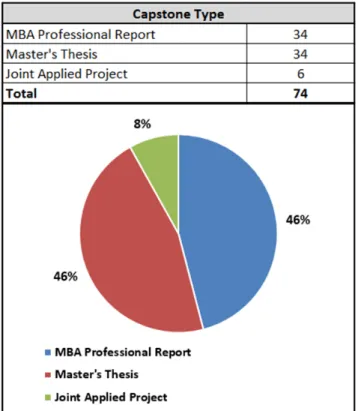
GSBPP capstones consist of three types: the MBA professional report, the Master’s thesis, and the joint applied project (see Figure 9). Although the three capstone types are substantively identical in both structure and execution, certain nuances do exist. For instance, most resident GSBPP students have the option to perform either the MBA professional report or the master’s thesis, but some GSBPP curriculums (like 817, Defense Systems Analysis) only allow the thesis option. All non-resident (i.e., Distance Learning) GSBPP students must perform the joint applied project, which is not an option available to resident GSBPP students.
Because the structure and execution of each type is essentially the same, the project team did not attempt to identify and analyze variations in capstone content relative to the capstone’s type. However, the project team acknowledges that variations in capstone processes or derived capstone value could exist relative to the capstone’s type. We propose this area for future research later in Chapter V.
Figure 9. Capstone Distribution by Capstone Type
2. Capstone Distribution by Funding and Sponsorship
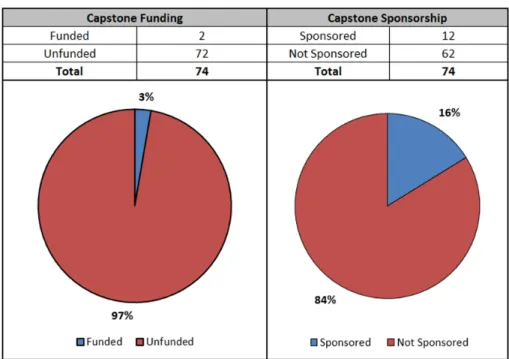
Capstone funding and sponsorship statuses are recorded on the Standard Form (SF) 298, Report Documentation Page. The SF 298 accompanies each capstone as an official record and is usually found on page i of the published capstone report. The
project team recorded funding and sponsorship statuses for each capstone contained in our sample. According to our findings, U.S. Department of Defense (DOD) agencies sponsored 12 of 74 capstones (16 percent) while funding two of 74 capstones (three percent). See Figure 10.
Figure 10. Capstone Distribution by Funding and Sponsorship
3. Number of Authors, Advisors, Chapters, and Appendices per Capstone
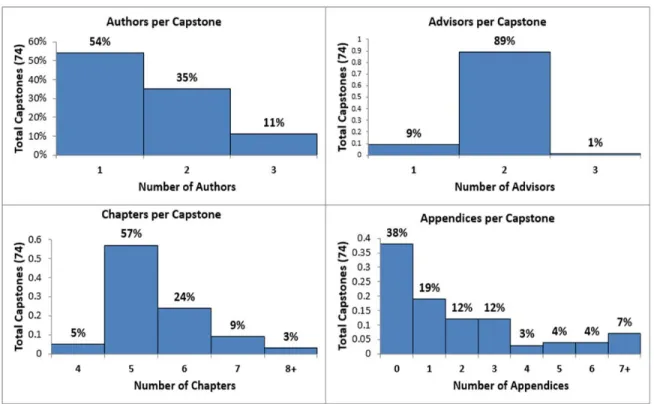
The project team recorded the number of authors, advisors, chapters, and appendices for each capstone and concluded that the typical GSBPP student from our sample opted to work alone (54 percent), select two capstone advisors (89 percent), author five capstone chapters (57 percent) and create very few appendices, if any (see Figure 11).
Figure 11. Number of Authors, Advisors, Chapters, and Appendices per Capstone (74 Total)
4. Number of Pages per Capstone
Table 12 presents descriptive statistics for the number of pages per capstone. The typical capstone from our sample contained 102 ± 9.8 pages with 95 percent confidence. There is a considerable range in page count between the lowest count (39 pages) and the highest count (319 pages). The page count is a cover-to-cover count that includes cover pages, title pages, blank pages, abstracts, executive summaries, and author acknowledgements, tables of content, appendices, references, and lists of figures, tables and acronyms as applicable.