Evolution of collective and non-collective structures in
123Xe
Anwesha Basu and A. K. SinghDepartment of Physics, Indian Institute of Technology Kharagpur, Kharagpur 721302, India S. Nag
Department of Physics, Indian Institute of Technology (BHU), Varanasi 221005, India G. B. Hagemann, G. Sletten, and B. Herskind
Niels Bohr Institute, Blegdamsvej 17, DK-2100 Copenhagen Ø, Denmark A. N. Wilson∗ and J. Rogers
R. S. P. E., ANU, Canberra, ACT 0200, Australia I. Ragnarsson
Division of Mathematical Physics, LTH, Lund University, Box 118, SE-221 00 Lund, Sweden H. Hübel and S. Chmel†
Helmholtz-Institut für Strahlen- und Kernphysik, Universität Bonn, Nussallee 14-16, D-53115 Bonn, Germany R. V. F. Janssens
Department of Physics and Astronomy, University of North Carolina at Chapel Hill, Chapel Hill, North Carolina 27599, USA and Triangle Universities Nuclear Laboratory,
Duke University, Durham, North Carolina 27708, USA
M. P. Carpenter, T. L. Khoo, F. G. Kondev, T. Lauritsen, and S. Zhu Physics Division, Argonne National Laboratory, Argonne, Illinois 60439, USA
A. Korichi
CSNSM-IN2P3, F-91405 Orsay Campus, France P. Fallon
Nuclear Science Division, Lawrence Berkeley National Laboratory, Berkeley, California 94720, USA B. M. Nyakó and J. Timár
Institute for Nuclear Research, Hungarian Academy of Sciences, H-4001 Debrecen, Hungary (Dated: November 9, 2019)
An experiment involving a heavy-ion induced fusion-evaporation reaction was carried out where high-spin states of 123Xe were populated in the 80Se(48Ca, 5n)123Xe reaction at 207 MeV beam energy. Gamma-ray coincidence events were recorded with the Gammmasphere Ge detector array. The previously known level scheme was confirmed and enhanced with the addition of five new band structures and several inter-band transitions. Cranked Nilsson-Strutinsky (CNS) calculations were performed and compared with the experimental results in order to assign configurations to the bands.
Keywords: Nuclear reaction: 80Se(48Ca,5n)123Xe; E= 207 MeV; Measuredγγ-coincidences; E
γ; Rθratios; 123Xe deduced levels; spin and parity; Cranked Nilsson-Strutinsky model calculation
∗Present address : Faculty of Social Sciences, University of Stir-ling, Stirling FK9 4LA, UK
†Present address : Fraunhofer INT, Appelsgarten 2, D-53879 Eu-skirchen, Germany
I. INTRODUCTION
The transitional nuclei lying between the spherical Sn (Z=50) and the deformed Ce (Z=58) isotopes in the
nu-Carpenter MP, Khoo TL, Kondev FG, Lauritsen T, Zhu S, Korichi A, Fallon P, Nyako BM & Timar J (2020) Evolution of collective and noncollective structures in Xe-123. Physical Review C, 101 (2), Art. No.: 024309. https://doi.org/10.1103/PhysRevC.101.024309
therefore, exhibit a rich variety of structures and defor-mation effects. Shape changes, from prolate to oblate via triaxial, are observed in these nuclei by excitation of nu-cleons to various deformation-driving orbitals [1, 2]. In the A=125 mass region, the unique-parity intruder or-bital, h11/2, is accessible to both protons and neutrons. Fig. 1 displays the energy levels calculated using the modified oscillator potential [3], whereA= 110 parame-ters have been used [4]. For a general understanding of the valence space orbitals, this diagram can be used also for protons. Thus, in addition to the orbital of the odd neutron in the ground state forN=69, the orbital occu-pied by the last proton pair for Z=54 is indicated. The neutron Fermi surface, which controls the extent of triax-iality, lies in the middle to upper part of the shell, whereas the proton Fermi surface lies in the lower part. In the low- and medium-spin region, the protons and neutrons in h11/2 orbitals have opposite deformation-driving ef-fects. Nuclei are driven towards a prolate shape when the
h11/2 protons get aligned due to rotation-induced Cori-olis effects, whereas an oblate shape is favored after the alignment ofh11/2 neutrons [1]. This interplay produces quite interesting shape coexistence effects [1, 2, 5–12]. In this mass region, it is favorable to consider114Sn as the closed core so that low-lying, oblate, fully-aligned states are formed at the Imax values of the respective config-urations formed from the valence nucleons. As seen in Fig. 1, for 123Xe, this corresponds to four valence pro-tons and five valence neutrons above theZ=50 andN=64 shell gaps. Using the availablej-shells, a maximum spin around or just aboveI=30 is easily achievable with the possible configurations. The evolution with spin makes it possible to investigate the interaction between config-urations with low or no collectivity. Another interesting aspect is the similarity between the availability of the neutron orbitals for nuclei above a 114Sn core (Z=50,
N=64) with that of the proton orbitals above a 146Gd core (Z=64,N=82) along with their distribution in these two mass regions [7, 13]. In the A=150-160 mass region, band termination has been observed [13, 14]. The inter-play between single-particle and collective excitations has been studied in detail in Refs. [10, 14, 15]. Maximally aligned states, with 8 to 11 particles, have been reported
tion, non-collective states where the angular momentum of one or two particles are anti-aligned with respect to the rotation axis formed by the valence particles have been observed in120Te [16], and123,125I [18, 19]. Several low-intensity, high-energy gamma rays have been observed to feed maximally-aligned states in121I [21],123I [18],123Cs [7] and124Ba [9]. Theoretical calculations suggest that these transitions originate from configurations involving excitations across the N=64 core [7, 9, 18, 19].
5.4 5.6 5.8 6 6.2 Single-neutron energies, e i ( osc. un.) ω/ω0 ε 2 0 0.22 0.08 64 74 64 [402]5/2 [404]7/2 [411]1/2 70 0.1 0 0.02 0.06 A = 110 param. 50 56 55 [404]9/2 123 54
Xe
d5/2 ε2 = 0.22, γ = 0ο, ε4 = 0.01 g7/2 s1/2 h11/2 d3/2 g9/2FIG. 1. (Color online) Single-particle neutron energies at a prolate shape as a function of the deformation parameter,ε2,
(left part) and as a function of the rotational frequency at ε2 = 0.22 (right part). Note that, for a larger quadrupole
deformation and/or rotational frequency, it will be advanta-geous to create proton holes in the g9/2 shell of the Z=50
core, leading to configurations of larger collectivity [17, 22– 24]. Negative-parity orbitals are drawn by dashed lines while dots are used for signatureα= -1/2 orbitals, i.e. full lines are used for (π, α) = (+,+1/2), dots for (+,-1/2), dashed lines for (-,+1/2) and dashed-dotted lines for (-,-1/2).
The structure of the Xe isotopes, other than that of 123Xe, has been studied in great detail [10, 12, 22, 25– 27] and shape evolution with increasing rotational fre-quency has been reported. In addition, highly deformed rotational bands, extending up to spins aroundI ∼60, have been observed to coexist along with "normally"
de-formed bands in the spin rangeI=20-30 in124,125,126Xe [12, 22, 27]. Similar bands have been observed in other neighboring nuclei such as 120,122Te [16, 17] and123,125I [18, 19].
In this article, the results obtained from high-spin gamma-ray spectroscopy of the 123Xe isotope are dis-cussed. The previously known level scheme of this nu-cleus [28–30] has been considerably extended. Cranked Nilsson-Strutinsky (CNS) model calculations were per-formed to assign configurations to the observed struc-tures.
The experimental details and the data analysis methods are presented in Sec. II. Section III deals with the ex-perimental results and the partial level scheme that has been established in the present work. In Sec. IV, prob-able configurations assigned to the new band structures are discussed. This is followed by a brief summary of the current work in Sec. V.
II. EXPERIMENTAL DETAILS AND ANALYSIS
In order to study the high-spin states of123Xe, a heavy-ion induced fusheavy-ion-evaporatheavy-ion reactheavy-ion, 80Se(48Ca, 5n)123Xe, was carried out at the Argonne National Labo-ratory. The ATLAS accelerator provided the48Ca beam of 207 MeV energy with an intensity of 4 pnA. The target consisted of80Se at 0.6 mg/cm2thickness evaporated on to a 0.3 mg/cm2Au backing. In addition, a 0.04 mg/cm2 layer of Au was deposited on the Se foil for protection against sputtering. For heat dissipation, the target was mounted on a rotating wheel and the beam was wobbled horizontally and was slightly defocused. With these pre-cautions, the target could withstand a maximum beam intensity of 4 pnA over the period of the experiment. The Gammasphere spectrometer [31], consisting of 101 Compton-suppressed Ge detectors at the time of the ex-periment, was used to measure gamma-ray coincidence relationships. A total of 2.7 × 10⁹ events, with a Ge-detector coincidence fold>4 were recorded over a beam time of 10 days. In this experiment, the high-spin lev-els of 123Xe were populated with an intensity sufficient to carry out this study, even though the main motivation was to search for hyperdeformed structures in124Xe. The
other strongly populated nuclei in the experiment were 124Xe,123I, and120Te via the4n,p4n, andα4nchannels, respectively. The results on124Xe [22],123I [18, 24] and 120Te [16] have already been published.
In the offline analysis, the raw data were pre-sorted. The process includes Compton suppression, pile-up re-jection, gain matching and the calibration of the detec-tors. The RADWARE software package [32] was used to sort theγ-ray coincidence data into two-, three-, and four-dimensional arrays called matrices, cubes, and hy-percubes, respectively.
In order to determine angular distribution ratios, the data were sorted into two matrices. In the first one, the events detected in the detectors mounted around for-ward (35◦) and backward (145◦) angles were placed on one axis (fb), whereas the other (all) contained events de-tected in all the detectors. Similarly, the second matrix had events detected in the detectors around 90◦ on one axis (90), and the events detected in all other detectors on the other axis (all). To determine the angular distri-bution ratios,Rθ, gates were set on the (all) axes of the
matrices. The intensity ratio is given by
Rθ= I(γ1f b, γall 2 ) I(γ90 1 , γ2all) (1)
and is used to distinguish between stretched dipole and stretched quadrupole transitions which have ≈ 0.6 and 1.4 respective values. The stretched quadrupole transi-tions were assumed to be of E2 multipolarity. The an-gular distribution ratio, Rθ, was determined from
spec-tra gated on dipole as well as on quadrupole spec-transitions. The difference in Rθ values with gates on dipole and
quadrupole transitions were within 10% limits. This is expected for a symmetric array such as Gammasphere, where angular distribution effects are averaged out for gating transitions.
The relative intensities of γ rays have been determined from spectra produced with double or triple gates on transitions below theγ ray of interest. The relative in-tensities ofγ rays listed in Table I have been normalized to that of the 616.6 keVγ ray of band 9 withIγ= 1000.
For some of the transitions of low-energy bands, e.g. 4, 5, 10, 11, 14, and 15, intensities could not be determined accurately due to un-availability of a referenceγray for
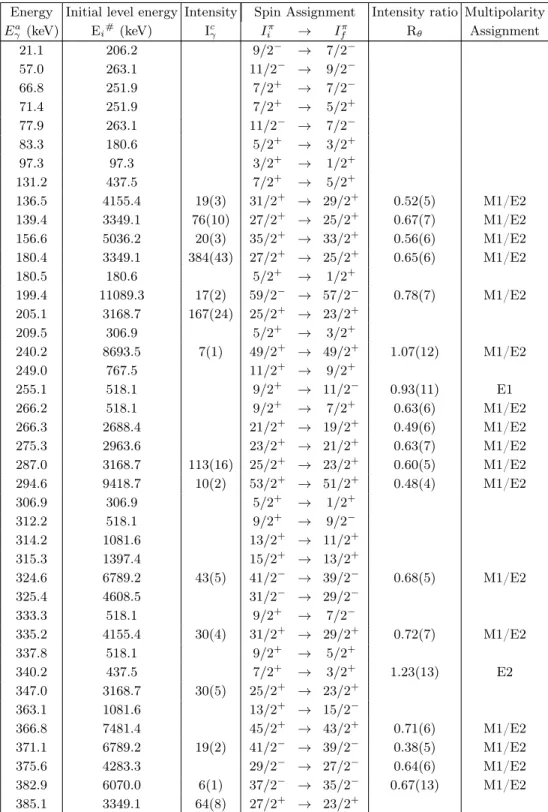
TABLE I: Gamma-ray energies, level energies, intensties, spin assign-ments, angular distribution ratios, and multipolarities, of γ-ray transi-tions of 123Xe. The γ rays with energies less than 100 keV have been adopted from Ref. [28].
Energy Initial level energy Intensity Spin Assignment Intensity ratio Multipolarity Ea
γ (keV) Ei#(keV) Icγ Iiπ → Ifπ Rθ Assignment
21.1 206.2 9/2− → 7/2− 57.0 263.1 11/2− → 9/2− 66.8 251.9 7/2+ → 7/2− 71.4 251.9 7/2+ → 5/2+ 77.9 263.1 11/2− → 7/2− 83.3 180.6 5/2+ → 3/2+ 97.3 97.3 3/2+ → 1/2+ 131.2 437.5 7/2+ → 5/2+ 136.5 4155.4 19(3) 31/2+ → 29/2+ 0.52(5) M1/E2 139.4 3349.1 76(10) 27/2+ → 25/2+ 0.67(7) M1/E2 156.6 5036.2 20(3) 35/2+ → 33/2+ 0.56(6) M1/E2 180.4 3349.1 384(43) 27/2+ → 25/2+ 0.65(6) M1/E2 180.5 180.6 5/2+ → 1/2+ 199.4 11089.3 17(2) 59/2− → 57/2− 0.78(7) M1/E2 205.1 3168.7 167(24) 25/2+ → 23/2+ 209.5 306.9 5/2+ → 3/2+ 240.2 8693.5 7(1) 49/2+ → 49/2+ 1.07(12) M1/E2 249.0 767.5 11/2+ → 9/2+ 255.1 518.1 9/2+ → 11/2− 0.93(11) E1 266.2 518.1 9/2+ → 7/2+ 0.63(6) M1/E2 266.3 2688.4 21/2+ → 19/2+ 0.49(6) M1/E2 275.3 2963.6 23/2+ → 21/2+ 0.63(7) M1/E2 287.0 3168.7 113(16) 25/2+ → 23/2+ 0.60(5) M1/E2 294.6 9418.7 10(2) 53/2+ → 51/2+ 0.48(4) M1/E2 306.9 306.9 5/2+ → 1/2+ 312.2 518.1 9/2+ → 9/2− 314.2 1081.6 13/2+ → 11/2+ 315.3 1397.4 15/2+ → 13/2+ 324.6 6789.2 43(5) 41/2− → 39/2− 0.68(5) M1/E2 325.4 4608.5 31/2− → 29/2− 333.3 518.1 9/2+ → 7/2− 335.2 4155.4 30(4) 31/2+ → 29/2+ 0.72(7) M1/E2 337.8 518.1 9/2+ → 5/2+ 340.2 437.5 7/2+ → 3/2+ 1.23(13) E2 347.0 3168.7 30(5) 25/2+ → 23/2+ 363.1 1081.6 13/2+ → 15/2− 366.8 7481.4 45/2+ → 43/2+ 0.71(6) M1/E2 371.1 6789.2 19(2) 41/2− → 39/2− 0.38(5) M1/E2 375.6 4283.3 29/2− → 27/2− 0.64(6) M1/E2 382.9 6070.0 6(1) 37/2− → 35/2− 0.67(13) M1/E2 385.1 3349.1 64(8) 27/2+ → 23/2+
Energy Initial level energy Intensity Spin Assignment Intensity ratio Multipolarity Eγa (keV) Ei#(keV) Icγ Iiπ → I π f Rθ Assignment 392.6 1269.6 15/2− → 13/2− 394.8 6464.6 11(2) 39/2− → 37/2− 0.68(5) M1/E2 396.3bd 5915.4 196(24) 39/2+ → 37/2+ 396.9bd 7481.4 45/2+ → 43/2+ 399.0 661.9 13/2− → 11/2− 401.3 5687.1 35/2− → (33/2−) 401.6 9356.4 169(20) 53/2− → 49/2− 1.38(12) E2 403.7 4354.9 (31/2−) → 31/2− 408.6 5036.2 17(2) 35/2+ → 33/2+ 0.72(8) M1/E2 417.8 5026.3 35(4) 33/2− → 31/2− 0.67(7) M1/E2 430.1 9124.1 16(2) 51/2+ → 49/2+ 0.92(10) M1/E2 430.9 1953.1 19/2− → 17/2− 455.6 718.7 15/2− → 11/2− 455.7 661.9 13/2− → 9/2− 455.9 5793.4 37/2− → 35/2− 0.68(7) M1/E2 457.6 8074.7 47/2− → 45/2− 462.7 8453.3 111(12) 49/2+ → 47/2+ 0.71(7) M1/E2 466.8 3349.1 28(4) 27/2+ → 23/2+ 470.9bd 3820.2 190(23) 29/2+ → 27/2+ 471.4bd 4627.6 33/2+ → 31/2+ 480.3 3168.7 107(15) 25/2+ → 21/2+ 1.39(16) E2 483.2 5519.1 109(13) 37/2+ → 35/2+ 0.88(10) M1/E2 484.3 2769.2 23/2− → 21/2− 497.0 934.5 11/2+ → 7/2+ 504.1 8693.5 8(1) 49/2+ → 47/2+ 0.66(7) M1/E2 515.1 12235.8 15(3) 63/2− → 61/2− 0.76(6) M1/E2 515.6 767.5 11/2+ → 7/2+ 521.7 6654.9 43(6) 41/2− → 39/2− 0.71(6) M1/E2 523.1 7780.3 45/2− → 43/2− 0.84(8) M1/E2 534.8 12857.6 − → − 541.8 2963.6 23/2+ → 19/2+ 1.29(10) E2 550.5 7616.8 22(3) 45/2− → 43/2− 0.59(6) M1/E2 550.8 1269.6 15/2− → 15/2− 0.71(7) M1/E2 555.7 3905.0 2.0(5) 29/2+ → 27/2+ 558.4 5584.7 35/2− → 33/2− 0.62(7) M1/E2 561.5 6476.8 308(36) 41/2+ → 39/2+ 0.59(6) M1/E2 563.5 1081.6 13/2+ → 9/2+ 566.8 9257.3 16(2) (51/2−) → (49/2−) 0.46(5) M1/E2 574.4 1293.5 17/2− → 15/2− 0.45(6) M1/E2 580.8 6374.2 34(5) 39/2− → 37/2− 0.58(6) M1/E2 582.7 10489.3 9(1) (55/2−) → (53/2−) 591.4 8954.8 33(4) 49/2− → 47/2− 0.97(9) M1/E2 591.5 2821.8 23/2+ → 19/2+ 602.3 7257.2 26(3) 43/2− → 41/2− 0.82(9) M1/E2 607.4 7084.2 207(24) 43/2+ → 41/2+ 0.58(6) M1/E2 607.5 8224.3 25(3) 47/2− → 45/2− 0.60(6) M1/E2 607.7 1269.6 15/2− → 13/2− 0.61(6) M1/E2 (608.8) 3559.7 27/2+ → 25/2− 613.7 877.0 13/2− → 11/2− 0.90(10) M1/E2 614.6 8690.0 (49/2−) → 47/2− 616.6 1335.3 1000 19/2− → 15/2− 1.46(11) E2
Eγa (keV) Ei#(keV) Icγ Iiπ → I π f Rθ Assignment 617.5 1953.1 19/2− → 19/2− 619.0 1553.5 15/2+ → 11/2+ 629.9 1397.4 15/2+ → 11/2+ 1.34(14) E2 631.5 11720.5 15(2) 61/2− → 59/2− 0.63(7) M1/E2 631.6 1293.5 17/2− → 13/2− 1.31(5) E2 633.1 11808.8 48(6) (61/2+) → (59/2+) 0.73(7) M1/E2 644.6 1521.6 17/2− → 13/2− 649.3 9905.7 10(2) (53/2−) → (51/2−) 651.7 2882.4 23/2+ → 19/2+ 1.37(14) E2 655.1 6789.2 15(2) 41/2− → 39/2− 656.8 3478.6 139(18) 27/2+ → 23/2+ 1.37(11) E2 669.8 4018.9 29/2+ → 27/2+ 0.40(5) M1/E2 670.1 9124.1 114(13) 51/2+ → 49/2+ 0.62(7) M1/E2 671.8 3168.7 253(31) 25/2+ → 21/2+ 674.7 11720.5 8(1) 61/2− → 57/2− 675.8 1757.4 17/2+ → 13/2+ 676.5 2230.0 19/2+ → 15/2+ 677.3 3559.7 27(4) 27/2+ → 23/2+ 1.70(21) E2 679.7 2769.2 23/2− → 23/2− 0.44(5) M1/E2 683.5 1953.1 19/2− → 15/2− 1.53(14) E2 684.6 9809.5 6(1) (53/2+) → 51/2+ 685.6 11175.6 3(1) (57/2−) → (55/2−) 695.6 3905.0 7(1) 29/2+ → 25/2+ 1.78(21) E2 700.9 4608.5 182(21) 31/2− → 27/2− 1.74(20) E2 703.4 8693.5 9(1) 49/2+ → 47/2+ 707.6 8189.4 47/2+ → 45/2+ 0.59(7) M1/E2 709.7 2821.8 168(22) 23/2+ → 19/2+ 1.67(18) E2 710.7 5337.4 23(4) 35/2− → 33/2+ 712.1 7969.8 14(2) 45/2− → 43/2− 0.69(7) M1/E2 712.2 7990.6 47/2+ → 43/2+ 712.4 3209.4 79(10) 25/2+ → 21/2+ 1.53(16) E2 714.7 2112.1 19/2+ → 15/2+ 1.30(15) E2 719.2 6789.2 34(5) 41/2− → 37/2− 1.26(14) E2 724.8 4879.6 6(1) 33/2+ → 31/2+ 726.9 2062.0 21/2− → 19/2− 728.9 5337.4 170(20) 35/2− → 31/2− 1.40(15) E2 732.7 2821.8 23/2+ → 23/2− 733.6 2963.6 23/2+ → 19/2+ 1.69(24) E2 734.3 4212.9 123(16) 31/2+ → 27/2+ 1.30(16) E2 735.7 1397.4 15/2+ → 13/2− 737.3 8954.8 55(7) 49/2− → 47/2− 0.82(11) M1/E2 738.9 3907.6 214(29) 27/2− → 25/2+ 0.77(13) E1 739.6 2497.0 119(15) 21/2+ → 17/2+ 1.33(17) E2 743.0 5026.3 71(9) 33/2− → 29/2− 1.71(19) E2 753.8 2089.1 875(81) 23/2− → 19/2− 1.43(15) E2 753.8 5687.1 35/2− → (33/2−) 755.1 4608.5 31/2− → (27/2−) 755.3 10889.9 57/2− → 55/2− 757.0 5793.4 48(6) 37/2− → 35/2+ 762.7 2284.3 21/2− → 17/2− 1.38(17) E2 763.9 2990.9 27/2− → (23/2−)
Energy Initial level energy Intensity Spin Assignment Intensity ratio Multipolarity Eγa (keV) Ei#(keV) Icγ Iiπ → I π f Rθ Assignment 765.9 4325.6 31(4) 31/2+ → 27/2+ 1.35(24) E2 766.5 5793.4 51(6) 37/2− → 33/2− 1.70(19) E2 768.5 2062.0 21/2− → 17/2− 1.56(17) E2 770.3 2882.4 62(8) 23/2+ → 19/2+ 1.41(16) E2 777.7 6464.6 39/2− → 35/2− 1.20(15) E2 778.3 10134.7 127(14) 55/2− → 53/2− 0.65(8) M1/E2 780.2 9904.8 30(5) − → 51/2+ 788.6 6374.2 39/2− → 35/2− 1.26(16) E2 788.7 4608.5 26(4) 31/2− → 29/2+ 0.95(18) E1 796.0 6133.2 132(15) 39/2− → 35/2− 1.40(15) E2 802.8 1521.6 17/2− → 15/2− 806.3bd 4155.4 439(52) 31/2+ → 27/2+ 807.4bd∗ 4627.6 33/2+ → 29/2+ 816.1 2769.2 264(29) 23/2− → 19/2− 1.31(15) E2 818.6 1081.6 13/2+ → 11/2− 819.4 4724.4 18(3) 33/2+ → 29/2+ 1.88(27) E2 819.4 2112.1 19/2+ → 17/2− 820.0 2882.4 23/2+ → 21/2− 830.6 4934.0 19(2) (33/2−) → 29/2− 830.6 11720.5 30(3) 61/2− → 57/2− 1.54(19) E2 848.7 5915.4 9(1) 39/2+ → 35/2+ 850.5 4018.9 40(8) 29/2+ → 25/2+ 1.31(18) E2 853.3 5066.2 105(13) 35/2+ → 31/2+ 1.46(19) E2 858.6 5213.5 (35/2−) → (31/2−) 861.1 2950.6 25/2− → 23/2− M1 861.3 4879.6 54(9) 33/2+ → 29/2+ 1.68(24) E2 861.5 6654.9 33(4) 41/2− → 37/2− 1.69(21) E2 862.1 3853.7 (27/2−) → 27/2− 868.2 3152.5 134(15) 25/2− → 21/2− 1.60(22) E2 871.1 5026.3 33/2− → 31/2+ 875.3 2963.6 23/2+ → 23/2− 875.8 7990.6 47/2+ → 43/2+ 875.9 2965.0 409(45) 27/2− → 23/2− 1.49(18) E2 879.2bd 5915.4 734(88) 39/2+ → 35/2+ 880.8bd 5036.2 35/2+ → 31/2+ 882.2 5207.8 25(4) 35/2+ → 31/2+ 1.40(20) E2 883.7 7257.2 43/2− → 39/2− 887.8 3853.7 (27/2−) → 27/2− 888.6 2950.6 141(17) 25/2− → 21/2− 1.89(27) E2 891.8 5519.1 100(12) 37/2+ → 33/2+ 1.29(18) E2 901.9 2990.9 27/2− → 23/2− 1.84(25) E2 906.4 7990.6 113(14) 47/2+ → 43/2+ 1.43(18) E2 910.9 11045.6 20(2) 57/2− → 55/2− 0.83(12) M1/E2 916.7 3907.6 142(17) 27/2− → 27/2− 919.2 7084.2 5(1) 43/2+ → 39/2+ 926.4 5650.8 9(2) 37/2+ → 33/2+ 1.71(21) E2 933.1 7066.3 68(8) 43/2− → 39/2− 1.48(19) E2 934.2 4283.3 29/2− → 27/2+ 0.74(9) E1 934.9 9124.1 29(4) 51/2+ → 47/2+ 1.23(18) E2 936.1 2230.0 19/2+ → 17/2− 939.9 3905.0 4(1) 29/2+ → 27/2−
Eγa (keV) Ei#(keV) Icγ Iiπ → I π f Rθ Assignment 941.0 13432.6 14(2) 67/2− → 63/2− 1.45(19) E2 942.6 3907.6 300(35) 27/2− → 27/2− 1.08(12) M1/E2 944.3 10068.4 98(12) 55/2+ → 51/2+ 1.53(23) E2 948.9 2284.3 21/2− → 19/2− 1.08(15) M1/E2 950.9 4103.4 86(10) 29/2− → 25/2− 1.48(22) E2 954.6 11089.3 40(5) 59/2− → 55/2− 1.70(23) E2 957.7 6165.5 15(2) 39/2+ → 35/2+ 1.48(22) E2 958.1 6476.8 89(11) 41/2+ → 37/2+ 1.40(21) E2 960.6 6070.0 37/2− → 33/2− 1.62(24) E2 960.8d 8217.8 42(6) 47/2− → 43/2− 961.3 5064.3 (33/2−) → 29/2− 962.5d 7616.8 45/2− → 41/2− 1.62(21) E2 965.4 9418.7 65(8) 53/2+ → 49/2+ 1.63(21) E2 966.7 8224.3 47/2− → 43/2− 967.6 6033.8 117(15) 39/2+ → 35/2+ 1.54(20) E2 971.9 8453.3 112(13) 49/2+ → 45/2+ 1.76(23) E2 985.0 8954.8 49/2− → 45/2− 985.8 3950.8 279(30) 31/2− → 27/2− 1.52(15) E2 1000.1 6418.1 16(2) 39/2− → 35/2− 1.34(16) E2 1004.7 7481.4 102(12) 45/2+ → 41/2+ 1.59(22) E2 1005.3bd 6048.6 118(15) (37/2−) → (33/2−) 1005.4bd 3956.0 (29/2−) → 25/2− 1005.7 6070.0 35(4) 37/2− → (33/2−) 1008.4 8074.7 54(7) 47/2− → 43/2− 1.32(20) E2 1027.3 6070.0 37/2− → (33/2−) 1029.6 11098.0 21(4) 57/2+ → 55/2+ 0.58(10) M1/E2 1032.8 6683.6 7(1) 41/2+ → 37/2+ 1.26(13) E2 1035.6 6045.5 129(14) 39/2− → 35/2− 1.37(15) E2 1038.3 1757.4 17/2+ → 15/2− 0.85(11) E1 1048.8 12146.8 12(2) 61/2+ → 57/2+ 1.58(22) E2 1050.2 7084.2 36(4) 43/2+ → 39/2+ 1.51(21) E2 1059.1d 5009.9 239(28) 35/2− → 31/2− 1.83(24) E2 1060.9d 7106.4 43/2− → 39/2− 1.55(20) E2 1062.7 3152.5 25/2− → 23/2− 1064.7 11133.1 15(3) − → 55/2+ 1073.2 8690.0 18(3) (49/2−) → 45/2− 1079.6 3168.7 407(45) 25/2+ → 23/2− 0.80(9) E1 1080.7 7114.5 58(8) 43/2+ → 39/2+ 1.29(22) E2 1084.5 3853.7 47(6) (27/2−) → 23/2− 1087.3 5043.3 34(5) (33/2−) → (29/2−) 1105.4 8189.4 47/2+ → 43/2+ 1.66(28) E2 1107.3 11175.7 41(6) (59/2+) → 55/2+ 1111.4 8217.8 76(8) 47/2− → 43/2− 1.76(23) E2 1113.7 7279.2 10(2) 43/2+ → 39/2+ 1.22(22) E2 1115.8 14553.6 7(1) (69/2−) → 65/2− 1118.1 8224.3 21(3) 47/2− → 43/2− 1120.8 3209.4 34(4) 25/2+ → 23/2− 1123.7 7807.3 45/2+ → 41/2+ 1.87(34) E2 (1126.9) 12216.2 3(1) − → 59/2− 1128.1 2422.1 19/2+ → 17/2− 0.80(9) E1 1133.3 9124.1 18(2) 51/2+ → 47/2+ 1.67(21) E2
Energy Initial level energy Intensity Spin Assignment Intensity ratio Multipolarity Eγa (keV) Ei#(keV) Icγ Iiπ → I π f Rθ Assignment 1137.1 12857.6 − → 61/2− 1138.3 3907.6 147(18) 27/2− → 23/2− 1.60(21) E2 1141.8bd 10707.7 8(2) (55/2+) → (51/2+) 1143.0bd 11850.7 (59/2+) → (55/2+) 1146.5 12235.8 8(1) 63/2− → 59/2− 1.86(27) E2 1152.0 9376.3 (51/2−) → 47/2− 1153.2 5109.4 33/2− → (29/2−) 1156.4 7840.0 − → 41/2+ 1160.9 2497.0 68(9) 21/2+ → 19/2− 1162.9 12296.0 14(3) − → − 1166.9d 9464.8 10(2) − → (47/2+) 1168.8 7084.2 85(10) 43/2+ → 39/2+ 1.47(19) E2 1169.2d 10634.0 − → − 1169.8 8449.0 3(1) (47/2+) → 43/2+ 1174.5 8954.8 49/2− → 45/2− 1178.2 10596.9 11(2) (57/2+) → 53/2+ 1180.6 7969.8 58(7) 45/2− → 41/2− 1.22(12) E2 1182.2 9257.3 26(4) (51/2−) → 47/2− 1183.4 8297.9 28(4) (47/2+) → 43/2+ 1194.4 8974.7 (49/2−) → 45/2− 1195.0 10613.7 11(2) 57/2+ → 53/2+ 1.47(22) E2 1196.0 13432.6 6(1) 67/2− → 63/2− 1197.4 10573.7 (55/2−) → (51/2−) 1202.0 13437.8 65/2− → 63/2− 0.28(8) M1/E2 1204.6 9422.4 35(4) 51/2− → 47/2− 1.23(18) E2 1211.3 11808.8 (61/2+) → (57/2+) 1212.7 8693.5 17(2) 49/2+ → 45/2+ 1215.7 9905.7 13(2) (53/2−) → (49/2−) 1216.2 12039.8 16(2) 61/2+ → 57/2+ 1.73(29) E2 (1222.1) 13437.8 65/2− → − 1225.5 5328.9 (33/2−) → 29/2− 1228.3 11133.1 − → − 1232.0 10489.3 14(3) (55/2−) → (51/2−) 1234.2 12322.8 − → 59/2− 1251.9 6464.6 39/2− → (35/2−) 1256.6d 8363.4 29(4) 47/2− → 43/2− 1257.0d 10679.4 55/2− → 51/2− 1.26(20) E2 1262.5 5213.5 (35/2−) → 31/2− (1264.0) 11898.0 − → − 1268.0 9565.9 9(2) (51/2+) → (47/2+) 1269.9 11175.6 6(1) (57/2−) → (53/2−) 1288.5 11098.0 6(1) 57/2+ → (53/2+) 1292.4 9590.3 − → (47/2+) 1311.6 14485.1 20(3) − → (65/2+) 1318.9 11998.3 14(2) (59/2−) → 55/2− 1327.2 14759.8 10(2) 69/2− → 67/2− 0.24(7) M1/E2 1329.5 5285.5 (33/2−) → (29/2−) 1348.2 14521.7 27(3) − → (65/2+) 1352.4 2688.4 21/2+ → 19/2− 1355.3 9809.5 11(2) (53/2+) → 49/2+ 1364.7 13173.5 58(6) (65/2+) → (61/2+)
Eγa (keV) Ei#(keV) Icγ Iiπ → I π f Rθ Assignment 1372.4 11440.8 − → 55/2+ 1389.9 4354.9 (31/2−) → 27/2− 1402.3 12491.6 14(2) 63/2− → 59/2− 1.78(28) E2 1404.9 10823.6 33(5) 57/2+ → 53/2+ 1.84(30) E2 1408.2 6418.1 11(2) 39/2− → 35/2− 1454.7 6464.6 31(7) 39/2− → 35/2− 1.76(18) E2 1466.6 5418.0 35/2− → 31/2− 1480.5 12921.3 7(2) − → − 1534.0 10889.9 9(2) 57/2− → 53/2− 1764.1 3853.7 (27/2−) → 23/2− 1818.9 3907.6 73(15) 27/2− → 23/2−
aThe uncertainties inγ-ray energies lies between 0.2 and 1.0 keV depending on intensity. bMeasurement of angular distribution ratio (R
θ) was not possible due to presence ofγrays of overlapping energy. cIntensities forγrays are normalized to that of 616.6 keV transition, with I
γ=1000. dThe quoted intensity is the combined value forγrays of overlapping energies.
∗The energy ofγray could not be measured exactly due to the presence of multiple gamma rays of similar energy.
#The energy levels have been determined using the centroid of the most intense transition decaying from the level. The uncertainties of the level energies lie between 0.2 and 1.0 keV.
III. RESULTS AND LEVEL SCHEME
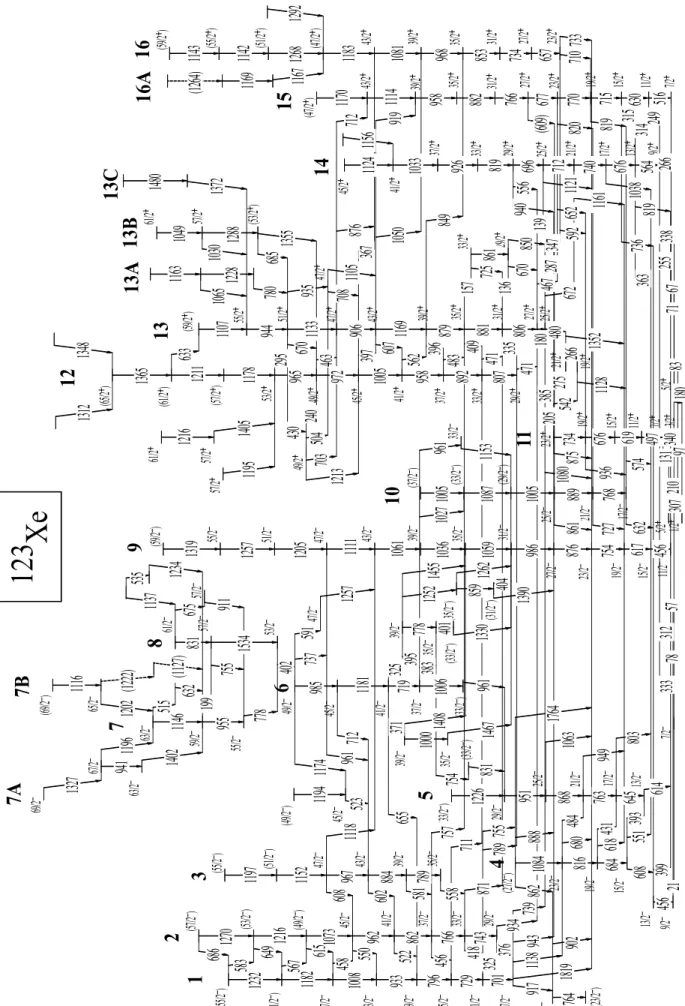
Low- and high-spin states of123Xe were known from pre-vious work [28, 29]. Here, several new bands have been identified in the high-spin region, and the existing se-quences have been extended. Theγ-ray transitions with energies less than 100 keV were not observed in this ex-periment and have been adopted from Ref. [33]. The updated123Xe level scheme is displayed in Fig. 2. The low-energy levels of Fig. 2 have been shown separately with an expanded energy scale in Fig. 3. The dipole band reported by Rainovskiet al. [34] could not be con-firmed in this experiment. Most of the transitions in this band are also present in one of the bands assigned to124I and intense transitions from this channel were observed in gated spectra. In the following subsections, the re-sults are summarized and the assignments of spin-parity quantum numbers to the levels are discussed.
A. Bands 1, 2, and 3
Band 1 was observed in the previous work by Schmidt
et al.[29], although the spins and parity were tentatively assigned. In the present work, the in-band transitions are confirmed and the band is extended to spin 55/2. Two new bands, bands 2 and 3, have been observed. They are connected with band 1 and several decay-out transi-tions have been observed from these sequences to lower-energy levels. The lowest-lower-energy level of band 1 at 3908 keV was tentatively assigned spin 27/2 in previous work [29]. Here, the angular distribution ratios (Rθ) measured
for the 1138- and 739-keV decay-out transitions indicate their respective quadrupole and dipole nature (see Table I). Thus, a spin of 27/2 and negative parity have been assigned to the level. The assignment is also consistent with other decay-out transitions from this level. TheRθ
values measured for some of the transitions of band 1 confirm their stretched quadrupole character. For these and the other in-band transitions,E2 multipolarity was assumed. Several inter-band transitions have been ob-served between bands 1 and 2, confirming the placements
1/2 3/2 5/2 9/2 7/2 11/2 7/2 5/2 7/2 11/2 15/2 19/2 23/2 9/2 15/2 19/2 23/2 27/2 31/2 35/2 39/2 43/2 47/2 51/2 55/2 (59/2 ) 13/2 15/2 19/2 23/2 13/2 17/2 21/2 25/2 29/2 (33/2 ) 27/2 31/2 35/2 39/2 43/2 47/2 (51/2 ) (55/2 ) 41/2 37/2 33/2 29/2 45/2 (49/2 ) (53/2 ) (57/2 ) 43/2 47/2 39/2 35/2 (51/2 ) (55/2 ) 27/2 (23/2 ) (27/2 ) 39/2 41/2 45/2 49/2 37/2 (33/2 ) 35/2 (31/2 ) (35/2 ) (33/2 ) 39/2 35/2 45/2 (49/2 ) 47/2 53/2 55/2 59/2 57/2 63/2 61/2 63/2 67/2 69/2 65/2 (69/2 ) 57/2 17/2 21/2 25/2 (29/2 ) (33/2 ) (37/2 ) (33/2 ) 33/2 25/2 27/2 31/2 35/2 39/2 43/2 47/2 49/2 45/2 41/2 37/2 33/2 29/2 53/2 51/2 55/2 (59/2 ) (57/2 ) (61/2 ) (65/2 ) 21/2 19/2 49/2 57/2 57/2 61/2 47/2 57/2 61/2 (53/2 ) 13/2 17/2 21/2 25/2 29/2 33/2 37/2 41/2 45/2 11/2 15/2 19/2 23/2 27/2 31/2 35/2 39/2 43/2 (47/2 ) 33/2 29/2 23/2 27/2 31/2 35/2 39/2 43/2 (47/2 ) (51/2 ) (55/2 ) (59/2 )
97
83
21
307
210
57
67
71
78
340
497
619
676
734
131
266
255
312
333
338
456
617
754
876
986
1059
1036
1061
1111
1205
1319
1257
456
608
684
816
399
551
393
614
645
763
868
951
1226
484
431
618
680
943
701
729
796
933
1008
1182
1232
522
862
766
743
376
418
550
962
1073
1216
1270
458
567
649
686
583
615
602
608
967
581
558
884
789
1152
1197
1118
917
764
1138
456
325
1819
1084
755
862
1764
888
1063
949
803
1455
325
1181
985
719
1006
961
395
383
778
1390
859
1252
404
1262
831
754
655
712
371
1000
1467
961
523
1194
737
1174
591
1257
402
778
955
199
755
1534
1146
831
515
632
1402
941
1196
1327
1202
1116
(1222)
(1127)
911
675
1137
535
1234
632
574
768
889
1005
1087
1005
727
861
1330
401
961
1153
1080
180
806
881
879
1169
906
463
972
397
607
1005
562
396
958
483
409
892
471
335
807
471
875
936
965
295
1133
670
944
1107
1178
633
1211
1365
1348
1312
1408
739
789
934
871
902
711
757
385
205
480
266
275
542
1128
1352
1027
240
703
1213
430
1195
1405
1216
504
708
935
1105
1065
1163
1228
780
1030
1049
1288
685
1355
1372
1480
564
676
740
712
696
819
926
1033
1124
516
630
715
770
677
766
882
958
1114
1170
712
919
672
467
287
139
249
314
315
819
363
819
820
(609)
736
940
1038
1161
1121
1156
157
136
725
670
850
861
652
710
592
556
347
657
734
853
968
1081
1183
1268
1142
1143
1292
1167
1169
(1264)
733
876
367
1050
849
180
1
2
3
5
6
7
8
9
10
1
1
12
13
14
7A
7B
13A
13B
13C
15
16
16A
123
X
e
4
1/2 11/2 15/2 19/2 9/2 13/2 15/2 19/2 5/2 13/2 17/2 3/2 5/2 7/2 7/2 11/2 17/2 9/2 7/2 13/2 17/2 11/2 15/2
456
617
456
608
684
307
645
57
78
97
181
21
432
618
393
551
399
803
614
340
497
575
632
83
564
676
516
629
266
333
255
312
314
315
249
66
71
1039
735
363
818
131
210
338
9
5
10
11
15
14
FIG. 3. Low-energy levels of123Xe displayed in expanded energy scale. The levels have been taken from refs [28–30, 33].
of Fig. 2. The dipole nature of some of these could be confirmed through the angular distribution ratio,Rθ(see
Table I).
Band 2 is newly observed and is most likely the signature partner of band 1. The Rθ ratio measured for the
376-keVγ ray connecting to band 1 shows its dipole nature. Therefore, spin 29/2 has been assigned to the lowest level of band 2. This state also decays by a transition at 934 keV to a level with known spin and parity of 27/2+ of band 13. The value Rθ = 0.74(9) is consistent with an
E1 character for the transition. In addition, severalE1 transitions, notably those of 757, 711, 871, 739, and 789 keV, decaying alternatively from bands 1 and 2 to the positive-parity bands 12 and 13, have been observed in the coincidence spectra.
Another cascade of transitions, marked as band 3, has been observed in coincidence with transitions of band 2. Altogether, bands 1, 2, and 3 form a cluster of bands con-nected by dipole transitions. The parity for each of the bands has been tentatively assigned to be negative as-suming that inter-band transitions are of M1/E2 char-acter. The gated spectra with γ rays of bands 1-3 are displayed in Fig. 4.
B. Bands 4 to 10
The levels of bands 4 and 5 were known from earlier work [29, 30]. However, the spins and parity of some of the levels were not assigned. In the present work, several new γ rays, connecting bands 1, 2, and 9 to bands 4 and 5, have been observed. These transitions confirm
the placement of the levels and provide restrictions on possible spins. The 684- and 816- keVγ rays of band 4 have been identified asE2transitions (Rθ= 1.53(14) and
1.31(15), respectively).
A new cascade of transitions, labeled band 6, has been found to feed band 5 at higher spin. Some of the de-cay transitions from the lower part of the band; e.g., the 1455-, 1262-, and 1390-keV transitions decaying to band 9, were reported in previous work [29] and have been confirmed. The band structure is irregular and exhibits a fragmented decay pattern to several sequences. Intenseγ
rays of energies 325, 1181, 985, 778, and 402 keV were ob-served in coincidence with the 1455-keV transition and a list comprisingγrays from the lower portion of the yrast band, band 9. The spins of the levels in band 6 could be established through the 1455- and 325-keV transitions of quadrupole and dipole character, respectively. The as-signments are further supported by the dipole nature of the 712- and 737-keV transitions linking band 6 to bands 3 and 9, respectively (see Table I). Bands 7 and 8 are extensions of band 6 to higher spin and, together with band 6, most likely represent non-collective excitations. The placements of the levels are justified by several link-ing transitions between these states as well as to other bands. With the tentative assignment of a spin to the highest level observed in this work, band 7 extends up to a spin of 69/2. The newly addedγ-ray transitions are visible in Fig. 5.
The yrast band 9 has been extended to anIπ = 59/2−
state above the previously known51/2− level with the addition ofγ rays of 1257 and 1319 keV. Similarly, band
0
250
500
0
500
1000
1500
250
500
750
1000
1250
0
100
200
402 456 418 456 550 567 583 602 617 729 754 325 796 862 876 933 962 986 1008 766 1182 1073 558 581 602+608 617 522 456 325 701 778 754 789 876 884 967Counts
Energy (keV)
199 402 1182 1216 1232 1270 1073 754 796 583 567 550 649 701 686 876 943 933 1008 729 739 1152 1194+1197 402 617 523 778 655 955p/701/943
q/q/q
p/r/417
(a)
(b)
(c)
615+ +458 917 764+766 766 522 +458 615+ 180 471 1138 831 816FIG. 4. (Color online) Background-subtracted summed triple-gatedγ-ray coincidence spectra. Panel (a): spectrum obtained with gates on a list ‘p’ of four transitions of 456, 617, 754, and 876 keV of band 9, and on the 701- and 943-keV transitions at the bottom of band 1. Panel (b): quadruple coincidences of list ‘q’, which contains the 701-, 729-, 796-, 933-, and 1008-keV transitions of bands 1 and 2. Panel (c): coincidences of lists ‘p’ and ‘r’ and of the 418-keV transition, where list ‘r’ contains the 558-, 789-, and 884-keV transitions of band 3. The peaks marked in red color are the newly observed transitions.
10 has been extended to I = 37/2 by adding another 1005-keV γ ray on top of the band. A cascade of 961-and 1153-keV transitions from b961-and 6 has been observed to feed band 10 at the 29/2 level.
C. Bands 11, 12, 13, and their extensions
Band 11 was established in previous work and was as-signed positive parity [28, 29]. Several deexcitation paths in and out of the band have been observed in the present work.
Bands 12 and 13 were previously reported by Schmidtet al. [29] up to a tentative spin of(53/2+). In the present work, these bands have been extended with the addi-tion of five (1178, 1211, 1365, 1348, 1312 keV) and three (1133, 944, 1107 keV) new γ rays in bands 12 and 13,
respectively. The angular distribution ratio of 1.53(23) could be measured only for the 944-keVγray confirming its stretchedE2 character. For the other transitions, an
E2 multipolarity has been assumed in view of the ap-parent rotational character of the sequences. At higher spin, the angular distribution ratio measured for the 633-keV transition indicates its dipole nature with someE2 mixing.
Three cascades labeled 13A, 13B, and 13C, each consist-ing of two or three transitions have been observed to feed band 13 at higher spin. Spins could not be assigned to the levels of 13A and 13C due to poor statistics. A cluster of decay transitions has been observed around spin 51/2 of band 13; these are visible in a coincidence spectrum gated by transitions of bands 12 and 13, see (Fig. 6(a)). Another cluster of transitions connecting levels of bands 13 and 14 is observed around spin 35/2. These decay
0
1500
3000
0
500
0
2750
5500
Counts
250
500
750
1000
1250
1500
Energy (keV)
0
250
199 180 325 371 395 383 401 456 515 617 755 778 632 831 876 675 911 941 955 985 1036 1059+1061 1181 1146 1402 1262 #862 1196 180 199 325 456 401 515 617 #701 1181 778 831 754 986 1146 1205 1327 1402 1000 911 1257 1319 876 1455 180* 402 456 617 754 778 876 986 1059+1061 180 199 325 395 402 456 562 607 670 756 778 806+807 879+881 1006 962 1059+1061 1036 1080 1402 1181 737 591 1257 943 986402/754/986
p/402/778
p/p/1111
1327 955 719 # 602 #796 #729 1036 #581 859+ 1202 1127 1116 1234(a)
(b)
(c)
(d)
371 712 1059+1061 335* 806* 906* 944* 670* 1080* #729 #701 #701 712 #729 719 1036 632FIG. 5. (Color online) Background-subtracted summed triple-gatedγ-ray coincidence spectra. Panel (a): spectrum obtained with triple gates on 456-, 754-, and 876-keV transitions. The transitions of band 6 and its decay-out transitions are displayed. Panel (b): The presence of second 401-, 755-, and 985-keVγ rays can be seen in spectrum with triple gates on 402, 754, and 986 keV. Panel (c): quadruple coincidence of list ‘p’ of 456-, 617-, 754-, and 876-keV transitions of band 9, and the 402- and 778-keV transitions. The transitions of bands 7 and 8 can be seen in this spectrum. Panel (d): quadruple-coincidence spectrum with two gates onγrays from list ‘p’, and the 1111-keV transition of band 9. The new transitions of band 9 and the 737-keV transition linking bands 7 and 8 to band 9 are displayed. Theγrays marked by # belong to bands 1, 2, and 3. The transitions marked by * are from bands 12 and 13 of123Xe. The new transitions are marked in red color.
transitions indicate strong mixing of the levels involved.
D. Bands 14, 15, 16, and their extensions
Bands 14 and 15 have been considerably extended in the current work. Band 14, which was earlier known to a spin of 29/2, has been extended toI=45/2 with the addition of the 819-, 926-, 1033-, 1124-, and 1156-keVγ rays (see Fig. 7(a)). Similarly, band 15 has been extended to spin (47/2) with the addition of six newγrays (see Fig. 7(b)). Several decay transitions ofE1 character were reported between bands 14, 15, and bands 9, 10 [29]. A few more such transitions have been added at lower energy. Several decay transitions from band 13 to band 15 have also been
observed at higher spin.
Band 16 was established up to spin 47/2 in previous work [29]. Here, the band has been extended to spin (59/2). Furthermore, a new branch, 16A, has been found to feed band 16 at spin 47/2. The angular distribution ratio of the new transitions could not be measured accurately due to poor statistics and, hence, spin values could not be assigned to the levels. A new decay transition of 733 keV has been observed from the 23/2+state of band 16 to the 23/2− level of band 9. At higher spin, decay transitions of 876, 367, 1050, and 849 keV have been observed from band 13. These transitions are seen in Fig. 7(c).
0
2000
4000
0
2500
5000
250
500
750
1000
1250
1500
0
2500
5000
7500
180 205 295 396+397 456 463 430 240 483 562 607 617 633 670 703+708 754 740 780 806+807 879+881 906 935 944 958 965 972 1005 1080 1105+1107 1169 1211 1365 1312 1348 1405Energy (keV)
335 180 396+397 430 456 463 471 562 607 617 1169 754 670 806+807 879+881 850 861 906 136 157 180Counts
456 806+807 879+881 562 607 617 633 670 1065 1163 1228 712 740 754 1405 1107 1080 1169 1312 1365+1372 1030 1049 944u/u/u
p/p/1080
u/v/v
139 205 287 295 906 504 944 1216(a)
(b)
(c)
935 396+397 266 335 335 1133 1288 895 1005 972 1105+1107 965 1211 1365 463 780 #701 #729 483 471 483 780 965 972 287 385FIG. 6. (Color online) Background-subtracted summed triple-gatedγ-ray coincidence spectra. Panel (a): quadruple-coincidence spectrum with gates on list ‘u’, containing 1080-, 180-, 806-, and 881-keVγ rays of bands 12 and 13. Panel (b): coincidence spectrum with two gates on transitions of list ‘p’ containing 456, 617, 754, and 876 keV of band 9, and the 1080-keV transition. The decay-out transitions from band 13 can be noted. Panel (c): quadruple-coincidence spectrum with two gates on list ‘v’ containingγ rays of 607, 463, 670, and 906 keV of bands 12 and 13, and a gate on list ‘u’. The transitions of bands 13A, 13B, and 13C are visible. The new transitions are marked in red color.
IV. DISCUSSION
The Xe nuclei in the mass 125 region are well known for possessing a variety of shapes as a function of angular momentum [1, 2, 12, 27]. In these nuclei, the neutron Fermi surface lies in the upper region of the N = 50-82 shell, see Fig. 1, and a shape change from a prolate to an oblate one involves a major change in occupancy of the h11/2 orbitals. Hence, significant changes in the characteristics of the bands can be expected. Theoretical calculations in Ref. [1] predict that coexisting minima are present in123Xe with triaxial shapes playing a significant role.
The low- and medium-spin states of 123Xe were known from previous work [28, 29] and configurations to the bands were assigned on the basis of a core-quasiparticle
coupling model. Also, tentative configurations were sug-gested for some of the bands on the basis of band-crossing frequencies and alignment gains. In the following, the bands are compared with those observed in neighbor-ing nuclei and possible configurations are qualitatively discussed. For medium- and high-spin states, the re-sults from the configuration-dependent cranked Nilsson-Strutinsky (CNS) formalism [4, 35, 36] are compared with the data.
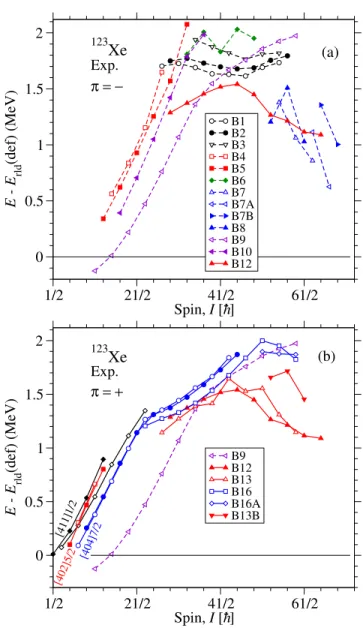
It is instructive to plot the observed bands in123Xe rel-ative to the rotating liquid drop energy, see Fig. 8. The figure suggests the presence of regular deformed bands up toI≈41/2; a mixture of such bands and more irregular sequences in theI= 41/2−61/2spin range as well as the presence of a few bands or states lying relatively low in energy for spin values just aboveI= 61/2. This suggests
0
500
1000
1500
0
500
1000
1500
2000
250
500
750
1000
1250
0
500
1000
1500
y/y/y
z/z/z
Counts
Energy (keV)
(a)
(b)
(c)
740 819 926 1033 1124 1156 139 #180 266 314 249 338 333 #396 #180 819 820 1114 958 882 766+ 677 770 715 630 516 287 #396 #463+467 #607 564 #881+ #497 #906 672+676 564 #879+#881 #806+#807 #607 940 456 1050 849+ 853 367 876 #396+ 1167+1169 1142+1143 (1264)+1268 1292 516 630 710+715 657 734 733+ 968 1081 1183 249 266 #340 #906 #463 #944 #295 #670 713 696 919 #944 1170 592 #562 819+ #397 736 249 266 315 314+ #806+#807 #676 617+#619 #965 #670 712+ #471 #463 617 #483 #1005 #1005 456 754 853* #1107 657* 734*+ 754FIG. 7. (Color online) Background-subtracted summed triple-gatedγ-ray coincidence spectra. Panel (a): quadruple-coincidence spectrum on list ‘x’, which contains 564-, 676-, 740-, 712-, 696-, 819-, 926-, and 1033-keV transitions of band 14. Panel (b): coincidence spectrum with triple gates on list ‘y’ containing 516-, 630-, 715-, 770-, 677-, 766-, 882-, and 958- keV transitions of band 15. Panel (c): coincidence spectrum with triple gates on list ‘z’ containing transitions of 657, 734, 853, 968, and 1081 keV of band 16. The new inter-band links between bands 13 and 16 are also visible. The ’#’-marked peaks depict transitions from bands 11, 12, and 13. Theγ-ray peaks marked by * are transitions from band 16 of123Xe. The new transitions are marked in red color.
small collectivity forI >41/2 with some configurations reaching or approaching termination forI= 61/2−71/2. This is in line with the interpretation of the level schemes for neighboring nuclei, see e.g. [7, 18, 19, 25].
A. The CNS formalism
The medium- and high-spin states of various nuclei in the A'125 mass region [7, 9, 18, 19] have been successfully interpreted using the cranked Nilsson-Strutinsky (CNS) formalism [4, 35, 36]. In this model, the orbitals in each
N major shell are grouped into high- and low-j orbits, respectively. A further division according to signature
α=1/2 andα=-1/2 is made. The configurations are then
labeled by the number of particles or holes in each group. It should be noted that no distinction between the core and valence particles are made and all theN-shells up to
N=8 are treated on an equal footing. The configurations are labeled as
[p1p2, n1n2],
where p1 and p2 are the number of protons in d5/2g7/2 (dg) andh11/2 orbitals, respectively, whereas n1, n2 are the number ofN = 4neutron holes andh11/2neutrons, respectively. If neutrons are excited to orbitals in the
h9/2f7/2 (hf) and/ori13/2shells above the N = 82gap, the configurations are specified as [p1p2, n1n2(n3n4)], where n3 and n4 are the number of hf and i13/2 par-ticles, respectively. Furthermore, for an odd number of particles in some group, the signature is often specified
1/2 21/2 41/2 61/2 Spin, I [h
-
] 0 0.5 1 1.5 2 E - E rld (def) (MeV) 123Xe
Exp. π = − (a) B1 B2 B3 B4 B5 B6 B7 B7A B7B B8 B9 B10 B12 1/2 21/2 41/2 61/2 Spin, I [h-
] 0 0.5 1 1.5 2 E - E rld (def) (MeV) 123Xe
Exp. [404]7/2 [402]5/2 [411]1/2 π = + (b) B9 B12 B13 B16 B16A B13BFIG. 8. (Color online) The observed energy levels of (a) negative-parity bands and (b) positive-parity bands in123Xe plotted relative to the rotating liquid-drop energy. The positive-parity band 12 in (a) and negative-parity band 9 in (b) have been included for comparison. The low-spin positive-parity bands have been taken from Ref. [30] and are labeled by the asymptotic orbitals on which they are built. The [404]7/2 band is labeled 14,15 in Fig. 2 and the α=−1/2
branch of the [411]1/2 band is labeled 11. Positive-(negative) parity bands are drawn by full (dashed) lines and closed (open) symbols are used for signatureα=1/2 (α=-1/2) states. This convention is used for all figures.
by a subscript, ‘+’ for α= 1/2 and ‘−’ for α =−1/2, while if signature is not specified, a configuration is fully defined by the number of high-j particles,[p2, n2]. In the present calculations, the A∼110 parameters, i.e. theκandµparameters defining thel·sandl2 strengths of the oscillator potential, have been used [4]. The sum
of the shell energy and the rotating liquid-drop energy is used to calculate the excitation energies. The rotat-ing liquid-drop energy has been modeled accordrotat-ing to the Lublin-Strasbourg drop model [37], while the rigid-body moments of inertia have been calculated with an
r0= 1.16 fm radius parameter and ana= 0.6 fm diffuse-ness parameter [36]. As the energy of each configura-tion is minimized at each spin in the deformaconfigura-tion space (ε2, ε4, γ), one can follow the development of collectivity as a function of angular momentum. Pairing correlations are not included in the CNS formalism and this implies that the results are pertinent at high spins, where pair-ing effects are negligible. However, in the recent work in the mass-125 region [7, 9, 16–20], it was established that the CNS model works quite well even in the intermediate-spin regions (I >15) and it provides at least a qualitative understanding for lower-spin states, see e.g. [38].
1. Valence-space orbitals
The CNS configurations which are expected to be low in energy in123Xe can be identified from Fig. 1, where the single-particle orbitals in the 50-82 shell are drawn at a prolate shape up toε2 = 0.22 and then as a func-tion of rotafunc-tional frequency at this deformafunc-tion. Even though many configurations in123Xe appear to be triax-ial, this diagram provides a general understanding of the
j-shells around the Fermi surface and of their occupation. The figure suggests that the ground state configuration has the odd particle in theN = 4 orbital [402]5/2 with six neutrons inh11/2 orbitals. Other low-lying, positive-parity neutron configurations might be formed with the odd neutron in the [411]1/2 or the [404]7/2 orbital. Fur-thermore, the low-lying, negative-parity configurations are formed with either 7 or 5h11/2 neutrons. Note also that, for the low-spin yrast configurations, there are in to-tal two or three holes in the [404]7/2 and the [402]5/2 or-bitals; i.e., there are at least two holes in theN = 64core. However, with increasing spin, the deformation generally becomes smaller and it might be advantageous to close theN = 64 core. Since the Fermi surface is in the mid-dle of theh11/2shell, it is expected that, with increasing spin, it will be energetically favorable to occupy fewer
The protons occupy four orbitals above theZ= 50gap. They all occupydgorbitals in energetically favored low-spin states, see Fig. 1. With increasing low-spin, it is ex-pected that it becomes energetically favorable to lift one proton to theh11/2 shell. This shell is so high in energy that states with two h11/2 protons are calculated to be located at a rather high excitation energy for low and intermediate spin values.
-15/2 -5/2 5/2 15/2
Spin projection,
m
i[
h
-
]
5 5.5 6e
i[
h
-
ω
ο]
16 + 14 -64 80 9 -Protons ε2 = 0.18 ε4 = 0.02 A=110 param.(a)
f5/2 p1/2 g9/2 d5/2 g7/2 d3/2 h11/2 40 50 -15/2 -5/2 5/2 15/2Spin projection,
m
i[
h
-
]
5.5 6 6.5e
i[
h
-
ω
ο]
d5/2 50 35/2 + 41/2 + Neutrons ε2 = 0.18 ε4 = 0.02 A=110 param. 21/2 −(b)
g7/2 d3/2 s1/2 h11/2 f7/2 h9/2 i13/2 64 82FIG. 9. (Color online) Calculated single-particle energies,ei,
as a function of the spin-projection quantum number,mi,
cal-culated atε2= 0.18,γ= 60◦, andε4 = 0.020: (a) for protons
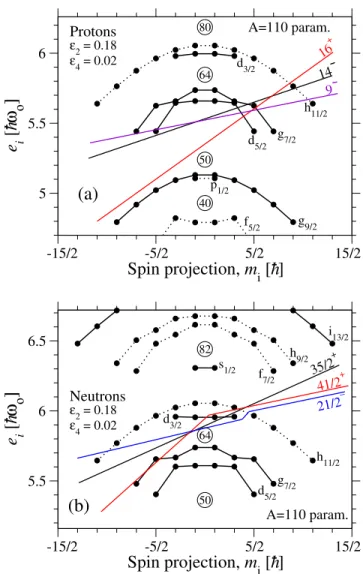
and (b) for neutrons. Some low-lying aligned configurations are defined by ‘straight-line Fermi surfaces’ [13], where the orbitals below the lines are occupied and the total spin is obtained as the sum of the projectionsmibelow the lines.
There is an analogy between the A = 155−160 region and the present A = 125 one that has been exploited previously, see e.g. [7, 13]. The protons in the heavier region fill the same orbitals above particle number 64 as the neutrons in the present region. In addition, there is a limited number of protons outside theZ = 50 gap in the present region in a similar way that there is a limited number of neutrons outside theN= 82gap in the
A= 155−160region. The analogy suggests that favored terminating bands are formed from configurations with a closed114Sn core and that these will terminate when all spin vectors of the particles outside the core are aligned, which corresponds toI≈63/2 for123Xe. Bands of this type have been observed for several other nuclei in the
A= 125region [7, 10, 16–20].
The favored aligned configurations for Z = 54 and
N= 69are illustrated in sloping Fermi surface diagrams [13] in Fig. 9, while low-lying terminating bands are drawn relative to the rotating liquid-drop energy in Fig. 10. For protons with four valence particles outside the
Z = 50 core, straight-line Fermi surfaces are naturally drawn with one or twoh11/2particles; i.e., for the config-urations(dg)3(h11/2)1 and(dg)2(h11/2)2withImax= 14
andImax= 16, respectively. For the neutrons, the most
favored configuration is(h11/2)4(sd)1 withImax= 35/2,
see Fig. 9. Combining this neutron configuration with the two proton ones results in bands terminating in the two most favored states in Fig. 10; the63/2− state of a [31,54] configuration and the67/2+level of a [22,54] one. There are other [31,54] and [22,54] configurations drawn in Fig. 10, terminating one spin unit lower, where either the thirddgproton is placed in ami = 3/2state instead
of ami= 5/2 one or thesd(s1/2d3/2) neutron is placed in mi = 1/2 instead of mi = 3/2. Furthermore,
config-urations with the fifth valence neutron in themi= 3/2,
h11/2 state instead of the mi = 3/2 one of sd
charac-ter, [31,65] and [22,65], are also displayed in Fig. 10. With present parameters, these alternative bands with negative neutron parity are less favored than [31,54] and [22,54], but with small changes in parameters, the situa-tion could be reversed.
41/2 51/2 61/2 71/2 81/2 Spin, I [h
-
] -1 0 1 2 3 E - E rld (def) (MeV) [2,4] [2,5] [1,4] [1,5] [2,5] 123Xe
CNS calc. [3+1- ,5+4 ] [3+1- ,5-4 ] [3-1- ,5-4 ] [22 ,5+4 ] [22 ,5-4 ] [3+1- ,65- ] [22 ,65+ ] [22 ,65- ]FIG. 10. (Color online) Calculated excitation energies, rel-ative to a rotating liquid-drop energy, for terminating con-figurations in 123Xe. The states with spin vectors aligned along the oblate symmetry axis are highlighted by large open circles. Some low-energy terminating states are marked by the number of protons and neutrons inh11/2orbitals in their
configurations.
higher-spin terminating configurations can be formed with one or two neutrons excited across theN = 64gap as shown by a broken line Fermi surface in Fig. 9(b) for the one-neutron excitation. On the other hand, ex-citations over the larger proton gap at Z = 50 will not result in any energetically competitive terminating con-figurations. The combination of the one-particle-one-hole (1p-1h) or 2p-2h neutron configurations with the closed core proton configurations leads to terminating states at higher spin as shown in Fig. 10. Furthermore, favored non-collective states might also be formed with some spin vector anti-aligned. Especially, theI= 53/2 state of the [22,65] configuration stands out in Fig. 10. In this state, all the valence neutrons are in h11/2 orbitals, but with one of these in the mi = −11/2 orbital, see Fig. 9(b),
leading to a neutron spin of21/2−. Thus, a total spin of
53/2 is obtained when combined with the proton spin of 16+. Indeed, aligned states with this kind of anti-aligned spin vectors are calculated to be yrast for many spin val-ues. They might be assigned to some states not placed in bands in the level scheme or might be responsible for irregularities in the observed bands.
B. Negative-Parity Bands
1. Bands 9, 10, 4, and 5
The calculated low-spin bands of negative parity must be assigned to configurations with four dg protons and an odd number of h11/2 neutrons. The lowest bands of this type have fiveh11/2 neutrons; i.e., the [40,65] con-figuration. This is the configuration assigned to bands 9 and 10, where the lowest observed state hasI = 11/2 because of decoupling. This is consistent with the config-uration assigned to the bands 9 and 10 in previous work [29, 30]. The experimental energy levels are compared with the calculated ones in Fig. 11. The general fea-tures of the difference curves come out as expected when pairing is not included; i.e., they lie rather close to the average difference curve for all bands in123Xe. The av-erage curve has been calculated with a least square fit of the differences to the function,a·exp (−bI)−c. The bands 6, 7, 8 and the highest spin values in band 16 have not been included in the fit. The resulting constants are
a= 3.05 MeV, b =−0.069~−1 and c = 1.12 MeV. The decrease with spinIfor the difference curve indicates the expected decrease of pairing energy with increasing spin. The calculated deformation for the lowest-energy [40,65] band is close toγ=−50◦up toI= 47/2where it jumps toγ≈0◦. This shape change leads to a small alignment, but is insufficient to explain the observed alignment gain at I≈35/2 in band 9. Furthermore, the shape change occurs at much higher spin than the observed crossing frequency of~ω ' 0.5 MeV. Thus, it appears that this
backbend in band 9 is caused by pairing, in this case with a pair of neutrons in the h11/2 shell, where the Fermi level is rather low in the shell, namely on the third level, corresponding to the [532]5/2 state at a prolate shape. The spins of the bands in123Xe are plotted as a function ofγ-ray energy in Fig. 12. The slope of the curves repre-sents the dynamic moments of inertia,J(2), of the bands. The alignment gain ofi'6~for a pair ofh11/2 neutrons in band 9 appears larger than expected, considering that a similar alignment is observed in 123Cs [7] for a band having an even number ofh11/2 neutrons. The compar-ison suggests that some shape change is also involved in the alignment of band 9 of 123Xe. Band 10 appears to
0
1
2
E
−
E
rld(def) [MeV]
Exp
123Xe
(a)
B10 B6 B7 B8 B7a B7b-1
0
1
2
E
−
E
rld(def) [MeV]
CNS calc
(b)
1/2
21/2
41/2
61/2
Spin, I [h
-
]
-1
0
1
E
theo.−
E
exp.[MeV]
Difference
(c)
[40,65-] [40,65+] [3-1-,5-4] [3+1-,5-4] [3-1-,5-4] [22,65-] [3+1-,5+4]FIG. 11. (Color online) Energies, relative to a rotating liquid-drop energy, for (a) the observed bands in123Xe, (b) calcu-lated bands, (c) difference between experiment and calcula-tions. The smooth curve in the lower panel is the average difference between experiment and calculations, see text for details.
be the signature partner of band 9. An indication of a configuration change is also observed in this band at a frequency similar to that observed in band 9.
Another pair of negative-parity bands, bands 4 and 5, has been observed at low energy: these are placed around 600 keV above the yrast band. Decay transitions have been observed from both bands to the yrast negative-parity band 9. Similar bands have been observed in neighbor-ing, odd-N Xe isotopes. In particle-rotor calculations with a triaxial deformation of γ= 20−25◦, such bands are well understood as excited bands relative to bands 9 and 10 [30, 39]. It seems that, with the rather large γ
deformation, theK= 2band of the triaxial core appears at low energy; see, e.g., chapter 7 in Ref. [40], and it is mainly the coupling to this K = 2 band which results
0.5 1 1.5 E γ (MeV) 1/2 21/2 41/2 61/2 Spin, I [ h
-
] B1 B2 B3 B4 B5 B6 B7 B7A B8 B9 B10 ~9h- ~6h -(a) 0.5 1 1.5 E γ (MeV) 1/2 21/2 41/2 61/2 81/2 Spin, I [ h-
] B11 B12 B13 B14 B15 B16 B16A B13A B13B B13C ~7h -~5h -(b)FIG. 12. (Color online) Spins of states plotted as a function ofγ-ray energy for the (a) negative- and (b) positive-parity bands observed in123Xe.
in bands 4 and 5. This assignment appears consistent with the suggestion that these bands in 121Xe [25] and 125Xe [27] are built on aνh
11/2 configuration coupled to theγ vibrational band of the even-even core [26]. With this assignment, these bands cannot be described in the present cranking approach.
2. Bands 1, 2, and 3
The bands 1, 2, and 3 start at higher spin with an align-ment of nearly 9 ~. This large initial alignment indi-cates a three quasiparticle configuration for the bands. Thus, their most likely configuration has an odd
num-1
2
Exp
123Xe
(a)
B1 B2 B31
2
E
−
E
rld(def) [MeV]
CNS calc
(b)
[3+1-,7-6] [3+1-,7+6] [3-1-,7+6] [3-1-,7-6]1/2
21/2
41/2
61/2
Spin, I [h
-
]
-1
0
E
theo.−
E
exp.[MeV]
Difference
(c)
FIG. 13. (Color online) Same as Fig. 11 but for bands 1, 2, and 3.
ber of protons in thedgandh11/2 orbitals, respectively; i.e., threedg and oneh11/2 protons. In order to end up with negative parity, there must be an even number of
h11/2 neutrons involved. In the CNS calculations, the configuration with six neutrons, [31,76], is found to be lowest in energy. The four bands which are formed from the two signatures of the dg protons and neutrons are drawn in Fig. 13. In these configurations, there is com-petition between minima at γ ≈0◦ and γ≈40◦, where the latter lies slightly lower in energy. However, it seems likely that the more collective close-to-prolate minimum is observed in the experiment. Therefore, the energy at this minimum is compared with experiment in Fig. 13, where it is gratifying that all differences are close to the average value. For the configuration[3−1,7−6], it is
ob-served in the figure that the energies forI= 33/2−49/2 are somewhat lower than the smooth trends seen for the other bands. This is because for this configuration, there is no local minimum atγ≈0◦ for these spin values and these energies correspond to the less collective minimum at γ ≈40◦. Indeed, the absence of a prolate minimum over an extended spin range for this configuration might explain why it has no experimental counterpart in the present level scheme.
3. Bands 6, 7, 7A, 7B, and 8
The bands 7, 7A, 7B, and 8 are low in excitation energy and decrease with increasing spin just above I = 55/2 (see Fig. 11 (a)). This suggests that they terminate in favored configurations. This is supported by the fact that they correspond to the spin values associated with the maximum spin in the valence configuration space. The favored negative-parity valence space configurations are [31,54] and [22,65] with Imax = 63/2 and 67/2,
re-spectively. These are the highest spin values observed in bands 7 and 7A, respectively. They correspond to the lowest energies at high spin for all observed bands in Fig. 8. It, thus, seems natural to assign bands 7 and 7A to the [31,54] and [22,65] configurations. Experiment and calculations are compared in Fig. 11. For band 7, the difference between experiment and calculations is, on the average, somewhat lower than expected and lies be-low the average values. The [22,65] configuration, on the other hand, is calculated somewhat higher than expected. Such discrepancies could, however, be cured by changing the rather uncertain position of the j shells. The fact that the calculated slope of theE−Erld curves is
con-siderably steeper in calculations than in experiment is of more concern. This means, for example, that the fully aligned63/2−state, which stands out as particularly
fa-vored in Fig. 10, is calculated too low compared with the highest-spin state observed in band 7.
The energies at high spin and the presence of linkingM1 transitions suggest that band 8 is a signature partner of band 7, where the energy of the 61/2 state lies at a similar energy if either the signature of the dg proton or that of thesdneutron is changed. It turns out that the full band 8 is better described by the signature change for the
dg proton. Therefore, the [3−1−,5−4] configuration is
compared with band 8 in Fig. 11. With this assignment, also the low energy of the I = 53/2 state is described by an aligned configuration with one anti-aligned spin vector. Thus, compared with the fully alignedI= 63/2 state, one proton is moved from the dg mi = 5/2 to
the mi = −5/2 orbital, see Fig. 9. This 53/2− state
is relatively low in energy in Fig. 10, but note that the 53/2− state of the [2,5] configuration, which has an anti-aligned h11/2 neutron, is calculated to be even lower in
Band 7B is also down-sloping and low in energy at high spin, see Fig. 8. As seen in Fig. 11, its energy is well de-scribed by a [31,54] configuration. In this configuration, a neutron is excited from thedg mi=−5/2orbital to the
sd mi = 1/2 state relative to the closed-core I = 63/2
state. The highest-spin state of band 7B,I = 69/2, cor-responds to the Imax state of the α= 1/2 [31,54]
con-figuration with one hole in theN = 64 core. All in all, with the present assignments, bands 7, 7A, 7B, and 8 are rather well described, on average. On the other hand, the rather large fluctuations of the differences between calcu-lations and experiment for these bands suggest that these low-collectivity configurations are somewhat difficult to calculate in the present pure cranking formalism. Bands 7 and 8 are feeding into band 6, and this suggests that this band is associated with a similar configuration. On the other hand, it is very irregular and, as seen in Fig. 8, observed at a relatively high excitation energy. Thus, it is difficult to propose a reliable assignment. In any case, it is compared with the same [31,54] configuration as assigned to band 8 in Fig. 11. It turns out that the energy difference between experiment and calculation appears close to the average value, but the staggering is out of phase. Therefore, as expected, only a very qualitative assignment to band 6 can be proposed.
C. Positive-Parity Bands
Lower-spin, positive-parity states are built with the odd neutron in the sd (s1/2d3/2) and dg (d5/2g7/2) N = 4 shells, keeping valence protons in the dg orbitals. As seen in Fig. 1, for a prolate shape, the odd proton oc-cupies the [411]1/2, [402]5/2, or [404]7/2 Nilsson orbital. Higher-spin states can be generated by exciting a pro-ton to the h11/2 state with an odd number of neutrons in the h11/2 orbital. Finally, close to the maximum-spin state in the valence space, configurations with twoh11/2 protons and, thus, with positive parity for the neutrons, might become competitive in energy. In the following, the positive-parity bands are first compared with similar bands in neighboring nuclei and possible configurations are discussed. The configurations are then assigned by
CNS calculations.
0
1
2
Exp
123Xe
B14 B151
2
E
−
E
rld(def) [MeV]
CNS calc
[40,7 +6] [40,7-6]1/2
21/2
41/2
61/2
Spin, I [h
-
]
-1
0
1
E
theo.−
E
exp.[MeV]
Difference
FIG. 14. Same as Fig. 11 but for bands 14 and 15, labeled as [404]7/2 in Fig. 8.
1. Bands 11, 14, and 15
The positive-parity spin 3/2 state, which is assigned to band 11 in Fig. 2, and the1/2+ ground state (see Fig. 2 (b)) were known from previous work [28, 29]. They can be described as the bandheads of a [411]1/2 band, see Fig. 1, even though they are best described with a rather large triaxiality,γ= 20−25◦ [30]. Similar bands have been observed in the neighboring 121Xe [25] and 125Xe [27] isotopes.
Another set of positive-parity bands start at lower en-ergy, bands 14 and 15; these are the positive-parity, yrast bands for spin valuesI= 7/2−21/2, see Fig. 8. These bands and similar ones in neighboring nuclei,121Xe and 125Xe, can be approximately described as built on the [404]7/2 orbital [30, 39]. They exhibit a band crossing at ~ω ' 0.35 MeV with an alignment gain of 5 ~ (see
alignment gain indicate that alignment of a pair ofh11/2 neutrons is taking place. Therefore, the configuration of the band beyond the band crossing can be described as containing two aligned h11/2 neutrons. Finally, a band which is best described as based on the [402]5/2 orbitals has also been observed [30], see Fig. 8. The general structure of the low-spin positive-parity ban
![Fig. 1 displays the energy levels calculated using the modified oscillator potential [3], where A = 110 parame-ters have been used [4]](https://thumb-us.123doks.com/thumbv2/123dok_us/531531.2562630/2.918.476.857.319.718/displays-energy-levels-calculated-modified-oscillator-potential-parame.webp)
![FIG. 3. Low-energy levels of 123 Xe displayed in expanded energy scale. The levels have been taken from refs [28–30, 33].](https://thumb-us.123doks.com/thumbv2/123dok_us/531531.2562630/12.918.91.788.87.281/energy-levels-displayed-expanded-energy-scale-levels-taken.webp)