Common area allocation, patterns and
design in permanent supportive housing
Christina Bollo, PhD1, Amanda Donofrio, AIA2 1The University of Illinois, Urbana Champaign 2Bergsund DeLaney Architects, Eugene, Oregon ABSTRACT: As a response to the growing homelessness crisis in North America, many non-profit housing providers are directing their architects to design housing projects that provide extensive support service spaces on site to support the transition from homelessness for some of the most vulnerable members of our communities. This paper reports on a study of the common spaces of Permanent Supportive Housing projects, which provide chronically homeless individuals with affordable housing, as well as emotional, mental, and physical health resources on-site. The purpose of the paper is to establish the stylized facts of common area allocation in Permanent Supportive Housing (PSH). The data for this research are the common area floor plans for twelve PSH projects. These spaces are analyzed, and typical entry sequences are compared with the intent of understanding the approach to security. The relationships between fundamental rooms are delineated through Space Syntax Analysis. The results from the study reveal high visibility between entry lobbies, offices, and threshold spaces though the space syntax indicated a significant amount of depth between the spaces, indicating difficulty of movement between them. The presence of a vestibule correlated with a greater depth of spaces but also greater visibility for staff and residents. Ultimately, the research serves the health and well-being of the residents and staff of future projects through an evidence-based approach to designing supportive service and resident common spaces. Future research will build on this analysis to investigate the empirical well-being outcomes influenced by design.
KEYWORDS: well-being, chronic homelessness, housing first, space syntax analysis, housing
INTRODUCTION
This paper reports on a research study of the common spaces of Permanent Supportive Housing projects which provide chronically homeless individuals with affordable housing, as well as emotional, mental, and physical health resources on-site. The pairing of housing and supportive services in the same building allows residents to have services tailored to their needs (Rog et al. 2014). The presence of service staff builds trust so the residents can seek assistance when they are ready. Staff in the building will check in with residents frequently even if they are not in treatment. A cornerstone of the Housing First model is that the resident has the right to choose the services they receive with their housing and will receive support in their recovery at their own pace (Tsemberis, Gulcur, and Nakae 2004).
The Housing First approach to Permanent Supportive Housing shows broad positive outcomes such as improved mental, physical, and behavioral health; lower drug and alcohol use; reduced emergency room usage; and fewer crimes of homelessness, such as trespassing and public urination, that result in arrest and jail (Fitzpatrick-Lewis, et al, 2011). A key factor in the success of Housing First is the simple fact that a safe and stable home enables people to remove themselves from survival mode and to work through past trauma in a supportive environment with reliable service providers (Henwood, Matejkowski, Stefancic, and Lukens 2014). Research shows that the Housing First model is effective in achieving residential stability for people who have been homeless for years. One study found that 88 percent of “Housing First” residents remained housed compared to 47 percent in a control group who had entered housing through the traditional, “Treatment First” model (Tsemberis and Eisenberg 2000).
The health and well-being outcomes of Housing First and Permanent Supportive Housing are well documented (Fitzpatrick-Lewis et al. 2011). There is moderate evidence that Housing First results in increased housing tenure and reduced emergency room visits (Rog et al. 2014). There is strong evidence that a sense of security has a demonstrated effect on health and well-being in this environment (Henwood et al. 2018). Residents in Permanent Supportive Housing programs report increased levels of autonomy, choice, and control, and a majority of clients participate in on-site services (Tsemberis and Eisenberg 2000).
Despite the ample literature in psychiatry and public health, there are no known studies that look at the spatial relationships of common areas in PSH. This paper is an examination of supportive housing facilities for homeless individuals in North America, and the results can be used to guide designers of new Permanent Supportive Housing support spaces. By spatializing the relationships of resident common areas, this research contributes an important and missing piece: an empirical understanding of these areas.
1.0. METHODS
The data for this research are the common area floor plans for twelve built, Permanent Supportive Housing projects. In the first stage of the research, the common area spaces are analyzed through inter-building cross-comparison to answer the research questions: What types of common spaces are provided, and how are these spaces allocated.The study places a particular emphasis on the spaces provided to support the well-being of residents. In the second stage, the typical entry sequence of each building is diagrammed for depth using Space Syntax gamma diagrams.
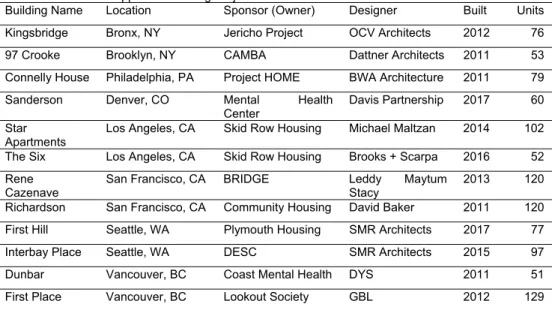
Architecture students chose the initial 40 precedent examples of PSH projects in North America, collecting floor plans from the internet resources or by contacting the architects and project sponsors directly. From this initial group of 40, the researchers winnowed the projects to a group of 12. The primary selection criteria are size (50 or more units), geographic, sponsor and architect diversity, and year built (Table 1). Though Permanent Supportive Housing projects were developed in the 1990s, they are most often rehabilitations of existing Single Room Occupancy (SRO) buildings with limited opportunities for common areas; this research focuses on new construction with a clear Housing First mission.
Table 1. Permanent Supportive Housing Projects Selected as Case Studies
Building Name Location Sponsor (Owner) Designer Built Units
Kingsbridge Bronx, NY Jericho Project OCV Architects 2012 76
97 Crooke Brooklyn, NY CAMBA Dattner Architects 2011 53
Connelly House Philadelphia, PA Project HOME BWA Architecture 2011 79
Sanderson Denver, CO Mental Health
Center Davis Partnership 2017 60
Star Apartments
Los Angeles, CA Skid Row Housing Michael Maltzan 2014 102
The Six Los Angeles, CA Skid Row Housing Brooks + Scarpa 2016 52
Rene
Cazenave San Francisco, CA BRIDGE Leddy Stacy Maytum 2013 120
Richardson San Francisco, CA Community Housing David Baker 2011 120
First Hill Seattle, WA Plymouth Housing SMR Architects 2017 77
Interbay Place Seattle, WA DESC SMR Architects 2015 97
Dunbar Vancouver, BC Coast Mental Health DYS 2011 51
First Place Vancouver, BC Lookout Society GBL 2012 129
The first phase of the study uses the case study research method as prescribed by Yin (2017) to understand the common area allocation in the PSH projects. Each building is treated as an
individual case, and they are then compared to understand the unique combinations of spaces. The common areas are inventoried, measured, named, numbered, and colored. In order to understand their distribution in each project, consistent colors and names are used throughout. The primary categories include office, common area, entry, vertical circulation, horizontal circulation, and accessible outdoor space. Secondary categories are used to differentiate between main, and auxiliary spaces. In order to standardize and make true comparisons, an index–– based on common area space per dwelling unit–– is created for each.
The second phase of the study uses the space syntax analysis method as prescribed by Hillier and Hanson (1989), Markus (2013), and Bafna (2003). Space syntax analysis has been applied to designed spaces from the scale of the house (Hillier, Hanson and Graham 1984) to the scale of the city (Bhiwapurkar 2018); and across building types from museums (Hillier and Tzortzi 2006), to healthcare (Sadek and Shepley 2016). A more direct precedent in scale and type for this paper is Julia Robinson’s Complex Housing: Designing for Density (2017) for which she conducted space syntax analysis of Dutch apartment buildings.
The space syntax process was not intended to be exhaustive nor explicative of the entire building. Instead, the research questions bounded the scope of the diagrams and analysis. Comparison of entry sequences amongst the buildings was facilitated through depth analysis where the street at the main entry is the root level and each room passed through is an added layer of depth. The calculations for integration and control are used to evaluate safety and security for tenants and staff. After comparison of all twelve projects, common patterns of social and spatial relationships emerge and are expressed through the Space Syntax language.
2.0. FINDINGS
The results of this study show unique combinations of common and office areas in twelve representative Permanent Supportive Housing projects. The key findings from this study are within the following themes: visual and spatial integration of spaces; layering of thresholds; vertical circulation as connective tissue; and hubs of control.
2.1. Allocation of common area and office spaces
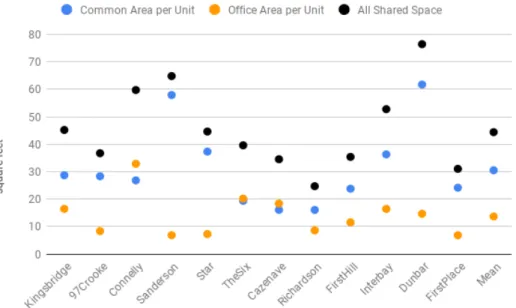
In addition to inventorying and calculating the individual spaces, they are also divided into general categories of “Common Area” and “Office Area” (Figure 1). The distribution analysis revealed four programmatic elements in the common area allocation found in all of the projects. These include a multipurpose room, office area, public restrooms associated with resident common area, and laundry room or rooms.
Each of the projects includes secure outdoor space for staff and resident use, either a courtyard on the ground floor or upper level roof terraces, with Kingsbridge including all three types of common outdoor areas. Where courtyards or roof terraces are provided, they are generally found at a depth of 4 or more. Literature in well-being supports access to substantial green space. Kuo and Sullivan (2001) found that aggression levels are significantly lower for residents when nature is present outside of apartments as compared to no nature and Wagenfeld, Roy-Fisher, and Mitchell (2013) found that access to nature improves physiological and psychological health outcomes for veterans with Post-Traumatic Stress Disorder.
While a typical apartment building has an average net-to-gross ratio of 70 to 75 percent (Meeks 2005), the PSH projects studied here range from 43 to 64 percent with a mean of 54 percent. As noted previously, PSH is distinguished from typical market-rate apartment buildings, or even typical affordable housing for families, by the inclusion of extensive common area spaces and supportive service office spaces, as well as smaller than average dwellings. This allocation at Sanderson is intentional, according to the Mental Health Center of Denver, “to create a sense of community, the building is equally divided between engagement spaces and apartment living.” Because of this unique condition, this study proposes a “PSH-adjusted”
net-to-gross calculation in which the common areas and office areas are added to the net unit areas. With this calculation, the metric ranges from 49 to 73 percent, with a mean of 61 percent.
Figure 1. Common and office area per unit by project
2.1.1. Supportive service offices
Essential to the Housing First philosophy is the inclusion of on-site supportive services paired with housing. Each of the case study projects has at least four designated supportive service offices on site. The arrangement of the supportive service spaces in these projects follow two distinct patterns. First, the “office tree” occurs when there is a room off the lobby or corridor that functions as an anteroom and the offices are arranged immediately off this area. A modified version of this has the “office tree” with a front check-in office within the space. Second, the offices are located immediately off the main corridor. This results in a plan with less depth than the office tree and, as a result, less spatial security for the staff and tenants. While eleven of the projects allowed tenants to remain within the enclosure of the building to access services, a recommendation of Housing First principles, the Los Angeles project, The Six, deviated from this pattern: the supportive service offices that directly serve the tenants of the building are accessed off the street, through a separate entry. This is likely to result in more privacy for residents, while still ensuring convenience.
2.1.2. Common areas
The primary recreation space for residents, found in all projects, is the multipurpose room. The multipurpose rooms do not vary significantly in size from project to project, regardless of unit count. The average multipurpose room is 985 square feet. However, the depth of the multipurpose room varies significantly according to the space syntax analysis. At First Place, the multipurpose room has a depth of 2, while Kingsbridge’s multipurpose room has a depth of 7. The space syntax analysis also showed that the multipurpose room frequently has an attached room of another depth, usually a kitchen or laundry room, and often a direct relationship at the same or similar depth to a common outdoor space.
All twelve projects in the study have a significant quantity of resident common area with an average common area per dwelling unit throughout the twelve projects at 32 SF per dwelling unit. This area ranges from 16 SF per unit at Rene Cazenave and Richardson to 62 SF at Dunbar, with Sanderson also representing the top end with 58 SF. In eight of the 12 study
projects, common area is distributed throughout the building; four of the projects have common area on the ground floor only. It is of note that the two projects with the lowest common area to unit count are examples of projects with common area on the ground floor only, while the two projects representing the top end have common area on multiple floors.
While all of the projects have at least one multipurpose room, as discussed above, some have small specialty rooms in addition to the multipurpose room. The proliferation of many, specifically programmed common areas aligns with principles of Trauma Informed Care. According to Hopper, Bassuk, and Olivet (2010), access to choice is key, “because control is often taken away in traumatic situations, and because homelessness itself is disempowering; trauma informed homeless services emphasize the importance of choice for consumers” (p. 82). Dunbar and Sanderson, found to have the greatest common area per dwelling unit, follow this approach of many, activity-specific spaces. The studied projects include art rooms (Sanderson and Star), libraries (Sanderson, Star and First Place), and wellness/exercise rooms (Sanderson, Star, First Place and Kingsbridge). Half of the projects include a common room labelled, lounge. There is a computer room in six of the projects and a specific television room at three of the projects (Sanderson, Interbay, and Dunbar).
2.2. Visual and spatial integration
Space syntax analysis does not typically explicate the visual links between spaces. The method is modified for this study and a dashed line indicates the visual connection when a spatial one does not exist. Several of the projects have designed visual connections, typically using interior windows, presumably to enhance safety, security, and social interactions. Some of these visual connections are between adjacent spaces at the same depth, but often a visual connection bridges a spatial divide of many layers.
Visual connections are especially common near reception areas. Of the twelve projects studied, all but one have distinct reception areas and half of the projects have reception desks within lobbies near the entrances to the buildings. These desks provide a physical connection to the lobby space with most, but not all, being physically accessed from the lobbies themselves. The exception to this can be found at Rene Cazenave in Los Angeles where the element of staff security is heightened with a door leading from the reception area to a secure corridor beyond the entry lobby. The reception area can also provide a strong visual connection to an entry area, when placing front desk staff within a secured room. In three of these examples, the reception room has a visual connection to an entry vestibule with access from the building lobby, adding an additional layer of depth. The visual connections between the office and entry court at Kingsbridge spans three layers of depth (Figure 2). Double-height spaces also create opportunities for visual connection across both spatial depth and floor level. In First Place, people in the double-height lobby and multipurpose areas can look up at the exercise room, and at Kingsbridge, a central stair connects the lobby with the supportive service spaces on the basement level.
2.3. Layering of threshold spaces
In the case study projects, combinations of four typical components make up the entry sequences: the entry court, the vestibule, the lobby, and reception (Figure 3). The space analysis reveals high visibility between entry lobbies, offices, and threshold spaces–but also a significant amount of depth between the spaces, indicating difficulty of movement between them. The presence of a vestibule correlates with a greater depth of spaces–but also greater visibility for staff and residents.
Three of the buildings provide access right off the street into the building lobby. In other projects, an outdoor entry court, set off from the street, is the first element of the project’s entry sequence. This outdoor green space is most often isolated from other common outdoor areas of the project but results in a greater setback from the street frontage for the entrance to these urban buildings. In three of the projects that utilize an entry court, two of those enter directly into a lobby, one into a vestibule, and the fourth directly accesses the residential vertical circulation in the lone project without a residential lobby or reception desk.
The entry vestibule has recognizable security implications for the six projects that have included it as a programmatic element. In these projects, the space syntax diagrams show a visual connection between the vestibule and a reception area with access between the two through the building lobby. The remaining three projects utilizing a vestibule have a reception desk inside of the building lobby. It is possible that the vestibule provides a point of control for visitors and that future observational studies could confirm this hypothesis.
Figure 2. Kingsbridge Gamma Diagram Figure 3. Typical Entry Sequences 2.3.1. Depth to dwelling unit
The scope of this research is the common areas of Permanent Supportive Housing, but study of the entry sequence requires a short discussion of the relationship of the dwellings themselves to the front doors of the buildings. Of the twelve projects studied, seven of the projects provide common areas serving staff and residents on the same floors as the dwelling units. The space syntax analysis reveals that the unit depth ranges from four to seven layers of depth from the outside of the building to the units. For the three projects with units on the ground floor, the unit depth ranges from 4 for Sanderson to 6 for Interbay where residents pass through common areas and office waiting areas to reach their dwelling units.
2.4. Vertical circulation as connective tissue
It was not unexpected to find that all of the projects in the study were elevator served, given the number of units and stories in the building projects. In half of the projects the elevator has a lower depth than the stairs, meaning residents and staff encounter the elevator before the stairs, indicating residents, staff, and visitors are likely to use the elevators for vertical circulation more frequently. The other six projects have a stairwell accessed from the same area as the building elevator. At Connelly, the space syntax analysis shows the stair is at the same depth as the elevator, but the floor plan analysis shows that the stair access is not as visible from the reception and mail area. Surprisingly, Dunbar and First Hill provide no stair access from the first floor of the building to the residential floors, as the stairwells serving the residential floors exit directly to the exterior at the ground floor. This requires visitors and staff to use an elevator to access the residential units on the upper floors, and anyone seeking to utilize the ground floor common areas featured in these projects are reliant on the building elevators.
In contrast to the two projects with no stair access at all from the common areas, four of the projects have a third, non-required, stair. In each, the openness and visual connection to the rest of the building likely encourages its use over the elevator for vertical circulation and provides a place for resident social interaction. In essence, the stair becomes additional
common area as opposed to circulation only. At three projects, the feature stair is located in the building lobby with a strong visual and physical connection to the entry area. The space syntax analyses for these three projects reveal the stair and the elevator at the same depth. The feature stair at Sanderson is enclosed in glass to control for smoke in a fire while not reducing the visual connection. At Richardson Apartments, the third stair is accessed from the secure exterior courtyard. A visitor or resident enters the building at the lobby, transitions from the lobby into the corridor, and exits the building into a courtyard to use this exterior open stair. The other two stairwells are not easily accessible from the main building entry. While the elevator and the stair are at the same depth for this project, the stair in the courtyard lacks a clear visual connection to invite use from a building visitor but rather serves as a social space and vertical circulation primarily for the building tenants.
2.5. Hubs of control
In addition to the paradigm of the “office tree,” where multiple supportive service spaces are served off a single office space, several projects had spaces that serve as “hubs” to multiple common areas. Hubs have the effect of “flattening” the space syntax diagram and increase spatial integration. To determine whether a space functioned as a hub, the control value of potential hubs and lobbies were calculated and compared (Table 2). According to Hillier and Hanson, spaces with higher values have greater potential for control.
Most hubs in the case study projects are two or three depth steps away from the street; Kingsbridge’s is the farthest, at six depth steps away. At Kingsbridge, the basement level of the double-height space (the landing of the third stair) serves six other spaces. Like Kingsbridge, the hub at First Place is not on the main entry level; it connects 8 second-level offices and common spaces. Dunbar’s lobby connects nine spaces, and opens directly onto the large multipurpose room. Sanderson’s lobby also functions as a common area hub, connecting eight spaces in addition to the vertical circulation and vestibules (Figure 4). Like Sanderson, Interbay’s lobby functions as a hub with vertical circulation. A pair of parallel and ringed corridors one level deeper connect nine spaces between them.
The central circulation spaces at Cazenave and Richardson each connect eleven distinct spaces, including the multipurpose rooms, courtyards, and office trunks, though neither connects directly to vertical circulation. The Star Apartments has two common area hubs, the first-floor lobby connecting five spaces, and the central circulation space on the second floor connecting seven. At Star, as well as Kingsbridge and Sanderson, the hubs are directly connected to the more open third stairs, further increasing the potential for social interaction. According to Space Syntax theory, distributed systems lead to diffusion of spatial control, while more symmetrical systems lead to integration (Hillier and Hanson 1984). The integration of the common area systems for these buildings ranged from .1561 for Star Apartments to .4080 for Crooke (Table 3). Mean depth had no correlation with number of common area spaces and very small correlation with overall depth.
3.0. DISCUSSION
The anticipated outcome of this research is a greater understanding of the importance of socially connected and secure spaces for the residents of Permanent Supportive Housing. Studying multiple buildings at a time rather than visiting one precedent helps to create patterns that architects can replicate instead of an idea they can copy. This is especially important for first time designers of such projects or for designers in new markets.
Connecting diverse uses creates space for potential social interactions between tenants, and between tenants and staff. space syntax analysis of existing spaces allows for an understanding of typological patterns. Space syntax as a design process tool reveals the hub-like nature of certain corridors, spaces which may then be augmented with increased chances for social interaction such as seating areas. However, the distillation of complex psycho-social and spatial elements of architecture down to two-dimensional diagrams is a limitation of the method. Future research will triangulate these results through primary narrative data such as interviews and other qualitative data collection methods.
Table 2. Space Syntax Empirical Value for Control Figure 4. Sanderson Gamma
Building Name Hub Lobby
Kingsbridge 2.95 1.00
97 Crooke N/A 3.83
Connelly House N/A 3.15
Sanderson Apartments 4.58 4.58
Star Apartments 3.87 1.86
The Six N/A N/A
Rene Cazenave 6.15 1.08 Richardson Apartments 5.68 2.09 First Hill 7.20 2.63 Interbay Place 4.65 1.93 Dunbar 6.85 6.85
First Place 8.00 2.97 Figure 4. Sanderson Gamma Diagram
Table 3. Space syntax analysis results for depth and integration
Building Name Entry Cour t Vestibul e Common Areas Total Depth Mean Depth Relative Asymmetr y Kingsbridge Y Y 33 8 6.45 0.3516 97 Crooke N Y 17 5 4.06 0.4080 Connelly House N Y 37 6 4.86 0.2206 Sanderson N Y 34 6 3.76 0.1725 Star Apartments N N 33 5 3.42 0.1561 The Six Y N 17 6 3.05 0.2733 Rene Cazenave N Y 30 5 4.10 0.2214 Richardson N N 23 4 3.08 0.1981 First Hill N Y 19 5 3.84 0.3341 Interbay Place Y N 31 6 4.22 0.2225 Dunbar Y N 24 6 3.71 0.2464 First Place N N 25 5 3.44 0.2122
There is mixed evidence of social integration in the Permanent Supportive Housing literature. On one hand, Nelson et al (2016) found that, “housing enabled people to move from a mode of survival to a place of security and future orientation, and the intensive support services that were provided with housing helped participants to gain greater control over their social relationships, mental health, and ability to maintain housing” (p. 595). Tsai, Mares and Rosenheck, on the other hand, found no increase in social integration after moving into Permanent Supportive Housing (2012). Further research will explore the design implications of social integration to understand how the spaces and their connections may influence relationships between residents.
CONCLUSION
This paper is a space syntax, empirical evidence-based examination of supportive housing facilities for homeless individuals in North America. It contributes a necessary spatialization to the existing research on Permanent Supportive Housing. It also establishes the stylized facts for this building type, through an inventory and analysis of the common areas and office spaces found in existing projects. While each case study project has a unique combination of
programmed spaces and demonstrates a particular set of priorities, similarities can be seen across projects regardless of building size, geographic location, architect or project sponsor. The results of this study can be used to guide designers of new Permanent Supportive Housing supportive spaces. The key patterns found by the researchers that are relevant for designers are: 1) augmented spatial separation with visual connection; 2) supportive service office arrangement with security and accessibility; 3) enhanced vertical circulation as a social integration strategy. Future studies will use these findings as hypotheses to be tested with field observations and interviews with staff.
REFERENCES
Bafna, Sonit. "Space syntax: A brief introduction to its logic and analytical techniques." Environment and Behavior 35, no. 1 (2003): 17-29.
Bhiwapurkar, Pravin. "Space Syntax and Walkability Analysis in Support of Urban Design Decisions." In ARCC Conference Repository. 2018.
Fitzpatrick-Lewis, Donna, Rebecca Ganann, Shari Krishnaratne, Donna Ciliska, Fiona Kouyoumdjian, and Stephen W. Hwang. "Effectiveness of interventions to improve the health and housing status of homeless people: a rapid systematic review." BMC Public Health 11, no. 1 (2011): 638.
Henwood, Benjamin F., Jason Matejkowski, Ana Stefancic, and Jonathan M. Lukens. "Quality of life after housing first for adults with serious mental illness who have experienced chronic homelessness." Psychiatry research 220, no. 1-2 (2014): 549-555.
Henwood, Benjamin F., Brian Redline, Sara Semborski, Harmony Rhoades, Eric Rice, and Suzanne L. Wenzel. "What's Next? A Theory on Identity Preservation for Young Adults in Supportive Housing." Cityscape 20, no. 3 (2018): 87-100.
Hillier, Bill, and Julienne Hanson. The social logic of space. Cambridge university press, 1989. Hillier, Bill, Julienne Hanson, and Heather Graham. "Ideas are in things: an application of the space syntax method to discovering house genotypes." Environment and Planning B: planning and design 14, no. 4 (1987): 363-385.
Hillier, Bill, and Kali Tzortzi. "Space syntax: the language of museum space." A companion to museum studies (2006): 282-301.
Hopper, Elizabeth, Ellen L Bassuk, and Jeffrey Olivet. "Shelter from the storm: Trauma-informed care in homelessness services settings." The Open Health Services and Policy Journal 3, no. 1 (2010).
Kuo, Frances E., and William C. Sullivan. "Environment and crime in the inner city: Does vegetation reduce crime?." Environment and behavior 33, no. 3 (2001): 343-367. Markus, Thomas A. Buildings and power: Freedom and control in the origin of modern building
types. Routledge, 2013.
Meeks, Donald. Cost Cutters. Multifamily Executive, June 03, 2005.
Nelson, Geoffrey, Michelle Patterson, Maritt Kirst, Eric Macnaughton, Corinne A. Isaak, Danielle Nolin, Christopher McAll et al. "Life changes among homeless persons with mental illness: a longitudinal study of Housing First and usual treatment." Psychiatric Services 66, no. 6 (2015): 592-597.
Rog, Debra J., Tina Marshall, Richard H. Dougherty, Preethy George, Allen S. Daniels, Sushmita Shoma Ghose, and Miriam E. Delphin-Rittmon. "Permanent supportive housing: assessing the evidence." Psychiatric Services 65, no. 3 (2014): 287-294. Robinson, Julia Williams. Complex Housing: Designing for Density. Routledge, 2017. Sadek, Ahmed Hassem, and Mardelle McCuskey Shepley. "Space syntax analysis: tools for
augmenting the precision of healthcare facility spatial analysis." HERD: Health Environments Research & Design Journal 10, no. 1 (2016): 114-129.
Tsai, Jack, Alvin S. Mares, and Robert A. Rosenheck. "Does housing chronically homeless adults lead to social integration?." Psychiatric Services 63, no. 5 (2012): 427-434. Tsemberis, Sam, and Ronda F. Eisenberg. "Pathways to housing: Supported housing for
street-dwelling homeless individuals with psychiatric disabilities." Psychiatric services 51, no. 4 (2000): 487-493.
Tsemberis, Sam, Leyla Gulcur, and Maria Nakae. "Housing first, consumer choice, and harm reduction for homeless individuals with a dual diagnosis." American journal of public health 94, no. 4 (2004): 651-656.
Wagenfeld, Amy, Connie Roy-Fisher, and Carolyn Mitchell. "Collaborative design: outdoor environments for veterans with PTSD." Facilities 31, no. 9/10 (2013): 391-406. Yin, Robert K. Case study research and applications: Design and methods. Sage publications,