CAM
Centre for Applied Microeconometrics Institute of Economics University of Copenhagen http://www.econ.ku.dk/CAM/
Case Management Interviews and the Return to Work of
Disabled Employees
Jan Høgelund and Anders Holm
Case Management Interviews and the Return to Work of
Disabled Employees
Jan HøgelundA and Anders HolmB,C,*
ADanish National Institute of Social Research BDepartment of Sociology, University of Copenhagen CCentre for Applied Microeconomics, University of Copenhagen
___________________________________________________________________________
Abstract
This study measures the effect of case management interview (CMI) on 1,000 long-term sick-listed employees’ probability of returning to work. In contrast to previous studies, we use instrumental variables to correct for selection effects in CMI. Using a competing hazard rate model, we find that CMI increases the probability of returning to work for the pre-sick leave employer, but has no effect on the probability of resuming work for a new employer. We argue that CMI either motivates the sick-listed employees to resume work or adjusts for asymmetric information between the employee and the pre-sick leave employer.
JEL classification: C21; H43; I12; J64
Keywords: Hazard rate model; Case management; Long-term sickness; Work-disability; Return to work;
___________________________________________________________________________ *Address of corresponding author: Anders Holm, Linnésgade 22, 1361 Copenhagen K,
1. Introduction
The number of disability beneficiaries has risen in many countries during the last decades (e.g. Bound and Burkhauser, 1999; Aarts, Burkhauser and de Jong, 1996). This development warrants concern, because it significantly reduces the supply of labor and puts pressure on public finances. Consequently, reducing long-term sickness absenteeism is high on the political agenda.
Interventions such as vocational rehabilitation are widely regarded by decision-makers and researchers as an effective strategy to reduce work-disability. Case management, as the organization and coordination of health and vocational services for sick-listed individuals, belongs to the group of vocational rehabilitation measures (Martin, 1995; Russo and Innes, 2002). In response to the increasing number of people receiving sickness and disability benefits, many governments have launched policy changes that emphasize the role of case management. For example, in 2001 the Norwegian government made an agreement with the unions and the employer federations, that involves a strengthening of case management in sickness benefit cases (Stortinget, 2001). Both the Swedish and the Dutch governments have fortified the responsibility of the pre-sick leave employer in their role as case managers (Satens offentliga utredningar, 1998; Förördning, 2003; Høgelund, 2003). In Denmark, the responsibility of the municipal case manager has been increased on several occasions, for example in 1997 where the obligation to perform follow-up evaluations was advanced from three to two months after the beginning of a sick leave (Folketinget, 1996).
However, it remains an unresolved question if case management increases the return to work of long-term sick-listed employees. To our knowledge, no econometric evaluation of this issue has yet been performed. In the medical literature several randomized
controlled trials have been published on the effect of case management in short-term sick leave cases (Fordyce, Brockway, Spengler, 1986; Greenwood et al., 1990; Faas et al, 1995; Verbeek, Weide, and van Dijk, 2002; Arnetz et. al., 2003). These studies yield mixed evidence of the effectiveness of case management. Only one randomized trial of long-term sick-listed employees has been published (Indahl, Velund and Reikeraas, 1995). This study appears, however, to have serious methodological drawbacks.
Our study contributes to this literature by examining whether long-term sick-listed employees who participate in a case management interview (CMI) have a better chance of returning to work compared to sick-listed employees who do not participate in an interview. In contrast to previous studies, we apply an econometric method to obtain an unbiased estimate of the effect of CMIs. Furthermore, in contrast to earlier studies that evaluated specially designed case management strategies, we assess the effect of a nationwide case management policy. We argue that CMIs may have diverse effects on the probability of returning to work for the pre-sick leave employer and a new employer, respectively. To test this proposition, which has not been done in previous studies, we distinguish between returning to work for the pre-sick leave employer and a new employer.
2. The return to work process
A number of different factors are known to affect the return to work of long-term sick-listed employees.1 Numerous studies have found that the mental and physical health of sick-listed employees influences whether they return to work (Butler, Johnson and Baldwin, 1995; Veerman and Palmer, 2001; see Currie and Madrian, 1999 for an overview of the econometric
literature on the relationship between health and labor market status). Socio-demographic characteristics such as sex, age, occupation, seniority, educational attainment, and previous labor market attachment are also often found to be associated with return to work, with female employees, older employees, blue-collar employees, those with a short education, and those with a short period of seniority and limited previous labor market experience having a below average probability of resuming work (e.g. Johnson and Ondrich, 1990; Butler, Johnson and Baldwin, 1995; Galizzi and Boden, 1996, 2003; Veerman and Palmer, 2001; Høgelund, 2003; Høgelund and Holm, forthcoming). Among these characteristics, educational attainment, seniority, and previous labor market attachment are assumed to reflect flexibility and human capital. Consequently, these variables are supposed to affect work resumption positively because high flexibility and much human capital make it more likely that the employer will offer the sick-listed employee new tasks or a new job.
Economic incentives have been found to be significant in some worker’s compensation studies (Meyer and Viscusi, 1995; Oleinick, Gluck, and Guire, 1996; Johnson, Baldwin and Butler, 1998; Galizzi and Boden, 2003), but insignificant in other studies (Butler and Worral, 1985; Aarts and Jong, 1992; Høgelund and Holm, forthcoming).
Demand side conditions have also been found to influence the return to work of long-term sick-listed employees. Several studies have demonstrated that employees in physically demanding jobs have a low chance of resuming work (e.g. Johnson and Ondrich, 1990; Johnson, Baldwin and Butler, 1998; Veerman and Palmer, 2001; Krause et al., 2001; Høgelund, 2003). Characteristics related to companies’ organizational structures in terms of ownership and size might also be of importance. Numerous studies have found that private ownership reduces the time off work (e.g. Cheadle et al., 1994; Galizzi and Boden, 1996; Infante-Rivard and Lortie, 1996). The findings about company size are contradictory. While
some studies have found that sick-listed employees return to work more quickly when company size is large (Aarts and Jong, 1992; Hunt and Habeck, 1993; Cheadle et al., 1994; Oleinick et al., 1996; Galizzi and Boden, 1996), other studies do not support this (Dasinger et al., 2000; Krause et al., 2001). The findings concerning the influence of unemployment are also mixed. For example, Aarts and Jong (1992) and Høgelund (2003) found that the risk of becoming unemployed and the unemployment level, respectively, have no influence on the probability of returning to work. In contrast, Johnson, Baldwin and Butler (1998) found that a high level of unemployment reduces the probability of resuming work after an injury for non-back pain diagnoses. A possible explanation for the contradictory findings may be that unemployment matters for the chance of finding a new job, but has no or only modest importance for the possibility of resuming work with the pre-sick leave employer. Our study contributes to this literature by examining how the unemployment level affects the probability of returning to work for the pre-sick leave employer and a new employer, respectively.
Vocational interventions may facilitate the return to work of sick-listed employees. Educational measures appear to have no or even a negative effect (Heshmati and Engström, 2001; Frölich, Heshmati and Lechner, 2004; Høgelund, 2003; Høgelund and Holm, forthcoming), whereas workplace based measures such as job training and adaptations of the working conditions are found to have positive effects (see overview articles of Krause, Dasinger and Neuhauser, 1998; Krause and Lund, 2002).
Case management, defined as a person or a team of persons who plans, organizes, and directs the coordination of health and occupational services for the sick-listed individual (Martin, 1995; Russo and Innes, 2002), can be considered as a vocational intervention. To our knowledge no econometric evaluation of the effectiveness of case management has yet been performed. A number of clinical/medical randomized trials have
been performed. The majority of these studies, however, concerned short-term sick-listed individuals and are therefore not directly comparable to the population in the present study (Fordyce, Brockway, Spengler, 1986; Greenwood et al., 1990; Faas et al, 1995; Verbeek, Weide, and van Dijk, 2002; Arnetz et. al., 2003). These studies provide mixed evidence about the effect of case management.
Indahl, Velund and Reikeraas (1995) seems to be the most comparable study in terms of sickness duration. 975 low back pain patients sick-listed from work for more than eight weeks were randomized into a control group and a comparison group. The intervention group was instructed by a case manager to stay active, live as normally as possible and avoid activities that involved static work of the back muscles. The comparison group received usual case management. Based on an observation period of 13-19 months a proportional hazard rate analysis suggested that the hazard rate to work was 2.23 times bigger in the intervention group than in the control group. The study of Indahl, Velund and Reikeraas (1995) had several problems that may have biased the measured effect. The study has been found to be of low quality in terms of e.g. randomization, blinding of study participants for treatment, and failure to adjust for observed heterogeneity between individuals in the treatment and control group comparability (Weide, Verbeek and Tulder, 1997).
Our study differs from the mentioned studies in several respects. First, in contrast to these studies, which primarily concerned medically oriented case management, the present study concerns case management performed by social caseworkers. Consequently, it is likely that the CMIs are more focused on vocational aspects than on medical aspects. Second, whereas the previous studies evaluated specially designed case management strategies, we assess the effects of a nationwide case management policy. This means that our findings are not restricted to a limited population. Third, we use an econometric approach.
This means that we avoid problems associated with an experimental design such as crossovers, non-compliance, and dropouts; however, we have to deal with problems of unobserved third variables that influence both the selection to CMI and the probability of returning to work. Finally, we distinguish between returning to work for the pre-sick leave employer and a new employer, respectively. Thereby we allow CMI to have diverse effects on the probability of returning to work for the pre-sick leave employer and a new employer.
3. The Danish sick leave policy
The public sickness benefit scheme covers wage earners, self-employed and unemployed persons. The scheme gives full wage compensation up to an amount that equals the maximum unemployment benefit. Benefits can normally be received for a maximum of 52 weeks within a period of 18 months.
Municipalities are obliged to make a follow-up assessment of all cases of sickness benefit within eight weeks after the first day of work incapacity, and thereafter every eighth week. The assessment is performed to verify that conditions for continued benefit receipt are met and to improve or retain the sick-listed individual’s labor market attachment. The municipal case manager should assess if the sick-listed employee will be able to return to work with the pre-sick leave employer, and if this is not possible, whether work resumption with a new employer is an option. If employment under ordinary or special conditions is impossible, the municipal case manager should consider if the sick-listed person should be granted a disability benefit.
if the case manager considers this necessary. This decision rests with the case manager who, if an interview is required, also decides when it should take place. The assessment should take place in cooperation with the sick-listed individual and other relevant agents such as the employer, medical experts, vocational rehabilitation institutions, unions, and labor market experts.
At the interview the case manager may advise the sick-listed person about contacting the employer, possibilities for partial work resumption, modification of job demands, job counseling, and possibilities for vocational rehabilitation. Based on the follow-up assessment(s) the case manager may refer the sick-listed employee to various types of vocational rehabilitation, e.g. test of vocational abilities, workplace based job training, courses, and long-term education.
Municipalities have strong incentives to apply an active policy that facilitates labor market reintegration of sick-listed people. In addition to the sickness benefit scheme, municipalities are responsible for the administration of social assistance, vocational rehabilitation, disability benefit, and a wage subsidy scheme. Municipalities’ expenditures on these benefits are partly reimbursed by the state with a higher reimbursement rate for active measures such as vocational rehabilitation and wage subsidies than for passive measures such as sickness benefits and especially disability benefits.
Finally, it should be noted that the Danish labor market policy is fairly deregulated. Employers can dismiss a sick-listed employee with relative ease. In a recent survey of employees sick-listed for more than eight weeks, 35% reported they were dismissed and 17% that they themselves quit (Høgelund, Filges and Jensen, 2003). Consequently, a substantial proportion of the sick-listed employees return to work for a new employer.
4. Possible return to work effects of case management interviews
The case management literature describing the aim and content of case management suggests that the positive return to work effects of CMI may originate from two sources (Martin, 1995; Maki, 1998; Russo and Innes, 2002). First, as the allocation of vocational services is a crucial aspect of case management, the effect of CMIs may stem from the effectiveness of vocational services. These services include temporary wage subsidies, job modifications, graded return to work, new job tasks, courses, and education. They are supposed to effect return to work positively for several reasons. Vocational services such as wage subsidies, job modifications, graded return to work, and new job tasks adapt job demands to the capacities of the sick-listed employee thereby making work resumption more feasible. In addition, subsidies reduce the costs to employers. Finally, these services, in particular education and courses may increase the sick-listed individuals’ human capital and thus increase their work capacity. Vocational services may influence the probability of return to work for the pre-sick leave employer as well as for a new employer, depending on the type of vocational service.
Second, CMI may have a motivational effect. An important element of the follow-up assessment by the municipal case manager is to verify that the conditions for benefit receipt are fulfilled. Most importantly, it is a requirement that the employee is incapacitated for work due to illness or injury and participates in necessary medical and vocational treatment. Such information may make continued benefit receipt appear less feasible or attractive and thereby motivate the sick-listed employee to return to work. The CMI may also have a positive, motivational effect because the interview provides the sick-listed employee with information that makes return to work more feasible or favorable. This
could be information about the availability of vocational services, cf. above.2 As the majority of CMIs take place relatively early in the sickness spell (see section 5), where most sick-listed employees are still attached to the pre-sick leave employer, the motivational effect will predominantly increase return to work for the pre-sick leave employer.
In addition to the above-mentioned effects, we propose that CMI may increase the return to work rate to the pre-sick leave employer because it adjusts for asymmetric information between the employer and the employee. Both the sick-listed employee and the pre-sick leave employer may have incentives to continue the existing job match because they might face search costs if the employment contract is terminated. It is likely therefore that sick-listed employees who anticipate a long work absence underestimate the absence duration when they inform the employer about this. If employers act rationally they will respond by adjusting the expected absence duration upwards. As employers cannot distinguish between underestimated expected absence durations and true expected durations, they will adjust all durations upwards. Consequently, sick-listed employees who state true short expected durations might be affected negatively by this statistical discrimination, because employers might decide to dismiss them. In this case, CMI may confirm the sick-listed employee’s initial stated absence duration and thus make the employer reduce the expected absence duration. This in turn will increase the probability that the pre-sick leave employer retains the sick-listed employee.3
In sum, the effect of CMI may stem from the allocation of vocational services, increased motivation, and adjustment of asymmetric information. We expect that CMI
2
Similarly, information about the availability of vocational services may motivate the pre-sick leave employer to facilitate a return to work because vocational services reduce the costs of work retention.
3
It should be noted that if CMI does not lead to a reduction of the expected absence duration, but only reduces the uncertainty about the expected absence duration, CMI will increase the probability of dismissal. This is shown in appendix A.
predominantly increases the probability of work resumption with the pre-sick leave employer, with the possible exception of the CMI leading to participation in vocational rehabilitation.
5. Data
This paper uses a stratified, representative, sample of wage earners sick-listed for more than eight weeks. A sample of 1,995 sickness benefit cases that were closed during August 2001 and February 2002 was randomly drawn from 52 municipalities. The 52 municipalities were selected so they resemble the 271 Danish municipalities concerning size and geographically location. A total of 310 persons were excluded because they could not be contacted by telephone. The remaining 1,685 long-term sick-listed employees were interviewed by telephone in October-November 2002, on average 18 months after their first day of work incapacity and 10 months after the termination of their sickness benefit case. Information was gathered about socio-demographic characteristics, self-reported diagnosis, and the timing of return to work. Interview was obtained with 1,393 persons. We exclude 36 persons who stated that they were not wage earners.
Parallel to the telephone interviews the 52 municipalities were asked to answer a questionnaire about their general sick leave policy. These data comprise information about the municipalities’ administrative practice concerning visitation of cases to follow-up, how they collect information about sick-listed individuals, and how they organize the administration. Forty-eight municipalities answered the questionnaire.
Each municipality was also asked to answer a questionnaire about the case management of each of the 1,685 sick-listed employees. These data comprise information
about medical examinations, the timing of CMI, contact with the employer and other agents, and vocational rehabilitation activities. Information was obtained for 1,448 persons.
Finally, for 1,683 of the 1,685 sick-listed employees register data was gathered from Statistic Denmark’s ‘Integrated Database for Labour Market Research’ and ‘the Database of Health Care Services’. These data comprise socio-demographic characteristics, information about previous labor market attachment, seniority in pre-sick leave job, and the number of visits to general practitioners.
Information from all the different data sources (individual survey, municipal surveys, and register) is available for 1,117 sick-listed employees. Hundred seventeen cases were excluded because of missing information on the dependent variables (102) and the covariates (15). The remaining 1,000 individuals constitute the analytical sample.
The register data about the 1,683 sick-listed employees allow us to compare the analytical sample with the non-responders. The (logistic regression) analysis suggests that younger, single persons, with low or medium educational attainment, and a relatively weak labor market attachment prior to the beginning of the sick leave (measured as previous employment degree, cf. below) are significantly over-represented among the non-responders. We therefore include these covariates in the return to work analysis in section 7.
65% of the sick-listed employees participated in at least one CMI. 50% of the sick-listed employees returned to work for the pre-sick leave employer, 15% returned to work for a new employer, and 35% did not return to work during the observation period. Figure 1 and 2 show Kaplan-Meier hazard rates to (the first) case manager interview, to the pre-sick leave employer, and to a new employer.
0 0.05 0.1 0.15 0.2 0.25 0.3 0.35 1 2 3 4 5 6 7 8 9 10 11
Months since beginning of sick leave
Hazard rate
Figure 1. Hazard to case management interview
0 0.02 0.04 0.06 0.08 0.1 0.12 0.14 0.16 0.18 2-3 3-4 4-5 5-6 6-7 7-8 8-9 9-10 10-11 11-12 12-13 13-14 14-15 15-16 Months since beginning of sick leave
Ha z a rd ra te
Pre-sick leave employer New employer
Figure 2. Hazard rate to pre-sick leave employer and new employer
The transition to CMI increases fast during the first months of the sickness spell and peaks at three months. Thereafter the hazard rate decreases gradually and after 10 months it is almost zero, cf. figure 1. The hazard rate to the pre-sick leave employer is high during the first three
to four months thereafter it decreases rapidly until the ninth month, cf. figure 2. This development reflects that most transitions to the pre-sick leave employer occur shortly after being sick-listed.4 In contrast, the hazard rate to a new employer remains at a relatively low level during the entire observation period.
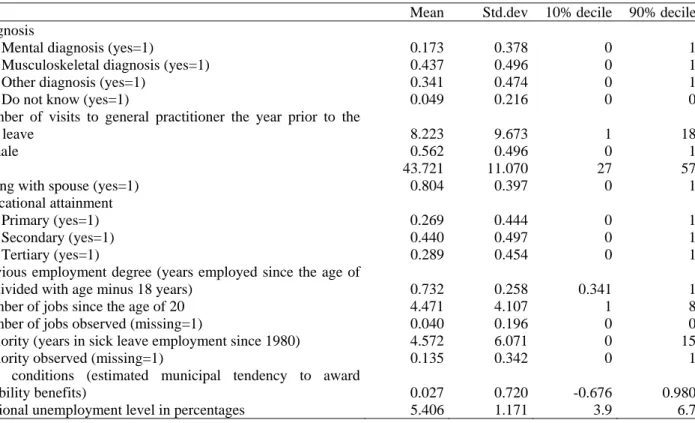
The covariates in the return to work estimations comprise socio-demographic characteristics, two health indicators, measures of previous labor market attachment, an indicator of the demand for labor, and a measure of the municipalities’ disability benefit award policy. Table 1 shows mean, standard deviation, and deciles for covariates used in the analysis (descriptive statistics for covariates included in the analysis of the hazard to CMI are shown in table B1 in Appendix B).
We include two covariates to capture the sick-listed employees’ health condition: the number of visits to general practitioners in the year prior to the beginning of the sick leave and the sick leave diagnosis. The sick leave diagnosis is self-reported and thus may be influenced by recall bias.
The socio-demographic characteristics include sex, age, educational attainment and three measures of labor market attachment prior to the beginning of the sick leave. One measure, the employment degree, is calculated as the ratio between the number of years in employment since the age of 18 and the employee’s age. This variable is based on register information between 1980 and the beginning of the sick leave. We construct another measure of previous labor market attachment as the number of jobs held since the age of twenty.
4
The increase in the hazard rate between the second and the fourth month may reflect inaccuracies in the data because individuals are selected on at least a nine-week duration of sick leave. Hence measurement errors for short durations can only be upwards. Furthermore, durations are measured on a monthly basis. Consequently, to avoid backwards causality between CMI (measured in days) and return to work in the econometric analysis, CMI that is measured to occur in month t is lagged one month. Thus, some individuals who actually had a CMI at t are now coded as if this occurred at t+1. If they return to work in month t they enter the analysis as if they did not have a case management interview. Therefore this approach underestimates the true effect of our treatment.
Finally, we use register information since 1980 to calculate a measure of seniority in the pre-sick leave job.
Previous return to work studies yield mixed evidence about the influence of the demand for labor (Aarts and Jong, 1992; Johnson, Baldwin and Butler, 1998; Høgelund, 2003). Intuitively it appears reasonable to expect that the demand for labor is more important for the probability of returning to work for a new employer than for the pre-sick leave employer. This is so because employers may apply statistical discrimination when they recruit new employees, i.e. employers use previous work-disability to screen out employees whom they expect have a low productivity (Stattinger, 1998). As this presupposes an excessive labor supply, we expect that unemployment influences statistical discrimination positively and thus reduces the probability that long-term sick-listed employees will find employment with a new employer. As the pre-sick leave employer has a relatively comprehensive knowledge of the sick-listed employee’s human capital, it is not necessary for the employer to apply statistical discrimination to the same extent to decide whether or not the sick-listed employee should be retained. The unemployment level will therefore have only a limited impact on the probability of returning to work for the pre-sick leave employer. To test this hypothesis we include the regional unemployment rate measured in the sick leave year.
Table 1. Mean, standard deviation and deciles for covariates in return to work analysis.
Mean Std.dev 10% decile 90% decile
Diagnosis
Mental diagnosis (yes=1) 0.173 0.378 0 1
Musculoskeletal diagnosis (yes=1) 0.437 0.496 0 1
Other diagnosis (yes=1) 0.341 0.474 0 1
Do not know (yes=1) 0.049 0.216 0 0
Number of visits to general practitioner the year prior to the
sick leave 8.223 9.673 1 18
Female 0.562 0.496 0 1
Age 43.721 11.070 27 57
Living with spouse (yes=1) 0.804 0.397 0 1
Educational attainment
Primary (yes=1) 0.269 0.444 0 1
Secondary (yes=1) 0.440 0.497 0 1
Tertiary (yes=1) 0.289 0.454 0 1
Previous employment degree (years employed since the age of
18 divided with age minus 18 years) 0.732 0.258 0.341 1
Number of jobs since the age of 20 4.471 4.107 1 8
Number of jobs observed (missing=1) 0.040 0.196 0 0
Seniority (years in sick leave employment since 1980) 4.572 6.071 0 15
Seniority observed (missing=1) 0.135 0.342 0 1
Exit conditions (estimated municipal tendency to award
disability benefits) 0.027 0.720 -0.676 0.980
Regional unemployment level in percentages 5.406 1.171 3.9 6.7
The possibilities of exiting the labor market through the disability benefit scheme may influence whether a sick-listed employee will return to work. In a study of long-term sick-listed employees with low back pain diagnoses, Høgelund (2003) found that individuals from municipalities with a lax disability benefit policy had a below average probability of returning to work. We follow the same approach and use the estimated disability benefit award rate for each municipality. This rate is estimated in an OLS regression as the residual between the estimated award rate for all Danish municipalities and the award rate of each of the 52 municipalities in our data. To correct for structural differences between municipalities that may influence the demand for disability benefits, the regression includes more than 40 socio-demographic characteristics of the municipalities.5 The disability benefit award rate relates to the sick leave year.
5
6. Methods
We use a piecewise constant hazard rate model to estimate how various factors affect the sick-listed employees’ probability of returning to work. To allow CMI to have diverse effects on the probability of returning to work with the pre-sick leave employer and a new employer we estimate a competing risk hazard model with two different outcomes: 1) return to work for the pre-sick leave employer, and 2) return to work for a new employer. As the information about the timing of return to work, t, is recorded in months, a discreet time model is used. The model can be expressed in terms of log-odds for returning to work:
(
)
(
)
1 1 2 , | ln 0, | tj j t j t P J j T t T t I x P J T t T t α β − β ⎛ = = ≥ ⎞ = + + ⎜ ⎟ ⎜ = = ≥ ⎟ ⎝ ⎠ (1)where, J = 0, denotes remaining absent from work, J = 1, 2 is returning to pre-sick leave and new employer, respectively. In the model, log-odds for returning to work, either with the pre-sick-leave or a new employer, at time t is a linear function of CMI at time t-1, It-1, and a vector of other observed covariates, xt. That is, we assume that CMIs have only a short-term effect on the probability of returning to work.6 Finally,αtis a time (month) dependent dummy variable capturing time varying effects on the hazard rate of returning to work.
To measure the overall effect of CMI, we also estimate a hazard rate model with a single outcome, returning to work either with the pre-sick leave or a new employer.
The analysis is subject to two methodological problems. It is likely that the CMI is an endogenous covariate for returning to work. Unobserved factors might exist that affect both CMI and returning to work. This would be the case if individuals participating in the
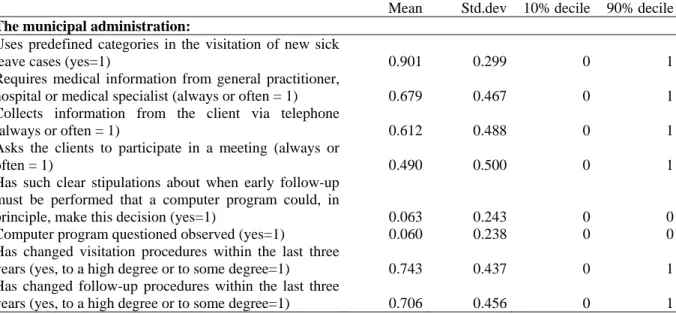
interviews have worse or better prospects of returning to work than sick-listed individuals on average. If some of these characteristics are not observed and hence cannot be conditioned upon in the analysis, there will be selection bias in the estimate of the effect of CMIs. Therefore we use the instrumental variables (IV) approach to correct for possible endogeneity of the interview. As instrumental variables that are correlated with CMI and uncorrelated with return to work we use information about the municipalities’ administrative practice in sick leave cases, see table B1 in Appendix B for a description of these covariates. That is to say, we assume that the probability of participating in a CMI is high (low) when the sick-listed employee lives in a municipality with an active and/or non-bureaucratic (passive and/or bureaucratic) sick leave policy. We also assume that the municipality policy does not affect the chance of returning to work, except indirectly through the CMI. This assumption is supported by a Hausman χ2 test suggesting that the two most significant instrumental variables, ‘Asks the clients to participate in a meeting’ and ‘Has such clear stipulations about when early follow-up must be performed that a computer program could, in principle, make this decision’ (cf. table B2 in Appendix B) are consistent estimators (with χ2(23)=24.2, p=0.393 and χ2(23)=17.3, p=0.794).
A second problem is related to the municipal covariates that we use as instrumental variables. The information used to construct these covariates was gathered after the sickness benefit cases had been closed. Consequently, the municipal covariates may be biased. To adjust for this, we include two covariates that measure if, within the last three years, the municipality had changed its administrative procedures regarding visitation of cases to follow-up assessment and how they perform the follow-ups.
7. Results
Table 2 presents estimates from the hazard rate models for returning to work (column 2), returning to work for the pre-sick leave employer (column 3), and returning to work for a new employer (column 4) (see table B2 in Appendix B for estimation results of the hazard rate model for participating in a CMI).
Table 2. Hazard rate for returning to work (n=1,000).
Return to work
Return to work for pre-sick leave employer
Return to work for new employer
Case management interview1) 1.770 (0.943)* 2.842 (1.094)*** -0.665 (1.697)
Regional unemployment -0.043 (0.037) 0.007 (0.041) -0.186 (0.077)** Diagnosis Mental diagnosis --- --- --- --- --- --- Musculoskeletal diagnosis 0.211 (0.127)* 0.777 (0.165)*** -0.922 (0.211)*** Other diagnosis 0.288 (0.132)** 0.785 (0.168)*** -0.741 (0.237)*** Do not know -0.144 (0.232) 0.361 (0.276) -1.045 (0.430)**
Number of previous visits to general
practitioner -0.027 (0.006)*** -0.032 (0.008)*** -0.011 (0.011)
Female 0.035 (0.095) 0.115 (0.106) -0.190 (0.192)
Age2) -0.076 (0.045)* 0.082 (0.052) -0.464 (0.093)***
Living with spouse (yes=1) -0.242 (0.108)** -0.097 (0.126) -0.453 (0.200)**
Educational attainment
Primary --- --- --- --- --- ---
Secondary 0.111 (0.110) 0.172 (0.126) -0.001 (0.213)
Tertiary 0.272 (0.121)** 0.349 (0.137)** 0.099 (0.244)
Previous employment degree 0.621 (0.203)*** 0.842 (0.236)*** -0.010 (0.369)
Seniority 0.010 (0.009) 0.018 (0.009)* -0.079 (0.029)***
Seniority observed (missing=1) -0.070 (0.141) -0.010 (0.162) -0.331 (0.264)
Number of jobs 0.006 (0.012) -0.005 (0.014) 0.043 (0.020)**
Number of jobs observed (missing=1) -0.196 (0.249) -0.294 (0.294) 0.196 (0.443)
Exit conditions (estimated municipal
tendency to award disability benefits) -0.037 (0.063) -0.011 (0.070) -0.177 (0.141)
Baseline, 3 months -0.584 (0.195)*** 0.379 (0.234) -2.900 (0.422)*** Baseline, 4 months -0.502 (0.151)*** 0.184 (0.186) -1.870 (0.284)*** Baseline, 5 months -0.848 (0.188)*** -0.333 (0.229) -1.532 (0.323)*** Baseline, 6 months -1.268 (0.183)*** -0.716 (0.224)*** -1.917 (0.318)*** Baseline, 7-8 months -0.905 (0.175)*** -0.494 (0.220)** -1.260 (0.271)*** Constant -1.274 (0.436)*** -4.232 (0.526)*** 2.559 (0.773)***
Note: See table 1 for further information about the content of the covariates. Standard errors between brackets. Significance levels: *** significant at 1%, ** significant at 5%, * significant at 10%. Baseline duration is lagged 1 month.
1): Estimates obtained from a hazard rate model of the probability of participating in a case management interview, see Appendix B.
We find that CMI has a positive effect on returning to work at a 10% significance level. This finding, however, masks that CMI has diverse effects on the probability of returning to work for the pre-sick leave employer and a new employer. CMI has a positive and strong impact on returning to work for the pre-sick leave employer, whereas its effect on returning to work for a new employer is negative and insignificant.
This finding supports the hypothesis that CMI has a short-term effect. This may either reflect that CMI motivates the sick-listed employee to resume work or that CMI adjusts for asymmetric information between the employee and the pre-sick leave employer. That is, the pre-sick leave employer receives information from the CMI indicating that the sick-listed employee will return to work sooner than anticipated, which in turn increases the probability that the employer will retain the employee.
As our model estimates only short-term effects, it is most likely that the observed effect does not relate to allocation of sick-listed employees to vocational services, as these measures have only long-term effects.
However, sick-listed employees who enter vocational services might suffer from a short-term locking-in effect, if they enter vocational services immediately after a CMI. As a fraction of our sample enters vocational services our estimates might underestimate the true effect of CMI. Therefore it is a lower bound of the short-term effect of CMI. To get an idea about the magnitude of the downward bias of the locking-in-effect, we re-estimate the hazard rate models on a sample that includes only those sick-listed employees who did not participate in vocational rehabilitation or receive other municipal financed vocational services.7 An increase in the re-estimated coefficient of CMI will indicate that vocational services
7
From the original sample of 1,000 individuals we exclude 167 individuals who participated in vocational rehabilitation (159) or received other vocational services (8) and 37 with missing information on these covariates. Vocational rehabilitation includes measures such as courses, education, test of vocational abilities, wage subsidised job training, whereas other vocational measures comprise economic support to workplace adaptation, aids, and other economic support to vocational services.
established in association with CMIs have a negative short-term locking-in effect on the probability of returning to work.8 Table 3 shows the estimates of CMI in the three models.
Table 3. Estimates of case management interview in hazard rate models on restricted sample (n=796).
Return to work
Return to work for pre-sick leave employer
Return to work for new employer
Case management interview1) 2.346 (1.013)** 3.923 (1.155)*** -1.954 (1.851)
Note: The models include the same covariates as the models shown in table 2. The sample is restricted to the sick-listed employees who did not participate in vocational rehabilitation.
1): Estimates obtained from a hazard rate model of the probability of participating in a case management interview, see Appendix B.
This analysis gives further support for a motivational effect or an adjustment for asymmetric information effect. Compared to the estimates in table 2, the coefficient of CMI is bigger in the model for returning to work, especially in the model for returning to work for the pre-sick leave employer.
Returning to the influence of unemployment, we see from table 2 that the unemployment level is insignificant in the model for returning to work. Once again it is apparent that this simple outcome measure disguises a significant effect. Whereas the unemployment level has no impact on the probability of returning to work for the pre-sick leave employer, it significantly affects the probability of resuming work with a new employer, i.e. a high unemployment level reduces the probability of returning to work for a new employer. This supports that unemployment increases the use of statistical discrimination in the recruitment process in the open labor market, thereby reducing long-term sick-listed employees’ chances of finding a new job. At the same time, the finding may reflect that
8
However, this procedure might bias our CMI estimates. If sick-listed employees entering vocational services after CMI have lower hazard rates back to work, over and above that induced by the locking-in effect, than those
unemployment does not influence the pre-sick leave employer's use of statistical discrimination to the same extent, because the employer has a relative comprehensive knowledge of the sick-listed employee’s capacities.
Finally, the effects of several of the other covariates underline the benefits of distinguishing between returning to work for the pre-sick leave employer and a new employer. For example, employees who were sick-listed with a musculoskeletal diagnosis and other diagnoses such as heart problems have a high probability of returning to work for the pre-sick leave employer but a low probability of returning to work for a new employer. In contrast, employees who were sick-listed with a mental diagnosis have a low probability of returning to work for the pre-sick leave employer, but a high chance of finding a job with a new employer. This could reflect that in some instances mental problems are caused by a poor working climate, which makes it less likely that the sick-listed employee will return to work for the same employer. It might also reflect that mental problems are difficult to manage in the workplace and as a consequence it might be less complicated to return to work for a new employer than for the pre-sick leave employer. Seniority is another example. Long seniority increases the probability of returning to work for the pre-sick leave employer but reduces the probability of resuming work with a new employer. As seniority increases human capital, the first part of this finding may reflect that employers are more committed to retaining employees with a long period of seniority. As employees with a long period of seniority often have high salaries, the latter part of the finding may reflect that these employees are unable to find a new job because of wage demands that are too high.
8. Conclusion
This paper examines the effect of an important element of all case management strategies: the case management interview (CMI). We use data from a national survey of 1,000 employees who were sick-listed for more than eight weeks. By applying the instrumental variables approach, we estimate the effect of CMI on the probability that the sick-listed employees return to work. We distinguish between returning to work for the pre-sick leave employer and a new employer in order to allow CMIs to have diverse effects on the probability of returning to work for the pre-sick leave employer and a new employer.
We find that CMI significantly increases the probability of returning to work for the pre-sick leave employer, while it has no significant effect on the probability of returning to work for a new employer. Additionally, we find that the effect of CMI does not apparently originate from the allocation of effective vocational services for the sick-listed employee.
Instead, we suggest that the observed effect of CMI originates from two potential sources. First, CMI may motivate sick-listed employees to resume work because it either makes continued benefit receipt appear less attractive or work resumption more attractive. Second, CMI may increase the probability of returning to work for the pre-sick leave employer because it adjusts for asymmetric information between the employer and the employee. When sick-listed employees inform their employer about the expected date of work resumption, employees with long expected absence durations may underestimate the duration in order to avoid dismissal. Rational employers will react by adjusting expected work absence durations upwards. Consequently, employers may not only dismiss sick-listed employees who in reality have long expected work absence durations, but also employees with short durations. As the CMI may confirm that some employees have short expected
absence durations, the CMI will increase the probability of work resumption with the pre-sick leave employer. Whether the CMI has a motivational effect, an asymmetric information effect, or both, remains to be verified in future studies.
Acknowledgements
We thank the Health Insurance Foundation for financial support. We gratefully acknowledge comments from Jan van Ours and Christopher Winship, and participants at the seminars held by the Danish National Institute for Social Research in Copenhagen (1-3 June 2004) and Hilleroed (7-8 June 2004).
Appendix A
In this appendix we briefly outline a model of the effect of the uncertainty (variance) of the work absence duration on the employer’s expected profit of retaining the sick-listed employee and hence on the decision of whether to retain the sick-listed employee.
The model illustrates that if CMI leads only to a reduction of the uncertainty of the absence duration, CMI will increase the probability of dismissal.
Let πkbe the profit if the sick-listed employee returns to work and let ρ denote the discount rate of the employer. Let the expected duration until return to work, t, be uniform in the interval a – b. Then the expected profit from returning to work is:
(
)
(
)
2(
(
)
)
1 ( ) a b b t s k k k t a e e b a e E t E e ds dt b a b a ρ ρ ρ ρ ρ k π π π ρ ρ − − ∞ − − − − − ⎛ ⎞ − = ⎜ ⎟= = − − ⎝∫
⎠∫
πBy defining b-a = δ we get:
(
)
( )2 ( )2 ( )2 ( )2 2 2 1 ( ) t t t t k k e e e e E t δ δ δ δ ρ ρ ρ ρ ρδ k π π π ρ ρ δ ρ δ − − − + ⎛ − − − + ⎞ − − ⎜ − ⎟ = = ⎜ ⎟ ⎝ ⎠ −where t =E t( ), the employer’s expected duration until the sick-listed employee returns to work. We now readily find:
(
)
( )2 ( )2 ( )2 ( )2 2 2 2 2 2 ( ) 0 t t t t k e e e e k E t π ρ ρ δ ρ δ ρ ρ δ ρ δ δ δ ρ δ δ π δ − − − − − + − + ∂ = ⎛ − + + ⎞ ⎜ ⎟ ∂ ⎝ ⎠>that is, an increase (decrease) in the variance of the duration of the return to work of the sick-listed individual yields an increase (decrease) in expected profit of work retention.
Hence, decreasing uncertainty on the timing of the return to work decreases expected profit from retaining the employee. This somewhat contradictory result emerges because by decreasing the variance we not only reduce the maximum expected work absence
duration, t 2
δ
+ , which is discounted the most, but also the minimum expected absence
duration, t 2
δ
− , which is discounted the least. In sum, we get a decreasing expected profit by
reducing uncertainty of the timing of the return to work. Consequently, CMIs that only convey more precise information on the work absence duration should induce employers to dismiss sick-listed employees.
Appendix B
Table B1. Mean, standard deviation and deciles for covariates in case management analysis.
Mean Std.dev 10% decile 90% decile
The municipal administration:
Uses predefined categories in the visitation of new sick
leave cases (yes=1) 0.901 0.299 0 1
Requires medical information from general practitioner,
hospital or medical specialist (always or often = 1) 0.679 0.467 0 1
Collects information from the client via telephone
(always or often = 1) 0.612 0.488 0 1
Asks the clients to participate in a meeting (always or
often = 1) 0.490 0.500 0 1
Has such clear stipulations about when early follow-up must be performed that a computer program could, in
principle, make this decision (yes=1) 0.063 0.243 0 0
Computer program questioned observed (yes=1) 0.060 0.238 0 0
Has changed visitation procedures within the last three
years (yes, to a high degree or to some degree=1) 0.743 0.437 0 1
Has changed follow-up procedures within the last three
years (yes, to a high degree or to some degree=1) 0.706 0.456 0 1
Table B2. Hazard rate for participation in case management interview (n=1,000). Uses predefined categories in the visitation of new sick leave cases (yes=1) -0.065 (0.163) Requires medical information from general practitioner, hospital or medical specialist
(always or often = 1) -0.120 (0.103)
Collects information from the client via telephone (always or often = 1) 0.023 (0.101)
Asks the clients to participate in a meeting (always or often = 1) 0.285 (0.101)***
Has such clear stipulations about when early follow-up must be performed that a computer
program could, in principle, make this decision (yes=1) -0.622 (0.229)***
Computer program questioned observed (yes=1) -0.156 (0.212)
Has changed visitation procedures within the last three years (yes, to a high degree or to
some degree=1) 0.464 (0.149)***
Has changed follow-up procedures within the last three years (yes, to a high degree or to
some degree=1) -0.326 (0.129)** Baseline, 2 months 1.949 (0.174)*** Baseline, 3 months 2.257 (0.180)*** Baseline, 4 months 1.858 (0.204)*** Baseline, 5 months 1.872 (0.228)*** Baseline, 6-7 months 1.614 (0.268)*** Baseline, >7 months 2.301 (0.263)*** Constant -3.223 (0.235)***
References
Aarts, L.J.M., Burkhauser, R.V., de Jong, P.R., 1996. Introduction and overview, in: Aarts, L.J.M., de Jong, P.H., Burkhauser, R.V. (Eds.), Curing the Dutch Disease. An International Perspective on Disability Policy Reform. Avebury Aldershot: England.
Aarts, L.J.M., de Jong, P.R., 1992. Economic Aspects of Disability Behavior. Elsevier Science Publishers B.V. Amsterdam, Holland.
Arnetz, B.B., Sjögren, B., Rydéhn, B., Meisel, R., 2003. Early Workplace Intervention for Employees with Musculoskeletal-Related Absenteeism: A prospective Controlled Intervention Study. Journal of Occupational and Environmental Medicine, vol. 45, no. 5.
Bound, J., Burkhauser, R.V., 1999. Economic Analysis of Transfer Programmes Targeted on People with Disabilities, in: Ashenfelter, O. and Card, D. (Eds.), Handbook of labor economics, vol. 3C. Elsevier: Amsterdam, pp. 3417-3528.
Butler, R.J., Johnson, W.G., Baldwin, M.L., 1995. Managing work disability: why first return to work is not a measure of success. Industrial and labour relations review 48.
Butler, R.J., Worral, J.D., 1985. Work Injury Compensation and the Duration of Nonwork Spells. The Economic Journal, 95 (379).
Cheadle, A., Franklin, G., Wolfhagen, C., Savarino, J., Liu, P.Y., Salley, C., Weaver, M., 1994. Factors Influencing the Duration of Work-Related Disability: A Population-Based Study of Washington State Workers’ Compensation. American Journal of Public Health, vol. 84, no. 2.
Currie, J., Madrian, B.C., 1999. Health, Health Insurance and the Labor Market, in: Ashenfelter, O., Card, D. (Eds.), Handbook of labor economics, vol. 3C. Elsevier: Amsterdam, pp. 3309-3416.
Dasinger, L.K., Krause, N., Deegan, L.J., Brand, J.B., Rudolph, L., 2000. Physical workplace factors and return to work after compensated low back injury: a disability face-specific analysis. Journal of Occupational Environmental Medicine, 42(3): 323-333.
Faas, A., Van Eijk J.T., Chavannes, A.W., Gubbels, J.W., 1995. A randomised trial of
exercise therapy in patients with acute low back pain. The efficiency and sickness
absence. Spine, vol. 20: 941-47.
Fordyce, W.E., Brockway, J.A., Spengler, D., 1986. Acute back pain: a control-group comparison of behavioural vs. traditional management methods. Journal of Behavioural Medicine, Vol. 9:127-140.
Folketinget, 1996. Lov om ændring af lov om dagpenge ved sygdom eller fødsel (Styrkelse af opfølgningen, ændrede beregningsregler m.v.). Lov nr. 1226 af 27. december 1996. Copenhagen: Folketinget.
Frölich, M., Heshmati, A., Lechner, M., 2004. A Microeconometric Evaluation of Rehabilitation of Long-term Sickness in Sweden. Journal of Applied Econometrics, Vol. 19, no. 3: p. 375-396.
Förördning, 2003. Förördning 2003:426 om rehabiliteringsutredning enligt 22 kapitel lagen (1962:381) om allmän försäkring.
Galizzi, M., Boden, L.I., 1996. What are the most important factors shaping return to work? Evidence from Wisconsin. WC-96-6. Workers Compensation Research Institute: Cambridge, MA.
Galizzi, M., Boden, L.I., 2003. The return to work of injured workers: evidence from matched unemployment insurance and workers’ compensation data. Labour economics, vol. 10, pp. 311-337.
Greenwood, J.G., Wolf, H.J., Pearson, R.J., Woon, C.L., Posey, P., Main, C.F., 1990. Early intervention in low back disability among coal miners in West Virginia: negative findings. Journal of Occupation Medicine, Vol 32: 1047-1052.
Gregersen, O., 1994. Kommunernes pensionspraksis. Servicerapport. The Danish National Institute of Social Research: Copenhagen.
Heshmati, A., Engström, L.G., 2001. Estimating the effects of vocational rehabilitation programs in Sweden, in: Lechner, M., Pfeiffer, F. (eds.), Econometric Evaluation of Labour Market Policies. ZEW Economics Studies 13. Physica-Verlag: New York.
Hunt, H.A., Habeck, R.V. (1993), The Michigan disability prevention study. Upjohn Institute for Employment Research. Kalamazoo, MI, W.E.
Høgelund, J., 2003. In Search of Effective Disability Policy. Comparing the Developments and Outcomes of Dutch and Danish Disability Policies. Amsterdam University Press: Amsterdam.
Høgelund, J., Holm, A., forthcoming. Returning the Long-Term Sick-Listed to Work: The Effects of Educational Measures and Employer Separations, in: Saunders, P. (eds.): Social Security and the Welfare to Work Transition. International Studies on Social Security, Volume Ten. Aldershot: Ashgate.
Høgelund, J., Filges, T., Jensen, S., 2003. Langvarigt sygefravær. Hvad sker der og hvordan går det? Report 03:20. The Danish National Institute of Social Research: Copenhagen.
Indahl, A., Velund, L., Reikeraas, O., 1995. Good Prognosis for Low Back Pain When Left Untampered. A Randomized Clinical Trial. Spine, Vol. 20, no. 4, pp. 473-477.
Infante-Rivard, C., Lortie, M., 1996. Prognostic factors for return to work after a first compensated episode of back pain. Journal of Occupational Environmental Medicine, Vol. 53, No. 7: pp. 488-94.
Johnson, W.G., Baldwin, M.L., Butler, R.J., 1998. Back Pain and Work Disability: The Need for a New Paradigm.Industrial Relations, vol. 37 no. 1.
Johnson, W.G., Ondrich, J., 1990. The Duration of Post-injury Absences from Work. Review of economics and statistics. vol. 72.
Krause, N., Dasinger, L.K., Deegan, L.J., Rudolph, L., Brand, J.B. (2001), Psychosocial job factors and return to work after low back injury: a disability phase-specific analysis. American journal of industrial medicine, Vol. 40: pp. 374-92.
Krause, N., Dasinger, L.K., Neuhauser, F., 1998. Modified Work and Return to Work: A Review of the Literature. Journal of Occupational Rehabilitation, vol. 8, no. 2:113-139.
Krause, N., Lund, T., 2002. Return to Work, in: Barling, J., Frone, M. (eds.), The psychology of workplace safety. American Psychological Association: Washington DC.
Maki, S., 1998. Case Management, in: King, P.M. (ed.), Sourcebook of Occupational Rehabilitation. Plenum Press: New York and London.
Martin, K.J., 1995. Workers’ compensation. Case management strategies. AAOHN Journal, vol. 43, no. 5, pp. 245-250.
Meyer, B.D., Viscusi, K.W., 1995. Workers’ Compensation and Injury Duration: Evidence from a Natural Experiment. American Economic Review. Vol. 85. No. 3.
Oleinick, A., Gluck, J.V., Guire, K.E., 1996. Factors Affecting First Return to Work Following a Compensable Occupational Back Injury. American Journal of Industrial Medicine, vol. 30.
Russo, D., Innes, E., 2002. And organizational case study of the case manager’s role in a client’s return-to-work programme in Australia. Occupational Therapy International, vol. 9(1), pp. 57-75.
Stortinget, 2001. Stortingsproposisjon nr. 1, Tillegg nr. 1, 2001-2002. Oslo: Stortinget.
Statens offentliga utredningar, 1998. Arbetsgivarens rehabiliteringsansvar. Betänkande av AGRA-utredningen. Stockholm: Fritzes.
Sattinger, M., 1998. Statistical discrimination with employment criteria. International Economic Review, Vol. 39, No. 1: 205-237.
Weide, W.E. van der, Verbeek J.H.A.M., Tulder, M.W., 1997. Vocational outcome of intervention for low-back pain. Scandinavian Journal of Work, Environment and Health, vol. 23:165-178.
Veerman, T. J., Palmer, E., 2001. Work Resumption and the Role of Interventions, in: Bloch, F.S., Prins, R. (Eds.), Who Returns to Work & Why. A Six-Country Study on Work Incapacity and Reintegration. International Social Security Series. Vol. 5, pp. 223-272. New Brunswick (U.S.A.) and London (U.K.): Transaction Publishers.
Verbeek, J.H., van der Weide, W.E., van Dijk, F.J., 2002. Early Occupational Health Management of Patients with Back Pain: A Randomised Controlled Trial. Spine, vol. 27, no. 13 pp. 1844-1850.
Curriculum vitae
Name: Jan Høgelund
Date of birth: 25 October 1963
Affiliation: The Danish National Institute of Social Research,
Denmark
Occupation: Senior researcher
Education and academic grades: MA in economic from Copenhagen University, 1990.
PhD in Public Administration from Roskilde University, 2000.
Recent publications:
Høgelund, J., 2003. In Search of Effective Disability Policy. Comparing the Developments and Outcomes of Dutch and Danish Disability Policies. Amsterdam University Press.
Høgelund, J., Holm, A., forthcoming. Returning the Long-Term Sick-Listed to Work: The Effects of Educational Measures and Employer Separations, in: Saunders, P. (eds.): Social
Security and the Welfare to Work Transition. International Studies on Social Security,
Volume Ten. Aldershot: Ashgate.
Høgelund, J., 2002. Reintegration: Public or Private Responsibility? Consequences of Dutch
and Danish Policies Toward Work-Disabled Persons.International Journal of Health Services,
Name: Anders Holm
Date of birth: 04 April 1963
Affiliation: Department of sociology, University of Copenhagen and
Centre for Applied Microeconomics, University of Copenhagen
Occupation: Associate professor
Education and academic grades: MA in economic from University of Copenhagen, 1988.
PhD in Economics from University of Copenhagen, 1996.
Recent publications:
G.J. van den Berg, A. Holm, J. van Ours, 2002. Do stepping stone jobs exist? Early career paths in the medical profession, Journal of Population Economics, vol. 15.
Holm, A., 2002. The Effect of Training on Search Durations; A Random Effects Approach, Labour Economics, vol 9.
Heinesen, E.R. Davies, A. Holm, 2002. The relative risk aversion hypothesis of educational choice, Journal of Population Economics, vol. 15.