Inductive Reasoning about Ontologies Using Conceptual Spaces
Zied Bouraoui
Cardiff University, UK [email protected]Shoaib Jameel
Cardiff University, UK [email protected]Steven Schockaert
Cardiff University, UK [email protected] AbstractStructured knowledge about concepts plays an increasingly important role in areas such as information retrieval. The available ontologies and knowledge graphs that encode such conceptual knowledge, however, are inevitably incomplete. This observation has led to a number of methods that aim to automatically complete existing knowledge bases. Unfor-tunately, most existing approaches rely on black box mod-els, e.g. formulated as global optimization problems, which makes it difficult to support the underlying reasoning pro-cess with intuitive explanations. In this paper, we propose a new method for knowledge base completion, which uses in-terpretable conceptual space representations and an explicit model for inductive inference that is closer to human forms of commonsense reasoning. Moreover, by separating the task of representation learning from inductive reasoning, our method is easier to apply in a wider variety of contexts. Finally, unlike optimization based approaches, our method can naturally be applied in settings where various logical constraints between the extensions of concepts need to be taken into account.
Introduction
Ontologies encode structured knowledge about the con-cepts and properties of a given domain. They are typi-cally encoded using description logics, and divided in two parts: a TBox, which contains information about the se-mantic relationships between concepts, and an ABox, which contains information about which entities belong to what concepts. Similar to ontologies, knowledge graphs encode information about concepts and entities as a set of sub-ject/predicate/object triples. The key difference with ontolo-gies is that knowledge graphs are considerably less expres-sive (e.g. we cannot express that two concepts are disjoint, or that the intersection of two concepts is subsumed by an-other concept). To date, ontologies have mostly been used in applications where deductive reasoning suffices, whereas knowledge graphs are often used in combination with forms of inductive reasoning (Lao, Mitchell, and Cohen 2011; Bordes et al. 2013).
As most ontologies are incomplete, it is clearly of inter-est to combine the deductive machinery of description logics
Copyright c2017, Association for the Advancement of Artificial Intelligence (www.aaai.org). All rights reserved.
with some form of induction. This is especially true in appli-cations such as information retrieval, where getting a plau-sible answer may be better than not getting an answer at all, even if the correctness of that answer cannot be guaranteed. A key requirement in such applications, however, is that an-swers can be supported by intuitive explanations, as this al-lows users to determine their plausibility. Another important requirement is that the inductive reasoning process should be relatively cautious, as in a deductive setting the impact of ac-cepting incorrect conclusions could be far-reaching. Finally, conclusions which are derived inductively should be asso-ciated with commensurable confidence scores that can be used to restore consistency when conflicts arise. Clearly, ap-proaches which rely on solving a global optimization prob-lem (Bordes et al. 2013) or on aggregating large amounts of individually weak pieces of evidence (Lao, Mitchell, and Cohen 2011) do not meet these requirements.
In this paper, we propose a method which is inspired by cognitive models of category based induction (Osherson et al. 1990; Tenenbaum and Griffiths 2001). In particular, given the knowledge that conceptsC1, ..., Ckall have some prop-ertyP, our aim is to determine the degree to which we can plausibly conclude that some other conceptChas property P. To this end, we first rely on the method from (Jameel and Schockaert 2016) to learn a vector space representation of the entities of each considered semantic type (e.g. people, countries, movies), which can be interpreted as a conceptual space (G¨ardenfors 2000). From these conceptual spaces, we subsequently derive a set of representative and interpretable features for each semantic type. The plausibility thatChas property P is then obtained using a form of Bayesian in-ference over the resulting feature values. We argue that this approach indeed meets the three aforementioned criteria: as it is similar in spirit to cognitive models for category based induction, and relies on interpretable representations, sup-porting explanations can be derived in a natural way, while the use of Bayesian inference supports cautious forms of in-terest and yields confidence scores in a principled way. Un-like most existing methods, our method can be used for both TBox and ABox reasoning.
The remainder of this paper is structured as follows. In the next section we give an overview of related work, after which we recall some basic notions from description logics and the theory of conceptual spaces. Subsequently we
de-scribe our proposed model. Finally, we discuss experimental results and present our conclusions.
Related Work
A natural form of inductive inference consists in using sim-ilarity based arguments of the form “if the instance(s) most similar to entityxbelong to conceptCthenxalso belongs to conceptC”. Several variants of this idea, which also un-derpins nearest neighbor classifiers, have already been ex-plored. In some cases, similarity is obtained from vector space representations that have been learned from text col-lections (Summers-Stay, Voss, and Cassidy 2016; Beltagy et al. 2013), whereas other approaches derive a notion of similarity directly from the ontology (d’Amato et al. 2010; Minervini et al. 2016; Janowicz 2006). A third class of meth-ods explicitly encodes aspects of similarity as part of the knowledge base (Sheremet et al. 2007).
While intuitive, similarity based reasoning is often too heuristic, especially for TBox reasoning. One particular problem is the context-dependent nature of similarity: it may not be a priori clear in what features two entities need to be similar to draw plausible conclusions about a given concept C. Interestingly, the method in (Minervini et al. 2016) ad-dresses this by explicitly learning a similarity relation from the relations encoded in the ontology. In particular, they identify relations that are predictive of the fact that two en-tities have the same value for a given property (e.g. peo-ple linked by a friendship relation tend to live in the same country), as well as relations that are predictive of the fact that two entities have a different value (e.g. people linked by the ‘married to’ relation tend to have different values for the property ‘gender’). This form of inference, which relies on the relations between entities, is essentially complementary to the method we propose in this paper.
A second limitation of similarity based reasoning is that it cannot be used when the knowledge base lacks entities that are sufficiently similar to the considered entityx. The use of analogical proportion based reasoning has been proposed as a technique for alleviating this issue (Miclet, Bayoudh, and Delhay 2008; Bounhas, Prade, and Richard 2014). In-tuitively, for triples of examples(a, b, c), a fourth example xis constructed such that a : b :: c : xmakes an ana-logical proportion (i.e. a relates to b like c relates to x), and similarity based reasoning is applied on the resulting extended set of examples (Hug et al. 2016). Another so-lution is to us interpolation; properties that hold foraand b are then assumed to hold for all entities which are ap-proximately betweenaandb(Schockaert and Prade 2013; Derrac and Schockaert 2015).
The vast majority of existing methods only focus on ABox reasoning, i.e. the problem of identifying which in-stances (plausibly) belong to which concepts. This problem can be cast as a standard classification problem. One pos-sibility is to make use of kernels for structured data (Bloe-hdorn and Sure 2007), in combination with classifiers such as support vector machines (SVMs). Intuitively, the classi-fier then uses the ontology itself to estimate how similar any two given entities are. Another possibility, considered in
(Neelakantan and Chang 2015), is to represent entities using external features derived from resources such as Wikipedia. Recently, the use of vector space embeddings has become a popular approach for completing knowledge graphs (Bor-des et al. 2011; 2013; Wang et al. 2014). These methods focus on finding plausible relationships, intuitively based on statistical correlations with other relationships from the knowledge graph. Some methods of this kind could in prin-ciple also be used for inductive ABox reasoning. A num-ber of embedding models that explicitly represent seman-tic types have recently been proposed (Hu et al. 2015; Xie, Liu, and Sun 2016; Jameel and Schockaert 2016).
One of the main limitations of classification and embed-ding based methods is that they require sufficient amounts of data to be effective. Moreover, as they are based on black box models, providing intuitive explanations for inferred conclusions can be problematic. In this sense, such meth-ods are complementary to similarity based reasoning and re-lated cognitively inspired methods. The method we propose in this paper aims to combine the best of both worlds.
Background
Our method is based on two complementary frameworks for representing and reasoning about conceptual knowledge: we use deductive inference in description logics to reason about structured knowledge, and use conceptual space representa-tions as the basis for inductive inferences. In this section, we briefly recall the basic notions from these two frameworks.
Description Logics
Description logics are the logical framework underlying on-tology languages such as OWL. For simplicity, we will con-sider ALC (Baader et al. 2003), which is one of the most basic description logics. However, the results of this paper can straightforwardly be extended to other description log-ics, as well as related formalisms such as existential rules (Baget et al. 2011; Cal`ı, Gottlob, and Pieris 2012).
The syntax ofALCis defined over three pairwise disjoint sets of namesNC,NR andNI, which respectively denote concepts (e.g. Scientist), roles (i.e. relations such as Spe-cializesIn) and individuals (i.e. entities such aseinstein). A concept expression can be (i) an atomic concept fromNC, (ii) one of the special concepts⊥and>, denoting respec-tively an empty concept and the universe of all individuals, or (iii) built from other concept expressions using the con-structs shown in Table 1. The operatorst,uand¬ corre-spond to the usual notions of union, intersection and com-plement. The concept expressions∃R.C and∀R.C depend on a role R and conceptC. They respectively denote the set of individuals who are related through R with at least one instance of C, and the set of individuals who are re-lated throughR only with instances fromC. For example ∃SpecializesIn.ScienceAreaintuitively denotes the set of in-dividuals who have a specialization that is an area of science. A knowledge base (KB) is a pairK=hT,AiwhereT is called the TBox and A is called the ABox. The TBox is a set of inclusion axioms of the form C v D, where C and D are concept expressions. The axiom C v D ex-presses that every instance ofCis also an instance ofD, e.g.
Scientist vSpecializesIn.ScienceAreaexpresses that every scientist specializes in some area of science. The ABox con-tains a set of assertions of the formA(a)andR(a, b), where A∈NC,R∈NRanda, b∈NI.
An interpretation is a pairI=(∆I, .I), where∆Iis a non-empty set called the domain, and.Iis a function that assigns to each a ∈ NI an elementaI ∈ ∆I, to eachA ∈ NC a subsetAI ⊆ ∆I and to eachR ∈ NR a binary relation RI ⊆∆I×∆I. The function.Iis extended in a straightfor-ward way for concept and role expressions as shown in Table 1. An interpretationI satisfies a concept inclusion axiom, writtenI |=CvDiffCI ⊆DI. Similarly, we say thatI satisfies a concept (resp.role) assertion, writtenI |=A(a)
(resp.I|=R(a, b)), iffaI ∈AI(resp.(aI, bI)∈RI). An interpretationIsatisfies KBK=hT,AiifIsatisfies every the concept inclusion axiom inT and every assertions inA. IfIsatisfiesKthenIis said to be a model ofK.
Syntax Semantics > ∆I ⊥ ∅ ¬C ∆I\CI CuD CI∩DI CtD CI∪DI ∃R.C {x∈∆I|∃y∈∆Ist(x, y)∈RIandy∈CI} ∀R.C {x∈∆I|if(x, y)∈RItheny∈CI}
Table 1:ALCSyntax and Semantics.
Conceptual Spaces
Conceptual spaces were proposed by G¨ardenfors (2000) as an intermediate representation level between symbolic and connectionist representations. A conceptual space is defined as the Cartesian product of a number of so-called quality dimensions. These can be understood as the (primitive) fea-tures in the domain being modelled. For example, in a con-ceptual space of people, the quality dimensions could cor-respond to features such as height, age, education level, etc. Each entity of the considered domain is thus represented by a vector(x1, ..., xn), wherexiis the value of this entity for theithquality dimension. In general, quality dimensions can
be arbitrary metric spaces in which a notion of betweenness is defined. However, in this paper, we will make the com-mon simplifying assumption that each quality dimension is modelled as the real line.
Inductive Reasoning Using Embeddings
To obtain conceptual space representations, we have used the method from (Jameel and Schockaert 2016), which uses textual descriptions from Wikipedia and structured informa-tion from Wikidata as input. For each semantic type occur-ring in Wikidata, this method constructs a Euclidean space in which all entities of that type are represented as points. The number of dimensions of each space is chosen in an au-tomated way, depending on how much information is avail-able about the corresponding semantic type. Moreover, the words occurring in the textual descriptions of these entities are represented as vectors in this Euclidean space. The ideais that each of these vectors could potentially be defining a quality dimension. When learning the space, the following constraint is imposed for each entityiand context wordj:
pivj ≈logcij−bi−bj (1) wherepiis the vector representing entityi,vj is the vector representing the context wordj,cij is the number of times wordj occurs in the description of entityi, andbi, bj ∈R
are constants. Since the resulting optimization problem is over-constrained, (1) will only be (approximately) satisfied for some words, and these words tend to be those that cor-respond to salient properties. Therefore, to select quality di-mensions, we determine those wordsjfor which (1) is max-imally satisfied. Specifically, for each wordj, we define:
ej= X
i
(pivj−logcij+bi+bj)2
To allow for some redundancy, for semantic types that are modelled inRnwe will select2nquality dimensions. One
possibility would be to select the2nterms for whichej is minimal. This choice, however, is likely to be suboptimal if among these terms we find near-synonyms. Therefore, we instead select the5nterms that minimizeej and then clus-ter the corresponding vectors in2nclusters, usingk-means clustering with cosine similarity. The mean vector vC for each cluster C is then treated as a quality dimension. The coordinate of an entityi for that quality dimension is de-fined aspi·vC. Moreover, note that each quality dimension is associated with a small set of labels, which enables us to generate natural language explanations for inductive infer-ences.
Inductive ABox Reasoning
Let B be a direct subconcept ofA, i.e.B v A is in the TBox of the considered ontology and there is no other con-ceptCsuch thatB vCandC vAare both in the TBox. Suppose that b1, ..., bmare the known instances ofB, and thata1, ..., an, b1, ..., bmare the known instances ofA. The problem we consider is to determine which elements from {a1, ..., an} are likely to be instances of B. Note that in practice, we would typically have a concept hierarchy, where B1vB2 v...vBk−1vBk v >, and first determine in-stances that are likely to be inBk; among those instances, we can then determine the ones that are likely to be inBk−1
(and similar for the other subconcepts ofBk), etc.
The first step of our method consists in linking the indi-vidualsa1, ..., an, b1, ..., bmto Wikidata entities, and thus to a conceptual space representation. If, for the considered on-tology, there exists an explicit mapping to Wikidata, or to a resource that is linked to Wikidata such as WordNet, this step is trivial. In other cases, we make use of BabelNet (Nav-igli and Ponzetto 2012) to suggest likely matches. To deal with ambiguities in the latter case, we first remove candidate links whose semantic type in Wikidata does not match that of the majority of the other instances ofA. If any ambiguity remains, we can either disregard that instance for inductive reasoning, or default to the most common sense (e.g. choos-ing the Wikidata entity whose associated Wikipedia page is
largest). Letτ1, ..., τkbe the Wikidata types that have at least 80% of the entitiesa1, ..., an, b1, ..., bmas instances. Note that there are typically several such types, because the types are organised in a directed acyclic graph through the sub-classrelationship, and because entities may have types that relate to different aspects (e.g.Eiffel Tower is an instance of bothtowerandlandmark). The following inductive infer-ence process is repeated for each of the typesτ1, ..., τk, and
the plausible assertionB(aj)is added to the ABox as soon as the conceptual space associated with one of these types warrants it, as we describe next.
Letv1, ..., vk be the vectors defining the quality dimen-sions of the conceptual space for some typeτ. We denote the coordinate for the ith quality dimension asxj
i = ajvi for the instancesaj and asy
j
i = bjvi for the instancesbj. The probability thatajbelongs to conceptB, given that we already know that it belongs to conceptAand that its coor-dinate isxji, can be written as:
p(B|xji, A) = p(x
j
i|B, A)·p(B|A) p(xji|A)
A central assumption we make is that for each quality di-mensioni the coordinates of instances of each concept A follow a Gaussian distributionG(A,i). Recall that the
prod-uct of two Gaussians is another Gaussian (up to renormaliza-tion), hence we can think ofG(B,i)as the product ofG(A,i)
and some other Gaussian, which is in line with the view that the instances ofBare those instances ofAthat satisfy some particular properties. Given thatp(B|A)is unknown, all we can say is that the probability thataj belongs toB is pro-portional toQ i p(xji|B,A) p(xji|A) = Q i G(B,i)(xji) G(A,i)(xji) , where we addi-tionally rely on the assumption that all quality dimensions provide independent evidence. This leads us to use the fol-lowing log-likelihood ratio as a scoring function:
conf(aj, B) = k X i=1 logG(B,i)(x j i)−logG(A,i)(x j i) (2) Since the parameters of the GaussiansG(A,i)andG(B,i)are
unknown, they have to be estimated from the valuesxji and yij. To this end we use a normal-inverse-χ2prior. In
particu-lar, we estimateG(B,i)as follows (x∈R):
G(B,i)(x) =
Z
G(x;µ, σ2)Iχ2(µ, σ2)dµdσ (3) where G(.;µ, σ2) denotes a Gaussian distribution, and
Iχ2 is an inverse-χ2 distribution with parameters µ(B,i), σ2(B,i), ν(B,i), κ(B,i). In absence of prior
knowl-edge, these parameters can be estimated from the data pointsy1i, ..., ymi as follows (Murphy 2007):
µ(B,i)= 1 m X j yij σ(2B,i)= 1 m−1 X j (yij−µ(B,i)) ν(B,i)=m−1 κ(B,i)=m
The use of Bayesian inference in cognitive models of in-duction has been advocated, among others in (Tenenbaum
Figure 1: Impact of data sparsity.
and Griffiths 2001). In contrast to the model proposed in (Tenenbaum and Griffiths 2001), however, we estimate in-ductive strength using a likelihood ratio. This is important in our context because we cannot be certain that the avail-able quality dimensions are sufficient to distinguish between instances fromAandB. If the available representation is in-deed insufficient, then we would expectG(B,i)to be similar
toG(A,i)for eachiand thusconf(aj, B) ≈ 0. In contrast, ifconf(aj, B)0we know that the quality dimensions are sufficient to conclude thatajis likely to be an instance ofB. Note that if we assume a uniform priorP(B|A) = 0.5, then
conf(aj, B)>0is equivalent top(B|x j
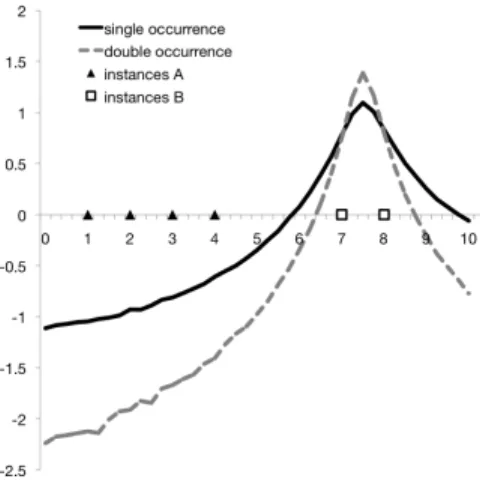
i, A)>0.5. Compared to maximum likelihood estimates, the use of Bayesian estimates in (3) leads to more cautious predictions when the number of data points is small, which is important because we only want assertions to be added to the ontology if the available evidence is sufficiently strong. Figure 1 illus-trates this effect: the solid line shows the value ofconf(., B)
in a scenario where there is only one quality dimension, the instances inB have coordinates7,8and the remaining instances of Ahave coordinates 1,2,3,4. The dashed line shows a similar scenario, with the only difference that each coordinate appears twice, i.e. the instances in B have co-ordinates 7,7,8,8 and the remaining instances of A have coordinates1,1,2,2,3,3,4,4. As can be seen, in the latter case we, the presence of more data results in more extreme confidence scores.
Note that the labels for the quality dimensions can be used to produce intuitive explanations. To this end, we first deter-mine the quality dimensionsiwhich maximally impact the confidence degree. For example, if the coordinatexji of en-tityajis such thatG(B,i)G(A,i)and the mean ofG(B,i)
is higher than the mean ofG(A,i), an explanation could take
the form of “aj is believed to be an instance ofB, as it is more (strongly related to)Li than typical instances ofA”, whereLiis the label for theithquality dimension.
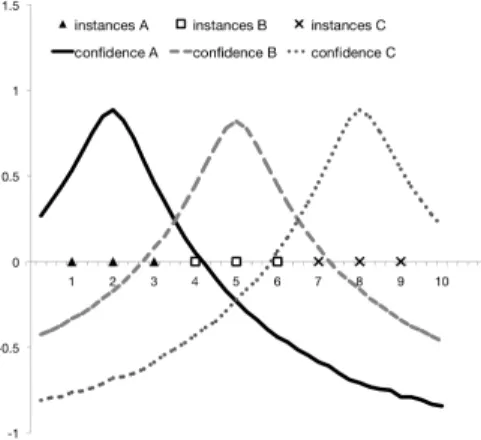
Now consider a setting where some conceptDhas three direct subconceptsA,B andC. When we use (2) to deter-mine which instances ofDshould also be instances ofA,B andC, conflicts may arise. Consider the scenario illustrated
Figure 2: Determining concept boundaries for disjoint cate-gories.
in Figure 2, where we again consider a single quality dimen-sion for simplicity, and the known instances ofAhave co-ordinates1,2,3, the known instances ofBhave coordinates
4,5,6, the known instances ofC have coordinates7,8,9, and we assume thatDhas no other instances. Figure 2 dis-plays the values ofconf(., A),conf(., B)andconf(., C). If we conclude that an entity with coordinatez belongs toA as soon asconf(., A) > 0, and similar forB andC, some entities will be added to more than one subconcept. Hence, if the ontology encodes that these subconcepts are disjoint (e.g.A∩B ⊆ ⊥), a conflict arises. A natural way to re-pair this conflict consists in removing the conclusions with the lowest confidence degree (if this contributes to resolving the conflict). The result is that an entity with coordinatezis added toAifG(B,i)(z)>max(G(B,i)(z), G(C,i)(z)), and
similar forB andC. In this way, the inductive and deduc-tive inference process are effecdeduc-tively combined to derive the most appropriate (hard) concept boundaries.
Inductive TBox Reasoning
We now consider a scenario involving three concepts A, B, C such thatB andCare both direct subconcepts of A. The problem we consider consists in determining to what extent we can be confident that C v B is a valid inclu-sion axiom. As for ABox reasoning, this inductive inference step can be applied in a recursive fashion, resulting in a general method for adding plausible inclusion axioms. Let b1, ..., bmbe the known instances ofB,c1, ..., cnthe known instances ofCanda1, ..., ap, b1, ..., bm, c1, ..., cnthe known instances ofA. These instances are linked to Wikidata enti-ties, as before, and we again determine the Wikidata seman-tic types that cover (most) of the instances ofA. To deter-mine whetherC vB is likely to be valid, we propose the following confidence score:
conf(B, C) = k X i=1 log Z G (B,i)(x) G(A,i)(x) ·G(C,i)(x)dx (4)
whereG(A,i)(x),G(B,i)(x)andG(C,i)(x)are evaluated as
in (3). Similar as for ABox reasoning, we assume that there are (unknown) Gaussians associated with the conceptsA,B
Table 2: Results for ABox reasoning.
SR BR Rec Pr F1 Rec Pr F1 |X|<5 1.0 1.0 1.0 1.0 1.0 1.0 |X|<10 0.909 0.842 0.874 0.958 0.904 0.930 |X|<50 0.725 0.827 0.773 0.821 0.849 0.835 |X|≥50 0.794 0.249 0.379 0.706 0.816 0.757
andC. Rather than evaluating the likelihood ratio (2) for a specific value, in (4) we evaluate what this likelihood ratio is on average for instances of conceptC.
We also consider a second way to use the conceptual space representations for TBox reasoning, which relies on the fact that concepts from the ontology may appear as in-stances in Wikidata. For example, scientist is regarded as an instance of the semantic typeprofession1. As a result, in
some cases we can determine confidence degrees for inclu-sion axioms using (2). In particular, let B1, ..., Bm be the subconcepts ofB(according to the ontology) for which we have a conceptual space representation (as an instance), and letA1, ..., An, B1, ..., Bmbe the subconcepts ofAfor which this is the case. Then (2) determines the confidence that the inclusion axiom Aj v B is valid, where the coordinates xji are now obtained from the representation of conceptAj instead of an individual, and similar for the coordinatesyij corresponding to the subconcepts ofB.
Evaluation
We have implemented2 our method, using Java including
OWLAPI3 and Pellet reasoner4 for deductive reasoning tasks (e.g. determining the instances or subconcepts of a given concept, checking consistency), and using a standard approach to repairing inconsistencies which uses the confi-dence scores as a penalty. To evaluate the effectiveness of the proposed approach, we have used the OWL version of the SUMO ontology5. This is a relatively large open-domain
ontology, covering a total of 4558 concepts, 86457 individu-als, 5330 inclusion axioms and 167381 ABox assertions. An advantage of SUMO is that for several concepts, an explicit mapping to WordNet is provided (which has, in turn, been linked to Wikidata).
We have evaluated our method (which is referred to as BR below) against the following baselines:
Similarity based reasoning (SR) For ABox reasoning, to decide whether an instanceaofAis also an instance of the subconceptB, we check whether the instance fromA which is most similar to abelongs toB. For TBox rea-soning, we apply the same method by using the represen-tations of SUMO concepts as instances in Wikidata. WordNet (WN) This method is only used for TBox
reason-ing. To decide whether a conceptBis subsumed byA, we
1https://www.wikidata.org/wiki/Q901 2 http://www.cs.cf.ac.uk/semanticspaces/ 3http://owlapi.sourceforge.net 4https://github.com/stardog-union/pellet 5 http://www.adampease.org/OP/
Table 3: Results for TBox reasoning
Variant 1 Variant 2
WN SR BR BR
Rec Pr F1 Rec Pr F1 Rec Pr F1 Rec Pr F1
|X|<5 0.79 1.0 0.883 1.0 1.0 1.0 1.0 1.0 1.0 1.0 1.0 1.0
|X|<10 0.632 1.0 0.775 0.914 0.847 0.879 0.938 0.966 0.952 1.0 1.0 1.0
|X|<50 0.214 1.0 0.353 0.490 0.836 0.618 0.806 0.822 0.814 0.954 0.916 0.935
|X|≥50 0.159 1.0 0.274 0.399 0.639 0.491 0.537 0.714 0.613 0.769 0.823 0.795
check whether the WordNet equivalent ofBis a hyponym of the WordNet equivalent ofA.
We also experimented with the use of Support Vector Ma-chines, but found them to be uncompetitive in this setting, due to the small number of instances in most cases and the lack of true negative examples (i.e. either a one-class set-up needs to be used, or we have to assume that instances which are not known to be inBare not inB).
To generate test instances for ABox reasoning, we con-sider each concept Awith direct subconcept B, such that the there exists some Wikidata typeSsuch thatAcontains at least four instances of S andB contains at least three6 instances ofS. For the evaluation of ABox reasoning, we use three-fold cross validation7as follows. LetY be the en-tities that are asserted to be instances ofB in SUMO, and letX be the entities that are asserted to be instances ofA (whereY ⊆X). We splitY =Y1∪Y2∪Y3 in three sets
of (approximately) the same size. Given the information that X are instances ofAandY2∪Y3are instances ofB, each
method is then applied to determine which among the in-stances inX\(Y2∪Y3)are also instances ofB. LetZ be
the instances predicted to belong toB. The performance is evaluated using precisionPr, recallRecand F1, defined as (assuming|Z|>0): Pr= |Z∩Y1| |Z| Rec= |Z∩Y1| |Y1| F1=2·Pr·Rec Pr+Rec
The whole process is then repeated two times, letting respec-tivelyY2andY3play the role ofY1.
For TBox reasoning, we consider two variants as in the previous section. In the first variant, we use the fact that concepts in SUMO are instances in WikiData, and use the same process as for ABox reasoning. This method can be applied in cases where the conceptsA,BandCeach have at least three subconcepts. For our method, we then use (2) to determine confidence. In the second variant, we use our method based on the instances of the conceptsA,BandC, using (4) to determine confidence. This method can be ap-plied in cases where the conceptsA,BandCeach have at least three instances. Note that both variants are applicable in different contexts, i.e. variant 1 can be used even if the ABox is empty, but requires the conceptAto have a suffi-cient number of subconcepts, while variant 2 requires a suf-ficient number of instances in the ABox. In all cases, when
6
This restriction is needed to apply three-fold cross-validation.
7
While 5 or 10 folds are more commonly used, we are espe-cially interested in concepts with very few instances.
using our method, we make the inductive inference as soon as the confidence score is strictly positive.
The results for ABox reasoning are shown in Table 2, grouped by the number of instances in the set of individuals Xthat are known to belong to the conceptA. Overall we can see that our method outperforms similarity based reasoning, especially in terms of precision for concepts with many in-stances. In particular, if the majority of instances ofA are not instances ofB, there are very limited guarantees that the most similar instances to the entity being categorized will be instances ofB, which is a result of the context-dependent nature of similarity. Note that, for our method, by setting the threshold for the confidence degree higher than 0, we can increase precision although at the cost of lower recall.
The results for both variants of TBox reasoning are shown in Table 3. Note that the results for both variants are not directly comparable, as the set of concepts to which they were applied differs. For Variant 1, our method outperforms the other methods in terms of F1 score, although the use of WordNet naturally leads to higher precision. The results for Variant 2 are particularly promising, although we are not aware of any baselines against which this method can be directly compared. When this method can be applied, i.e. when sufficient instances are available, it is clear that the richer concept representation it relies on, compared to meth-ods that rely on point representations of concepts (i.e. Vari-ant 1), leads to clear advVari-antages.
Conclusions
We have proposed a new method for inductive reasoning with ontologies. The method consists in using a form of Bayesian inference over interpretable feature representa-tions that are obtained from a learned vector space embed-ding. Our experimental results show that this method outper-forms similarity based reasoning for both ABox and TBox reasoning, while retaining the ability to generate intuitive explanations.
Acknowledgments
This work was supported by ERC Starting Grant 637277.
References
Baader, F.; Calvanese, D.; McGuinness, D. L.; Nardi, D.; and Patel-Schneider, P. F., eds. 2003.The Description Logic Handbook: Theory, Implementation, and Applications. New York, NY, USA: Cambridge University Press.
Baget, J.; Lecl`ere, M.; Mugnier, M.; and Salvat, E. 2011. On rules with existential variables: Walking the decidability line. Artif. Intell.175(9-10):1620–1654.
Beltagy, I.; Chau, C.; Boleda, G.; Garrette, D.; Erk, K.; and Mooney, R. 2013. Montague meets Markov: Deep seman-tics with probabilistic logical form. In Proceedings of the 2nd Joint Conference on Lexical and Computational Seman-tics, 11–21.
Bloehdorn, S., and Sure, Y. 2007. Kernel methods for min-ing instance data in ontologies. InProceedings of the 6th International Semantic Web Conference, 58–71.
Bordes, A.; Weston, J.; Collobert, R.; and Bengio, Y. 2011. Learning structured embeddings of knowledge bases. In
Proceedings of the Twenty-Fifth AAAI Conference on Arti-ficial Intelligence.
Bordes, A.; Usunier, N.; Garcia-Duran, A.; Weston, J.; and Yakhnenko, O. 2013. Translating embeddings for modeling multi-relational data. In Proceedings of the Annual Con-ference on Neural Information Processing Systems. 2787– 2795.
Bounhas, M.; Prade, H.; and Richard, G. 2014. Analog-ical classification: A new way to deal with examples. In
Proceedings of the 21st European Conference on Artificial Intelligence, 135–140.
Cal`ı, A.; Gottlob, G.; and Pieris, A. 2012. Towards more ex-pressive ontology languages: The query answering problem.
Artif. Intell.193:87–128.
d’Amato, C.; Fanizzi, N.; Fazzinga, B.; Gottlob, G.; and Lukasiewicz, T. 2010. Combining semantic web search with the power of inductive reasoning. InProceedings of the 4th International Conference on Scalable Uncertainty Manage-ment. 137–150.
Derrac, J., and Schockaert, S. 2015. Inducing semantic re-lations from conceptual spaces: a data-driven approach to plausible reasoning.Artificial Intelligence74–105.
G¨ardenfors, P. 2000. Conceptual Spaces: The Geometry of Thought. MIT Press.
Hu, Z.; Huang, P.; Deng, Y.; Gao, Y.; and Xing, E. P. 2015. Entity hierarchy embedding. InProceedings of the 53rd An-nual Meeting of the Association for Computational Linguis-tics, 1292–1300.
Hug, N.; Prade, H.; Richard, G.; and Serrurier, M. 2016. Analogical classifiers: A theoretical perspective. In Pro-ceedings of the 22nd European Conference on Artificial In-telligence, 689–697.
Jameel, S., and Schockaert, S. 2016. Entity embeddings with conceptual subspaces as a basis for plausible reasoning. In
Proceedings of the 22nd European Conference on Artificial Intelligence, 1353–1361.
Janowicz, K. 2006. Sim-DL: Towards a semantic similar-ity measurement theory for the description logic ALCNR in geographic information retrieval. InOTM Confederated In-ternational Conferences, 1681–1692.
Lao, N.; Mitchell, T.; and Cohen, W. W. 2011. Random walk inference and learning in a large scale knowledge base.
InProceedings of the Conference on Empirical Methods in Natural Language Processing, 529–539.
Miclet, L.; Bayoudh, S.; and Delhay, A. 2008. Analogical dissimilarity: Definition, algorithms and two experiments in machine learning.Journal of Artificial Intelligence Research
32:793–824.
Minervini, P.; d’Amato, C.; Fanizzi, N.; and Tresp, V. 2016. Discovering similarity and dissimilarity relations for knowl-edge propagation in web ontologies. Journal on Data Se-mantics1–20.
Murphy, K. 2007. Conjugate Bayesian analysis of the Gaus-sian distribution. Technical report, University of British Columbia.
Navigli, R., and Ponzetto, S. P. 2012. Babelnet: The au-tomatic construction, evaluation and application of a wide-coverage multilingual semantic network. Artificial Intelli-gence193:217–250.
Neelakantan, A., and Chang, M. 2015. Inferring missing entity type instances for knowledge base completion: New dataset and methods. In Proceedings of the 2015 Confer-ence of the North American Chapter of the Association for Computational Linguistics: Human Language Technologies, 515–525.
Osherson, D. N.; Smith, E. E.; Wilkie, O.; Lopez, A.; and Shafir, E. 1990. Category-based induction. Psychological review97(2):185–200.
Schockaert, S., and Prade, H. 2013. Interpolative and extrap-olative reasoning in propositional theories using qualitative knowledge about conceptual spaces. Artificial Intelligence
202:86–131.
Sheremet, M.; Tishkovsky, D.; Wolter, F.; and Za-kharyaschev, M. 2007. A logic for concepts and similarity.
Journal of Logic and Computation17(3):415–452.
Summers-Stay, D.; Voss, C.; and Cassidy, T. 2016. Using a distributional semantic vector space with a knowledge base for reasoning in uncertain conditions. Biologically Inspired Cognitive Architectures16:34 – 44.
Tenenbaum, J. B., and Griffiths, T. L. 2001. Generalization, similarity, and bayesian inference. Behavioral and Brain Sciences24:629–640.
Wang, Z.; Zhang, J.; Feng, J.; and Chen, Z. 2014. Knowl-edge graph embedding by translating on hyperplanes. In
Proceedings of the Twenty-Eighth AAAI Conference on Ar-tificial Intelligence, 1112–1119.
Xie, R.; Liu, Z.; and Sun, M. 2016. Representation learning of knowledge graphs with hierarchical types. In Proceed-ings of the Twenty-Fifth International Joint Conference on Artificial Intelligence, 2965–2971.