i
Managing Currency Risk Exposure
A case study of Svenska Cellulosa AB
Authors: David Lindström, Erik Säterborg Supervisor: Christer Peterson
Umeå School of business Spring Semester 2009 Bachelor thesis
ii
Acknowledgement
We want to thank our supervisor for contagious interest in and attitude towards the area of finance, and his fascinating anecdotes. Further we appreciate our families‟ support during the interview occasions, and our friends for voluntarily reading through the thesis and offering helpful feedback.
Thank you Arvid Nordquist for keeping us alert!
Finally we want to acknowledge Fredrik Lindvall and Ulf Stengard for inspiring and interesting interviews.
iii
Summary
Introduction: Recent years‟ globalization and expanding currency markets have
increased the importance of financial managers. A multinational company handles different currencies through export and imports, and is thus exposed to currency fluctuations. Awareness and assessment of risk management are issues more important not to ignore.
Research question: How does the multinational company SCA indentify currency risk
exposure, and how does the financial management relate to it?
Purpose: The aim of this study is to get a deeper understanding of the currency
risk management at a Swedish multinational company and how the individual manager identifies exposure. Furthermore, what means that exist for assessing the exposure and how the management choose to reduce the risk will be investigated.
Method: This case study has a qualitative approach, and is mainly based on
two unstructured interviews that have been conducted with the financial mangers of SCA.
Findings: The authors found that SCA identifies different kinds of exposures
related to currency risk. SCA is equipped with organizational
strategies as well as practical methods for reducing the risk exposure and positioning themselves in line with company framework and policies.
Conclusion: Currency risk management is a subject of great complexity since
exposures interrelate and alternates with time and as global economy changes. A company could hold a framework of policies, strategies and instruments that will provide their financial managers with means for risk assessment and management. Ultimately the responsibility is still in the hand of the managers.
iv
1. Introduction ... 1
1.1Background to the problem ... 1
1.2 Research question ... 2 1.3 Purpose ... 2 1.4 Delimitations ... 2 1.5 Terminology ... 3 2. Methodology... 4 2.1 Choice of topic ... 4 2.1.1 Preconceptions ... 5 2.2 Epistemological considerations ... 5 2.3 Ontological considerations ... 6 2.4 Paradigms ... 6 2.5 Research design ... 7 2.5.1 Case Study ... 7 2.6 Research strategy ... 8
2.6.1 Qualitative vs. quantitative study ... 8
2.6.2 Inductive vs. deductive approach ... 8
2.7 Data collection method ... 9
2.7.1 Qualitative interview ... 9
2.7.2 Primary and secondary data... 10
2.8 Literature review ... 11
2.8.1 Criticism on primary data ... 11
2.8.2 Criticism on secondary data ... 12
3. Theory ... 13
3.1 Risks with international trade ... 13
3.1.1 Financial risk ... 13
3.1.2 Product-, production- and transport risk ... 14
3.1.3 Commercial risk ... 14
3.1.4 Political risk ... 14
3.1.5 Ethical risk ... 14
3.1.6 Currency risk ... 14
3.2 Equilibrium theories ... 15
3.2.1 Purchasing power parity (PPP) ... 15
3.2.2 Fisher effect ... 15
3.2.3 International fisher effect (IFE) ... 16
3.2.4 Interest rate parity ... 16
3.2.5 Efficient market hypothesis (EMH) ... 16
3.2.6 Arbitrage ... 16
3.3 Definitions of currency risk exposure ... 17
3.3.1 Transaction exposure ... 17
3.3.2 Translation exposure ... 17
3.3.3 Economic exposure ... 17
3.4 Currency risk management ... 18
3.4.1 Policies and strategies ... 18
3.4.2 Organisational structure... 18
3.4.3 Choice of invoicing currency ... 19
3.5 Hedging and currency flow management ... 19
3.5.1 Netting ... 20
3.5.2 Currency matching ... 20
v
3.5.4 Derivatives used for hedging ... 21
4. Empirical Data ... 24
4.1 Introducing the… ... 24
4.1.1 … Company, treasury and subsidiary ... 24
4.1.2…Interviewees ... 26
4.2 Currency risk management ... 26
4.2.1 Organisation ... 26
4.2.2 Risk policy and strategies for risk management ... 26
4.2.2.1 Restrictions ... 27
4.3 Risk exposure ... 28
4.3.1 Currency risk ... 28
4.3.2 Interest rate risk ... 28
4.4 Currency flows ... 29 4.4.1 Netting ... 29 4.4.2 Matching ... 30 4.4.3 Cash pool ... 30 4.4.4 Forecasting ... 30 4.5 Derivatives... 31 4.5.1 Options ... 31 4.5.2 Swaps ... 32
4.5.3 Futures and forwards ... 32
4.6 Other aspects of currency management ... 33
4.6.1 Intraday risk ... 33
4.6.1 Arbitrage ... 33
4.6.2 Impact of the financial crisis ... 34
5. Analysis ... 35
5.1 Identifying currency risk exposure ... 35
5.1.1 Parity conditions and economic exposure ... 35
5.1.2 Transaction exposure ... 36
5.1.3 Translation exposure ... 36
5.2 Strategies for managing currency risk ... 37
5.2.1 Organisation ... 37
5.2.2 Policy and strategy ... 38
5.2.3 Cash pools ... 38
5.3 Practical management of currency flows ... 38
5.3.1 Netting ... 38 5.3.2 Matching ... 39 5.3.3 Derivatives... 39 6. Conclusion ... 41 6.1 Concluding discussion ... 41 6.2 Truth criteria ... 42
6.3 Suggestions for further research ... 43
7. Reference List ... 45
Appendix 1 ... 49
1
1. Introduction
This chapter provides the reader with the researchers’ reasoning on the importance and relevance of the topic. It will include a problem discussion which then leads to the actual purpose and the main research question this study addresses. To further help the reader understand what the study focuses on, a section of delimitations will clarify concepts and intensions of the authors.
1.1 Background to the problem
Ever since the fall of the Bretton-Woods system in 1971, fluctuations in floating exchange rates have been a recurrent issue for multinational company management. Increased globalization of world markets leads to increased imports and exports and that will require foreign currencies for trade. Since the exchange rate for major currencies used for trading, nowadays are floating, the risk that currency fluctuations could affect the result of exporting and importing goods is unquestionable.(Grath 2004)
To protect oneself from such fluctuations is in financial terms called hedging. The idea of hedging the risk of price movements is not a new invention. The history goes back to the mid 1800‟s when farmers wanted to fix their grain prices which at that time were very volatile. In order to do so, the Chicago Board of Trade was founded to establish a way to predetermine price of their goods by making financial contracts (www.fundinguniverse.com).
In recent years, there have been major fluctuations in the Swedish currency, Krona. From April 2008, when the US Dollar posted a year lowest of 5,8 SEK/USD, to the peak in March 2009, an approximate 58% appreciation had caused the exchange rate to increase to 9,2 SEK/USD. Figuratively speaking, a Big Mac would cost 20 SEK in April 2008 and one year later 30 SEK.
The globalization and technology progress involves in currency markets being open 24 hours a day, which increases demand on currency managers, who operate in a fast growing market. The foreign exchange market had a daily turnover of 3.2 trillion USD in 2007 and is constantly increasing (www.bis.org).
An article from Dagens Industri, a Swedish newspaper, illustrates the issue of currency impacts on multinational companies, with the telecommunications company Ericsson as an example. In that case the company‟s result from its currency hedges was negatively affected by 4,4 billion SEK (www.di.se).
So, the great turnover of the currency market and the financial impact it has on companies is shown to be of significance to the currency managers. But does the importance of the subject reflect the complexity of the working tasks? The researchers are certain that there is more to currency risk management than what the, perhaps ironic, statement of Kawaller implies: “Conceptually, hedging is easy. Identify an exposure, find a derivative that generates a compensating gain or loss relative to the identified risk, size the derivative position to assure the proper offset, and voila!” (Kawaller, 2008)
2
This interesting opinion leads the researcher to investigate how a firm in its home country is exposed to currency related risk and how the financial management handles issues concerning currency fluctuations.
Joachim Alpén, global head of currency at Skandinaviska Enskilda Banken (SEB), has argued that recent currency fluctuations have made people more aware, and that it is hard to resist not to hedge or just ignore the issue (Alpén (2009), cited in Carter er al., 2009).
The Swedish forestry company Svenska Cellulosa AB (SCA) is operating in countries all over the world and is thus exposed to currency risk. Most multinational companies construct guidelines and frameworks for assessing and handling risk, but currency risk is a broad concept that could occur in many different aspects. A belief that every individual has his or her own perception of risk leads to the question of how the involved managers at SCA perceive the currency risk. Is then the company solely in the hands of the currency managers or are there ways to reduce currency risk exposure both in an organizational and in a practical way? From this problem definition, the main question of the study arises.
1.2 Research question
How does the multinational company SCA indentify currency risk exposure, and how does the financial management relate to it?
1.3 Purpose
The aim of this study is to get a deeper understanding of the currency risk management at a Swedish multinational company and how the individual manager identifies exposure. Furthermore, what means that exist for assessing the exposure and how the management choose to reduce the risk will be investigated.
1.4 Delimitations
There are a lot of risks to account for in a multinational company, such as price risk, product risk, credit risk et cetera. It is existing interrelation between the various risks; however the focus of this study will be to examine problems concerning handling foreign currencies, and the components that affect the currency risk.
The accounting aspect, with the rules and regulation it involves, when dealing with currencies are complicated and out of the educational breach for the researchers. The research will mention a couple of important issues related to accounting, but will not be guided into detailed analysis of those.
3
1.5 Terminology
Appreciation/depreciation = Refers to currencies increasing or decreasing in value
Cash flow = Stream of cash in- and outflows
Default = When someone is unable to pay, or does not fulfill its obligations in a contractual agreement
Duration = A commonly used method to measure portfolios sensitivity to interest rate fluctuations.
Hedge = Taking a position in order to offset another position
Pip = The smallest quoted change in a currency price
Point = 1/100
Position = Refers to if a security is owned (long) or owed (short). Taking long positions means that you buy a security and expects it to rise in value. Short position means that you lend that security and expect the value to fall.
Risk = The possibility of unexpected movements
Risk averse = A investors attitude, who is reluctant to risk
Speculation = Investors who takes greater risk to achieve profit from expected price fluctuations, exercises speculation.
Spread = The difference between bid and ask price, usually nominated in points or
pips (www.investopedia.com)
Currency abbreviations that will be used in the study:
AUD = Australian Dollars
DKK = Danish Kroner
EUR = Euro
GBP = British Pounds
MXN= Mexican Pesos
NOK = Norwegian Kroner
SEK = Swedish Kronor
4
2. Methodology
This chapter will show to the reader how the researchers arrived at the choice of topic and the preconceptions that existed. Methods relevant to the study will be presented, along with the researchers´ views and approaches, which allow the reader to critically examine the study. The chapter will further explain how the study was conducted and how the literature for the study was found, and finishes with a critical discussion of the data collection and method used.
2.1 Choice of topic
This research originates from the experience of two business students interested in the subject of finance. The authors share a mutual study abroad experience in Canada in fall 2008. During this exchange study period there was a major exposure to fluctuation between the home currency Swedish Krona and the Canadian Dollar in which the expenditures was accounted for. There was also a global financial crisis occurring throughout the period, which was subject to many discussions and lectures in the studies. All these events had an impact on the choice of the research subject.
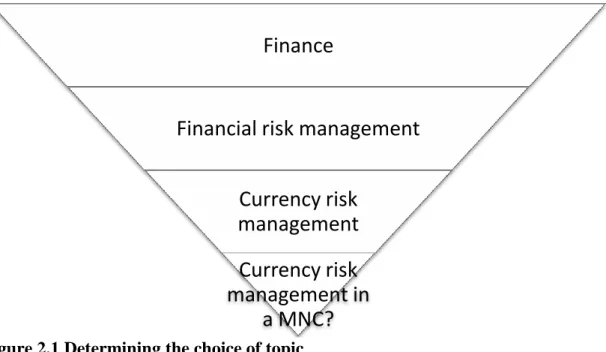
The figure below shows how the researchers narrowed down, starting from a broad general interest in finance, then, step by step, descending to the final choice of the study topic.
Figure 2.1 Determining the choice of topic
When discussing, it transpired that both authors had a history of working with, and relatives continuously influencing them about, forestry companies. This explains the foundation of the interest, but also suggests that there is some degree of deeper knowledge about the topic shared among the authors. Still there was a mutual feeling of achieving greater understanding of the risk management involved when dealing with international trade. This led to the decision of choosing a case study approach, since the aim is not to look for differences between risk management or to try to evaluate its performance, merely to understand and describe.
Finance
Financial risk management
Currency risk
management
Currency risk
management in
5
The multinational company SCA is located in the vast proximity of the researchers‟ home university and complies with the requirements of characteristics concerning the problem discussion as well as the purpose of the study. There has also existed a previous relation to the company which facilitates initial contacts and pre-knowledge of the established financial management related to currency issues.
2.1.1 Preconceptions
It is important to include preconceptions in the study because it shows indications of personal values that can affect and bias the research. Bryman and Bell (2007, p. 30) highlights the issue that researchers cannot be free from personal values, and thereby may reflect a bias on important parts of the study.
The paper might be presented in a way where the researcher highlights their gained knowledge and issues important to them, instead of basic information related to the company SCA, which for the reader would be useful when interpreting the business attitude in general. The current position as business students interested in the area of finance put the researchers in a possible position of idealising the financial managers. This should, however, not be a crucial influence of bias in the study.
The authors‟ preconceptions regarding the risk management at SCA were that they were practising hedging to some extent in order to minimize the risk and exposure. There was also an assumption that a company of SCA‟s magnitude organizes companies within the Group to gain some advantages through internal trading or indentifying business opportunities.
2.2 Epistemological considerations
Epistemology assesses the theory of knowledge. A major question is in what light knowledge should be considered. Bryman and Bell argues that a natural science approach to knowledge is referred to as positivism. This approach tends to generalize the social entities; it favours hard facts and has strong belief in the data collected to evaluate the study. Therefore, there is a lot of criticism to the limitations of this approach and to which extent positivism can be used Interpretivism is the contrasting view to positivism. It stresses the fact that the subject matter of the social science is fundamentally different from natural science. The subjective approach renders inconclusiveness in asserting social phenomena (ibid. pp. 16-17).
Grint argues that the social phenomena “leadership” relies on the subjective interpretations of the followers and that there is no such thing as “good leadership”, which can be defined, identified and measured (Grint 2000, cited in Bryman and Bell, 2007, p. 19). This argument relates to the difficultness of interpreting the individual managers‟ perception of risk, an underlying issue of this study.
This study should be read in the light of interpretivism. The necessity for the researcher to understand the differences between humans role as social actors is a key feature of the currency manager as his or her personal identification of risk assessment. To further
6
emphasize the importance of respecting the managers own perspective of risk involvement, Saunders states that when utilizing an interpretivist epistemology it is essencial that the researcher adopts an empathetic stance to the research subject to understand their point of view (Saunders et al., 2007, pp. 106-107).
Since business situations like currency risk management often involves rich complexity, generalisability is not of crucial importance. The interpretivist has to respect the uniqueness of the organisation itself and this study aims to endorse that approach.
2.3 Ontological considerations
This section discusses the issue of the nature of being, and is addressing the question “whether social entities can and should be considered objective entities that have a reality external to social actors, or whether they should be considered social constructions built up from the perceptions and actions of social actors”. According to Bryman and Bell there are two ways of approaching this question. Objectivism implies that social phenomena are independent from its social actors and beyond the influence of individuals. The alternative one, Constructionism, states the opposite, that the social phenomena are constructed under the influence of the social actors. Cultures, organizations and actions are, amongst other things, interpreted in these two approaches. The determinative factor of the choice between the approaches lies in how we formulate the research questions and choose to collect the data for the study (Bryman and Bell, 2007, pp. 22-25).
This study is aiming to gain an understanding of how the risk management at SCA indentifies currency risk exposure, and how they relate to it. Risk management is to some extent constructed on individuals‟ perception of risk that differs from manager to manager. It is the researchers‟ aim to understand the subjective reality of the managers in order to clarify their motives, actions and decisions. This approach to ontology would be considered constructionist, or as Saunders chooses to refer to it, subjectivism (Saunders et al., 2007, p. 108).
2.4 Paradigms
“A paradigm is a cluster of beliefs and dictates which for scientist in particular discipline influence what should be studied how research should be done and how results should be interpreted.”(Bryman, 1988, cited in Bryman and Bell, 2007, p. 25)
When studying an organization there are different aspects the researcher can consider. The objectivist states that the viewpoint is external and that the organisation is constructed of consistent processes and structures. The subjectivist views the organisation as a socially constructed product (Bryman and Bell, 2007, p. 25). The function and purpose of scientific research can also be separated into two aspects:
Regulatory assumption implies that the purpose is to describe what is going on within organisations and possibly comment on some minor changes or improvements to be done. By radical assumption, the researcher tries to make judgements about the way that the organisation is meant to be and suggests ways to fulfil the purpose.
7
The different approaches create four different frameworks for research and are presented in the table below.
Table 2.1 Paradigms
Regulatory Radical Objectivist
Functionalist Radical Humanist Subjectivist
Interpretative (this study) Radical Structuralist
Source: Bryman and Bell, 2007, p. 25-26
Considering the alternatives and the previous discussion the researchers define this study as an interpretative one. The interpretative choice of paradigm refers “to the way we as humans
attempt to make sense of the word around us”. This study‟s concerns are to describe and understand what is going on in the decision making progress of the managers in the subjectivist light that organisations are mouldable and alive. Even though some framework within the multinational company is regarded to be consisting, there is still a belief that SCA would indentify and adapt to issues related to an economic recession. This statement could be interrelated to Saunders argument that the interpretative paradigms‟ concerns are to understand the fundamental meanings attached to organisational life (Saunders et al., 2007, p. 113).
2.5 Research design
2.5.1 Case Study
A case study is defined by Saunders et. al (2007, p. 139) as a “research which involves an empirical investigation of a contemporary phenomenon within its real life context using multiple sources of evidence”.
When selecting the approach of a case study, the researcher‟s emphasis is to provide a deeper understanding, by illustrating the unique characteristics of the specific case. The case study may be a single organization, a location (such as a single factory), a single event or a person (Bryman and Bell, 2007, p. 62).
The case study could be conducted as holistic or embedded, which refers to what the researcher choose to analyze. A holistic way is for example to examine a whole organization, while the embedded is when you observe different subsidiaries of an organization with more than one unit to be analyzed. When using a case study approach, you could also integrate multiple cases instead of just a single case. The reason for why one would want to do this is to see if the result from the single case could be similar to the findings of the multiple cases, to be able to generalize the conclusions (Saunders et al., 2007, p. 140).
The authors have chosen to do a case study to get a wider perspective of how currency risk management works in a specific company, not in every company. The aim is not to generalize, criticize or compare, merely to describe and understand the mechanisms of risk exposure and management at a multinational company. Therefore, a case study design is best
8
suited to fulfill the purpose. This study will mainly be looking at two parts of the organization, SCA Finans and SCA Obbola, where the first is a centralized treasury unit and the latter an operative subsidiary. This could be considered an embedded analyzing strategy, but the two companies are very different and the results will not be compared in order to generalize. By also using secondary data, in the form of the Group‟s annual report, as a critical evaluation to the statements made by the financial managers, the authors aim to grasp the entire organizations assessment towards currency risk exposure.
Critics of case studies emphasize the lack in generating conclusions and the difficulties of generalizing (Bryman and Bell, 2007, p. 63). A well constructed case study strategy can still be valid when challenging existing theory and also provide a source of new research questions (Saunders et al., 2007, p. 140). The aim of this study is not to challenge theories, but to see how the decisions and ideas of a currency risk manager relates to existing theory.
2.6 Research strategy
2.6.1 Qualitative vs. quantitative study
Many researchers argue that there is more to choosing strategy other than the fact that quantitative researchers tend to employ measurement and qualitative researchers do not. There is also a distinctive difference regarding the choice of epistemology and ontological considerations, which suggests that a quantitative strategy incorporates a natural science and positivistic approach to social phenomena, while social entities are viewed in an objectivist angle. On the contrary, a qualitative study rejects the natural science approach and focuses on the individual‟s interpretation of the social world. Social entities are constantly shifting depending on the property of the individual‟s creation (Bryman and Bell, 2007, p. 28).
Aligned with the other considerations and approach, this study adopts the qualitative characteristics. Emphasis on understanding the management at SCA enables the researchers to dig deeper into the functions of the risk assessment. By gathering qualitative data, the aim is to get a profound understanding of whether the treasury department and currency management is based on the individuals perception of risk and to what extent it is influenced by existing theories or tools.
2.6.2 Inductive vs. deductive approach
There is also a distinctive difference of the choice of strategy approach when it comes to the orientation to the role of theory in relation to research. A deductive method suggests that the researcher gathers data in order to test a hypothesis generated from existing theories. This method is generally associated with quantitative research, while an inductive method is mostly used in qualitative research. The inductive method attempts to draw theoretical conclusions based on the data collected, while in the consideration of existing theory.
However, approaching the study is not as strict as one would imagine. Bryman and Bell (2007, p. 15) argues that “to a large extent, deductive and inductive strategies are possibly better thought of as tendencies rather than as a hard-and-fast distinction”
9
Saunders (2007, p. 493) does not believe one can take on an inductive approach without sufficient knowledge in the area. The researchers of this study agree with him on that reasoning and are therefore preparing theory in advance, therefore our presentation of theories could be perceived to be in a deductive view, when the actual reason is to obtain sufficient information for a properly implemented interview.
The study also indentifies with his list of characteristics related to an inductive approach. Gaining understanding of the meanings humans attach to events
- A close understanding of the research context - The collection of qualitative data
- A more flexible structure to permit changes of research emphasis as the research progress
- Less concern with the need to generalize (ibid., p. 57).
Even if the accepted model of an inductive approach implies that the analysis of the data renders in creating new theory building, the interpretivist paradigm, as previously noted, states a more of a general creation of understanding in the subject matter.
2.7 Data collection method
A quantitative analysis is mostly generated from numbers, a qualitative focuses more on words. Bryman and Bell argues that this is the most significant difference between the two strategies (Bryman and Bell, 2007, p. 402).
There are many different approaches to gather the research data for a qualitative study. Ethnographic observation puts the researcher in a social setting for a certain period of time, and observation and listening will consequently render an appreciation of the social group. Focus groups enable interviewees to discuss issues in larger settings. The one most widely utilized method in qualitative research is, according to Bryman and Bell, the qualitative interview. This method could be partly used in the other methods and have many different forms.
In this study the data collection method primary used, will be the Qualitative Interview, which will be presented in the upcoming section.
2.7.1 Qualitative interview
First of all, there needs to be clarification on the main differences compared to a structured interview that is most common in quantitative research. A structured interview focuses more on maximizing the reliability and validity of the research, in the way that they tend to have questions that are less open and thus less exposed to interpretation bias (Bryman and Bell, 2007, p. 473). A qualitative interview is often referred to as a semi-structured or an unstructured interview, where the interviewer leaves the answers or issues open for discussion, in order to obtain a deeper knowledge and understanding of the interviewees. This is considered to be of importance when adopting an interpretive epistemology, where the words and opinions of the persons could lead to discussions in new areas, not previously
10
considered, but yet be of assistance when addressing the research questions (Saunders et al., 2007, p. 316).
The interviews for this study are prepared in a way so that the interviewers have sufficient background knowledge to be able to present the interviewee with a framework of topics, and at the same time guide the interview to the desired outcome by having a number of issues to address related to each topic. By conducting the study in a familiar setting for the interviewees, in this case their workplaces in Obbola and Stockholm, the interviewers hope to gain trust and positive interrelationship so the interviewee will not feel inhibited or afraid of elaborating within the actual topic.
The most common ways of documenting data from interviews is through an audio-recording or by taking notes. One of the main advantages with audio recording is obviously the fact that you get everything on tape, and could listen to it afterwards, and in that way focus on the interview. Examples of drawbacks can be encountering technical problems, or limiting the respondent by the means that he will not be as open if the interview is recorded, and the reliability of the study can then become a factor. The time issue of transcription is another drawback to consider (Saunders et al., 2007 pp. 333-334).
The authors‟ approach is to document data through both interviewers taking notes during the conversations, mainly for the convenience of the respondents. Instantly after the interviews, the notes are compiled into full text transcript of the interview to reduce the amount of data loss. There is always a certain probability that some data is lost due to lack of notes, where some information may have been insufficient. Another factor to consider when taking notes is that it might be the subjectivity involved from transcribing the interviews, which might cause misinterpreted answers. Later there will be a subsequent email correspondence to make sure the interviewers did understand the interviewee correctly, and to add important data missing from transcription.
2.7.2 Primary and secondary data
Data collected specially for the study, is referred to as primary data (Saunders et al., 2007 p. 607). A qualitative interview with financial managers at SCA, would be an example of primary data. Secondary data is data already produced for a different purpose. Examples of this are raw data, articles in newspapers, organisations‟ websites, television or published books. Most research questions are answered with a combination of primary and secondary data, but the researcher should beware of the risk of conducting a research based on only secondary data with regarding the trustworthiness (ibid., pp. 246-249).
The main secondary data collected for this study is written documentation such as previous studies with similar objectives, and also more renowned books, dealing with fundamental information regarding the subject. Annual reports from companies within the SCA Group is a good example of secondary data, that will be included when looking at more general guidelines and company policies that are supposed to reflect in the actions of currency- or financial managers. An equivalent treatment will be conducted on additional published text on SCA‟s website.
11
Keep in mind that the research is mainly built on qualitative interview data, but some information extracted from the Annual Reports could be understood as quantitative date. This does not, however, diverts from the qualitative study as the main approach.
2.8 Literature review
The purpose of a literature review is among other things to discover research approaches and techniques that may be appropriate to your own research questions. It is also supposed to provide the basis on which the research is built (ibid., p. 57).
When evaluating, the literature should relate to the study research question and objectives. One has to look for relevance to exclude too broad areas of the data, and data insignificant for the purpose. The value of the literature is concerned with the quality of the gathered data. It is supposed to reflect a solid methodology and theory as well as quality in the arguments, areas where articles in newspapers or managerial autobiographies could appear weak or subjective. The third criteria when assessing literature is to find out if one‟s own gathered literature is sufficient, meaning that it covers enough aspects and views and does not lack information in certain areas (ibid., p. 87).
To find proper literature, the authors searched for books and journal articles through databases such as Business Source premier (EBSCO), and the library of Umeå University‟s information resource, using keywords such as: “Currency risk management”, “Currency Exposure” and “hedging”.
2.8.1 Criticism on primary data
The selection of interviewees presents two different aspects, from the subsidiary and treasury view, which will be complemented with the annual report. This ought to be sufficient information for making a credible study. The researchers also believe that it is useful to look at the risk situation from more than one view.
Using literature as a standpoint gave the authors signals about the most significant and interesting questions to ask and using open questions to influence the respondent to highlight the factors considered important to them. Since the interview questions are formed as open questions, this means to a certain extent that questions go into one another, but provide a broader perspective. The opportunity of elaborating involves a probability of diminishing relevance, since inter interviewee could discuss issues not relevant for the topic.
The authors conducted two face-to-face interviews. The close relationship with the case company contributed to the fact that the interview situations preceded efficiently. The disadvantages with a face-to-face interview are “the interviewer‟s effect” (Bryman and Bell, 2007). This is related to the fact that an individual might respond differently to the same question when it is asked by different interviewers. An interview over the phone would no doubt take less time and resources from the authors‟ point of view, but would conflict with the purpose of the study. The authors believe that a face-to-face interview would provide more honest in-depth answers, and be easier for the respondents to explain to some extent advanced concepts within currency risk management, which implies an additional strength considering
12
the value criteria when evaluating. Making the effort to travel to their respective offices would also give a professional impression.
2.8.2 Criticism on secondary data
The relevance of the secondary data could sometimes be questioned as some of the books were published a long time ago. This study has been using some old books, but it mostly concerns theory that is descriptive and hard to manipulate. Most of the literature is also in English, when the mother tongue of the authors is not. This, along with the fact that the chosen subject is complex and the written information is often very technical, could increase the probability of data misinterpretation. Regarding the data on derivatives, new financial instrument are constantly appearing and the choice of proper instrument alternates. However, this study is built upon the views of the financial managers, and the derivatives presented in the theory chapter are those which appeared in the discussion during the interviews.
It has occurred both Swedish and English literature written. The English literature has more of the value aspect, whereas Swedish books highlight the aspects from a Swedish company‟s perspective. Finally, we suspect a probability of bias in the Annual Reports regarding the information and how it is presented, since it often tries to reflect a strong position for the company. This data is mainly used to increase the sufficiency of the qualitative research strategy, meaning if some important aspects regarding the company are missing from interviews, the Annual Reports and SCA‟s webpage will be useful.
13
3. Theory
This chapter starts with a general introduction about the risks involved with international trade, then considers theories that deal with how exchange rates are affected by macro economical factors. Following is a definition of the exposures that may exist in a multinational company. It continues with a discussion of managing risk on both the practical and organizational level, and which instruments are available to manage currency risk. The theory chapter should give the reader a foundation of understanding to the rest of the paper.
3.1 Risks with international trade
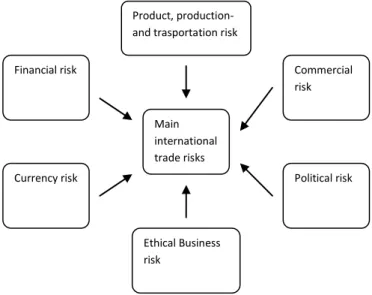
To be able to show the various types of risks for the companies involved in international trade, Grath (2008) illustrates six particular main risks, illustrated in the figure below. This paper focuses mainly on currency risk, but it should be borne in mind is that there are other important types of risks that will directly or indirectly affect the currency risk, which will be illustrated in this section. The upcoming section is inspired by Grath‟s literature.
Figure 3.1 Main international trade risks Source: Grath, 2008, p15
3.1.1 Financial risk
The issue is the financial commitments of purchase, store keeping and time of delivery, which puts pressure on the seller in the form of financial capitalization and interest cost. Compared to domestic trade, international trade often lengthens the time perspective and increases costs. In large international trades there are sometimes even requirements of a bank guarantee to increase the security of the transaction as well as the increasing liquidity demands (Grath, 2008. p. 39).
Product, production- and trasportation risk
Financial risk Commercial
risk
Ethical Business risk
Currency risk Political risk
Main international trade risks
14 3.1.2 Product-, production- and transport risk
There are risks connected to the actual product, like expected lifetime, performance or commitments to service and maintenance. Unless these risks are protected by any contract or guarantees, the buyer has the ultimate responsibility on deliverance, which has had some impact on international trade. For example, the issue of unusual or extreme weather conditions and the implications of rust- and moist damages that the product might not be designed to meet.
Transportation risks occurring in international trade are not only associated with the increased distance, but also the related insurances and level of responsibility between the buyer and the seller. This varies from case to case, but is often settled through standard agreements almost exclusively stipulated by the Institute of London Underwriters (ibid., p. 25).
3.1.3 Commercial risk
There is always a possibility of buyer default or not fulfilling the obligations of the agreement. The international issue is the possible lack of information about the buyer in another country, especially outside the EU-region where independent credit rating agencies have difficulties obtaining financial information (ibid., p. 26).
3.1.4 Political risk
Political risk, or country specific risk, deals with the issue of when a business can be conducted according to contract depending on interventions of the buyers, government or other institution. This could for example be a new restriction on import to protect domestic industries, but also changes in currency regulation to minimize foreign capital inflows or outflows (ibid., p. 33).
3.1.5 Ethical risk
There is a lot of international business praxis with negative nature. Corruption, bribes or money laundering are more associated with some countries than with others. These actions will not only alternate business patterns and create bias for the actors involved, but also negatively affect trading and foreign direct investments in the home country (ibid., p. 29).
3.1.6 Currency risk
Whenever a company has revenues and costs in different currencies, a currency risk will occur. Sometimes companies have components of their manufacturing, or similar, purchased abroad, but the main expenditures are often in their home currency. The currency risk is then transferred to the foreign currency invoicing, and thus also influenced by the choice of currency, the amount and the maturity of the contract agreements (ibid., pp. 37-39).
15
3.2 Equilibrium theories
There are different theorems that explain the connection and relation between inflation, exchange rates and interest rates. The theorems embrace the equilibrium conditions in international market fluctuations. Due to the differences of control and regulation in currency markets, there must be a consideration when assessing these theorems, as well as there are other influencing factors which complicates the pricing. Multinational companies have an opportunity to assess the risk by internally transfer funds and reallocate profits (Shapiro, 1999 p. 436). The upcoming section will present the key theorems, also known as parityconditions, which are vital to managers working under market imperfections and exchange-adjusted prices of tradable goods, also known as the law of one price (ibid., p. 207).
The equilibrium theories are widely established in economics and in business in general. Even though the theorems apply in a broader field than the currency risk, there is still need to understand the underlying function that is the basis of international trade and economic relations. Understanding and forecasting the movements of the interest rates is knowledge that is based on the theorems, which is important to financial managers. Equilibrium theories could help managers understand and explain exchange rate movements, and is a key instrument for forecasting trends in the longer run (Eiteman et al., 2001, p. 64).
3.2.1 Purchasing power parity (PPP)
PPP is the economic theory of the relationship between real purchasing power and exchange rates. In terms of absolute PPP, the price of an identical product should be equal in any market. The price only reflects the exchange rates of the local currencies, disregarding transportation costs, insurance costs et cetera (Shapiro, 1999, p. 210). The relative PPP, which is more common used, states that the spot rate between two currencies will change as the price level in each country changes. So if one country has higher inflation, its currency is expected to appreciate or depreciate towards equilibrium.
3.2.2 Fisher effect
The Fisher effect means that the nominal interest rate consists of two parts, the real inflation and the expected amount of inflation, also known as the inflation premium. As virtually all financial contracts are stated in nominal interest rate, the real interest rate has to be adjusted with the inflation premium. If the expected real rate of return is higher in one currency than another, capital would flow from the second to the first. This equalization is due to the opportunity of arbitrage, which occurs when currencies are not in equilibrium, and a risk-free profit is possible (ibid., pp. 219-220). The theorem only holds if there are no government interventions or transaction costs greater than the arbitrage.
As mentioned in the article in Berstein Journal, author Guilio Martini argues that the long lags that occur between changes in interest rate and the impact it have on the countries creates a risk premium that differs over time. With an effective timing an extra compensation for the managers occurs (www.bernstein.com).
16 3.2.3 International fisher effect (IFE)
The PPP and the Fisher effect combined would mean that the difference in the exchange rates of two currencies should be equivalent to the difference in those two currencies nominal interest rates. So, the IFE states that currencies with comparatively lower interest rates are expected to appreciate in comparison to the currencies with higher interest rates.
The most essential consideration is that, the arbitrage between financial markets and the difference between the interest rate in two countries should represent the unbiased predictor of changes in the future exchange rate (Shapiro, 1999, p. 228).
3.2.4 Interest rate parity
The interest rate parity states that the difference between two countries‟ interest rates should be equivalent to the forward differential in those currencies, given that the transaction cost is zero and the market is efficient. Interest parity ensues that no arbitrage exists when hedging a foreign investment of identical risk as the domestic.
The interest parity does not immediately holds and this could be due to non-efficient market or government intervention, which eventually cause a capital flow between countries. This in turn affects the interest rate; as money flows from country A to country B, interest rates tend to increase in country A and decrease in country B until the interest parity holds (ibid., pp. 162-164).
3.2.5 Efficient market hypothesis (EMH)
The EMH is one of the most crucial theories in finance, and it is a strong and widely adapted fundamental hypothesis. The issue whether financial markets are efficient or not is extensively debated among renowned researchers and experts around the world.
The EMH suggests that prices on the financial markets reflect all relevant current public information (Bain et al., 2008 p. 573). To earn abnormal profits by exploiting existing public information would then be impossible. Kollias (2001, pp. 435-444) states: “Efficient capital markets would lead to optimal allocation of resources”
The market is also supposed to quickly adjust to any new information. Variation in prices of firms, after any additional information is released, is just random. Empirical testing has shown that the major securities markets are reasonably efficient (Eiteman et al., 2001 p. 309).
3.2.6 Arbitrage
Arbitrage is the process of simultaneous purchase and sell of an asset in order to earn a profit by exploiting price differentials. By conducting this strategy, the investor should be able to obtain a risk-free profit (ibid., p. EM-29).
On the foreign exchange market there are discussions whether arbitrage situations ever appear. Akram et al. (2008 p. 237-253) argues that arbitrage opportunities do exist, but not to a great extent.
17
Kollias et al. (2001 pp. 435-444) agrees with the statement that there exist situations when arbitrage could exist. He stresses the fact that it does not mean that the market is inefficient as the dealer exposes himself to risk by involvement in arbitrage trading. Thus, exploiting the disequilibrium has equivalent risk-return trade off for the investor.
3.3 Definitions of currency risk exposure
“Foreign currency exposure is the extent to which transaction, assets and liabilities of an enterprise are denominated in currencies other than the reporting currency itself. The results and financial position of the enterprise are, therefore, susceptible to variations in foreign currency exchange rates.” (Davis et al., 1991, p. 24)
This study is concerned with a single company‟s perception of risk. To be able to evaluate and discuss the topic, it is important to show how previous studies define risk perception and currency exposure.
3.3.1 Transaction exposure
Transaction exposure relates to the risk involved with the currently known contractual bound future cash flow that is denominated in foreign currencies. Exchange rates fluctuate until the transaction is settled and the value of the cash flow changes, leading to either a currency gain or loss (Shapiro, 1999, p. 267). The transaction exposure thereby only deals with the changes in cash flow with contractual bound financial obligations affected by exchange rates.
Eiteman et al. (2001, pp. 152-156) states that transaction exposure could arise in four different ways:
- By buying or selling goods nominated in a foreign currency - Borrowing or lending in foreign currencies
- Being one of the counterparties of a forward contract
- By acquiring assets or liabilities denominated in foreign currencies.
3.3.2 Translation exposure
Translation exposure is also known as the accounting exposure. This is the risk involved, from a firms‟ perspective, in the possibility of the change in a currency will affect your financial statements. So when an asset is listed on the balance sheet in a foreign currency, and the value of the currency appreciates or depreciates, the assets value is changed.
The translation exposure actual gain or loss is not realized however until the asset or liabilities are settled or liquidated (Shapiro, 1999 p. 266).
3.3.3 Economic exposure
The risk of real currency fluctuations, in combination with price adjustments can change the company revenues and costs due to competitive disadvantages. So the economic exposure is the possibility of the future earnings being affected by movements in the exchange rate, and thereby the value of the company in measures of future cash flow (ibid., p. 267).
18
Indirectly, the value of the company is affected, in terms of net present value (Eiteman et al., 2001, p. 152), and thereby, the importance of assessing its economic exposure.
3.4 Currency risk management
This section will discuss how the manager approaches currency risk in a general way, supported by frameworks and guidelines. Later on, the study will go into more details showing a more direct approach to currency risk management and what means exist for coping with risk on a daily basis.
A company who trades with foreign currencies will face currency risk and currency exposure. The great complexity of currency risk management is discussed by Grath (2004, p. 98): “A company could have different attitudes towards currency exposure depending on factors such as the amount of cash flow affected by currency fluctuations or the exposure over time.”
3.4.1 Policies and strategies
According to Grath (2004) there are three main different strategies for currency risk management. The first alternative is to minimize the exchange exposure by hedging all positions. The second alternative is to use selective exchange hedges to keep the exchange exposure at a moderate level, to enable the company to have some freedom. The major way to use this philosophy is by hedging some of the currencies in the currency portfolio, like the largest positions or the main currencies. The third alternative is to not hedge the currency risk at all. The motive for this would be that management believes that currency fluctuations will even out over time or that the home currency will appreciate. (Grath, 2004, p. 98)
3.4.2 Organisational structure
Multinational companies eventually expand to the extent that it could be advantageous to reconsider the organizational structure. One concern might be where to locate the main responsibility for certain company divisions. A decentralized financial management puts the responsibility on each subsidiary, while centralized financial management organizes a mutual body for handling all subsidiaries‟ financials. There are lots of different views of whether a multinational company should have a centralized or decentralized financial management, and there are good arguments for both sides. Shapiro et al. argues that the centralized function will work for the best for the corporation as a whole, while the subsidiaries in a decentralized system would only want to optimize their own situation to maximize their profit, not the entire firm. As the subsidiaries in a multinational company probably will use different currencies, the opportunity to net out subsidiaries‟ surplus or deficit in different currencies could be used to reduce the firms overall currency exposure.
Arguments against the centralization imply that there is a lack of encouragement, and sometimes even regulative limitations, for the local manager to make quick decisions when beneficial situations arise in the local market. (Shapiro, 1999, p. 289)
In times of volatile markets, an expert centralized management is preferable because it‟s hard to handle and experience is needed. It could be costly to have experts in currency risk
19
management in every subsidiary. Also positive is the pure financial benefits generated by having a centralized financial management, primarily through reducing dealing costs. If transactions are minimized, cash flows are netted and all the money in the firm is centrally handled, the overall costs will be reduced (Kenyon, 1990, p. 227).
A centralized financial management could also locate the cheapest way to fund loans for subsidiaries, or the most beneficial placement of excess funds for short term investments (Eiteman et al., 2001, p. 562).
3.4.3 Choice of invoicing currency
An easy way to reduce currency exposure for a firm is to invoice using its home currency, if the main expenditures are in the same currency. This could however lead to some competitive disadvantages, which are discussed further by Grath (2008).
Given that the company has its current expenditures nominated in its home currency, using the home currency solves the arising issue of currency exposure. On the other hand, the foreign customers will then carry the currency risk instead. This could imply that the buyer would have problems to determine the risk of the currency, and thereby prefer a competitor to the firm who could provide the same deal in the buyer‟s currency.
To determine what kind of risk the specific currency which a contract is nominated in involves, the company could consider the following;
-Is the currency used in international trading, and is it freely convertible? -Is it tradable on the currency market?
-Is there any additional cost to hedge a certain volume of the currency to the due date of the deal? (Grath, 2008, pp. 134-135)
3.5 Hedging and currency flow management
The procedure to reduce one‟s risk exposure is in financial terms called hedging. Hedging currency issues would be an attempt to reduce the exposure by offsetting existing positions in one currency by investing in an instrument that has negative correlation. This would mean that if that currency you hold fluctuates positively, your offsetting position is affected negatively, and thereby decreases the effect of the fluctuation. The financial manager could by hedging positions reduce or eliminate the risk caused by currency fluctuations. The idea with a hedge could be to fix the price at a pre-determined level to reduce its exposure for any unexpected change in price. Hedging will thereby work as insurance, protecting the owner of an asset from losses caused by the price fluctuation. It will also reduce any possible gains in the case of reverse fluctuations, so both losses and wins are limited (Shapiro, 1999, pp. 282-283).
A perfect hedge would be if the investor takes an offsetting position that eliminates the total risk from the original position, by using instruments that are absolutely uncorrelated (www.investopedia.com).
20
Proponents of hedging argue:
- Reducing the risk by hedging will improve the planning capability of the company since the value of the future cash flow is known.
- Reduction of volatility of the cash flow will also insure that the company future cash flow is above critical level.
- A manager has more knowledge about the company than the shareholders in terms of the real currency risk.
Opponents of hedging however argue:
- Managers cannot outperform the market, and with the parity conditions in mind, the net present value of the hedge will be zero.
- Currency risk management does not add any value to the company, but rather consumes its resources for hedging and thereby reduces its cash flow.
- Since the management generally is more reluctant to risk than the shareholders, maximizing shareholders profit will not be prioritized. The hedging is thereby a drawback to the shareholders since it will generate less profit (Eiteman et al., 2001, pp. 154-155).
According to studies of Swedish firms hedging behaviour Hagelin and Pramborg (2004, p. 1) finds following:
“We find that transaction exposure hedges significantly reduce exposure, and that translation exposure hedges also reduce exposure. A possible explanation for the latter is that translation exposure approximates the exposed value of future cash flows from operations in foreign subsidiaries (i.e. economic exposure). If so, by hedging translation exposure, economic exposure is reduced”
3.5.1 Netting
Collecting all the inflows and outflows at a given maturity to net out the amount of receivables or payables at the maturity date is called netting. In terms of risk, the cash risk is zero at maturity if all positions are netted that day. Depending on its policy, the company aims to reduce the exposure to desired levels. The netting could be done through use of instruments such as swaps and forwards, and is not an instrument itself, but a process for a company to reduce or increase its exposure (Kenyon, 1990 pp. 204-209).
3.5.2 Currency matching
A company could use matching to minimize its net positions in a certain currency, and thereby limit or eliminate the risk involved of holding a surplus. This is acquired through funding of its capital expenditures or acquisitions using the same currency. However, matching for zero risk positioning, a company has to bear in mind factors such as tax, the interest rates and inflation in order to avoid currency exposure (ibid., p. 204).
3.5.3 Cash pooling
Cash pooling is an approach for corporations that allows them to benefit from current credit and debit positions by “pooling” assets and liabilities (www.wisegeek.com).
21
The basic concept of cash pooling means to relocate excess affiliate cash into a central account (the cash pool), where all the groups funds are managed by corporate staff. If possible it should be located in a country where the taxes are low (Shapiro, 1999, pp. 431-32, 794).
3.5.4 Derivatives used for hedging
Derivatives is the umbrella term that refers to contracts that derive their value from an underlying asset, such as currencies, commodities or stocks (ibid., p. 787).
Derivatives are generally used for hedging purposes and for speculation (Bain et al., 2008, p. 435). Empirical studies, such as Mohammad and Stewart‟s (2009) on the use of derivatives in risk management, find that hedging through the use of currency derivatives is significantly correlated with reduction of foreign exchange rate exposure. Derivatives are either traded on an organized exchange or over the counter.
Over the counter (OTC) refers to trading of securities (such as currencies, stocks, derivatives) directly between two counterparties, whereby they set their own conditions for the agreement (Shapiro, 1999, p. 794). Buyer and seller usually settle over the phone or through a computerized system, where the latter is preferable to be able to verify the agreements (Nyberg et al., 2006 p. 90).
A security is usually traded OTC because it is not eligible on the ordinary exchange.
The OTC markets are well organized and less formal and it is less regulated than the organized exchange, but it does also include some lack of transparency due to its absence of possibility to compare prices. Randall (2008) further mentions another drawback with OTC markets:
“It is noted that dealers in an OTC security can withdraw from making a market, which causes liquidity to dry up”.
The most common types of derivatives are options, swaps, forward and futures. A more thoroughly explanation of these follows next.
Options
An option is one type of derivative that contracts the counterparties (buyer-seller) to trade an asset of specified amount at a specific time. A call option gives the buyer the option, but not the obligation to buy the underlying asset at a pre-determined price, also known as the strike price.
Reversibly, the put option gives the seller the option to sell. Depending on the probability if the option will be exercised, a premium is expected in return, in other words, the price of acquiring the option to buy or sell the underlying asset (Bain et al., 2008, pp. 433-449). When calculating the premium of the option, mainly four factors are used:
-The difference in spot price and strike price -The volatility of the underlying asset -Time until maturity
-The risk-free rate, as it is used to discount future cash flow and indirect affects the price of the option. (Nyberg et al., 2006, p. 81)
22
There are two ways of stating when the option could be exercised, either the European style option where it only can be exercised at maturity, or the American style when it could be exercised at any time. The underlying asset in a currency option is a nominal amount of a currency. (Bain et al., 2008, pp. 417-418, 434)
Exotic options
More complex options that differ in terms of size, exercise, or how and when the buyer receives the payout are called exotic options. Exotic options are generally traded over the counter (Bain et al., 2008, p. 433). One of the advantages of buying options OTC is that one can get them customized for the company specific requests (Eiteman et al., 2001, p. 124).
Swaps
A swap is a derivative that concerns the exchange series of cash flows between two parties. An interest swap is for one part of an agreement to swap its fixed interest rate to a floating interest rate. The simplest kind of interest rate swaps, to exchange fixed from floating rate is often termed plain vanilla swaps. So, using this derivative, synthetically you can change a floating debt payment to a fixed. This could be useful when for example, a company cannot exceed a certain level of interest payment, but their debt is nominated with a floating rate agreement. Since the interest payments then could fluctuate, the company needs to revise its loan conditions. By instead using a swap this could be achieved without re-arranging the loans and the additional costs this would imply. A currency swap refers to an exchange of interest and principal between two parties for the equivalent in another currency. In both these kinds of swaps, the instrument itself got no monetary value but provides the service that could help companies adjust maturities and debt associated cash flows (Eiteman et al., 2001, pp. 279-280).
Usually there is no fee for entering the swap agreements, and thereby one of the factors why this instrument is so attractive.
Swaps often have long maturity and large volumes are traded, whereby the default risk in these instruments could be an issue. To overcome the default risk of the counterparties the swap could be done through financial institutions such as a bank. The bank will then act as a guarantee to both parties and will charge a fee including the risk of default (Bain et al., 2008, p. 449).
Forwards
A forward contract is a type of agreement that implicates that an underlying asset should be delivered at a specified date at a specific price. The contract could be between for example a bank and a firm, and the asset is a certain amount of a currency. The contractual agreement maintains unchanged until maturity date, where the loss or gain is realised. So buying a forward contract could provide an asset at future delivery for a pre-determined price. Thereby the investor could also be protected by negative fluctuations in the value of the asset. The bigger the difference between the market price and the forward price at maturity, the greater the realized loss or gain will be. Thereby the risk for default implies a payment increase, since no formal assurance is necessary in a forward contract. Forwards is generally traded OTC, since they often are customized to fit a specific customer requirement (Nyberg et al., 2006 pp. 54-56).
23
Futures
A future is basically a forward contract traded on an organized exchange that is standardised, in terms of both size of the contract and the date of delivery. Quality and quantity of the asset is also specified in the contract (Bain et al., 2008, p. 412).
Since futures are traded on the organized exchange, the currency futures market provides transparency and the possibility to compare prices (Srinivasan, 2009, p. 4).
The main difference concerning default risk of futures and forwards is that the future is confirmed through a clearinghouse. The clearinghouse will act as an accommodator for the counterparties, and the purchaser has to make a deposit as collateral. The collateral could be for example cash, or a letter of credit.
In contrast to the forward, the future is marked to market every day. This means that the daily changes in the underlying asset will update the value of the future on a daily basis, and changes in price will be paid in cash (Eiteman et al., 2001, pp. 114-115).
The future also requires a margin to ensure that the change in value of the future could be paid. So if an investor is losing money on his position of the contract, daily marking to market will ensure that losses are limited. So if the value of an investor‟s future rises, he can withdraw that amount from his margin account, and reversely if the price of the future falls, then he has to deposit that amount to cover up the loss. This is in opposition to the forward contract, where huge losses could be realized at maturity (Shapiro, 1999, p. 176).
Eiteman et al discusses how futures are not particularly useful for large firms, due to the restrictions of the futures contracts in terms of size and maturity. Another issue is that the future has to have a margin deposit at market price, which implies that the firm must put cash aside every day. As the deposit could fluctuate, this means that the firm has more uncertainty and gets to deal with maintenance of having to put in extra deposits if the market value of the future is changed. On the other hand, firms who don‟t have the access to forward contracts from financial institutions will find futures very convenient (Eiteman et al., 2001, p. 117).