Conservation Payments, Liquidity Constraints and Off-Farm Labor:
Impact of the Grain for Green Program on Rural Households in China
Emi Uchida*,†, Scott Rozelle‡ and Jintao Xu§
†
Department of Environmental and Natural Resource Economics, University of Rhode Island ‡
Department of Agricultural and Resource Economics, University of California, Davis, and
Asian Pacific Research Center, Stanford University
§
Department of Environmental Sciences, Beijing University
Selected Paper prepared for presentation at the American Agricultural Economics Association Annual Meeting, Portland, OR, July 29-August 1, 2007
Copyright 2007 by Emi Uchida, Scott Rozelle and Jintao Xu. All rights reserved. Readers may make verbatim copies of this document for non-commercial purposes by any means, provided that this copyright notice appears on all such copies.
JEL classification: J22, O13, Q23
Keywords: Payments for environmental services, off-farm labor supply, Grain for Green program, China, program evaluation
* Corresponding author. Address: 219 Coastal Institute, Department of Environmental and Natural Resource Economics, University of Rhode Island, 1 Greenhouse Road, Kingston, Rhode Island 02881. Tel: +1-401-879196. e-mail: [email protected]
The authors are grateful for the assistance in survey design, data collection and entry by Michael Bennett, Yazhen Gong, Zhigang Xu, Fujin Yi, and other members of the Center for Chinese Agricultural Policy, Institute of Geographical Sciences and Natural Resources Research, Chinese Academy of Sciences. The authors acknowledge the support from Ford Foundation, National Science Foundation of China (70024001) and the Agricultural Extension Service of Rhode Island (AESxxxx) for financial assistance. Scott Rozelle is a member of the Giannini Foundation. Please do not cite without permission from the authors.
Conservation Payments, Liquidity Constraints and Off-Farm Labor: Impact of the Grain for Green Program on Rural Households in China
Abstract
This study evaluates the off-farm labor response of rural households participating in the Grain for Green program in China, the largest conservation set-aside program in the developing world. Using a panel data set that we designed and implemented, we examine the impact of the program on changes in off-farm labor participation between 1999 (pre-program) and 2004
(post-program) using a difference-in-differences approach and several extensions that account for program intensity. We also test whether the program impact is diverse depending on level of physical and human capital of participants.
We find that on average the Grain for Green program has a positive effect on off-farm labor participation. Importantly, however, we find that program effects vary across groups of individuals in the sample. For example, we find that lower initial levels of wealth enhance the impact of the program on the off-farm employment activity. This result supports our view that the Grain for Green program may be relaxing liquidity constraints for the participating
households and that is one reason why participants are more likely to find off-farm employment compared to non-participants.
The positive impact of the conservation payments on off-farm labor is in stark contrast with the findings in the US where most studies have found that government payments to farmers decrease off-farm labor participation. One reason for the difference in findings between China and US may be because there are more impediments to participating in off-farm labor market in the poor areas of rural China (the areas in which the programs are being implemented) compared to the US and Grain for Green helps overcome these constraints. It could also be that there are differences in the age structure of the farming population between China (which is generally younger) and the US (which is generally older). This interpretation is reinforced by the finding that, while the average impact is positive, there is an even larger measured positive effect for the younger cohort. The measured effect of Grain for Green is negative for the older cohorts. We also find no impact on off-farm labor participation for individuals with low educational
attainment (and positive for those with higher levels of education), suggesting that human capital is necessary when trying to achieve a structural change to earning activities. If policymakers want to achieve a win-win outcome through Grain for Green by meeting both the program’s environmental and development goals, they may need to provide extra support (for example, through greater assistance to education) to the vulnerable sub-populations in the program areas.
I. Introduction
In the past decade, an increasing number of incentive-based conservation programs have been launched in the economies of developing countries, including Costa Rica, Columbia, Mexico and China (e.g., Alix-Garcia, et al., 2003, Hyde, 2003, Pagiola, et al., 2002). Often called payments for
environmental service (PES), incentive-based programs provide financial incentives to those who “supply” environmental services, including farmers who agree to set aside environmentally sensitive land or adopt farming technologies that generate environmental services such as conservation of wildlife habitat, sequestration of carbon and protection of watershed functions.
Since rural farmers often are suppliers of these environmental services, programs often have been designed with dual goals—to generate environmental services and to achieve economic
development (Pagiola and Platais, 2005). A PES program can potentially increase the income of rural farmers directly and indirectly through compensation payments. For example, farmers who agree to set aside previously cultivated land for conservation purposes can increase their incomes if the payments they receive exceed the opportunity cost associated with retiring their land. In addition, farmers can use the compensation to finance other productive activities, both on and off the farm. Depending on the program design, these schemes can induce a reallocation of factor endowments and thus shift or
diversify income-earning activities. PES programs can therefore indirectly induce fundamental structural changes in household income-earning activities.
The programs may be unsuccessful, however, if they cannot induce farmers to transform their income-generating activities. Payments are typically made for only a fixed term and can be terminated
early due to political disagreements and/or budget constraints. In the longer run, farmers often must shift their agricultural practices and income-generating activities so that they do not rely on program
compensation payments. Otherwise farmers may become dependent on the incentive payments and upon their termination may have to return the land to cultivation to survive, undoing the long-term benefits of the program.
Despite the importance of understanding how farmers change their labor-allocation patterns in response to these programs, few studies to date have examined how PES schemes have or have not enabled farmers to optimally reallocate factor endowments and structurally change their
income-generating activities. Many critical questions remain. For example, how does a conservation set-aside program induce farmers to shift labor allocations from on-farm production to off-farm work? What is the effect of such programs on on-farm labor allocation? Do program impacts depend on the endowment of the physical and human capital of the participants?
This study examines these questions by analyzing the largest PES experiment in the developing world: the Grain for Green program in China. Following a series of devastating floods in 1998, China’s government initiated a conservation set-aside program known as Grain for Green.1 The program’s main objective is to increase forest cover on sloped cultivated land in the upper reaches of the Yangtze and Yellow River basins to prevent soil erosion. When such land is available in a community and the community is chosen to be part of the program, households can choose to set aside all or part of the cultivated land on such slopes and plant them with tree seedlings.2 In return, the government
seedling planted and free seedlings in the initial year.3 By the end of 2004, officials had expanded the program to some eight million hectares of cultivated land, involving approximately 15 million farmers in more than 2,000 counties in 25 provinces in China (State Environmental Protection Administration, 2005, Xu, et al., 2006).
More than five years into the program, however, it is not yet clear how Grain for Green has affected how farmers allocate labor across income-generating activities. On one hand, the government explicitly states that poverty alleviation and restructuring of agricultural production into a more environmentally and economically sustainable set of activities are program goals (State Forestry Administration, 2003). Therefore, the government clearly has an expectation that the program will facilitate a shift in labor from low-profit grain production to production of more profitable crops and of livestock and, more importantly, from primarily on-farm work to greater off-farm work. On the other hand, off-farm activities, including self-employment and wage income, both in local job markets and in migrant labor markets, have been a driving force in reducing poverty in rural China (Bowlus and Sicular, 2003, deBrauw, 2002, Meyer, et al., 1995 ). Given this recent trend, households in rural China may have been increasing their participation in off-farm activities even when they were not enrolled in the Grain for Green program. The results of empirical studies on the extent of the program’s labor impact are mixed: two studies of the Grain for Green program used data collected two years after the program began and found that the program had no impact on off-farm incomes or on off-farm labor participation (Uchida, et al., forthcoming, Xu, et al., 2004). A study involving data collected four years into the program found a positive effect on off-farm labor participation (Groom, et al., 2006).4
In fact, this study of the impact of Grain for Green on labor allocation in China is part of a wider set of studies examining the fundamental question of how government payments affect the
off-farm-labor decisions of farmers, a subject of long-time interest to agricultural economists. During the past three decades, off-farm activities have provided a critical source of income to a majority of farm households in the U.S. and off-farm provision has been largely responsible for closing the gap in income between farm and nonfarm households (Ahearn, et al., 2005, Gardner, 1992, Mishra, et al., 2002).
Importantly, nearly all of the research conducted on U.S. farms has found that government payments to farmers, whether coupled or decoupled from decisions about production of a specific commodity, have decreased off-farm labor participation (El-Osta and Ahearn, 1996, Mishra and
Goodwin, 1997). For example, Ahearn et al. (2005) found that payments from the Conservation Reserve Program decreased the likelihood of a farm operator working off the farm.5 These findings suggest that the substitution effect, which would increase off-farm labor allocation, is outweighed by the income effect, which would decrease the number of hours allocated to off-farm labor. While these previous findings suggest a hypothesis that Grain for Green will lead to decreased off-farm participation, it is important to ask whether results from the U.S. can be expected to hold up for a developing economy.
In fact, there is reason to believe that the impact of conservation payments in a rural,
developing economy may not follow the U.S. example and may have a positive effect on off-farm labor. Rural farmers in developing countries have much lower levels of income (and, as such, a higher
marginal utility of income) than farmers in the U.S., so the negative income effect may be small enough that it is outweighed by the positive substitution effect. Moreover, household preprogram participation in
off-farm labor markets may be inhibited by low incomes (and the absence of liquidity to finance the shift into the off-farm market) as well as poorly functioning land and credit markets (Bardhan and Udry, 1999, Hoff and Stiglitz, 1990). Since land rental markets are frequently incomplete in rural China, most
households cannot leave agriculture entirely (Nyberg and Rozelle, 1999). Furthermore, rural farmers in developing economies may be more likely to face high transaction costs and fixed/variable costs that prevent them from participating in off-farm labor, particularly for activities involving new
self-employment or migration. To the extent that government payments can relax the liquidity constraints of rural farmers, incentive programs may help rural farmers obtain jobs off the farm and facilitate the structural transformation of households and the economies within which household members live and work.
The literature suggests that this conjecture may apply to rural China. A combination of high transaction costs, weak information-sharing and other regulations has been shown to restrict farmers in rural China from starting self-employment enterprises and seeking wage-earning jobs (deBrauw, 2002, Knight and Song, 2005). Although comprehensive investigations of credit markets in rural China have been rare, case studies suggest that, though formal and informal loans are available, borrowing remains severely constrained, especially for the resource-poor strata of the population (International Fund for Agricultural Development, 2001). Credit constraints have been shown to affect factor allocation in the production decisions of rural China’s households (Feder, et al., 1990). Given these conditions, if the Grain for Green program can increase liquidity for farmers, the program may enable them to find jobs off the farm and increase other productive activities.
In the rest of the paper, Section 2 describes the Grain for Green program and the data used in this study. Section 3 develops the household model that illustrates how a PES may affect a household’s decisions about how to allocate land and labor across different activities when faced with a liquidity constraint. Section 4 gives an overview of the study’s empirical approach and discusses the
identification strategy. Section 5 is devoted to estimation of the effect of China’s Grain for Green program on the off-farm-labor participation of rural households, and Section 6 provides estimates of the effects of the program for various groups, dividing the sample according to levels of physical and human capital endowment. Section 7 concludes and summarizes the results.
II. The Grain for Green Program and Study Data
China’s Grain for Green Program
Starting in 1999 as a pilot program, the Grain for Green program was implemented by China’s government as a crop land set-aside program to increase forest cover and prevent soil erosion on
cultivated slopes.6 By 2010, the State Forest Administration plans to convert 15 million hectares of crop land (approximately 10 percent of all of China’s cultivated area) (State Forestry Administration, 2003).7 Since the main objective of China’s program is to restore the nation’s forests and grasslands to prevent soil erosion, program designers have set slope as one of the main criteria by which plots are selected for inclusion in the Grain for Green program.
According to the program’s rules, each participating farmer receives three types of
annually in response to the farm passing an inspection; seedlings are provided only in the first year. The program is designed so that there are only two levels of compensation nationwide, which reflect inherent differences in regional average yields. The compensation level is 1,500 kilograms per hectare per year in the Yellow River basin and 2,250 kilograms per hectare per year in the Yangtze River basin. In
cash-equivalent terms, the sum of the three types of compensation given to farmers in the upper and middle reaches of the Yellow River basin amounts to 3,150 yuan per hectare during the first year of conversion and 2,400 yuan per year per hectare in following years.8 For the upper reaches of the
Yangtze River, the program pays farmers 4,200 yuan per hectare in the first year and 3,450 yuan per year per hectare thereafter.
While preventing soil erosion is Grain for Green’s primary objective, poverty alleviation is another stated goal (State Forestry Administration, 2003). According to interviews that we have
conducted over the past several years, many local governments consider access to the nation’s Grain for Green program as an opportunity to promote transformation of their counties’ local economic structures. A survey of investment projects between 1998 and 2003 in 2,459 sample villages across six provinces in China showed that the Grain for Green program was the third most common project being implemented after road, bridge and irrigation projects (Zhang et al. forthcoming).
The program can potentially affect household wealth, both directly and indirectly. Grain for Green directly affects household incomes through the grain and cash compensation, which can be used for other productive activities and for consumption. How much compensation influences wealth depends on the level of that compensation relative to a household’s opportunity cost. Previous studies of the
Grain for Green program have found that the compensation rate typically is larger than the value of the crop yielded by the retired plots (i.e., the opportunity cost of program participation) (Xu et al., 2006; Uchida et al., 2004).9 The conservation set-aside program also can indirectly induce structural change in household wealth by reducing the demand for labor for cultivating crops. How the freed-up labor time gets reallocated critically depends on the other physical resources possessed by the household, the household’s stock of human capital and preferences for utility for leisure. Postprogram resource allocation also is influenced by the nature of labor and credit markets. In addition, the ultimate use to which a participating family’s freed-up labor is reallocated can be expected to interact with the amount of physical capital available to the household. Farmers could invest the compensation that they receive into investments or activities that will aid them in switching from cultivating crops to other productive activities, particularly off-farm endeavors. The costs associated with migration—and with funding the investment needed to start a family-owned business—can be high for households living in poor,
mountainous areas. Farmers also may use the compensation to invest in higher-value crops and livestock enterprises.
Data
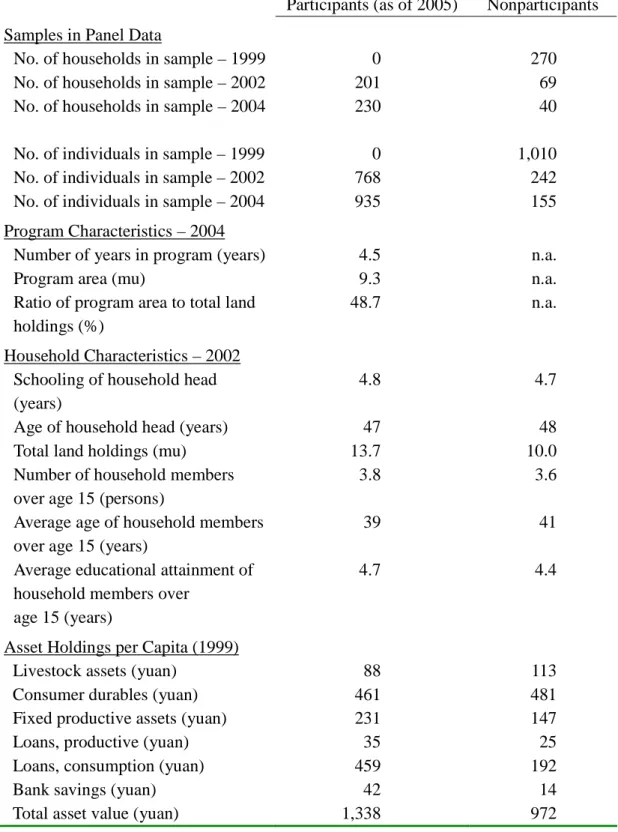
We use a panel data set from household surveys that we designed and implemented in 2003 and 2005. The surveys were commissioned by China’s State Forest Administration as part of its effort to evaluate the Grain for Grain program at the end of its third year of implementation. This data set is believed to be the only existing panel data set that includes both participating and nonparticipating households. The descriptive statistics for the key variables discussed here are shown in Table 1.
The 2003 household survey used a stratified sampling strategy designed to collect data on a random sample of 359 households in the program area. From the three provinces (Sichuan, Shaanxi and Gansu) that had been participating in Grain for Green since 2000, we selected two counties from each province and then randomly selected three townships from each county. In each township, we randomly selected two participating villages and randomly chose ten households from each village. The data includes information on at least one program-participating household for each village. Two of the 36 villages had only participating households. The survey in 2003 collected information on 2002 and 1999. The survey in 2005 was nearly identical to the earlier wave and included 348 households. Of the 359 households surveyed in 2003, we were able to track 270 of them in 2005, 230 of which were
participating households. Of the 230 households, 27 had entered the program since 2003. The attrition rate (from the survey) was 24 percent for households participating in the program and 32 percent for nonparticipating households. The households not included in the 2005 survey were not systematically different from households that were included in both surveys and were dropped from further analysis.10
Among the program participants, there is variability in the number of years that they participated; the extent of their participation (in terms of absolute cultivated area and share of the
household’s cultivated area) varied widely across the sample (Figures 1 and 2). A third of the households in the sample started to participate during the initial year of the program (Figure 1). The share of land that each household retired from cultivation also varied among participating households and ranged from less than 5 percent of total cultivated land holdings to 100 percent (Figure 2). When considering program impacts, it is reasonable to expect that the effect of the program will vary depending on how
much of a farm is part of the program and how long the land has been retired. Hereafter, we use these two variables as measures of the intensity of program participation and as tools for identifying the effects of the program.
Combining the 2003 and 2005 surveys provides information on nearly all of the same variables for both before (in 1999) and after (in 2002 and 2004) implementation of Grain for Green. Enumerators collected information on each household’s production activities on a plot-by-plot basis. The survey also collected detailed information on each household’s total asset holdings, its demographic make-up and other income-earning activities involving both on-farm and off-farm activities.
The study relies on information for 1999 that was collected in 2003, and we acknowledge the potential for problems inherent in recall data, especially regarding the preprogram period. Long-term recall data are potentially inaccurate, although this issue continues to be debated in the literature. Unfortunately, the Chinese government’s quick decision to implement Grain for Green and lack of transparency in the details of its implementation precluded interviews with potential participants at the program’s onset. We addressed concerns about recall bias through the design of the survey and careful training and monitoring of the enumerators to ensure that respondents gave their best recollection of past amounts and activities. We also endeavor to deal with the recall bias by reestimating all of the analyses using a sample of only 67 households—the 27 households that switched from nonparticipant to
participant status between the two surveys and the 40 nonparticipating households. With this subsample, we can compare the changes in off-farm labor between 2002 and 2005 to avoid having to rely on the
recall data for 1999. If the results from the analysis using the subsample of households are consistent the results from the analysis using the full sample, it would suggest that that recall bias is limited.
Off-farm labor allocation
By 2004, a large share of participating household members has reallocated their time to
off-farm work (Figure 3). In the 2005 survey, enumerators asked each respondent what the participating household did with the time that was freed up after implementation of the program. According to tabulations of the data, the largest share of respondents replied that they had reallocated the time of household members to off-farm work (32 percent). The second most frequent response was that households had allocated more labor to their remaining cultivated land (29 percent). In addition,
respondents stated that they had invested this freed labor time in leisure time (or time spent at home—11 percent) and (in conjunction with the in-kind grain compensation) to increase the scope of their livestock enterprises (9 percent).
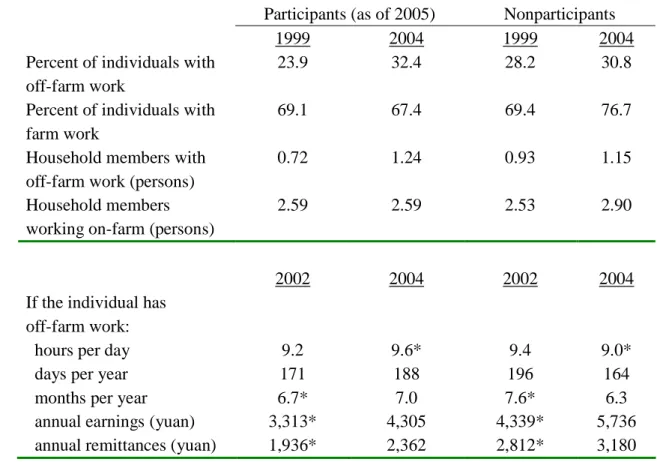
Descriptive statistics from the household data showed that off-farm labor allocation was increasing for both participating and nonparticipating households (Figure 4, Panel A). From 1999 through 2004, individuals with off-farm jobs increased 13 percent for participating households and 8 percent for nonparticipating households. Because off farm employment is changing for both types of households, it is clear that in order to evaluate convincingly the impact of the program on off-farm labor, we need to control for the time effect and thus cannot simply compare postprogram levels of off-farm work between the two groups. Among the individuals that had off-farm employment in 2002, we find that 42 percent had jobs that were not local (implying that they were part of the migrant labor force and
both lived and worked away from home). Forty percent of individuals with off-farm employment had local wage-earning jobs and 18 percent were self-employed. The costs associated with migration and the investment funds needed to start a family-owned business can be high. The high costs that would be associated with shifting a family’s labor allocation from on-farm to off-farm jobs (or between farm enterprises) are why we assume that poor farmers may face a liquidity constraint in the conceptual model.11
While there was a detectable increase in off-farm employment participation for both program participants and nonparticipants, the same cannot be said for on-farm work (Figure 4, Panel B).
Individuals who engaged in farming activities (for at least some part of the year) increased by 6 percent among nonparticipants but decreased by 4 percent among participants. The reason why on-farm labor did not decrease as much as the increase in off-farm activities may be because off-farm jobs frequently did not provide full-time work and individuals consequently returned to farm work periodically.
III. Conservation Set-Aside and Labor Allocation Decisions:
A Conceptual Framework
Given the interactions between factors that influence how a conservation set-aside program affects a farmer’s time allocation, we construct a conceptual model to understand how land and labor allocations are interlinked with liquidity and other constraints that a farmer might face. We extend the literature on off-farm labor allocation in a household production framework by including liquidity and
land constraints as well as the choice to allocate land to the conservation set-aside program. Here we provide a sketch of the model; the full model is described in Appendix 1.
We consider a farm household that maximizes utility, which is defined by consumption of leisure and a composite consumption good. In maximizing its utility, the household faces four
constraints: a time constraint, a land constraint, a liquidity constraint and a full income constraint. First, the household’s time endowment is divided among working on-farm, working off-farm in a
wage-earning activity and leisure. To work off the farm, the household incurs variable transaction costs (e.g., transportation costs) and fixed transaction costs (e.g., job-search costs or start-up costs for a family-owned business). Second, the household’s land endowment is divided among cultivated land that can be used for agricultural production and the conservation set-aside program. The government
compensates the household for program participation at a fixed rate per unit of land. We assume that the land and labor required to produce the agricultural good on-farm are complements. Third, the household is endowed with a certain amount of liquidity. Expenditures on nonlabor input for farm production plus the (variable) transaction costs that a household faces when it wants to participate in off-farm work are limited to the sum of the value of the household’s liquidity, which is the sum of its liquid asset, the amount borrowed and the compensation from land retirement. Households may have to seek credit to finance farm production or to work off-farm. If a household chooses to borrow an amount B, it incurs a fixed transaction cost, representing time and monetary costs of the loan application and disbursement. Finally, the full income constraint limits consumption to income from off-farm labor, profits from
production of agricultural commodities, compensation from the set-aside program and liquid asset minus any fixed transaction costs that are made when participating in off-farm labor and/or credit markets.
In this stylized model, the Grain for Green program can affect labor allocation in three ways. First, the program can relax the liquidity constraint through its compensation, gfg
A
δ . When the liquidity constraint is relaxed, the shadow value of liquidity, λB
, decreases. The household will allocate less labor to farm production and more to off-farm activities, ceteris paribus (through the substitution effect). Moreover, without a well-functioning land rental market, allocating land to a conservation set-aside program will reduce the land allocated to farm production. By assumption, labor and land are complements, so decreasing the amount of land allocated to farm production also decreases on-farm labor. As a consequence, households have freed-up time to allocate to either productive labor uses or leisure (also the substitution effect). Finally, if compensation from the set-aside program can relax the liquidity constraint, the household may be able to either afford the transaction costs associated with obtaining credit and/or earn additional income through off-farm labor and on-farm activities, potentially garnering a higher income because of participation in the program. If so, the household can allocate time to leisure, which would reduce the time devoted to on-farm and/or off-farm labor (income effect).
Whether the net impact is positive is an empirical question. In the following section, we will explain the identification strategy to test these hypotheses.
Assuming that the income effect is small in the poor regions where the program is implemented, we derive the following hypotheses:
Hypothesis 1: If an agent’s liquidity constraint is relaxed through program payments, then an agent allocates more time to off-farm labor and less to on-farm labor.
Hypothesis 2: The more liquidity-constrained a household’s is prior to the program, the larger the effect of program payments on off-farm labor.
IV. Identification Strategy
Based on the conceptual model and its assumptions, the reduced form of the off-farm labor-supply equation for a liquidity-constrained household is given by
(
)
* ; , , , , , , , , , , , , , gfg vo o B c f o o L = f A p wω δ K B A L τ τ τ z z zwhere is off-farm labor, is land allocated to Grain for Green; are the output price, wage and agricultural input prices, respectively; is a compensation rate per area unit for the conservation set-aside program; K and B are liquid assets and the amount that was borrowed,
respectively; are the household’s endowment of land and labor; represent variable and fixed transaction costs for off-farm work and borrowing; and represent a household’s consumption preferences, exogenous conditions on farming productivity and a household’s human capital.
If the Grain for Green program were truly a randomized experiment in which participants were randomly chosen from the targeted population, we would have an ideal statistical basis on which we could use postprogram data for participants and nonparticipants to estimate
* gfg
o
and obtain an unbiased program impact of α. However, the participants in the Grain for Green program were not randomly chosen. In the absence of truly randomized experimental program, the coefficient α may be contaminated by other unobserved factors that could affect a household’s off-farm labor-supply decisions. Simple comparisons of preprogram and postprogram outcomes for the participants also may be biased due to temporal trends in off-farm labor markets and/or by the effects of events other than the Grain for Green program that occurred between the two periods (and affected each household’s off farm employment). Systematic differences could arise, for example, because households were selected for the program based on unmeasured household or village characteristics or because earning levels differed among different segments of the labor markets in which the participating and nonparticipating households function. In essence, these are all components of the selection bias that is inherent in data from nonrandomized programs.
The descriptive statistics underscore the bias that can arise if we estimate the program impact by a simple regression that uses only data from participating households or only data from the
postprogram period. Although the number of participating households that reported off-farm work increased between 1999 and 2004, off-farm employment rates for nonparticipating households also increased. One or more factors, such as deepening of the local off-farm labor markets in regions that host the Grain for Green program, could contribute to households shifting labor to the off-farm employment market. Hence, to obtain the least biased estimate of the impact of the Grain for Green program, we hold constant other observable and unobservable time-variant and time-invariant effects as much as possible.
To address this concern, we use data from nonparticipating households to identify variations in the outcome variables of interest (e.g., off-farm labor-market participation) that are due to factors other than the Grain for Green program. The data from both participating and nonparticipating households are used in a difference-in-differences (DID) estimator that analyzes these types of program effects with these types of data. In fact, DID has been used extensively in the labor economics literature to assess the employment effects of a number of different government policies, including the impact on employment of a raise in the minimum wage (Card and Krueger, 1994) and the effects of temporary disability benefits on the duration of time off from work after an injury (Meyer, et al., 1995 ).
In short, DID compares outcomes from a policy change on two groups—those affected by the policy change (program participants) versus those who are not (non-participants of the program -- Meyer, 1995). Formally, DID can be shown by letting t and t′ denote time periods after and before the
program, respectively. The DID estimate is given by
[
( t| 1) ( t | 1)] [
( t | 0) ( t | 0)]
DID = E Y D = −E Y′ D = − E Y D = −E Y′ D = .
The idea is to correct the simple difference between an outcome before the policy change and after for the treatment group by comparing the before-after change of treated units with the before-after change of control units. By doing so, any common trends that show up in the outcomes of the control units and of the treated units are differenced out (Smith, 2004). The estimator also can eliminate recall bias inherent in a retrospective survey to the extent that the bias is the same for the two groups.
Use of the DID estimator, however, depends on several key assumptions. The conventional DID estimator requires that, in the absence of the program, average outcomes for participants and
nonparticipants follow parallel trends over time. In other words, it assumes that the coefficients associated with Yt′ (the preprogram outcome) and the covariates in t′ (the preprogram period) equal one. This assumption may be implausible if unobservable preprogram characteristics are thought to be associated with the dynamics of the outcome variable and the characteristics are different for
participating and nonparticipating groups. We also report DID estimates of the impact of Grain for Green on off-farm employment (and other outcome variables) for models that include the preprogram outcome (Yt′) and other preprogram control variables (such as household size and total land holdings) that can increase the probability that the parallel trend assumptions hold.
Employing DID allows us to control for a number of variables in the reduced form of the model.12 First, DID differences out all the time-invariant variables. We assume that the total land and time endowment
( )
A L , the variable and fixed transaction costs for participation in off-farm-labor and , credit markets(
τ τ τvo, o, B)
and the household characteristics that determine consumption andproduction
(
z zc, f,zo)
are time-invariant.13 Next, DID zeroes out any time-variant variables for which the two groups change in parallel (i.e., variables that have common trends). We assume that changes in input and output prices
(
p w, ,ω)
are common to all households, so these effects are captured.After controlling for time-invariant factors and for time-variant factors that have common trends, we are left with time-varying observable and unobservable factors for the two groups that affect changes in off-farm labor participation and that systematically change along nonparallel trends. Among them, we are able to control for the program compensation rate
( )
δ , which varies over time. It equals zero for all households in 1999 and has a positive value only for participating households in 2004. Thereare two rates of compensation set for the entire sample: a higher level for samples in Sichuan Province, which is located in the Yangtze River basin, and a lower one for households in Gansu and Shaanxi Provinces, which are located in the Yellow River basin. We therefore include an interaction term between a dummy variable for the Yangtze River basin rate and a year dummy variable for 2004.
Given the preceding considerations, we estimate the empirical model as
(1)
where t indicates time, which equals zero for the preprogram period and one for the postprogram period. The coefficient α (from the DID estimator) is the parameter of interest. Because we have both
household and individual data, we estimate equation (1) at both the household and the individual level. Since errors in the equation that uses individual data may be correlated within households, we report model results that account for clustered errors at the household level. We also extend the DID
framework to test whether the intensity of participation in the program influences the program effect by replacing the treatment variable D i t( , ) with measures of intensity.
Strategy to Estimate How Liquid Assets Affect the Program’s Impact on Off-Farm Labor
Two of our variables that can be used as measures of liquidity
(
K B,)
also depict different trends between the participating and nonparticipating groups. Since we are specifically interested in whether the program’s effect on labor allocation differs for households with different levels of liquidity, we turn now to the strategy for testing this.14 Ideally, if we could directly classify households into those that are liquidity-constrained and those that are not (e.g., Carter and Olinto, 2003), we could estimate the program’s impact for each group and test whether there are statistically detectable differences betweenthe two groups. Unfortunately, we do not have sufficient information on credit and loan application history from the surveys to do this.
Consequently, we take two alternative approaches. We first calculate the preprogram value of each household’s liquid assets ( )S . We assume that liquid assets include the value of livestock assets, fixed productive assets and consumable durable goods, plus loans and deposits. We then divide the sample households into quartiles based on the value of their total liquid asset: Qj, j=[1, 2, 3, 4] where j = 1 is the group of households with the lowest asset value. We then test whether the program effects differ among the quartiles using the DID framework. Heterogeneity in treatment effects can be studied by including interactions between Qj and the treatment dummy variable. Thus, we estimate the following equation:
. (2)
If a household’s liquidity constraint is indeed being relaxed by participation in the Grain for Green program, there will be a positive impact by the program on participation in the off-farm labor market (or on earnings from agriculture). In the empirical model, we anticipate that households that had a lower level of liquidity before Grain for Green (those households belonging to the lower two quartiles) will see a greater relaxing of their liquidity constraint when they receive their compensation than households that had owned a set of liquid assets with a higher value (or those from the top two quartiles).
As a second alternative approach, we utilize a rule developed by Zeldes (1989) to split the households into liquidity-constrained and -unconstrained groups. Specifically, Zeldes classifies
months’ worth of income. We split our sample households using this criterion, estimate DID for each group and test whether or not those estimates are statistically significantly different between groups.
V. Effect of the Grain for Green Program on Off-Farm Labor
Basic Difference-in-Differences Results
Point estimates from the DID model reveal that the Grain for Green program increased off-farm labor participation and decreased on-farm labor participation (Tables 3 through 6, column 1 in all tables). Off-farm labor participation increased for both participants and nonparticipants, but it increased more for participating households. A household that participates in Grain for Green increases its off-farm labor by an average of 0.3 persons (Table 3, column 1).15 Intuitively, the size of the estimate implies that one adult in one out of every three households that participate in the program enters the off-farm
employment market after the program is implemented. This estimate is not statistically significant at the 10 percent level. At the individual level, however, participating in the program increases the likelihood of an individual person working off-farm by 15 percent, an estimate that is statistically significant at the 5 percent level (Table 5, column 1).
Similarly, participation in the Grain for Green program decreases the number of adults working on-farm (Table 4, column 1). The program decreases participation in on-farm work by an average of 0.43 persons and this estimate is statistically significant at the 5 percent level. Intuitively, this means that an adult in nearly one out of two participating households stops working on-farm. In the model that uses
individual data, participation in the program decreases the likelihood of an individual working on-farm by 13 percent, although the point estimate is not significant (Table 6, column 1).
For those that expect that Grain for Green will help to promote off-farm employment, the results of the basic regression are somewhat encouraging. The signs of the basic DID estimates suggest that Grain for Green is promoting structural change, although the low t-ratios on some of the estimates suggest weak confidence in the results. In addition, the nature of the results differs for estimates that use household-level data and those that use individual-level data.
Effect of Program Intensity
While the positive results from the program-participation models are relatively weak, the results for estimates of the effect of program intensity are somewhat stronger. To exploit the variation in
treatment intensity across households, the DID strategy can be generalized. Consider the difference between average off-farm labor participation for Grain for Green participants versus nonparticipants. If devoting more land to the program led to an increase in available labor time or an increase in liquidity that households could use to find off-farm jobs, the difference in off-farm labor could be positively related to the area of land retired by each household. This suggests the following regression:
where P i t( , ) denotes the intensity of the program for observation i in year t. P i t( , ) is zero for all observations in year 1999 and positive only for participants in year 2004. As before, all specifications control for the interaction term for the Yangtze River basin dummy variable times the year 2004 dummy variable and for household size and total land holdings. In the model, we include (1) the ratio of program
area to total land holdings, (2) the number of years in the program, and (3) an interaction term between the ratio of retired to total land area and the duration of the program.
The results in most specifications of the model reveal that greater intensity of program
participation increases off-farm labor participation (Table 3, columns 2–6). Specifically, a larger retired land area and a higher ratio of retired land to total holdings lead to an increase in off-farm labor
participation. The results imply that a household composed of five adults that retires an additional 10 mu of its cultivated land to the Grain for Green program will increase off-farm work by 0.5 persons (0.01 × 10 × 5) (column 2). Likewise, when a household of five adults allocates 40 percent more of its cultivated area to the program, the household will increase off-farm work by 0.5 persons (0.284 × 0.4 × 5—column 3). In the sample, the average number of adults per household is four. Duration in the program, by itself, is not associated with greater off-farm labor participation (column 4), but when the program area and duration are jointly considered, the longer a household has been in the program, the greater its increases in off-farm labor participation (columns 5–6).
At the individual level, only the ratio of program area to total land holdings is associated with a greater propensity to work off-farm (Table 5, columns 2–6). These results suggest that a household (that the individual belongs to) retires all of its cultivated land will increase the likelihood of an adult member working off-farm by nearly 10 percent (column 3).
Interestingly, we find that program intensity matters for changes in off-farm labor participation but not for changes in work on the farm regardless of whether the data is at the household or individual level (Tables 4 and 6, columns 2–6). This result may be driven by the binary nature of the measure of
off-farm work; with a binary variable, we cannot capture changes in time spent on-farm (measured in days or hours). Since most households (and individuals) in the sample continue to farm while
participating in the program (even when they get local jobs off-farm), we find no statistical effect of participation in Grain for Green on on-farm labor.
Assessing Selection Bias
Since we are concerned that the preprogram variables for 1999 may suffer from recall bias, we repeat all of the preceding analyses on the smaller subset of households (n = 27) that changed status from nonparticipant to participant between 2002 and 2004. In that analysis, we use the same 40
nonparticipating households as the control group. With this subset, while the sample is smaller, the data are true panel data and are not subject to errors due to recall.
Overall, the findings from the smaller subset are consistent with those from the full sample (Appendix Tables 1 and 2). The Appendix tables provide the results of the program’s effect on off-farm labor participation at the individual level. The DID estimates for the subset are slightly larger than the estimates for the full sample. This consistency between samples suggests that recall bias in 1999 was limited and/or that the DID approach controlled for bias that existed in both groups.
Discussion
In summary, the DID estimates of the binary indicator for program participation and the variables for program intensity suggest that the Grain for Green program led to something between a small and moderate increase in off-farm work among participating households. This finding is in sharp contrast to two prior studies of the Grain for Green program that found no effect on off-farm labor
participation or on income from off-farm work (Xu, et al., 2005; Uchida, et al., 2005). Furthermore, since both of those studies used household surveys that collected information on labor-allocation decisions only for the first three years of the program, it may have been too soon for changes to be detected. In this study, we use data collected five years after the program began, which may have allowed sufficient time for participating households to begin to find off-farm employment in numbers that are statistically detectable.
The positive impact of the program on off-farm labor also is in stark contrast to findings from studies of the impact of government farm payment programs in the U.S. Previous U.S. studies of
government payments to farmers, including the Conservation Reserve Program, have consistently found that government payments negatively affect household off-farm employment participation (e.g., Ahearn, et al., 2005). The results in China may move in the opposite direction for several reasons. The higher level of income of U.S. farmers compared to what is typical for farmers in the Grain for Green program in China probably is the most likely reason why farmers in the U.S. do not choose to work off-farm when offered a government payment (i.e., the wealth effect dominates). In short, the income effect of leisure may dominate for richer U.S. farmers while the substitute effect may dominate for poor farmers in China. We also believe that the divergent program effects stem from underlying conditions in the two labor and credit markets. Although labor and credit markets exist in rural China, transaction costs may be high enough that households face much larger constraints in accessing them. According to our results, it appears that Grain for Green is helping to alleviate the liquidity constraints.
VI. Heterogeneous Program Effect on Off-Farm Labor
In the previous section, we found—with at least some degree of confidence—that the Grain for Green program has led to an increase in off-farm labor participation. The DID estimates, however, do not allow us to understand how the program affects off-farm labor or which types of farmers are
participating. In fact, we are interested in understanding how these changes occur. In particular, based on the stylized conceptual model, we want to understand the role of two factors when households make off-farm labor-participation decisions: physical capital and human capital. In this section, we test whether the program has heterogeneous effects on off-farm labor that depend on the availability of physical and human capital to the households before the program. To do so, we estimate equation (2). Liquidity Constraint
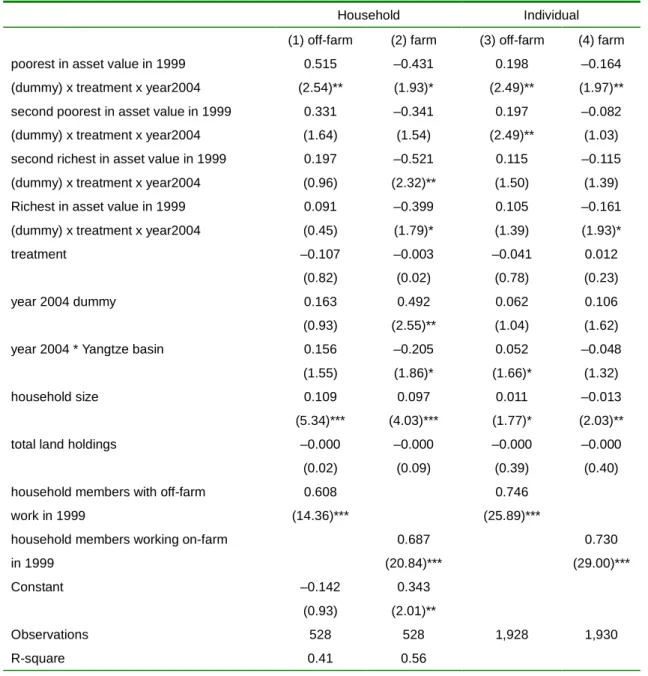
We find that the effect of the program on off-farm labor is clearly larger for households that had less liquid assets prior to the program (Table 7, columns 1 and 3). For households belonging to the quartile of households with the lowest level of assets, the program increased off-farm work by an average of 0.52 persons (column 1). Intuitively, this means that one adult member in one out of every two liquidity-constrained participating households started to work off-farm after joining Grain for Green. In contrast, although the program had a positive effect on off-farm employment decisions by less
liquidity-constrained household in the other three quartiles, the estimated coefficients are mostly statistically insignificant. Estimates of the coefficients at the individual level are consistent and show even stronger results compared to the household-level findings (column 3). The program increased the probability of a household member starting an off-farm job by 20 percent for households in the two
lowest quartiles, while the effect was statistically insignificant for individuals in the higher two quartiles. In contrast, estimates for on-farm work suggest that households and individuals in the lowest-asset quartiles moved away from on-farm work (columns 2 and 4). The magnitude of the coefficient gets steadily smaller as the level of assets in the quartile categories gets higher (although the increase is not linear).
We found consistent results when we split the households using Zeldes’ rule into
liquidity-constrained and -unconstrained groups and compared the DID estimates. The DID estimates for the constrained group was positive and statistically significant both at the household and individual levels. The DID estimates for the unconstrained group were insignificant.16
In sum, the findings reveal that the less liquidity-constrained a household is prior to the program the more positive the impact of the Grain for Green program is on its off-farm employment participation. One way of interpreting this result is that participation in Grain for Green relaxes a household’s liquidity constraint and that it garners resources the household can use to participate in off-farm work. Thus, the more constrained the household, the larger is the program’s impact on off-farm work.
Human Capital
We also are interested in understanding how human capital can influence the program’s effects among households. Age and education are two fundamental indicators of human capital that affect the ability of individuals to find off-farm work. Higher education is expected to result in greater rewards from off-farm labor (Becker, 1993). Education here is defined as the number of completed years of
schooling and is assumed to capture the skills the individual may bring to a given job in the off-farm labor market. Previous studies have also shown that migration (which is included in this study’s off-farm labor supply) is influenced inversely by age; older people are less likely to migrate since they have less time to pay back the investment (Lanzona, 1998). In the conceptual model, education and age are included in zo, one of the factors that is assumed to help determine the off-farm labor supply. To test whether the program’s effect on off-farm labor is influenced by the households’ access to human capital, we again divide the sample into quartiles based on an initial level of education and on age cohorts.
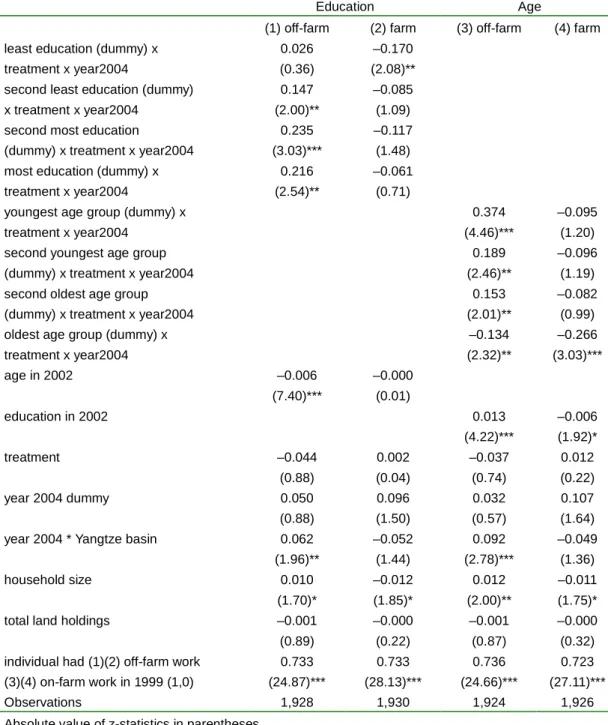
The results show that levels of human capital, in terms of both age and of education, impact how the program affects off-farm labor (Table 8). The estimates imply that adult family members who are younger are more likely to shift to the off-farm labor market after the onset of Grain for Green than are older ones. For example, for adults in the youngest quartile, the program increased the probability of off-farm labor participation by 37 percent; for the oldest quartile, Grain for Green decreased off-farm employment by 13 percent (columns 3 and 4). This result is convincing considering that the types of off-farm jobs that are first available to rural farmers are physically demanding (jobs such as construction work) and naturally favor young adults.
Perhaps more importantly, the results show that Grain for Green did not have a positive effect on off-farm employment for adults who had only limited education prior to the program (columns 1 and 2). If the individual was in the lowest quartile for education, participation in the program did not change the likelihood of that person gaining an off-farm job, and the likelihood of finding off-farm employment increases as educational attainment increases. This result suggests that the program may not be able to
induce structural change in income-generating activities if participants do not have adequate education for off-farm work. These findings add yet another piece of empirical evidence suggesting that China will have to expand its investment in education to achieve its goals.
In the 2005 survey, we asked participating household members what they would do if the government stopped payments after five to eight years (Figure 5). More than 20 percent of the respondents wanted to find work off the farm. If they are unable to do so without a certain level of education, they are at risk for being trapped in poverty when program compensation ceases.
VIII. Conclusion
In our study, we consistently find that, on average, the Grain for Green program has a positive (although only moderately strong) effect on off-farm labor participation. In other words, households that participate in the program are increasingly shifting their labor endowment from on-farm work to the off-farm labor market. This shift occurs not only in absolute terms but is statistically significant when compared to similar shifts in nonparticipating households. In terms of program intensity, we find that program impacts increase as the ratio of a household’s retired plots to total land holdings grows. These findings are different from those of previous studies that evaluated Grain for Green. The results also indicate that households with less liquid assets are more affected (positively) by the program. This result supports the view that the compensation paid by Grain for Green for setting aside cultivated land may be relaxing the liquidity constraint for participating households, allowing participants to more readily move into the off-farm employment sector (relative to nonparticipants).
The positive impact of conservation payments on off-farm labor in China contrasts with findings in the U.S., where studies have typically found that government payments to farmers decrease off-farm labor participation. Although we could not directly determine the reasons why this is so, we did observe an opposing effect, the sensitivity of the Grain for Green program impact to the level of the household’s physical and human capital indicates that there may be more impediments to participating in off-farm labor in rural China than there are in the U.S. Therefore, in terms of policy impact for China, if policymakers want to achieve a win-win outcome from the Grain for Green program by meeting both environmental and development goals, they may need to provide additional support to vulnerable populations through job training programs or other means.
REFERENCES
Ahearn, M. C., H. El-Osta, and J. Dewbre. "The impact of coupled and decoupled government subsidies on off-farm labor participation of U.S. farm operators." American Journal of Agricultural
Economics 88, no. 2(2005): 393-408.
Alix-Garcia, J., A. de Janvry, and E. Sadoulet. "Payments for Environmental Services: To whom, where and how much?" INE/CONAFOR/World Bank, Workshop on Payment for Environmental Service (2003).
Bardhan, P., and C. Udry. Development Economics. Oxford: Oxford University Press, 1999. Becker, G. Human Capital. 3rd ed. Chicago: University of Chicago Press, 1993.
Bowlus, A., and T. Sicular. "Moving towards markets? Labour allocation in rural China." Journal of Development Economics 71(2003): 561-83.
Card, D., and A. B. Krueger. "Minimum Wages and Employment: A Case Study of the Fast-Food
Industry in New Jersey and Pennsylvania." American Economic Review 84, no. 4(1994): 772-93. Carter, M. R., and P. Olinto. "Getting institutions "right" for whom? Credit constraints and the impact
of property rights on the quantity and composition of investment." American Journal of Agricultural Economics 85, no. 1(2003): 173-186.
deBrauw, A. (2002) Three essays on migration, education and household development in rural China, University of California, Davis, pp. p.67.
El-Osta, H., and M. Ahearn. Estimating the opportunity cost of unpaid farm labor for U.S. farm operators. Vol. 1848. Technical Bulletin. Washington, D.C.: U.S. Department of Agriculture,
Economic Research Service, 1996.
Feder, G., et al. "The relationship between credit and productivity in Chinese agriculture: a
microeconomic model of disequilibrium." American Journal of Agricultural Economics 72, no. 4(1990): 1151-57.
Gardner, B. L. "Changing economic perspectives on the farm problem." Journal of Economic Literature 30, no. 1(1992): 62-101.
Groom, B., et al. "Relaxing rural constraints: a 'win-win' policy for poverty and environment in China?" Draft, School of Oriental and African Studies, 2006.
Hoff, K., and J. E. Stiglitz. "Imperfect information and rural credit markets -- puzzles and policy perspectives." World Bank Economic Review 4(1990): 235-50.
Hyde, W., Brian Belcher, and Jintao Xu (2003) China's forests: Global lessons from market reforms. Washington, D.C., Resources for the Future.
International Fund for Agricultural Development. "Rural financial services in China: Thematic study." International Fund for Agricultural Development.
Knight, J., and L. Song. Towards a labour market in China. Oxford: Oxford University Press, 2005. Lanzona, L. A. "Migration, self-selection and earnings in Philippine rural communities." Journal of
Development Economics 56, no. 1(1998): 27-50.
Meyer, B. D. "Natural and Quasi-experiments in Economics." Journal of Business and Economic Statistics 13, no. 2(1995): 151-161.
from a Natural Experiment." American Economic Review 85, no. 3(1995 ): 322-40. Mishra, A., et al. Income, wealth, and the economic well-being of farm households. Agricultural
Economics Report No. 812. Washington, D.C.: U.S. Department of Agriculture, Economic Research Service, 2002.
Mishra, A., and B. Goodwin. "Farm income variability and supply of off-farm labor." American Journal of Agricultural Economics 79, no. 880-87(1997).
Nyberg, A., and S. Rozelle. Accelerating China's Rural Transformation. Washington, D.C.: The World Bank, 1999.
Pagiola, S., N. Landell-Mills, and J. Bishop (2002) Market-based Mechanisms for Forest Conservation and Development, ed. S. Pagiola, J. Bishop, and N. Landell-Mills. London, UK, Earthscan Publications Ltd.
Pagiola, S., and G. Platais. "Can Payments for Environmental Services Help Reduce Poverty? An
Exploration of the Issues and Evidence to Date from Latin America." World Development 33, no. 2(2005): 237-253.
Smith, J. (2004) Evaluating the Local Economic Development Policies: Theory and Practice, ed. A. Nolan, and G. Wong. Paris, OECD Publishing.
State Environmental Protection Administration (2005) Report on the State of the Environment in China 2004. Beijing.
State Forestry Administration (2003) Master Plan for the Sloping Land Conversion Program. Uchida, E., et al. "Are the Poor Benefiting from China's Conservation Set-aside Program?"
Environmental and Development Economics (forthcoming).
World Bank. World Development Indicators. Washington, DC: The World Bank, 2003.
Xu, Z., et al. "China's Sloping Land Conversion Programme four years on: current situation, pending issues." International Forestry Review 6, no. 3-4(2004): 317-326.
Xu;, J., et al. "China's Sloping Land Conversion Program: Does expansion equal success?" Working Draft (2006).
Zeldes, S. P. "Consumption and liquidity constraints: An empirical investigation." The Journal of Political Economy 97, no. 2(1989): 305-346.
Zhang, L., et al. "Investing in rural China: China's commitment to modernization." The Chinese Economy (Forthcoming).
Endnotes
1 The program was officially implemented in 2000. Pilot projects for the program got under way in 1999
in selected provinces. The Grain for Green program is also known as the Sloped Land Conversion Program.
2 Most close observers believe, however, that Grain for Green has been “quasi voluntary.” Although
households officially can choose whether or not to participate, some households with land fitting the slope criterion reported being “strongly encouraged” to participate. In fact, Xu et al. (2005) found that on 53ly percent of participating households in their sample believed that their participation was not mandatory and only 30 percent had the autonomy to choose which plots to retire. If households are coerced into an unattractive program, do not have the physical and human capital necessary to switch to alternative income-generating activities and are not permitted to return the land to cultivation after the program ends, it is possible such households could be trapped in poverty.
3
Both grain and cash compensations are provided for eight years if ecological forests are planted, for five years for planting of economic forests, and for two years for planting of grasses State Forestry Administration (2003) Master Plan for the Sloping Land Conversion Program.. To account for the difference in regional average yields, annual grain compensation was set at 2,250 kilograms per hectare in the Yangtze River basin and 1,500 kilograms per hectare in the Yellow River basin. The cash
component is 300 yuan per hectare of eligible land per year. 4
The study by Groom et al. (2006) used a household survey implemented in 2004 and collected 1999 preprogram data on a recall basis.
5
Ahearn et al. (2005) argue that the expected impact of government payments on off-farm labor participation depends on whether the payment is decoupled (producers are not required to produce specific commodities to receive a subsidy) or not. If it is a decoupled payment, it is like nonlabor income; a traditional labor-leisure model would predict that an increase in nonlabor income would unambiguously decrease off-farm labor. If, however, the payment is coupled to the commodity grown, the compensation then is like an increase in wage, which would have an income and a substitution effect
that, combined, would have an ambiguous effect on labor.
6
For an excellent overview of the Grain for Green program, see Xu et al. (2005). 7
But, due to recent controversies over fiscal pressures, hikes in grain prices, and delivery of program compensation, the government scaled back expansion of the program in 2005 and is discussing how to reduce the extent of the program overall (Xu, et al., 2006).
8
The annual average official exchange rate in 2001 was 8.28 Chinese yuan to one U.S. dollar. The purchasing-power parity conversion factor in 2001 was 1.9 yuan to the dollar World Bank. World Development Indicators. Washington, DC: The World Bank, 2003..
9
For example, Xu et al. (2006) found that the value of preprogram production for more than 70 percent of participating households was less valuable than the compensation rate. Furthermore, the level of compensation is not trivial relative to the earnings of the typical participating household in the study region. For example, if an average household in Sichuan Province (Yangtze River basin) received full compensation, it would receive 340 yuan per capita, an amount equal to 24 percent of the average household’s preprogram total per capita income in 1999 (Uchida et al., 2005).
10
Because some households could not be included in the 2005 survey, 78 new households were added in 2005. We found, however, that the newly sampled households had systematically different household characteristics for some variables, such as household size and land holdings. In addition, preprogram data for 1999 that was collected in 2005 from these additional households would likely suffer from recall bias. Consequently, we excluded these households from our analysis.
11 Unfortunately, we did not have a variable that distinguished between types of off-farm work in the
2005 survey, and thus we relied on the binary variable that indicated whether an individual member had an off-farm job or not. For 2002 and 2004, however, we do have information regarding the intensity of off-farm work (Table 2). We find that between these two years the average hours worked per day and the number of days per year increased for participants but not for nonparticipants. Earnings from off-farm work and remittances increased for both groups but the differences between the two groups in a particular year are not statistically significant. The survey did not ask for information on labor hours
invested before the program (in 1999) out of concern for measurement error. Consequently, we hereafter leave behind analysis of the program’s impact on the intensive margin (differences in number of hours worked) and focus on the extensive margin (whether there was a shift of a family member from the on-farm to the off-farm sector).
12
While DID allows us to control for unobserved factors, a disadvantage of this type of reduced-form approach is that I cannot estimate other interesting parameters such as price elasticities. The main objective of this study is to evaluate the impact of the Grain for Green program so I chose to take the DID approach. In addition, this method avoids errors in measurement errors of wage and other prices. 13
The household data set includes household size and total land holdings for 1999 and 2004. Changes in these two variables are observed in only a few households in the sample so including changes in those variables when estimating DID does not make a significant difference.
14
The reliability of the DID estimator lies in the identification assumption that there are no omitted time-varying effects that are correlated with the program. For example, the identification assumption might be violated if other local governmental programs existed that both affected labor allocation and were correlated with participation in the Grain for Green program. Unfortunately, I did not have information to control for other governmental programs and thus had to interpret all results with this caveat in mind.
15
The term “persons” is loosely used here. The dependent variable is the head count of household members with off-farm labor work. Since a household member with any number of hours of off-farm work is counted as one person, “persons” cannot be defined by hours or full-time equivalents (FTEs). 16 The number of participating households that were liquidity-constrained and -unconstrained were 170 and 55, respectively, and for non-participating households 32 and 8. The DID estimates for liquidity -constrained and -unconstrained households were 0.415 (t=1.96) and -0.260 (t=0.70), respectively. At the individual level, the estimates were 0.132 (t=2.78) and -0.013 (t=0.14), respectively.