Providing Fault-tolerant Execution of
Web-service–based Workflows within Clouds
∗Johannes Behl,
Tobias Distler,
Florian Heisig
Friedrich–Alexander University Erlangen–Nuremberg {behl,distler,heisig}@cs.fau.deRüdiger Kapitza
TU Braunschweig [email protected]Matthias Schunter
IBM Research – ZurichABSTRACT
With a variety of services rapidly evolving at all architec-tural levels of cloud computing, there is an increasing de-mand for a standardized way to coordinate their interac-tions. Business process management, that is, more general, the management of Web-service–based workflows, could sat-isfy this demand and, indeed, first corresponding offerings have gained instant popularity. While from a functional per-spective, these Platform-as-a-Service (PaaS) solutions are al-ready quite mature, their support for fault tolerance is still very limited, making them inapplicable for critical tasks.
Concerning the deficiencies of currently existing systems, this paper presents a practical solution for executing criti-cal Web-service–based workflows, particularly within clouds, in a fault-tolerant, highly available and highly configurable manner. We achieve this by actively replicating workflows as well as Web services in a combined architecture, reusing existing standard systems and coordination services. By providing an automated transformation tool, replication is realized transparently to existing systems and workflows. Measurements show that our proposed architecture achieves lower response times than existing systems and that the in-tegration of a coordination service imposes only moderate costs, while simplifying the implementation and leading to a dynamically adaptable solution.
1.
INTRODUCTION
Following the slogan “Everything as a service”, cloud com-puting leads to a constantly growing number of services, ranging from very basic infrastructure offerings such as com-puting power or storage space, to more complex platform services like application and other execution environments, ∗The research leading to these results has received fund-ing from the European Union’s Seventh Framework Pro-gramme (FP7/2007-2013) under grant agreement n◦257243
(TClouds project: http://www.tclouds-project.eu/).
Permission to make digital or hard copies of all or part of this work for personal or classroom use is granted without fee provided that copies are not made or distributed for profit or commercial advantage and that copies bear this notice and the full citation on the first page. To copy otherwise, to republish, to post on servers or to redistribute to lists, requires prior specific permission and/or a fee.
CloudCP 2012: 2nd International Workshop on Cloud Computing Plat-forms.Bern, Switzerland.
Copyright 2012 ACM 978-1-4503-1161-8 ...$10.00.
to entire software solutions, for example, Web-based office tools. Their growing number comes along with a growing demand for a common way to coordinate and manage in-teractions of all these services. As the majority of them can be accessed by standard Web-service technology, this demand is basically the demand for orchestrating Web ser-vices, a problem for which exactly the field ofbusiness pro-cess management offers solutions. For instance, infrastruc-tures for theWeb Services Business Process Execution Lan-guage (WS-BPEL, short BPEL) provide a platform for ex-ecuting business processes, or more general, workflows that are based on one or more Web services and that are offered as Web services themselves.
Most of the generic or domain-tailored solutions for creat-ing, executing and managing suchWeb-service–based work-flows (e. g., Visual Process Manager1 and runMyProcess2) exhibit sophisticated interfaces, a multitude of connectors to subsystems, and increasing support for non-functional prop-erties such as scalability and security. Nevertheless, fault tolerance has received relatively limited attention. Standard BPEL engines, responsible for executing Web-service–based workflows within BPEL infrastructures, log state changes to persistent storage to enable recovery of active workflows after a reboot or crash. This approach has two disadvan-tages: first, the need for synchronous logging slows down the execution speed during normal operation; second, the reli-ability of this mechanism depends on the relireli-ability of the storage. In addition, BPEL provides only limited means to handle failures of the Web services the workflows are based on. Making these Web services fault tolerant is not sup-ported at all by standard BPEL infrastructures. However, recent studies on cloud offerings [11] and hardware in gen-eral [10] show, that clouds are less reliable than traditional data centers and hardware failures are more common than previously assumed. This basically inhibits outsourcing of critical processes like financial or medical services to clouds. An effort to close this gap by supporting critical applica-tions in the context of cloud computing is the EU IP project TClouds which targets the provision of a dependable and se-cure cloud infrastructure. As part of this project, we present a solution for offering highly available, fault-tolerant execu-tion of critical Web-service–based workflows as a platform service within clouds. Our approach is practice-oriented, since current BPEL infrastructures and workflows can be widely reused, and it is extensively configurable as well as
1http://www.salesforce.com/platform/process/
2
dynamically adaptable through the use of external coordi-nation services provided by today’s cloud infrastructures.
Unlike other works in this field, the architecture presented here provides fault tolerance by means of active replica-tion at both the process level and the service level. Usu-ally, porting an unreplicated service to run in an actively replicated environment is not trivial and often requires man-ual modifications to the code, for example, to integrate key mechanisms like message distribution, request ordering, and replica coordination. In contrast, our solution includes an automated and transparent transformation process for work-flows that obviates the need for manual intervention. Basi-cally, the transformation process inserts calls to proxy com-ponents whenever a Web service is to be invoked, which enables the proxies to intercept calls and carry out tasks necessary for replication. Besides eliminating manual adap-tion of workflows, this approach permits to reuse standard BPEL engines, simplifying the implementation of our solu-tion. To simplify it further, we heavily make use of Apache ZooKeeper [6], a service to coordinate distributed applica-tions. This allows us to externalize coordination tasks and to realize global configuration as well as dynamic adaptation to changing environmental conditions.
Initial evaluation results show that our approach outper-forms a standard BPEL engine, which relies on logging for recovery purposes, by a factor of 2.0 to 3.4 while providing higher availability. Furthermore, the overhead of external-izing coordination is about 13% compared to a traditional design that utilizes a group communication as an integrated part, co-located with the engines.
2.
BASICS ABOUT BPEL
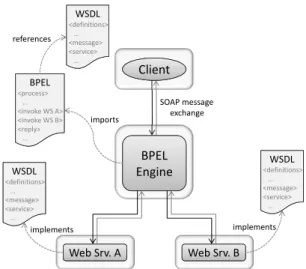
The Web Services Business Process Execution Language (WS-BPEL, short BPEL) is an XML-based language de-signed to describe and specify the behavior ofbusiness pro-cesses. In the context of BPEL, a business process is a set of activities that uses different Web services (possibly from different providers) to realize a newcomposite Web service. Figure 1 shows a standard (unreplicated) BPEL
infras-tructure. Its main component is the BPEL engine, which
is responsible for executing business processes specified in BPEL process definitions. When a client sends a request to a BPEL service, the BPEL engine handles the request according to the corresponding process definition. It partic-ularly calls all Web services necessary to fulfill the request.
Besides comprising the means to invoke Web services, BPEL also provides mechanisms for holding intermediate data, handling exceptions, and expressing control flows that allow BPEL to be used to describe more complex business processes. Furthermore, most BPEL implementations rely on a recovery mechanism that logs intermediate state on a persistent storage to provide reliable process execution.
Thus, being designed for the description of business pro-cesses, BPEL is not confined to this special purpose. It can easily be used to describe all kinds ofworkflows, given that these workflows are offered as and composed of Web services.
3.
APACHE ZOOKEEPER
Apache ZooKeeper [6] is a crash-tolerant service, which offers basic services like distributed coordination and config-uration maintenance to distributed applications and, among other things, enables the implementation of leader election.
Web Srv. A Web Srv. B Client BPEL Engine BPEL <process> … <invoke WS A> <invoke WS B> <reply> … WSDL <definitions> … <message> <service> … WSDL <definitions> … <message> <service> … WSDL <definitions> … <message> <service> … imports implements implements references SOAP message exchange
Figure 1: Standard unreplicated BPEL infrastruc-ture: a BPEL engine executes workflows according to their process definitions described in BPEL. In particular, it calls all necessary Web services the workflows are composed of.
ZooKeeper manages data in a hierarchical tree, similar to a file system; each node is accessed using a unique path. All nodes in the tree can store a small chunk of data (usually a few kilobytes). ZooKeeper distinguishes between different types of nodes: regular nodes have to be explicitly created and deleted by a ZooKeeper user,ephemeral nodes behave like regular nodes except that they are also implicitly deleted when the connection to the user that created the node ear-lier is terminated. Furthermore, ZooKeeper users are able to request a regular or ephemeral node to be asequential node, which leads to the assignment of a sequence number to the node’s name at creation time. In our reliable BPEL infras-tructure, for example, we use sequential nodes to establish a total order on the requests of BPEL clients.
ZooKeeper offers a callback mechanism that informs users about certain events (e. g., the creation or deletion of a data
node) by registering watches. Watches can be used, for
instance, to implement fault detection: after establishing a connection, each ZooKeeper user (e. g., a BPEL engine replica) creates an ephemeral node and registers a set of watches to monitor the deletion of the ephemeral nodes of other users. This way, when a user crashes, its ephemeral node is deleted, which in turn triggers the watches that no-tify all other users about the crash.
Although our current prototype relies on ZooKeeper, the proposed approach is not limited to a specific coordination service implementation. As a consequence, other systems like Chubby [1] could be used for externalizing coordination and configuration in our infrastructure.
4.
RELIABLE BPEL INFRASTRUCTURE
Standard BPEL infrastructures have some deficiencies re-garding their ability to tolerate faults. Logging intermediate state for recovery purposes, for example, depends on reliable storage. This is a weak point, not only in terms of fault tolerance, but also with regard to performance. Moreover, BPEL processes depend on the Web services they use, but fault tolerance of Web services is not considered at all by standard BPEL infrastructures.
ZooKeeper BPEL Engine IP OP Client OP BPEL Engine IP OP BPEL Engine IP OP 1 5 5 5 Web Srv. A IP 10 Web Srv. A IP 10 Web Srv. A IP 10 6 6 6 R1 R2 R3 2 3 4 12 7 8 11 11 11 9 Coordination messages Service invocation
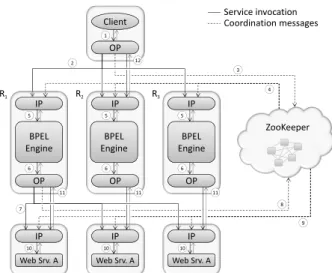
Figure 2: Proposed architecture: BPEL engine and Web services are actively replicated using output and input proxies (OP and IP). An automatic trans-formation of process definitions allows them to in-tercept the communication chain transparently. The proxies make use of a ZooKeeper service for coordi-nation and dynamic configuration.
4.1
General Approach
We address these problems by actively replicating not only the BPEL engines, but (optionally) also the Web services in a combined architecture. This architecture (see Figure 2) is designed according to three main objectives. First, all measures taken for fault tolerance have to be transparent to the workflows described in BPEL; that is, it should not make a difference whether a process definition is executed on a standard or a replicated infrastructure. Second, all measures are to be as little invasive as possible to existing BPEL infrastructures in order to reuse them. Third, for further minimizing the implementation effort, cloud services are to be used where possible.
In our architecture, these design objectives are met by means of proxies that intercept Web-service calls to im-plement replication. In particular, the proxies distribute requests across replicas and collect results. Because Web-service formats and protocols are used between clients and BPEL engines as well as between BPEL engines and Web services, the replication of BPEL engines and Web services can be achieved by almost the same mechanisms.
The proxies use an external ZooKeeper service for coordi-nation, dynamic retrieval of system information and config-uration, crash detection, and request ordering. Using an ex-ternal service simplifies all these tasks and saves resources. It also can permit global coordination within clouds such as the dynamic assignment of replica virtual machines to servers and the consideration of quality-of-service constraints when choosing suitable Web-service implementations.
To integrate a BPEL service with our architecture, the service needs to be made replication aware. This step is per-formed by a fully automated tool and does not require any manual modifications to the service code. In order to insert calls to the proxies handling replication, our tool transforms the BPEL process definition of the service to integrate. The transformed process definition is then loaded by the BPEL engine replicas. Note that this transformation needs to be executed only once for every service, prior to its first run.
4.2
Replication Architecture
In the following, we describe the steps necessary to process a client request in our reliable BPEL infrastructure.
Client/BPEL Stage.
When a client sends a request usinga Web-service library, the request is passed to a localoutput proxy( 1, see Figure 2). The proxy is responsible for
assign-ing a uniquerequest id to the request, sending the request data to all BPEL engine replicas 2 , registering the request
at ZooKeeper 3, and for collecting the result12. ZooKeeper
is used at this stage to obtain the active replicas and to en-force a total order on all requests. The former allows an easy propagation of configuration changes within the system, for example, if replicas fail or are to be replaced. The latter guarantees that all BPEL engine replicas process the same sequence of input data. Sending the request data in a sep-arate step prior to the registration is done for performance reasons, as ZooKeeper is designed for use with small chunks of data. After distributing and registering the request, the output proxy waits until a reply becomes available.
In our architecture, output proxies do not communicate directly with BPEL engines. Instead, each replica runs an input proxy in front its BPEL engine. Input proxies main-tain a steady connection to ZooKeeper, which allows the detection of crashed replicas. Moreover, they are informed
by ZooKeeper when a new request has been registered 4.
In that case, they deliver the corresponding request data to the local BPEL engine 5 and wait for the reply. After the
engine has processed the request, an input proxy stores the reply in a local cache where it can be retrieved by the output proxy of the client.
BPEL/Web-Service Stage.
Executing a client requestre-quires a BPEL process to issue calls to different Web ser-vices; these calls have to be coordinated across replicas in order to guarantee exactly-once semantics. Similar to the client side, we rely on output proxies for that purpose, to which all outgoing calls of a BPEL process are redirected to 6 . The redirection of calls is performed statically during
the automated process transformation, which also provides the means to tag each Web-service invocation with acall id that uniquely identifies each call (see Section 4.3).
The output proxies of all BPEL engine replicas make use of ZooKeeper to elect a leader. The leader (in Figure 2: the output proxy on the left) is responsible for performing the actual calls to Web services, 7 to 10, analog to the output
proxy of a client, 2 to 5. When a reply becomes available,
the output proxies of all BPEL engine replicas retrieve it
from a randomly chosen Web-service replica 11. Relying
on ZooKeeper allows the output proxies to detect the crash of their leader (see Section 3). In such a case, the remain-ing output proxies elect a new leader which takes over by completing the pending Web-service invocations. With calls being uniquely identifiable, the input proxies of Web services are able to detect and suppress duplicate calls.
4.3
Automated Process Transformation
Actively replicating a service creates the need for mech-anisms to distribute messages, order requests, and coordi-nate replicas. In our architecture, this functionality is pro-vided by means of application-independent proxies (see Sec-tion 4.1). In this way, all replicaSec-tion-related measures are completely transparent to the BPEL engines. Thus, exist-ing implementations of such engines can be used in our
sys-<bpel:process name="calcTotalPrice" /> <bpel:receive name="recvArticleList" />
<bpel:while name="doForEachArticle"> <bpel:invoke name="getPrice" /> <bpel:assign name="addPrice" /> </bpel:while>
<bpel:reply name="replyTotalPrice" /> </bpel:process>
<bpel:process name="calcTotalPriceTransf" /> <bpel:assign name="initCounter" />
<bpel:receive name="recvPackedReq" /> <bpel:assign name="unpackReqID" /> <bpel:assign name="unpackArticleList" />
<bpel:while name="doForEachArticle"> <bpel:assign name="incCounter" /> <bpel:assign name="packGetPriceReq" /> <bpel:assign name="packReqID+Counter" /> <bpel:invoke name="invokeOutputProxy" /> <bpel:assign name="addPrice" />
</bpel:while>
<bpel:reply name="replyTotalPrice" /> </bpel:process> O1 O2 O4 O5 O6 O7 O9 O10 T1 T2 T4 T5 T6 T8 T9 T10 T11 T12 T13 T14 T16 T17
Figure 3: Comparison of an original (left) and a transformed (right) process definition (simplified). The
business process sums up article prices with the help of a Web service (getPrice) determining these prices.
The transformed definition contains steps for unpacking requests and request ids from the input proxy and handling invocations through the output proxy; each call to the external Web service is assigned a unique id. tem without modifications. This approach, however, makes
it necessary to adapt process definition and interface de-scription of each workflow that is to be replicated. Per-forming this task for every individual workflow by hand is time-consuming and error-prone and therefore not an op-tion. To address this issue, we developed an automated tool that statically transforms all files necessary to make a work-flow replication aware prior to its first run.
During the transformation, our tool applies four modifi-cations. First, the interface description of a BPEL process is extended to enable the propagation of request ids. Sec-ond, all requests received from clients are unmarshalled to extract the request id attached. Third, all outgoing calls are redirected to an output proxy. Fourth, for each outgo-ing call to a Web service, the process definition is extended to allow the BPEL process to assign a unique call id to the Web-service call in order to be able to distinguish different invocations (see Section 4.2).
Figure 3 illustrates a simplified example of a transformed process definition for a business process that sums up the prices of different articles; the price of an article is obtained via agetPriceWeb-service call. In the first step, the trans-formed BPEL process receives the article list from the client and extracts the request id (L. T4-T6). Next, the process de-termines the prices of all articles and sums them up (L. T8-T14) before it returns the result to the client (L. T16). Note that the getPrice Web-service call in the original process definition (L. O5) is redirected to the output proxy of the transformed BPEL process (L. T12) using a wrapper request that contains the original client request (L. T10) and the call id assigned (L. T11). The call id is dynamically gen-erated by concatenating the request id and the value of a counter which is incremented for every invocation of
get-Price(L. T9). As a result, the call id allows an output proxy
to distinguish different Web-service calls, including multiple calls to the same Web service.
5.
EVALUATION
In the course of the evaluation, we pursue two basic ques-tions: what is the overhead for active replication in our ap-proach compared to a standard BPEL infrastructure that uses logging, and what are the costs of externalizing coordi-nation to ZooKeeper? To answer theses questions, we com-pare our approach with a standard unreplicated BPEL
en-gine and with a variant based on a traditional fault-tolerant architecture using a group communication (i. e., JGroups3).
Test Setting.
Our test installation comprises 16 machinesequipped with 2.4 GHz quad-core CPU, 8 GB RAM, and connected over Gigabit switched Ethernet. As platform for BPEL engines and Web services, we use an Apache software stack containing Tomcat, Axis2 and ODE. The replication groups of BPEL engines, Web services, and ZooKeeper com-prise five servers each and are therefore able to tolerate two faults per replica group4; the client is executed on a dedi-cated host. The values presented are the average of multiple test runs, each including 250 requests.
Replication Overhead.
As single requests from a clientto a BPEL engine typically lead to interaction with mul-tiple Web services, we examine the Client/BPEL stage and BPEL/Web-service stage (see Section 4.1) independently. In the first scenario, we measure the response time to a client request that is immediately answered by a BPEL process, without making any external Web-service calls. In the sec-ond scenario, we evaluate the time it takes a BPEL process to receive a reply to a Web-service invocation.
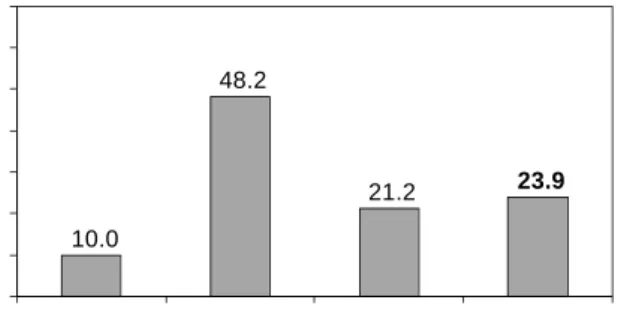
Figure 4 shows that the overhead for replication in our ar-chitecture is significantly smaller than the overhead for log-ging in standard BPEL infrastructures. Without the need to perform costly synchronous logging of intermediate state, our approach achieves 3.4 times (Client/BPEL stage) and 2.0 times (BPEL/Web-service stage) lower response times. The difference between stages is due to the fact that in our implementation the client output proxy is part of the Web-service library whereas the BPEL-replica output proxy is alized as Web service running on the same machine, thus re-quires an additional Web-service call (see Figure 2, step 6).
Disabling the logging mechanism for a standard unrepli-cated BPEL engine (i. e., deactivating fault tolerance en-tirely) exposes the high costs of this technique. Without logging state to persistent storage, response times drop to about 10 milliseconds for both stages. However, improving performance this way is not acceptable for critical services, as it prevents a service from being recovered after a crash.
3http://www.jgroups.org/
4
9.7 62.5 16.0 18.2 0 10 20 30 40 50 60 70 No fault tolerance Logging (standard) Active Repl. JGroups Active Repl. ZooKeeper R e sp o n se t im e [ m s] Active Repl. ZooKeeper 10.0 48.2 21.2 23.9 0 10 20 30 40 50 60 70 No fault tolerance Logging (standard) Active Repl. JGroups Active Repl. ZooKeeper R e sp o n se t im e [ m s] Active Repl. ZooKeeper
(a) BPEL echo process called by a client (b) Echo Web service called by BPEL process
(Client/BPEL stage) (BPEL/Web-service stage)
Figure 4: Architecture comparison: unreplicated with and without logging-based fault tolerance vs. trans-parent active replication via ZooKeeper and JGroups (response times are in milliseconds).
Cost of Externalized Coordination.
Instead ofexternal-izing replica coordination to ZooKeeper, we could have used a group communication framework integrated with the input proxies to perform request ordering. To evaluate the effect of our design decision on performance, we implemented a variant of our prototype that is based on the JGroups group communication. In this variant, an output proxy sends a request to only one of the input proxies, not all of them (cf. steps 2 and 7). The reliable delivery and ordering of
re-quests is subsequently carried out by JGroups. Additional steps (see 3 and 8), as needed in the ZooKeeper variant,
can be omitted.
A comparison of the results for both variants (see Fig-ure 4) shows that the overhead of using external coordina-tion is moderate (about 13%). Despite the increased num-ber of messages exchanged, the additional latency costs are mostly hidden due to concurrent execution. Even if the un-derlying network exhibited higher latencies, the overhead should be negligible. The low overhead makes using coordi-nation as an external service attractive, as it simplifies the design and is often already available in cloud infrastructures and data centers, thereby saving on deployment and mainte-nance costs. Furthermore, management of clouds could take advantage of such an architecture (see Section 7).
Summary.
Besides achieving a higher performance than astandard unreplicated BPEL implementation, our fault-tole-rant BPEL infrastructure has additional advantages. First, it does not depend on reliable storage. Second, it also pro-vides improved fault tolerance as the services offered by a replicated business process remain available even in the pres-ence of a limited number of crashes.
6.
RELATED WORK
Fault tolerance of Web services has been subject of re-search almost since their first specification. For instance, Di-alani et al. [3] designed a framework that implements recov-ery mechanisms for Web services primarily based on check-pointing and logging at the level of SOAP. Liang et al. [9] added similar mechanisms to the SOAP layer, but used it for passive replication of Web services. Furthermore, they realized different components of their system as Web ser-vices themselves, instead of integrating them into existing software stacks as it was done by Dialani et al.
A different approach of how fault-tolerance mechanisms for Web services could be implemented was pursued by Dob-son [4]. He analyzed in which way known fault-tolerance patterns can be mapped to and realized with BPEL. How-ever, improving the dependability of BPEL engines was none of his objectives. Lau et al. [8] used BPEL for the active and passive replication of Web services. In order to tolerate BPEL engines failures, they proposed a passive replication scheme. In their concept, a monitoring process at the client is responsible for coordination between engine replicas. This makes the deployment more complex and requires a BPEL engine running at the client, unnecessarily raising the re-source demand. Moreover, only stateless Web services are supported and transparent transformation of BPEL process definitions was not addressed by Lau et al., since the system is meant for the fault tolerance of single Web services, not for the fault tolerance of entire Web-service–based workflows.
Fault tolerance of workflows was investigated by Juhnke et al. [7] who implemented a module that is able to trans-parently handle some faults caused by network or server outages. Here, all Web-service invocations initiated through a BPEL process are intercepted by an extension installed to the BPEL engine. If a failure occurs during an invocation, it is handled by this extension according to policies that take the specific characteristics of a cloud environment into account; the policies are stored in a central registry, which creates a single point of failure. Additionally, the registry is a specialized component, which entails higher development and maintenance efforts compared to the usage of an existing coordination service, while being less flexible. Furthermore, intercepting Web-service calls through extensions binds the solution to a specific BPEL engine. Improving the depend-ability of BPEL engines was not considered by Juhnke et al. Di Penta et al. [2] used a different technique for the in-terception of Web-service invocations. In their architecture, process definitions are transformed to reroute calls to prox-ies. This is similar to our approach and enables solutions in-dependent of particular BPEL engines. However, their main interest was to establish dynamic binding between workflows and Web services according to functional and non-functional requirements, which can be achieved by solely modifying ad-dress information within process definitions. Our architec-ture, instead, supports comparable mechanisms and addi-tionally permits replication of Web services as well as BPEL
engines, requiring the transformation of whole workflows. Moreover, Di Penta et al. create a specialized proxy for each Web service whereas we use generic proxies leading to a sim-pler deployment and less resource demand.
The concept of generic proxies was applied by Ezenwoye and Sadjadi [5]. Except from that, their solution seems to resemble the solution proposed by Di Penta et al., which par-ticularly means that they did not regard dependability of BPEL engines. They used the proxies to ensure quality-of-service properties and to dynamically adapt BPEL processes to changed environmental conditions.
To our knowledge, the solution presented in this paper is the first implementation of an actively replicated platform for executing Web-service–based workflows with all their components. Realizing active replication transparent to the replicated processes by automatically transforming them is also a novel approach. Furthermore, our solution shows, that the integration of existing coordination services offered by today’s cloud infrastructures leads to simplified implemen-tations and new opportunities regarding global coordination and configuration within clouds.
7.
FUTURE WORK
The current results for our reliable BPEL infrastructure
are encouraging. We therefore intend to extend the
pre-sented architecture in several ways:
Using an external coordination service does not only sim-plify the implementation while causing only moderate over-head, it also creates the possibility of managing entire cloud infrastructures over such a service. Allocation of platforms and resources for virtual machines, failure detection, dy-namic reconfiguration, job distribution and control are some exemplary tasks that could be conducted by a cloud-wide co-ordination service which also acts as a decentralized, partly self-managed registry for global information of all kinds. Al-though we already utilize this potential, a fair amount of it is still unused, so we plan to exploit it further.
Moreover, distributing all kinds of services over multiple, sometimes up to thousands of hosts increases the risk of arbitrary hardware errors. This is particularly true in the context of cloud computing, where, in general, off-the-shelf hardware is used. Additionally, tolerating only crash fail-ures does not protect against malicious attacks. For these reasons, we will adapt the presented infrastructure in order to tolerate arbitrary, also called Byzantine faults.
An other approach to make the architecture even more dependable is the usage of multiple clouds. Distributing the replicas over different clouds avoids being dependent from a single cloud provider. Thus, we plan to evaluate the behav-ior of our solution in such an environment.
8.
CONCLUSION
BPEL infrastructures provide the execution of business processes that are composed of and offered as Web ser-vices. Thus, they would be a perfect supply for the growing demand of Web-service orchestration in cloud computing. However, current BPEL implementations do not support the level of fault tolerance required in this context.
We therefore presented a solution for the provision of plat-form services within clouds that allows the fault-tolerant execution of critical Web-service–based workflows. In our holistic approach, fault tolerance is achieved by actively replicating not only such workflows, but also the Web
ser-vices on which they are based and dependent. Using active replication provides very high availability rates, indepen-dence of, for instance, reliable storage as mostly required by passive variants, and gives the opportunity to tolerate arbitrary faults in a next step. The use of generic proxies in combination with an automatic transformation of process definitions leads to a simple and practical solution. Exist-ing workflows described in BPEL can be replicated with-out manual intervention, new workflows can be written as they were intended for an unreplicated operation and cur-rent BPEL infrastructures can be reused. The implementa-tion is further simplified by utilizing coordinaimplementa-tion services offered by today’s cloud infrastructures. Externalizing coor-dination and configuration tasks by means of such services also permits a solution that is dynamically configurable and adaptable according to cloud-wide constraints.
As our evaluation results show, this approach of external-izing coordination incurs only moderate overhead compared to a traditional fault-tolerant architecture, in which a group communication is directly integrated into the middleware, and it outperforms an unreplicated BPEL execution sup-porting only simple recovery mechanisms.
9.
REFERENCES
[1] M. Burrows. The Chubby lock service for
loosely-coupled distributed systems. In Proc. of the 7th
USENIX Symp. on Operating Systems Design and Im-plementation, pages 335–350, 2006.
[2] M. Di Penta, R. Esposito, M. L. Villani, R. Codato, M. Colombo, and E. Di Nitto. WS Binder: a framework to enable dynamic binding of composite Web services. InProc. of the 2006 Intl. Workshop on Service Oriented Software Engineering, pages 74–80, 2006.
[3] V. Dialani, S. Miles, L. Moreau, D. D. Roure, and M. Luck. Transparent fault tolerance for Web services based architectures. InProc. of the 8th Intl. Euro-Par Conf. on Parallel Processing, pages 889–898, 2002. [4] G. Dobson. Using WS-BPEL to implement software
fault tolerance for Web services. In Proc. of the 32nd EUROMICRO Conf. on Software Engineering and Ad-vanced Applications, pages 126–133, 2006.
[5] O. Ezenwoye and S. M. Sadjadi. TRAP/BPEL: A framework for dynamic adaptation of composite ser-vices. In Proc. of the 3rd Intl. Conf. on Web Informa-tion Systems and Technologies, 2007.
[6] P. Hunt, M. Konar, F. P. Junqueira, and B. Reed. ZooKeeper: Wait-free coordination for Internet-scale
systems. In Proc. of the 2010 USENIX Annual
Tech-nical Conf., pages 145–158, 2010.
[7] E. Juhnke, T. D¨ornemann, and B. Freisleben. Fault-tolerant BPEL workflow execution via cloud-aware
re-covery policies. In Proc. of the 35th EUROMICRO
Conf. on Software Engineering and Advanced Applica-tions, pages 31–38, 2009.
[8] J. Lau, L. C. Lung, J. d. S. Fraga, and G. S. Veronese. Designing fault tolerant Web services using BPEL. In Proc. of the 7th IEEE/ACIS Intl. Conf. on Computer and Information Science, pages 618–623, 2008. [9] D. Liang, C.-L. Fang, C. Chen, and F. Lin. Fault
toler-ant Web service. InProc. of the 10th Asia-Pacific Soft-ware Engineering Conf., pages 310–319, 2003.
[10] E. B. Nightingale, J. R. Douceur, and V. Orgovan. Cy-cles, cells and platters: An empirical analysis of hard-ware failures on a million consumer PCs. InProc. of the 6th ACM EuroSys Conf., pages 343–356, 2011. [11] K. Sripanidkulchai, S. Sahu, Y. Ruan, A. Shaikh, and
C. Dorai. Are clouds ready for large distributed
ap-plications? ACM SIGOPS Operating Systems Review,