Effect of modified SiO
2
on the properties of PEO-based
polymer electrolytes
Lizhen Fan
a,b, Ce-Wen Nan
a,b,*, Shujin Zhao
c aState Key Lab of New Ceramics and Fine Processing, Tsinghua University, Beijing 100084, China b
Department of Materials Science and Engineering, Tsinghua University, Beijing 100084, China c
Department of Materials Engineering, Jiamusi University, Jiamusi 154007, China
Received 9 May 2003; received in revised form 20 July 2003; accepted 15 August 2003
Abstract
Composite polymer electrolytes based on poly(ethylene oxide) (PEO) were prepared by using LiClO4as doping salts and
silane-modified SiO2as filler. Electrochemical, thermal and mechanical properties of PEO-based polymer electrolytes mixed
with modified SiO2were studied. Differential scanning calorimetry (DSC) results showed that in the presence of the filler,
there is a decrease in the glass transition temperature of the electrolyte, whereas, on the other hand, enhances the crystallinity of the sample. Compared with unmodified SiO2 as inert filler, the addition of silane-modified SiO2 increases the ionic
conductivity of the (PEO)16LiClO4more noticeably, and leads to remarkable enhancement in the mechanical properties of
polymer electrolytes.
D2003 Elsevier B.V. All rights reserved. PACS:82.35.Rs; 73.61.Ph; 72.80.Tm
Keywords:Polymer electrolytes; Ionic conductivity; PEO; SiO2
1. Introduction
Solid-state, high-density, rechargeable batteries are important to the development of several applica-tions, from portable electronics to electric vehicles to backup power sources in aircraft. Polymer electro-lytes have been quite attractive because they can lead
to flexible, compact, laminated solid-state structures free from leaks and available in different geometries
[1]. A solid polymer electrolyte serves as both a separator to prevent electrodes from coming into physical contact, and more importantly, as an ionic conductor. Poly(ethylene oxide) (PEO)-based poly-mer electrolytes have been the most extensively studied polymer ionic conductors because of the beneficial structure in supporting fast ion transport. Unfortunately, a high crystalline phase concentration limits the conductivity of PEO-based electrolytes. Various methods have been applied to reduce the crystallinity of PEO-based electrolytes while main-taining their flexibility and mechanical stability,
0167-2738/$ - see front matterD2003 Elsevier B.V. All rights reserved. doi:10.1016/j.ssi.2003.08.004
* Corresponding author. Department of Materials Science and Engineering, Tsinghua University, Beijing 100084, China. Tel./fax: +86-10-6277-3587.
E-mail address:[email protected] (C.-W. Nan).
www.elsevier.com/locate/ssi Solid State Ionics 164 (2003) 81 – 86
which extends over a wide temperature range [2]. Among them, the addition of inert phases into polymer electrolytes has attracted considerable atten-tion due to its improved mechanical stabilities and enhanced ionic conductivities and electrolyte/elec-trode interface stability [3 – 8]. The increase in con-ductivity has been found to depend upon the concentration and particle size of the inert phases
[9 – 13]. The improvement in the ionic conduction observed has been generally assigned to the decrease of polymeric crystallinity after the addition of the fillers [3]. However, Choi et al. [14] found a
de-crease in Tg and an increase in the crystalline
fraction when adding 22 kinds of fillers into (PEO)16LiClO4. The exact role played by such oxide
fillers in PEO-based composite electrolytes still remains to be quantified.
The principal motivation of this work is to investigate the effect of interaction between the polymer and the oxide fillers by modification of filler surfaces on the properties of composite electro-lytes. We use silane-coupling agent KH550 to mod-ify SiO2particles in order to improve the dispersion
of inert SiO2 particles in the polymer matrix. The
modification by the silane molecules that were attached to the SiO2 surface could make the polar
SiO2 particle surface become a much less
polar-sililated surface [15,16]. Thermal, electrical and mechanical properties of (PEO)16LiClO4 electrolyte
complexed with modified and unmodified SiO2were
compared.
2. Experimental
2.1. Sample preparation
PEO (Alfa Aesar) with an average molecular
weight of 300 000 was used. LiClO4 (Alfa Aesar)
was dried in a vacuum oven at 100jC for 24 h and
then stored in a desiccator, prior to use. Acetonitrile was refluxed at a suitable temperature under nitrogen atmosphere, prior to use. SiO2powder with a specific
surface area of 249 m2/g (BET absorption measure-ment) and particle size of about 10 nm was used as inert filler. The SiO2particles were dried in vacuum
oven at 80 jC for 2 days. KH550 silane-coupling
agent (Nanjing Chemical Engineering Factory, China)
was used to modify the SiO2 particle surface. The
chemical structure of the silane-coupling agent mole-cule is
2.2. Modification method of SiO2particles
A certain amount of KH550 silane-coupling agent was dissolved in absolute alcohol and then SiO2 was added to form a suspension. The mixture
was stirred at room temperature for 24 h and stayed still for 24 h. Then the resultant SiO2 was
centri-fuged and washed with absolute alcohol to remove the residual silane-coupling agent. Finally, the SiO2
particles were dried in vacuum oven at 80 jC for 2
days. After treated, the reactions between active
silane and SiO2 would lead to the hydrolysis of
three Si – O – C2H3 groups in the silane molecule
[15,16], which produces three Si – OH groups. These OH groups then reacted with the OH groups on the
surface of SiO2 to form SiUOUSi bonds and
release H2O as the condensation product [15]. The
silane molecules attached to the SiO2 surface might
further link together to form a cross-linking struc-ture of short polyether units surrounding the silica particles.
2.3. Preparation of polymer electrolytes
The PEO – LiClO4 concentration ratio was fixed
to 16 and the SiO2weight percent (both unmodified
and modified SiO2) is the amount of SiO2added to
the total (PEO)16LiClO4 weight. The composites
were prepared first by dispersion of dried SiO2 in
acetonitrile with the aid of ultrasonic dispersion, followed by the addition of predetermined amounts of PEO and LiClO4. This solution was stirred at
room temperature for approximately 24 h until the mixture appeared to be homogeneous. The mixture was cast on a Teflon plate followed by evaporating solvent in an argon-filled glove box for 24 h. Finally, the samples were dried under vacuum at 80 jC for 48 h to form the films of about 150 Am in thickness.
2.4. Characterization of polymer electrolytes
The complex impedance was measured by using an HP 4192A LF impedance analyzer in the frequency range from 5 Hz to 2 MHz. The composite film was sandwiched between stainless steel blocking electro-des (1 cm in diameter). The impedance response was gauged in air over the range 25 – 80jC.
Differential scanning calorimetry (DSC) measure-ments were carried out under nitrogen atmosphere with DuPont TA 2910-modulated DSC. Samples were loaded in hermetically sealed aluminum pans and measurements were taken at a heating rate of 10jC
per min. TGA measurements were carried out under nitrogen atmosphere with DuPont TGA 2050.
The mechanical strength of the polymer electro-lytes was measured from stress – strain tests using a Shimadzu AGS-10KNG instrument. The samples had been kept in a desiccator until the experiment, which lasted for at most 5 min for each sample.
The electrochemical stability of the polymer elec-trolytes was determined at 80jC by running a linear
sweep voltammetry, using stainless steel as a working electrode and lithium as a reference electrode. Shang-hai CHI 660A electrochemical workstation was used for voltammetry measurement.
3. Results and discussion
3.1. Thermal analysis of polymer electrolyte
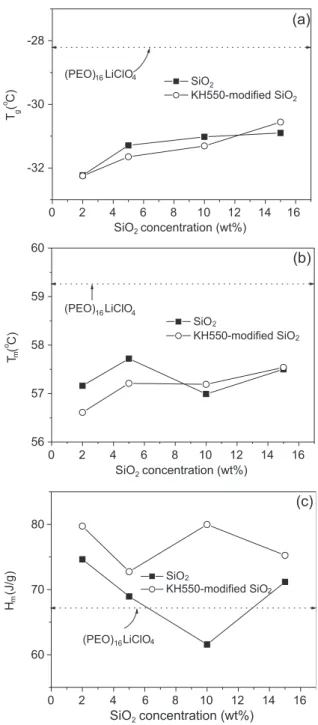
Fig. 1 shows the thermal properties of (PEO)16
LiClO4 with various contents of SiO2 and
KH550-modified SiO2. The glass transition temperature (Tg)
involves the freezing of large-scale molecular motion without a change in structure at which a glassy phase of the sample becomes a rubbery amorphous phase on heating. Fig. 1a shows Tg for (PEO)16LiClO4 with
various weight contents of SiO2and KH550-modified
SiO2. It shows that Tg is lowered when SiO2 and
KH550-modified SiO2 are added. As Tg lowers, the
amorphous phase becomes more flexible and the ionic conductivity should be enhanced at low temperature.
Fig. 1b shows that Tm mostly decreases when SiO2
and KH550-modified SiO2are added. The decrease in Tmupon SiO2addition is attributed to the appearance
of smaller crystallites due to the presence of ceramic
particles[14]. The area under the curve for the melting endotherm (Hm) is related to crystallinity in the
species. Fig. 1c shows that Hm increases when the
Fig. 1. Thermal properties of (PEO)16LiClO4with various contents
of SiO2and KH550-modified SiO2: (a) glass transition temperature Tg, (b) melting temperatureTmand (c) heat of meltingHm.
SiO2 particles are added. It means that the volume
fraction of crystalline phase increases. This is opposite to suggestions that inert fillers enhance the formation of an amorphous phase[3,6,8]. But it is in accordance with the results recently by Choi et al. [14], who reported that the formation of crystalline phase is possible if the filler particle acts as a nucleation center of the crystalline polymer phase. Because ionic con-duction takes place primarily through the amorphous phase of the polymer, high crystallinity would lead to low conductivity.
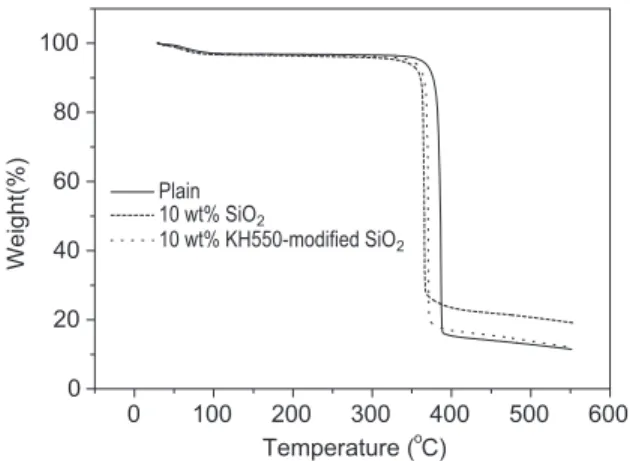
The TGA measurement (Fig. 2) shows that the
amount of the residual solvent is similar in the (PEO)16LiClO4/SiO2, (PEO)16LiClO4
/KH550-modi-fied SiO2and the (PEO)16LiClO4, implying that the
plasiticizing effect resulting from the residual solvent should be similar for the electrolytes of both unmod-ified and KH550-modunmod-ified SiO2filler.
3.2. Ionic conductivity
Fig. 3shows temperature dependence of the ionic conductivity for the (PEO)16LiClO4/SiO2 composite
electrolytes. The increase in ionic conductivity of the composite polymer electrolytes at low temperature is attributed to the two competing effects. The decrease inTgimplies an increase in segmental motion of the
polymer, and thus a conductivity enhancement, whereas increase in Hm implies an increase in
crys-tallinity and thus a conductivity reduction. The con-ductivity values of the composite polymer electrolytes
depend on the relative content of these two competing effects[14]. At high temperature, where the polymer electrolytes are mostly amorphous, the ionic conduc-tivity increases in comparison with pure (PEO)16
Li-ClO4. It indicates that the interface between SiO2and
polymer/salt electrolyte has crucial importance for ionic conduction. It has been suggested that the weakening of the polyether – cation association in-duced by the ceramic particles might be important for ionic conduction[17].
As seen from Fig. 3, the conductivity increases with the increase in SiO2content and then attains a
maximum value when SiO2concentration is at about
10 wt.% for both SiO2 and KH550-modified SiO2.
Subsequently, the conductivity decreases with further increasing SiO2 content. The enhancement in ionic
conductivity due to the addition of ceramic fillers has
Fig. 2. TGA of (PEO)16LiClO4/10 wt.% of SiO2 and
KH550-modified SiO2composite electrolytes.
Fig. 3. Temperature dependence of ionic conductivity for (PEO)16LiClO4/SiO2 composite electrolytes: (a) SiO2 and (b)
been explained by an improved effective-medium theory (EMT)[10 – 13]. From a microscopic perspec-tive, the composite electrolyte can be treated as a quasi two-phase system, which consists of a polymer-ic ion-conducting matrix with dispersed composite units. The ionic conductivity could arise from the existence of a highly conducting layer at the electro-lyte/filler interface[10 – 13]. This interface layer could
be an amorphous polymer layer surrounding SiO2
[12,13] and/or a space-charge layer [18,19]. At low ceramic filler loadings, the conductivity increases with SiO2 content basically due to the increase in
amount of the conductive layers. The conductivity does not continue to rise indefinitely, with increasing concentration of SiO2particles. It falls once an
opti-mum concentration of SiO2is crossed. This behavior
is a direct consequence of the high concentration of
SiO2, which tends to impede ionic movement by
acting as mere insulators[9 – 11].
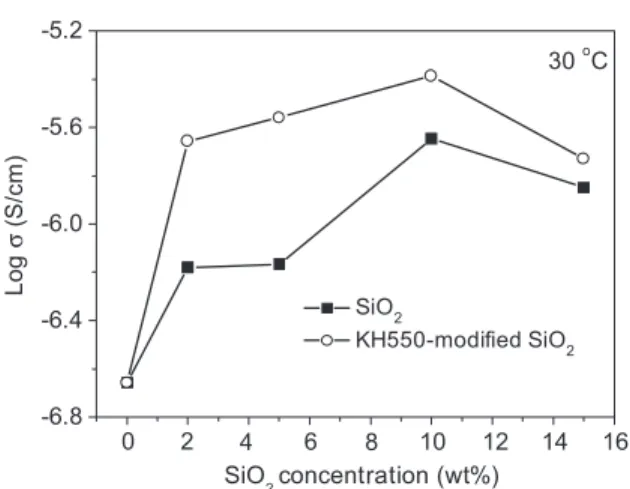
For further illustration, Fig. 4 shows the ionic conductivity of (PEO)16LiClO4with various contents
of SiO2 and KH550-modified SiO2 at 30 jC. The
comparison ofFig. 4shows that the KH550-modified SiO2 can produce larger enhancement than
unmodi-fied SiO2, especially at low loading levels. Thus the
surface modification of SiO2is an effective approach
to prepare composite electrolytes with enhanced per-formance[15]. The modified SiO2particles are more
compatible with the PEO – LiClO4 solution because
the silane molecule carries a short PEO block. As
discussed above, the interaction between active silane and SiO2leads to a monolayer coverage of the short
polyether units on the SiO2surface [15,16], and the
oxygen atoms from the short polyether units on the SiO2surface can compete with oxygen atoms in the
PEO backbone for complexation with Li+ions, result-ing in a more relaxed coordination between oxygen atoms and Li+ ions and thereby facilitating the trans-port of Li+ ions through the polymer [15]. On the other hand, the silane moieties attached on the SiO2
particle surface can effectively improve the dispersion
of the SiO2 particles in the PEO matrix during
blending because of steric repulsive actions. In com-parison with the case of unmodified SiO2powder, a
higher interfacial area between the polymer and fillers can be reached. The increase in the polymer – SiO2
interfaces raises the proportion of effective media for ion conduction in the electrolyte, which leads to enhancement in ionic conductivity.
3.3. Mechanical properties
The mechanical property of a polymer electrolyte during charge/discharge cycles is vital for a safe and endurable battery. The tensile strength of the compos-ite electrolyte as a function of SiO2content is given in
Fig. 5. The addition of inert filler, both SiO2 and
KH550-modified SiO2, apparently increases the
ten-sile strength of polymer films. The reinforcement mechanism is attributed to the adhesion of inorganic
Fig. 4. Ionic conductivity for (PEO)16LiClO4with various contents
of SiO2and KH550-modified SiO2at 30jC.
filler to the macromolecular chain and thus immobil-izes the polymer chains [20]. The enhancement in tensile strength of polymer electrolytes caused by KH550-modified SiO2is larger than that by
unmod-ified SiO2, which could be attributed to the structure
of silane[15,16].
3.4. Electrochemistry stability window
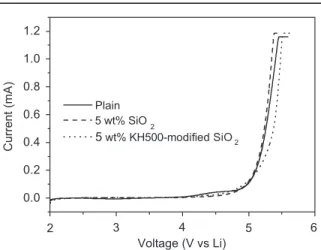
Fig. 6 shows the current – voltage response obtained from polymer electrolytes based on PEO – LiClO4– SiO2. Both cases exhibit good
electrochem-ical stability up to 5.0 V. For composite complexes with KH550-modified SiO2, the electrochemical
sta-bility window is a little higher than that with unmod-ified SiO2. The high window might be related to the
high dispersion of SiO2 particles when they are
modified with KH550 silane-coupling agent.
The measurement of variation in the ionic conduc-tivity of these composite electrolytes with time (not presented here) showed that there was no significant change in their conductivity with time, as observed previously by Croce et al. [3] for PEO – LiClO4/10
wt.% TiO2polymer electrolyte.
4. Conclusions
(PEO)16LiClO4-based composite polymer
electro-lytes containing silane-modified SiO2have been
fab-ricated. DSC results indicate that the volume fraction of crystalline phase in composite polymer electrolytes increases but the amorphous phase becomes more flexible. Compared with unmodified SiO2, modified
SiO2 in PEO-based polymer electrolytes effectively
leads to higher enhancement in ionic conductivity and mechanical stability. The enhancement can be attrib-uted to the good dispersion of silane-modified SiO2in
polymer electrolyte.
Acknowledgements
This work was supported by the MOE of China under grant 20020003079 and Heilongjiang Province Natural Science Foundation (grant No. E0213).
References
[1] M.M.E. Jacob, E. Hackett, E.P. Giannelis, J. Mater. Chem. 13 (2003) 1.
[2] E. Quartarone, P. Mustarelli, A. Magistris, Solid State Ionics 110 (1998) 1.
[3] F. Croce, G.B. Appetecchi, L. Persi, B. Scrosati, Nature 394 (1998) 456.
[4] L.Z. Fan, C.-W. Nan, Z.M. Dang, Electrochim. Acta 47 (2002) 3541.
[5] L.Z. Fan, C.-W. Nan, M. Li, Chem. Phys. Lett. 369 (2003) 698. [6] B. Scrosati, F. Croce, L. Persi, J. Electrochem. Soc. 5 (2000)
1718.
[7] G.B. Appetecchi, F. Croce, L. Persi, F. Ronci, B. Scrosati, Electrochim. Acta 45 (2000) 1481.
[8] W. Wieczorek, J.R. Stevens, Z. Florjanczyk, Solid State Ionics 85 (1996) 76.
[9] C.-W. Nan, Acta Phys. Sin. 36 (1987) 191.
[10] C.-W. Nan, D.M. Smith, Mater. Sci. Eng., B 10 (1991) 99. [11] C.-W. Nan, Prog. Mater. Sci. 37 (1993) 1.
[12] W. Wieczorek, D. Raducha, A. Zalewska, J. Phys. Chem., B 102 (1998) 8725.
[13] W. Wieczorek, A. Zalewska, D. Raducha, Z. Florjanczyk, J.R. Stevens, Macromolecules 29 (1996) 143.
[14] B.K. Choi, Y.W. Kim, K.H. Shin, J. Power Sources 68 (1997) 357.
[15] Y. Liu, J.Y. Lee, L. Hong, J. Power Sources 109 (2002) 507. [16] Silanes, Silicones and Metal – Organics, Gelest Catalog, 2000,
p. 75.
[17] S.H. Chung, Y. Wang, L. Persi, F. Croce, S.G. Greenbaum, J. Power Sources 97 – 98 (2001) 644.
[18] J. Maier, Prog. Solid State Chem. 23 (1995) 171.
[19] N. Sata, K. Eberman, K. Eberl, J. Maier, Nature 408 (2000) 946.
[20] R.B. Seymour, Reinforced Plastics, Properties and Applica-tion, ASM International, Philadelphia, USA, 1991, p. 52. Fig. 6. Current – voltage response of (PEO)16LiClO4/SiO2
electro-lytes at 80jC on stainless steel electrode as a working electrode