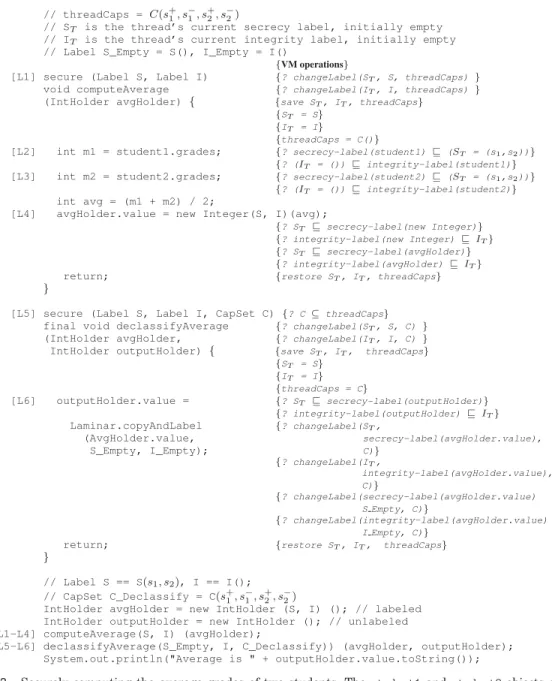
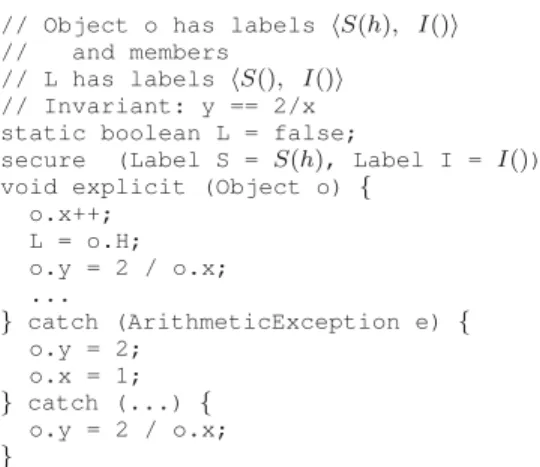
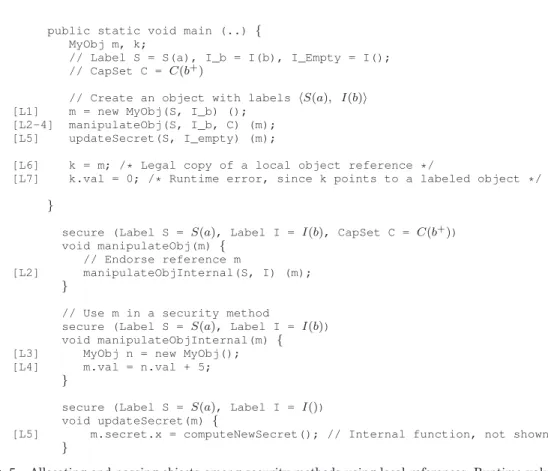
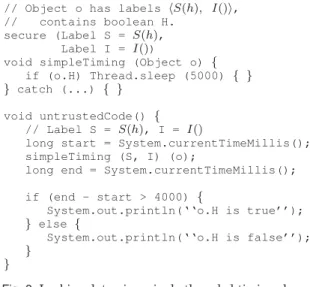
4
Practical Fine-Grained Information Flow Control Using Laminar
1DONALD E. PORTER, Stony Brook University 2
MICHAEL D. BOND, Ohio State University 3
INDRAJIT ROY, Hewlett Packard Labs 4
KATHRYN S. MCKINLEY, Microsoft Research 5
EMMETT WITCHEL, The University of Texas at Austin 6
Decentralized Information Flow Control (DIFC) is a promising model for writing programs with powerful, 7
end-to-end security guarantees. Current DIFC systems that run on commodity hardware can be broadly 8
categorized into two types: language-level and operating system-level DIFC. Language solutions provide 9
no guarantees against security violations on system resources such as files and sockets. Operating system 10
solutions mediate accesses to system resources but are either inefficient or imprecise at monitoring the 11
flow of information through fine-grained program data structures. This article describes Laminar, the first 12
system to implement DIFC using a unified set of abstractions for OS resources and heap-allocated objects. 13
Programmers express security policies by labeling data with secrecy and integrity labels and access the 14
labeled data insecurity methods. Laminar enforces the security policies specified by the labels at runtime. 15
Laminar is implemented using a modified Java virtual machine and a new Linux security module. This article 16
shows that security methods ease incremental deployment and limit dynamic security checks by retrofitting 17
DIFC policies on four application case studies. Replacing the applications’ ad hoc security policies changes 18
less than 10% of the code and incurs performance overheads from 5% to 56%. Compared to prior DIFC 19
systems, Laminar supports a more general class of multithreaded DIFC programs efficiently and integrates 20
language and OS abstractions. 21
Categories and Subject Descriptors: D.2.4 [Software Engineering]: Software/Program Verification; D.3.3 22
[Programming Languages]: Language Constructs and Features; D.4.6 [Operating Systems]: Security 23
and Protection—Information flow controls 24
General Terms: Languages, Performance, Security 25
Additional Key Words and Phrases: Information flow control, Java virtual machine, operating systems, 26
security method 27
ACM Reference Format: 28
Donald E. Porter, Michael D. Bond, Indrajit Roy, Kathryn S. McKinley, and Emmett Witchel. 2014. Practical 29
fine-grained information flow control using Laminar. ACM Trans. Program. Lang. Syst. 37, 1, Article 4 30
(October 2014), 50 pages. 31
DOI: http://dx.doi.org/10.1145/2638548 32
This research was supported in part by NSF grants CAREER-0644205, 0905602, CAREER CNS-1149229, CNS-1161541, CNS-1228839, CNS-1228843, CAREER-1253703, CSR-1218695, SHF-0910818, NIH LM011028-01, and the Office of the Vice President for Research at Stony Brook University.
Authors’ addresses: D. E. Porter, Computer Science Department, Stony Brook University; M. D. Bond, Q1
Department of Computer Science and Engineering, Ohio State University; I. Roy, Hewlett Packard Labs; K. S. McKinley, Microsoft Research, Redmond; E. Witchel, Department of Computer Science, The University of Texas at Austin.
Permission to make digital or hard copies of part or all of this work for personal or classroom use is granted without fee provided that copies are not made or distributed for profit or commercial advantage and that copies show this notice on the first page or initial screen of a display along with the full citation. Copyrights for components of this work owned by others than ACM must be honored. Abstracting with credit is permitted. To copy otherwise, to republish, to post on servers, to redistribute to lists, or to use any component of this work in other works requires prior specific permission and/or a fee. Permissions may be requested from Publications Dept., ACM, Inc., 2 Penn Plaza, Suite 701, New York, NY 10121-0701 USA, fax+1 (212) 869-0481, or [email protected].
c
2014 ACM 0164-0925/2014/10-ART4 $15.00 DOI: http://dx.doi.org/10.1145/2638548
1. INTRODUCTION 33
As computer systems support more aspects of modern life, from finance to health
34
care to energy, the security of these systems becomes increasingly important. Current
35
security policies and enforcement mechanisms are typically sprinkled throughout an
36
application, making security policies difficult to express, change, and audit. Operating
37
system security abstractions, such as file permissions and user IDs, are too coarse
38
to express many desirable policies, such as protecting a user’s financial data from a
39
program downloaded from the Internet.
40
Furthermore, poor integration of Programming Language (PL) constructs and
Oper-41
ating System (OS) security mechanisms complicates the expression and enforcement
42
of security policies. For example, a policy against sending a user’s credit card number
43
on the network should be enforced whether the number originates from a file or an
44
application data structure. In current systems, the OS governs the security of files,
45
and application-specific logic governs the security of data structures; because these
46
mechanisms are completely distinct, developers must understand both mechanisms
47
and ensure that they interoperate correctly. This article describes Laminar, which
48
integrates PL and OS security mechanisms under a common set of programmer
ab-49
stractions and uniformly enforces programmer-specified security policies at all levels
50
of the software stack.
51
Laminar builds on the Decentralized Label Model (DLM) [Myers and Liskov 1997],
52
which expresses more powerful, sophisticated, and intuitive security policies than
tra-53
ditional security models. The enforcement of DLM restrictions is called Decentralized
54
Information Flow Control (DIFC). DIFC is more expressive than traditional access
55
control. For instance, traditional access control models are all-or-nothing; once an
ap-56
plication has the right to read a file, it can do anything with that file’s data. In contrast,
57
a DIFC policy may give an application the right to read a file and simultaneously
for-58
bid it to broadcast the contents of the file over an unsecured network channel. A DIFC
59
implementation dynamically or statically enforces user-specified security policies by
60
tracking information flow throughout the system.
61
In the decentralized label model, users createtags, which represent secrecy or
in-62
tegrity concerns. A set of tags is called alabel, and all data and application threads
63
have an associated secrecy label and an integrity label. The system restricts the flow
64
of information according to these labels. Secrecy guarantees prevent sensitive
infor-65
mation from escaping the system (no illegal reads),1and integrity guarantees prevent
66
external information from corrupting the system (no illegal writes).
67
As an example, suppose Alice and Bob want to schedule a meeting without disclosing
68
other appointments on their calendars. In the DLM model, Alice and Bob each place
69
a tag in thesecrecy labelon their calendar files. Alice and Bob can give the calendar
70
application permission to read these files but only if the application taints its own
71
secrecy label with the secrecy tags of each file. A tainted application thread may no
72
longer write to less-secret outputs, such as the terminal or the network. In our example,
73
the tainted thread may read each calendar file and select an agreeable meeting time,
74
but the thread can only write output to a file or data structure labeled with both Alice’s
75
and Bob’s secrecy tags. In order for the calendar application to output a nonsecret
76
meeting time, Alice and Bob must provide adeclassifierwith the capability of removing
77
their tags from a datum’s secrecy label. The declassifier is a piece of code responsible
78
for checking that its output conforms to a secrecy policy associated with a tag; the
79
declassifier may write acceptable data to a less-secret output. In the calendar example,
80
Alice and Bob might both provide declassifiers; each declassifier can generate output
81
1The literature uses bothconfidentialityandsecrecyfor this guarantee. We useSfor secrecy,Ifor integrity,
without that user’s tag in the secrecy label. For instance, Bob’s declassifier might read 82
the labeled meeting time and check that the output is simply a date and does not include 83
mention of his upcoming vacation to Las Vegas. Note that DIFC exists in addition to 84
traditional access control; for example, a web server would not be allowed to open either 85
calendar file due to standard OS-level permission checks. 86
Similarly, Alice may use anintegrity label on her calendar file to ensure that any 87
updates to the file respect certain invariants. Suppose Alice’s calendar is stored as a 88
chronologically sorted list of appointments. Untrusted code that adds appointments to 89
Alice’s calendar might serialize her appointments into the on-disk format and store the 90
pending data in a memory buffer. Alice could then run this buffer through anendorser, 91
which ensures that the pending data write meets the specifications of her calendar for- 92
mat, such as checking that all appointments are sorted chronologically. Just as secrecy 93
labels can be removed from the output of a computation by a declassifier, an endorser is 94
trusted with the capability to add a tag to the integrity label of inputs that it validates. 95
Once the endorser has validated that its input is trustworthy, the endorser adds Alice’s 96
integrity tag to its integrity label and writes a new version of her calendar file. 97
DIFC provides two key advantages: precise rules for the legal propagation of data 98
through an application and the ability to localize security policy decisions. In the 99
calendar example, the secrecy labels ensure that any program that can read the data 100
cannot leak the data, whether accidentally or intentionally. The label is tied to the data, 101
and the label modulates how data can flow through threads and data containers (e.g., 102
files and data structures). The decision to declassify data is localized to small pieces of 103
code that programmers may closely audit. The result is a system where security policies 104
are easier to express, maintain, and modify than with traditional security models. 105 Combining the Strengths of Language and Operating System Enforcement. Laminar 106
is a new DIFC system design that features a common security abstraction and labeling 107
scheme for program objects and OS resources such as files and sockets. The Java 108
Virtual Machine (VM) and OS coordinate to comprehensively enforce rules within an 109
application, among applications, and through OS resources. 110
Prior DIFC systems are implemented at the language level [Chandra and Franz 111
2007; Myers and Liskov 1997; Myers et al. 2001; Nair et al. 2008] in the operating 112
system [Krohn et al. 2007; Vandebogart et al. 2007; Zeldovich et al. 2006], or in the 113
architecture [Tiwari et al. 2009a; Vachharajani et al. 2004; Zeldovich et al. 2008]. 114
Each approach has strengths and limitations. Language-based DIFC systems can track 115
information flow through data structures within a program but have little visibility into 116
OS-managed resources, such as files and pipes. In contrast, OS-based DIFC systems 117
track labels at the coarse granularity of pages or a process’s virtual address space 118
rather than on individual data structures. Information flow rules are enforced on OS- 119
level abstractions, such as sockets and files. For many simple applications, these coarse- 120
grained rules simplify DIFC adoption. However, OS protection mechanisms are not a 121
good fit for managing information flow on data structures within an application because 122
the OS’s primary tool is page-level protections. Although an application developer could 123
group objects with similar labels on similarly labeled pages, this undermines developer 124
productivity and application efficiency. Thus, we believe that coordinating language and 125
OS mechanisms will maximize security and programmability. 126
We limit the scope of this article to DIFC implementations on commodity hardware. 127
Architecture-based solutions track data labels on various low-level hardware features, 128
such as CPU registers, memory, cache lines, or even gates, but require similar coordi- 129
nation with trusted software to manage the labels. 130
Language-based DIFC systems can be further categorized by how they enforce DIFC 131
[Shroff et al. 2007], or a hybrid [Chandra and Franz 2007; Nair et al. 2008]. Static
133
systems generally introduce a type system that is expressive and powerful but difficult
134
to program or retrofit onto existing code. Because static systems do most security
anal-135
ysis at compile time, they introduce little runtime overhead; static systems may insert
136
dynamic checks for properties that cannot be established at compile time. Dynamic
sys-137
tems generally enforce information flow rules by mediating every operation at runtime
138
but with relatively high performance overheads. Purely dynamic systems also struggle
139
to regulate implicit flows (discussed further in Section 6.4) and can ultimately reject
140
safe programs or leak sensitive data [Russo and Sabelfeld 2010].
141
Most language-level systems are actually a hybrid of static and dynamic analysis.
142
Each design strikes a balance among changes to the programming language to
facili-143
tate static analysis, runtime overheads, and security guarantees. The Laminar design
144
restricts the programming model slightly, ensuring that all security properties can be
145
checked dynamically. Laminar does employ intraprocedural static analysis at
Just-in-146
Time (JIT) compilation time to optimize security checks.
147
Limiting the Scope of Analysis. A second key contribution of Laminar is the design of
148
a language-level feature, called asecurity method, which strikes a unique balance
be-149
tween programmability and efficiency. Developers place all security-sensitive program
150
logic in security methods. The Laminar VM requires that all operations on labeled data
151
or system resources occur within security methods, according to developer-specified
152
policies. In addition, all methods dynamically invoked by a security method, directly or
153
transitively, are security methods. Code that attempts to manipulate security-sensitive
154
data outside of a security method will fail.
155
Laminar enforces stringent requirements on transitions to and from security
meth-156
ods, restricting both control and data flow. These restrictions are enforced dynamically
157
by VM instrumentation. Security methods reduce the overhead of dynamic security
158
checks because only code within security methods requires complex DIFC checks.
159
Security methods also minimize the code changes required to adopt DIFC. In our
160
case studies, changes to adopt security methods account for 10% or fewer of the total
161
lines of code, which suggests that pervasive program modifications are unnecessary to
162
use DIFC with Laminar.
163
Contributions. The contributions of this article are as follows:
164
(1) We present the design and implementation of Laminar, the first system to unify
165
PL and OS mechanisms for enforcing DIFC. Laminar features a novel division of
166
responsibilities between the VM and OS.
167
(2) We introduce security methods, an intuitive security primitive that reduces the Q2
168
work required to convert an application to use DIFC, makes code auditing easier,
169
and makes the DIFC implementation simpler and more efficient.
170
(3) We present the design and implementation of Laminar in the Linux OS and Jikes
171
RVM, a Java research VM.
172
(4) We evaluate four case studies that retrofit security policies onto existing code.
173
These case studies require modification of less than 10% of the total code base and
174
incur overheads from Laminar ranging from 5% to 56%.
175
(5) Based on our experiences, we substantially modified the conference publication
176
that introduced this research [Roy et al. 2009]. We replace security regions with
177
security methods to simplify our implementation. We use only dynamic
analy-178
sis to simplify the enforcement security policies. We identify and fix a covert
179
channel bug arising from the interaction of termination and concurrency.
Fur-180
thermore, we improve the programming model for initializing and using security
181
labels.
(6) We describe strengths and limitations of the Laminar model, its open challenges, 183
and potential solutions. In particular, Laminar is one of the few DIFC systems to 184
attempt multithreading support, which is prone to high-bandwidth timing chan- 185
nels. Laminar cannot prevent all of these timing channels, but we outline how 186
subsequent work by others [Askarov et al. 2010; Askarov and Myers 2012; Zhang 187
et al. 2011] could strengthen the Laminar threading model. 188
Initial results suggest that integrating PL and OS DIFC enforcement is practical and 189
incurs low overheads. Our experience with Laminar shows that it prevents some ter- 190
mination information channels, but it cannot yet make guarantees on some timing 191
channels. We believe restrictions on the programming model within security methods 192
can solve some of these problems, but this research leaves open the definition of such 193
a formalism and accompanying proofs. Laminar provides a first step for application 194
developers to write expressive abstractions with fine-grained, powerful, and useful 195
security policies that span program data structures and system resources. 196
2. DIFC MODEL 197
This section describes how the DIFC model specifies and enforces safe information 198
flows and how Laminar embodies the DIFC model. All DIFC systems denote the sen- 199
sitivity of information and the privileges of the participating users, as well as describe 200
application-specific policies that map between users and sensitive information. The 201
security policy is defined in terms ofprincipalsthat read and write data in the system. 202
Examples of principals in DIFC systems are users [Myers et al. 2001], processes [Krohn 203
et al. 2007], and kernel threads [Zeldovich et al. 2006]. Principals in Laminar are ker- 204
nel threads, which ultimately work on behalf of human users or other application-level 205
actors. 206
2.1. DIFC Abstractions 207
Standard DIFC security abstractions include tags, labels, and capabilities. Tags are 208
short, arbitrary tokens drawn from a large universe of possible values (T) [Krohn et al. 209
2007]. Programmers use tags to denote a unique secrecy or integrity property, but 210
a tag has no inherent meaning. Programmers may create tags dynamically and may 211
persist tags beyond execution of an application. A set of tags is called a label. In a DIFC 212
system, any principal can create a new tag for secrecy or integrity. For example, a web 213
application might create one secrecy tag for its user database and a separate secrecy tag 214
for each user’s data. The secrecy tag on the user database will prevent authentication 215
information from leaking to the network. The tags on user data will prevent a malicious 216
user from writing another user’s secret data to an untrusted network connection. 217
Principals assign labels to data objects. Data objects include program data structures 218
(e.g., individual objects, arrays, lists, and hash tables) and system resources (e.g., files 219
and sockets). Previous OS-based systems limit principals to the granularity of a process 220
or support threads by enforcing DIFC rules at the granularity of a page. Laminar is 221
the first to support threads as principals and enforce DIFC at object granularity. 222
Each data object and principalx has two labels, Sx for secrecy and Ix for integrity. 223 A tagtin the secrecy labelSxof a data object denotes that it may contain information 224 private to principals with tagt. Similarly, a taguinIx indicates that the owner of in- 225 tegrity taguendorsesthe data. Data integrity is a guarantee that data exist in the same 226
state as when they were endorsed by a principal. For example, if Microsoft endorses a 227
data file, then a user can choose to trust the file’s contents if she trusts Microsoft. With 228
integrity enforcement, only Microsoft may modify the integrity-labeled file. However, 229
Microsoft may choose to remove the integrity label, or some other application may write 230
no longer trust the contents as coming from Microsoft. In general, a principal’s labels
232
restrict the interaction that the principal has with other principals and data objects.
233
A partial ordering of labels imposed by the subset relation forms a lattice [Denning
234
1976]. Secrecy and integrity may be treated separately, as asymmetric duals. The
235
bottom of the secrecy lattice is the least restricted label (public): Any principal can
236
read it. The bottom of the integrity lattice is the most secure (trusted): All principals
237
can trust it. Adding secrecy tags to a label restricts the use of the data, moving higher in
238
the lattice. The most restricted data at the top of the secrecy lattice includes all secrecy
239
tags. The bottom of the integrity lattice is the most secure (trusted) and includes all
240
integrity tags. Removing integrity tags moves the label higher in the lattice and the
241
data are less trusted. The top of the integrity lattice has no integrity tags—no principal
242
endorses it.
243
Some other DIFC explanations put an empty integrity label at the bottom of the
244
lattice so that adding tags moves up the lattice, as opposed to the preceding description
245
that places the label with all integrity tags at the bottom, so that moving up the lattice
246
adds restrictions. Both representations are functionally equivalent. For clarity, this
247
article generally discusses the secrecy and integrity labels separately, but occassionally
248
some explanations treat principals and data as having a single label and capability set
249
for ease of exposition.
250
Because Laminar’s threat model includes code that may be contributed to the
appli-251
cation by an adversary, all application data are assigned an empty label (public and
252
untrusted) by default. Data from the JVM itself are public and trusted. The
program-253
mer need not label every data structure, nor does the OS need to label every file in the
254
file system. Code that executes with a nonempty integrity label must sanitize untrusted
255
data before a read. Default empty labels make Laminar easier to deploy incrementally,
256
but introduce some asymmetry in the treatment of secrecy and integrity tags.
257
A principal may change the label of a data object or principal if and only if the
258
principal has the appropriate capabilities, which generalize ownership of tags [Myers
259
and Liskov 1997]. A principal p has a capability set Cp that defines whether the
260
principal has the privilege to add or remove a tag. For each tagt, lett+andt−denote
261
the capabilities to add and remove the tagt.
262
If tag t is used for secrecy, a principal with the capability t+ may classify data
263
with secrecy tagt. Classification raises data to a higher secrecy level. Given the t− 264
capability, a principal may declassifythese data. Declassification lowers the secrecy
265
level. Principals may addt to their secrecy label if they have thet+ capability. If the
266
principal addst, then we call ittaintedwith the tagt. A principal taints itself when it
267
wants to read secret data. To communicate with unlabeled devices and files, a tainted
268
principal must use thet−capability to untaint itself and to declassify the data it wants
269
to write. Note that DIFC capabilities are not pointers with access control information,
270
which is how they are commonly defined in capability-based operating systems [Levy
271
1984; Shapiro et al. 1999].
272
DIFC handles integrity similarly to secrecy. A principal with integrity tagtis
claim-273
ing to represent a certain level of integrity; the system prevents the principal from
274
reading data with a lower integrity label, which could undermine the integrity of the
275
computation. Given thet+ capability, a principal mayendorsedata with integrity tag
276
t, generally after validating that the input data meet some requirements. Given thet− 277
capability, a principal may drop the endorsement and read untrusted data. For
exam-278
ple, code and data signed by a software vendor could run with that vendor’s integrity
279
tag. If the program wants to load an unlabeled, third-party extension, the principal
280
drops the endorsement of the tag.
281
Note that the capability setCpis defined on tags. A tag can be assigned to a secrecy
282
or integrity label. In practice, a tag is rarely used for both purposes.C−p is the set of
tags that principalpmay declassify (drop endorsements), andC+p is the set of tags that 284 pmay classify (endorse). Principals and data objects have both a secrecy and integrity 285
label; a data object with secrecy labelsand integrity labeli is written:S(s),I(i). An 286
empty label set is written:S(),I(). The capability set of a principal that can add both 287 sandibut can drop onlyiis written:C(s+,i+,i−). 288
2.2. Restricting Information Flow 289
Programs implement policies to control access and propagation of data by using labels 290
to limit the interaction among principals and data objects. Information flow is defined 291
in terms of data moving from a sourcex to a destination y, at least one of which is 292
a principal. For example, principal x writing to file y, principal x sending a message 293
to principaly, and principal yreading a filexare all information flows fromxto y. If 294
principalxwrites to a filey, then we say information flows from sourcexto destination 295 y. Laminar enforces the following information flow rules forxto y: 296 Secrecy rule. Bell and LaPadula introduced the simple security property and the 297
*-property for secrecy [Bell and LaPadula 1973]. The simple security property states 298
that no principal may read data at a higher level (no read up), and the *-property 299
states that a principal may not write data to a lower level (no write down). Expressed 300
formally, information flow fromxto ypreserves secrecy if: 301 Sx ⊆Sy
Note thatx orymay make a flow feasible by using their capabilities to explicitly drop 302
or add a label. For example,x may make a flow feasible by removing a tagt from its 303
labelSxif it has the declassification capability fort(i.e.,t−∈Cx−). Similarly,ymay use 304 its capabilities inC+y to extend its secrecy label and receive information. 305 Integrity rule. The integrity rule constrains who can alter information and restricts 306
reads from lower integrity (no read down) and writes to higher integrity (no write up) 307
[Biba 1977]. Laminar enforces the following rule: 308 Iy⊆Ix
Intuitively, the integrity label ofx should be at least as strong as destinationy. Just 309
like the secrecy rule,x may make a flow feasible by endorsing information sent to a 310
higher integrity destination, which is allowed ifxhas the appropriate capability inC+x. 311
Similarly, y may need to reduce its integrity level, using C−y, to receive information 312
from a lower integrity source. 313
Label changes. According to the previous two rules, a principal can enable informa- 314
tion flow by using its current capabilities to drop or add tags from its label. Laminar 315
requires that the principal mustexplicitlychange its current labels. Zeldovich et al. 316
show that automatic, or implicit, label changes can form a covert storage channel 317
[Zeldovich et al. 2006]. 318
In Laminar, a principal pmay change its label from L1toL2if it has the capability 319 to add tags present inL2but not inL1, and can drop the tags that are inL1but not in 320
L2. This is formally stated as: 321
(L2−L1)⊆C+p and (L1−L2)⊆C−p.
2.3. Calendar Example 322
Again, consider scheduling a meeting between Bob and Alice using a calendar server 323
that is not administered by either Alice or Bob. Alice’s calendar file has a secrecy tag, 324 a, and integrity tagi; Bob’s calendar file has a secrecy tag,b. 325
Ensuring secrecy. Focusing on Alice, she givesa+ to the scheduling server to let it
326
read her secret calendar file, which has labelS(a). A thread in the server uses the
327
a+capability to start a security method with secrecy tagathat reads Alice’s calendar
328
file. Once the server’s thread has the labelS(a), it can no longer return to the empty
329
label because it lacks the declassification capability,a−. As a result, the server thread
330
can read Alice’s secret file, but it can never write to an unlabeled device like the disk,
331
network, or display. If the server thread creates a new file, it must have labelS(a),
332
which is unreadable to its other threads. Before the server thread can communicate
333
information derived from Alice’s secret file to another thread, the other thread must
334
add theatag, and it also becomes unable to write to unlabeled channels.
335
Ensuring integrity. Alice also places an integrity label on her calendar file, which
336
is propagated to the heap data structures representing her calendar. In order for any
337
thread to update Alice’s calendar, the thread must add thei integrity tag to its label.
338
In general, the capability to add this tag would be restricted to code that is trusted to
339
check that inputs or updates uphold application invariants. In this example, much of
340
the calendar code may run with an empty integrity label, but once a meeting request
341
is ready to be added to Alice’s calendar, the meeting request is checked by Alice’s
342
endorser. If the checks pass, Alice’s endorser adds theitag to the meeting request data
343
structure. The code that writes the updated calendar to disk must also run with thei 344
tag, preventing data from untrusted heap objects from inadvertently being written to
345
the calendar file.
346
Sharing secrets with trusted partners. Alice and Bob collaborate to schedule a meeting
347
while both retain fine-grained control over what information is exposed. After the
348
scheduler has read Alice’s and Bob’s calendar files, the output data are labeled with the
349
aandbsecrecy tags. Alice’s module has access to hera−capability, so the server calls
350
her code, which validates that the output does not disclose unintended information
351
to Bob. Alice’s module then removes theatag from the output data, publishing the
352
meeting time to Bob. Alice controls which of her data flow out of the scheduler. Bob
353
does the same, and the scheduler can communicate with both of them and coordinate
354
their possible meeting times.
355
Discussion. In this example, Alice specifies a declassifier as a small code module
356
that can be loaded into a larger server application, which can be completely ignorant
357
of DIFC and requires no modifications to work with Alice’s DIFC-aware module. For
358
previous DIFC systems, this example is more cumbersome. OS-based DIFC systems
359
require the declassifier to run as a separate process. Language-based DIFC systems
re-360
quire programmers to annotate the entire application. By integrating OS and language
361
techniques, Laminar simplifies incremental DIFC adoption.
362
2.4. Goals and Threat Model 363
This subsection describes our threat model and its rationale at a high level. We revisit
364
these security properties in Section 6, after describing our system design and
imple-365
mentation. Section 10 surveys related work in more detail, but here we summarize key
366
categories of DIFC systems and challenges in DIFC adoption. DIFC systems can be
367
roughly categorized by how they enforce flows: static analysis, dynamic language-level
368
analysis, or OS-level enforcement.
369
Incremental Adoption. A key design goal of Laminar is facilitating incremental
adop-370
tion of DIFC on a large body of code. The ease with which a programmer can adopt
371
DIFC is an issue for most DIFC designs. DIFC based on static analysis often
re-372
quires substantial annotations of the program with a new type system. OS-based DIFC
requires substantial reorganization of the application code in order to segregate data 374
pages and code by label. It is unclear whether a language-level dynamic analysis is 375
any easier to adopt. Although there has been some work in this area, it has generally 376
enforced only simple policies on outputs [Chandra and Franz 2007] or had problems 377
with “label creep,” which requires error-prone, manual analysis by the programmer 378
[Nair et al. 2008]. 379
The insight underlying Laminar’s security-method-based design is that many appli- 380
cations already handle sensitive data only in relatively small portions of their code. 381
For instance, web server authentication code is generally small relative to all of the 382
code that generates and transmits web content. Thus, Laminar is designed so that the 383
programmer audits only these relatively small portions of preexisting code for correct 384
handling of sensitive data. Sensitive code is placed in security methods, and the system 385
dynamically checks that all information flows according to the restrictions imposed by 386
the developer and end users. 387
Laminar enforces DIFC rules using a combination of dynamic analysis and pro- 388
grammer annotations (i.e., security methods). Compared to other dynamic or hybrid 389
language-level systems, Laminar is generally more efficient than previous systems be- 390
cause of careful implementation choices and limited scope of analysis. As discussed 391
earlier, all DIFC systems require some measure of work to adopt, and our experience 392
is that security methods minimize the effort without sacrificing functionality. 393 Integration of OS and PL Abstractions. Laminar integrates OS and PL DIFC abstrac- 394
tions to implement uniform policies and label management across resources. Existing 395
systems cannot easily integrate these abstractions. For instance, a PL system might 396
enforce all-or-nothing policies about output or might make educated guesses about 397
information flow through OS abstractions, but it cannot ensure that these rules are 398
followed once data leaves the application. 399
Threading. A key aspect of incremental deployability is tracking information flow 400 through a program, including with multiple, concurrent threads. OS systems medi- 401
ate multiprocess concurrency through explicit channels and at page granularity. In 402
practice, these systems cannot track fine-grained information flow through traditional 403
thread packages without major modifications to the application. PL systems have gen- 404
erally avoided multithreading because it increases the risks of covert channels. Lami- 405
nar does permit multithreading, but cannot prevent all timing channels attacks. This 406
article identifies some threats and points to solutions developed after the initial publi- 407
cation of this work [Roy et al. 2009] that could be integrated into security methods to 408
mitigate these channels. 409
Threat Model. In a DIFC system, the primary concern is limiting the ability of 410
one principal to access another principal’s data. So, in our threat model, the attacker 411
may have contributed code to the application and is executing as principal (thread) 412
A. Laminar does not allow principal A to explicitly read or write another principal B’s 413
data (e.g., by explicit assignment in the program) without acquiring appropriate secrecy 414
and integrity labels. Any other user controls access to her data by controlling which 415
principals she gives the capabilities to add and remove tags associated with her data. 416 Limitations. Like most DIFC systems, the Laminar VM and OS mediate all explicit 417
assignments of labeled data, as described in Sections 4 and 5. Laminar prevents im- 418
plicit information flows by restricting the visibility that untrusted code has into the 419
control flow of a security method, including restrictions on input and output variables 420
(discussed further in Section 6.4). 421
Eliminating all timing, termination, and other covert channels are open problems 422
In particular, it is well established that preventing all these channels on a
general-424
purpose programming model is tantamount to solving the halting problem [Denning
425
and Denning 1977]. In order to eliminate information leaks due to unbounded
execu-426
tion, more recent work has investigated highly restricted programming models (e.g.,
427
without unbounded loops [Tiwari et al. 2009b]) or bounding the execution time of code
428
that manipulates sensitive data [Tiwari et al. 2009a].
429
To facilitate incremental adoption, Laminar places capabilities in threads, rather
430
than statically mapping them to functions. The underlying tradeoff is that the
program-431
mer can more easily invoke standard libraries from a security method. For example,
432
programmers may therefore manipulate secure objects using standard
implementa-433
tions of arrays, lists, and sets. Code invoked from a security method executes as if it were
434
in the security method. This choice introduces some risk for a confused deputy
prob-435
lem and requires trusting the caller of a security method to manage capabilities. The
436
Laminar design mitigates the risk of capability management errors by requiring that
437
all endorsers and declassifiers be declared final and that non-endorser/declassifier
438
security methods do not accept capabilities as arguments. These issues are discussed
439
further in Section 6.6.
440
Two key innovations of Laminar are support for multiple threads and the ability of
441
a single thread to transition between different trust levels—facilitating incremental
442
adoption but also introducing new opportunities for covert channels based on the timing
443
of these transitions. Section 6 describes the new classes of timing and termination
444
channels that these features could introduce and how Laminar mitigates them. To
445
summarize, Laminar restricts the ability to create a channel based on control flow
446
within a security method by requiring a single exit point from a security method
447
and carefully mediating any OS- or VM-level storage channel, such as the thread’s
448
capabilities. The article also discusses how more recent work, such as predictive timing
449
models [Askarov et al. 2010], could be applied to the Laminar prototype to further
450
reduce covert channels, especially through thread synchronization. These issues are
451
discussed further in Section 6.
452
3. DESIGN 453
This section describes the Laminar programming model and how Laminar enforces
454
DIFC in an enhanced VM and OS.
455
3.1. Overview 456
Figure 1 illustrates the Laminar architecture. The OS kernel reference monitor
medi-457
ates accesses to system resources. The VM enforces DIFC rules within the application’s
458
address space. Only the OS kernel and VM are in the Laminar trusted computing base.
459
The OS kernel and VM trust each other as well.
460
The Laminar OS kernel extends a standard OS kernel with a Laminar security
mod-461
ule for information flow control. Users and programmers invoke the Laminar kernel
462
security APIs to create tags, store capabilities for their tags, and label their data in
463
files. Users launch processes with a subset of their tags and capabilities. The Laminar
464
OS kernel governs information flows through all standard kernel interfaces, including
465
through devices, files, pipes, and sockets. DIFC rules are enforced by the kernel on
466
all threads, whether the threads are of the same or different processes. Resources and
467
principals without an explicit label have empty secrecy and integrity labels, facilitating
468
incremental adoption. Our prototype uses the Linux Security Modules [Wright et al.
469
2002] framework, although the design could be extended to any OS that provides
simi-470
lar hooks to an in-kernel reference monitor to label kernel objects and mediate system
471
calls that could create an information flow.
Fig. 1. Design of Laminar. An OS kernel reference monitor and VM reference monitor enforce information flow control. All data is labeled, including objects in the VM, as well as OS abstractions, such as files and sockets. Objects without explicit labels default to empty secrecy (public) and integrity (untrusted) labels. Threads have capabilities and an empty label. A thread enters a Security Method (SM) to acquire a nonempty label. A security method may optionally receive capabilities from the calling thread.
To regulate information flows within an application, Laminar extends the runtime 473
system of a standard Java VM. By default, the Laminar OS kernel requires all threads 474
within a process to have the same secrecy and integrity labels. The OS relaxes this 475
restriction for threads running on the trusted Laminar VM. The Laminar VM binary is 476
labeled with a special TCB integrity tag, which indicates to the OS that this application 477
is trusted to control information flows within its address space. Although the kernel 478
trusts the Laminar VM to regulate flows within the address space, the kernel still 479
checks all accesses to system resources. 480
The Laminar VM regulates information flow between heap objects within a thread 481
and between threads of the same process via these objects. The Laminar VM inserts 482
dynamic DIFC checks to regulate DIFC flows. 483
The key abstraction for manipulating labeled data is thesecurity method. Program- 484
mers explicitly declare security methods. In addition, any method invoked directly or 485
transitively from a declared security method is implicitly defined as a security method. 486
Outside of a security method, a thread has empty secrecy and integrity labels and may 487
only read or write data with empty secrecy and integrity labels. The VM terminates the 488
program if it attempts to read or write any labeled data outside a security method. If a 489
thread has the capability to add a tag to its secrecy or integrity labels, the thread may 490
change its labels by entering a security method. Within a security method, a thread 491
may read or write data with nonempty labels as long as the reads and writes constitute 492
a legal information flow according to the capabilities specified by the parameters. A 493
thread typically runs with a subset of the user’s capabilities, and a security method 494
specifies a subset of the thread’s capabilities. Security methods may nest. Each security 495
method may only have a subset of the parent security method’s capabilities and may 496
only change its labels as permitted by the parent’s capabilities. 497
For example, Alice writes a program in Java with the Laminar programming model 498
and uses the Laminar API (see next paragraphs and Table I). Alice compiles the code 499
using a standard, untrusted bytecode generator such asjavac. The Laminar JIT com- 500
Table I. Laminar API
These functions manipulate labels and capabilities.LabelTypedenotes whether a request is for a secrecy label or integrity label.CapTypedenotes plus, minus, or both capabilities for a tag. ThegetCurrentLabeland copyAnd-Labelfunctions may be invoked inside of a security method, but tags and capabilities may only be created and destroyed outside of a security method, usingcreateAndAddCapabilityandremoveCapability, respectively. The API has wrapper functions (not shown) for the new Laminar system calls.Labelstores a set of secrecy or integrity tags (Section 5.1).
Function Description
Label getCurrentLabel(LabelType t) Return the current secrecy or integrity label of the security method as an opaque object. Label objects cannot be enumerated.
Object copyAndLabel(Object o, Label S, Label I)
Return a copy of the objectowith new secrecy labelS
and integrity label I.
CapSet getCurrentCapabilities() Return the current capability set of the thread as an opaque object.
Label createAndAddCapability() Create a new tag and add capabilities to the current thread. Must be used outside of a security method.
void removeCapability(CapType c, Label l) Drop the capabilities listed inc(plus and/or minus) associated with the tags inlfrom the current thread. Must be used outside of a security method.
VM. During execution, the program labels data with security and integrity tags that it
502
obtains from the kernel API. The OS kernel and VM thus use the same tag namespace
503
for the system resources and objects. For example, the application reads data from a
504
labeled file into a data structure with the same labels. The Laminar VM ensures that
505
any accesses or modifications to labeled data follow the DIFC rules and occur in a
506
security method, a labeled method specified by the programmer.
507
Restricting security policies to security methods makes it easier to add security
508
policies to existing programs. Furthermore, auditing security methods will generally be
509
easier than auditing the entire program. These features should facilitate incremental
510
deployment of Laminar in existing systems. Security methods also decrease the cost of
511
performing dynamic security checks in the Laminar runtime.
512
Laminar does not track information flows through local variables. Because labeled
513
data are manipulated in security methods, locals in an untrusted parent are out of
514
scope inside the security method and vice versa. With additional static analysis on
515
information flow through locals, one might be able to safely implement security methods
516
as arbitrary, lexically scoped regions, as originally proposed [Roy et al. 2009]. We
517
expect that the additional static analysis required to support lexically scoped regions
518
would be easiest to implement in the Java compiler (javac), but these properties might
519
also be checked by the JVM during bytecode verification. We found mediating flows
520
through locals at method boundaries to strike a good balance between implementation
521
complexity for the application programmer and JVM developer.
522
3.2. Programming Model, VM, and OS Interaction 523
Laminar provides language extensions, a security library, and security system calls.
524
Table I depicts the Java APIs, which include methods that perform tag creation,
de-525
classification, label queries, and capability queries. The Laminar OS kernel exports
526
security system calls to the trusted VM for capability and label management, as shown
527
in Table II. These system calls are used by the Laminar VM internally to implement
528
security methods and are not directly exposed to Laminar applications. An application
529
not running on the Laminar VM may directly use these system calls to manage its
530
capabilities and labels, excludingdrop_label_tcb, which can only be issued by the
531
trusted Laminar VM. The Laminar OS securely stores all of the persistent capabilities
532
of a user so that these capabilities can be used across user sessions. On login, the OS
533
kernel gives the capabilities of the user to the login shell. Laminar does not innovate in
Table II. Laminar System Calls
Thetag_tandcapability_ttypes represent a single tag or capability, respectively. Thestruct labeltype represents a set of tags that compose a label, and thecapList_ttype is a list of capabilities.
System Call Description
tag_t alloc_tag(capList_t &caps) Return a new tag, add plus and minus capabilities to the calling principal, and write new capabilities intocaps.
int add_task_tag(tag_t t, int type) Add a tag to the current principal’s secrecy or integrity label (secrecy or integrity selected bytype), as allowed by the principal’s capabilities.
int remove_task_tag(tag_t t, int type) Remove a tag from the current principal’s secrecy or integrity label (secrecy or integrity selected bytype).
int drop_label_tcb(pid_t tid) Drop the current temporary labels of the thread without capability checks, invoked only by threads with the special integrity tag.
int drop_capabilities(capList_t *caps, int tmp)
Drop the given capabilities from the current principal.
tmpis a flag used by the VM to suspend a capability only for a security method or during afork().
int write_capability(capability_t cap, int fd)
Send a capability to another thread via a pipe.
int create_file_labeled(char* name, mode_t m, struct label *S, struct label *I)
Create a labeled file with labelsSandI.
int mkdir_labeled(char* name, mode_t m, struct label *S, struct label *I)
Create a labeled directory with labelsSandI.
capability persistence but rather adopts a simple and stylized model. Asbestos develops 535
a more robust model for persistent storage of tags [Vandebogart et al. 2007]. 536
Thesecurekeyword applies to methods used as security methods. The VM and kernel 537
enforce the rule that the program may only access labeled data objects (e.g., files, heap- 538
allocated objects, arrays) inside security methods, which includes all methods directly 539
or transitively invoked from a declared security method. Outside security methods, 540
threads always have empty labels but may hold capabilities that determine whether 541
the thread may enter a security method. Threads are the only principals in Laminar, 542
and the VM modifies the thread’s labels and capabilities when it enters and exits a 543
security method. When a thread enters a security method, it dynamically passes the 544
desired secrecy label and integrity label as arguments to the method, using the opaque 545 Labelobject. If the security method endorses or declassifies data, it may also accept 546
the necessary capabilities as an argument, as aCapSetobject. During the execution 547
of a security method, the VM internally uses these labels and capabilities for DIFC 548
enforcement, and the kernel mediates thread accesses to system resources according 549
to the security method’s labels. Because security methods are not visible to the kernel, 550
the VM proxies the security method by tainting the thread with the correct labels and 551
capabilities. At the end of the security method, the VM restores the thread’s original 552
capabilities and labels. 553
3.3. Security Methods 554
A security method is a special method type that has parameters for a secrecy and 555
integrity label. A security method that can endorse or declassify data also has a pa- 556
rameter for a capability set. The labels dictate which data the program may touch 557
inside the security method. Labels on secure method parameters must satisfy the data 558
flow constraints of the labels on the security method, and the label on the returned 559
data must satisfy the data flow equations for the labels of the calling context. In the 560
Laminar implementation, these labels and capabilities are represented as sets that 561
can be variably sized and assigned at runtime. Label and capability sets are stored as 562
Only code within a security method can access data with nonempty labels. Security
564
methods demarcate the methods that are security sensitive, thus easing the
program-565
mer’s burden when adding security policies to existing programs. The programmer
566
must place all code that references labeled data in a security method, such as a routine
567
that reads a sensitive file into a data structure. In our experience, only a small portion
568
of code and data in a program is security sensitive and will belong in a security method,
569
which simplifies the task of auditing security-sensitive code. This design also limits the
570
amount of work the VM must do to enforce DIFC.
571
Dynamic DIFC Enforcement with Barriers. The VM insertsbarriersthat ensure no
572
reference outside a security method reads or writes labeled data, and all references
573
inside a security method follow the DIFC rules. A barrier is a snippet of code the VM
574
executes before every read and write to an object and is a standard implementation
575
feature in VMs for garbage-collected languages [Blackburn and Hosking 2004]. The
576
Laminar VM inserts barriers at every object read and write. Outside the security
577
method, the barrier throws an exception if the program tries to read or write data with
578
a nonempty secrecy or integrity label. Inside a security method, every time the program
579
reads or writes objects or kernel resources, the barrier checks that the information flow
580
follows the policies specified by thecurrentlabels of the security method.
581
For example, an assignmentw=rinside a security methodMis safe if and only if the
582
information flow from rto w is legal for the thread insideM. Note that the Laminar
583
library API (Table I) does not include a routine for adding labels to a thread. In order
584
to add labels, threads must start a security method.
585
Security methods have the added benefit that they make the DIFC implementation
586
more efficient because the barrier checks outside a security method are simpler than
587
checks inside a security method. Outside a security method, the barrier simply checks
588
if data have nonempty labels and throws an exception if they do, since any access to
589
secure data is forbidden. Inside a security method, the DIFC barriers must compare
590
DIFC labels of references to ascertain if the information flow is legal.
591
In summary, security methods make it easier for programmers to add security policies
592
to existing programs. They make it easier for programmers to audit security code.
593
They limit the effects of implicit information flows (Section 6.4), and they make the
594
implementation more efficient.
595
Inputs, Return Values, and Container Objects. Security methods have two default
596
parameters: a secrecy label and an integrity label. A declassifier or endorser includes
597
a third parameter: the capability set. Security methods may take other parameters
598
as inputs and/or return an output value so long as the input or return is a valid
599
information flow. These input and output values may be primitives (int,boolean, etc.)
600
or object references. Generally speaking, security methods with a nonempty secrecy
601
label cannot return a value, and security methods with a nonempty integrity label
602
cannot read inputs without being wrapped in an endorser. Section 5.2 details the
603
specific rules.
604
A key abstraction in Laminar that improves programmability is the stylized use
605
ofcontainer objects. The programmer allocates objects with secret labels outside of a
606
secret security method by invokingnew and passing the appropriate labels. Labeled
607
object creation is explained further in Section 5.2. The program then passes this object
608
to security methods. Each security method may update the contents of the object, but
609
outside of the security method, the object’s contents and any modifications are opaque.
610
Code outside of a security method may not dereference references to objects with
non-611
empty labels.
612
Example. Figure 2 presents the calendar example from the introduction. A calendar
613
server calls code provided by Bob that reads theCalendar object belonging to Alice,
Fig. 2. Example security methods that read and write a secure calendar. Bob provides the first two security methods.BobFindMeetingTimeexecutes with both Alice and Bob’s secrecy tags (aandb, respectively). This method selects a meeting time such that Alice and Bob are both available and places it in aMeetingTime
object with labelS(a,b),I().BobDeclassifythen removes Bob’s secrecy tag (b). The calendar application then executes Alice’s endorser (AliceCheckMeeting), which checks that theMeetingTimeobject is well-formed, and then adds theiintegrity tag and writes the meeting time to a file with labelS(a),I(i). The label on Alice’s calendar ensures both secrecy of her calendar data, as well as that all updates have been checked by trusted code. Execution order is indicated with LX, where X is the line number if the code were inlined into
creates a Meeting object, exports the meeting time to Bob, and writes the meeting
615
into Alice’s calendar file. The code begins at L1 by allocating a container object,Mtg,
616
which is passed to subsequent security methods to store the secret meeting time.
617
When the thread enters the security methodBobFindMeetingTimeto read the calendars
618
(line L2), the VM sets the thread’s secrecy label to S(a,b) and therefore the thread
619
can read secret Calendar data guarded by tags a and b. The code that reads each
620
calendar (line L3) is a valid information flow because the thread’s labels are more
621
restrictive than either Calendar’s labels (e.g., S(a,b),I() ⊇ S(a),I()). The thread
622
has the capabilityC(b−) to declassify tagb, which is used to enter the security method
623
BobDeclassify, at lineL5. Entering the nested declassifier at lineL5may be conditioned
624
on additional checks to prevent information leaks. Before writing the meeting time into
625
Alice’s calendar file, the thread must acquire integrity labelI(i) by calling an endorser
626
function, AliceCheckMeeting, which checks that the data to be written meet Alice’s
627
invariants, such as prohibiting conflicting meeting times.
628
The VM inserts barriers that check the information flow safety at every object read
629
and write. Locals are limited to method scope and implicitly have the same label as the
630
security method. The code at LineL3computes the common meeting time and stores
631
it in the container object referred to byMtg. For instance, the read barrier code tests
632
if reading fields of objectsOtherandBobare valid information flows and whether the
633
writes into the newly createdMeetingobject are legal. The writes into theMeetingobject
634
are legal because the object has the same secrecy label as the thread in the security
635
method at that point. A nested security method declassifies the meeting to Alice (L5/L6),
636
updating the meeting time inthis.val. By replacing the object referenced bythis.val 637
with a copy with a lower secrecy level (LineL6), this code effectively removes the tagb 638
from the output. Copying and relabelingtmpatL6is legal because the method has the
639
b−capability and can declassify data protected by the secrecy tagb. Notice that if line
640
L6performed copyAndLabel(tmp, S(),I()) to remove all tags from the secrecy label,
641
the VM would throw an exception because when the thread is in the security method,
642
it does not have thea− capability and cannot remove theatag from the data. In this
643
example, the kernel checks the file operations in lineL12andL13that write to Alice’s
644
calendar file, and the VM checks the other operations on application data structures.
645
Security Method Initialization. Laminar enforces the following rules when a thread
646
enters a security method. Let SR, IR, and CR be the secrecy label, integrity label,
647
and capability sets of a security method, R. Similarly, let SP, IP, andCP be the sets
648
associated with a kernel thread P that enters and then leaves R. Laminar supports
649
arbitrarynestingof security methods. P could, therefore, already be inside a security
650
method when it enters R. When the thread P enters the security method R, the VM
651
ensures that the following rules hold:
652 (SR−SP)⊆C+p and (SP−SR)⊆C−p (1) 653 (IR−IP)⊆C+p and (IP−IR)⊆C−p (2) 654 CR⊆CP (3)
The first two rules state that, in order for principalPto enter methodR, Pmust have
655
the required capabilities to change its labels toR’s labels. The third rule states that the
656
principalPcan only retain a subset of its current capabilities when it enters a security
657
method. While the security method executes, the sets associated withPchange toSR,
658
IR, andCR.
659
These rules encapsulate the common-sense understanding that a parent principal,
660
P, has control over the labels and capabilities it passes to a security method and
that the VM will prevent the principal from creating a security method with security 662
properties that the principal itself lacks. The rules also state that security methods 663
nest in the natural way based on the labels and capabilities of the thread entering the 664
nested method. 665
3.4. VM and OS Interface 666
Our design trusts the Laminar VM and OS kernel for DIFC enforcement. The VM 667
is trusted to enforce DIFC policies on application data structures and implements 668
security methods without kernel involvement. The kernel is responsible for enforcing 669
DIFC rules on OS kernel abstractions, such as files and pipes. If a security method 670
does not perform a system call, the VM does all the enforcement and does not involve 671
the kernel. For example, if code inside a security method with secrecy tags tries to 672
write to a public object, the VM will throw an exception that will end the security 673
method. As an optimization, the VM does not notify the kernel of changes to the 674
thread’s labels until the VM needs to issue a system call on behalf of the application. 675
The kernel enforces DIFC rules on each system call according to the thread’s labels 676
and the labels of any other objects involved (e.g., writing data to a file or the network). 677
For standard system calls, such asread, the labels of the thread and file handle are 678
implicit system call arguments. The VM communicates security metadata to the kernel 679
via the Laminar system calls (Table II). For instance, the VM changes the labels on the 680
current application thread (embodied as a kernel thread) executing within a security 681
method using theadd_task_tag system call. The kernel ensures that the labels are 682
legal given the thread’s capabilities. 683
Acquiring Tags and Capabilities. Principals (threads) in Laminar acquire capabil- 684
ities in three ways. They allocate a new tag, they inherit them through fork(), or 685
they perform interprocess communication. A thread working on behalf of one user 686
may call security methods provided by another user; for instance, Alice’s thread may 687
call Bob’s declassifier with the capability to read Alice’s calendar. Another thread 688
running on Bob’s behalf can only acquire Alice’s capability if Alice shares it over 689
an IPC channel. The system carefully mediates capability acquisition lest a princi- 690
pal incorrectly declassify or endorse data. Laminar assumes a one-to-one correspon- 691
dence between application and kernel threads. Application threads use the Lami- 692
nar language API, which in turn invokes the system calls for managing tags and 693
capabilities. 694
A principal allocates a new tag in the kernel via thealloc_tagsystem call, which is 695
used to implement the language API functioncreateAndAddCapability. As a result of 696
the system call, the kernel security module will create and return a new, unique tag. 697
The principal that allocates a tag becomes the owner of the new tag. The owner can 698
give the plus and minus capabilities for the new tag to any other principal with whom 699
it can legally communicate. A thread explicitly selects which capabilities it will pass 700
to a security method, and the trusted VM can temporarily remove the capability from 701
the thread using thedrop_capabilitiessystem call. 702
Threads and security methods form a natural hierarchy of principals. When a kernel 703
thread forks off a new thread, it can initialize the new thread with a subset of its 704
capabilities. Similarly, when a thread enters a security method, the thread retains 705
only the subset of its capabilities specified by the method. In general, when a new 706
principal is created, its capabilities are a subset of its immediate parent, which the VM 707
and kernel enforce. 708
The passing of all interthread and interprocess capabilities is mediated by the kernel, 709
specifically with the write_capabilitykernel call. This system call checks that the 710