eTOM – ITIL Application Note
Using eTOM to model the ITIL Processes
GB 921 L
TMF Approved Version 4.0
March 2004
NOTICE
The TeleManagement Forum (“TM Forum”) has made every effort to ensure that the contents of this document are accurate. However, due to the inherent complexity in the design and implementation of software and systems, no liability is accepted for any errors or omissions or for consequences of any use made of this document. Under no circumstances will the TM Forum be liable for direct or indirect damages or any costs or losses resulting from the use of this specification. The risk of designing and implementing products in accordance with this specification is borne solely by the user of this specification. This document may involve a claim of patent rights by one or more TM Forum members, pursuant to the agreement on Intellectual Property Rights between TM Forum and its members, and by non-members of TM Forum.
This document is a copyrighted document of TM Forum, and if reproduced in any manner shall clearly acknowledge the authorship of TM Forum.
Direct inquiries to the TM Forum office: 89 Headquarters Plaza North - Suite 350 Morristown, NJ 07960 USA
Tel No. +1 973 292 1901 Fax No. +1 973 993 3131
TM Forum Web Page: www.tmforum.org –
ETOM – ITIL APPLICATION NOTE
ACKNOWLEDGMENTS
The eTOM – ITIL Application Note, TMF GB921L Version 4.0 is a genuinely collaborative effort. The TeleManagement Forum would like to thank the following people for contributing their time and expertise to the production of this document.
• • • • • • Frank Birch, Fujitsu Grant Erickson, Telstra Mike Richter, Telstra Nick Webb, QinetiQ
A number of people provided input and/or formal contributions. Although not an exhaustive list, many thanks to the following for their thoughtful input and contributions:
Andrew Smith, QinetiQ Kazumi Kuwabara, NTT Comware
Masayoshi Ejiri, Fujitsu Krzysztof Samp, ITTI
Jane Hall, Fokus Johan Vanderberge, Lucent Technologies
Dave Milham, BT Exact Technologies Alfred Anaya, Telcoremance Enrico Ronco, Telecom Italia Lab Jacques Potier, France Telecom
Yigal Gur, Worldcom Viviane Cohen, Amdocs
Seth Nesbitt, Amdocs Wim Keppens, Ormvision
Jose Ricardo Bueno, Fundacao CPqD Greg Fidler, Practical Enterprise Architecture P/L
Documentation and work from standards bodies and other forums have also contributed to the evolution of the eTOM – ITIL Application Note. This access was via public information or TM Forum member knowledge. This list of standards bodies and forums is not exhaustive and does not imply review and concurrence by these organizations or their representatives. It is important however to acknowledge the work and their influence on the TeleManagement Forum work:
Office of Government Commerce, UK IT Service Management Forum
Particular thanks go to Nick Webb of QinetiQ who handled editing of this document, and integrated comments and suggestions into the final form shown here. This task requires insight and an ability to balance and combine suggested changes into a result that can find consensus amongst those involved, and the efforts involved are much appreciated.
ITIL is a registered trade mark of OGC – the Office of Government Commerce
ABOUT THIS DOCUMENT
TM Forum Documents
This eTOM – ITIL Application Note is being issued as Version 4.0 as part of the GB921v4.0 suite of eTOM documentation.
The purpose is to encourage input based on experience of members and the public as they begin to use the document.
This document will continue under formal change control. Further work will be reflected in revisions to this document.
Revision History
Version Version Name (optional)
Date Purpose/Changes from Previous/Status
1.0 ETOM-ITIL June 2003 Evaluation Version released to public for comment
4.0 eTOM-ITIL Feb 2004 Updated mapping to reflect eTOM v4.0 (version numbering aligned with GB921 v4.0 release)
4.0.1 eTOM-ITIL Mar 2004 Cosmetic updates to state Approved document
How to obtain a copy
An electronic copy of this document can be downloaded at the TM Forum Web Site (www.tmforum.org), Publications or through a link to Publications from a specific team’s public project area.
How to comment on the document
Comments must be in written form and addressed to the contacts below for review with the project team. Please send your comments and input to:
Enrico Ronco, Telecom Italia Lab Team Lead of eTOM Team
Mike Kelly, TM Forum eTOM Program Manager
Please be specific, since your comments will be dealt with by a team evaluating numerous inputs and trying to produce a single text. Thus, we appreciate significant specific input. We are looking for more input than “word-smith” items, however editing and structural help are greatly appreciated where better clarity is the result.
Individuals or companies who are not members of the TM Forum are encouraged to provide comments on this document. However, in order for their comments to be considered, a signed waiver must be on
ETOM – ITIL APPLICATION NOTE
file with TM Forum pertaining to intellectual property rights. To obtain this form, please contact the TM Forum
TABLE OF CONTENTS
Notice ...iii
Acknowledgments ... iv
About this Document... v
TM Forum Documents... v
Revision History... v
How to obtain a copy ... v
How to comment on the document... v
Table of Contents...vii
List of Figures... ix
List of Tables... xi
Preface... 1
About TeleManagement Forum... 1
Use and Extension of a TM Forum Application Note ... 1
1 Introduction ... 3 1.1 Objective ... 3 1.2 Background ... 3 1.3 Role of eTOM... 3 1.4 Role of ITIL... 3 1.5 Document Purpose ... 4 1.6 Document Structure ... 5 2 ITIL Background/Introduction ... 7 2.1 Overview ... 7
2.2 Service Delivery & Service Support – The core of ITIL ... 8
3 Service Management in ITIL... 9
3.1 Service Support... 9 3.1.1 Service Desk ... 10 3.1.2 Incident Management ... 10 3.1.3 Problem Management ...10 3.1.4 Configuration Management ... 10 3.1.5 Change Management ...10 3.1.6 Release Management ...10 3.2 Service Delivery ... 11
3.2.1 Service Level Management... 12
3.2.2 Financial Management for IT Services... 12
ETOM – ITIL APPLICATION NOTE
3.2.4 IT Service Continuity Management ... 12
3.2.5 Availability Management... 12
3.3 Application Management ... 12
4 USING eTOM TO MODEL ITIL PROCESSES... 14
4.1 ITIL is a guideline for IT Service Management ... 14
4.2 eTOM is a catalogue of Process Element categories... 14
4.3 Distinguishing between Service and Service Instant... 14
5 MAPPING AND MODELING BETWEEN ITIL AND eTOM ... 16
5.1 Scope and Types of Mapping in this document... 16
5.2 Modeling ITIL Processes using eTOM Process Elements ... 16
5.3 Information-mapping approach to ITIL and eTOM ... 21
5.4 Overlay of ITIL to the level 2 eTOM Framework... 22
5.5 Detailed overlay of ITIL processes with eTOM level 2 processes... 24
Appendix A: Terms and Abbreviations Used within this Document – using Heading 0 style format ... 1
A.1 Terminology ... 1
A.2 Abbreviations and Acronyms... 1
Appendix B: References ... 1
B.1 References... 1
LIST OF FIGURES
Figure 2-1: The ITIL Publication Framework © OGC ... 7
Figure 3-1 - ITIL Service Support Diagram (© OGC) ... 9
Figure 3-2 - ITIL Service Delivery Diagram (© OGC) ... 11
Figure 3-3 - Relationship between Service & Application Management ... 13
Figure 5-1 - Overview of ITIL Assurance processes to be modeled in these examples ... 17
Figure 5-2 - Develop & Report Workaround for Problems...17
Figure 5-3 - Develop & Deliver Resource Repair Solution for Problems... 18
Figure 5-4 - Develop & Deliver Supplier-side Solution for Problems... 18
Figure 5-5 - Develop & Deliver Complex Service Level Solution for Problem... 19
Figure 5-6 - Proactive Supplier side Solution for Problem... 19
Figure 5-7 - Proactive Problem Identification and Resolution ... 20
Figure 5-8 - Proactive Process Improvement ... 20
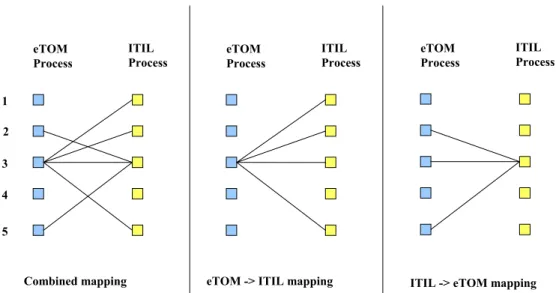
Figure 5-9 - ITIL to eTOM Mappings... 21
Figure 5-10 - How ITIL processes overlay eTOM Operations Process Elements... 22
Figure 5-11 - How ITIL processes overlay eTOM SIP Process Elements... 23
LIST OF TABLES
Table 5.1: Detailed overlay of ITIL processes with eTOM level 2 processes... 29 Table A.1: Terminology... 1 Table A.2: Abbreviations and Acronyms>... 1
PREFACE
About TeleManagement Forum
TeleManagement Forum is an international consortium of communications service providers and their suppliers. Its mission is to help service providers and network operators automate their business processes in a cost- and time-effective way. Specifically, the work of the TM Forum includes:
• Establishing operational guidance on the shape of business processes.
• Agreeing on information that needs to flow from one process activity to another.
• Identifying a realistic systems environment to support the interconnection of operational support systems.
• Enabling the development of a market and real products for integrating and automating telecom operations processes.
The members of TM Forum include service providers, network operators and suppliers of equipment and software to the communications industry. With that combination of buyers and suppliers of operational support systems, TM Forum is able to achieve results in a pragmatic way that leads to product offerings (from member companies) as well as paper specifications.
TeleManagement Forum supports several kinds of projects, including Process Automation and Technology Integration projects, as well as Catalyst Projects that support both Process Automation and Technology Integration projects through real-product integration.
Use and Extension of a TM Forum Application Note
This document defines the business problem and requirement model for the use of the ITIL process framework within the eTOM domain. The Application Note represents a consensus view on how ITIL can be mapped to eTOM to solve a specific business problem. It is expected that this document will be used:
• To facilitate requirement agreement between Service Providers and vendors
• As input to a service Provider’s Request for Information / Request for Proposal (RFI/RFP—RFX)
• As input for vendors developing COTS products
1 INTRODUCTION
1.1 Objective
While eTOM is the global de facto Business Process Framework at the Enterprise Level for the Telecommunications Industry, specific process frameworks and good practice guides have also been developed for use in other industries. For example the Supply Chain Council, the IT Infrastructure Library (the subject of this application note) and the Balanced Scorecard. This document is the first in a planned series of documents showing how the frameworks and best practices of other industry sectors can be used together with the eTOM to provide a richer and more complete Enterprise Business Process Framework.
1.2 Background
In recent years there has been a rapid growth and evolution in the sophistication of Telecommunications Services offered to Customers, reflected in increasing complexities in the hosting, switching, routing and transport platforms on which those Services are delivered and managed. As the Telecommunications market has developed, the network control environments and even the make-up of those Services is becoming more IT based and orientated. An example of this is the growth in I.P. based products.
To support these trends, Information and Communications Service Providers (ICSPs) are becoming increasingly reliant on the provision of high quality IT services from their own providers. At the same time, customers are making stringent demands on their ICSPs for high quality service management capabilities, as the services they support are becoming ever more critical to the Customer’s business operations.
These new directions are leading to a juxtaposition of process engineering based challenges in both the IT and Telecoms spaces that both eTOM and ITIL can contribute to addressing. One way to show how eTOM can be put to practical use is to use it to model the IT Service Management processes using the Process Elements from eTOM.
1.3 Role of eTOM
eTOM is a business process framework to guide the development and management of key processes within a Information and Communications Service Provider. It provides this guidance by offering a catalogue of industry-standard names, descriptions and scope, at multiple hierarchical levels, of all the Business Activities (or Process Elements) within an ICSP. Among its objectives is to aid the end-to-end automation of information and communications services for business and operations processes. Its functional coverage is still at a high level with respect to any detailed descriptions of key internal support services, including the management and delivery of IT services. It is intentionally aimed at a broad coverage of activities within an Information and Communications Service Provider, without documenting detail because its purpose is to focus on the commonality between similar processes (whether for telephony, data, internet, mobiles, content etc), rather than delivering complete detail to guide implementation.
1.4 Role of ITIL
The operational processes described in the IT Infrastructure Library (ITIL) for managing IT Services
have never been more relevant to ICSPs. They were developed to provide guidance on the best practice
ETOM – ITIL APPLICATION NOTE for IT Service Management processes. In the words of the ITIL authors:
The ethos behind the development of the IT Infrastructure Library (ITIL) is the recognition that organisations are increasingly dependent upon IT to satisfy their corporate aims and meet their business needs. This growing dependency leads to growing needs for quality IT services - quality that is matched to business needs and user requirements as they emerge.
This is true no matter what type or size of organisation, be it national government, a multinational conglomerate, a decentralised office with either a local or centralised IT provision, an outsourced service provider, or a single office environment with one person providing IT support. In each case there is the requirement to provide an economical service that is reliable, consistent and of the highest quality.
IT Service Management is concerned with delivering and supporting IT services that are appropriate to the business requirements of the organisation. ITIL provides a comprehensive, consistent and coherent set of best practices for IT Service Management processes, promoting a quality approach to achieving business effectiveness and efficiency in the use of information systems.
There are three key areas in which ITIL may be applied within an ICSP.
1. As Products which are sold to Customers increasingly include IT type offerings (LAN services, Web Hosting etc) the internal processes which are needed to enable and support these IT type offerings must be designed to be an integral part of the complete end-to-end processes - i.e. the back-of-house engineering processes must be integrated with the customer-focussed sales and customer management processes. This can be done by modeling ITIL processes using eTOM Process Elements.
2. Customers are outsourcing the delivery and support of their IT Services to Telcos, so Telcos are offering IT Service Management as a sellable service. Because the Telco is dealing with the Customer IT workforce, they must communicate using ITIL standards or using the language of the ITIL standards.
3. Telcos are becoming more dependant on effective IT Service Management of their own computer systems. Since ITIL represents best practice in this area, it is natural that ITIL terminology will be used in this field. Since they are doing this specialist task within a Telco, they need to understand how describe ITIL activities in eTOM terms.
1.5 Document
Purpose
ITIL can be used very effectively in conjunction with eTOM, in that it will assist in creating a more complete Enterprise Business Process Framework which includes all the functional elements needed for IT support processes. For an ICSP company consolidating their processes, using ITIL as a guide to IT Service Management processes can provide a number of benefits;
• A better understanding of how the IT systems are managed in contributing to the delivery of Services to Customers
• More efficient and effective management of Customer services having a significant IT basis (eg Application and Web Services)
The aim of this application note is to:
•
• •
show how eTOM can be used to model the IT Service Management processes (Incident Management, Configuration Management etc) in a way that is consistent with the modeling standard for Information and Communications Service Providers - eTOM.
provide an overview and introduction to the ITIL Service Management Frameworks from a Information and Communications Service Provider perspective
show which eTOM process type each ITIL Service Management process belongs to
1.6 Document
Structure
This document has three major parts: an introduction to ITIL Service Management and Service Management Processes, the relationship between eTOM and ITIL, how eTOM process elements can be used to build ITIL processes and a mapping between eTOM and ITIL. The following is the structure of the specification:
Section 1 Introduction: Provides overview of this the document and outlines its structure and defines essential terms used in the document.
Section 2 ITIL Background/Introduction: Background on the ITIL framework and its applicability to the telecommunications environment.
Section 3 Service Management in ITIL: A guide to the ITIL Service Management processes.
Section 4 Relationship between ITIL and eTOM: Description of the relationship between the ITIL and eTOM frameworks.
Section 5 ITIL to eTOM Mapping: Mapping between the eTOM and ITIL frameworks, from a process flow perspective and an analytical perspective.
Appendices
Appendix A Terminology, acronyms and abbreviations Appendix B References
ETOM – ITIL APPLICATION NOTE
2 ITIL BACKGROUND/INTRODUCTION
2.1 Overview
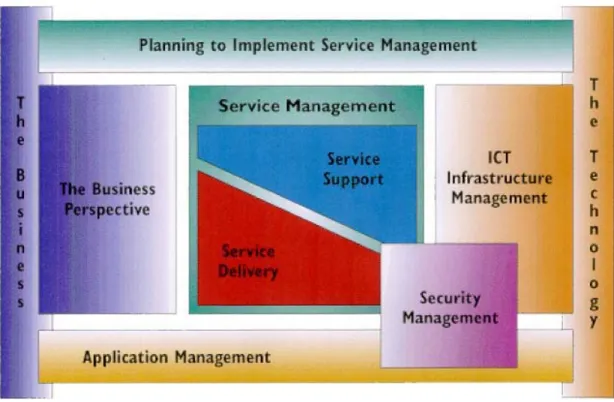
“ITIL (the IT Infrastructure Library) was initially developed by the UK government's Central Computer and Telecommunications Agency (CCTA), with input from industry to give guidance upon the best practice in managing IT Services. It has recently been rewritten under the direction of the Office of Government Commerce (OGC) which was set up in 2000 and incorporates CCTA, which no longer operates as a separate agency.” ITIL is the global de-facto standard for IT Service Management and forms the basis for BS15000. ITIL is now comprised of a seven document set consisting of:
• Service Support
• Service Delivery
• Application Management
• ICT Infrastructure Management
• Security
• The Business Perspective
• Planning to Implement Service Management
The relationship between these documents is shown in Figure 2.1.
Figure 2-1: The ITIL Publication Framework © OGC
ETOM – ITIL APPLICATION NOTE
2.2 Service Delivery & Service Support – The core of ITIL
The two “core” ITIL documents which were published initially, Service Delivery and Service Support combine to cover all aspects of services as perceived by the end-user of those services. This combination covers the area of “Service Management” as defined by ITIL. The content of these documents is covered in section 3 below. The remaining ITIL documents (with the exception of “The Business Perspective” – not available at the time of writing) are:
1. Application Management covers the full life cycle of a service including Development in addition to Delivery and Support of the service. An application is viewed as being primarily software so the core of this book looks at software development issues with the emphasis being on how to ensure that what is developed is kept aligned with the organisations strategic direction and existing support infrastructure.
2. Security Managementcovers issues such as Confidentiality, Integrity and Availability of data as well as the security of hardware, software, documentation and procedures. The Security Management function is responsible for interfacing with Service Management processes when any of these issues are involved.
3. Planning to Implement Service Management focuses on how to set about putting in place the core Service Management processes that comprise Service Delivery and Service Support although the principles detailed in the document should apply to processes elsewhere as well.
4. ICT Infrastructure Management covers the provision and support of the infrastructure necessary for the delivery and support of services and as such, interacts with virtually all the processes in Service Delivery and Service Support.
3 SERVICE MANAGEMENT IN ITIL
The two “core” documents of the ITIL set are the two ITIL Service Management components; Service Support and Service Delivery. The decomposition of these components into processes and functions is covered below.
3.1 Service
Support
The content of sub-section 3.1 is adapted from the Service Support and Service Delivery Guidebooks (© OGC).
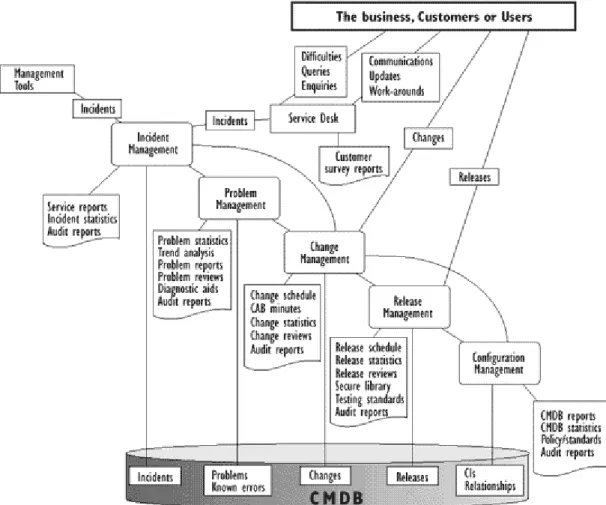
ETOM – ITIL APPLICATION NOTE Service Support decomposes into the following functions and processes:
3.1.1 Service Desk
The Service Desk is the only function within ITIL Service Management and provides a single point of contact between the IT Service Customer/User and all the other processes within the ITIL Service Management.
3.1.2 Incident Management
The Incident Management process handles service requests (new service requests, change requests etc) as well as incidents. An incident is any event that affects the required Service Levels as defined by a relevant SLA. The aim of Incident Management is to return IT Service delivery to the required Service Levels as quickly as possible while minimising any negative impact upon business operations.
3.1.3 Problem Management
The Problem Management process is comprised of two aspects; proactive Problem Management and reactive Problem Management. Proactive Problem Management involves the detecting and resolving of Problems and Known Errors before they lead to Incidents. Reactive Problem Management responds to Major Incidents and Problems as they occur, again providing problem resolution. There are two stages to the Problem Management process; the first, Problem Control involves investigating and establishing a root cause of a problem and providing a resolution; the second, Error Control, is the investigation and elimination of Known Errors so that they do not reoccur. Once the root cause of a problem has been identified and the problem resolved then it becomes a known Error.
3.1.4 Configuration Management
The Configuration Management process is the underpinning discipline to all the other Service Management Processes. The aim of the process is to document all the Configuration Items (CIs) within an organisation and the relationship between them all in the Configuration Management Database (CMDB). The Configuration Management process is also responsible for keeping the CMDB up to date. The CMDB is used by the other processes to hold reports, plans, records etc since these also can be related to CIs.
3.1.5 Change Management
The Change Management process is responsible for the implementation of changes to both IT Services and Infrastructure. All changes should show a benefit to the business; be it the resolution of a problem, service improvement or cost reduction. The Change Management process provides a structured method for the approval and management of all changes. This approach allows the resources required to implement a change, the business impact of a change (both benefits and incidents that may arise because of the change).
3.1.6 Release Management
The Release Management process is an output of the Change Management process since Release Management is the implementation of any change. The Release Management process is concerned with all types of IT Service or system change and takes a wider view of a change so that all aspects of a change are considered. The Release Management process is also responsible for the Definitive Software Library (DSL) and Definitive Hardware Store (DHS) within the CMDB.
3.2 Service
Delivery
The content of sub-section 3.2 is adapted from the Service Support and Service Delivery Guidebooks (© OGC).
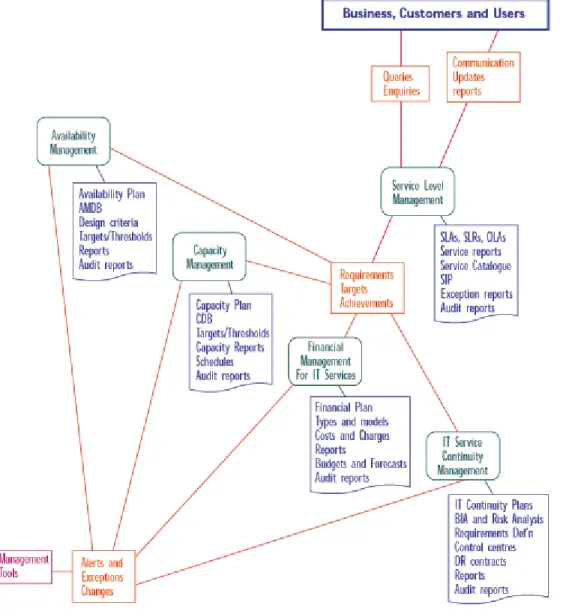
ETOM – ITIL APPLICATION NOTE Service Delivery decomposes into the following main processes:
3.2.1 Service Level Management
The aim of the Service Level Management process is to ensure that IT Service quality is maintained and improved. The Service Level Management maintains the relationship between the Customer and the IT Service Provider (who can be either internal or external to the Customer’s organisation) through Service Level Agreements (SLAs), Operational Level Agreements (OLAs) and Underpinning Contracts (UCs).
3.2.2 Financial Management for IT Services
The Financial Management for IT Services process is concerned with the budgeting, accounting and charging of IT Services. It considers both internal IT Service provision and external third party providers.
3.2.3 Capacity Management
The aim of the Capacity Management process is ensure that the IT Infrastructure can meet current and future IT Service requirements, and consequently business requirements, can be met cost effectively. The Capacity Management processes also looks at improving IT Service Delivery through the introduction of new technology and continuous monitoring and improvement of the IT Service.
3.2.4 IT Service Continuity Management
The IT Service Continuity Management process is underpins the organisations Business Continuity requirements and is responsible for ensuring that the required IT Services (including infrastructure, telecommunications, applications and support) can be restored in the required time to ensure business continuity.
3.2.5 Availability Management
The aim of the Availability Management process is to ensure that the availability of the IT Services meet the SLA, and consequently the business requirements through the continuous monitoring of and improvement to the IT Services. The Availability Management process is also responsible for the implementation of Security Policy.
3.3 Application
Management
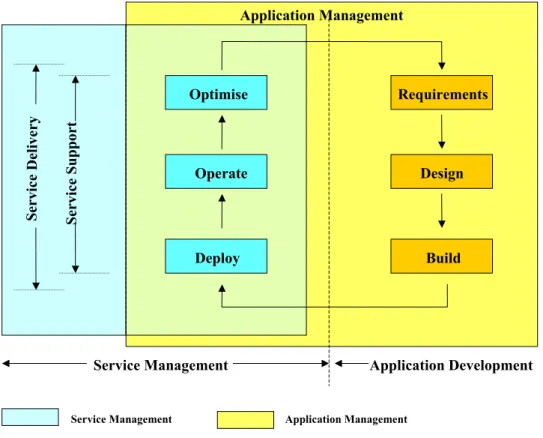
Application Management overlaps Service Management as shown in figure 3-3 below and divides into two areas:
1. Application development – those activities needed to plan, design and build the application. 2. Service Management – which sub-divides into:
• •
Service Delivery Service Support
Application Management is split into six processes which are distributed between Application Development and Service Management as shown in Figure 3-3 below:
Optimise Requirements
Design
Build Deploy
Operate
Service Management Application Development
Service Su pport Ser vi ce D el iv er y
Service Management Application Management
Figure 3-3 - Relationship between Service & Application Management
An application is the software that is the embodiment of the service being delivered - a service is however more than just the functionality offered by the application and hence, service management is only partially included within Application Management.
The Application Management document details the 6 areas of Application Management shown in Figure 3-3, the functionality that they will typically embody, the interactions they will have with other Service Management processes and the way in which an organisation should approach implementing these processes.
ETOM – ITIL APPLICATION NOTE
4 USING ETOM TO MODEL ITIL PROCESSES
4.1 ITIL is a guideline for IT Service Management
ITIL was originally developed as a guideline to serve a single Customer, though many Users, delivering many IT Services. The Customer in this case is generally the organisation or company that is using the IT Services to support its business whether they are provided using internal resources or external outsourcers. Below this single point of delivery any number of Operational Level Agreements (OLAs) and Under Pinning Contracts can be used to support the delivery of IT Services to the Customer and their Users. An OLA is an internal Service Level Agreement while an Under Pinning Contract is a Service Level Agreement with a third party supplier.
ITIL is primarily non-prescriptive – it offers advice/guidance on the implementation and continued delivery of Service Management. It contains extensive advice covering the construction of cases for the systematic implementation of Service Management, overcoming objections raised to those proposals, planning their implementation and resolving typical problems likely to be encountered during the implementation process.
4.2 eTOM is a catalogue of Process Element categories
eTOM is a business process framework to guide the development and management of key processes within an Information and Communications Service Provider. It provides this guidance by offering a catalogue of industry-standard names, descriptions and scope, at multiple hierarchical levels, of all the Business Activities (or Process Elements) within an Information and Communication Service Provider. The current version of eTOM is customer centric viewing business processes in terms of their contribution (whether directly or indirectly) to customer service. At that level, it is difficult to discern the shape of some of the internal support processes dealing with the infrastructure, resource and business needs of the organization. Those processes supporting IT systems fall into this category. Future iterations of eTOM may illustrate the shape of these processes, as well as develop the linkages needed between these processes and Customer-related processes.
To accelerate these enhancements to eTOM, reference to specialized process recommendations such as ITIL will bridge these gaps with proven, reliable process models. Further, the application of eTOM to the development of ITIL processes is likely to improve the scope and design of these processes, and will ensure their successful integration into a Service Provider’s overall process environment.
4.3 Distinguishing between Service and Service Instant
The ITIL framework is centered on the two Service Management areas of “service delivery” and “service support”, but without a clear demarcation between the delivery/support of a service (into the company’s product portfolio) and the delivery/support of an instance of that service to a specific customer.
Consider for example an ITIL process such as Capacity Management:
•
•
When a new product is being planned/developed consideration needs to be given to the implications of deploying this product on the capacity of the existing infrastructure, conversely, it might be a design aim that the product minimizes its impact on capacity. (For example, it could utilize compression technology to reduce bandwidth requirements).
When a product is deployed and new instances are being supplied to end-users continuous monitoring is required to assess the impact of uptake on capacity.
eTOM represents Service Instance within the Operations level-0 process grouping that is concerned with the delivery of service to a user, and Generic Services within the SIP level-0 process grouping which is concerned with the lifecycle management of both Products and Infrastructure.
ETOM – ITIL APPLICATION NOTE
5 MAPPING AND MODELING BETWEEN ITIL AND ETOM
5.1 Scope and Types of Mapping in this document
There are several methods of mapping the relationship between the ITIL processes and the eTOM framework. For example ITIL processes can be decomposed into lower-level processes and end to end flows can be constructed from a combination of both eTOM and ITIL processes alternatively ITIL processes can be constructed solely from lower-level eTOM process elements1. This Application Note is focused on the latter methodology, showing how ITIL Service Management processes can be modeled using the Process Elements of the eTOM process framework. Modeling any operational process using these Process Elements is essential for communicating and understanding processes in a way that will achieve enterprise-wide efficiencies and re-use. Mappings of other ITIL processes may be the subject of later revisions of this Application Note or may be the subject of separate Application Notes.
It is also possible to take an information-mapping approach to show a relationship between eTOM and ITIL, (See Figure 5-9). But this should be considered an analytic view useful to managers of the models, whereas the flow mapping (see figures 5-1 to 5-8) is what is useful to process analysts and operators. Though modelers may find benefit in the analytical view in understanding which eTOM process elements form ITIL processes.
5.2 Modeling ITIL Processes using eTOM Process Elements
Information and Communication Service Providers need to ensure that the many different processes that they operate will work together effectively, staff can easily understand the processes without having to learn a new language and they must be effectively implemented in IT. To do this they need to model all their operational process in a standard way and that can be done by modeling the processes using the Process Elements of the eTOM process framework. The approach used to model ITIL operational processes is exactly the same as for modeling other operations processes such as Fulfillment or Assurance and this methodology is documented in GB921 Addendum F.
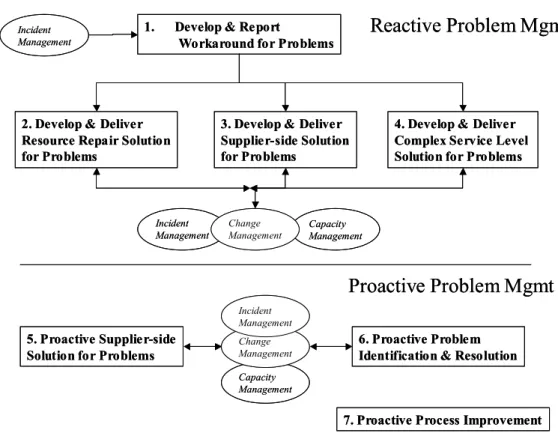
Here are seven processes as examples to show how the ITIL Assurance processes can be modeled (or built up) in a standardized way using the eTOM Process Elements.
1 It should be noted that eTOM v4.0 is currently defined to Level 2 for Operations processes and Level 2
for all other processes
Capacity Management Change Management
1. Develop & Report
Workaround for Problems
2. Develop & Deliver Resource Repair Solution for Problems
3. Develop & Deliver Supplier-side Solution for Problems
5. Proactive Supplier-side Solution for Problems
4. Develop & Deliver Complex Service Level Solution for Problems
6. Proactive Problem Identification & Resolution
7. Proactive Process Improvement
Incident Management Incident Management Incident Management
Reactive Problem Mgmt
Proactive Problem Mgmt
Capacity Management Change Management Capacity Management Change Management1. Develop & Report
Workaround for Problems
2. Develop & Deliver Resource Repair Solution for Problems
3. Develop & Deliver Supplier-side Solution for Problems
5. Proactive Supplier-side Solution for Problems
4. Develop & Deliver Complex Service Level Solution for Problems
6. Proactive Problem Identification & Resolution
7. Proactive Process Improvement
Incident Management Incident Management Incident Management
Reactive Problem Mgmt
Proactive Problem Mgmt
Capacity Management Change ManagementFigure 5-1 - Overview of ITIL Assurance processes to be modeled in these examples
Service Proble m Mgmt. Resource Proble m Mgmt. Resource Restoration Supplie r Partner Proble m Report & Mgmt. Incident Mgmt. Change Mgmt. Incident Report Mgmt Log & Classify Diagnose Problem Diagnose Problem Diagnose Problem Develop Workaround Develop Workaround Report Workaround Develop Workaround Service Proble m Mgmt. Resource Proble m Mgmt. Resource Restoration Supplie r Partner Proble m Report & Mgmt. Incident Mgmt. Change Mgmt. Service Proble m Mgmt. Resource Proble m Mgmt. Resource Restoration Supplie r Partner Proble m Report & Mgmt. Incident Mgmt. Change Mgmt. Incident Report Mgmt Log & Classify Diagnose Problem Diagnose Problem Diagnose Problem Develop Workaround Develop Workaround Report Workaround Develop Workaround
ETOM – ITIL APPLICATION NOTE Service Proble m Mgmt. Resource Proble m Mgmt. Resource Restoration Supp/Partner Proble m Report & Mgmt. Incident Mgmt. Change Mgmt. Diagnosed Problem Manage Repair Request Repair Incident Report Mgmt
Develop Solution Implement Solution Report Solution
Resource Repair Develop Solution Service Proble m Mgmt. Resource Proble m Mgmt. Resource Restoration Supp/Partner Proble m Report & Mgmt. Incident Mgmt. Change Mgmt. Diagnosed Problem Manage Repair Request Repair Incident Report Mgmt
Develop Solution Implement Solution Report Solution
Resource Repair Develop Solution
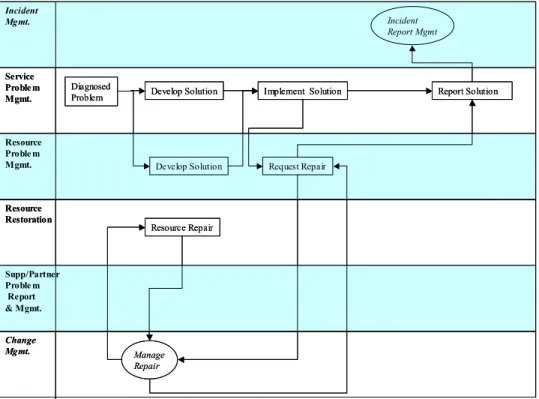
Figure 5-3 - Develop & Deliver Resource Repair Solution for Problems
Service Proble m Mgmt. Resource Proble m Mgmt. Incident Mgmt. Change Mgmt. Diagnosed Problem Manage Supplier Resolution
Request Problem Resolution
Incident Report Mgmt
Develop Solution Implement Solution Report Solution
Develop Solution
Supp/Partner Proble m
Report & Mgmt.
Supplier Problem Liaison
Service Proble m Mgmt. Resource Proble m Mgmt. Incident Mgmt. Change Mgmt. Diagnosed Problem Manage Supplier Resolution
Request Problem Resolution
Incident Report Mgmt
Develop Solution Implement Solution Report Solution
Develop Solution
Supp/Partner Proble m
Report & Mgmt.
Supplier Problem Liaison
Figure 5-4 - Develop & Deliver Supplier-side Solution for Problems
Service Proble m Mgmt. Resource Proble m Mgmt. Mgmt. Other Processes Diagnosed Problem Report Mgmt Develop Solution Implement Solution Report Solution Develop Solution Supp/Partner Proble m Report & Mgmt. Develop Solution Change Mgmt. Manage Change Capacity Management
(Infrastructure & Product processes)
Availability Management (Operations Support processes)
Service Proble m Mgmt. Resource Proble m Mgmt. Mgmt. Other Processes Diagnosed Problem Report Mgmt Develop Solution Implement Solution Report Solution Develop Solution Supp/Partner Proble m Report & Mgmt. Develop Solution Change Mgmt. Manage Change Capacity Management
(Infrastructure & Product processes)
Availability Management (Operations Support processes)
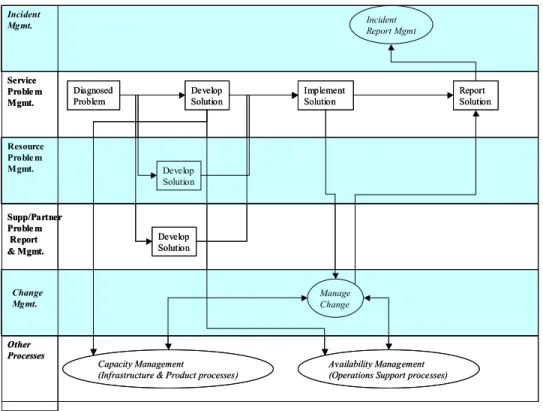
Figure 5-5 - Develop & Deliver Complex Service Level Solution for Problem
Service Proble m Mgmt. Incident Mgmt. Supplier Reported Problem Report Problem Develop Workaround Report Resolution
Manage Supplier Resolution
Supp/Partner Proble m Report & Mgmt. Log & Classify Develop Workaround Incident Report Mgmt Service Proble m Mgmt. Incident Mgmt. Supplier Reported Problem Report Problem Develop Workaround Report Resolution
Manage Supplier Resolution
Supp/Partner Proble m Report & Mgmt. Log & Classify Develop Workaround Incident Report Mgmt
ETOM – ITIL APPLICATION NOTE Incident Mgmt. Other Processes Incident Report Mgmt Manage Change Capacity Management
(Infrastructure & Product processes)
Availability Management (Operations Support processes)
Performance Analysis Problem Identification Develop Solution Performance Analysis Performance Analysis Problem Identification Problem Identification Develop Solution Develop Solution Service Proble m Mgmt. Resource Quality Analysis, Action & Reporting Service Quality Analysis, Action & Reporting Supplie r/ Partner Performance Monitoring Log Problem Implement Solution Report Solution Incident Mgmt. Other Processes Incident Report Mgmt Manage Change Capacity Management
(Infrastructure & Product processes)
Availability Management (Operations Support processes)
Performance Analysis Problem Identification Develop Solution Performance Analysis Performance Analysis Problem Identification Problem Identification Develop Solution Develop Solution Service Proble m Mgmt. Resource Quality Analysis, Action & Reporting Service Quality Analysis, Action & Reporting Supplie r/ Partner Performance Monitoring Log Problem Implement Solution Report Solution
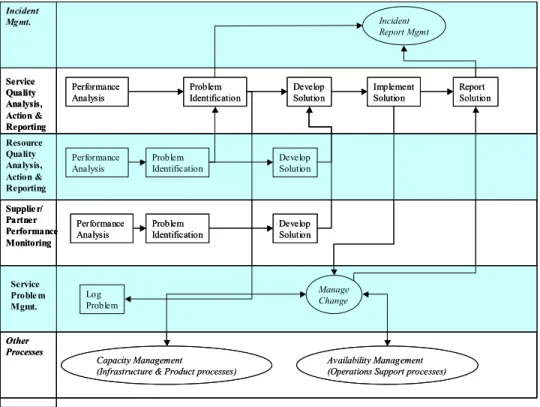
Figure 5-7 - Proactive Problem Identification and Resolution
Other Processes
Manage Change
Capacity Management
(Infrastructure & Product processes)
Availability Management (Operations Support processes)
Process Performance Analysis Improvement Identification Develop Improvement Process Performance Analysis Process Performance Analysis Improvement Identification Improvement Identification Develop Improvement Develop Improvement SM&O Support & Process Mgmt S/PRM Ops Support & Process Mgmt Implement Improvement RM&O Support & Process Mgmt Change Mgmt. Other Processes Manage Change Capacity Management
(Infrastructure & Product processes)
Availability Management (Operations Support processes)
Process Performance Analysis Improvement Identification Develop Improvement Process Performance Analysis Process Performance Analysis Improvement Identification Improvement Identification Develop Improvement Develop Improvement SM&O Support & Process Mgmt S/PRM Ops Support & Process Mgmt Implement Improvement RM&O Support & Process Mgmt Change Mgmt.
Figure 5-8 - Proactive Process Improvement
As ITIL recommends operational end-to-end processes, and eTOM standardizes process element decompositions, information-mapping views will appear to be complex. In addition, because ITIL and eTOM dissect their respective domains of interest in essentially different ways, the overlay of processes will not typically be one to one.
Because ITIL recommends operational end-to-end processes, and eTOM standardizes process element decompositions, information-mapping views will appear to be complex and of little use. The reason that so many ITIL process steps are shown mapping to one eTOM Process Element is because eTOM is currently only defined to Level 2. When eTOM Level 3 Process Elements are published a more detailed modeling of ITIL Processes will be possible. Another reason so many ITIL process steps are shown mapping to one eTOM Process Element is because in eTOM a process element (e.g. Customer Interface Management) appears only once in a taxonomy, however will appear many times in operational process flow and visa versa.
eTOM Process ITIL Process eTOM Process ITIL Process eTOM Process ITIL Process 1 2 3 4 5
eTOM -> ITIL mapping ITIL -> eTOM mapping Combined mapping
ETOM – ITIL APPLICATION NOTE
5.4 Overlay of ITIL to the level 2 eTOM Framework
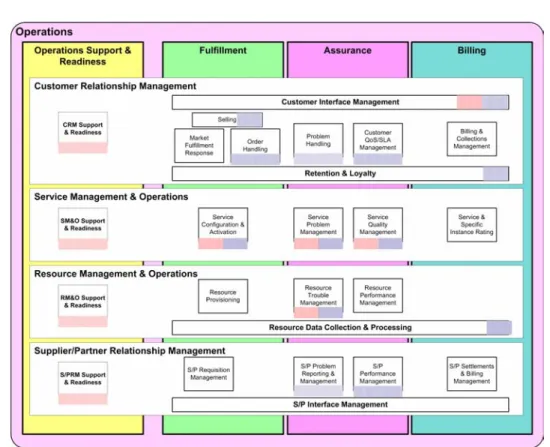
The ITIL Service Support and Service Delivery Processes can be readily overlaid onto the eTOM. The following three figures, 5-10, 5-11 and 5-12 show the eTOM level-2’s within the eTOM level-0’s of Operations, SIP and Enterprise, that will be used, in building ITIL processes from the Service Support and Service Delivery recommendations. The ITIL processes and functions that have been described are of an equivalent process level to the eTOM level 2 decompositions. One of the limitations in using eTOM in its present form to map ITIL processes, is that in version 4.0, eTOM is only defined down to Level 2, though Operations processes are defined to Level 3. Because ITIL Processes aim to guide detailed implementation they really need to be mapped using Level 3 Process Elements. Though the ITIL documentation shows some ‘decomposed’ flows which provide lower level process detail. It is this lower level detail and level 3 eTOM process decompositions that will provide a clearer process overlay between the two frameworks and a better understanding of the modeling of ITIL processes using eTOM process elements.
The red shading indicates where ITIL supports the management of internal IT services, while the blue shading indicates where ITIL supports the management of customer services. The type of shading also shows the amount of correlation between the processes at this level.
Medium correlation of processes Low correlation of processes
High correlation of processes
Figure 5-10 - How ITIL processes overlay eTOM Operations Process Elements
Figure 5-11 - How ITIL processes overlay eTOM SIP Process Elements
ETOM – ITIL APPLICATION NOTE
5.5 Detailed overlay of ITIL processes with eTOM level 2 processes
The following table, a textural description of figures 5-10, 5-11 and 5-12, shows the eTOM level 2 processes and the ITIL processes that overlay them with an explanation of how ITIL process supports eTOM processes. This provides a further indication of how the ITIL processes can be constructed from eTOM process elements.
ITIL
Function/Process
eTOM Level 2 Process How ITIL supports the management of
customer services
How ITIL supports the management of internal IT services
Service Desk Customer Interface Management
Customer QoS/SLA Management Resource Data Collection and Processing
CRM Capability Delivery Enterprise Performance Management
Employee and Labor Relations Management
• The Service Desk is the only function within ITIL and acts as the first point of contact for the Customer/Users and well as their interface to all the other ITIL processes
• Inform Customer/Users of the Service Level Agreements (SLAs), Operational Level Agreements (OLAs) in place.
• Monitor usage of the Support Services, provide appropriate metrics (call logs, incident records, RFCs raised, Service Requests etc)
• Act as first point of contact for Customers and Users gather data on Customer/User perception of Service Quality
• Monitor usage of the Support Services, provide appropriate metrics (call logs, incident records, RFCs raised, Service Requests etc)
• Ensure that the Service Desk meets the requirements of the Customer as defined in the SLA or OLA
• ITIL covers some of the softer issues with regard workplace environment etc
Incident Management Order Handling Problem Handling
Service Problem Management Resource Trouble Management RM&O Support and Readiness S/P Problem Reporting and Management
• Incident Management also handles Service Requests (Requests for Change (RFCs), enquires etc)
• Incident Management Process Steps:
⇒ Classification and Initial Support
⇒ ⇒ ⇒
Classification of Problem (Hardware, Software, Network etc)
Investigation and diagnosis Resolution and Recovery
• Escalation, either internally or externally and either functional or hierarchical, of Incident to Problem Management or other 2nd, 3rd or nth line support organisation
Function/Process customer services services Problem Management Service Problem Management
Resource Trouble Management RM&O Support and Readiness S/P Problem Reporting and Management
• Problem Management Process Steps:
⇒ Problem identification and recording
⇒ ⇒ ⇒
Problem Classification
Problem Investigation and diagnosis RFC and Problem resolution and closure
• Escalation, either internally or externally and either functional or hierarchical, of Problem to other 2nd, 3rd or nth line support organisation Configuration
Management
Service Configuration and Activation
Regulatory Management Audit Management
• Maintain the Configuration Management Database so all assets are known and their relationship between each other
• The Configuration Management Database can be used to ensure that legal requirements are adhered to, for example in the UK the Freedom to Information Act and Data Protection Act
Change Management Service Configuration and Activation
RM&O Support and Readiness Product and Offer Development and Retirement
Resource Development and Retirement
Supply Chain Development and Change Management
• Manage and changes that occur and inform the Configuration Manager of any changes made
• Acceptance of the RFC, Authorisation and Planning of the Change required for the Resolution of Services
• Filter, approve and manage changes to the current IT services/infrastructure
• Manage any changes introduced (new or improved Services); this can be with either an internal IT Department or External IT Outsourcer/Supplier
ETOM – ITIL APPLICATION NOTE
ITIL
Function/Process
eTOM Level 2 Process How ITIL supports the management of
customer services
How ITIL supports the management of internal IT services
Release Management Service Configuration and Activation
RM&O Support and Readiness Product and Offer Development and Retirement
Service Development and Retirement
Resource Development and Retirement
Supply Chain Development and Change Management
Procurement Management
• Manage the implementation of any Change
• Implementation of any Change required for the Resolution of Services
• Policy, Planning and Development of changes to IT Services/ infrastructure
• Policy, Planning and Development of changes to IT Services/ infrastructure
• Define policy, purchase, test and accept any COTS or bespoke IT hardware or software
Function/Process customer services services Service Level
Management CRM, SM&O, RM&O and S/PRM Support and Readiness Selling
Customer QoS/SLA Management Retention and Loyalty
Service Quality Management S/P Performance Management Product Marketing
Communications & Promotion Service Capability Delivery Resource Capability Delivery Supply Chain Capability Delivery Supply Chain Development and Change Management
Strategic Business Planning Technology Scanning Audit Management Enterprise Performance Assessment
• Monitor and maintain required service levels
• Develop and maintain the Service Catalogue so the Customer/Users are aware of what IT Services are available
• Manage relationship between IT Service Management and the Customer
• Inform the Customer of possible Service improvements/cost savings
• Monitor and analysis Service performance SLA or OLA requirements are met
• Monitor, review and report SLA performance
• Ensure that the SLA meets Customer and User requirements
• (Re)Negotiate with the Customer developing the Service Level Requirements (SLRs) that will form the basis of the SLA, OLA or Under Pinning Contract (this can be with either an internal IT Department or External IT Outsourcer)
• Negotiate with the Customer developing the Service Level Requirements (SLRs) that will form the basis of the SLA, OLA or Under Pinning Contract and ensure that they meet business requirements
• Monitor and maintain required service levels whether the Service is provided internally to an OLA or externally via a SLA.
• Manage OLAs or Under Pinning Contracts
• Monitor, review and report SLA. OLA and Under Pinning Contract performance
• Negotiate with the Customer developing the Service Level Requirements (SLRs) that will form the basis of the SLA, OLA or Under Pinning Contract and ensure that they meet business requirements
ETOM – ITIL APPLICATION NOTE
ITIL
Function/Process
eTOM Level 2 Process How ITIL supports the management of
customer services
How ITIL supports the management of internal IT services
Capacity Management Service Quality Management Resource Data Collection and Processing
Product & Offer Development and Retirement
Service Capability Delivery Service Development and Retirement
Resource Capability Delivery Resource Development and Retirement
Strategic Business Planning Technology Scanning Enterprise Performance Assessment
• Model, monitor and analysis Service/Resource performance to ensure that capacity is sufficient to meet Business needs and SLA or OLA requirements
• Technology watch, introduction of new technology to offer new, different and improved Services (Service Quality, Availability,
Capacity, and Continuity)
• Model, monitor and analysis Service/Resource
performance to ensure that capacity is sufficient to meet Business needs and SLA or OLA requirements
• Ensure that the Service Desk meets the requirements of the Customer as defined in the SLA or OLA (resourcing both people and equipment)
• Technology watch, introduction of new technology to offer new, different and improved Services (Service Quality, Availability, Capacity, and Continuity)
Availability Management Service Quality Management Resource Data Collection and Processing
Service Capability Delivery Resource Capability Delivery Technology Scanning Security Management Enterprise Performance Assessment
• Model, monitor and analysis Service/Resource performance to ensure that capacity is sufficient to meet Business needs and SLA or OLA requirements
• Model, monitor and analysis Service/Resource
performance to ensure that capacity is sufficient to meet Business needs and SLA or OLA requirements
• Responsible for the implementation of the Security Policy
Function/Process customer services services IT Service Continuity
Management Regulatory Management
Business Continuity Management
• Compliance with any legal requirement with regards IT Service Continuity
• The IT Service Continuity Plan forms part of the Business Continuity Plan
Financial Management
for IT Services CRM, SM&O, RM&O and S/PRM Support and Readiness. Billing and Collections
Management
Financial Management
• Collect monies for the use of the IT Service as
per the Charging model/SLA or OLA • Budget, Account (develop Cost Model) and charge
ETOM – ITIL APPLICATION NOTE
APPENDIX A: TERMS AND ABBREVIATIONS USED WITHIN THIS
DOCUMENT – USING HEADING 0 STYLE FORMAT
A.1 Terminology
Term Definition TMF or Outside Source
Incident An event which is not part of the
standard operation of a service and which causes or may cause disruption or a reduction in the quality of services and Customer productivity.
ITIL Service Delivery Guidance
Problem Ths unknown root cause of one
or more existing or potential Incidents.
ITIL Service Delivery Guidance
Table A.1: Terminology
A.2 Abbreviations and Acronyms
Abbreviation/ Acronym
Abbreviation/ Acronym Spelled Out
Definition TMF or External Source
ITIL Information
Infrastructure Library Defacto standard on best practice for IT Service Management
OGC Office of Government
Commerce Department of UK Government whose previous incarnation developed the ITIL guidelines
<<Source>>
ItSMF IT Service Management
Forum Organization, similar in naturle to the TeleManagement Forum, who works with the OGC in the
development and promotion of ITIL.
APPENDIX B: REFERENCES
B.1 References
Reference Description Brief Use Summary
Project Charter eTOM Team
TMF Glossary TMF Glossary made available to
public and members Version <<#>>
TOM TMF Telecom Operations Map: A
high-level view of end-to-end service fulfillment, service assurance and billing, TMF-GB910,TMF, Morristown, 1998 TMF Project Management, Process and Methodology Documents
TMF Team Leader Handbook, TMF Process Guides, TMF Templates, TMF Template Guides, TMF Modeling Methodology Manual
ITIL Service Delivery Guidance>
Guidance on the ITIL Service Delivery Processes which, with Service Support Processes, form the basis of IT Service Management.
ITIL Service Support Guidance
Guidance on the ITIL Service Support Processes which, with Service Delivery Processes, form the basis of IT Service Management.