Application of the Analytic Hierarchy Process
Optimization Algorithm in Best Management Practice
Selection
Kevin D. Young
Thesis submitted to the faculty of Virginia Polytechnic Institute and State
University in partial fulfillment of the requirements for the degree of
Master of Science
in
Civil Engineering
Dr. David F. Kibler, Committee Chair
Dr. G.V. Loganathan
Dr. Brian Benham
May 30, 2006
Blacksburg, Virginia
Keywords: BMP optimization, BMP pollutant removal performance, BMP
maintenance costs, multi-criteria decision making
Application of the Analytic Hierarchy Process Optimization Algorithm in Best Management Practice Selection
Kevin D. Young Abstract
The efficiency of a best management practice (BMP) is defined simply as a measure of how well the practice or series of practices removes targeted pollutants. While this concept is relatively simple, mathematical attempts to quantify BMP efficiency are numerous and complex. Intuitively, the pollutant removal capability of a BMP should be fundamental to the BMP selection process. However, as evidenced by the absence of removal efficiency as an influential criterion in many BMP selection procedures, it is typically not at the forefront of the BMP selection and design process.
Additionally, of particular interest to any developer or municipal agency is the financial impact of implementing a BMP. Not only does the implementation cost exist, but there are long-term maintenance costs associated with almost any BMP. Much like pollutant removal efficiency, implementation and maintenance costs seem as though they should be integral considerations in the BMP selection process. However, selection flow charts and matrices employed by many localities neglect these considerations.
Among the categories of criteria to consider in selecting a BMP for a particular site or objective are site-specific characteristics; local, state, and federal ordinances; and implementation and long-term maintenance costs. A consideration such as long-term maintenance cost may manifest itself in a very subjective fashion during the selection process. For example, a BMPs cost may be of very limited interest to the reviewing locality, whereas cost may be the dominant selection criterion in the eyes of a developer. By contrast, the pollutant removal efficiency of a BMP may be necessarily prioritized in the selection process because of the required adherence to governing legislation. These are merely two possible criteria influencing selection. As more and more selection criteria are considered, the task of objectively and optimally selecting a BMP becomes increasingly complex. One mathematical approach for optimization in the face of multiple influential criteria is the Analytic Hierarchy Process. “The analytic hierarchy process (AHP) provides the objective mathematics to process the inescapably subjective and personal preferences of an individual or a group in making a decision” (Schmoldt, 2001, pg. 15).
This paper details the development of two categories of comprehensive BMP selection matrices expressing long-term pollutant removal performance and annual maintenance and operations cost respectively. Additionally, the AHP is applied in multiple scenarios to demonstrate the optimized selection of a single BMP among multiple competing BMP alternatives. Pairwise rankings of competing BMP alternatives are founded on a detailed literature review of the most popular BMPs presently implemented throughout the United States.
Acknowledgements
Upon the completion of this academic endeavor there are numerous people that I wish to thank. Reflecting back on the work represented in this thesis, as well as that
necessary to complete my coursework, I am flattered by the number of people willing to give me their time, effort, support, advice, and guidance. It has truly been my pleasure to have crossed paths with these people in not only my academic journey, but in the journey of life.
I would like to thank Geoff Reese and the Lehigh Valley Planning Commission in Allentown, PA for their financial support during the final semester of my Master’s coursework. Extending far beyond a paycheck, my work with the LVPC provided me with a timely opportunity to broaden and strengthen my knowledge of best management practices.
I would like to thank Dr. Brian Benham. Dr. Benham was a late addition to my committee, yet he was always available to meet, provide guidance, and promptly
respond to my needs. This thesis represents the first piece of significant research I have undertaken, and Dr. Benham’s review comments, advice, and critiquing of my writing will certainly prove invaluable in my future research.
I would like to thank Dr. G.V. Loganathan. Dr. Loganathan receives full credit for first introducing me to the AHP – the fundamental component of this thesis. My first classroom exposure to Dr. Loganathan occurred in the spring of 1998. I’ve never, before or since, met a professor who cared more about his students as individuals. Dr. Loganathan selflessly gives of his time and knowledge to any student willing to partake. It is simply not possible to adequately comment on Dr. Loganathan’s value to Virginia Tech.
I would like to thank Dr. David Kibler. My first encounter with Dr. Kibler was in an undergraduate hydrology class in the fall of 1999. It was at that point that I knew, beyond any doubt, that water resources would be my niche within the civil engineering field. Upon the completion of a class taught by Dr. Kibler, the student is equipped with real-world engineering skills that can be applied immediately in a consulting
environment. It’s impossible to overestimate the value of Dr. Kibler’s undergraduate courses in my work as a consulting engineer, preparation for the professional engineer examination, and graduate studies. I now work full time for Dr. Kibler as a research associate, and it is truly an honor to have the opportunity to grow as an engineer under his mentorship.
I would like thank my parents, David and Almeta Young. Growing up, they always had time for me. Whether it was teaching me how to catch a baseball or quizzing me for an upcoming history test. They gave me anything a child could ever ask for, and taught me discipline, respect, work ethic, and humility by example. From my earliest memories, my parents emphasized the importance of education. My academic accomplishments are directly attributable to their support and motivation.
I would like to thank my wife, Kelly. Kelly was never too busy to proofread my writing, to give me help when Microsoft’s programs sought to steal my sanity, or to serve as an “audience” when I practiced presentations. But, beyond those things, she was simply
there. When you’ve been studying in the Newman library for 10 hours straight or you have a crippling headache from a day spent in front of the computer, there’s no price tag that can be placed on a loved one’s touch or smile. Without Kelly’s support and
encouragement, none of this would have been possible for me.
Finally, I must thank God. There are countless people capable of achieving the academic accomplishments that I have. But, many of them are not blessed with the opportunity. I have been blessed with more opportunity than any person could possibly deserve – the financial resources to undertake a graduate degree, a support network of friends and family upon which I could always rely, professors and an academic
environment second to none. I am unable to simply categorize these blessings as chance or fate. I firmly believe that I have been blessed with opportunity for a reason, and hope that I can apply my education in making the world a better place.
Kevin D. Young Blacksburg, Virginia June 20, 2006
Table of Contents
1.0 Introduction 1
1.1 Problem Statement 4
1.2 Research Objectives 4
2.0 Literature Review of BMP Selection Approaches 6 And of Identification of Individual BMPs
2.1 The Maryland Department of the Environment Approach
to BMP Selection 6
2.2 The Minneapolis – St. Paul Metropolitan Council Stormwater
Suitability Approach to BMP Selection 17
2.3 Identification of Individual Best Management Practices 22 3.0 Literature Review of the Analytic Hierarchy Process 24 3.1 Construction of Pairwise Comparison Matrices 26
3.2 Extraction of Priority Vectors 28
3.3 Consistency Evaluation 32
3.4 Ranking of Competing Alternatives 34
4.0 Construction of Long-Term Pollutant Removal Performance
Matrices 38
4.1 Data Sources – Long-term pollutant removal performance 38 4.2 National Pollutant Removal Database Methodology 40 4.3 National Pollutant Removal Database Results 45 4.4 International Stormwater BMP Database Methodology 49 4.5 International Stormwater BMP Database Results 52 4.6 Technology Acceptance and Reciprocity Partnership
Methodology 57
4.7 TARP / MASTEP Stormwater Technologies Database –
Results 58
4.8 Performance Review of Individual Practices 60
4.8.1 Extended Dry Detention Ponds 62
4.8.2 Wet / Retention Ponds 63
4.8.3 Infiltration Trenches, Basins, and Porous Pavement 64
4.8.4 Constructed Wetlands 66
4.8.5 Bioretention 67
4.8.6 Vegetated Filter Strips 68
4.8.7 Vegetated Water Quality Swales 69
4.8.8 Stormwater Filtering Systems 70
4.8.9 Proprietary Stormwater Technologies 71 4.8.10 Low Impact Development Strategies 72 4.9 Long-term BMP Pollutant Removal Matrices 73 5.0 Construction of Annual BMP Operations and Maintenance
Cost Matrices 77
5.1 Background 77
5.2 Consideration for the Time Value of Money 79 5.3 Annual Operations and Maintenance Cost by Individual
BMP 81
5.3.2 Infiltration Trenches 84
5.3.3 Infiltration Basins 86
5.3.4 Porous Pavement 87
5.3.5 Constructed Wetlands 88
5.3.6 Bioretention 89
5.3.7 Vegetated Filter Strips 90
5.3.8 Vegetated Water Quality Swales 90
5.3.9 Stormwater Filtering Systems 91
5.3.10 Proprietary Stormwater Technologies 92 5.3.11 Low Impact Development Strategies 92 5.4 Construction of Operations and Maintenance Cost
BMP Selection Matrices 93
6.0 Construction of BMP Pairwise Comparison Templates 95 6.1 Identification of Relevant Selection Criteria 95 6.2 Pairwise Comparison Template Construction 96 6.2.1 Contributing Drainage Area Criterion 96
6.2.2 Shallow Groundwater Table Criterion 101
6.2.3 Shallow Bedrock Depth Criterion 103
6.2.4 Hydrologic Soil Group D Criterion 105
6.2.5 Hydrologic Soil Group A Criterion 107
6.2.6 Groundwater Recharge Criterion 109
6.2.7 Capital Implementation Cost 111
6.2.8 Operations and Maintenance Costs 114
6.2.9 Ability to Accept Hotspot Runoff 116
6.2.10 Ability to Mitigate Peak Rate of Runoff 118
6.2.11 Aesthetic Benefit of BMP 120
6.2.12 Safety Issues Associated With the BMP 122
6.2.13 Pollutant Removal Capability 124
6.2.14 Supplemental Pollutant Removal Templates 128 7.0 Application of the AHP in Multiple BMP Selection Scenarios 131
7.1 Application Scenarios 131
7.1.1 Hospital Development 131
7.1.2 Hospital Development – Alternative Approach 138 7.1.3 Industrial “Hotspot” Application Scenario 142 7.1.4 Parking Lot Retrofit Application Scenario 146 8.0 Summary of Research Objectives, Findings, and Future Work 151
8.1 Review of Stated Research Objectives 151
8.2 Summary of BMP Pollutant Removal Performance Findings 153 8.3 Summary of BMP Maintenance Cost Findings 154 8.4 Summary of the Analytic Hierarchy Process in BMP Selection 155 Appendix A: References
Appendix B: Review of Individual Best Management Practices
B.1 Extended Dry Detention Ponds 160
B.2 Wet / Retention Ponds 163
B.3 Infiltration Trenches 166
B.5 Porous Pavement Systems 171
B.6 Constructed Wetlands 173
B.7 Bioretention 177
B.8 Vegetated Filter Strips 180
B.9 Vegetated Water Quality Swales 184
B.10 Stormwater Filtering Systems 187
B.11 Proprietary Stormwater Technologies (Hydrodynamic /
Swirl Separators and Water Quality Filtering Units 191 B.12 Low Impact Development Strategy – Vegetated Roof Systems 196 B.13 Low Impact Development Strategy – Minimum Disturbance /
Minimum Maintenance 200
B.14 Low Impact Development Strategy – Rainwater Capture
and Reuse 205
Appendix C: Data Summary – National Pollutant Removal Database, 2000 Appendix D: Data Summary – International Stormwater Best Management
Practices Database Appendix E: Glossary
List of Tables
2.1 BMPs Grouped by Class 22
3.1 Scale of Relative Importances 27
3.2 Preliminary Construction of Judgment Matrix 27
3.3 Completed Judgment Matrix 28
3.4 Priority Vector Extraction – Method 1 29
3.5 Priority Vector Extraction – Method 2 30
3.6 Column Reciprocal Values 30
3.7 Priority Vector Extraction – Method 3 30
3.8 Row Root Values 31
3.9 Priority Vector Extraction – Method 4 31
3.10 Normalized Column Values and Resulting Row Sums 31
3.11 AHP Random Indices 33
4.1 Stormwater Treatment Practice (STP) Design Variations 41 4.2 Distribution of Study Data Among Various STP Types 42 4.3 Median Pollutant Removal (%) of Various BMPs 47 4.4 Median Pollutant Removal (%) of Stormwater Treatment Practices
by Drainage Class 47
4.5 Median Effluent Concentration (mg/L) of Various BMPs 49 4.6 Median Total Suspended Sediment Effluent Concentration of
Various Categories of BMPs 53
4.7 Median Phosphorus Effluent Concentration of Various
Categories of BMPs 54
4.8 Median Nitrogen Effluent Concentration of Various
Categories of BMPs 55
4.9 Median Pollutant Removal (%) of Various BMP Categories 56 4.10 Performance Data – Hydrodynamic / Swirl Separator BMPs 59 4.11 Median Removal Efficiencies for all Hydrodynamic
/ Swirl Separator BMPs 59
4.12 Performance Data – Catch Basin Inserts and Filters 59 4.13 Median Removal Efficiencies for all Catch Basin Inserts and Filters 60 4.14 Median Effluent Pollutant Concentration (mg/L) Among All Classes
of BMP 62
4.15 Performance Summary – Extended Dry Detention Ponds 62 4.16 Long-term Pollutant Removal Performance –
Extended Dry Detention Ponds 63
4.17 Performance Summary – Wet / Retention Ponds 63 4.18 Long-term Pollutant Removal Performance – Wet Ponds 64 4.19 Pollutant Removal Efficiency – Infiltration Practices
(Basins and Trenches) 64
4.20 Performance Summary – Porous Pavement 65 4.21 Long-term Pollutant Removal Performance –
Infiltration Practices and Porous Pavement 66 4.22 Performance Summary – Constructed Wetlands 66 4.23 Performance Summary – Constructed Wetlands 67
4.24 Performance Summary – Bioretention 67
4.25 Performance Summary – Bioretention 68
4.27 Median Pollutant Removal Efficiency – Vegetated Filter Strips 69 4.28 Long-term Pollutant Removal Performance – Vegetated Filter Strips 69 4.29 Performance Summary – Vegetated Water Quality Swales 69 4.30 Performance Summary – Vegetated Water Quality Swales 70 4.31 Performance Summary – Stormwater Filtering Systems 71 4.32 Long-term Pollutant Removal Performance –
Stormwater Filtering Systems 71
4.33 Performance Summary – Proprietary Stormwater Technologies 71 4.34 Long-term Pollutant Removal Performance – Proprietary Stormwater 72 4.35 Matrix of Long-Term Expected Pollutant Reduction Performance by BMP 75 4.36 Matrix of Long-Term Anticipated Pollutant Removal Efficiency by BMP 76
5.1 Typical Maintenance Activities for BMPs 77
5.2 Historical Federal Discount Rates 80
5.3 Dry and Wet Pond Sediment Removal Cost (1 Acre Surface Area) 81 5.4 Estimated Annual Maintenance Costs – Extended Detention Ponds
(Surface Area of One Acre) 82
5.5 Estimated Costs – Dry Extended Detention Basin
(Surface Area of One Acre) 83
5.6 Estimated Costs – Wet Extended Detention Basin
(Surface Area of One Acre) 84
5.7 Porous Pavement Maintenance Schedule 87
5.8 Estimated Costs – Constructed Stormwater Wetlands
(Surface Area of One Acre) 88
5.9 Anticipated Annual Maintenance Costs – Vegetated Swales 90 5.10 Construction Costs – Stormwater Filtering Systems 91 5.11 Anticipated Annual BMP Operation and Maintenance Costs
(Quantitative Comparison) 94
5.12 Anticipated Annual BMP Operation and Maintenance Costs
(Qualitative Comparison) 94
6.1 Relevant BMP Selection Criteria 94
6.2 Recommended Contributing Drainage Area (Acres) By BMP 96 6.3 Pairwise Comparison Template – Drainage Area Less Than Ten Acres 98 6.4 Pairwise Comparison Template – Drainage Area 10 – 25 Acres 99 6.5 Pairwise Comparison Template – Drainage Area Greater Than 25 Acres 100 6.6 Pairwise Comparison Template – Shallow Groundwater Depth 102 6.7 Pairwise Comparison Template – Shallow Bedrock Depth 104 6.8 Pairwise Comparison Template – Hydrologic Soil Group D 106 6.9 Pairwise Comparison Template – Hydrologic Soil Group A 108
6.10 Groundwater Recharge Ability of BMPs 109
6.11 Pairwise Comparison Template – Groundwater Recharge 110
6.12 BMP Implementation Costs 111
6.13 Relative Comparison of BMP Implementation Costs 112 6.14 Pairwise Comparison Template – Capital Implementation Cost 113 6.15 Pairwise Comparison Template – Operations and Maintenance Cost 115 6.16 Pairwise Comparison Template – Ability to Accept “Hotspot” Runoff 117 6.17 Peak Mitigation Performance of Various BMPs 118 6.18 Pairwise Comparison Template – Ability to Mitigate Peak Rate of Runoff 119 6.19 Relative Aesthetic Benefit of Various BMPs 120
6.20 Pairwise Comparison Template – Aesthetic Benefit 121 6.21 Relative Safety and Liability of Various BMPs 122 6.22 Pairwise Comparison Template – Safety / Nuisance Liability 123 6.23 Pairwise Comparison Template – Long-term Suspended Sediment
Removal 125
6.24 Pairwise Comparison Template – Long-term Total Phosphorus
Removal 126
6.25 Pairwise Comparison Template – Long-term Total Nitrogen
Removal 127
6.26 Pairwise Comparison Template – 80% Suspended Sediment Removal 129 6.27 Pairwise Comparison Template – 40% Total Phosphorus Removal 130 6.28 Pairwise Comparison Template – 30% Total Nitrogen Removal 131
7.1 Preliminary Criteria Judgment Matrix 134
7.2 Completed Criteria Judgment Matrix 135
7.3 Hospital Site Decision Matrix 136
7.4 BMP Ranks for Hospital Development Scenario 137 7.5 Performance of Wet Pond in Addressing Identified Selection Criteria 138
7.6 BMP Ranks for DA-1 and DA-2 139
7.7 Revised Criteria Judgment Matrix (DA-3) 140
7.8 BMP Ranks for DA-3 141
7.9 Industrial BMP Application – Relative Importance of Selection Criteria 142 7.10 Criteria Judgment Matrix – Industrial BMP Application 143
7.11 Industrial Site Decision Matrix 144
7.12 BMP Ranks for Industrial Site Application 145 7.13 Performance of Stormwater Filtering System in Addressing
Identified Selection Criteria 146
7.14 Retrofit BMP Application – Importance of Selection Criteria 147 7.15 Criteria Judgment Matrix – Parking Lot Retrofit Application 148
7.16 Retrofit Scenario Decision Matrix 149
7.17 BMP Ranks for Retrofit Application 150
7.18 Performance of Porous Pavement System in Addressing Identified
Selection Criteria 151
8.1 Future BMP Selection Criteria to be Considered 156 B.1 Pollutant Removal Performance – Extended Dry Detention Basins 163 B.2 Relative Stormwater Management Function –
Extended Dry Detention Basins 163
B.3 Pollutant Removal Performance – Wet Ponds 166 B.4 Relative Stormwater Management Function – Wet Ponds 166 B.5 Pollutant Removal Performance – Infiltration Trenches 168 B.6 Relative Stormwater Management Function – Infiltration Trenches 168 B.7 Pollutant Removal Performance – Infiltration Basins 171 B.8 Relative Stormwater Management Function – Infiltration Basins 171 B.9 Pollutant Removal Performance – Porous Pavement 173 B.10 Relative Stormwater Management Function – Porous Pavement 173 B.11 Pollutant Removal Performance – Constructed Wetlands 176 B.12 Relative Stormwater Management Function – Constructed Wetlands 177
B.13 Pollutant Removal Performance – Bioretention 180 B.14 Relative Stormwater Management Function – Bioretention 180 B.15 Pollutant Removal Performance – Vegetated Filter Strips 183 B.16 Relative Stormwater Management Function – Vegetated Filter Strips 183 B.17 Vegetated Swale Permissible Velocities By Return Period 185 B.18 Cost Comparison – Vegetated Swale Vs. Underground Piping
and Curb & Gutter 187
B.19 Pollutant Removal Performance – Vegetated Swale 187 B.20 Relative Stormwater Management Function – Vegetated Swale 187 B.21 Pollutant Removal Performance – Constructed Filters 191 B.22 Relative Stormwater Management Function – Constructed Filters 191 B.23 Typical Maintenance Activities for Gravity Separators 194 B.24 Relative Stormwater Management Function – Vegetated Roofs 200 C.1 NPR Database Summary – Extended Dry Detention Pond 207
C.2 NPR Database Summary – Wet Pond 207
C.3 NPR Database Summary – Infiltration Trench 209
C.4 NPR Database Summary – Porous Pavement 209
C.5 NPR Database Summary – Extended Detention Constructed Wetlands 210
C.6 NPR Database Summary – Bioretention 210
C.7 NPR Database Summary – Vegetated Swales 211
C.8 NPR Database Summary – Stormwater Filters 211 C.9 NPR Database Summary – Hydrodynamic Separators 212 D.1 ISB Database Summary –Extended Detention Pond 213
D.2 ISB Database Summary – Wet Pond 214
D.3 ISB Database Summary – Extended Detention Wetlands 214
D.4 ISB Database Summary – Vegetated Swale 215
D.5 ISB Database Summary – Vegetated Filter Strip 216 D.6 ISB Database Summary – Surface Sand Filters 217
List of Figures
2.1 MDE Watershed Factors Matrix 7
2.2 MDE Terrain Factors Matrix 9
2.3 MDE Stormwater Treatment Matrix 10
2.4 MDE Physical Feasibility Matrix 13
2.5 MDE Community / Environmental Factors Matrix 14
2.6 MDE Location and Permitting Checklist 16
2.7 Minneapolis-St. Paul Metropolitan Council Stormwater Suitability Matrix 17 2.8 Minneapolis-St. Paul Metropolitan Council Physical Feasibility Matrix 19 2.9 Minneapolis-St. Paul Metropolitan Council Community / Environmental
Factors Matrix 21
3.1 Flowchart Illustrating AHP Application in the BMP Selection Process 37
5.1 Infiltration Trench Construction Costs 85
7.1 Schematic Pre and Post Development Site Conditions 133 7.2 Decision Matrix and Criteria Priority Vector 137 7.3 Alternative Decision Matrix and Criteria Priority Vector 139 7.4 Decision Matrix and Criteria Priority Vector (DA-3) 141 7.5 Decision Matrix and Criteria Priority Vector – Industrial Site 145 7.6 Decision Matrix and Criteria Priority Vector – Retrofit Site 150
List of Equations
3.1 Priority Vector Extraction – Method 1 29
3.2 Priority Vector Extraction – Method 2 30
3.3 Priority Vector Extraction – Method 3 30
3.4 Priority Vector Extraction – Method 4 31
3.5 Matrix Consistency Index Equation 32
3.6 Matrix / Vector Multiplication Equation 33
3.7 AWVector Equation 33
3.8 Matrix Maximum Eigenvalue, λMax Equation 33
3.9 Consistency Index Evaluation 34
3.10 Random Index Equation 34
3.11 Decision Matrix Construction 35
3.12 Competing Alternative Ranking by Matrix Multiplication 35
4.1 EMC Efficiency Equation 44
4.2 Mass Efficiency Equation 45
5.1 Time Value of Money Equation 79
5.2 Annuity Equation 82
5.3 Dry Pond Base Construction Cost Equation (1997 Dollars) 83 5.4 Dry Pond Base Construction Cost Equation (2006 Dollars) 83 5.5 Wet Pond Base Construction Cost Equation (1997 Dollars) 83 5.6 Wet Pond Base Construction Cost Equation (2006 Dollars) 83 5.7 Infiltration Trench Base Construction Cost Equation
(1997 Dollars) 85
5.8 Infiltration Trench Base Construction Cost Equation
(2006 Dollars) 85
5.9 Infiltration Trench Base Construction Cost Equation
(1997 Dollars) 86
5.10 Infiltration Trench Base Construction Cost Equation
(2006 Dollars) 86
Chapter 1.0 Introduction
A Best Management Practice (BMP) is a device, practice, or method for removing, reducing, retarding, or preventing targeted stormwater runoff constituents, pollutants, and contaminants from reaching receiving waters. A BMP performs beyond the scope of many conventional storm water management practices, such as detention ponds, by not only mitigating the peak rate of runoff from a given site, but also attempting to improve the quality of the runoff. BMPs are broadly categorized as structural or non-structural. Non-structural BMPs or “source control” systems operate by minimizing the
accumulation of pollutants, thus reducing their initial concentrations in stormwater runoff. Street sweeping, fertilizer application controls, and vegetated buffer areas are examples of non-structural BMPs. Structural BMPs are the physically tangible measures that typically come to mind when one thinks of surface runoff treatment. They can range from something as conceptually simple as porous pavement to large engineered wetlands where pollutant removal occurs at the biological and chemical level. The common trait found in all structural BMPs is uncovered by examining the means by which they remove pollutants. “The basic mechanisms of pollutant removal operating in structural BMPs are the gravitational settling of pollutants, infiltration of soluble nutrients through the soil profile, and to a lesser extent, biological and chemical stabilization of nutrients” (FHWA, 1996, pg.181). While the structural BMPs at an engineer’s disposal inherently vary by geographic region, there are approximately 15 different measures widely used throughout the United States. These measures are discussed individually, in detail, in Chapter 2.
Structural BMPs can be further categorized as retention, detention, infiltration, wetland, or filtration. Retention BMPs include wet ponds, extended storage ponds, and wet vaults. In contrast to detention facilities, retention BMPs usually exhibit a permanent pool. In most instances, this permanent pool will require that a constant baseflow be present. Detention BMPs exist as extended detention ponds, oversized pipes, oil and grit separators, and dry swales. The mechanism by which detention BMPs operate is to detain a “first flush” volume of runoff to permit pollutants to settle out of the water
column. Both retention and detention BMPs have the potential to do an excellent job of mitigating the peak rate of runoff from a developed site to levels equal or less than
pre-development conditions. Infiltration BMPs consist of porous pavement, infiltration trenches, and infiltration basins. Typically, infiltration BMPs exhibit very high pollutant removal efficiencies, but do very little to control the peak rate of runoff leaving a site. Wetland BMPs can be naturally occurring or engineered. The unique simultaneous treatment of pollutants by physical, chemical, and biological means define wetland practices. The final category of structural BMPs is filtration measures. Filtration
measures include sand filters, underground filters, bioretention devices, and filter strips. Much like infiltration measures, filtration devices exhibit exceptionally high pollutant removal capabilities. However, these measures are associated with inherently high maintenance costs. In addition to the structural BMPs discussed, a number of low impact development strategies exist which are also considered viable BMP practices in many settings.
Having such a wide array of BMPs at one’s disposal makes selection of the optimal measure for a given site not only daunting, but subject to personal or historical preference. Presently, the engineering community relies heavily on a number of BMP selection matrices to facilitate selection of an adequate BMP for a particular application. However, as discussed later, many significant shortcomings exist in this BMP selection approach, as well as in the selection matrices themselves. In the Mid-Atlantic region of the United States, the Maryland Department of the Environment (MDE) is a progressive leader in BMP design and selection research. Chapter four of the Maryland state stormwater manual is dedicated solely to the selection and location of BMPs. The Maryland BMP selection process employs six primary criteria, with each of these criteria represented by an individual selection matrix. These matrices assist in the selection of appropriate site-specific BMPs by examining contributing watershed factors, terrain factors, stormwater treatment suitability, physical feasibility factors, community and environmental factors, and permitting. Conspicuously absent in the BMP selection approach used by the MDE and other agencies throughout the United States are considerations for long-term BMP pollutant removal performance and maintenance costs.
The efficiency of a BMP is defined simply as a measure of how well the practice or series of practices removes targeted pollutants. While this concept is relatively simple in concept, the mathematical attempts to quantify BMP efficiency are numerous and
often complex. Intuitively, the pollutant removal performance of a structural BMP, and the inevitable decline in this performance over the measure’s lifetime, should be paramount criteria in the BMP selection process. However, as evidenced by the absence of removal efficiency as a selection criterion in the stormwater management measure selection procedure previously described, it is typically not at the forefront of most BMP selection and design processes.
Of additional interest to any developer or municipal agency is the financial impact of implementing a BMP. Not only does the implementation cost exist, but there exists long-term maintenance costs associated with almost any BMP. Much like pollutant removal efficiency, implementation and maintenance costs logically should be integral considerations in the BMP selection process. However, the selection flow charts and matrices employed by many agencies neglect these considerations. The Federal Highway Administration 1996 publication titled Evaluation and Management of Highway Runoff Water Quality contains a selection matrix which presents pollutant removal efficiencies and the various costs associated with various BMPs. The selection matrix developed by the FHWA examines the efficiencies and costs associated with ten different BMPs. Pollutant removal efficiencies are expressed as nominal removal percentages. The costs associated with the various measures are categorized as capital costs, operation and maintenance costs, and long-term maintenance costs. These costs are expressed only as “high,” “moderate,” or “low.” Brief examination of this matrix (FHWA, 1996, pg.184) reveals that many of the removal efficiencies are not shown, listed only as “insufficient data.” Similarly, the cost data presented in the matrix is vague and does not consider geographic location or the decline in performance as the BMP ages.
As previously described, among the categories of criteria to consider in selecting a BMP for a particular site or objective are site-specific characteristics; local, state, and federal ordinances; and implementation and long-term maintenance costs. A selection consideration such as long-term maintenance cost may manifest itself in a very
subjective fashion during the BMP selection process. For example, a BMPs cost may be of very limited interest to the reviewing locality, whereas cost may be the dominant selection criterion in the eyes of a developer. By contrast, the pollutant removal efficiency of a BMP may be necessarily prioritized in the selection process because of
the required adherence to governing legislation. These are merely two possible criteria influencing selection. As more and more selection criteria are considered, the task of objectively and optimally selecting a BMP becomes increasingly complex. One mathematical approach for optimization in the face of multiple influential criteria is the Analytic Hierarchy Process. “The analytic hierarchy process (AHP) provides the objective mathematics to process the inescapably subjective and personal preferences of an individual or a group in making a decision” (Schmoldt, 2001, pg. 15).
“Fundamentally, the AHP works by developing priorities for alternatives and the criteria used to judge the alternatives” (Schmoldt, 2001, pg. 16). This prioritization procedure places weights on the influential selection criteria, thus accommodating the varying scales and units exhibited by these criteria. The weighting component of the AHP permits mathematical optimization when the influential criteria exhibit vastly different scales, or even no scale (units) at all.
1.1 Problem Statement
Clearly, while of great value to the practicing engineer or planner, the BMP selection matrices presently in existence exhibit significant shortcomings. In particular, these matrices lack adequate consideration for annual BMP maintenance costs and the inevitable decline in a BMPs pollutant removal performance over time. Furthermore, these matrices are subject to personal, geographic, and historical bias. This research seeks to expand upon the BMP selection matrices used presently in the engineering community. Additionally, this research will apply a mathematical optimization algorithm, namely the Analytic Hierarchy Process, to the BMP selection process in an attempt to minimize human subjectivity in the selection process, thus providing optimal and unbiased selection of BMPs for a given site.
1.2 Research Objectives
In order to successfully address the outlined problem statement, the following tasks must be completed.
1. Construction of stand-alone matrices that facilitate BMP selection based on long-term pollutant removal performance and annual maintenance cost.
2. Construction of hierarchal comparisons between alternative BMPs and also between their relevant selection criteria.
3. Application of the hierarchal comparisons created in step 2 to the Analytic Hierarchy Process in BMP selection case studies.
Chapter 2 of this work provides a literature review of the Maryland Department of the Environment and Minneapolis – St. Paul Metropolitan Council approaches to BMP selection. Chapter 3 presents a literature review of the AHP and documents the algorithm’s theory, equations, and required input data necessary to achieve the aforementioned research objectives. Chapter 4 details the construction of new BMP selection matrices whose selection criteria are long-term pollutant removal performance. Chapter 5 details the construction of new BMP selection matrices whose selection criterion is annual operations and maintenance cost. Chapter 6 subjects existing BMP performance data as well as the BMP selection data developed in Chapters 4 and 5 to the AHP methodology, facilitating hierarchal comparisons of the 14 BMPs described in Chapter 2. Finally, Chapter 7 presents a case study for implementation of the AHP in multiple real-world BMP selection scenarios. Chapter 8 summarizes the successes and shortcomings of this work, and presents areas of future research related to optimal BMP selection.
Chapter 2.0
Literature Review of BMP Selection Approaches And Identification of Individual BMPs
Chapter 2 presents a literature review of two of the BMP selection processes used in the present-day engineering community.
2.1 The Maryland Department of the Environment Approach to BMP Selection In the Mid-Atlantic region of the United States, the Maryland Department of the Environment (MDE) is a progressive leader in BMP design and selection research. Chapter four of the Maryland state stormwater manual is dedicated solely to the selection and location of BMPs. The MDE has developed a BMP selection process employing six primary criteria, with each of these criteria represented by a selection matrix. These matrices facilitate the selection of appropriate site-specific BMPs by examining contributing watershed factors, terrain factors, stormwater treatment suitability, physical feasibility factors, community and environmental factors, and permitting. Rather than consider each individual BMP in the selection matrices, the MDE approach directs the designer to a particular category of BMPs (ponds, wetlands, infiltration, filters, channels) from which the designer can then chose the specific BMP that he or she considers most appropriate.
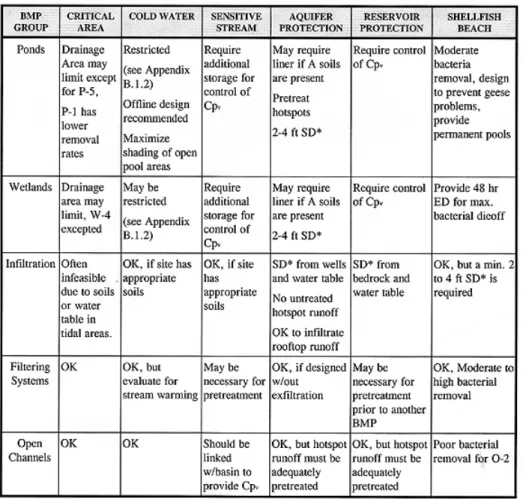
The first selection matrix, “Watershed Factors,” evaluates BMP suitability by the following six criteria: proximity to intensely developed areas, proximity to designated cold water streams, proximity to sediment-sensitive streams, required aquifer protection, required reservoir protection, and the presence of shellfish harvesting beds. Of
fundamental concern when designing urban BMPs are the characteristics of the receiving water body and its entire contributing watershed. This matrix’s purpose is to prohibit the selection of BMPs that are not capable of achieving the necessary pollutant removal required for environmentally sensitive watersheds. Additionally, this matrix precludes selection of BMPs that do not satisfy unique watershed design constraints and objectives. Existing as the initial phase of BMP selection, this matrix forces the designer to become aware of any special water quality concerns present in the watershed of interest.
Figure 2.1 MDE Watershed Factors Matrix
Source: Maryland Department of the Environment Stormwater Design Manual, 2000
The first criteria-based column of the Watershed Factors Matrix considers BMPs that are to be located within the Intensely Developed Area (IDA) of the Maryland Critical Area. This critical area is designated as a zone extending 1,000 feet landward from the mean high tide and the landward edge of tidal wetlands. Within this zone, BMPs must demonstrate compliance with Maryland’s “10% Rule.” This rule requires that post-development stormwater runoff from a site exhibit a minimum 10% reduction in phosphorus loads when compared to the pre-development runoff from the same site. This component of the matrix precludes selection of BMPs not capable of reducing the phosphorus content of stormwater runoff.
The next column in the matrix considers the special requirements governing discharge to designated cold and cool water streams. These designated streams have habitat qualities that are capable of supporting trout and other sensitive aquatic species.
Stormwater discharge from some BMPs can have potentially adverse impacts on cold water streams, and this component of the selection process exists to prevent selection of these measures. When discharge of a site’s runoff is planned for a designated cold water stream, certain design objectives arise that otherwise may not be prioritized. These measures include, prevention of stream warming, ensuring naturally occurring recharge, prevention of bank and channel erosion, and preservation of the natural riparian corridor. In addition to prohibiting the use of certain BMPs in the vicinity of designated cold water streams, the matrix also provides special provisions for those measures deemed permissible.
Streams categorized as “sensitive” may be designated by local authorities based on a number of criteria. Typically, these streams are characterized by a contributing watershed whose impervious cover is less than 15%. Additionally, these streams may possess high quality cool or warm water aquatic resources. Much like the previous selection consideration for cold water streams, the sensitive stream criterion attempts to maintain and preserve habitat quality and the stream’s natural integrity. Unlike
designated cold water streams, stream warming from stormwater runoff is not the paramount concern. However, the inability of a BMP to achieve other sensitive stream requirements may preclude its use.
The next two considerations in the Watershed Factors Matrix, aquifer and reservoir protection, present unique and potentially conflicting elements for the BMP designer. The primary design constraint is to prevent the contamination of drinking water by preventing the entrance of hotspot runoff into the water supply. However, from a water budget standpoint, the recharge of stormwater is needed to maintain flow in streams and wells during periods of dry weather. When stormwater runoff is directed from a BMP to a public supply reservoir, depending on the treatment employed at the water intake, it may be necessary to achieve a greater level of pollutant removal than would otherwise by necessary. Of particular concern is ensuring that hotspot runoff is adequately treated so that it does not contaminate drinking water.
The final element of the Watershed Factors Matrix provides consideration for the unique protection necessary when runoff is directed to a shellfish harvesting area or a public swimming beach. In these areas, a higher level of treatment is required of the
BMP chosen, with the principal concern being bacterial contamination from stormwater runoff. This element of the first MDE BMP selection matrix steers the designer to BMPs that maximize bacteria removal from stormwater runoff.
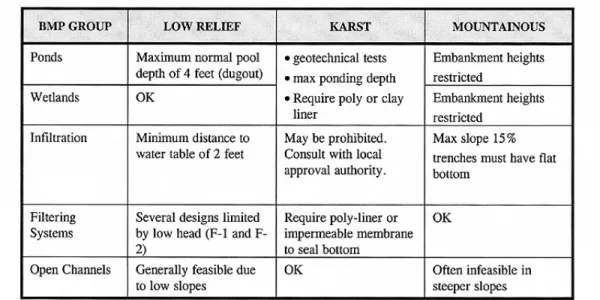
The second step in the MDE best management practice selection process is executed by employing the “Terrain Factors” matrix. This matrix guides BMP selection by examining the following three factors: site relief, site proximity to karst areas, and special concerns for sites located in mountainous terrain. Sites, such as those found in coastal areas, lacking pronounced relief, may make some BMPs such as ponds
infeasible. Conversely, due to the inherently flat slopes found in low relief areas, measures such as swales and infiltration basins may operate exceptionally well. Karst regions with high occurrences of carbonaceous rocks often limit or prohibit the use of the infiltration family of BMPs. These limitations are typically governed by the local review authority. Sites situated in mountainous regions will usually exhibit steep slopes.
Slopes in excess of 10 percent require special design provisions for pond embankments, and often prevent the use of infiltration swales, trenches, and basins.
Figure 2.2 MDE Terrain Factors Matrix
Source: Maryland Department of the Environment Stormwater Design Manual, 2000
The next matrix in the MDE selection process is the “Stormwater Treatment” matrix. This matrix evaluates the various BMPs by their ability to provide groundwater
recharge, ability to achieve the TSS removal levels required for discharge to impaired streams, ability to provide mitigation of peak rate of runoff, potential safety risks, required space, and the ability to accept “hotspot” runoff. This matrix is used in conjunction with Chapter 2 of the MDE stormwater manual to consider the ability of varying BMPs to meet these stormwater treatment criteria. Unlike the two previous MDE selection matrices, the Stormwater Treatment matrix examines individual measures as well as categories of BMPs. It is important to note that the inability of a particular measure to meet one of these criteria may not completely eliminate it from consideration. However, the inability of a BMP to meet one of these criteria, should the BMP be required by governing ordinance, does mean that it must be used as only one of multiple BMPs at the site.
Figure 2.3 MDE Stormwater Treatment Matrix
The first item considered in Figure 2.3 is groundwater recharge (ReV). While some BMPs are capable of providing significant recharge of groundwater, others, such as wet ponds equipped with a liner, actually prevent the natural recharge of site runoff that would otherwise occur. It is important to note that other stormwater management measures and approaches such as grass channels, filters, and disconnection of rooftop runoff are capable of meeting Rev requirements. Therefore, the inability of a BMP to achieve the required recharge may not prohibit its use on a particular site, provided other measures and approaches can be incorporated to provide the required recharge.
The second selection criterion in Figure 2.3 is the ability of the BMP to provide a stream channel protection volume (CpV). In addition to the detention volume often required to provide peak runoff rate mitigation, sensitive streams may require stormwater runoff to be detained such that sediment can settle out prior to entering the receiving stream. This selection criterion only examines the individual BMPs ability to meet the Cpv requirement. However, the inability of a BMP to meet this requirement does not eliminate it from consideration. To the designer, it simply implies that multiple BMPs are necessary to achieve the Cpv.
The third column in Figure 2.3 presents the peak mitigation performance of the individual BMP practices. Once the lone concern of stormwater management, peak mitigation remains a critical site design consideration. Typically the post-development runoff from a site must be less than or equal to the pre-development runoff. Often, this requirement is enforced for multiple return frequency storms. As with the other selection criteria represented by this matrix, the inability of a single BMP to satisfy a site’s peak mitigation requirement does not necessarily preclude its use. However, if a single BMP cannot reduce the peak sufficiently, multiple BMPs may be required.
The matrix’s next two columns consider safety issues associated with each BMP and the relative space required of the measure. The “Additional Safety Concerns” column is presented as a comparative index to express the potential need for additional safety concerns within a BMP practice. A “no” indicates that no additional measures are needed while a “yes” alerts designers that deep pools inherently associated with the particular practice may present potential safety risks. Liability and safety are primary considerations when BMPs are to be located in the vicinity of residential settings. The
“Adequate Space” column is also a comparative index that examines how much space a BMP typically consumes at a site. A “yes” indicates that, compared to the overall land area of a site, the BMP practice consumes a relatively small area. A “no” indicates that the BMP may consume a relatively high fraction of land on the site.
The final column of the Stormwater Treatment Suitability Matrix considers
whether or not the BMP practice can directly receive the highly contaminated runoff from areas classified as “hotspots,” such as industrial parking, loading, and storage areas. The matrix presents not only information on whether or not a particular measure can receive hotspot runoff, but also includes design restrictions and any additional measures that may be required to protect downstream areas from potential spills or leakages.
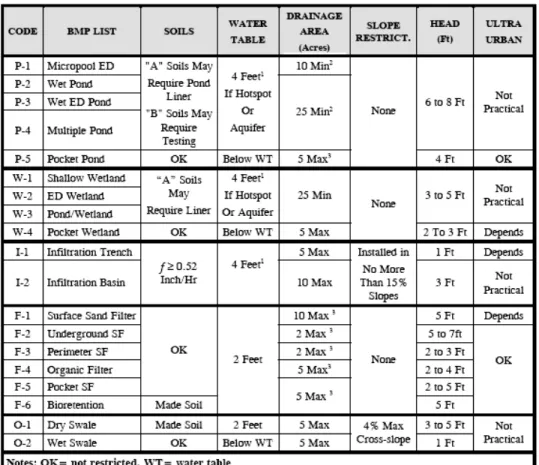
The next task in the MDE selection process is accomplished by utilizing the “Physical Feasibility” matrix. Existing as the fourth step in the selection process, it is assumed that at this point in the selection process the quantity of feasible BMPs has been reduced to a manageable number from which to choose. The purpose of this matrix is to further evaluate the appropriateness of the remaining measures by the following factors: site soil type, depth to water table, contributing drainage area, slope restrictions, available hydraulic head, and the proximity to “ultra-urban” areas. Infiltration measures as well as filtration measures require a minimum soil permeability.
Conversely, soils with excessively high permeability may not support certain BMPs such as ponds. Also of particular interest when considering infiltration measures is the depth to the seasonally high water table, represented by the matrix’s second column. The matrix’s drainage area column allows the designer to identify measures suitable and capable of accepting the runoff volume from the site’s contributing watershed. The site slope column places restrictions on infiltration measures, prohibiting their use if site slopes exceed 15 percent. The hydraulic head criterion provides the designer with an estimate of the elevation difference necessary at a site for gravitational processes to operate within a particular BMP practice. Finally, the matrix identifies which measures are suitable for highly urbanized areas. These areas present potential difficulties in that they frequently offer limited space for the BMP, but often produce highly contaminated runoff.
Figure 2.4 MDE Physical Feasibility Matrix
Source: Maryland Department of the Environment Stormwater Design Manual, 2000
Step five in the BMP selection process employed by the MDE examines community and environmental factors. As with previous criteria, selection of BMP practices conforming to various community and environmental factors is facilitated by a selection matrix. This matrix evaluates potentially suitable BMP practices by the following factors: ease of maintenance, community acceptance, construction cost, habitat quality, and “other factors” that may influence selection. The components of this matrix are less quantitative than those previously described. Consequently, practices are evaluated in terms of “benefit” rather than by quantifiable data.
Figure 2.5 MDE Community / Environmental Factors Matrix
Source: Maryland Department of the Environment Stormwater Design Manual, 2000
The Community / Environmental Factors Matrix’s first column provides the user with information on a BMP practice’s maintenance requirements. This information assesses the relative maintenance effort needed in terms of three criteria: frequency of scheduled maintenance, chronic maintenance problems (such as clogging of infiltration practices), and anticipated failure rates. To maintain expected performance, all BMPs require routine maintenance. However, as evidenced by the matrix, the relative maintenance effort varies considerably among measures.
The Community Acceptance criterion presented in column two of the matrix assesses the community acceptance of BMP practices based on three factors: market and preference surveys, reported nuisance problems, and visual aesthetics. The
information presented in this column considers only the BMP practice itself, and does not consider amenities such as landscaping which may potentially improve a practice’s ranking.
The Construction Cost column of the matrix evaluates the various BMPs in terms of their relative construction cost per impervious acre treated. The rankings presented in this column are based on cost surveys and data that are geographically specific to the state of Maryland. It should be noted that the cost rankings presented in this matrix represent only initial construction costs, and do not consider long-term maintenance costs, or the costs to repair or overhaul the practice should it fail.
The final two columns of the matrix evaluate the individual BMP practices on their ability to provide wildlife habitat and other factors that may be unique to the practice. The criteria considered in the Habitat Quality column of the matrix include size of the BMP, wetland features and vegetative cover, and the BMP buffer. The quality of wildlife habitat presented in this column is based on the assumption that routine maintenance efforts are made to landscape the measure appropriately.
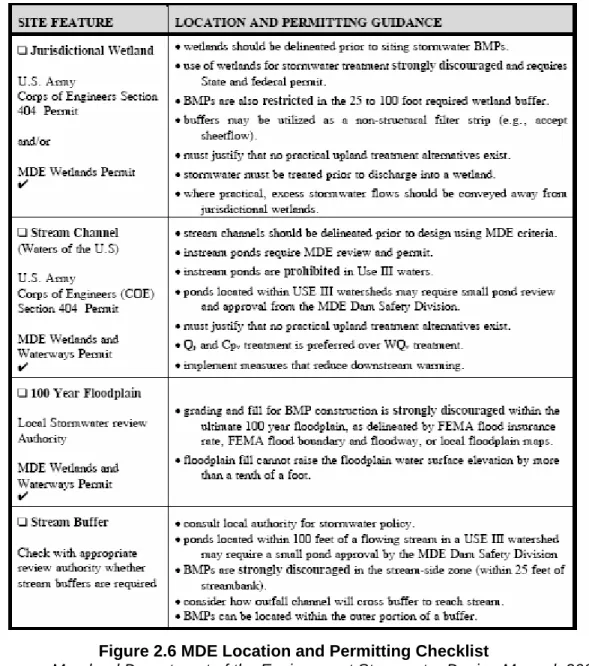
The final step in the Maryland BMP selection process is the completion of a Location and Permitting Factors checklist. Unlike the previous five steps, this
component of the BMP evaluation process does not assist in selecting an appropriate or optimal BMP practice for a site. It simply serves as a condensed summary of current BMP restrictions as they relate to site features regulated under local, State, or federal law. The restrictions addressed in the Location and Permitting Factors checklist fall into one of three categories, detailed as follows.
1. Locating a BMP within an area expressly prohibited by law.
2. Locating a BMP within an area that is strongly discouraged and is only allowed on a case-by-case basis.
Figure 2.6 MDE Location and Permitting Checklist
2.2 The Minneapolis – St. Paul Metropolitan Council Stormwater Suitability Approach to BMP Selection
In an effort to investigate how other regions of the country address best management practice selection, the Minneapolis – St. Paul Metropolitan Council’s stormwater design manual was reviewed. Chapter two of the Minneapolis – St. Paul manual is dedicated exclusively to the selection of BMPs. More abbreviated than the Maryland selection procedure, the Metropolitan Council suggests a three step process to BMP selection. The first step in this process is to evaluate the stormwater treatment suitability of the various practices. This matrix constructed by the Minneapolis – St. Paul Metropolitan Council is analogous to the Stormwater Treatment Suitability Matrix
employed by the MDE. This selection step employs three primary criteria. The first component investigated is the ability of various BMPs to meet stormwater runoff rate reduction requirements. Second, the ability to meet stormwater runoff volume reduction requirements is considered. And, finally, the matrix considers the ability of the various BMPs to serve as a primary or secondary treatment practice for pollutant removal.
Figure 2.7 Minneapolis-St. Paul Metropolitan Council Stormwater Suitability Matrix
Examination of Figure 2.7 reveals that the Stormwater Suitability Matrix
employed by the Minneapolis-St. Paul Metropolitan Council is very qualitative in nature. Evaluation of the individual BMP practices exists in relative terms compared to other BMPs, and not in absolute terms of performance. While the matrix is useful in refining the selection of measures capable of providing volume and/or peak runoff mitigation, it exhibits significant shortcomings in the evaluation of a measure’s ability to achieve a target pollutant removal percentage. Typically, the installation of BMP practices coincides with a specific performance target for pollutant removal. While the matrix indicates which measures are capable of serving as primary water quality measures, it does not present quantified pollutant removal performance data.
The next step in the BMP selection process described by the Metropolitan Council is to examine physical feasibility factors. The matrix employed in this step is very similar to that developed by the Maryland Department of the Environment,
essentially considering any physical restraints at a site that may restrict or preclude the use of a particular BMP practice.
Figure 2.8 Minneapolis-St. Paul Metropolitan Council Physical Feasibility Matrix Source: Minnesota Urban Small Sites BMP Manual, 2001
The first evaluation column of the matrix shown in Figure 2.8 presents
information regarding which hydrologic soil groups (HSG) affect the selection of each individual practice. The presence of hydrologic soil group “A” and, to a lesser degree, “B” often presents obstacles for the implementation of pond BMPs. These soil groups exhibit high and moderate infiltration rates respectively. The water quality benefit of pond BMP practices arises primarily from the gravitational settling of pollutants over some hydraulic residence time in the pond. High infiltration rates exhibited by the soil upon which the pond is constructed result in significant losses of the detained runoff through the pond bottom and embankments. This infiltration loss not only shortens the desired hydraulic residence time, but may also permit the transport of pollutants into ground water supplies. As indicated by Figure 2.8, the presence of high infiltration soils
on a site may not preclude the use of pond BMP practices, provided that the measure is constructed with a liner. Contrasting the problems encountered with high infiltration soils, hydrologic soil groups such as “C” and “D” present their own problems. Low infiltration soils often preclude the implementation of infiltration BMP practices. The low infiltration rates observed by these soil groups greatly increase the desired drawdown time for infiltration practices, resulting in undesired ponding and inadequate storage volume for subsequent runoff producing events.
Much like the MDE Physical Feasibility Matrix, the Minneapolis-St. Paul Metropolitan Council matrix considers the depth to the water table on a site, the site’s elevation difference (head), the area requirements for each individual BMP practice relative to overall site area, and the ability of the various measures to accept hotspot runoff. Unlike the MDE BMP selection approach, the Metropolitan Council includes a selection criterion dedicated to small sites (less than five acres in area). BMP practices designed to maintain a permanent pool must possess a source of surface baseflow to maintain the permanent pool during periods of drought and high evaporation rates. As evidenced by Figure 2.8, this minimum area requirement places possible restrictions on which BMP practices can be considered for sites with small contributing watersheds.
The final component of the Metropolitan Council’s selection process is to
examine community and environmental factors that influence BMP selection. While the Metropolitan Council’s recommended BMP selection process has only three steps, many selection criteria and considerations overlap with the six step selection process developed by the Maryland Department of the Environment.
Figure 2.9 Minneapolis-St. Paul Metropolitan Council Community / Environmental Factors Matrix
Source: Minnesota Urban Small Sites BMP Manual, 2001
The Metropolitan Council matrix shown in Figure 2.9 is essentially a duplicate of the Community / Environmental Factors matrix used by the MDE and presented as Figure 2.5. The two matrices serve only as relative comparisons between the various BMP practices, or, in the case of the “cost” column, as a relative cost of the practice relative to the area of the practice’s contributing watershed. As with the case of the MDE Community / Environmental Factors matrix, practices are evaluated in terms of “benefit” rather than by absolute, quantifiable units.
Clearly, the Minneapolis-St. Paul Metropolitan Council approach to BMP practice selection is very similar to the Maryland Department of the Environment approach. While useful in refining the selection process, the matrices previously described exhibit significant shortcomings. First, they inherently lend themselves to personal and
the design and implementation of certain, “favorite” BMP practices. In many cases these same practices are applied in settings where they may be feasible but not optimal. Second, completion of the matrix-based selection processes will present the designer with a collection of practices suited to the site. However, among the feasible options, there is no way to determine which measure is optimal. Finally, the matrices do not provide quantified data on the pollutant removal performance (initial and long-term), implementation cost, and maintenance cost of the practices.
2.3 Identification of Individual Best Management Practices
Broadly, BMPs are defined as “structural or nonstructural practices, or
combination of practices, designed to act as effective, practicable means of minimizing the impacts of development on water quality” (FHWA, 1996). The breadth of this definition leads to an almost limitless number of structural devices and management / development strategies potentially classified as BMPs. However, examining a number of existing state stormwater management manuals, Federal Highway Administration documents, and publications by the Environmental Protection Agency reveals 15 practices/strategies to be the most popular BMP options employed within the United States. These practices are presented, as follows, by BMP class.
Table 2.1 BMPs Grouped by Class
BMP Class Practice / Strategy Dry Extended Detention Pond Wet Porous Pavement Trench Infiltration Basin
Wetlands Constructed Stormwater Wetlands Bioretention
Vegetated Filter Strips
Vegetated Water Quality Swales Filtering
Sand Filtering Systems
Water Quality Inlets / Catch Basin Inserts Proprietary
Hydrodynamic Separators Vegetated Roofs
Minimum Disturbance / Minimum Maintenance Low Impact
The BMPs identified in Table 2.1 are discussed individually, at length, in Appendix B. The detailed description, review, and technical performance summary of these BMPs found in Appendix B serves as the foundation of the pairwise comparison templates developed in Chapter 6.
Chapter 3.0
Literature Review of the Analytic Hierarchy Process
Chapter 3 introduces and discusses the Analytic Hierarchy Process, including the algorithm, theory, and required inputs to support completion of the research objectives presented in Chapter 1. In summary, these research objectives are:
1. Construction of stand-alone matrices that facilitate BMP selection based on pollutant removal performance long-term maintenance cost.
2. Construction of hierarchal comparisons between alternative BMP measures and also between their relevant selection criteria.
3. Application of the hierarchal comparisons created in step 2 to the Analytic Hierarchy Process in multiple BMP selection and design case studies. Among the categories of criteria to consider in selecting a BMP for a particular location or objective are site-specific characteristics; local, state, and federal pollution control ordinances; and implementation and long-term maintenance costs. A selection consideration such as long-term maintenance cost may manifest itself in a very
subjective fashion during the BMP selection process. For example, in a private development scenario, a BMPs associated costs may be of very limited interest to the reviewing locality, whereas economic considerations may be the dominant selection criterion for the developer. By contrast, the pollutant removal efficiency of a BMP may be necessarily prioritized in the selection process because of the required adherence to governing legislation. These are two possible criteria influencing selection. As more and more selection criteria are considered, the task of objectively and optimally selecting a BMP becomes increasingly complex. One mathematical approach for optimization in the face of multiple influential criteria is the Analytic Hierarchy Process. “The analytic hierarchy process (AHP) provides the objective mathematics to process the inescapably subjective and personal preferences of an individual or a group in making a decision” (Schmoldt, 2001, pg. 15).
First introduced by Saaty in 1977 and later revised in 1994, the AHP acts as a decision-support tool capable of solving complex decision problems. From its inception, and arising from its concise mathematics and easily obtained input data, the AHP has been of great interest to researchers in many different fields (Triantaphyllou & Mann,
1995). Perhaps the greatest strength of the AHP is that, although its foundation lies in complex matrix manipulation, its employment is readily available to those with little knowledge of optimization theory. Furthermore, as illustrated in this document, the computational phases of the AHP are easily executed by employing familiar desktop software such as Microsoft Excel.
During the BMP selection process, in addition to easily quantified engineering and economic criteria, there are often political and financial influences impacting the choice of design options. Popular optimization tools, such as linear and non-linear programming, fall short in resolving these decisions because they inherently lack the ability to address multiple influential criteria with differing units or criteria exhibiting non-quantifiable units. The AHP is a powerful tool capable of considering an unlimited number of influential criteria exhibiting different units or no units at all. “Fundamentally, the AHP works by developing priorities for alternatives and the criteria used to judge the alternatives” (Schmoldt, 2001, pg. 16). Through pairwise comparisons, the AHPs prioritization step compares the various competing alternatives, such as different BMP practices, in terms of each selection criteria. Additionally, the algorithm establishes comparisons and prioritizations of the selection criteria themselves. These pairwise comparisons occur by establishing dimensionless relative importances among the competing alternatives and their influential selection criteria. The weighting component of the AHP permits mathematical optimization when the influential criteria exhibit quite different scales, or even no scale (units) at all.
Conceptually, the AHP is a three-step process that enables a decision maker to resolve the daunting task of multiple criteria optimization into an objective algorithmic approach. First, a hierarchy consisting of the possible outcomes and subordinate (intermediate) features influencing these outcomes is constructed. In the application scenario presented later in this paper, the end outcome or goal is to choose among competing BMP alternatives the optimal measure capable of addressing all required pollutant removal performance targets while simultaneously proving to be the most economically attractive option. The subordinate features of the hierarchy are the
multiple categories of selection criteria influencing the decision. Next, and for each level of the hierarchy, pairwise comparisons between the possible BMP alternatives and between the criteria themselves determine the ordering of decision elements. This step
enables priority weighting of the criteria influencing the outcome decision, as well as ranking of the possible outcomes in terms of performance for each criterion. Finally, matrix algebra propagates level-specific, local priorities to global priorities.
Fundamentally, the AHP algorithm operates by prioritizing competing alternatives as well as the criteria used to judge the alternatives. This prioritization procedure places
weights on the influential selection criteria, thus accommodating the varying scales and units exhibited by these criteria.
3.1 Construction of Pairwise Comparison Matrices
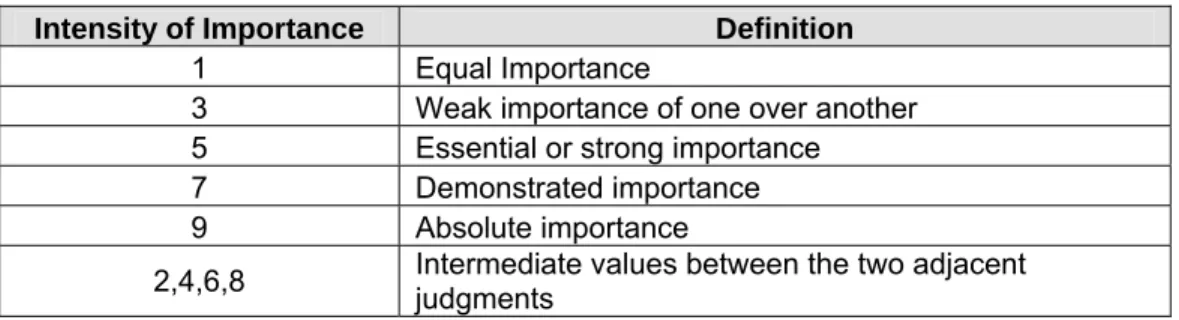
The first step in performing the AHP is to identify all possiblealternatives from which a single alternative is selected. Next, it is necessary to identify all relevant criteria influencing the selection of a single alternative from the pool of feasible alternatives. Because the numerous selection criteria exhibit varying units (or in some cases no units at all), mathematical evaluation of the criteria requires the operator to determine the relative scale, or weight, of the alternatives in terms of each criterion. This task is accomplished by employing Table 3.1. Table 3.1 was first proposed by Saaty for determining the dimensionless scale of relative importances. This table and others developed since Saaty’s initial work, permits pairwise comparisons within the AHP. “In this approach the decision-maker has to express his opinion about the value of one single pairwise comparison at a time.” (Triantaphyllou & Mann, 1995) In other words, within every hierarchal comparison matrix, the user must compare each competing alternative against every other competing alternative employing a scale of relative importance. This type of comparison is executed for each influential criterion, and ultimately the influential criteria are compared and ranked against themselves.
Employing the scale of relative importances, one is able to construct judgment matrices for each selection criterion. This step evaluates the performance of each possible alternative against the other alternatives in terms of the various selection
criteria. These judgment matrices are of dimensions MxM, “M” being the total number of alternatives considered. The final judgment matrix is termed the criteria judgment matrix and evaluates and ranks the importances of each of the influential criterion when
compared against the other criteria. The criteria judgment matrix is of dimension NxN, “N” being the total number of influential criteria. It is during the construction of the
criteria judgment matrix that the operator is able to prioritize the criteria influencing the selection of the competing alternatives.
Table 3.1 Scale of Relative Importances (Saaty, 1980)
Intensity of Importance Definition
1 Equal Importance
3 Weak importance of one over another 5 Essential or strong importance
7 Demonstrated importance
9 Absolute importance
2,4,6,8 Intermediate values between the two adjacent judgments
Entries into the judgment and criteria judgment matrices are expressed in terms of the importance intensities illustrated in Table 3.1. For instance, consider a judgment matrix comparing alternatives “A,” “B,” and “C” in terms of criterion “N.” “By convention, the comparison of strength is always of an activity appearing in the column on the left against an activity appearing in the row on top.” (Saaty, 1980, pg. 18) An element in the matrix is equally important when compared with itself, and thus the main diagonal of all judgment matrices must be 1. Employing Table 3.1, consider the following scenario:
• In terms of criterion “N,” A is demonstrably more important than B. In practice, such a comparison would indicate that, in terms of satisfying criterion “N,” alternative A strongly outperforms alternative B.
• In terms of criterion “N,” C is weakly more important than A. In practice, this comparison expresses that, in terms of criterion “N,” alternative C is slightly superior to alternative A.
At this point, the judgment matrix of criterion N appears as follows:
Table 3.2 Preliminary Construction of Judgment Matrix (Criterion “N”)
N A B C
A 1 7 1/3
B 1/7
Following the aforementioned convention, notice that the relative importances