!
NIH$Toolbox$
!
!
!
!
Technical$Manual$
Michael!Kallen,!PhD,!Jerry!Slotkin,!PhD,!James!Griffith,!PhD,!Susan!Magasi,!PhD,!John! Salsman,!PhD,!Richard!Gershon,!PhD,!and!Cindy!Nowinski,!MD,!PhD!! ! September$27,$2012$NIH$Toolbox$Technical$Manual$
$
Domain:$
EMOTION$
$
Subdomain:$
SOCIAL$RELATIONSHIPS$
$
Subdomain$Component:$
SOCIAL$DISTRESS$
$
Measure:$
NIH$Toolbox$Peer$Rejection$Survey$
Expert$ContributorsEEMOTION$
$
Rita$K.$Bode,$PhD$(Northwestern$University),$Zeeshan$Butt,$PhD$(Northwestern$University),$ David$Cella,$PhD$(Northwestern$University),$Seung$Choi,$PhD$(Northwestern$University),$Jill$ Cyranowski,$PhD$(University$of$Pittsburgh),$Hugh$Hendrie,$MB,$ChB,$DSc$(Indiana$University),$ Mary$Jo$Kupst,$PhD$(Medical$College$of$Wisconsin),$JinRShei$Lai,$PhD$(Northwestern$University),$ Tara$Moore,$MA$(University$of$Pittsburgh),$Cindy$Nowinski,$MD,$PhD$$(Northwestern$ University),$Paul$Pilkonis,$PhD$(University$of$Pittsburgh),$John$Salsman,$PhD$(Northwestern$ University),$Nicholas$Zill,$PhD$(Westat,$Inc.)$ $ $ $Member$Institutes,$Centers,$and$Offices$
$ National$Center$for$Complementary$and$Alternative$Medicine$(NCCAM)$ National$Eye$Institute$(NEI)$ National$Institute$of$Biomedical$Imaging$and$Bioengineering$(NIBIB)$$ Eunice$Kennedy$Shriver$National$Institute$of$Child$Health$and$Human$Development$(NICHD)$$ National$Institute$of$Dental$and$Craniofacial$Research$(NIDCR)$ National$Institute$of$Environmental$Health$Sciences$(NIEHS)$$ National$Institute$of$General$Medical$Sciences$(NIGMS)$ National$Institute$of$Mental$Health$(NIMH)$$ National$Institute$of$Neurological$Disorders$and$Stroke$(NINDS)$$ National$Institute$of$Nursing$Research$(NINR)$$ National$Institute$on$Aging$(NIA)$ National$Institute$on$Alcohol$Abuse$and$Alcoholism$(NIAAA)$ National$Institute$on$Deafness$and$Other$Communication$Disorders$(NIDCD)$ National$Institute$on$Drug$Abuse$(NIDA)$ Office$of$Behavioral$and$Social$Sciences$Research$(OBSSR)$ $ $ $ $This$project$is$funded$in$whole$or$in$part$with$Federal$funds$from$the$Blueprint$for$ Neuroscience$Research$and$the$Office$of$Behavioral$and$Social$Sciences$Research,$National$ Institutes$of$Health,$under$Contract$No.$HHSRNR260R2006R00007RC,$with$additional$support$from$ the$National$Children’s$Study,$under$Contract$No.$HHSRNR267R2007R00027RC.$ $ $ $ $ $ $ $ $ $ $ $ $ $ $ $ $ $ ©$2006R2012$National$Institutes$of$Health$and$Northwestern$University$
This$Technical$Manual$contains$the$following$informational$sections:$ $
Section$1:$ Introduction$to$NIH$Toolbox$
Section$2:$ Validation$
Section$3:$ Norming$
Section$4:$ NIH$Toolbox$and$the$National$Children’s$
Study$(NCS)$
Section$5:$ Domain$Definition$
Section$6:$ Subdomain$and$Subdomain$Component$
Definitions$
Section$7:$ Measure$Description$
Section$8:$ PostEValidation/PostENorming$Changes$to$
the$Measure$
Section$9:$ The$Measure’s$Scoring$Model$
Section$10:$ Measure$Norms$
$
$
Section$1:$ Introduction$to$NIH$Toolbox$
$ NIH$Toolbox$is$a$multidimensional$set$of$brief$measures$assessing$cognitive,$emotional,$motor,$ and$sensory$function$from$ages$3R85.$This$suite$of$onRline$and$royaltyRfree$measures$can$be$ administered$to$study$participants$3$to$85$years$of$age$in$two$hours$or$less,$across$diverse$study$ designs$and$settings.$ $ What$is$the$NIH$Toolbox?$ The$NIH$Toolbox$provides$a$standard$set$of$royaltyRfree,$brief,$and$comprehensive$assessment$ tools$that$can$be$used$by$researchers$and$clinicians$in$a$variety$of$settings,$with$a$particular$ emphasis$on$measuring$outcomes$in$longitudinal$epidemiologic$studies$and$prevention$or$ intervention$trials$across$the$lifespan$(ages$3R85).$The$battery$ensures$that$assessment$ methods$and$results$can$be$used$for$comparisons$across$existing$and$future$studies$and$ provides$a$“common$currency”$for$the$study$of$neurological$research$that$promotes$economies$ of$scale$and$enhanced$efficiency$in$measurement.$The$NIH$Toolbox$can$be$used$to$monitor$ neurological$and$behavioral$function$over$time$and$measure$key$constructs$across$ developmental$stages.$This$facilitates$the$study$of$functional$changes$across$the$lifespan,$ including$evaluating$intervention$and$treatment$effectiveness.$ $ $ $The$NIH$Toolbox$Batteries$ The$basic$NIH$Toolbox$can$be$administered$within$two$hours$and$divides$tests$into$four$domain$ batteries:$Cognition,$Emotion,$Motor,$and$Sensation.$In$addition,$within$some$domains,$there$ are$supplemental$measures$that$are$available$to$be$administered.$$ $ Selection$of$the$NIH$Toolbox$Domains$and$Subdomains$$ Four$domains$were$selected$for$the$NIH$Toolbox:$Cognition,$Emotion,$Motor,$and$Sensation.$ Subdomain$selection$was$based$upon$literature$reviews,$expert$interviews,$and$multiple$formal$ Requests$for$Information$(RFI)$of$NIHRfunded$researchers.$Initial$literature$and$database$ reviews$and$an$RFI$identified$the$subdomains$for$inclusion$in$the$NIH$Toolbox,$existing$ measures$relevant$to$the$project$goals,$and$criteria$for$instrument$selection.$NIH$Project$Team$ members,$external$content$experts,$and$contract$scientists$met$at$a$followRup$consensus$ meeting$to$discuss$potential$subdomains$along$with$the$criteria$affecting$instrument$selection,$ creation,$and$norming.$Additional$expert$interviews$were$undertaken$to$gather$more$detailed$ information$from$clinical$and$scientific$experts$to$help$further$refine$the$list$of$possible$ subdomains.$A$second$consensus$group$meeting$was$held$and$results$directed$the$decision$for$ the$final$NIH$Toolbox$to$assess$four$core$domain$areas$(cognitive,$emotional,$motor,$and$ sensory$health$and$function).$ $ Selection$of$Measures$for$the$NIH$Toolbox$ More$than$1,400$existing$measures$were$identified$and$evaluated$for$potential$inclusion$in$the$ NIH$Toolbox.$The$selection$criteria$included$a$measure’s$applicability$across$the$life$span,$
psychometric$soundness,$brevity,$ease$of$use,$applicability$in$diverse$settings$and$with$different$ groups,$and$lack$of$intellectual$property$constraints.$There$was$also$a$preference$for$ instruments$that$were$already$validated$and$normed$for$use$with$individuals$between$3$and$85$ years$old.$Results$of$the$instrument$selection$process$yielded$draft$development$plans$ established$for$the$NIH$Toolbox$measures.$$ $ Early$Childhood$Use$ NIH$Toolbox$measure$development$focused$special$attention$on$assessing$young$children,$to$ ensure$that$all$tests$given$are$developmentally$appropriate$for$ages$3R7.$A$special$team$of$early$ childhood$assessment$consultants$was$engaged$to$provide$testing$guidelines$for$the$very$ young,$to$offer$input$on$measure$development,$and$to$review$all$NIH$Toolbox$measures$to$ ensure$they$fit$the$needs$of$young$children.$Advanced$statistical$methods$were$used$to$ emphasize$continuity$of$measurement,$allowing$Toolbox$users$to$confidently$conduct$ longitudinal$measurement$from$age$3$through$the$life$span$while$assessing$the$same$domain$ constructs.$ $
Section$2:$ Validation$
$ Validation$studies$were$conducted$for$all$NIH$Toolbox$Emotion$domain$measures,$to$assure$ that$these$important$tools$for$research$met$rigorous$psychometric$standards.$Studies$were$conducted$across$the$entire$age$range$and$were$statistically$compared$against$“gold$standard”$ measures$wherever$available.$$
$
For$specifics$regarding$Emotion$domain$measure$validation,$see$Salsman$et$al.,$Emotion$ Assessment$using$the$NIH$Toolbox,$Neurology,$in$press.$This$manuscript$describes$measure$ development$studies$undertaken$(e.g.,$expert$panels$for$content$development$and$validation;$ cognitive$interviews;$small$and$largeRscale$pilot$testing)$and$psychometric$characteristics$(e.g.,$ internal$consistency$and$testRretest$reliability;$convergent$and$divergent$validity).$ $
Section$3:$ Norming$
$ NIH$Toolbox$conducted$a$large$national$standardization$study$in$both$English$and$Spanish$ languages$to$allow$for$normative$comparisons$on$each$assessment.$A$sample$of$4,859$ participants,$ages$3R85$–$representative$of$the$U.S.$population$based$on$gender,$ethnicity,$race,$ and$socioeconomic$status$–$was$administered$all$of$the$NIH$Toolbox$measures$at$sites$around$ the$country$(n$=$2,917$EnglishRspeaking$children,$ages$3R17;$n$=$496$SpanishRspeaking$children,$ ages$3R7;$n$=$1,038$EnglishRspeaking$adults,$ages$18R85;$n$=$408$SpanishRspeaking$adults,$ages$ 18R85).$NIH$Toolbox$normative$scores$are$now$available$for$each$year$of$age$from$3$through$17,$ as$well$as$for$age$ranges$18R29,$30R39,$40R49,$50R59,$60R69,$and$70R85,$allowing$for$targeted$ and$accurate$comparisons$to$the$U.S.$population.$ $Specifics$regarding$NIH$Toolbox$norming$sampling$methods$(e.g.,$stratification$by$age,$gender,$ and$language$preference;$sampling$a$minimum$of$25R100$individuals$per$targeted$demographic$ and$language$subgroup)$and$norming$analytic$methods$(e.g.,$postRstratification$adjustment$ using$iterative$proportional$fitting,$i.e.,$“raking”)$can$be$found$in$the$following$publication:$ Beaumont$et$al.,$Norming$Plans$for$the$NIH$Toolbox,$Neurology,$in$press.$
$
Section$4:$ NIH$Toolbox$and$the$National$Children’s$
Study$(NCS)$
$ In$collaboration$with$NIH$Toolbox$scientists,$NCS$investigators$selected$measures$from$PROMIS$ and$NIH$Toolbox$for$a$Maternal$Health$Profile,$the$Maternal$SelfRReported$Health$Battery.$This$ profile$assesses$Physical$Health$(Physical$function,$Fatigue,$Sleep$disturbance,$SleepRrelated$ impairment),$Mental$Health$(Anger,$Anxiety,$Depression,$Positive$affect,$Perceived$stress,$SelfR efficacy),$and$Social$Health$(Social$support$and$companionship,$Social$isolation).$The$Maternal$ SelfRReported$Health$Battery$was$field$tested$in$fall$2011,$using$an$online$sample$of$1000$ women$(200$preRconception,$150$pregnant$women$(50$per$trimester),$and$650$mothers$with$a$ child$between$0R36$months$of$age).$In$addition,$NIH$Toolbox$norming$was$jointly$sponsored$by$ the$NCS$and$included:$3,413$children$in$singleRyear$age$bands$(from$3R17$years);$1,446$adults$in$ seven$age$bands,$including$the$mothers$of$children$also$being$tested;$and$105$pregnant$ women.$The$NIH$Toolbox$sampling$plan$matched$distributions$of$race/ethnicity$and$level$of$ education$for$each$age$band.$Section$5:$ Domain$Definition$
$ Domain:$ EMOTION$ Emotion$refers$to$any$strong$feelings,$as$of$joy,$sorrow,$or$fear.$$Emotion$is$an$affective$state$of$ consciousness$in$which$joy,$sorrow,$fear,$hate,$or$the$like,$is$experienced,$as$distinguished$from$ cognitive$and$volitional$states$of$consciousness.$$Emotions$can$be$negative$and$distressing,$or$ positive$emotions$can$be$reflections$of$wellRbeing$in$our$lives,$and$positive$social$relationships$ can$buffer$stress$and$enhance$health.$The$NIH$Toolbox$Emotion$domain$includes$four$major$ subdomains:$Psychological$WellRBeing,$Negative$Affect,$Stress$and$SelfREfficacy,$and$Social$ Relationships.$Measures$include$both$selfRreport$and,$for$certain$ages,$parentRreport$versions.$ $ PSYCHOLOGICAL$WELLEBEING$$ POSITIVE$AFFECT$ Measured$by:$$ NIH$Toolbox$Positive$Affect$Survey$$ $ LIFE$SATISFACTION$ Measured$by:$ $NIH$Toolbox$General$Life$Satisfaction$Survey$ NIH$Toolbox$DomainRSpecific$Life$Satisfaction$Survey$(Supplemental$ Measure)$MEANING$AND$PURPOSE$ Measured$by:$$ NIH$Toolbox$Meaning$and$Purpose$Survey$$ $ NEGATIVE$AFFECT$$ ANGER$ Measured$by:$$ NIH$Toolbox$AngerRAffect$Survey$ NIH$Toolbox$AngerRHostility$Survey$ NIH$Toolbox$AngerRPhysical$Aggression$Survey$ NIH$Toolbox$Anger$Survey$ $ FEAR$ Measured$by:$$ NIH$Toolbox$FearRAffect$Survey$ NIH$Toolbox$FearRSomatic$Arousal$Survey$ NIH$Toolbox$FearROver$Anxious$Survey$ NIH$Toolbox$Fear$Survey$ NIH$Toolbox$FearRSeparation$Anxiety$Survey$$ $ $ $
SADNESS$ Measured$by:$$ NIH$Toolbox$Sadness$Survey$ NIH$Toolbox$Apathy$Survey$(Supplemental$Measure)$ $ STRESS$AND$SELFEEFFICACY$ PERCEIVED$STRESS$ Measured$by:$$ NIH$Toolbox$Perceived$Stress$Survey$ $ SELFEEFFICACY$ Measured$by:$$ NIH$Toolbox$SelfREfficacy$Survey$ $ COPING$STRATEGIES$ Measured$by:$$ NIH$Toolbox$Emotion$Control$Survey$(Supplemental$Measure)$ $ SOCIAL$RELATIONSHIPS$ PERCEIVED$SOCIAL$SUPPORT$ Measured$by:$$ NIH$Toolbox$Emotional$Support$Survey$
NIH$Toolbox$Instrumental$Support$Survey$ NIH$Toolbox$Maternal$Relationship$Survey$(Supplemental$Measure)$ NIH$Toolbox$Paternal$Relationship$Survey$(Supplemental$Measure)$ NIH$Toolbox$Positive$Parental$Relationship$Survey$(Supplemental$ Measure)$ NIH$Toolbox$Negative$Parental$Relationship$Survey$(Supplemental$ Measure)$ $ COMPANIONSHIP$ Measured$by:$$ NIH$Toolbox$Friendship$Survey$ NIH$Toolbox$Loneliness$Survey$ NIH$Toolbox$Social$Withdrawal$Survey$ NIH$Toolbox$Positive$Peer$Interaction$Survey$ $ SOCIAL$DISTRESS$ Measured$by:$$ NIH$Toolbox$Perceived$Rejection$Survey$ NIH$Toolbox$Perceived$Hostility$Survey$ NIH$Toolbox$Peer$Rejection$Survey$ NIH$Toolbox$Sibling$Rejection$Survey$(Supplemental$Measure)$ $
POSITIVE$SOCIAL$DEVELOPMENT$ Measured$by:$$ NIH$Toolbox$Empathic$Behaviors$Survey$ $ EMOTION$Batteries$ There$are$two$NIH$Toolbox$Emotion$Batteries$–$a$selfRreport$battery$and$a$parentRreport$ battery.$The$selfRreport$battery$is$available$for$ages$8R85$and$includes$all$ageRspecified$ measures$in$the$Psychological$WellRBeing,$Negative$Affect,$Stress$and$SelfREfficacy,$and$Social$ Relationships$domains,$as$indicated.$The$parentRreport$battery$is$available$for$ages$3R12$and$ includes$all$ageRspecified$measures$in$the$Psychological$WellRBeing,$Negative$Affect,$Stress$and$ SelfREfficacy,$and$Social$Relationships$domains,$as$indicated.$$There$are$individual$scores$ provided$for$each$individual$battery$measure,$as$described,$but$no$composite$scores.$ $
Section$6:$ Subdomain$and$Subdomain$Component$
Definitions$
$ Subdomain:$ $ $ SOCIAL$RELATIONSHIPS$ There$are$several$dimensions$of$Social$Relationships,$including$their$structure,$extent,$and$ quality.$NIH$Toolbox$focuses$on$four$aspects$of$Social$Relationships:$Perceived$Social$Support,$ Companionship,$Social$Distress,$and$Positive$Social$Development.$ $Subdomain$Component:$ SOCIAL$DISTRESS$ Social$Distress$is$the$extent$to$which$an$individual$perceives$his/her$daily$social$interactions$as$ negative$or$distressing.$$This$can$include$aspects$of$perceived$hostility$(e.g.,$how$often$people$ argue$with$me,$yell$at$me,$or$criticize$me)$and$perceived$insensitivity$(e.g.,$how$often$people$ don’t$listen$when$I$ask$for$help,$or$don’t$pay$attention$to$me).$In$NIH$Toolbox,$Social$Distress$is$ measured$by:$$ $ NIH$Toolbox$Perceived$Rejection$Survey$ NIH$Toolbox$Perceived$Hostility$Survey$ NIH$Toolbox$Peer$Rejection$Survey$ NIH$Toolbox$Sibling$Rejection$Survey$(Supplemental$Measure)$ $
Section$7:$ Measure$Description$
$ EMOTION$Core$Measure$ As$an$analogue$to$the$NIH$Toolbox$Perceived$Rejection$Survey,$the$NIH$Toolbox$Peer$Rejection$ Survey$is$a$parentRreport$measure$for$children$ages$3R12.$It$is$a$9Ritem$fixedRlength$form$that$ assesses$how$often$a$child$is$left$out,$avoided,$or$teased$by$peers.$ $Section$8:$ PostEValidation/PostENorming$Changes$to$
the$Measure$
$
In$addition$to$those$changes$previously$reported$on$during$the$measure’s$development$and$ validation$phases$(Salsman$et$al.,$Emotion$Assessment$Using$the$NIH$Toolbox,$Neurology,$in$ press),$the$following$changes$have$been$made$to$this$measure:$ $ ItemRlevel$changes$(8R12$Parent$Report,$3R7$Parent$Report):$ Item$wording$changed$from:$How$often$your$child$is$left$out$by$his/her$siblings$(12th$ grade$level)? -Item$wording$changed$to:$How$often$your$child$is$left$out$by$his/her$brothers-or-sisters$ (4th$grade$level)?$ Rationale$for$change:$Improved$readability.$ $
Section$9:$ The$Measure’s$Scoring$Model$
$ Measurement$theory$applied$for$scoring:$ Classical$Test$Theory$(CTT)$ $ CTT$scoring$approach$employed:$ Sum$(raw$sum$of$item$responses)$Measure$length:$ Fixed$(9$items,$3R12$Parent$Report)$ $ Response$data:$ Ordinal$(items$have$a$5Rpoint$response$scale;$options$range$from$“never”$to$“always”)$ $ Scores$computed/available*:$ AgeRAdjusted$Scale$Score$(mean=50,$standard$deviation=10)$ Fully$Adjusted$Scale$Score$(mean=50,$standard$deviation=10)$ Unadjusted$Scale$Score$(mean=50,$standard$deviation=10)$ National$Percentile$Rank$(corresponds$to$the$AgeRAdjusted$Scale$Score)$ $ *Details$on$these$scores$and$their$interpretations$are$available$in$the$NIH$Toolbox$Scoring$and$ Interpretation$Guide.$ $
$
$
Section$10:$ Measure$Norms$
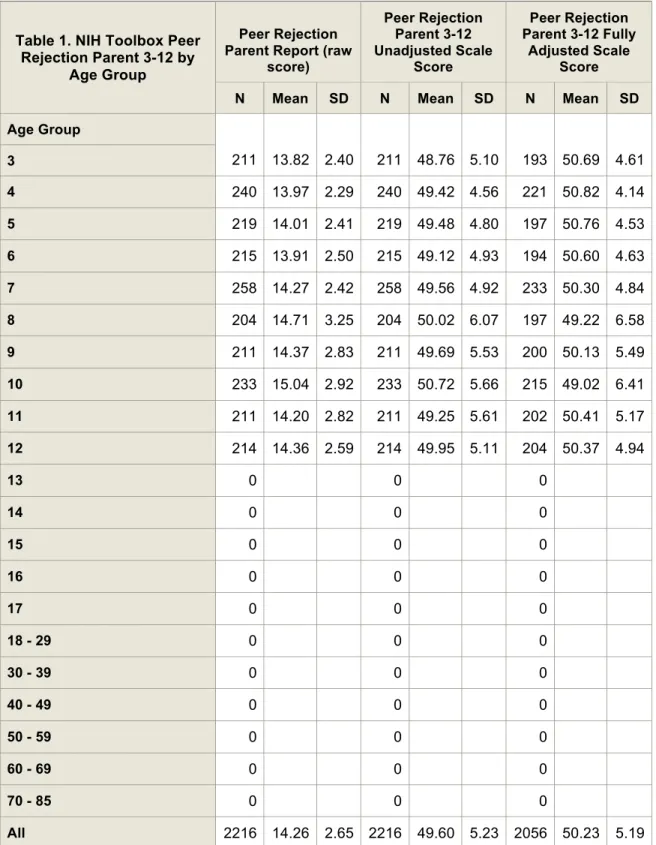
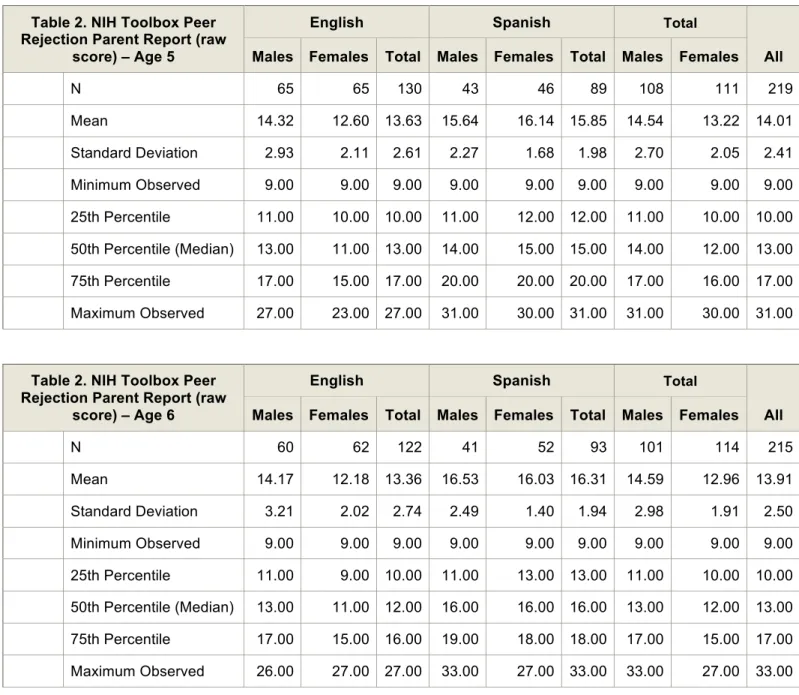
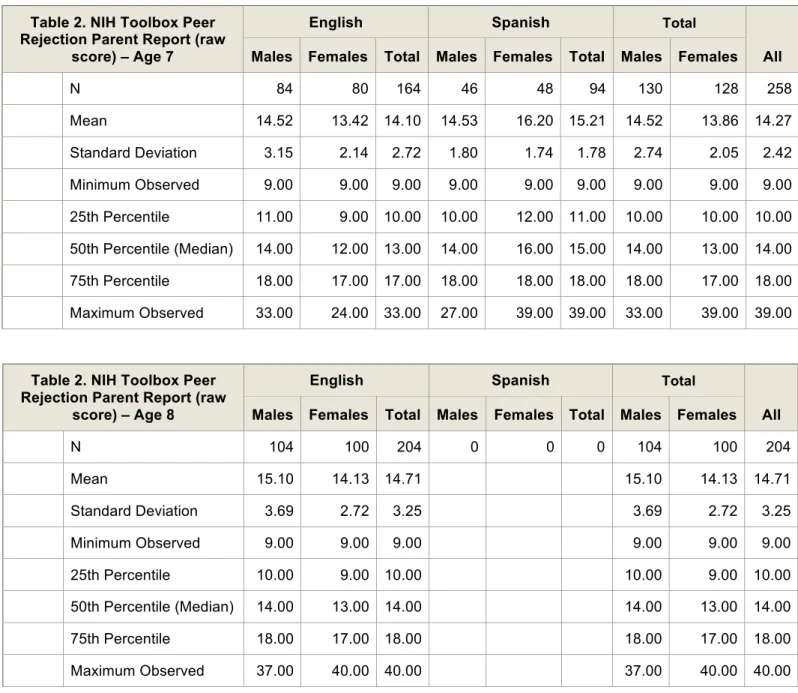
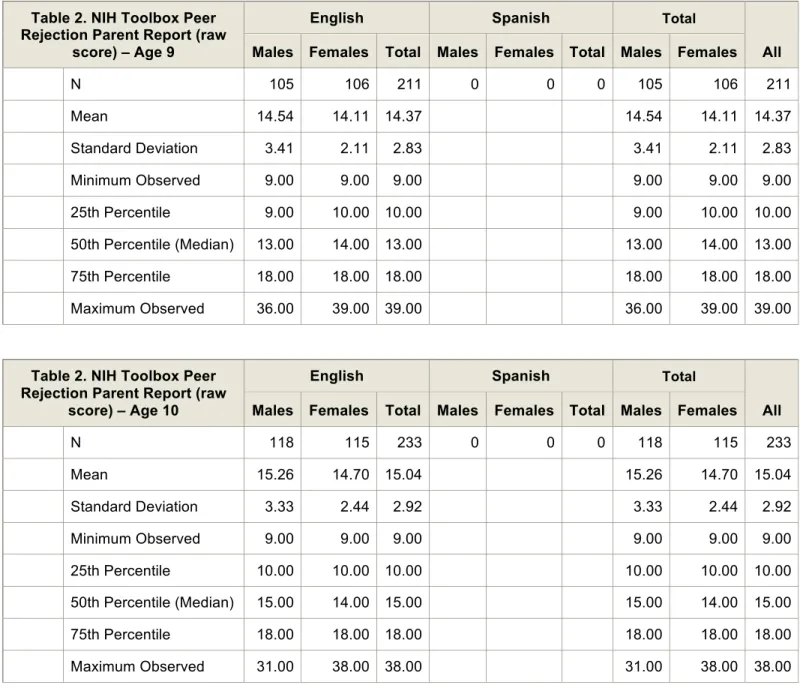
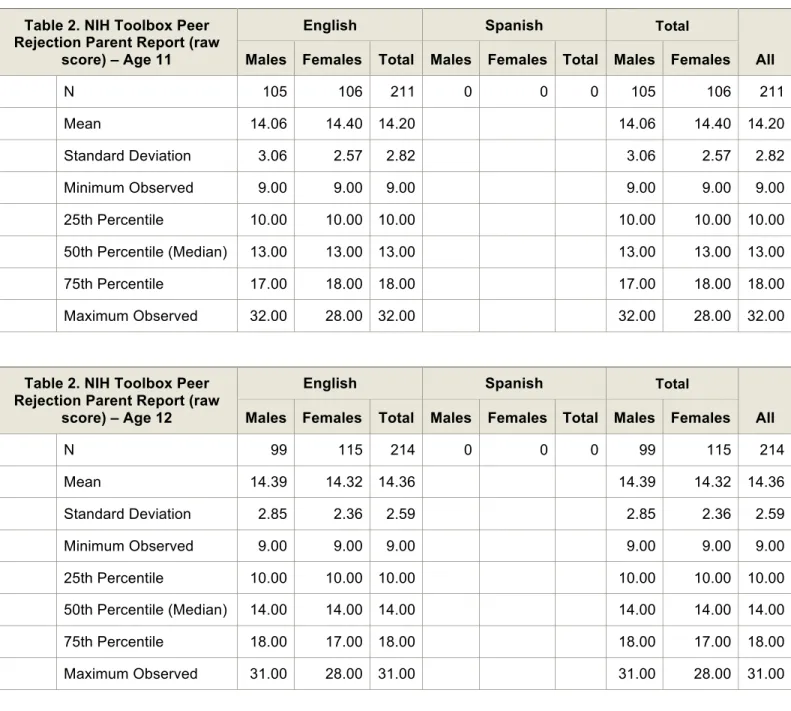
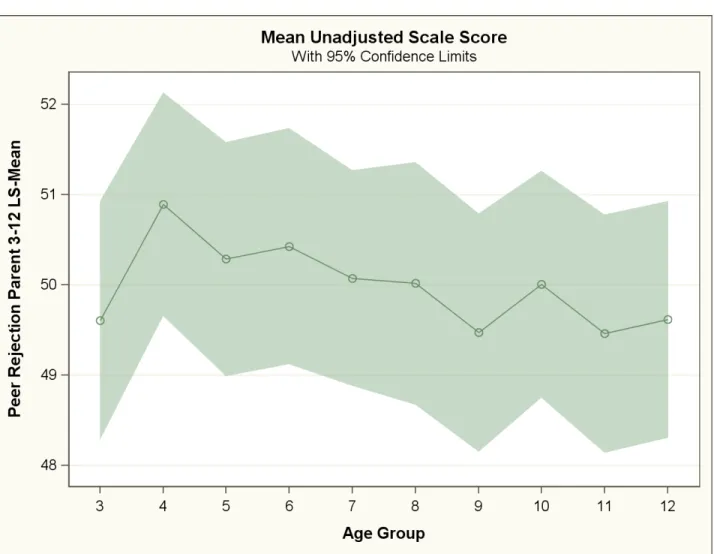
$ The$following$Tables$and$Figure$present$NIH$Toolbox$normative$data$associated$with$this$ measure:$ $ Table$1.$ Measure$Raw/Computed$Score,$Unadjusted$Scale$Score,$and$Fully$ Adjusted$Scale$Score$Summary$(N,$Mean,$Standard$Deviation)$by$Age$ Group$(3,$4,$5,$6,$7,$8,$9,$10,$11,$12,$All)$ $ Table$2.$ Measure$Raw/Computed$Score$Statistics$(N,$Mean,$Standard$Deviation,$ Minimum/Maximum$Observed,$25th/50th/75th$Percentile)$per$Age$ Group$(3,$4,$5,$6,$7,$8,$9,$10,$11,$12,$All)$ $ Figure$1.$ Measure$Mean$Unadjusted$Scale$Scores$across$All$Age$Groups$(3,$4,$5,$ 6,$7,$8,$9,$10,$11,$12)$$
Table 1. NIH Toolbox Peer Rejection Parent 3-12 by
Age Group
Peer Rejection Parent Report (raw
score) Peer Rejection Parent 3-12 Unadjusted Scale Score Peer Rejection Parent 3-12 Fully Adjusted Scale Score N Mean SD N Mean SD N Mean SD Age Group 211 13.82 2.40 211 48.76 5.10 193 50.69 4.61 3 4 240 13.97 2.29 240 49.42 4.56 221 50.82 4.14 5 219 14.01 2.41 219 49.48 4.80 197 50.76 4.53 6 215 13.91 2.50 215 49.12 4.93 194 50.60 4.63 7 258 14.27 2.42 258 49.56 4.92 233 50.30 4.84 8 204 14.71 3.25 204 50.02 6.07 197 49.22 6.58 9 211 14.37 2.83 211 49.69 5.53 200 50.13 5.49 10 233 15.04 2.92 233 50.72 5.66 215 49.02 6.41 11 211 14.20 2.82 211 49.25 5.61 202 50.41 5.17 12 214 14.36 2.59 214 49.95 5.11 204 50.37 4.94 13 0 0 0 14 0 0 0 15 0 0 0 16 0 0 0 17 0 0 0 18 - 29 0 0 0 30 - 39 0 0 0 40 - 49 0 0 0 50 - 59 0 0 0 60 - 69 0 0 0 70 - 85 0 0 0 All 2216 14.26 2.65 2216 49.60 5.23 2056 50.23 5.19
Table 2. NIH Toolbox Peer Rejection Parent Report (raw
score) – Age 3
English Spanish Total
All Males Females Total Males Females Total Males Females
N 58 52 110 51 50 101 109 102 211 Mean 13.67 12.70 13.31 15.82 15.15 15.57 14.15 13.25 13.82 Standard Deviation 3.24 2.27 2.83 1.73 1.62 1.67 2.69 2.03 2.40 Minimum Observed 9.00 9.00 9.00 9.00 9.00 9.00 9.00 9.00 9.00 25th Percentile 10.00 9.00 9.00 13.00 11.00 12.00 10.00 9.00 10.00 50th Percentile (Median) 13.00 12.00 12.00 17.00 15.00 16.00 14.00 12.00 13.00 75th Percentile 17.00 15.00 16.00 19.00 17.00 19.00 18.00 16.00 17.00 Maximum Observed 29.00 22.00 29.00 27.00 32.00 32.00 29.00 32.00 32.00
Table 2. NIH Toolbox Peer Rejection Parent Report (raw
score) – Age 4
English Spanish Total
All Males Females Total Males Females Total Males Females
N 67 67 134 49 57 106 116 124 240 Mean 13.80 13.00 13.49 16.02 16.51 16.23 14.17 13.67 13.97 Standard Deviation 2.98 2.15 2.60 2.00 1.21 1.62 2.65 1.89 2.29 Minimum Observed 9.00 9.00 9.00 9.00 9.00 9.00 9.00 9.00 9.00 25th Percentile 10.00 10.00 10.00 11.00 14.00 13.00 10.00 10.00 10.00 50th Percentile (Median) 14.00 12.00 13.00 16.00 17.00 16.00 14.00 12.00 13.00 75th Percentile 17.00 15.00 16.00 19.00 19.00 19.00 17.00 16.00 17.00 Maximum Observed 27.00 28.00 28.00 29.00 30.00 30.00 29.00 30.00 30.00
Table 2. NIH Toolbox Peer Rejection Parent Report (raw
score) – Age 5
English Spanish Total
All Males Females Total Males Females Total Males Females
N 65 65 130 43 46 89 108 111 219 Mean 14.32 12.60 13.63 15.64 16.14 15.85 14.54 13.22 14.01 Standard Deviation 2.93 2.11 2.61 2.27 1.68 1.98 2.70 2.05 2.41 Minimum Observed 9.00 9.00 9.00 9.00 9.00 9.00 9.00 9.00 9.00 25th Percentile 11.00 10.00 10.00 11.00 12.00 12.00 11.00 10.00 10.00 50th Percentile (Median) 13.00 11.00 13.00 14.00 15.00 15.00 14.00 12.00 13.00 75th Percentile 17.00 15.00 17.00 20.00 20.00 20.00 17.00 16.00 17.00 Maximum Observed 27.00 23.00 27.00 31.00 30.00 31.00 31.00 30.00 31.00
Table 2. NIH Toolbox Peer Rejection Parent Report (raw
score) – Age 6
English Spanish Total
All Males Females Total Males Females Total Males Females
N 60 62 122 41 52 93 101 114 215 Mean 14.17 12.18 13.36 16.53 16.03 16.31 14.59 12.96 13.91 Standard Deviation 3.21 2.02 2.74 2.49 1.40 1.94 2.98 1.91 2.50 Minimum Observed 9.00 9.00 9.00 9.00 9.00 9.00 9.00 9.00 9.00 25th Percentile 11.00 9.00 10.00 11.00 13.00 13.00 11.00 10.00 10.00 50th Percentile (Median) 13.00 11.00 12.00 16.00 16.00 16.00 13.00 12.00 13.00 75th Percentile 17.00 15.00 16.00 19.00 18.00 18.00 17.00 15.00 17.00 Maximum Observed 26.00 27.00 27.00 33.00 27.00 33.00 33.00 27.00 33.00
Table 2. NIH Toolbox Peer Rejection Parent Report (raw
score) – Age 7
English Spanish Total
All Males Females Total Males Females Total Males Females
N 84 80 164 46 48 94 130 128 258 Mean 14.52 13.42 14.10 14.53 16.20 15.21 14.52 13.86 14.27 Standard Deviation 3.15 2.14 2.72 1.80 1.74 1.78 2.74 2.05 2.42 Minimum Observed 9.00 9.00 9.00 9.00 9.00 9.00 9.00 9.00 9.00 25th Percentile 11.00 9.00 10.00 10.00 12.00 11.00 10.00 10.00 10.00 50th Percentile (Median) 14.00 12.00 13.00 14.00 16.00 15.00 14.00 13.00 14.00 75th Percentile 18.00 17.00 17.00 18.00 18.00 18.00 18.00 17.00 18.00 Maximum Observed 33.00 24.00 33.00 27.00 39.00 39.00 33.00 39.00 39.00
Table 2. NIH Toolbox Peer Rejection Parent Report (raw
score) – Age 8
English Spanish Total
All Males Females Total Males Females Total Males Females
N 104 100 204 0 0 0 104 100 204 Mean 15.10 14.13 14.71 15.10 14.13 14.71 Standard Deviation 3.69 2.72 3.25 3.69 2.72 3.25 Minimum Observed 9.00 9.00 9.00 9.00 9.00 9.00 25th Percentile 10.00 9.00 10.00 10.00 9.00 10.00 50th Percentile (Median) 14.00 13.00 14.00 14.00 13.00 14.00 75th Percentile 18.00 17.00 18.00 18.00 17.00 18.00 Maximum Observed 37.00 40.00 40.00 37.00 40.00 40.00
Table 2. NIH Toolbox Peer Rejection Parent Report (raw
score) – Age 9
English Spanish Total
All Males Females Total Males Females Total Males Females
N 105 106 211 0 0 0 105 106 211 Mean 14.54 14.11 14.37 14.54 14.11 14.37 Standard Deviation 3.41 2.11 2.83 3.41 2.11 2.83 Minimum Observed 9.00 9.00 9.00 9.00 9.00 9.00 25th Percentile 9.00 10.00 10.00 9.00 10.00 10.00 50th Percentile (Median) 13.00 14.00 13.00 13.00 14.00 13.00 75th Percentile 18.00 18.00 18.00 18.00 18.00 18.00 Maximum Observed 36.00 39.00 39.00 36.00 39.00 39.00
Table 2. NIH Toolbox Peer Rejection Parent Report (raw
score) – Age 10
English Spanish Total
All Males Females Total Males Females Total Males Females
N 118 115 233 0 0 0 118 115 233 Mean 15.26 14.70 15.04 15.26 14.70 15.04 Standard Deviation 3.33 2.44 2.92 3.33 2.44 2.92 Minimum Observed 9.00 9.00 9.00 9.00 9.00 9.00 25th Percentile 10.00 10.00 10.00 10.00 10.00 10.00 50th Percentile (Median) 15.00 14.00 15.00 15.00 14.00 15.00 75th Percentile 18.00 18.00 18.00 18.00 18.00 18.00 Maximum Observed 31.00 38.00 38.00 31.00 38.00 38.00
Table 2. NIH Toolbox Peer Rejection Parent Report (raw
score) – Age 11
English Spanish Total
All Males Females Total Males Females Total Males Females
N 105 106 211 0 0 0 105 106 211 Mean 14.06 14.40 14.20 14.06 14.40 14.20 Standard Deviation 3.06 2.57 2.82 3.06 2.57 2.82 Minimum Observed 9.00 9.00 9.00 9.00 9.00 9.00 25th Percentile 10.00 10.00 10.00 10.00 10.00 10.00 50th Percentile (Median) 13.00 13.00 13.00 13.00 13.00 13.00 75th Percentile 17.00 18.00 18.00 17.00 18.00 18.00 Maximum Observed 32.00 28.00 32.00 32.00 28.00 32.00
Table 2. NIH Toolbox Peer Rejection Parent Report (raw
score) – Age 12
English Spanish Total
All Males Females Total Males Females Total Males Females
N 99 115 214 0 0 0 99 115 214 Mean 14.39 14.32 14.36 14.39 14.32 14.36 Standard Deviation 2.85 2.36 2.59 2.85 2.36 2.59 Minimum Observed 9.00 9.00 9.00 9.00 9.00 9.00 25th Percentile 10.00 10.00 10.00 10.00 10.00 10.00 50th Percentile (Median) 14.00 14.00 14.00 14.00 14.00 14.00 75th Percentile 18.00 17.00 18.00 18.00 17.00 18.00 Maximum Observed 31.00 28.00 31.00 31.00 28.00 31.00